




Abstract
A growing number of organizations subscribe to ideals of openness in areas such as innovation or strategy-making, supported by digital technologies and fuelled by promises of better outcomes and increased legitimacy. However, by applying a relational lens of inclusion and exclusion, we argue that, paradoxically, certain forms of closure may be necessary to achieve desired open qualities in strategy-making. Analysing the case of Wikimedia, which called for participation in a globally open strategy-making process, we show that openness regarding participation in crafting strategy content depends on certain forms of closure regarding procedures of the strategy-making process. Against this background, we propose a two-dimensional framework of openness, in which content-related and procedural openness are characterized by a combination of open and closed elements.
Introduction
A growing body of research addresses a trend towards organizational openness in domains ranging from open innovation (Baldwin & von Hippel, 2011; Chesbrough, 2006) to open strategy (Hautz, Seidl, & Whittington, 2017; Whittington, Cailluet, & Yakis-Douglas, 2011) and open government (Janssen, Charalabidis, & Zuiderwijk, 2012; Kornberger, Meyer, Brandtner, & Höllerer, 2017). All these different ‘open approaches’ share – and fuel – hopes of combining greater efficiency and innovation with more transparent and participatory forms of organizing. Specifically in the field of strategy-making, recent works suggest that more openness may not only lead to better outcomes (Chesbrough & Appleyard, 2007) but also bear the potential to ‘democratize’ strategy-making (Luedicke, Husemann, Furnari, & Ladstaetter, 2017; Stieger, Matzler, Chatterjee, & Ladstaetter-Fussenegger, 2012). To a certain degree, greater openness promises a combination of a business case with a moral case similar to the literature on ‘inclusive organizations’ – another growing research field in organization studies (Oswick & Noon, 2014; see, e.g., Mor Barak 2015; Turco, 2016).
Accordingly, most studies on openness in strategy-making focus on different forms and degrees of collaboration with previously excluded actors (for an overview, see Hautz et al., 2017) and on the potential benefits of open strategy by generating more, and more suitable, ideas (Aten & Thomas, 2016; Stieger et al., 2012; Whittington et al., 2011). While this literature distinguishes ‘transparency’ and ‘inclusiveness’ as key dimensions of open strategy-making, we propose a relational framework of inclusion and exclusion (Ashcraft, Muhr, Rennstam, & Sullivan, 2012; Dobusch, 2014; Goodin, 1996) to assess the actual open qualities of strategy-making labelled as ‘open’. This is based on the assumption that inclusion constitutively implies exclusion and therefore openness needs to be assessed in light of its accompanying – or even required – forms of closure. By looking at inclusionary and exclusionary dynamics associated with increased openness in terms of access to sensitive information as well as modes of participation and decision-making, we ask the research question: How do strategy-making practices labelled as ‘open’ enact ideals of organizational openness?
We deliberately refer to ‘ideals of organizational openness’ in the plural for two reasons. First, various concepts of organizational openness rest upon different motivations, ranging from functional rationales such as potential gains in innovation and efficiency (e.g. Bauer & Gegenhuber, 2015; Jeppesen & Lakhani, 2010) to principled attempts at establishing more transparent and participatory forms of organizing (e.g. Tkacz, 2012, 2015; Turco, 2016). Second, organizations adopting and applying the label of openness are therefore both free and forced to develop their own understanding – ideal – of what ‘open’ should mean in their particular empirical context.
Empirically, we investigate the challenges of opening up strategy-making by looking at an extreme case of the involvement of external actors in organizational strategizing, namely, the case of Wikimedia, the organization behind the free online encyclopedia Wikipedia. Wikimedia’s strategic planning process lasted approximately a year (August 2009 to July 2010), and it was based upon an open call for participation. The deployment and refinement of existing technological tools (in this case, wiki technology, an information technology that enables collaborative authoring) potentially allowed thousands of volunteers to engage in this strategy-making process. In essence, Wikimedia is devoted to enhancing openness in terms of broader access to knowledge, making its open strategy process an exemplary enactment of values propagated by itself.
We contribute to the debate on organizational openness in general and to our understanding of open strategy-making in particular as follows. First, we highlight the ambiguous role of openness in strategy-making as it exhibits characteristics enabling broad participation and the sharing of knowledge in the strategy process, while concurrently reproducing asymmetries (e.g. social inequalities regarding access to education or technology such as the internet) related to these very conditions. Second, we find that certain approaches to openness may give rise to countervailing mechanisms that further create unequally distributed information and participation in the strategy-making process. Specifically, we introduce a two-dimensional framework of openness distinguishing between content-related openness regarding the actual praxis of strategizing and procedural openness relating to the overall structure of the strategy-making process. By analysing strategizing practices through a relational lens of inclusion and exclusion, we show that open strategy-making requires at least some degree of closure of the overall procedures (e.g. specifying who is allowed to participate and how) to enable certain open qualities (e.g. content creation). Without such a simultaneous combination of closed and open qualities, the objective of offering a strategy-making process that is transparent, participatory and perhaps subject to change itself can hardly be met. Conceptually, this implies that organizational openness should be analysed relationally in the sense that certain forms of openness are related to and depend on complementary forms of closure.
Theoretical Background
Conceptual foundations of organizational openness
One of the earliest attempts to conceptualize openness in an organizational realm predates the boom in research on phenomena described as ‘open’, such as open source software (von Hippel & von Krogh, 2003), open innovation (Chesbrough, 2003), open government (Kornberger et al., 2017) or open strategy (Whittington et al., 2011). Contrary to these mostly phenomenon-driven works, Armbrüster and Gebert (2002) utilize Popper’s fundamental understanding of openness and closure (1966 [1944]) and apply it to the organizational context by distinguishing between substantial and procedural openness. We build on this distinction because it is compatible with our relational lens of inclusion and exclusion, recognizing the need for closure in any attempt to achieve greater openness. According to Armbrüster and Gebert, ‘Popper shifts from substance to procedure, from the prescription of what is good to the prescription of procedures on how to get rid of evil’ (Armbrüster & Gebert, 2002, p. 173; emphasis by the authors). Transferring Popper’s understanding of the mutually dependent relationship between openness and predefined procedures to the organizational realm, they propose that ‘in Popperian terms, the establishment of bureaucracy is a step from the closedness of patronage towards the openness of rules and procedures” (p. 176). This makes the paradoxical nature of Popper’s definition of openness evident. Openness does not connote absence of rules, instructions and prescribed procedures but rather requires such bureaucratic – albeit transparent, reliable and modifiable – forms of organizing to enable openness. Consequently, Armbrüster and Gebert also refer to Freeman’s (1972/73) classical argument of the ‘tyranny of structurelessness’, which popularized the idea that an absence of bureaucratic organizing might reduce opportunities for participation by certain groups.
Interestingly, Armbrüster and Gebert’s openness framework is hardly ever cited in the vast literature on the various open phenomena that has emerged over the past two decades. However, while not explicitly referring to Popper or Armbrüster and Gebert’s application of his thought to organization studies, foundational works on open phenomena, such as open source, implicitly underline the importance of procedural rules for establishing and preserving openness. Open source software as a private-collective innovation model (von Hippel & von Krogh, 2003), for instance, depends on openness being regulated and secured in the form of open source software licences; these licences constitute procedural and legally binding rules that both enable (e.g. change and re-distribute) and restrict (e.g. appropriate and change without revealing those changes) what actors can do with openly licensed software source codes (Osterloh & Rota, 2007).
Overall, however, most works on open phenomena neither problematize openness as a concept in general nor distinguish between substantial and procedural openness in particular. Usually, literature in fields such as open innovation (Chesbrough, 2003) or open strategy (Whittington et al., 2011) deals with content-related openness, emphasizing the value of interacting with and leveraging external actors (Chesbrough & Bogers, 2014; Prahalad & Ramaswamy, 2003; West & Bogers, 2014). The focus in these studies is on substantive contributions through input by external audiences for organizational innovation processes (Chesbrough & Bogers, 2014; Dahlander & Gann, 2010), as well as strategy formation and implementation (Matzler, Füller, Koch, Hautz, & Hutter, 2014; Whittington et al., 2011).
The discussion of organizational openness in public management followed the traits of open innovation in reconsidering the role of citizens as potential contributors to government activities and demanding heightened transparency under the joint label of openness. Making large data sets publicly available and deploying new digital tools for interacting with citizens have since gained traction at both national and local government levels (Janssen et al., 2012; critical: Kornberger et al., 2017). Proponents of open government argue that increasing openness in terms of access to data from public institutions contributes to both the transparency and efficiency of these institutions (Mergel & Desouza, 2013; Tkacz, 2012).
Nonetheless, what has been lost when focusing on information sharing and efficiency of openness is Popper’s distinction between substance and procedure when it comes to organizing openness. In other words, previous research has not addressed the paradoxical need for certain aspects of closure in terms of procedures as a precondition to establishing or increasing openness in terms of content (Armbrüster & Gebert, 2002; critical however: De Cock & Böhm, 2007). According to Tkacz, the dichotomous framework of ‘open as opposed to closed’ in most of these works on open phenomena ‘is flawed from the start’ (Tkacz, 2015, p. 180) because the ‘seeds of closure are always already present within the open, but the language of openness doesn’t allow us to gain any traction on that closure’ (p. 181).
Although we agree with Tkacz’s concern about an all too ready application of openness in software and network cultures and presumably other fields, we do not think that this is due to an intrinsic conceptual flaw in the open/closed framework. Rather, we consider the phenomenon that ‘there is something about openness […] that actively works against making these closures visible’ (Tkacz, 2012, p. 400) as a possible shortcoming of many practical endeavours oriented towards social change. For instance, Ahmed (2012) points to the fact that the explicit commitment of organizations to diversity and their self-description as diversity-affine may be an unintended way to conserve the status quo:
The ease or easiness in which diversity becomes description shows how diversity can be a way of not doing anything: if we take saying diversity as if it is doing diversity, then saying diversity can be a way of not doing diversity. (Ahmed, 2012, p. 121; emphasis in original)
We assume that the case could be the same with regard to the concept of openness as an organizational ideal similar to that of the ‘diversity-affine organization’. By qualifying organizations in general or strategy processes in particular as open, we are confronted with a serious ‘commitment that points to the future it brings about’ (Ahmed, 2012, pp. 126–127), which is simultaneously threatened by potentially countervailing institutionalized habits already in place, or intended forms of resistance. Keeping this in mind and also considering the fact that it is an imperative quality of openness to enable the general possibility of closing endeavours (Popper, 1966 [1944]), we understand openness according to Whittington et al. (2011, p. 535) not as a ‘binary phenomenon (open versus closed) [but as a] matter of degree’. Analysing the degree of openness in strategy-making vis-a-vis an ideal of openness in a given context is the purpose of this paper and we will explain our criteria for doing so in the following section.
Analysing open strategy-making through the framework of inclusion and exclusion
We follow Tkacz in that ‘we cannot adopt the language used in the practices we wish to study’ (2012, p. 404) and thus need to leave ‘the rhetoric of open behind’ (p. 404). Towards this end we work with a relational framework of inclusion and exclusion (Ashcraft et al., 2012; Dobusch, 2014; Goodin, 1996) to establish an analytical language capable of describing the potential and limits of the open qualities of strategizing labelled as ‘open’. With regard to our research context, this means analysing processes, measures or actions of strategizing that are referred to as ‘open’ in terms of both what they include and exclude at the same time (e.g. including external actors may exclude ‘organizational insiders’ or at least reduce their influence). By applying such a relational lens of inclusion and exclusion, we hope to get a more nuanced picture of the particular dynamics that unfold in the context of a ‘praxis of openness’. The lens allows us to investigate what is overlooked or intentionally neglected in the conceptualization of openness, as well as to keep an eye on practices of closure that may already develop ‘at the margins of the open’.
To perform such a relational analysis of organizational openness and open strategy-making, it is necessary to define specific analytical criteria. For this purpose we draw on literature that deals explicitly with the phenomenon of open strategy-making (Whittington et al., 2011) and research that engages with concepts of organizational participation (Dachler & Wilpert, 1978; Kelty et al., 2014) and organizational inclusion/exclusion (Mor Barak & Cherin 1998; Pelled, Ledford, & Mohrman, 1999) in general. All these bodies of literature are somehow connected with transparency, collaboration, competition and participation (Tkacz, 2012, p. 399) across different settings. The point of departure for defining our analytical criteria is represented by the two central dimensions that Whittington et al. (2011) identify as relevant for open strategy-making: transparency and inclusiveness.
In respect of transparency, Whittington et al. (2011, p. 536) define it as the ‘visibility of information about an organization’s strategy, potentially during the formulation process but particularly with regard to the strategy finally produced’. Further, they argue that transparency can differ regarding internal (within the organization) and external (organizational environment) access to strategy-making. Following Mor Barak and Cherin (1998) as well as Pelled et al. (1999), we capture the notion of transparency more specifically as access to sensitive information, which is to be provided or denied by the organization as such. With ‘sensitive information’ Pelled and colleagues describe being ‘kept well-informed about the company business objectives and plans’ (1999, p. 1015), which includes strategically relevant information. We interpret access to sensitive information even more broadly as not only concerning the actual strategy-making practices and the final announcement of the developed strategy but also – in line with Popper’s understanding of openness – the procedures of the strategy-making process itself. In this context, it is important to take the different forms of access to information (e.g. face-to-face communication, newsletter) into account, because each form and its respective features induces different inclusionary and exclusionary effects.
With regard to inclusiveness, Whittington et al. (2011, p. 532) define it ‘as the range of people involved in making strategy’. Elsewhere in the article, they describe inclusion as ‘participation in an organization’s “strategic conversation”, the exchanges of information, views and proposals intended to shape the continued evolution of an organization’s strategy’ (Whittington et al., 2011, p. 536). Due to the fact that the concept of inclusion (and exclusion) represents our overall analytical lens, we do not use the relatively broad term of ‘inclusiveness’ but instead refer to modes of participation as an essential dimension of inclusion/exclusion and thus an important quality of openness. In particular, we understand participation not as an ‘either/or parameter’ (Kelty et al., 2014, p. 485) but rather as being characterized by a wide spectrum of more or less participatory practices ranging from organizing a protest movement to commenting on a blog or hitting the ‘Like’ button. This means that participation can differ in terms of specific activities, the skills needed to perform these, and the respective goals (Mantere & Vaara, 2008). Further, it is relevant whether participatory practices have a more individualized or collaborative character, which can strongly influence the mutual dependence of each participant (e.g. level of individual technical skills; see Dachler & Wilpert, 1978).
In addition to access to sensitive information and participation, we also take modes of decision-making into account for assessing the openness of strategy-making processes. Whittington et al. (2011) acknowledge the possibility of including decision-making as well. Yet, they deem decision-making non-obligatory or uncommon for open strategy processes. From our perspective, this position may reflect how strategy processes labelled as ‘open’ are usually implemented. However, taking the roots of openness into account, democratic decision-making is one of its irreplaceable pillars (Armbrüster & Gebert, 2002; Popper, 1966 [1944]). Therefore, we identify decision-making as an essential criterion for evaluating the openness/closure of organizational strategy-making processes labelled as ‘open’ (see also Adler & Borys, 1996; Mor Barak & Cherin, 1998; Pelled et al., 1999).
Apart from the three criteria (see Figure 1) by which we analyse the open/closed qualities of strategy-making processes, we identify a cross-dimensional issue as being crucial for each criterion: the specific status of participants included in or excluded from strategizing practices – either as active contributors or as passive recipients of strategically relevant information – needs to be considered in order to assess comprehensively the open qualities of the strategy-making process (Mantere & Vaara, 2008). Even in a strategy-making process labelled as ‘open’, the responsibilities and resources of actors involved in strategy-making differ according to their status inside or outside the organization, and this can increase opacity in strategy-making (see, e.g., Lorente-Vicente (2001) on strategy workshops). However, the actual configuration of inclusionary and exclusionary dynamics within the strategy-making process does not necessarily coincide with the different positionings of the respective actors.
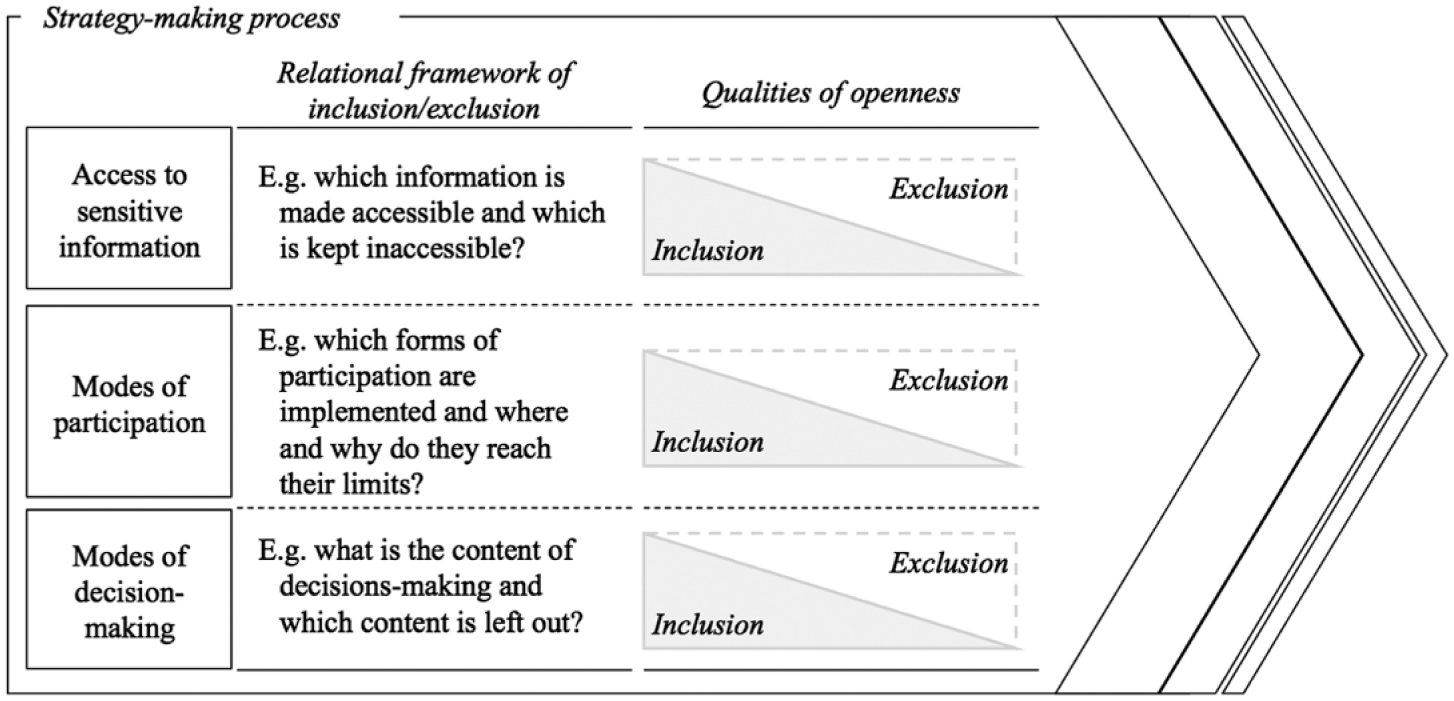
Criteria for analysing openness in strategy-making
Research Setting and Method
Case selection and research site
The Wikimedia strategy-making process represents an exceptional case (Patton, 1990; Yin, 2013) for investigating openness in strategy-making, not only because of the size and importance of the external community of volunteers involved: about 120,000 volunteers contribute regularly to Wikipedia, the key activity of Wikimedia. Even more importantly, Wikimedia is an organization that strives for openness as a general principle in the realm of access to knowledge, proclaiming the vision of ‘a world in which every single human being can freely share in the sum of all knowledge’ on its website. More specifically, Wikimedia propagates an ideal of ‘unrestricted openness’ as is evidenced by describing Wikipedia as ‘the free encyclopedia that anyone can edit’ on its main page. It is this fit between Wikimedia’s overall mission of allowing anyone to contribute to Wikipedia and its understanding of open strategizing as a way to allow anyone to contribute to strategy-making, which makes the case a particularly promising site for investigating how strategy-making practices labelled as ‘open’ enact ideals of organizational openness.
The Wikimedia Foundation was created in June 2003 as a non-profit organization to support the communities of volunteer contributors behind Wikipedia and related activities such as Wiktionary (an online dictionary). ‘Supporting’ means that Wikimedia collects donations to provide the server infrastructure, to develop the wiki software used by Wikimedia’s activities in general, and to organize offline events such as the annual global Wikimania conference series. For reasons of principle, Wikimedia does not interfere in decision-making within the online encyclopedia Wikipedia (see also Kozica, Gebhardt, Müller-Seitz, & Kaiser, 2015). For instance, it is possible for anyone visiting Wikipedia to add content, even without being a registered user, which requires you to log in with a verified e-mail address. Yet it is only registered volunteer contributors who elect administrators in each of the different language versions; these administrators then have the usage rights to make decisions regarding, for example, reverting edits or deleting articles.
Having been established in the United States, the wiki software behind Wikipedia enabled different language versions from the outset, which is also reflected by its formal organizational structure in the shape of local Wikimedia chapter organizations. Wikimedia chapters are legally independent membership-based associations, which are officially recognized and partly funded by the Wikimedia Foundation. Wikimedia’s ultimate authority is the Board of Trustees, which is composed of three members elected by the community volunteer contributors, two members selected by the local chapter organizations, and four members who are appointed by the board itself; in addition, Wikimedia Foundation’s founder Jimmy Wales is a lifetime member of the board. The board selects Wikimedia’s CEO, who then makes all other staffing decisions and steers Wikimedia’s day-to-day operations at the Foundation headquarters in San Francisco.
Wikimedia’s core activities already hint at the importance of the primary communication technology. While PowerPoint is a key tool for communication in other organizations (Kaplan, 2011), wikis are vital for Wikimedia and its related volunteers. Wikis represent a collaborative, IT-mediated workspace composed of interlinked webpages, on which contributors are able to alter both the content of an article and its structure. The distinctive elements of a wiki include the ‘edit’ button, which allows for collaborative authoring, the ‘history’ button for retracing prior versions of a webpage and the ‘discussion’ button for exchanging ideas. Taken together, these features constitute the key means of exchange by allowing globally dispersed contributors to speak ‘wiki language’ (i.e. the formatting shortcuts for editing wiki pages in a web browser) and to collaborate while ensuring transparency throughout.
In 2009, after years of exponential growth, Wikipedia had encountered two consecutive years of stagnating editor numbers and acknowledged a continued lack of editor diversity in terms of gender and ethnicity (Suh, Convertino, Chi, & Pirolli, 2009). This situation prompted Wikimedia’s CEO, Sue Gardner, to initiate a one-year strategy process supported by two consulting firms specializing in non-profit strategy consultancy (Bridgespan Group and Blue Oxen Associates). In line with the way the Wikimedia Foundation engages in digitally enabled operations (e.g. Wikipedia), the role of wiki technology became pivotal for engaging volunteers in the strategy-making process. A newly set up ‘Strategy Wiki’ served as a central location to share and disseminate information and results (for additional background on the case, see also Heracleous, Gösswein, & Beaudette, 2017).
Data collection
We collected data between 2009 and 2013. For triangulation purposes (Yin, 2013) we combined data from the three sources presented in Table 1. First, we drew extensively on material from conferences, including archival data such as presentation slides, informal conversations and semi-structured interviews. The first conference pertinent to the purposes of this study was Wikimania 2009 in Buenos Aires (Argentina), at which the strategy process of the Wikimedia Foundation was publicly launched. The results of this process were subsequently presented and discussed at Wikimania 2010 in Gdansk (Poland). One of the authors of the present study participated in both Wikimania events. As is common for participant observations, gathering data at such venues allowed us to gain a first-hand account of dynamics such as personal relations and networks that would otherwise be difficult to comprehend. Such an approach also allowed us to check the accuracy of statements made by interview respondents and thus reduce the occurrence of hindsight bias, in which respondents use what they know at the time of the interview to interpret and rationalize the earlier actions under discussion.
Case study database
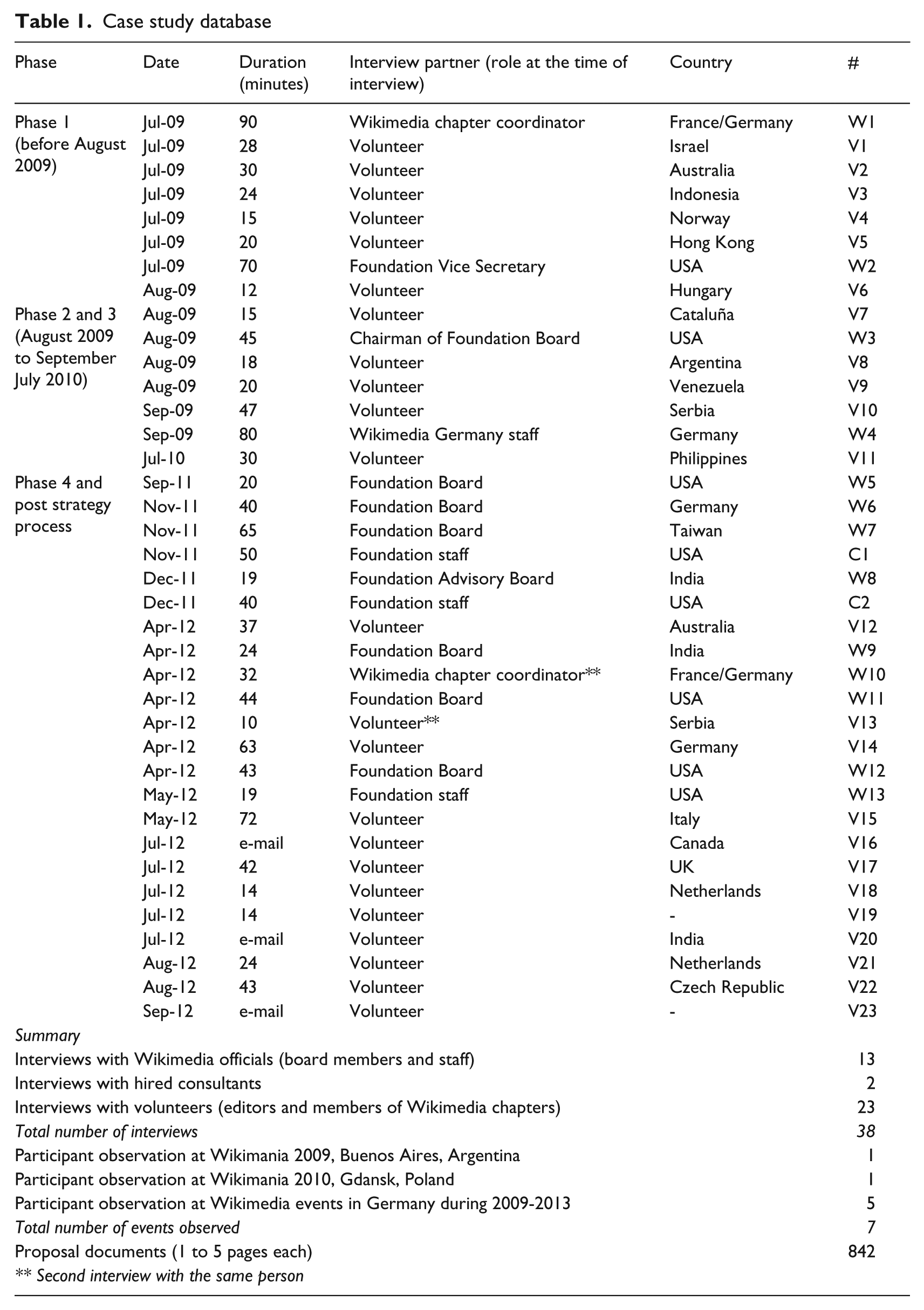
Second, we conducted 38 semi-structured interviews with members of the Wikimedia organization and volunteer contributors. Interview data offer insights into the subjective experiences and assessments of participants and into how they are related to the focal organization (Barley & Tolbert, 1997). Of these 38 interviews, 15 took place before or during the strategy process, while the remainder were conducted after the publication of its results in order to clarify certain important issues. Three interviews were conducted via e-mail. See Table 1 for further details such as the classification of interview partners into three participant categories and the respective notation (e.g. W for Wikimedia officials such as board members and staff). 1
Third, we analysed the entire set of documents and sources of the Wikimedia Foundation strategy process available online. This comprises the websites of the Wikimedia Foundation, the ‘strategy wiki’ (a collaborative workspace composed of webpages on which volunteers add and modify suggestions concerning the strategy process) and secondary data (e.g. news coverage of Wikimania conferences, retrieved via the LexisNexis database). These sources not only provided background information on the strategy-making process and on the reactions and behaviour of those involved in it, but also enabled us to reconstruct elements of the process based on real-time data, as wiki technology enables the tracking of contributions and changes over time (every change can be accessed ex post and the date and time retrieved). Furthermore, we compared and contrasted these wiki-based data and the semi-structured interviews with respondents, a data triangulation approach that has been widely employed in organizational research (e.g. Chiles, Meyer, & Hench, 2004).
Data analysis
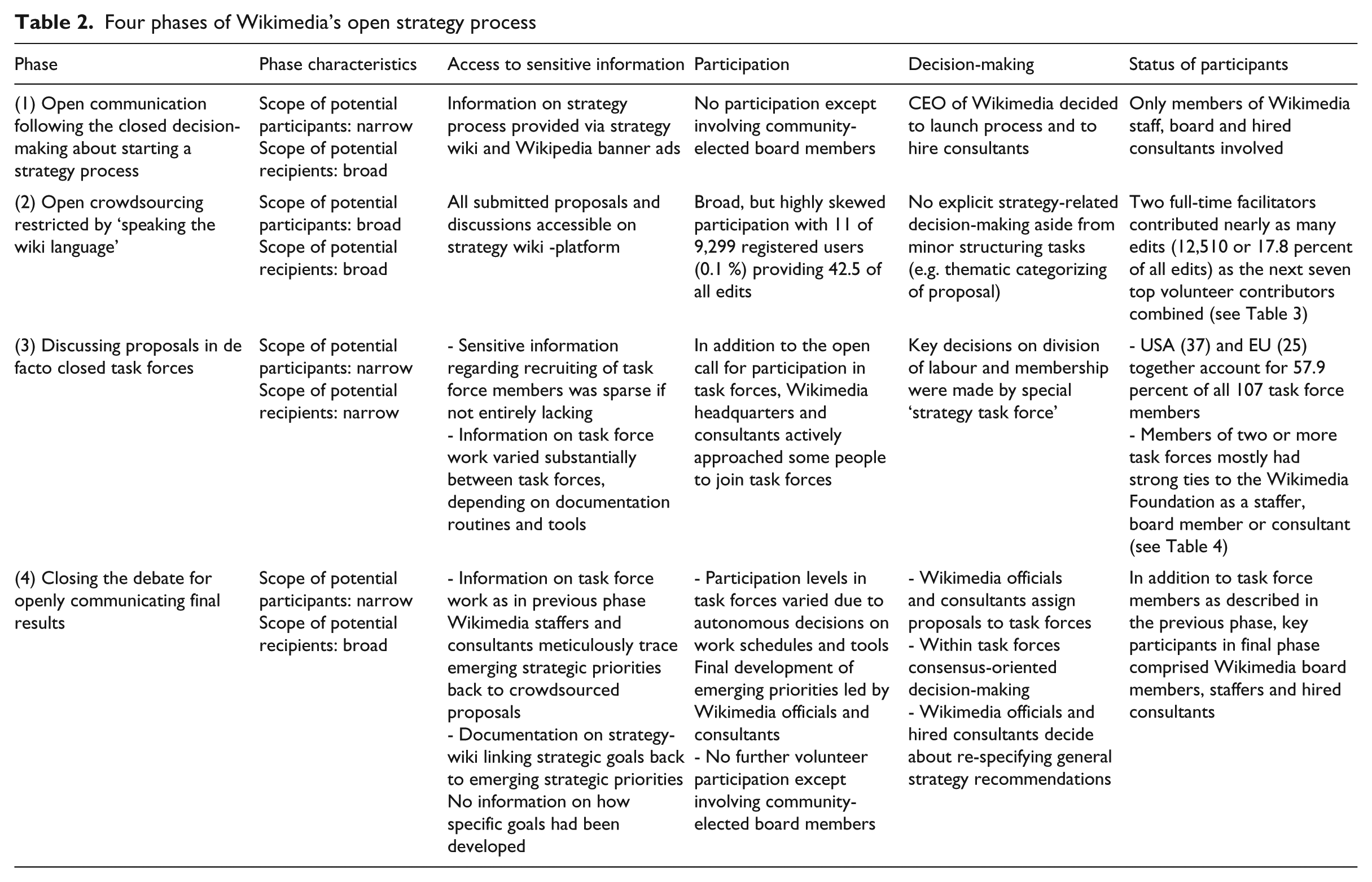
The data analysis was guided by the criteria for analysing openness in strategy-making that we developed in our theory section (see Figure 1) and followed an iterative logic (Corbin & Strauss, 1990), going back and forth between data and emerging theoretical concepts. As a first step, we sorted key events and actors into a schedular timeline as a basis for reconstructing the overall development of Wikimedia’s strategy-making process. We thereby utilized all available data sources to come up with a comprehensive description of the overall strategy-making process (see Miles & Huberman, 1994; Jarzabkowski, 2008). Applying a temporal bracketing logic (Langley, 1999), we tried to identify distinct phases of this process. Given the iterative logic of analysis, the analytical distinction between as well as the number of these phases was refined repeatedly during our data analysis, depending on the results of subsequent steps in the data analysis. The final sequence of four phases resulted from the reconstruction of significant shifts in both (a) the respective strategizing practices and (b) the status of participants (Wikimedia staff, consultants, volunteer contributors) and the quality of their involvement (potential participants vs. potential recipients) in the strategy process (see Table 2).
Four phases of Wikimedia’s open strategy process
In a second step, we then explicitly addressed the issue of inclusion and exclusion for each of the four phases of the strategy-making process identified during the first part of the analysis. Specifically, we coded data sources independently and in a question-driven manner (see Aten & Thomas, 2016, for a recent example of similar question-driven analysis of IT-based open strategy-making practices) to investigate how the strategizing practices enabled or restricted access to sensitive information (e.g. what insight or knowledge was shared or kept back, in what way), modes of participation (e.g. who was included in or excluded from which practices) and modes of decision-making (e.g. what decisions were made or not made, by whom).
Guided by the questions listed above, one co-author clustered relevant passages from interview and observation transcripts temporally, according to the preliminary phases of the Wikimedia strategy process identified during step one of our data analysis. Another co-author followed the same logic, focusing on respective data from the Strategy Wiki website. All the authors together then compared, integrated and revised the previously identified phases along the three dimensions of access to information, modes of participation and modes of decision-making. In the case of conflicting data and with regard to judging the credibility of interview partners, our final assessment was also informed by background information provided during numerous informal conversations with Wikimedia officials on different hierarchical levels and from different locations – data which could not be easily included in a structured case study database but was shared among the co-authors in discussing preliminary findings.
Findings: Inclusion and Exclusion in the Course of Open Strategy-Making
Our analysis of how strategy-making labelled as ‘open’ unfolded at the Wikimedia Foundation is oriented along a chronological axis. Table 2 provides an overview of our findings following the analysis criteria set out in Figure 1.
Phase 1: Open communication following the closed decision-making about starting a strategy process
Description
The idea of an open strategy-making process only circulated within the Wikimedia Foundation headquarters at first. Subsequently, Wikimedia officials agreed on pursuing an open strategy-making process, which they considered necessary to secure acceptance among the community of volunteer contributors. Then Wikimedia headquarters hired external consultants to support the overarching process before it engaged contributors.
Access to sensitive information
According to the leading consultant, the strategy-making process needed to be coherent with Wikipedia activities because ‘if there was a strategy development at the movement level in a wiki way, then the Wikimedia Foundation could be empowered to make decisions and to move forward in a way that the community agreed was really in everybody’s best interests’ (I-C2). This is also shown in the self-description of the strategy process on the Wikimedia homepage: ‘We need to make sure that the process and the plan are owned by all of us …. This means that the process is flexible and forkable, and that the work happens transparently in an open and inviting space.’ 2
These convictions led to the information about the upcoming strategy-making process and the opportunities to participate therein being disseminated primarily via wiki technology. As the leading consultant put it: ‘We announced [the call for participation] in a variety of forms, but the thing that helped us the most was the central notice feature on Wikipedia’ (I-C2). Broadcasting the call for participation on such a banner ad on Wikipedia was deemed to invite editors and readers to participate in strategy-making on a separate ‘Strategy Wiki’, which featured the following description: ‘This wiki is the hub for collecting, analyzing, and synthesizing information relevant to strategic planning.’ 3 The rationale behind choosing a wiki as the main strategy-making tool was to transfer the existing practice and culture of using wikis for collaborative authoring in Wikipedia to the strategy-making process. As a member of the Wikimedia board explains: ‘This is the “Wikiocracy Model”. If you put energy into it, you have a voice’ (I-W11).
However, the dominance of wiki technology underlying the strategy-making process also attracted suspicion. For instance, another board member (I-W12) critically remarked that Wikipedians ‘throw wikis at any problem’ regardless of whether it is actually the most suitable tool. In this context, one of the most active volunteer contributors to the strategy wiki (I-V23) mentioned that other IT-based technologies, including a ‘communication tool called “liquid threads”’ (i.e. a different format for structuring online discussions) or a ‘new database for managing and rating proposals’, were tested in order to offer a variety of different information channels and communication tools. But ‘in the end’, the interviewee concluded that ‘the most important tools were still good ol’ fashioned discussions, diligent research, and (of course) the Wiki process of writing and rewriting each other’s contributions’. The barriers to accessing the information about the strategy-making activities are, on the one hand, fundamental (e.g. lack of computer, internet connectivity or knowledge about the existence of Wikipedia), but on the other hand, rather low (e.g. the homepage of Wikipedia can be accessed with basic internet knowledge).
Modes of participation
The starting of the strategy-making process was neither preceded nor accompanied by the opportunity for volunteers to express their opinions or contribute their potential expertise. The only way in which ‘ordinary’ Wikipedia editors were represented was by two community-elected members of the Wikimedia Foundation Board.
Modes of decision-making
According to one of the leading consultants hired to facilitate Wikimedia’s strategy-making, the process was initiated by individual members of the Wikimedia Foundation Board. They assumed that the Wikimedia ‘movement was facing some longer term difficulties’ such as ‘challenges in terms of participation’ (I-C2), that is, continuously declining editor numbers during the three years prior to the strategy process. Against this background, it was the ‘people involved in the leadership in the Foundation’ who came to the conclusion that ‘what they really needed was a strategy […] they needed some clear goals, they needed some clear priorities and they needed clear understanding of what the different roles were’ (I-C2). Similarly, another consultant, who was hired by Wikimedia later on, recalled that ‘the Executive Director, Sue Gardner, asked us to put together a team to look at doing a strategic plan, but with the caveat that it had to be in the same style as Wikipedia’ (I-C1). These statements illustrate that the decision to initiate a strategy process was made exclusively by actors who had the status of Wikimedia board members and staffers and were trying to gain greater control over unforeseen developments associated with past and future challenges.
Phase 2: Open crowdsourcing restricted by ‘speaking the wiki language’
Description
The second phase is best characterized as a multilevel crowdsourcing process. At the heart of this phase was the broad collection of all issues that volunteers perceived as relevant for the future development of Wikimedia. Thus it was about enabling the broadest participation possible in the strategy-making process by whoever was interested in contributing ideas, discussing, and categorizing strategy-relevant proposals. In total, participants provided 842 proposals, either by creating a new page on the strategy wiki or by submitting them via a ‘proposal submission box’, which was an online form that could be used without specific knowledge of the wiki language.
Access to sensitive information
All proposals contributed during the crowdsourcing phase were accessible on the focal strategy wiki. In addition to the proposals, the strategy wiki software also offered opportunities to discuss the submitted proposals. The discussions of the proposals mainly took place on ‘talk pages’, i.e. sub-pages that are part of any strategy-wiki page and are also openly accessible to anyone with internet access and sufficient proficiency in wiki technology to find and handle those. Moreover, the working language on the whole strategy wiki was English, substantially restricting access to potential participants lacking English language skills.
Modes of participation
With respect to the composition of the status of contributors, the dominance of the wiki technology presented itself as a curse and a blessing at the same time. For one, it meant that the strategy-making process was smoothly integrated into the everyday practices of communicating and collaborating via wiki software. However, similar to the preeminent relevance of English literacy for contributing, the dominance of wiki technology implied that participation in the strategy-making process was strongly influenced by an existing knowledge of the wiki language. Overall, the distribution of contributions was highly skewed, with only 3,096 of 9,299 registered users actually contributing at least one single edit, while 73 users contributed 100 edits or more (see Table 3).
Data on Users of the Strategy Wiki
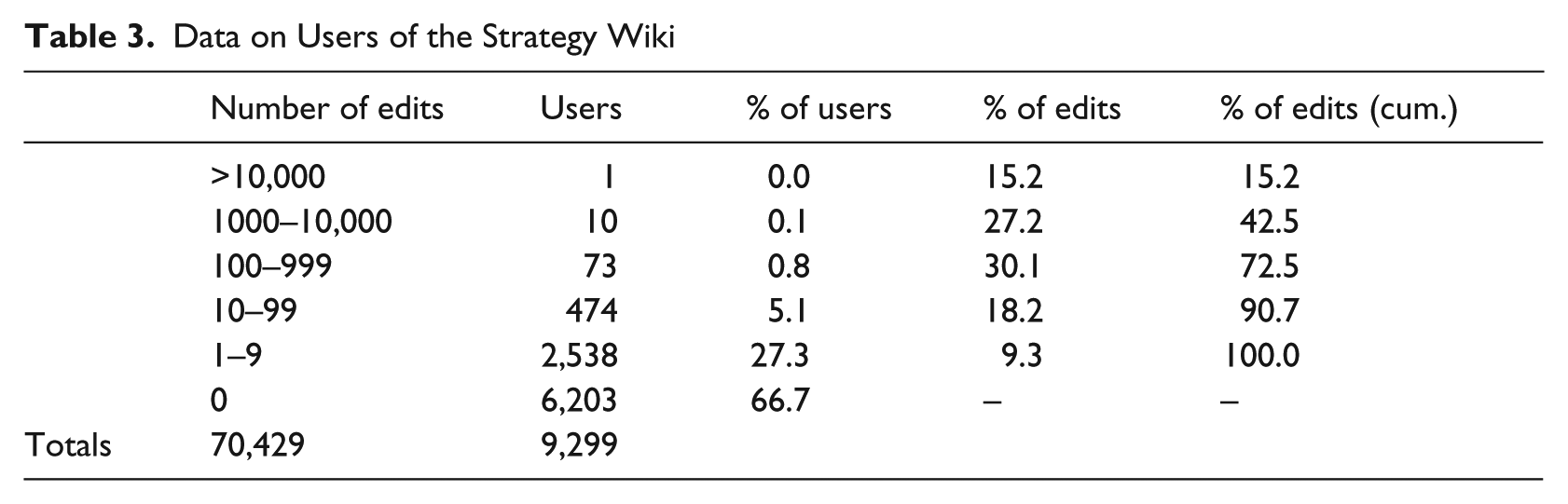
A closer look at the top eleven contributors (0.1 percent of all users), who were collectively responsible for 42.5 percent of all edits, reveals just how skewed the participation was in terms of wiki editing. After subtracting edits from two algorithms (called ‘bots’), we see that two full-time facilitators (one from Wikimedia and one consultant) contributed nearly as many edits (12,510 or 17.8 percent of all edits) as the remaining seven top volunteer editors combined (12,709 or 18.0 percent of all edits). In terms of individual backgrounds, all of the top eleven contributors are proficient in English and – as far as this information was disclosed – stem from Western Europe and the US.
Taken together, the ability to speak the wiki language represented the key condition for participation in the strategy-making process. As a consequence, within the ‘wiki universe’, the practices of the crowdsourcing phase were quite comprehensive (e.g. no pre-selection of topics for proposals or ‘talk pages’ that allow the reconstruction of the discussion at a later point in time). However, the preconditions for accessing this universe were even more restrictive than those in phase 1 because of the almost inescapable necessity to comprehend and apply the wiki language for any activity beyond merely dropping ideas in the suggestion box. The potential exclusion accompanying this dominance of wiki-based participation opportunities was even recognized by members of the Wikimedia community themselves, as described by a volunteer contributor (V22): ‘My main concern would be that the wiki was still a barrier for many people to participate.’ The fact that English was the only working language raised further concerns about the permeability of the strategy-making process. For instance, another volunteer contributor reported that
it is understandable that we so far agreed on using the English language everywhere […] But even the English language is, when you are speaking about abstract things, very difficult for someone who does not deal with it on a daily basis. (I-V14)
Modes of decision-making
The crowdsourcing phase did not involve explicit forms of decision-making, since no decisions on strategic priorities or other outcomes later on in the process had been substantially pre-determined by activities during this phase. However, practices such as discussing and categorizing constituted marginal and early forms of agenda-setting. While in principle anyone was able to categorize ideas and proposals, only a few volunteers already experienced at categorizing content on other wikis, such as Wikipedia, conducted this task. One volunteer contributor involved in categorizing described his approach to the task as follows:
My favourite occupation was to read [strategy proposals] and reorganize them, because I’m a categorizer. I hate uncategorized pages, so I categorized all proposals by topic and many proposals were actually similar, so I merged some of them or proposed merging them. (I-V15)
In fact, the great number and diversity of proposals generated through crowdsourcing were mostly preserved by categorization or even increased by discussion. For instance, there were proposals that insisted on the continuation of Wikipedia’s no advertising-policy: ‘We should be run in the interests of the current and potential users of our information, not in the interest of commercial organisations.’ On the other hand, proposals were submitted that suggested a change in the non-profit policy: ‘Companies, organisations or individuals would be able to buy articles at a fixed price, [which would] provide a constant source of external income for the Foundation without begging for donations every year.’ During this phase of the strategy-making process the contradictions between individual proposals were not addressed in any particular way, but were instead included in the thematic categories side by side.
Phase 3: Discussing proposals in de facto closed task forces
Description
Already during phase 2, when crowdsourcing was still being conducted on the strategy wiki platform, the Wikimedia headquarters, together with consultants, set up 17 task forces on issues such as ‘Wikipedia quality’, ‘technology’, ‘financial sustainability’, ‘China’ and ‘community health’ (see Figure 2). Each task force’s ‘task’ was to formulate strategic recommendations based upon proposals made in the wiki, as well as additional research and discussions. According to one of the consultants involved in selecting task forces and their members, ‘the task force process was really the most challenging process’ and required ‘constantly balancing bottom-up and top-down’ (I-C2).
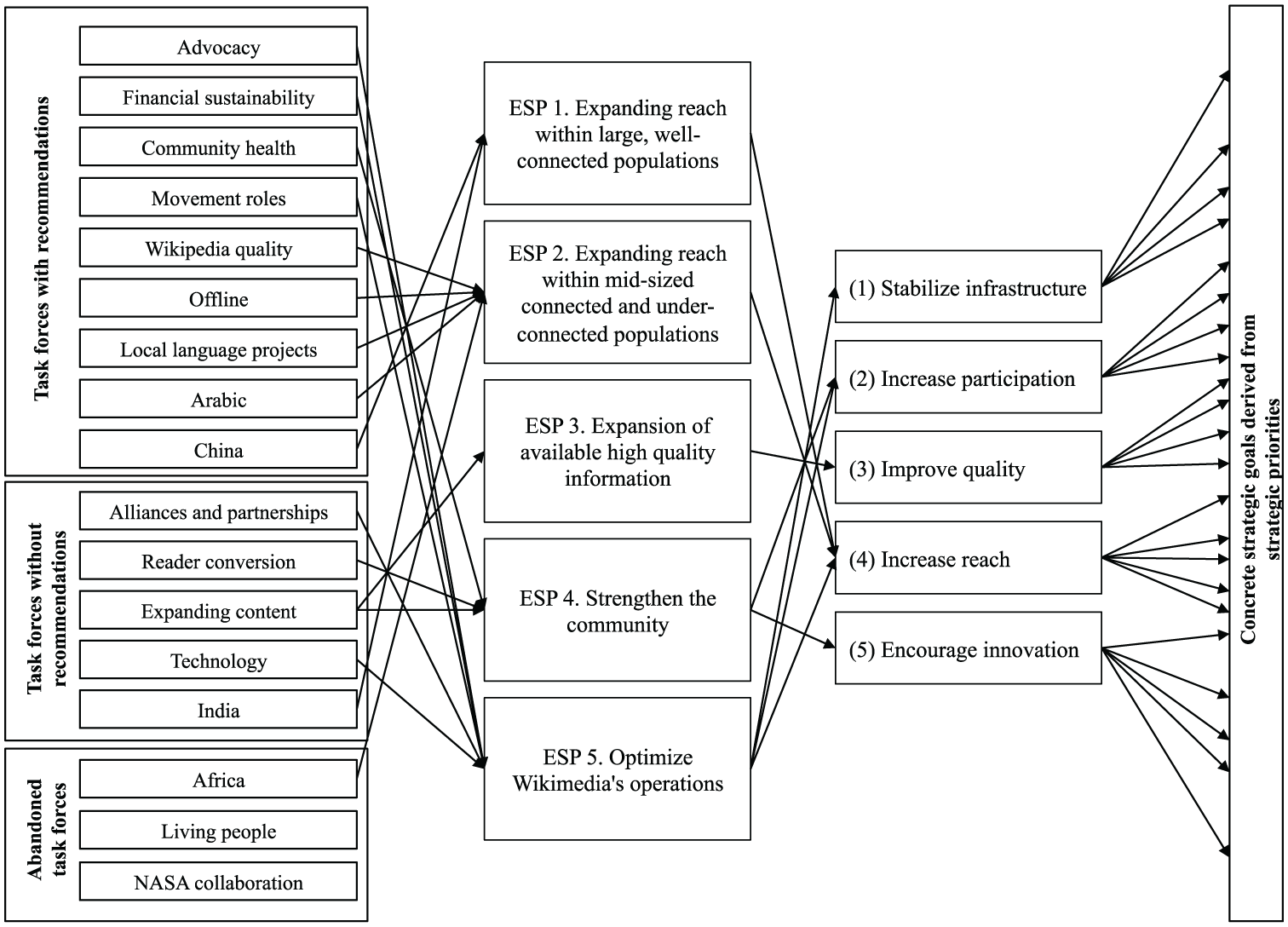
Simplified depiction of how strategic proposals were condensed and re-specified over time (ESP = emerging strategic priority)
Access to sensitive information
For task force related information to become accessible, task forces had to either use tools that allowed for online documentation (e.g. chat logs) or provide minutes and summaries of task force meetings in the strategy wiki. The degree to which task forces documented and shared information on their work varied widely, with the majority of task forces providing only very limited, if any, details on discussions; information on points of disagreement were entirely absent from publicly accessible documentation. Overall, access to sensitive information regarding task force work and recruiting patterns of task force members was sparse, and sometimes entirely lacking.
Modes of participation
While an open call for task forces published on different wiki platforms invited anyone to apply for task force membership, Wikimedia headquarters actively approached and invited ‘the right people’ to join task forces:
If you just wait then the right people don’t necessarily show up. So at that point in the process, we had seen members of the community who were really good, who were really active, who were spending a lot of time being thoughtful, being facilitative of other people and we went and we made individual invitations to those people. (I-C2)
Not all of the resulting seventeen volunteer-led task forces were comparable in terms of participants’ status or backgrounds. Of those 107 people active in the task forces, 87 ‘only’ contributed to a single task force. The remaining task force members that contributed to more than one task force were involved in two (12 people), three (four people), six and 14 task forces (in each case one person). While the task force members had a comparatively broad range in terms of their professional backgrounds (e.g. freelancers, IT and other professionals, scholars, Wikipedia volunteers), of those contributing to two or more task forces, the majority had strong ties to the Wikimedia Foundation as a staffer, board member or hired consultant.
Geographically, the distribution of participants heavily favoured the US (37 of 107 members) and the EU (25 members), which together accounted for 57.9 percent of all task force members (see Table 4). The actual US/EU dominance was even stronger, given the fact that 15 of 17 Indian task force members were only members in the task force ‘India’ and 6 of 7 Arabic members also only took part in the respective task force ‘Arabic’. A task force ‘Africa’ was planned but members could not be recruited; the respective wiki page states that ‘There is no Africa task force, though the questions being asked for the Arabic task force can also be asked regarding Africa.’
Data on members of strategy task forces
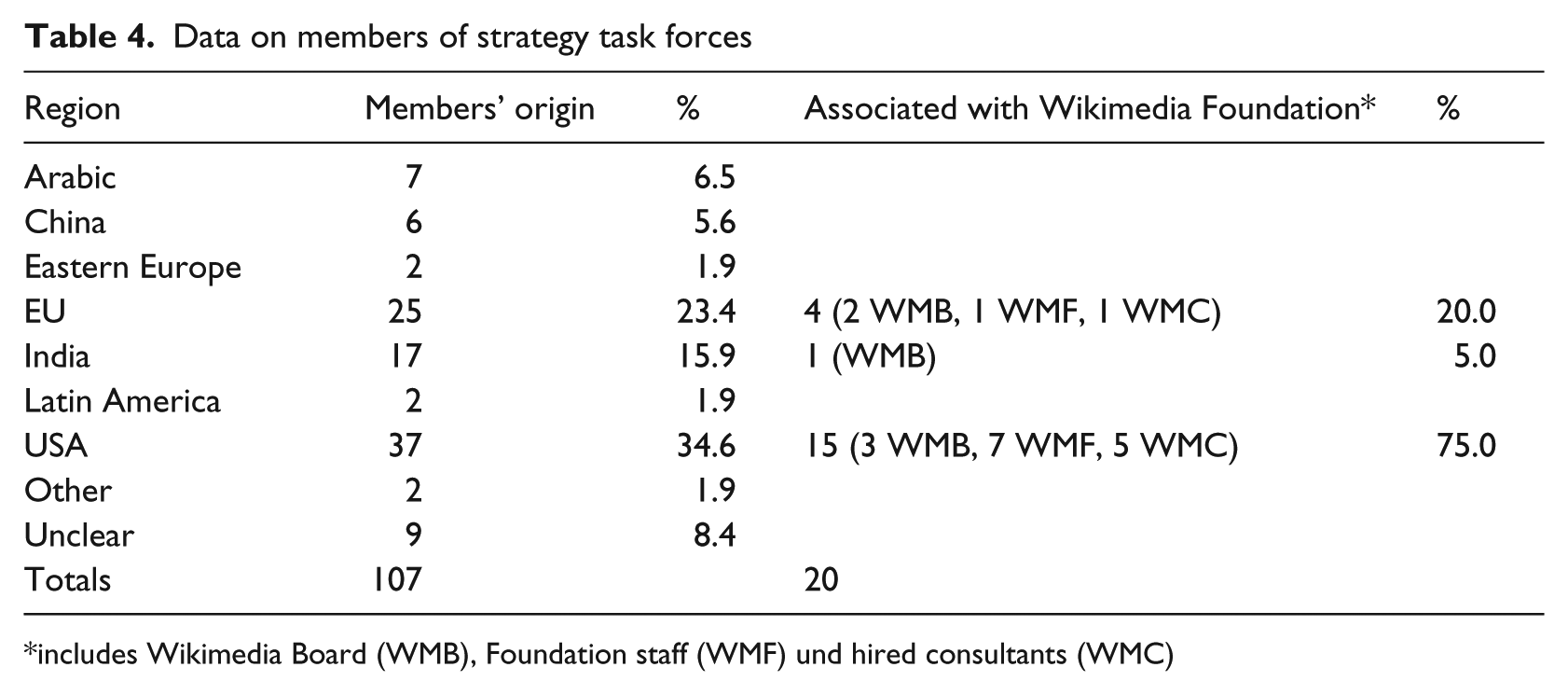
includes Wikimedia Board (WMB), Foundation staff (WMF) und hired consultants (WMC)
While the open call for participation in task forces at least opened up the process to participation by volunteer Wikipedians in principle, their actual involvement was limited. Division of labour between task forces that differed in terms of influence on final outcomes, as well as informal selection procedures, led to a dominance of US- and EU-based task force members. The most important conditions for participation and thereby potential barriers in this phase were again a proven proficiency with wiki technology and the English language.
Modes of decision-making
The influence of the various task forces on the final outcome of the strategic goals was far from equal. One particularly influential task force was the ‘Strategy task force’, consisting primarily of Wikimedia officials (including the then Wikimedia Foundation CEO), board members, consultants and invited members. It was this strategy task force that was responsible for accomplishing meta-level tasks such as making the final call on who to assign to the other task forces or integrating the recommendations from all task forces. Decisions about who to include in certain task forces were also made by a small group of Wikimedia board members, staffers and hired consultants, as is evident in a statement by one board member describing the difficulties in making these decisions:
It was pretty difficult trying to figure out when you exclude somebody from the process. When you try to be a community of stakeholders, are trolls [i.e. unconstructive members of online communities] stakeholders? Are people who are really difficult stakeholders? … That was something we always had trouble with. When do we exclude somebody from the process? (I-W5)
Decisions regarding documentation of task force discussions and results were made entirely by the task forces themselves, leading to great differences in terms of transparency between the task forces.
Phase 4: Closing the debate for openly communicating final results
Description
During the final phase the strategy-making process consisted of two consecutive procedures of first narrowing down the results by means of closed decision-making, and second, communicating the results in an open manner. To this end, the task forces started assigning thematic categories to the proposals, followed by more coarsely categorizing and condensing them. Thereafter, Wikimedia Foundation officials and the consultants reformulated and embedded previously emerged strategic priorities into an overarching strategic plan, which was then openly proclaimed to mark the end of the open strategy process.
Access to sensitive information
Most of the discussions on how to condense and prioritize topics took place in the form of conference calls and even face-to-face meetings. A board member put it as follows:
In the phase that was geared towards aggregation [of the proposals] there were two board meetings where we took a look at the data and then discussed these data face-to-face, and of course there was a lot of e-mail traffic. (I-W3)
As this is somewhat delicate, given that it represents a move away from the wiki-based ethos of Wikimedia, members of some task forces felt the need to ‘self-police’ (I-C1) by documenting these activities on the strategy wiki. For example, the task force on ‘community health’ published seven ‘weekly reports’ and the task force on ‘financial sustainability’ documented three conference calls: ‘Below are the summarized discussion items from this morning’s meeting. In true wiki form, please add, edit, comment as needed.’ 4
At the end of the discussion process, the task forces had come up with condensed recommendations that were at best loosely and selectively coupled to the original proposals. For instance, one recommendation by the task force ‘Financial sustainability’ was that ‘Wikipedia should increase the resources devoted to fundraising from donations in order to generate more income.’ This shows the basic intention of most of the budgetary proposals, namely, to improve the revenues of Wikimedia, but at the same time it does not engage with the sensitive debate on the opportunities and risks of the commercialization of Wikipedia.
A wiki page called ‘Emerging strategic priorities’ was established to document the last intermediary results prior to the final strategic plan (Figure 2 presents a simplified version of the relations as we found them explicitly mentioned on the strategy wiki).
The page on emerging strategic priorities also provided a table meticulously linking five emerging strategic priorities back to nearly all of the task forces, creating the impression that most of the crowdsourced output had been preserved. This was done to allow for transparency and also ex post re-traceability purposes once the strategy process had terminated. Subsuming the variety of task force recommendations under only five priorities was accomplished by choosing very general headings such as ‘Strengthen the community’ or ‘Optimize Wikimedia’s operation’ (for an overview, see Figure 2). With respect to the decision-making process within the Wikimedia Foundation about the final prioritization of the recommendations, no information was directly available.
Modes of participation
Within the task forces, participation levels ranged from relatively easily accessible opportunities to limited ones with a varying dependence on IT- and wiki-based communication tools. This variation in participation levels may result from the Wikimedia Foundation’s basic claim to provide maximum autonomy and thus the enablement of different approaches by the task forces. Towards the end, Wikimedia staffers and hired consultants increasingly took over and led the way in developing ‘emerging strategic priorities’, also resulting in participation barriers. For instance, a then volunteer contributor, who was elected to the Wikimedia board later on, saw the engagement and influence of the consultants as being detrimental to volunteer motivation:
They had the personnel that was able to write longer papers to put them on the wiki. They work full-time and you only have a restricted amount of time to address the same issue. And you can see how the professional input is of higher quality, much deeper into the issues with the possibility to prepare respective data. And I found that this takes away your power. You just have to acknowledge that you cannot keep pace. (I-V14)
Another member of the Wikimedia board pointed to the fact that, in the end, time pressure resulted in the growing influence of full-time consultants:
When [writing the final strategic plan] happened, […] the group of consultants decided to do it themselves, and this was the one part of the process that happened off-wiki. Personally, I wasn’t very happy with that stage of the process. I don’t think it was nearly as good as it could have been. (I-W11)
While speaking the wiki language represented a precondition to participating in the preceding phases of the strategy-making process, knowing how to navigate the wiki language decreased significantly in its relevance in this phase. However, non-wiki-based practices such as e-mailing, conference calls and even face-to-face meetings reduced the scope of potential participants.
Modes of decision-making
In general, the Wikimedia Foundation set up the task forces on the assumption that minimum guidelines and maximum autonomy would result in the broadest possible participation of the community, as well as new volunteers. This is reflected in a statement by three of the consultants involved (Grams, Beaudette, & Kim, 2011), who explained how the task forces were implemented:
While [the task forces] were supported by professional facilitators [i.e. hired consultants], the community members themselves were accountable for the success or failure of their task forces. So, by default, you want to make it an open process, so anyone can participate in the discussion and you do everything openly and transparently.
However, not all task force members appreciated this autonomy – or lack of guidance – as one volunteer contributor (I-V14) recalled: ‘They just told us: “here is your playground and we will throw in a lot of sand, for example in all those suggestions in the strategy wiki, and you see what you can do”.’
To condense the high number of proposals, members of the Wikimedia board and headquarters, in collaboration with consultants, assigned diverse proposal categories to specific task forces. For instance, the task force ‘financial sustainability’ included proposals such as the establishment of the category of so-called ‘WikiDonors’ (e.g. ‘This “sponsorship” would show up as a small, non-obtrusive watermark on the bottom of the page’) or financial support for particular wiki chapters (e.g. ‘We should help chapters to earn money in regions with large language populations where the Wikimedia projects are currently under-performing relative to the opportunity’). Moreover, the assigned proposals were accompanied by a set of questions that were raised by members of the consultant firms in order to facilitate and simultaneously guide condensing and prioritizing. For instance, the task force ‘financial sustainability’ was to develop answers to the following questions:
What revenue streams could support Wikimedia in an ongoing, sustainable manner? […] What business model options are available? […] Which models are most appropriate, given the Wikimedia Foundation’s mission and the strengths of the community? Who is needed to support this strategy […] and what do they need to do?
The decision-making within the task forces about which proposals to develop further and which to ignore followed – in line with Wikipedia’s general policy – the principle of consensus. Although this was supposed to create the greatest participation possible, the analysis of the status of actual contributors shows that the process was in effect dominated by a small circle of Wikimedia officials, consultants and some exceptionally engaged volunteers (mostly from the US and from EU countries), instead of a broad cross-section of the community.
After nine of the 17 task forces had come up with their list of recommendations, Wikimedia headquarters, together with the hired consultants, took on the further condensation of the various recommendations. The condensation practices mirrored those of the task forces and mainly consisted of subsuming concrete recommendations under more and more generic headings – selectively incorporating some and ignoring others.
In the course of doing so, the five ‘emerging strategic priorities’ did not directly correspond to the set of strategic prioritizations championed by the board in the final ‘strategic plan’. For instance, the emerging strategic priority ‘optimizing and enhancing Wikimedia’s operations’ informed three of the final priorities presented in the strategic plan, which the authors of the strategic plan – in particular the consultants – then re-specified with concrete strategic goals (see Figure 2 for an overview of how emerging strategic priorities were transformed into final strategic priorities). Some of these proposals were even operationalized into measurable goals such as the following pledge to increase editor diversity: ‘Support healthy diversity in the editing community by doubling the percentage of female editors to 25 percent and increasing the percentage of Global South editors to 37 percent.’
Overall, the decisions about how to re-specify the general strategy recommendations developed during previous phases were made exclusively by Wikimedia officials and hired consultants.
Theoretically framing the findings
The different forms of inclusion and exclusion and their implications for the open qualities of Wikimedia’s strategy-making process can be attributed to the combination of both (1) the general challenges that organizations face when attempting to live up to abstract ideals of openness and (2) the specific conceptualization – the organizational ideal – of open strategizing.
General challenges of open organizing
Regarding the general challenges of openness as an organizing principle, two factors seem particularly relevant in the context of Wikimedia’s strategy-making process: the knowledge and application of the ‘wiki language’ as well as good English language skills and, on the other hand, the socioeconomic status of the contributors. As our analysis has shown, it was two full-time facilitators who contributed nearly as many edits to the strategy wiki as the next seven most active volunteers combined. And with regard to the task forces, we found that the ‘strategy task force’, which was dominated by Wikimedia officials, board members and consultants, had the greatest influence on the further course of the strategy-making process and its final prioritization. There are major disparities between core (e.g. North America, Western Europe) and peripheral (e.g. most African countries, Eastern Europe) countries regarding the number of people who have access to the internet at home (81.3 percent compared to 34.1 percent) or the availability of mobile broadband (86.7 percent compared to 39.1 % see ITU, 2015). Against this background, the unequal distribution of technological conditions may partly explain the dominance of US-American and Western European contributions to the strategy-making process. However, DiMaggio and Hargittai (2001, p. 18) point out the necessity to focus not only on the ‘“haves” and “have-nots”’ but also on the ‘full range of digital inequality in equipment, autonomy, skill, support, and scope of use among people who are already on-line’. In this context, it is the interplay between the user’s socioeconomic and educational background as well as other characteristics (e.g. gender, age) that has a large influence on the actual development of internet skills and how these are applied (Hargittai & Hinnant, 2008; Hargittai & Hsieh, 2013).
The specific conceptualization of ‘open strategizing’
This is where Wikimedia’s specific conceptualization – or ideal – of openness in strategy-making comes into play. As King (2006, p. 53) notes, ‘The most open system theoretically imaginable reveals perfectly the predicating inequities of the wider environment in which it is situated.’ Against this background, the socioeconomic status of the most active and influential contributors as well as the geographical imbalance of contributions indicate that the general digital divide is largely reflected in the quality of Wikimedia’s strategy-making process. And as we will argue below, the specific conception and application of openness in the open strategy process do not counteract these environmentally induced biases. When we take a closer look at the criteria of openness – access to information, modes of participation and decision-making – we actually identify an increasing trend toward informal and opaque exclusivity, the more the practices are connected to binding decision-making. In the case at hand, this refers to the beginning and ending of the strategy-making process as well as to the commitment to strategic objectives.
With respect to access to sensitive information, our analysis shows that the announcement of Wikimedia’s strategy-making process was disseminated as widely as both the wiki and IT-based technology allowed. Further, Wikimedia officials and consultants made quite an effort to create traceability of the connections between the recommendations of the task forces and the final strategic plan on the strategy wiki. However, there was only very limited overarching information about the development and the gradual adjustments of the strategy process itself. Moreover, at the end of the process, no information was provided on how the decisions about the final strategic plan had been made. Thus, in the case at hand, openness in terms of access to sensitive information was high regarding content but limited regarding procedural information. This not only contradicts a Popperian (1966 [1944]; Armbrüster & Gebert, 2002) understanding of openness, which values procedure as much as content, but also undermines Wikimedia’s self-imposed claim to enable a transparent and potentially even forkable strategy-making process.
Regarding the modes of participation, it was during the crowdsourcing phase when the broadest involvement of different contributors took place. At this stage, however, it was all about collecting, categorizing and discussing diverse proposals without any restrictions but also without any binding effect. The more the proposals were condensed and prioritized, the more we observed a shift in the form of participation from individual contributions (e.g. posting suggestions) to more collaborative practices such as task forces. Each task force established its own mode of participation, which included e-mailing, conference calls and even face-to-face meetings. Thereby, the wiki technology became less significant and other factors such as language skills and time availability gained in importance. Some task forces used the wiki technology for documentation of their meetings in order to ensure the traceability of the recommendations developed. Overall, participation practices show a certain arbitrariness in that they were highly dependent on leading task force members, who had been ‘handpicked’ by a small circle of Wikimedia officials and consultants. Consequently, the design of the task force procedures was characterized by a lack of formalization (in other words, lack of closure), with task force members being quite free to choose their participation approach. Looking at the homogeneous composition of the actual task forces (mainly from the US or EU context and proficient in English; dominance by Wikimedia officials and consultants), this specific conception of openness seemingly did not counteract but rather reinforced participation biases already present in Wikipedia’s community of volunteers (Hill & Shaw, 2013; Suh et al., 2009). Similar to the lack of procedural information, lack of clearly stated participation procedures may have unintentionally undermined the openness of the strategy-making process.
The impression of arbitrariness and opacity increases in the context of the modes of decision-making. All decisions – whether about starting the strategy-making process in the first place, about who to include or exclude from the task forces, or about the definition of the final strategy plan – were made by Wikimedia officials and consultants hired by them. The decisions were taken in an informal way, which not only excluded the majority of the Wikipedia community but also made the course and progress of the strategy-making process generally opaque. Since decision-making – in the sense of a choice between alternatives – is a core element of the concept of openness, defining its modus operandi for each point of decision-making as well as the procedure of the strategy-making process as a whole is a key indicator for openness.
The application of our three openness criteria to the empirical case allowed us to paint a fine-grained picture of how openness was (implicitly) conceptualized and actually organized throughout Wikimedia’s strategy-making process. Here, it became very clear that openness was enacted first and foremost as ‘structurelessness’ (Freeman, 1972/73, p. 153), which was meant to increase the opportunities for participation and to counteract centralization but in fact led to informal and elitist group building, as shown by the non-transparent decision-making processes and the ‘cliquish’ association of Wikimedia officials and consultants. Moreover – and this becomes particularly apparent when considering both procedures and content as equally important for openness – we see that the strategy-making process as a whole was designed as an ‘exclusive’ endeavour because of its ‘openly’ implemented components. At no point did ‘ordinary’ Wikipedians have official opportunities to question or modify the individual steps or the overall procedure of the strategy-making process.
Discussion
In light of the above analysis, we propose a framework (see Figure 3) of how strategy-making practices labelled as ‘open’ can address the dilemma associated with ideals of openness put forward in contexts such as open innovation, strategy and beyond (see also Kornberger et al., 2017; Luedicke et al., 2017; Schor, Fitzmaurice, Carfagna, & Attwood-Charles, 2016). We argue that it is a purposeful combination of open and closed components that constitutes a precondition for establishing a certain, feasible open quality of strategy-making processes. Following Ashcraft’s work on ‘organized dissonance’ (2001, p. 1304), we do not understand the necessity of ‘closing for the benefit of openness’ as a contradiction but rather as a productive dynamic that comprises ‘pushes and pulls that become a check-and-balance system’ (Ashcraft, 2001, p. 1304). In order to establish such a check-and-balance system – which represents a core value of openness, namely to allow the possibility of non-violent and transparent change (Popper, 1966 [1944]) – we strive to identify ‘enabling types of bureaucracy’ (Adler & Borys, 1996, p. 85). ‘Enabling’ in our reading implies that the rules, procedures and instructions codify ‘routines so as to stabilize and diffuse new organizational capabilities’ (Adler & Borys, 1996, p. 69) and that they are compatible with the normative requirements underlying open qualities: broad participation and collaboration of various internal and external stakeholders (Aten & Thomas, 2016; Dahlander & Piezunka, 2014), access to and sharing of various knowledge sources (Chesbrough, 2006; Jeppesen & Lakhani, 2010) as well as transparent and collective decision-making practices (Luedicke et al., 2017).
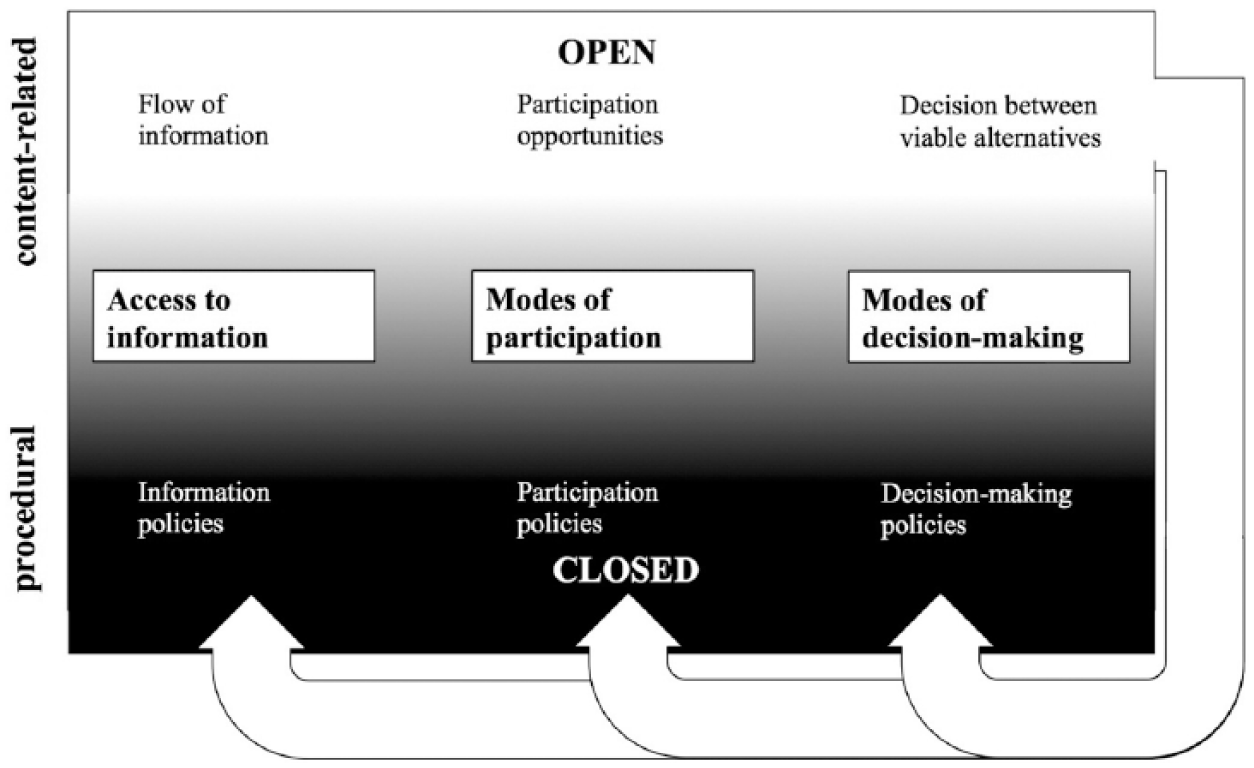
Two-dimensional framework of openness in strategy-making
Against this background, we propose a two-dimensional, interrelated framework of openness, in which the interplay of open and closed elements provides the basis for enacting ideals of organizational openness.
The first dimension of openness, procedural openness, provides the preconditions for content-related openness, which, however, can be modified recursively provided that the decision-making opportunities entail certain open qualities (discussed further below). Basically, procedural openness concerns the whole composition of the strategy-making process with a particular focus on establishing a reliable checks-and-balances system. In a nutshell, procedural openness requires predetermined and transparent procedures in order to restrict opportunities for individual actors or informal groups to change ‘the rules’ flexibly – ad hoc (Mintzberg & McHugh, 1985; Mintzberg & Waters, 1985) – as the strategy-making process unfolds (in a similar vein, see Bardach, 2001). Specifically, this means that the overall structure of the strategy-making process and the embedded prerequisites for its individual elements – access to sensitive information, modes of participation and modes of decision-making – need to exhibit a ‘closed quality’ (for a similar argument from a bureaucratic perspective, see du Gay, 2005).
For one, this closed quality implies that the overall design of the strategy endeavour is characterized by a predefined and explicit schedule that reveals relevant milestones and thereby enables orientation and potential agency throughout the process. But transparent ‘meta-instructions’ also need to be established for the individual elements of the strategy process. For instance, allowing access to sensitive information to be as open as possible requires formalizing and explicitly (dis)closing the envisaged information policies. This includes clarifying which information will be shared with whom at what point in time, as well as which information will not be shared. The latter is similar to Costas and Grey’s understanding of ‘formal secrecy … defined as the intentional concealment of information by actors in officially defined, established and recorded ways’ (Costas & Grey, 2014, p. 1431).
With respect to the modes of participation, their potential open qualities rely on a specification of participation policies and – consequently – a limitation of participation opportunities in the first place. Such an initial closure of participation opportunities allows the purpose of the respective modes of participation to be defined in the context of the whole strategy-making process as well as proactively approaching certain internal and external contributors. For instance, it offers the possibility to design participation opportunities that explicitly deal with issues of increasing the diversity among the potential contributors and of diminishing barriers connected to specific forms of participation (e.g. need for speaking ‘wiki language’ vs. face-to-face meetings that are timely and locally bound). Additionally, such a specification of participation policies facilitates predictability of the expected commitment in general and thereby both guides one’s engagement and enhances individual agency (see also Dahlander & Piezunka, 2014; Thompson & Alvesson, 2005).
In a similar vein, the predefinition of decision-making policies with certain decision gates throughout the strategy-making process discloses the rights and obligations of potential contributors and thereby closes arbitrary or informal possibilities of change. However, nowhere does the inextricable link between openness and closure become more apparent than in the context of decision-making: particularly because the modes of and gates for decision-making are extensively predefined, the actual decisions concerning the strategy content as well as the organizing of the overall process could be as open as possible. In the case of Wikimedia – and its self-imposed requirement to start a strategy initiative that is ‘flexible and forkable’ – this would imply letting its community decide about whether to start a strategy-making process in the first place, as well as creating opportunities to decide on its further course (including its termination).
The effective decision-making between viable alternatives is part of the second dimension: content-related openness. This dimension concerns all the actually performed activities related to access to sensitive information, the modes of participation and the modes of decision-making. With respect to information access, content-related openness implies enabling a flow of information as open as possible via channels mastered by target audiences in order to stimulate their desire to participate. As for the modes of participation, the specific participation opportunities should encourage a wide range of contributions and knowledge sharing without any limits for content creation, even if it seems to be opposed to the original strategy endeavour. Similarly, as already argued above, content-related openness also implies that the core elements of the strategy-making process are not protected from becoming a matter of decision-making, if openness in terms of a checks-and-balances system is taken seriously.
Applying our two-dimensional framework (Figure 3) to the four phases of Wikimedia’s strategy-making process, we see that only the first two phases reflect a combination of elements related to content-related openness (information about starting the strategy process, contributing strategy-relevant proposals) and procedural openness (explicit instructions and rules about how to deal with the proposals) as suggested by the framework. In contrast, the third and fourth phases are characterized by open participation policies (discussing, categorizing and condensing) and closed forms of decision-making (informal, opaque ways of decision-making by Wikimedia officials and consultants) that run counter to what our framework recommends. Procedural openness, in terms of a closed design of the overall structure of the strategy-making process that is thereby open to rule-based changes by its participants, is not implemented in any of the four phases.
Since we only have one case at hand and cannot test alternative conditions, we do not claim that our proposed coexistence of closed and open elements on the procedural and content-related level will undoubtedly enhance the number of contributors or the diversity and innovation potential among contributions. However, we consider the framework to enable ‘new forms of reflexivity’ (Hautz et al., 2017, p. 306; see also Baptista, Wilson, Galliers, & Bynghall, 2017) regarding preexisting asymmetries in the organizational and societal context, which may not simply be reproduced or exacerbated in the course of open strategy processes. Finally, with the framework we address another research gap identified by Hautz et al. (2017, p. 307), providing a conceptual basis for capturing ‘different patterns of moving between openness and closure’.
In this context, our paper constitutes a first attempt at bringing together two streams of literature on openness that have developed independently of each other: the debate on openness in bureaucratic organizing (Armbrüster & Gebert, 2002; De Cock & Böhm, 2007) and the works on openness as an organizational phenomenon in fields such as innovation (Chesbrough, 2003) or strategy (Whittington et al., 2011). More specifically, we suggest that the distinction between procedural and content-related openness inspired by the former allows us to better theorize how openness can be organized in aspiring to various ideals of the latter. In turn, the recently revived debate on formalized modes of organizing (du Gay & Vikkelsø, 2016) could be enriched by re-introducing openness as a guiding organizational principle.
Conclusion
This study set out to inquire how ideals of openness are implemented in the practice of strategy-making processes with external actors. By operationalizing openness with the criteria of access to sensitive information, modes of participation and decision-making, we found that the members of the Wikipedia community were ambivalently – if not arbitrarily – included in and excluded from those areas of the strategy-making process. In this context, we showed how openness regarding participation in crafting strategy content depended on certain forms of closure related to procedures of the strategy-making process. Contrariwise, when openness is interpreted as the absence of rules and instructions in the sense of structurelessness, it will lead to a reproduction – or even reinforcement – of preexisting biases among potential groups of participants in open strategy-making.
Some of the limitations of our study also point to avenues for future research. First, while we recognize sociomateriality as an important aspect concerning openness, particularly in the realm of technology-enabled forms of openness, the scope of our analysis made it impossible to dive deeper into the relationship between specific sociomaterial conditions and corresponding effects of inclusion and exclusion. Given that many forms of organizational openness in innovation, strategy-making and beyond are technology-driven, explicitly focusing on this issue from an inclusion and exclusion angle might be promising in order to assess the role of sociomateriality for reinforcing or mitigating preexisting social biases (Leonardi & Barley, 2008).
Second, our analysis of the strategy-making process at Wikimedia is based on a reconstruction of open and closed elements of the overall procedure and certain content-related practices and how their combination affects the opportunities for information sharing, participation and decision-making. To develop a more general model showing which arrangement of open and closed elements will lead to which forms of openness, it would be necessary to compare different content- and procedure-related arrangements within the same and across different strategy-making processes.
Footnotes
Acknowledgements
We are grateful to handling editor David Seidl for his guidance as well as the four anonymous reviewers for their constructive and challenging, but in retrospect very helpful advice on how to further develop the article.
Funding
This research received no specific grant from any funding agency in the public, commercial, or not-for-profit sectors.