




Abstract
This essay integrates emotions into the attention-based view of the firm to enhance the theory’s explanatory power and open a generative path for future research. Organizational structures and communicative practices shape organization leaders’ and members’ emotions. These emotions influence their attentional engagement. Structures and communicative practices shape emotions via two main paths: (1) perceived issue or initiative characteristics, which influence organization leaders’ and members’ specific emotions toward the issue and initiative, and (2) the socially constructed context for interaction about the issue or initiative, which influences the emotional energy leaders and members associate with the issue or initiative. The resulting emotions influence attentional engagement over three time horizons: immediately in the triggering situation, recurringly after the triggering situation, and through the creation of additional structures and practices that influence attentional engagement.
Introduction
Attention and emotions are intertwined: what people notice triggers emotions in them, and their emotions influence their subsequent attention and behaviors (e.g. Barrett, 2017; Damasio, 1994; Izard, 2009). This fundamental interplay between attention and emotion needs to be better integrated into the attention-based view (ABV) of the firm (Ocasio, 1997; Ocasio et al., 2018), for the theory to better predict and explain organizational decisions and actions. Emotions are particularly strong and impactful when organizations face ambiguity and radical changes (e.g. Vuori and Huy, 2022). Emotions are therefore crucial when organizations drive new strategic initiatives or face major strategic issues.
The original ABV (Ocasio, 1997) builds on the information processing perspective (Joseph and Gaba, 2020; March and Simon, 1958). People are boundedly rational and have limited information processing capacity. Hence, the way they allocate their attention influences what decisions they make and what actions they take. Central factors influencing organization members’ attention allocation include organizational structures and communication channels (Ocasio, 1997). Empirical work has confirmed and extended these core ideas of the ABV successfully (e.g. Cho and Hambrick, 2006; Joseph and Ocasio, 2012; Joseph and Wilson, 2018; Maula et al., 2013).
In conceptual work, scholars have recently emphasized a more dynamic or communicative approach to attention (Laamanen, 2019; Ocasio et al., 2018; Ocasio et al., 2022). Accordingly, organizational leaders’ and members’ attentional engagement with potential topics is substantially influenced by communicative practices and situational interactions, in addition to the relatively stable structural factors highlighted earlier. However, while the influence of communicative practices and situational factors on attentional engagement is becoming recognized, a recent review concluded that “situated attention has hardly attracted any scholarly attention in leading journals” (Brielmaier and Friesl, 2022: 22). Hence, our understanding of what shapes attentional engagement and situated attention remains limited, and we lack clear answers to questions such as “how different strategic themes emerge and compete for the attention of the decision makers” and “how the attention to a firm’s goals cascades in the organization [. . .] influencing strategic change and renewal” (Ocasio et al., 2018: 163).
The importance of communicative practices and situational interactions indicates that emotions could substantially influence attentional engagement. When people interact, they experience emotions toward the content of the interaction (e.g. Raffaelli et al., 2019; Vuori and Huy, 2022) and the interaction partner (e.g. Hareli and Rafaeli, 2008; Vuori and Huy, 2016), and other emotions (e.g. Liu and Maitlis, 2014; Pham, 2007). These emotions, in turn, influence what they attend to and how (e.g. Fan and Zietsma, 2017; Scherer and Moors, 2019).). Hence, emotions could significantly influence the patterns of attentional engagement in organizations. However, the ABV has hardly acknowledged the role of emotion. For instance, three recent integrative works on the ABV (Brielmaier and Friesl, 2022; Ocasio et al., 2018; Ocasio et al., 2022) do not even mention the word “emotion” or “feeling.”
To increase understanding of the determinants of attentional engagement and open a generative path for future research, I develop a theoretical model that integrates emotions into the ABV. Accordingly, organizational structures and communicative practices influence perceived issue and initiative characteristics and the socially constructed context for interaction, both of which shape the emotions organizational actors associate with a particular issue or initiative. These emotions substantially influence their attentional engagement with the issue or initiative over three time horizons. I theorize how these influences occur. My central contribution is that I show how characteristics of organizational structures and communicative practices, which should have a marginal influence on attentional engagement from an emotion-free perspective, generate emotions and, therefore, substantially influence attentional engagement. My theorizing is integrative in that I show how emotions complement the information processing and communicative elements of the ABV rather than supersede them.
Theoretical background
Structure and practices influence attentional engagement
The ABV recognizes three varieties of attention: attentional perspective, attentional engagement, and attentional selection (Ocasio, 2011). In this essay, I focus on attentional engagement, which refers to “the process of intentional, sustained allocation of cognitive resources to guide problem solving, planning, sensemaking, and decision making” (Ocasio, 2011: 1288) 1 . A central assumption in the ABV is that decision makers are more likely to act on issues they attend to than those they do not (Ocasio, 1997). Hence, attentional engagement is of crucial importance.
Organization members do not attend to everything that occurs in the organizational context. Instead, organizational structures and communicative practices direct their limited attention capacity to a subset of cues reflecting the context (Ocasio, 1997). Attention becomes structurally distributed because different organizational units are likely to allocate their attention to different matters. The formal structure and various meeting and reporting practices make some issues salient for any particular unit while de-emphasizing or ignoring other issues (Bouquet and Birkinshaw, 2011; Joseph and Wilson, 2018). For example, top managers at a headquarters are more likely to pay attention to issues in a subsidiary near the headquarters than issues in a distant subsidiary (Bouquet and Birkinshaw, 2008; Monteiro et al., 2008).
Besides being structurally distributed, attention is situational such that any member of the organization is attentionally engaged with some matters at any particular point in time and may or may not engage with the same matters at another point in time (Ocasio, 2011). For example, top managers likely attend to matters presented during a meeting and may or may not continue attending to the same matters after the meeting (Nicolini and Korica, 2021).
Attentional engagement can be driven by top–down and bottom–up factors (Ocasio, 2011; Shepherd et al., 2017). Attention is driven by top–down factors when it is intentionally directed by factors such as goals or schemas (Ocasio, 2011) or organizational strategic agenda (Ocasio and Joseph, 2018). Attention is driven by bottom–up factors when the characteristics of stimuli pull people’s attention to the stimuli (Ocasio, 2011). For example, a competitor’s aggressive advertising campaign can draw organization members’ attention and make them discuss the competition, even if their work role does not require it.
Furthermore, recent theoretical work suggests a more dynamic perspective on attentional engagement. Accordingly, communicative practices, language use, rhetorical tactics, and different forms of talk and text influence organization members’ attentional engagement with issues and initiatives (Ocasio et al., 2018). Communicative practices refer to “the ways in which communication technologies and tools are used, rules about participation rights, conventions about language use, and norms about appropriate forms of interaction that steer organizational communication and attentional engagement within and between channels” (Ocasio et al., 2018: 159). They are likely to influence attentional engagement in organizations, because much of the attending occurs during interpersonal interactions—people talk with other people, and, as they talk, they attend to the content of the conversation and make decisions regarding it.
However, while the ABV and its recent developments offer several valuable insights, the omission of emotion leaves a potentially important explanatory factor unaddressed. Research in psychology (Lerner et al., 2015; Mlodinow, 2022; Scherer and Moors, 2019), micro-sociology (Collins, 2004), and management (Ashkanasy et al., 2017; Brundin et al., 2021; Healey and Hodgkinson, 2017; Huy, 2012) has shown that attention and emotions strongly influence one another. Hence, organization leaders and members likely experience emotions as they communicate about strategic issues and initiatives, and these emotions could substantially shape their attentional engagement (e.g. Fan and Zietsma, 2017; Vuori and Huy, 2016). As a recent ethnographic study on CEOs’ attentional engagement discussed: “emotions [. . .] also matter [and] future work could focus more on the non-cognitive aspects [e.g. emotions] determining the content of attentional engagement” (Nicolini and Korica, 2021: 24-25).
Emotions and emotional energy
Emotions refer to a process that “begins with a focal individual who is exposed to an eliciting stimulus, registers the stimulus for its meaning, and experiences a feeling state and physiological changes, with downstream consequences for attitudes, behaviors, and cognitions, as well as facial expressions and other emotionally expressive cues” (Elfenbein, 2007: 315).
Emotions include two central components: valence and activation. Valence varies between pleasant and unpleasant, and activation varies between high and low (Russell, 2003). In general, unpleasant emotions signal that something is wrong or threatening to the focal person and prepare them for defensive action, such as hiding, running away, or attacking the threat. In contrast, pleasant emotions signal beneficial developments or opportunities and often prepare the focal person to seize the opportunities. The object of the emotion refers to the entity that triggers the emotion. For example, a loudly barking dog can trigger negative emotions in an individual.
Emotions are physiological reactions in that they include activation in select brain areas and the body (Bechara and Damasio, 2005; Phelps et al., 2014). In the brain, emotions are an integral part of how people connect to their environment, as emotions influence how the brain processes information and prepares the individual for adaptive action (Damasio, 2010; Damasio and Carvalho, 2013). In addition, physiological changes prepare the individual for action, such as fleeing or attacking when facing a threat (Scherer and Moors, 2019).
Different combinations of valence and activation can be categorized as discrete, specific emotions such as fear, anger, disgust, and joy (Russell and Barrett, 1999). Regardless of their valence, some emotions are likely to pull people’s attention toward the triggering entity; for example, anger and love both make people think about and approach the object of the emotion (see, e.g. Kudesia, 2021; Mlodinow, 2022). These emotions can be called approach emotions. 2 In contrast, other emotions are likely to reduce people’s attention toward the triggering entity; for example, disgust and anxiety make people move away from the entity that triggers the emotion. These emotions can be called avoidance emotions (see, for example, Scherer and Moors, 2019; Strack and Deutsch, 2004, for more detail).
Emotional energy as a concept complements the basic notion of emotions and relates them more directly to actions in organizational research (Goss and Sadler Smith, 2018; Metiu and Rothbard, 2013. (Collins, 2004: 49) defined emotional energy as “a feeling of confidence, elation, strength, enthusiasm, and initiative in taking action.” More recently, a comprehensive review (Baker, 2019: 374) defined emotional energy as “the subjective capacity to do work where the source of energy is affect—the subjective component of a biobehavioral system of activation” and emphasized that emotional energy can be directed or channeled into motivation or effort, but it is different from them. Emotional energy thus characterizes emotions that increase the likelihood of an actor engaging with a topic and continuing to do so. While I recognize the definition by Baker (2019), I use Collins’s (2004) definition in this essay to remain consistent with recent management studies that have used the concept (e.g. Fan and Zietsma, 2017; Goss, Sadler, and Smith, 2018; Soderstrom & Weber, 2020).
At the psychological level, the influence of emotions on attention varies depending on the context (Pham, 2007). The influence is particularly strong in contexts that contain high ambiguity because, in such settings, people cannot easily determine what would be the “right” or rational action (e.g. Vuori and Huy, 2022). In contrast, the impact of emotions is weaker in contexts that offer a clear right answer. There are two reasons for this. First, it is easier for people to regulate their emotional impulses when they know the right action and understand how it leads to beneficial outcomes (e.g. Baumeister, 2002; Lian et al., 2017). Second, when it is clear to people how the right action leads to beneficial outcomes, their emotional reactions are likely to favor this action because the expected positive outcome triggers positive emotions (e.g. Ellsworth and Scherer, 2003). However, even in such well-defined situations, emotions may not fully match the rational action, as emotional reactions tend to emphasize short-term outcomes more than what is typically considered rational (e.g. Bechara and Damasio, 2005). In this essay, I assume a context containing at least moderate levels of ambiguity that leave more room for emotional influences. This assumption is consistent with the observation that “ambiguity is at the core of organizational decision making and action [in James March’s work]” (Ocasio, 2022).
The intensity of emotions also shapes how much they influence attention, such that the stronger the intensity, the stronger the influence. This occurs because the more intense the emotion, the stronger the action tendency (including mental activity) associated with the emotion (e.g. Scherer and Moors, 2019). In extreme situations, when the emotional reaction is very strong, the emotions can “take over,” and people’s rational thinking is reduced (e.g. Pham, 2007; Tice et al., 2001). While such extreme emotions do not dominate organizational settings, organizational structures and communicative practices can influence the intensity of emotions (as well as their valence) and, therefore, shape how strongly emotions influence organization leaders’ and members’ attentional engagement.
Structure and practices, emotions, and attentional engagement
Organizational structures and communicative practices can have qualities that generate emotions that pull attention either toward or away from a specific issue or initiative. Below, I describe two key pathways through which structures and communicative practices can generate specific emotions and emotional energy and provide more specific mechanisms under each pathway.
Perceived issue characteristics influence specific emotions
When people encounter new information or situations, they automatically appraise if and how it will change their relationship with their environment; these appraisals generate emotions (Ellsworth and Scherer, 2003; Lazarus, 1991; Lerner et al., 2015; Roseman, 2013). The appraisal process has several dimensions, such as the relevance of the event to the wellbeing or goals of the focal individual and the controllability of the event (Lerner et al., 2015; Scherer and Moors, 2019).
During the appraisal process, people evaluate whether the situation has relevance for their (collective’s) wellbeing or goal achievement and whether the situation is beneficial or harmful for them (Scherer and Moors, 2019). The higher the relevance, the higher their emotional activation. The more beneficial (harmful) the situation, the more pleasant (unpleasant) the valence. Furthermore, people appraise additional aspects of the situation and their coping potential (Scherer and Moors, 2019). These appraisals influence the discrete emotion they are likely to experience. For instance, if people perceive that a specific individual is causing harm for them and that they can improve the situation by attacking the individual, they are likely to experience anger (Lazarus, 1991: 226).
What enters people’s appraisal process in organizations is largely determined by the structures and communicative practices that shape their situated attention. Emotional reactions are, therefore, an integral part of situated attention. (The resulting emotions, in turn, influence their subsequent attentional engagement). Rather than seeking to be exhaustive, I illustrate three ways below how organizational structures and communicative practices can modify 3 its leaders’ and members’ emotional reactions toward issues and initiatives by shaping the appraisal process.
Visibility of issue-related cues and coping options
Typically, organizational attention structures and communicative practices distribute attention within the organization to enable organization members to focus on information that is most relevant for their task achievement (March and Simon, 1958). However, an unintended side effect of such distributed attention is that the emotional reactions of any given group are primarily based on the immediate or local demands faced by the group. Such emotions may become counterproductive for the firm.
To illustrate, attention structures and communicative practices provided limited cues of customer reactions to Nokia’s software middle managers in 2005–2010 (Vuori and Huy, 2016). Rather than perceiving how customers reacted to Nokia’s products, software middle managers received demands from product units, who had a closer connection to the customers. From an information processing perspective, this was an efficient way of distributing scarce attentional capacity: product units processed information related to customers and communicated the key insights to software middle managers; the latter would not become overwhelmed by customer feedback and should therefore have more capacity for actual software development. However, due to this compartmentalized approach, software middle managers became emotionally detached from the customer (Vuori and Huy, 2016: 23). They, therefore, felt no emotional urge to truly develop solutions to match the new external competition, that is, iPhone and Android.
On the contrary, providing a more global perspective for organization members can trigger more instrumental emotions among them. For instance, at NASA in the 1960s, a frequently communicated meaningful vision alongside a concrete goal for the organization (“we are going to the moon”) generated widespread excitement and contributed to effortful implementation; hence, even the cleaning staff, whose work performance required no knowledge of the progress of the moon project, was emotionally engaged with the organization’s mission and worked harder (Carton, 2018). As one of the cleaning staff members quipped, “I’m not mopping the floor; I’m putting a man on the moon!”
The implication is that providing information that is irrelevant from a task perspective can have beneficial emotional effects. When structures and communicative practices expose organizational leaders and members to the broader context of their tasks, they perceive how their efforts contribute to more general organizational goals and stakeholders’ wellbeing. Hence, they are likely to feel emotions about the broader situation (e.g. “does this issue influence how our customers perceive our products?” or “is this initiative going to help our organization to succeed in its mission?”). In contrast, when communicative practices share information on a strictly “need-to-know” basis, organization members are likely to feel emotions that primarily relate to their own task achievement, regardless of the overall impact of their efforts on the organization and its stakeholders: Proposition 1a(i): Structures and communicative practices that vividly describe the broader implications of an issue or initiative generate emotions that reflect its implications for the whole organization and its stakeholders. In contrast, structures and communicative practices that only describe the local implications of an issue or initiative generate emotions that reflect the personal implications of the issue or initiative for the focal leaders or organization members.
In addition, as a part of the appraisal process, people evaluate their options for coping with the emotion-triggering situation (Lazarus, 1991; Scherer and Moors, 2019). These coping options influence their emotional reactions. Organizational structures and communicative practices could influence the number, quality, and salience of potential coping options recognized and, thus, change people’s emotional reactions toward issues and initiatives. Coping options influence people’s perceived control over the situation and can therefore change their emotions (e.g. Scherer and Moors, 2019).
To illustrate, Nokia’s top managers perceived iPhone and Android as significant threats to their company partly because they saw that Nokia had no other option but to keep implementing its prevailing strategy that seemed to be failing against the new competition in 2007–2010 (Vuori and Huy, 2022: 340-341). This fear, in turn, caused their thinking to remain rigid. However, when the board of directors created a new strategy process in 2012–2013 that forced top managers to develop multiple options for the company, top managers started feeling hope and other less threatening emotions. These emotions, in turn, made them think about the company situation more flexibly, which enabled them to attentionally engage with a wider set of options. This, in turn, generated further hope and positive excitement and helped them to envision a radical strategic change: Proposition 1a(ii). Structures and communicative practices that expose organization leaders and members to a wide (narrow) set of coping options, such as strategic alternatives, are likely to lead to more (less) positive emotional reactions toward specific issues.
Situated identity activation
A central component of the appraisal process is the perceived impact of the appraised event on the focal entity’s relationship with the environment. Typically, the focal entity is assumed to be the individual making the appraisal. However, individuals can have multiple identities, and different identities can be active at different moments (e.g. Van Bavel and Packer, 2021: chapter 1; Ramarajan, 2014). The multiple identities people hold typically cover various aspects of their personal and professional life. Individuals can also identify with a collective (Tajfel, 1974). Thus, they can transcend the personal implications of a situation and feel emotions on behalf of a larger collective (Menges and Kilduff, 2015). For example, football fans feel happy when their team wins because they identify with the team.
Various events can have different implications for these different identities and cause different emotional reactions. Such identity conflicts can lead to mixed emotions at the individual level (e.g. Hirsh and Kang, 2016). Furthermore, as people can have multiple different group identities, members of the same organization can react with different emotions to the same events. For example, Huy (2011) showed how an organizational change process activated its members’ language-related identities as either French or English speakers and caused them to respond to the same change actions either with negative or positive emotions.
Identity activation need not be random or triggered by the specific issue being considered. Instead, specific identities can be activated intentionally, which causes people to perceive issues differently. Experiments have shown, for example, that writing a short essay reflecting some aspect of one’s identity activates that identity and causes people to perceive images differently (Chiao et al., 2006). Likewise, specific identities can be activated by asking people to think about a problem as a finance professional (vs, e.g. unit manager) (Cohn et al., 2014), by showing a logo symbolizing a group (Reicher et al., 2016), or other nudges (e.g. Van Bavel and Packer, 2021). Importantly, this kind of situational identity activation influences people’s emotional reactions, such as how much disgust they feel toward a smell (Reicher et al., 2016), how much they like specific foods (Hackel et al., 2018), and how they respond to a person needing help (Levine et al., 2005).
Given the possibility of situational identity activation, communicative practices can influence which identities become activated in different communication and information processing settings and, therefore, influence organization leaders’ and members’ emotions toward a focal issue. For example, at NASA, leaders helped R&D engineers perceive their work role and identity as “solution seekers” rather than “problem solvers” (Lifshitz-Assaf, 2018). This enabled them to appraise open innovation practices more positively and feel more positive about them.
In addition, organizational structure and physical layout of offices could influence which identities become more active during specific work interactions and information processing settings. For example, DiBenigno (2018) shows how US Army commanders and mental health workers—two groups with strong professional identities—were able to collaborate successfully only when organizational structure enabled what she calls “anchored personalization,” such that the mental health workers were able to maintain their home group identity while developing personalized relations with the commanders. This balance reduced negative intergroup emotions and ensured that neither group’s professional identity became dominant when they were appraising specific situations. For example, a mental health worker described how they became able to think “about what does the commander feel?” and come up with a solution that felt good from the perspective of both groups (DiBenigno, 2018: 550): Proposition 1b. Structures and communicative practices that situationally (do not) activate a specific identity, from the perspective of which the focal issue or initiative has beneficial consequences, generate more (less) positive emotions toward the issue or initiative.
Physical cues and objects
The salience of cues also influences how actively they are included in the appraisal process, with physical cues and experiences typically being more salient than abstract information or spoken language (e.g. Bechara and Damasio, 2005). Management scholars have shown how physical cues and objects, such as artifacts (Rafaeli and Vilnai-Yavetz, 2004), product demonstrations (Gorbatai et al., 2021), and prototypes (Stigliani and Ravasi, 2012) trigger strong emotions. Hence, organizational structures and communicative practices that leverage such physical cues and objects may increase the intensity of organizational leaders’ and members’ emotions toward specific issues and initiatives.
To illustrate, a company building a platform for charging electric cars in the early 2010s used physical objects and cues to increase potential partner firms’ members’ positive emotions toward electric cars and the company: the company leaders systematically took potential partners to test-drive electric cars and made them feel the car’s silence, smoothness, and acceleration. These test drives—which often were the first time the potential partners had driven an electric car—activated positive emotions that increased their attentional engagement with the collaboration and electric cars more generally (Ojanperä and Vuori, 2021: 30-31). Likewise, Kotter and Cohen (2002: 29-30) describe how a manager and a trainee increased their colleagues’ and superiors’ attentional engagement by leveraging physical cues. To illustrate the cost of fragmented procurement practices, they brought dozens of different working gloves used by the company with price tags to a meeting and placed them on the table. Seeing the diversity and the radical price differences, the other participants felt strong emotions and an urge to address the issue.
On the contrary, the absence of physical cues can reduce attentional engagement with an issue. For example, Nokia’s middle managers were relatively ignorant of the threat imposed by the iPhone in 2007–2010. While the middle managers may have analytically understood iPhone’s features and consumer appeal, they did not feel it was a major threat to the company. This absence of emotion reduced their attentional engagement with initiatives that would have helped Nokia develop a stronger response to the iPhone (Vuori and Huy, 2016). A key factor that contributed to their low emotional response to the iPhone, in addition to the lack of direct interaction with customers discussed above, was that they had almost no experience using it. This lack of direct experience with the product was partly caused by the organizational practice of using the company’s own products (Vuori and Huy, 2022). As they did not use it, they could not feel it; hence, they dismissed and ignored it.
These arguments and examples suggest that when organizational structures and communicative practices bring forth physical cues and objects associated with the content of an organizational issue or initiative, organization leaders and members are likely to feel stronger emotions toward the issue or initiative: Proposition 1c. Structures and communicative practices that (do not) expose organization leaders and members to concrete, physical cues and objects related to an issue or initiative generate more (less) intense emotional reactions toward the issue or initiative.
Socially constructed context for interaction influences emotional energy
Besides influencing how organizational leaders and members perceive specific issues, organizational structures and communicative practices create the context for their interactions and shape the interaction flow. This influences the emotional energy the participants feel in the settings.
According to Collins’s (2004: 48) theory of interaction ritual chains, energy-producing interactions include group assembly (bodily co-presence), a barrier to outsiders, the mutual focus of attention, and shared mood. In addition, other characteristics of the interaction setting can influence the emotional energy experienced during the interaction (Baker, 2019). Organizational structures and communicative practices can influence these characteristics. Rather than trying to be exhaustive, I illustrate two mechanisms below.
Group assembly
Group assembly refers to two or more people being “physically assembled in the same place, so that they affect each other by their bodily presence, whether it is in the foreground of their conscious attention or not” (Collins, 2004: 48). In such settings, organization members are exposed to one other’s emotional expressions (face, body, and tone of voice), which enables them to react to them, generating new emotions (see also, Hareli and Rafaeli, 2008). In addition, emotional expressions can trigger further emotions in others through emotional contagion—people automatically mimic one another’s emotional expressions, which activates more emotions (e.g. Barsade, 2002; van Kleef and Côté, 2021). Such amplification of emotions is particularly likely when group assembly includes a barrier to outsiders, which ensures that group members continue attending to one another and do not get distracted by outsiders (Collins, 2004; Metiu and Rothbard, 2013).
Some organizations intentionally organize co-located events to generate emotional energy. For example, hackathons are typically organized in a shared physical location, even though they could be entirely virtual, because co-presence generates emotional energy (Endrissat and Islam, 2022). Beyond community events, Goss and Sadler-Smith (2018) describe how Sir Richard Branson organized spectacle-like events to promote his new airline, Virgin Atlantic, during which the physical co-presence of the participants activated emotional energy.
More generally, structures and communicative practices influence whether people are in the same physical location (or in a virtual space that sufficiently mimics the properties of physical co-presence; see Metiu and Rothbard, 2013). For instance, organizational leaders may discuss strategic issues in co-located meetings or via phone calls and emails. This choice does not directly influence the quality of the interaction from an information processing perspective (cf. Ocasio, 1997), as the leaders can share and attend to any information they consider relevant. Furthermore, the choice has only marginal implications for language use and rhetorical tactics they could use (cf. Ocasio et al., 2018). Yet, co-location is likely to influence their emotional energy and, therefore, the participants’ attentional engagement with the issue: Proposition 2a. Issues or initiatives discussed via structures and communicative practices that generate group assembly (physical co-presence or rich, synchronous virtual co-presence) are associated with higher emotional energy than issues or initiatives discussed via other structures or practices.
Physiological context for interaction
Emotional energy is substantially influenced by the physiological conditions of the human body. Essentially, deprivation of life-supporting resources from the body reduces people’s energy levels, making them feel negative emotions (e.g. Baker, 2019; Mlodinow, 2022; Russell and Barrett, 1999). For example, when people are hungry (Bushman et al., 2014; Montagrin et al., 2021), sleep-deprived (Kahn et al., 2013; Talbot et al., 2010), or exhausted from mental work (Chen et al., 2018; Linder et al., 2014; Wiehler et al., 2022) they are likely to feel more negative emotions and less emotional energy than when they are not. For example, Garg and Eisenhardt (2017) described how discussing both operational and strategic issues in a single meeting exhausted board directors and led to poor quality strategizing, whereas they were more energized when strategy discussions were held separately.
Although organization members’ and leaders’ physiological conditions are implicitly taken for granted in the ABV (Ocasio, 1997; Ocasio et al., 2018), organizational structures and communicative practices influence them, with substantial consequences for emotional energy and attentional engagement. For instance, hackathon organizers often consider physiological aspects such as the “flows of foods and drinks” to increase emotional excitement (Endrissat and Islam, 2022: 11). More generally, this line of reasoning suggests that structures and communicative practices generate a more energizing context for interactions if they are mindful of the physiological needs of the participants (e.g. enough rest, water, food, caffeine, oxygen, light). Consequently, issues and initiatives associated with physiologically mindful interaction structures and communicative practices become more likely to be associated with emotional energy than issues that are not: Proposition 2b. Issues or initiatives discussed via structures and communicative practices that increase positively valenced physiological arousal are associated with higher emotional energy than issues or initiatives discussed via other structures or practices.
Emotions influence attentional engagement over three time horizons
So far, I have described how the perceived issue or initiative characteristics and the socially constructed context for interaction influence organization leaders’ and members’ emotions. In this section, I describe how emotions, in turn, influence attentional engagement over three time horizons: immediately during the triggering situation, recurringly after the triggering situation, and by motivating the creation of additional structures and practices that influence attentional engagement. The attentional consequences of emotions depend on the quality of the emotion—approach emotions and emotional energy are likely to increase attentional engagement with the focal issue or initiative. In contrast, avoidance emotions and low emotional energy are likely to reduce it.
Attentional engagement during the triggering situation
Emotions have evolved to help people act rapidly in situations that contain threats or opportunities (Barrett, 2017; Lazarus, 1991; Mlodinow, 2022). They, therefore, influence how organizational leaders or members behave in specific situations. Emotional energy experienced during a situation tends to maintain people’s attentional engagement (Collins, 2004). Hence, in meetings that are organized to generate interaction ritual chains and physiological conditions that generate emotional energy, the participants are more likely to engage with the meeting content, that is, pay close attention to what others communicate and offer their own contributions (e.g. Goss and Sadler-Smith, 2018; Metiu and Rothbard, 2013). Such intense back-and-forth interaction between people about the focal issue further increases emotional energy and amplifies attentional engagement.
Furthermore, specific emotions can amplify the effect of interaction-based emotional energy. For example, suppose a presentation to decision makers makes them feel approach emotions (such as excitement, curiosity, hope, or focused anger toward a common enemy). In that case, they are more likely to pay attention to the presentation, ask more questions about the idea, and continue talking about it (e.g. Elsbach and Kramer, 2003; Huang and Pearce, 2015; Jiang et al., 2019). As such emotional reactions toward an issue only partially correlate with the long-term implications of the issue for the organization (as discussed above), top managers’ attentional engagement might become more active than what an information processing perspective would predict in the presence of emotional energy and strong approach emotions.
Besides influencing the intensity of attention toward an issue, emotional reactions can also influence the quality of attentional engagement. For example, positive moral and social emotions (Fan and Zietsma, 2017) and positive emotions more generally (Liu and Maitlis, 2014) make managers more open to diverse perspectives and more willing to seek solutions that integrate them (see also, Van Knippenberg et al., 2004). This impact is at least partly based on how emotions shape cognitive processes at the individual level: positive emotions make people think more open-mindedly (e.g. Fredrickson, 2005), enabling them to attend to different perspectives and react more positively to what others are saying.
Emotional reactions can also reduce attentional engagement. For example, issues that activate high anxiety among individuals are likely to lead to reduced attentional engagement, as anxiety signals danger and produces an action tendency to avoid the source of the anxiety (e.g. Lazarus, 1991: 238). For example, Brusoni et al. (2020) suggest that negative arousal reduces individuals’ exploration behaviors (i.e. reduces attentional engagement with unfamiliar options).
Field studies have shown how managers’ anxiety can cause attentional withdrawal. Hodgkinson and Wright (2002) described a workshop during which threatening scenarios activated strong negative emotions in the CEO and caused him to act defensively against the workshop facilitator and leave the workshop. Likewise, Vuori and Huy (2022: 340) described how Nokia’s top managers felt negative emotions and dismissed a consultant who described the threat generated by the iPhone and shut down the conversation (i.e. minimized their attentional engagement with the issue). In both field situations, an information processing perspective would predict that top managers recognize the issue’s importance for the organization, attend to it, and start a search for solutions. In contrast, the emotional perspective suggests they may ignore the issue instead: Proposition 3a. Attentional engagement is increased (reduced) toward issues and initiatives that are associated with high (low) emotional energy and approach (avoidance) emotions during the situation that activates these emotions.
Recurring attentional engagement after the triggering situation
The effects of emotional energy and specific emotions are not limited to what occurs in the specific situation that triggers the emotions, but can linger long after the meeting. As emotions can persist and activate attention (e.g. Izard, 2009), organizational leaders and members are more likely to spontaneously remember and think about issues and initiatives associated with high emotional energy or approach emotions after a meeting than other issues and initiatives. On the most basic level, they may think about such issues or initiatives when driving home from work or taking a shower and thus continue their attentional engagement with the issue or initiative. They are also more likely to bring up those topics spontaneously in casual conversations with friends and colleagues (Meinecke and Handke, 2022). As they think about and discuss a specific issue or initiative, they are also likely to get new insights, which can further increase their attentional engagement with the issue or initiative. For example, von Koskull et al. (2016) showed how emotions influenced actions and cognitions during an innovating process, “giving it energy and direction”—that is, guiding what people attended to.
The emotions associated with an issue or initiative are also likely to influence organization members’ and leaders’ reactions and behaviors toward additional information. For instance, they are more likely to read emails about initiatives that trigger approach emotions more carefully than other initiatives and search for additional information from websites and other sources (see, for example, Bagozzi and Dholakia, 2006; Healey et al., 2015). Such spontaneous attentional engagement, in turn, is likely to generate additional learnings and fuel continued, more intentional attentional engagement with the issue or initiative.
On the contrary, avoidance emotions, such as high anxiety, associated with an issue or initiative may cause organizational leaders and members to continue avoiding it also after the triggering event. Studies have shown that individuals privately avoid thinking about and attending to issues that make them feel bad, even if such avoidance has negative economic consequences for them (Karlsson et al., 2009). Such effects may also occur in organizational settings (Hodgkinson and Healey, 2011). Anxiety-based avoidance can also occur during subsequent conversations. For instance, the Ottawa Water Council members avoided discussing a specific future issue because, as one informant noted, “it is such an emotional issue” (Fan and Zietsma, 2017: 2341). Likewise, at Nokia, top managers avoided talking about the iPhone threat because, in the words of a top manager, the “consequences [of the issue for Nokia] were emotionally burdening. We didn’t want to deal with them” (Vuori and Huy, 2022: 337).
Some strong negative emotions, such as anger, can also sustain attentional engagement with an issue and lead to aggressive behaviors (Berkowitz and Harmon-Jones, 2004; Krieglmeyer and Deutsch, 2013) that pull further attention on the issue or initiative and lead to major collective outcomes. For example, Kudesia (2021) described how individuals’ anger in the aftermath of the Ferguson shootings triggered them to take actions such as verbally attacking police officers and blocking traffic. These actions gained much subsequent attention from the public and stirred their anger, substantially contributing to the development of the Black Lives Matter movement. Likewise, in more typical organizational settings, anger could motivate people, for example, to express their voice (Grant, 2013) and, in this way, attract more attention to select issues (see also Oreg et al., 2018; Satterstrom et al., 2021): Proposition 3b. Attentional engagement is increased (reduced) toward issues and initiatives that are associated with high (low) emotional energy and approach (avoidance) emotions after the situation that activated these emotions.
Creating new situations for attentional engagement
Emotion-driven attentional engagement during and after the triggering events can generate patterns of thinking and interaction, which are ultimately formalized into practices and structures that further guide attentional engagement. For example, Soderstrom and Weber (2020) showed how emotional energy generated during situational interactions caused people to organize more meetings, ultimately leading to the emergence of new organizational structures, which drew more attention to the topic. Likewise, Farny et al. (2019) described how collective emotions motivated people to engage in new institutional creation practices, contributing to continued attentional engagement with the focal issue and concrete progress in addressing it.
Emotional energy can also motivate actions that influence the attentional engagement of a broader set of individuals, such as stakeholders and potential customers. For example, Goss and Sadler-Smith (2018: 228) showed how Virgin Atlantic leveraged emotional energy by generating exciting events: “the extensive press and media coverage that followed as the emotionally energized journalists relayed the story to their readers” contributed to the successful launch of the company. In the age of social media, such widespread, emotion-driven attentional engagement can become ever-more important for organizations—in terms of both positive (e.g. Endrissat and Islam, 2022) and negative attention (e.g. Kanitz et al., 2022).
On the contrary, the absence of emotional energy and approach emotions can cause strategic initiatives and other issues to lose attentional engagement. For instance, Fan and Zietsma (2017) showed how members of the Ottawa Water Council skipped meetings when they perceived them as boring and felt low emotional energy during them: Proposition 3c. Organization leaders and members are (not) likely to generate new structures and practices that increase attentional engagement with issues and initiatives that are associated with high (low) emotional energy and approach (avoidance) emotions.
Implications
As illustrated in Figure 1, emotions should be an integral part of the ABV of the firm. I have shown two key pathways through which organizational structures and communicative practices influence emotions: (1) perceived issue or initiative characteristics and the resulting specific emotions and (2) the socially constructed context for interaction and the resulting emotional energy. I have also shown specific mechanisms within each pathway that concretize how elements of organizational structures and communicative practices that seem relatively inconsequential from an emotion-free perspective substantially influence organization leaders’ and members’ emotions. Furthermore, I have shown how the resulting emotions shape their attentional engagement with issues and initiatives over three time horizons: during the emotion-triggering event, recurringly after the triggering event, and by motivating the creation of new structures and practices that increase attentional engagement with the issue or initiative. While focusing on the emotion-related mechanisms, the model also recognizes how organizational structures and practices influence the relationship between objective issue or initiative characteristics and attentional engagement through mechanisms typically discussed in the ABV (bottom part of the figure). Thus, I have integrated emotional dynamics into the ABV and shown how they have a significant role in the relationship between organizational structures, communicative practices, and attentional engagement with specific issues and initiatives.
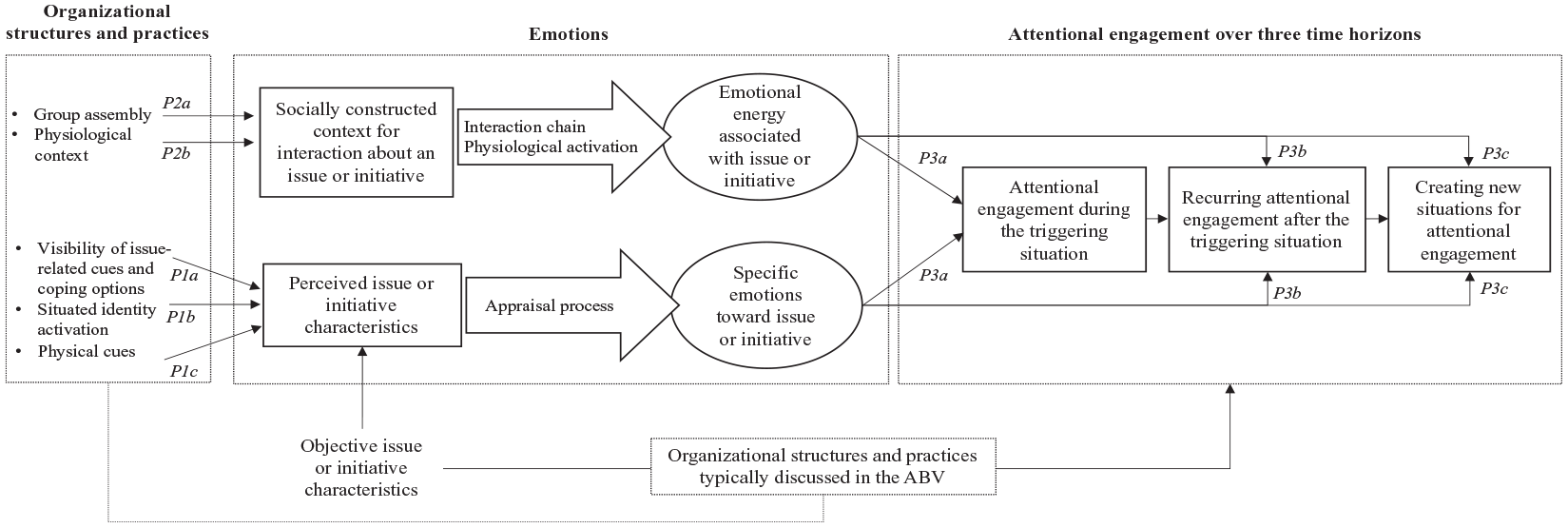
Structure and communicative practices, emotions, and attentional engagement.
Theoretical contributions
The integration of emotions into the ABV provides the most important theoretical contribution of this essay. As noted in the “Introduction,” emotions and attention are highly intertwined, but most research and theorizing on the ABV have not considered emotions. Yet, as I have shown above, emotions are influenced by organizational structures and communicative practices, and emotions substantially shape attentional engagement within organizations in ways that are difficult to predict or explain without considering their role. I have also provided several propositions that provide a starting point for the empirical testing of the arguments presented in this essay and a springboard for further theoretical development.
In addition, emotional dynamics elaborate and provide further elements to important subtopics within the ABV. The dynamic ABV highlights the role of social interactions and communicative practices as factors influencing attentional engagement (Ocasio et al., 2018). My theorizing on the role of emotions is consistent with the dynamic view and elaborates it further. The dynamic and emotional views agree that social interactions and skilled rhetoric are likely to increase attentional engagement. However, the emotional view suggests that a key reason why these communicative practices have this impact is that they activate emotions: social interactions tend to generate emotional energy (Collins, 2004), and skillful rhetoric typically includes metaphors and other means that trigger emotional reactions (Hill and Levenhagen, 1995; König et al., 2018). In addition, also other means for generating and associating emotions with issues and initiatives may be effective for increasing attentional engagement. Hence, managers’ toolbox for increasing attentional engagement via communication may be broader than Ocasio et al. (2018) suggested. On the contrary, emotions create additional constraints for managers: rhetoric and other communicative practices that generate avoidance emotions, such as high anxiety or disgust, may cause organization members to withdraw their attention from the select issue—hence, it is the emotional consequences of communicative practices that determine their influence on attentional engagement, not necessarily the type of rhetoric or language used per se.
The dynamic ABV also discusses how communicative practices and language use influence power dynamics. Ocasio et al. (2018: 161) emphasize the importance of considering “not only power but also influence through rhetorical tactics.” Such influence becomes significant when multiple individuals compete for leaders’ and organization members’ attention. The emotional view suggests that triggering specific approach emotions toward one’s idea increases others’ attentional engagement with the idea. Hence, emotions and the manipulation of others’ emotions are likely to be essential power-and-influence tools in organizations (see also Kilduff et al., 2010).
More generally, the ABV emphasizes the importance of “the ability of the organization to transform [strategic] ideas into a focused pattern of organizational attention (i.e., agenda) that guides decision making [and sustains the] focus of attention in developing, implementing, and elaborating good ideas into a great strategy” (Joseph and Ocasio, 2012: 290). However, such attentional engagement has remained relatively understudied (Brielmaier and Friesl, 2022). Research has only recently started developing insights into how CEOs sustain attentional engagement with important long-term issues (Nicolini and Korica, 2021), and there has been less work on how attentional engagement waxes and wanes over time (but see Joseph and Ocasio, 2012; Joseph and Wilson, 2018). My argumentation above suggests that structures and communicative practices that associate emotional energy and approach emotions with the strategic agenda are likely to increase attentional engagement with the agenda over three time horizons: immediately in the triggering situation, recurringly after the situation, and through the creation of structures and practices that sustain attentional engagement. In this way, my theorizing contributes to the ABV by explicating temporal dynamics of attentional engagement and suggesting how emotions influence them.
ABV scholars have also discussed how both top–down and bottom–up processes shape organizational leaders’ and members’ attentional engagement (Ocasio, 2011; Shepherd et al., 2017). The emotional view suggests that emotions partly influence both types of attention and that emotions may partly determine whether the top–down agenda or bottom–up factors dominate attentional engagement in particular situations. On one hand, communicative practices can generate emotions that support and reinforce top–down attention, as implied in the propositions above. On the other hand, chance factors can influence the emotions associated with the stimulus faced by organization leaders and members and, therefore, influence their attentional engagement with the stimulus. It might be that the emotional salience and evocativeness of the top–down agenda versus the bottom–up stimuli determine which one gets more attention. For instance, highly evocative external stimuli might pull top managers’ attention and cause them to form radical opportunity beliefs outside the firm’s strategic agenda (cf. Shepherd et al., 2017). Equally, strong emotions associated with the strategic agenda might keep top managers focused on the agenda and blind them from new external opportunities.
While some studies have started integrating emotions into the ABV (Vuori and Huy, 2016), this essay offers a more nuanced and comprehensive discussion of how emotional dynamics complement rather than supersede the mechanisms previously recognized in the ABV. In particular, Vuori and Huy (2016) showed how the structural distribution of attention contributed to different fears between top and middle managers at Nokia, and how these misaligned fears hindered the integration of attention. However, the strong emphasis on emotions in their theorizing might leave the impression that emotional dynamics are more influential than attention structures, information processing, and communicative practices. To ensure a balanced approach, this essay highlights that the effects of structural, cognitive, communicative, and emotional factors are intertwined and complementary. The broader implication is that scholars should seek to study the impacts of cognition and emotion jointly instead of going to the extreme and assuming a world that is either emotion-free or one in which only emotions matter.
Future directions
The theorizing presented in this essay can be extended to multiple directions by future research. A central question in the ABV is how organizations could maximize the attentional engagement of their leaders and members toward issues and initiatives that are of the highest adaptive value for the organization. Naturally, multiple factors influence attentional engagement and the adaptive value of issues and initiatives. Nevertheless, some forms of emotion management are likely to generate more adaptive emotions and attentional engagement than others. I theorized in this essay how organizational structures and communicative practices shape emotions that influence attentional engagement. Future research could further study how emotions could be leveraged to generate more beneficial patterns of attentional engagement, such that organization leaders and members attend to the right issues for the right duration of time.
One potential direction could be to further differentiate between the effects of different emotions on attentional engagement, going beyond the distinction between approach and avoidance emotions and emotional energy discussed in this essay. The impacts of specific emotions could show, for example, different temporal patterns that warrant further study. Intense fear might, for instance, initially pull much attention but then lead to avoidance behaviors (analogical to noticing a threat and then hiding). The effects of specific emotions could also differ at the intra- and interpersonal levels. For example, some unresolved threats might cause moderate anxiety that keeps pulling attention at the individual-level, but become taboos at the interpersonal level and therefore fail to gain substantial attentional engagement (cf. Fan and Zietsma, 2017; Hodgkinson and Wright, 2002). As these examples suggest, the effect of emotions on attentional engagement can be complex and depend on both the specific emotion and the nature of the issue.
In addition to being influenced by the specific emotion, the impact of emotions might also depend on the interpersonal constellation of emotions (cf. Vuori and Huy, 2016). In one extreme, all organization members feel the same emotion. In the other, all the members feel different emotions. And in between, there can be shared emotions within each organizational unit but differences between units. Furthermore, the differences between units’ emotions could be conflicting (Goldenberg et al., 2016) or complementary (Gilbert, 2005). Each of these constellations might generate different patterns of attentional engagement in organizations. Future research should investigate which patterns are most adaptive.
The effects of emotions on attentional engagement are also likely to interact with the context in which those emotions are experienced. For example, the type of the organization or participants’ organizational roles might moderate the impact of emotions on attention. In more mechanistic organizations, where members’ roles and tasks are strictly defined, emotions might have a weaker impact than in organizations that allow for more freedom and autonomy (cf. Finkelstein and Hambrick, 1990). Indeed, one reason why emotions have become a more central topic in management research and practice (Ashkanasy et al., 2017) might be the increased prevalence of knowledge work, which is more autonomous by its nature. Furthermore, the dynamics between emotions and attentional engagement might have unique characteristics in the post-Chandlerian world of new business models and digital technologies (Ocasio et al., 2022) and in platform ecosystems where hierarchical controls are not strong (Altman et al., 2022).
The impact of structures and communicative practices on emotions might also differ depending on individual-level factors. While my theorizing considered how situated identity activation influences emotional reactions, other individual-level factors could also shape organization members’ and leaders’ emotions toward strategic issues and initiatives (e.g. Kuppens et al., 2009). For instance, individuals’ mental models influence how they perceive external cues (Walsh, 1995). People with a specific mental model might perceive a particular cue as an opportunity, whereas others might perceive it as a threat. As mental models are influenced by several factors, such as personal experiences, formal education, and organizational history, both at the conscious and subconscious levels (e.g. Healey et al., 2015), there could be substantial differences between individuals’ emotional reactions. Hence, future research could further investigate how the effects of organizational structures and communicative practices on emotions interact with individual-level factors. Future research could also investigate which kinds of individual-level factors are most optimal from an emotional perspective and whether and how it would be possible for organizations to help their members develop them.
The explication of the three time horizons over which emotions influence attentional engagement also offers opportunities to investigate the temporal patterns of attentional engagement more generally (cf. Kunisch et al., 2017). Patterns could vary: for example, some issues might attract intense attentional engagement initially in the triggering situation but fail to generate recurring engagement after the triggering situation. In contrast, some issues might initially gain relatively modest attentional engagement but continue to attract engagement recurringly after the triggering situation and even lead to the creation of structures and practices that further increase engagement. Such patterns matter for organizational adaptation, as sustained or intensifying attentional engagement is more likely to lead to changes in organizational actions. It could also be that there is an optimal rhythm of attentional engagement, such that, for example, it might be more adaptive to engage with a topic once a week rather than every day. How do organizational structures and communicative practices influence temporal patterns of attentional engagement, and how do such patterns influence organizational outcomes?
Future research could also investigate the broader consequences of emotions triggered by structures and communicative practices. For example, such emotions could substantially influence wellbeing and health (e.g. Consedine and Moskowitz, 2007), risk preferences (e.g. Wang, 2006), decision making (e.g. Lerner et al., 2015), and various other variables that are important for organizations more generally (e.g. Ashkanasy et al., 2017; Elfenbein, 2007). ABV scholars might be in an ideal position to study the broader emotional implications of structures and communicative practices, because they have developed an ever-increasing understanding of the macro–micro interplay between structures and attention; they could apply the same understanding for studying the emotional consequences of structures and practices more generally and help us better understand how structures and practices contribute to emotionally healthy and productive organizations.
The theorizing of this essay also has methodological implications for ABV scholars. Methods to capture the emotional dynamics proposed in this essay need to span multiple levels of analysis and time horizons. They need to consider the qualities of the organizational structure and communicative practices, the emotional energy and specific emotions occurring during and after situations faced by organization leaders and members, and the quality and intensity of their attentional engagement during the situation and after it. So far, much of the research on such dynamics has been qualitative (e.g. Fan and Zietsma, 2017; Liu and Maitlis, 2014; Vuori and Huy, 2016), which has enabled the recognition of the mechanisms across multiple levels and time horizons, but not precise measurement. In the future, methods such as wearable devices to measure emotions physiologically (e.g. Engelniederhammer et al., 2019), experience sampling to measure momentary emotions and thoughts (e.g. Liu et al., 2017; Seo et al., 2010), and eye-tracking (e.g. Armstrong and Olatunji, 2012; Slykhuis et al., 2005) and recording of browsing behaviors (e.g. Zhang and Zhao, 2011) to measure which information receives most attention could be used to test the ideas more rigorously. Ideally, research would combine multiple methods to capture both the emotions triggered by an issue or initiative and attentional engagement with the issue over multiple time horizons, as well as the structures and practices that influence and are influenced by the emotions and attentional engagement.
Practical implications
A central task for leaders is ensuring they and their organization members attentionally engage with the most relevant issues and initiatives for their organization. This essay suggests they can leverage emotions to increase attentional engagement with relevant topics. They should design organizational structures and communicative practices to maximize emotional energy and approach emotions to pull more attention to the most relevant topics while minimizing avoidance emotions associated with them. Furthermore, they should design practices to minimize emotional energy and approach emotions associated with less relevant topics. Emotions are like tools—they need to match the task at hand. Leaders should ensure they and their followers feel the right emotions toward each issue and initiative.
Footnotes
Acknowledgements
The author thanks Suvi-Tuuli Vuori, Willie Ocasio, and the three anonymous reviewers for their help and encouragement in writing this paper. He also thanks Quy Huy for his more general advice and collaboration, which have had a major impact on this paper, and Saouré Kouamé for related discussion.
Funding
The author(s) received no financial support for the research, authorship, and/or publication of this article.
