



Abstract
This report provides an example implementation of a virtual gaming simulation (VGS) in counseling seminars in teacher education as a tool for learning psychological conversation skills. The theory-practice seminar “Counseling language learners” in a blended learning environment includes the teaching of counseling competencies, followed by actual online counseling sessions with school students. As a further approximation of practice, before gathering their first experience as counselors, preservice teachers play through a virtual simulation of a counseling session in which they can interactively control the counselor's behavior by choosing from a pool of alternatives. In this way, users learn inductively about the functionality of conversational techniques, and begin to anticipate the consequences of their actions. An evaluative study explores the benefits perceived by preservice teachers of the present VGS application. Results indicate high levels of usability and utility of the VGS as well as an aroused situational and topic interest through the task. Confirmatory evaluations are still required.
Keywords
Introduction
Teachers’ Need for Counseling Competencies
According to the Kultusministerkonferenz (2022), teachers are responsible for both teaching and counseling students. This includes identifying students’ learning resources, obstacles, and progress, as well as reflecting on their role as counselors. Tailored counseling approaches for strategy instruction are essential for promoting learner autonomy (O'Reilly, 2012). Enhancing teachers’ counseling skills is vital to support self-regulated learning (SRL) and should be a key component of teacher psychology education.
In the context of foreign language learning, Martinez (2021) concretizes literature-based (Kleppin, 2019) four literacies required for counseling: Declarative knowledge about counseling, learner variables, and learning strategies (savoir); procedural competencies in conducting conversations (savoir-faire); an accepting, empathetic, and open attitude towards the counselee (savoir-être); and the reflective regulation and control of one's own actions (savoir-apprendre/savoir-réfléchir).
Implementing a Blended Learning Seminar for Training Counseling Competencies
At the University of Bamberg, an interdisciplinary theory-practice seminar structure on counseling learners on their general SRL (Horn et al., 2021) was therefore enhanced thematically and enriched with digital aspects (Figure 1; Herrmann et al., in press): preservice teachers are trained in systemic-constructivist counseling before conducting online counseling with students (grade 5–12), addressing language learning autonomy in particular. The training of the above-mentioned competencies includes self-paced, asynchronous units via the university's e-learning system focusing on language learning theories and strategies, learner variables, and systemic counseling. These units consist of explanatory videos, reading and discussing scholarly work (e.g., Benson, 2012; Bonnet, 2018; Wiethoff & Stolcis, 2018), interacting and reflecting on digital notepads (e.g., Padlet), listening to topic-related podcasts (e.g., Lueg, 2023), and self-checking their individual learning process through quizzes realized with the software H5P. Moreover, assigning various tasks depending on the degree program (e.g., EFL students read English texts) ensures differentiation. In-person lessons supplement the seminar concept with focusing on self-reflection and tasks in which the participants encounter the effect of systemic conversational techniques and practice sequences from the counseling process. Additional online meetings for peer intervisions cater for the variable needs to discuss individual challenges in the actual counseling process. The examination format is a digital portfolio — realized with OneNote — that records the student's development in the four savoirs-literacies areas, including the documentation of tasks, individual reflections, case studies of their counseling sessions, and a small academic essay.
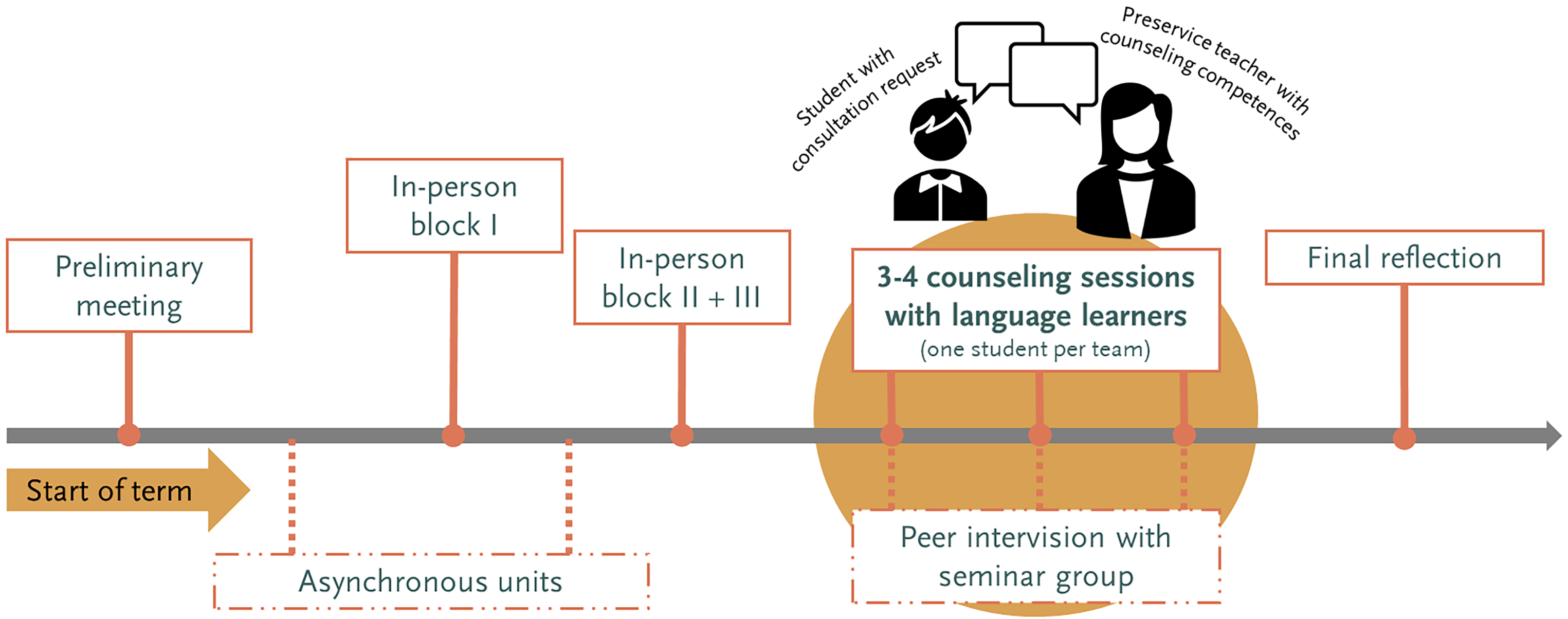
Blended learning approach in the seminar “Counseling language learners” (adapted from Horn et al., 2021).
The seminar concept aims at promoting preservice teachers’ counseling competencies, at supporting the participants in reflecting their personal learning behavior, and in taking responsibility for their own learning. The instructor serves as a supportive facilitator, fostering a positive classroom environment.
Similar to the preceding, promisingly evaluated seminar concept (Horn et al., 2021, 2024), the new cohort received this medium-impact blend (Alammary et al., 2014) positively. During the initial implementation of the enriched seminar concept, student feedback revealed a notable discrepancy between role-plays in sessions and real-life counseling, causing uncertainty before meeting with their counselee. Horn et al. (2021) acknowledge the importance of increasing authenticity in seminar tasks throughout the semester, but transitioning to individual counseling sessions can be daunting for students. Research is needed to find a method that satisfies students’ desire to approximate practice (Grossman et al., 2009).
Considerations on a Game-Based Learning Approach
Over the past decade, a growing research body on game-based learning has emerged (Irwanto et al., 2023). Also in nongame contexts, such as higher education, gamification has the potential to promote motivation (Clark et al., 2016; Foster & Shah, 2020; Sailer et al., 2013) and to develop a positive attitude towards failure on the path to competence (Lee & Hammer, 2011). Moreover, multiple studies and teaching concepts in preservice teacher education show the successful implementation of virtual (gaming) simulations (VGS) for the training of skills needed in a real classroom (e.g., Angelini et al., 2023; Connolly et al., 2020; Peterson-Ahmad & Landon-Hays, 2020; Theelen et al., 2019). Simulations are “simplified but valid representations” of different systems and “include features that learners can manipulate” (Fischer et al., 2022, pp. 10–11). In that way, a risk-free approximation of practice for learners is possible.
For the integration of a VGS into the abovementioned counseling seminar concept, the three-phase experiential learning cycle (Angelini et al., 2023; Kolb, 2015), including the phases briefing, action-simulation, and debriefing-reflection, is advantageous. Based on Verkuyl et al.'s (2016, 2022) implementation of VGS with Branching Scenario (H5P) in nursing education, VGS seem suitable to also enable preservice teachers to reflect comprehensively on conversation techniques.
Ideally, in an asynchronous unit, preservice teachers are guided through conversation phases using a Branching Scenario-VGS. With pop-up questions, this tool prompts them to choose appropriate behaviors toward the counselee at critical moments in the counseling simulation from a pool of possible reactions. By evaluating the resulting conversation flow, teachers learn autonomously about conversational techniques and expand their interactional skills by anticipating consequences. The simulation promotes logical reasoning and allows students to experiment with ideas and learn from mistakes (Akahori, 2005). It is crucial for the application to consider core attributes such as relevance, realism, engagement, challenge, and instructional value when developing case scenarios (Kim et al., 2006).
This report contributes to research on practice scaffolds as it proposes integrating a VGS in counseling seminars to enhance counseling competences, and evaluates its benefits. The hypothesis is that the VGS is appealing to preservice teachers in terms of user-friendliness, interest, and utility.
Method
Development of a VGS-Prototype for Counseling Seminars
In a first trial, a VGS-prototype of a counseling session, including 18 video clips (produced by the university's video studio team), and a corresponding worksheet were developed. To create an immersive experience, the videos show the counselor's perspective; the viewer only sees the counselor's hands and hears her voice. In addition to the counselee, another person is visible representing the observer who is giving feedback to the counselor afterwards (compare Horn et al., 2021). All acting persons were not professional actors but student assistants and the author. In the postproduction, subtitles were added via the platform Panopto that also hosts the in moodle embedded videos. The clips were then integrated into Branching Scenario, which did not require further programming skills.
Branching Scenario
In a briefing phase (McDermott et al., 2021), users are merely required to read textual instructions within the H5P application on the task, the functionality of the VGS, and the worksheet. As for the action phase, the case simulation is based on anecdotal evidence obtained by the author during previous intervision sessions: the student counselors’ accounts provided insight into critical situations that should now be addressed in the VGS. Therefore, the storyline is the preparation and beginning of the first session between a timid 17-years-old high school student and her student counselor. Being discontent with her current grades in English, the girl had signed up for the counseling. Before the first scene of the actual counseling starts, viewers can follow the enrollment procedure through a chat, realized with the app TextingStory. The scenery shows a comfortable counseling room with a table and chairs, decorative plants, and prepared water. The plot — with alternative situational endings — involves four branches: (1) the counselor's considerations on the arrangement of the chairs before the counselee enters, (2) the beginning of the conversation (see Figure 2), (3) the challenging goal setting, and (4) the resource-oriented exploration of the counselee's situation. After that, the remaining conversation phases are briefly summarized in textual form, before the end of the conversation with an outlook to the next meeting is presented. To ensure that students reflect comprehensively about conversational techniques, and deliberately choose less promising options in the Branching Scenario, the VGS includes textual prompts for the viewers, reminding them to watch all alternative scenarios.
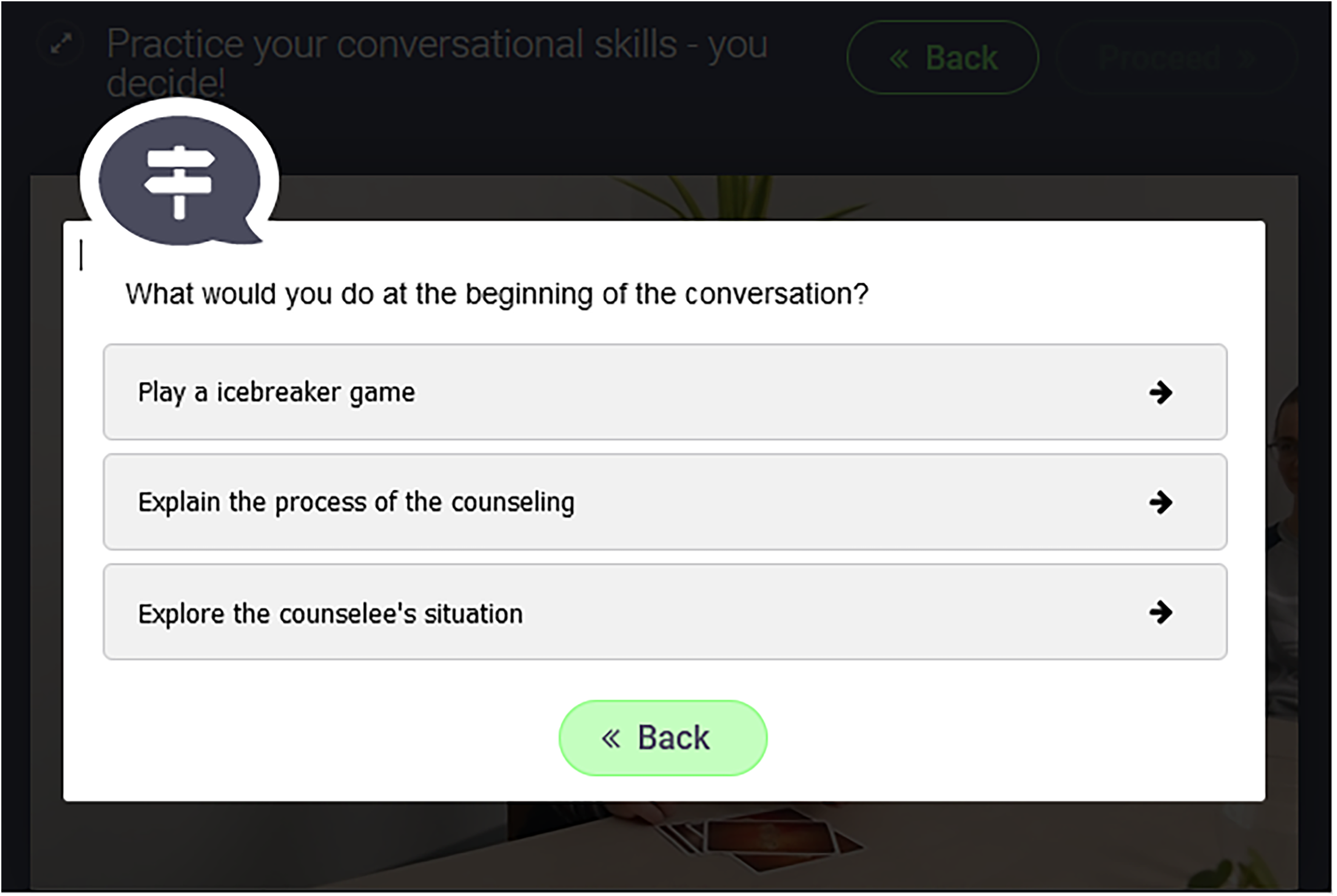
Example pop-up question with choice of alternative scenarios in the virtual gaming simulation (VGS).
The duration of the video clips varies (6 s to 2:45 min), depending on the suitability of the alternative: whereas less favorable conversation elements lead to short answers of the counselee, systemic techniques trigger a conversation flow. Free access to the application is currently available and can be asked from the corresponding author.
Worksheet
Students were assigned to engage in the VGS while filling in their observations and reflective thoughts on a worksheet that had been particularly designed for the task. The form mainly includes a table with blanks to fill in labels for conversation phases, observations on both the counselor and the counselee, and finally the personal evaluation of the alternative situational ending.
Seminar Proceedings
Prior to using the material in the study, a student assistant was asked to try out the VGS-worksheet-task to check for any technical problems and gain insight into the required time-on-task (40 min). Since November 2022, the H5P-VGS-activity has been integrated as a midterm activity in the learning platform moodle of 11 interdisciplinary counseling courses for preservice teachers at the University of Bamberg. At this point, the students had already dealt with the topic theoretically, but had not yet entered into a real counseling process. Regarding the thematic focus, the courses slightly differ from counseling language learners (CLL) (see seminar concept above), general SRL counseling (Horn et al., 2021), and a peer counseling training (Drechsel et al., 2020). While the number of participants in the theory-practice seminars is generally small; thematic seminars can accept larger cohorts. In all but one context, students were assigned to engage in the VGS asynchronously. Additionally, as part of a workshop, the VGS had been played individually in class during a thematic counseling seminar. As for interaction data, the moodle interface showed whether the students actually played the VGS and made the order of chosen alternatives visible. However, the data could not be exported to a csv-file. For the debriefing/reflection phase, the students were asked to, firstly, compare their notes on the worksheet with a partner. Secondly, in plenary, they discussed their observations and hypotheses regarding the different phases of the counseling and their assessments of the (un)suitability of respective conversation techniques. During this phase, the instructor informed about the actual terminology of the conversation phases and systemic techniques as well as their functionality in the counseling process. In that way, the participants were able to check and, if necessary, correct their implicit assumptions, and gained declarative knowledge (savoir). To put the newly generated insights into practice (savoir-faire, savoir-être), subsequent tasks in course of the seminar included consolidating and extending their repertoire of systemic questions, and practicing these conversation techniques with a partner in role-plays. In this phase, the instructor observed the pair activity and gave advice and feedback to the students (savoir-réfléchir). It must be highlighted that during this subsequent in-person session, the lecturer observed that teacher students in the CLL seminar adopted conversational elements previously used by the counselor in the videos. This might infer that they oriented strongly toward the VGS scenes.
Participants
Right after having played the VGS, teacher students were provided with information regarding data protection and their rights as research subjects. All subjects agreed to these conditions. Followingly, they were asked to participate voluntarily in an anonymous online exploratory evaluation of the application. In total, out of the frame population of 160 students who received access to the VGS, 71 (60 female, 10 male, 1 nonbinary) preservice teachers, who were on average in their 5th semester, both played the simulation and took part in the survey. The majority of these students (54.9%) was studying in the teacher training program for elementary school teaching, 35.2% for middle and high school teaching (Gymnasium 19.7%, Realschule 12.7%, Mittelschule 2.8%) and another 7.0% for vocational school teaching. Two persons described their course of studies as “Other.” While all participants reported to have started the activity, six persons did not complete the task, and mentioned as reasons time constraints, that the content was already known, sickness, and technical difficulties. Seven completely at random missing values were imputed by the mean of the respective variable's observations. One person did not respond to the topic interest-items. In addition, 20 students from two cohorts of the CLL seminar gave qualitative feedback.
Students’ Evaluation of the VGS
The evaluation orients toward the conceptual framework of teaching case development (Kim et al., 2006) and therefore includes usability scales (Laugwitz et al., 2008; Cronbachs α > .7 except for the subscale dependability), interest scales (Seidel et al., 2022, ω = .85 for triggered interest, ω = .86 for maintained interest; Reinders, 2016, α = .86–.87), and utility scales (adapted from Teo, 2019, CR = .95) (e.g., items, see Table 1). The data was analyzed with Microsoft Excel. Furthermore, during the subsequent in-person session in the seminar on CLL, participants gave qualitative feedback regarding the task anonymously: on three whiteboards, they commented on the following aspects: (1) “What I enjoyed about the VGS…”; (2) “What I disliked about the VGS…”; and (3) “My ideas to improve the VGS…” Screenshots of the whiteboards were taken and, afterwards, analyzed by grouping similar comments in a table.
Example Rating Items of the Online Evaluation (translated from German).
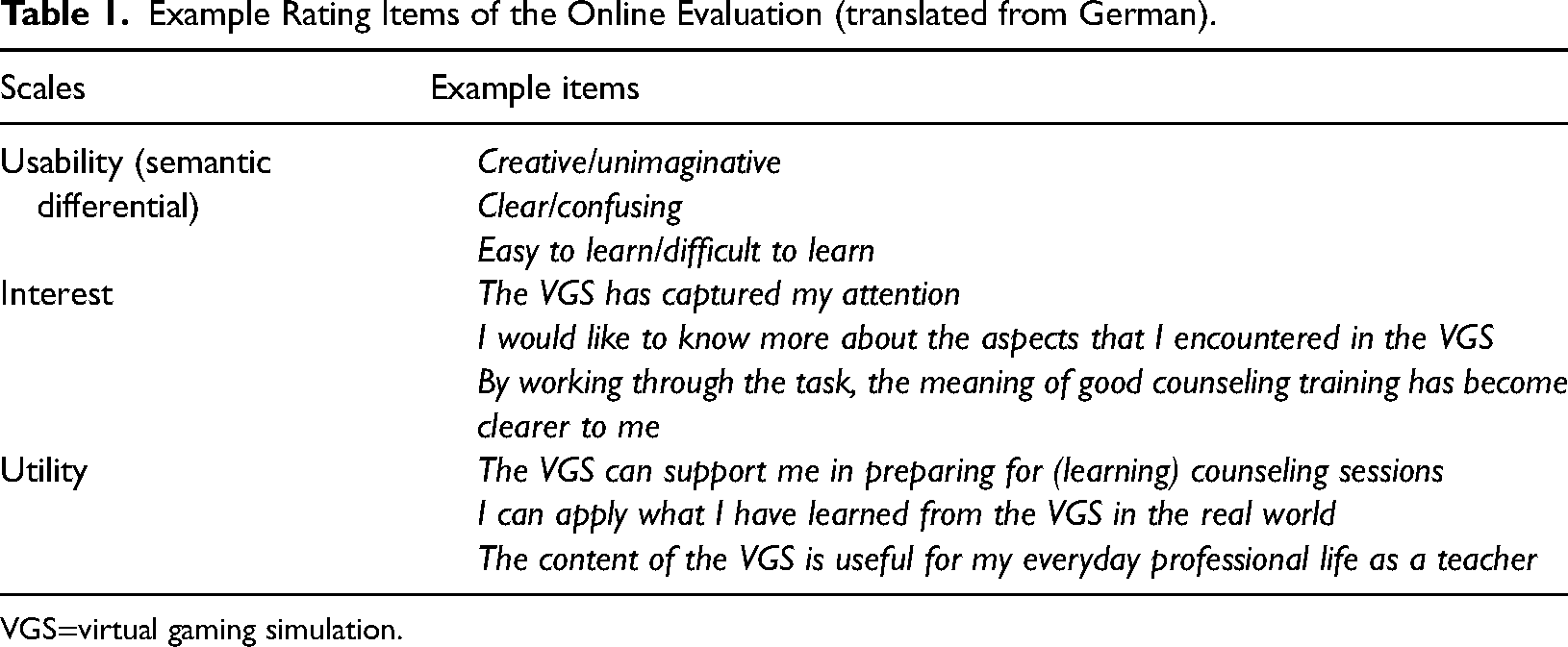
VGS=virtual gaming simulation.
Results
Quantitative Evaluation
Regarding usability (see Figure 3), they rated the VGS on seven-point scales (Laugwitz et al., 2008; 26 items) as highly attractive (M = 5.7; SD = 1.2), perspicious (M = 5.7; SD = 1.3), novel (M = 5.5; SD = 1.3), stimulating (M = 5.6; SD = 1.4), and efficient (M = 5.4; SD = 1.3); as well as generally dependable (M = 5.3; SD = 1.3). In terms of interest (Seidel et al., 2022; 4-point scale, 6 items each), the VGS largely triggered (M = 3.4; SD = 0.7) and maintained (M = 3.2; SD = 0.8) situational interest. The participants found that the simulation promoted their topic interest (n = 70 as one person did not respond to the corresponding items; M = 4.9; SD = 1.1) (Reinders, 2016; 6-point scale, 6 items). Additionally, the sample assessed the perceived utility of the VGS for their course of studies (adapted from Teo, 2019; 6-point scale, 4 items, M = 4.8; SD = 1.0) and for the transfer to their future profession (Seidel et al., 2022; 4-point-scale, 6 items, M = 3.4; SD = 0.6) positively. Finally, regarding their personal learning gain (self-developed; 5-point scale, 1 item), the participants regarded the application as useful (M = 3.8; SD = 0.7).
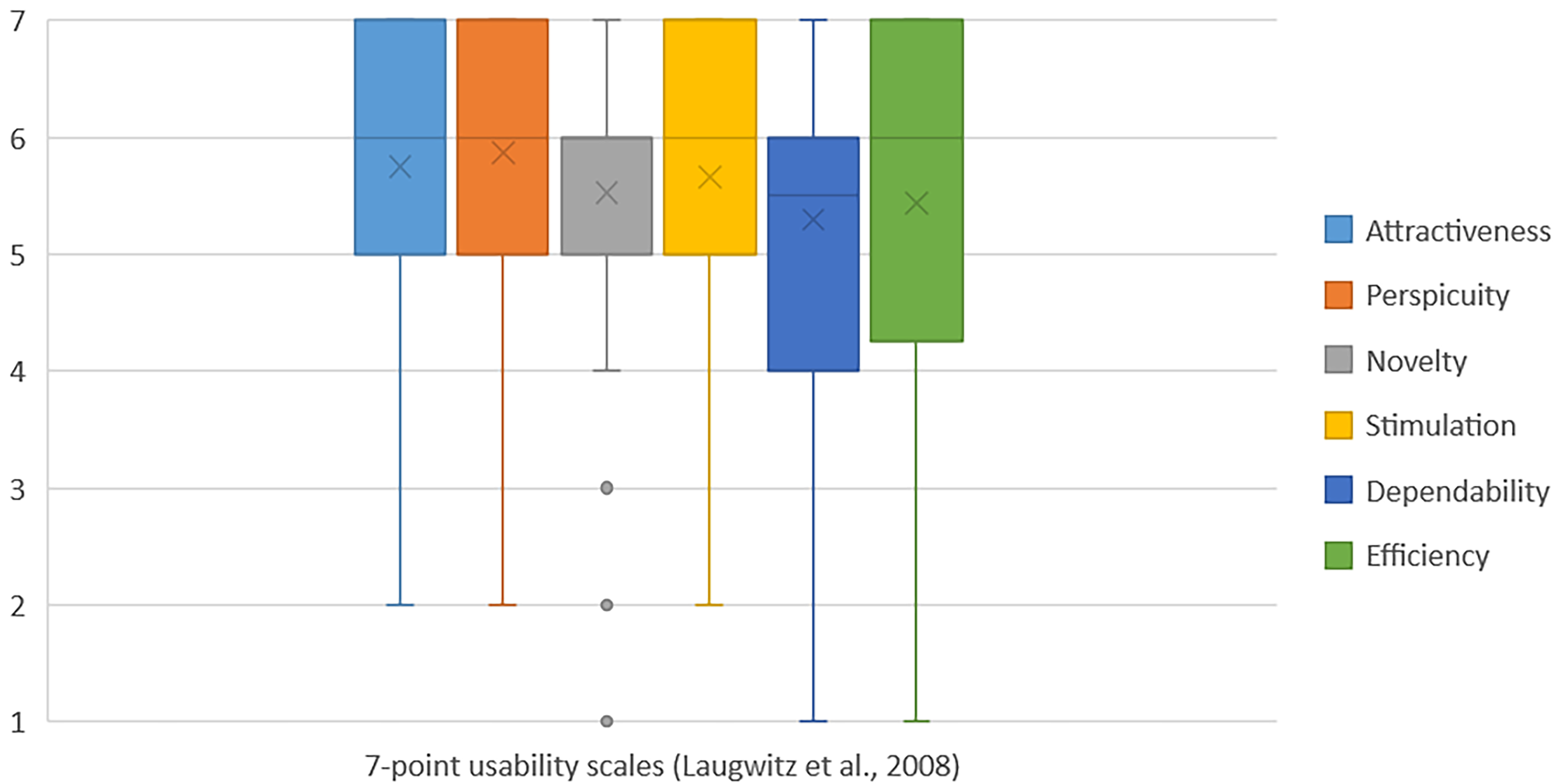
Results of the virtual gaming simulation’s (VGS) usability evaluation (n = 71).
Qualitative Evaluation
The qualitative feedback of the CLL seminar students provides valuable insight into their reception of the application. For positive aspects, they described the application as “motivating,” “activating,” and “authentic” regarding the performance of the actors, and enjoyed the autonomous learning process as well as the interactivity through the choice of possible reactions. Additionally, they highlighted the clear structure of the VGS. However, some students pointed out difficulties with the application's settings, especially in relation to the back button and the text prompts to watch all alternative endings. Other aspects were the difficulty of noting down observations regarding the counselor and some volume settings during the TextingStory scene. Meanwhile, the TextingStory scene was removed and the back button problem could be solved. For improvement, the teacher students suggested an even deeper level of interactivity, longer video sequences for observation purposes, and direct feedback regarding the suitability of the chosen alternative.
Discussion
Initial findings suggest that using VGS in counseling seminars is a promising way for preservice teachers to practice without real-world risks. The tool showed strengths in all evaluated areas (usability, interest, and utility). Results suggest that improving the application's dependability, such as by revising settings, could enhance usability. Additionally, there is a discrepancy between positive evaluations and final assessment of personal learning gain. Further research could explore individual learner characteristics to understand relevant impact factors. Generally, the cost and effort of producing video clips must be weighed against the benefits. While creating the videos is time-consuming and requires professional equipment, the ease of digital implementation in various courses and workshops, along with the minimal requirements for students (just an online device), make VGS a sustainable and appealing teaching method for counseling skills. Additionally, the application is being tested in training workshops for in-service teachers and student tutors to assess its effectiveness beyond higher education settings.
Limitations of the current study include the nonexportable log data, small sample size, and self-report nature of aspects such as utility and interest in the questionnaire. The imbalanced gender ratio in the study may be attributed to the higher proportion of women in the teacher education program in Bamberg. Empirical evidence supporting the hypothesis that the interactive component of VGS contributes to a greater sense of preparedness for actual counseling compared to passively watching a videotaped counseling session is still pending. A study design with treatment and control groups, along with performance-based assessment, would be preferable. In addition, running the VGS prototype and considering the students’ feedback, it becomes apparent that the application should be revised. Furthermore, the level of immersion is optimizable: in the current prototype, the counselee does not look directly into the camera, which might lead to a more observing than interacting feeling of the viewer. Conceivable would moreover be the use of virtual reality (VR) to increase the level of immersion in the counseling situation, following the example of the project by the VR-team at University of South Bohemia (https://www.vrteam.cz/eng/). In the context of the CLL seminar, it became apparent that a wider range of VGS would be desirable for practice opportunities and to cater for the diversity of counselee personalities (e.g., introverted vs. extraverted, different age levels, high vs. low performers) and consulting occasions (e.g., self-initiated vs. externally initiated, intrinsically vs. extrinsically motivated). Also, a presentation of various counseling role-models in the simulation (e.g., different genders) could help the students to identify more strongly with the counselor's perspective. Meanwhile, further critical situations in learning counseling sessions had been extracted through expert interviews.
Eventually, VGS is only one approximation of practice. In future, even more authentic, performance-based tasks could be designed. Innovative simulation formats, like the OSCE in clinical psychology programs (Glatz et al., 2022), could benefit teacher education by enhancing psychological literacy. After using VGS, student teachers could engage in role-plays with simulated counselees while being assessed, similar to the OSCE model for clinical internships. While teacher students have a skeptical view of role-playing for exams, they nevertheless recognize its importance and value it as a beneficial practice method (Meier et al., 2023).
Footnotes
Declaration of Conflicting Interests
The authors declared no potential conflicts of interest with respect to the research, authorship, and/or publication of this article.
Funding
The authors disclosed receipt of the following financial support for the research, authorship, and/or publication of this article: This work was supported by the Stiftung Innovation in der Hochschullehre.
