



Abstract
In a rapidly changing and challenging world, teachers as influential social agents can play an important and promising role to guide through but also bring about positive change to individuals and society as a whole. This potential stresses the importance of professionalization of teachers and the need for elaborate learning settings to equip (future) teachers as psychologically literate and reflective practitioners who systematically reflect and integrate practice and (psychological) theory. As part of the preservice teachers’ psychology curriculum, we implemented a theory–practice learning setting in their educational foundation studies that aims at fostering preservice teachers’ psychological literacy. Specifically, to reflect their own and other's behavior and to apply their psychological knowledge of learning and counseling principles into real-life counseling sessions. This study addresses the didactical concept of teaching psychology to non-psychology students and the results from its evaluation. In a quasi-experimental pre-posttest design with comparison group (Nintervention = 46; Ncomparison = 102), we analyzed the effects of the seminar on the preservice teachers’ reflexivity, their beliefs about the theory–practice relationship and their agency. Results indicate that beliefs about the theory–practice relationship and the levels of reflection significantly increase through the practice task in the intervention group, but reflexivity and agency does not.
Keywords
Introduction
Social challenges like the pandemic shutdown and a growing skills shortage had, still have and will continue to have a long term effect on society as a whole and the educational sector (Castro, 2023; Reimers, 2022). Consequently, ideas and solutions to adapt and approach changes on a societal and individual level are called for. Psychology and its transfer into practice can offer answers and prepare for work and life in the post-pandemic era while contributing to the wellbeing and quality of life individually, locally and globally (Coulson & Homewood, 2016; Cranney et al., 2022). Psychological literacy, defined by Cranney et al. (2022) as “the intentional values-driven application of psychology knowledge to achieve personal, professional, and community goals,” should not only be considered a desired outcome of psychology education (Cranney & Morris, 2021; Taylor & Hulme, 2015, 2018), but as a learning goal outside the psychology profession as well.
Psychological Knowledge in Initial Teacher Education
Specifically, in Initial Teacher Education programs, psychology knowledge and the fluent and purposeful application thereof equips future teachers with a deep understanding of human behavior, cognition, and development. This knowledge serves as a pivotal instrument in crafting impactful learning environments, support pupils’ well-being, implementing differentiated instruction, effectively managing classrooms, and fostering continuous professional growth. Besides the acquisition of psychological knowledge, psychology offers a repertoire of specific social, personal and methodological competencies for preservice teachers’ helping them to achieve their professional goals. Among other things, preservice teachers have the opportunity to learn, for example, principles of learning and social psychology such as setting learning goals, motivation, assessment or helping to successfully deal with group dynamics in their classrooms (Lohse-Bossenz et al., 2013; Patrick et al., 2011; Voss & Kunter, 2013). Voss et al. (2011) demonstrated the importance of preservice teachers’ general psychological knowledge as it positively relates to several indicators of their instructional quality. By incorporating psychological principles into their teaching practice, educators can positively influence students’ learning outcomes and overall educational experiences (Voss et al., 2011). To transfer psychology knowledge into application, learning formats aiming for psychological literacy often include an interactive approach such as placement, volunteering or work based learning (Taylor & Hulme, 2015, 2018), which offer and consolidate both theory and practice. Yet, regarding preservice teachers, the gap between theory and practice is rarely bridged to actually apply psychology knowledge to the personal and professional life. Against this backdrop, our study examines the potential and limitations of fostering psychological literacy among (future) teachers by engaging them in a practice task in the local community.
Psychological Literacy for (Future) Teachers
This article relates to two often cited and complementary definitions of the complex concept of psychological literacy. As mentioned above, Cranney et al. (2022) define psychological literacy as “the intentional values-driven application of psychology knowledge to achieve personal, professional, and community goals.” McGovern et al. (2010) postulate nine components of psychological literacy to describe the specific characteristics and skills which are necessary to achieve a purposeful and ethical application of psychology. Table 1 lists those nine attributes and shows the transferability to teacher education and preservice teachers’ psychology learning goals by the example of this study's seminar.
Components of Psychological Literacy Through Teachers’ Lens.
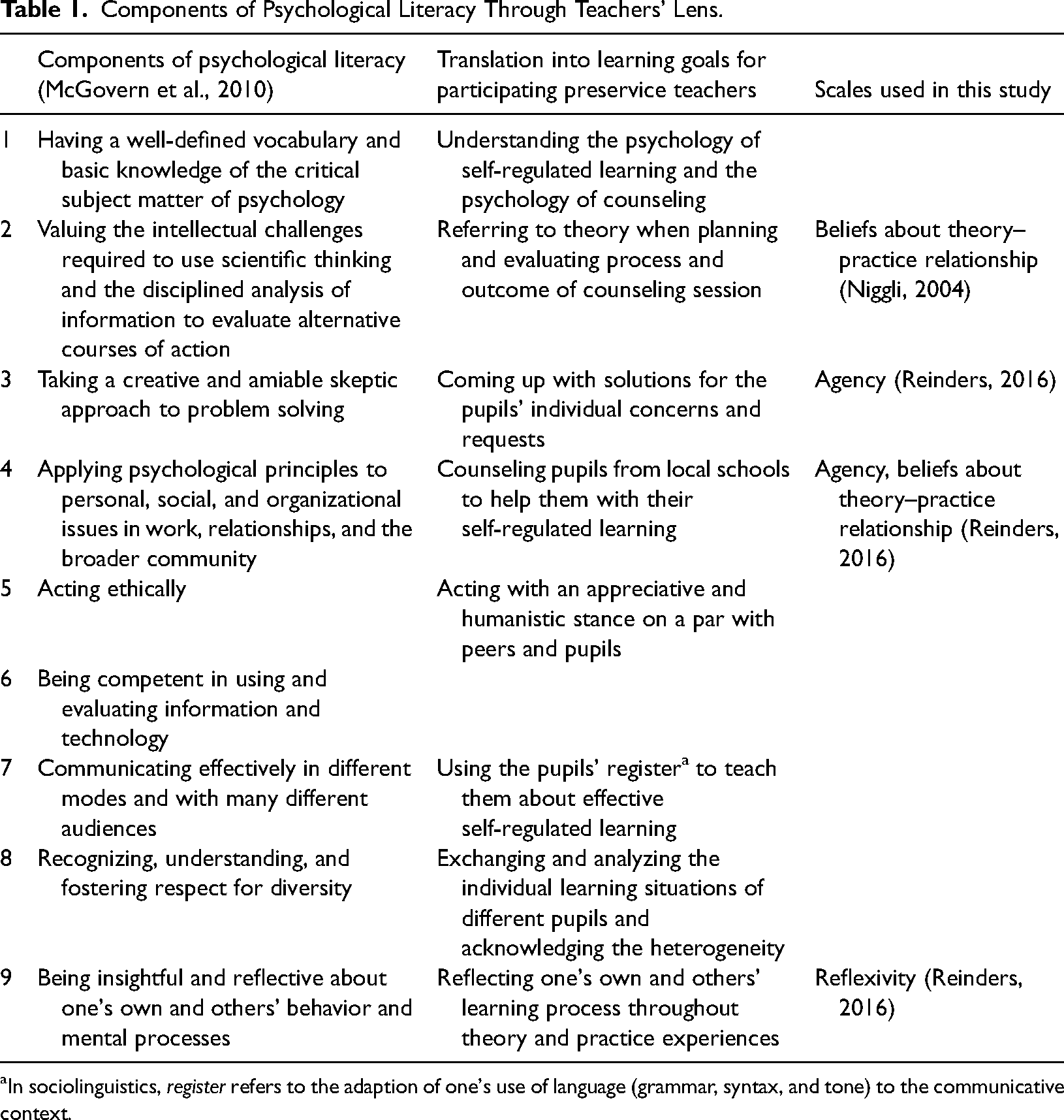
In sociolinguistics, register refers to the adaption of one's use of language (grammar, syntax, and tone) to the communicative context.
With respect to undergraduate psychology students, there is a growing body of research on the teaching of psychological literacy (Taylor & Hulme, 2015). However, studies addressing psychological literacy and its implementation in the curriculum of preservice teachers are still scarce (Horn et al., 2021). In general, to develop psychological literacy, service-learning initiatives are an effective tool and provide promising educational opportunities (Bringle et al., 2016a; Murdoch, 2016). Service-learning gives students the opportunity to participate in an organized service activity in the community (e.g., public institutions or non-profit organizations, etc.) and to reflect on their experiences in the seminar, thus, connecting theory and practice and gaining a deeper understanding of the course content and an enhanced sense of civic engagement, at the same time (Bringle et al., 2006). This practice-oriented teaching method has been increasingly applied in teacher education in order to offer preservice teachers meaningful learning opportunities at the interface between theory and practice (Resch & Schrittesser, 2023; Tatebe, 2013). One core characteristic of service learning is the instructed and well-mentored reflection of the relationship between theory and practice (Reinders, 2016). Learners have to equally deal with both and, especially, come to terms with possible perceived incongruity between learnt and lived psychology. Practical experience needs to incorporate reflective practice in order to lead to (preservice) teachers’ professionalization (Berliner, 2004; Prenzel & Mandl, 1993). Therefore, we conceptualized a seminar based on the service-learning approach that prepares, closely mentors and systematically incites preservice teachers to reflect during their practice task. Following the categorization by Bringle et al. (2016b), the practice task of this study qualifies as direct service learning, since preservice teachers interact with pupils from local schools as part of a credit-based university seminar. And, the cooperation between the seminar and its community partners (i.e., schools) mutually benefits both (practice experience in exchange for free-of-charge counselling sessions on learning). The practice tasks, also, align with Cranney's proposal to use “psychological literacy to problem-solve in an ethical and socially responsible manner in a way that directly benefits their communities” (Cranney & Dunn, 2011). We want to know if a seminar with theory and practice settings is a superior learning format compared to a theory seminar without practice experience to foster reflexivity, the integration of theory and practice and preservice teachers’ agency as attributes of psychological literacy.
Reflexivity and Levels of Reflection
As listed above, reflexivity is an essential attribute of psychological literacy (McGovern et al., 2010) and the demonstration of insight and reflection part of an adaptive application of psychological knowledge (Coulson & Homewood, 2016; Halonen et al., 2011). John Dewey (1933) defines reflection as consciously thinking about and challenging past and present action, beliefs, or knowledge with the intention to learn or to inform future practice (Richert, 1990). Reflexivity, the ability to reflect on one's own behavior and experiences as a basic principle is considered as crucial for teaching (Baumert & Kunter, 2013; Von Felten, 2005) as well as for the professional development in any field of psychology (American Psychological Association, 2010). Hence, reflexivity is particularly relevant for the professionalization of preservice teachers, as it can invigorate critical thinking and theory–practice connections (Bain et al., 1999; Caruso & Harteis, 2020; Mulryan-Kyne, 2021; Reinders, 2016). Reflective practice within or after a specific situation is linked to higher-order cognitive skills such as metacognition, self-regulation and agency (Coulson & Homewood, 2016). There are different frameworks to define the reflective practice in categories or levels whose complexity increases from recounting experiences to more critical and transformative thinking like incorporating alternative explanations and including the context of the situation (Fund et al., 2002; Hatton & Smith, 1995; Kember et al., 2008; Reinders, 2016; Ward & McCotter, 2004). Interventions to facilitate (preservice) teachers’ reflection at these different levels by engaging them in more complex and critical reflection are meant to help teachers to develop a deeper understanding of and to improve their practices (Cole & Knowles, 2000; Griffin, 2003; Hunter & Hatton, 1998).
Agency
The concept of teacher agency is also highly compatible with the application-oriented characteristic of psychological literacy, especially, to McGovern et al.'s (2010) attribute 3 taking a creative and amiable skeptic approach to problem solving and attribute 4 applying psychological principles to personal, social, and organizational issues in work, relationships, and the broader community (see Table 1). Teachers’ agency refers to teachers’ capacity to perceive and react to dynamics of their professional context and to make well reflected decisive choices that shape and influence their own and the life of others based on their resources, values and contextual situation (Li, 2023; Sahragard & Rasti, 2017; Sang, 2020). It encompasses the ability to take initiative and exert control over one's actions and their outcomes and it is closely tied to concepts such as autonomy, self-determination and self- regulation, and personal empowerment (Bown, 2009; Lipponen & Kumpulainen, 2011; Mercer, 2011). Having a sense of agency allows teachers to feel a sense of ownership and responsibility that enables them to set and pursue goals, overcome obstacles, and act purposefully and constructively to contribute to their own and the growth of education quality (Sang, 2020), thereby, making meaningful contributions to society. This closely resonates with the idea of psychologically literate citizens who use their psychological knowledge with ethical and social responsibility (McGovern et al., 2010). Acting in a psychologically literate way encompasses the awareness of one's own agency and the ability to take responsibility for one's thoughts, feelings, and actions. At the same time, to act agentic within the school system, for example, to challenge restrictive teaching practices or to reform collaborations with parents (Calcagni et al., 2023; Damşa et al., 2021; Sang, 2020) teachers can build upon their psychological literacy to make and incorporate founded decisions.
Didactical Reasoning Behind the Present Study
We conceptualized a learning setting, which asks preservice teachers to put psychological theory into practice at a relatively early stage of their studies and constantly encourages them to reflect on their learning and practice experience (for a detailed description of the seminar see Horn et al., 2021). The seminar is part of the preservice teachers’ educational studies, which are attended by most students in their first two years, the same phase in which they do their first internships. Figure 1 displays the seminar's timeline on four levels: cooperation with local schools, theory, practice, and reflection.
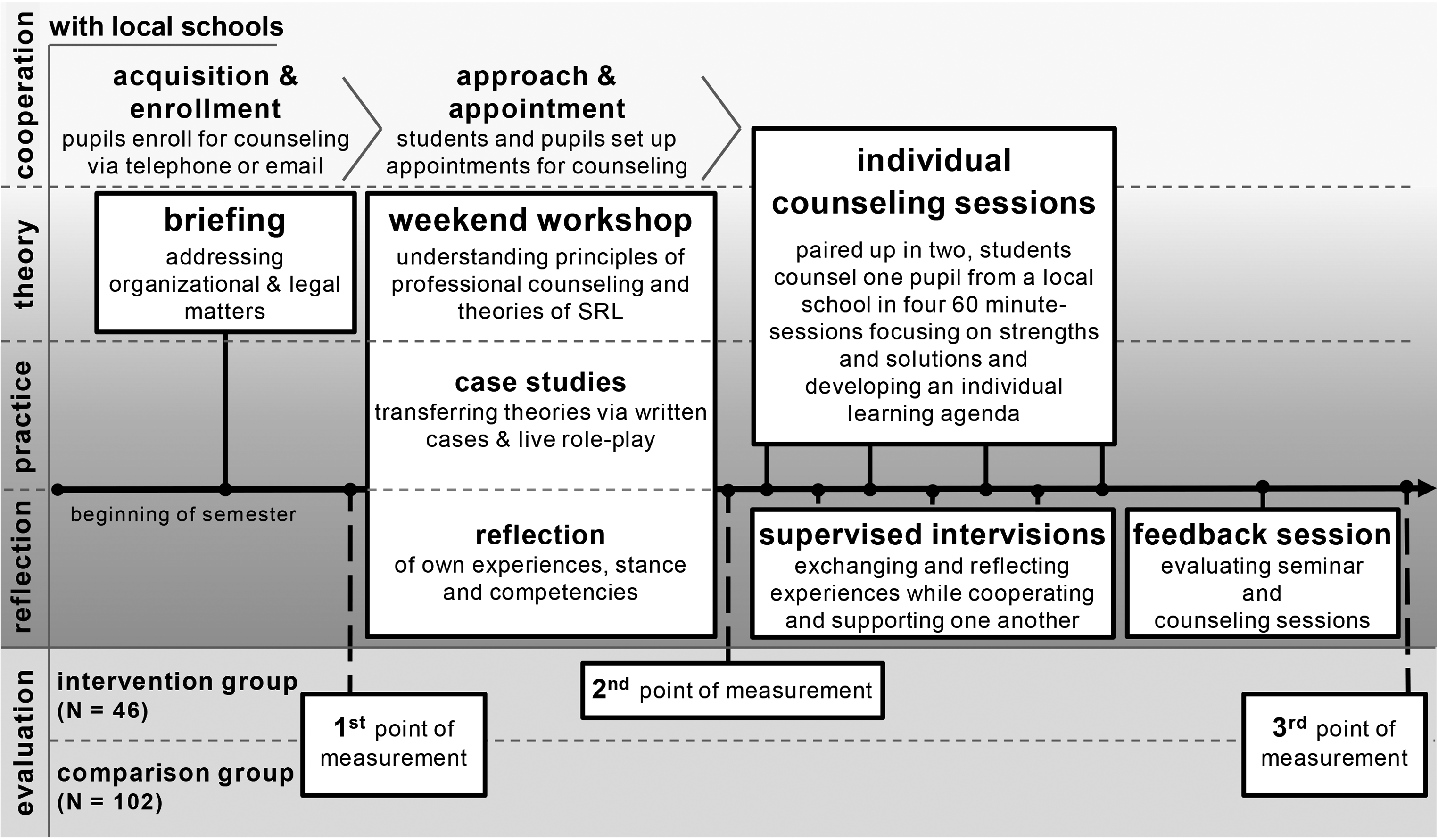
Seminar structure and evaluation design.
As Cranney and Dunn (2011) argue, knowledge and an appreciation of the scientific method to gain such must come before a value-driven application in the sense of psychological literacy. Consequently, preservice teachers, first, acquire necessary psychological knowledge. Specifically, to understand the process of and the conditions for successful self-regulated learning (SRL), the preservice teachers work with the process-model by Schmitz and Schmidt (2007) and the layer model of self-regulated learning by Boekaerts (1999), as cited in Perels et al. (2020). The preservice teachers, also, discuss and engage in core humanistic-systemic counseling skills such as active listening and resource- and solution-oriented questions in order to be able to guide their pupils through the counseling sessions which are conceptualized as a five-step problem-solving process (Bamberger Counseling Model, see Drechsel et al., 2019). Then, by conducting counseling sessions with pupils on how to optimize their self-regulated learning, the preservice teachers apply their psychological knowledge to a pedagogical setting and can connect course material to their own and their pupils’ lives. They thereby bring “psychology to life” and also “life to psychology” which may boost preservice teachers’ instrinsic motivation to learn (Hulme, 2014) and their personal sense of agency.
During the course of the semester, the preservice teachers approximate authentic praxis step by step (Grossmann et al., 2009) from real-life case vignettes to live role play during the weekend workshop, planning the counseling sessions and finally, conducting four counseling sessions with one pupil. At the end of the weekend workshop, the preservice teachers get the contact details of their respective pupil and then set up the first counseling session within the following 2 weeks. Each of the four individual counseling session lasts 60 minutes and usually takes place biweekly, thereby, giving pupils enough time to consolidate and to try out newly gained ideas while also giving preservice teachers enough time to reflect, discuss and coordinate with their peers and to plan the next counseling session. Since a cycle of self- and other observation in practice settings and feedback loops can help to develop a reflective stance (Kayapinar, 2016), the preservice teachers are instructed to reflect in a learning journal and during regular intervision sessions with their peers and lecturer, which are planned between the counseling sessions (Figure 1). For a detailed description of the preparation for and content of the counseling sessions, see Horn et al. (2021).
The overarching learning goal of the seminar is to improve the preservice teachers’ psychological literacy operationalized (a) as the implementation of the psychology of counseling and self-regulated learning (SRL) into practice and (b) as the reflection of one's own and other's behavior and mental processes while collaborating with their peers. As established in the beginning, (future) teachers need psychology (Dutke et al., 2019), yet, there are challenges that come with the teaching of psychology to non-psychologists, such as the fit between the psychology curriculum and its respective professional workfield or a possible transgression of expertise (Hulme, 2019). Consequent implication for the conceptualization of our seminar to align psychology knowledge with the characteristics and requirements of teachers’ professional field of application was, for instance, that school psychologists who are graduated school teachers as well as graduated psychologists, designed and deliver the content of the seminar and the counseling sessions. Besides, as demanded by Hulme (2019), the seminar explicitly addresses and raises awareness to the (future) teachers’ fields and boundaries of psychology expertise. Specifically, the preservice teachers learn and reflect on when and where they have the competence to teach, counsel and to mentor (e.g., questions on learning strategies, motivation, school career) and when they are responsible to consult and refer to professional psychologists (e.g., severe mental health issues).
Research Questions and Hypotheses
In a previous study by Horn et al. (2021), qualitative analyses of students’ learning journals have shown the perceived complex, yet rewarding and instructive character of a counseling practice task and alluded to the potential of fostering certain attributes of psychological literacy through such a practice experience. With a quasi-experimental pre-posttest design with comparison group, the presented study investigates the effects of the practice intervention on the preservice teachers’ psychological literacy. Particularly, we looked at three facets of psychological literacy as introduced earlier: reflexivity, beliefs about the theory–practice relationship (beliefs) and agency.
The following hypotheses were examined:
Method
Sample
In total, 148 preservice teachers took part in this study. Of which 46 who participated in the theory–practice seminar are part of the intervention group (MAge = 25.5, SD = 5.6; 91% female). The preservice teachers from the intervention group voluntarily chose the theory–practice seminar amongst other seminars as part of their educational studies in psychology and gave informed consent to participate in the survey. The sample was collected over three consecutive semesters. As depicted in Figure 1, the preservice teachers filled in a questionnaire at three points of measurement: at the beginning of the semester (pre), at the end of the theory weekend-workshop, which prepares the preservice teachers for their practice task (post 1) and after the practice task, that is, counseling sessions (post 2). The comparison group consists of 102 preservice teachers (MAge = 22.70, SD = 3.34; 85% female) who attended regular courses of psychology, yet, without this practice experience. All participants were duly provided with comprehensive informed consent, and their involvement in the study was voluntary.
Measures
The data in the intervention group were collected via a paper–pencil questionnaire, whereas the comparison group filled in an (identical with some exceptions as stated below) online questionnaire. To investigate the hypotheses, we used various tools to evaluate the students’ reflective practice by assessing reflexivity as well as levels of reflection, beliefs about the theory–practice relationship, and agency. Furthermore, motivation to learn was collected as control variable.
Reflexivity
To assess the preservice teachers’ self-assessed reflexivity, respondents indicated the extent to which they agree with each of nine items by Reinders (2016), which is an adaption of the scale by Eyler and Giles (1999), on a 4-point Likert-type scale (1 = “strongly disagree” to 4 = “strongly agree” 1 ). The reliability coefficients of the scale were between α = .74 and .81. A sample item from the scale is “I try to explain my experience through my theoretical knowledge.”
Levels of Reflection
Participants of the intervention group filled in a questionnaire to assess the depth of reflection (Reinders, 2016) on four different levels 2 after the theory (post 1) and after the practice task of the seminar (post 2). This scale was not administered in the comparison group, because the questions specifically refer to experiences with case studies or with counseling sessions during the seminar. The four levels were addressed as follows: On level 1 (describing the situation), the preservice teachers were asked “Please describe one situation of a written or video-based case study that you particularly recall from the seminar (post 1)” or “Please describe one situation that you particularly recall from your practice experience (post 2).” Afterwards, the preservice teachers indicated the extent to which they agree with each of seven items on a 4-point Likert-type scale, that is, “Through the case study (post 1)/practice task (post 2), I noticed differences between theory and practice” (α = .83 and .69). To assess reflection level 2 (describing thoughts and feelings), the preservice teachers received the instruction “The following questions refer to the observation of pedagogical situations (e.g., in videos or in the role of an observer during the practice task)” and rated their extent of agreement with each of eight items on a 4-point Likert-type scale, e.g., “I can easily recollect my feelings” (α = .80 and .87). Level 3 (evaluating situation based on theory) included ten items. A sample item from the scale is “Theories help to better understand the pedagogical situations which I experienced” (α = .90 and .89). Level 4 (evaluating options for agency) included nine items (e.g., “Theories help to find solutions for practice-specific problems” (α = .88 and .87).
Beliefs About the Theory–Practice Relationship
To measure preservice teachers’ beliefs about the theory–practice relationship, we used the scale by Niggli (2004). Its five items reflect the importance of theories for teaching practice. A sample item from the scale is “Extensive scientific knowledge is important for coping with everyday school life.” All items were rated on a 4-point Likert-type scale. The scale's reliability coefficients were between α = .74 and .83.
Agency
To measure preservice teachers’ agency, we used the five-item-scale by Reinders (2016) (e.g., “I think that I make an important contribution through my studies”). Respondents were asked to indicate the extent to which they agreed with each item on a 4-point Likert-type scale. The reliability coefficients of the scale were between α = .82 and .86
Motivation to Learn
As a control variable, we assessed general motivation to learn at the first measurement point with a scale comprising 13 items by Reinders (2016). A sample item from the scale is “I work and learn in my field of study because I enjoy it.” The reliability coefficients of the scale was α = .78
Analyses
Statistical analyses were performed with the Statistical Package for the Social Sciences (SPSS) version 26. First, t-tests for independent samples were used to examine the differences between the intervention and comparison group at the first measurement time point. The change in self-assessed reflexivity, beliefs about theory–practice relationship, and agency within the intervention group was examined using a one-factor analysis of variance with repeated measures at the first and third measurement time points. Post-intervention group differences (Hypothesis 1, effectiveness of the intervention) were tested using multiple linear regression, which allows multiple predictors to predict changes (Cohen et al., 2003). The dependent variable was posttest 2 (third measurement time point), and the independent variables were pretest (first measurement time point), group membership (1 = intervention group, 0 = comparison group), and motivation to learn. To test Hypothesis 2a, b, and c (effects of the theory part and the practice task), single-factor analyses of variance with repeated measures were performed in the intervention group. t-Tests for paired samples were carried out to examine the differences between the levels of reflection in the intervention group (Hypothesis 3). All calculations were based on a significance level of p < .05.
Results
Descriptive Results
Table 2 shows the descriptive results at all three measurement time points. In the pretest, the intervention group's mean values of reflexivity, beliefs about theory–practice relationship and agency were all in the upper range of the 4-point Likert scale. Also, they were slightly higher than the comparison group's mean values, respectively. In the intervention group, mean values of reflexivity, beliefs about theory–practice relationship and agency increased from pretest to posttest 2, yet, the mean value of agency was higher in posttest 1 than in posttest 2. Whereas, in the comparison group, the mean value of reflexivity in the pretest was identical to posttest 2 and the mean values of beliefs about theory–practice relationship and agency marginally increased from pretest to posttest 2. All mean values of the four levels of reflection in posttest 1 and posttest 2, which were only measured in the intervention group, were in the upper range of the 4-point Likert scale. Except for level 2, there was an increase from posttest 1 to posttest 2 in the mean values of the other three levels.
Descriptive Results.
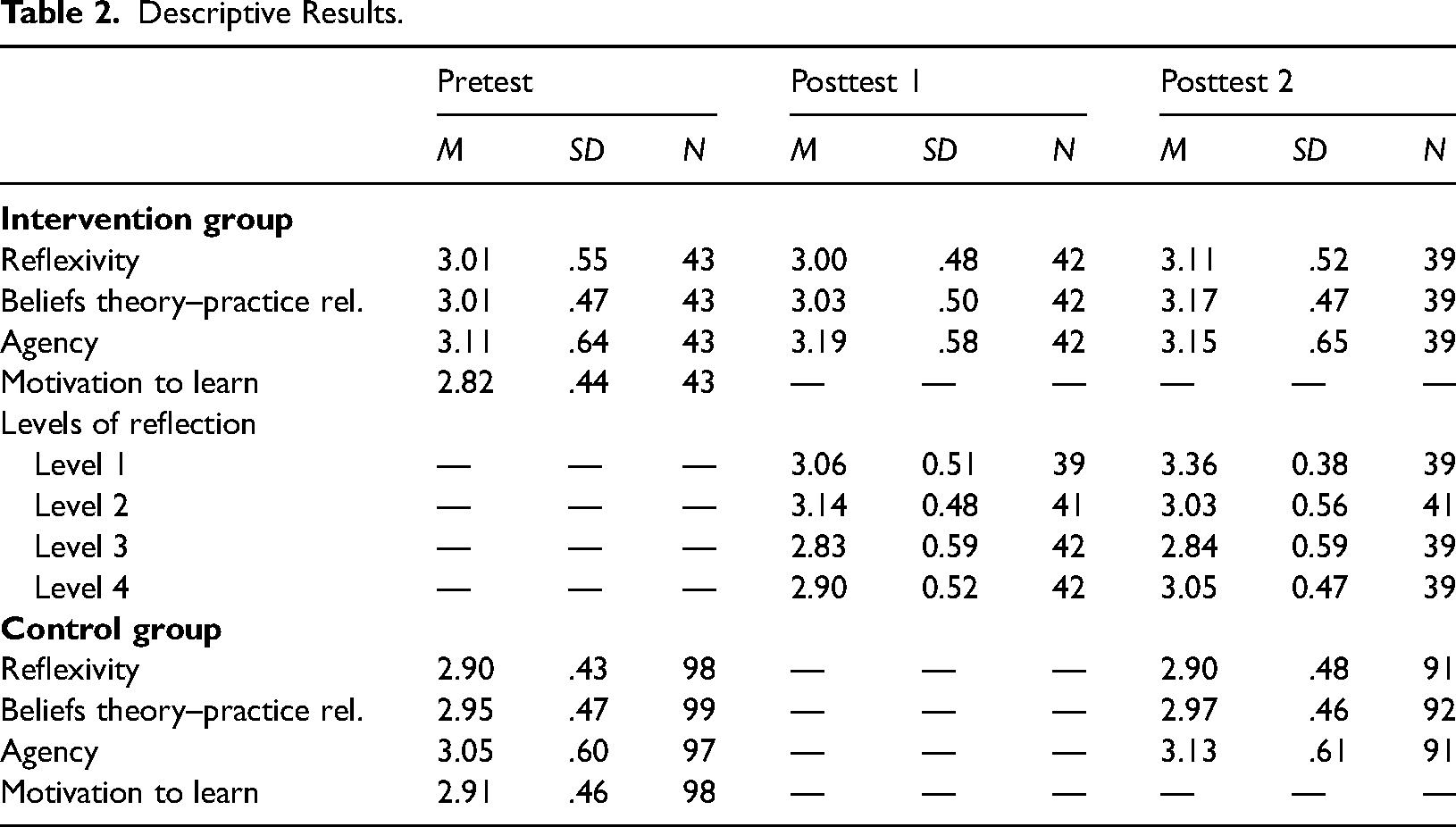
t-Tests for independent samples were used to examine the differences between the intervention and comparison group at the first measurement time point. We didn’t find statistically significant differences between the two groups on reflexivity [t(139) = -1.84, p = .07], beliefs about the theory–practice relationship [t(139) = -0.75, p = .46], agency [t(138) = -0.56, p = .58], and motivation to learn [t(138) = 1.07, p = .29].
The change in reflexivity, beliefs about theory–practice relationship and agency within the intervention group was examined using a one-factor analysis of variance with repeated measures at the first and third measurement time points. The results of the repeated-measures analyses of variance showed significant improvements in the intervention group from the first to the third measurement time point for beliefs about the theory–practice relationship (F(1, 35) = 6.04, p = .02, partial η2 = .15) but not for reflexivity (F(1, 35) = 2.41, p = .13, partial η2 = .07) and agency (F(1, 35) = 0.18, p = .89, partial η2 < .01).
Post-Intervention Group Differences
A comparison of group differences to test for intervention effects (Hypothesis 1) was conducted using multiple linear regressions including pretest scores (see Cohen et al., 2003). Motivation to learn was included as a control variable. Regarding beliefs about theory–practice relationship, pretest assessment (β = .64, p < .001) and group membership (β = .15, p = .037) were found to be significant predictors of the criterion variable beliefs about theory–practice relationship posttest assessment (see Table 3). Hypothesis 1a can be accepted: the beliefs about theory–practice relationship of intervention participants are significantly higher than in the comparison group when controlling for pretest scores.
Post-Intervention Group Differences.
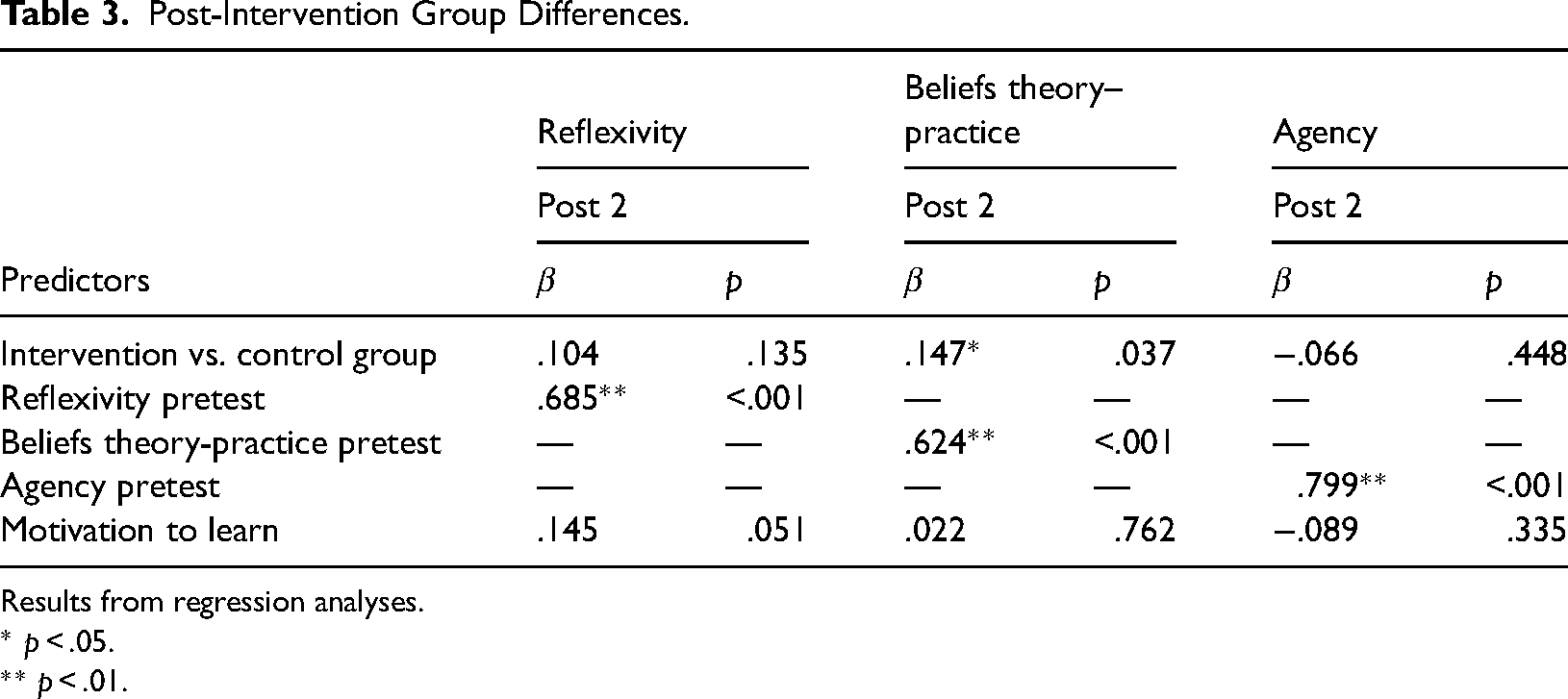
Results from regression analyses.
* p < .05.
** p < .01.
Regarding reflexivity, pretest assessment (β = .69, p < .001) was found to be a significant predictor of reflexivity posttest assessment but not group membership (β = .10, p = .014) (see Table 2). Hypothesis 1b must be declined. Regarding agency, pretest assessment (β = .78, p < .001) was found to be a significant predictors of agency posttest assessment but not group membership (β = -.067, p = .45) (see Table 3). Hypothesis 1c must be declined.
Changes in the Intervention Group
The examination of the changes in the intervention group, taking into account all three measurement points (separate consideration of the theoretical and practical parts), was carried out with single-factor analyses of variance with repeated measures. It was assumed that the dependent variables (a) beliefs, (b) self-assessed reflexivity, and (c) agency of the intervention participants would increase in particular after the practice task of the intervention and not after the theory part (Hypothesis 2). For beliefs about theory–practice relationship, there was a significant main effect (F(2,68) = 5.34, p = .01, partial η2 = 0.14). Post-hoc tests showed that significant changes were only detectable from the first to the last measurement time point (mean difference: −0.18, 95% CI [(-.33) – (-.02)], p = .02) and from the second to the last measurement time point (mean difference: −0.17, 95% CI [(-.33) – (-.01)], p = .04) with a medium effect size. From the first to the second measurement time point (between which the theory part took place) the beliefs about theory–practice relationship did not change significantly in this respect (p = 1). Hypothesis 2a can therefore be accepted, since a significant difference in beliefs about theory–practice relationship was found after the practice task, whereas no change was shown after the theory part. For reflexivity (F(2,68) = 2.50, p = .09, partial η2 = 0.07) and agency (F(2,68) = 2.22, p = .12, partial η2 = 0.06), we didn’t find significant main effects. Hypothesis 2b and c must be rejected. We analyzed the statistical power post-hoc for repeated-measures ANOVA with three measurement points using G-Power (Faul et al., 2007). The results revealed a test power of .95 (α = 0.05, N = 35, medium effect size), indicating a high likelihood of correctly identifying a genuine effect or pattern in the data, given that such an effect exists.
t-Tests for paired samples were used to examine the differences between the levels of reflection in the intervention group (Hypothesis 3). We expected that the participants will have more reported skills in higher levels of reflection after the practice task compared to before. Results show that the practice task statistically significantly increases participants’ level 1 and level 4 of reflection. Mean level 1 of reflection was .31 (95% CI [.13, .49]) higher after the practical part, t(98) = 3.51, p < .001, d = .52. Mean level 4 of reflection was .17 (95% CI [.05, .30]) higher after the practice task, t(98) = -2.85, p = .004, d = .37. In Level 2 (describing thoughts and feelings) and level 3 (evaluating situation based on theory), there were no significant changes after the practice task. Hypothesis 3 can be accepted, since the participants show an increase in level 1 (describing the situation) and level 4 (evaluating options for agency) which constitutes the highest level of reflection.
Discussion
An important goal of university teacher training is to increase psychological literacy of future teachers. Learning formats that aim to develop psychological literacy often use interactive methods such as placement, volunteering or work based learning (see Taylor & Hulme, 2015, 2018). By combining both theoretical knowledge and hands-on practice, these approaches help individuals gain a deeper understanding of psychology and how it can be used in real-life situations. However, little is known about the effectiveness of interventions and their components. In particular, the question remains open to what extent the theoretical and practical components of the qualification measures have an impact on the acquisition of psychological literacy of preservice teachers.
The aim of this study was to analyze the effects of a practice task within a theory–practice learning setting on preservice teachers’ reflexivity, beliefs about theory–practice relationship and agency as operationalized attributes of psychological literacy. With a pretest–posttest comparison group design, we wanted to determine if a seminar, which embeds direct service-learning (Bringle et al., 2016b), is a better learning format compared to other formats without practice experience to foster the integration of theory and practice in preservice teachers. Does a thoroughly prepared, closely guided and repeatedly reflected service-learning activity help preservice teachers to incorporate psychological theory into their practice experience and vice versa? Therefore, we conceptualized, conducted and evaluated a seminar that teaches field specific psychological knowledge (theory) and then mentors participants while they apply their psychological knowledge to a real-life counseling setting (practice) in the community. In a previous study, qualitative analyses of the preservice teachers’ learning journals revealed that the practice task is perceived as a demanding and complex, yet motivating and rewarding learning setting (Horn et al., 2021). Also, the results alluded to the seminar's potential of fostering self- and other reflections as well as the successful application of counseling theories into professional counseling as attributes of psychological literacy.
The findings of our study show a statistically significant increase in the intervention group's beliefs about theory–practice relationship compared to the comparison group. There were no effects for agency and reflexivity, however, reflexivity slightly increased after the practice experience, but the results are not on a significant level. Additionally, we found that participants reach higher levels of reflection through the practice task.
Based on the theoretical assumption that practical elements like work-integrated or service-learning experiences have a great potential for the development of students’ psychological literacy (Cranney et al., 2022), it was hypothesized that the practical intervention part would be crucial in promoting reflexivity, beliefs about theory–practice relationship and agency. Taking a closer look at the mode of action, students’ beliefs about theory–practice relationship and the levels of reflection only increased after the counseling sessions, whereas no change was observed after the theory part. Thus, the results substantiate the assumed capability and superiority of the service-learning experience.
This study indicates that the practice task within a theory–practice seminar might enable preservice teachers to better integrate theory and practice towards their professional development. Preservice teachers showed an increase in reflection-level 1 (describing the situation) and level 4 (evaluating options for agency), meaning they agreed more on the practical relevance of theories when reflecting on current and future professional situations and challenges. In level 2 (describing thoughts and feelings) and level 3 (evaluating situation based on theory), there were no significant changes after the practice task. The fact that there were only changes in level 1 and level 4 could be ascribed to the seminar's focus on learning how to decode, describe and analyze the pupil's current situation (level 1) in order to then transfer theory into well-founded ideas to support the pupil in reaching their respective learning goal (level 4).
In addition, preservice teachers’ beliefs about the relationship between theory and practice significantly changed; they allocated greater importance and relevance to theory once they had been confronted with practice and had to act on their own responsibility in a professional context. The degree to which preservice teachers allocate usefulness to theory for practice is known to be a relevant precondition for quality learning and teaching (Donche & Van Petegem, 2009) and the openness to theory is essential for reflective teaching and to develop a higher sense of self-efficacy (Hascher & Hagenauer, 2016). While, the mentored four counseling sessions within one seminar is just a very short intervention compared, for example, to the teaching practicum, this reduced version of one essential future core practice offers preservice teachers a micro learning setting. Preservice teachers apply psychological knowledge to real-life in the sense of psychological literacy and thereby reflect and deal with the integration of theory and practice. In order to “intentionally and adaptively use psychology” (Cranney et al., 2012) in new contexts, one needs psychological knowledge that is theoretically founded and practically flexible at the same time. The practice task could help to break preservice teachers’ resistance to refer to theory when reflecting and adapting their own teaching practices (Allen & Wright, 2014) and, thus, paving the way for subsequent learning experiences in the academic curriculum or the in-service training phase of teacher education.
Even though, our study provides valuable support for the implementation of practice learning settings into preservice teachers’ curriculum, there are limitations to our study design that should be addressed. For instance, a bigger sample in the intervention group and additional objective measures to collect data on reflexivity and agency could help to get a clearer picture and to capture smaller effects as well. Also, since data was collected over three semesters it is almost impossible to prevent slight irregularities and to ensure comparability, even with a standardized and scripted procedure of the seminar's content and structure. Furthermore, the quasi-experimental design of the study limits the interpretation of the findings. Since participation in the seminar was on a voluntary basis, self-selection effects could have led to systematic differences between the groups. For example, one can assume that participating students show a stronger interest in the seminar topics than students in the comparison group. The comparison group was only questioned twice. Finally, a clear differentiation between the mere effects of the theory vs. practice part of the seminar on our results is limited due to the seminar's structure: preservice teachers necessarily have to engage with theory, as it is part of their mandatory preparation for the practice task. Consequently, it is hard to determine whether the practice experience itself or the combination of theory and practice causes the increase in preservice teachers’ beliefs about theory–practice relationship.
Next Steps
In this study, we shed some light on the immediate effects of a practice experience on preservice teachers’ beliefs and reflexivity. It would be interesting to implement a follow-up study and to analyze if and how the increase in perceived relevance of theory and the deeper reflection of theory and practice will be effective over time and might even be transferred into other learning settings.
Footnotes
Declaration of Conflicting Interests
The authors declared no potential conflicts of interest with respect to the research, authorship, and/or publication of this article.
Funding
The authors disclosed receipt of the following financial support for the research, authorship, and/or publication of this article: This work was supported by the Bundesministerium für Bildung und Forschung,
