




Abstract
This report illustrates the didactical concept and implementation of a theory–practice learning setting where preservice teachers counsel pupils from local schools on their self-regulated learning. The learning setting is part of the preservice teachers’ psychology curriculum embedded in their educational foundation studies and aims at fostering preservice teachers’ psychological literacy; specifically, to reflect their own and other’s behavior and to apply their psychological knowledge of learning and counseling principles into real-life counseling sessions. Besides describing the motivation behind the structure and content of the theory–practice learning setting, the report discusses results of a first qualitative analysis of the preservice teachers’ learning journals, which function as a reflection tool and are part of the overall evaluation design. Results indicate that the practice task (counseling session) is a complex and demanding, yet instructive and rewarding, learning setting that fosters certain attributes of psychological literacy. Practical implications and further research endeavors are discussed.
Keywords
Introduction
Teaching psychology in university teacher training often focuses on establishing content knowledge in traditional learning formats like lectures. Yet, university teacher training rarely looks at how students use psychological content for their personal and professional development in the sense of cultivating psychological literacy. There are multiple definitions of psychological literacy (Newstead, 2015) and different approaches to operationalize its attributes (Newell et al., 2020). In this report, we relate to the two most cited definitions by Cranney et al. (2012) and McGovern et al. (2010). According to Cranney et al. (2012), psychological literacy is the general capacity to adaptively and intentionally apply psychology to meet personal, professional, and societal needs. Following Hulme (2014), who states that such an application of psychology is possible wherever people are involved, we attribute enormous potential to establishing psychological literacy specifically in preservice teachers as future agents of education, due to its impact on pupils and society as a whole. School and university teachers are in a unique position to make multiple areas of psychology accessible to society by propagating psychology to their pupils and students in order to help them become psychologically literate citizens. For example, teachers apply principles of learning and social psychology such as setting learning goals, fostering motivation, or helping to successfully deal with group dynamics in the school setting. Hence, teachers can be suited to give psychological literacy a large platform early on.
We conceptualized a theory–practice seminar as a learning setting in which German preservice teachers are requested to apply psychological theories of learning by counseling pupils from local schools on how to optimize their self-regulated learning (SRL). Throughout the theory–practice setting, the preservice teachers keep a learning journal to engage in self- and other reflection, since McGovern et al. (2010) describe a psychologically literate person among eight other attributes as “being insightful and reflective about one’s own and other’s behavior and mental processes.” In this report, we introduce the didactical concept of our seminar and discuss first results from the analysis of the preservice teachers’ learning journals.
Fostering Counseling Skills, Self-Regulated Learning and Reflection
The seminar is embedded within a project 1 that conceptualizes and facilitates learning settings in which preservice teachers learn about, reflect on, and practice their future task to counsel pupils, parents, and colleagues as part of their official scope of responsibilities (Kultusministerkonferenz, 2004). In the German education system, counseling is an inherent part of the teacher’s everyday job 2 and their professional competence as it is theoretically embedded in the COACTIV model of professional competence by Baumert and Kunter (2013). Thereby, in their daily professional activities, teachers most commonly counsel on learning and learning difficulties, pupils’ educational career, and behavioral problems (Hertel et al., 2009).
Our seminar addresses how to individually counsel and support pupils in their learning, with the aim to foster preservice teachers’ counseling skills and their understanding of SRL. In terms of psychological literacy, preservice teachers are guided to apply the psychology of counseling and SRL-learning as “critical subject matter[s] of psychology” (McGovern et al., 2010, p. 11) to meet the professional (and societal) need of supporting pupils’ learning.
SRL is the selected subject matter of the counseling task because it is highly relevant for pupils’ and students’ achievements (Broadbent & Poon, 2015; De Bruijn-Smolders et al., 2016; Glaser et al., 2009; Leutner & Leopold, 2005; Steuer et al., 2015) and is considered an ultimate goal for learners in general (Council of the European Union, 2002). In order to effectively teach techniques of SRL, preservice teachers must have the ability and opportunity to apply principles of SRL to the field in addition to a secure knowledge of the domain being taught (Mihalca & Mengelkamp, 2020). University learning settings rarely bridge the gap between preservice teachers’ knowledge about SRL and actually fostering pupils’ SRL skills. Our seminar’s theory–practice learning setting gives us the opportunity to analyze (1) how preservice teachers deal with conveying SRL to pupils and, particularly, (2) how they reflect on their experiences. John Dewey (1933) defines reflection as consciously thinking about or challenging past and present action, beliefs, or knowledge with the intention to learn or to inform future practice (Richert, 1990). The ability to reflect on one’s own behavior and experiences is crucial for professional development in any field of psychology (American Psychological Association, 2010) as well as in teaching (Baumert & Kunter, 2013; Von Felten, 2005). Models define the reflective practitioner as someone who adopts a reflective stance toward their practice as a means of on-going professional development (Reis-Jorge, 2007). Development of this stance can be achieved via a cycle of self- and other observation in practice settings and feedback loops (Kayapinar, 2016) which are embedded in our didactical concept.
Structure and Didactical Concept of the Theory–Practice Seminar
As displayed in Figure 1, the structure of the theory–practice learning setting entails four levels (cooperation with local schools, theory, practice, reflection) intertwining and laying the foundation for a thoroughly prepared, mentored, and reflected learning experience in order to achieve the goals explicated above. In the following, it is explained who takes part in the counseling settings, how preservice teachers are prepared and equipped for their practice task (counseling sessions), how they are supervised and mentored, and, finally, how their learning experience is being documented.
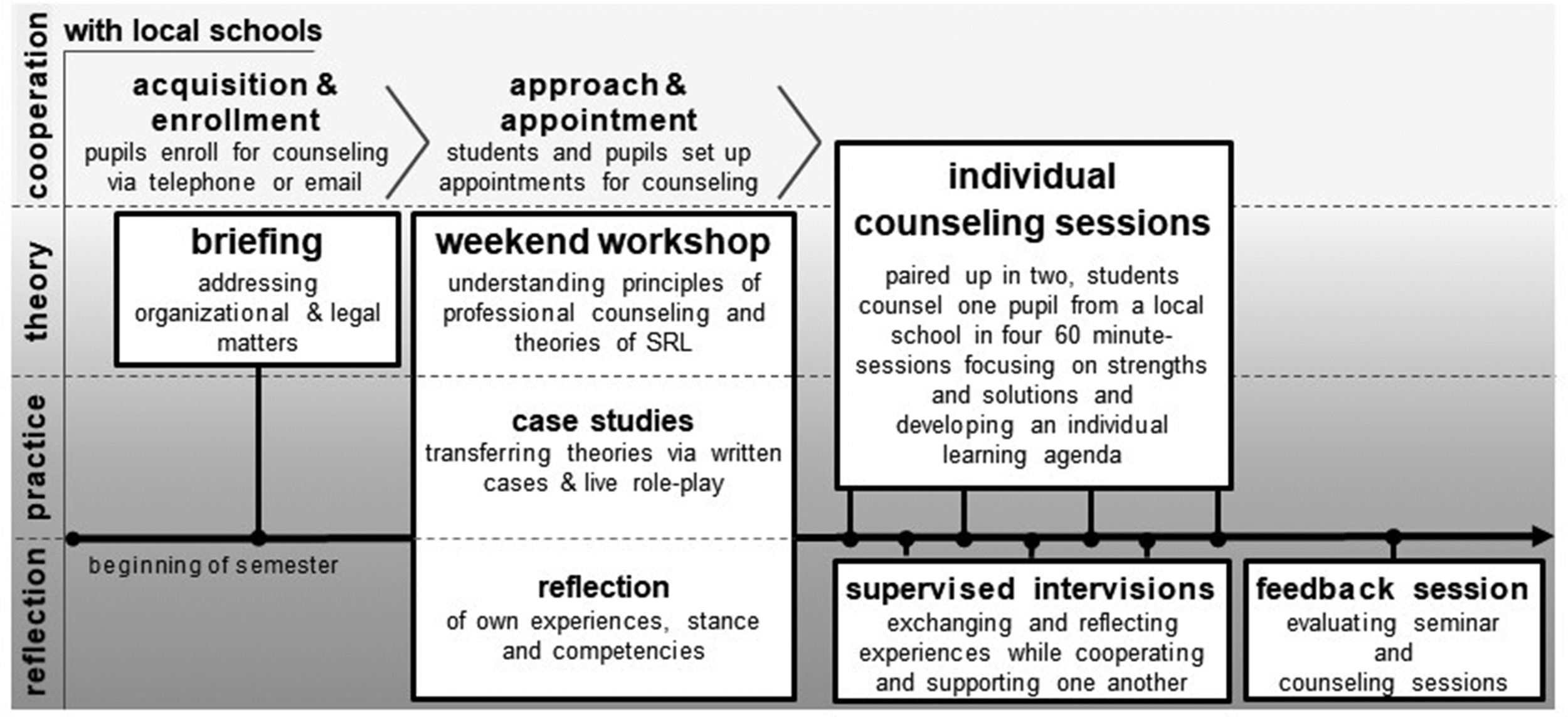
Seminar Structure and Content
Who Counsels Whom? Facilitating the Practice Experience in Cooperation With Local Schools
The seminar’s exceptional characteristic is the interaction between preservice teachers and pupils from local schools. The preservice teachers pair up, and each pair counsels one pupil each over a period of 8 to 10 weeks in four 60-minute sessions. Since individual concerns, behavior, and reactions of the respective pupils cannot be anticipated, the practice-experience constitutes a possible real-life situation. To facilitate the authentic encounters between preservice teachers (counselors) and pupils (counselees), we cooperate with teachers from several local secondary schools who promote the counseling sessions to interested pupils and their parents. The counseling sessions are free of charge and take place in two rooms especially designated and furnished for counseling outside of school premises. When enrolling, pupils 3 leave their contact details for the respective preservice teacher pair to contact them. Each counseling pair consists of one counselor and one supportive observer; both are preservice teachers usually midway through or further advanced in their studies attending our seminar as part of their educational foundation studies.
How are Preservice Teachers Prepared and Equipped for Their Counseling Task?
The seminar starts with a briefing session introducing organizational and legal requirements (e.g., non-disclosure agreement) to ensure the preservice teachers’ commitment, since they will be working with real-life clients from partner schools. Moreover, the preservice teachers’ learning goals are introduced and from thereon function as a thread running through the seminar: preservice teachers are to improve their psychological literacy operationalized as knowledge and implementation of the psychology of counseling and SRL and as the reflection of one’s own and other’s behavior and mental processes while collaborating with their pair partner. At a weekend workshop, the preservice teachers acquire generic or field-nonspecific counseling skills and field-specific knowledge (e.g., self-regulated learning, especially, models and strategies to foster SRL) as the two necessary components of professional counseling defined by Nestmann and Sickendieck (2011). The generic counseling skills entail counseling as a reiterative five-step problem-solving process (Bamberg Counseling Model, see Drechsel et al., 2019) and the core humanistic-systemic counseling skills such as active listening and resource- and solution-oriented questions. Both counseling skills and SRL-field-specific knowledge are consolidated, first in case vignettes and later in role-play situations, to prepare students step by step for the authentic counseling session, as demonstrated in Figure 2 alongside the approximations of practice model (Grossman et al., 2009). According to Grossmann et al. (2009, p. 2079), the counseling sessions qualify as a “more complete integrated representation of practice” with a high degree of authenticity and full participation by novices.
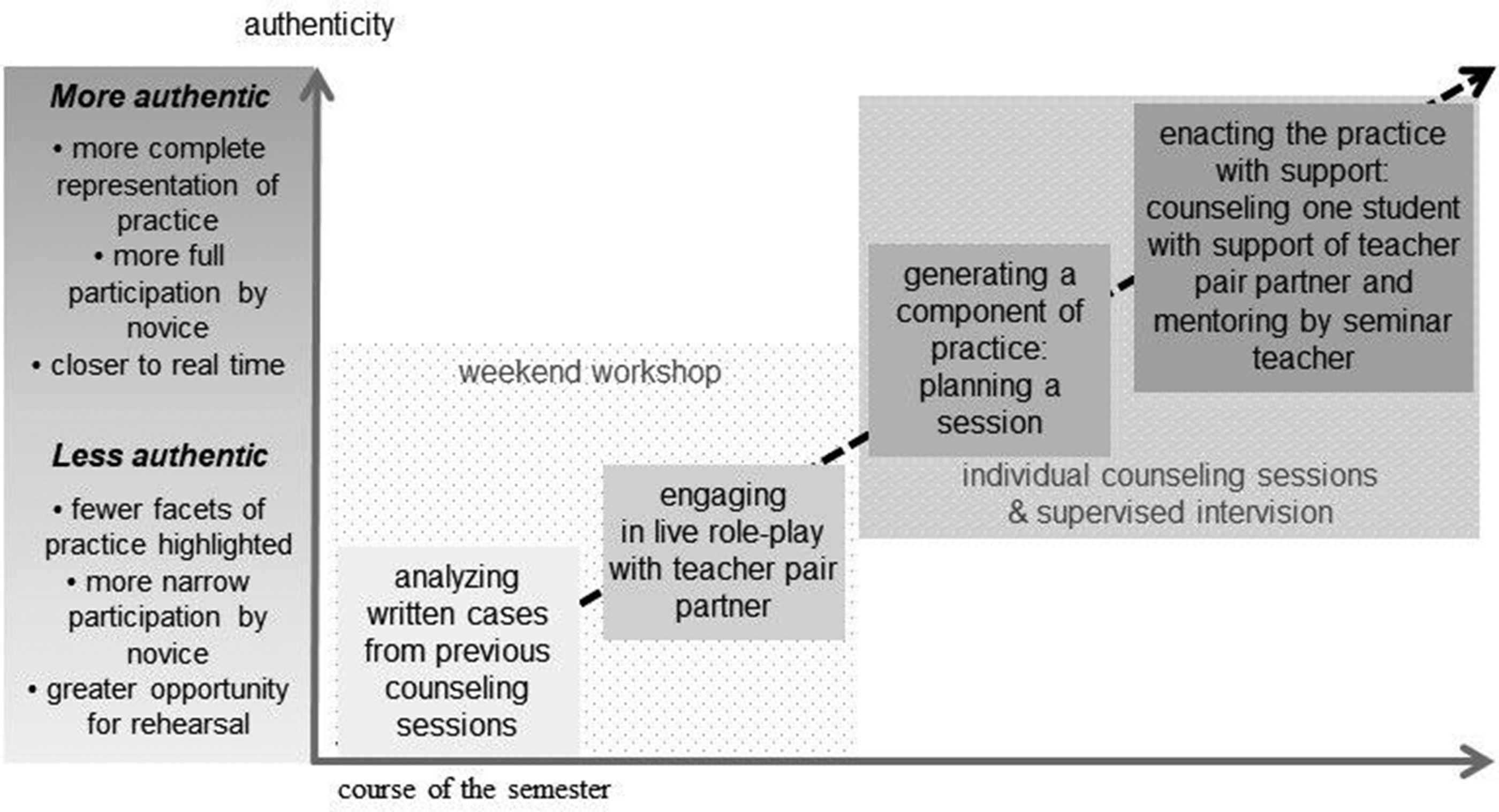
Degree of Authenticity in Seminar Task According to Approximations of Practice Model by Grossman et al. (2009)
By analyzing pseudonymized real-life case vignettes from previous counseling sessions, preservice teachers get a first impression of varying possible scenarios. In groups of four, preservice teachers formulate possible explanatory hypotheses for their case’s reported problem by applying models of SRL (i.e., they either choose the process-model of self-regulated learning by Schmitz & Schmidt, 2007 or the layer model of self-regulated learning by Boekarts, 1999, as cited in Landmann et al., 2015). They present their findings to the whole seminar group, where theory-based ideas on how to support each pupil are then collected and discussed. The seminar teacher moderates the discussion, checks for the quality of contributions, and adds further ideas, if necessary. In this exercise, the written cases narrow down the complexity of the counseling process to the field-specific knowledge of SRL as necessary background to successfully counsel pupils on their learning. To enhance counseling skills, the preservice teachers work in pairs and practice different parts of the counseling process in live role-play, such as establishing an open and appreciative relationship with the counselee and exploring his or her current learning situation. They are asked to explore each other’s learning path and current situation while focusing on active listening and asking solution-oriented questions. A detailed manual including the structure of each counseling session, examples of schedules, exact wordings, etc. accompanies the preservice teachers during the exercises, the preparation for, and the implementation of the counseling sessions. At the end of the workshop, the preservice teachers team up in pairs and take on the role of the counselor or the role of a friendly observer/critical friend. Each role comes with different assignments: as counselors, the preservice teachers are the main communicator and the person of reference for the pupil during the counseling sessions; as observers, the preservice teachers take a backseat and give feedback to their partner based on observer forms they fill in during each counseling session; both are responsible for the planning and organization of each counseling session.
Each pair of preservice teachers gets the contact details of one pupil and then arranges the first appointment. Among pupils’ most common reasons to enroll for counseling are difficulties with (1) upholding motivation and volition (metacognitive strategies), (2) learning content-specific strategies, for instance, vocabularies, (cognitive strategies), and (3) organizing learning at school and at home (resource-management strategies). Through asking solution-oriented systemic questions, the preservice teachers support pupils in their analysis, planning, maintenance, reflection, and evaluation of learning and mirror the phases of process-oriented models of SRL (cf. Landmann et al., 2015) in the counseling process. The structure and content of the four counseling sessions and their parallels to the process-oriented model of SRL are depicted in Figure 3.
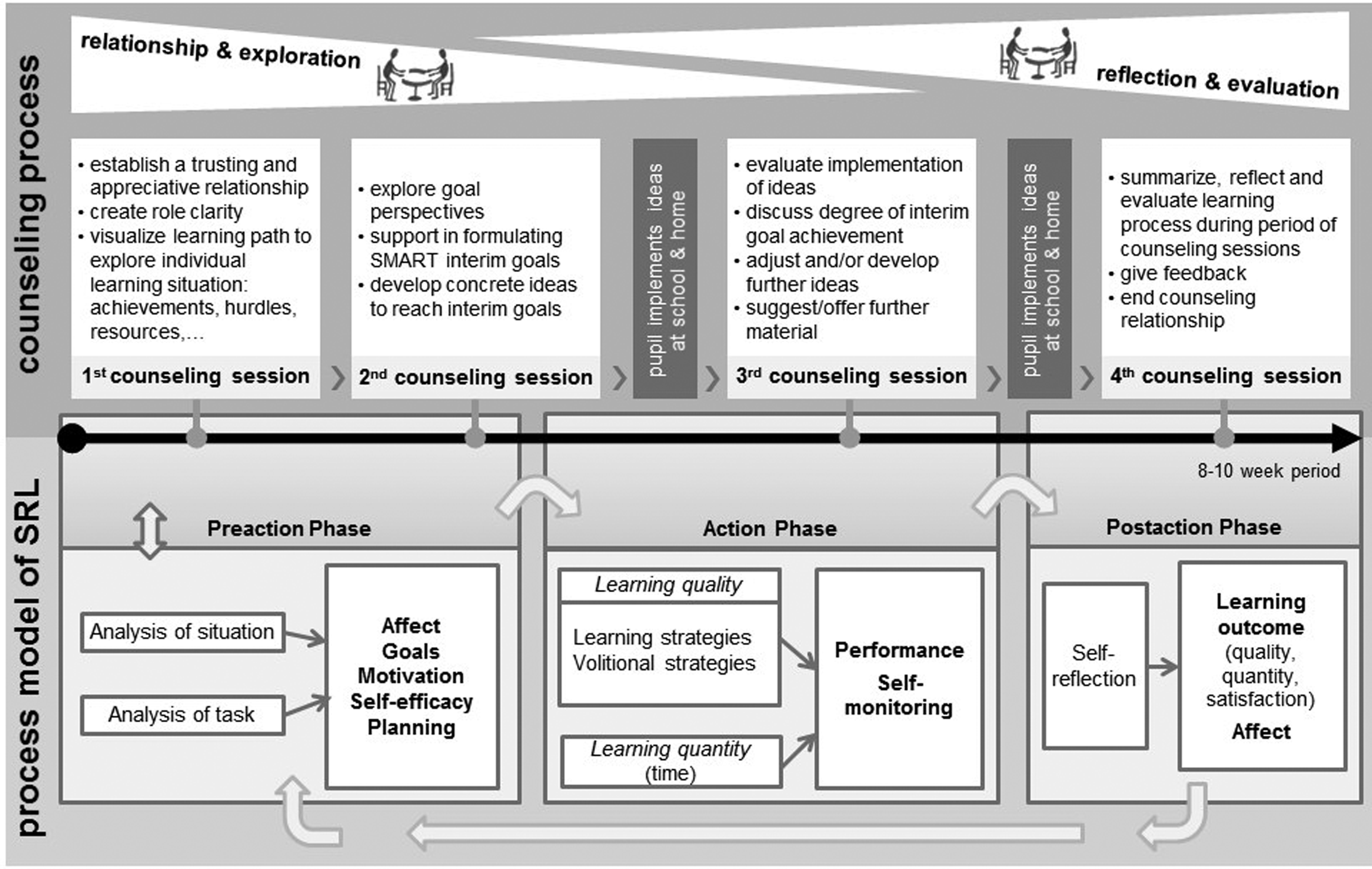
Counseling Sessions and Process Model of SRL
How are Preservice Teachers Mentored and Supervised Throughout Their Learning?
Throughout the counseling process, the preservice teachers take part in supervised intervision sessions in which they share their experiences, address questions, and co-construct their further course of action in the counseling process. Intervisions are scheduled in between each of the four counseling sessions to monitor and ensure the quality of counseling sessions and closely mentor and support the preservice teachers all through their practice learning. Next to reasons of quality management, the supervised intervision sessions as well as the work in pairs give preservice teachers an example of a productive scholarly exchange. Teacher cooperation can positively influence pupils’ performance and understanding (Egodawatte et al., 2011; Reeves et al., 2017), yet is often scarce (Steinert et al., 2006) or only revolves around conversation and exchange of ideas (Hargreaves & O’Connor, 2017). Creating a positive collegial culture among preservice teachers might, therefore, be beneficial for their future attitude towards cooperation (cf. De Jong et al., 2019). The preservice teachers are asked to jointly work in pairs in the sense of a deep-level collaboration (Vangrieken et al., 2015): they share the responsibility for the counseling process and plan, conduct, observe, and evaluate each counseling session as well as present and further develop their cases with the other teacher pairs during the intervision sessions. The final feedback session at the end of the semester completes the seminar: the preservice teachers again come together as a group, this time to amply evaluate the seminar and the counseling sessions, both openly and anonymously via a questionnaire.
How is the Preservice Teacher’s Learning Process Documented? Learning Journals as a Tool of Reflection and Evaluation
Over the course of the semester, preservice teachers keep learning journals on their experiences in both the seminar and the individual counseling sessions. The journals are used as a reflective tool to facilitate a structured reflection of learning experiences allowing for elaboration of their learning (Cazan, 2012) and contributing to the development of psychological literacy (Coulson & Homewood, 2016). Studies show that diaries as a tool of self-reflection enhance reflective competence, which is essential for applying psychological literacy (Halonen et al., 2011) and also have a positive effect on SRL (Dörrenbächer et al., 2018; Güvenc, 2010). On the other hand, the learning journals as they are handed in by the preservice teachers at the end of the semester are part of the overall evaluation design of the theory–practice learning setting (see Table 1).
Evaluation Design of Theory–Practice Learning Setting With Times of Measurement And Questionnaires
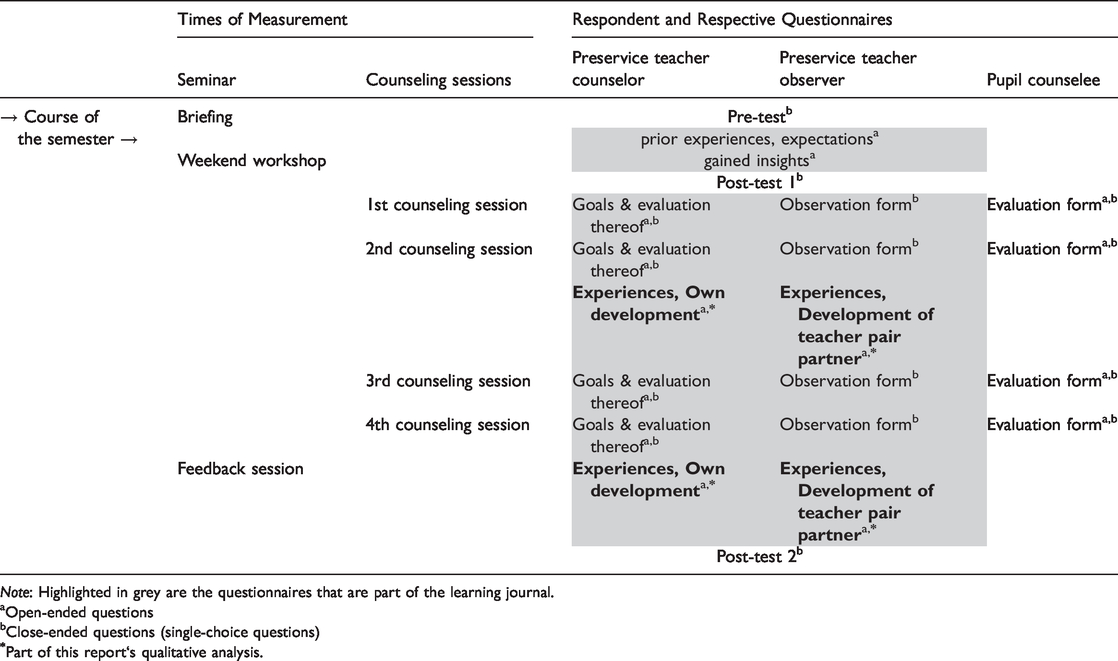
Note: Highlighted in grey are the questionnaires that are part of the learning journal.
aOpen-ended questions
bClose-ended questions (single-choice questions)
As preservice teachers take on different roles (counselor and observer) during the counseling sessions, some parts of the journals differ between the two groups. Whereas counselors are asked about the planning of counseling sessions and the setting and evaluation of their own counseling goals before and after each session, observers are given a set of observation forms. Each observation form includes a generic set of 35 items for field-unspecific counseling skills (e.g., “The preservice teacher counselor paraphrases the pupil’s statements.”) and four to five session-specific items (e.g., “The preservice teacher counselor supports the pupil in defining criteria to measure her/his goal achievement.”) to be answered on a four-point Likert scale (1= “strongly disagree”, 4 = “strongly agree”). Both journal versions also comprise open-ended questions of reflections, prompting, 4 for instance, general insights, personal development, and challenges encountered during the counseling process.
Research Question and Method
The aim of this first study is to explore the scale and manner in which preservice teachers exercise self- and other reflection as an attribute of their psychological literacy as defined by McGovern et al. (2010). More specifically, the study focuses on the experiences regarding the theory–practice learning setting preservice teachers predominantly reflect on in their learning journals. Besides, didactical implications and further research endeavors are discussed. In a first qualitative analysis, we examined the preservice teachers’ journal entries from two points of measurement: After the second counseling session and after the final feedback session, counselors were asked to draw an interim and final conclusion on their learning process (see appendix for exact prompts), while observers were asked to evaluate their partner’s development.
Results
In total, 672 statements from 35 learning journals from participating preservice teachers (M = 22.83; 82.9% female) were collected over three university terms. Data from counselors (nc = 20) and observers (no = 15) were analyzed, coded, and categorized with MAXQDA (2020). Unfortunately, not all learning journals are submitted at the end of the semester, since it is voluntary for the participating preservice teachers to do so. Thus, the sample is unevenly distributed between counselors and observers. Initially, both groups were separately analyzed, but subsequently re-integrated, as counselor and observer results did not significantly differ from each other either in scope or distribution of topics reflected. According to qualitative content analysis (Mayring, 2014), categories were formed along preservice teachers’ learning goals comprising psychological literacy operationalized as counseling skills, knowledge and implementation of SRL as well as reflection and cooperation between teacher pair partners. During the coding process, we formed further categories when statements went beyond or differentiated pre-determined learning goals. Categories containing less than three statements were omitted from the analysis as well as statements that are “descriptive writing” (Hatton & Smith, 1995, p. 48) because, for example, they do not reflect but solely describe the use of counseling techniques. Data analysis was performed by up to four researchers and research assistants, all of whom were familiar with the didactical setting of the counseling sessions and the principles of SRL and counseling. The coding results were compared for agreement and showed substantial inter-rater reliability (Cohen’s κ = .830, p < .0005). In the end, the statements dealing with preservice teachers’ reflections spread into the categories depicted in Figure 4.
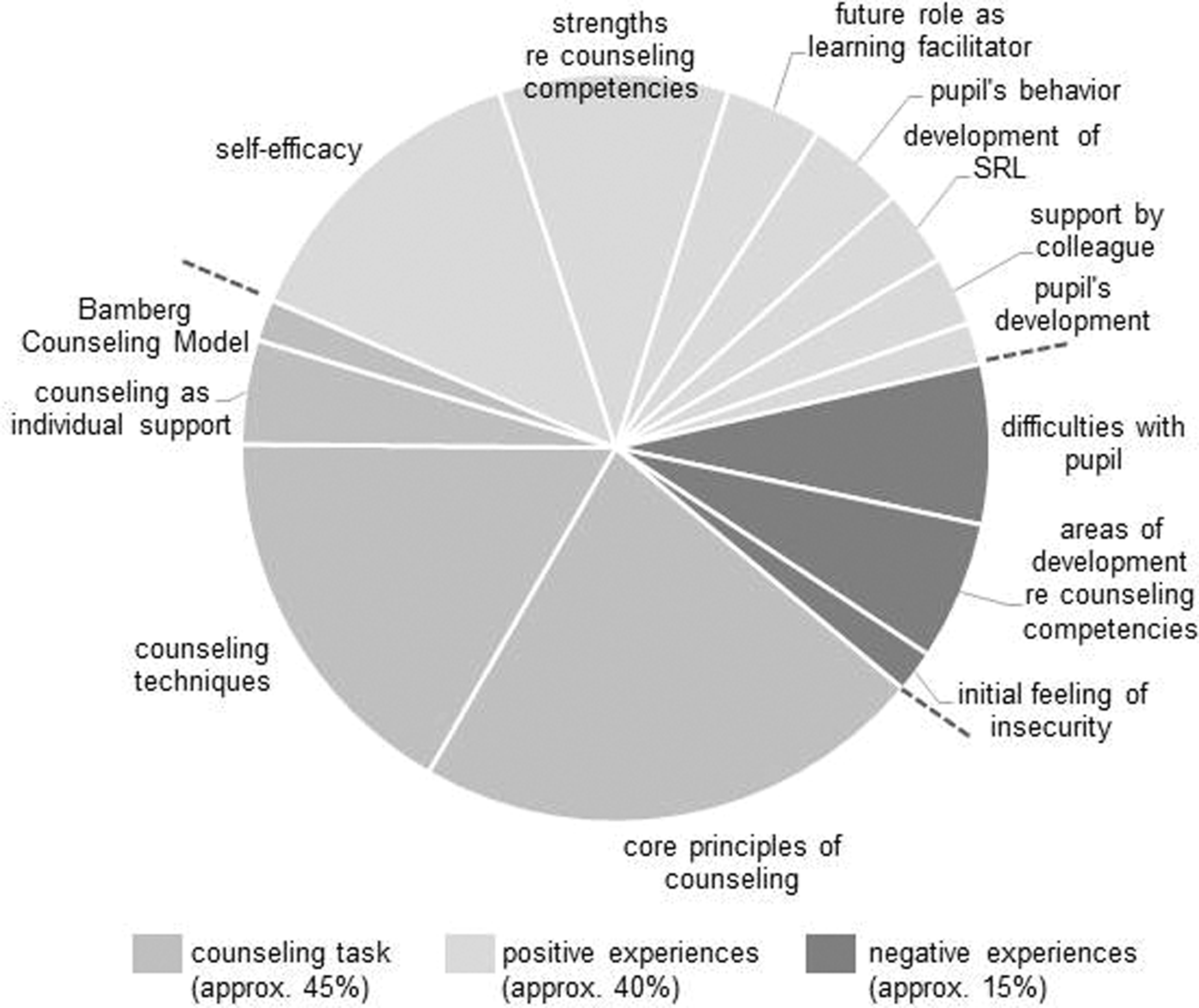
Distribution of Generic Topics Reflected by Preservice Teachers
The two most often reflected topics concern counseling principles like establishing a positive relationship, authenticity, and focusing on strengths and solutions (22%) or counseling techniques like active listening and asking questions professionally (17%). Preservice teachers acknowledge the necessity to individually consider each pupil’s (counselee’s) personality and her respective needs (5%). Some reflections also address the Bamberg Counseling Model (2%). Grouping those four preceding categories together as reflections of the counseling task, they make up approximately 45% of all preservice teachers’ statements.
Almost 40% of all preservice teachers’ statements address positive experiences during the counseling process, specifically, feelings of self-efficacy which they developed over the counseling sessions (14%) or strengths regarding counseling skills they either discovered or felt reaffirmed through the practice task (10%), a positive stance towards their future role as learning facilitators (3%) and positive behavior (4%) or perceived positive developments of their pupil counselee (2%). Some preservice teachers also relate an increase in their own SRL skills (3%) and value the given support from their fellow preservice teachers (3%).
In general, preservice teachers rather reflect on positive than negative experiences (approx. 15%). Only a few reflections deal with difficulties that emerged (7%), areas of counseling skills they need to improve (6%) or initial feelings of insecurity (2%).
Discussion
Our results shed some light on the content and the extent to which preservice teachers reflect on their experiences in a specific theory–practice setting. Results indicate that preservice teachers are able to differentiate between their learning experiences: for example, they seem to mentally represent and evaluate their actual behavior in contrast to the professionally required behavior or assess their own shortcomings and possible undesired outcomes against the backdrop of successful counseling skills. In terms of the overarching goal to foster psychological literacy, this indicates that preservice teachers not only have an understanding of the psychological subject matter of counseling but are also able to reflect their own and other’s behavior and mental processes as an attribute of psychological literacy (McGovern et al., 2010). That impression is strengthened by the range of topics and the number of reflective statements given by both counselors and observers. The fact that preservice teachers predominantly reflect on principles and models of counseling and the effective implementation of the corresponding techniques alludes to a mental link between theory and practice. Moreover, it elucidates the complexity of the counseling task (Baumert & Kunter, 2013) and the perceived necessity to thoroughly engage with theories and principles of counseling in order to be equipped to meet the challenges of this “thematically and socially complex” (Baumert & Kunter, 2013, p. 36) task.
Most preservice teachers consider their participation as a positive learning experience and predominantly depict positive feelings, whereas only around 15% of the diary entries deal with difficulties during the counseling sessions. It needs to be identified whether the dominance of reported positive experiences is truly representative of the practice-learning setting or whether it is those 15% who maybe reflect on a deeper level and are less susceptible to the socially desirable bias of self-reports (Smith et al., 2011).
Perhaps surprisingly at first glance, only very few preservice teachers’ reflections touch on theories of SRL as psychological knowledge to be applied in terms of psychological literacy. One reason could be the slightly stronger emphasis on counseling skills compared with SRL, both in the project the seminar is embedded in and in the prompts of the learning journals. Also, when compared to studies on expert and novice teachers’ perception of and dealing with classroom management (Berliner, 2001; Wolff et al., 2015), another explanation could be, again, the novice counselors’ perceived complexity of the task. Structuring and leading through the counseling sessions might be experienced as so demanding that novice teachers outsource the counseling content (SRL) to the supervised intervisions. There, however, preservice teachers co-construct ideas for custom-made SRL-strategies, instead of reflecting them in their learning journals. Consequently, the reflection of SRL taking place in the supervised intervisions should be better documented and strengthened in the learning journals (e.g., further SRL prompts).
Nevertheless, our results hint at a development of psychological literacy in terms of self- and other reflection as well as the successful application of counseling theories into professional counseling. All in all, the elaborate didactical concept resonates with the preservice teachers’ want for more practice experiences. It seems to offer a promising learning setting that could be further expanded and integrated into university teacher education as well as into other professional contexts aiming at encouraging people to become psychologically literate citizens.
Next Steps
Although initial findings give a brief insight into the nature and quantity of reflected topics, the depth and quality of these reflections need to be specified in further analyses. Drawing on the categorization of reflections by Kember et al. (2008), for instance, the levels of reflection should be further distinguished, and it could be explored how reflections evolve under which theoretical and/or practical conditions over the course of the semester. Additionally, the qualitative and the quantitative questions of the diaries will be analyzed, in particular, to more deeply look for differences in the learning experiences of the two roles during the practice task (counselors and observers). Future research will include measures for counseling success, for instance, short- and long-term questionnaires for pupils and parents.
Supplemental Material
sj-pdf-1-plj-10.1177_1475725720973517 - Supplemental material for Fostering Preservice Teachers’ Psychological Literacy by Counseling Pupils on Their Self-Regulated Learning – Didactical Concept of a Theory–Practice Learning Setting and Insights Into Preservice Teachers’ Reflections
Supplemental material, sj-pdf-1-plj-10.1177_1475725720973517 for Fostering Preservice Teachers’ Psychological Literacy by Counseling Pupils on Their Self-Regulated Learning – Didactical Concept of a Theory–Practice Learning Setting and Insights Into Preservice Teachers’ Reflections by Dorothea Horn, Daniel Grötzbach and Barbara Drechsel in Psychology Learning & Teaching
Footnotes
Declaration of Conflicting Interests
The author(s) declared no potential conflicts of interest with respect to the research, authorship, and/or publication of this article.
Funding
The authors disclosed receipt of the following financial support for the research, authorship, and/or publication of this article: This project is part of the “Qualitätsoffensive Lehrerbildung”, a joint initiative of the Federal Government and the Länder which aims to improve the quality of teacher training. The programme is funded by the Federal Ministry of Education and Research. The authors are responsible for the content of this publication.

Supplemental Material
Supplemental material for this article is available online.
Notes
Author Biographies
References
Supplementary Material
Please find the following supplemental material available below.
For Open Access articles published under a Creative Commons License, all supplemental material carries the same license as the article it is associated with.
For non-Open Access articles published, all supplemental material carries a non-exclusive license, and permission requests for re-use of supplemental material or any part of supplemental material shall be sent directly to the copyright owner as specified in the copyright notice associated with the article.
