



Abstract
Self-regulated learning is the capacity to monitor and regulate your learning activities and is vital in an increasingly complex and digitalized world with unlimited amounts of information at your fingertips. The current Special Issue highlights five articles and one report, which provide different approaches for teachers to promote effectively self-regulated learning in various educational contexts: training, feedback, and addressing teachers’ misconceptions. This editorial serves as a succinct review article and an introduction to the content of this issue. Training programs frequently teach information about effective learning strategies. Accordingly, Benick et al. (2021) found that students reported using more learning strategies when their teachers provided direct-strategy instruction combined with a learning diary, as compared to when these supports were not implemented. Yet, in this study, no transfer effect on academic performance was observed. Note that it is important that students are motivated to engage with these training courses and the learning strategies that are taught. Accordingly, van der Beek et al. (2021) investigated high school students in their last year before graduation and demonstrated that “motivated” students more often participated in a voluntary, self-regulated-learning training. However, a utility-value and implementation-intention intervention did not increase the likelihood of participation. McDaniel et al. (2021) reported a theoretical training framework addressing multiple components of self-regulated learning. The authors then tested a pilot college course based on this framework: knowledge of and belief in the effectiveness of learning strategies are targeted combined with efforts to promote students’ commitment and planning to apply these strategies (Knowledge-Belief-Commitment-Planning framework; McDaniel & Einstein, 2020). Another approach to promote self-regulated learning is to provide feedback and opportunities to effectively process and utilize it. Bürgermeister et al. (2021) developed an effective online tool supporting preservice teachers to assess and provide feedback on peer learners’ self-regulated use of effective learning strategies. Kuepper-Tetzel and Gardner (2021) demonstrated how to enhance self-regulated processing of feedback by temporarily withholding university students’ grades in favor of accessing and engaging with the feedback first. Finally, teachers’ misconceptions about learning can affect the degree to which teachers can scaffold students’ learning how to learn. As a first step, to address these misconceptions, Eitel et al. (2021) developed and psychometrically evaluated the Misconceptions about Multimedia Learning Questionnaire (MMLQ). Using the MMLQ, the authors showed that (preservice) teachers endorsed three out of four common misconceptions of self-regulated multimedia learning, with the potential to design instructional devices to refute them and thereby to promote rather than hinder self-regulated learning in students. Taken together, the contributions of the current Special Issue highlight self-regulated learning as a critical skill at all levels of education, which can be promoted through structured training programs, various uses of feedback, and addressing misconceptions about self-regulated learning from (pre-service) teachers.
Introduction
Research on student learning has evaluated the power and generalizability of various learning strategies (such as retrieving prior information or spacing study episodes; e.g., Dunlosky et al., 2013) and feedback forms across a range of content, conditions, and abilities (e.g., Hattie & Timperley, 2007; Kubik et al., 2021). Yet, effective strategies can only enhance learning if students actually implement them. Critically, students must often implement these strategies in a self-regulated fashion. That is, students are often responsible for deciding on their own—at least to a degree—what, when, and how to study. The current Special Issue focuses on fostering effective self-regulated learning. Self-regulated learning refers to the capacity to monitor and regulate learning activities, for example, by applying effective learning strategies to achieve your learning goals (Bjork et al., 2013). Such learning goals may include increasing your knowledge and deepening your understanding within a particular subject of interest (Paris & Paris, 2001; Schraw, 1998). Self-regulated learning not only involves controlling how one studies, but also involves monitoring and regulating motivational and emotional processes associated with learning (Zimmerman, 2002).
Self-regulated learning is relevant for almost all levels of education (Nückles et al., 2020), and is positively associated with improved motivation and academic outcome (Dignath & Büttner, 2008). Notably, self-regulated learning has become more and more important in an increasingly complex and dynamic digitalized world with unlimited amounts of information available via the internet, which has become more evident than ever during the ongoing global pandemic of the corona virus (COVID-19) and the temporary challenge of switching to distance learning. Given its critical importance, it is key to promote self-regulated learning (Dignath & Veenman, 2021).
To achieve this goal, the contributions of this Special Issue took different approaches on how to conceptualize and implement effective measures to promote self-regulated learning. One approach is to provide training courses to enhance the self-regulated use of learning strategies. Benick et al. (2021) examined an intervention to train teachers imparting learning strategies in elementary school combined with an additional teacher course on the theoretical basis of self-regulated learning strategies and their effective implementation into class. Van der Beek et al. (2021) conducted a utility-value and implementation-intention intervention to enhance the likelihood of engaging in self-regulated learning in high school one year before graduation. Based on a theoretical (Knowledge-Belief-Commitment-Planning framework [KBCP]; see McDaniel & Einstein, 2020), McDaniel et al. (2021) introduced a college course on applying efficient learning strategies. The course incorporated practical exercises to increase students’ knowledge of these learning strategies, belief in their effectiveness, commitment to applying these strategies, and some prior planning to do so.
Stand-alone self-regulated learning courses are not the only way to teach effective studying. Another approach to support self-regulated learning is to enhance students’ processing and utilization of feedback. Bürgermeister et al. (2021) developed a tool to support preservice teachers in assessing students’ self-regulated learning habits and formulating effective feedback accordingly. Furthermore, teachers can tweak their instruction within a course to improve students’ self-regulated learning. For example, Kuepper-Tetzel and Gardner (2021) manipulated when feedback was provided and showed that an economical way to enhance self-regulated learning in university students is to provide feedback before releasing grades.
As teachers play an important role in scaffolding students’ learning how to learn, it is critical to train teachers about which strategies are effective and how to convey this information to their students. Indeed, Eitel et al. (2021) found that teachers endorse multiple misconceptions about learning in general and multimedia learning in particular. An important next step will be to tackle and refute such misconceptions because learning in most educational settings involves processing multiple media (e.g., text and pictures).
In the next sections, we set the stage for the contributions of the Special Issue by discussing the instruction of learning strategies as well as the potential of training, feedback, and addressing misconceptions to promote self-regulated learning. We conclude by listing practical recommendations for students and teachers from papers in the Special Issue.
Instruction of Learning Strategies and Facilitating its Use
Cognitive and educational psychologists commonly examine the use of specific learning strategies, such as retrieval practice (i.e., attempt to recall previously studied materials during the learning period, see Yang et al., 2021), restudying or note taking (e.g., Heitmann et al., 2018; Rummer et al., 2017) and evaluate the efficiency to achieve a certain learning outcome. Participants often receive the explicit instruction to learn an e-lecture or a prose text either by restudying it (with the text being presented again), note taking (e.g., Heitmann et al., 2018; Rummer et al., 2017) or alternatively by attempting to retrieve the contents from memory (with no text being presented; e.g., Roediger & Karpicke, 2006). In laboratory experiments, participants are typically externally instructed to apply one of two learning strategies with specific learning material and often time-matched presentation times, and researchers compare the relative effectiveness of these strategies to foster memory or comprehension (e.g., Kubik et al., 2020). In contrast, in more applied research settings, educational psychologists tend to examine learning strategies more often also in the context of self-regulated learning, that is, in terms of what, how, and for how long students choose to study and in comparison to study strategies such as note taking (Heitmann et al., 2018; Rummer et al., 2017) that are more effective and of higher utility than restudy. For example, when completing a study guide, students can choose the degree to which they practice retrieving information from memory versus rely on their textbooks to find relevant information (e.g., Agarwal et al., 2008; Hiller et al., 2020). In this Special Issue, we refer to learning strategies often, but not exclusively, in instructional scenarios in which students have the self-regulated control about the how and when to apply various learning strategies (see Nückles et al., 2020).
In the last decades, various generative learning strategies have been shown to be highly effective in enhancing long-term learning and comprehension across various student characteristics (e.g., working memory or fluid intelligence) and academic fields (e.g., Dunlosky et al., 2013; Fiorella & Mayer, 2016). The application of effective learning strategies has also been shown to be correlated with future academic success (Geller et al., 2018; Hartwig & Dunlosky, 2012), yet there is evidence suggesting that students often rely on rather ineffective learning strategies in everyday life (for reviews, see McDaniel & Einstein, 2020; Miyatsu et al., 2018). One prominent example of a generative but seldom spontaneously used learning strategy is to generate self-explanations (see e.g., Wylie & Chi, 2014). For this reason, many learning environments rely on prompting learners to generate self-explanations about the principles of given learning material and thereby ensure its deep processing (e.g., Hefter & Berthold, 2021).
To conclude, beyond merely knowing which strategies are effective, students must learn when and how to apply them. It is therefore essential that teachers know how to train and encourage students to effectively self-regulate their learning (Bjork et al., 2013). To this end, there is a promising line of ongoing research that has identified effective ways to teach students to self-regulate their use of productive strategies (see e.g., how to enhance students’ use of self-regulated use of retrieval practice, Ariel & Karpicke, 2018; Broeren et al., 2021; for a review, see Carpenter et al., 2020).
How can Training Promote Self-Regulated Learning?
Numerous studies have examined training programs to enhance the self-regulated use of effective learning strategies (Dignath & Büttner, 2008; Dignath & Veenman, 2021). Trainings can be defined as temporary, structured interventions in which an activity is repeatedly performed with the aim to enhance abilities, skills, and/or the usage of strategies across specific situations and materials (see Fries & Souvignier, 2020). These training programs can be offered online (e.g., Endres et al., 2021), making them inexpensive and widely available. The current Special Issue expands on this interest in training of self-regulated learning. We will first synthesize existing research on the elements of effective training programs before we highlight the contributions in this Special Issue that add to this growing literature on training self-regulated learning.
Training of Learning Strategies and Their Use
Self-regulated learning can be trained and the literature on cognitive training more broadly can inform approaches to training of self-regulated learning. At the same time, self-regulated learning seems to be a domain that can challenge and extend the educational psychology perspective on training: Often, cognitive training has targeted working memory or other general cognitive systems and skills through dedicated repeated practice over many sessions (Strobach & Karbach, 2021) to uncover the limits and processes of plasticity in cognitive and brain functions (Kubik & Knopf, 2021; Tymofiyeva & Gaschler, 2021).
When it comes to self-regulated learning, the term “training” is often used. However, repeated and dedicated practice is often not a key characteristic of existing studies on promoting self-regulated learning. In cognitive training studies, participants typically engage in repeated practice with a challenging task over many sessions (see Green et al., 2014). In self-regulated learning studies, however, the term “training” typically refers to providing some additional activity beyond the mere instruction of which learning strategies are effective that should include at least more than one session (Dignath et al., 2008) but not always does. For instance, participants may be granted the repeated experience of effort and success in performing a particular learning strategy and/or be given support in committing to and planning the more regular usage of this strategy (see McDaniel et al., 2021).
Often, self-regulated learning training studies focus on conveying information about efficient cognitive learning strategies to students and their evidence-based evaluation, for example, in the form of lectures or by letting them read assigned articles (McDaniel & Einstein, 2020; Winne & Marzouk, 2019; for a meta-analysis, see Donker et al., 2014). Students gain declarative knowledge about general learning strategies, how effective they typically are, and potentially in which context one might use them. Prior research showed that instructing a novel learning strategy can boost academic performance but can be further enhanced when combined with practicing the learning strategies. For example, explaining a novel learning strategy (e.g., imagery) can lead to an increase in memory performance (Brehmer et al., 2007), yet, practicing the learning strategy contributes more to learning. To successfully apply cognitive learning strategies in a self-regulatory fashion, learners need to identify and apply the cognitive learning strategy that specifically fits the learning situation at hand (see Endres et al., 2021).
Nonetheless, it is likely that merely the knowledge of the learning strategies and appropriate situations in which to apply them is not sufficient for effective self-regulated learning.[1] For example, Benick et al. (2021) assumes the following planning phases need to be initiated and performed in sequence in order for students to use effective learning strategies: (a) goal setting: deciding on the to-be-pursued goal before starting to learn; (b) time planning: deciding how long to engage with the material; and (c) strategic planning: deciding on how to approach a task. Monitoring for opportunities to initiate these planning phases is effortful and may exhaust working memory resources, which would then be less available for engaging with the learning material at hand (McDaniel & Einstein, 2000). Therefore, it would be beneficial for learning if some self-regulated learning decisions could become automatic to avoid such dilemmas of resource allocation. For example, it would free up working memory resources for learning if students could automatically recognize the cues indicating that they need to take a break from learning or shift the strategy that they are using. Training could therefore promote self-regulated learning by helping students automatically recognize situational cues that indicate an opportunity to apply a particular learning strategy. To our knowledge, the training programs that have been tested thus far have not directly trained students’ skills to automatically identify which strategies to use in different situations. Thus, we suggest that self-regulated learning training should incorporate not just practice applying various learning strategies but also practice recognizing the situational cues that indicate which strategies to use (see McDaniel et al., 2021).
Given the importance of learning strategies for self-regulated learning and in primary education (Bronson, 2000; Dignath et al., 2008), their early promotion is important and efficient (Dignath & Büttner, 2018); yet, only few primary education teachers seem to teach learning strategies in class (Dignath & Büttner, 2018). Note that in elementary school, children increasingly develop an awareness of their learning processes and the metacognitive ability to control them (Perry et al., 2018). Thus, in this sensible stage, teachers are important models that play an important role to guide and scaffold pupils along the way to become self-regulated learners (Zimmerman, 2000) and to use learning strategies in more self-regulated and efficient ways. While prior research mainly focused on teaching cognitive strategies, the promotion of metacognitive and motivational learning strategies (e.g., goal setting, time planning, self-monitoring, self-motivation, attention focusing) may be equally important at this developmental stage. To this end, Benick et al. (2021) examined a training program to foster self-regulated learning among primary school students. The training group received both a teacher-directed invention of learning strategies over several learning units combined with the instruction to write a learning diary before and after each unit to reflect about their learning processes during class and thereby to indirectly promote self-regulated learning. During strategy instruction, a character (i.e., a koala) was introduced to the primary school students that faced and mastered a learning challenge (e.g., lack of motivation) in different units and taught them how, when, and why to use a learning strategy (i.e., time planning) tackling specific learning challenges. The results showed that this combined training program led students report a self-reporting greater use of self-regulated learning strategies, compared to a passive control group, specifically in attention focusing, self-motivation but also strategic planning and self-monitoring. Potentially, introducing the koala character as a role model and writing the learning diary to reflect about the reported learning strategies led to better self-monitoring, strategic learning, and self-motivation of the fourth graders. In addition, one training group of teachers participated in an extra course providing theoretical background on self-regulated learning strategies and discussions on how to implement the strategies most effectively into their regular class. The additional teacher course did not yield any further benefit beyond the character-based intervention for students on learning strategies. Future research should examine moderator variables, such as the length and temporal spacing of the training course for teachers, to identify the characteristics of trainings that modulate their effectiveness.
Training Components of Students’ Motivation: Getting Students Started to Train
Learning strategies can substantially enhance learning outcomes and can be promoted by psychological interventions (e.g., Dignath & Büttner, 2008). This involves investing some time and effort to acquire the knowledge and skills necessary to profit from the learning strategy. A bias for short-term gains (e.g., Scholten et al., 2019) might dissuade students from investing time into learning how to learn. Arguably, students might think that the time and effort invested in learning about learning do not pay off—for instance, because they question the strategy's effectiveness, doubt that they can acquire a new skill, or assume that time demands are too high to justify shortening the time of direct engagement with the learning material. Therefore, one major issue is that students need to be motivated to use these strategies. Accordingly, psychological research should address how motivational interventions can incentive students to expand beyond their known strategies for engaging with the material and explore potentially more useful ways to learn despite the effort required (Cohen et al., 2007; March, 1991). Different interventions can be implemented to enhance students’ motivation to engage in learning strategies or to participate at all in a learning strategy course.
Psychological interventions on motivation in university students to engage in a learning-strategy training may be particularly attractive if they combine a practice value (i.e., learning effective motivational strategies in a short time) with a concise theoretical basis. The study of van der Beek et al. (2021) combines both aspects. First, based on the expectancy-value framework (Eccles & Wigfield, 2002), psychological interventions have targeted the utility value of a behavior (i.e., connecting the task with current and future goals) and implementation intentions (i.e., if-then plans to carry out that behavior) to enhance learners’ motivation and performance in educational contexts. More specifically, learners often face obstacles in their pursuit of goals. To meet those goals, a brief written online intervention can help them to set a concrete intention (e.g., to participate in class) by specifying concretely where, when, and how this intention will be executed (Gollwitzer, 1999). Furthermore, learners that fail to perceive a behavior as valuable often do not commit to a learning goal, and as a consequence, leave opportunities unused (Gollwitzer, 1999). A motivational self-regulated learning intervention has high practical value: It supports students’ learning activities, and it is cost and time efficient both to have participants write down why they take part in the learning-strategy course and/or to formulate a specific intention about when and how to start the course.
It is notable that van der Beek et al. (2021) uses an especially challenging population to examine whether brief motivation interventions can help tip the balance in the exploration–exploitation dilemma: high school students in their last year before graduating. Given the effectiveness of utility-value and volitional interventions in other domains (Gollwitzer et al., 2011; Hulleman et al., 2010), research should examine ways to apply these types of interventions to increase participation rate in an online learning strategy training. Although these students are about to review a lot of material and therefore have a reason to adopt effective learning strategies, they may also see little value in or time for changing how they study with only one year left before the graduation exams. Can high-school students be influenced to use some of their limited time to take an online learning-strategy training instead of studying the materials with their existing (likely suboptimal) learning strategies? The authors report that most of the students did not take part in the online learning strategy training. Furthermore, at least for this target group, the utility-value and implementation-intentions interventions did not affect participation rate in the training. However, the students with better grades were more inclined to invest some of their time into exploration (of learning strategies) rather than exploitation (of known learning strategies). Notably, participation was positively predicted by the expectation to succeed in the training. Thus, future research should examine motivational interventions targeting students’ expectation of success.
Comprehensive Training Programs
As reported above, there are various training studies focusing on single components of behavior change, yet a systematic training program should likely target cognitive, metacognitive, and motivational components together to maximize its impact on self-regulated learning.
McDaniel et al. (2021) presents such a comprehensive training program that targets the spontaneous, self-regulated use of efficient learning strategies, or the lack of it, in college students at multiple levels. Based on KBCP framework, they assume that knowledge about efficient learning strategies is not sufficient for students to spontaneously use them. An effective training program combining all four components would likely optimize the self-regulated use of learning strategies and transfer to various courses. Students should acquire knowledge about efficient learning strategies as well as how and when the strategies are to be applied. Beyond knowledge, they need to experience that a learning strategy is specifically effective for themselves as individual learners (i.e., Belief), they need to perceive the value of a task (e.g., learning math in terms of increased future academic success) to enhance their motivation and persistence to learn (i.e., Commitment to action), and make a specific action plan to implement learning strategies in their study context (i.e., Planning).
On a practical level, McDaniel et al. (2021) implement this KBCP framework in a college course, with the goal that students would be able to know about effective learning strategies, learn how to apply them in a self-regulated fashion, and have positive personal experiences with effective self-regulated learning (Dignath & Veenman, 2021). The authors suggested that lectures convey the knowledge of learning strategies, in-class demonstrations boost students’ belief in the efficiency of the learning strategies, and homework assignments guaranteed a certain level of commitment and motivation. Furthermore, to tackle the planning component, students should develop an action plan for when and how to implement the learning strategies. Students are instructed to plan and perform the learning strategies for specific situations, and based on their experience, reflect and revise how they used the strategy. McDaniel et al. (2021) provide preliminary evidence for the effectiveness of their learning strategies course but future research needs to systematically test the program. As a first step towards this end, a few studies (Biwer et al., 2020; Endres et al., 2021) have already evaluated specific components that can be related to the KBCP framework.
Although this college course is referred to as training, the focus is not on repetitive practice of learning strategies per se. Instead, the focus is on high-quality experiences with learning strategies and to observe their effectiveness, without necessarily involving repetitive practice of the strategy (Kubik & Knopf, 2021; Tymofiyeva & Gaschler, 2021).
How can Feedback Support Self-Regulated Learning?
Instruction about learning strategies does not always enhance motivation, strategy use, or learning (Dignath & Veenman, 2021). For students, it is also important to receive feedback on how to use the learning strategies (Zimmerman, 2002), and how to utilize and process such feedback.
From a self-regulated-learning perspective, feedback can be defined as information that is given to students after completing a learning task that allows learners to monitor and regulate further learning. That is, feedback allows students to compare their current state of learning with a desired state (learning goal, Narciss, 2008). If there is a discrepancy between current and desired learning states, students can self-regulate their learning activities to close the gap. Feedback can take many forms. For example, feedback can differ in quality by providing different types of information. Feedback can entail information about the learning goal, the current state of learning, and the next learning steps (see “effective feedback” in the influential review of Hattie & Timperley, 2007). Critically, this feedback information can be either explicitly provided or learners need to infer this feedback by themselves as a self-regulatory affordance. For example, when instructors provide a sample solution to the problem they gave their students (e.g., a mathematical task), this solution primarily entails information about a concrete instance of the learning goal—a sample solution of the instructor is usually ideal in that it corresponds to the learning goal, but does not explicate the learning goal itself. Thus, when receiving an instructor's sample solution, learners need to rely more on their self-regulated learning skills: they need to infer the learning goal, their current learning state, and need to determine their next step in learning. In contrast, if explicit information about the goal, the current state, and potential next steps are provided, less self-regulated learning skills are needed (Hattie & Timperley, 2007).
In addition, feedback can provide information at different levels (Hattie & Timperley, 2007; see also Kubik et al., 2021). For example, feedback can directly address the self-regulation level by providing information on how to enhance the self-regulated use of a learning strategy to reach the learning goals (e.g., “To deepen your understanding of the topic, generate your own examples of new or abstract concepts”). Alternatively, feedback can simply address the task level by providing more or less elaborate information about the task performance in simple, fact-based quizzes (e.g., Enders et al., 2021) or more comprehension-based learning tasks (e.g., “You do not yet have a sufficient understanding of a concept X”). It is important to consider the quality of feedback and the level on which feedback information is given when supporting self-regulated learning via feedback (Bürgermeister et al., 2021).
Another factor relates to the context of providing the feedback such as the timing of feedback in relation to grades. This timing can influence the degree of students’ self-regulation after they received feedback information (Kuepper-Tetzel & Gardner, 2021). That is, the more feedback is provided before receiving the grade, the more students can use the chance to self-regulate their learning.
The articles in the current Special Issue address these three factors that may contribute to the effectiveness of feedback on self-regulated learning: (a) the level of feedback, specifically addressing self-regulated learning in feedback, (b) the quality of the feedback itself, and (c) timing of feedback in relation to grading.
The Level of Feedback—Self-Regulation Level
Most commonly, feedback addresses the task level of learning rather than the quality of the self-regulation of that learning (see Hattie & Timperley, 2007; Kubik et al., 2021). For example, students (i.e., preservice teachers) write a text on Piaget's theory of cognitive development. Feedback on the task level could involve providing information regarding the students’ textual understanding or gaps in their understanding. Feedback on the self-regulation level involves providing information about their usage of cognitive and metacognitive strategies to help them deepen their understanding of Piaget's theory or other theories they encounter in their study program. There is only little research regarding the self-regulation level (see Jonsson, 2013; but see, e.g., Pieper et al., 2020). One reason for this is that providing feedback on self-regulation is often a greater challenge, demanding more effort and time compared to providing feedback on the task level. This is perhaps why automated tutoring systems by and large have been focusing on the task level (Kulik & Fletcher, 2016). Bürgermeister et al. (2021) addressed this research gap and explored how to best support self-regulated learning through feedback.
Bürgermeister et al. (2021) had students give each other peer-feedback on the self-regulatory level. Students used learning journals (see Nückles et al., 2020) to make their self-regulated learning strategies visible to their peers. This kind of learning journal asks students to deepen their understanding on learning contents (in this study: developmental psychology) by prompting the usage of learning strategies such as elaboration, organization, and comprehension monitoring (metacognitive strategies). Students made learning-journal entries weekly during one term. In addition, they were instructed to give peer feedback three times. It was required that their feedback addressed elaboration, organization, as well as metacognitive strategies, supported by a digital tool. More specifically, they were asked to provide feedback along three questions that effective feedback should answer (see Hattie & Timperley, 2007): (a) Where am I going? (feed-up; learning goals), (b) How am I going? (feed-back; current state of learning), and (c) Where to next? (feed-forward). Thus, by combining the method learning journal with supported peer-feedback, the authors provide a practice example for implementing feedback on the self-regulation level in comprehension-oriented learning.
The Quality of the Feedback Itself
The quality of feedback can be a critical factor from task level to self-regulation level. Feedback quality can refer to how accurately task performance is assessed as well as how clearly the verbal or written feedback is expressed (Herppich et al., 2018). Note that well-designed feedback should answer the above-mentioned three questions posed by Hattie and Timperley (2007). To facilitate the phrasing of feedback by peers, provided sentence starters can be structured according to these three questions (i.e., procedural facilitation; Scardamalia et al., 1984).
Bürgermeister et al. (2021) investigated whether feedback quality is enhanced if learners are offered support using sentence starters. In a quasi-experiment, the authors manipulated the type of support that students received when providing peer-feedback: they received support in assessing feedback, in formulating the feedback, in assessing and formulating feedback, or they received no additional support. To provide feedback, all students used a digital tool with a text box for each learning strategy mentioned above. The authors coded the quality of peer feedback and assessed students’ self-efficacy when generating feedback. Students reported higher self-efficacy in generating feedback after repeatedly giving and receiving peer feedback. Even with practice, that is, after the first round of peer-feedback, support for formulating feedback was beneficial for the feedback provider's self-efficacy. The combination of fostering the assessment and formulation of feedback was the most advantageous regarding self-efficacy after several rounds of feedback. The authors coded the written feedback at one point in time during the term. Results showed that feedback quality was higher when students received writing support as compared to when not. Thus, promoting the quality of peer-feedback on the self-regulation level is an important step to supporting self-regulated learning in general. Future research may explore whether this enhancement in feedback quality then fosters self-regulated learning among the students who receive the feedback, as suggested by the analysis of Hattie and Timperley (2007).
Note that feedback can serve as a component of larger training designs to improve self-regulated learning. One variant of setting up a training is to combine repeated cycles of practice and feedback. As detailed above, Bürgermeister et al. (2021) used a digital tool to repeatedly support students in providing peer feedback on learning strategies. Results suggested that the repeated combination of practice and feedback made participants more confident that they were able to assess learning strategies and to provide feedback on them.
Timing of Feedback in Relation to Grading
Irrespective of its level or quality, feedback can only be beneficial if students engage with it. The extent to which learners use feedback to improve their learning in a self-regulated manner is often low (Jonsson, 2013). Learners do not use the information that feedback offers them to improve their learning (Carless, 2006). In a review of 195 papers regarding the learners’ use of feedback, Winstone et al. (2017) identified characteristics of feedback that can hinder the uptake of feedback and classified these characteristics in terms of the feedback content, who provided the feedback, and who was receiving the feedback. These characteristics may be potential moderators for the effectiveness of feedback. One specific characteristic of the feedback receiver (i.e., the learner) is the degree to which they focus on grades at the expense of the elaborate, explanatory information that they often receive concurrently (Winstone et al., 2017). Therefore, in this Special Issue, Kuepper-Tetzel and Gardner (2021) examined the value of temporarily withholding grades until after feedback is provided.
Kuepper-Tetzel and Gardner (2021) conducted two field experiments, in which they manipulated the timing for providing feedback: They compared a grade-before-feedback group to a feedback-before-grade group in terms of their performance on lab reports (Experiments 1 and 2), and in terms of whether they sought out feedback on the course learning platform (Experiment 2). Results showed that providing feedback before releasing grades can enhance feedback seeking as well as students’ academic performance. The hypothesis is that students pay more attention to the feedback, process it more deeply, and then improve their subsequent self-regulated learning processes if they receive the information of the grade later. As the study showed that students’ performance in this experimental group increased, we can assume that they regulated their learning in a more effective way than learners in the grade-before-feedback group. Thus, the timing of providing elaborate feedback before releasing grades seems to be an economical way to enhance self-regulated learning by feedback.
Addressing Teachers’ Misconceptions About Self-Regulated Learning
Prior research suggested that there is an association between teachers’ knowledge and beliefs about self-regulated learning and how they teach to promote it (Dignath & Veenman, 2021). For this reason, it may be specifically effective to target teachers’ misconceptions about learning as they likely will have detrimental effects on students’ engagement in self-regulated learning and the future academic outcomes (Dignath & Veenman, 2021; Lawson et al., 2019). Thus, a complement to student-focused self-regulated learning trainings is a teacher-focused training designed to assess and refute teachers’ potential misconceptions of self-regulated learning.
In particular, it is still poorly understood how students can be best supported in learning and integrating information from multiple media sources. This is surprising as self-regulated learning with multimedia is typically required in educational contexts, and increasingly so when involving online learning environments (Lehmann et al., 2014). Effective multimedia learning often requires a high degree of active, generative, self-regulated processing from the learner to be effective. Given that teachers play a key role in transmitting knowledge and learning strategies to students, it is a promising starting point to assess teachers’ knowledge and beliefs about multimedia learning.
Eitel et al. (2021) examined the prevalence and structure of misconceptions about multimedia learning in teachers and preservice teachers. Developing the Misconceptions about Multimedia Learning questionnaire, they reported that most preservice teachers endorsed three out of four misconceptions. They incorrectly believed that instructions need to be tailored to individual learning styles (e.g., some students learn better by reading vs. listening to the content materials), and thereby are not effective for all students. Furthermore, they believed that the right and left hemisphere serve different functions and need to be considered when designing the learning material (i.e. hemispheric isolation misconception), and learning automatically improves increasingly when more sensory modalities are involved (i.e., naïve summation). The preservice teachers also provided certainty ratings on their answers. These ratings revealed that teachers’ misconceptions do only represent a lack of knowledge, but also a confident belief in incorrect information. Replicating and extending prior research with different rating scales and student populations (Eitel et al., 2019; Krammer et al., 2019; Menz et al., 2021b), this study supports the notion that misconceptions about self-regulated learning with multimedia material and learning strategies in general, exist in preservice teachers (Glogger-Frey et al., 2018a, 2018b). As a potential consequence, preservice teachers will believe that not all students profit from learning strategies. Thereby, they will not encourage their general usage, but rather will further transmit misconceptions, for example, about specific learning styles, likely impeding students’ potential learning outcome and academic success.
As a next step, it is important to address and potentially refute misconceptions, ideally at an early stage during teaching education, as they may be one source why teachers do not promote, but rather hinder, the development of self-regulated learning skills (Glogger-Frey et al., 2018a). Unfortunately, misconceptions appear to be quite persistent across time (Taylor & Kowalski, 2014). However, research shows that misconceptions can be effectively reduced in the short term when providing refutation texts (e.g., Ferrero et al., 2020; van Loon et al., 2015), refutation lectures (Kowalski & Taylor, 2009; Taylor & Kowalski, 2014), and/or support for conceptually restructuring incorrect knowledge (Ohst et al., 2014). With these interventions, people typically uncover prior conceptions as inaccurate and provide correct information with an explanation. Furthermore, interventions aimed at correcting misconceptions can also enhance preservice teachers’ interest and increase the pace at which they learn (Ohst et al., 2015). While there is little research on long-term effects of such interventions, a recent study revealed that refutation lectures can also have large and enduring effects on misconceptions that spilled over to misconceptions that were not targeted by the refutation lectures (Menz et al., 2021a; but for contrary evidence, see research with refutation texts, Ferrero et al., 2020). Future studies should determine the degree to which teachers’ misconceptions affect their own practice of self-regulated learning and the amount in which they promote students’ self-regulated learning (Dignath & Veenman, 2021).
Conclusion
Taken together, the contributions in this Special Issue provide evidence for how to foster self-regulated learning in students through both student-focused and teacher-focused approaches. Student-focused trainings include components such as attempts to increase student motivation or to enhance their self-monitoring ability; particularly promising are comprehensive trainings programs that combine cognitive, motivational, and metacognitive training components. Another approach is to provide students with feedback on how to use the learning strategies (Zimmerman, 2002) as well as provide some guidance on how to utilize and process feedback in efficient ways. A third approach, discussed in this Special Issue, is to assess and eventually refute teachers’ misconceptions to promote self-regulated learning. Based on the contributions to this Special Issue, we have provided in Table 1 preliminary recommendations how to promote self-regulated learning by means of these instructional approaches (Table 1).
Practical Recommendation For Students and Teachers From Papers in This Special Issue.
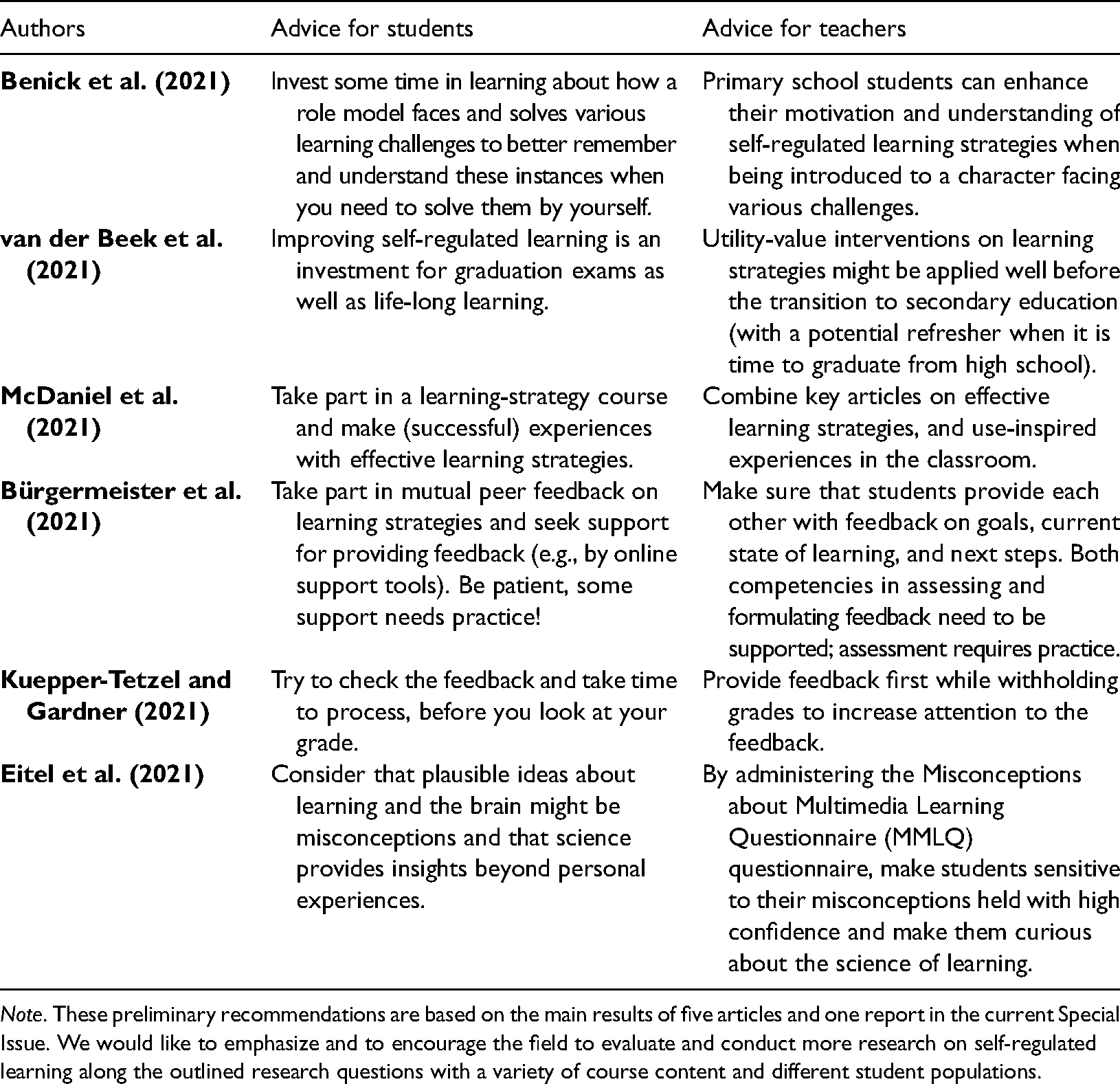
Note. These preliminary recommendations are based on the main results of five articles and one report in the current Special Issue. We would like to emphasize and to encourage the field to evaluate and conduct more research on self-regulated learning along the outlined research questions with a variety of course content and different student populations.
We hope that this Special Issue will inspire you to implement and enhance self-regulated learning and feedback fostering it in your own learning and teaching of psychology. Please note that the current abstracts from Psychology Teaching Review (PTR27(1)) and Teaching of Psychology (ToP48(3)) can also be found in this Special Issue.
Footnotes
Acknowledgments
We appreciate the dedicated work of the reviewers and authors of the Special Issue. We specifically would like to thank the senior editor Prof. Dr. Birgit Spinath for the opportunity to launch this Special Issue and—together with the journal manager Dr. Cordelia Menz—for all the guidance and support realizing this project.
Declaration of Conflicting Interests
The authors declared no potential conflicts of interest with respect to the research, authorship, and/or publication of this article.
Funding
The authors received no financial support for the research, authorship, and/or publication of this article.
