




Abstract
Gender-fair language makes women and other genders, their interests, and their achievements more visible and is particularly relevant to grammatical gender languages such as German, in which most nouns and personal pronouns are assigned to a specific gender. The present study tested the often repeated critical claims that gender-fair language impairs the comprehensibility and aesthetic appeal of videos. In an experiment with N = 105 students, participants watched a video on self-determination theory, either with masculine-only forms or using the glottal stop, a form of spoken gender-fair language that inserts an abrupt and sustained closure of the vocal cords in the larynx between the masculine form or the stem and the feminine ending of words (e.g. in German “Leserʔinnen”, ∼feʔmale readers). Subsequently, participants completed a questionnaire regarding the video's comprehensibility. The results show no statistically significant impairment regarding the general subjective comprehensibility (partial η2 < .01), the ease of ascribing meaning to the words (partial η2 < .01), the ease of decoding the syntax of the sentences (partial η2 = .03), or the aesthetic appeal of the videos (partial η2 = .02). The critics’ claims are therefore questioned.
Languages vary widely with regard to the representation of gender. Gygax et al. (2019) distinguish languages into five categories with regard to grammatical gender. In genderless languages like Finnish or Turkish, only a few nouns are assigned to a specific gender. In genderless languages with a few traces of grammatical gender, such as Basque or Oriya, some nouns, adjectives, and verbal forms are assigned to a specific gender, but most personal nouns and pronouns are not. In natural gender languages such as English, most personal pronouns are assigned to a specific gender, but most nouns are not. In languages with a combination of grammatical gender and natural gender like Dutch or Norwegian, some nouns and typically personal pronouns are assigned to a specific gender, but most nouns referring to humans are not. Finally, in grammatical gender languages like French, German or Spanish, almost all nouns and personal pronouns are assigned to a specific gender. Here, the feminine forms are often formed by derivation from the masculine forms. In German, for example, many feminine forms are created by adding the suffix “-in” in the singular and the suffix “-innen” in the plural, e.g. der Lehrer und die Lehrerin, “the teacher (male) and the teacher (female)”, and die Lehrer und die Lehrerinnen, “the teachers (male) and the teachers (female)”.
In most grammatical gender languages it is common practice to use masculine forms when all genders are meant or the gender is irrelevant to the actual statement (Stahlberg et al., 2007). This practice is sometimes called “masculine generics” (Diewald & Steinhauer, 2020). Regardless of whether a masculine form is intended to refer only to males or to all persons, the linguistic form is the same in both cases. When masculine forms are used, it is therefore always clear that males are meant, but whether women and members of other genders are also meant is subject to uncertainty (Gabriel & Gygax, 2016). The practice of using masculine forms when all genders are meant has therefore been criticized for implying maleness as the norm and making women and members of other genders, their achievements, and their interests less visible (Saul & Diaz-Leon, 2018).
Gender-fair language refers to language use that is inclusive of all genders. The literature typically distinguishes two strategies regarding gender-fair language, namely neutralization and feminization (Gabriel et al., 2018; Sczesny et al., 2016). In the case of neutralization, gender-neutral forms are used, i.e. neutral forms such as Lehrkraft, “teaching staff (singular)” or nominalized participles, e.g. Lehrende, ∼ “those who teach”. In the case of feminization, the feminine forms are used explicitly, for example through pair forms (e.g. Lehrerinnen und Lehrer, “teachers (female) and teachers (male)”), slash forms (e.g. Lehrer/innen, ∼”fe/male teachers”), or so-called capital-I forms (e.g. LehrerInnen, ∼”feMale teachers”; Diewald & Steinhauer, 2020). These feminization forms have been criticized for not adequately representing genders outside the male-female dichotomy (Kolek, 2019). More recently, therefore, other forms have emerged that are intended to explicitly represent genders outside the male-female dichotomy typographically, notably the gender gap (e.g. Lehrer_innen, ∼”fe_male teachers”), the gender asterisk (e.g. Lehrer*innen, ∼”fe*male teachers”), and the colon (e.g. Lehrer:innen, ∼”fe:male teachers”; Diewald & Steinhauer, 2020). Neutral forms, pair forms, and nominalized participles can be used in both printed and spoken texts. Slash forms and capital-I forms can be appropriately translated into pair forms in spoken texts (Diewald & Steinhauer, 2020). The gender gap, the gender asterisk, and the colon are more appropriately translated into spoken language by appending the glottal stop, an abrupt and sustained closure of the vocal cords in the larynx represented by the symbol “ʔ” (Garellek, 2013), between the masculine form or the stem of the word and its feminine ending, e.g. Lehrerʔinnen, ∼“feʔmale teacher”.
Effects of Masculine-Only and Gender-Fair Forms
Since masculine-only forms always refer to males but not always to females and persons of other genders, the associative links between masculine forms and male referents should be stronger overall than the associations between masculine forms and females or referents of other genders. However, the associations that are formed of course not only depend on the linguistic form but also on the prior knowledge that is activated in the context. The German word Kindergärtnerin, “kindergarten teacher (female)”, for example, denotes a typically female profession, which is why it can be expected that the masculine form Kindergärtner, “kindergarten teacher (male)”, also leads readers to imagine female kindergarten teachers. These assumptions are consistent with the findings regarding the effects of masculine-only forms and gender-fair language. Numerous studies using a wide variety of methods show that the use of masculine forms to represent all genders leads readers to predominantly build mental representations of men, the so-called “male bias”, while the use of gender-fair language leads at least to a more balanced mental representation of men and women (e.g. Braun et al., 2005; Gabriel et al., 2008; Heise, 2000; Misersky et al., 2019; Sato, Gabriel, et al., 2016; Sato, Gygax, et al., 2016). There are no studies that include other genders, though.
Unlike masculine-only forms, gender-fair language has several desirable effects: Stereotypical thinking is decreased (Kollmayer et al., 2018); women are perceived as more suitable for typically male occupations and are considered more likely to succeed in these jobs (Horvath & Sczesny, 2015; Vervecken et al., 2015; Vervecken et al., 2013); women show more interest, commitment, and self-efficacy for typically male occupations (e.g., Bem & Bem, 1973; Metaxa-Kakavouli et al., 2018; Stout & Dasgupta, 2011; Vervecken & Hannover, 2015). Both theoretically oriented work and empirical studies thus show that there are good reasons for using gender-fair language. Yet, it is often argued, that gender-fair language would make texts less comprehensible and less aesthetically appealing, and communication more difficult (cf. Braun et al., 2007).
Comprehensibility
Comprehensibility is understood as the ease with which readers can perform the process of comprehension (Friedrich & Heise, 2019; Kintsch & Vipond, 1979). While the product of comprehension constitutes the appropriate mental representation of an entity, the process of comprehension denotes the construction of this product. This process involves establishing rich connections between (new) content and prior knowledge. The resulting product has a number of advantages: In the long run, it is the most economical way to interact with the environment because events and actions can be acted out and tested by means of the mental representation of the environment, and because it allows to act out an infinite number of situations from a limited number of representations. Comprehension thereby promotes learning in which the content is stored for a particularly long time and does not remain inert knowledge (Kintsch, 1998). It is therefore highly desirable that it is easy for learners to comprehend the contents they are learning. Two approaches to the study of comprehensibility can be found in the literature (Friedrich et al., 2021). The more widespread approach understands comprehensibility as a feature of the texts. According to this approach, comprehensibility is high when a text uses short, common words, short sentences and sentences with a simple syntax, when the text gives explicit clues about the structure of the text, and when the text is globally as well as locally coherent (e.g. McNamara et al., 2014). Comprehensibility is equated with text complexity here.
However, this approach to comprehensibility has been criticized for neglecting the characteristics of the readers (Ballstaedt & Mandl, 1988; Friedrich & Heise, 2019; Kintsch & Vipond, 1979). A text may, for example, be incomprehensible to students in their first semester, but comprehensible at the end of their studies. The text itself has not changed, but the characteristics of the readers, such as prior knowledge, interest, and reading skills, have. Within this interactionist view of comprehensibility, a text is therefore more comprehensible the easier it is for the readers to carry out the processes needed to comprehend the text.
Friedrich (2017), for example, updated Kintsch and Vipond's (1979) interactionist concept of comprehensibility in light of Kintsch's (1998) construction-integration model. On this basis he developed a questionnaire that reliably and validly measures seven factors of comprehensibility. According to this, comprehensibility depends on how easily readers can assign meaning to the words of the text (word difficulty), how easily readers can decode the syntax of the sentences (sentence difficulty), how many arguments (concepts) there are in relation to the number of words in the text (argument density), how much effort it takes readers to correct their notions of the content or the text's proceeding (effort needed for reorganizations), how easily readers can build up a mental model of the content or the texts’ proceeding (clarity of representation), how varied and lively readers find the text (aesthetic appeal), and as an overarching feature, how easy it is for readers to carry out the processes necessary to comprehend the text overall (subjective comprehensibility). According to this approach, comprehensibility depends on characteristics of the texts as well as on characteristics of the readers. Following these considerations, one must empirically test whether texts with masculine-only forms are easier to process than texts in gender-fair language.
Studies of the Possible Influence of Gender-Fair Language on Comprehensibility
Without further information it is unclear whether the sentence Die Studenten feierten, “The students (masculine) celebrated” refers only to males or to persons of all genders. Since comprehensibility has been defined as the ease with which readers can perform the processes necessary to build an adequate mental representation of a text, and since masculine forms lead to biased mental representations regarding gender or require conscious effort to correct these mental representations, it can be argued that masculine forms make texts less comprehensible.
On the other hand, gender-fair forms are often longer and less familiar, and require longer sentences and a more complex syntax than texts with masculine-only forms. For example, the German sentence Die Studenten feierten, “The students (masculine) celebrated”, uses the masculine-only form Studenten, “students”. Gender-fair alternative sentences include Die Student*innen feierten, ∼”The fe*male students celebrated”, or Die Studierenden feierten, ∼”Those who study celebrated”. These gender-fair alternatives use less common forms such as Student*innen, ∼”fe*male students”, and Studierende, ∼”those who study”, which also result in longer sentences.
Frequent words are more easily processed than infrequent words (Crossley et al., 2008; McNamara et al., 2014), and short sentences are overall easier to comprehend than long sentences (McNamara et al., 2014). It is therefore reasonable to assume that reading masculine-only forms can be conducted more fluently than reading in gender-fair language. Critics therefore argue that readers can assign meaning to masculine-only forms more easily than to gender-fair forms, that readers can decode the syntax of sentences with masculine-only forms more easily than the syntax of sentences in gender-fair language, that gender-fair language therefore increases text complexity and thus impairs comprehensibility as well as the aesthetic appeal of the text (Braun et al., 2007; Frank-Cyrus & Dietrich, 1997; Vergoossen et al., 2020).
For the following reasons, it is likely that perceived syntax decoding (sentence difficulty) will also increase when masculine-only forms are replaced with gender-fair forms, even if the syntax itself is not changed in the process: Studies show that the load of working memory increases the longer and less familiar the words processed are (Hulme et al., 1995). Gender-fair forms like the combination of the gender asterisk with the ending “-innen” typically make the words of the text longer. This puts a greater load on working memory, especially the phonological loop. The increased load on working memory caused by the longer words should therefore also make it more difficult to decode the sentences, or in other words, increase perceived sentence difficulty, even if the syntax itself is not altered. There are no assumptions in the literature that gender-fair language also impairs other features of comprehensibility such as clarity of presentation or the effort for reorganizations.
A number of experiments have compared the influence of masculine-only forms and different types of gender-fair forms against the background of the interactionist view of comprehensibility by using questionnaires and sometimes eye movements (for an overview see Friedrich & Heise, 2019). Overall, the studies indicate that comprehensibility is not impaired by pair forms (Blake & Klimmt, 2010; Braun et al., 2007; Friedrich & Heise, 2019; Rothmund & Christmann, 2002), neutral forms (Pöschko & Prieler, 2018; Rothmund & Christmann, 2002; Steiger-Loerbroks & van Stockhausen, 2014), capital-I forms (Blake & Klimmt, 2010; Braun et al., 2007), or the gender asterisk in plural forms (Friedrich et al., 2021), but is impaired by the gender asterisk in singular forms and by slash forms (Friedrich et al., 2021; Klimmt et al., 2008; Pöschko & Prieler, 2018). The studies also tend to indicate that texts in gender-fair language are less aesthetically appealing than texts with masculine-only forms (Friedrich & Heise, 2019; Klimmt et al., 2008; Rothmund & Christmann, 2002). The reports on these studies mostly do not clearly indicate whether only the simpler plural forms, e.g. die Lehrer/innen, ∼“the fe/male teachers”, were examined or also the more complex singular forms, e.g. der/die Lehrer/in, ∼”the/the fe/male teacher”. To our knowledge, all studies on the topic so far have examined German texts. Furthermore, all of the aforementioned studies have examined printed texts. To our knowledge, there are no studies of the comprehensibility of spoken texts or videos, even though videos are increasingly used as teaching materials (Mayer et al., 2020).
Processing of Written versus Spoken Texts
The processing of spoken and printed texts is similar, but not identical. According to Mayer's Cognitive Theory of Multimedia Learning (2014), for example, the graphemes of a printed text are read into the visual channel of the sensory register, from where they can be selected into the working memory, where they are typically translated into the auditory channel. According to the theory, spoken texts on the other hand are read into the verbal channel of the sensory register, from where they can be selected into the working memory without the need to translate them from graphemes. In both cases, the words may further be related to visual images in the visual channel, e.g. the mental image of a tree to the word tree.
When processing printed text, it is easier to set the pace of processing by oneself and to jump back and forth in the text; it also typically requires less constant attention during processing (Niegemann et al., 2008). Listening comprehension and reading comprehension are closely correlated with each other, and the correlation increases with the level of reading competence (Hoover & Gough, 1990). However, it is an open question whether the results regarding the influence of gender-fair language on comprehensibility can be generalized from printed texts to spoken texts and videos. Furthermore, to our knowledge there have so far been no empirical studies of the effects of the glottal stop in combination with female suffixes as a specific form of gender-fair language on comprehensibility in German.
Hypotheses
The present experiment tests common critical claims regarding the impairment of comprehensibility and aesthetic appeal by gender-fair language (Braun et al., 2007; Frank-Cyrus & Dietrich, 1997; Vergoossen et al., 2020). Gender-fair language typically results in the use of less familiar words and longer or more complex syntactic structures. It is easier to assign meaning to words, the shorter and more familiar the words are. Sentences can be decoded more easily, the shorter the sentences are, the simpler their syntax is, and the shorter and more familiar the words they consist of are. Some forms of gender-fair language have been shown to impair comprehensibility. Therefore, the following hypotheses are tested: Compared to video lectures with masculine-only forms, video lectures in which the glottal stop in combination with female suffixes is used as a particular form of gender-fair language in German are less comprehensible overall (Hcomprehensibility), it is more difficult to assign meaning to the words in these video lectures (Hword_difficulty), and it is more difficult to decode the syntax of the sentences of these video lectures (Hsentence_difficulty). Previous studies have also indicated impairments of the aesthetic appeal of texts due to gender-fair language. Therefore, the following hypothesis is tested: Video lectures in which the glottal stop in combination with female suffixes is used are judged to be less aesthetically appealing (Haesthetic_appeal).
Attitudes toward gender-fair language and past use of gender-fair language are known predictors of the use of gender-fair language (Sczesny et al., 2015) and may also influence how familiar one is with the relevant forms and phrases and how one evaluates texts in gender-fair language. Therefore, attitudes toward gender-fair language and past use of gender-fair language are incorporated as covariates in the experiment.
Method
Participants
This experiment was conducted in German and was approved by the Ethics Committee of Faculty 2 of the TU Braunschweig (identification number BA_2021–08). Participants were recruited through various e-mail lists for a study of learning by means of videos. Psychology students could receive credits for participating in the study. All other participants had the opportunity to take part in a draw for vouchers worth 20 euros each. 105 people participated in the study. 8 subjects were excluded from the sample because they had watched the 8-min video for less than 5 min. This resulted in a sample size of N = 97 with 77 females, 19 males, and 1 person of a different gender. Participants were between 18 and 60 years old (M = 23.69, SD = 5.96). 71 of the participants were studying psychology.
Materials
The videos used showed a presentation of Wohlbefinden im Lehrberuf – Einfluss der Autonomie-Unterstützung und der Befriedigung und Frustration der psychologischen Grundbedürfnisse, “Teachers’ well-being – The influence of autonomy support and the satisfaction and frustration of basic psychological needs” by Ebersold et al. (2019). The video showed a recording of the PowerPoint slide presentation, and the speaker (female) was not visible. The video was therefore a so-called “screencast”. The slides did not include personal or occupational titles. Two versions of the video were generated. Both versions of the video contained the same visual track, but they had slightly different audio tracks. The speaker recorded the audio twice, once with masculine-only forms and once with feminine-only forms. The first audio track used masculine-only plural forms on 27 occasions, either Lehrer, “teachers (male)” (15), Schulleiter, “principals (male)” (5), Sekundarschullehrer, “secondary school teachers (male)” (1), or Teilnehmer, “participants (male)” (6). Sample sentence: In meinem Vortrag geht es nun um den Einfluss der Autonomie-Unterstützung durch Schulleiter und der Befriedigung und der Frustration der psychologischen Grundbedürfnisse auf das Wohlbefinden von Lehrern, “My presentation now focuses on the impact of autonomy support by principals and the satisfaction and frustration of basic psychological needs on the well-being of teachers.” This video will be referred to as video with masculine-only forms (MOF; see online supplemental material). To create the version with the glottal stop and the ending “-innen”, the ending “-innen” was copied from the recording with feminine-only forms for each manipulated word and appended to the respective words in the audio track with masculine-only forms, resulting in a short pause (of about 20 to 40 milliseconds) between the masculine stem and the feminine ending in order to mimic the sound of the glottal stop. This procedure promised the most natural-sounding result while at the same time ensuring the highest possible congruence between the two audio tracks. This video will be referred to as video with gender-fair forms (GFF; see online supplemental material). The audio tracks of both videos were thus almost identical and only differed in terms of the linguistic forms of the person designations. By systematically adding the suffix “-innen” in 27 places, the video in gender-fair language was slightly longer at 8:01 min than the video with only masculine forms at 7:56 min. The texts in both videos were 1,056 words long.
Instruments
The comprehensibility of the videos was assessed using an adaptation of the comprehensibility questionnaire by Friedrich (2017; see online supplemental material). The questionnaire is based on the updating of Kintsch and Vipond's (1979) comprehensibility concept against the background of Kintsch's (1998) construct integration model, extended by features from the comprehensibility concepts of Langer et al. (1974; cf. Ballstaedt & Mandl, 1988) and Gagné and Bell (1981). In the present study, only those scales of the questionnaire were used for which – based on the literature – differences between the two versions of the video were to be expected and corresponding hypotheses were drawn. Comprehensibility was assessed using an adaptation of the subjective comprehensibility scale (3 items; sample item: Ich fand das Video verständlich. “I thought the video was comprehensible.”). The ease with which the viewers could assign meaning to the words of the video was measured using the word difficulty scale (3 items; sample item: Bei manchen Wörtern war ich mir nicht sicher, was sie bedeuten. “For some words, I was not sure what they meant.”). The ease with which viewers could decode the syntax of the video's sentences was measured using the sentence difficulty scale (3 items; sample item: Die Sätze waren kompliziert gebaut. “The sentences had a complicated structure.”). The aesthetic appeal of the video's language was assessed using the variety of language use scale (3 items; sample item: Ich fand die Sprache lebhaft. “I thought the language was lively.”).
Attitudes toward gender-fair language were assessed using the positive attitudes scale from Sczesny et al. (2015; 5 items; sample item: Geschlechtergerechte Sprache zu verwenden, ist mir persönlich wichtig. “It is important for me personally to use gender-fair language.”).
The use of gender-fair language was assessed with four items constructed following Sczesny et al.’s (2015) “frequency of past behavior” scale (sample item: Geschlechtergerechte Sprache habe ich in den letzten Monaten im privaten Bereich in schriftlicher Form verwendet. “I have used gender-fair language in writing in my private life over the past few months.”).
The participants were also asked if they had watched the video in total and, if not, how long they had watched it. In an open-ended question, the respondents were asked to guess which hypotheses the present study was designed to test. Finally, the participants’ age, gender identity, educational level, and course of study were recorded (see online supplemental material). At the end of the study, the participants had the opportunity to write comments about the study and the videos.
Procedure
The study was conducted as an online study in a between-subjects design with the factor video (MOF vs. GFF) using the online survey software unipark.com. After reading a welcome text and being informed about data protection and the voluntary nature of their participation, participants were randomly assigned to watch one of the two versions of the video. They were then asked how long they had watched the video and completed the comprehensibility questionnaire. After the respondents had been asked to guess the hypothesis of the present study, they were informed that they could not return to the earlier parts of the study. They then completed the scales on attitudes toward gender-fair language, the use of gender-fair language, and the background variables. Finally, the participants had the opportunity to comment on the study or the videos.
Statistical Analysis
Hypotheses were tested using ANCOVAs with the factor language form (MOF vs. GFF) and the two covariates attitudes toward gender-fair language and use of gender-fair language. The significance level was set at α = .05 for all hypotheses tests. Thereby, medium effects of f < .29 could be detected with a power of 1 − β = .80.
Results
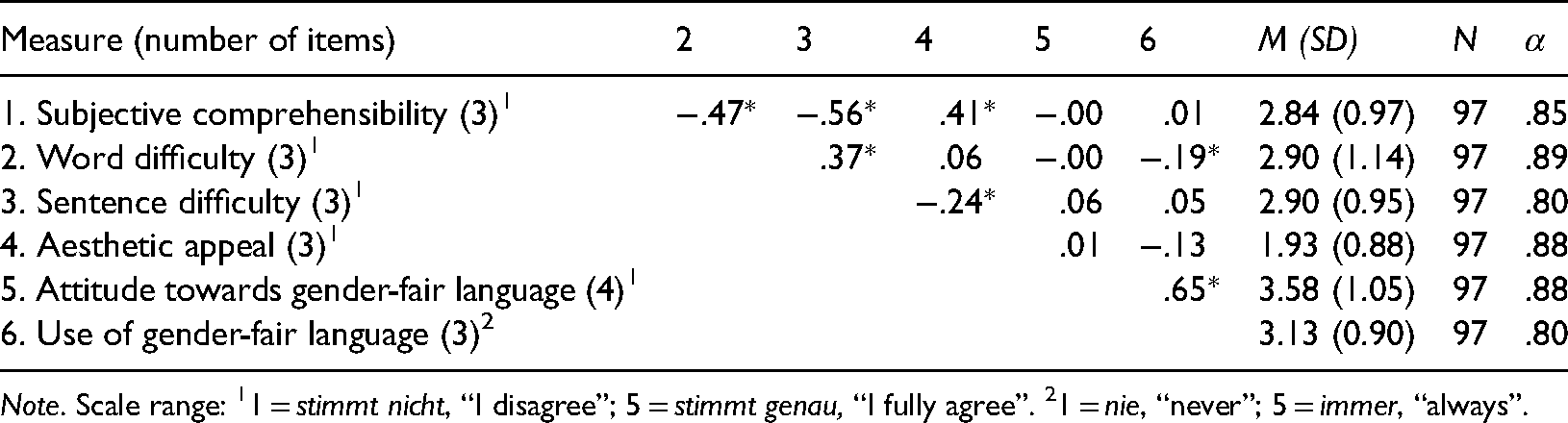
Table 1 shows the means, standard deviations, and internal consistencies of the scales, as well as their intercorrelations.
Psychometric properties and intercorrelations between the variables.
Note. Scale range: 11 = stimmt nicht, “I disagree”; 5 = stimmt genau, “I fully agree”. 21 = nie, “never”; 5 = immer, “always”.
Inferential Statistics
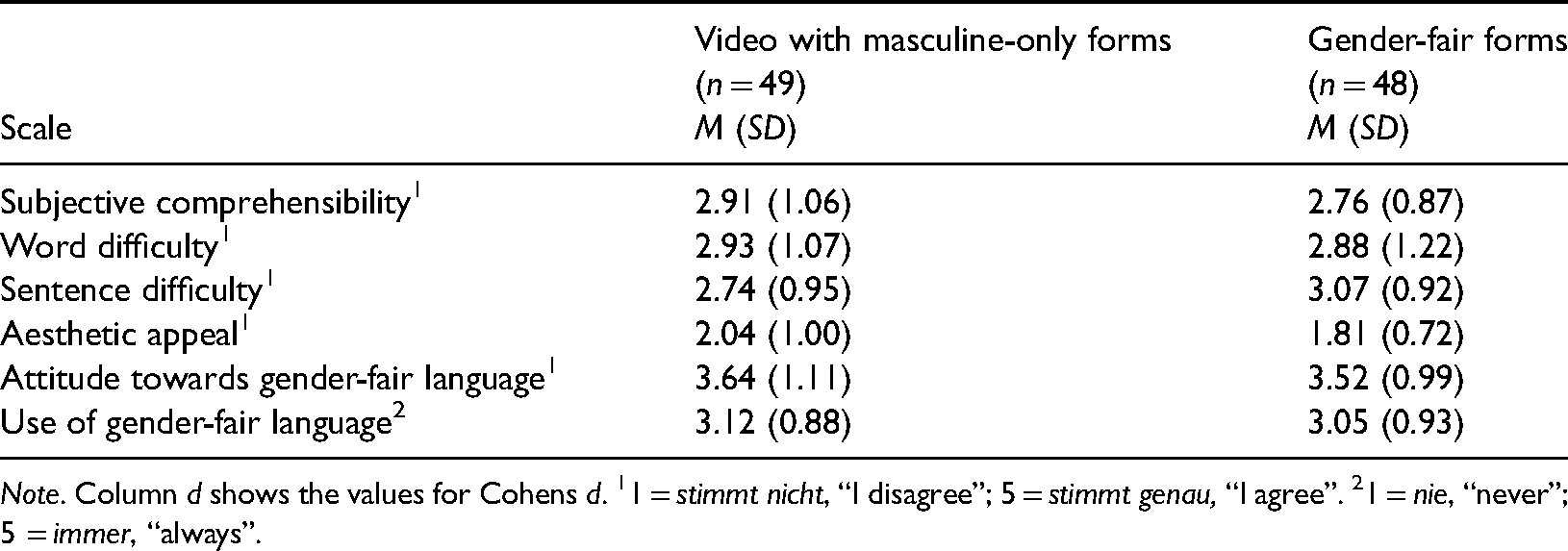
Table 2 shows the means and standard deviations for both groups. The differences between the two groups correspond to non-significant null effects with respect to attitudes toward gender-fair language with d = 0.11 (temp = 0.56, df = 95, p = .58), the use of gender-fair language with d = 0.16 (temp = 0.80, df = 95, p = .42), gender (MOF: nmale = 8, GFF: nmale = 11, Φ = .13, df = 2, χ2 = 1.58, p = .45), age (d = 0.08, temp = 0.41, df = 94, p = .68), level of education (Somer's d = -.02, df = 4, χ2 = 2.02, p = .73), or the study of psychology (MOF: npsychology = 33, GFF: npsychology = 38, Φ = .13, χ2 = 1.73, df = 1, p = .19).
Descriptive statistics for the two conditions.
Note. Column d shows the values for Cohens d. 11 = stimmt nicht, “I disagree”; 5 = stimmt genau, “I agree”. 21 = nie, “never”; 5 = immer, “always”.
The following results each report the influence of language form (MOF vs. GFF) on the dependent variables under control of the covariates attitudes toward gender-fair language and the use of gender-fair language.
There was no statistically significant effect on subjective comprehensibility, F(1,93) = 0.60, p = .44, partial η2 < .01. Hypothesis Hcomprehensibility is therefore rejected.
There was no statistically significant effect on word difficulty, F(1,93) = 0.16, p = .69, partial η2 < .01. Hypothesis Hword_difficulty is therefore rejected.
There was no statistically significant effect on sentence difficulty, F(1,93) = 3.08, p = .08, partial η2 = .03. Hypothesis Hsentence_difficulty is therefore rejected.
When controlling for both covariates simultaneously, the Levene test became statistically significant for aesthetic appeal, so that variance homogeneity in both groups can no longer be assumed. The hypothesis Haesthetic_appeal was therefore tested with both covariates independently. After adjusting for attitudes toward gender-fair language, there was no statistically significant effect on aesthetic appeal with F(1,94) = 1.64, p = .20, partial η2 = .02. After adjusting for the use of gender-fair language, there was also no statistically significant effect on aesthetic appeal with F(1,94) = 1.97, p = .16, partial η2 = .02. Hypothesis Haesthetic_appeal is therefore rejected.
Discussion
The present study tested hypotheses stating that video lectures using the glottal stop with the suffix “-innen” as a special form of gender-fair language in German are less comprehensible than videos using masculine-only forms. Comprehensibility was understood as the ease with which the target audience can perform the processes necessary to understand the videos. Since the glottal stop in plural forms requires longer and slightly less familiar words, it was reasonable to assume that texts in gender-fair language would make it more difficult for the audience to assign meaning to the words (word difficulty), make it more difficult to decode the syntax of the sentences (sentence difficulty), decrease the aesthetic appeal of the texts, and decrease the comprehensibility of the text overall. Contrary to the often repeated claims of critics of gender-fair language (Braun et al., 2007; Frank-Cyrus & Dietrich, 1997; Vergoossen et al., 2020), an experiment with a screencast on the topic of self-determination theory (Ryan & Deci, 2000; Ebersold et al., 2019) showed no significant effects of gender-fair language on comprehensibility, word difficulty, sentence difficulty or aesthetic appeal of the videos compared to the use of masculine-only forms. Subjects thus had no problems understanding the video in gender-fair language or got used to the corresponding form quickly.
The results of the study are overall in line with previous studies on the effects of gender-fair language on comprehensibility. Like pair forms and neutral forms in printed texts, the glottal stop with the suffix “-innen” had no effect on comprehensibility in German (cf. Blake & Klimmt, 2010; Braun et al., 2007; Friedrich & Heise, 2019; Pöschko & Prieler, 2018; Rothmund & Christmann, 2002; Steiger-Loerbroks & van Stockhausen, 2014). Yet, the study has the greatest similarity to studies that have examined the effects of capital-I forms, slash-forms, and the gender asterisk on comprehensibility in printed texts, since these forms also append feminine endings, potentially with a special character. Like capital-I forms and the gender asterisk in plural forms, the glottal stop with the suffix “-innen” had no effect on comprehensibility in German (cf. Blake & Klimmt, 2010; Braun et al., 2007; Friedrich et al., 2021). In contrast to slash forms, the glottal stop with the suffix “-innen” did not impair comprehensibility (cf. Klimmt et al., 2008; Pöschko & Prieler, 2018). It is questionable, however, why the slash form in particular shows negative effects that other forms of gender-fair language do not. It is possible that the slash is more associated with bureaucracy and separation, while the other forms of gender-fair language do not evoke such negative associations (cf. Friedrich et al., 2021). Furthermore, the lack of correlations between attitudes toward gender-fair language and the various dimensions of comprehensibility indicate that even people who dislike gender-fair language have no problems comprehending texts in gender-fair language (cf. Table 1).
In the present study gender-fair language was found to cause weak but statistically non-significant impairments of the sentence difficulty and the aesthetic appeal of the texts. However, the power of the statistical tests was designed to detect medium effects and was too weak to detect such a small effect. Previous studies also showed weak, partly non-significant impairments in the aesthetic appeal due to gender-fair language (Friedrich & Heise, 2019; Klimmt et al., 2008; Rothmund & Christmann, 2002). The reason for this could be that gender-fair language is not very common yet and that common stimuli are generally evaluated more positively (cf. Friedrich et al., 2021). It can be assumed that the effect becomes weaker the more gender-fair language in general or the glottal stop with the suffix “-innen” in particular spread. It can also be argued, however, that a weak effect on aesthetic appeal is an acceptable price to pay for more gender equity (Friedrich & Heise, 2019).
The present study is subject to a number of limitations. It examined a sample of psychology students, who may have more experience and more positive attitudes regarding gender-fair language than students of other study programs such as engineering, for example. Furthermore, students have a high level of linguistic proficiency. It is therefore questionable whether the results can be generalized to apply to other students and people with lower linguistic competencies, especially children and people learning the language as a foreign language. Moreover, only plural forms were used in the videos, so that it is also questionable whether the results can be applied to singular forms. Due to dependent words, especially articles, singular forms are often more complex than plural forms, e.g. der bzw. die Lehrer*in, ∼“the respectively the fe*male teacher (singular)” compared to die Lehrer*innen, ∼“the fe*male teachers”. Studies on the comprehensibility of printed texts have shown different effects for different forms of gender-fair language. It is therefore questionable whether the effects of this study can be generalized to other forms of spoken gender-fair language such as pair forms. At eight minutes, this video was also rather short. Two audio recordings were made, one with masculine-only forms and one with feminine-only forms. To produce the video in gender-fair language, the suffix “-innen” from the second audio recording was appended to each of the corresponding masculine forms from the first recording. This ensured that both experimental conditions were as similar as possible and that the result sounded natural. This, however, is not actually a glottal stop, but an acoustic approximation of it. To our knowledge, there have been no studies to date on the influence of gender-fair language on comprehensibility in other languages. The results of the present studies are most likely transferable to other grammatical gender languages such as French, Italian, or Spanish, though. Finally, it is unclear if the results regarding videos can be generalized to spoken texts such as audiobooks, radio broadcasts, podcasts or in-person lectures. Future studies should therefore examine the influence of different forms of gender-fair language with different topics, different samples of people, with different approaches for the manipulation (of the glottal stop), in different languages for media of different lengths.
The present study could not find significant negative effects of this specific form of gender-fair language on comprehensibility or aesthetic appeal for (psychology) students, even though it had sufficient power to detect medium effects. Further experiments should attempt to replicate the results of this experiment, ideally with an even greater statistical power. So far, however, the results argue in favor of using the glottal stop and the suffix “-innen” in video lectures, at least for psychology students.
Supplemental Material
sj-docx-1-plj-10.1177_14757257221107348 - Supplemental material for Does the use of Gender-Fair Language Impair the Comprehensibility of Video Lectures? – An Experiment Using an Authentic Video Lecture Manipulating Role Nouns in German
Supplemental material, sj-docx-1-plj-10.1177_14757257221107348 for Does the use of Gender-Fair Language Impair the Comprehensibility of Video Lectures? – An Experiment Using an Authentic Video Lecture Manipulating Role Nouns in German by Marcus C. G. Friedrich, Jennifer Muselick and Elke Heise in Psychology Learning & Teaching
Footnotes
Declaration of Conflicting Interests
The author(s) declared no potential conflicts of interest with respect to the research, authorship, and/or publication of this article.
Funding
The author(s) disclosed receipt of the following financial support for the research, authorship, and/or publication of this article: Bundesministerium für Bildung und Forschung, Grant ID 01JA2028.

Supplemental material
Supplemental material for this article is available online.
Author Biographies
References
Supplementary Material
Please find the following supplemental material available below.
For Open Access articles published under a Creative Commons License, all supplemental material carries the same license as the article it is associated with.
For non-Open Access articles published, all supplemental material carries a non-exclusive license, and permission requests for re-use of supplemental material or any part of supplemental material shall be sent directly to the copyright owner as specified in the copyright notice associated with the article.
