



Abstract
In many languages, masculine forms are used generically. However, extensive research demonstrates that these forms exhibit a male bias that can adversely affect the perception of opportunities by women. To address this issue, alternative linguistic forms have been proposed, typically categorized into two main strategies: feminization and neutralization. Both approaches have proven effective in reducing the male bias of masculine forms. However, their relative effectiveness remains unclear. This study investigates this question in French. We compare gender representations elicited by three linguistic forms—masculine forms, pair forms (feminization), and neutral forms (neutralization)—against a stereotypical baseline. Our findings reveal that, in stereotypically neutral contexts, neutralization and feminization are equally effective in counteracting the male bias of masculine forms. However, in male- or female-dominated contexts, feminization is less sensitive to contextual bias and therefore more successful in mitigating the influence of stereotypes. Implications and limitations are discussed.
Introduction
The promotion of equal opportunities across genders has been a key societal goal for several decades. Various strategies have been developed to encourage women and men to better recognize the opportunities available to them in order to promote equal opportunities. Prior research suggests that even seemingly small actions, such as how we use feminine and masculine forms in language, can significantly influence how women and men perceive these opportunities (e.g., Gaucher et al., 2011; Hetjens & Hartmann, 2024). In many languages, masculine forms can be used generically, that is, to refer to groups including both women and men or to individuals whose gender is unknown or irrelevant (Aikhenvald, 2016; Gygax et al., 2019; Sczesny et al., 2016). An example is provided in (1) in French. Although the noun étudiants “students” appears in its masculine form in (1), this sentence can be used to address a group of students that includes both women and men or to students for which gender is unknown or not important.
(1) Bienvenue à nos étudiants. ‘Welcome to our students.
Extensive research shows that generically intended masculine forms are not interpreted as truly generic. Rather their interpretation exhibits a bias towards male representations. For instance, readers will typically infer that the group of students referred to in (1) includes more men than women (Brauer & Landry, 2008; Xiao et al., 2023; Tibblin et al., 2023b). Similar findings indicating a male bias for generically intended masculine forms have been observed in other languages, including English (e.g., Gastil, 1990; Bailey & LaFrance, 2017), German (e.g., Gygax et al., 2008; Misersky et al., 2019; Stahlberg et al., 2001; Körner et al., 2022; Rothermund & Strack, 2024), Russian (e.g., Garnham & Yakovlev, 2015) and Spanish (e.g., Kaufmann & Bohner, 2014).
1
This male bias carries tangible consequences. For instance, using masculine forms instead of gender-fair language (i.e., any linguistic strategy aimed at avoiding a male bias, as discussed in the following section) in job advertisements or descriptions has been shown to elicit negative emotions in girls and women and to reduce their sense of efficacy, interest, and engagement (Stout & Dasgupta, 2011 on English; Chatard-Pannetier et al., 2005, on French; Vervecken et al., 2013; Vervecken & Hannover, 2015 on Dutch and German; Hetjens & Hartmann, 2024 on German).
Gender-Fair Language
To counteract this bias and promote more gender-fair language, alternative linguistic forms have been proposed. These forms are typically categorized into two main strategies, which differ in whether they combine or remove gender distinctions: feminization and neutralization (Gabriel & Gygax, 2016; Sczesny et al., 2016; Gabriel et al., 2018). These strategies are illustrated in (2a) and (2b), respectively, using again French examples.
a. Bienvenue à nos étudiants et étudiantes. (feminization) ‘Welcome to our students. b. Bienvenue à nos élèves. (neutralization) ‘Welcome to our students.’
Feminization involves explicitly mentioning the feminine form alongside the masculine form, through the use of pair forms, such as French étudiants et étudiantes in (2a). This strategy gives equal visibility to the two grammatical genders by including them explicitly. Due to the added complexity resulting from combining gender distinctions, contracted versions of pair forms have been proposed, particularly in writing, such as the mid-dot in French (étudiant·e “student”; e.g., Burnett & Pozniak, 2021; Xiao et al., 2023) or the gender star in German (Lehrer*innen “teachers”; e.g., Schunack & Binanzer, 2022).
Neutralization differs from feminization in making gender less salient. It involves the use of gender-indefinite forms, that is, forms that lack a morphological distinction between masculine and feminine gender, such as the French common-gender noun élèves in (2b). Common-gender nouns are nouns that use the same form in the masculine (un élève) and the feminine (une élève; Corbett, 1991, p. 67).
2
Neutralization can be achieved through different means, depending on the morphological systems of languages. For instance, in English, the plural third-person pronoun they lacks a gender distinction, contrary to the singular pronouns he and she, and is used as a gender-neutral alternative in generic contexts (e.g., LaScotte, 2016). In German, nominalized forms also lack gender distinctions (e.g., die Studierenden “the students” from studieren “to study”) and are used as an alternative to masculine and feminine plural nouns (e.g., die Studenten “the students.
Feminization and neutralization have both been shown to result in more balanced gender representations than masculine forms and therefore to constitute promising gender-fair alternatives. For instance, Xiao et al. (2023) asked French-speaking participants to evaluate the proportion of women and men belonging to groups described using masculine forms (musiciens “musicians.
Neutralization has also been found to be more gender-fair than masculine forms (e.g., on French: Kim et al., 2023; Richy & Burnett, 2021; Spinelli et al., 2023; Storme & Delaloye Saillen, 2024; Tibblin et al., 2023a, 2023b; on German: Braun et al., 2005; Sato et al., 2016; Stahlberg et al., 2001). For instance, Kim et al. (2023) asked French-speaking participants to judge whether a person identified by a gendered first name (e.g., Sarah) could be part of a group described using a neutral form (e.g., a collective noun such as service informatique “IT department”) and a masculine form (e.g., informaticiens “computer scientists.masc”). They found a consistently larger number of positive responses for female first names when the group was described using the neutral form than when it was described using the masculine form. This indicates that neutralization is more compatible with a female interpretation than masculine forms.
Neutralization Versus Feminization
Although feminization and neutralization are both effective at reducing the male bias associated with masculine forms, their relative effectiveness is less clear. Several studies have compared the two strategies, but with mixed results, finding either a greater effectiveness of feminization (Bailey & LaFrance, 2017; Lindqvist et al., 2019; Spinelli et al., 2023; Tibblin et al., 2023a) or no difference (Stahlberg et al., 2001; Tibblin et al., 2023b). For instance, using a sentence evaluation paradigm, Spinelli et al. (2023) found that feminization is more effective in French. In Experiment 2, participants had to decide whether a second sentence starting with a gendered personal pronoun (il “he” or elle “she”) was a sensible continuation of the first sentence. The first sentence contained either a contracted form of the indefinite determiner, using mid-dots (un·e élève “a.masc/fem student”), or a neutral form of the definite determiner, using the reduced variant l’ “the” (l’élève “the student”). They found that feminine continuations were judged as less correct than masculine continuations when the neutral form of the determiner was used (e.g., l’ “the”), but not when the contracted form was used (e.g., un·e “a.masc/fem”). This indicates that contracted forms (feminization) were judged as more compatible with a female interpretation than neutral forms. This difference was also reflected in reaction times, feminine continuations being associated with longer reaction times than masculine continuations after neutral forms, but not after contracted forms.
However, another study comparing feminization and neutralization by Tibblin et al. (2023b) found no evidence for a difference between these strategies in French. This study used the same type of gender-ratio estimation task as Xiao et al. (2023), where participants estimated the proportion of women and men in groups described using various linguistic expressions. Four expressions were compared: masculine forms, pair forms, contracted forms (using mid-dots), and neutral forms. The authors did not find significant differences in the estimated percentages of women and men corresponding to the three gender-fair strategies, suggesting that feminization and neutralization might be equally inclusive.
Interaction With Gender Stereotypes
A key limitation of the aforementioned studies comparing feminization and neutralization is that they did not investigate how these strategies interact with stereotypical information in influencing gender representations. Stereotypical information is another important factor besides grammatical information that has been shown to affect how people interpret the gender of referents in a sentence (e.g., Gygax et al., 2008; Richy & Burnett, 2021; Xiao et al., 2023). For instance, Gygax et al. (2008) found that, in English, a language with no grammatical gender in nouns, readers interpret the gender of referents based on role-noun stereotypes. Sentences with stereotypically female (e.g., beauticians) or male (e.g., mechanics) role nouns are interpreted accordingly, while stereotypically neutral role nouns (e.g., musicians) are equally associated with women and men.
The studies comparing feminization and neutralization (e.g., Bailey & LaFrance, 2017; Lindqvist et al., 2019; Spinelli et al., 2023; Tibblin et al., 2023b) focused on stereotypically neutral nouns (e.g., humans, musicians, neighbors). While this approach helps control for the influence of stereotypical information, it does not provide the full picture. Considering stereotypically non-neutral nouns is essential, as prior research examining how feminization (e.g., Xiao et al., 2023) and neutralization (e.g., Richy & Burnett, 2021) interact with stereotypical information suggests that the differences between these strategies could be more pronounced in strongly stereotyped contexts—a point already noted by Gabriel et al. (2018).
As described in section “Gender-fair language,” Xiao et al. (2023) studied the effect of feminization on gender representations in French, but they also examined how this effect interacts with stereotypical information by distinguishing three categories of role nouns (female, neutral, and male) based on an earlier norming study by Misersky et al. (2014). The authors found that gender representations elicited by feminization strategies (specifically, pair forms and contracted forms using mid-dots) deviated the most from the stereotypical baseline when role nouns were stereotypically marked: feminization led to an overestimation of the proportion of women in stereotypically male activities and an overestimation of the proportion of men in stereotypically female activities (Xiao et al., 2023, p. 17). In contrast, with stereotypically neutral role nouns, the estimated proportion of women and men aligned closely with the stereotype, approaching 50%-50%. One interpretation of these findings is that feminization strongly counteracts stereotypical information, shifting gender interpretations closer to gender parity (Gabriel et al., 2018). This effect appears stronger at the extremes of the stereotype scale because this is where stereotypes deviate the most from gender parity.
Richy and Burnett (2021) ran a similar study investigating the effect of grammatical and stereotypical information on gender representations, but this time focusing on neutralization. Participants were presented with sentences containing a noun phrase describing an individual. This noun phrase featured a neutral form of the definite determiner (l’ “the”) followed by an epicene adjective (e.g., aimable “kind”) and a role noun varying in gender stereotypicality. Scores of gender stereotypicality, ranging from 0 (= 100% male) to 1 (= 100% female), were based on Misersky et al. (2014), as in Xiao et al.'s (2023) study. Participants were asked to guess the gender of the referent described by the neutral form, using a scale ranging from 0 (= 100% male) to 1 (= 100% female), with intermediate values indicating lower degrees of confidence. The authors found that gender estimations based on neutral forms closely tracked Misersky et al.'s (2014) stereotypical proportions across the full range of stereotypes, from female-dominated to male-dominated activities (Richy & Burnett, 2021, p. 10). In other words, neutralization functioned as a stereotype-preserving mechanism.
Taken together, these two studies suggest that the divergence between feminization and neutralization is likely to be most pronounced at the extremes of the stereotypicality scale—precisely in stereotyped contexts. These are the contexts in which gender representations associated with pair forms and contracted forms (feminization) deviate most significantly from the stereotype (Xiao et al., 2023). To date, however, no single study has compared feminization and neutralization across the full range of gender stereotypes (male, neutral, female), leaving the question of whether this difference is genuine unresolved. The present study aims to fill that gap.
A Model of the Interaction of Linguistic Form and Stereotype
If confirmed, the difference between feminization and neutralization found in Xiao et al. (2023) and Richy and Burnett (2021), respectively, would align with the hypothesis that forms involving feminization (pair forms or contracted forms) carry a strong egalitarian meaning, shifting gender representations closer to 50% women. On the other hand, neutral forms would not contribute to gender representations, allowing contextual information (such as stereotypes) to guide interpretation. Finally, masculine forms would be male-biased, shifting gender representations closer to 0% women. The hypothesized lexical meanings of masculine forms, pair/contracted forms, and neutral forms are summarized in (3).
(3) Hypotheses about lexical meanings
Masculine form: 0% women
Pair/contracted form (feminization): 50% women
Neutral form (neutralization): no contribution to gender representation
According to these hypotheses, when used in a context that does not bias the interpretation towards women or men (e.g., when used in combination with a stereotypically neutral role noun), forms involving feminization and neutralization should be as likely to refer to women and men. For neutral forms, in the absence of any lexical bias and contextual bias, an equal proportion of women and men should be the default interpretation. For pair forms and contracted forms (feminization), this default interpretation should be further strengthened by the gender-fair lexical meaning of these forms.
However, when used in a context that biases the interpretation in one direction (e.g., when used in combination with stereotypically female or male role nouns), forms featuring feminization and neutralization should pattern differently. Due to their underspecified meaning, neutral forms should let gender representations be entirely determined by contextual bias. By contrast, due to their gender-fair lexical meanings, forms involving feminization (pair forms and contracted forms) should counteract any effect of contextual bias, pulling gender representations towards parity.
These insights into the interaction of linguistic form and stereotype can be sharpened using graphic representations. Figure 1 illustrates the expected differences in gender representations corresponding to masculine forms, feminization (pair/contracted forms), and neutralization (neutral forms) as a function of stereotypes. These patterns are modeled based on the lexical meanings hypothesized in (3) and the notion that gender representations represent a compromise (i.e., an average) between linguistic forms and stereotypes. The dotted lines in the figure represent interpretations driven solely by stereotypes (x = y), while the solid lines reflect predictions under the assumptions about lexical meanings in (3). In all cases, global gender representations are calculated by averaging the effect of linguistic form and stereotype. The arrows illustrate how interpretation of linguistic form deviates from stereotype. With the masculine form, interpretation is male-biased, resulting in fewer female representations than the stereotype would predict. Feminization (pair/contracted forms) brings gender representations closer to parity than the stereotype would predict. Meanwhile, the neutral form aligns with the stereotype.
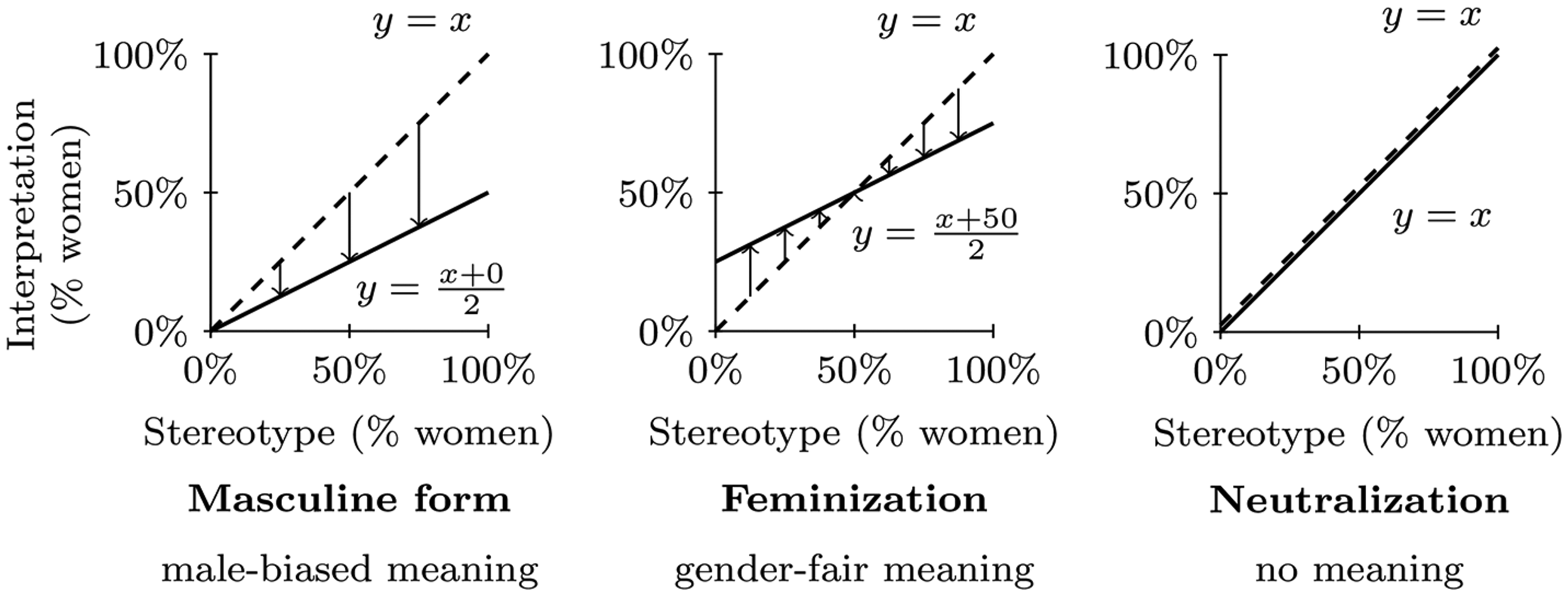
Model of the interpretation of masculine forms, feminization (pair/contracted forms) and neutralization, assuming that interpretation of sentences is an average of the contribution of linguistic form and stereotype.
The predicted interpretations of masculine form, feminization, and neutralization, which are shown separately in Figure 1, are plotted together in Figure 2 to facilitate comparison. Figure 2 demonstrates how this approach yields distinct interpretations for the different linguistic forms, which are qualitatively in line with the results of Xiao et al. (2023) and Richy and Burnett (2021) on feminization and neutralization, respectively. While both feminization and neutralization lack the male bias associated with masculine forms (as indicated by generally higher estimated proportions of women), feminization exhibits a shallower slope than neutralization, with more pronounced divergence from stereotypes at the extremes of the scale—that is, in highly stereotyped contexts. In other words, feminization is predicted to be less sensitive to stereotypical information and therefore more gender-fair than neutralization, with interpretation being closer to parity across the range of stereotypes.
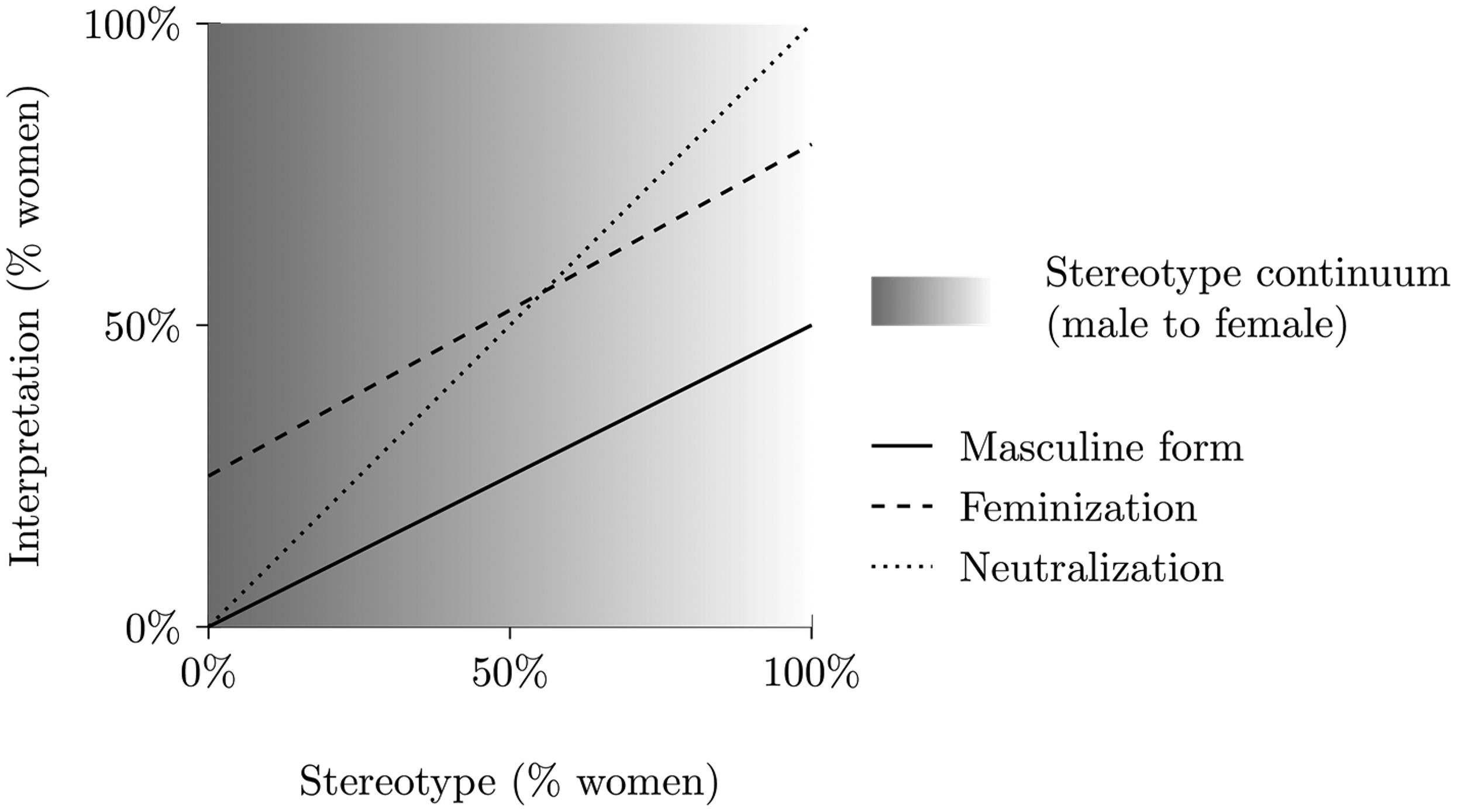
Predicted interpretation as a function of linguistic form and gender stereotype.
Study Overview and Hypotheses
The aim of this study is to evaluate whether feminization and neutralization interact with stereotypical information as qualitatively predicted in Figure 2, using French as a testing ground. To address this, we employ a task similar to the gender-ratio estimation tasks used in previous research. First, we establish the stereotype base rate using verb phrases, controlling for individual differences in stereotypes. We then compare three linguistic strategies against this base rate, expressed through noun phrases: masculine forms, pair forms (feminization), and neutral forms (neutralization).
We hypothesize that, overall, both feminization and neutralization counteract the male bias inherent in masculine forms, but that feminization and neutralization differ in how they mitigate the influence of stereotypes. More specifically, we hypothesize that feminization is more effective at reducing bias from contextual stereotypes than neutralization.
Methodology
The study was preregistered on AsPredicted (https://aspredicted.org/7jjt-swpd.pdf). As outlined in the preregistration, we examined the influence of participants’ personality traits alongside the effects of linguistic form and stereotype on gender representations. However, since personality traits showed no significant effects, we have omitted these results from the main text of the paper. The full analysis is available in the Appendix. The data and scripts are available on OSF (https://doi.org/10.17605/OSF.IO/TJ46D).
Participants
We recruited 180 French-speaking participants via Prolific. The sample was evenly split into two groups.
The first group (N1 = 90, 47.78% women, Mage = 34.04, SDage = 9.84) participated in a preliminary study to establish the stereotype base rates for activities used in the main study. The second group (N2 = 90, 47.19% women, Mage = 34.32, SDage = 8.73) took part in the main study, which examined the joint effect of linguistic form (masculine form, feminization, neutralization) and stereotypical information.
Stimuli
To assess the gender representation associated with different linguistic forms, we used brief classified-like advertisements inviting individuals to join a group, such as a job, club, or similar setting. We chose advertisements because gender-sensitive wording choices in this type of texts have been shown to have an effect on women's interest in the advertised activity (e.g., Gaucher et al., 2011; Hetjens & Hartmann, 2024 on job advertisements). They are therefore concrete examples of texts where gender-fair language might make a difference.
In total, 12 ads were written, differing by the type of activity advertised (e.g., beautician, dancer, etc.). Activities were sampled from a previous study on neutralization (Kim et al., 2023), which included 36 activities corresponding to different gender stereotypes (male, female, neutral), as established in a previous norming study (Misersky et al., 2014). We chose four activities for each of the three stereotypes (male, female, neutral), resulting in a total of 12 activities, listed in Table 1.
Stimuli Used in the Study (female stereotype, male stereotype, neutral stereotype).
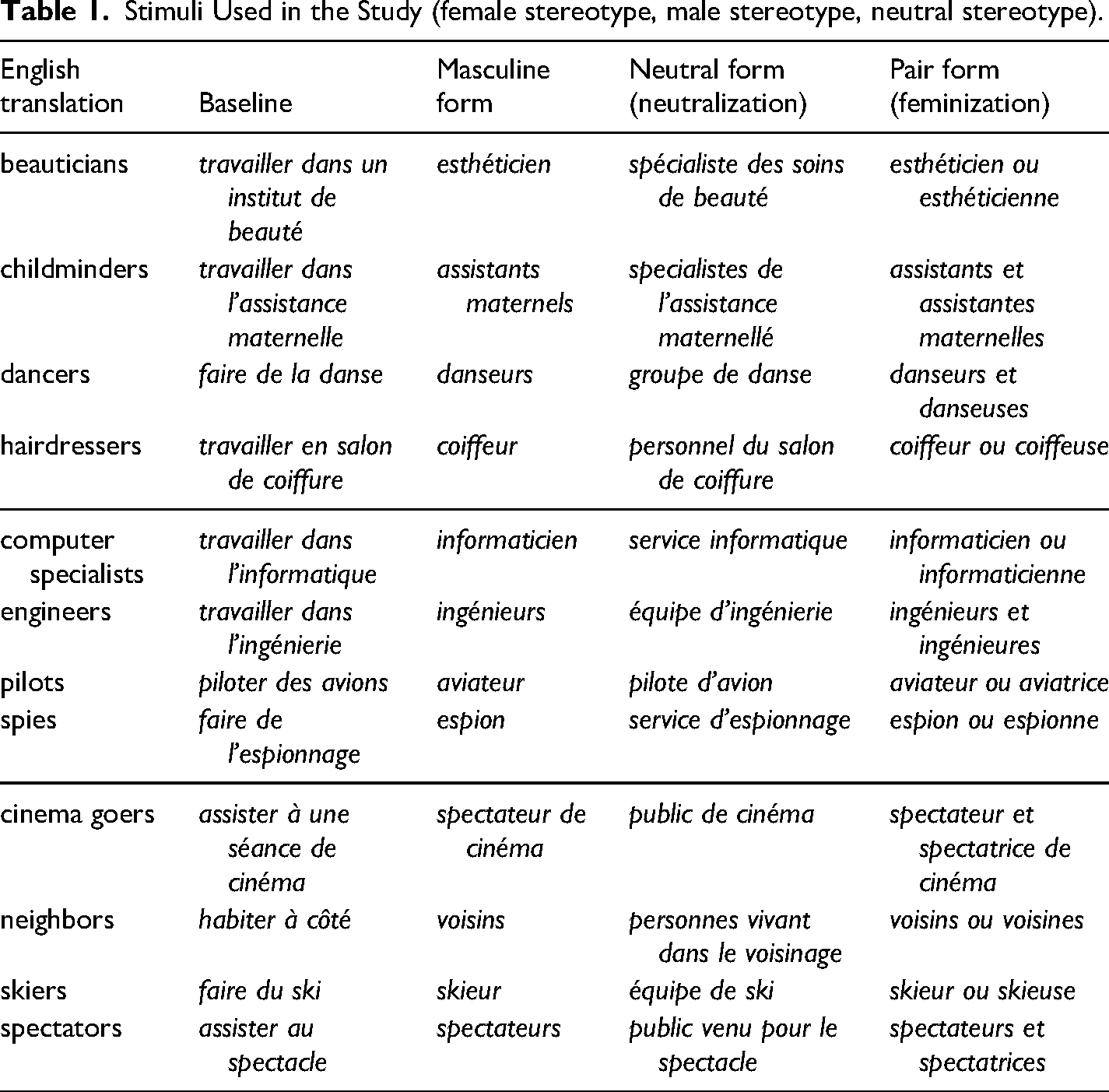
Each ad came in four different versions: baseline, masculine form, neutral form, and pair form. The baseline condition aims to evaluate the gender stereotype associated with a particular activity independently of grammatical gender marking. In that condition, we used a verb phrase describing the activity but crucially without any human-denoting noun. The choice of verb phrase was based on the authors’ judgments about their semantic similarity to the nouns from Kim et al. (2023). An example is the verb phrase travailler dans un institut de beauté “work in a beauty salon.” The corresponding ad is shown in (4). In the absence of gender-marked human-denoting noun, only gender stereotypes should play a role in gender representations triggered by this ad. The 12 verb phrases that were used in the baseline condition are shown under the column “Baseline” in Table 1 and the full set of ads is available in the OSF repository.
(4) Baseline
Vous voulez ‘Do you want to work in a beauty salon in Lyon? Join our professional network, with contacts across the whole region.'
(5a) Masculine form
Vous voulez travailler comme ‘Do you want to work as a beautician.masc in Lyon? Join our professional network, with contacts across the whole region.'
(5b) Neutral form (neutralization)
Vous voulez travailler comme ‘Do you want to work as a specialist in beauty treatments in Lyon? Join our professional network, with contacts across the whole region.' (5c) Pair form (feminization)
Vous voulez travailler comme ‘Do you want to work as a beautician.masc or beautician.fem in Lyon? Join our professional network, with contacts across the whole region.'
For the neutral form, we followed Kim et al. (2023) in choosing a collection of words that neutralize the distinction between masculine and feminine, either by being compatible with both genders (e.g., common-gender nouns such as spécialiste “specialist” in (5b)) or by having a fixed grammatical gender. In the latter case, we used either collective nouns (e.g., équipe “team,” which is always feminine grammatically but can be used regardless of the gender composition of the group it refers to) or feminine epicene nouns (e.g., personne “person,” which is always feminine grammatically but can refer to both women and men). We did not include epicene nouns with a fixed masculine gender (e.g., individu “individual”), as these have been shown in previous research to come with a male bias (Storme & Delaloye Saillen, 2024). By contrast, feminine epicene nouns such as personne have not been shown to be female-biased, but rather gender-neutral (Storme & Delaloye Saillen, 2024).
For feminization, pair forms including the masculine form followed by the corresponding feminine form were used, such as esthéticien ou esthéticienne “beautician.
The masculine form in the doublet was always the same as in the masculine condition. The conjunction of coordination was either et “and” or ou “or.” We chose pair forms rather than contracted forms because they can be found in both written and spoken modalities. Contracted forms, using parentheses (e.g., esthéticien(ne)), dots (e.g., esthéticien.ne) or mid-dots (e.g., esthéticien·ne), are modality-specific: they are only found in written texts. Although we focused on this specific strategy, we did not anticipate substantially different results with other strategies. Recent studies comparing feminization strategies in French suggests no significant differences in their effects on gender representations (e.g., Tibblin et al., 2023b; Xiao et al., 2023).
To check that participants were carefully reading the study material, we included four ads that described activities clearly exclusive to one gender (e.g., “The Rennes women's soccer club is looking for players for the new season. Contact us via the registration form.”). Additionally, to obscure the study's objective, four filler ads were included featuring gender-neutral names (e.g., “Hello Sacha, you have won a weekend getaway in the countryside. Click here for more information.”). Neither the attention checks nor the fillers were included in the main analyses.
Procedure
After having provided informed consent, participants were presented with the ads and asked to estimate the proportion of women among those targeted by each ad, using a slider scale ranging from 0% to 100%, with 1 point increments. We used a unipolar gender scale (proportion of women) rather than a bipolar scale (proportion of women and proportion of men) because we are interested first and foremost in how the representation of women is affected by gender-fair language. Unipolar scales allow participants to focus their attention on only one of the gender groups made salient by the scale (Gannon & Ostrom, 1996; Sato et al., 2025).
To further obscure the study's objective, participants were also asked to estimate the education level of the targeted group. Responses regarding education level were not used in the analyses.
Half of the 180 participants read the ads using the baseline description of the activity, without referencing any grammatical gender. The baseline estimates reflect the stereotypical perception of the activity described in the ad within the general population and served as a baseline to study the effects of different linguistic forms (i.e., masculine form, pair form, and neutral form) in the second half of the sample. In the second half of the sample, the three linguistic forms were presented in random order. Each participant evaluated a total of 12 ads, with 4 ads for each linguistic form presented in random order. The adoption of a repeated-measures design could strengthen the interpretation of masculine forms as male-biased and pair forms as gender-fair. Research has shown that masculine forms are perceived as more male-biased when feminine forms are also present in the context (Gygax & Gabriel, 2008). However, we argue that this more accurately reflects real-life situations, where various linguistic forms are used, such as in advertisements that differ in their language choices.
After evaluating the ads, participants completed demographic questions.
Data Analysis
Our primary objective was to investigate the effects of linguistic forms on estimates of proportion of women in the audience that is targeted by the ad while taking into account the stereotypical baseline of the particular activity described in the ad. First, we established a stereotypical baseline for each ad using data from the first half of the sample, who viewed only the versions of the ads describing the activity without mention of gender. We regressed the estimated proportion of women on each ad, modeling the proportion as a continuous variable bounded between 0 and 1 using a Beta distribution. As the Beta distribution does not accept exact values of 0 or 1, we applied a transformation described by Smithson and Verkuilen (2006) to address this issue. The relationship between the mean of the distribution and predictors was modeled using a logistic function to avoid predicted values outside the [0, 1] range. Random intercepts for participants were included to account for the fact that the same participant has evaluated several ads. To determine whether the baseline needed adjustment in the main study, we tested whether participant characteristics (age, gender, and education level) predicted the estimated proportions.
The second half of the sample estimated proportions after reading ads in three linguistic forms: masculine form, pair form (feminization), and neutral form (neutralization). We regressed the estimated proportions on the baseline established in the first half of the sample, introducing dummy-coded variables for the linguistic form conditions masculine form (coded 0: Not masculine form, 1: Masculine form) and neutral form (coded 0: Not neutral form, 1: Neutral form), with the pair form condition serving as the reference category. Using the pair form as a reference category in the analyses will allow readers to see immediately how this form differs from the other two. Because observations are nested within participants and ads, we included random intercepts for participants and ads. This allows us to account for the potential variability in the dependent variable that can be attributed to these sources.
Analyses were performed using the Bayesian framework with the R package brms (Bürkner, 2017). In the Bayesian approach to regression, parameters are treated as random variables, and the analysis combines prior beliefs with data to estimate their posterior distributions. This approach contrasts with frequentist methods, which rely on point estimates and do not take parameter uncertainty into account in the same way. For this analysis, we used uninformative priors, meaning that we assumed minimal prior knowledge of the parameters, allowing the data to primarily guide the estimation. We relied on the full ROPE (Region Of Practical Equivalence) decision rule described by Makowski et al. (2019) to determine whether an effect was present or not in the population. Concretely, we concluded there was an effect if the percentage of the full posterior distribution of a parameter in the null region (the ROPE) was less than 2.5%. Following the recommendations of Kruschke (2014) for a logistic model, we used the interval [−0.18, 0.18] for the ROPE.
To ensure our study design had adequate power to detect effects, we conducted a Bayesian power analysis by simulating 1000 datasets with similar statistical properties to our sample. For medium to large effects, as defined by Chen et al. (2010), the effect was detected in a little over 80% of the simulated datasets based on the full ROPE decision rule, suggesting that our study was adequately powered.
Results
Estimating Stereotypical Baselines
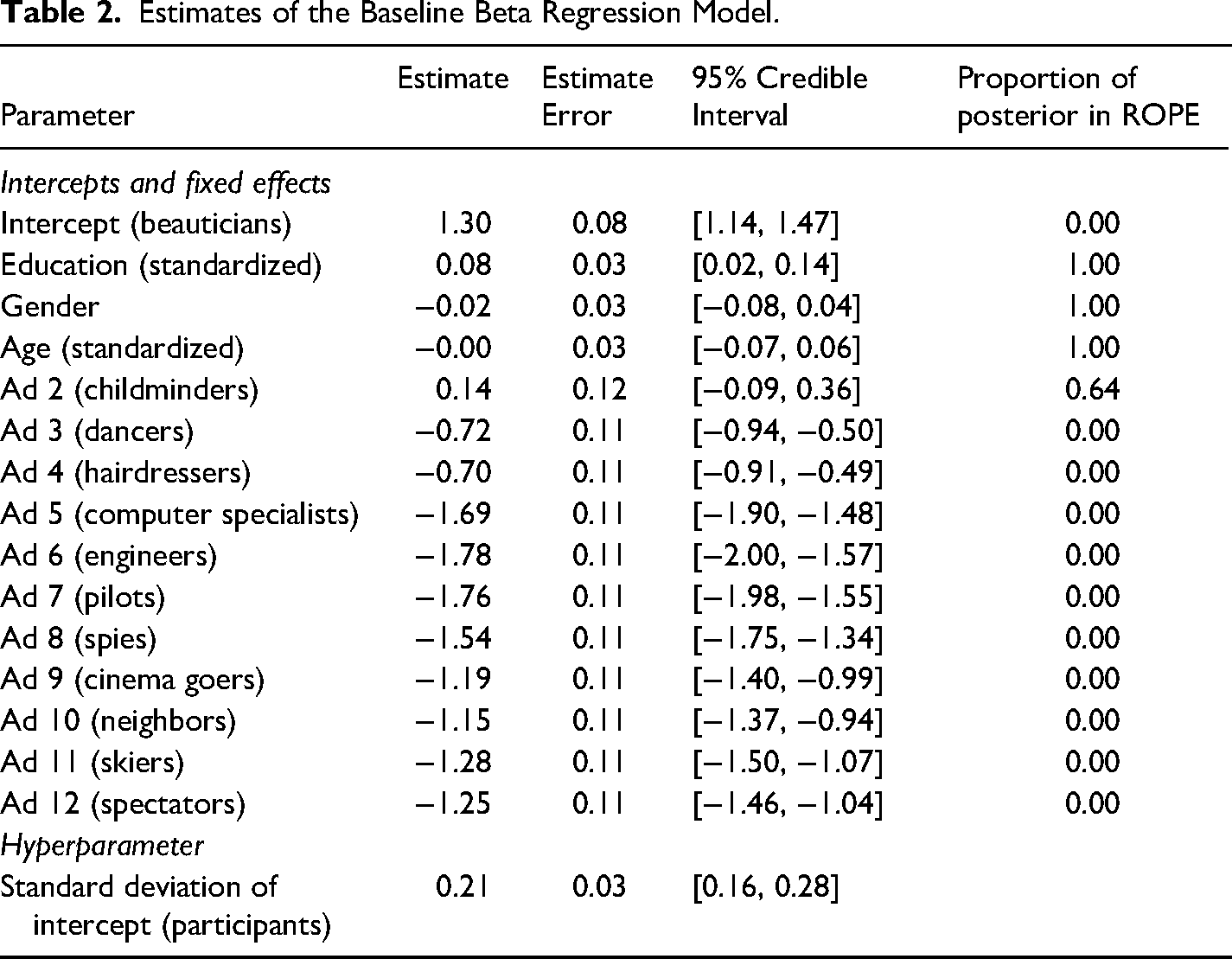
The first step was establishing a baseline for each one of the twelve ads, reflecting the stereotypical level of feminization of the activity described in the ad. This was done by regressing the estimated proportion of women on each ad with random intercepts for participants (N1 = 90), and while including participant characteristics (age, gender, education level) as control variables. Estimates are reported in Table 2. The significant differences observed between ad baselines align with expectations, as we intentionally selected activities that vary in their degree of stereotypical masculinity or femininity. None of the participants’ characteristics significantly influenced the estimated proportions of women. This indicates that participants’ perceptions were consistent across demographic profiles. We thus used the same baseline rates for all participants in the main analysis. The baseline rates ranged from 38.23% women (for engineers) to 80.85% women (for childminders).
Estimates of the Baseline Beta Regression Model.
Main Analysis
Estimates of the Main Beta Regression Model.
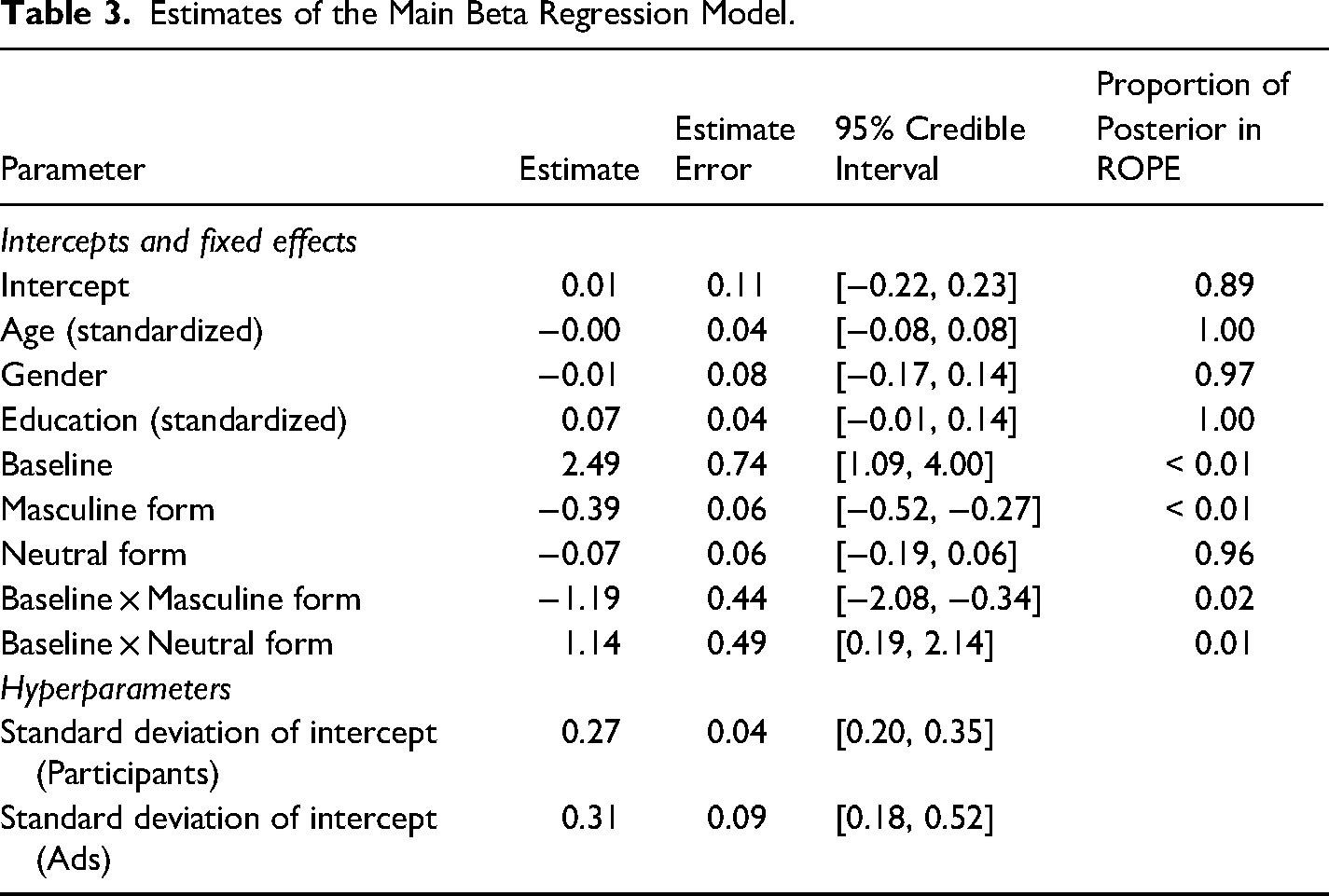
The estimated proportion of women in the pair form condition (50.25%) for an ad with a 50% baseline was not significantly different from the estimated proportion of women of 48.50% in the neutral form condition (B = −0.07, 95% CI = [−0.19, 0.06], Percentage of Posterior in ROPE = 0.96). However, the estimated proportion of women was significantly lower in the masculine form condition (40.37%) than in the pair form condition (B = −0.39, 95% CI = [−0.52, −0.27], Percentage of Posterior in ROPE < 0.01). This provides a first indication that using masculine forms in non-stereotypical activities leads to an underestimation of the proportion of women in the population that is targeted by the ad.
We further examined interactions to assess the impact of linguistic forms on the estimation of proportions of women at different levels of the baseline. To facilitate the interpretation of the findings, we reported the predicted curves for each linguistic form as a function of the stereotypical baseline in Figure 3. The shaded area represents the interpretations of the three linguistic forms that correspond to the observed stereotypes, ranging from 38.23% to 80.85% women. Values outside this range were extrapolated and therefore are not truly interpretable. The observed interpretation of the three linguistic forms in Figure 3 closely resembles our model's predictions in Figure 2, though over a more limited range of gender stereotypes. More specifically, it appears that the slope of baseline in the pair form condition is positive (B = 2.49, 95% CI = [1.09, 4.00], Percentage of Posterior in ROPE < 0.01), suggesting that using feminization does not completely eliminate the role of stereotypical information in the estimated proportion of women targeted by the ad. However, stereotypical information plays an even bigger role when the ad is presented with a neutral form. This can be seen in the fact that the slope of baseline is steeper in the neutral form condition than in the pair form condition (B = 1.14, 95% CI = [0.19, 2.14], Percentage of Posterior in ROPE = 0.01). Altogether, this suggests that neutralization and feminization have different effects in more stereotypical contexts. For ads describing activities that are more typically masculine, the estimated proportion of women tends to be higher in the pair form condition (feminization) than in the neutral form condition (neutralization). However, for ads describing activities that are more typically feminine than masculine, the estimated proportion of women tends to be lower in the pair form condition than in the neutral form condition.
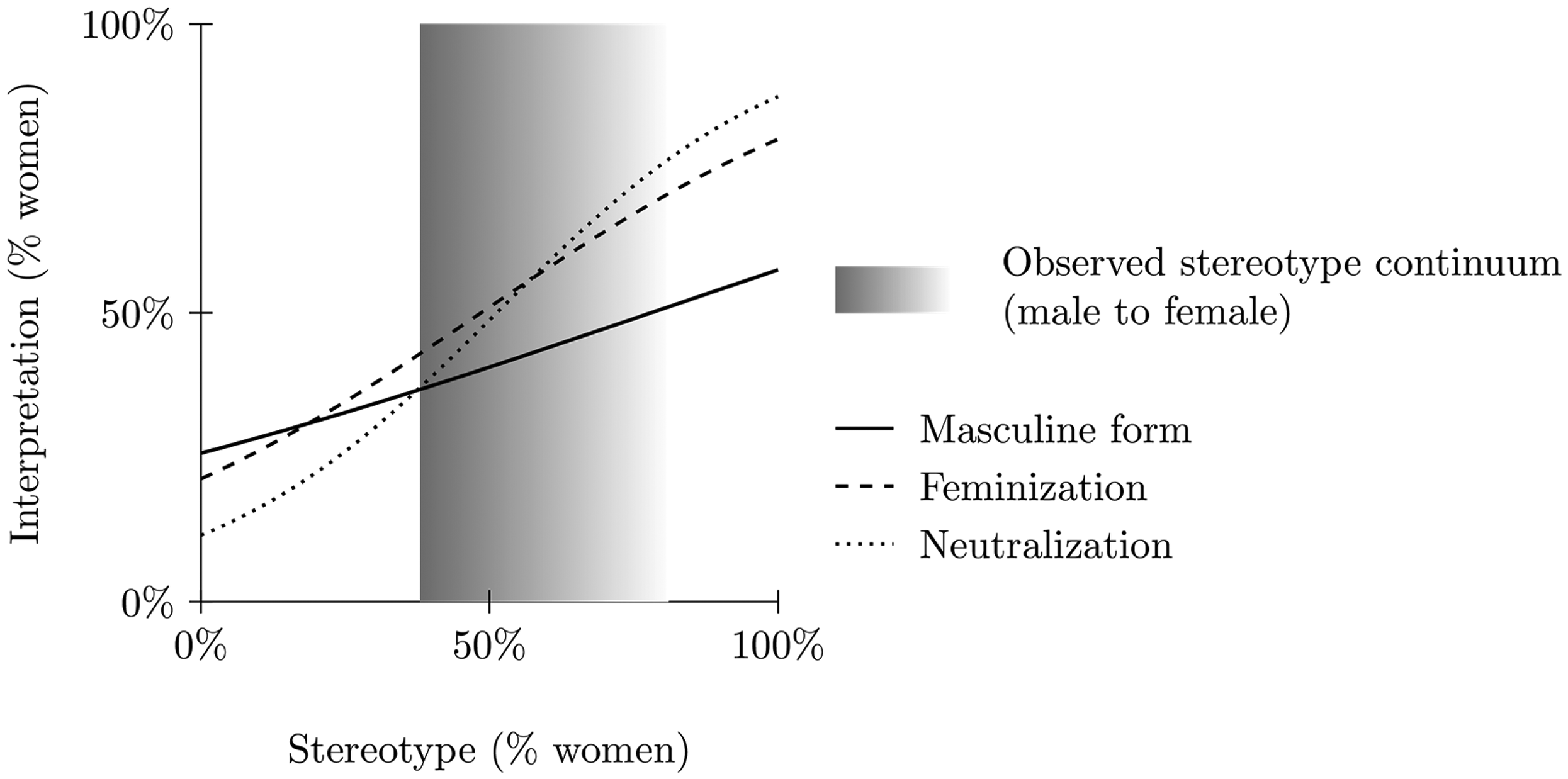
Observed estimations of proportions of women targeted by the ad as a function of the activity baseline stereotype and the linguistic form. The observed range of stereotypes is shown in gray.
Discussion
Our study aimed at exploring how feminization and neutralization reduce the male bias associated with masculine forms in ads while taking into account the baseline stereotype of the activity described in the ad. We hypothesized that both feminization and neutralization would effectively counteract the male bias of masculine forms for ads describing non-stereotypical activities, but that feminization would be more effective than neutralization for ads describing stereotypical activities. Our findings confirmed the hypotheses. Overall, pair forms (feminization) demonstrated a stronger capacity to promote gender equity in perceptions than neutral forms (neutralization). Furthermore, the results qualitatively align with our model's predictions, showing that global gender representations reflect a balance between the influence of linguistic forms and stereotypes.
Theoretical and Practical Implications
Pair forms appear to introduce a strong egalitarian representation, shifting interpretations toward gender parity, while neutral forms act more as stereotype-preserving mechanisms. Concretely, this suggests that the use of feminization (versus neutralization) could increase the chances that women will perceive an opportunity for them to join an activity that is typically associated with men. But what is interesting is that it could have the same effect in men with regard to activities that are more typically associated with women. For instance, encountering the pair form esthéticien ou esthéticienne (versus the corresponding neutral form) could lead men to consider becoming beauticians, as the form itself challenges gendered assumptions about the profession. This is in line with prior research showing that boys judged themselves as more apt to do a stereotypically female activity when this activity was presented through a pair form (Chatard-Pannetier et al., 2005). Feminization could therefore benefit both genders.
Our finding that the interpretation of neutralization is particularly sensitive to gender stereotypes is compatible with the hypothesis that neutralization does not contribute to gender representation, allowing the context to guide interpretation. This hypothesis might also help explain why neutral forms have been found to come with a male bias in some studies (Bailey & LaFrance, 2017 on English; Spinelli et al., 2023 on French; Renström et al., 2023 on Turkish and Finnish). If societies in which these studies were carried out are predominantly androcentric (i.e., men's perspectives and experiences are prioritized over others), a general male bias will shape interpretations, leading to the assumption that forms refer to men by default. Given their weak meaning, neutral forms will not counteract this bias but rather allow it to persist, resulting in male-biased interpretations.
The hypothesis that neutralization leaves more room for contextual bias than feminization can also explain why its interpretation has been found to be more sensitive to the utterance situation, such as the gender of the listener/reader. For instance, Bailey and LaFrance (2017) found that the English neutral noun human was more likely to be interpreted as referring to men by male participants than by female participants whereas the pair form man/woman led to more balanced gender representations for both male and female participants.
Moreover, our findings contribute to the broader understanding of how language influences cognitive processing and social perception. It adds to a growing body of evidence showing that linguistic forms can have subtle but yet measurable effects on how one perceives cognitive categories, including agency (Fausey et al., 2010), color (Winawer et al., 2007), and time (Boroditsky, 2001). The use of pair forms increases the perception that both women and men are the target of the message, which could, in turn, lead to counter-stereotypical behaviors such as applying for a job that is not typically congruent with one's gender.
From a practical viewpoint, our study provides insights for promoting gender fairness in communication. Educators and (language) policymakers can leverage our findings to promote a broader adoption of feminization. Indeed, the use of feminization could have a positive effect in many areas where gender equity is lagging behind. For example, organizations aiming to foster inclusivity should prioritize the use of feminization in job advertisements. This could increase the chances that both women and men candidates will apply. But this does not stop at the world of work as using feminization could also be beneficial in education contexts to increase, for example, the perception of the scope of study opportunities among boys and girls from a young age.
Limitations and Future Directions
The study was conducted in French, a language with specific linguistic strategies to neutralize gender distinctions (common-gender nouns, collective nouns, feminine epicene nouns). Maybe the findings do not fully generalize to languages that use other strategies (e.g., nominalized forms in German). Also, among the different feminization strategies available in French, we only tested pair forms with the masculine-feminine order. Although we do not have strong expectations that other strategies (e.g., pairs forms with the feminine-masculine order, contracted forms) will pattern differently (e.g., Tibblin et al., 2023b; Xiao et al., 2023), there might still be differences. Replication in other languages and using other linguistic strategies for neutralization and feminization is therefore needed. Another limitation concerns the construction of our stimuli, specifically how we matched the four conditions (baseline, masculine form, feminization, and neutralization). For the baseline, feminization, and neutralization conditions, verb phrases and nouns were selected based on our judgment and guided by Kim et al. (2023). However, both the verb phrases and the neutral forms would benefit from pretesting (particularly for semantic association and stereotypicality) in future research, as suggested by a reviewer.
The study focused specifically on the representation of women, through the use of a unipolar gender scale. Future research should examine how neutralization and feminization influence the representation of men and non-binary individuals. This is especially relevant for the latter, as neutralization has been argued to be more appropriate and inclusive than feminization for non-binary individuals in English (e.g., LaScotte, 2016, p. 71). For instance, the American Psychological Association (2020) advocates for the use of gender-neutral they instead of he or she “because it is inclusive of all people and helps writers avoid making assumptions about gender” (Publication Manual of the American Psychological Association, p. 120). However, in light of our results, neutral forms such as they should also be more sensitive to stereotypical information than pair forms such as he or she. Further studies are needed to investigate how linguistic forms (masculine, feminization, neutralization) affect inferences about the binarity/non-binarity of individuals in French and beyond and how these effects interact with stereotypical information.
Another limitation is the narrow range of stereotypes we were able to elicit, possibly due to social desirability bias—participants may have been reluctant to explicitly label an activity as male- or female-dominated. As a result, it remains unclear whether the relationship between feminization and neutralization aligns with the model at the most extreme stereotype values. Future research should be designed to mitigate this issue.
What are the behavioral consequences of the differences we found between neutralization and feminization in perception? Prior research suggests that perceptions can have behavioral consequences, in particular in the domain of gender. For instance, in a study on German, Hetjens and Hartmann (2024) found that the use of feminization in job ads on a recruitment website translated into more views by women. Neutral forms attracted fewer female viewers and masculine forms even fewer. This suggests that the differences found between feminization and neutralization in the present study on French could translate into differences in behavior. Future studies are needed to establish whether that is indeed the case across gender stereotypes. In particular, these studies should control for stereotypical information associated with advertised jobs to evaluate whether feminization triggers a more homogeneous behavior between women and men than neutralization across gender stereotypes.
It would also be interesting to investigate how long the interpretative effect of feminization lasts in time. Is the effect of feminization on opportunity perception short-term or long-term? If it is only a short-term effect, that does not invalidate the relevance of using feminization, because short-term effects can sometimes have far-reaching consequences. For example, if a man clicks on an ad for a beautician's job, the mere fact of clicking increases his chances of applying and becoming a beautician, even if his perception of the job later reverts to its stereotypical basis. But does the use of feminization also have long-term effects on perceptions of opportunities? If it were the case, feminization could have the potential to challenge and counteract gender stereotypes in a more profound way, changing how individuals perceive gender stereotypes. Future studies are needed to establish what the effect of repeated exposure to feminization is, and whether it can contribute to changing the core gender stereotype associated with a job or an activity over time.
Footnotes
Acknowledgments
The authors thank Nicholas Palomares and two anonymous reviewers for their helpful feedback.
Data Availability Statement
All data and materials used in this study are openly available in the OSF repository at https://doi.org/10.17605/OSF.IO/TJ46D.
Declaration of Conflicting Interests
The authors declared no potential conflicts of interest with respect to the research, authorship, and/or publication of this article.
Funding
The authors received no financial support for the research, authorship, and/or publication of this article.

Notes
Author Biographies
Appendix
To further assess individual differences in responses to grammatical gender marking, we investigated the moderating role of various personality traits, including the Big Five dimensions (extraversion, agreeableness, conscientiousness, emotional stability, and openness), right-wing authoritarianism (RWA), and social dominance orientation (SDO). Specifically, we examined whether these traits influenced the relationship between baseline estimates of gender proportions and the effects of different writing forms. The estimates are reported in Table 4.
The results indicate that personality traits, including the Big Five dimensions (extraversion, agreeableness, conscientiousness, emotional stability, and openness), right-wing authoritarianism (RWA), and social dominance orientation (SDO) do not significantly moderate the effects of linguistic forms on participants’ estimates of the proportion of women in different activities. None of the interaction terms with personality traits reached statistical significance, as their overlap with the Region of Practical Equivalence (ROPE) was always greater than 2.5%. This suggests that individual differences in personality do not meaningfully alter how participants respond to variations in grammatical gender marking.