




Abstract
We implemented NSF-funded computerized Experimental Psychology Laboratories at Touro College and incorporated process-oriented guided-inquiry learning (POGIL). We designed POGIL modules for the labs and conducted workshops for faculty on the implementation of the guided-inquiry approach, including learning teams. Data were collected from students who took experimental psychology with and without using POGIL, to assess the impact of the curriculum materials. Achievement was measured with (a) selected items from the Major Field Achievement Tests (MFAT) and (b) our own assessment instrument. Results indicated that students using the POGIL materials performed significantly better on both achievement tests than students not using them. This is the first demonstration that POGIL led to higher achievement than non-POGIL instruction for experimental psychology. These results are consistent with previous POGIL findings in the field of chemistry.
Keywords
Introduction
Experimental psychology is often considered to be a difficult course, and one that is sometimes dreaded by psychology majors. By experimental psychology we are referring to the course and lab we offer in our curriculum, which covers methods of research design as well as some of the content areas of experimental psychology. It is a fundamental course, required for the psychology major to learn how to design and conduct research experiments and relevant to many areas of psychology students plan to pursue(e.g., behavioral neuroscience, industrial psychology, biological psychology, or clinical psychology). There have been a number of articles on ways to improve teaching and learning in such methodology-focused courses. For a review, see Jackson & Griggs (2012). The suggestions have been varied—for example, Christopher and Marek (2009) suggest using concrete examples, such as those drawn from baking, to demonstrate statistical main effects and interactions, and Burkley and Burkley (2009) use clips from the Mythbusters: Collection 1 DVD (Rees, Luscombe, Rudolph, LeDonne & Plavnick, 2007) to illustrate between-groups experimental designs, as well as the concepts of independent/dependent variables. However, efforts at teaching research methodology using process-oriented guided-inquiry-learning (POGIL) have been sparse.
By “process-oriented,” we mean an emphasis on process, that is, examining thinking and reasoning skills. “Process” is contrasted with “content,” in that content (the material to be learned) is the medium one utilizes, with the larger purpose of developing and refining the associated reasoning skills. It has been argued that content is not as essential; rather, process is what is important. An individual with good reasoning skills should be able to apply them to any content and it is, therefore, these reasoning skills that we want to develop and reinforce. Once students have developed these skills, they are equipped to use them to tackle ever-changing contents they will encounter. By “guided-inquiry,” we mean we guide the process-learning through well-thought-out and well-formulated questions.
How does POGIL compare with other nontraditional methods of teaching? The other popularly used nontraditional methods are:
Inquiry-based learning. This approach is based on the work of Dewey (e.g., Dewey, 1997), Piaget (1950, 1967), and Vygotsky (1962, 1978) and emphasizes constructivist ideas of learning, that is, that students are involved in the construction of knowledge through active involvement. Inquiry-based learning is an essential component of POGIL. Indeed, POGIL is a form of guided inquiry, as it provides guidance to direct student thinking; Problem-based learning (PBL). The PBL method (e.g., Boud & Feletti, 1997; Duch, Groh, & Allen, 2001; Evensen & Hmelo, 2000; Miflin, Campbell & Price, 2000; Savin-Baden, 2003; Savin-Baden & Major, 2004) is a variation on inquiry-based learning. POGIL incorporates problem-based learning: Each POGIL activity starts with a challenging problem for students to tackle. In both POGIL and PBL, the professor is a facilitator rather than a provider of solutions, and students work in small collaborative groups; Active learning (e.g., Butler, Phillman & Smart, 2001; Giordano & Hammer, 1999; Lesgold, 2001; Meyers, 1997). Students are proactive and actively engaged with the content. POGIL incorporates active learning; Collaborative learning (e.g., Halpern, 2004; Smith & MacGregor, 1992). Students work in groups of two or more, mutually searching for understanding or solutions as they explore or apply the course material. POGIL incorporates collaborative learning; Interteaching (e.g., Boyce & Hineline, 2002; Saville, Zinn, Neef, Van Norman, & Ferreri, 2006). Students work in groups of two or three, and the focus is on student discussion, peer-to-peer teaching, and frequent feedback. They receive points (or tickets) for focused discussion. This resembles POGIL teams.
Thus, the POGIL approach may be superior because it incorporates the essential characteristics of the other alternative nontraditional teaching methods. POGIL has the following key components:
Use of a guided-inquiry-based format to present activities. Use of problem-based learning, with each activity starting with a context-rich problem or model which students explore. Students are then guided by structured activities that direct their thinking and reasoning. They are prompted, by questions, hints, and directions to think critically about different possible alternative solutions; Use of active learning and collaborative learning via teams (e.g., Hanson & Wolfskill, 2000). The instructor sets up diverse teams so that stronger students can assist weaker ones. By discussing the material together, all students develop a better understanding and consolidation of the material. Also, each student is assigned a specific role in the team; A shift in the role of the instructor from that of “sage on the stage” (who mainly lectures while the students listen and take notes) to that of “guide on the side” (King, 1993). The instructor acts as a facilitator, guiding and helping learners as they discover knowledge. When students experience success, their responses are acknowledged positively.
It has been postulated that the two key components of the POGIL method are (a) guided-inquiry, which has students actively constructing knowledge, and (b) the team learning that serves both as a support system and provides a social-reinforcement role.
What is the Empirical Evidence for the Effectiveness of POGIL?
Research to date shows that when inquiry methods such as POGIL are used, students demonstrate better learning and better retention than with traditional instruction. This has been shown most notably for chemistry (e.g., Farrell, Moog & Spencer, 1999; Hanson &Wolfskill, 2000; Moog & Spencer, 2008; Moog, Creegan, Hanson, Spencer & Straumanis, 2006) and also for anatomy and physiology (e.g., Brown, 2010). The majority of chemistry students found the POGIL activities helpful, challenging, and worthwhile. Students taught with POGIL exhibited increased interest and confidence in learning chemistry. Students (both low and high achieving) scored significantly higher than those taught by traditional methods. Students’ process skills improved throughout the course, and performance in the POGIL sessions was highly correlated with exam grades (see www.pogil.org for additional student outcome data in the field of chemistry).
POGIL in Psychology
There is one reported study on the use of POGIL in psychology, which is limited in scope: POGIL was used for 1 week—week 5 of a 22-week course—in a recitation section of an introductory psychology course (Vanags, Pammer & Brinker, 2013). The researchers compared the long-term retention of information concerning the physiology of the brain for groups that used POGIL (or a variation of POGIL) in the recitation section with groups that did not use POGIL. They found that on a surprise follow-up quiz administered 2 weeks later, the POGIL group showed a smaller decline in knowledge, and concluded, “POGIL and its variations appear to consolidate existing knowledge against memory decay …” (p. 233).
There is also one POGIL activity for experimental psychology on the POGIL.org website, developed by Dr. Elizabeth Morgan and called “Complex Experimental Design” (Morgan, 2018). It deals with the principles of factorial design, but no data are provided on its effectiveness.
Our Goal: POGIL for the Experimental Psychology Laboratory
Given the scientific nature of experimental psychology, it is well-suited to a process-oriented guided-inquiry approach. As in all science courses, the thinking and reasoning process is paramount, and POGIL emphasizes reasoning and problem-solving through guided-inquiry. However, there are currently no textbooks that present the experimental psychology laboratory curriculum in a POGIL format. With the use of a POGIL format, the written material does not just explain the concepts to be learned; each module also has a major activity for students to work on in collaborative learning teams to help them experience ownership of the material. Our goal was to design POGIL curriculum materials for the experimental psychology laboratory that could be implemented at many colleges. In designing these activities, we followed the guidelines proposed by Apple and Krumsieg (1998), which include guided inquiry and where questions guide exploration of the material, stimulate thought, and promote understanding.
POGIL utilizes the Process Workshop Classroom, a model developed by David Hanson and Troy Wolfskill of the Department of Chemistry at SUNY of Stony Brook (Hanson & Wolfskill, 2000). It combines process-oriented guided-inquiry with team learning, which are the two main ingredients of POGIL.
Learning teams typically consist of three to four students. Within a learning team, each student has an assigned role, such as:
Manager/facilitator. This student manages the group and ensures that assigned tasks are completed on time. She or he is also responsible for having all group members participate, and ensuring that each one understands the concepts addressed. Recorder. The recorder acts as the secretary, writing down the group observations and discussions. Presenter/spokesperson. This student speaks for the team and makes oral presentations to the class. She or he uses the Recorder’s record to share the team’s insights with the class. Reflector/strategy analyst/quality control. This student observes the group dynamics and periodically reports to the group, and to the class at the end of an activity, on how the group is functioning and where improvement is needed. This individual is also responsible for ensuring that the responses on paper reflect the group’s consensus.
Giving assigned roles to students encourages active learning because the student is no longer a passive listener. For the team to succeed, each person has to succeed. Students in the team are interdependent and are told that it is each member’s responsibility to help other team members learn the material.
The present study applies Hanson and Wolfskill’s (2000) Process Workshop Classroom model to the experimental psychology laboratory. The classroom activities involve guided-discovery, critical thinking, analyzing data, making inferences, drawing conclusions, and problem solving (applying knowledge in new contexts). A major purpose of our project was to shift the emphasis in the experimental psychology laboratory course from a content-based to a research-based curriculum. The curriculum emphasizes process skills (i.e., reasoning and critical thinking skills) that are an integral component of POGIL and, where possible, it focuses on analyzing classical research experiments in experimental psychology and the steps involved in designing these experiments and interpreting the data.
We had several goals in undertaking our study: (a) to create a set of process-oriented curriculum materials (i.e., materials stressing thinking and reasoning processes) for the undergraduate experimental psychology laboratory; (b) to have these curricular materials expose students, wherever possible, to methods and data from the original research conducted in order to give them more experience with actual research methods, design and data interpretation; and (c) to have students actively engaged and working collaboratively in learning teams of three or four, to make the class more student-centered and less instructor-centered. The learning team provides a support system, in addition to having a social-reinforcement role.
Our Study
To achieve the above goals, we established NSF-funded dedicated computer-based psychology laboratories at three campuses of Touro College to employ new learning materials for a POGIL experimental psychology laboratory curriculum. We conducted workshops for the Touro experimental psychology faculty on the use of student learning teams and the POGIL guided-inquiry approach. All faculty members were required to attend the training sessions. We expected that students using the new instructional POGIL materials would exhibit greater gains in achievement on questions testing mastery of concepts in experimental psychology than those using traditional learning materials.
Method
Participants
Participants were 138 students at Touro College enrolled in the experimental psychology laboratory course at three sites of the college: Avenue J in Brooklyn, N.Y., 23rd Street in Manhattan, and 60th Street in Manhattan. This was a 2-hour laboratory course that took place once a week. Participants were 28 males, 108 females and two unknown (gender unreported). The college levels were, 1 freshman, 17 sophomores, 37 juniors, 80 seniors, and 3 graduate students.
The study was a quasi-experiment as students were not randomly assigned to classes; instead, students registered for classes in the usual manner and were unaware whether their section would be a POGIL section or not. We compared students in concurrent sections of the experimental psychology laboratories that were and were not using the POGIL materials.
Materials and Design
We designed POGIL modules for the experimental psychology laboratories; these can be found at www.POGILforExperimentalPsychologyLabs.org. The topics include statistics (ranging from reading a graph) to experimental design (such as repeated measures designs), plus the usual topics covered in experimental psychology (e.g., memory, signal detection theory, insight learning, operant conditioning, etc.). The modules given included all the modules in the sections “Statistics,” and “Experimental Design,” and “Learning”; all the modules in “Cognition” except for “Mathematical Models of LTM”; and from the “Perception” section we included the “Stroop Experiment” and “Psychophysics: Signal Detection Theory.” For example, in cognition, there are modules on Levels of Processing, the Three-Store Model of Memory, and the Wason Selection Task, to name some.
When available, the data from the original classic experiments (e.g., the Stroop Effect, see Stroop, 1935; the Lexical Decision Task, see Meyer & Schvaneveldt, 1971) were included as part of the module. The POGIL and non-POGIL sections spent the same amount of time on content. We now describe one of the modules and how the material was presented using the POGIL or traditional instructional methods for Sternberg’s “Scanning of STM (Short-Term Memory).”
Comparing POGIL and Non-POGIL Presentations of Sternberg’s “Scanning of STM”
(i) The Traditional Lecture-Format (Non-POGIL) Presentation
In the traditional lecture-format presentation, students were told there are three possible models for how an individual scans STM. The models were named (parallel search, serial self-terminating search, and serial exhaustive search), and each model was described. The students were asked, “How does the individual scan short-term memory?”; they had difficulty understanding this. In reviewing the slopes for the corresponding graphs for each model, students were not asked to think about why the slopes differ and did not examine Sternberg’s original data.
(ii) The POGIL Presentation
The POGIL module, “Scanning of STM (Short-Term Memory),” appears on our website. In POGIL, a key principle is, “Instead of telling the student, ask the student” (Hanson, personal communication, 2008). The “Motivation” section of the module sets the stage, with questions framed as real-life examples. The module requires each student to think aloud about the possible methods to search short-term memory store to decide whether a certain digit is contained in a phone number one just heard. Also, instead of telling students the three methods that Sternberg postulated, students were asked to think for themselves, to articulate the possible methods of scanning STM.
Embedded within the module is a section where students conduct the classic Sternberg experiment. After completing the experiment, the students performed the Exercises, in which there are questions about the graphs and their slopes, where each graph corresponds to one type of potential memory scan. Answering these questions requires reasoning about how each type of search is processed. Students are then asked to match the graph of the data they obtained from the experiment with the graphs for each of the possible searches, to decide which STM search model was used.
The last exercise requests students to think about the graphs that Sternberg obtained from many participants over many trials, to help determine what type of memory scans they used. As is commonly done in POGIL, the next section provides students with an application of what they learned to a different problem domain.
The Learning Teams
The POGIL sections involved learning teams of three to four students which were heterogeneous, with stronger students paired with weaker ones to help the latter. When learning teams consisted of three students, one of the students would fill two roles. For learning teams consisting of four students, each student would fill one role. From one lab class to the next, groups were often changed. If the learning groups remained the same, the roles would be rotated within the team. The non-POGIL sections did not have learning teams.
Measures/Questionnaires
Students completed three measures. The first, Student Survey 1, was a questionnaire to collect demographic data. The second, Achievement Test 1, consisted of 27 items from the Major Field Achievement Test (MFAT), developed by ETS (Educational Testing Service) in Princeton, NJ, and used by many colleges as an exit exam. The items selected tested knowledge of statistics, research methods and design, and the usual content areas of an experimental psychology course (i.e., learning, memory, cognition, perception and sensation, neuroscience). The Major Field Achievement Test is a standardized, valid, and reliable measure of student outcomes (ETS, 1990). The third measure was our own assessment tool, included to obtain more information on students’ understanding of basic statistical concepts, since these concepts were not sufficiently tested in Achievement Test 1. We refer to this assessment as Achievement Test 2. The items here were multiple-choice questions, taken from a test bank, on statistics in experimental psychology. This achievement test has not been formally validated but it has face validity. Student Survey 1 and both achievement tests were administered at all the sites. We also held discussions with students using the POGIL materials at the end of the semester to gauge their reactions to the POGIL curriculum.
Procedure
Instructors were introduced to the POGIL materials at faculty seminar meetings. Student Survey 1 was administered to all lab sections during the first week of classes. We collected data on student achievement in lab sections that used or did not use POGIL to assess the impact of the new curriculum materials. Achievement Tests 1 and 2 were both administered to students a week or two before the end of the 16–17-week semester, at the following sites: West 60th Street in Manhattan, Avenue J in Brooklyn, and West 23rd Street in Manhattan. Achievement Test 1 was given from the start and consisted of items from the MFAT. Achievement Test 2 was added once our study was already in progress and, therefore, was given to only some of the sections and has a smaller n.
Data were collected over a period of four semesters. There were eight instructors and ten sections in all. All instructors were full-time faculty who were experienced in teaching experimental psychology; all had taught experimental psychology for at least 5 years. For both the POGIL and non-POGIL sections, there were repeated instructors, i.e., instructors that taught more than one section. There were four sections in Manhattan and six sections in Brooklyn. Half the sections at the two Manhattan sites (23rd Street and 60th Street) used POGIL and half used non-POGIL instruction. Similarly, at the Ave J campus in Brooklyn, half of the sections used POGIL and half used non-POGIL instruction. 90% of participants in both the POGIL and non-POGIL sections were psychology majors. The remaining 10% were pre-med, education/special education majors, or biology majors. Both POGIL and non-POGIL sections were daytime classes.
There were on average 10 students per class in POGIL sections and 16 students per class in non-POGIL sections. For Achievement Test 1, there were more non-POGIL than POGIL students (83 to 49) whereas for Achievement Test 2, there were more POGIL than non-POGIL students (35 to 30).
To obtain qualitative data, students in the POGIL sections were asked if they wanted to participate in a focus group, which consisted of open-ended questions; 46 students participated.
Statistics
Of the 138 students, 134 took Achievement Test 1. College level/rank turned out to be insignificant as a covariate, so we did not control for it. As noted earlier, there were two cases with missing information on gender, which was a key covariate, and thus the total sample size for Achievement Test 1 was 132. Of these 132, 49 used POGIL and 83 used the traditional curriculum. Of the 138 students, 65 took Achievement Test 2. Of these, 35 used the POGIL curriculum, and 30 used the traditional curriculum. We performed Multiple Ordinal Least Square regression to assess differences on Achievement Tests 1 and 2 by group (POGIL vs. non-POGIL). We included gender and site in the model as covariates. We did a multiple regression to control for covariates. Since we performed multiple regression, we obtained adjusted means—adjusted for site and for gender. Statistical significance was based on two-tailed p < .05.
Results
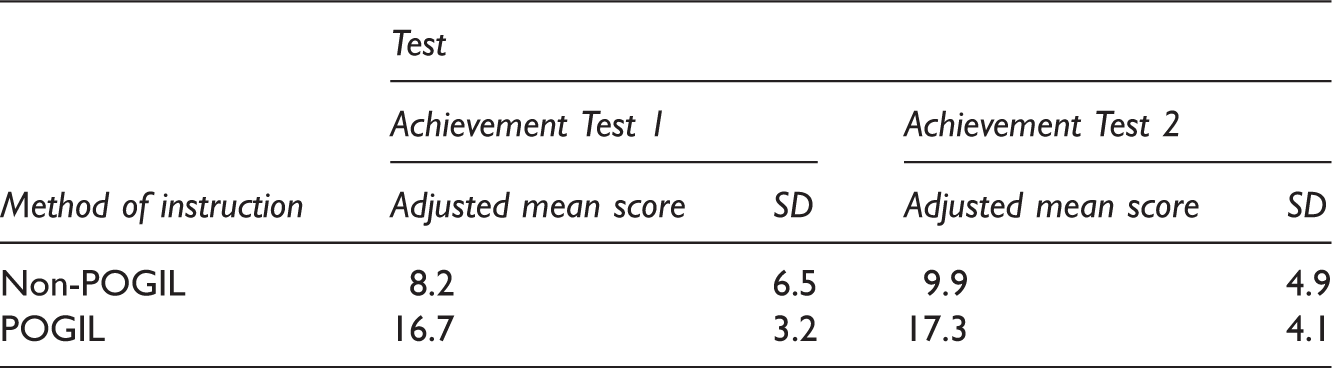
For Achievement Test 1, scores ranged from 3 to 24 and for Achievement Test 2, scores ranged from 4 to 31. The adjusted means and standard deviations for the POGIL and non-POGIL groups for both Achievement Tests 1 and 2 are shown in Table 1. The regression model for Achievement Test 1 was highly predictive. The POGIL group performed significantly better by 8.5 points than the non-POGIL group, coefficient = 8.5, t = 9.3, p < 0.001 (see Figure 1 for the adjusted mean scores). Female students overall scored significantly better than male students, coefficient = 2.24, t = 2.6, p = 0.028. There was a nonsignificant trend for females to improve more, by 9.5 points, when using POGIL than males, who improved by 6.5 points, p < 0.10. There was also a site difference, with students at the West 60th Street performing the best, coefficient = 4.87, t = 3.3, p < 0.001, followed by those from Avenue J, and then 23rd Street. The treatment effect held after adjusting for the sites.
Adjusted mean scores for Achievement Test 1 and 95% confidence intervals (CIs). Descriptive statistics showing adjusted mean scores by achievement test and by method of instruction.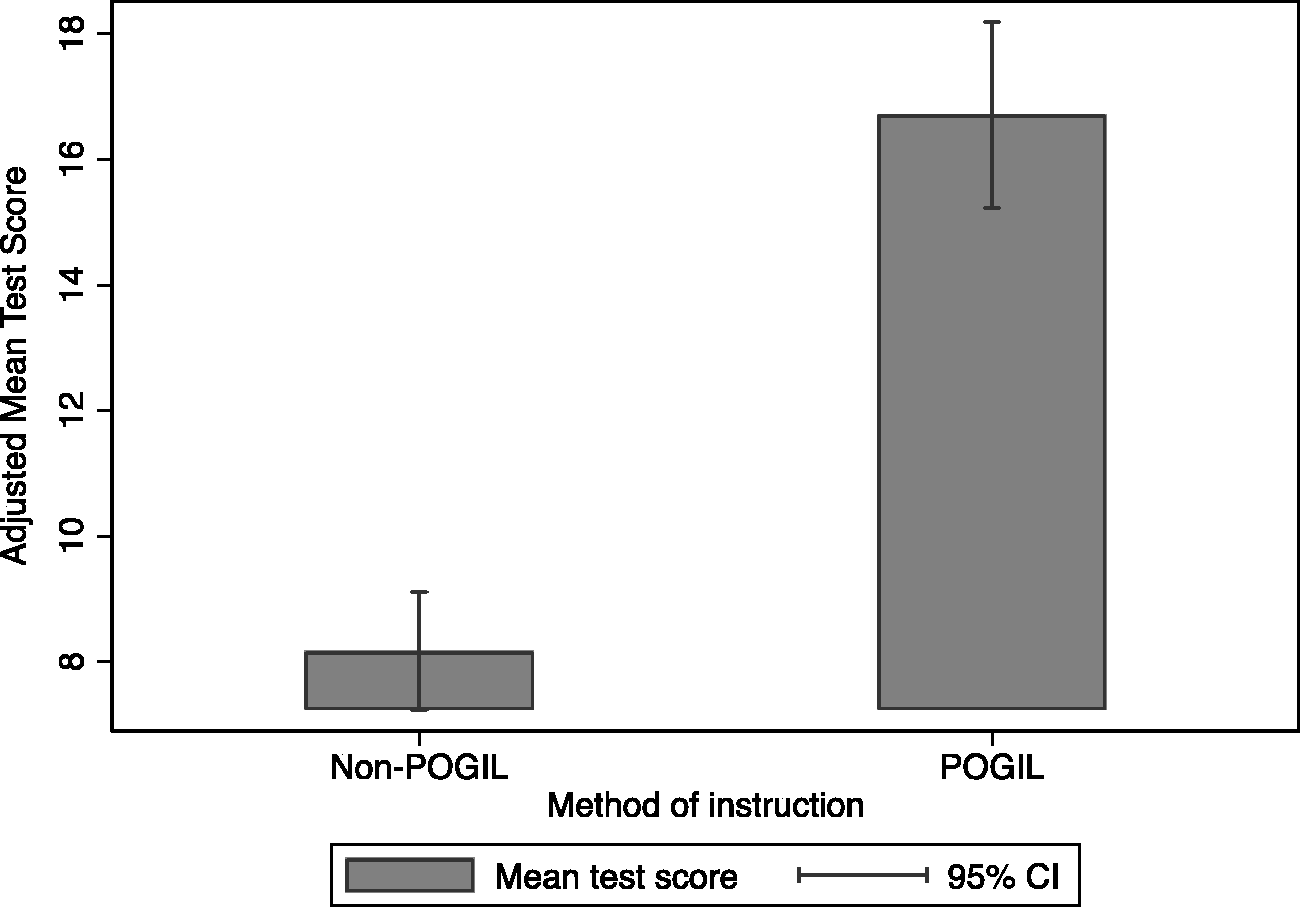
The results were similar for Achievement Test 2. The difference in test scores between students in the POGIL and non-POGIL group was also large and significant, coefficient = 7.43, t = 5.7, p < 0.001. The POGIL group scored 7.43 points higher than the non-POGIL group (Figure 2 shows the adjusted mean scores). For Test 2, there was no difference by gender. There was a significant difference by site, with students at the 60th Street site performing the best, coefficient = 3.62, t = 2.14, and p = 0.037, followed by Avenue J. (Students from 23rd Street did not take the test.)
Adjusted mean scores for Achievement Test 2 and 95% confidence intervals (CIs). Students using POGIL scored higher than those who did not, p < 0.0001.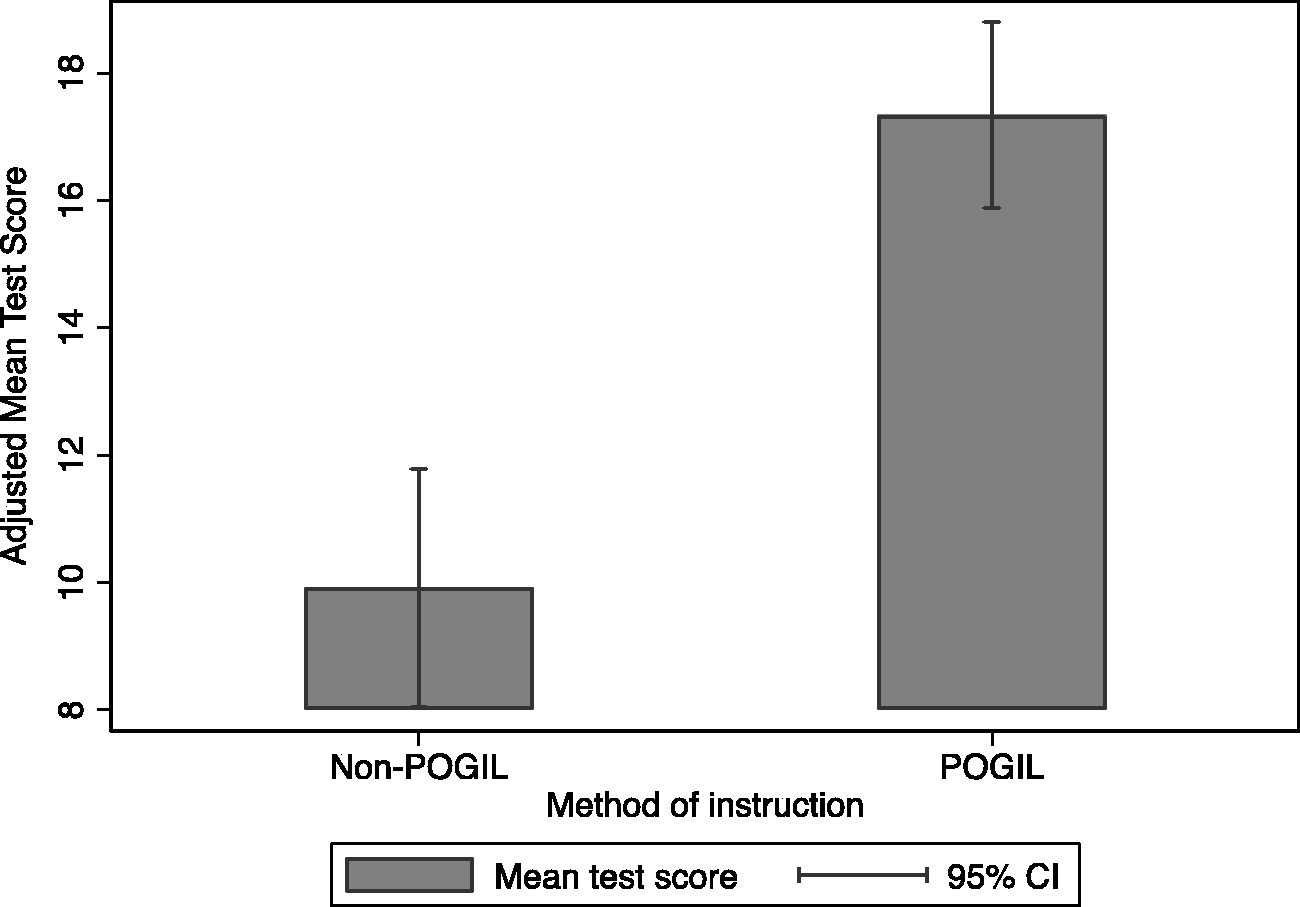
Among the 46 students from four sections of the lab who participated in the focus groups and answered the question, “Do you find the POGIL activities beneficial?” 32 (70%) provided a positive response, ranging from 60% in Section 1 to 73% in Section 3. In addition, students said that the POGIL activities were enjoyable because they were interactive. Students also offered the following suggestions for improving the POGIL activities: (a) more explanation of the terms used in the POGIL activities and more contextual use of the terms: for example, the POGIL activities use the term “random assignment” but some students were unclear whether “randomization” meant the same as “random assignment”; (b) more background material for each POGIL module/activity; and (c) more integration of the lecture material with the lab activities.
Discussion
This is the first study of POGIL in the experimental psychology curriculum. It compares the effectiveness of POGIL versus non-POGIL teaching of experimental psychology labs using a quasi-experimental design. The students using the POGIL materials performed significantly better on the two achievement tests than those that had traditional instruction. For Achievement Test 1, where the test items were taken exclusively from the MFAT, students using POGIL did significantly better than those that did not. There was a gender effect, with female students scoring significantly better than male students. For Achievement Test 2, a test focusing on statistics, those students using POGIL did significantly better than those that did not, but there was no gender effect.
Although the results were highly significant, a limitation of the present study is that it is a quasi-experiment as the students were not randomly assigned. A logical next step would be a randomized study where students are assigned to either POGIL or non-POGIL sections. A second limitation is that there were various instructors involved and various sites, and there may be differences among the students at the various sites, as well as inherent differences among the instructors, even though all instructors were experienced in teaching experimental psychology. A third limitation is that whereas the MFAT is a standardized test whose psychometric properties of reliability and validity are known, the items in Achievement Test 2 were constructed from test bank questions and were not validated. An additional limitation is there were more non-POGIL than POGIL students who took Achievement Test 1 and more POGIL than non-POGIL students who took Achievement Test 2.
There are some challenges in moving to a POGIL-based classroom. First, it requires a shift in the traditional role of the instructor, from “sage on the stage” to “guide on the side.” As part of the faculty training, instructors need to be trained on this aspect of POGIL. Another challenge is that problems arise in managing discussion and learning teams (e.g., http://pogil.org/about-pogil/pogil-faqs# on the POGIL Project Website, 2018). The issues that arise include: Assigning roles to team members; getting the attention of teams and students; handling the reporting component of each activity, in which teams relay their conclusions and findings; maintaining focus if the teams get restless; and helping students who do not like teams or who do not participate. Moreover, the metacognitive processes of self-reflection and self-assessment are new to many students. In our experience, students are not usually asked to reflect on how they think or to assess themselves. These issues need to be addressed during the faculty training sessions, where faculty can gain experience both in managing discussion and learning teams.
Our findings in the present study are consistent with previous positive findings with POGIL in the field of chemistry. As already noted, they are also consistent with previous findings of the beneficial effects of inquiry methods, generally speaking, and of collaborative learning. The guided-inquiry component actively involves the student in constructing knowledge, while the presence of teams serves several purposes: The student is actively involved in learning; teams provide students with a support system so that they can ask each other if they do not understand something; and teams also serve as a means of social reinforcement. The combination of these factors may help explain why POGIL has been effective.
Footnotes
Acknowledgements
We thank Dr. Yao Lu of Columbia University for performing the statistical analyses. We also thank Moshe Schneiderman for assisting with the analyses.
Declaration of Conflicting Interests
The author(s) declared no potential conflicts of interest with respect to the research, authorship, and/or publication of this article.
Funding
The author(s) disclosed receipt of the following financial support for the research, authorship, and/or publication of this article: This study was supported by NSF grants 0511077 and 1123136.
