




Abstract
Ensemble practices have been essential to the performing and visual fine arts over centuries. The skills of working in ensembles, including team work and collaborative learning, are increasingly understood to be critical and transferable professional attributes. However, much teaching of ensembles is practical and embodied, relying on tacit knowledge within a focused specialism. This kind of approach champions depth of expertise in a particular field, but may have limitations, particularly where more explicit awareness is needed to support transferring practical skills to new contexts. There is therefore a need to strengthen reflective practice in ways that connect explicit procedural understanding with tacit practical experience. To serve this purpose, this paper develops a reflective matrix as a framework to support dynamic reflection for students and teachers in higher arts education. The matrix emerges from analysis of the literature across music, theatre, dance and visual fine art.
Keywords
Introduction
By joining with others we accept their gift of confidence, and through interdependence, we achieve competence and connection. Together we create our futures (Original emphasis). (John-Steiner, 2000: 204)
This article starts from a premise, echoing John-Steiner, that collaboration and team work are fundamental to the arts, and that many ensemble practices involve long-established approaches to these. Moreover, the significance of collaboration and team work is, if anything, increasing as professional practices evolve. Artists are finding themselves called to meet new challenges in unfamiliar contexts, often working in unusual ensemble formations or interdisciplinary teams. While responding to such challenges may be the norm for newer parts of the creative industries, not least those based in digital media, this tends to be less established within more traditional arts disciplines, particularly those dependent on intensive practical craft training such as western classical music, ballet and contemporary dance, acting or painting.
Nevertheless, in these disciplines too ensemble work is becoming more and more diverse. As a result, agile skills for collaborating within ensembles are increasingly important, which in turn creates greater need for artists to be effective reflective practitioners. This has important implications for these more traditional disciplines within higher arts education. Research presented in this article therefore seeks to create materials to support learning and teaching in these fields (here focused particularly towards a more traditional cluster of performing arts disciplines: music, theatre, dance and fine art; with music further focused to the fields of classical, jazz and folk genres rather than fully encompassing popular and digital genres; and fine art focusing on traditional techniques rather than fully encompassing newer digital disciplines of film and media and applied forms such as graphic design). The research forms the first part of a larger practice-based study which aims through iterative processes to evolve new tools and pedagogies to underpin ensemble work in higher arts education, with a view to preparing the next generations of artists for successful careers in diversifying professional landscapes.
Research into team work and collaborative learning within ensemble practices in the performing and fine arts disciplines has started to gather momentum in recent years (see, for example, Butterworth and Wildschut, 2009; Kokotsaki and Hallam, 2007; Radosavljevic, 2013), although little research appears to have been done at an interdisciplinary or transdisciplinary level. Team work and collaborative learning are also increasingly understood in higher education to be transferable skills, critical to employability across a range of professional fields. Within the arts, contemporary contexts of rapid change call for artists to be able to understand and reflect on their own individual practices, and to collaborate reflectively as well as creatively to facilitate inter- and transdisciplinary work, embracing multiple diversities across social and cultural borders. This is as important for long-established traditional art forms as it is for newer and hybrid art forms if they are to thrive as professional practices within contemporary societies.
In order to develop a research base to support reflective practice, this article seeks to analyse existing relevant research literature in order to propose a reflective matrix relating to ensemble practices in the arts. The matrix aims to illuminate the rich diversity of ensemble practices across the arts and to draw out areas of commonality between them. The process of developing the matrix therefore seeks to answer the following question:
How may the critical features of ensemble practices in the performing and fine arts be conceptualised in ways to support reflection on team work and collaborative learning in both traditional and novel ensemble types in these disciplines, and more widely across higher education?
Later stages of the overall study (reported in subsequent research articles) focus on developing a range of approaches to working with the reflective matrix, and to assessing its value in fostering greater explicit awareness of ensemble processes and skills, and in stimulating learning, exchange and innovation across disciplines.
This article is structured as follows: the first section fleshes out the rationale for developing a reflective matrix. This leads to exposition of the research method. The major part of the article then focuses on setting out the reflective matrix, presenting analysis of the literature to underpin each element. A final discussion considers implications for using the matrix in practice, and for further research.
The case for a reflective matrix relating to ensemble practices in the arts
Team work and collaborative learning in ensembles in the arts
Team work and collaborative learning are ubiquitous in the arts, central to what is often termed ‘ensemble’ activity, where practitioners for example prepare to perform existing repertoire or devise new work. Approaches are distinctively embodied, embracing an integrated set of kinaesthetic, cognitive, imaginative and emotional skills.
In the performing arts, ensembles and group working have long been fundamental to practice, across cultures, genres and contexts (Berliner, 1994; Blom and Chaplin, 2010; Blum, 1986; Cohen, 2011; Tharp, 2009). From sung liturgy to community dancing, theatre productions to folk bands and orchestral concerts, these disciplines are characterised by collective endeavour. Through the 20th century, a number of factors, including the growth of the recording industry and the ongoing rise of the music ‘virtuoso’, in part shifted attention away from the values and practices of ensembles, and heralded an era of ‘star’ culture prioritising individual talents. Nevertheless, even ‘solo recitals’, ‘one-man shows’ and celebrity appearances represent the culmination of collaborative effort between diverse professionals, although the nature and quality of such collaborative effort may often remain unexamined.
On the surface, working in groups may appear less prominent in the fine arts. In fact, it has been suggested that the perceived quality of an artwork decreases when increasing the number of artists (Smith and Newman, 2014). Thus, the Modernist concept of the artist as a solitary creator has been pervasive, often supported by the structures of the art market. Nevertheless, the long history of apprenticing artists within a studio underlines significant reliance on team work even in this discipline (Macdonald, 2004). Furthermore, contemporary concepts of studio practice have diversified to include a range of cooperative and transdisciplinary models (Coles, 2012). Social art, new genre public art, dialogic art and conversation art have all indicated important shifts in artistic processes towards more collective and socially-engaged approaches, expressed, for example, through extended artistic residencies in particular societal contexts (Bishop, 2006).
Transdisciplinary and socially-oriented trends have also been reflected in music, theatre and dance, with momentum building particularly through the 21st century. Across the professional arts industries, rapidly changing landscapes are demanding innovation. For example, where audiences for traditional artistic outputs are dwindling and novel opportunities are opening up (not least through technology), many artists have developed more collaborative, interdisciplinary/transdisciplinary and co-creative approaches in order to remain relevant to the societies in which they are embedded (Bennett and Hannan, 2010; Henley, 2016; Oakley and Selwood, 2010; Rogers, 2002). There are immediate implications for how such developments are addressed in higher education, and certainly in terms of ensemble practices and the skills of team work and collaborative learning they foster being adaptable. A challenge frequently encountered is that these skills remain largely tacit. This is likely to impede the task of reflecting on, evolving and adapting approaches to them, from both learning and teaching perspectives.
Team work and collaborative learning as generic graduate skills
Team work and collaborative learning are increasingly highlighted as important pedagogies for higher education as a whole, further emphasising the importance of this work in the arts, and perhaps also pointing towards particular strengths of these disciplines in higher education. The last 20 years have seen a shift from pedagogical models of transmission from one expert teacher to many students, to more distributed approaches focusing on many-to-many interactions and exchange within learning environments (Illeris, 2007; Ramsden, 2003). Alongside this, attention has turned to embracing diversity and supporting democracy in learning (Blank and Davidson, 2007; Gurin et al., 2002; Saltmarsh and Hartley, 2011). In this context, concepts of communities of practice and social networks as a basis for effective team work and collaborative learning have been foregrounded (Lee, 2010; Lin, 2008; Wenger et al., 2002).
At the same time, the importance of careful design for collaborative learning in higher education has been identified, alongside challenges in managing individual and collective priorities, and unpredictability of outcomes (De Hei et al., 2014; Fransen et al., 2011; Gilies et al., 2008; Harju and Åkerblom, 2015; Lee et al., 2015). Pedagogies of team work and collaborative learning are not straightforward, and often point towards a paradigm shift in understanding knowledge and how it is generated. Aligned to this, three metaphors of learning have been identified by Paavola et al.: ‘learning as knowledge acquisition … as participation in a social community … [and] as knowledge creation’ (2004: 557). These authors particularly emphasise creating new knowledge collaboratively between diverse participants in order to transform knowledge creation from a domain dominated by an elite of intellectuals. From this perspective, it is evident that strong connections can be made between approaches to nurturing team work and collaborative learning on the one hand, and the renewal and democratic development of knowledge on the other hand.
In spite of the challenges of designing and implementing team work and collaborative learning in higher education, both theory and practice have evolved considerably (Boud et al., 2001; Gillies, 2015; Riebe et al., 2016), underpinned by arguments for their contribution in combining cognitive, social and emotional dimensions of learning (Gilies et al., 2008; Järvelä et al., 2010). Such developments have been important in catalysing student motivation and responsibility for learning (Castle, 2014; Illeris, 2007). Equally they have contributed to promoting distributed creativity (Hakkarainen, 2013; Sawyer, 2007), interdisciplinary and intercultural exchange (Loes et al., 2018; Power and Handley, 2017) and critical thinking (Loes and Pascarella, 2017).
These elements have become highly prized in terms of graduate employability (Knight and Yorke, 2003; O’Leary, 2015; Riebe et al., 2010). It is not surprising, therefore, that interest in processes of team work underpinning high-level performance in knowledge-based societies, and the dynamic capabilities and innovation that these can catalyse, is also a growing theme in the literature on organisational management and leadership (Bateson and Martin, 2013; Gilboa and Tal-Shmotkin, 2012; Hadida and Tarvainen, 2015; Hakkarainen, 2013; Hunt et al., 2004; Sawyer, 2003). This reinforces arguments for further exploring team work and collaborative learning in higher arts education. Furthermore, ensemble working in the arts has also been identified as a field that offers powerful models for professional work in other disciplines (Meisiek and Barry, 2014; Pearce et al., 2014; Sicca, 2000). For example, the skill sets of improvisation enable professionals to co-create new work or a new product, often under circumstances that are unpredictable (Hatch, 1999; Sawyer, 2006). Improvisation skills may also be invaluable where interdisciplinary and transdisciplinary collaborations are needed to address complex societal issues (Max-Neef, 2005). Active listening with its important intersubjective and intercorporeal dimensions (Rutter, 2003) is another essential skill that is central to musicians’, actors’ and dancers’ work alike, and may be utilised in numerous other professional settings as an integral part of the ability to focus closely on a task at hand (Meyer et al., 2016). In many ways, ensemble processes in the arts thus seem to resonate particularly with professional contexts that ask for flatter hierarchies within collaborative processes, where social capital becomes less about reproducing inequalities (Bourdieu, 1984) and more about creative interdependence built on trust and mutual obligation (Frick and Hoffman, 2012; Lee, 2010).
The specific need for ensemble skills in the arts taken together with their wider value within a higher education learning process and as transferable graduate skills, lend support to the premise that articulating a reflective matrix has potential to support students and teachers as reflective practitioners. As attention to the significance of team work and collaborative learning in higher education grows, such a reflective matrix should contribute to the ways in which ensemble work is able to address key agendas such as interdisciplinary innovation, employability, diversity and inclusion, and for arts practitioners should further illuminate the transferability of their core skills in team work and collaborative learning.
Research method
The research reported in this article forms an early part of a larger practice-based study: The Art of Ensemble: Enhancing Team Work and Collaborative Learning in Performing and Fine Arts Higher Education. An important aim for the overall study was to undertake research and generate outputs that could be of practical use within learning and teaching in higher arts education, embracing the fundamentally practical nature of these disciplines. The research approach therefore combined theoretical work based on existing literature to develop a reflective matrix (as reported in this article) with collaborative exploration in practice of the reflective matrix in order to propose relevant pedagogies for its use.
The study was developed collaboratively by two arts practitioner researchers working in professional higher arts education contexts that have a particular focus on western classical performance traditions. Both of us have previously experienced immersive apprenticeship training, and have gone on to work as professional practitioners in the arts, and as teachers and researchers within higher arts education. Our position in undertaking this research has therefore been as insiders to vocational professional higher arts education.
In order to develop the reflective matrix in the first instance, critical analysis of a representative selection of available literature was undertaken in relation to team work and collaborative learning in ensembles in music, theatre, dance and fine art. A systematic approach was taken to identifying literature through database search with a view to covering the breadth of disciplines. A range of keywords were used including ‘ensemble’, ‘team work’, ‘collaborative learning’, ‘peer interaction’, ‘group dynamics’ and ‘leadership’ in relation to the arts disciplines encompassed in the study. By reading abstracts, a representative sample was selected for attention to the full article. A snowballing technique was then adopted, searching the references of compelling material encountered to draw out significant new insights, until thematic saturation was reached. In this process, literature was included that oriented more clearly towards practitioner perspectives than academic research. This was considered particularly important given the need for the reflective matrix to be able to connect to practitioner experience, and the relatively limited extent of published research.
Thematic coding of the literature identified a series of themes, many of which pointed to nuances and creative tensions between ensemble types, disciplines and genres. These themes were then clustered within four overarching issues as follows:
Purpose and vision Resources: people, materials, process structure and context Leadership Qualities of communication and interaction
Within these overarching issues, a question about how best to represent the themes emerged. It was important to reflect the scope of nuances and creative tensions characterising the themes and the dynamic ways in which practitioner approaches evolve in response to particular situations over time. Furthermore, our aim was to avoid polarisation between extremes and to enable both similarities and differences between practices to be considered. We therefore decided to express the themes in terms of continua, as a way of stimulating reflection that might be dynamic and nuanced, and could emphasise possibilities within ensemble practices and the number of choices that practitioners have. In developing the reflective matrix, we thus began to consider its practical implementation in higher arts education, and its potential to support emerging practitioners in developing their skills of team work and collaborative learning in ensembles, and to stimulate reflection and exchange across disciplines in the arts.
Articulating a reflective matrix exploring ensemble practices in the arts
The matrix articulates the four overarching themes relating to ensemble processes in the arts that clearly emerged from the literature. These four themes interrelate and are often interdependent. We have therefore decided to represent them in terms of a dynamic system. This system also allows both for pre-determined elements and for new elements to emerge through interaction between the themes. This is shown in Figure 1.
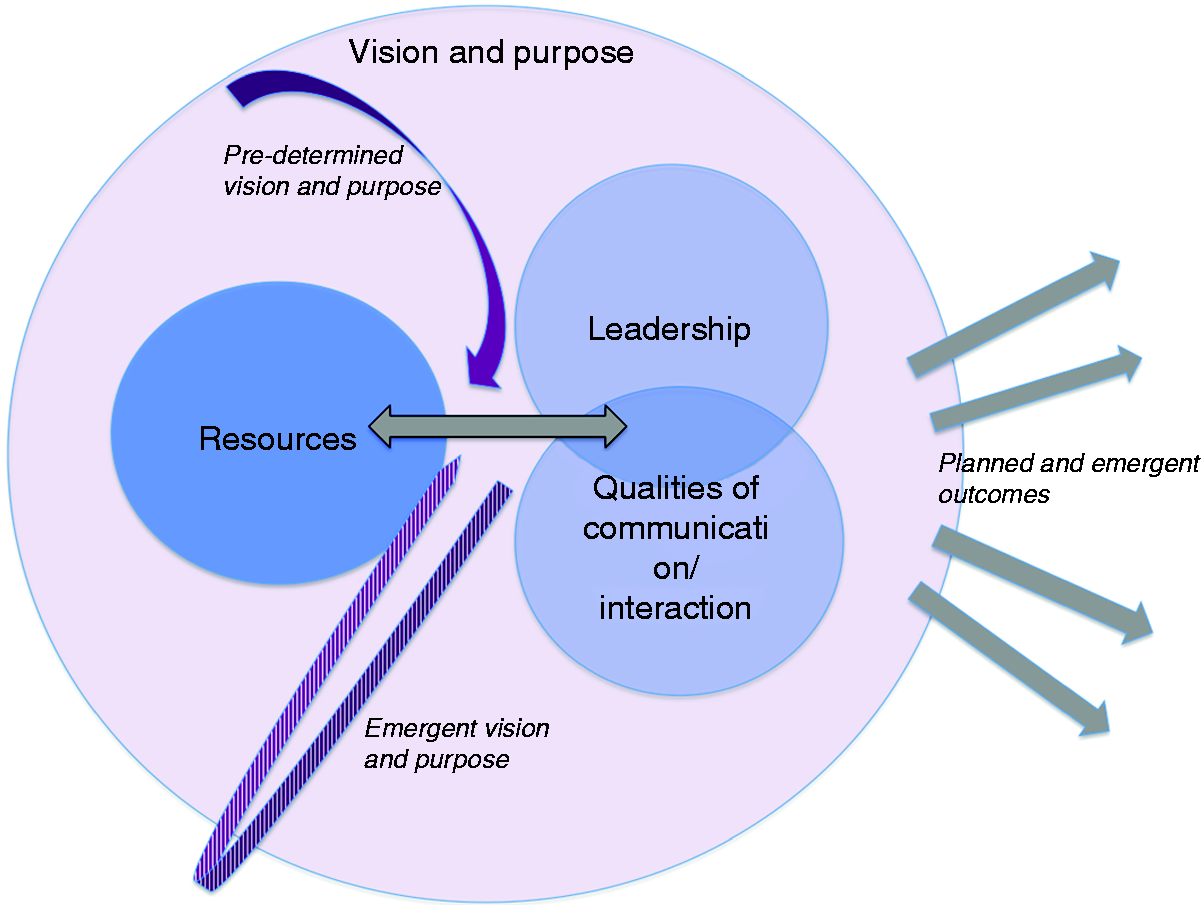
Reflective matrix for ensemble practices in the arts.
Each of the four main areas of the framework then contains a series of continua, as shown in Figure 2. Each continuum opens up trajectories of nuanced differences between practices, and equally demonstrates potential for any one practice to change fluidly over time or in response to context rather than being characterised only through fixed attributes. This is shown in Figure 2.
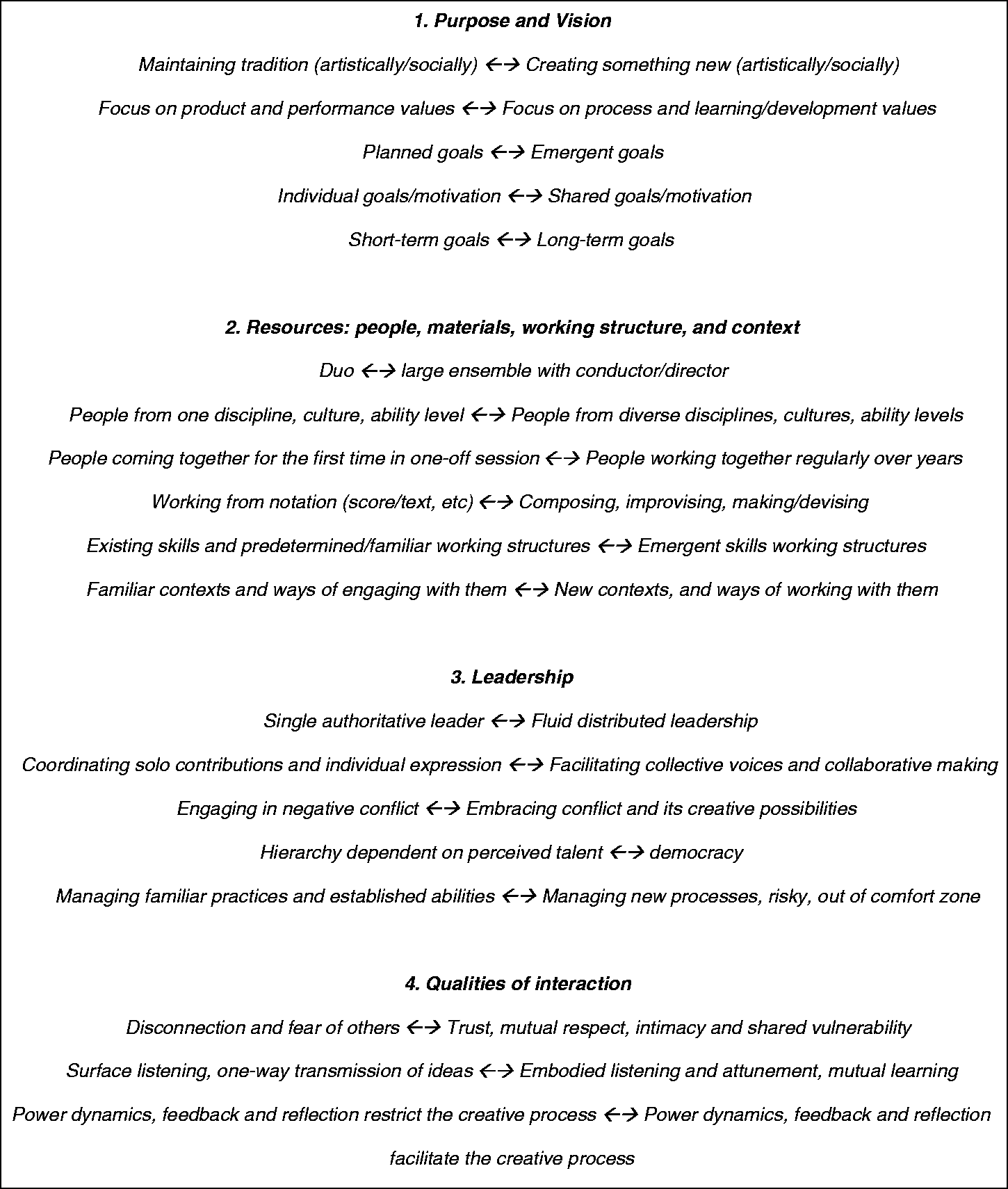
Continua emerging within the four main areas of the framework.
In the following sections, each of the four themes of the matrix, along with its associated continua, is presented in detail, through critical analysis of the literature.
Purpose and vision
The overall purpose and vision of ensembles vary considerably in different contexts within each discipline as well as between disciplines. Diverse factors may be at play, including the nature of the artistic material, the relative importance of creative process and final output and contrasts between individual and shared, planned and emergent goals.
Relationships between maintaining tradition and creating something new
A key distinction concerns whether an ensemble focuses on realising existing repertoire (for example, well-known ballet or symphonic repertoire), or on devising new work, which may well include collaborating in unusual interdisciplinary formations (Bremser and Sanders, 2011; Coles, 2012; Radosavljevic, 2013). With new work, the extent of innovation desired may align both with how many different disciplines are involved in an ensemble and with how participants work together. Coles (2012: 16–17), for example, describes on the one hand a ‘mutation’ of disciplines through interdisciplinary work, where the disciplines as such remain recognisable; and on the other hand a more radical departure that develops quite new ways of working through transdisciplinary work, and consequently leads to new forms of knowledge.
An innovative purpose may equally include radical shifts in relationships with audiences, moving towards immersive or co-creative processes that extend beyond collaboration taking place between artists to foreground audience agency and/or active participation with the professional artists (Bishop, 2006; Freshwater, 2009; O’Neill and Sloboda, 2017). Professional ensembles exploring and evolving such practices are increasing, as is evidenced in the work of companies such as Punch Drunk theatre, Artichoke and the Multi-Storey Orchestra.
These ideas are taken further in concepts of socially-engaged practice. In fine art, directions in avant-garde and community-based work have sought to redefine a genuinely dialogical set of relationships, moving away from hierarchies of perception where ‘the viewer lacks a sufficiently critical and reflective understanding of the world, while the artist possesses an exemplary critical awareness’ (Kester, 2013: xvi). In this context, the production of an art object often becomes less important in itself, and the purpose focuses more on creating space for a performative, process-based approach. Thus artists … are ‘context providers’ rather than ‘content providers’ in the words of British artist Peter Dunn, whose work involves the creative orchestration of collaborative encounters and conversations, well beyond the institutional confines of the gallery or museum. (Kester, 2013: 1)
Differences in focus on product and performance values or on process and learning values
Significant differences between ensemble practices emerge depending on whether the focus for an ensemble is more on process or artistic product. While in participatory arts, process may tend to pervade (Lowe, 2014), for many professional ensembles, a focus on product is inexorable (Gaunt and Dobson, 2014; Harvie and Lavender, 2010). Navigating the tension between process and product is therefore considered important within professional education and training contexts, where in addition, the learning process and skills building will be more important at certain times than performance/creative outcomes (Alix et al., 2010).
Ensembles as a learning environment in higher arts education tend to dominate most strongly in theatre and dance, where practitioners often train full-time as an integrated member of a tight-knit ensemble (typically 12–25 participants). Consonant with this, Alix et al. (2010) have suggested that facilitating and teaching specific skills of collaboration are most current in theatre and dance, followed then by music. In western classical music, which traditionally has been premised on a one-to-one apprenticeship between master teacher and student, together with practising alone, ensemble plays a more fluid part-time role than in dance or theatre. Nevertheless, recent years have seen increasing emphasis in degree programmes on chamber music and collaborative ensemble work, and on elements of team work, and collaborative and peer learning (Gaunt and Westerlund, 2013). Furthermore, transferability of musicians’ collaborative skills has been noted in terms of equipping them for professional life to work flexibly and responsively in diverse contexts (Bennett, 2008).
Combinations of planned goals and emergent goals
The goals of an ensemble project are inevitably determined in part from the outset, and will be coloured by the degree to which a final product is prioritised and predetermined. Rehearsal towards planned performances of canon repertoire is likely to be more predictable and open to advanced detailed planning than open, enquiry-led activity where the process needs to be fluid to follow the creative and perhaps interdisciplinary or intercultural work (Butterworth and Wildschut, 2009; Cohen, 2011). Where innovative technical resources or artistic materials are used, more experimental, divergent creative processes are needed before convergent decision-making processes can be addressed. Unexpected goals can thus emerge in any ensemble process, but a comparatively longer time frame may more easily accommodate approaches that proactively seek to allow these goals to surface (Harvie and Lavender, 2010).
Individual goals/motivations and their relationship to shared goals/motivation
Although members of an ensemble may have their own distinct individual goals, in general they will also have at least some common ground with shared goals. This is certainly true in the case of an orchestra (Dobson and Gaunt, 2015), and a similar collective purpose in a smaller ensemble may provide the basis for collective spontaneity and satisfaction that comes from the interplay between the shared goal and individual contributions the ensemble members make: … a quartet tries to stamp each performance with its own character and style, and, even after considerable rehearsal, members can surprise each other or their audience with spontaneous flourishes. Quartet players feed off each other, as one cellist put it, trying to achieve ‘a spiritual experience …’ (Murnighan and Conlon, 1999: 166)
Given that the fundamental purpose and goals of different ensembles can vary so much, a key question for teachers in higher arts education concerns the degree to which these may be explicit or implicit. Not surprisingly, goals tend to be made more explicit between professional artists in situations where significant aspects of the ensemble or process are unfamiliar (Hayden and Windsor, 2007). Similarly, in participatory arts practices, goals are often explicitly discussed because of the lack of pre-existing shared experience between participants (Lowe, 2014). When ensemble processes are longstanding and familiar to the majority of participants, goals may be held implicitly, without articulation or negotiation. However, this opens up possibilities for unspoken friction (Murnighan and Conlon, 1999; Nathan et al., 2015).
Resources: People, materials, working structure and context
In professional contexts, the ways in which ensemble work takes shape in terms of people, source materials, working structure and engagement with context vary considerably.
The part played by size of ensemble and diversity within it
Ensemble size ranges from a duo, trio or quartet up to a large orchestra or theatre/opera company with 200 plus members. The larger an ensemble, for example, the more likely it is to use a designated director/choreographer/conductor/curator, whereas small ensembles such as a string or jazz quartet tend to be self-directed. The sheer size of a symphony orchestra makes the questions of organising and distributing tasks significant (Carnicer et al., 2015), and immediately raises issues of leadership. Larger ensembles may open up more possibilities for interdisciplinarity/transdisciplinarity, but they also reduce potential for intensity of interaction between participants. An opera production, for example, may involve several hundred people drawn from different artistic and production disciplines. Some participants, however, may never meet one another. Rather they work cooperatively within highly specified functions, for example, the orchestra and costume design/management team. Even a smaller multi-disciplinary ensemble situation may require a ‘professionalized collaborative ethic’ for success (Coles, 2012: 64), clarifying expectations for the ways in which people will interact.
The impact of timeframe and existing familiarity between participants
The time available and familiarity of the participants with one another and the work practices clearly impact the ensemble. String quartets often work together over many years (Blum, 1986). They spend intense and sometimes extended rehearsal periods working on repertoire that is new to them, but will also be able to perform familiar repertoire with practically no rehearsal, perhaps even with a guest player, because of the existing shared understanding of the piece and performance practices amongst the core members. Jazz musicians may equally develop long-standing partnerships. Nevertheless, the improvised nature of the music is understood and shared across the globe, and this means that they frequently pride themselves on being able to perform effectively in a band where none of the musicians have previously met (Sawyer, 1999).
There are also notable examples of long-standing communities bringing diverse artists together to explore a revolutionary vision and reinvent fundamental aspects of artistic practice. These include the Bauhaus collective that ran for 14 years (Droste, 2002) and Black Mountain, an initiative that lasted for 23 years (Duberman, 1972). In theatre, so-called permanent companies where the same group of actors work together consistently over a period of years are by no means always the norm. Whilst in part this is dictated by financial constraints, artistic risks have also been noted. Sir Peter Hall, director of both permanent and impermanent theatre companies in London, UK, summarised a radical view: I fervently believe in ensemble, but if you elevate ensemble into the concept of a permanent company then you have dogma, and that’s death. No question about it, down it goes … (Miles, 1995: 208) [original emphasis] It’s a bit like democracy of marriage: it doesn’t work, but it’s the only way. You have to try and make it work. And it has an inevitable cycle of creation and death which is built into it. (208)
The significance of source materials and starting points
Ensembles in all the art forms have to make choices about starting points in the materials used. Such choices may range from realizing an already complete text or score to beginning with fragments of materials, a concept alone, or even a decision to find inspiration through responding to location or context (Harvie and Lavender, 2010; Lerman, 2012). Materials chosen often relate closely to the particular purpose and goals of an ensemble, as outlined earlier. The choice of materials will also make certain technical demands of participants. Choosing technically demanding repertoire, for example, makes it important to prioritise the relevant craft skills in ensemble members. In contrast, devised work may be able to embrace a greater range of specific technical abilities.
Individual directors' tastes may also demand specific skills. For example, in theatre, Steven Berkoff is known for exploring the potential of choral unity to move and speak with a single intention in his productions (Sherman, 2010). This is a case in point of ensemble members needing to acquire highly specialised skills to meet the demands of a particular ensemble. In music, particular conductors may seek to stretch an orchestra’s ability for example to reach extreme dynamics and sound colours.
Diverse approaches to working structures within ensembles
The structure of preparation processes differ considerably between the disciplines. In many theatre practices, for example, with both devised work and classic texts, actors develop a production together, often with little individual preparation in advance (Brook, 2008). In dance companies, members tend to work together on aspects of pure technique within what is colloquially knows as ‘class’ before entering the space of developing choreographed work (Bull, 2011; Lerman, 2012). In contrast, in western classical music, much individual preparation is likely to take place before an ensemble starts to rehearse (Ford and Sloboda, 2013). In a symphony orchestra, individual musicians usually only see their specific part, rather than the full score, and may not therefore be sure of the parts of the other musicians. Attention to personal precision and execution of an individual line is paramount (Mintzberg, 1998).
Engaging with audiences
Approaches to interaction with audiences also vary between ensembles from traditional presentation of work to an audience, to immersive participatory or co-creative experiences with audience members (Anberrée et al., 2015). How artists perceive their responsibility in relation to audiences seems to be equally diverse. According to Mintzberg (1998), connecting to audience is a critical part of a conductor’s job in an orchestra rather than the responsibility of the players. Recent research has also drawn attention to the ways in which improvisatory approaches to classical music performance may significantly and positively impact the dynamic between performing musicians and their audience (Dolan et al., 2013). This contrasts with earlier research which found that more successful string quartets were less attentive to their audiences than less successful quartets (Murnighan and Conlon, 1999). In fine art, the extent to which artists may have to ‘… surrender the security of self-expression for the risk of intersubjective engagement’ is raised by Kester (2013: 8). Frameworks to help understand art in this way are, however, still emergent: the idea that a work of art should solicit participation and involvement so openly, or that its form should be determined through direct interaction with the viewer, is antithetical to dominant beliefs in both modernist and postmodernist art and art theory. (11–12)
Leadership
Leadership in any domain is now widely understood to be distributed across roles and individuals rather than residing solely in one person. Leadership within ensembles in the arts is similarly multi-layered.
Different forms of distributed leadership
The role of a conductor, director or choreographer is an obvious locus of leadership, and larger ensembles mostly require such a role to be explicit. A conductor is responsible for pacing and timing in both rehearsals and performances, this being the case with choirs as well as orchestras (Cox, 1989; Mintzberg, 1998). In smaller ensembles, however, one member may also dominate artistically and/or organisationally, often the first violin for example in a string quartet (Murnighan and Conlon, 1999). The literature reveals underlying tensions between on the one hand desire for democratic exchange, and on the other hand belief in leadership emanating from heightened artistic credibility and charisma.
Nevertheless, in practice, leadership is also distributed in both smaller and larger ensembles (Lehmann et al., 2007; Tovstiga et al., 2004). Within and across the sections of an orchestra, for example, distributed musical and social leadership has been found to be highly developed and present in every rehearsal and concert (Gaunt and Dobson, 2014). Indeed some orchestras pride themselves on not having a conductor, thereby making leadership more explicitly distributed between players (Vredenburgh and He, 2003). It has also been suggested that the real test of success for conductors lies in their ability to coordinate multiple agendas and skills at play, and to balance their own centre of power with that of the players: ‘If the players do not accept the conductor’s authority or if the conductor does not accept the players’ expertise, the whole system breaks down’ (Mintzberg, 1998: 145). This chimes with the leader versus democracy paradox proposed by Murnighan and Conlon (1999) based on Smith and Berg (1987), which suggests that ensembles have to deal with ‘the struggle of individuals and the group to each establish a meaningful identity that is an integral part of the other’ (Murnighan and Conlon, 1999: 168).
Similar issues are at play in theatre and dance. Distinctions have been made, for example, between ensembles organised around a single charismatic leader, usually chosen for their perceived artistic talent, and ensembles working together with a purpose to use a particular working method (Harvie and Lavender, 2010; Lerman, 2012). Devised theatre practices in particular have questioned the dichotomy between director as visionary leader and a thoroughly democratic process: … after decades of attempts at democratic practice which were at best sometimes frustrating and at worst grossly compromised, many practitioners are now exploring strategies for negotiating democratic practices and relationships, in recognition that dispersed power is not necessarily democratic power and also that negotiated leadership can facilitate group agency. (Harvie and Lavender, 2010: 4)
Coordinating individual and collective voices, and the conflict between them
Managing conflict has been highlighted as an essential part of leadership if ensemble working is to be an environment for productive challenge of individual practices and to break new ground (Alix et al., 2010). In the context of theatre, Hall, interviewed by Miles (1995) draws attention to the natural cycle of an effective ensemble – echoing Tuckman’s analysis of five natural stages of group process, from Forming to Adjourning (1965) – and the difficulty of sustaining ensembles effectively beyond this cycle, given inevitable conflicts between individual priorities.
In the context of dance, the concept of ‘elastic coordination’ between participants in devised work is proposed by Harrison and Rouse (2014). This allows for a balance of individual autonomy producing divergent ideas in the creative process, and coordination towards a single coherent whole through the choreographer’s leadership. In a similar vein, Pentland (2012: 7) found that in the best performing teams, members’ contributed in roughly equal measure, and that ‘individual […] talents contribute far less to team success than one might expect’. Furthermore, this research found that members in high-performing teams connected directly with one another and not only with the team leader to help coordinate the team’s effort.
Further insight is added by experience of a transdisciplinary art studio (Coles, 2012). One lead artist, Eliasson, articulates the need to nurture personal as well as collective aspects of his own practice in order to avoid constricting his individual creativity. He does this by physically moving between three studios in different countries: Each of these studios is important to Eliasson’s creative process: the mobile-studio being where he can be alone amidst the relative silence of Eidar in Iceland; the micro-studio affording Eliasson and key studio members the space to reflect without the pressures of a large studio; and the macro-studio facilitating the production of it all, while also hosting the parallel activities of the school and the seminars. (63)
Qualities of communication and interaction
Communication and interaction in ensemble practices are both intensive and embodied (Blom and Chaplin, 2010; Blum, 1986; Coles, 2012; Harvie and Lavender, 2010). Several key themes emerge in the literature, including the fundamental significance of trust, mutual respect and intimacy, the importance of embodied listening and its connection to a learning process, and the role of power, feedback and reflection. Taken together, these elements reflect interconnections between artistic and social dimensions of ensembles in the arts. In jazz, several research studies have already demonstrated reciprocal exchange between artistic interaction and social community between musicians, these together underpinning both cultural meanings and the development of the art form (MacDonald and Wilson, 2005; Monson, 1996).
The importance of trust, mutual respect and intimacy
Collaborative work in the arts has been summed up as ‘primarily a process of learning how to engage the self with others’ (Alix et al., 2010: 15). Consonant with Sennett’s wider investigation of collaboration (2012), these researchers talk about ‘finding a language of communication, creating trust and respect, sharing of expertise, as well as developing a strong partnership’ (37), and this being central to the ‘conversation’ of collaboration. They go on to hint at the ethical dimensions and intimacy involved: It is about crossing boundaries, entering another ‘space’ together and, ideally, creating a new one – an intermedial space. (37) The most important thing about the theatre is that every actor, however great, is totally dependent on the actors around him, and unless there is a real sharing, a real sense of support, no actor can play as well as he could when he is being supported by his fellows. (Miles, 1995: 207)
The worlds of theatre and dance seem to be most explicit about these issues. Less attention has been given to them directly in either music or fine art. Relatively little, however, is said in any of the disciplines about how trust is enabled within a collaborative environment. For example, the value and challenges of developing a shared language within an ensemble are highlighted by director and actor, Emma Rice, interviewed by Radosavljevic (2013: 99), but the process of establishing trust remains implied: There’s a British phrase ‘familiarity breeds contempt’ – but familiarity also breeds a shared language, a shared understanding and a shorthand, and a bravery, a fearlessness that, if you balance [it], the dividends can be so extraordinarily high.
Embodied listening and attunement as core skills for ensemble work
Skills of listening and responding are evident in all the performing arts. In orchestras, for example, a multi-sensory embodied process akin to ‘radar’ has been described as essential to ensemble outcomes (Dobson and Gaunt, 2015). This resonates with reciprocal and subtle embodied dimensions of an holistic process identified by King and Gritten (2016) and McCaleb(2014) in chamber music groups. Drawing on Sawyer’s understanding of ‘attunement’ between jazz musicians (Sawyer, 2005), McCaleb proposes three steps in ensemble interactions: ‘transmitting, inferring and attuning’ (99) that may sit alongside explicit verbal communication between the players.
Another angle on these issues is provided in participatory arts practices by the concept of ensemble work as a learning process. Here there is an expectation of all those involved, including the leading artists, to be listening as part of being ready themselves to experience a developmental process: The work rests on dialogue and mutual learning – the artist putting themselves in the position of co-learner. Let’s try this together. (Lowe, 2014: 8)
Power, feedback and reflection in the creative process of ensembles
The idea of a learning process through ensemble interactions has been explicitly connected both to dynamics of power and potential to break new ground (Hayden and Windsor, 2007). Focusing on collaborative composition, these researchers highlight the importance of attitudes towards open-loop (as opposed to closed-loop) learning (Argyris and Schon, 1974) to underpin the readiness of participants in collaborative partnerships to move beyond their existing comfort zone and pursue the boundary-breaking potential of interdisciplinary groups. Where this kind of attitude does not prevail, they suggest that both composers and performers ‘might act as if their technical knowledge is so specialized as to be unquestionable, resulting in defensive and controlling behavior, rather than a focus on mutually beneficial goals’ (30).
Open-loop learning is premised on feedback and reflection, and thus the powerful role and impact of feedback becomes evident. This connects back to issues of leadership and democracy (who is empowered to give feedback and of what kind). In the context of dance, Lerman and Borstel (2003) go further to highlight the vital role of feedback in supporting development. They consider such feedback relevant both when working on existing repertoire and in devising new work. They describe ways in which feedback can be profoundly motivating but equally can baffle and demotivate artists, particularly when they are left with a sense of lack of ownership of their work.
These perspectives begin to demonstrate important relationships between the power dynamics within ensemble work and the ways these may impact the process of feedback between ensemble members, and the collaborative learning that takes place to drive the creative process of an ensemble.
Discussion and conclusions
Critical analysis of the literature presented above has provided a systematic approach to developing a reflective matrix for ensembles in the arts. The matrix is designed to support enhancement of ensemble team work and collaborative learning in higher arts education. By helping to make tacit elements of ensemble practices explicit, it should assist individual practitioners in reflecting and deepening individual awareness, and in facilitating exchange between peers both within focused discipline areas and across disciplines. Development of the matrix has demonstrated that ensemble practices in music, theatre, dance and fine art encompass a rich array of approaches, and suggests that this diversity offers an important resource. This may be particularly important in contemporary contexts where inter- and transdisciplinarity, flexible team and collaborative working are increasingly critical dimensions of employability. With professional practices in these art forms demanding innovation and collaborative work in unfamiliar disciplinary, cultural and social contexts, such enhanced attention to team work and collaborative learning will be invaluable in preparing students for contemporary professional landscapes.
The reflective matrix should also be valuable in supporting the extension and enhancement of pedagogical approaches to teaching team work and collaborative learning within ensemble activities in higher arts education. This issue is particularly pertinent in the arts where those teaching in higher arts education are often practitioners who do not necessarily have extensive pedagogical experience prior to starting to teach in higher education, and who are then also engaged with embodied practice where much of their skill is tacit and therefore challenging to make fully accessible to students. However, further research is needed to explore effective use of this reflective matrix in practice. Many possibilities arise, from using the matrix to prompt particular questions in situ during ensemble work, to one-to-one reflective tutorials outside of the rehearsal room. We have developed one innovative example as part of our own continuing research, where we have used the matrix to help drive analysis of empirical data from interviews with a range of artist teachers, and to sharpen our own reflective and reflexive stance as insider researchers in this process (authors, in preparation). This has highlighted the significance of several critical dimensions of collective creativities including the handling of ‘mistakes’ and approaches to engaging with audiences. Further empirical research into ensemble work is also clearly needed. Three key areas were immediately evident to us as we developed the matrix:
Relationships between inter/transdisciplinary collaboration and abilities to embrace multiple diversities and work effectively across boundaries; Explicit and implicit distributed leadership, and its relationship to creative tensions between individuals and the ensemble collective; and Ways in which trust, intimacy and feedback evolve between ensemble participants.
Overall, the reflective matrix is intended to support learning and teaching practices in higher education, both within the art forms, and more widely through catalysing and enhancing team work and collaborative learning. It is hoped that the matrix will be valuable as a reflective tool in planning activities with students, and in supporting their skills development. In addition, it should help to facilitate exchange between disciplines and to focus further empirical research.
Footnotes
Acknowledgements
Within the project, we wish to acknowledge the collaboration in its early stages of Dr. Patrick Furu, then lecturer at the Sibelius Academy, University of the Arts Helsinki.
Declaration of conflicting interests
The authors declared no potential conflicts of interest with respect to the research, authorship, and/or publication of this article.
Funding
The authors disclosed receipt of the following financial support for the research, authorship, and/or publication of this article: This research has been supported by the Center for Educational Research and Academic Development in the Arts (CERADA) of the University of the Arts Helsinki, without which the work could not have been undertaken.