




Abstract
An academic career in psychology typically begins with a role reversal: young academics, who were only recently being taught, become doctoral researchers and teachers. Studies at two German universities provide insights into how students and early-career academics (ecas) in psychology view research and teaching and how their perspectives might differ due to changed roles. In Study 1, participants (n = 35 ecas and n = 26 students) rated the appropriateness of pictures for illustrating teaching or research. Study 2 (n = 25 ecas and n = 42 students) reassessed typicality judgements and collected open statements for the 10 most representative pictures from study 1. Five pictures for research and teaching each illustrate how the discipline is seen by students and doctoral academics. The views of the groups differed in two regards: in how independent research and teaching situations were seen, with students treating them as more integrated than early-career academics; and in the perspective from which comments were given, with students reacting from a learner's perspective and early-career academics reacting mainly from a teacher's perspective. Findings implicate that roles shape how one views research and teaching. The pictures are valuable to the research community and applicable in teaching and academic development.
Introduction
Socialization into academia is a complex, long-term process that begins with a role reversal: students, who were just recently being taught and introduced to research through their courses, become doctoral researchers who do their own research as well as teach undergraduates. These new doctoral researchers are faced with a crucial challenge because to succeed in academia they have to leave their student roles behind and develop professional identities that contain both active researcher and teacher roles (Sverdlik, Hall, McAlpine, & Hubbard, 2018). Little is known about this role reversal and how it might affect doctoral researchers’ perspectives on research and teaching at this early-career stage. Therefore, it is helpful to compare students’ and doctoral researchers’ views on research and teaching in order to find out whether and in what way changes in perspectives can be observed. As such a shift in perspectives is difficult to capture, and established methods to do so are lacking, the use of pictures constitutes an innovative approach. Therefore, the aim of this study was twofold: in a first step, pictures for research and teaching in psychology were generated, which, in a second step, were shown to students and doctoral researchers (in the following referred to as early-career academics), after which their reactions to these pictures were compared. This procedure sheds light on how students and early-career academics differ in the way they visually categorize research and teaching according to representative pictures.
In this article, we use the term “early-career academics” for doctoral students with active responsibilities in both research and teaching. When we refer to “students,” bachelor's and master's students are meant. Arguably, early-career academics should differ from students in how they see research and teaching due to their more active and responsible roles in the university system. Therefore, in the following we outline the academic double role of German doctoral students in the discipline of psychology.
From Student to Early-Career Academic: Changes in Perspectives?
In Germany, up to 600 candidates earn their PhD degrees in psychology every year (Antoni, 2019). The most typical way to finance doctoral studies is by securing a staff position paid by the regular university budget (Rentzsch, Harzer, & Wolter, 2017). Junior academic staff members are expected to do both research (in order to prepare their dissertation) and teaching, whereby the amount of time devoted to teaching, typically 2 hours a week, is smaller than the time allocated to research (Teichler, 2014). However, junior academics in psychology indicate that they spend more time on teaching than their actual teaching duties would demand (Rentzsch et al., 2017). Early-career academics are not systematically trained for teaching, and professional development courses are optional (Teichler, 2014).
As the aforementioned survey data illustrate, research and teaching shape the daily work-life of early-career academics. Yet little is known about their perspectives on research and teaching and how they evolve. This knowledge gap might result from the fact that one's development as a teacher is often addressed separately from one's development as a researcher (Åkerlind, 2011). Accordingly, studies that focus on both research and teaching as fields of (early-career) academic work are rare (see, for example, Jucks & Hillbrink, 2017 for conceptions of research and of teaching). However, professional roles do not operate in isolation, but are likely to interact in various ways (Stryker & Burke, 2000). Researcher and teacher roles can, for example, compete for resources such as time or energy or, in contrast, facilitate synergies (Colbeck, 2008). Such interplay of multiple professional roles needs further research (Miscenko & Day, 2015).
Although the doctoral phase is known as a relevant time for changes in professional identities and roles (McAlpine, Amundsen, & Jazvac-Martek, 2010), the literature on (undergraduate) students and on doctoral students is seldom connected, such that little is known about the changes at these early stages. The literature on teacher identity formation typically evaluates changes that occur during the transition from doctoral to lecturer positions and onward (van Lankveld, Schoonenboom, Volman, Croiset, & Beishuizen, 2017), leaving open which antecedents of professional identity development can already be found at the transition from being an undergraduate student to a doctoral student.
When entering the doctoral stage, the change in roles is most obvious, where one goes from being the recipient of (research-led) teaching to the producer of one's own research work and the leader of teaching courses. This role reversal is most salient for teaching, where it literally marks a change of sides from being among a group of learners to being the one in front, planning and facilitating the learning of the group. For research, the change is more implicit and may primarily lie in the detachment of research from the teaching context. As a student, one's own research—for example, in a research methods course or for a bachelor's or master's thesis—is always embedded in teaching settings, in many cases the work is even graded, and research occurs under close supervision. Conversely, doctoral research (at least in junior staff positions) is done more independently and with the goal of generating new knowledge. We argue that the transition from a student to a early-career academic is especially suited to show how the initial impacts of socialization into academia affect early-career academic views of research and teaching. To this effect, differences in students' and doctoral researchers' perspectives on research and teaching can be understood as early-career academics' first steps toward developing professional identities as researchers and teachers. As such identities are not isolated, but may influence each other, an integrated approach, looking at both research and teaching simultaneously, is needed to study students' and early-career academics' perspectives.
So far, differences between students and (early-career) academics have only been studied for adjacent topics. Again, either teaching or research, but not both, have been the focus of such studies. For teaching, one example is that students and teachers (at various career stages, including doctoral students) differed in their conceptions of teaching, where students had a higher teacher focus than the teachers themselves (Päuler-Kuppinger & Jucks, 2017). This means that students more often understood teaching as consisting of knowledge transfer from a teacher to mostly passive, receptive students, whereas teachers focused more on the students' activity and responsibility for their own learning. For research, one example from chemistry shows that doctoral students differed from undergraduate students in their choice of problems and methods, their models for handling empirical anomalies, and their criteria for evaluating their own research work (Samarapungavan, Westby, & Bodner, 2006). The authors concluded that roles and responsibilities shape the understanding of what it means to do science. These studies suggest that being in the role of a student or an early-career academic makes a difference for how one views teaching or research.
We want to apply this idea to both research and teaching, exploring whether one's roles and responsibilities also shape views on research, teaching, and, possibly, the relationship between research and teaching. To address this research gap in an innovative way, pictures of research and teaching in psychology can be developed to be used as stimuli, whereby the pictures might elicit different reactions from groups of students vs. early-career academics.
Visualizations as a Vehicle to Study Research and Teaching
The use of visual material is a relatively unorthodox method in higher education research, but some studies have successfully used images, such as metaphors, drawings, or photographs, in this context (Löfström, Nevgi, Wegner, & Karm, 2015). Images are a valuable alternative to conventional research methods, as they address deeper levels of consciousness that participants might not be aware of (Harper, 2002) and provide a manifest context for abstract concepts. Thereby, visualizations are well suited to investigate perspectives on research, teaching, and the interrelation of both. Moreover, this method tackles the obstacle of participants tending to respond in a socially desired way by allowing for more implicit measures, such as reactions to pictures, in the form of ratings or statements.
When it comes to the topic of research and teaching, visualizations have been used mainly to study (self-)images of teachers and researchers. These approaches include academics drawing themselves as a teacher (Nevgi & Löfström, 2014) or researcher (e.g., Bryans & Mavin, 2006), academics taking photographs to symbolize their work as a teacher (Karm & Remmik, 2013), and the so-called draw-a-scientist test as a method specifically used to study students' understanding of researchers (Finson, 2002).
So far, such studies have differed greatly in the given task, the discipline, and the academic status of the sample. Often, the drawings or photos generated in visualization studies are not used in further studies (partly because the content belongs to the participants), which means they are lost as stimulus material for future research. This drawback can be overcome by presenting carefully preselected picture material to the participants. This approach also tackles the challenge of participants being hesitant to produce material themselves (Taylor, 2002). Therefore, we aimed to present selected pictures as stimuli to elicit reactions that reflect perspectives on research and teaching.
Furthermore, disciplinary contexts differ in their methods, their conceptions of teaching, and their understanding of science (Åkerlind, 2008; Elby, Macrander, & Hammer, 2016; Lindblom-Ylänne, Trigwell, Nevgi, & Ashwin, 2006); thus, they invite participants to interpret visual materials in different ways (Nevgi & Löfström, 2014). In addition, discipline is discussed as one factor that influences the doctoral experience (Sverdlik et al., 2018), which suggests that there are benefits to focusing on a single discipline; in the current study, namely, psychology.
To the best of our knowledge, so far there have not been any studies on the visualization of research and teaching in psychology. This has fostered our interest in developing such visualizations as a valuable tool to study the perspectives of different groups in academia.
To sum up, we formulated the following research questions:
Which pictures visualize research and teaching best according to early-career academics and students in psychology? How do the perspectives of early-career academics and students differ in reaction to visualizations of research and teaching?
Methods and Results
The research questions were addressed in two studies at different universities, both including samples of students and doctoral researchers. A quantitative rating study was followed by a mixed methods study, in which a new sample was presented with the visualizations that were rated as most typical by the previous sample. In the following, the development of the picture material is explained, followed by methods and results for each of the two studies.
Development of the Picture Material
Inspiration for possible pictures was threefold: Besides ideas from the higher education literature and their own everyday experiences of research and teaching at a university, two doctoral students in psychology who were active in research and teaching wrote down their associations with the two activities. In order to provide a diverse range of pictures, we gathered ideas for settings, activities, metaphors, and artefacts (items) connected with research and teaching (see Nevgi & Löfström, 2014 for these categories). From this input, lists with 15 different topics for research and teaching each were generated; for example, data analysis or correction of exams. These topics were transferred into pictures by producing our own pictures and according to creative common licensed pictures using Google (find sources in the supplements). The number of artefacts versus people and the number of metaphorical versus non-metaphorical pictures was kept the same across the two picture pools in order to parallel their attractiveness. The a priori classification of pictures was confirmed by the participants later on. 1 The procedure of data collection was piloted with another doctoral student and slightly adapted according to her feedback.
Study 1: Paper-Pencil Rating
Methods
The early-career academics' mean age was 28.54 years (SD = 2.23), and 25 (71%) of them were female. On average, they started their PhD studies 2.03 years ago (SD = 1.22). Their average teaching duty was 1.66 hours per week (SD = 1.41). They had taught a mean number of 4.37 courses (SD = 2.60). The students' mean age was 24.31 years (SD = 5.48), 21 (72%) of them were female, and 15 (58%) studied in the bachelor's programme.
Data were collected anonymously. Early-career academics were rewarded with a set of flipchart markers, whereas the students received 5 Euro in cash or—if preferred—a certification of a half-an-hour study experience (corresponding to 0.015 credit points).
Results
In the following, the most representative visualizations of research and teaching as well as differences between early-career academics' and students' ratings across pictures are presented.
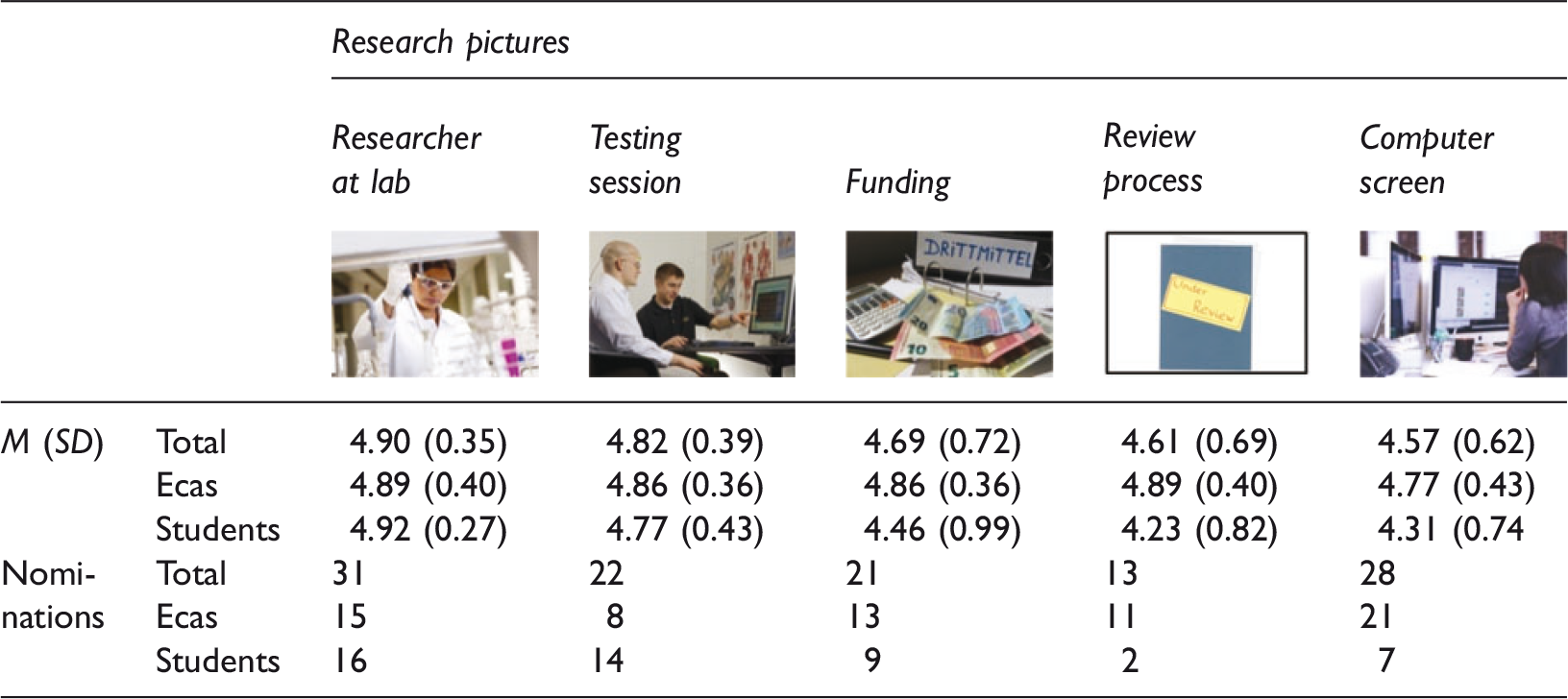
Descriptive statistics of the top five research pictures



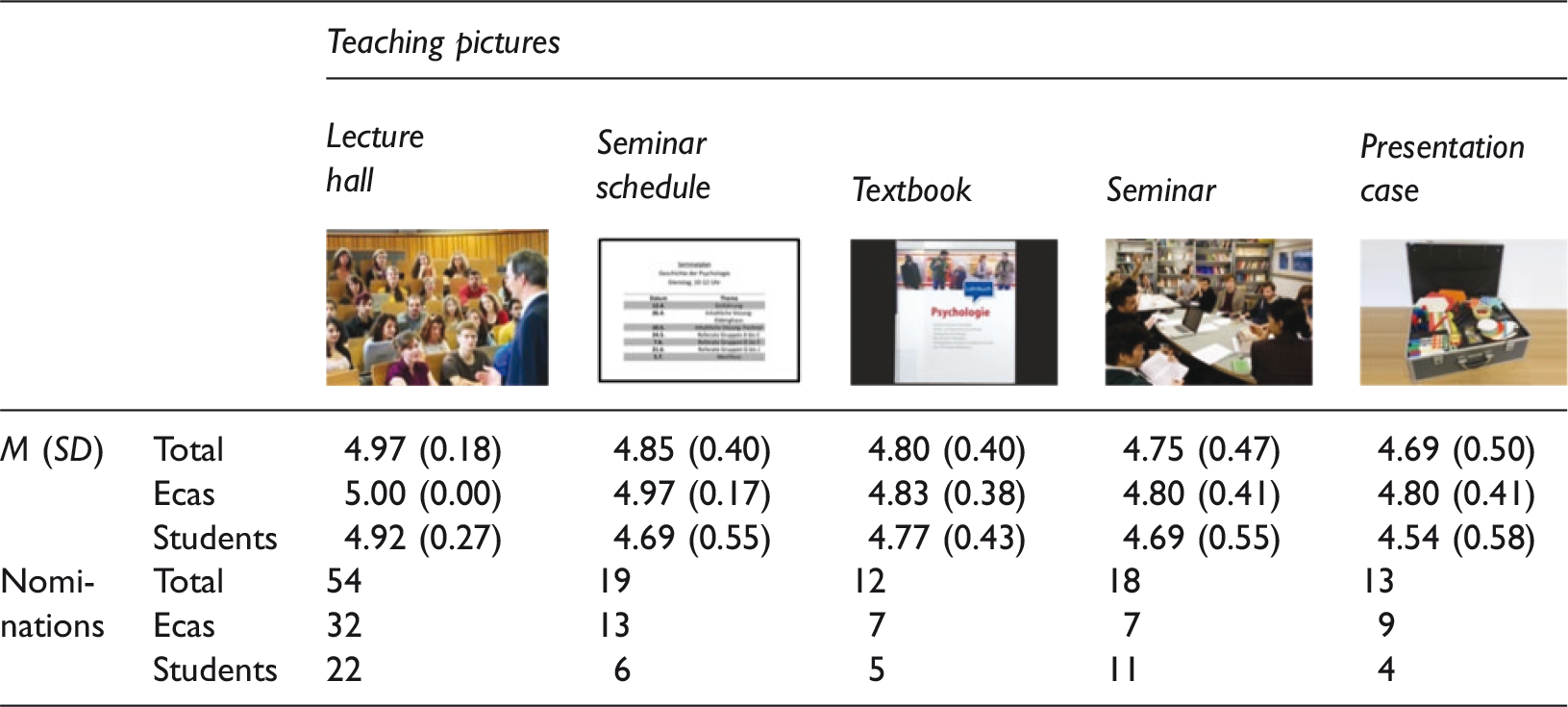
Descriptive statistics of the top five teaching pictures


Further, the students had a higher mean rating across pictures on the teaching scale (M = 3.60, SD = 0.40) than did the early-career academics (M = 3.40, SD = 0.33), F(1,59) = 4.80, p = .032. Put differently, students associated the pictures more strongly with teaching situations than did the early-career academics, independent of what the picture was classified as beforehand (research or teaching).
Study 2: Online Survey
Methods
Data were collected anonymously. Participants were rewarded monetarily via Amazon or PayPal (early-career academics' with 10 Euro, students with 5 Euro).
Results
In the following, typicality and valence judgements of the pictures are presented, and differences in the perspectives the groups had in reaction to the pictures are shown. In 3.88% of all cases in this sample, a picture was interpreted differently from what was intended. These data were excluded from the following analyses.
Concerning the research pictures, we coded whether participants reacted with a teaching perspective to the material. Teaching perspective answers connected the research pictures to the context of teaching; for example, concerning research methods training or students' own research projects. A second coder validated the quality of the coding process. Of all answers to the research pictures, 9% explicitly displayed a teaching perspective. Again, groups differed in this respect, with a majority of 64% of the students taking a teaching perspective on the research pictures (at least once), whereas only 24% of the early-career academics articulated a teaching perspective (at least once), χ2(1) = 10.18, p = .001.
Discussion
Which Pictures Visualize Research and Teaching Best According to Early-Career Academics and Students in Psychology?
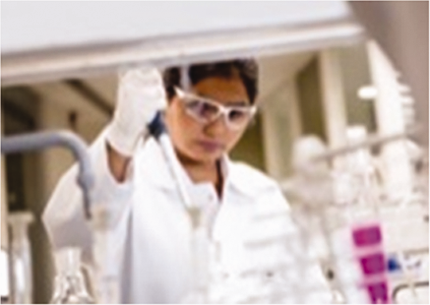
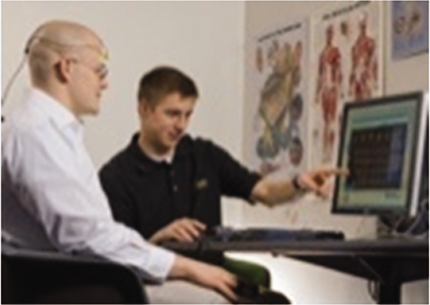
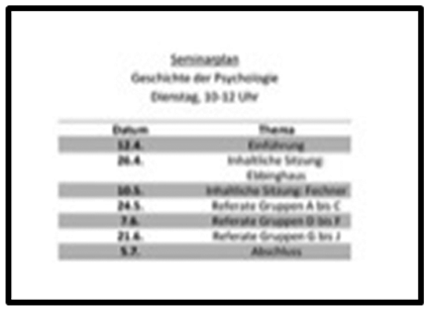
Both within and across the groups of early-career academics and students, there was a shared understanding of what is typical of research and teaching in psychology. The top five pictures for the two practices (research and teaching) covered settings (e.g., lecture hall, laboratory), activities (e.g., testing participants, doing screen work), and artefacts (e.g., textbook, seminar schedule). The more metaphorical pictures were not chosen; these showed, for example, a person with binoculars symbolizing “searching for something new” (research) or hands that protect the growth of small plants symbolizing “fostering knowledge and development in students” (teaching; cf. Nevgi & Löfström, 2014). Nevertheless, it remains striking that the most typical picture for psychology research unanimously is the prototypical researcher in a lab wearing a coat, although other pictures showing researchers as conducting an electroencephalogram (EEG), taking part in conferences, or Albert Einstein as one famous representative also have been available. This depiction is reminiscent of the technically skilled researcher in the results of school students’ draw-a-scientist tests (Solomon, Scott, & Duveen, 1996), but it does not necessarily mean that participants’ concepts of research are so simple (Finson, 2002). In fact, prototypes of a given category are easier and faster to identify than other members of that category (Rosch, 1999). This information processing effect is likely to have impacted the typicality ratings reported here.
Taking a broader view of the top five research pictures chosen, our findings indicate that, today, psychology research involves a great deal of screen handling (second prominent picture). At the same time, it involves interacting with others (testing session) and is socially negotiated and controlled, which is symbolized by the review process picture. In addition, the administrative part of being a researcher, here specified as managing third-party funding, is addressed among the most typical pictures as well. The high representativeness of this selection was approved by the second sample from a different university, but students found the research pictures less typical than did early-career academics. As the first selection was based on both students’ and early-career academics’ ratings, it contained pictures that symbolized phenomena students might be less familiar with, such as the review process or third-party funding. The impression that familiarity influences typicality scores is also backed by the finding that the ‘testing session’ picture gained highest typicality judgements in the second study: the participation in testing sessions is obligatory for all bachelor's and master's students in order to obtain course credit.
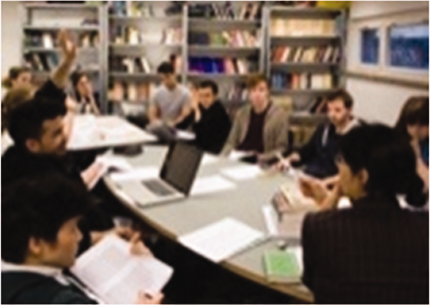
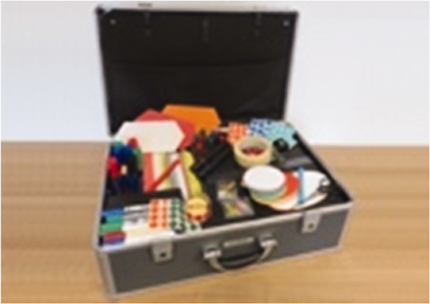
Turning to the most typical teaching pictures, analogous to the prototypical researcher, there was also a prototypical teacher, which is the lecturer in front of his audience. This type of teaching setting was the most salient for both students and early-career academics. It is complemented by two pictures symbolizing the second most prominent teaching format, preparing (seminar schedule) and conducting a seminar (students and teacher around a desk). Along with these two different teaching formats, the content/knowledge (psychology textbook) and the method of content transmission (presentation case) are central aspects of teaching, which were expressed among the top five teaching pictures. The typicality of this selection for teaching was approved by early-career academics and students from a second university.
To sum up, the ratings of selected visualizations enabled us to capture more complex understandings of research and teaching, as they allow participants to weigh different aspects of a concept which might not be covered by (the drawing of) a single picture. In these samples of students and early-career academics, several aspects of research and teaching seemed to be important, whereby prototypical displays gained the highest typicality scores.
How do the Perspectives of Early-Career Academics and Students Differ in Reaction to Visualizations of Research and Teaching?
The visualizations proved to be able to detect differences between students and early-career academics in two ways, namely in how independent research and teaching were seen, and from which perspective (learner vs. teacher) the participants reacted to the pictures.
Taken together, these findings suggest that students treated research and teaching as being more associated, especially in the way that research is embedded in a teaching situation. The students’ view matches their experience at university, as they become familiarized with research through teaching settings and by teachers who are also researchers. These learning experiences may nourish views of research and teaching as belonging together and, more specifically, of research as being integrated into teaching. The implicit measures of research-teaching integration found here are in line with more explicit ones, such as questionnaire data which show that students perceive research integration in their courses and also believe that such integration is beneficial for their learning (Visser-Wijnveen, van der Rijst, & van Driel, 2016; for psychology, see Robertson, Teoh, McMurray, Roberts, & Sochos, 2011).
The early-career academics treated research and teaching as being more independent of each other, which could be interpreted as a sign of more clear-cut, mutually exclusive conceptions of research and teaching that they might have acquired during their doctoral work, as they participate in both practices. The dissimilarity of research and teaching was also one type of research–teaching relationship that has been described previously by psychology doctoral students (Jucks & Hillbrink, 2017), meaning that research and teaching were experienced as unalike and distinct from each other.
Although our findings can only be understood as proxies for the experienced research–teaching relationship, they have informational value because of their raw and implicit nature. Asked directly, psychology early-career academics utter more positive, socially desired views of the relationship between research and teaching (Jucks & Hillbrink, 2017). Beliefs about the research–teaching relationship are relevant on both the teachers' side—for example, for their teaching practice (Elen, Lindlbom-Ylänne, & Clement, 2007), especially research-related teaching (Mägi & Beerkens, 2016); and on the students' side—for example, for their achievement and motivation (Vereijken, van der Rijst, de Beaufort, van Driel, & Dekker, 2018).
To sum up, early-career academics' reactions to the visualizations differed from students' reactions in two ways: research and teaching were seen as (more) independent practices, and the viewpoint was that of a teacher instead of a learner. These findings might complement each other, as differentiating between research and teaching could be a prerequisite for acquiring the two roles as researcher and teacher. Seen from the student role, however, research is something that is embedded in teaching.
Strengths and Limitations
Our findings are based on samples from two different universities with matching groups of students and early-career academics and on data gathered with both qualitative and quantitative methods. We examined possible visualizations for research and teaching in one study, honouring the fact that both are core to academic work-life.
Nevertheless, working with prepared photographs is limited by the fact that the researchers' point of view is somehow reflected in the chosen photographs (Taylor, 2002). This might at least be true for the selection of pictures presented in the first study. Because of the innovative approach to assess students' and early-career academics' perspectives on research and teaching via visualizations, the research questions were quite explorative in nature and need further investigation, inside and outside the discipline of psychology.
Prospective Future Research
A strength of the pictures developed here is that they can be understood as symbols for a practice in general (e.g., teaching), as well as for a single approach (e.g., seminar), or with regard to the specific situation depicted (e.g., students and teacher gathered in a circle). This flexibility allows the pictures to be used in future studies on diverse questions related to research and teaching and with different groups at a university. Future research should attempt to replicate the present results and test whether they are valid for other disciplines as well. The material is creative common licensed which makes it a precious resource for the scientific community. The pictures can be useful in experiments as well; for example, as stimuli to activate teacher versus researcher roles in academics (Hillbrink and Jucks, 2019).
Practical Implications
The developed pictures provide several opportunities to be used practically in higher education as well. In professional development courses for (early-career) academics, they can foster reflexivity on topics such as researcher and teacher roles and the research–teaching relationship. Visualizations can also be helpful in tracking possible changes in these concepts over a period of time (see Lehner, 2016). Student teaching offers another field to successfully implement visualizations. The research pictures could, for example, be used in order to initiate discussion about what it means to do research in courses using inquiry-based learning or research methods courses. In addition, the teaching pictures can facilitate discussion about teaching as a topic, where students can contribute their perspective beyond their evaluations of specific teaching activities.
Conclusion
To sum up, these studies identified 10 pictures that best visualize research and teaching for early-career academics and students in psychology. Reactions to these pictures uncovered differences in perspectives on research and teaching between the groups: firstly, early-career academics treated research and teaching as more mutually exclusive than students. Secondly, early-career academics were already reacting to pictures from the perspective of a teacher, whereas students reacted from the perspective of a learner. Using visualizations to address students' and academics' views of research and teaching seems to be a promising approach in higher education research, which can also be transferred to student teaching and professional development courses for academics.
Supplemental Material
Supplemental material for Pictures of Research and Teaching in Psychology: A Comparison of Early-Career Academics' and Students' Perspectives
Supplemental Material for Pictures of Research and Teaching in Psychology: A Comparison of Early-Career Academics' and Students' Perspectives by Alessa Hillbrink and Regina Jucks in Psychology Learning & Teaching
Footnotes
Declaration of Conflicting Interests
The author(s) declared no potential conflicts of interest with respect to the research, authorship, and/or publication of this article.
Funding
The author(s) received no financial support for the research, authorship, and/or publication of this article.
Supplemental material
Supplemental material for this article is available online.
Note
References
Supplementary Material
Please find the following supplemental material available below.
For Open Access articles published under a Creative Commons License, all supplemental material carries the same license as the article it is associated with.
For non-Open Access articles published, all supplemental material carries a non-exclusive license, and permission requests for re-use of supplemental material or any part of supplemental material shall be sent directly to the copyright owner as specified in the copyright notice associated with the article.
