




Abstract
In Germany, most PhD psychology students are engaged in research and teach as well. As a result, they may experience both synergy and competition between these two activities. How do PhD psychology students themselves perceive the relationship between research and teaching? And how does this perception depend on their conceptions of research and teaching? The present study assessed conceptions of teaching (student vs teacher-focused, ATI-R), conceptions of research (CoRI) and the perceived relationship between research and teaching (open-ended question) as far as 63 PhD students in psychology were concerned. The perceived relationship was represented in terms of Compatibility (Commonality vs Dissimilarity) and Valence (Enrichment vs Burden). Results showed that conceptions of teaching were decisive for the research–teaching relationship. A teacher-focused conception of teaching was associated positively with the perceived Commonality of research and teaching, but negatively with perceived Enrichment. It is concluded that conceptions of teaching provide a promising approach for studying the research–teaching relationship. Theoretical and practical implications are discussed.
Keywords
Introduction
At German universities that award degrees in psychology, teaching is mainly done by academics who are also engaged actively in research. The psychology lecturer is simultaneously a psychology researcher—an idea that dates back to Wilhelm von Humboldt’s reform of German education in the 19th century. Indeed, the advantages of this model are easy to imagine for a number of reasons: the young academics gain access to the latest research and can be guided when carrying out their own research projects; as lecturers, they serve as authentic models of what it means to be a researcher; they can make own research results public; and they can even profit from students participating in their ongoing research (Visser-Wijnveen, Van Driel, Van der Rijst, Verloop, & Visser, 2010).
Nevertheless, even in Humboldt’s home country, there is a growing debate on the appropriateness of this ideal. In order that qualified lecturers for the increasing numbers of students at German universities are available, the Council of Science and Humanities (Wissenschaftsrat, 2008) has recommended the introduction of professorships that focus on teaching (two-thirds of working hours devoted to teaching duties) and exclusive teaching staff positions. Temporary, part-time contracts with a high number of teaching hours are now being used to cover regular lectures (Teichler, 2014). Because these concepts either allow no research at all or restrict research activities, they have been criticized for undermining the ideals of academic teaching by both associations representing young academics (Menke et al., 2013) and the German Rectors’ Conference (Hochschulrektorenkonferenz, 2013).
Despite ongoing discussions on the research–teaching nexus among higher education policymakers, the combination of research and teaching still exerts a strong influence on the daily working life of academics. Most begin their socialization into the academic world with their PhD studies. Even during this early stage of their academic career, research and teaching duties already go hand in hand for those working as academic staff. This model is typical of psychology in which it is simply taken for granted that the main task for a PhD student is to combine research for his/her own dissertation project with teaching students at the bachelor’s or master’s level (Margraf, 2015). So, how do the students experience this combination of teaching and carrying out research in psychology? How do they themselves experience the relationship between their two fields of work? And what specifically characterizes those PhD students who experience a positive research–teaching relationship?
Psychology is a hub science that advances knowledge not only within its own discipline but also in other disciplines (Boyack, Klavans, & Börner, 2005). In addition, the number of PhD psychology students has been rising since the year 2000 (Margraf, 2015). Hence, these are not just important issues for the work satisfaction and achievement of a growing group of PhD students, but also for public discussion on the research–teaching nexus and the organization of academic jobs and paths of qualification. In the following, the current status quo for German PhD students’ experiences is outlined.
The Experiences of PhD Students in Germany
Evidence on German PhD students’ experiences is mixed. In a national study from 2012, PhD psychology students did not report any time constraints with regard to their dissertation research due to teaching commitments (Hauss et al., 2012). In particular, PhD students aiming for future careers in research and teaching did not feel affected by this combination.
However, in another large study that asked young academics directly about conflicting tasks, nearly one-half named goal conflicts between research and teaching (Esdar, Gorges, & Wild, 2012). They also experienced this as being the most stressful type of goal conflict compared to goal conflicts between two teaching tasks, two research tasks, or other tasks. Young academics reported coping with this conflict by working longer hours than stated in their work contract, on average, 13.2 extra hours per week during the teaching semester. This is clear evidence that time constraints due to research and teaching do exist. On the other hand, these young academics also reported synergistic effects between research and teaching due to teaching being integrated into their own research: for example, they could read the same literature both in class and for research purposes. They also considered that teaching skills would promote their future careers both inside and outside university (Esdar, Gorges, & Wild, 2013). However, the sample in this study did not focus on PhD students, but recruited academics from different German universities who were active in research and teaching below the level of a professorship (41% of them already held a doctorate or a postdoctoral qualification).
A literature review indicates that all previous studies on PhD students’ experiences in Germany have focused on the possible conflict between research and teaching by asking them directly about either time constraints (Hauss et al., 2012) or conflicting tasks (Esdar et al., 2012). However, it would be interesting to assess how PhD students experience the research–teaching relationship in a more holistic way. Using an open-ended question enabled PhD students to describe both positive and negative aspects of the relationship between research and teaching. It was hoped that their initial spontaneous answers to such a question would give a more comprehensive view of their experiences.
In the next sections, we review studies on how academics perceive their fields of work that may contribute information on how they view their research–teaching relationship. Teaching and research are dealt with separately, beginning with academics’ conceptions of teaching.
Perspectives on Teaching and Research
Conceptions of teaching
University lecturers’ conceptions of teaching have been a major research topic in higher education (Richardson, 2005). It is usual practice to differentiate between two conceptions that vary in their emphasis on student vs teacher. This distinction, introduced by Kember (1997) on the basis of 13 different qualitative studies, has been employed successfully by different researchers (see Richardson, 2005). Student-focused teaching aims to challenge students’ existing concepts (conceptual change). It views students as active participants in the learning process. In contrast, teacher-focused teaching concentrates on the transmission of the teacher’s knowledge to the, mostly, receptive students. A questionnaire, the Approaches to Teaching Inventory (ATI-R), has been developed to assess levels of these foci in university lecturers (Trigwell, Prosser, & Ginns, 2005). This is seen as a valid and time-saving tool for studying conceptions of teaching (Stes & Van Petegem, 2014). The ATI-R has been used in order to link conceptions of teaching with, among other things, academic discipline, teaching context (Lindblom-Ylänne, Trigwell, Nevgi, & Ashwin, 2006; Päuler-Kuppinger & Jucks, 2017) and students’ learning strategies (Gibbs & Coffey, 2004). A higher Student Focus was found in the soft disciplines and in more unusual teaching contexts and was related to students’ use of deep learning strategies.
With regard to the research–teaching relationship, a phenomenographic study on conceptions of learning in academics engaged actively in research revealed a Disconnected category that combined a teacher-focused view of student learning with the opinion that research and teaching do not inform each other (Light & Calkins, 2015). The opposite opinion was found in members of the Connected category who took a student-focused view of student learning. Against this background, testing was carried out to determine whether a student-focused conception of teaching could be found on an individual level—namely, in PhD students’ experiences of the research–teaching relationship. In the following section, we review work carried out on academics’ conceptions of research that complements these findings on conceptions of teaching.
Conceptions of research
Any examination of PhD students’ experiences of the relationship between research and teaching and their conception of teaching needs to take their conception of research into account as well. Conceptions of research vary fundamentally with regard to how academics understand research and working as a researcher, and research intentions, questions, processes or outcomes can all be addressed (Aakerlind, 2008). Research on the scholarship of teaching and learning (SoTL) (see Boyer, 1990) starts from the basic concept of research per se, but argues that more is needed than a scholarship of discovery, that is, original research to enhance knowledge. Meyer, Shanahan, and Laugksch (2005, 2007) developed an instrument to assess conceptions of research held by students and academics, the Conceptions of Research Inventory (CoRI). They differentiated between conceptions of research as: solving problems; a search for the truth; re-search; an insightful process; and something that is misconceived. The instrument has recently been cross-validated in a sample of undergraduate students by Zhang, Zwaal, and Otting (2016). They also found differences in conceptions of teaching across PhD study years.
How far are differences in these views on research related to academics’ conceptions of teaching? Prosser, Martin, Trigwell, Ramsden, and Middleton (2008) have already shown a moderately strong relationship between conceptions of teaching and conceptions of research. They interviewed academics active in research in the UK and Australia, and observed that a focus on wholes (i.e., the whole field) in research was associated with a student-focused conception of teaching. Are conceptions of teaching and research already related at the PhD level and, if so, do they influence the experience of the research–teaching relationship at that stage?
Aim of the Present Study and Research Questions
Conceptions of teaching, conceptions of research and the experience of the relationship between research and teaching in PhD students are assessed in order to illustrate the students’ situations and shed light on the association between their conceptions and how they experience the research–teaching relationship. Hence, the following research questions are asked.
How do German PhD psychology students experience the relationship between research and teaching? How are their conceptions of teaching and conceptions of research related? How does the conception of teaching, as measured with the ATI-R, relate to the subjective view on the relationship between research and teaching? How does the conception of research, as measured with the CoRI, relate to the subjective view on the relationship between research and teaching?
The hypothesis is that a student-focused conception of teaching would be associated with a positive experience of the research–teaching relationship.
Method
Participants
A request to participate in the study was sent to 120 PhD psychology students at four large German universities. A total of 83 students (69% response rate) participated, but 10 of these had a significant amount of missing data and a further 10 were not undertaking their PhD studies and/or not teaching at the time of data collection. Hence, 63 participants (50 female) returned complete datasets and met the pre-set criteria (currently being a PhD psychology student generally involved in both research and teaching). Their mean age was 29.03 years (SD = 2.34) and they had been studying for their doctoral degree for an average of 2.35 years (SD = 1.36). A majority of 81% reported being part of a research team. PhD studies were financed by (combinations of) staff positions (52.4%), project funding (33.3%) or scholarships (20.6%). The average amount of paid working time a week was 55.94% of the regular working time of 39.85 hours (SD = 20.3%). Participants received an online voucher worth €10 (via Amazon or PayPal) as a reward for taking part in the study.
Measures
Conceptions of teaching
These were assessed with the ATI-R (in the German version by Lübeck, 2009). The ATI-R (Trigwell et al., 2005) is a well-established instrument containing two 11-item subscales. The Teacher Focus scale assesses the strength of the emphasis on the teacher and on the transmission of the teacher’s knowledge (e.g., ‘My teaching in this subject focuses on delivering what I know to the students.’) A high Teacher Focus indicates an active teacher and receptive students. In contrast, the Student Focus scale assesses the strength of the emphasis on the students and on changing their mental concepts (e.g., ‘I see teaching as helping students develop new ways of thinking in this subject.’) A high Student Focus is characterized by the idea that knowledge has to be constructed actively, resulting in high student activity and teachers challenging their students’ actual concepts. Items are rated on a 5-point scale ranging from 1 (definitely disagree) to 5 (definitely agree).
Conceptions of research
The conceptions of research were measured with the CoRI (Meyer et al., 2007). This inventory uses categories with metaphors addressing individuals’ views on research. Again, items are rated on a 5-point scale ranging from 1 (definitely disagree) to 5 (definitely agree). A total of 20 items belonging to five 4-item subscales were presented: The first scale, Research as Finding out the Truth, describes the perspective that research is carried out in order to reveal the truth (e.g., ‘Research is a process for establishing what is true about something.’) The second scale, Research as Re-Search, takes the view that research is a repetition of work done by other researchers in order to find out more (e.g., ‘Research is there to challenge research that has been done before.’) The third scale, Research as Solving Problems, conceptualizes research as being about finding solutions to problems (e.g., ‘Research means collecting data to help solve a particular problem.’) The fourth scale, Research as an Insightful Process, contains the assumption that research means an in-depth study of a topic to gain a better understanding that consequently opens up new topics for investigation (e.g., ‘Research extends current concepts to obtain a deeper understanding.’) The fifth scale, Misconceptions, contains misunderstandings about research (e.g., ‘If followed correctly, research procedures will always yield positive results.’) A German translation was used (Hillbrink, 2015) that was double-checked with colleagues in order to maintain the original meaning.
Subjective view on the relationship between research and teaching
The first open-ended question (the one analysed here) addressed the subjective view on the relationship between research and teaching: ‘For me, research and teaching are …’ A category system was developed based on qualitative content analysis (Mayring, 2015). This identified four categories reflecting different experiences of the relationship between research and teaching: Enrichment, Commonality, Dissimilarity and Burden. After the second author had divided answers into aspects and assigned each aspect to a category based on the coding manual, a second rater did so for the answers of 20 participants in order to assess interrater reliability. Interrater reliability, as in Krippendorff’s α (see Krippendorff, 2004), was satisfactory for the division of answers into aspects (α = 0.87, 95% CI [0.75, 1.00]), as well as for the assignment of categories (α = 0.80, 95% CI [0.60, 0.95]). Hence, the data were analysed by one coder for each participant. The length of the answers ranged from 1 word to 40 words. Each participant received a value corresponding to the number of aspects she or he wrote in each of the four categories. This value varied between zero and three per category. The coding manual and an extract from the coding scheme can be found in Appendices 1 and 2.
Design and procedure
The survey was conducted online using Unipark® software. Participants were guided through a sequence of nine pages containing the inventories used to measure conceptions of teaching and conceptions of research (see below). Following this, they were then presented with an open-ended question asking them to write down their subjective view on the relationship between research and teaching. Additional open-ended questions addressed positive and negative aspects of teaching and research. These are not analysed further here. The survey ended by gathering demographic details. Participants were thanked, and the necessary data to send them an online voucher were collected separately from the other content.
Results
The control variables age, gender, university, amount of paid working hours, type of funding, years in programme, member of research team and research focus (social vs natural science) related to neither the ATI-R nor CoRI scores nor to the distribution of the answer categories to the open-ended question. A false discovery rate (FDR) correction was applied according to Benjamini and Hochberg (1995) in all multiple correlation analyses.
Conceptions of Teaching and Research
Initially, the inventories and their subscales were inspected. As expected and documented in previous research, the subscales of the ATI-R—Teacher Focus and Student Focus—were not independent but correlated moderately (r = −.27, p = .031). Participants showed a higher Student Focus (M = 3.66, SE = 0.08) than Teacher Focus (M = 3.23, SE = 0.07). This difference, −0.43, 95% CI [−0.67, −0.19], was significant, t(62) = -3.55, p = .001, and had a large effect size, d = 0.81.
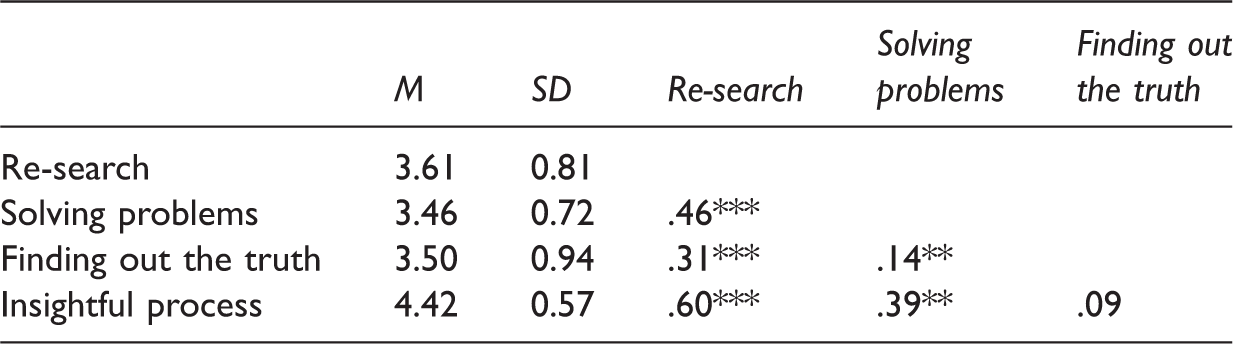
Means, Standard Deviations and Correlations Between CoRI Subscales
Note: *p < .05, **p < .01, ***p < .001.
No significant correlations were found between any of the subscales of the ATI-R (Student Focus, Teacher Focus) or any of the CoRI subscales (Research as Solving Problems, Research as Finding out the Truth, Research as an Insightful Process or Research as Re-Search). All p values exceeded the critical p values in the FDR correction, and pcrit for the smallest p value was .006.
Relationship Between Research and Teaching
The answers to the open-ended question were segmented into 111 aspects using content analysis. Here, 32% (36 in total) of these aspects belonged to the Enrichment category, comprising answers describing research and teaching as mutually enriching and inseparable domains. Participants wrote, for example, ‘For me, research and teaching are two mutually stimulating aspects of my work’ or ‘For me, research and teaching are fulfilling activities.’ Another 39% of the aspects represented the category Commonality, depicting research and teaching as belonging together and being similar. Answers were, for example, ‘For me, research and teaching are two entities belonging together’ or ‘For me, research and teaching are main tasks of my job.’ The category Dissimilarity comprised 23% of the aspects. It defines research and teaching as dissimilar and incompatible. Typical answers were, for example, ‘For me, research and teaching do not necessarily belong together’ or ‘For me, research and teaching are mainly independent.’ The least frequently used category was Burden with 5% of the aspects. It covers answers describing research and teaching as an exhausting and stressful combination. Examples are, ‘For me, research and teaching are not always easy to cope with at the same time’ or ‘For me, research and teaching are exhausting.’
Combination of Categories
As reported earlier, the four categories obtained through content analysis were distinct. The subjective views were mostly positive (Enrichment or Commonality representing 71% of all content units). In the following, the proportion of individuals in each of the four categories is reported (see Figure 1). The majority of participants addressed only one single category in their answers. The categories Commonality and Enrichment correlated the most negatively. Because the variables representing the categories were not normally distributed (Kolmogorov–Smirnov tests, all p < .001), Kendall’s τ is used for all correlations of a category with another variable. Kendall’s τ was also appropriate here because it is able to handle the high number of rank ties present in the data.
Proportion of participants in each of the four content categories.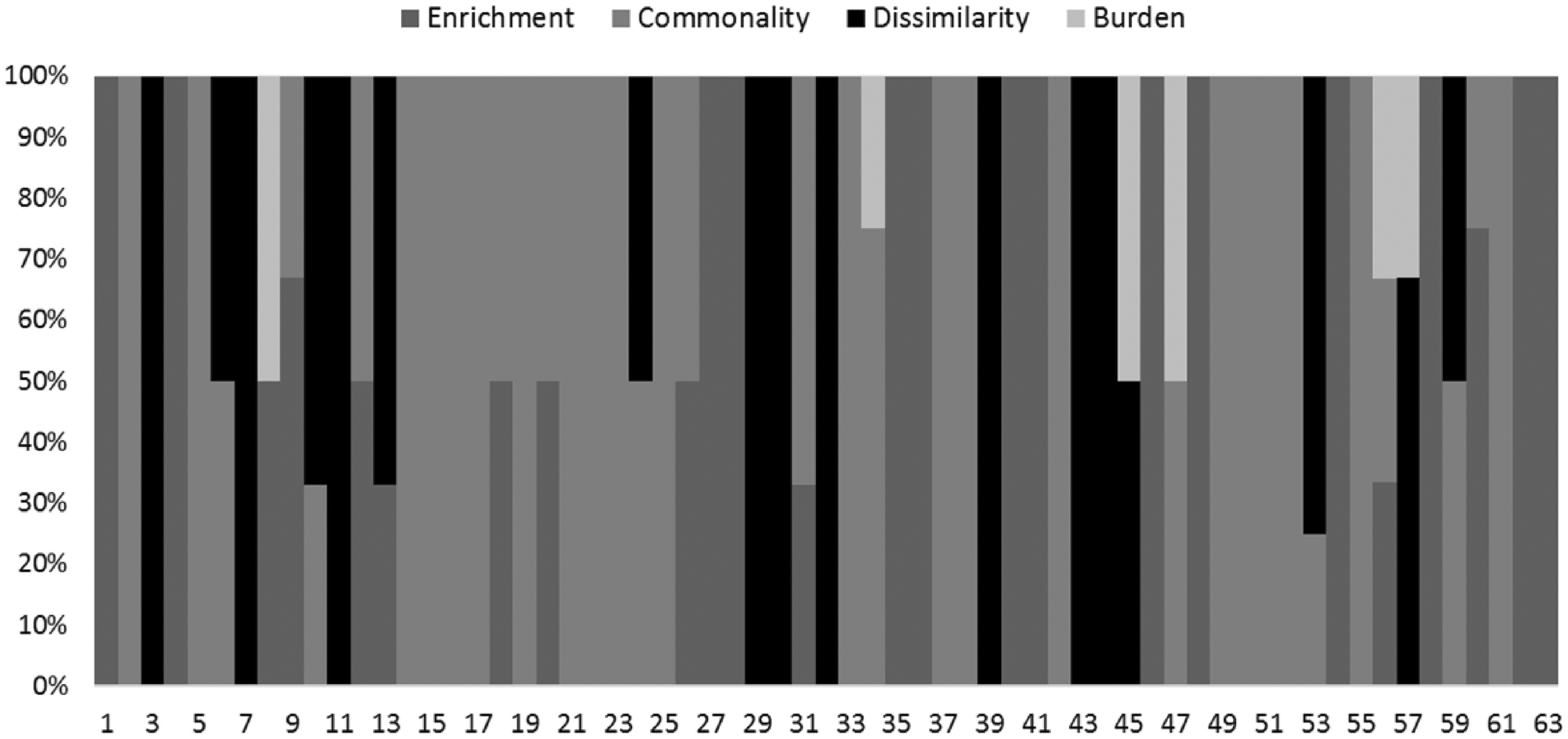
There was a negative correlation between research and teaching as Enrichment and as Commonality (τ = −.53, p < .001). Participants mentioning more aspects addressing the symbiosis and entanglement of research and teaching wrote less about aspects of their similarity as two fields belonging together. Research and teaching as Commonality and as Dissimilarity were negatively correlated (τ = −.43, p < .001), meaning that the more aspects a person reported that described research and teaching as belonging together and being similar, the fewer aspects the person gave describing research and teaching as independent and dissimilar. Research and teaching as Enrichment and as Dissimilarity also correlated negatively (τ = −.38, p = .001). This means that the more aspects reported that addressed the mutual benefits of research and teaching, the fewer aspects were named that focused on their differences.
ATI-R Values and Subjective Views on Research and Teaching
The two ATI-R subscales were correlated with the proportion of aspects for each of the four content categories. Two correlations showed a significant interrelation. First, the Teacher Focus in the conception of teaching correlated positively with research and teaching as Commonality (τ = .35, p = .001). Participants with higher scores on the Teacher Focus scale, meaning that they focused on teaching and the transmission of knowledge in their courses, named more aspects describing research and teaching as similar and belonging together. Second, Teacher Focus related negatively to research and teaching as Enrichment (τ = −.33, p = .001). A higher Teacher Focus score was accompanied by fewer reports on aspects addressing the mutually enriching effects of research and teaching and their entanglement.
CoRI Values and Subjective Views on Research and Teaching
Relating the four CoRI scales to the four categories identified through content analysis produced one significant correlation (all other p > .10 or p > pcrit): there was a negative correlation between Research as Solving Problems and the relationship between research and teaching as Dissimilarity (τ = −.31, p = .003). This means that participants with high scores on the Research as Solving Problems scale (mainly understanding research as finding solutions to problems) less frequently named aspects describing research and teaching as dissimilar and independent.
In the following, these results are interpreted and integrated into the current literature. Implications for academic development programmes are outlined, limitations of the present study are discussed, and suggestions for further research in this field are presented.
Discussion
How do PhD psychology students experience the relationship between research and teaching? A majority of the aspects in the answers (71%) described a positive research–teaching relationship—either as Enrichment or Commonality. Hence, what these PhD students bring to mind when asked about research and teaching is mostly positive. With regard to the dimensions of the research–teaching relationship, the results of the current study are in line with Coate, Barnett, and Williams (2001). As far the positive evaluation of the relationship is concerned, the current study shows a favourable depiction of PhD students’ experiences, but it does not seem to be in line with findings reported by Esdar, Gorges, Kloke, Krücken, and Wild (2011) that 62% of the early career academics interviewed felt highly stressed by goal conflicts between research and teaching. The cause of this difference may lie in the different aims of the two studies: Esdar et al. (2011) directly asked for goal conflicts between tasks because they were interested in conflicting goals at universities. The study presented in this article assessed the research–teaching relationship with an open-ended question in order to obtain spontaneous answers describing the experience of the research–teaching relationship. Even though PhD students may have had goal conflicts, these were possibly not the focus of how they experienced the relationship between research and teaching at that point in time.
As both conceptions of teaching and conceptions of research were assessed as far as PhD students were concerned, it is interesting to look at how these might be related. In the current sample no associations between conceptions of teaching as measured with the ATI-R and conceptions of research as measured with the CoRI were found. None of the subscales in one inventory correlated significantly with any subscale in the other inventory. One reason could be the many intercorrelations between the subscales of the CoRI: each subscale correlated significantly with at least one other subscale. As reported by the authors of the CoRI (Meyer et al., 2007), the subscales do not seem to be independent. Therefore, the version of the CoRI employed here does not seem to be suitable for uncovering relations between conceptions of teaching as measured by the ATI-R, and conceptions of research. It might be better to assess conceptions of research in broader categories by, for example, differentiating between atomistic versus holistic conceptions as proposed by Brew (2003). Prosser et al. (2008) based their study on this differentiation and found associations between student-focused conceptions of teaching and a holistic focus (focus on wholes) in the conception of research.
One very important finding in the present study is the importance of the Teacher Focus in the conception of teaching for the experience of the research–teaching relationship: the higher the Teacher Focus of these PhD students, the more they described the relationship between research and teaching as Commonality. At the same time, a higher Teacher Focus was associated with the relationship between research and teaching being described less frequently as Enrichment. The Teacher Focus seems to impact differently on the two dimensions: On the Compatibility dimension, a high Teacher Focus is combined with a positive statement regarding the research–teaching relationship; namely, research and teaching are seen as similar and belonging together. On the Valence dimension, however, the opposite is the case: a high Teacher Focus is combined with fewer positive statements on the mutually enriching and fulfilling relationship between research and teaching. In other words, PhD students with a high focus on the transmission of the teacher’s knowledge said that research and teaching are similar and belong together, but did not indicate experiencing them as mutually enriching and fulfilling. A difference occurs between the ideal picture of the research–teaching relationship circulating at universities (see conventional wisdom model, Hattie & Marsh, 1996) and young academics’ experiences with regard to and feelings towards this relationship. These findings are in line with research by Postareff and Lindblom-Ylänne (2011) and Trigwell (2012), who found that the Teacher Focus was associated with neutral or negative emotions in teaching, whereas the Student Focus was associated with positive emotions.
Nevertheless, it remains remarkable that no associations could be found between Student Focus and the research–teaching relationship. Several researchers have postulated a positive influence of student-focused teaching on the research–teaching relationship (e.g., Brew, 2003; Elton, 2001; Ramsden, 2001; Spronken-Smith & Walker, 2010). One reason for not finding any links between the Student Focus and the categories describing the research–teaching relationship could be that a rather homogeneous sample from only one discipline was investigated that scored high on the Student Focus scale and reported a good experience of the research–teaching relationship in general. To conclude, there is an indirect hint that a higher Student Focus might benefit the research–teaching relationship, because a higher Teacher Focus was associated with fewer positive feelings of Enrichment by a combination of research and teaching, whereas there was a substantially negative correlation between Student Focus and Teacher Focus. This study does, indeed, show that PhD students’ conceptions of teaching are associated with their experiences of the research–teaching relationship.
Several implications for academic development can be drawn from these findings. The open-ended question ‘For me, research and teaching are …’ is a helpful tool for assessing the current experience of the research–teaching relationship and for stimulating reflection on it. Carefully chosen examples from the material obtained from the research participants can also be used to introduce different perspectives on the research–teaching relationship and to foster discussion. Furthermore, when addressing the research–teaching relationship in academic development courses, it is helpful to differentiate between Compatibility and Valence. The perception of Compatibility, namely, how compatible and similar research and teaching are seen to be, may be influenced strongly by the norms and expectations of the institution concerned. Humboldt’s ideal of a research–teaching nexus still seems to be very common among academics (Teichler & Arimoto, 2014). Regarding Valence, experience with regard to and feelings towards the research–teaching relationship may differ completely.
What is most interesting with regard to emotional involvement is why some PhD students experience the combination of research and teaching in their work lives as enriching, whereas others experience it as a burden. Teacher Focus in the conception of teaching might be one decisive parameter. Additionally, it is necessary to explore further factors within academics themselves and in their working conditions as well. This study links conceptions of teaching to the experience of the research–teaching relationship in a way that goes beyond research on the latter links to teaching behaviour (e.g., Ho, Watkins, & Kelly, 2001; Kember & Kwan, 2000; Trigwell & Prosser, 1996) and emotions in teaching (Postareff & Lindblom-Ylänne, 2011; Trigwell, 2012). Because conceptions of teaching can be influenced by training (Postareff, Lindblom-Ylänne, & Nevgi, 2008), this could be one indirect, but powerful way to influence PhD students’ experiences of their work fields as well.
However, before launching any such actions, it is necessary to prove a causal relation between conceptions of teaching and the experience of the research–teaching relationship. Being both correlational and a single-point-in-time measure, the data reported here do not permit causal conclusions. Results indicate two different paths with regard to an explanation: the experience of the research–teaching relationship could impact on the conception of teaching; or a third variable could impact on both. Another issue is whether the constructs that were measured were stable. Situational factors may influence not only conceptions of research and teaching but also the experience of the research–teaching relationship. For example, success or failure in one of the two fields or the point of time in the academic year (semester vs exams vs conferences) may lead to different impressions of the research–teaching relationship. This indicates the need to determine whether the constructs investigated here are stable traits or variable states. Moreover, the open-ended question aimed to tap the first spontaneous impression of the research–teaching relationship. It is possible that even more PhD students would report on conflicts between research and teaching if they were asked to reflect on the pros and cons of the research–teaching combination in more depth. Moreover, results reported here are valid only for a defined group, German PhD psychology candidates, who are actively engaged in both research and teaching with an average number of two teaching lessons a week.
Further research in this area could employ a cross-lagged design and check the causality of the relations and the stability of the constructs over time. The combination of open-ended questions and established inventories proved to be productive in this study. Therefore, it should be replicated with different disciplines, especially those in which higher Teacher Focus scores can be expected, for instance, in the so-called hard disciplines such as mathematics or the natural sciences (e.g., Lindblom-Ylänne et al., 2006). When investigating the conceptions and experiences of PhD students, a promising and more holistic approach is to take both research and teaching into account and to examine them both on the level of prevalent beliefs and individual feelings.
To sum up, PhD students in the study presented here spontaneously described research and teaching as belonging together and being enriching. Those with a higher Teacher Focus experienced more the Commonality but less the Enrichment of their work fields. These findings need to be incorporated into future research on the research–teaching relationship as well as into academic development courses.
Footnotes
Acknowledgements
We would like to thank Celeste Brennacka for language editing. The data have been collected as part of the second author’s master’s thesis.
Declaration of Conflicting Interests
The author(s) declared no potential conflicts of interest with respect to the research, authorship, and/or publication of this article.
Funding
The author(s) received no financial support for the research, authorship, and/or publication of this article.