




Abstract
This exploratory paper presents insights from a qualitative interview-based study of the academic identity-building among a group of early career researchers working in the field of education across the European higher education space. Set against a policy background framed by the initiatives in European higher education and research policy, geared towards a production of a mobile, entrepreneurial researcher in pursuit of ‘valuable’ knowledge, the respondents’ narratives reveal individual complexity, but also emerging patterns of professional identification.
We identify the traditional academic values of creating and sharing knowledge validated by an epistemic community, and pursuing autonomy and collegiality in research, as still dominant, however, find these interacting with the demonstration of a strong proactive, entrepreneurial spirit, and a lack of institutional attachment. The narratives indicate the availability of supportive, encouraging communities as being of high significance, and contest the notions of Europeanisation and the utility of geographic mobility in researchers’ identities. The paper discusses different types of academic identification driven by value orientation and social attachment that emerged from the early career researchers’ interviews, alongside pervasive issues around mobility raised in most narratives, and concludes with suggestions for further study.
Introduction
The last two decades have witnessed top-down policy initiatives aimed at standardising the processes and outcomes of higher education (HE) learning and research across the European space, geared towards creating a common higher education, and research, area. What would have previously been an academy-driven context of international collaboration and scholarly exchange has, since the 1990s, become a formalised aspect of national and transnational (European) policy, from the Bologna process that contributed to the making of the European Higher Education Area (EHEA) to the Lisbon strategy and the mechanisms to encourage the standardisation of quality within the European Research Area (ERA). These initiatives have been designed with a view to driving excellence (Hazelkorn, 2011) and ensuring a globally competitive and internally competing ‘Europe of knowledge’ (Balaban and Wright, 2017).
Some of the strategies involved in meeting this imperative, driven by the ethos of the global knowledge economy, include an emphasis on mobility of staff and students, increased measuring and monitoring of academic performance in a move from ‘old administration’ to ‘new public management’ of universities (Enders et al., 2013), closer links between academic and non-academic sectors and the focus on applied ‘mode 2’ (Gibbons et al., 1994) knowledge production, whilst striking a balance of competition and co-operation between institutions and individuals. The multitudinous effects of these initiatives, situated within the wider context of transformation of academia caused by marketisation, neoliberalisation and globalisation of HE since the 1980s, have been fastidiously tracked, especially by large-scale international studies of the changes in the academic profession, such as CAP and EUROAC. 1 These and similar examinations (Enders and de Weert, 2009; Husiman et al., 2002) have noted shifts in the academic work towards productivity and performance (assessed in the form of measurable, countable, comparable outcomes), entrepreneurialism and mobility (Normand, 2016; Young, 2015), accompanied by the ceding of professional autonomy and peer-conferred status (Bourdieu, 1990), to a redefined professionalism understood as externally motivated and rewarded (Evetts, 2011).
Such work concerning the effects of the ‘new governance regime’ (Normand, 2016) on the academic identity in particular, tended, however, to focus on middle-career and senior academic staff, and there have been few studies with a European focus that introduced in the scholarly discussions bottom-up, context-rich narratives of the experience of academic-self construction and perception among early career researchers (ECRs). It was the intention of this study to address this gap, and join recent attempts (notably by Hakala, 2009 and Ylijoki and Henriksson, 2017) to understand the identity work among new European researchers as they become caught in between cultural ideals of academic work and calling, contemporary shifts in the nature of academic work, and the socio-economic reality of forging a career in an internationalised, extremely competitive labour market.
The literature on ECRs’ experience of academic development and training in the ‘Europe of knowledge’ has tended to explore the quality and implications of the ‘training’ aspect of the early academic experience, for example, through international surveys of mobility and employability (Lola, 2004; Parada and Peacock, 2015; Schäfer, 2018; Walakira and Wright, 2017), with a relative scarcity of insights into the ‘academic’ aspect of the identity development, for example, via a focus on the individual motivation for, and the value of, knowledge production and exchange. With good reason, given the single largest challenge faced by European ECRs – protracted state of precariousness – the authors have focused on the latter’s employment opportunities and conditions, and a way out of the global phenomenon of extreme job insecurity. This precariousness is seen a result of the combined – and mutually reinforced – trends towards the massification of higher education and participation in PhD levels of study, reduction in public spending on HE, and the increase in short-term contracts through project-based employment (Åkerlind, 2005; Bosanquet et al., 2017; Bozzon et al., 2018; Carrozza et al., 2017; Herschberg et al., 2018; Krilić et al., 2018; McAlpine and Emmioğlu, 2015; Neumann and Tan, 2011). The ‘postdoc’ employment, in particular, having become a standard career expectation stage for ECRs, both through the lack of public and institutional investment, and the fostering of mobility, seems to have created a more ‘professionalised’ researcher, but a more fragmented academic due to the sometimes very frequent change of the research focus, method, and environment, via dependence on external funding and funding agencies’ shifting priorities (Åkerlind, 2005; Chen et al., 2015).
In the wider process of academic profession change and flux, recent research, mostly with an Anglo-Saxon (Archer, 2008; Billot, 2010; Bosanquet et al., 2017; Feather, 2016; McAlpine and Turner, 2012) and occasionally European (Balaban, 2017) focus has reported that ECRs remain to a significant degree influenced by the still relatively stable cultural ideal of academic work forged prior to recent transformations, caught in-between the identity of a neophyte-scholar and a mandate to become a professionalised, jobbing researcher. It thus appeared to us that the current reports of ECRs’ condition in Europe would benefit from a further focus towards an agent-based qualitative narration of academic experience taken in its complexity that encompasses personal, professional, and epistemic factors, as one builds the project of the academic self.
Underpinned by the theory of self-construction of identity in late modernity as the iterative dynamic of personal and social (Giddens, 1991; Jenkins, 1996) and the academic identity as an example of a project of epistemic, social, and ethical positioning increasingly surpassing the classical discipline-oriented category (Clarke at al., 2013; Hakala, 2009; Henkel, 2005, 2009; Ylijoki and Henriksson, 2017), we look at the experiences of 13 mobile European ECRs working in the field of education, and discuss what their reports of motivation, purpose, spaces of knowledge production and projections about the future can tell us about the possibly neglected aspects of early academic identity work that might be at the risk of getting lost in the drive to create – both through policy and through research about the effects of policy – a skill-driven figure of an ‘excellent’ European researcher. In what follows, we outline the policy framework briefly introduced above, and examine the literature dealing specifically with the ECRs’ experience of this framework, before describing our research design and discussing our findings within the context of relevant literature, and sketching the context for further research.
The construction of the new European researcher
The phenomenon of academic mobility and cross-border communication and collaboration is far from new, nor is it exclusive to Europe, as Robertson (2010) points out in her paper on internationalisation and regionalism in higher education. What is new is a replacement of inherent ‘internationalism’ in academia (Teichler, 2009), or the 19th-century-style scholarly exchange for the purposes of comparison and national improvement (Musselin, 2004), with the current inter- and trans-national mode of governing of academic work, for the explicit purpose of increasing the research capacity of the EU, and fostering the growth of a ‘Europe of knowledge’ (Keeling, 2006).
EHEA has been in the making since the 1999 signing of the Bologna Declaration, an intergovernmental agreement, presently among 48 nation states (far beyond the European Union) with the purpose of facilitating mobility and standardising quality of Europe’s future workforce through quality assurance and recognition of degrees, whilst fostering the intercultural learning and experience through programmes that enable the movement and exchange of students and staff. Concurrently, European Commission recognised in the Lisbon Agenda (2000) the importance of the collaborative (as well as competitive) transnational efforts towards the creation of knowledge and innovation as an imperative for EU’s global competitiveness and as the ultimate goal for ERA, working for several subsequent years on creating conditions for EU-level steer of research funding and collaboration and enabling the fifth among EU ‘freedoms of movement’ – the movement of knowledge (Leemann, 2018).
Since the 2003 ministerial meeting in Berlin, doctoral training has become an explicit concern of the Bologna Process, perceived as a link between EHEA and ERA (Evans, 2010). Various funding (e.g. ‘innovative training networks’ 2 ) and quality assurance mechanisms (such as the European Charter for Researchers and the by-Code of Conduct in Recruitment of Researchers 3 ) were introduced to help new researcher mobility, contribute to the standardisation of the process of research and quality of the output, as well as combat academic ‘inbreeding’ and promote meritocracy (Goastellec et al., 2013): all envisaged to strengthen the EU’s research innovation capacity (Sousa and Magalhāes, 2014). Knowledge, in words of Barbara Kehm (2009), became too important a commodity to leave in the hands of the professors and departments and thus became a matter of first national, and then supranational policy (p.166) governing Europe’s ‘flexible knowledge workers’ (Balaban, 2017).
The latter, currently massively overburdening the non-expanding academic labour market, became just as likely to end up working outside of academia as in it (McAlpine and Emmiouğlu, 2015), a prospect that for some disciplines is more a matter of necessity than choice, for a variety of reasons including imbalance of investment, proximity of field of research to industry, or the difficulty of conducting culturally sensitive research in international contexts (Murgia and Poggio, 2018; Schäfer, 2018). It is thus questionable whether ‘early career researcher’ and ‘early career academic’ categories, used interchangeably in literature, can be said to be treated as such by current policy. 4
What are the skills and qualities expected of the European ECR? As Balaban (2017) points out, the earlier form of doctoral education focused on immersion in ideas and acquisition of specialised knowledge was no longer enough, as a broader set of competencies was expected to create and assist the flexible worker in both academic and non-academic labour markets. The more widely documented expectations placed on their more senior colleagues whose academic work has been subjected to forms of neoliberalisation and new managerialism (Bozzon et al., 2018; Deem and Brehony, 2005), point in the direction of reward of entrepreneurial spirit, performativity, accountability, efficiency, hyper productivity, mode 2 5 knowledge production (Gibbons et al., 1994) and broadening of capacities (to research, teach, manage, raise funds, engage in knowledge exchange) (Ball, 2012; Bleiklie and Powell, 2005; Guena and Martin, 2003; Musselin, 2007; Nixon et al., 2001; Normand, 2016), simultaneously leading to diversification (Whitchurch, 2012) and specialisation of the academic workforce (Musselin, 2007), and transforming the academic work from a vocation into a profession (Keeling, 2006), from a calling into a job (Hakala, 2009).
Similarly, studies have found the ideal European ECR to be imagined as a multi-skilled, flexible and entrepreneurial innovator (Vittorio, 2015), responsible for the development of their own career, capable of confidently navigating the funding landscape and taking opportunities for professional development and research collaboration (Leemann, 2010), geographically, interdisciplinarily, and intersectorally mobile (Parada and Peacock, 2015; Walakira and Wright, 2017) – this afforded and encouraged by a number of funded mobility opportunities at the doctoral and post-doctoral level (such as Marie Skłodowska Curie Actions that appear under the European Commission Horizon 2020 funding framework 6 ). Colleagues have also been concerned that the above described projection of an ‘ideal’ European ECR tends to favour single researchers without caring responsibilities, promote masculine behaviours and act as an impediment to reconciling personal and academic life (Bozzon et al., 2017; Krillić et al., 2018; Tzanakou, 2017). These qualities have been made more imperative by the uncertain job prospects created by the research funding landscape.
Namely, due to the composite effects of decreased public investment in HE, universities’ cost-managing strategies (e.g. fixed-term and part-time positions) and increased grant-dependency of academic research (Bozzon et al., 2018; Huisman et al., 2002), European ECRs are faced with the projectification of employment (Müller, 2014), whereby massification of doctorate completion is not accompanied by growth in permanent faculty positions (Aarnikoivu et al., 2019), and work is gained in temporary research posts, whether through an individual fellowship or attachment to a larger project. Meanwhile, the relatively closed nature of academic systems and recruitment is found to favour less mobile candidates, precluding long-term mobility (Lola, 2004; Musselin, 2004), which still holds true for much of ERA, demonstrated by high national market segmentation and patterns of circulation and return to the original country (Jöns and Deakin, 2015).
What of the academic identity?
While there have been significant developments in theorising academic identities in recent decades, their contribution to the study of European ECRs has been somewhat unexplored in favour of the more recent focus on their job prospects and conditions in the extremely competitive market, or the individual variations in their increasingly codified ECR experience – Weber et al. (2018) offer, for example, an exhaustive matrix of skills and competencies expected of doctoral training, only some of which concern the actual ‘core’ of scholarly work.
Yet, it was also found that the unfavourable circumstances faced by mobile academics – such as postponing family planning, spending years on short-term cross-country contracts, negative effects on health and wellbeing – are endured through, as Bozzoni et al. (2017: 335) found, a ‘combination of pleasure and obligation [and an internalisation] of a “sacrificial ethos” (Gill 2010)’. It seems that this ‘unconditional passion’ (Bozzoni et al., 2017: 335) for knowledge, a key component of a scholarly ideal that has little space in recent European construction of an image of a new researcher, obviously still holds an important place in academic self-development, however, this value appears to be increasingly at odds with expectations placed on them, however consistent with scholarly-values-oriented modes of training across European universities (Parada and Peacock, 2015).
There is then a discrepancy, it seems, between the policy emphasis on skill and flexibility, the focus on disciplinary knowledge and scholarly values imparted during one’s doctorate (Vittorio, 2015), combined with supervisors’ reluctance to convey to the PhD candidates the likelihood of an employment outside of academia (Aarnikoivu et al., 2019), and the individual concern with value, motivation and professional identification, inadequately explored as a factor that presumably plays an important role in driving new generations of constantly increasing numbers (an increase of about 60% in a decade at the European level; Aarnikoivu et al., 2019) of aspiring academics into what already in 2002 Huisman et al. feared was becoming an unattractive profession.
The question of value is key in the exploration of academic-identity-building, the theories of which have moved in recent years from the earlier focus on how one becomes an academic (Bourdieu, 1990; Merton and Gaston, 1977; Metzger, 1977), to more recent exploration of the type of academic one becomes. The diversity of academic identities has been explained as a matter of disciplinary tribes and associated norms (Becher, 1989; Becher and Trowler, 2001), or as Henkel (2005, 2009) points out, a nexus of disciplinary and epistemic, organisational and institutional, and personal affiliations, as the previously bounded, self-regulated social category of ‘academic’ experiences influences from external communities affecting its mechanisms of valuation and regulation, the latter leading, in the case of the UK context, to the rise of ‘hybrid’ identities (Grove et al., 2018; Whitchurch, 2019).
There has thus far been limited work on the nature of socialisation into the changing academic communities. Smith (2017), Feather (2016) and Lamont and Nordberg (2014), all working within an Anglo-Saxon context, agree that the process of building an academic identity involves multiple and often conflicting identifications with different roles, groups and values. Acknowledging this complexity of building the academic identity in a contemporary HE context, McAlpine’s and her collaborators’ (Castelló et al., 2017; Chen et al., 2015; McAlpine and Turner, 2012; McAlpine et al., 2014) long-standing work in the UK and Canada, and more recently, in comparison with some European countries such as Spain, has been aimed at defining an intention-based development of an identity-trajectory, the shape of which will depend on a variety of factors, including, in particular, personal ones, and a ‘horizon of opportunity’ that ECRs are always scanning.
In Europe, and with the specific focus on moral frameworks and spaces of core commitment, recent work on which we specifically build in this paper was conducted on small groups of early career Finnish social scientists, by Hakala (2009) and Ylijoki and Henriksson (2017), respectively. Hakala (2009) used Charles Taylor’s theory of moral frameworks as key to creating group identification and sought to explore how, in their present work and future projection, ECRs draw on existing and build new frameworks. She found, for example, that they were predominantly oriented towards notions of ‘usefulness’ and work of practical value, and while interested in the career in academia, perceived this as being outside of their control, and in some ways, divorced from ‘reality’.
Ylikoji and Henriksson (2017: 1296) meanwhile identified five types on ECRs according to their core commitment: ‘novice of the academic elite (commitment to scientific community), victim in the teaching trap (disciplinary teaching duties), academic worker (wage earning rationality), research group member (research group), and academic freelancer (self-branding in networks)’. This work demonstrates that while ‘classic’ academic identities survive (e.g. in the ‘novice’ and ‘research group member’ types), some new, isolated and/or precarious (‘victim in the teaching trap’, ‘worker’) and some relatively prospering, entrepreneurial ones (‘freelancer’) have been enabled by the new HE policies. This was similar to the types identified by Enright and Facer in their 2017 study of UK precarious, interdisciplinary identities: the Disciplinarian, the Worker Bee, the Freelancer, and the Social Activist – the last one perhaps an example of attachment to Hakala’s new moral framework of usefulness.
We build on this work, and are inspired by McAlpine’s agent- and intention-driven theorisation of identity-trajectory. We ask how, in the process of increased fragmentation, and introduction to changing communities, this ‘Erasmus generation/precarious generation’ (Raffini, 2014 in Carrozza et al., 2017: 81) take opportunities and tackle challenges in building their academic identity. We emphasise the mobile character of this study’s participants, and examine how in the presumed short-term attachment to a research topic, a discipline, an institution, or even a cultural context, they identify and pursue values and alliances that define their purpose and paths in their academic work. In this final point, as well, we seek to make a substantive contribution to the recent scholarship, by opening up the conversation to construction of academic identities and pursuit of one’s values through also being able to build consistent research programmes and avoid the risks of the loss of creative autonomy (Musselin, 2007) and being turned into expendable ‘knowledge workers’ (Walakira and Wright, 2017).
The study
The study initially developed from discussions had at a European Educational Research Association (EERA)-run summer school in education studies, about future directions for European educational research. This prompted a question by the authors on who the future European educational researchers were, and what their experience of living and working around Europe may have meant for the nature of research that they were motivated to do – or were drawn into. The question later morphed into one of the academic identity of mobile European ECRs.
We conducted an emic study which allowed a deep, intimate understanding of the participants’ narratives, whilst simultaneously demanding that sources of influence on research questions and interpretation of data, as well as the process of data generation itself, 7 be carefully articulated. The two authors identify as ‘ECRs’. They are both European – although not both originally from an EU country – and have experienced living, studying and working in at least two countries. They share experiences of work insecurity, uncertainty and casualisation. In other ways, they stand ‘outside’ of the participants’ experience: one of them did not have a European mobility experience, nor did she ever work on an EU-funded project. The other experienced something that none of the participants did – a period of extended unemployment.
Although the participants, through their affiliation with the summer school that only accommodates what EERA considers ‘ECRs’ were already outwardly defined as such, we sought to interview those researchers who were either doctoral candidates, postdocs, or in the initial years of their first lectureship position, to allow for relating experiences of relative liminality in building their academic identities. Other factors that influenced our choice of participants were the experience of one or more of the following: mobility throughout the duration of the academic career; a European approach to the study of education; the experience of working on an EU-funded project. The participants were recruited through the summer school alumni, and subsequent snowballing.
We interviewed 13 ECRs (three male, 10 female, all Caucasian), six of whom were doctoral candidates, one post-doctoral researcher, five lecturers (one on a tenure track, all of whom had experience of precariousness and ‘postdoc’-ing prior to their current position), and one who identified as an independent researcher, although she was also in the process of completing her (unfunded) doctorate. Among the doctoral candidates, the majority were either through a project affiliation or participation in a ‘European Doctorate’ (a doctoral programme that requires at least one term of mobility), EU-funded. Although we withhold our participants’ nationalities and countries of residence to preserve their anonymity within a fairly small group, roughly half of them are based in a western/northern European country, and the majority come from either a southern European country, a post-communist EU country, or outside of the EU. The full list of participants (pseudonyms used), their status and their regions of origin and current residence is found in the Appendix.
Semi-structured interviews took place between December 2017 and March 2018, over Skype (and one in person), and lasted roughly between 40 and 80 minutes, the difference in length indicative of the participants’ style of narration. Interviewees were asked to narrate their academic biography, a version of a life story interview (Atkinson, 2007), starting from their undergraduate degree and leading to present day. This method allowed for a free construction of the interview narrative, which had the purpose of inviting the most pertinent themes in the life story and the sequencing that helped interviewees’ meaning-making (Squire, 2013). Our prompts were in the form of open questions related to the challenges faced, actors with whom they have engaged in the course of their academic work, and future plans and career expectations. The interviews closed with a brief reflection on their idea of a ‘European researcher’.
Guided by the theoretical underpinning in the late modern constructions of identity as an ongoing, reflexive project (Giddens, 1991) in which one develops their identity through a combination of intention and recognition from the social group (Jenkins, 1996), their stories were treated as the manifestations of the ‘identity one has shaped . . . the important interpersonal and social relationships one has formed, and a sense of one’s values, beliefs, and worldview in the storyteller’s own words’. (Atkinson, 2007: 236). Interviews were recorded and although not transcribed verbatim in their entirety, meticulous and close notes were made, including a frequent transcription to allow for direct quotations, especially around the key segments of analysis. The latter included a description of the resolution of dilemmatic situations (Bamberg et al., 2011), motivation, spaces of knowledge production, depiction of role models, spaces of support and alliance-building and future projection, that were chosen as significant in eliciting implicit or explicit value orientation and social group commitment. After deductive coding that allowed us to identify these segments, inductive coding and thematic analysis produced patterns that were synthesised into distinct types of academic identity-development, that we describe in the next section, before proceeding to discuss what we – and our interviewees – identified as pertinent topics for further investigation.
Four types of ECR academic identities
The four types (one including two subtypes) are based on dominant, not exclusive patterns of value orientation and attachment, and are thus not ‘ideal’. There were some overlaps, and broader themes appeared across all individual narratives, whose significance, and potential for further exploration, we discuss below. But in order to maintain the primary purpose of the paper – an exploration of the value-based, meaning-driven academic identity building among mobile European ECRs – we start with the description of the four emerging types that for our respondents seemed to create a relatively clear frame for academic self-positioning and future action. These were: Individualist-Philomath, Mode 1 Academic (Aspiring and Established), Mode 2 Academic and Student-Neophyte. ‘Mode 1’ and ‘Mode 2’ labels draw on the distinction in the nature of academic work made by Gibbons et al. (1994), where by ‘mode 1’ academic work is usually conducted within the legitimation and valuation structures of epistemic communities – whether disciplines, specialised subfields (Becher and Trowler, 2001) or interdisciplinary domains (Henkel, 2009), and ‘mode 2’ work is problem-oriented and characterised by intersecting influences of ‘external’ structures of legitimation and valuation, coming from the public, private and civil society sectors.
The Individualist-Philomath
Individualist-Philomath was thus named due to their very broad, intrinsic, interest in theory and scholarship, and their love of learning, which whilst present in all narratives, certainly dominated the narrative of this type. More significantly, what characterised this type was the comparative absence of connections and networks outside those offered by their working conditions. Although two out of four interviewees representative of this type were doctoral candidates attached to a larger project (one EU, one institutionally funded), this was presented more as a source of income/stability, rather than a space of identification and affiliation. The narration of their work, and especially challenges encountered and a future imagined, rested on an ideal of a lone scholar committed to research and theory, scaling the summits of knowledge. Alexandra thus reflects on her supervisor:
She’s quite successful and has a tenure track already and she says she never had any problems finding funds or jobs, but she is really intellectually driven, and really enjoys the academic work itself – not the travels, not the community, just writing and developing theory is what she really enjoys. She used to send me really difficult books and say ‘that’s bedtime reading for me’. So she’s a real . . . a person who is supposed to be a researcher, and me probably not but I can be sort of . . . have a connection to the academic world.
Meanwhile, Agnes is similarly uncertain of her credibility:
My challenge is that . . . you learn a lot while you do your research, but it is still a narrow niche, but for me . . . I think that in the future the biggest challenge for me will be having a solid theoretical basis . . . and especially in a PhD, it’s three years and you don’t have much time to explore different theoretical approaches, and it also depends on your supervisor, if you have a very theory-based supervisor, they might feed you more theory or push you in certain directions but in my case, I don’t think my supervisor is a very theoretical person, so it’s mostly my responsibility to decide how much I want to explore theory.
Their work is often performed in solitary conditions, and as apparent from the quotes above, there is an expectation of a master–apprentice-style support. Whilst immensely enjoying research and knowledge creation, they might feel overwhelmed due to the variety of interests and the lack of guidance. Another aspect of contemporary academic life in which they may feel to be lacking is in entrepreneurship and networking. Perhaps guided by the older cultural idea of academic life, they are critical of, and discouraged by, the demands placed on early career academic: [Y]ou have a very limited time to explore things and do things properly, you are always in a haste to finish and I am not saying you need seven years for many things, and some amount of pressure is always good, but personally, I feel like there’s lot of pressure to finish and get your PhD done, and I am not sure how much the quality of my PhD might suffer because of that. (Agnes) It’s interesting, despite all the leftist, socialist positions in research, you still have to be proactive to find money for projects, trips, you have to be able to sell yourself and your ideas constantly, like between a freelancer and an entrepreneur, and if you are good at doing that, you will be successful in academia. (Alexandra) Right now the challenge is to have your project, to have money, to have access to data, all the time you need to be good and informed, it’s not easy to be at the same time very good and maintain a work-life balance . . . I feel disappointed in some ways – the need to be good and to be part of the international community, in other ways I still have the enthusiasm, to learn, the confidence, I still have the energy, but I’m torn; I want to continue the academic career, not give up because I don’t feel comfortable, but if I find out that I’m not very good, maybe in the future. (Elena)
A relatively isolated idealist who finds the modern academic way of life incompatible with both their scholarly and their personal values (e.g. the importance of family), coupled with a feeling of deficiency of knowledge (or what is thought of as necessary commitment), they may be more likely to leave academia, despite the strong intrinsic motivation for knowledge creation, or the skill to engage in it. Such decisions might also be motivated by the desire expressed by a couple of them to see more immediate effects of their work ‘on the ground’, hence a possibility of research in a non-academic or ‘hybrid’ (Grove et al., 2018; Whitchurch, 2012) context. For Marc, an opportunity to engage in a research project in a non-academic context, even if he disagrees with some of the principles guiding it,
gives you an opportunity to engage with educational institutions on a practical level and that I find inspiring. [. . .] One of my fears, if I were to become a researcher, is to become detached from street level research.
Similarly, Alexandra feels that
universities are too slow in a way and industry has more life, but on the other hand maybe hurries too much and thinks too much about money and efficiency, so it’s nice to be in the middle, to take good sides of both.
Meanwhile, Agnes is clear on her desire to continue with academic research, primarily driven by a Humboldtian idea of autonomous scholarship, however, the prospects of achieving this are perceived as outside of her control, nor is she presently – past half way through her doctorate at the time of the interview – preoccupied with taking specific steps towards it:
The more you talk to people around you, and maybe it’s like that everywhere but I have first-hand experience of [context of work], the more I am convinced that it is not looking very promising unfortunately [. . .] I would very much like to do a postdoc and focus on research, that would be my first priority, I might do a little bit of teaching on the side, but I don’t think I would like to apply for a lectureship immediately, I think for the moment I would like to do research and gain more teaching skills on the side, I wouldn’t be ready to apply for lectureship. And postdoc, I know this is ideal world [. . .] I would like to have my own postdoc project, now I am working as a part of the project, and next I would like to work on my project, work on things I am passionate about.
The future projections of this type sound similar to Hakala’s (2009) respondents’ concern with usefulness and practicality of their work, or their interest in pursuing academic research but finding this outside one’s control, perhaps due to the lack of embeddedness in, and true affiliation with, the community as much as the reality of shrinking job opportunities. In other ways, however, this type did not really have an equivalent in previous typologies. One that did, however, this perhaps pointing to the strong prevalence of the figure of a ‘traditional’ academic professional, is that of a Mode 1 Academic, comparable to Ylijoki and Henriksson’s (2017) ‘novice of the academic elite’, or Enright and Facer’s (2017) ‘Disciplinarian’.
Mode 1 Academic – Aspiring and Established
This type is divided into two subtypes (Aspiring and Established) based on one’s circumstances – whether a doctoral candidate or a lecturer in their first academic post, respectively – but united in the value orientation and group attachment evident in the narration of their motivation, future projection and resolution of challenges.
While the representatives of this type share with the previous one a passion for knowledge, and enjoyment derived from the process of conducting research, the primary difference is that Mode 1 Academic frequently refers to the very specific activities aimed at the advancement of science, and – however, this is not the dominant motivation – their scientific careers. These activities may involve seeking individual funding and development opportunities, but they are always conducted within an academic community that one either joins or creates. Belonging to spaces of communal epistemic advancement is the chief distinguishing quality of this type. Unlike the Individualist, for the representatives of the Mode 1 Academic, the work environment is extremely important, as is the collegiality and support within it – support sought (mostly for the Aspiring subtype) but also provided to others (for the Established subtype). This type seeks academic tribes and alliances, whether these are discipline- (Becher, 1989) or ‘domain-’ (interdisciplinary and topic-based, as per Henkel (2009)) oriented.
Whilst for some of them, personal circumstances and individual preferences dictate remaining attached to their locale physically, their work and their communities are always international. Belonging to an international tribe helps one gain confidence, and having a supportive and inspiring environment may tip the scales towards feeling empowered and confident, or feeling inadequate and despondent. Thus, while the entrepreneurial spirit is an undeniable quality of this type, receiving support and encouragement from their academic environment is extremely beneficial.
Ana, for example, comments on being invited to contribute to a research project by someone she considers a mentor as a hugely empowering experience compared to the previous sense of feeling ‘degrad[ed]’ at the home institution, where she ‘didn’t get responsible tasks’ and was not ‘involved’ and even though her supervisor was insistent that she had the necessary skills, she ‘didn’t know it’ because she didn’t experience it; and that was a difference with [other context] where they didn’t tell you you were great but you were given challenging tasks that you managed to do things you never thought you can do.
Although this type is aware of, and arguably benefitting from, the entrepreneurial, self-promoting quality of contemporary academic work, the latter is predominantly placed in service of academic development, rather than being functionalist towards career-building, as we will illustrate is more often the case with the Mode 2 Academic. Networks are sought, and activities engaged in, only if one perceives to be able to meaningfully contribute to them. For example, for Anna, the fact that at one point she was peer-pressured into attending a conference even though her data were not properly analysed, encouraging her to just ‘sort it out’ as people ‘go without data all the time’ – was very problematic, ‘this thing that it doesn’t matter. It does matter for me and it should matter for science’.
Meanwhile, Hannah seeks opportunities to connect with scholars whose work inspires and motivates her (following one’s dream is a frequent description of intellectual pursuit in her narrative):
I’ve never tried to do something myself, to send a paper to a journal, I usually just have an idea, and find someone from the transnational milieu and then go straight to the journal, either for a special issue or something like that . . . But depends how innovative your idea is.
Alex, now a lecturer interested in building an environment for his future supervisees that is supportive of their autonomous intellectual development, is very active in building networks, participating in academic events, and seeking funding, however, this is portrayed as driven by the research idea: This is more of a hobby project, but with some colleagues we are trying to redesign, or redirect the general focus of sociologies of education . . . this was a symposium, that we are trying to scale up either as special issue. . . . I am planning about going somewhere where I can belong . . . to make qualitative take on big data or explore how to move my position to a research centre that is closer to this work . . . this will take time. . . . But I have my connections and networks.
While Alex has a strong institutional positionality if not commitment, others perceive themselves as more mobile, however ultimately motivated by the quality of the work that they are able to engage in and its significance. For Ina, this translates into a confidence with which she builds networks and creates opportunities for research and community development across the world:
I am a networker. . . If there is anyone working in my field and whose work I am interested in, I get in touch, meet them at conferences, over Skype . . . I have never been isolated . . . I organised seven conferences around the world, funded, focused on my area of research, I have initiated research projects, I am introduced to people, so my network grows . . . Everyone who was interesting or relevant in some way became the part of the network.
While across the board the quality of research is considered to be defined and validated by the epistemic community, some members of this category commented also on external (to scientific advancement), though vague, influences on their motivation: I find pursuit of knowledge very stimulating and fascinating . . . how theory marries reality. Research has an important role to play in society . . . I care about global justice, equity and equal opportunity, and learning . . . and although my research focuses on . . . governance, it still sheds light on unfair practices, and how they can be understood and improved. (Ina) There are social phenomena that we must react to . . . Motivation to be a researcher must stem for this immense passion for learning [. . .] that you want to get to know the world and you want to do this in a systematic way. . . . To me it’s important that research reacts to what is happening in real life and that is why it is important to go into the classroom and the public debate. (Anna)
Although for only some of them, embarking on a doctorate was a decision made early in their academic path, a vibrant and supportive academic community during its course facilitated this decision to be made later. And while not all had a linear disciplinary, or even professional, path, most of them having engaged in non-academic work (however, in all cases still closely related to their topic of research), their present primary commitment is to contribute to the quality of research and build strong communities of practice, and all of them are unequivocal about their intention, or at least, desire, to remain a part of academia. This is also the only type in whose academic self-development teaching and supervision feature as an important, and enjoyable, component, whether they are, as Anna (Aspiring) resolute to maintain teaching an aspect of their daily work, or as the Established subtype, already happily engaged in it in a way that is integrated with their research: I want to follow my dream to be researcher, this is my ‘fix’; and especially when I teach, when I help students in their work, when I provide guidance for them . . . it’s hard [being an academic], but I did not give up. (Catharina) I love the difficulty [of academic work] because I learn a lot; every time I write an article and prepare for teaching . . . and the relationship with students, sharing knowledge with them, inspiring them – I love supervising students and find that inspiring, to guide people in their educational and research training and in their professional finding of themselves, I love bringing those two worlds together – research and teaching. (Ina) I’ve always been given the opportunity to research what I wanted, and now I am giving others the opportunity to do the research they want [. . .] I am not a believer in imposed research, I don’t want my PhD students to do this [type of] work, it’s not research, it’s investigation. (Alex)
Mode 2 Academic
Teaching is not the primary concern of the Mode 2 Academic. In David’s words: ‘Teaching is not really valued here so you need to be careful [not to fall into a predominantly teaching role]’. Despite significant differences in age, nationalities and mobility patterns within this group, commonalities in how they orient themselves in the academic landscape are striking: they can be described as very entrepreneurial, proactive, strategic and pragmatic, including in the choice of topics of research, or a highly ranked institution within which to pursue their research. Although intrinsically motivated by an interest in the topic and the enjoyment of knowledge creation, and concerned with the quality of their research, this is in narratives often secondary to the concern with employment and positioning themselves in the international knowledge-production field (both academic and non-academic), a project that they – explicitly – recognise as requiring the skills and qualities encouraged by the recent policy developments: networking, academic service, outreach to non-academic communities, external funding seeking, international publishing.
Representatives of this group tend to be oriented towards policy and practice in their research work and networks far more than any of the other types, which for some of them might eventuate in employment in the policy sector. This is also a consequence of the attraction, similarly to some of the individuals belonging to the Individualist type, of the proximity of practical results of their research work.
The advantage of the [international] organisations is that they influence policy much more than an academic could, unless he [sic.] is famous . . . And I would like my work to influence policy, to see implementation happening or to consult organisation or government . . . I also see a path as a policy advisor for the government or OECD. (David)
Their readiness to ‘play the game’ of the contemporary academia, does not preclude them from being critical of it. Faced with a prospect of protracted precariousness, and being promised by her supervisor that there would always be ‘bits’ of work coming her way and that she should not be concerned about employment, Alice comments:
And I am wondering for how long and when that bit ends, does another one come along, and at what point do you get 100% of bits and at what point do you get enough to pay your rent and get a mortgage?
David and Maria are similarly reflexive about the downsides of a neoliberal academia. On learning about the ‘two’ types of academic researcher in the course of his doctorate, David says:
[There is] the philosopher researcher and the business researcher . . . I see people who do their postodcs and are great theoreticians and scholars and have a great passion for their field and are always building on previous study and promoting their field, and on the other hand those who are not sure if they should be in academia but their main thing is how to get money flowing, projects . . . and you wonder about their research competences.
Maria, meanwhile, has learned that she might need to compromise on her original topic and approach due to its unattractiveness to international journals:
When I was trying to publish something, a lot of feedback coming back was that they weren’t very sure about the contribution of research even though it was well written. And even though I published a lot from my PhD and postdoctorate . . . I decided to encompass other areas . . . [Country] context doesn’t sell a lot, it is not easy to publish, and when you do policy sociology where it is very context specific, it is not very interesting, not very publishable, so I have to work across disciplines.
Changing topics and approaches is generally not considered problematic, partly this is due to the genuine interest in a variety of issues, especially when in proves to be more broadly conducive to gaining skills and experience: I fought [the supervisor, on approach to PhD topic] but ultimately went for a policy angle and I’m not sure if that’s what I want to do but I appreciate how much it opened up new spaces for meeting people and working with [stakeholders] and on a European project, and how much new perspective I gained through the supervisor. (Alice)
Generally, they tend to seek out their mentors and consider them as equals and collaborators, or sometimes as figures who could provide assistance with scholarly or career matters, rather than someone embodying a master role for their apprentice.
Perhaps due to their entrepreneurial outlook, they could be said to be more likely than other types to benefit from European funding opportunities and be Europe-oriented – although their personal, or even scholarly commitment can be global, European, or local. Maria, a lecturer in her country of origin, after an extended period of mobility, comments: ‘what I want to achieve is to search for other countries to collaborate with, or work with programmes like Horizon2020’. David, although having studied and worked in at least four different European countries, is for personal reasons drawn to his country of origin, especially as its system is ‘more receptive to European funding’.
Like most other respondents, those belonging to this type did not necessarily follow a linear path from undergraduate to doctoral degree without interruptions, though there is significant consistency in their past work, whether disciplinary or professional, which in all cases involved some form of experience in an educational policy and practice context. In many ways, what we here term Mode 2 Academic coincides with the less-attached types identified in other studies, such as the ‘research group member’ and the ‘academic freelancer’ in Ylijoki and Henriksson’s (2017) study, or Enright and Facer’s (2017) ‘Freelancer’. In our group, this type was the least populous one.
Student-neophyte
Finally, while none of the above types are, as previously emphasised, ‘ideal’, but rather indicative of dominant aspects of one’s narrative, we experienced difficulties with classifying the academic lifestory of one participant who was at a very early stage of her doctorate, following a linear academic progression. While this is in some ways an important methodological lesson for future projects, we considered it useful to briefly address a developing identity of someone not yet sufficiently exposed to competing values and rationalities, or without an experience of a major conflict (outside of a growing realisation about the breadth of her topic and the relatively restrictive nature of a three-year doctoral programme). In her case, although her research is framed by an EU focus, and requires a period of fieldwork-based mobility and international collaboration, her orientation was straightforwardly towards exploring her research interest and scanning the horizon of possibility (to use McAlpine’s terminology). She expressed little worry about the future, perhaps due to both the life stage (in early 20s) and a confessed ‘lack of a plan’, instead driven by a free and agentive pursuit of knowledge: I wanted to do a PhD when I was 16 because I like research. I don’t come from an academic family, but I like being better, I’m competitive – I sort of thought: what comes after college, university, ok, after university, PhD – I just had the idea that I wanted to know more, to learn more, to be more educated. Because I like education, I never disliked education at any point, and I have a tendency to follow my interest, and if I could, I would never stop. I would continue to study law, to study philosophy, I’d like to be an expert on statistics, but at some point I would also like to make some money, so I would probably not continue doing that forever. (Elisabeth)
European ECRs’ experience of mobility as a pervasive theme
Although all our participants were in some way in the conduct of their work and the construction of their academic identities influenced by the European regionalist HE policy, for most, their ‘Europeanness’, while it might exist as a very strong personal, cultural, or political attachment, was in the building of their academic identity an aspect of their wider international outlook, and on its own even something quite meaningless.
Well, the European researcher, is just a researcher who’s European . . . But, um, but for me, this distinction between the European and the global, it doesn’t really make any sense to me. (Elisabeth) European means nothing to me – European and international is the same, professionally, international makes more sense . . . it facilitates travel, and [is] maybe more cultural than professional – professionally, competition is global. (Elena)
A couple of respondents also identified the very issue of ‘Europeanness’ in research policy as problematic, due to its possible misuse as a facet of Eurocentrism. Interestingly, the only person who expressed a strong professional attachment to the ‘European’ side of the (for most others, fuzzy) distinction between European and international/global, was the one whose academic career had mostly benefitted from national funding and career opportunities: The European focus has always been a subject of what I do [. . .] I am not so much interested in regional and national. [. . .] I would very much consider myself to be a European researcher; I do not consider myself a global researcher at all. Not even the [national] researcher, despite the funding coming from [national] sources [. . .] first and foremost a European researcher [. . .] because I scrutinise European things and more importantly, it is things like SUSEES, ECER, EERJ. (Alex)
So while Alex gives here a rare overt acknowledgement of the role that European academic outputs and communities play in his identity-building (in a way typical of a Mode 1 Academic, similarly to Hannah), most others also at some point of their academic journey benefitted from the EHEA and ERA. Mode 2 Academics, as seen above, tended to treat it pragmatically, as a channel to funding and networking. For some in the Individualist-Philomath type, it provided a temporary financial stability, and an anchor to explore their interests.
Furthermore, although the scope of this paper prevented us from detailing the different nation-level adaptations of the EU HE policy in researcher development for all of the countries represented in our study – and according to various authors (Goaestellec et al., 2013; Kehm, 2009; Magalhães and Veiga, 2017), the intra-European variance is still significant – it is notable that several narratives emphasised that the mobility schemes and international funding allowed them an opportunity to pursue research and employment outside of closed academic systems (mostly in central and southern Europe), in which, according to David, ‘unless your father is in faculty, you will never find a job in academia’ or, as forcefully expressed by Hannah, you have to compromise on all your scholarly values and ‘sell your soul to [national] academia’ in order to gain employment.
The relationship between a welcome sense of opportunity and a personal attachment to one’s own country is a tense one, so although for Hannah European networks might provide an escape from a conservative, nepotistic system, she does not consider the possibility of permanently moving abroad, due to family commitments. Maria had similarly, after years of living abroad, returned to her home country where she feels momentarily settled due to the partner’s job (he is not an academic). David, while single, experiences the emotional burden of disrupted personal relationships, and plans his return, subject to employment opportunities: ‘I want to do things in [home country], the salary doesn’t matter [. . .] but it is impossible for now, maybe in five years or later’. And while Alex finds his European networks and activities crucial for his academic work and a sense of self (‘It’s not that you just present at conferences’, he points out, ‘they create you’), a required period of mobility is something that puts his life on hold (a sentiment similarly expressed by Ina, who is currently living apart from her partner):
I want to get it [required period of mobility] over with as quickly as possible [. . .] all this mobility thing, the international thing that we’re doing, really puts your life on hold [. . .] it’s not impossible but it is very difficult to start buying property, [to think of] family expansion.
The ‘openness’ created by the European HE policy, did, then, for most of our participants offer funding opportunities, allow an exercise of a broader sense of cosmopolitanism (Gouldner, 1958) or provide access to more fair and transparent channels of development (if not employment). Crucially for their academic identity, it also opened the doors to the experience of different academic norms or an adoption of a research approach closer to one’s scholarly preferences and values. Ultimately, however, it is, as testified by McAlpine and Henkel, the way in which these professional opportunities have interacted with personal goals or cultural norms and expectations (of particular note in some narratives of southern female academics), that decide which route they would take. Notably, for a great majority of them, it remains one close to academic research.
European higher education space and academic identity building
Returning to the qualities and the behaviour encouraged in ECRs in the European HE space today, what do the narratives of our participants, with the focus on academic identity building within the context of mobility, add to the conversation? First, for our participants, a more ‘traditional’ ideal of academic life prevails (Mode 1 Academic type was most populous), as they seem committed to a profession that marries research and teaching, oriented towards contribution to academic knowledge production and transmission, and the expansion of the academic community. While we agree with Parada and Peacock (2015) and Vittorio (2015) about there being some discrepancy between developing these scholarly values at the level of individual and institutional academic development, and the EU policy’s concern with training a flexible academic/non-academic researcher, the recent policy and the wider changes in the governing of academic profession seem to have in most cases in our study actually interacted with the ‘Humboldtian’ values, to produce professional identities characterised by a proactive, entrepreneurial, spirit, and the sense of institutional un-bounded-ness (institution is primarily viewed as an employer), while maintaining a strong core attachment to international epistemic and professional communities and values of creative autonomy and collegiality contained therein.
Community – or rather communities, academic and non-academic – were also important to the Mode 2 Academic, as valuable sources of support, networking, experience and a sense of agency and the possibility of contribution to knowledge. However, it is important to note – particularly in view of challenges experienced by the Individualist type – that our interviewees’ institutions seem to have largely become reliant on ECRs to be proactive in seeking and creating these, and do not seem to feel obliged to guide and support their new members. In return, our ECRs seem to have learnt not to identify with, or expect support from, their institutions. Perhaps, the greatest influence of European initiatives on their academic identities has been in giving them opportunities to find their place within more broadly international communities, and a globalised research landscape, whilst generally failing, for most, to foster ‘Europeanness’ in their academic self.
Finally, despite their relatively peripatetic academic experiences, a great proportion of our respondents were optimistic about their prospects of pursuing intrinsically driven research interests – with Mode 2 type being readier to negotiate these – and contributing to their wider epistemic or stakeholder communities, while in some cases very realistic – to the point of being cynical – about the necessity to reconcile this optimism with a prospect of precariousness (for those at the doctoral stage), or excessive demands on academics’ time and the endlessly expanding tasks (for those in lecturer positions). However, the majority are not prepared to paraphrase Hannah’s earlier quote, ‘sell their soul to the neoliberal academia’, and are seeking ways of preserving their autonomy and shielding their passion from being co-opted by unfair employment. Further research should aim to explore how their agency can be supported and independence fostered (Deem, 2015; Hallet and Fildago, 2014) and quality of their work ensured (Evans, 2010).
Conclusion
This paper identified four types of emerging academic identity among a group of mobile European educational ECRs, and noted a relatively strong orientation to academic values, accompanied by a spirit of agency and entrepreneurship. Despite the differences in their paths, we encountered a sobering amount of realism about the competitive nature of much of academic work, and occasionally qualms about the quality of life – as well as research – that this produces. This was, however, coupled with a commitment to creating knowledge that ‘matters’ whether to a scientific or a policy and practice communities, and determination not to, in the words of one interviewee who secured a lectureship after years of uncertainty, ‘give up’. This ambition, however, needs to be accompanied by adequate employment opportunities and an inspiring and constructive community of senior colleagues.
This exploratory paper was designed to highlight some issues obscured by existing research and set out future research agenda. As others have noted, there is significant variance between expectations or requirements placed on ECRs in different disciplines and national contexts, as well as between opportunities – for funding and employment, particularly where it concerns the role of the non-academic sector – afforded to them. This variance both requires us to not underestimate the necessity to repeatedly qualify our findings, and also to point to the need for more multi-discipline-based, international qualitative studies in the future, that would expand and enrich the field of early career academic-identity-building in Europe today, and ultimately help improve their condition and their opportunities for meaningful, high-quality work.
Footnotes
Appendix
List of interviewees.
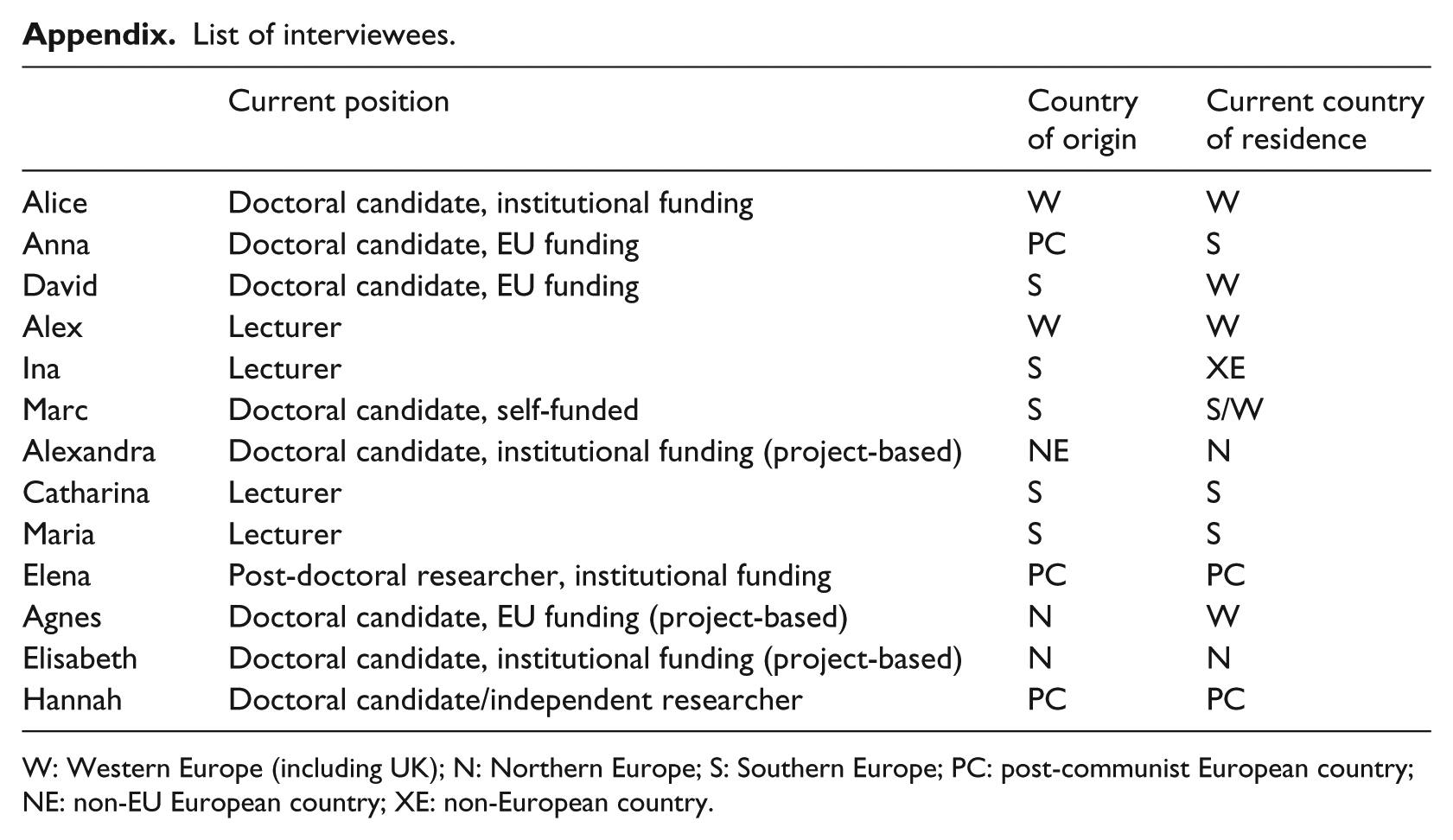
| Current position | Country of origin | Current country of residence | |
|---|---|---|---|
| Alice | Doctoral candidate, institutional funding | W | W |
| Anna | Doctoral candidate, EU funding | PC | S |
| David | Doctoral candidate, EU funding | S | W |
| Alex | Lecturer | W | W |
| Ina | Lecturer | S | XE |
| Marc | Doctoral candidate, self-funded | S | S/W |
| Alexandra | Doctoral candidate, institutional funding (project-based) | NE | N |
| Catharina | Lecturer | S | S |
| Maria | Lecturer | S | S |
| Elena | Post-doctoral researcher, institutional funding | PC | PC |
| Agnes | Doctoral candidate, EU funding (project-based) | N | W |
| Elisabeth | Doctoral candidate, institutional funding (project-based) | N | N |
| Hannah | Doctoral candidate/independent researcher | PC | PC |
W: Western Europe (including UK); N: Northern Europe; S: Southern Europe; PC: post-communist European country; NE: non-EU European country; XE: non-European country.
Acknowledgements
The authors wish to thank the organisers of SUSEES for creating conditions that prompted important discussions that motivated this project, and to Jenny Ozga and the anonymous reviewers for their invaluable comments on the earlier drafts of this paper.
Declaration of conflicting interest
The author(s) declared no potential conflicts of interest with respect to the research, authorship, and/or publication of this article.
Funding
The author(s) received no financial support for the research, authorship, and/or publication of this article.
