



Abstract
Insecurity and intense competition for permanent academic positions appear to be common experiences for early career researchers across the globe. With academic precarity now firmly on the international research and policy agenda, this article looks comparatively at postdoc precarity in three European countries: Ireland, Norway and Switzerland. It suggests that the career prospects and status of these early career stage researchers depend to a large extent on societal variations in academic career structures and research funding models. The article underlines the implications of an increasingly competitive academic labour market on postdoc precarity and identifies both common and specific (national and/or disciplinary) challenges facing postdocs in these different contexts.
Keywords
Introduction
Academic institutions have always depended on temporary staff to carry out teaching and research duties. However, the rapid expansion in the number of PhD holders and postdoctoral researchers (postdocs) in jobs without long-term secure employment prospects marks a watershed. Although the proportion of the academic labour force who are on temporary contracts varies substantially within and across countries (Le Feuvre et al., 2019), insecurity and intense competition for permanent academic positions appear to be common experiences for early career researchers (ECRs) across the globe. With academic precarity now firmly on the international research and policy agenda, we aim to contribute to the state of the art with an inquiry into the implications of different academic career structures and research funding models for the configuration of postdoc precarity in three European countries: Ireland, Norway and Switzerland. These countries were selected purposively, based on similarities and differences in their higher education (HE) systems. The discussion is based on a secondary analysis of official documents and statistics, relevant literature and data from previous large-scale EU-funded projects and national case studies. The article also aims to identify gaps in the existing literature, by highlighting the importance of adopting a multi-level (macro, meso and micro) approach to understanding the ‘lived experiences’ of postdocs. In this context, the macro-level refers to the national contexts, the meso-level refers to the organisational settings (HE institutions and research funding bodies) and the micro-level encompasses the everyday experiences of working in HE institutions. We propose that academic citizenship is located at the intersection of these levels, yielding different formations of membership, recognition and belonging in different national and disciplinary contexts (Sümer, O’Connor and Le Feuvre 2020).
The dramatic increase in the number of temporary academic positions across the globe has taken place in parallel to the shift towards ‘academic capitalism’, defined as an outcome of the ‘interplay between neoliberalism, globalisation, markets and universities’ (O’Hagan et al., 2019: 206; Jessop 2018; Slaughter and Rhoades 2004). Major impacts of neoliberal values on HE institutions include competitive procedures for research funding, widespread adoption of ‘performance’ indicators, increased competition for permanent academic jobs and the casualisation of the academic labour force (Bozzon et al., 2019; Angervall 2016). The ‘good academic citizen’ is increasingly depicted as the ‘effective market competitor’ (Morley 2018: 21) and the individualised need to perform has become a key element of HE governmentality (Sümer and Eslen-Ziya 2023).
In this context, academic citizenship is a multi-dimensional concept, involving three key components: membership, recognition and belonging, each relating to specific levels (macro-meso-micro) of observation and empirical enquiry (Sümer et al., 2020). The membership component of academic citizenship is mostly related to the macro-level of career structures and formal employment contracts in HE institutions (HEIs). Recognition is linked to the meso-level of organizations and to the power relations and prospects of influencing key decision-making processes within specific HEIs. The micro-level dimension of academic citizenship refers to an individual sense of belonging to an academic community (Sümer et al., 2020: 20). We propose that this multi-dimensional understanding of academic citizenship is particularly useful to analyse the employment conditions and experiences of researchers at different career stages, including postdocs who occupy fixed-term positions in HE institutions. Although we recognise that micropolitical practices (O’Connor et al., 2020) are important dimensions of academic citizenship, the focus in this article is on the macro- and meso-level factors that influence working conditions of ECRs, who currently bear the brunt of precarious employment positions in the HE sector.
The background to postdoc precarity
Initially occurring in male-dominated science, technology, engineering, mathematics and medicine (STEMM) domains, postdoctoral positions have become more common in all disciplines in the past two decades. They are usually dependent on a principal investigator (PI), not only for the definition of their daily tasks and workload, but also for job references and the consolidation of their future employment opportunities. A recent global study of postdocs found ‘a regime of long hours, severe dependence on senior researchers, lack of recognition and a deterioration in physical and mental wellbeing’ (OECD, 2021:17). Although postdoc positions were initially intended to increase the skills of PhD holders and thus their employment opportunities, evidence suggests that, in practice, postdocs receive little guidance, training or supervision from their PI (Woolston, 2020). Eight out of ten postdocs stated finding satisfaction in the intrinsic nature of their work, with the proportion who were satisfied being highest among those who had been postdocs for less than 2 years and declining after that (OECD, 2021). The longer and more open-ended their position and the greater the ambiguity surrounding how to move to a permanent position, the greater the power imbalance between postdocs and their PIs.
With the globalisation of academic careers, postdocs are increasingly recruited internationally or are often expected to move abroad and/or between institutions at this stage in their careers (Sautier, 2021; Schaer, 2021; Nokkala et al., 2020). The postdoc experience is also highly gendered as the suitability for an academic career with family formation and care-commitments is usually assessed according to male-dominated structures, procedures and criteria (Le Feuvre et al., 2019; Bozzon et al., 2019). High workloads and the long-hours culture exacerbate pressures on ECRs with care responsibilities (Ivancheva et al., 2019). The gendered implications of the vague construction of ‘academic excellence’ in performance evaluations have been well-documented (e.g. Fassa and Kradolfer 2013; Steinthorsdóttir et al., 2018; Van Den Brink and Benschop 2012; O’Connor and Barnard 2021).
Postdocs are expected to carry out a wide range of tasks, including teaching, tutoring, laboratory work, data collection and analysis, and providing various support services for their institutions. Despite being the ‘lifeblood of academic research’ (Scaffidi and Berman 2011: 697), postdocs typically end up ‘doing someone else’s job, be it supervising students, reviewing papers or writing project reports’ (Bozzon et al., 2019: 38). Previous studies on postdoctoral experiences (e.g. Akerlind, 2005; Müller, 2014; Scaffidi and Berman, 2011; Teelken and Van der Weijden, 2018) document job insecurity, lack of career structures and strong focus on individual achievement as major problems for postdocs across the globe. The ‘short-term objectives’ that dominate recruitment decisions stand in contrast to the jargon of ‘academic excellence’ (Herschberg et al., 2018) and create a key challenge for Human Resource Management (HRM) practitioners at HEIs to ‘bridge the gap’ between managerial and academic objectives (Teelkeen and Vand der Weijden 2018).
Thus, a ‘transitional’ or ‘probationary’ form of academic citizenship is experienced by early career academics who aspire to an academic career, but who are currently located on the periphery of academic institutions, with limited resources, recognition and sense of belonging (Le Feuvre et al., 2020). Against this background, we highlight the role of academic career structures and research funding models for the academic citizenship experiences of postdocs in three national contexts, selected for their comparable size and contrasting characteristics.
Academic career structures and research funding models
Recruitment procedures, promotion rules, workload and career paths tend to vary significantly from one national HE system to another (Enders and Musselin 2008). Four aspects of academic labour markets are particularly sensitive to national variation: recruitment procedures; length and function of the postdoc period; the relative importance of internal and external labour markets and pay determinants (Musselin 2005: 135). Based on these indicators, three major academic career models can be identified: the ‘tenure track’, the ‘survivor’ and the ‘protective pyramid’ models (Musselin 2009).
The
Research funding models
Typology of research funding systems and their implications.
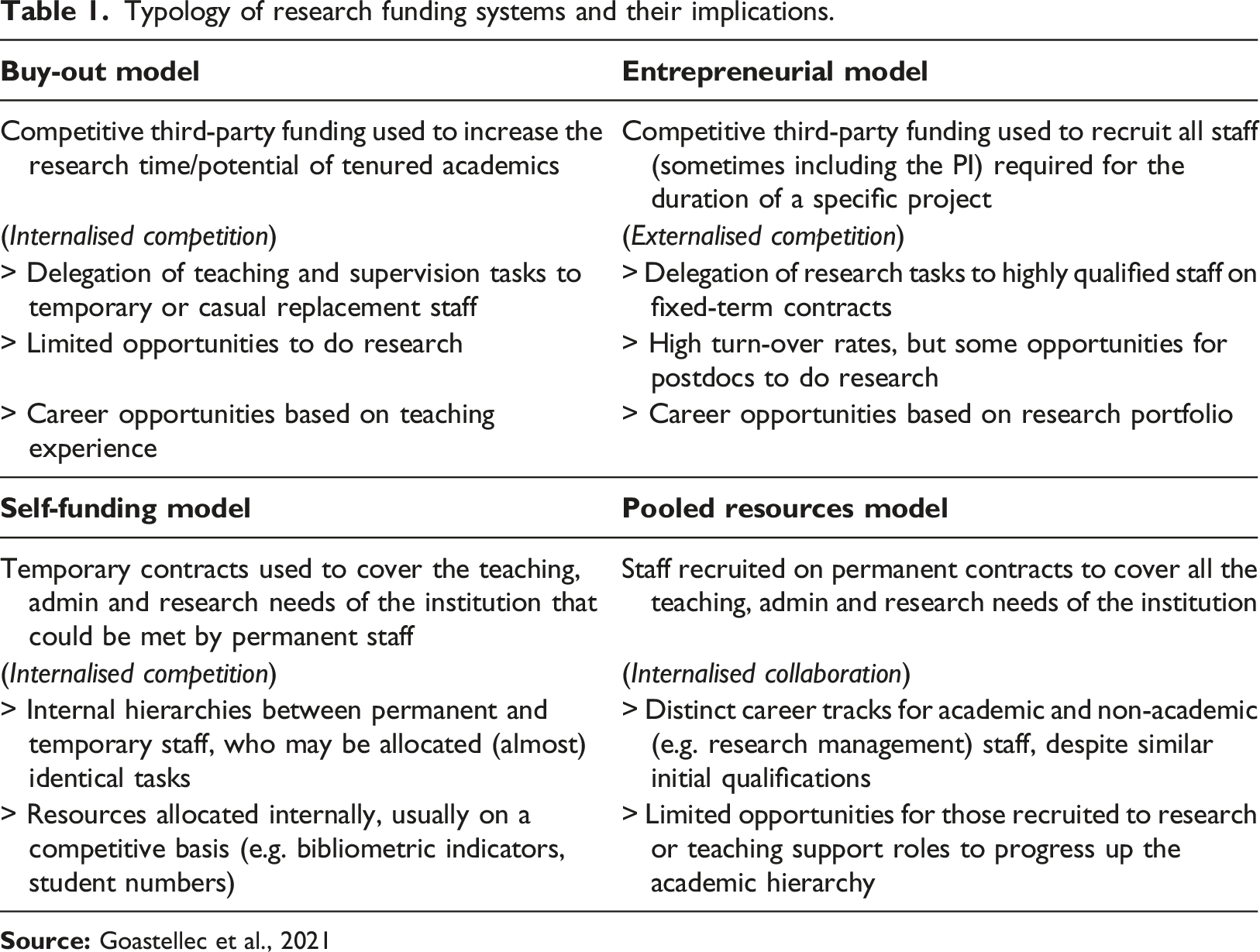
In a ‘self-funding’ model, HE institutions provide the time and/or infrastructure required to carry out research, by allocating resources to all permanent academic staff. This funding model may exist in combination with a ‘pooled-resources’ model, whereby HE institutions directly recruit technical staff, PhD students or postdocs and then allocate them internally to assist permanent academic staff in their research. Research may also be funded through a ‘buy-out’ model, whereby success in competitive external funding bids enables permanent academic staff to renegotiate their initial employment contract to allocate more time to their own research activities, usually by delegating less prestigious activities, such as undergraduate teaching or administrative duties, to temporary staff. Finally, the ‘entrepreneurial’ model of research funding involves success in competitive funding bids and enables researchers to recruit their own research teams who are employed for the duration of the project, on fixed-term contracts, under the direct authority of a PI (Goastellec et al., 2021).
The ‘buy-out’ model tends to be favoured in Arts, Humanities, Social Sciences and Law (AHSSL) domains, where time to carry out one’s own research is deemed more important than being able to recruit a ‘team’ of temporary, project-specific, collaborators (Goastellec et al., 2021: 18). The entrepreneurial funding model is traditionally favoured in STEMM domains, where funding applications are primarily aimed at increasing the number of researchers available to work on a particular project. Key elements include the allocation of lab work to postdocs and maintaining a high ratio of temporary to permanent staff (NASEM, 2014). The ‘entrepreneurial’ funding model contributes to the reputation and global ranking of HE institutions and to the career progression of permanent academics, who utilise the skills and productivity of postdocs to meet the productivity targets that will ultimately improve their own career progression. In this case, postdocs may not be able to build up the independent research portfolio and teaching experience required to access a permanent academic position (Powell 2015).
The ‘self-funding’ model leads to a situation where temporary postdocs may be recruited to perform very similar tasks to colleagues employed permanently by the same institution, whilst being deprived of equivalent benefits or recognition. In some contexts, this highly qualified ‘precariat’ or Limpiadores (Rings 2022) means that permanent academics risk being replaced by a cheaper and more flexible ‘reserve labour supply’. The ‘pooled-resources’ research funding model also leads to a stratified internal labour market (Goastellec et al., 2021). Depending on whether they are recruited to (permanent) academic positions or to (fixed-term) research and/or teaching support positions, postdocs with very similar backgrounds and credentials may end up on very different career tracks, with very different opportunities.
Making sense of postdoc precarity from a cross-national perspective
Due to the mismatch between the rate of increase in the numbers of PhDs/postdocs, and permanent academic positions, only a small percentage of ECRs will ultimately secure a permanent position in a HE institution. In 2021, a study of postdocs found that one-third of them, and 80% of those currently working in North America or Europe, saw academia as their preferred career destination (Woolston 2020). It is therefore important to consider the factors that influence the career prospects of postdocs in different national contexts.
The three countries chosen for this comparative study have different academic career structures and research funding mechanisms, and these are evolving over time. In the following section, we present the overall characteristics of the Irish, Norwegian and Swiss HE systems, in order to discuss the potential implications of cross-national and disciplinary variation (STEMM vs AHSSL) for postdoc employment conditions and their academic career prospects.
The academic career structure and research funding models in Ireland
Ireland traditionally had a binary HE system consisting of universities and institutes of technology, which changed with the creation of five new Technological Universities (TUs) over the 2019–2022 period. New Public Management began to impact on the Irish HE in the late 1990s (Lynch et al., 2012). Its influence has been reflected in the prioritisation of research over teaching and service; in recruitment and promotion procedures; in the corporatisation of universities, and the focus on performance metrics. The Irish university career structure traditionally had some similarities with the UK model, with four types of permanent academic positions arranged hierarchically: lecturer, senior lecturer, associate professor and professor.
The TUs currently retain the Institutes of Technology academic career structure (consisting of assistant lecturer, lecturer and senior lecturer: without a professorial position). The OECD (2022) has recently recommended the creation of a new career structure in the TUs with five ranks: assistant lecturer, lecturer, senior lecturer, associate professor and full professor. Both the old university and the TU systems offer opportunities to move up the career ladder over time within a single HE institution. These positions co-exist with short-term contractual positions for people providing lectures, tutorials and research support on an ad hoc basis. In recent years, a parallel research career track has emerged. In general, postdocs are located on the research career track, which is somewhat truncated (i.e. the highest position is senior researcher, equivalent to senior lecturer). They tend to progress from one fixed-term research contract to another, depending on the availability of research funding and their relationship with the PI, who is typically a permanent academic. Largely contingent on competitive external funding, the research career track offers few opportunities to move back onto the academic career track, limiting job security and career progression.
Full professors make up roughly one-eighth of all permanent core-funded academics in Irish Universities (HEA 2021). In 2020, there were 5198 academic core-funded staff employed in Irish universities, an increase of more than a fifth in 5 years (HEA 2021). Including all HE institutions, there were just under 16 000 academics and researchers on core or non-core funding, compared with just over 9000 in 2015 (HEA, 2022a).
Lecturer and full professor positions are publicly advertised, while the intermediate positions are mostly accessible via internal promotion mechanisms. Positions on the academic track have broadly similar salary scales across all Irish universities. Tenure-track, involving recruiting lecturers on a 5-year fixed-term basis with the possibility of access to a permanent position thereafter, are emerging at the ECR stage.
Excluding PhD students, postdocs and other researchers, 87% of the core-funded academic staff are permanent, the majority of them full time (HEA 2022b), although this figure is highly contested (O’Keefe and Courtois 2019). Precarity was identified as a key (but unquantified) issue affecting Irish HE institutions (HEA 2022a) which use various kinds of precarious contracts to meet existing and emerging requirements within tight budget parameters.
The Irish HE Authority recently published data on the status of non-core funded staff, including grant funded research positions (HEA 2022b). The overwhelming majority of these (83%) are non-permanent, mostly full-time temporary (73% as compared with the 9% of those who are core funded). This means that across all Irish HEIs, 35% of all academics and researchers are non-permanent, the majority of these being full-time in research. Women are marginally less likely than men to be in full-time permanent research positions, although they are much less likely to be in permanent academic positions (HEA 2022b).
Women make up 46% of all core-funded academic staff, but only 30% of those at (full) professorial level (HEA 2022b). Since 2014, there have been a series of policy initiatives to increase the proportion of women in senior academic positions in Ireland (O’Connor and Irvine 2020). Women made up 63% of the 110 new professors, that is, women making up 27% of the applicants and 46% of the appointments to the professorial positions created in 2018–2020 (Woods 2022). Nevertheless, overall, just under 10% of all male academic staff but less than three per cent of their female counterparts are full professors (EC 2021: 187).
The largest funder of academic research is Science Foundation Ireland (SFI), with project-based competitive funding, predominantly funding postdoc positions as part of larger research teams or consortia. The Irish Research Council (IRC) has a much more limited budget and mainly provides fellowships to individuals on a buy-out basis in the AHSSL domain. There are expectations in HE institutions that all faculty, but particularly professors, will engage in research and their time is often nominally costed into funding applications, effectively facilitating a buy-out situation. Some funds are provided internally by HE institutions on a competitive basis to individuals and/or to research centres on a ‘pooled-resources’ basis. Nevertheless, the ‘entrepreneurial model’ of research funding would seem to be widespread, leading to the recruitment of postdocs primarily onto the research career track, with very limited opportunities to shift to the academic career track.
Postdoc employment conditions and career prospects in Ireland
There has been a dramatic increase in the number of PhD graduates in Ireland: from 1750 PhDs awarded in 2016, to 2250 in 2020 (ICSTI 2020). Depending on the source of funding, PhD students may undertake teaching duties, predominantly acting as tutors, but they are not included in the academic staff figures. There is no limit on the time postdocs or other researchers can spend on a succession of temporary contracts in any one HE institution. One-fifth of all PhD graduates in Ireland become postdocs (HEA, 2020). This contrasts with the US where 65% of US PhDs complete a postdoc (Powell 2015). Just under half of the PhD graduates in Ireland are on 12-month, fixed-term contracts, with the remainder being on even shorter contracts or being paid on a casual, hourly basis (HEA, 2020).
The IUA (2020) defines the purpose of postdocs as undertaking research under the supervision of a PI, implying some form of career development. It suggests that postdocs have ‘a primary research role’, with their responsibilities including undertaking research and related administrative work, preparing grant proposals, disseminating results and participating in the wider activities of their research group. There is also reference to ‘limited teaching’ partly to further their own career and partly to provide ‘day-to-day advice and assistance’ to students (IUA 2020: 2). The IUA (2020) distinguishes between postdoc researcher Level 1 and Level 2, with the latter including the identification of external funding opportunities, the supervision of research graduates and students and understanding the management requirements of a successful research project. The expectation is that a Level 2 appointee would generally have 3–4 years previous postdoc research experience (IUA 2020: 4). However, there is no mechanism for monitoring this system and this opportunity for moderate career progression is obscured by the existence of a single salary scale.
Most of those who are involved on temporary (grant) funded research and specialist posts (i.e. non-core) are employed on a full-time basis. This means that if they were to become permanent, such full-time permanent academics and researchers would need to increase by roughly 50%. Furthermore, since research positions with longer contracts are mainly in the STEMM domain, this could dramatically alter the disciplinary profile of Irish HE institutions. It could also have gender implications since men are more likely than women to be in STEMM and have longer contracts and so more likely to access such permanent positions. A case study in STEM in one Irish university found that postdocs had frequently been ‘groomed’ by a permanent academic as an undergraduate, invited to do a PhD under their supervision, and then offered a postdoc under their sponsorship (O’Connor 2022).
The SFI-IRC Pathway Programme is the first indication of any attempt by the research funders ‘to provide a mechanism to retain excellent ECRs from all disciplines and support their development toward becoming research leaders of the future’ (SFI-IRC, 2021: 3). These fellowships, half of which are ear-marked for women, are funded for 4 years. The requirement to identify a mentor and to provide a letter of support referring to teaching commitments in the host institution suggests that the grantees might ultimately lead a research programme and have an academic career. However, the relatively small number of fellowships available suggests that they are currently little more than a rhetorical gesture towards reducing postdoc precarity.
The academic career structure and research funding models in Norway
Traditionally, Norway had a binary HE system, consisting of universities and university colleges, offering vocational degrees. Since 2004, the binary divide has been gradually eroded (Frølich et al. 2018). This was triggered by the introduction of New Public Management principles to the Norwegian HE sector, promoting competition between institutions for students and research funding, with an emphasis on performance indicators and the strengthening of institutional leadership (Stensaker 2014; Iddeng and Norgaard 2020). Currently, the Norwegian academic system includes 10 universities and nine specialised university/scientific colleges owned by the Ministry of Education and Research (NOKUT 2022). These are governed by the Universities and Colleges Act that provides a common framework for the organisation and governance of HE institutions, supplemented by a more detailed set of regulations around appointment and promotion in teaching and research posts, laid down by the Ministry of Education and Research (Frølich et al. 2018).
The Norwegian academic career structure was traditionally based on two distinct tracks: a research-oriented and a teaching-oriented track. Universities predominantly offer research track positions. The research track includes the permanent positions of associate (førsteamanuensis) and full professor. The position of ‘researcher’ is increasingly used in the universities, mainly in the context of externally funded, short-term research projects. The teaching-oriented track (mostly used in university colleges) includes the permanent positions of lecturer (universitets-/høyskolelektor), senior lecturer (førstelektor) and docent (dosent), all of which offer the possibility of doing some research. The widespread merging of smaller university colleges and their attempts to gain status as universities led to a focus on increasing research competence on the teaching track and teaching competence on the research track (Frølich et al. 2018).
Associate professorships are structurally funded from faculty budgets. These positions are advertised internationally and usually attract a large number of applicants who are evaluated and ranked by an expert committee, with external members. Anyone who holds a PhD degree can apply for these positions, although candidates are increasingly expected to have completed a postdoc and to have an extensive list of publications before applying. Once they have enough teaching and research experience and outputs, associate professors are eligible to apply for promotion to a full professorship. Candidates are again evaluated by an expert committee, in accordance with the nationally regulated criteria. Due to the existence of this possibility to personally apply for promotion based on accumulated competence, the share of professors in permanent positions is very high (over 40%) at Norwegian HEIs (Frølich et al. 2018: 31).
In 2021, women comprised 33.5% of full professors and 50% of associate professors. Overall, 20% of male academic staff and nine per cent of their female counterparts have full professorship or equivalent status (EC 2021: 187). The scarcity of women in top academic positions has been on the political agenda for some time and the Research Council of Norway (RCN) established and funded Gender Balance in Senior Positions and Research Management initiatives for the period 2012–2022.
The RCN allocates research funding through annual calls for proposals in selected priority thematic areas. The Ministry of Education and Research allocates basic research funding to HE institutions according to bibliometric performance indicators (Schneider 2009). All permanent positions at associate and full professor level have 40–50% of their contractual working time ear-marked for research and are expected to apply to the RCN (and increasingly the EU) for additional, competitive, research funding. If they are successful, they can trigger a ‘buy-out’ mechanism and hire temporary staff to cover all or part of their teaching duties in order to dedicate more time to their research. Both funding models are equally available to permanent academics in STEMM and non-STEMM domains. New projects usually involve the creation of fixed-term PhD or postdoc positions, in line with the ‘entrepreneurial’ model. In summary, the Norwegian context is characterised by a combination of the ‘self-funding’, ‘buy-out’ and ‘entrepreneurial’ research funding models and a relatively high share of public funding.
Postdoc employment conditions and career prospects in Norway
In Norway, the number of PhD graduates has quadrupled over the past 25 years, from about 500 in the mid-1990s to over 2150 in 2019 (Gunnes et al., 2020). The number of postdocs has increased by approximately 75% in the past decade (Frølich et al. 2018), while there has only been a 20% increase in the number of permanent academic staff in public universities and colleges. In 2021, 16% of all HE teaching and research positions were temporary (DBH 2021), but this figure does not include PhD students and postdocs. When these are included, the rate of temporary contracts in Norwegian HE institutions increases to over 30% (DBH 2021).
Postdoc positions in Norway are supposed to enable PhD graduates to improve their research and teaching skills in order to prepare them for an academic career. The majority (60%) of such positions are externally funded and are most likely to be in STEMM disciplines (Gunnes et al., 2020). The most common duration is 4 years (3 years funded by the RCN or the EU, plus 1-year of ‘matching funding’ from the host institution). Around 60% of postdocs are recruited immediately after their PhD graduation, with some starting several years later, usually after working in other temporary research or teaching positions.
A national survey of two cohorts of postdocs (recruited in 2014 and in 2018), with a total of 2466 respondents, showed that HE institutions use postdoc positions for various purposes, and that qualifying them for permanent academic positions does not appear to be their main goal (Gunnes et al., 2020). Overall, women represent about half of those holding postdoc positions in Norway, with some disciplinary differences: women make up 60% of postdocs in Medicine and Health Sciences, but only 30% in Technology. Around half of all postdocs are international researchers (i.e. not born or brought up in Norway).
Universities can advertise ‘personal postdocs’, which are usually in the AHSSL domain, and have a more specific career development dimension, including mentoring and dedicated time (usually 25%) devoted to teaching, since associate professorship positions require teaching experience. In total, 40% of postdoc positions in Norway are financed by the RCN as part of larger projects funded through competitive research applications; 30% are financed from the core budget of HE institutions and 30% from ‘other sources’ (Gunnes et al., 2020; RCN 2021).
About half of the postdocs in Norway have a research position 4–5 years after the end of the postdoc period, with those in Technology and Natural Sciences more likely to be in research institutions than universities. More than half of the postdocs working in STEMM domains left academia 4 years after their postdoc period, as did roughly a third of those in AHSSL domains and almost two-fifths of those in Medicine and Health Sciences (Gunnes et al., 2020: 35). These high attrition rates may reflect the relative attractiveness of academic careers, compared to alternative employment opportunities for PhD graduates.
Approximately five percent of all postdocs achieve a full professorship and 15% an associate professor position 4 years after the end of their postdoc contract (Gunnes et al., 2020). There are significant disciplinary differences: roughly three-fifths of those in AHSSL domains had a permanent academic position (either in universities or research institutions) 4 years after their PhD, as compared to roughly a third of those in STEMM domains. Similarly, roughly a third of postdocs in AHSSL were offered an associate professorship within 4 years of their PhD graduation, compared to roughly one in 10 in STEMM (Gunnes et al. 2020).
The academic career structure research funding models in Switzerland
The Swiss public HE sector is internally diverse and fragmented. It includes 10 (public) cantonal universities, two prestigious Federal Institutes of Technology and eight public-sector Universities of applied science. The Swiss academic career structure is difficult to describe because the same job title can correspond to a different career stage, salary, job content, depending on the institution, with variations even existing between faculties in a single university (Boisseaux 2018).
The academic career structure is based on the Germanic tradition with chairs (i.e. full professorships) being the only permanent positions. They are expected to coordinate teaching and research as well as managing their institute/lab/section. These professorships were historically endowed by their institutions with subordinate collaborators, mostly PhD candidates and postdocs on fixed-term contracts. They are increasingly dependent on competitive external funding bids for recruiting doctoral students and postdoc researchers. There are limited opportunities for any of these to access a professorship unless they manage to ‘survive’ long enough to step into the shoes of their ‘boss’ once s/he retires (or dies).
Some Swiss universities have now adopted a ‘tenure track’ career model and recruit Assistant professors on a fixed-term basis, with the promise of performance-based tenure (as Associate professor) within 5–6 years, with later opportunities for promotion to Full professorship. In 2018, the Federal Statistical Office identified 4531 full-time equivalent professors, representing 10% of academic staff. In addition, there were 9063 ‘other academic staff’, a hybrid category including a minority of permanent research or teaching staff and a majority of temporary researchers or lecturers, along with 31,947 ‘assistants et scientific collaborators’, a category that includes (funded) PhD candidates and postdocs on fixed-term contracts (OFS 2018). In 2011, a report from the Swiss Federal Council recognised that 80% of academic staff were employed on fixed-term contracts.
The number of permanent academic positions in the Swiss HE system increased by 26% since 2010 (Dubach et al., 2017). There has also been a considerable increase in the number of PhD degrees awarded: 4424 in 2020 a 42% increase since 2005. Almost 60% of PhD students do not have Swiss nationality. The number of PhD degrees awarded each year in Switzerland is equivalent to the total number of permanent academic positions in all public-sector HE institutions (Goastellec et al., 2021).
The ratio of PhD candidates and scientific collaborators per professor stands at 5.5, with little change between 2013 and 2019. Postdocs ability to remain within academia is potentially limited by the employment rules of their universities, which may prevent them working for more than six consecutive years on fixed-term contracts in any one university (Bataille et al., 2017). In addition, some HE institutions, notably in the German-speaking cantons, require prospective professorial candidates to submit a second (habilitation) thesis, which usually requires at least 10 years research after the PhD, in addition to barring them from recruitment to a full professorship at any university where they have previously studied or worked.
As in most European countries, women still face a significant glass ceiling within the Swiss HE system. Thus, 20 years after the first Federal Programme to promote equal opportunities in HE and research (Faniko et al., 2021), they still only make up 36% of permanent academic staff and are particularly under-represented in the most prestigious, research-intensive universities. Only 20% of full professors are women (Bataille et al., 2017), although they now represent 50% of new recruits to tenure-track assistant professorships. Likewise, 15.5 of male academic staff, but only 7.4% of their female counterparts have professor or equivalent status (EC 2021: 187). Women are particularly disadvantaged by the timing of the postdocs phase in the Swiss context. Doctorates are usually awarded between 31 and 37 years of age, with candidates being older in those ASSHL disciplines where there are the most female PhD holders. The average duration of the postdoc period is currently more than 6 years, meaning that women have to navigate a succession of fixed-term contracts, often requiring geographical mobility, precisely when they are most likely to be starting a family (AHSS 2018).
In recent years, efforts to reduce the precarity of early career-stage researchers have mostly consisted of limiting the duration of fixed-term positions within a single HE institution and of opening up competitive research funding opportunities for ‘high potential’ postdocs who are free to locate their externally funded research team for a period of 5–6 years. However, these Swiss National Science Foundation (SNSF) ‘professorships’ provide no guarantee of receiving tenure from their host institution at the end of the fixed-term funding period (Goastellec et al., 2021).
Almost all basic research funding is channelled through the SNSF, with more limited contributions from other public or private bodies. Funding is distributed on a competitive basis to individual academics or consortia headed by several permanent professors. Postdocs can be recruited to work on the research projects of their PIs or funded as independent research fellows to carry out their own research activities / projects (often with the possibility of recruiting their own PhD students or postdocs). At any point in time, the SNSF funds 12 times more postdocs through project funding than through individual fellowships (2192 vs 177 individual fellowships, including postdoc mobility grants) (Goastellec et al., 2021).
There are a variety of other funding sources for postdocs, including research and teaching positions funded from the HE institutions’ core budget, funding from other public or private-sector organisations, as well as international mobility grants, which can be combined or used successively. The Swiss National Science Foundation (SNSF) provides a nationwide sliding salary scale for postdocs, but this only covers a 5-year period, after which they are expected to have found a permanent position, or to have left the academic labour market. In sum, most research funding in Switzerland is allocated to PIs according to an ‘entrepreneurial model’, which exists in parallel to ‘self-funding’ or ‘pooled-resources’ opportunities from HE core-budgets.
Postdoc employment conditions and career prospects in Switzerland
Only a minority of PhD holders in Switzerland eventually achieve an academic career, either at home or abroad, although there is some evidence of variation according to discipline. Whereas the share of PhD holders working in a HE institution is stable (at around 45%) throughout the 5 years following the PhD in AHSSL domains, it drops from 41% to 28% for PhD holders in STEMM fields. Indeed, PhD holders in political science who leave academia rapidly after graduation report fewer difficulties in finding a job compared to those who complete one or several postdocs (Borgeat et al., 2020).
The source of funding is also important: those who benefitted from a personal SNSF fellowship have a slightly higher chance (44%) of still being in academic employment 4 years after their PhD than those funded via other third-party sources or from HE core-budgets (37%). This difference might reflect the higher academic achievements of those receiving competitive SNSF funding. The proportion of PhD holders staying in academia 5 years after the PhD is about the same (34%) for people who studied in Switzerland and those who studied abroad. However, postdocs with Swiss nationality are less likely than their non-Swiss counterparts to say that they ultimately aspire to an academic career.
Although men are more likely than women to have some form of postdoc employment 1 year after their PhD (42% vs 37%), 5 years on, there is almost no gender difference in the proportion of PhD holders still working in HE institutions (33.5% for men vs 35% for women). It is not clear to what extent these patterns reflect other underlying factors, such as the relative attractiveness of an academic career in Switzerland.
Cross-national variations in postdoc precarity as a public policy issue
The HE systems in Ireland, Norway and Switzerland differ in their academic career structures and research funding models, although they have all adopted varying degrees of New Public Management, leading to an increase in precarious postdoc positions. All three countries (as most universities globally) have seen dramatic increases in the number of PhDs awarded, without a similar increase in the number of permanent academic positions. This mismatch has led to the emergence of a large transient labour force, living for extended periods on the margins of the academic labour market, with little chances of achieving permanent positions and full academic citizenship rights. However, the experiences of this ‘postdoc precariat’ varies according to the academic career structure and research funding models in their national and disciplinary contexts.
In Ireland, due to parallel academic and research career tracks, postdocs run the risk of getting ‘stuck’ in the latter with very little chance of moving across to the more secure (and prestigious) academic career track. Given the dominance of SFI project-based competitive research funding, it seems plausible to suggest that most research funding in Ireland is allocated according to an ‘entrepreneurial’ model. The postdocs recruited on 2-year contracts funded by the IRC or on the 4-year SFI-IRC Pathways programme might be able to secure individual external funds, but they remain a very small minority. However, the absence of data on the characteristics, employment status, career outcomes and aspirations of postdocs in the Irish system makes it difficult to draw conclusive evidence about the precise, gendered and intersectional, forms of precarity they might face.
In Norway, there is quite a linear career structure in the universities, based on recruitment at assistant professor level, after a single, relatively short, postdoc, with the possibility of remaining at that level for an indefinite period of time, even in the same university. There are also good prospects of promotion to full professor reflecting a relatively flat academic hierarchy, and a much better chance of eventually getting a permanent position than in the Irish or Swiss case. Norway is also characterised by a mix of research funding models, with only 40% of funding being allocated on a competitive basis to large-scale projects that are expected to recruit temporary research staff. Extensive Norwegian longitudinal data highlights the fact that postdocs in the AHSSL domains are more likely to access an academic career than their counterparts in STEMM. As in Switzerland, roughly half of the postdocs working in Norway were born outside the country. Non-nationals are predominantly in STEMM domains (Wendt et al., 2022) and this factor lies behind their high levels of non-academic employment.
Switzerland is characterised by a bottom-heavy academic career structure, with very few permanent positions and a myriad of subordinate, fixed-term positions dependent on external funding schemes that are almost always accessed by permanent academic staff, usually professors. It is also characterised by a very hierarchical organisational structure, whereby even other permanent staff without professorial status are formally subordinate to a chair (professor). However, in contrast to the Irish case, this does not lead to an internal labour market within each HE institution, but rather to a volatile and highly mobile trans-national academic labour force, where postdocs are obliged to move between institutions and across borders in order to ‘follow’ each new funding opportunity. With the exception of a very small number of externally funded temporary SNSF fellowships or (pseudo-)professorships, postdocs are dependent on permanent PIs for their employment opportunities and working conditions. The ‘entrepreneurial’ model that characterises the most competitive funding instruments in Switzerland places postdocs in ‘salaried subordination’ vis-a-vis permanent professors, with potentially negative implications for their health and wellbeing (Academy of Humanities and Social Sciences 2018; OECD 2021).
In all the countries studied here, there is currently little incentive for tenured academics to support a change in the precarious academic citizenship status of postdocs, since they rely too heavily on their work to increase their own academic productivity, notably by delegating them routine, time-consuming ‘academic housework’ (Heijstra et al., 2017), such as laboratory work, teaching undergraduate courses, supervising graduate students, drafting funding proposals, etc.
Nonetheless, postdoc precarity is now emerging as a political issue across the globe. In Switzerland, ECRs have petitioned the Swiss Federal Parliament to create more ‘non-professorial permanent’ positions in academic institutions. 1 The petition has received a good deal of media coverage, but the potential funding levels currently being discussed would only cover a handful of such positions.
In Ireland, apart from the SFI-IRC Pathways fellowships, there has been little interest in tackling postdoc precarity to date. However, in 2022, with the staff-student ratios in tertiary education significantly above the European average, the Department of Further and HE, Research, Innovation and Science indicated that the HE sector would be supported ‘in moving away from the scale of use of more precarious forms of employment arrangement’ (DFHERIS 2022: 10–11). The Joint Committee on Education, Further and HE, Research, Innovation and Science called for the abolition of the Employment Control Framework and for funding for postdocs to be provided by the HEA, in order to avoid a reliance on short-term funding (JCEFHERIS, 2022: 5). The HEA (2022a) reiterated these recommendations, although they did not appear to recognise that those benefitting from the creation of permanent research positions were most likely to be men in STEMM domains. They also recommended the removal of ‘the designation of postdoctoral researchers as trainees… thereby affording them the full protections of labour law’ (HEA 2022a: 46). The implications of such recommendations for the knowledge creation model in STEMM; for the disciplinary or gender balance of full-time permanent posts has not been discussed, neither have the implications of the state funding full-time permanent academic staff, half of whom undertake little or no teaching duties. Nevertheless, it is clear that political unease around the position of postdocs is mounting. It is significant that the HEA (2022a) is now classifying such non-core funded research posts as academic.
In Norway, academic trade union organisations have also been active in putting the issue of academic precarity on the political and research agenda. Since 2017, the RCN requires applicants to provide a ‘professional development plan’, indicating measures to ensure that the postdocs will eventually qualify for permanent academic positions (RCN 2022). There has been a decrease in temporary positions from around 18% in 2009 to 14% in 2019. But this is mainly due to the increasing use of the category of ‘externally financed permanent positions’. These positions appear as permanent in statistics, but the researchers can be made redundant when the externally funded project ends (Khrono 2022). Furthermore, considering that only 7.4% of the Norwegian labour force is employed on temporary contracts, the high share of fixed-term employment at HEIs remain ‘alarming’ (Iddeng and Norgaard 2020). The Labour-Centre coalition government that came to power in October 2021 declared a commitment to reduce precarious positions in Norwegian HEIs. An expert committee was appointed in 2022 to investigate the relationship between externally funded research and the increase in temporary positions in HE institutions. Suggested revisions to the law aim to restrict the use of temporary positions for research and teaching purposes and consider limiting the possibility of having more than one postdoc employment.
Conclusions
The comparative approach adopted in this article has enabled us to detect gaps in the national statistics on the employment conditions and background characteristics of postdocs. While we could identify longitudinal and comprehensive studies in Norway, there is a persistent gap in the research data on this topic in Ireland and Switzerland, as in most other countries. Our secondary analysis of available data confirms the need to fully contextualise the gendered and disciplinary experiences of ECRs across national contexts in order to understand the conditions for their potential transition from probationary to secondary or full academic citizenship, or their departure into non-citizenship. Their ambiguous and insecure employment status with fixed-term funding in an increasingly competitive work context is identified as a key problem.
In this article, we have focussed on academic career structures and research funding systems, but it is important to stress that individual HE institutions within a given national context can also influence the status of postdocs regarding academic decision-making structures and their sense of belonging to the wider academic community. Former qualitative research on the micro (relational) level documents the central role that immediate supervisors (PIs) play in the career development and wellbeing of postdocs (Bozzon et al., 2019; Brandser and Sümer 2020). Clear guidance about career opportunities and support in future planning are highly valued by postdocs (Teelken and Van der Weiden, 2018). The HEIs as employers need to develop clearer regulations on the professional development of postdocs and PI-postdoc relations as part of their standard HRM policies.
We thus underline the significance of targeting change at macro-, meso- and micro-levels through an awareness of both common and specific (national and/or disciplinary) challenges facing postdocs in different contexts. In conclusion, we encourage more research on the complex multi-level influences on the configurations of postdoc precarity across national and disciplinary boundaries and stress the importance of context specific responses to this emerging policy issue.
Footnotes
Declaration of conflicting interests
The author(s) declared no potential conflicts of interest with respect to the research, authorship, and/or publication of this article.
Funding
The author(s) received no financial support for the research, authorship, and/or publication of this article.
