




Abstract
Social media is integral to students’ lives. Pinterest, an online social network for “Pinning” (sharing) links and images, is the fastest-growing social media tool in history. The purpose of this investigation was to determine the effectiveness of a semester-long active-learning assignment using the Pinterest platform. Forty-nine students (42 female; 18 psychology majors) enrolled in a Lifespan Development course contributed data to this investigation. Students used Pinterest to apply their knowledge of developmental theory and research to two celebrities or fictional characters of their choice. At the end of the semester, students completed a short questionnaire in which they reported on their experiences with the project. Participants also consented to have their academic achievement data (course grades) analyzed in aggregate. Results indicate that students enjoy the Pinterest platform and that they perceive learning more from the assignment than from other assignments in this and other courses. However, some students reported struggling with practical concerns of the platform, including difficulty in adjusting to an unfamiliar platform. Results suggest that Pinterest can be used to encourage student learning but that instructors must take care to ensure that assignments in this medium are inclusive of a broad range of students.
Introduction
Active learning is a learning strategy in which students engage themselves in the learning process through reading, writing, collaboration, problem-solving, or other activities that encourage students to take responsibility for their learning (Bonwell & Eison, 1991; Prince, 2004; Weltman, 2007). Use of such strategies is connected to improved academic achievement, improved self-esteem, and improved interpersonal relationships amongst students (Johnson, Johnson, & Smith, 1998a, 1998b; see Prince, 2004 for review). Recently, attention has been given to the possibility that technology could lend one pathway through which instructors can provide students with an active learning experience (Mellecker, Witherspoon, & Watterson, 2013; Roehl, Reddy, & Shannon, 2013).
Social media is an integral part of college students’ lives. In fact, 95% of high school seniors report using social media (Higher Education Research Institute, 2012). It follows, then, that social media could potentially be used to improve active learning in the classroom. One recent report finds that 64% of faculty members have used some form of social media in the classroom (Moran, Seaman, & Tinti-Kane, 2011). In many cases, social media platforms, such as Facebook and Twitter, have been used effectively inside and outside of the classroom as an engagement tool geared toward reinforcing course concepts (Blessing, Blessing, & Fleck, 2012; Marovich & Stanaityte, 2010; Mazer, Murphy, & Simonds, 2007; Thomas & Thomas, 2012).
Pinterest is the fastest-growing social media tool in history (McBride, 2013). Pinterest has been used as a venue from which a reference library can be built and from which library marketing can be improved (Dudenhoffer, 2012; Richardson, Vance, Price, & Henry, 2013). However, little is known about how well Pinterest can be used to promote learning in the classroom. There is some evidence that Pinterest can be used effectively in the Writing and English classrooms (Castro-Lewandowski, 2013; Chapman & Ortlieb, 2015; Grote-Garcia & Vasinda, 2014). However, more research is necessary to determine the breadth of disciplines in which Pinterest could be an effective platform for promoting active learning. To the best of my knowledge, no research to date has examined the effectiveness of Pinterest as a learning tool in a college-level Social Science course.
Therefore, the purpose of this project is to assess the effectiveness of a semester-long assignment in which students use Pinterest to apply their course knowledge about Psychology to specific situations. I hypothesized that students would enjoy the Pinterest assignment, that they would perceive learning more from the assignment than from other assignments, and that their performance in the course would be tied to their ratings of perceived enjoyment and learning. I hypothesized that students would describe several ways in which the assignment improved their engagement with course material and that they would report few difficulties with the assignment structure. I also allowed students to report on the platforms that they would most prefer for an assignment of this nature as well as the ways in which students would suggest improving the project in the future, but I offered no specific hypotheses regarding these responses.
Method
Procedure
As part of the requirements for a Lifespan Development course, students completed a semester-long Pinterest assignment in which they used Pinterest to apply their knowledge about developmental theory and research to two (one child and one adult) celebrities or fictional characters of their choice. Students were instructed to create a Pinterest “board” and then, using their board, they pinned on the physical, cognitive, social, and personality development of their chosen characters. Students completed the pins at times corresponding to when the analogous material was covered in class (i.e., students pinned on childhood during the beginning of the semester when lectures focused on childhood development, and on adulthood during the end of the semester when lectures focused on adulthood development). Students received instructor feedback on these pins and then wrote two 4–5 page essays, one for their child subject, and one for their adult subject, relating their subject’s development to theory and research learned in class.
At the end of the semester, students completed a short questionnaire in which they reported on their experiences with the project. Participants also consented to have their academic achievement data (individual assignment grades and final course grades) analyzed in aggregate.
Participants and Measures
Participants
Forty-nine students (42 female; 18 psychology majors; 19 freshmen, 16 sophomores, eight juniors, four seniors) out of 55 students enrolled in a Lifespan Development course at a mid-sized Southeastern Regional institution during the Spring 2016 semester contributed data to this investigation. Twenty-three reported participating in extracurricular activities. Fifteen were employed, working for an average of 17.8 hours per week (standard deviation (SD) = 8.8). Students reported spending 12.8 (SD = 16.04) hours on social media. 17 (34.7%) reported using Pinterest before beginning the course.
Pinterest Assignments
As described above, students “pinned” on two celebrities or fictional characters of their choice. In the first iteration of the project, students were instructed to pin on a character in infancy, early or late childhood, or adolescence. In the second iteration of the project, students were instructed to pin on a character in the developmental stage of early, middle, or late adulthood. For each iteration of the assignment, students pinned 20 pins: five to introduce their subject; five to discuss their physical development; five regarding their cognitive development; and five regarding their social and personality development. Students submitted their work by providing the instructor with a link to their Pinterest board after each set of pins (once when completing the introductory pins for their first character, again when submitting the physical development pins, etc.).
To “pin”, within the context of this assignment, meant to find an image, video, or link that was representative of students’ chosen subject’s development, and to then, within the 300–500 characters that Pinterest allows in the “description” section of the pin, relate this particular subject’s development to developmental theory and research that had been presented in class. Students were given the familiar example of Taylor Swift to guide their conceptualization of how the project was to be completed. In this example, it was suggested that, when pinning on this celebrity’s social development, it would not be appropriate to simply pin images of the celebrity. Instead, instructions suggested to students, it would be better to pin a meme about breakups and to then relate this to course material by discussing Erikson’s conceptualization of Intimacy vs. Isolation or Sternberg’s conceptualization of love.
In advance of the assignment, students received documentation that outlined, in detail, assignment instructions, “frequently asked questions” regarding the assignment, rubrics describing how they would be graded, and detailed instructions (including screen captures) of how to use Pinterest; students were scored on their ability to find creative, relevant pins to their character’s development, and on the connections that they made between their character’s individual development and theory and research discussed in class. The grading rubric associated with this assignment can be found in Figure 1.
Grading rubric for pinning portion of the Pinterest assignment.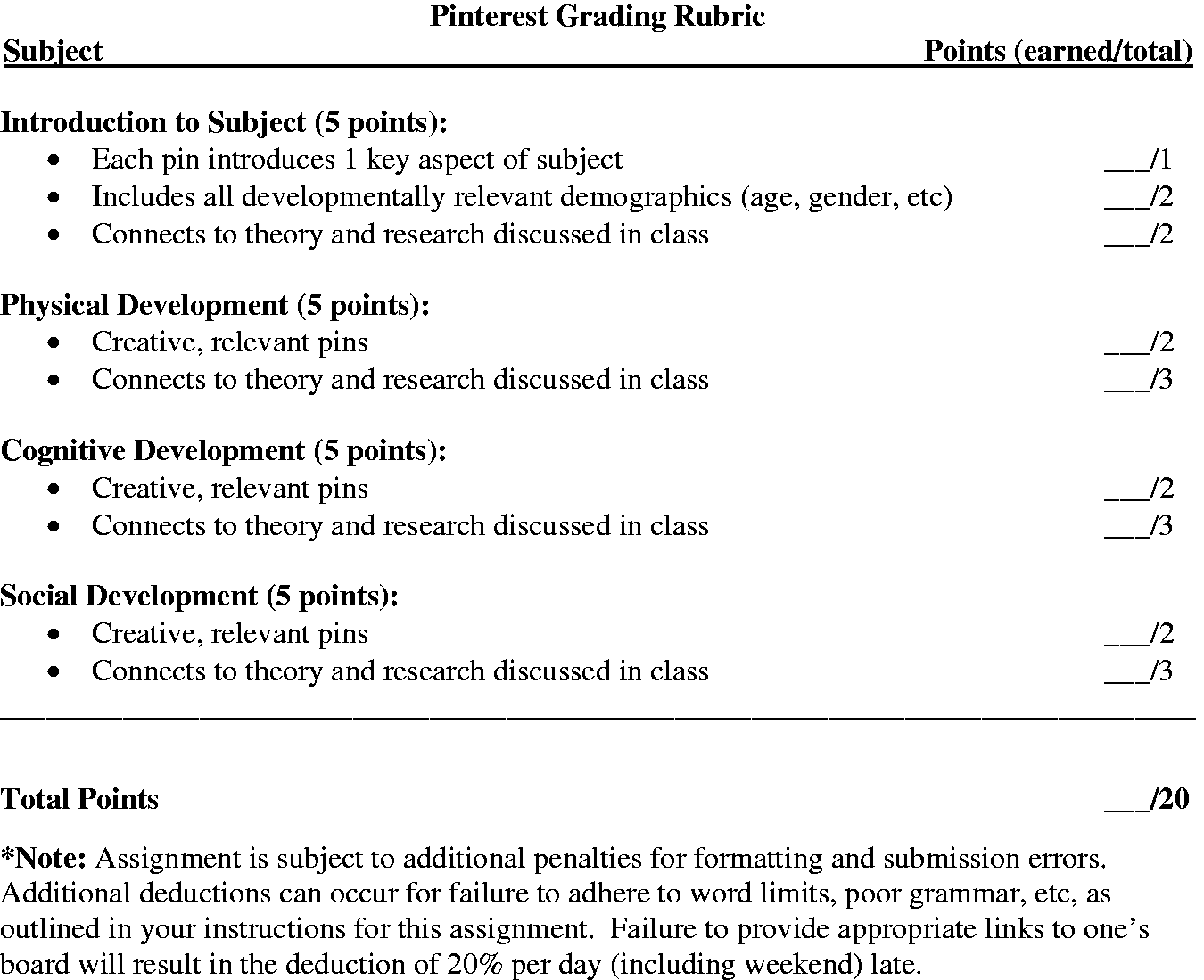
Writing Assignment
After completing their pins, and receiving instructor feedback, for each character, students were instructed to write a 4–5 page essay response in which they elaborated on the points addressed in their pins. Again, grading primarily focused on students’ ability to connect aspects of their characters’ development to course concepts. The grading rubric associated with this assignment can be found in Figure 2.
Grading rubric for observation paper portion of the Pinterest assignment.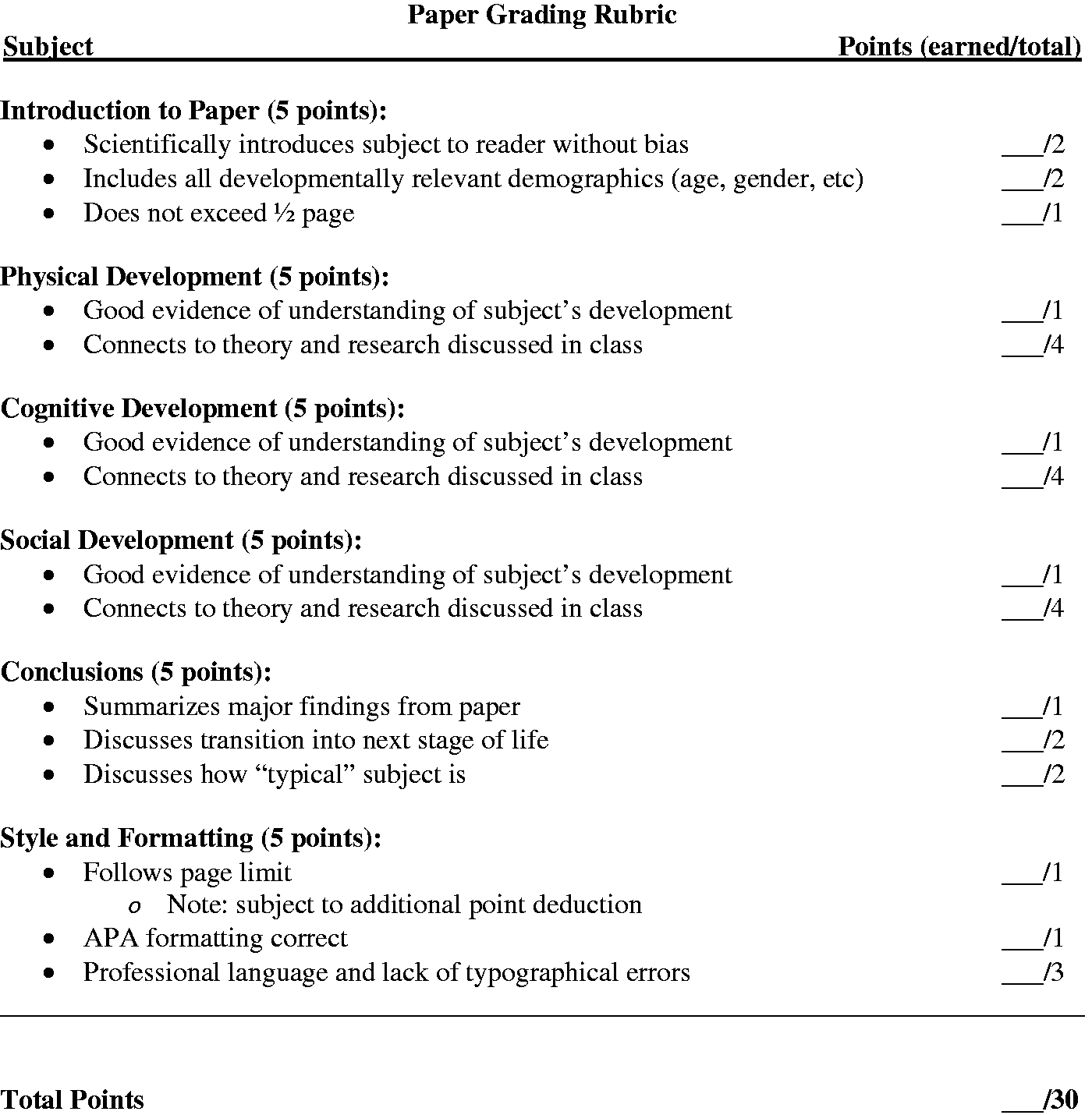
Course Grades
Participants consented to have their academic achievement data analyzed in aggregate. Consent forms were distributed early in the semester by a graduate assistant and were then placed in a sealed envelope that was not opened until after final course grades were submitted, so as to prevent any instructor bias to student grades. Students were informed of these protections before deciding to consent to the study. Of interest to this investigation were student scores on the Pinterest and Writing assignments as well as their final course grade.
Feedback Questionnaire
Descriptive Statistics for and Correlations Amongst Student Perceptions of Pinterest Assignment and Academic Outcome Variables
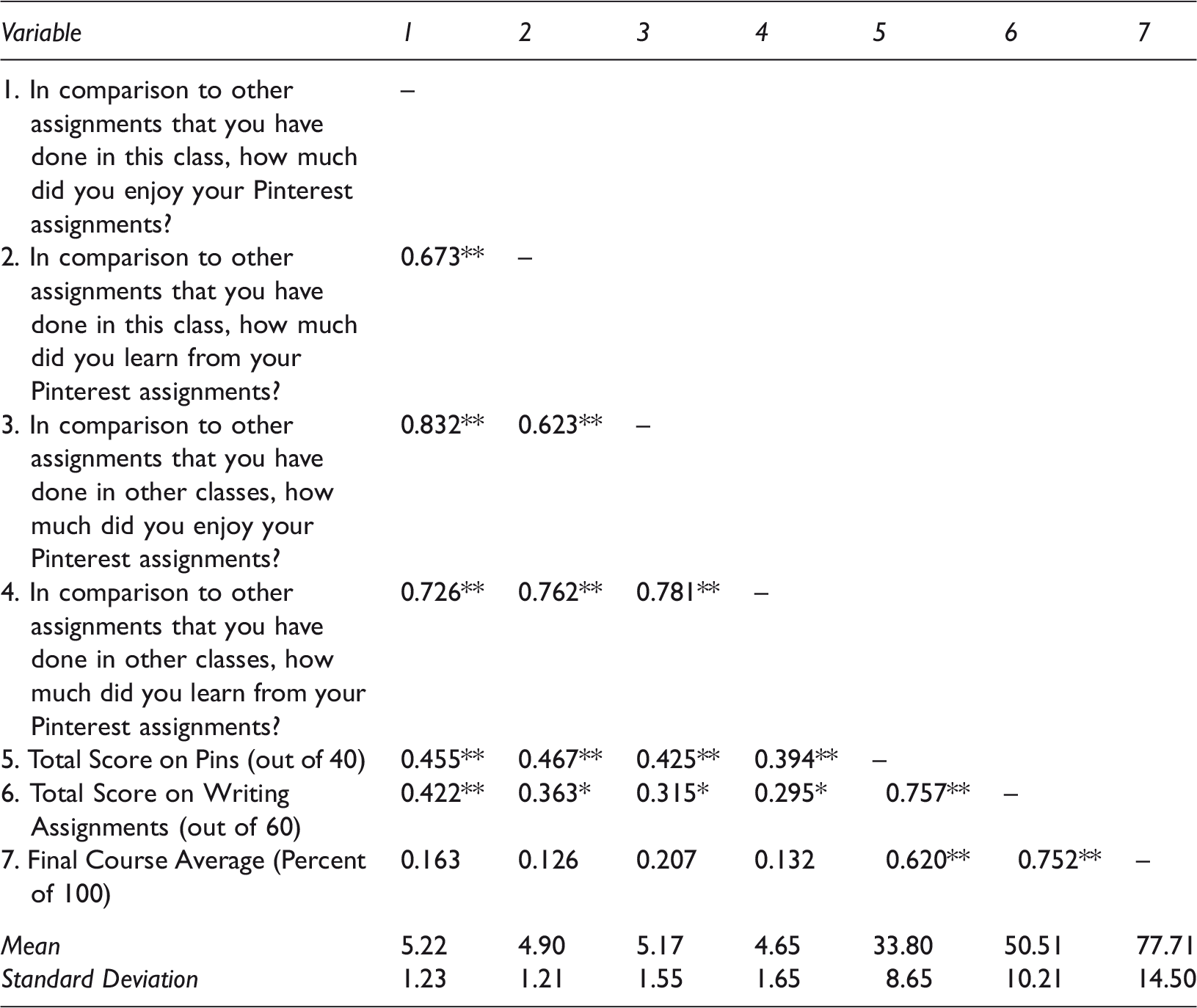
Note. For “in comparison” questions, 1 = much less; 4 = about the same; 7 = much more.
, p < 0.01; *, p < 0.05.
Selected Student Feedback to Open-Ended Responses
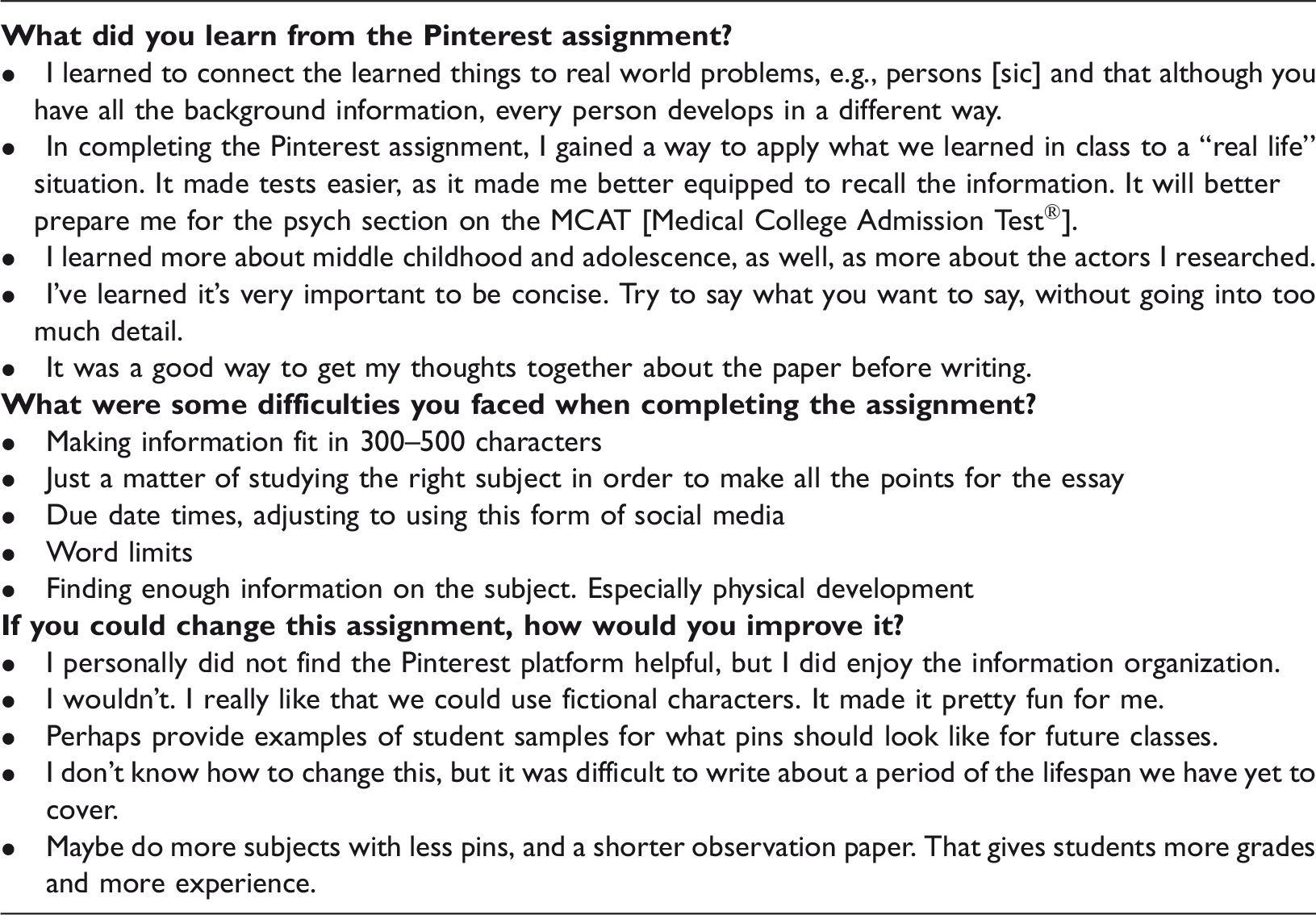
Note. Forty-eight of the 49 participants in this study answered the open-ended questions. Their responses were categorized and are described in the results section of this paper. This table provides representative responses rather than full responses.
Results
Student Grades and Perceptions
First, I calculated means and standard deviations of variables of interest. Specifically, Table 1 displays average cumulative student scores on the Pinterest and Writing assignments, as well as their average final course grade. Also displayed are student-reported levels of enjoyment and learning on the Pinterest assignment. Students’ responses indicate that they enjoyed and learned more from the Pinterest assignment than from other assignments in this and other courses.
Next, I conducted a series of Pearson correlations in order to determine interrelations amongst variables. Associations between these variables of interest are displayed in Table 1. Though the Likert-scale items collected represent ordinal data, I have chosen to analyze the data using parametric tests. This is consistent with previous research in this area (Mazer et al., 2007; Slusser & Erikson, 2006) and has been deemed statistically appropriate (Sullivan & Artino, 2013).
All variables were positively correlated with one another, with the exception of final course grades. While final course grades were, as expected, related to scores on the Pinterest and Writing assignments, they were not associated with students’ perceptions of the Pinterest assignment.
Preference for Platforms
Of the 49 participants, 39 reported that they were satisfied with the Pinterest platform, while 10 indicated that they would have preferred another platform. Students who said that they preferred another platform were asked to describe their platform of choice. Though the question was open-ended, student responses indicated that they were only interested in 4 other platforms: Instagram (4 suggestions); Tumblr (2 suggestions); Twitter (2 suggestions); and Facebook (2 suggestions).
Open Ended Feedback: Learning
Selected student feedback to open-ended questions about the assignment can be found in Table 2. Several patterns emerged in the full student feedback in response to the question, “What did you learn from the Pinterest assignment?”. Fourteen student responses indicated that students learned to apply what they learned in class. Eleven responses indicated that the project reinforced their learning of course material. Five students responded that they learned more about their character/celebrity. Three indicated that the Pinterest assignment prepared them for course writing assignments. Two reported learning more about broad psychological themes such that “there are no cookie cutter answers” in psychology, and that different areas of development relate to one another. Remaining responses indicated that students learned the skills of concise writing (n = 1), psychological observation (n = 2), Pinterest use (n = 1), and creativity (n = 1). Only one indicated that the subject did not learn anything from the project.
Open Ended Feedback: Difficulties
Most commonly, students reported difficulty in finding appropriate images for their pin (n = 12) and expressing their ideas concisely within Pinterest’s character limit (n = 12). Students also reported not knowing enough about their character (n = 11). Difficulties in creativity in applying course material were the next most common concern (n = 9). Still yet, others reported technical difficulties in using Pinterest and the course Canvas webpage (n = 3), in meeting deadlines (n = 3), and in understanding instructions (n = 1). One expressed difficulty with writing about age-ranges that we had not yet covered in class (n = 1). Finally, two explicitly indicated that they had not experienced any difficulties with the assignment.
Open Ended Feedback: Improving the Assignment
Three students explicitly suggested that they would have preferred another platform to Pinterest, and another three requested clearer instructions for the assignment. Remaining responses requested that the number of Pinterest assignments (n = 1) or points associated with these assignments (n = 2) be increased, that word limits be increased (n = 1), due dates pushed back (n = 1), or that the instructor provide additional support to technology-challenged students (n = 1). One final suggestion expressed concerns regarding the potential for students to plagiarize other student work through “repining” (n = 1). Fifteen students indicated that they did not think that the assignment was in need of improvement.
Discussion
The current study examines the effectiveness of an active-learning assignment meant to allow students to apply their knowledge about course material through the social network platform, Pinterest. Importantly, the study found that students both enjoyed the assignment and perceived learning from it, though there are also limitations of the platform and the assignment that must be addressed.
Students reported that they enjoyed and that they learned more from the Pinterest assignment than from other assignments in this and other courses. When asked for feedback on their learning, students reported that the assignment helped to reinforce their understanding of course material and that it helped to prepare them for the writing assignments associated with the project. Furthermore, their reported enjoyment and learning positively related to their performance on the Pinterest project as well as its associated writing assignments. Because grades on the Pinterest project were distributed before students completed their feedback questionnaire at the end of the semester, it is possible that students’ assignment grades factored into their positive ratings. However, student ratings of the Pinterest project also related to their writing assignment grades. These writing assignments were not part of the Pinterest project, and grades on the project likely did little to color student perception of the Pinterest assignment. It is highly likely, then, that the association between student ratings of the Pinterest project and their earned grades on the writing assignments is real. In other words, students who enjoyed and learned from the Pinterest project were able to apply their knowledge in a way that helped them to succeed in their writing assignments.
The association between perceived learning and enjoyment and subsequent course grades did not extend to students’ final course grades. Unfortunately, this is not unique. For example, one study examining the impact of collaborative learning on group quizzes in a sociology class found that students who worked collaboratively received higher quiz scores than those who did not work collaboratively, but that final course averages did not differ between the two groups (Slusser & Erikson, 2006). Similarly, the number of sessions that computer science and communications students were allowed to browse the web was not significantly correlated with final course grade (Grace-Martin & Gay, 2001). It appears that there is too much noise in final course grades to reliably predict improvement in them from one assignment or technique. Specifically, in the Lifespan Development class in the current study, several weather-related lecture cancellations may have impacted how well students were able to grasp material that they later needed for the Pinterest project as well as their course exams.
Final course grades (78%) and student scores on the course writing (84%) and Pinterest (85%) assignments could be considered low. However, these grades are quite strong for a sophomore-level class in this academically-rigorous department, within a university that serves many lower-performing students. The primary investigator has only taught Lifespan Development once, but, one year prior to the course, and at the same university, taught a similar sophomore-level course in Adolescent Development. In that class, students completed an analogous writing assignment but without a similar Pinterest assignment.
Final course averages in that class (71%) as well as grades on the writing assignment (68%) were lower than those in Lifespan Development. It would be rash to conclude, from this difference alone, that the Pinterest assignment was successful, but taken together with other evidence in this report, it seems that the assignment was beneficial in some ways.
It is valuable to have found an assignment that students report enjoying, from which they perceive learning, and which benefits their performance on associated course assignments. In fact, similar assignments may also benefit instructors and students in other courses. For example, instructors of Abnormal Psychology courses may find that their students benefit from using Pinterest to profile famous mentally ill individuals. Instructors of Personality courses may alter the assignment to allow students to profile a celebrity from the framework of classical theories in personality. Learning and Memory instructors could have their students pin on scenarios that could then be labeled for unconditioned and conditioned stimuli and responses. The possibilities are endless.
That said, while students reacted positively, they did express several difficulties in this assignment. It is clear from their open-ended responses that students struggled with aspects of the Pinterest platform, such as expressing themselves concisely within the platform’s character limits. Though the majority reported that they were happy with the Pinterest platform, roughly 20% indicated that they would have been happier with another platform, and, most frequently, they suggested Instagram as an alternative. Future iterations (and alterations) of the assignment should be altered to accommodate this feedback, and future research is necessary to determine if Instagram would be a suitable domain for similar assignments.
In conclusion, students’ responses indicate that they enjoyed and learned from the Pinterest assignment. Student enjoyment and perceived learning positively related to earned scores on the Pinterest assignment and its associated writing assignments. Interestingly, students’ enjoyment and perceived learning did not relate to their final course grade. Open-ended student responses indicated that many students enjoyed the Pinterest platform and found it useful to their understanding of how to apply developmental theory and research, while others struggled with practical concerns of the platform. Results suggest that Pinterest can be a suitable platform for encouraging student learning but that care must be taken to ensure that assignments in this medium are inclusive of a broad range of students. More research is necessary to determine if the assignment can be successful in other classes or on other platforms.
Footnotes
Declaration of Conflicting Interests
The author(s) declared no potential conflicts of interest with respect to the research, authorship, and/or publication of this article.
Funding
The author(s) received no financial support for the research, authorship, and/or publication of this article.