




Abstract
In Arabic literacy education in Europe, whether within mainstream education or in supplementary schools, instruction is a translocal endeavour at its core. The socio-historical conditions and ways of knowing embedded in traditional ways of teaching Arabic literacy are still deeply intertwined with the teaching of Arabic literacy in the diaspora. However, European expectations of education in general and literacy education in particular influence the purposes, content and materials of the Arabic literacy classroom, which leads to a process of transculturation. The current study investigates how Arabic literacy education as part of two Arabic heritage language settings in Norway and Sweden serves as a site for transculturation and how the entirely different ways of organising heritage language education in the two settings influence the transculturation processes of Arabic literacy education. This exploratory investigation is carried out through ethnographically inspired fieldwork in three mainstream schools in Sweden and in one supplementary school in Norway. The findings suggest that the inclusion of Arabic literacy education in mainstream schools in Sweden likely leads to an education closely aligned with official Swedish expectations about literacy education, while the supplementary school in Norway, to a greater extent, maintains traditional approaches to Arabic literacy education.
Keywords
Introduction
Heritage language education has been criticised for promoting segregation in education and thus hindering the integration of students with migrant backgrounds (Salö et al., 2018; Soukah, 2022). As a result, different European countries have taken different approaches to heritage language education (Gogolin, 2022; Walldoff, 2017; Woerfel et al., 2020). In Norway, students speaking languages associated with recent migration are only entitled to transitional mother tongue education aimed at facilitating the swift acquisition of Norwegian and subsequent mainstreaming (Kjelaas and van Ommeren, 2019). Nevertheless, many linguistically minoritised students participate in supplementary schools during afternoons or weekends, initiated by their parents, migrant organisations or religious organisations, to receive instruction in a heritage language (Vedøy and Vassenden, 2020). In Sweden, on the other hand, all students speaking a language other than Swedish at home are entitled to mother tongue education as long as there are at least five students in a municipality who are requesting instruction in a particular language, and the municipality can identify a suitable teacher (Ganuza and Hyltenstam, 2020). At the same time, Berglund and Gent (2019) pointed out that Swedish mainstream education is characterised by secular normativity, in which students who participate in Arabic literacy education as part of Qur’anic supplementary schools experience a general lack of knowledge and understanding of this form of education within Swedish mainstream education (Berglund, 2017). Because of the diverging approaches to heritage language education between the two countries, an analysis of the two settings can provide new knowledge about how different ways of organising heritage language education potentially influence the teaching of a heritage language in the diaspora. Thus, this study explores the following two research questions:
How does Arabic literacy education, as part of two Arabic heritage language settings in Norway and Sweden, serve as a site for transculturation?
How do the different ways of organising heritage language education in the two settings influence the transculturation processes of Arabic literacy education?
Transculturation refers to a process in which ‘members of subordinated or marginal groups select and invent from materials transmitted by a dominant or metropolitan culture’ (Pratt, 1991: 36). The investigation was carried out over 8 weeks of ethnographically inspired fieldwork in a supplementary heritage language school in Norway, where I followed one teacher and her literacy instruction. I also conducted 8 weeks of fieldwork in three mainstream schools in Sweden, where two of the municipality’s Arabic heritage language teachers allowed me to follow their instruction. Although both settings aimed to develop students’ Arabic literacy, the two sites demonstrated how processes of transculturation can manifest under different circumstances.
Arabic literacy as a social practice in space and time
It has long been accepted that literacy entails more than being able to decode letters and sounds; instead, it is intimately associated with the dominant knowledge and communicative conventions of a particular community (Heath, 1980; Street, 1984). This realisation led Street (1984: 10) to conclude that ‘any literate practice is a social practice and thus cannot be described as “neutral” or in isolation’. Barton and Hamilton (2000: 7) defined literacy practices as ‘the general cultural ways of utilizing written language which people draw upon in their lives’. They include values, attitudes, feelings and social relationships. This definition highlights how literacy is embedded in local socio-historical conditions and ways of knowing (de Souza, 2017). Furthermore, other researchers have emphasised how literacy practices are situated in space and time and how this situatedness inevitably shapes them (Leander and Sheehy, 2004; Mills and Comber, 2020). Bloome and Green (2020: 20) explained that ‘literacy cannot be separated from what people are doing, how they are doing it, when, where, under what conditions and with whom they are doing it’. Hence, literacy events are deeply situated and contextual.
De Souza (2017) argued that transnational flows across space and time can dislocate and fracture deep connections between language, literacy, culture and the contexts in which they are engendered. Societal developments can also interrupt the long-held connections between language, literacy and culture. In fact, Street (1984) developed his theories about literacy as a social practice from his fieldwork in a rural village in Iran. When he arrived in the village in 1970, Street (1984) described how the traditional maktab school providing Qur’anic education and what he (p. 132) called ‘maktab literacy’ was already replaced by a state school promoting what he described as ‘commercial literacy’ (Street, 1984: 158). As a result of the economic boom and infrastructural development in Iran through the early 1970s, the previously dominant maktab literacy was given new meaning and use in alignment with the new economy’s requirements. While some previous students at the earlier maktab school only learned to recite the Qur’an without being able to decode letters, commercial literacy required decoding. Nonetheless, students with maktab literacy had multiple skills that facilitated commercial literacy, for example, an understanding of ‘the way meaning is dependent on the layout of a page as well as the content of the words’ (Street, 1984: 133). Thus, traditional literacy practices were adapted and developed for new purposes.
Arabic literacy education does not constitute one monolithic form of education, either in the Arab world or in the Arab diaspora (Sai, 2017; Saiegh-Haddad and Everatt, 2017). Modern Standard Arabic (MSA), known as alfusha in Arabic, is the written standard of Arabic used throughout the Arab world as the formal medium of communication in education, media and religious contexts (Saiegh-Haddad and Everatt, 2017; Versteegh, 2014). This variety of Arabic is a modern descendant of Classical Arabic, as found in Islam’s holy book, the Qur’an (Sai, 2017; Versteegh, 2014). Thus, there is a close connection between MSA and the language of the Qur’an. Advanced competence in Arabic is not only necessary for prospective educational and professional advancement but also considered foundational to learning the Qur’an and to taking part in Islamic practices (Shatara et al., 2020). As such, knowledge of the Arabic language is a prerequisite for fully participating in Muslim prayer and reading of Muslim sacred texts (Haeri, 2003; Sai, 2017). Although a substantial portion of the population in the Arab world belongs to religions other than Islam, the close association between the Arabic language and Islam is indisputable (Sai, 2017; Versteegh, 2014). However, Versteegh (2014: 226) observed that there have been conflicting discourses about Arabic as ‘the true language of Islam’ and consequently the uniting language for Muslims, and Arabic as the language of the Arabs and as a resource in pan-Arab nation building. The same distinction was also reflected in Haeri’s (2003) seminal study of Arabic in Egypt, where she distinguished between Classical Arabic of Islam and contemporary Classical Arabic for secular functions. Haeri (2003) argued that the connection between the Egyptian state and Islam prevented language reform and as a result impeded literacy education in Egypt.
In their analysis of early Arabic literacy education in different national contexts in the Middle East, Saiegh-Haddad and Everatt (2017: 191) found that Arabic literacy education in the occupied Palestinian territories ‘reflect[s] the cultural, linguistic and national values of Palestinians and they include the general aim of fostering in young students (grades one to four) pride in their religion, language, Arabism and homeland’, including an explicit objective of learning verses from the Qur’an and other religious and literary sources by heart. Moreover, Saigh-Haddad and Everatt (2017) reported that the education systems of Kuwait and Saudi Arabia are embedded in monarchical and religious values, leading to an emphasis on traditional content. Similarly, research on Arabic heritage language education in the diaspora has suggested that this instruction is closely associated with Islam (Abourehab and Azaz, 2023; Gonzalez-Dogan, 2022; Moraru, 2019; Sai, 2017; Shatara et al., 2020). As such, the teaching of Arabic literacy becomes equally a religious practice as the teaching of specific literacy skills. Research from the diaspora suggests that while Arabic literacy is taught by proficient speakers of Arabic, they do not necessarily hold the pedagogical qualifications required to teach children (Ramadan, 2004; Sai, 2017). With a generally underqualified teaching force, it might be unsurprising that researchers have observed that Arabic heritage language education often has a universal and ‘timeless quality’ (Scourfield et al., 2013: 106), suggesting that its teaching commonly follows traditional approaches to language and literacy developed over the centuries.
Transculturation and Arabic literacy education
Although movements across borders may contribute to decontextualising certain literacy practices (de Souza, 2017), new practices will naturally emerge through processes of transculturation (Ortiz, 1940; Pratt, 1991). Writing from the Cuban context, where Indigenous, European, African and Asian cultures have clashed and interacted over several centuries, the sociologist Fernando Ortiz proposed transculturación as a concept to capture the result of this cultural interaction. Ortiz (1940) advanced the term as a replacement for the concept of acculturation, which he found imprecise and insufficient to describe the Cuban context. While acculturation describes the transition from one culture to another, transculturation entails a synthesis of cultural encounters – the creation of something new (Ortiz, 1940: 93). Although transculturation entails a loss of the previous cultures, it hails the birth of a new culture that transcends the previous (Ortiz, 1940: 96). Ortiz used tobacco as an example of a product that went through a process of transculturation, from a sacred substance for the Indigenous Cubans to an export commodity for the European market. When Mary Louise Pratt used the term ‘transculturation’, she described this concept as the process in which members of marginalised groups select and invent from materials transmitted by a dominant culture (Pratt, 1991).
Pratt (1991: 36) argued that transculturation is a phenomenon of the ‘contact zone’. As such, transculturation is a concept with many commonalities to Bhabha’s (2004) conceptualisations of hybridity and third space. However, these concepts contrast with Wolfgang Welsch’s conceptualisation of Transkulturalität. Although Welsch (1999) developed the term ‘transculturality’ independently from both Ortiz and Pratt, he nevertheless captured much of the same ideas when he wrote that ‘the concept of transculturality seeks [. . .] to articulate today’s cultural constitution, one characterised by intertwinement’ (Welsch, 1999: 194, italics in original). Nevertheless, as Skrefsrud (2022) pointed out, Welsch highlighted the importance of context, local affiliations and cultural traditions to the individual. Consequently, transculturality captures the dynamic nature of traditions, in which cultures constantly change while simultaneously maintaining connections with their historical origins. Although Welsch (1999) associated this intertwinement with globalisation at the turn of the millennium, Ortiz (1940) documented similar transformations in Cuba more than half a century earlier. Nevertheless, transculturation processes have clearly accelerated with the rise of globalisation.
Students in the Arab diaspora taking part in Arabic heritage language education are situated between the cultural, linguistic, political and religious communities of the Arab world and their current surroundings. Although Arabic holds high prestige in the Arab world (Versteegh, 2014), it is often considered a language with low prestige in Europe. Hence, heritage language education can also be described as a contact zone, which Pratt (1991: 34) defined as ‘social spaces where cultures meet, clash, and grapple with each other, often in contexts of highly asymmetrical relations of power’. In Europe, speakers of Arabic constitute a small minority of the population, and Arabic provides limited opportunities in European societies. This situation contributes to asymmetrical power relations between speakers of Arabic and society at large. In criticising stable and monolithic conceptualisations of ‘speech communities’, Pratt (1991: 37) argued that ‘the idea of the contact zone is intended in part to contrast with ideas of community that underlie much of the thinking about language, communication, and culture that gets done in the academy’. The contact zone is instead a place of encounter and diffusion.
Methods and materials
This work is part of a larger ethnographically inspired study exploring different forms of heritage language education within and beyond mainstream education. Ethnographic research is an approach to research which, in the words of Fitzpatrick and May (2022: 1), investigates ‘people and environments, experience and histories, voices and the unspoken, discourse and materiality’ (italics in original). Although ethnographers study particular settings uniquely situated in space and time, these settings should be interpreted as ‘the crystallisation of various layers of context’ (Blommaert and Jie, 2020: 17); as such, they can provide important information about broader society. Ethnographers approach the field with curiosity and an open mind to what they will encounter (Blommaert and Jie, 2020; Fitzpatrick and May, 2022).
As part of this study, I conducted ethnographically inspired fieldwork in a supplementary Arabic language school in a large city in Norway. In this supplementary school, students from different country backgrounds met every Sunday in a mosque to learn how to read and write in Arabic. I participated in two weekly lessons over the course of 8 weeks. The fieldwork resulted in 4 hours and 20 minutes of video recordings of the instruction, in addition to one individual teacher interview and four individual student (aged 6–9) interviews. I also collected teaching materials and students’ language portraits. Furthermore, I followed two ambulating heritage language teachers of Arabic who worked in three mainstream schools in a large city in Sweden. The fieldwork spanned 8 weeks, generating 10 hours and 20 minutes of video recordings of instruction, as well as two individual teacher interviews and eight individual student (aged 7–15) interviews. The interviews were always conducted in a separate room with only the interviewee and me present. While each of the interviews with the teachers lasted about 45 minutes, the student interviews lasted around 20 minutes. As I am not a proficient speaker of Arabic, the interviews were conducted in Norwegian or Swedish, languages of which all the participants were proficient speakers.
I approached the field with an interest in understanding how different ways of organising Arabic heritage language education could potentially influence the purpose and content of such education. With this broad objective in mind, I initially meticulously recorded everything that happened. Blommaert and Jie (2020) have argued that ‘rich points’, surprising moments which challenges what is readily understandable to the ethnographer, is the start of ethnographic investigation. From this surprise, the ethnographer is compelled to pursue a better understanding of the observed phenomenon. What initially struck me about the Arabic literacy education was the role of Islam and the degree to which participants engaged in religious practices as part of the lessons. As I focused my attention on this aspect, I noticed how this differed across the two settings. During my fieldwork, I relied on my limited knowledge of Arabic and social cues to identify sequences in the recordings containing relevant exchanges between participants. These sequences were submitted for transcription and translation by research assistants proficient in Arabic.
Fieldwork in the Swedish setting
The curriculum for mother tongue education states that students should develop different reading and writing strategies through the subject. In Sweden, Arabic is the language within mother tongue education that has the highest number of participants (Walldoff, 2017: 3). However, Arabic speakers in Sweden do not constitute a monolithic community. They speak different dialects of Arabic and originate from different countries across the Arab world (Walldoff, 2017). This was also the case for the teachers and students involved in the current study.
The two Arabic mother tongue teachers in Sweden, Hamda and Amir, were university educated, both from their respective homelands and from Sweden. They also studied mother tongue pedagogy at a university in Sweden and had extensive experience with heritage language education. Thus, they possessed professional identities as mother tongue teachers within the Swedish education system. They were committed to the curricula for mother tongue education and had clear ideas about how to achieve the objectives found in the curricula. Hamda mostly taught at the lower secondary level, while Amir taught all levels, from pre-school to upper secondary. The teachers moved between different schools, where they would gather students from different grade levels at the different schools for Arabic heritage language education for about 1 hour per week. In some schools, they were given ordinary classrooms; in other schools, they were only given a small study space. As Amir and I walked through the hallways, students would approach him and call him ‘3amu’ 1 (‘uncle’ in English), while other teachers would stop for a chat. About half of Hamda’s and Amir’s students were born in Sweden, with parents or grandparents born in different parts of the Arab world. The other half were born in various countries in the Arab world and arrived in Sweden later in life. Thus, the mother tongue education constituted a contact zone between different Arabic cultures, dialects and customs, in addition to being a contact zone between the Arab world and Swedish society.
Fieldwork in the Norwegian setting
Fatima, the Arabic heritage language teacher in the supplementary school in Norway, is a student in her final year of upper secondary school. She has been a volunteer at the supplementary school for a long time and has recently been given the responsibility for the introductory class, in which the students learn the Arabic alphabet before transferring to a more advanced group. Fatima was born and raised in Syria and came to Norway as a refugee 5 years prior to my fieldwork. She was aware that her qualifications to teach Arabic were minimal, but she observed how the other teachers went about their teaching and often asked them for advice. She also found additional resources online. Besides this support, she told me that she tried to replicate the way she was taught Arabic as a little girl in Syria. Fatima’s qualifications as an Arabic teacher seem to reflect a general tendency among Arabic teachers in the diaspora (Ramadan, 2004; Sai, 2017).
The classroom where Fatima taught Arabic was rather large, with a whiteboard decorated with the Arabic alphabet above. On the walls were Islamic calligraphy conveying verses from the Qur’an and the 99 names of Allah. Four rows of desks allowed about 25 students in the classroom. However, there were never more than 16 students in the room at the same time. Girls and boys were taught in the same classroom, and no form of gender segregation was enforced (for a discussion of co-education in supplementary mosque education in Europe, see Berglund, 2021: 117). Although parents and students initially looked at me with reserved curiosity, after a few weeks, they seemed to have accepted me as a natural part of the supplementary school. Some students were born in Norway, while others arrived in the country later in life. The students and/or their parents originated from all across the Arab world. Similar to the mother tongue teaching in Sweden, the supplementary school was a contact zone not only between the Arab world and Norwegian society but also between numerous Arabic cultures, dialects and customs.
Method of analysis
According to Blommaert and Jie (2020: 10), ‘ethnography attributes [. . .] great importance to the history of what is commonly seen as “data”: the whole process of gathering and moulding knowledge is part of that knowledge, knowledge construction is knowledge, the process is the product’ (italics in original). As in any ethnographic study, the interpretations of my fieldwork began while I was still in the field. In the supplementary school, I soon understood that the main objective of the instruction was to develop students’ literacy skills, as they already spoke Arabic. As I transitioned from the supplementary school in Norway to the mainstream schools in Sweden, the teachers explained that literacy was also their primary concern. Nevertheless, the way they talked about literacy, how they approached literacy teaching and the materials they used were quite different. In line with the inductive nature of ethnography (Blommaert and Jie, 2020), the analysis commenced with a desire to better understand the similarities and differences I observed in the teachers’ approaches to Arabic literacy education and the factors that contributed to these differences.
This analysis was conducted through a careful reading of field notes, transcriptions from classroom interactions and interview transcripts. Moreover, I considered policy documents regulating mother tongue education in Sweden and the website describing Arabic education in the supplementary school in Norway. Despite the significant differences between the two settings, this reading identified patterns in the articulated purposes, the observed content and the collected materials that the teachers used. When these categories had been inductively established, I discovered how transculturation theory provided a productive framework to interpret how the Arabic heritage language teachers selected and invented from materials transmitted by the dominant European culture in their approaches to Arabic literacy education (e.g. Pratt, 1991) and how this selection process differed between the Norwegian supplementary school and the Swedish mainstream schools by analysing the purposes, content and materials in light of the regulating documents (or the lack thereof).
Research ethics
Teachers, students and parents were provided with information about the project in both Norwegian/Swedish and Arabic, as well as with signed consent forms indicating their agreement to be observed and recorded and to participate in the interviews before the fieldwork started. Despite adherence to these formal requirements, there are obvious ethical challenges related to a research project in which a researcher from the linguistic and cultural majority, to which I belong, conducts research in minoritised language communities. Anthony-Stevens (2017) criticised so-called academic voyeurism or academic tourism, in which privileged researchers venture into damaged communities to fix them, thereby both othering and spreading stereotypical images of the social challenges of these communities. Notwithstanding such a criticism, most researchers agree that it is possible for ‘outsiders’ to carry out meaningful and valuable research in minoritised communities as long as they exercise the necessary reflexivity and awareness (Anthony-Stevens, 2017; Glynn, 2013; Leonard and Haynes, 2010). To do so, researchers agree that developing respectful, collaborative, trusting and caring relationships is necessary (Berryman et al., 2013; Glynn, 2013). In my own fieldwork, I shared my preliminary analyses with the teachers, and I was in dialogue with researchers from the Arab diaspora throughout the analyses to strengthen the trustworthiness of my interpretations and to let voices from the relevant communities shape the findings. Without the insights of Arab and Muslim colleagues, the analyses presented in the remainder of this article would have been impossible.
Analysis
Arabic literacy education in Europe takes place in radically different settings and it is therefore relevant to explore how this variation potentially influence Arabic literacy education. Through the analysis, I identified three complementary aspects demonstrating the process of transculturation taking place in this form of education: purpose, content and material. In the following, I demonstrate how these three aspects illustrate transculturation processes in the two settings, as well as how these processes can reflect the organisation of heritage language education, either within or beyond mainstream education.
Purpose of Arabic literacy education
As literacy practices are influenced by the space and time in which they take place, transnational movements or societal changes necessarily influence the meaning of a given literacy practice (Bloome and Green, 2020; de Souza, 2017; Mills and Comber, 2020). Street (1984: 12) described how conventional maktab literacy was suddenly redirected towards new clusters of meaning and usage as a result of the rapid changes in the Iranian economy in the early 1970s. Similarly, the Arabic literacy education I observed underwent a process of transculturation, which redirected the teaching towards new purposes in the diaspora (e.g. Ortiz, 1940). The Arabic literacy education taking place as part of Arabic mother tongue education in mainstream schools in Sweden was strictly regulated by a national curriculum and staffed with mother tongue teachers educated in Swedish teacher education institutions. By contrast, the Arabic literacy education taking place in the supplementary school was not regulated by any formal curriculum. Rather, the teacher capitalised on traditional ways of teaching Arabic literacy, reflecting her own experiences with Arabic literacy education. This discrepancy between the two settings likely led to a situation in which the Arabic literacy education in Sweden was much more oriented towards literacy skills that could be useful in the students’ educational or professional lives, while that in the supplementary school was primarily oriented towards Arabic literacy for religious purposes and the preservation of the Arabic diaspora community.
The secular normativity of Swedish education presumably contributed to a transculturation of the Arabic literacy education (Berglund, 2017; Berglund and Gent, 2019). The process of transculturation became salient through the Arabic teachers’ explicit goal to keep religion and politics out of the classroom. With students coming from families with different political and religious affiliations, the teachers found it wise to avoid any overt discussions about religion and politics in class. Rather, they aimed to bridge the gap between the students’ home countries and their current lives in Sweden (e.g. Berglund, 2009). They cited the curriculum for mother tongue education, which states that students should be given the opportunity to develop their knowledge about the cultures and areas in which the mother tongue is spoken. Thus, the curriculum presupposed that the mother tongues being taught could be associated with particular geographical areas. Consequently, the teachers associated Arabic with the Arab people and Arab-majority countries through their teaching, rather than with Islam (cf. Abourehab and Azaz, 2023; Gonzalez-Dogan, 2022; Moraru, 2019). In line with this view, they promoted a variety of Arabic similar to what Haeri (2003) described as Classical Arabic for secular purposes.
In the interviews with the students, they often referred to Arabic as their language, and they were eager to learn how to read and write in this language for multiple purposes. Some students explained that a good grade in Arabic would later facilitate access to their preferred upper secondary schools. Others mentioned a possible return to their respective homelands for work or university studies as an important incentive to develop advanced literacy skills in Arabic. Another common response was that they needed to communicate with their Arabic-speaking relatives, as one student expressed: ‘[I need to learn Arabic] because my whole family is Arab’. In this way, the students connected the Arabic language not only with Arab people but also with future opportunities in their educational and professional lives in Sweden. However, although the students were primarily concerned with the personal, educational and professional gains from developing their Arabic literacy skills, religion was still a factor, albeit not overtly. One experience from my fieldwork illustrates how the students still associated Arabic with Islam (e.g. Haeri, 2003; Versteegh, 2014): Fieldnotes from 19 September 2022 As the students walk out of the classroom, one of the students asks another why his Arabic is so poor. He replies that he was born in Sweden. A third student adds, ‘and he’s Christian!’ The students disappear out the door.
Despite the teacher’s insistence on keeping his classes free from religion, this brief incident demonstrates that there is still an understanding among some students that the Arabic language and proficiency in it are somehow connected with Islam. This reflects previous research on Arabic heritage language education in the diaspora (e.g. Abourehab and Azaz, 2023; Gonzalez-Dogan, 2022; Moraru, 2019). As a result of processes of transculturation (Ortiz, 1940), the connection between Arabic literacy and Islam was weakened in Swedish mainstream schools, although not completely eradicated.
On the other hand, the Arabic heritage language education that takes place in the supplementary school in a Norwegian mosque had no formalised document detailing the content of the instruction. This probably contributed to a rather different trajectory for the transculturation process. The supplementary school’s website reported (in Norwegian) that the students would learn ‘to read and write Arabic texts and grammar’, enable them to recite and understand sections of the Qur’an and Hadith and, finally, bring about ‘self-development’ and ‘contribute to improve society’. These objectives correspond with how researchers have described Islam as an integral part of Arabic literacy education in the Middle East (Saiegh-Haddad and Everatt, 2017) and in the diaspora (Abourehab and Azaz, 2023; Gonzalez-Dogan, 2022; Moraru, 2019). Within the rather broad objectives described above, the teacher reported enjoying great freedom with regard to filling the lessons with content. From what I observed, Fatima’s lesson had the ‘timeless quality’ described by Scourfield et al. (2013: 106), in which Fatima directed her literacy teaching towards Classical Arabic for religious purposes (e.g. Haeri, 2003).
The double objective to teach both Arabic literacy and Islam was also reflected in the interviews with the teacher and four of her students. One of the students reported learning ‘the letters and the Qur’an’ in the supplementary school, while the teacher explicitly stated that her objective was to teach the students how to read and write. Contrary to Hamda and Amir, Fatima claimed to have no clear ambition to connect the students with a particular culture: Interview recording from 3 April 2022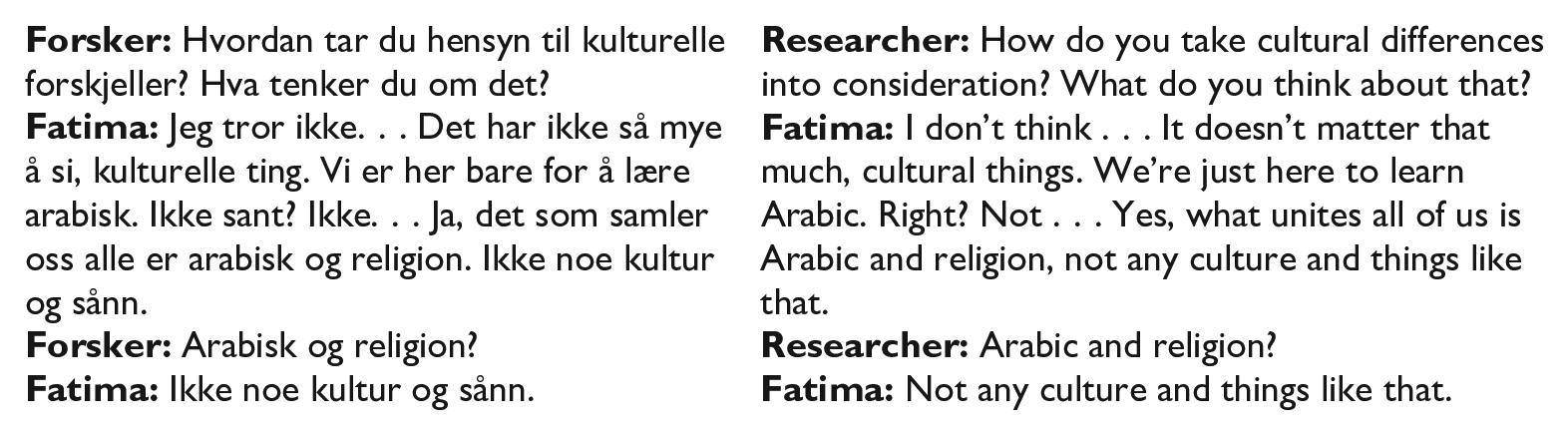
Notwithstanding such comments, in the supplementary school, the importance of teaching the students to read and write in Arabic was again twofold. On the one hand, the teacher reported that she was motivated to preserve her own Arabic competence and contribute to preserving the students’ mother tongue to strengthen their Arab identities and give them access to ‘the great and beautiful’ Arabic literature. The teacher claimed that although a student is born in Norway, ‘they carry the culture within them’, and they are still from an Arab country. On the other hand, she explained that lessons should enable the students to understand their religion better. She argued that it would be impossible for them to explore their own religion without Arabic competence. In my interview with her, she used the Afghan Taliban as an example of a group that does not understand their religion correctly because of their limited knowledge of Arabic. Thus, Fatima considered Arabic both ‘the true language of Islam’ (Versteegh, 2014: 226) and the language of the Arab people. Contrary to the mother tongue teachers in Sweden, Fatima did not emphasise Arabic literacy skills as useful beyond the Arab community, for example, for educational or professional purposes in Norway. As such, the process of transculturation seemed to have detached the Arabic literacy education from academic and professional opportunities in the students’ life.
Content in Arabic heritage literacy education
Street (1984: 1) argued that ‘what practices are taught and how they are imparted depends upon the nature of the social formation’ and that the skills and concepts that accompany literacy acquisition ‘do not stem in some automatic way from the inherent qualities of literacy’. Rather, Street (1984) argued that the content of literacy education is an expression of a particular ideological conceptualisation of literacy. The content of Arabic heritage language education in the two settings reflects in different ways how this form of language education had undergone different processes of transculturation following its relocation into European societies (e.g. Ortiz, 1940). While the content of the Arabic mother tongue education in Sweden was strictly regulated by a government-developed curriculum, the teacher in the supplementary Arabic education in Norway had full liberty to develop its content as she wanted.
The Arabic mother tongue education in Sweden was dedicated to developing students’ literacy skills, including their knowledge of MSA vocabulary and grammar. Amir pointed out that, to many students, learning Arabic is like learning a foreign language. The students limited familiarity with MSA was one factor that advanced the transculturation of the literacy teaching. At home, the students spoke different dialects, but in school, they were supposed to learn MSA. Hence, much time had to be allocated to teaching students basic vocabulary, as the following lines illustrate: Recording from 24 October 2022
2
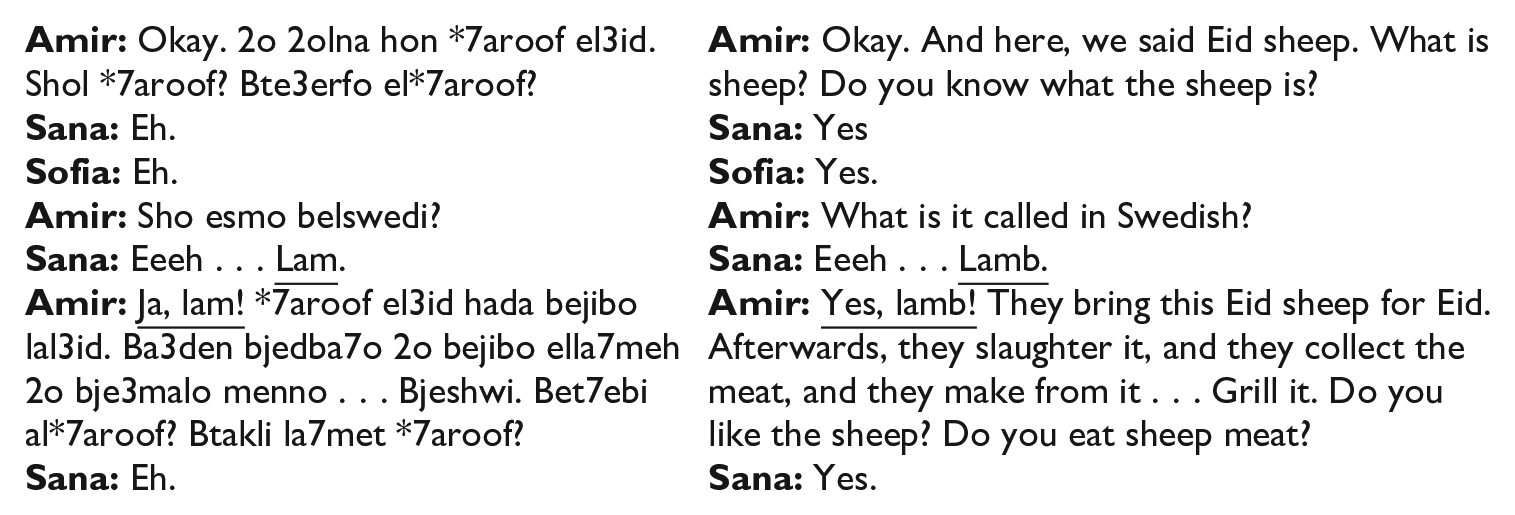
In this example, Amir discussed a brief text from the students’ textbooks with them. The text describes an ‘Eid sheep’. It is common to slaughter sheep for the celebration of the Muslim holiday Eid al-Fitr. The teacher did not explain this tradition to the students but assumed that they knew it. However, he asked the students whether they understood the Arabic word for ‘sheep’ (‘*7aroof’). Because of the students’ diverse origins in different parts of the Arab world, the mother tongue classes also functioned as a contact zone (e.g. Pratt, 1991), in which different dialects of Arabic and various Arab cultures interact. While teachers in the Arab world usually combine features of MSA and the local dialect in classroom interactions, resulting in a form of Arabic sometimes referred to as the language of the intellectuals (Saiegh-Haddad and Everatt, 2017; Versteegh, 2014), Amir adapted his speech to his students’ dialects. Contrary to how Arab teachers usually speak in the classroom, when Amir taught students of Iraqi heritage, he accommodated his speech to their dialects in the interactions. Hence, demonstrating another consequence of the transculturation of Arabic literacy education (Ortiz, 1940).
The students participating in the supplementary school all reportedly spoke Arabic at home, but they had yet to learn how to read and write in Arabic. The weekly lessons in Arabic were therefore centred on teaching the students the letters of the Arabic alphabet so that they could eventually learn how to read and write. Each Sunday, the students would have two lessons, one before and one after the midday prayer (‘Zuhr’). Each Sunday would typically start with an hour working on a particular Arabic letter. After the midday prayer, the teacher would integrate Muslim practices, such as introducing text excerpts from the Qur’an for the students to practice reading. When I asked the teacher what guided her lesson planning, she simply said that she taught Arabic the way she was taught the language as a child in Syria (e.g. Scourfield et al., 2013). However, in contrast to Syria, the limited demand for Arabic literacy skills in Norwegian society prevented her from encouraging the students to learn Arabic for academic or professional purposes. Rather, the Arabic literacy education underwent a process of transculturation where Arabic was directed towards religious or community-specific purposes (e.g. Ortiz, 1940).
Even when the content of the instruction was not explicitly religious, religion was never removed from classroom activities. An incident from a lesson on 20 March 2022 illustrates how religion was constantly interwoven into literacy teaching. After an initial greeting and recitation, the students were asked to write their names on the whiteboard in Norwegian (meaning with Latin letters) and then in Arabic. One by one, the students came up to the whiteboard and wrote their names in Norwegian and then in Arabic. As the students did so, the teacher commented on their performance. One student approached the whiteboard with great confidence and wrote his name directly in Arabic. However, the teacher corrected him: Recording from 20 March 2022
Although the way the student spelled his name was perfectly acceptable and likely how his parents taught him to write it, the teacher corrected him and instructed him to spell his name in accordance with how the name is spelled in the Qur’an. This example illustrates that although the teaching aimed to develop students’ literacy skills in Arabic, these skills also had religious content. Moreover, it indicates how the transculturation had come a long way in separating Arabic literacy from secular purposes (e.g. Ortiz, 1940; Pratt, 1991; Welsch, 1999).
Materials in Arabic literacy education
Street (1984: 173) described how previous textual encounters with the Qur’an prepared the inhabitants of an Iranian village to develop specific literary skills involved in commerce as a result of the economic transformation of Iran in the 1970s. Sacred texts were replaced with notebooks and official forms. Recent literacy studies have also drawn attention to the artefacts involved in literacy education (Mills and Comber, 2020). The different teaching materials that were used in the Arabic literacy education I observed also illustrated how Arabic literacy education can serve as a contact zone, as the teachers brought with them to class textbooks and exercise sheets produced in the Middle East. How these materials were used clearly demonstrated how the transculturation played out differently within the two settings of Arabic literacy education (e.g. Ortiz, 1940).
Because of the scant access to textbooks for Arabic learners in Sweden (Berglund, 2009), the mother tongue teachers mostly used textbooks produced in the Middle East. However, the teachers were mindful of the need to keep Arabic education religiously and politically neutral (e.g. Berglund, 2017; Berglund and Gent, 2019). This was a particular concern because the teachers relied heavily on teaching materials produced in the Middle East (e.g. Berglund, 2009). Amir showed me examples of texts he removed from the textbook, one apparently describing the excellence of the Jordanian royal family and another supposedly devotional religious text about the Muslim holiday Eid al-Fitr. This editing constituted a practical example of how transculturation can play out in a particular classroom. Despite the editing, the textbooks offered the students an opportunity to become acquainted with daily life in the Arab world and with stories and legends familiar to children across the Arab world. One such example is a lesson in which the students worked on a brief text about the legendary figure Joha (also known as Nasreddin Hodja): Recording from 24 October 2022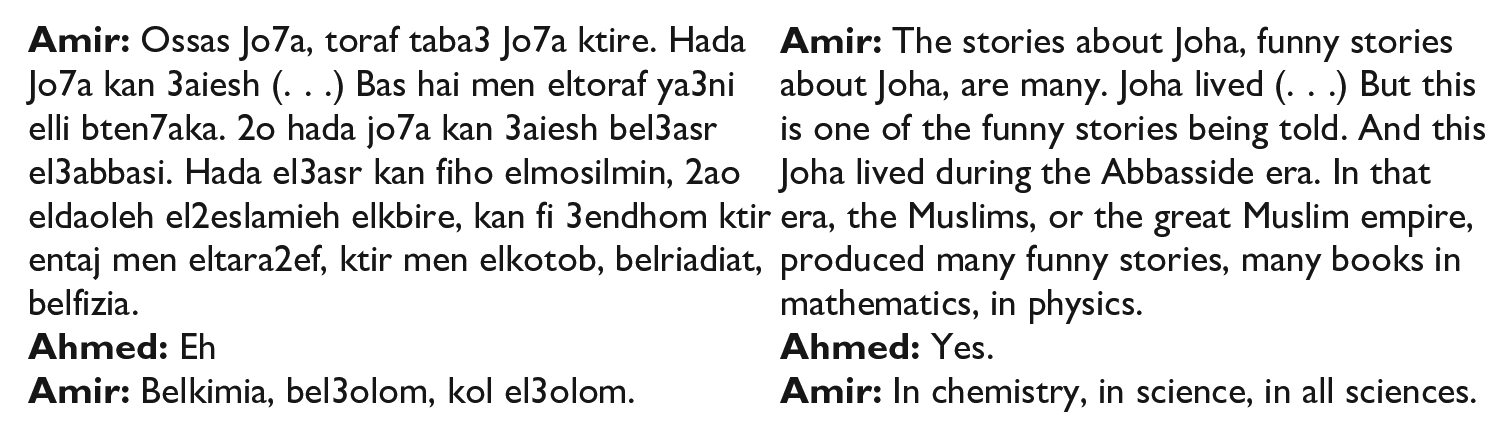
After reading through the text together with the students, the teacher gave a brief lecture on the historical context of the legend of Joha. This information was presumably meant to connect the students with the Arab world. As such, the students become acquainted with Arab history. Stories about the splendour of the Abbasside Caliphate are well known across the Arab world, as a historical empire, which covered most of the current Arab world. Hence, students from Iraq, Palestine and Tunisia could potentially relate to the story. In addition to the teacher’s emphasis on students’ sense of belonging to their respective countries of origin, the teacher was equally concerned with their sense of belonging to Sweden. The teacher explained that he would select texts from the textbooks that dealt with topics that were easily relatable and familiar to the students in Sweden (e.g. Berglund, 2009). In my interview with him, he mentioned texts about autumn or oak trees as examples of texts that are easily accessible to students living in Sweden. I also observed lessons in which the students worked with a text about pollution, which included content familiar to the students from their science and social studies classes. Hence, Amir purposefully weaved Arabic texts and the students’ life in Sweden together in a way resembling Welsch’s (1999) description of transculturation as intertwinement.
In the supplementary school in Norway, the teacher used an exercise book apparently published for early literacy education in the Middle East, in combination with a booklet containing copies from various sections of the Qur’an, such as Surah Al-Falaq. Traditional prayers, Hadiths and sections from the Qur’an were key teaching materials in the supplementary school. These materials reflected Fatima’s orientation towards Classical Arabic of Islam (e.g. Haeri, 2003). Below is a brief excerpt from Fatima’s opening of a lesson: Recording from 20 March 2022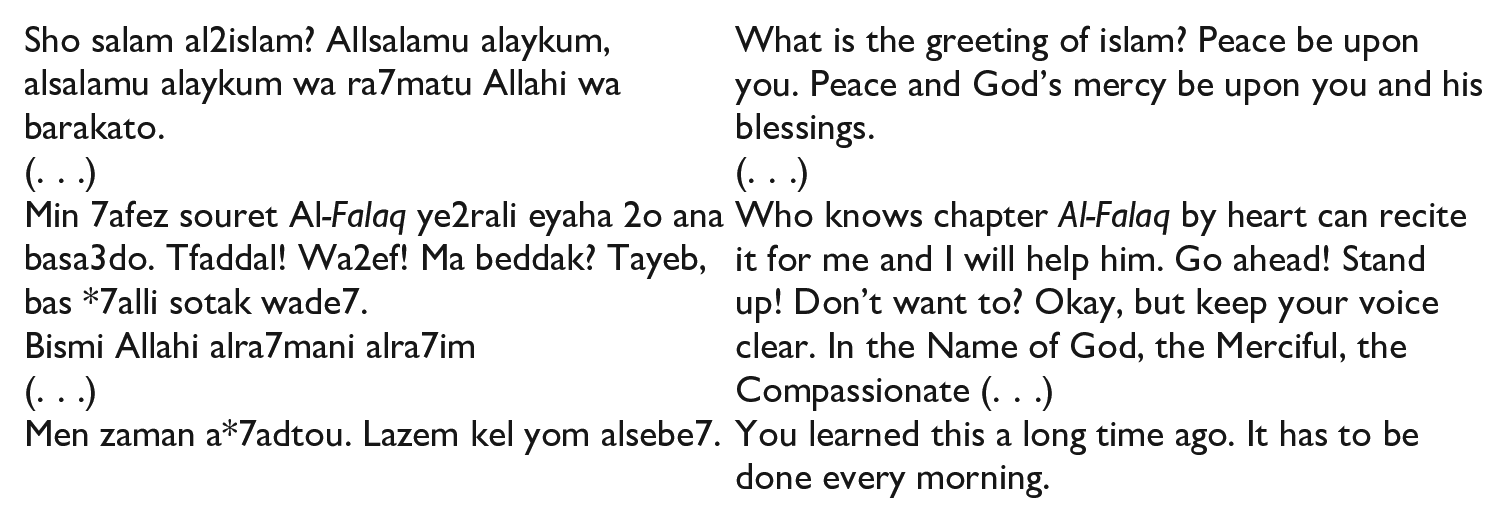
In this excerpt, the teacher opened the lesson using a religious greeting commonly used throughout the Arab world. She went on to check whether the students remembered their homework on Surah Al-Falaq. Religious texts as part of literacy education functioned as tools to socialise the students into the norms and values of the religious community and served as teaching materials.
Despite the prevalence of traditional devotional practices in literacy education, such as the recitation of the Qur’an, known as tajweed, this practice acquired new meaning as the result of the transculturation of Arabic literacy education in the supplementary school (e.g. Ortiz, 1940). While tajweed is considered central in Qur’anic education because it is thought that God’s own speech is preserved through the memorisation and recitation of the Qur’an (Nelson, 2001), Fatima implemented tajweed as a pedagogical practice. The students were given copies of particular sections of the Qur’an that they already knew by heart. She would instruct the students to try to follow the text as they recited it in chorus. Fatima explained that she hoped this practice would help the students connect phonemes and graphemes. Thus, devotional recitation acquired an additional pedagogical function, demonstrating the process of transculturation taking place in this setting as well.
Discussion
For historical reasons, Arabic literacy education is closely associated with Islam and Islamic religious education (Shatara et al., 2020; Versteegh, 2014), both within different education systems in the Middle East (Haeri, 2003; Saiegh-Haddad and Everatt, 2017) and in supplementary Arabic literacy education in the Arab diaspora (Abourehab and Azaz, 2023; Gonzalez-Dogan, 2022; Moraru, 2019). To isolate Arabic literacy education from the Qur’an and Islam would seem artificial to many Arabs. Reflecting a general secular ethos within Swedish education (Berglund, 2017; Berglund and Gent, 2019), this is nevertheless exactly what the Arabic teachers in Sweden attempted to do. As such, this separation is a clear example of how members of subordinated groups need to adapt to the guidelines transmitted by the dominant culture (Pratt, 1991). Within the space of Swedish mainstream education, teachers could teach Arabic literacy, but it had to be accommodated to particular circumstances. This process is what Ortiz (1940) described as transculturation.
In the Swedish school system, there are ambitious expectations for students to develop advanced literacy skills through mother tongue education. The alignment with the Swedish curriculum aimed at developing literacy skills corresponding with what one would otherwise expect from a language subject in Swedish schools. Amir frequently reminded the students of the opportunities associated with high proficiency in Arabic. He told them that they could use their Arabic language skills to become translators, teachers or businesspersons. This fulfilment of expectations of language teaching likely contributes to increasing the status of Arabic in the Swedish education system. Nevertheless, the lessons were infused with familiar stories from the Arab world, such as the story of Joha and memories of the great Caliphates of the Middle Ages; Islam was never far away (e.g. Abourehab and Azaz, 2023; Gonzalez-Dogan, 2022; Moraru, 2019), for example, when the text discussed the slaughter of an Eid sheep or when the students commented on their Christian peer’s poor Arabic. These negotiations between the teaching of Arabic within the framework of the Swedish education system thus constitute examples of transculturation (e.g. Ortiz, 1940; Pratt, 1991).
In the supplementary school in Norway, Fatima had the freedom to develop the content and use the materials she preferred without regard for any involvement from the government. As the education took place in a mosque, it was only natural that this teaching was geared towards preparing students to study the Qur’an (e.g. Abourehab and Azaz, 2023; Gonzalez-Dogan, 2022; Moraru, 2019). However, she directed her instruction away from Classical Arabic for secular purposes and emphasises Classical Arabic of Islam (e.g. Haeri, 2003). Consequently, the transculturation process seemed to have awarded Arabic limited meaning and value outside religious or community-specific settings. Because of her limited qualifications as an Arabic literacy teacher, she naturally depended on conventional methods of teaching with which she was acquainted. This contributed to preserving the ‘timeless quality’ of Arabic literacy education (e.g. Scourfield et al., 2013: 106) and to replicating an approach to Arabic literacy education in which Islam and Qur’anic texts were given a predominant role that Fatima was familiar with from her own education in Syria. As Street (1984) described, religious literacy developed within a Qur’anic setting can also be given new meaning and use in new circumstances. Hence, Arabic literacy developed for the purpose of reading the Qur’an can also be redirected for other purposes later in life. However, contrary to the practice of the Arabic teachers in Sweden, this was not emphasised in Fatima’s lessons.
Nevertheless, the fact that boys and girls were taught in the same classroom, seated along school desks in a room resembling a classroom in a Norwegian mainstream school (e.g. Berglund, 2021), and were learning to decode texts from the Qur’an – all these taking place in a mosque – demonstrate how the supplementary school in Norway also constituted a site for transculturation. In this Arabic literacy classroom, traditional ways of teaching children in mosques, conventional ways of teaching Arabic literacy in Arab-majority countries and dominant expectations of schooling in a European society were intertwined in the process of transculturation.
Concluding remarks
In this study, I investigated how Arabic literacy education as part of two Arabic heritage language settings in Norway and Sweden served as sites for transculturation. I also examined how the entirely different ways of organising heritage language education in the two settings influenced the transculturation processes of Arabic literacy education.
Neither of the settings under investigation in the current study operated in isolation from its surroundings. When heritage language education is integrated into mainstream education, as is the case in Sweden, my findings suggest that such education go through a process of transculturation, in which certain aspects of the conventional ways of teaching the particular language are lost. However, as Ortiz (1940: 96) pointed out, transculturation also hails the birth of something new. For example, the Arabic literacy education I observed provided the students with language skills that were perceived as useful in Swedish society and as preparatory for the students’ future educational and professional opportunities. When certain heritage languages are excluded from mainstream education, other actors fill the demand for heritage language education (Abourehab and Azaz, 2023; Gonzales-Dogan, 2022; Moraru, 2019; Vedøy and Vassenden, 2020). In such supplementary school settings, the community has greater liberty and can define the purpose and content more independently. Nevertheless, as indicated by this study, such settings will likely also be influenced by processes of transculturation, albeit in different ways. Although the transnational movement of people across space and time has brought Arabic literacy education to Europe, this education will not necessarily become dislocated or fractured. Rather, these forms of literacy education can constantly develop and acquire new meanings through processes of transculturation (e.g. de Souza, 2017). Although more knowledge about transculturation processes within heritage language education is needed, these findings can contribute to the ongoing conversation about the place and role of heritage languages education within mainstream education in Europe.
Footnotes
Declaration of conflicting interests
The author declared no potential conflicts of interest with respect to the research, authorship, and/or publication of this article.
Funding
The author received no financial support for the research, authorship, and/or publication of this article.
