




Abstract
This paper presents a systematic framework of the most needed Vocational Education and Training (VET) reforms in The Azores, a Portuguese outermost region. Our report is based on a participatory research approach involving the perspectives of five different groups of stakeholders. Our data was collected in 18 virtual world-café sessions (n = 164 participants—58 trainees; 21 trainers; 42 institutional representatives; 21 unemployed people registered at local public employment agencies; and 22 businesspersons; M age = 45.20; 60.37 women). Based on content analysis, we identified three main priorities to restructure vocational training policies: (a) VET perception and valorization, comprising strategies to disseminate a more positive social representation of VET in the region; (b) horizontal coordination between stakeholders, including effective ways of coordinating and sharing information; and (c) vertical coordination in terms of VET improvements of curricula, funding models, and investments in the sector’s human capital. Our correspondence analysis did not show significant differences regarding the prevalence of the three priorities across the five groups of stakeholders. We interpret and contextualize our results according to relevant publicly available data about the region, and an integrated governance lens to inform policy design in outermost territories.
Keywords
Introduction
Our aim is to present a systematic analysis of the most needed reforms in the Vocational and Educational Training (VET) sector—including both initial and lifelong-learning VET—in The Azores, a Portuguese outermost region, following a participatory research approach involving different stakeholders’ perspectives. Our goal is justified by three reasons that lay down the context and relevance of our research.
Firstly, VET deliverance in outermost regions is challenged by these territories’ limited resources. Outermost regions are small islands within the European Union, which are distant and isolated from the European continent and sometimes closer to non-European countries. These are usually considered low-density territories, typically with small, sparse, and aging populations, which are economically excluded from significant national and international commercial flows (European Parliament, 2015; Ferrão, 2019). These regions depend, therefore, on limited local markets and often rely on a reduced number of goods or the primary sector activities (e.g. agriculture) (European Parliament, 2015).
Secondly, the development of VET public policies in outermost regions is driven by high expectations of its short- and long-term impact. Overall, VET refers to educational pathways that go beyond schooling and certification requirements, by preparing students to perform a certain profession or group of professions (Fiolhais, 2013; United Nations, 2011). In outermost regions, VET is understood as one of the main tools to overcome the shortage of a qualified labor force. However, political proclamations at the regional level often frame VET as a fit-all solution for other societal problems such as school failure, youth out-migration, lack of economic competitiveness and social exclusion. Driven by this narrative, VET may fail to tackle both qualification goals, as well as any of the previously pinpointed societal challenges efficiently (Governo Regional dos Açores, 2022).
Thirdly, the success of VET in outermost regions is strongly dependent on a complex coordination of policies in two ways. To begin with, VET is heavily supported in these territories by EU funds (Direcao Regional do Planeamento e Fundos Estruturais, 2014), calling for strong vertical coordination between regional, national, and European priorities (European Commission, 2020a). Such coordination is seldom found in areas of decision-making related to vocational training, such as school-to-work transition or youth employment (Shore and Tosun, 2019). Additionally, vocational training implementation requires strong horizontal coordination across different domains of regional policy-making, as education, employment and economy, for example. This requirement, increasingly embedded in pivotal European recommendations (e.g. European Council, 2021), is often challenged by a dominant, bureaucratic culture of policy-making silos, with only a few interconnections between sectoral policies, and a severe loss of efficiency (Christensen, 2015; Marques, 2015).
In the following subsections, we outline each of these specific challenges faced by the VET sector in an outermost region. Firstly, we explore the main demographic, social, and economic features and limitations of The Azores. We then describe the national and regional VET field to contextualize the existing expectations about the sector. Finally, we describe the integrated governance paradigm and the vertical and horizontal axis coordination of policies to better interpret our results.
The context: The Azores
The Azores is a Portuguese archipelago of nine islands in the Atlantic Ocean with a population of 236,657 inhabitants. The region faces several challenges fitting Bæck’s (2016) definition of a shrinking region, meaning a low-density region with increasingly reduced social and economic capital. From the demographic point of view, between 2011 and 2021, The Azores lost 10,115 inhabitants, a decrease of 4.1 percentual points, which is above the Portuguese depopulation trends (Instituto Nacional de Estatstica [INE], 2021). Moreover, the population is rapidly aging, due to a decrease in the population’s natural growth rate (−0.14%, in 2021) and low immigration influxes (Governo Regional dos Açores, 2022).
From the social standpoint, despite having shown signs of improvement for the past decade, The Azores presents higher poverty levels compared to the rest of the country, as measured by the Social Inclusion Income (SII), a monthly allowance paid by Social Security to help individuals or families cope with their most immediate needs. While 9.00% of the population aged 15 or more received this allowance in The Azores, in 2020, only 2.90% received it in Portugal. Moreover, social inequalities as measured by the Gini coefficient were greater in the region compared to the rest of the country (34.50% in The Azores, 31.20%, in Portugal). Regarding income, the GDP per capita in the region was 88.00% of the GDP per capita in the country (Governo Regional dos Açores, 2022).
Cultural and educational resources are also scarcer in The Azores compared to the Portuguese and the EU contexts. Figure 1 shows that the share of people aged 25–34 years who had completed tertiary education in the region in 2021 (24.20%) was below the national (47.50%) and the EU27 (41.20%) rates, although it has increased for the past 10 years (Eurostat, 2022a). Importantly, the level of school drop-out, as measured by the early leaving from education and training indicator, is still very high in the region. According to Figure 2, the share of early leavers from education and training decreased for both the EU and Portugal (Eurostat, 2022b). In the Azores, this indicator remained stable at around 27.00% from 2016 to 2020 (Simões et al., 2021), dropping to 23.20%, in 2021, way above the average rates for the EU and the country levels.
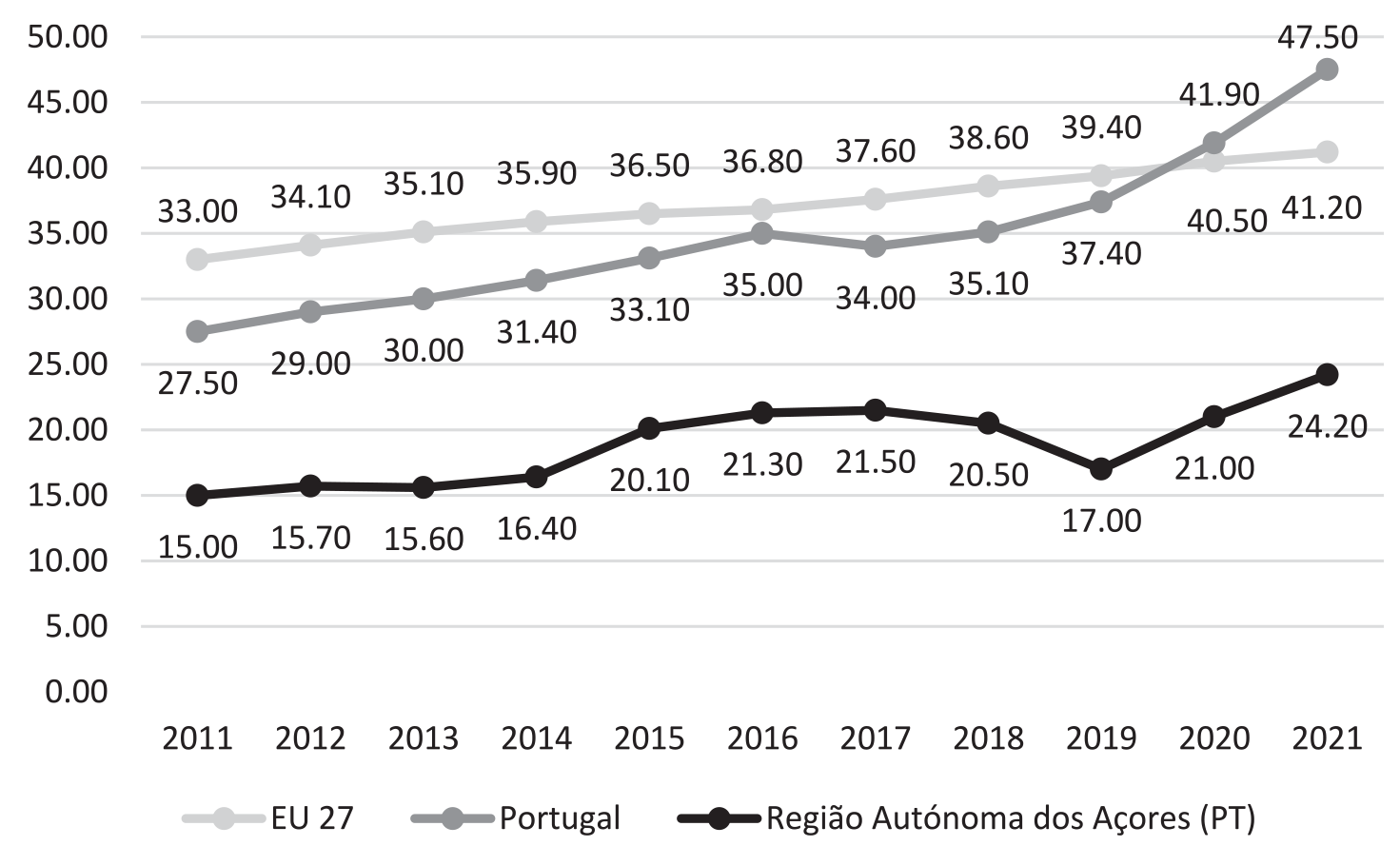
Share of population aged 25–34 years, by tertiary educational level (%).
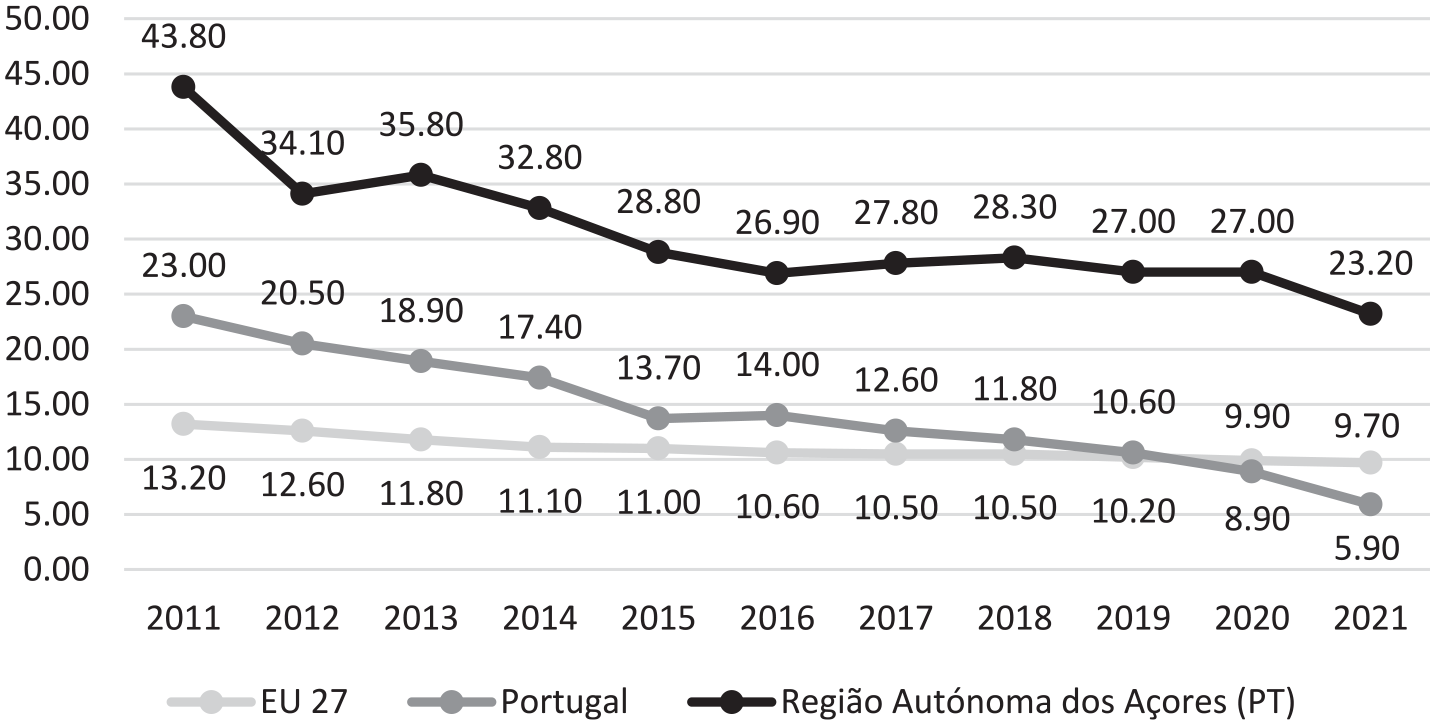
Share of early leavers from education and training, 2011–2021, in population aged 18–24 (%).
Finally, in 2020, and even after the pandemic, only 5.50% of the active labor force was unemployed, below the 7.10% rate for the whole country (Governo Regional dos Açores, 2022). However, there are specific negative trends, which are structural and relevant for the training sector, such as the high share of young people aged 15–34 Not in Employment, nor in Education or Training (NEET), which is depicted in Figure 3. It is important to note that Azorean NEET rates have remained higher than the average rates of Portugal and the EU 27, for the past decade (Eurostat, 2022c). In 2019 NEET rates in The Azores dropped to 16.90%, the lowest rate for this region in the last decade. However, in 2020, after the COVID-19 breakthrough, the percentage of NEETs rose to 17.70%, increasing again in 2021 to 18.10%. In turn, in Portugal and the EU27, the NEETs share increased between 2019 and 2020 (to 10.30% and 13.70%, respectively). However, these figures decrease for both the national and the EU levels in 2021 (9.50% and 13.10%, respectively).
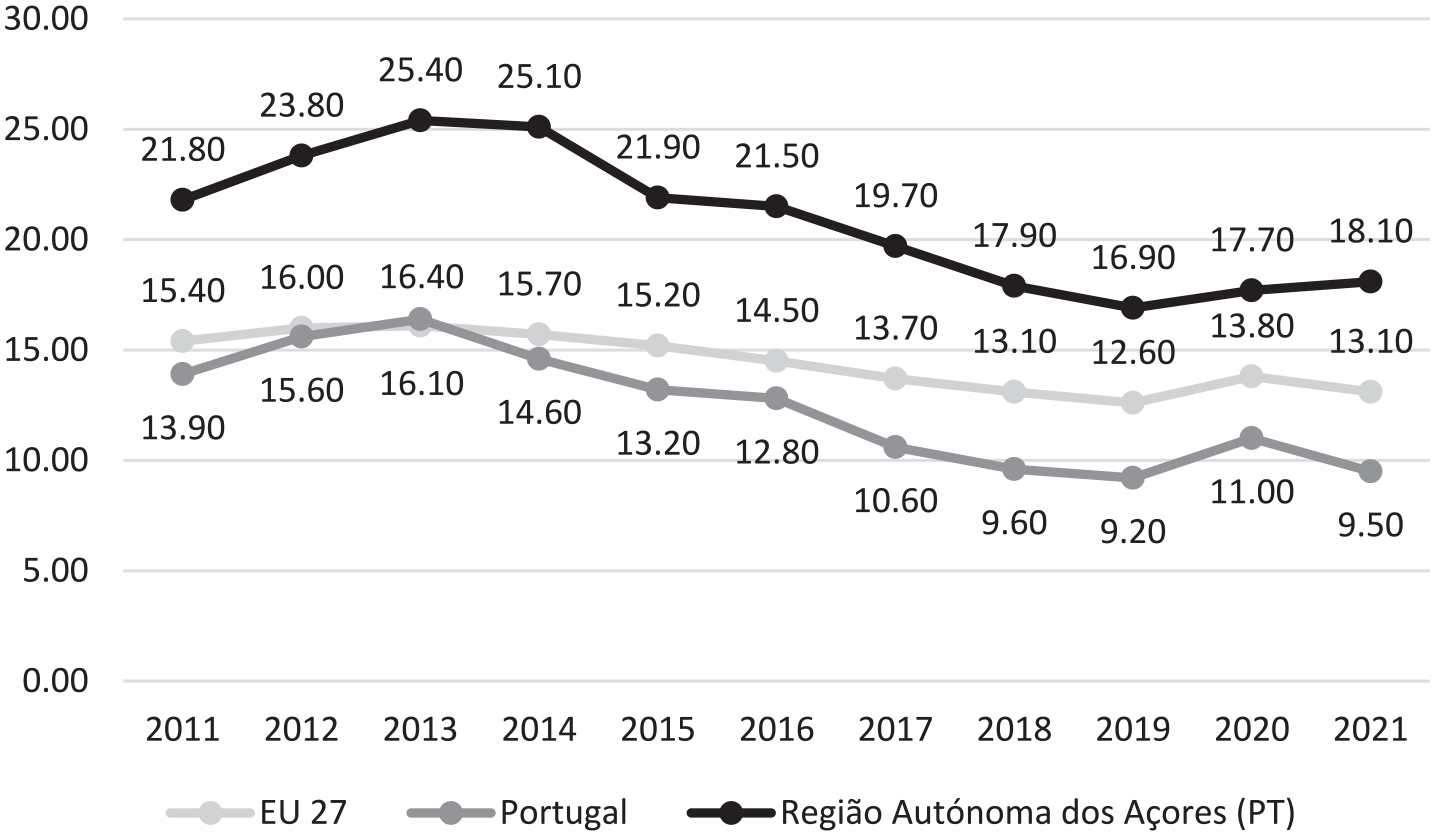
Share of young people (15–29 years) neither in employment nor in education and training (NEET) (%).
Vocational education and training: Delimitation, priorities, and expected outcomes
VET is an educational modality aimed at developing knowledge and skills for the labor market (Gekara and Snell, 2018). In the EU, the VET system is organized into three main typologies: vocational and technical secondary schools, the dual apprenticeship or dual VET system, and formal apprenticeships (Cedefop, 2016; Eichhorst et al., 2015). Vocational and technical schools provide a formal curriculum blending general and occupation-related knowledge, an alternative to academically oriented schooling tracks. The dual apprenticeship/dual VET system encompasses learning in both the workplace and an educational or training institution, being included in formal education and training, which provides scholars a qualification and an official certificate (Cedefop, 2016). In sum, it combines apprenticeships in the workplace with a school-based curriculum provided at VET schools, based on a certification system of learning involving social partners and companies, providing individuals with both school and professional certification (Eichhorst et al., 2015). Finally, formal apprenticeships are conceived as a subgroup of the dual apprenticeship/dual VET system, involving workplace training complemented by institutional instruction. However, formal apprenticeships also concede apprentices the status of employees, being paid for their work, and are drawn up by a contract or legal agreement between employer and apprentice (Cedefop, 2016).
In the short term, VET is seen as a pathway to increase educational attainment, promote higher qualifications, and foster work skills. This view is embedded in the most recent strategic policies for the educational sector, such as the European Skills Agenda, which promotes VET as one of its three core axes (European Commission, 2020b). This priority given to VET by the EU authorities encompasses an increase of trainers’ and trainees’ mobility, greater cooperation between local/regional VET stakeholders, and the development of both technical and soft skills. Giving leeway to VET development in outermost regions is vital. Large shares of young generations in these remote areas intend to out-migrate and those staying are less academically-minded, meaning that VET may be more appealing than traditional educational strands (Almeida and Simões, 2020; Bæck, 2016; Farrugia, 2016).
VET is also seen as an instrument that can contribute to increasing economic competitiveness (Conselho Económico e Social, 2021; European Council, 2021). This vision relies on the key idea that a more qualified workforce can improve private companies and public sector efficiency and innovation in providing products and services, resulting in added-economic value in globalized, competitive markets (European Commission, 2020b). This vision resonates in vulnerable territories such as outermost regions for two reasons. Firstly, these regions struggle with low levels or low quality of social capital. In a nutshell, social capital involves personal and informal networks support, institutional support, and perceptions of community safety and cohesion (Culliney, 2014). Overall, young people in more vulnerable territories disproportionately rely on their informal networks, due to limited access to or high levels of mistrust regarding institutional support (Bello and Cuzzocrea, 2018; Simões, 2018). This trend ultimately perpetuates cycles of social reproduction as younger generations replicate their own family and friends’ educational and professional pathways marked by low qualifications and low-quality jobs (Culliney, 2014). Secondly, those remaining there, especially young people, require increased skills and knowledge to tackle immediate labor force needs (Farrugia, 2016), including in traditional sectors, such as agriculture (Almeida and Simões, 2020). VET has also been highlighted as a means to tackle poverty and social exclusion. Upward social mobility based on education and qualification is one of the strongest axes of the social contract in Europe, something that is entirely acknowledged by the European Social Pillar priorities (European Commission, 2018). VET is thus seen as part of the educational and training tools ensuring successful transition to and participation in the labor market, contributing therefore to social inclusion (European Commission, 2018). This is particularly relevant in regions such as The Azores, still facing high levels of poverty and social exclusion (Governo Regional dos Açores, 2022), which mostly affects adolescents and young adults (Simões, 2018).
The structure of vocational training in Portugal and in The Azores
During the Portuguese dictatorship regime (1933–1974), specifically in the 1950s, when primary education was the only offer for the majority of the population, the national educational offer was divided in secondary schools and industrial or commercial schools, which had different targets, according to students’ socio-cultural backgrounds. The first was intended to the middle/upper classes, and the second to the underprivileged classes, being prominently practical (Martins and Martins, 2016). Until the April Revolution of 1974, this education modality was reinforced and subject to several restructurings, developing public policies based on the need to ensure economic development, framed in a logic of access to post-primary education, specifically, to a path of secondary education differentiated from the high school education, and without the possibility of continuing studies in higher education (Grácio, 1998; Martins and Martins, 2016). The most enrolled in vocational education were the most disadvantaged classes, fostering a marked stigmatization of this education pathway (Martins and Martins, 2016).
After the April Revolution of 1974, technical education was extinguished and secondary education unified, leading to a clear distinction between secondary and vocational education, in which the former is valued and the latter marginalized, generating social divisions, and inequality of opportunities (Martins and Martins, 2016). In the public sphere, VET became the last resort for those who did not have the opportunity to access a higher educational level than primary education. Additionally, VET was socially perceived as an educational modality almost exclusively dedicated to practical work skills, putting aside cultural and theoretical knowledge (Martins and Martins, 2016). In 1983, vocational education was reintroduced in upper secondary education, in the form of Technical-Professional courses (Diogo, 2016; Martins and Martins, 2016; Normative Order n.º 194-A/83, 1983). Later, in 1984, the Apprenticeship modality become another vocational training possibility, even though it was not formally part of the educational system (Decree-Law n.º 102/84, 1984). It was designed for those young people who left the official educational system, with or without compulsory education (Decree-Law n.º 102/84, 1984). In 1986, VET, including its different modalities, was legally defined as a teaching modality of the national educational system, with the enactment of Law n.º 46/86 - Basic Law of the Education System (Diogo, 2016; Law n.º 46/86, 1986).
Later, in 1989, the first Professional Schools (vocational private schools) were founded (Barbosa et al., 2019). Then, in the 1990s, new layers were added to VET, namely those associated with adult professional qualifications. In 2000, the Education and Training of Adults courses were implemented together with the Recognition, Validation and Certification of Competences (RVCC) (Barros, 2013). It becomes clear that the VET sector is not homogeneous, offering various training and education modalities for different target groups. Today, in Portugal, it includes several types of courses, sorted by the level of education. Within upper secondary education, there are the following: (a) Professional Courses; (b) Specialized Artistic Courses (Visual and Audiovisual Arts, Dance); (c) Apprenticeship Courses; (d) Youth Education and Training Courses; (e) Education and Training of Adults Courses; (f) Specialized or Scientific-Technological Courses; (g) Certified Modular Training; and (h) Recognition, Validation and Certification of Competences (Agência Nacional para a Qualificação e o Ensino Profissional, 2021). Regarding post-secondary non-tertiary education, there are the Technological Specialization Courses (Agência Nacional para a Qualificação e o Ensino Profissional, 2021).
The first major VET sector boost in The Azores also took place in the 1980s (Antunes, 2004). Although the national and region’s education systems follow common norms, they differ in some respects, such as the types of regional training programs. As an example, the Training and Integration of Young People Program, created in 1997, is included in the regional public school curricula, to address the lack of vocational schools in some municipalities and islands (Diogo et al., 2016). Besides this, the REATIVAR program, implemented in 2003, covers adult education courses for individuals aged 16 or more holding compulsory school diplomas (Lalanda-Gonçalves et al., 2016).
The above-mentioned demographic, social, and economic indicators demand adequate public education policies, including in the VET sector (Diogo et al., 2016), through the coordination of European, national and regional policies. To address that requirement, in 2012, the European Commission outlined a plan for the sustainable and inclusive development of outermost European regions, in line with the Europe 2020 strategy. In the case of The Azores, this plan integrated The Azores Regional Operational Program 2014–2020 financed by the European Regional Development Fund and the European Social Fund (GoK, 2017). This program sought to link employment policies to VET policies, aiming at increasing the population’s qualifications and vocational skills. Matching labor market needs with the VET offer remained firmly at the top of the agenda, through the implementation of Priority Theme 10 - Education and Lifelong Learning (GoK, 2017). Nevertheless, the results obtained (e.g. low numbers of trainees enrolled in VET) have signaled the need to implement new public policies, both in terms of vision and concrete strategies, which are able to reform the regional VET sector (Governo Regional dos Acores, 2022).
Integrated governance: A useful framework for cooperation in the vocational sector
Public policy effectiveness relies on governance models that go beyond strict compliance with regulations and norms. Governance models, such as the integrated governance model, value and bring together the most relevant skills of each institution in order to provide collective solutions for complex social problems and, thus, promote change (Christensen, 2015). Complex social problems (Cortez et al., 2015) or wicked problems (Rittel and Webber, 1973) are those that resist a single solution. Addressing such problems stems, in fact, from the collaborative work of multiple actors focused on finding suitable forms to manage them (Klijn and Koppenjan, 2014). The complexity and unpredictability of these problems require an open dialog within a trustful environment between different players (Cortez et al., 2015); framed by four crucial factors: leadership, participation, communication and evaluation/monitoring (Marques, 2017). This dialog must occur across public and private sectors, adopting a simultaneously horizontal and vertical logic (Christensen, 2015), and countering an exclusively top-down strategy that blocks the participation of different sectors and target groups (Pülzl and Treib, 2006). Addressing the multiple dimensions of complex problems under an integrated governance model ensures seeing all these dimensions in a holistic, interconnected way (Christensen, 2015; Marques, 2015), while allowing for more sustainable and effective use of resources from different areas (Karré et al., 2012).
As an educational modality focused on the development of skills for the labor market (Gekara and Snell, 2018), VET is a sector where the joint work of educational institutions and companies is prominent. Therefore, the success of policy measures undertaken to reform this sector, particularly in The Azores, should depend on the concertation between different resources from the education, economy, and employment sectors. The dialog between different public and private sectors and decision-makers to address the challenges the regional VET sector faces may, therefore, be inspired by an integrated governance model. Fostering a simultaneously horizontal and vertical interconnection between sectoral policies is justified by two main reasons. Firstly, VET is a current priority of European, national and regional political agendas, expressed in relevant recommendations (e.g. the Osnabrück Recommendation of the European Council; the Agreement on VET from the Conselho Económico e Social; the 13th Government Program of the Autonomous Region of The Azores). Together with the respective financial funds, these political instruments highlight the pivotal role given to education and qualification, expressing a focus on a vertical coordination of policies. Secondly, horizontal coordination is highlighted by the EU in various institutional documents designed for the VET sector for the next decade (e.g. Skills Agenda), and in the Portuguese Agreement on VET between social partners (Conselho Económico e Social, 2021). In a nutshell, collaboration is seen as the cornerstone to ensure adequate VET development and implementation. This comes at a vital time, when professional skills will be shaped by the demands of the twin transition (green and digital); the changes in the work market as a result of the COVID-19 pandemic (e.g. the growth of telework); and the unpredictable consequences of the war on European soil. In sum, looking to the future of VET in The Azores for the next decade through the lens of integrated governance demands fostering the dialog between the education, economy, and employment sectors, outlining realistic goals and positive expectations that manage to align European, national and regional discourses (Huxham and Vangen, 2005).
Present study
Our goal is to systematically analyze the most needed reforms in the VET sector in The Azores, following a participatory research approach involving different stakeholders’ perspectives. Our aim is, therefore, exploratory, stemming from a central research question: how can the VET sector be improved in The Azores from a multi-stakeholder perspective?
To meet our research objective, we conducted a participatory research project. Data collection involved the organization of multiple world-café sessions involving different relevant stakeholders (trainees, trainers, VET school board members, professionals from employment, welfare, and education institutions, unemployed people registered in local employment agencies, and businesspersons). The study was conducted as part of a public initiative, the Fórum Regional para a Qualificação Profissional (Regional Fórum for Professional Qualification), with the intention of informing the design of a new strategy for the VET sector, in The Azores, for the next decade.
Method
Participants
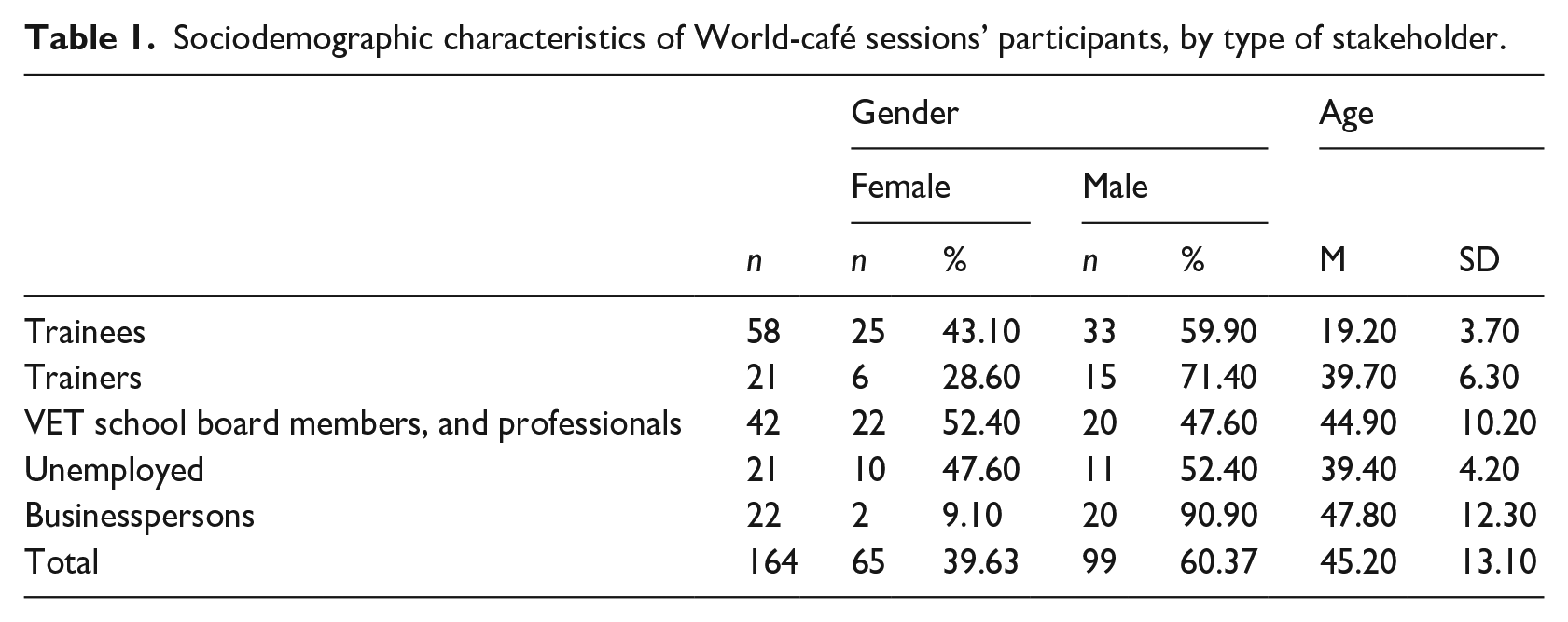
A total of 164 participants were involved in our study, sorted into five groups: trainees (n = 58); trainers (n = 21); institutional representatives, including VET school board members, and professionals from on-the-ground employment, welfare, and education services (n = 42); unemployed people registered at local public employment agencies (n = 21); and businesspersons (n = 22) (see Table 1).
Sociodemographic characteristics of World-café sessions’ participants, by type of stakeholder.
Procedures
Data collection occurred between May and November 2021 over 18 sessions organized by type of stakeholder. Specifically, five sessions were held with trainees, two sessions with trainers, six sessions with VET school board members and institutional representatives from services, two sessions with unemployed people, and three sessions with businesspersons. Each session required a sample of six to 12 participants, with the exception of five sessions, which counted on two to five participants. All participants were invited, by email, by the organizing committee of the Regional Forum for Professional Qualification.
The sessions were framed according to the world-café methodology (Vogt et al., 2003). This methodology was chosen to allow a favorable space for each person to participate, encouraging everyone to discuss the questions presented during a given discussion (The World Café, 2021). At the same time, it enabled common ground among the different ideas shared to be identified (Vogt et al., 2003). Due to the COVID-19 pandemic situation, all sessions were held online. The small round tables, specific to world-café on-site sessions (The World Café, 2021), were replaced with virtual simultaneous rooms, using the video platform Zoom. All sessions were recorded, with the participants’ consent. A script for the session was produced for each type of stakeholder. The different versions of the script covered the following topics: (a) social perception of the VET sector; (b) coordination between companies and the VET sector; (c) employability; (d) coordination between different public and social partners and politics; and (e) improvements in initial and continuing training. These topics were covered by three central questions adapted, in terms of language and prompt questions, according to the type of participants. Each session was organized into five segments: (1) introduction: the research team presented the main aims of the session: to map the VET sector of The Azores and to collect proposals to improve the VET sector in The Azores with a wide range of stakeholders. The research team also presented a shortlist of VET sector potentialities and challenges in The Azores, to ignite the discussions further ahead in the session (e.g. the share or NEETs in the region); (2) session methodology and net etiquette: the research team presented the session structure step by step. Importantly, the team also explained how the session would be held in a virtual mode; (3) small group discussions: these discussions took place over 20 minutes in parallel rooms. Each group focused on a single question/topic of the script; (4) plenary debate of each question: during this part of the session, a speaker from each small group listed his/her group proposals, while offering a short description of what each proposal meant. The proposals were registered by one of the team members in a document shared on the screen with all the participants. After a discussion, each of the participants was invited to select the three proposals that best addressed the topic explored in that specific question from the list of all the proposals presented. This process was repeated until all questions were explored; (5) next steps: the research team concluded the session by sharing the steps ahead, including the organization of debriefing sessions in early 2022 to offer the participants and institutions feedback on the results of this study.
Data analysis
Data analysis followed a two-step approach. Firstly, data was qualitatively assessed, through a content analysis of the proposals shared by the participants during the sessions. Content analysis is a qualitative methodology that aims at interpreting the content of text data, through a classification process to code and identify themes, categories, and patterns (Hsieh and Shannon, 2005). By following several coding steps (Stemler, 2000), content analysis offers new insights into a better understanding of specific phenomena, and to describe and quantify them (Moldavska and Welo, 2017). Thus, it entails both qualitative and quantitative methods. Moreover, it can follow a deductive or inductive approach (Moretti et al., 2011 ).
For the purposes of this paper, we conducted an inductive content analysis to find out the main categories and sub-categories of the proposals collected over the sessions, using the Excel software. The analysis comprised six moments: (1) transcription of all sessions; (2) proposal categorization into main categories; (3) codification of the proposals of each category into sub-categories; (4) refining category and sub-category content; (5) an inter-rater reliability analysis using the Cohen’s Kappa coefficient to determine consistency among raters regarding proposal categorization and codification into sub-categories; and (6) frequency analysis of each category and sub-category.
Secondly, we conducted a correspondence analysis to analyze which topics were more relevant to the improvement of the regional VET sector for each group of stakeholders, using the software package SPSS 25.0. Correspondence analysis is a data visualization method that can be applied to cross-tabular data such as counts, compositions and any ratio-scale data where relative values are of interest (Greenacre, 1984, 2010). It is one of multiple singular value decomposition methods, and the equivalent of principal components’ analysis for categorical and ratio-scale data (Greenacre, 2010). This analytical approach enabled us to understand if the category distribution was balanced across the different types of stakeholders, constituting an additional indicator of the coherence and soundness of the proposals stemming from the sessions.
We next present the results of both content and correspondence analysis.
Results
Content analysis
The participants shared 193 proposals over 18 sessions. Results show that three major categories emerged from the sessions (see Figure 4): Category 1—VET Perception and Valorization, Category 2—Coordination Strategies, and Category 3—VET Improvements. Category 1 comprised proposals regarding policy measures to improve the social perception of VET for relevant actors (in)directly involved in the sector and the society in general. Category 2 covered policy measure proposals for better interaction and coordination between different public and private sectors (e.g. companies/employers, educational institutions, social partners) in the VET sector and to enhance people’s employability. Category 3 involved proposals for the improvement of initial and life-learning VET (e.g. curricula, teaching methods). As shown in Figure 4, participants highlighted more proposals related to Category 3—VET Improvements (n = 92; 47.7%), followed by Category 2—Coordination Strategies (n = 59; 30.6%), and Category 1—VET Perception and Valorization (n = 42; 21.8%).
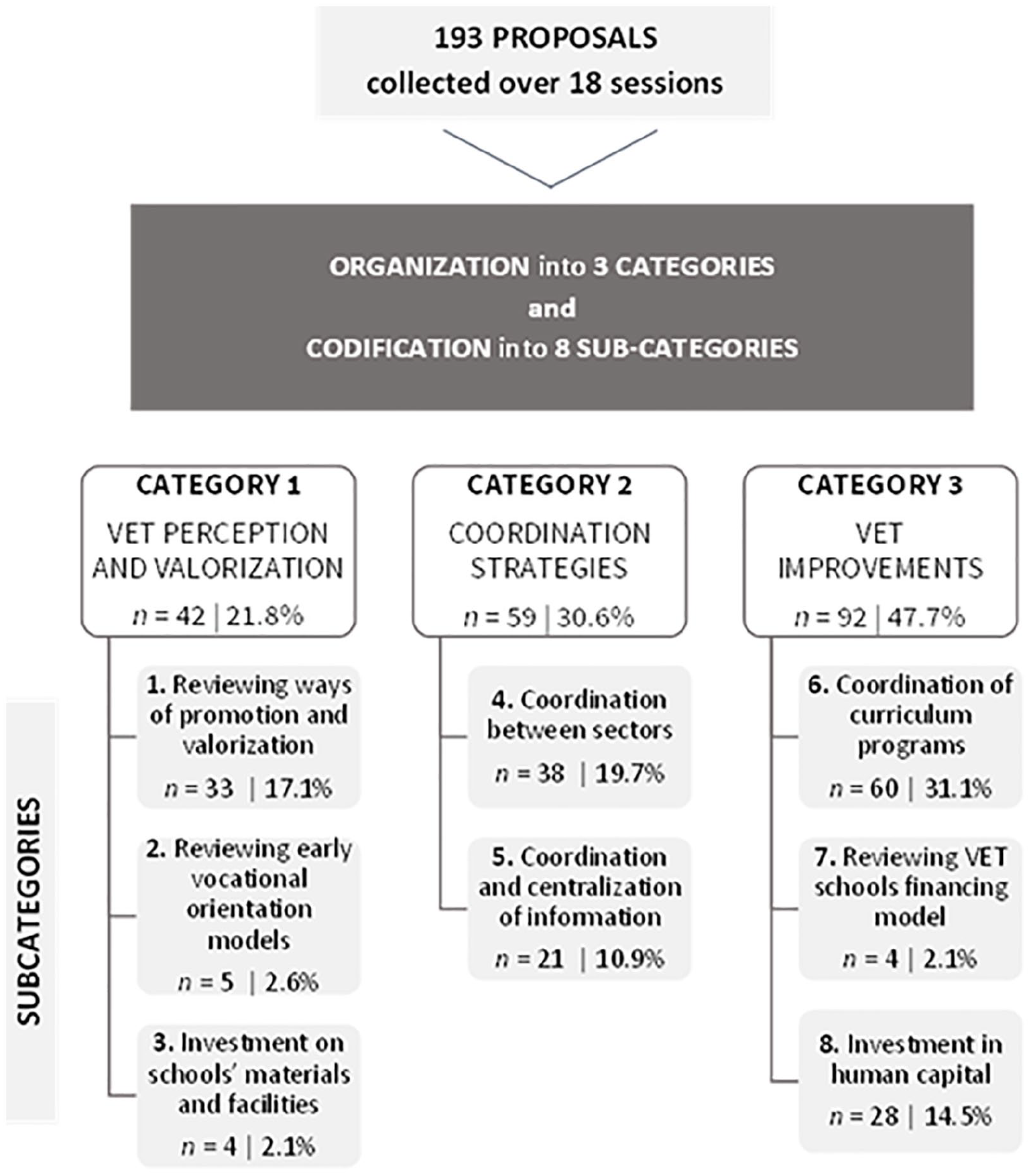
Categorization and codification of the proposals.
After the categorization into three categories, the proposals of each category were codified into sub-categories (see Figure 4). Category 1 included three sub-categories. Firstly, Sub-category 1—Reviewing ways of promotion and valorization (n = 33; 17.1%), which comprised proposals to reduce the negative social representation frequently associated with VET, such as its inferior quality teaching modalities or lower status (Martins and Martins, 2016). This sub-category covered proposals such as the dissemination of success stories of former trainees through traditional media and social networks, activities in VET schools to present career and professional possibilities within the VET sector to the community, and better training conditions for trainees. Such proposals were mentioned by all types of stakeholders. Secondly, Sub-category 2—Reviewing early vocational orientation models (n = 5; 2.6%) focused on proposals for a more specialized and earlier monitoring of students’ educational and professional choices on the part of schools from mainstream education and VET. Some of the proposals of this sub-category involved the implementation in schools of vocational orientation programs for seventh-grade students, and social and psychological support for trainees when choosing their internship. These proposals were shared by trainees, trainers and VET school board members, and professionals. The last sub-category of Category 1 was Sub-category 3—Investment in schools’ materials and facilities (n = 4; 2.1%), which covered suggestions for improving VET schools’ equipment and infrastructures. This aimed to attract more young people to VET courses, being highlighted by trainees and VET school board members, as well as professionals.
Category 2 comprised two sub-categories involving all five groups of stakeholders. Sub-category 4—Coordination between sectors (n = 38; 19.7%) concerned proposals centered on promoting coordination between public and private sectors, (in)directly related to the VET sector (e.g. employers, educational institutions, policy decision-makers). Better coordination between companies and educational institutions, company need’s evaluation, better financing conditions for companies that take on trainees and the implementation of VET policies promoting coordination between public services (e.g. social security, employment services) were some of the proposals made in this sub-category. All five groups of stakeholders emphasized the proposals of this sub-category, especially VET school board members and professionals, and businesspersons. Sub-category 5—Coordination and centralization of information (n = 21; 10.9%) included proposals to develop market studies, evaluate trainees’ needs, and aggregate and disseminate relevant information for trainees and employers. Some of the proposals included the development of an online platform with information about worker profiles, job opportunities, trainees’ job expectations, and information sessions in VET schools about the demand on the regional labor market by employment agencies. Such proposals were highlighted by the five groups of stakeholders.
The remaining three sub-categories were included in Category 3. Sub-category 6—Coordination of curriculum programs was the one most highlighted by all groups of stakeholders (n = 60; 31.1%). This sub-category involved proposals to improve coordination among schools, and to promote schools’ specialization and continuous training. Better matching VET courses and the demand on the regional labor market, greater diversity of VET courses, reviewing the training course offers according to the needs of the region, and better school schedules are examples of the proposals shared during sessions, by the five groups. Sub-category 7—Reviewing VET schools financing model (n = 4; 2.1%) concerned the implementation of policy measures to review the financing criteria of VET schools. Both trainers and VET school board members and professionals called for class sizes to be reduced. Finally, Sub-category 8—Investment in human capital gathered 28 proposals (14.5%) focused on promoting better access conditions to VET courses for trainees and the training of trainers and professionals of employment services. Grants or financial assistance for trainees (e.g. food and transportation allowances), merit-based grants, and training courses carried out by VET trainers for advanced technicians of employment services were some of the proposals collected over the sessions with the five groups of stakeholders. Worth noting that the awarding of grants or financial assistance for trainees was a proposal mentioned only by trainees, the unemployed people and the VET school board members and institutional representatives from services, although this kind of support is already provided for by law.
The categorization was made by two researchers, separately, and the inter-rater reliability for both raters was found to be Kappa = 0.97 (p < 0.001), showing an almost perfect agreement between the researchers.
Correspondence analysis
The correspondence analysis does not show significant differences regarding the prevalence of the three topics across the five groups of stakeholders [χ2 (8.1) =14.12, p = 0.079]. Category distribution was balanced across types of stakeholders (see Figure 5). The relevance given to each one of the three categories of proposals is similar among all five groups, with Category 3—VET Improvements being the most highlighted by participants.
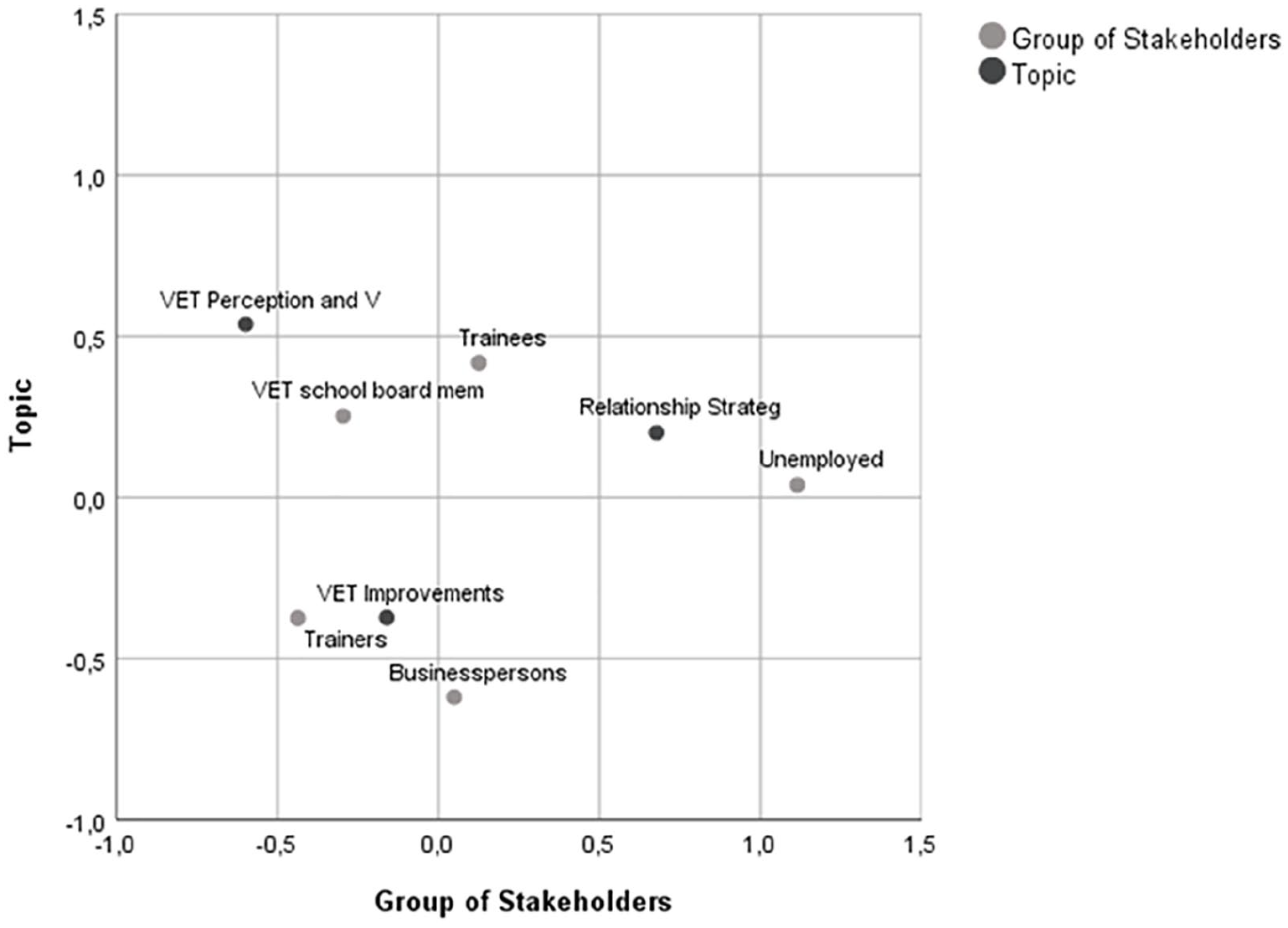
Correspondence analysis of the three categories across the five groups of stakeholders.
Discussion
Our participatory analysis of VETs needed reforms in The Azores reached three main findings. Each of them reflect different layers of the integrated governance model. The first set of reforms voiced by the stakeholders stressed the need for policy measures to improve the social perceptions about VET, in line with the commitment of integrated governance to producing social change through policies (Christensen, 2015; Marques, 2017). To fulfill this vision, the stakeholders often suggested the implementation of communication measures, such as traditional and social media campaigns, while issuing some ideas for developing early vocational orientation processes or the improvement of infrastructures and materials. Through these proposals, participants generally acknowledged that VET is still perceived as an inferior, second-chance education modality in the region. These negative social representations are prevalent because VET is presented as a non-normative educational pathway to secondary school certification (Gekara and Snell, 2018) and to develop practical work skills (Martins and Martins, 2016). These views are common in outermost regions, where VET is often seen as a magical solution for early leaving from education and training (Diogo et al., 2016). This narrative, paired with a well-documented lack of adequate on-the-ground counseling services (Simões, 2018), increases the odds of large shares of trainees being enrolled only to attain a secondary school level and, consequently, of VETs depicting worse outcomes, leading to even more negative representations of this educational modality.
We found that a second set of proposals reflected the need for reforming the VET sector through coordination between multiple public agencies, as well as between public and private actors (in)directly involved in VET. This need for coordination also covered actions for sharing information between stakeholders, through studies or adequate dissemination platforms. When laying down these specific proposals, the stakeholders largely described horizontal coordination requirements, one of the structural axes of the integrated governance model (Christensen, 2015; Marques, 2017). Their proposals are contextually relevant, as VET involves complex policies with potential spill-over effects over wicked problems common in outermost regions, such as high shares of young generations out-migration (Bæck, 2016; Farrugia, 2016; Simões, 2018), low economic competitiveness (Conselho Económico e Social, 2021; European Council, 2021) and poverty (Governo Regional dos Acores, 2020). The number and breadth of VETs’ expected indirect effects on these wicked problems are often exaggerated. However, a combination of relevant stakeholder skills and expertise in a non-hierarchical approach (Pülzl and Treib, 2006) to find shared, sustainable solutions for such complex social problems is still required. In the case of VET, such cooperative efforts will fine-tune the use of resources (e.g. teachers’ proper allocation to VET schools and to public schools) or avoid parallel efforts from stakeholders (e.g. training offer redundancies and overlaps) (Christensen, 2015; Cortez et al., 2015; Klijn and Koppenjan, 2014). Interestingly, the participants acknowledged that effective horizontal collaboration encompasses an “institutional agreement” that must be translated into concrete actions. Their operative proposals repeat, however, collective actions common in hierarchical forms of policy implementation (e.g. diagnosis and centralizing information), in which institutions and their representatives adopt bilateral communication models, develop parallel, and sometimes contradictory efforts, and seldom negotiate policy outcomes (Pülzl and Treib, 2006). These examples conform with more superficial models of policy implementation such as sharing (mutual information between stakeholders about ongoing policies and measures) or cooperation (when stakeholders work together on one or a few occasions). These models differ from the collaboration (when stakeholders work together in a sustained way, based on the appropriate institutional arrangements) (Trein and Tosun, 2021) envisioned by the integrated governance model. Thus, the translation of collaboration values into proposals for reforming the VET sector is still far from reflecting the integrated governance collaborative approach based on collective policy-design and making; namely leadership, participation, communication, and evaluation/monitoring (Marques, 2017).
Finally, the third set of reforms proposed by the participants covered a significant number of suggestions aimed at improving the VET sector curricula, associated funding schemes and human resources capacity. Overall, these proposals highlighted another fundamental axis of the integrated governance model: the vertical coordination of policies, with a few references, again, being made to horizontal coordination (e.g. coordination between VET schools) (Christensen, 2015; Marques, 2017). VET implementation in outermost regions is strongly shaped by the EU funds. These funds bring attached practical requirements for VET development (e.g. minimal number of trainees enrolled in each training course; curricular structure; trainers’ certification), which are often hard to achieve in outermost regions. The participants’ proposals express, therefore, how the EU financial rules end up constraining both training diversification and specialization, as well as the balance between labor force offer and demand because they are not flexible enough to accommodate regional challenges, such as the geographical discontinuity of the archipelago, the low numbers of young people in some islands and the lack of certified trainers. In a nutshell, the participants echo regional authorities’ concerns and limitations to tailor their policies to local needs and resources (Shore and Tosun, 2019), which are often scarce and dispersed in outermost regions (Simões et al., 2021). Practical side-effects stemming from ignoring vertical coordination between regional and European level policies are common and recurrent. For instance, The Azores deals with recurrent training saturation situations, meaning excessive training in some sectors for the local job market demand, as those are the areas in which VET schools are able to comply with EU funding requirements (Simões et al., 2021). Another side-effect of these financial constraints is that even though the awarding of financial assistance for trainees is already provided by law and assured by various VET courses (e.g. Professional Courses, Apprenticeship Courses), other financial incentives that would be meaningful in the region (e.g. specific grants for retraining) do not always fit the existing regulations. Importantly, participants—trainees, unemployed people and VET school board members and institutional representatives from services—were aware of such financial support, but were keen to point out that it should be improved (e.g. new kinds of grants, higher-value grants), and that the respective legislative rules should be reformulated. The relevance given to the integration of such a proposal into the set of needed reforms for the region may indicate another failure in policies coordination, and the need for a better negotiation/dialog between authorities and stakeholders directly or indirectly associated with the VET sector.
Our study has limitations. The contacts with the stakeholders were mediated by local authorities. While this may have influenced the stakeholders’ views, local authority representatives did not attend the online sessions, and instructions were given to explain how the research team did not embrace their views. The online use of the world-café methodology is new, so it is uncertain how much this has affected our results. The number of participants in each session was unbalanced. Nonetheless, we managed to involve many participants with very diverse backgrounds. Finally, although personal experiences were the basis of the discussions, our questions were made in general about the VET system as a whole, without focusing on particular training areas. This may have also affected the outcomes of our study.
Conclusion
Outermost European regions face significant demographic, social, and economic challenges that threaten their development. VET policies are usually depicted as one of the most prominent policy-making instruments used to address complex social issues, at the regional level. While the reliance on VET in outermost regions is sometimes disproportionate, our study shows relevant avenues to promote reforms in the sector, from the stakeholders’ perspective and in line with the integrated governance model. Improving the sector’s social representation is a fundamental one. Besides this, horizontal coordination, between different public and private stakeholders with common, but also competing interests in the VET field, is required to deliver effective policies. However, our findings also show that training and negotiation forums are needed to drive stakeholders to concrete actions aligned with the integrated governance views. Finally, the implementation of VET policies requires much more flexibility to achieve vertical coordination of policies, meaning, between European, national and regional policymaking levels. This may include keeping negotiation channels open between the European Commission and regional authorities for ongoing adjustments during funding package implementation or creating more specific funding programs for outermost regions with greater autonomy for managing both funds and curricula.
Footnotes
Acknowledgements
The research team wishes to thank all the participants who were involved in the study.
Declaration of conflicting interests
The author(s) declared no potential conflicts of interest with respect to the research, authorship, and/or publication of this article.
Data archiving and sharing statement
Data available upon request to the corresponding author.
Funding
The author(s) received no financial support for the research, authorship, and/or publication of this article.
Ethics statement
The authors declare that this research was conducted ethically, the results are reported honestly, the submitted work is original and not (self-)plagiarized, and authorship reflects individuals’ contributions.
