



Abstract
Although the curriculum ideally serves the interests of its recipients, student perspectives have been marginalised in curriculum negotiation. Our objective is to better meet the needs and wishes of vocational education students by including them in planning, acting/observing and reflecting on the citizenship education curriculum. In this participatory action research project students were made responsible for designing, developing and delivering a lesson for their peers. Data collection consisted of interviews, focus group discussions and observations during three action rounds involving five classes. Even though many teachers were initially sceptical about their students’ abilities, it turned out that students enjoyed engaging in curriculum negotiation. Students were the main drivers of the curriculum. Relevant factors for implementation were: teachers’ beliefs about student capabilities and attitudes, changing roles and responsibilities, and safe and constructive classroom dynamics. Students were exposed to a wide variety of skills and challenges. Future research should focus on studying the same participants during multiple implementation rounds. Also, opportunities for curriculum negotiation activities within other topics should be explored. Lastly, a more rigid analysis of the learning outcomes as well as the impact on personal development of students and teachers would be recommended.
Keywords
Introduction
The concept of student voice –which stresses ‘that young people have unique perspectives on learning, teaching and schooling; that their insights warrant not only the attention but also the responses of adults; and that they should be afforded opportunities to actively shape their education’ (Cook-Sather, 2006a: 359–360)– has gained in popularity in recent years. However, despite a plethora of possibilities for engaging students to achieve more meaningful, appropriate and worthwhile teaching and learning, the majority of studies continue to position students as passive recipients of education developed by others (Pinter et al., 2016). Indeed, ‘while the curriculum supposedly exists to serve the interests of learners, their preferences, if sought at all, are marginalised and their voices are mostly silent in curriculum-making’ (Brooker and MacDonald, 1999: 84). Thus, scholars have only sporadically capitalised on opportunities for developing education which is more tailored towards students’ lives and interests (Bron, 2014; Bron et al., 2018; Pennisi, 2013). Previous studies established that engaging students in curriculum-making contributed to participation, commitment, engagement, investment, enthusiasm and joy, which, in turn, resulted in an increased sense of confidence, ownership and empowerment (Enright and O'Sullivan, 2010, 2012; Guadalupe and Curtner-Smith, 2020; Howley and Tannehill, 2014; Pennisi, 2013; Shilcutt et al., 2021, 2022; Wahl-Alexander et al., 2016).
As Shor (1992: 20) argues: ‘education for empowerment is not something done by teachers to students for their own good but is something students co-develop for themselves, led by a critical and democratic teacher.’ With this in mind, the curriculum should be created through a systematic and purposeful collaboration between teachers and students, in which the latter are afforded opportunities to shape and develop the aims and content of their education (Brooker and MacDonald, 1999; Enright and O'Sullivan, 2010; Guadalupe and Curtner-Smith, 2020; Oliver and Kirk, 2015). This process –which Boomer et al. (1992) called ‘curriculum negotiation’– is most effective when the curriculum is viewed as a process rather than a static product. Due to continuous influence and alterations during negotiation, the curriculum is both situational and temporal (Bron, 2014). Accordingly, ‘listening to, responding to, and being guided by student voices is not about succeeding […] but rather about always changing in response to what we hear’ (Cook-Sather, 2006b: 26). That being said, negotiating the curriculum does not imply surrendering all decision-making abilities to students. Rather, it requires teachers to willingly share their power and authority with students by facilitating dialogue, listening and responding to students, appreciating their views and knowledge, and integrating different ideas and perspectives (Enright and O'Sullivan, 2010; hooks, 1994; Oliver and Kirk, 2015). Teachers also play a fundamental role in increasing students’ perceived competences and capabilities by offering guidance, support, encouragement and insights (Biddulph, 2011; Howley and Tannehill, 2014).
While conducting a systematic literature review on how students participated in educational development (Geurts et al., 2023), we followed previous scholars (Creswell, 2015; Koshy, 2009; Pardede, 2019) in discerning three phases, that is, planning, acting/observing and reflecting. Studies that merely involved students as subjects or information providers were excluded. We demonstrated that despite students being included in planning in almost all studies, participation was largely passive and restricted to advising. In the acting/observing phase, students acquired more responsibilities as they were frequently engaged as co-researchers. Students were least involved in reflecting and in those instances that they were, participation was limited to sharing their experiences during concluding activities. Overall, students’ involvement in co-creation and decision-making about teaching and learning was quite limited (Geurts et al., 2023).
As opposed to only involving students incidentally, curriculum negotiation is most effective when students are presented with numerous opportunities throughout the entire course (Glasby and MacDonald, 2004; Oliver and Kirk, 2015). These are apparent in everyday teaching and learning encounters with students and have the additional benefit of making curriculum negotiation activities accessible to every student (Bron et al., 2018). This explains why in this study students were provided with ample opportunities for diverse roles and responsibilities in curriculum negotiation during each phase of the project as well as throughout the whole course.
Although being granted opportunities for curriculum negotiation is thought to be particularly relevant for vulnerable students (Brooker and MacDonald, 1999; Cook-Sather, 2002), the vast majority of existing studies focus on university students (e.g., Bergmark and Westman, 2016; Bovill, 2014; Carey, 2013). In our literature review –which excluded university students– all included studies targeted secondary school students and only three out of fifteen studies mentioned specifically serving marginalised groups. Hence, one of our concluding recommendations was to study students in vulnerable positions as well as in more diverse school settings (Geurts et al., 2023). For that reason this study explicitly focuses on students in vocational education and training (VET). This group is not only likely to have vulnerabilities and/or feel side-lined in their everyday lives, they are also generally not included in research and have therefore been underserved by scholars. Our objective is to better meet the needs and wishes of VET students by including these students and their teachers in planning, acting/observing and reflecting on the citizenship education curriculum. Our research questions are:
How and when do VET students participate in curriculum negotiation? What are relevant factors that influence the implementation of curriculum negotiation activities in VET? What is the impact of participating in curriculum negotiation activities on VET students’ personal development and school connectedness?
Methods
Study design
Participatory Action Research (PAR) was selected as the methodological framework for this study. PAR ‘assumes knowledge is rooted in social relations and most powerful when produced collaboratively through action’ (Fine et al., 2001: 173). PAR's objectives are ‘to produce knowledge and action directly useful to a group of people’ as well as ‘to empower people at a deeper level through the process of constructing and using their knowledge’ (Nieuwenhuys, 2004: 210). These objectives are in line with the previously discussed ideals of student voice and curriculum negotiation that all fit in a larger movement which strives to redefine young people as knowledgeable partners and active learners in education, research and beyond.
In our case, this means that students, teachers and researchers work collaboratively in sharing knowledge and experiences, while coming up with potential solutions to improve practice. Next, these shared actions are implemented and subsequently the effects of these actions on practice as well as on those involved are studied (Streubert and Carpenter, 2011), which results in continuous adaptation and enhancement of future actions. Hence, implementation of potential solutions generally consists of multiple rounds and is an indispensable part of the research process. PAR is therefore characterised by an emergent design and is thought to be an iterative process of planning, acting/observing and reflecting (Lang et al., 2012; Regeer and Bunders, 2009; Rodríguez and Brown, 2009).
The Dutch context
In addition to preparing students for practising a profession and possibly continuing further education, Dutch VET institutions have a legal duty to support students in developing necessary knowledge, skills and attitudes in order to participate in a democratic society as active and responsible citizens. This is accomplished via ‘burgerschap’, which can be translated as citizenship education. The Dutch law on Schooling and Vocational Education (WEB, art. 1.2.1 lid 2) states the following: ‘VET promotes general education and personal development of participants and contributes to social functioning.’ The relevant themes are divided in four dimensions: (1) political-legal dimension (i.e., active participation in democracy and human rights); (2) economic dimension (i.e., functioning as an employee and as a consumer); (3) social dimension (i.e., active participation in the community and dealing with social and cultural differences); and (4) vitality dimension (i.e., care for one's own vitality and health). Furthermore, obtaining critical thinking skills is emphasised, which entails being able to appraise information and its sources, take the perspective of another person, and reflect on your own thinking (Elfering et al., 2016).
There are no strict criteria for institutions concerning how to organise and deliver citizenship education to their students as this would allow for adjustments based on local context and students’ needs. However, in practice, the absence of guidelines has led to huge variations in vision, content, form, quality, assessment, organisation and intensity of citizenship education. Likewise, no requirements are in place regarding basic competences for citizenship education teachers, making this type of education even more teacher-dependent and teacher-driven. Also, being a citizenship education teacher is at best a side job, since this topic is usually combined with other demanding roles and responsibilities. On top of that, previous research determined that citizenship education does not suit students’ wishes and needs (ecbo, 2019).
Participants and setting
VET in the Netherlands consists of four levels. Previous research generally focused on the intermediate and advanced levels (i.e., level 3 and 4) or incorrectly assumed VET students to be one homogeneous group. This study specifically targets students of the basic level (i.e., level 2), because these students are believed to be extra vulnerable and have formerly been underserved. Level 2 classes tend to encounter substantial diversity in students’ age, capabilities, background, Dutch language proficiency and motivation. Moreover, students are known to come from diverse educational backgrounds as the Dutch system promotes the flow of students from inclusive and special needs secondary education into mainstream further education. The participants in this study were part of a large VET institution with multiple locations in the south of the Netherlands.
Data collection
In this study, students, teachers and researchers worked collaboratively in negotiating the citizenship education curriculum, which meant that students were alternately responsible for designing, developing and delivering a citizenship education lesson for their peers. Data collection took place between June 2022 and June 2023 and consisted of three action rounds involving five classes (totalling 60 students and six teachers) from three study programmes (see Table 1). Every class more or less went through the following phases:
Overview of participants.
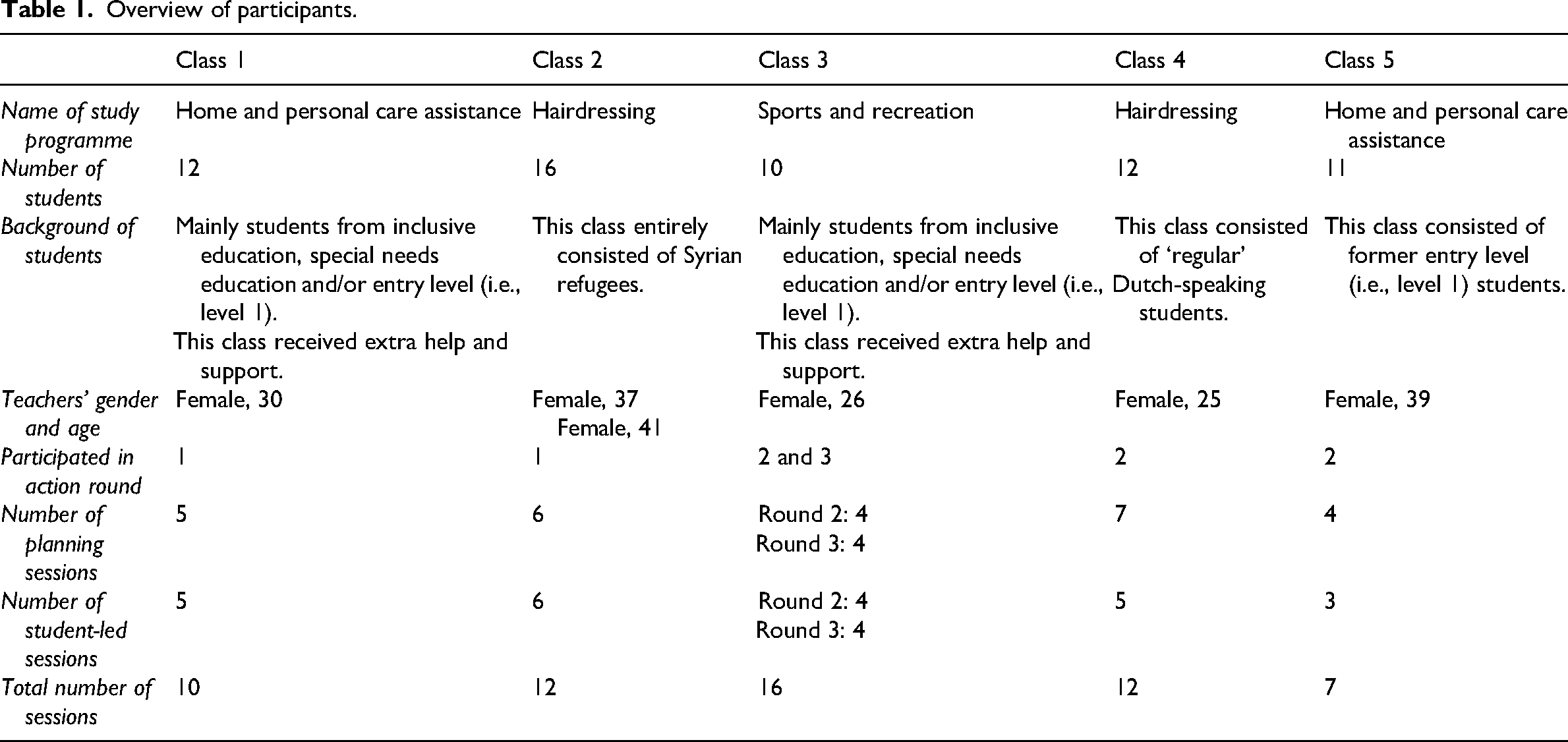
Planning – Each class was divided in small groups of students, who spent four to seven sessions on devising, developing and organising the content, activities, speakers, materials and location for their lessons. During the first action round, in collaboration with two classes, the first author (EG) took the lead by facilitating each planning session while being assisted by the teacher. EG wrote field notes describing the activities and content that occurred during each session as well as the interactions among students and between teacher and students. These were complemented with entries in a researcher journal in which EG described reflections, feelings, successes and challenges experienced while facilitating each session. During round 2 and 3, involving three classes, teachers took on the role of facilitator in order to promote sustainability and professional development, while EG and an additional researcher (ES) observed in turns. The observation forms included general impressions, student and teacher behaviour, classroom atmosphere and good practices. A total of 30 planning sessions were observed; each session lasted about an hour.
Acting/observing – Subsequently, groups of students rotated in delivering lessons to their peers, which varied from three to six student-led lessons per class. While nearly identical observation forms were used, this phase specifically distinguished between students delivering the lessons (i.e., so-called student-teachers) and their peers receiving them. Each student-led lesson was concluded with a critical reflection together with students. In total, the number of lessons led by students amounted to 27, which varied in duration from 20 to 60 min.
Reflecting – As a result of PAR's iterative nature and as described above, data collection and reflection occurred continuously throughout all phases. Additionally, interviews were conducted with participating teachers (i.e., eight interviews with six teachers), which zoomed in on personal beliefs, goals, feelings, successes and challenges as well as perceived impact on their students, reflections on their own role and takeaways. Moreover, over the course of eight focus group discussions, 45 students (i.e., five to ten per group) shared their experiences with curriculum negotiation during and/or at the end of the project. When possible, interviews and focus group discussions were recorded and transcribed verbatim. In those cases when this was not feasible, the researchers resorted to taking notes both during and after the meetings.
Data analysis
In our literature review on student voice (Geurts et al., 2023), the Theoretical Domains Framework (TDF) (Atkins et al., 2017; Davis et al., 2015; Michie et al., 2005) was used for establishing dominant factors affecting the implementation of student voice initiatives in teaching and learning as well as assessing the impact of participating in these initiatives on students. As such, the TDF provided a lens through which to view and categorise the included studies. Our review study established that the following seven domains were most relevant: knowledge, skills, beliefs about capabilities, optimism, emotions, social/professional role and identity, and social influences. In our current study, these domains were used as a first starting point for thematic content analysis.
The transcripts, notes and observation forms were coded and analysed using Atlas.ti (version 23). The transcripts of the interviews and focus groups discussions of three classes were coded separately by two authors (EG and ES). Codes and subcodes were subsequently discussed, compared and merged, resulting in an extensive code book, which EG used while coding the remaining classes individually (Creswell and Creswell, 2017).
Ethical considerations
Every participant gave written informed consent. In order to protect the privacy of the participants, each record was anonymised and data which may reveal their identities were deleted from the transcripts. The research proposal of the study was evaluated by the Medical Ethical committee of FHML-REC/2021/075, which exempted the study from formal ethical approval.
Results
As expected, students, teachers, classes and study programmes tended to vary considerably. In order to make this diversity explicit as well as do justice to the unique context of VET, the results section has been divided in three cases, equivalent to the three participating study programmes. Each case starts with a context description after which the most telling domains and themes will be illustrated using various case-specific examples.
Case 1: Home and personal care assistance (class 1 and class 5)
In this study programme, citizenship education was considered to be a high-stakes topic. In fact, teaching citizenship education was a sought-after position and most current teachers had years of experience teaching this topic. Class 1 was exclusively comprised of students who received additional help and support as compared to Class 5, which consisted of ‘regular’ level-2 students.
In the beginning, teachers had fairly low expectations of their students’ capabilities. Although this was true for all participating study programmes, throughout the project both teachers within this study programme mentioned that whatever their students came up with was already admirable, even more so considering their capabilities (i.e., level 2). Meanwhile, teachers struggled with being open and sincere when students discussed their plans and ideas, as one teacher described: ‘I find that very difficult, that I already know in advance, this is just not going to happen’ (teacher, Class 5). As a result, these negative beliefs were sometimes revised: ‘I think that this was an eye opener for me, in the sense that students should have more of a say in what they want to learn’ (teacher, Class 1).
One of the key skills that students practised was collaboration: ‘I saw students working together who normally would not even talk to each other, […] I saw students who usually would not achieve anything come up with great ideas and give presentations, […] just because they belonged to a group’ (teacher, Class 5). Within small groups, students practised for instance with establishing rules, sharing opinions and responsibilities, compromising, making agreements and decisions, and communication. Students’ experiences with working together varied: some groups reported increased motivation, coming up with new ideas and making more well-considered decisions, whereas other groups had to deal with disappointment, lack of mutual understanding and tension. Teachers play an important part in navigating and handling these group dynamics, which can be demanding and chaotic: ‘Sometimes I feel like superwoman: I have to be everywhere at the same time, because one student is about to start crying, and I have to dismiss another student from the classroom right now, because a fight is brewing’ (teacher, Class 5). Providing positive feedback as well as giving credits to those who deserve it are important tools for restoring and keeping peace in the classroom. This also entails condemning lack of participation or absence of students.
Both teachers felt that, compared to regular citizenship education lessons, students had learned less in terms of content. However, these teachers also revealed that their students had practised with a wide variety of skills and challenges, which they normally would not have been exposed to. This sentiment was shared by students: ‘You have to think about whether people will enjoy [our lesson], isn’t it too much explaining or too much inactivity?’ (student, Class 1) or ‘How are you going to design [your lesson] in such a way that everyone gets something out of it and will participate?’ (student, Class 1). Other skills that were mentioned by students were: being creative, asking yourself and the people around you questions, and pursuing new perspectives or interests. One student also identified perseverance as an important skill, particularly when trying to arrange a guest speaker: ‘Sometimes you just have to persist when you do not get a response or are not called back’ (student, Class 1).
To conclude, teachers had to handle several roles and responsibilities at once, for example setting goals and having achievable expectations, giving credit when credit is due, trusting their students while also knowing when to interfere, making sure each group develops and delivers their lesson, dealing with conflicts between students, and supporting their class in learning new skills.
Case 2: Hairdressing (class 2 and class 4)
As opposed to the two other study programmes, citizenship education within hairdressing was perceived as a low-stakes topic. Most teachers were not keen on providing these lessons, which meant that this role was often bestowed upon relatively new as well as frequently changing teachers. For instance, halfway through the project, Class 2 switched teachers. In addition, this study programme is different from the others because it separates non-native speakers from Dutch students: Class 2 entirely consisted of Syrian refugees, whereas Class 4 was a native Dutch-speaking class.
As mentioned before, negative beliefs and low expectations about students’ capabilities were apparent in all study programmes, albeit in varying degrees. However, in this case, negative views and ideas also involved their students’ attitude. Accordingly, teachers described their students as not disciplined, uninterested, unmotivated, disrespectful, indifferent, lazy and/or, as one teacher expressed, unruly: ‘I do know that other teachers who also teach this class are often like “O my God, what kind of a class is this?”’ (teacher, Class 4). Apart from feeling distraught, they also seemed to experience low levels of self-efficacy. One teacher hoped that participating in this project would provide solutions: ‘I think that students will not only discover how difficult it is to come up with a lesson, but also learn how to keep the students’ attention. […] Maybe they will think “I should start behaving differently towards the teacher”’ (teacher, Class 2).
Unsurprisingly, at the start of the project, the atmosphere in both classes was poor and feelings of connectedness were low. This was true for both the relationship between teachers and students as well as among students. Even though the students in these classes were not immediately thrilled to participate in the project, many groups came up with inventive and non-traditional topics, for example in the fields of history, art, psychology or music. In the beginning, teachers seemingly found some fresh energy and were actively engaging with their students. However, as the sessions progressed, it was increasingly difficult to keep students going. Considerable differences in effort and presence halted cooperation between students, leading to quarrels, decreased motivation and refusal to continue working on or delivering their lessons. All three teachers adopted a more authoritarian approach by repeatedly reminding students that: ‘If you do not do this, you will fail the course [and you cannot graduate]’ (teacher, Class 2). At the same time, teachers became more and more passive and less willing to support students, especially those who were considered ‘bad students’ (e.g., students who were easily distracted, came across as unmotivated or were often absent). Although some student-led sessions were a success, a considerable number was cancelled, while others lacked in quality, due to no-shows of student-teachers, insufficient preparation and/or limited interaction. The majority of the students in both classes mentioned presenting or being in front of their peers as the main hurdle, which was to be expected as their teachers did not succeed in providing a safe and non-judgmental space. Students were especially concerned about being made fun of, peers not paying attention or their efforts not having the desired impact: ‘Eventually, they [their peers] will not remember anything from what we told them, while we worked on this lesson for hours’ (student, Class 4).
In conclusion, the relationship between teachers and students as well as among students was strained and teachers had various negative beliefs about their students. Despite the fact that many students enjoyed working on topics of interest and cared about making their lesson a success, the already existing poor atmosphere combined with high levels of absence hindered realising a fully operational and student-led curriculum.
Case 3: Sports and recreation (class 3)
In this study programme, citizenship education and student voice were widely supported among staff. Over the last few years, citizenship education has gone through numerous changes. This schoolyear citizenship education was no longer provided as lessons to individual classes, but rather during five so-called citizenship education days offered to all students at the same time. Class 3, whose students received additional help and support and were based at a separate location, were responsible for designing, developing and delivering lessons for their peers from three ‘regular’ classes. This was the only class that participated twice.
When this class first participated, they needed a lot of assistance and support from their teacher. Students had difficulties with thinking outside-the-box and frequently wondered about what they thought the teacher would want them to do. As for the teacher, she struggled with balancing ‘letting go’ and taking over, which was especially apparent during the planning phase. On the one hand, she felt that overly helping her students would hinder student participation, while on the other hand, as the date of the citizenship education day grew closer, she increasingly started making decisions for her students. The latter made sense as organising a citizenship education day comes with considerably more pressure as compared to regular lessons: multiple classes depend on following a series of lessons at the same day which leaves little room for error or fooling around. Unfortunately, during the first citizenship education day, students were not ready to independently deliver their lessons in front of their peers. Moreover, due to simultaneously planned lessons, the teacher was constantly changing back and forth between lessons, which not only caused stress, anxiety and chaos for the teacher, but also resulted in students not feeling supported. When the teacher left right before another lesson was about to start, one student-teacher tellingly said: ‘Don’t abandon us’ (student, Class 3). No wonder the teacher's first response at the end of the day was ‘once but never again’ (teacher, Class 3). However, after hearing how much the class had enjoyed organising ‘their day’ as well as after some emotions had subsided, the teacher declared: ‘I am proud of [my students] […] even if it was not perfect, they managed to do everything themselves’ (teacher, Class 3).
The second time round saw many improvements. Both the teacher and her students built on previous experiences and were determined not to make the same mistakes. The main goal of the teacher was: ‘I wanted my students to experience even more success […] that they feel “we can do this”, which also allows them to personally grow’ (teacher, Class 3). During the planning phase, the teacher tried to ‘structure the chaos’ by safeguarding the process of lesson development more strictly, while the lesson itself remained completely up to the students. During the second citizenship education day, students were better prepared and the teacher was more vocal about cheering on as well as complimenting her students. Even though some student-teachers were again quite apprehensive in the beginning, they improved with each lesson and clearly grew more confident during the day. Some of the misconceptions that the teacher had were adjusted: ‘I think it is very positive when students are a bit nervous, because that means they feel responsible. […] Sometimes I feel like they do not care at all, but they did care. […] I really liked that’ (teacher, Class 3). Furthermore, she realised: ‘I have discovered how to have faith in my students’ (teacher, Class 3).
Organising citizenship education days comes with increased pressure and responsibility for both teachers and students, which, at first, resulted in diminishing students’ influence. However, with continuing support, encouragement and trust, and with trial-and-error, students were able to show their worth as well as their capabilities.
Discussion and Conclusion
This study aimed to answer three questions. Research question 1 focused on how and when students participate in curriculum negotiation. Students were involved in different roles throughout the project and were offered many opportunities which allowed them to be the main drivers of the citizenship education curriculum. Research question 2 focused on relevant factors for implementation of these activities, which were: teachers’ beliefs about student capabilities and attitudes, changing roles and responsibilities of teachers in relation to their students, and safe and constructive group dynamics within the classroom. Research question 3 focused on the impact of participation on students’ personal development and school connectedness. Students generally enjoyed working on topics of their own choice. Even though teachers felt that students had learned less in terms of knowledge, they agreed this was more than made up for by exposure to a wide variety of skills and challenges.
Previous studies determined that within the context of curriculum negotiation and collaborative work, beliefs about capabilities were particularly relevant for students, who often lacked confidence and self-esteem at the start of the project, which hindered them from finding and expressing their voice. Regardless, by the time these projects were finished, the same studies reported on more participation, commitment, engagement and investment among students, which, in turn, contributed to an increased sense of confidence, ownership and empowerment (Coll et al., 2018; Howley and Tannehill, 2014; Shilcutt et al., 2021, 2022). Although these findings were confirmed in our study, we additionally established that the domain concerning beliefs about capabilities should also encompass beliefs about someone else's capabilities. In our case, we found that, at the start of the project, teachers had fairly negative beliefs about the capabilities of their students. Moreover, some teachers harboured unfavourable views concerning their students’ attitude. Be that as it may, having low expectations as well as false assumptions may result in adverse outcomes. For example, Van den Bergh and colleagues (2021) established that low expectations of teachers lead to less challenging goals and more steering feedback regarding their students, which consequently generates lower results. High expectations, on the other hand, kindle greater challenge and more feedback, which contribute to increased student performance. Evidently, teachers need to be aware of their potentially stereotypical views and should start operating based on high expectations (Van den Bergh et al., 2021). However, this is challenging as the Dutch education system classifies and groups students based on their educational level, which inherently triggers labelling and stereotypes. Within the context of VET level 2, this means that students have to deal with negative beliefs about their own worth as well as low expectations and false assumptions from their teachers.
Self-determination theory (SDT) is concerned with human motivation and underlines our tendencies towards growing, mastering challenges and integrating new experiences (Deci and Ryan, 2000; Ryan and Deci, 2000). According to Deci and Ryan (2000), three psychological needs motivate self-initiated behaviour, namely autonomy, competence and relatedness. Autonomy refers to acting with volition and having input (Deci and Ryan, 2000; Ryan and Deci, 2000). In our case, students were the main decision-makers concerning content, activities, materials, speakers and location of their own citizenship education lesson. Each group of students would deliver their lesson to their peers, which meant that each student would be the driving force once, while being a participant in the remaining student-led lessons. According to SDT, intrinsically motivating tasks are interesting and enjoyable, which is in accordance with our findings that involvement in curriculum negotiation activities led to more joy, enthusiasm, participation, commitment, engagement and subsequently motivation among students. Competence occurs when people feel they have the knowledge and skills needed for success (Deci and Ryan, 2000; Ryan and Deci, 2000). As mentioned earlier, students often lacked confidence in their own abilities, which was in line with their teachers’ low expectations about the capabilities and attitudes of their students. Nonetheless, prior research suggested that teachers are crucial in increasing students’ perceived competences and capabilities by offering guidance support, encouragement and insights (Biddulph, 2011; Howley and Tannehill, 2014). Both students and teachers needed time to adjust to their new roles and responsibilities. Via learning by doing students gradually obtained the necessary skills for successfully designing, developing and delivering their lessons, while their teachers also improved their abilities to effectively work together as well as find a balance between ‘letting go’ and taking over. What is more, doing multiple rounds of curriculum negotiation allowed for increased personal growth as both students and teachers were able to reflect on and learn from past mistakes, which contributed to increased feelings of competency, responsibility, pride and empowerment. Relatedness refers to feeling connected with and cared for by others (Deci and Ryan, 2000; Ryan and Deci, 2000). Feeling connected is not limited to the relationship between students and teachers, but also includes connections among students. Collaboration in small groups of students tended to be challenging due to differences in effort, presence and perspectives, which sometimes resulted in feelings of disappointment, annoyance or alienation. Also, students were sometimes reluctant in delivering their lesson in front of their peers due to fear of being made fun of. Some teachers, however, did succeed in providing a safe environment in which everyone was allowed to make mistakes without being judged. In these classes, students, even though they did not always like each other, were able to help each other out as well as work together in a respectful manner. Again, teachers had an important task in dealing with group dynamics by providing feedback, making agreements and appropriately responding to diversity.
To our knowledge, this is the first study focusing on curriculum negotiation with VET students. Rather than involving one class, this study included five classes from different study programmes and diverse backgrounds. The majority of these classes exclusively consisted of students who received additional help and support or who were more likely to have certain vulnerabilities compared to ‘regular’ level 2 students. Moreover, this study consisted of three action rounds, which not only allowed for continuous improvement of the process of curriculum negotiation, but also personal growth and increased confidence and faith among both students and teachers.
Some limitations are worth mentioning. First, participation of each individual class was limited to a duration of three to six months. However, due to the fact that this project was presented as a short-term commitment, participation became more accessible and feasible for teachers, because potential disruption of the existing curriculum would be minimal. Eventually five classes from various study programmes participated over the course of one schoolyear, which is similar in duration compared to other studies (e.g., Howley and Tannehill, 2014; Nuñez Enriquez and Oliver, 2022; Shilcutt et al., 2021, 2022). It is also worth mentioning that VET level 2 study programmes only last two years in total, which means that the window of opportunity for including students in curriculum negotiation or student voice activities is particularly short. Second, although one class participated in two action rounds, the remaining four only participated once. Be that as it may, our findings regarding the twice-participating class confirm that going through multiple rounds of curriculum negotiation with the same class and teacher allows for even more personal development among those involved. Third, every participating study programme was focused on preparing students for service providing professions, which may have led to somewhat one-sided results. Future endeavours should focus on reaching a wider variety of study programmes. Fourth, the impact and outcomes were mainly determined based on self-reporting. Nevertheless, this was a participatory action project and we wanted to be open to potentially unexpected outcomes. We now have a deeper understanding of what kind of impact we may expect and therefore, in the future, it is possible to do a more rigid analysis of the learning outcomes as well as the impact on personal development. Fifth, observer bias may have occurred due to the observers’ prior knowledge and experience. This type of bias was minimised by having two observers who divided the classes among them and who regularly met to discuss their considerations. Furthermore, half of the transcribed interviews and focus group discussions were independently coded and analysed before being discussed between the two researchers. Moreover, various different data collection methods were used which promoted triangulation.
Clearly, in terms of implications for practice, teachers should be assisted in planning, acting/observing and reflecting on curriculum negotiation activities in the classroom. A first step should be to educate both teachers-in-training as well as current teachers in the principles of curriculum negotiation and how to work collaboratively with students. Extra attention should be paid to forming expectations about their students, changing roles and responsibilities, and promoting a safe and non-judgmental environment. These competences do not only benefit teachers who desire to work collaboratively with students, but are useful to all teachers who are attentive to students’ knowledge and skills regarding citizenship, personal development and wellbeing. The need for training such competences corresponds with an increased recognition that today's teachers require abilities which go beyond knowledge about content, didactics and pedagogy. Evidently, teachers should also be equipped with pedagogical sensitivity –which has been described as fundamental for the quality of teaching (Van Manen, 2016)– and entails ‘maintaining an overview over the educational situation, grasping its pedagogical relevance, understanding appropriate approaches and assessing the impact of different ways of behaving’ (Diemel, 2019: 277). Either way, pedagogical sensitivity involves alert observation, open and empathic interpretation, adequately timed responses and balancing the teacher-student relationship (Ainsworth, 1969; Meins et al., 2001; Tronick, 2018), which undoubtedly will also be useful when engaging in curriculum negotiation. Thus far, forming expectations, changing roles and responsibilities, promoting a safe environment as well as pedagogical sensitivity have been considered as ‘nice to have’, but a shift towards labelling these as ‘need to have’ is essential for promoting adequate support for VET students as well as continuous professional development among teachers.
Future research should focus on studying the same class and teacher during multiple rounds of implementation. Also, a wider variety of VET levels and study programmes should be included in order to examine potential differences. In addition, opportunities for arranging curriculum negotiation activities within other courses or topics should be explored. Besides, more research is necessary on studying how curriculum negotiation and student voice activities fit within the complex context of VET. Lastly, a more rigid analysis of the learning outcomes as well as the impact on personal development of students and teachers would be recommended.
This study has underlined that, even though many teachers were initially sceptical about their students’ abilities, VET level 2 students enjoyed and were capable of engaging in curriculum negotiation. Students were the main drivers of the citizenship education curriculum. Relevant factors for implementation were teachers’ beliefs about student capabilities and attitudes, the changing roles and responsibilities of teachers in relation to their students, and safe and constructive group dynamics within the classroom. Students were exposed to a wide variety of skills and challenges.
Footnotes
Acknowledgements
We would like to thank The Netherlands Organisation for Health Research and Development for funding this research.
Declaration of Conflicting Interests
The authors declared no potential conflicts of interest with respect to the research, authorship, and/or publication of this article.
Funding
The authors disclosed receipt of the following financial support for the research, authorship, and/or publication of this article: The Netherlands Organisation for Health Research and Development under Grant Agreement No 70-74700-98-303.
