




Abstract
The article seeks to advance understanding of the involvement of transnational student associations in European governance of higher education policies within the European Union (EU) and the European Higher Education Area (EHEA). Specifically, the article explores the mechanisms for interest intermediation that exist for transnational student associations in both policy arenas. Three transnational student associations stand out in terms of their involvement: European Students’ Union (ESU), Erasmus Student Network (ESN) and European Students’ Forum (AEGEE). The findings point to two distinct models of student interest intermediation in European policy-making. Within the EU, the European Commission interacts with all three transnational student associations; however, ESU and ESN participate in more expert and working groups. The roles afforded to each association in relation to the European Commission are demarcated and functionally differentiated. Within EHEA, in neo-corporatist fashion, ESU, as a representative platform of national student unions, holds representational monopoly. In the EHEA and the EU, the involvement of transnational student associations in policy-making can be attributed to the evolving nature of transnational governance regimes in which participation of transnational student associations not only brings expertise to but also aids the legitimacy of the policy processes and outcomes.
Keywords
Introduction
Transnational student associations are a largely unexplored phenomenon within the transnational governance of the European Union (EU) and the European Higher Education Area (EHEA). Both regimes have engaged in notable policy-making in higher education. Even if their structures are distinct, they are in many ways interlinked (Keeling, 2006). Since 2001, when education and especially higher education has become marked as one of the key drivers of the EU’s economic and social development (European Council, 2000), a series of influential policy documents, collectively referred to as the ‘Modernization Agenda for European Higher Education’, was prepared by the European Commission and adopted by the Council of Ministers. These policy documents were subject to an open consultation procedure in which several transnational student associations participated. EHEA emerged in 2010 from the Bologna Process, which was launched in 1999 as a voluntary intergovernmental process facilitating cooperation and policy convergence in higher education in the participating countries. EHEA now comprises 49 member countries plus the European Commission, which jointly formulate policies adopted at Ministerial Conferences. Several stakeholder associations are involved in EHEA as consultative members, among them – the only one representing students – European Students’ Union (ESU). Thus, since the early 2000s, due to the Bologna Process and the EU’s strengthened political interest in higher education, there has been an unprecedented growth in higher education policy cooperation and coordination within Europe. These political developments created both drive and opportunities for interest intermediation by stakeholder associations (Vukasovic, 2017), including transnational student associations (Klemenčič, 2012c).
Yet, European governance of higher education policies has been strikingly absent from the mainstream studies of multi-level governance in Europe (Chou et al., 2017; Chou and Gornitzka, 2014). Furthermore, transnational student associations (as well as other education stakeholders) have not attracted much attention in the extant studies of interest representation within the EU. The few studies that exist on student interest representation in the EU and EHEA focus exclusively on ESU (Klemenčič, 2012a, 2012b, 2012c).
This article aims to fill the gap in scholarship by investigating two research questions: (1) Which are the transnational student associations active in European higher education policy-making? and (2) What are their roles in the policy processes within the EU and EHEA? The article first defines transnational student associations and presents the main student associations active in European governance of higher education policies. Next, the article explores how these associations intermediate student interests in both policy arenas. We compare student interest representation in the EU and EHEA between two points in time: at the launch of the Bologna Process, i.e. in the period from 1999 to 2001 until 2016, following the 2015 Yerevan Ministerial Conference. Through this specific focus, the article contributes to the broader question of the transformations of multi-level governance of higher education policies in Europe and to a better understanding of the politics of interest representation within these contexts.
Methods
For the empirical analysis, data has been obtained from internal documents of ESU (e.g. Board Meeting documents) and official ESU documents (policy papers); official documents of EHEA and minutes from the meetings of the EHEA Bologna Follow-Up Group (BFUG); official documents of the EU (policy documents, and information from transparency registers); internal documents from the European Youth Forum (YFJ); and publicly available websites on the different transnational student associations. With content analysis of these data sources we sought to extrapolate evidence of the formal mechanisms and venues of involvement of transnational student associations in EHEA and EU policy-making.
In September and October 2016, we conducted interviews with representatives from several transnational student associations (ESU, Erasmus Student Network (ESN), Lifelong Learning Platform, International Federation of Medical Students Associations), and with the officials from the European Commission, Directorate General Education and Culture, Unit EAC.B1 Higher Education.
Both authors were directly involved in European higher education policy-making as representatives of ESU 1 in two distinct periods: from 1998 to 2001, at the launch of the Bologna Process, and from 2015 to 2016, respectively. Our leadership positions within ESU, and through ESU participation in the BFUG and EU expert groups, afforded us expert insights into policy processes and prime access to documentary sources. At the same time, cognizant of our own positionality as former insiders in both policy arenas, we took active steps to consider our own viewpoints on the issue of transnational student representation. We exercised caution against leading questions in interviews and carefully triangulated data between interviews and documentary sources. Since both authors were in leadership positions in ESU, we were particularly conscientious of rigorous methodology to come to objective findings, supported by evidence, on the role of ESU in European policy-making.
Theoretical considerations
Students participate in national or supranational public policy processes via representative student associations, political parties, trade unions or other interest groups that seek to intermediate student interests (Klemenčič and Park, forthcoming). The core assumption of stakeholder participation in public policy processes is resource dependency: ‘political resources are dispersed over several public and private actors, thus forcing a government or university leaders to include these actors in decision-making in the interest of effective policy formulation, legitimization of adopted policy, and accountability’ (Klemenčič, 2014: 398–399). As Gornitzka and Sverdrup (2015) suggest, governments engage stakeholder associations to aid the efficiency of policy-making processes and policy implementation since these associations possess specialized knowledge, information and implementation agency. In Europe, student representatives have long been held to be a vital stakeholder, indeed a constituency, to participate in higher education governance and policy processes (Klemenčič, 2012a, 2012b, 2012c, 2014). To gain access to the policy processes, students appeal to the principles of participatory democracy, representation and democratic accountability, all of which are inherent in the European conception of shared governance of universities (Klemenčič, 2014; Klemenčič and Park, forthcoming). Of course, governments and university leaders may agree to involve students also out of motivation to co-opt or control them. 2
For student involvement in policy processes two conditions must be present (Klemenčič and Park, forthcoming). First, students must be organized in representative or interest associations with political agendas and display observable political activities towards influencing policy outcomes. In the case of student associations active in governance of higher education policies, such interests inevitably address educational and social welfare interests of students. Based on the interests they seek to represent, different types of student associations emerge: discipline-specific, party political, religious, identity, student governments, student service, public interest, extracurricular (sports, cultural, recreational and so on), etc. Student governments are a distinct form of student associations specific to higher education governance. They present a system of rules and norms by which the student body is organized (Klemenčič, 2014). 3 Transnational student associations are those ‘meta associations’ 4 which operate transnationally: their political activities are targeted towards supranational – European – organizations and institutions, and their geographic level of mobilization is transnational.
The success of stakeholder associations in establishing legitimate power to participate in policy processes and to successfully influence policy outcomes depends largely on the exchange resources that the different actors can bring to the table. Interest intermediation namely also involves internal policy processes to formulate policy positions and policy papers. These processes depend on organizational capabilities to generate expertise, gather information, conduct policy implementation and be able to publicize political activities through effective public relations. Organizational resources, such as membership structures, staff, governance structures and financial resources are significant for organizations’ capabilities for interest intermediation (Kochler-Koch and Quittkat, 2016). Membership structures are relevant because they define these associations’ mobilization potential, spread of communication channels and determine their representativity. Employed staff in the Secretariat is an indication of organizational continuity and professionalization. Governance structures and processes testify to the democratic legitimacy of the association. Budgets determine financial resources available for political activity. According to Peter van der Hijden, former European Commission official: [s]everal factors can make a transnational (student) organization effective and influential at European level: 1) Credibility as a representative, democratic organization rooted at local and national level. 2) Student Officials elected at European level have already a ‘career’ behind them as elected mandate holders at local and national level. They are young politicians, used to defend and negotiate positions. 3) Student Officials rotate between various positions at European level: working group member, board member, vice-president, president, advisor. This practice results in a remarkable continuity and longer presence at the European scene than many national officials. 4) Once graduated the former student officials continue to be active in the (international) higher education sector (as researcher, policy officer, board member or director), whilst maintaining close contacts with active student officials, thus extending their influence beyond their mandate and maintaining a two-way information flow. 5) A Brussels office, allowing frequent formal and informal contacts with other stakeholder representatives, national- and EU officials. (Email correspondence, 20 September 2016)
To compare the capabilities of the transnational student associations to influence European higher education policies we will thus depict and analyse the key background characteristics of these associations: membership structures, staff in Secretariat, governance structures and financial resources. In other words, we will evaluate the organizational background characteristics which shape these associations’ capabilities for political activities and for exercising influence on policy outcomes within the EU and EHEA.
The second condition for student involvement in policy processes presents the formal rules and structures which determine the formal pathways for student interest intermediation. There must exist some structures or processes through which student representatives funnel student interests into policy processes (Klemenčič and Park, forthcoming). These structures and processes can be formalized, i.e. defined in statutory documents of policy regimes or established through informal practices, for example when student representatives get routinely, but informally invited to meetings. The differences in formalization of pathways for student interest intermediation can be significant between different policy regimes, and these can privilege some associations over others. Furthermore, the structures and processes that allow for student interest intermediation can change over time. This is especially the case in international regimes, in which the traditional ‘bureaucratic idea of organizing’ with state actors as rule-setters is dissolving towards more policy networks like governance (Gustafsson and Hallström, 2014: 2). As the rules of governance continue to evolve, this creates conditions for stakeholders, such as students, to try to influence ‘rules of the game’ in a way that would allow them to partake in policy decisions. To understand the role of transnational student associations, we therefore need to explore the formal pathways for interest intermediation that exist for transnational student associations in both policy arenas. Which are the key intermediation structures and processes available to transnational student associations at the European level, and how have these developed between 1999 and 2016?
In the remainder of this article, we will first investigate empirically the organizational characteristics of key transnational student associations active in European governance of higher education policies. Then, we will analyse the structures and processes for student interest intermediation within the EU and EHEA.
Key transnational student associations in European governance of higher education policies
Since we are interested in exploring the mechanisms of student interest intermediation in European governance of higher education policies, we focus here exclusively on those transnational student associations who fulfil two criteria: (1) they are listed in the European Union Transparency Register, and (2) they are recorded in the Register of the European Commission Expert Groups, and specifically involved in those expert groups which focus on higher education. These two registers are the authoritative source of data on interest representation within the EU governance of higher education policies. 5 Expert groups serve as ‘a forum for discussions, providing high-level input from a wide range of sources and stakeholders, and as such are also open for input by European social partners and European-level stakeholder/civil society associations’ (Register of the Commission Expert Groups, 2016). 6 In other words, this Register records which stakeholder associations have formal access to expert groups which potentially have influence on policy-making (Gornitzka and Sverdrup, 2015). The EU Transparency Register lists organizations and associations that formally meet with European Commission and European Parliament officials, and records key data on these associations. As stated on the official webpage, the Register has been ‘set up to answer core questions such as what interests are being pursued, by whom and with what budgets’ (EU Transparency Register, 2016). 7 Neither of those registers, of course, has any indication of informal channels through which stakeholder associations meet policy-makers or of their influence.
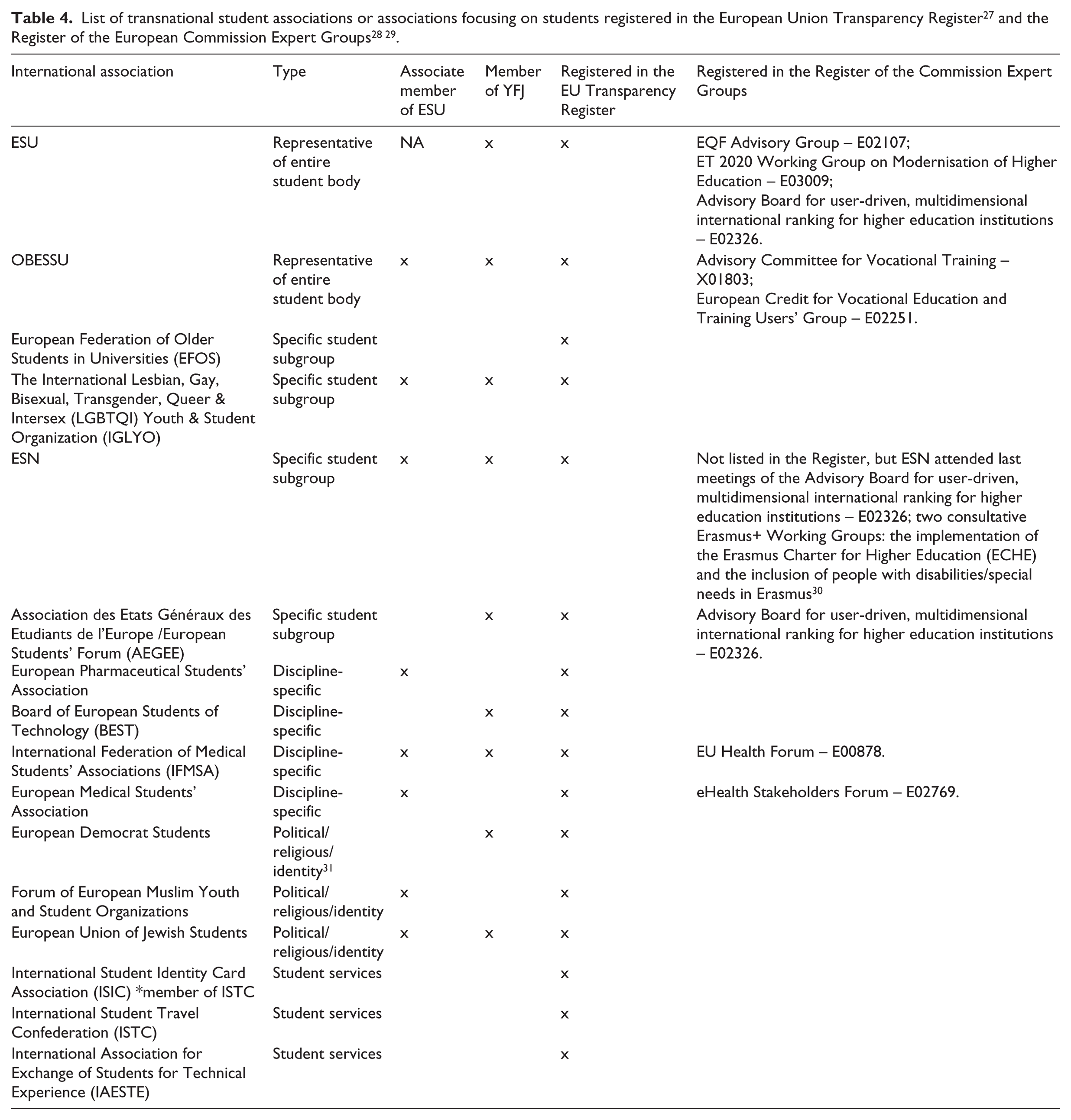
Three transnational student associations are listed in both registers and have explicit interest in European higher education policies: ESU, ESN and European Students’ Forum (AEGEE) (see Table 1 below and see a complete list of all transnational student associations in Table 4 in the Appendix). 8 Although ESN is not listed in the Register of the EU Expert Groups, we have obtained evidence that its representatives attended meetings of the Advisory Board for user-driven, multidimensional international ranking for higher education institutions – E02326, in which ESU and AEGEE also participate, as well as two consultative Erasmus+ Working Groups. 9 Two medical student associations are also listed in both registers, but participate in EU expert groups focusing on health rather than higher education (see Table 4 in Appendix for full list). Therefore, we do not consider them in this article.
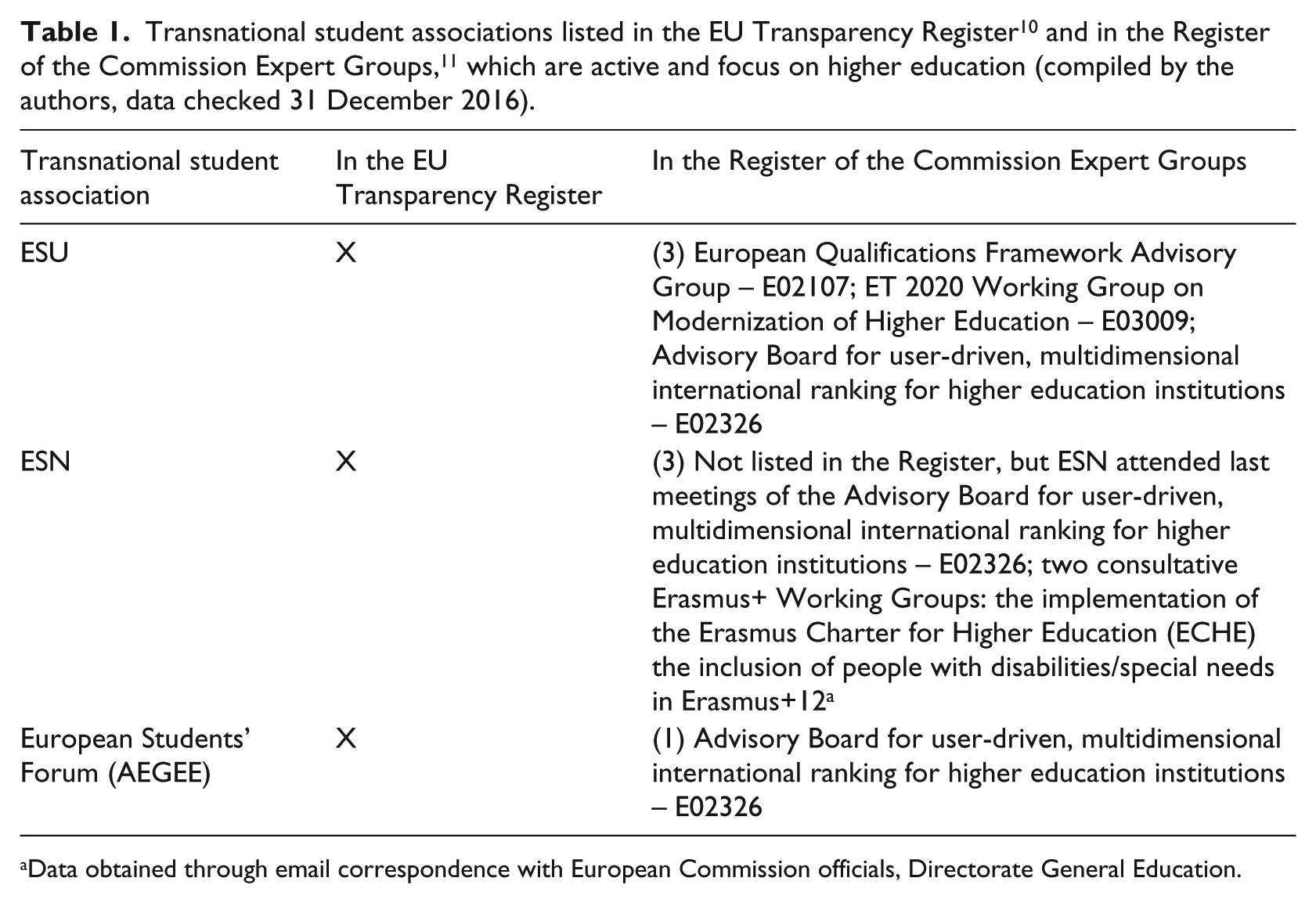
Data obtained through email correspondence with European Commission officials, Directorate General Education.
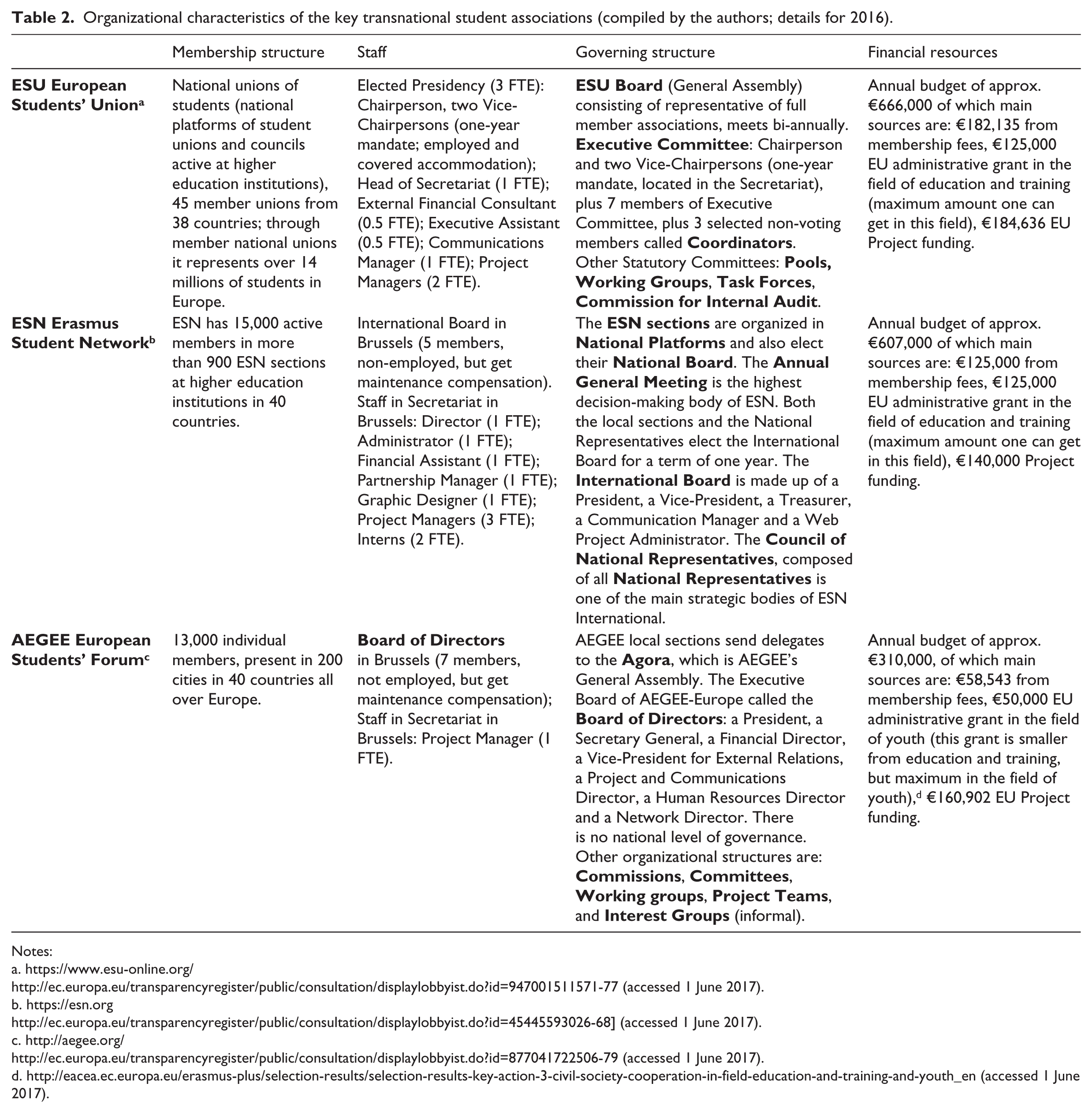
In terms of the four organizational characteristics highlighted earlier, the three student associations share many similarities, but also a few notable differences (see Table 2 for details). They all have transnational mobilization potential since their member organizations or branches or individual members come from different European countries. However, there are significant differences in the extent of their mobilization potential. ESU, as a ‘meta association’ of national platforms of student unions, potentially can – through its member national unions – reach millions of students across Europe. Given its membership structures, this association can also claim to represent the majority of European students. ESN’s and AEGEE’s membership is comparatively much smaller, but they justify their access to European policy making by arguing that they work in the interests of specific groups of students and on issues highly relevant to the EU policy agendas. ESN claims to work in the interests of international students and seeks to support student exchanges, especially through the Erasmus+ Programme, one of the EU’s flagship programmes. AEGEE ‘puts the idea of a unified Europe into practice’ and ‘empowers students and young people in Europe to take an active role in society’. 12
Organizational characteristics of the key transnational student associations (compiled by the authors; details for 2016).
Notes:
http://ec.europa.eu/transparencyregister/public/consultation/displaylobbyist.do?id=947001511571-77 (accessed 1 June 2017).
http://ec.europa.eu/transparencyregister/public/consultation/displaylobbyist.do?id=45445593026-68] (accessed 1 June 2017).
All three associations have headquarters in Brussels. ESU is the only association that employs not only administrative staff but also the elected Presidency: Chairperson and two Vice-Chairpersons. ESN has a well-staffed Secretariat and its elected Board members are also located in Brussels. However, the elected Board members are full-time volunteers with maintenance compensation. AEGEE’s elected seven-member Board of Directors also work as volunteers in the head office in Brussels, and the office is typically supported only by one employed staff member. All associations practise transparent democratic procedures in terms of elections of its representatives into various governing structures. The elections take place through their highest legislative body, where all members are represented. The governance structures of these associations comprise multiple levels reflecting their transnational character and the multi-level governance of the European higher education policies: at the level of individual higher education institutions, at the regional and national levels and the transnational – European – level. Only AEGEE does not have a national level of governance reflecting its membership structure. In terms of financial resources, ESU and ESN have comparable annual budgets of over €600,000, and AEGEE about half that size. All three associations obtain EU administrative grants in addition to membership fees and project funding, which are the three main sources of income. All three associations regularly carry out or participate in EU-funded projects.
In sum, although all three associations are comparable in their organizational characteristics, ESU and ESN stand out in terms of their resources, and ESU in terms of its mobilization potential. As stated by Peter van der Hijden, former European Commission official, [European Students’ Union] ESU is the most influential transnational association because of its general political outlook, its representativeness and its modes of operation … Other associations are appreciated for their sector specific role. They cater for an aspect or niche interest (like student mobility, European integration or doctoral studies) and are therefore supported by the European Commission and consulted when education or research programmes are designed, revised or evaluated. (Email correspondence, 20 September 2016)
In terms of the relationship with other transnational student associations, ESU and ESN have established a rather stable cooperation on higher education issues. In contrast, the cooperation between ESU and AEGEE is less stable (interview, ESU representative, 20 September 2016, personal records). For example, in 2014, AEGEE applied to become an observer of the Steering Committee for Education Policy and Practice (CDPPE) of the Council of Europe, of which ESU is already member, but ESU did not support it and AEGEE was not granted observer status (Council of Europe 2014, point 18). However, the three associations also collaborate. For example, during the 2012 negotiations for the new Erasmus + Programme, ESU, ESN and AEGEE prepared a joint statement calling for adequate support for education and youth programmes in the budget negotiations under the Multiannual Financial Framework 2014–2020 (AEGEE, ESN and ESU 2014).
Pathways for student interest intermediation in the EU and the EHEA
This section explores the two European distinct yet interrelated governance regimes for higher education policies: the EU and the EHEA. When investigating pathways for student interest intermediation in the area of higher education policy in the EU, it is the relationships between transnational student associations and the Higher Education (EAC.B1) unit inside the European Commission’s Directorate General Education and Culture that are relevant. This is the unit which prepares the key EU policies on higher education, such as the Renewed EU Agenda for Higher Education, 13 formulates the objectives of the EU flagship higher education programme, Erasmus+, and participates in the Bologna Process/EHEA structures. Transnational student associations never had any formal intermediation structures with the European Parliament, although they all cultivate relationships with individual members of the Parliament, especially in European Parliament’s Committee on Culture and Education (CULT) or Employment Committee. Likewise, the associations do not have any formal involvement with any structures of the Council of Ministers. However, due to the often-close relations between national student unions and governments, ESU has close contact with several of the member states’ permanent representations, which is less common for other transnational student associations (interview, ESU representative, 20 September 2016). ESU is also the only transnational student association that is regularly invited to the meetings of the EU Directors Generals for Higher Education organized every six months under the rotatory presidency of the Council, and who are able to meet national government officials within the meetings of the BFUG of the EHEA (interview, ESU representative, 20 September 2016). So the key aspect for formal student interest intermediation in the EU lies in the structures of the European Commission, which is not to say that students do not hold informal contacts and seek to influence the European Parliament and the Council. They do, only those relations are not formalized. In EHEA, the involvement of stakeholder associations in policy processes is clearly defined and formalized. However, in contrast to the EU, ESU is the only transnational student association that is involved. The following sections will explore student interest intermediation in each governance regime in turn.
The (overall) pluralist approach of the European Commission
There was a significant policy change in the relationship between the European Commission and interest groups in the early 2000s. Following the concerns about rising ‘democratic deficit’, the EU began to call for more citizen involvement and more transparency in EU decision-making (European Commission, 2001; Johansson and Kalm, 2015). Specifically, the Commission argued in favour of strengthening the role of ‘civil society organizations’ as facilitators of a broad policy dialogue to improve effectiveness, relevance and coherence of EU policies (European Commission, 2002). Consequently, the European Commission made several changes in the EU consultation regime to make it more open, transparent and participatory (Kochler-Koch and Quittkat, 2016). Public consultations, policy forums and platforms became more streamlined, and involvement of stakeholder associations in advisory expert groups more carefully considered. Furthermore, the Commission made available financial support for the formation and administration of European non-governmental organizations and networks (or associations) of non-governmental organizations. Several new civil society organizations were created by the EU to interact with national organizations and participate in EU policy-making (Johansson and Kalm, 2015). These changes happened in the same period as the political interest in higher education strengthened with the adoption of the Lisbon Agenda (European Council, 2000). These two developments together have had profound implications on the involvement of transnational student associations in EU higher education policy-making.
At the end of the 1990s, the relationship between the EU institutions and student associations was predominantly informal and student interest intermediation on higher education issues was intermittent and fragmented among the three transnational student associations – ESU, ESN and AEGEE – and the European Youth Forum (YFJ). Unlike youth policies, where the European Commission applied a corporatist approach and YFJ was its privileged partner, in higher education policies, the Commission’s approach was at the time pluralist. 14 The Commission engaged – independently and sometimes collectively – several student associations as well as YFJ. For example, in 1999, ESU, ESN and AEGEE as well as YFJ were all invited to the Evaluation Group of the Socrates Programme, which was then a key working group of the European Commission (Klemenčič, 2012b).
In 2016, several transnational student associations continued to have access to the European Commission. Judging from the Register of the Commission Expert Groups, ESU, ESN and AEGEE are the ones with whom the Commission has most regular contacts in the area of higher education policy (see Table 2 above). YFJ’s role in higher education policy area diminished to involvement with the European Qualifications Framework (EQF) Advisory Group, which deals with the validation of non-formal and informal learning, and where ESU is also represented. Furthermore, since the early 2000s there has been an implicit understanding between YFJ, ESU and The Organizing Bureau of European School Student Unions (OBESSU) that the former focuses on non-formal and informal education and the latter two have political influence in formal education. ESU and OBESSU, as members of YFJ, cooperate to ensure that YFJ does not encroach politically into the formal education policies, reserving the political influence to ESU in the field of higher education and OBESSU in secondary education and vocational education and training (Interview with ESU representative, April 2016; personal records).
Although the pluralist fashion of involvement remains,
15
the roles that each association plays in the relation to the Commission are now more clearly demarcated. Also, AEGEE’s involvement with higher education policy has become marginal compared to the roles ESU and ESN play. ESU engages with the Commission broadly on issues of higher education policy and through several pathways. Notably, ESU is the only transnational student association represented in the Commission’s ET2020 (Education and Training 2020) Working Group on the Modernization of Higher Education, which is the most strategically important EU expert group in the area of higher education policies (European Commission, 2016). ESN is called on to provide input to the European Commission especially on issues related to the Erasmus+ Programme and student mobility. The only formal involvement of AEGEE is through the U-Multirank Advisory Board (i.e. Advisory Board for user-driven, multidimensional international ranking for higher education institutions), which is one of the Commission-funded projects launching a new ranking tool, and in which ESU and ESN are also represented. Hence, strictly on higher education policies, ESU and ESN stand out as the Commission’s privileged civil society partners. The interview with the officials from the Directorate General Education and Culture confirms this observation drawn from the data from the Register (email correspondence with European Commission official(s), 10 October 2016): ESU and ESN actively participate in consultations and meetings organised by the Commission in the field of education and training, specifically in the field of higher education. In particular, ESN is a member of two consultative Erasmus+ Working Groups in the field of higher education, one dealing with the implementation of the Erasmus Charter for Higher Education (ECHE) and another one on the inclusion of people with disabilities/special needs in Erasmus+. ESU is one of the civil society partners in the ET2020 Working Group on Modernisation of Higher Education. Furthermore, ESU participates in regular meetings co-organised and funded by the European Commission e.g. DG HE. The Commission and ESU also meet regularly as member and consultative member, respectively, of the Bologna Process.
Interestingly, the interview also revealed involvement of another, more recently established, transnational student association: The Erasmus+ Student and Alumni Association (ESAA): Another body the Commission works with is the Erasmus+ Student and Alumni Association (ESAA). As an umbrella organisation, ESAA brings together four existing organisations, which continue to operate independently from the Commission: Erasmus Student Network (ESN), the Erasmus Mundus Association (EMA), OCEANS Network and garagErasmus … A service contract was established by the European Commission in 2014 to provide a common platform to support logistically and financially the joint activities within ESAA. ESAA is also a member of the consultative Erasmus+ Working Group in the field of higher education dealing with the implementation of the Erasmus Charter for Higher Education (ECHE). (email correspondence with European Commission official(s), 10 October 2016)
It is not uncommon for the European Commission to support the establishment of transnational stakeholder platforms. This is in line with the stated objectives in the White Paper on Governance (European Commission, 2001) and the general principles and minimum standards for consultation of interested parties with the Commission (European Commission, 2002) mentioned earlier. In the past, both AEGEE and ESN were established with the involvement and support of the European Commission (personal records). In 2014, ICUnet.AG, a German consulting firm, won the tender of €1 million to act as a service provider for ESAA activities between 2014–2018, which effectively established the ESAA.
16 17
ESAA’s Board is the main governing body and is composed of ten members nominated by the four organizations constituting ESAA.
18
Similarly, the European Commission has also supported the establishment of the Lifelong Learning Platform (LLL Platform). The LLL Platform was initiated in 2004 by six NGOs (AEGEE among them) as a consultation platform open to all interested civil society actors in the field of education and training. Over the years, the platform has grown (ESU and ESN also joined) to represent 39 European organizations, covering all education sectors and various stakeholder associations involved in them (email correspondence with a representative from the LLL Platform, 20 September 2016). The aim of the platform is, as stated by a platform representative: [t]o bring a common voice to the [European Commission] (but also [European Parliament]) on education issues … We support members’ activities in this regard, promote it and give them the channels to raise awareness about [the] sector’s specific needs. Let’s say in a way we try to facilitate the communication with the [European Commission] for the members … LLLP has seats in EQF, ET2020 thematic groups such as Citizenship and Digital Skills. (email correspondence with a representative from the LLL Platform, 20 September 2016)
Large scale civil society platforms or networks comprised of meta stakeholder associations, such as ESAA, LLL Platform or European Youth Forum, create certain order in the complexity and large numbers of interest groups interacting with the European Commission. They present an efficient way of strengthening the dialogue with civil society organizations and thus making the EU consultation regime more open and participatory. These platforms thus play a special role in EU policy regime, and ‘present a good networking opportunity’ for stakeholder associations (interview, ESU representative, 20 September 2016). 19
Important developments in the relations between the European Commission and the transnational student associations is also in the funding arrangements. Since 1999, the European Commission has also revised the administrative support to transnational student associations. The administrative grant all transnational student associations obtained from the EU in 1999 was part of the European Commission action line supporting international non-governmental youth organizations, which was negotiated by YFJ. The amount obtained by these associations was around €19,000, similar across all youth associations, and only a fraction of the administrative grant by the YFJ. The current operating grants to associations from the European Commission come from the ‘Erasmus+ Key Action 3 – Civil Society Cooperation: Education and Training’, which has two funding instruments. One instrument is operating support for associations active in the field of education and training. In 2014, ESU was granted €125,000 per year, the same as ESN (Erasmus + Call for Proposal EACEA/31/2014 Civil Society Cooperation – Education and Training). 20 Under the youth call, eight other European transnational student associations received funding of up to €50,000 per year, AEGEE among them. 21 YFJ has retained its special funding status, 22 which is explained in the Evaluation Report of YFJ: ‘the policy input and feedback provided by the YFJ is considered to be very important by the EC. Having one platform that generates inputs from the wider youth field is a useful instrument to structure and channel opinions and inputs’ (Ecorys, 2013). Hence, the new operational grants received by ESU and ESN also testify of their special position in the area of higher education policy. However, their funding is far from being on a par with the operational grant received by YFJ for its role as representative of youth interests.
In sum, from 1999 until 2016, formal pathways for student interest intermediation in the European Commission’s policy processes have increased with the number of EU expert groups working in higher education policy. ESU and ESN are clearly privileged partners, whereas the role of AEGEE and YFJ is marginal in this area. Unlike AEGEE, ESU and ESN are also among the key associations active in the field of education which obtain the special operational grants from the Commission. The reasons for this development are twofold. One is in a more developed EU consultation regime, in which the Commission structures make more transparent and considered choices of expertise and representativity each student association can bring into the policy process. The other is in the professionalization of these associations, which was also aided by the access these have to EU operational grants and project funding. Apart from the operational grants mentioned earlier, all of the three associations also receive ample EU funding for projects (see Table 2 for details).
The representational monopoly of ESU in EHEA
The Bologna Process which established EHEA was already in its early years conceived as a more policy-network-like model of governance, distancing itself from the bureaucratic ideal of the predominance of state actors. The intended outcome of EHEA is policy convergence across the member countries, which means that formal decisions are taken by the member states to align their national policies and strategies (or if you like, their higher education steering documents) with the policy objectives agreed in the context of the Bologna Process. These policies are formulated as non-binding rules and voluntary commitments, which – although ultimately decided by state actors – are nevertheless developed by both government representatives and representatives of transnational stakeholder associations. The involvement of stakeholder associations in all governance structures and all stages of the policy process is an essential element of the EHEA governance and affirmed as such in its policy documents. Student involvement in EHEA governance as a policy objective has been specifically reaffirmed by the Ministers in several of the Ministerial Communiqués, which are the main EHEA steering documents (Klemenčič, 2012b, 2012c). In other words, the governance structures of EHEA reflect what Gornitzka and Sverdrup (2015: 151) call the principle of ‘legitimacy from below’ whereby the governments involved in policy coordination seek to directly connect to the associations representing stakeholders whom these policies are supposed to serve. Stakeholder associations are involved as consultative members in all governing structures and its working bodies, which grants them access to policy processes, even if without formal voting rights.
In EHEA, ESU is the only transnational student association that participates in governing structures. The reasons for this arrangement are twofold. First, the Bologna Process was initiated by several governments, and in those respective countries national student unions play a visible role in higher education politics. National unions lobbied the governments to involve ESU in the Bologna Process and so they did. The European Commission, which argued in favour of involving all three student associations, had a limited influence in the early stages of the Process. Second, once ESU became involved, which was very early in the Bologna Process, it worked towards consolidating its position as a consultative member and implicitly ensured that no other association joined. 23
Moreover, as Table 3 below displays, ESU secured a seat in all EHEA governing bodies and advisory and working groups. Notably, ESU also co-chairs the strategic working group on policy developments for the new EHEA goals. Thus, in EHEA there exist several formal pathways for student involvement, and student interests are represented by ESU.
ESU’s involvement in the EHEA structures (Source: Bologna Process, BFUG Work Programme 2015–2018).
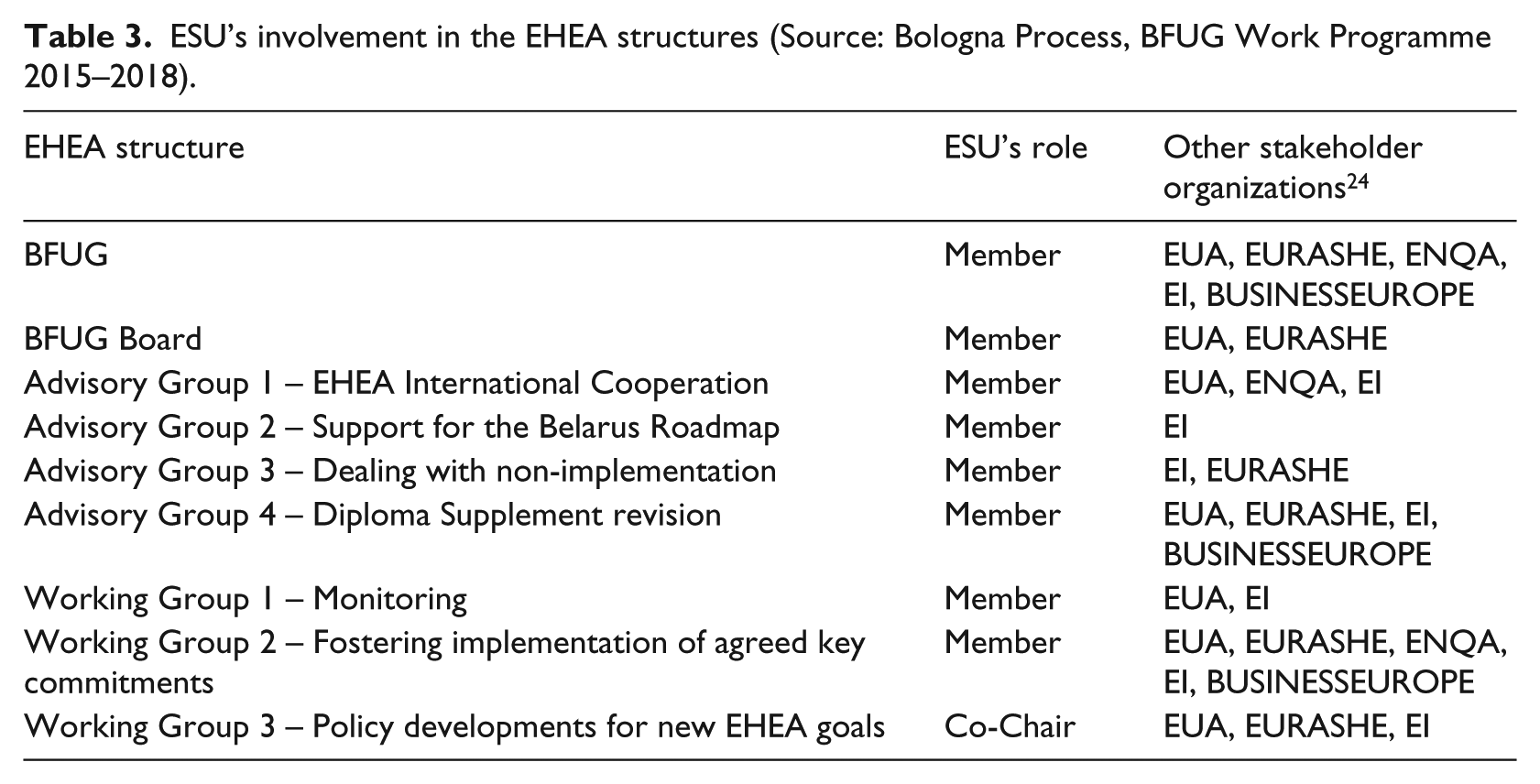
As in any transnational policy regime, the Ministerial (i.e. political) level tends to be involved only when it comes to the overall policy objectives and the most contentious issues. The agenda-setting, policy drafting and policy implementation tend to be handled by the experts. In the case of EHEA, these experts include government officials from member states, officials from international organizations and stakeholder representatives, ESU among them. EHEA policies have comprised some highly technical issues, such as the structure of the degree systems, national qualification frameworks, standards and guidelines for quality assurance, the European Credit Transfer System, etc. Such policy agenda has even further increased the influence of policy experts whose involvement as a rule tends to intensify the more technically complex the issues become. Through the EHEA structure, ESU not only had a significant opportunity to influence EHEA policies but also to regularly and frequently socialize with all key policy actors within the EHEA.
There are several concrete examples of ESU’s influence on policy outcomes, including the inclusion of the ‘Social Dimension’ within the priority lines in the Prague Communiqué in 2001 (Klemenčič, 2012b), and the introduction of a paradigm shift towards ‘Student-Centred Learning’ in the London Communiqué (2007) (Klemenčič, 2017). EHEA’s governing structures also engage in periodic monitoring and evaluation of the implementation of the reforms against established benchmarks. BFUG has had a role to monitor the implementation of the Bologna recommendations through ‘National reports regarding the Bologna Process implementation’ and then publish an international comparative analysis as ‘stocktaking reports’ or concretely the Bologna Process Implementation Reports prior to the Ministerial summits. Since 2003, ESU has published and submitted to the Ministerial Conference the ‘Bologna with Student Eyes’, which reports the views of national student unions on the implementation of the Bologna Process. In 2016, agreement was reached by BFUG (Bologna Process, BFUG Outcomes of Procedures, 7–8 March 2016) to incorporate information collected by ESU for ‘Bologna with Student Eyes’ into the official Bologna Implementation Report, which gives ESU’s findings additional leverage. Until 2016, those reports were based only on statistical data from Eurostat and Eurydice and from the national reports submitted by governments. ESU has been involved in the so-called E4 Group consisting of ENQA, EUA and EURASHE, which was mandated a task to formulate the European Standards and Guidelines 25 and to establish EQAR 26 (E4 Group, 2013). ESU has been directly associated with the addition of a new standard on student-centred learning in the revised Standards and Guidelines for Quality Assurance in EHEA (Klemenčič, 2017); and the involvement of students in quality assurance activities, both internal and external, as a mandatory aspect for higher education institutions and quality assurance agencies (Jungblut et al., 2015).
In conclusion, the involvement of ESU and other stakeholder associations in the governance of higher education polices in EHEA is not the least as a consequence of a lack of government authority in this policy area. Rather, it is a reflection of a more complex and fluid set of authority relations and roles that have been constructed within EHEA. Stakeholder involvement, which necessarily includes student representatives, has been seen as a legitimizing condition and crucial for the implementation of EHEA. ESU has helped build collective norms and values within the EHEA which acknowledge the importance of student participation in higher education governance at all levels (Klemenčič, 2012b, 2012c).
Concluding remarks
EHEA and EU are two distinct yet interconnected arenas of European-level higher education policy-making. They are similar in that both are multi-level governance regimes in the sense that there exist multiple levels of policy-making processes: on the national level where member countries decide on their preferences, often within regional networks which serve as sources of information and coalition-building and further shape the national preferences, and finally on the European level. In both arenas, the formal authority over higher education policy-making lies in the hands of national governments; however, in many ways this authority is diffused and shared with stakeholder associations, one of which is transnational student associations. The strong presence of transnational student associations in European policy-making is a manifestation of the multi-level character of European interest intermediation. The opportunity structures for collective student interest intermediation expanded significantly from 1999 until 2016. This is due to more extensive European intergovernmental cooperation within the area of higher education within the Bologna Process and also within the EU. Furthermore, the EU is further developing civil society consultation and has done so both in creating more formal pathways for involvement and by boosting operational grants to associations.
The three key transnational student associations active in European higher education policy are ESU, ESN and AEGEE. They are similar in terms of their organizational characteristics, but ESU and ESN surpass AEGEE in financial resources, and ESU surpasses the others in terms of employed staff in Secretariat and mobilization potential based on the membership structure. The findings regarding formal pathways for student interest intermediation in European governance of higher education policies point to two distinct models. Within the EU, the European Commission interacts in pluralist fashion with all three transnational student associations; however, ESU and ESN are consulted in the more strategically important expert and working groups. Since 1999, the role that each association plays in relation to the Commission have become more clearly demarcated and functionally differentiated. EHEA has a highly developed formal structure for stakeholder involvement in policy processes. Within EHEA, in neo-corporatist fashion, ESU, as a representative platform of national student unions, holds representational monopoly in the EHEA and the EU. The involvement of transnational student associations in European governance of higher education policies can be attributed both in the EU and EHEA to the evolving nature of transnational governance regimes in which participation of transnational student associations not only brings expertise to but also aids legitimacy of the policy processes and outcomes.
Footnotes
Appendix
List of transnational student associations or associations focusing on students registered in the European Union Transparency Register 27 and the Register of the European Commission Expert Groups 28 29 .
| International association | Type | Associate member of ESU | Member of YFJ | Registered in the EU Transparency Register | Registered in the Register of the Commission Expert Groups |
|---|---|---|---|---|---|
| ESU | Representative of entire student body | NA | x | x | EQF Advisory Group – E02107; ET 2020 Working Group on Modernisation of Higher Education – E03009; Advisory Board for user-driven, multidimensional international ranking for higher education institutions – E02326. |
| OBESSU | Representative of entire student body | x | x | x | Advisory Committee for Vocational Training – X01803; European Credit for Vocational Education and Training Users’ Group – E02251. |
| European Federation of Older Students in Universities (EFOS) | Specific student subgroup | x | |||
| The International Lesbian, Gay, Bisexual, Transgender, Queer & Intersex (LGBTQI) Youth & Student Organization (IGLYO) | Specific student subgroup | x | x | x | |
| ESN | Specific student subgroup | x | x | x | Not listed in the Register, but ESN attended last meetings of the Advisory Board for user-driven, multidimensional international ranking for higher education institutions – E02326; two consultative Erasmus+ Working Groups: the implementation of the Erasmus Charter for Higher Education (ECHE) and the inclusion of people with disabilities/special needs in Erasmus 30 |
| Association des Etats Généraux des Etudiants de l’Europe /European Students’ Forum (AEGEE) | Specific student subgroup | x | x | Advisory Board for user-driven, multidimensional international ranking for higher education institutions – E02326. | |
| European Pharmaceutical Students’ Association | Discipline-specific | x | x | ||
| Board of European Students of Technology (BEST) | Discipline-specific | x | x | ||
| International Federation of Medical Students’ Associations (IFMSA) | Discipline-specific | x | x | x | EU Health Forum – E00878. |
| European Medical Students’ Association | Discipline-specific | x | x | eHealth Stakeholders Forum – E02769. | |
| European Democrat Students | Political/religious/identity 31 | x | x | ||
| Forum of European Muslim Youth and Student Organizations | Political/religious/identity | x | x | ||
| European Union of Jewish Students | Political/religious/identity | x | x | x | |
| International Student Identity Card Association (ISIC) *member of ISTC | Student services | x | |||
| International Student Travel Confederation (ISTC) | Student services | x | |||
| International Association for Exchange of Students for Technical Experience (IAESTE) | Student services | x |
Acknowledgements
The authors would like to thank all interviewees for their valuable input, to the anonymous reviewers for their feedback on earlier versions of the article and to the guest editors of this special issue for their guidance and feedback, and for giving us the opportunity to participate at the workshop hosted in May 2016 by ExCID (Expert cultures and institutional dynamics: Studies in higher education and work), a research group at the Department of Education, University of Oslo (Norway).
Declaration of Conflicting Interests
The author(s) declared no potential conflicts of interest with respect to the research, authorship, and/or publication of this article.
Funding
The author(s) received no financial support for the research, authorship, and/or publication of this article.
Notes
Author biographies
 .
.