




Abstract
This paper discusses the workings of the European Semester (ES) in relation to the policy field of education. My study shows how the ES enables the steering of education policy through encouraging specific economic and employment-related actions by European Union (EU) member states. With a focus on the relationship between the EU institutions and member states, this paper examines how the ES discursively promotes certain approaches to education through country-specific recommendations (CSRs). In this study, CSRs are revealed as policy spaces where European and national interests are brought together, enabling shared problem definition and collective learning. The paper illustrates how policy moves through translation and negotiation in the construction of CSR. The evidence drawn on here comes from analysis of CSRs in 2011–2016 and 15 semi-structured interviews with key policy actors, mainly from the European Commission, Council and Parliament. This paper concludes that CSRs work through soft power to manage governing tensions through translation and by building convergence and consensus. The analysis is framed theoretically by research on governing and knowledge and draws on a social constructivist perspective on policy work.
Introduction
This paper illustrates how governing of education works through a policy instrument, the European Semester (ES), constituted through a process of translation of meanings about policy and purpose. I draw on a body of research and data to show how compliance develops when actors feel that they are co-constructing policy that provides a legitimacy for policy attraction and action at national level. Despite the principle of subsidiarity, education is becoming a significant policy area in European Union (EU) policymaking. Indeed, I argue that education is no longer perceived as an exclusive arena of national policy but is established as a site of EU policymaking. In the context of the new global economy, policymakers have shifted their focus from the domestic level to global arenas where standards, indicators and benchmarks are no longer restricted to national fora and providers but involve growing numbers of transnational actors (Grek, 2020). The research on governing and knowledge (e.g. Fenwick et al., 2014; Lawn and Grek, 2012; Normand, 2016; Ozga, 2014) identifies a new governance situation which makes use of persuasion and attraction concealing the traditional power relations (Ozga, 2020). This paper then explores how the ES may produce legitimised regulation, or persuasive power, through the development of shared indicators and common policy targets. I suggest that the ES uses soft power to build convergence, stability and competitiveness discursively in Europe through education. I argue that what started as the Open Method of Coordination (OMC) (e.g. Haahr and Walters, 2004) seems to have developed into an arena of more regulated EU-wide soft policy coordination in the field of education. I use the notion of translation to understand how education policy is constituted and recontextualised in the ES. That is, how policy is been constructed between various actors and locations that connect to different agencies (Ozga and Dubois-Shaik, 2015).
I suggest that the ES has treated education broadly, as a tool for social and economic policy blurring the boundaries of policy sectors. One obvious indicator is the emergence of education in the ES in the first place. Indeed, EU policymaking has implications for education although it might not directly refer to education as a domain of policy due to the principle of subsidiarity. However, my argument here is not that the European Commission’s (EC) tendency to streamline all social policy coordination through European Union would indicate a decline in the powers of nation-states or suggest an increase of policy activity in the field of education (cf. Zeitlin and Vanhercke, 2018). The ES is primarily designed as an instrument to regulate fiscal policy and it constitutes the framework for the EU’s annual cycle of economic policy guidance and surveillance (EC, 2020a). It was established in 2010 in the aftermath of the economic crisis largely to monitor EU member states’ economic and budgetary policies, and steer member states towards social policies that support economic recovery and growth (EC, 2020b). The instrument consists of various policy instruments or, in ‘the Commission’s speak’, legislative packages 1 that are coordinated within the ES cycle. The monitoring is implemented in Country-Specific Recommendations (CSRs) which the European Commission addresses to each member state every year. In their official capacity, CSRs provide ‘tailored advice on how to boost jobs and growth, while maintaining sound public finances’ in line with the EU’s Europe 2020 strategy (EC, 2015: paragraph 1). Although some of these recommendations have been aimed at specific levels of education, education is still primarily considered through broader references to skills and labour market needs.
The question arises as to how education policy is constituted as part of a policy instrument that seems to have become a formalised practice and is able to produce compliance. In what follows, I outline how the ES as an instrument of soft power creates identification, through specific standards and shared meanings of the ‘common’ project to ‘recover’ Europe, and discuss the consequences for the governing of education. As Ozga (2020) puts it, these developments ‘erase the political from the governing of education, obscuring the interplay and conflict of different interests and masking the operation of power relations’ (p. 5). Examples of literature show how education policy is coordinated through various EU-level instruments and mechanisms which embed the work of governing as illustrated in the policy development of adult education (Milana et al., 2019). Here I draw on soft power as a concept that captures the influence and ability to affect and entice without coercion. In simplified terms it is a form of power that does not use enforcement or compel by force of authority. Drawing on Nye’s (1990) definition, soft power ‘rests on the ability to shape the preferences of others’ (Nye, 2008: 95). In terms of policy attraction, soft power works through creating a cultural or ideological identification with the rules and institutions of international regimes (Nye, 1990: 168). It operates discursively through negotiation and consensus-building formations, constructing common practices and shared values. The focus on soft power is relevant to my enquiry because power is becoming ‘less transferable, less tangible and less coercive’ in the knowledge economy era (Nye, 2007: 63).
The European Semester and the framing of education policy
Education has been somewhat absent in the existing literature on the ES. The instrument’s educational content has been broadly identified as part of the ‘social dimension’ of EU governance, perhaps reflecting the importance of streamlining key policy areas in Europe today to help in times of crisis. Thus far recent scholarship has approached the instrument mainly from a legal perspective (Bekker, 2015), whereas other scholarly work centres on the CSRs and their implementation in national contexts (e.g. Zuleeg, 2015), or on the role national parliaments play under the ES (e.g. Hallerberg et al., 2018). Several authors have considered the impact of the ES on health policy (e.g. Azzopardi-Muscat et al., 2015) and social policy (Copeland and Daly, 2018; Verdun and Zeitlin, 2018). Yet, some observations have focussed on scrutinising education policy in the ES (e.g. Antunes, 2016; Stevenson et al., 2017), and its connectedness to other policy instruments, including the European Social Funds (e.g. Sorensen et al., 2021). This article provides complementary views on education policy to supplement these existing reviews on the instrument.
The first European Semester cycle took place in 2011 and has completed in total 10 rounds of country-specific recommendation during EU 2020 (see Figure 1). The ES has changed its shape and form over the course of its existence and during the period of this research: its implementation cycle has evolved and the policy framework expanded. Although the ES is presented as independent, it also draws on and possibly shapes the lives of the other interconnected but separate instruments as illustrated in the EC’s official ES timeline (see Figure 1).
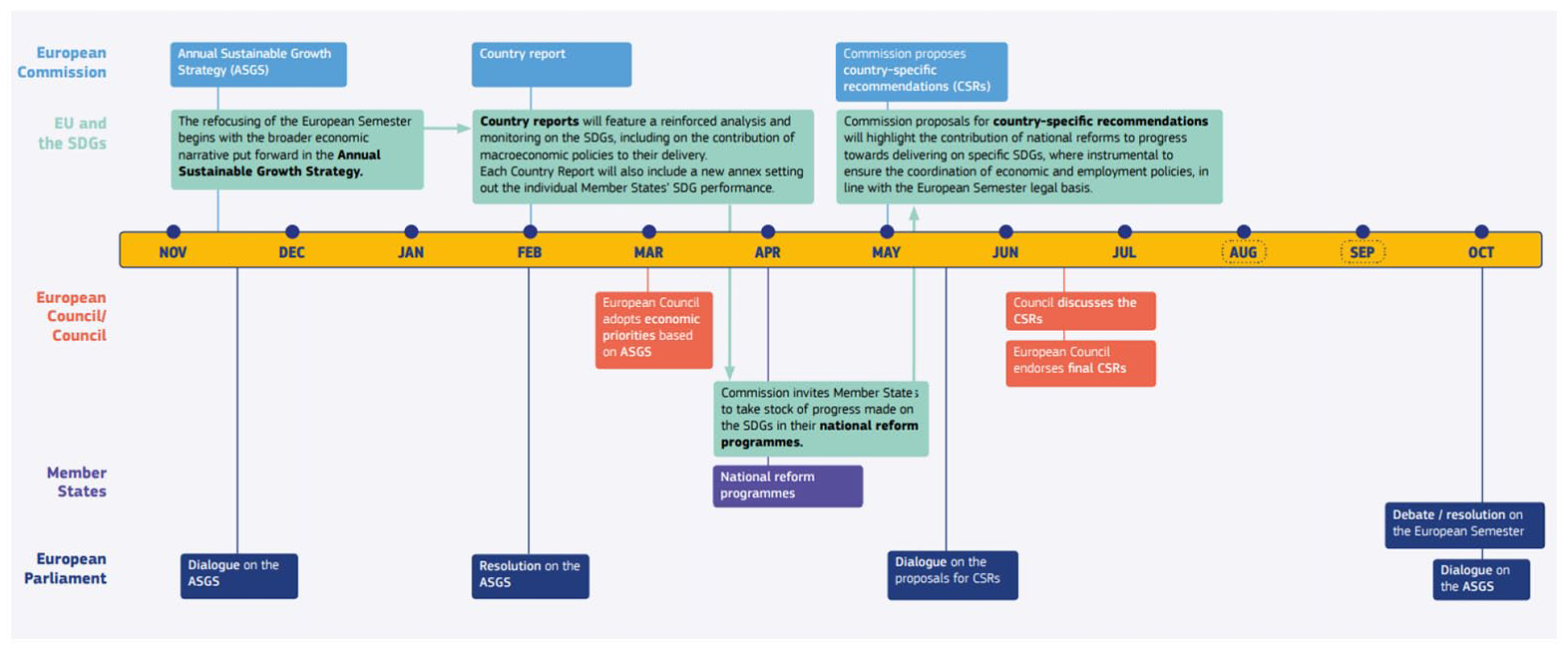
Timeline for the European Semester.
Figure 1 depicts how the instrument is driven by the complex set of standardisation and comparison of performance (i.e. the benchmarking for EU 2020) that assume convergence. The ES functions not merely as policy text but it also provides a space to cultivate a bond through governing activity that keeps the instrument alive (Freeman, 2017a). Following Latour (1990), the negotiation process sets the ES ‘in motion’: if policy actors can cohere around common policy terms, the ES will ‘move’. Therefore, the process of co-constructing country-specific recommendations provides legitimacy which builds convergence – allowing soft power to do the governing work. I use the country-specific recommendations and the governing work surrounding their construction as an example to investigate the interactions which enable consensus-building ‘on paper’. The CSRs as policy text possess problems, purposes and agencies held by actors in different social worlds, which may become converted and incorporated into the instrument (Carvalho, 2014). That is, policy instruments are socially constructed and connected to policy targets and goals that draw on data and indicators which are also based on negotiated consensus between various policy actors. For example, the EU countries have translated the EU-level (EU 2020) targets into national targets, each year reporting on their actions to meet these targets via the ES policy cycle. This process illustrates a practice of translation (Freeman, 2009) that takes place within and through various ES activities, shaping knowledge production and use.
Translation as a term is assigned different meanings in the scholarly literature. I draw on sociological approaches that consider translation in connection with policy and practice (e.g. Freeman, 2017b). Therefore, ‘translation’ is here understood as meaning-making of social interaction in policy practice. It allows policy actors to adhere with different worldviews to common objects of interest because ‘translation takes place within discourses in which some kinds of association or translation are legitimated and authorised just as others are excluded or denied’ (Freeman, 2009: 434). I focus on the work of translation; that is, the tools and practices it cultivates and explore them in the meeting-making and drafting of ES policy. I attempt to ‘study up’ how the construction of CSRs generates governing practises in which translation operates.
I draw on scholarly work that place emphasis on processes that replace traditional governing forms, laws and regulation (e.g. Lawn and Grek, 2012; Ozga et al., 2011). Grounded on this perspective, I apply a socio-constructivist enquiry that allows me to look beyond the institutional hierarchies and the rules of representation, focussing on social relationships through discourse (Fairclough and Wodak, 2008). I examine the ES as open to meditation (Jacobsson, 2006) and translation rather than through the ‘top down’ or ‘bottom-up’ actions of institutions and structures. In lieu of scrutinising evidence of policy capacity or policy implications, I focus on the operation of soft mechanisms in constructing, mobilising and monitoring ES policy content.
The formal EU framework does not acknowledge the ways in which policy actors use technical knowledge, such as the objectives of the EU 2020, to build, negotiate and translate policy. I suggest that this development can be comprehended not only as a method but also as a political solution achieved by coordinating and transforming national governing practices to correspond to European and international indicators (Nóvoa and Yariv-Mashal, 2003). Translation becomes the means to develop governing practices cultivated in the ES as it provides capacity to foster peer learning and co-construction of policy, appearing to dissolve or naturalise political disposition. The translation work is then an interaction in which actors are also defined by the translation process itself and by other actors (Freeman, 2009). In this frame, translation is a means but also an end product of policymaking (Freeman, 2017a).
Research context and design
I understand discourses as a medium of soft power. They co-opt actors into shared meanings and values held by specific groups or institutions, projecting an imaginary of a world that is attractive to those actors. Thus, my empirical approach follows the emphasis on understanding language as a form of social practice. I examine the interaction between texts and talk in the production of country-specific recommendations, investigating how they, as policy texts, create common meanings and rhetoric ‘containing the problems, ideas, and purposes which move between actors and locations and are replicated at different levels of the governing practices’ (Freeman, 2009: 431). Indeed, CSR policy texts connect different forms of agency in different settings (Stritzel, 2017). I approach policy construction as a process of learning and socialisation (Grek, 2017) in which a common discourse on a certain topic or field is created. The interview and documentary data presented here illuminate how the meaning-making of policy purpose is processed and synthesised into country-specific indicators and benchmarks.
In framing my methodological enquiry, I followed Grek (2015: 38) in conceptualising policy as a sharing and cooperative activity, focussing on the social dimension of policy. I identified discursive key concepts and terms emerging from policy text: They focussed on ‘economising’ themes – efficiency, competitiveness, performance and skills. These key concepts informed the data analysis and coding procedures. I used a semi-structured interview format in my sampling design. The interviewees were selected based on gained access but also on the networks they belonged to. The primary interviewees also provided me with contacts for other policy actors within their networks, therefore having a ‘snowball’ effect on the original sampling during my fieldwork.
The content and discourse analysis 2 focussed primarily on country-specific recommendations in 2011–2016 coupled with selected interviews with key actors involved in the construction of the instrument. The analysis was conducted on the final versions of the CSRs which were approved by the European Council (hereafter ‘Council’). These ‘final’ versions of the recommendations were preceded by several drafting and re-drafting stages that involved various actors in the EC, Council, EP and member states. In total 165 3 education-related CSRs were analysed alongside other policy documents related to the ES, such as National Reform Programmes 4 (NRP) and country reports, 5 which supplied complementary knowledge about benchmarking in the ES. The thematic interviews were conducted during 2015–2017 with 15 policy actors consisting of MEPs, high-ranking officials, academic experts and national representatives possessing specialised knowledge of benchmarking in the ES. Themes for interview discussions derived from the discourse analysis of aforementioned ES policy documents selected CSRs. The data also encompassed publicly available meeting documents, email correspondence with the interviewees and my personal fieldwork notes – all of which contextualised and supported my interview data.
Grounded on the research described above, the documentary analysis was based on the CSR policy texts that addressed education(al) elements. The mapping of education-policy related CSRs would itself be a topic of a research paper as there are various ways of defining the particular country-specific recommendations that are regarded as ‘education’. The selection of CSRs was scrutinised by examining all Council’s recommendations between 2011 and 2016. Instead of identifying educational content as we traditionally understand ‘education’ within the EU official framework, I refined the discourses that constructed education-related recommendations and referred to them as ‘borderline recommendations’. I have reported this discourse analysis in more detail elsewhere (see Eeva, 2019). These borderline recommendations are identified in the next section but, in short, they seem to spill over into other policy fields – namely economic, employment and social.
The content analysis of the education-related country-specific recommendations between 2011 and 2016 contributes to the existing literature on the ES by (a) illustrating the changing landscape of education governance and (b) identifying the implications for education policymaking in the European Union. Inevitably, CSRs can be read and data presented in alternative ways. The common practice, especially in the literature of political sociology, is to view education-related recommendations as part of the social and employment objectives (e.g. Zeitlin and Vanhercke, 2018) or justified by the ‘EU convention’ (Copeland and Daly, 2018: 1004). With a focus on the relationship between the EU institutions and member states, I address the interactions and processes in the production of ES policy rather than specific policy outcomes. That is, how ‘education’ becomes encapsulated in the CSRs and is conceptualised in the policymaking of the ES.
Co-constructing the European Semester
I present here how education is conceptualised in the country-specific recommendations and then discuss the interaction that defines the policy text and constitutes representation. On this basis, I look at (1) CSRs policy formulation as it relates to education; (2) the interplay between various actors in the construction of the instrument; and, (3) practices cultivated in the governing work of the ES. First, the analysis suggests that education policy has increasingly become associated with employment and economic policies. I argue that the ES operates discursively, through elements of soft power expressed in the country-specific recommendations, suggesting an overarching policy discourse of socio-economising education.
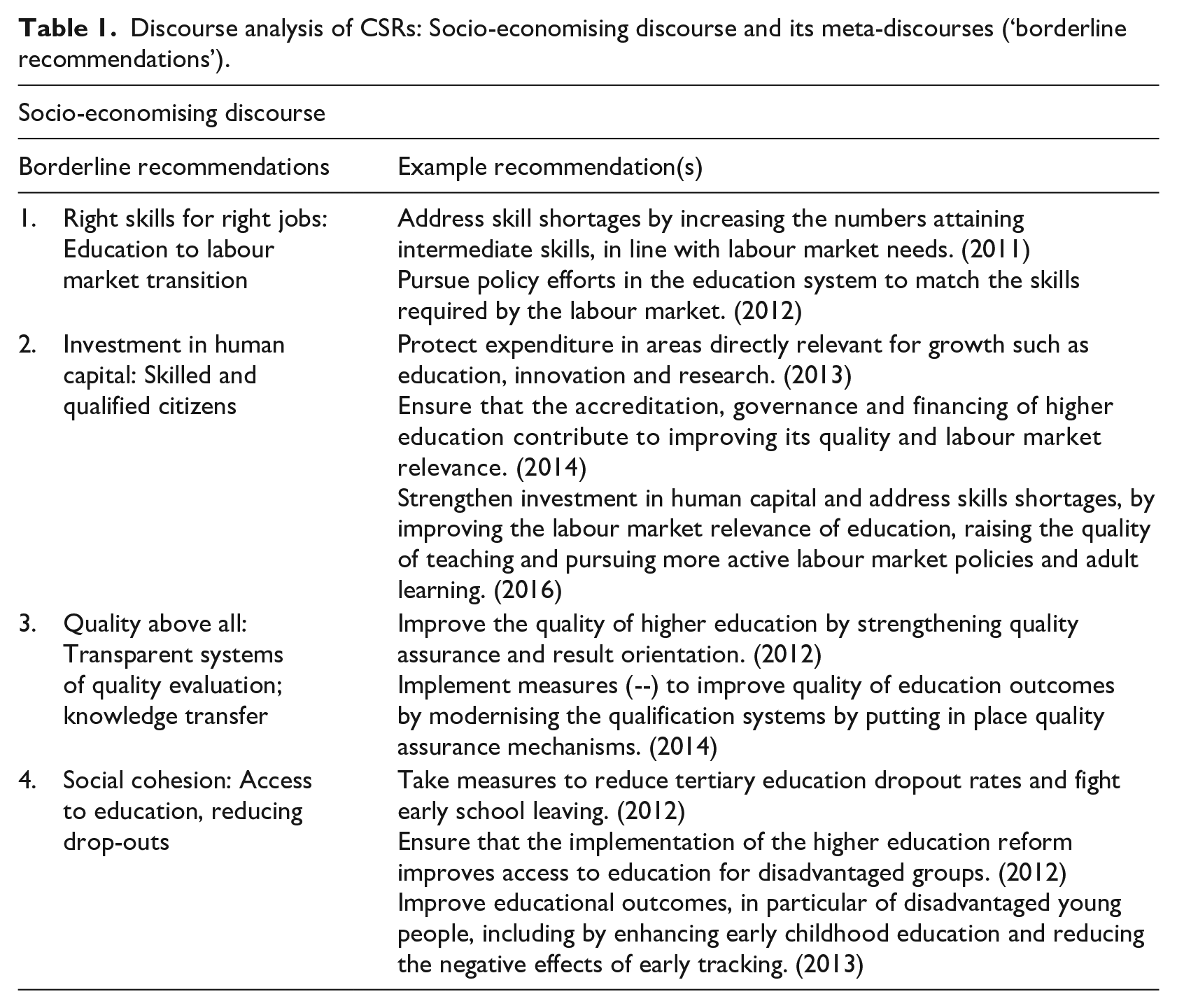
Thus, this paper contributes to wider scholarly debate on the narrative of economisation of education. It connects to the prominent discourse of education performance that is often indicated in data, numbers and standards reflecting the economisation of education (see e.g. Carney, 2012; Ozga, 2008; Steiner-Khamsi, 2004). The meta-narratives emerging from the overarching policy discourse are illustrated in Table 1: the Right skills for the right jobs; Investment in human capital; Quality assurance; and Social cohesion. They indicate how education policymaking is now in a close relationship with economic policy. The knowledge production in the ES policy framework is realised through demands of the knowledge economy effectuated by neoliberal approaches to the economy and governance that put the emphasis on investing in human capital in an ‘audit state’ (Ranson, 2003: 466).
Discourse analysis of CSRs: Socio-economising discourse and its meta-discourses (‘borderline recommendations’).
The analysis of the interview data reveals that a consensus on the role of education as a tool for economic recovery enables policy actors to create a governing discourse based on the ES indicators and country-specific recommendations which provide accountability for policymakers. In this context, I argue that CSRs provide a platform where policy can take shape: it allows conflicting ideas and interests to be encapsulated in a consensual way into policy text. In the Commission language, the CSRs are considered as the main tool for evaluating the implementation of the ES and for collecting data to help monitor economic developments in EU member states through common indicators and benchmarks (EC, 2020d). This also seems to reflect and draw comparison to the global economy.
The analysis of the country-specific recommendations shows that the discourse emerging from the policy documents relates to the European-wide, common benchmarks underpinning the EU 2020 strategy. Discourses, such as the socio-economisation of education, provide a way to see how knowledge is operationalised into shared meanings and common understandings as is exemplified by the ‘translation’ or ‘naturalisation’ of the EU 2020 benchmarks into national contexts. These indicators, then, become governing resources enabling policy actors to steer policy through consensus about best practices, a form of soft power. Discourses operate as soft power when they are grounded in information that is presented as evidence-based and reliable (Nye, 2008: 99). Specific knowledge forms such as comparative performance data, often expressed in benchmarks and indicators, provide such legitimacy when they are encapsulated in discourses (Stone, 2013). Moreover, discourses produced by influential sources or actors are attractive (Nye, 2008: 100); their credibility is often acquired in social interaction and through social practices.
Second, soft power takes place through the brokering work in the EU-national interaction resulting in policy reforms which derive from meditative activities (Jacobsson, 2006). This quotation from the European Commission illustrates the capacity assigned for the ES to manage the national-EU interplay and brokering work:
The European Semester is presented here as ‘treatment’ for the crisis in the economy in Europe and beyond, following global prescriptions in pursuit of growth. Before the economic crisis, fiscal coordination at EU level was limited: economic and budgetary policy planning occurred at the national level (EC, 2010) despite the attempts to coordinate fiscal policies through, for instance, the creation of the Economic and Monetary Union (EMU). After the economic and financial crisis there was a need to extend the areas of surveillance and coordination to broader macroeconomic policies (EC, 2015). The ES was established as part of this wider reform of the EU’s economic governance and the EU 2020 strategy.
The ES is a site of translation work as well as itself the practice or a technology in which translation can take place. Indeed, public policy instruments are not inactive and purely technical, they may define terms and produce a change through technicalities without necessarily agreeing on the aims or principles of reform (Lascoumes and Le Gales, 2007: 16). These technicalities may allow the ES to disconnect from political goals and enable persuasive interaction between the national and European (Borrás and Jacobsson, 2004). The conditions of translation are constituted on paper in country-specific recommendations as policy texts. Consensus building is integral to the translation work because it enables transformation of the presentation of (national) policy agendas, for example, into shared meanings such as the CSRs. Such policy engagement and exchange can be seen in the shaping of national and European policy into practices that enable comparison (i.e. CSRs) through compatible standard-setting (i.e. national EU 2020 targets). This process, cultivated in translation, is key in making visible the discursive aspects which define the space in which European education policymaking operates.
Third, I considered the ways policy actors responded to the governing work of the country-specific recommendations outside the formal (institutional) ES framework. Exploring the unofficial interaction provides an interesting enquiry because the work of translation often remains hidden in the policy process (e.g. Freeman, 2009). The EC and national governments have developed unofficial practices to maintain dialogue in the production of CSR policy. This interaction is often omitted in literature on international relations and political science, but sociological approaches (e.g. Ozga et al., 2011) recognise its characteristics and the governing practices which are unofficial by nature. Following Wodak (2015), the interplay between frontstage and backstage deliberations can shed light on understanding how policy moves in CSRs and how consensus is sought as a response to the Commission’s official ES cycle (see Figure 1). The official cycle represents, in Wodak’s (2015) words, the frontstage politics whereas governing practices in the ‘backstage politics’ appear to be drawn from the practices of the politics du couloir, ‘conversation in the corridors’ (p. 30).
The analysis suggests that CSR policy is established through stages of translation that occur, in the context of the ‘official’ ES timeline, through informal or backstage policymaking practices:
informal consultation of country reports by member states prior to their publication;
country team visits; and
policy engagement in the Commission’s ES national offices.
This consensus building activity and interplay between the member states and the EC is, in the official ‘Brussels speak’, indicated as ‘dialogue on the proposal for CSRs’ (see Figure 1). The interplay takes place between the frontstage and backstage deliberations, employing various levels of knowledge production that illuminate the ‘life span of the instrument’ (Eeva, 2019). In speaking about the increasing consultation with member states, this interviewee from the EC illustrates the construction process of CSRs:
This year we also sent a draft country report to be [unofficially] consulted [by member states] three weeks before they were published; well, it was sent to the [nation x] Ministry of Finance which then communicated it to other relevant ministries. They provided comments on our draft report within a week and we took them into account. So, member states had an opportunity to add and correct information in the draft report – this was the first time [it happened]. So, this is a big change and at least this first round seems successful. From the EC’s perspective. . .that we give the member states a chance and they can correct. . .this is a sort of more open process. And member states have given positive feedback [re] that they have been able to see [the draft report] before it is published. (Policy actor 05)
The work of translation takes form in the unofficial meeting-making and drafting of documents, and it is ‘achieved on paper’ generating consensus (Freeman and Maybin, 2011: 166). The excerpt illustrates the provision for national governments to respond through informal engagement to the drafting of the country reports before they are published in February (see Figure 1). In this process, the construction of the CSRs becomes itself a means of realisation and implementation (Freeman, 2017a: 147): the depiction of the ‘backstage’ elements in the cycle of the ES indicate the rather invisible stages of the work of translation in governing between member states and the Commission.
I suggest that the country-specific recommendations are a platform for actors to organise their preferences, such as political interests, into a manageable form. Country-specific recommendations have become a site where the EC and national contexts are ‘performed’ to seek policy consensus. Following this line of analysis, consensus enables the work of soft power by generating policy solutions in CSRs which are then employed, for example, to frame policy purposes: member states’ response to the ES suggests that the ES is used as an effective policy strategy to support agenda setting at home. This governing work takes form in the practice of social interaction (e.g. consultation) in which policy decisions are defined and encapsulated in CSRs and other ES related policy papers, namely country reports and NRPs. The following excerpts exemplify the process of unofficial deliberation in policy engagement against which the official account becomes redefined:
We, ministers and experts from member states, managed together to influence the ES policy direction and the degree of competence. However, our influence varies according to the themes that the EC initiates within the ES. (--) Member state [x], for example, has a clear-cut vision on how to influence the CSRs. . .they can do it via [financial] support from the EU structural funds which facilitate their education reforms. (Policy actor 03)
The [ES] country desks know pretty well who to contact and call. In the beginning there was less such know-how but I think there has been lessons learned. (--) So, yes, I think they are reinforcing each other. (--) Of course, these people talk to each other. So, it is not a coincidence that they all came up with the same conclusions and [country-specific]recommendations. (Policy actor 01)
It is this policy engagement where narratives and different forms of agencies and their social and political effects are connected and reconfigured; that is, the official dialogue is coupled with ‘backstage’ policy practices. The analysis of interviews shows that the consultation on country reports is followed by visits conducted by Commission delegations to members states once the reports are published. Issues covered in the country reports are often established well prior to the publication of these reports as they have been discussed in various arenas at the European level and through unofficial dialogue, as this interviewee suggests:
We have always done data collection trips to member states around the time of the construction of the CSRs. However, the importance of these trips has increased; they are longer and we talk to more stakeholders than before and try to expand the coverage. Before, a few years ago, we used to go and visit [a member state] but only for a day or two, and only focused on few specific themes. But now, we cover a wider scope in the field, among various stakeholders in [a member state] during these trips. (Policy actor 05)
In this process, various actors – policymakers, experts, officials, civil servants, academic experts and other stakeholders – at European, national, transnational, local and regional levels, are engaged in the meeting-making in which the country-specific recommendations get constructed. The persuasive element in these activities becomes more apparent through the meeting documents, agendas and presentations that are publicly available online. This excerpt discusses how talk becomes constituted on paper and encapsulated both in CSRs and country reports:
In ECFIN where most of the CSRs are written, it is customary that 2-3 people cover one [member] country. Of course, they also collect information and data from their colleagues who work on other policy fields. (--) In addition, the EC conducts country visits [to member states] and the ES officials based in the Commission’s national representation office [in a member state] function as a point of contact for the national authorities and for research institutions among other. They circulate knowledge but also collect information (Policy actor 01).
This interaction illustrates the governing capacity of soft power: the ability to make policy visible through discourse where policy text is recontextualised and adjusted to the policy needs of regional, national and European levels. The implications of this interplay between Brussels and the national are then shown in policy purpose, demonstrating how meaning-making is expressed and recreated in text. I argue that both the EC and Council employ a range of activities within their structures for policy work arranged between various stages and groups of experts combining the ‘national’ and ‘European’ governing work. This interviewee further illuminates the stages of negotiation within ‘the ES cycle’ in the Council:
Once the working groups have done the initial negotiations [in the Council], the Coreper
6
takes over. (--) The working groups are attended by a civil servant from each Perm[anent]Rep[resentation] and each Capital [of EU member state], and the emphasis is on the national level. However, at the Coreper level, it was only me and my experts from the Brussels office. Then, the policymaking transfers to the Council so that the ministers and “Capital” take charge. So, the procedure was Capitals-Brussels-Capitals. Between those stages of negotiation, the national (policy) connects to the European. (Policy actor 04)
This type of interaction is often presented as an embedded procedure within the institutional framework and considered as part of the official and frontstage policymaking. However, the analysis indicates how meeting and negotiation becomes a governing device which operates through persuasion and consensus building in the European-national interaction. As Freeman (2017a: 143) puts it: ‘translation is not merely pronounced but it is a product of cultivation and choreography’. To identify common European meanings, actors address shared (European) problems through these meditative activities by aligned benchmarking. The emerging policy discourse of socio-economising education is a good example of such discourse as it has gained prominence in the governing of education and has also become normalised in the national contexts. The similitude is reinforced by synthesising and presenting online the data on CSRs and national reports from each member state. For example, the Commission-run online platform on the ES not only presents the ES documents for each member state but also indicates nation-specific statistics and indicators in relation to Europe 2020 targets.
To conclude, the analysis suggests that governing happens in the work of translation, in its tools and practices making the ES move and change as it is being constructed and recontextualised. The meeting-making shapes the ES as much it is, itself, the technology that creates and maintains the instrument. The aim then appears to be providing a platform for the policy actors, people, policies and instruments it contains to mobilise ‘common ways of thinking and working’ (Freeman, 2017a: 140).
Governing through consensus: New governing practices
This section discusses the new governing practices that emerged in the education sector as a response to the ES. I examine how these new governing practices make policy move. The repertoire of soft power in the ES allowed for interpretation by various policy actors involved, enabling them to generate meanings, such as the socio-economising discourse, that were useful for specific policy purpose and action. I focus here on two examples of governing work in the Council regarding the ES and country-specific recommendations: (a) Education Committee’s ‘joint letter’ to the Employment Committee and (b) the country-supportive recommendations employed by the Education Committee. Each practice developed into unofficial fora for the exchange of views on the ES and education-related recommendations as my analysis of interviews shows. These practices were generated as part of the ‘peer review’ meetings with Directors General from Ministries of Education in which CSRs were discussed among the EC, Council and member states (policy actor 03 and policy actor 08). These policy arrangements in the domain of education show how discursive practices ‘move’ within the space where European meanings are crafted or translated by policy actors involved in the process.
First, the joint letter of Council’s Education Committee was a response to the heightened role of education in the ES and CSRs, and in particular, a reaction to the part assigned to the Employment Committee in the Council. In fact, the Employment Committee was given the main responsibility for education policy as it related to the ES from the launch of the instrument. This was agreed in the six pack negotiations (in words of policy actor 02). Consequently, the Education Committee, which consists of representatives from national ministries and the EC secretariat, was left without a formal platform to engage with education-related country-specific recommendations. The education sector (in words of policy actor 02) ‘reacted’ to this development by addressing the education recommendations in a letter to the Employment Committee. According to the interviewees’ analysis, the function of the letter was to bring forward the Education Committee’s views on the Employment guidelines
7
that the Council, together with the EC, communicates to the member states. The joint letter, drafted in consensus among the Education Committee members, illuminates how the socio-economising discourse was being negotiated. It exemplifies how the ‘skills’ discourse was conceptualised and circulated in the relations between texts and interactions (Fairclough, 2010). This policy actor speaks about the new practice that was established during the Danish Presidency in 2012:
In the initial legislation on the ES, the Education Committee was given no formal role. So, we [the Education Committee] have come up with this procedure of addressing a letter to the Employment Committee [in the Council] so that they can have a say about the educational elements in the ES. But it always depends on the Presidency. . .if they don’t want to do it. (Policy actor 02)
This excerpt depicts how the pressure to reach European standards, indicated through the ES and expressed in CSRs, allows flexibility in the formal powers and competence issues. According to the Treaty on the functioning of the European Union (TFEU), the Council is to ‘adopt employment guidelines, specifying that they must be consistent with the broad economic policy guidelines’ (EC, 2017). These guidelines function as a basis for drafting CSRs and they also contain elements of education policy: The sixth guideline concerns skills development to ‘enhance labour supply’ in terms of access to employment, skills and competences. The following excerpt captures the consensus building practice cultivated by the joint letter:
Based on the employment guidelines. . .we [a national delegation in the Education Committee] wanted to have ‘lifelong learning’ instead of ‘adult learning’ because we wanted to make the scope wider so that the Employment Committee would include our [the Education Committee] views. Some other member states suggested that we should use a term ‘work-based learning’ which covered more than the original suggestion. (--) The competence always used to be education and training but then skills came along with the ES. ‘Skills’ have never even been defined but presumably it refers to vocational or adult education and training. The EC has decided that skills is part of the employment policy and in that case the Commission has a completely different degree of competence: any Commission’s legislative act that comes within employment policy as a legislative initiative gives the EC much more competence and power than in the DG EAC [Directorate-General for Education, Youth, Sport and Culture]. Consequently, the skills theme is quite difficult in the member states. (Policy actor 02)
The work of translation defines the relationship between governing and knowledge. ‘Skills’ becomes a reference point against which policy actors assign meanings of concepts such as ‘lifelong learning’, ‘adult education’ and ‘work-based learning’ as they relate to respective national policy frameworks. The attempt to construct a shared understanding of what ‘works’ best to drive the policy is a production of consensus seeking between 28 8 member states. It illustrates how platforms, such as CSRs, enable divergent views and interests to be expressed in a consensual way in social interaction. Yet, tensions and contention remain as the letter itself developed into a lengthy policy text from what was originally ‘a short piece of text’ (in words of policy actor 02). This shows how translation, although attentively managed, is able to move the action forward. As a result, the product of the translation work, such as the joint letter, becomes a tool to monitor the ES in terms of education policy. Originally an informal practice, the joint letter has now become a formal practice: The Council publishes annually a document called ‘Resolution on education and training in the European Semester: ensuring informed debates on reforms and investments’ (Council of the European Union, 2020), encapsulating the function of the former joint letter.
Second, this novel practice illustrates the broadening development of the policy field of education within the EU framework. The cooperation in the field evolved outside of the legal structure (Novoa and Lawn, 2002), laying the basis for the division of competences within the EU. The Treaty (TFEU) states that the EU has ‘shared competencies’ in the area of social policy (Article 4 of the TFEU) and ‘supporting competence’ in the area of education. The so-called community action in the area of education has formed into open policy coordination without legal status. Against this backdrop, the integration of education into the ES resulted in generating non-politicised, ‘unofficial’ governing practices to overcome the problem of legitimacy (in words of policy actor 03); that is, the issue of national subsidiarity. Therefore, the education sector mobilised an informal practice in the ‘peer review’ meetings with Directors General for Higher Education: the crafting of a tailor-made approach for the ES. Instead of country-specific recommendations, the education sector adopted the country-supportive recommendations. This reflects the source of authority for national governments through their political participation in agenda setting but also the capacity of consensus building in generating instrumentation for governing the European education policy field. A policy instrument needs to be flexible so that it can be easily transformed to ‘fit’ for a policy purpose and agenda, as this policy actors from a national delegation in the Council explains:
Vassiliou [the former Commissioner for education and culture] understood the standpoint of the member states and begun to revise the role of education in the ES with determination so that it could not be defined as anything else than what is stated in the articles 165 and 166 [of TFEU]. That is, all EU action is supporting the member states’ actions. There was never an official statement from the Commission, but it became a practice in the education sector and we started to speak about
The ES can be disconnected from the actual policy goals to facilitate consensus building among EU member states. This interaction illustrates how ‘soft power functions through persuasion and deliberation creating “voluntarily” agreed consensus on performance’ (Eeva, 2019): it depicts soft governance as self-managing, a process in which policy becomes apparently depoliticised through the translation work (Lawn and Grek, 2012: 78). Indeed, I suggest that country-supportive recommendations contain the rhetorical rules for cooperation in the policy sector, structuring actors’ behaviour and ‘the movement of discourses across the national and European levels and in the interaction between actors’ (Grek, 2014: 267). This illuminates how discourse becomes a governing resource organising the relations between systems and institutions beyond hierarchies. Member states prefer these unofficial channels of meeting-making and discussion in the context of ES because they have, according to the analysis of interviewees’, ‘no official impact or consequence in policy terms’. This development encompasses the idea of naturalisation of the European dimension into domestic settings in policy terms allegedly reducing the political levers. Speaking from the EC’s point of view, this policy actor unfolds the social character of knowledge in the instrument:
Our country reports and recommendations could have an indirect impact. National stakeholders may use our arguments within the national context to support their own arguments, but we cannot dictate member states that this is what we think they should do. We don’t have any sanctions if the recommendations are not implemented the way we would want to. But we can try to support and guide towards the direction that we think is right. (Policy actor 05).
This interplay between the EC and the national demonstrates how norms, patterns of thoughts, identities and subjectivities are expressed and reproduced in text as vehicles of discourse (Freeman and Maybin, 2011: 158). It enables a dialogue for those countries that voluntarily open up while maintaining control of the policy direction. The analysis of this paper then suggests that the ES is an instrument of soft power through its ability to generate consensus of measures and tools – such as the joint letter and country-supportive recommendations – through discourse.
Discussion: Governing through soft power
This paper has argued that soft power manages governing tensions in the field of education through translation and by building convergence and stability in Europe through the development of country-specific recommendations. Although here I can only explore a fraction of documentation on the ES and CSRs, the examples presented above show (i) how policy actors engage in the process of translation and (ii) how policy texts are in constant interaction with the national and European ‘levels’ which shape each other but are also being shaped by the transnational influence. Soft power, in the realm of education, is effective because peer pressure is sufficiently productive of the desired effects of coherence and compliance. The policy action around the ES and CSRs is significant in a field that has traditionally been contested (Corbett, 2005). Now, the flexibility and ambiguity of the role of education in the ES makes it attractive to member states as they are able to adapt the benchmarking in the CSRs to fit their national education policy. In other words, the CSRs are a venue to bring in policy agendas in the areas where soft power is able to operate, such as employment and social policy, because there is no formal power for the EU to regulate in those areas, yet, it can develop pressure through persuasion, negotiation and consensus-building.
I acknowledge, however, the limits of my empirical approach and the scope of my application. Based on the empirical material, it is not possible to draw generalisations, nor present evidence for specific policy influence or implications. Nevertheless, this enquiry enables to establish the ways soft power is able to operate. First, the ES formalises and normalises a monitoring process, such as the CSR cycle, through discussion and meditation – both of which are soft forms of power. The overarching discourse of socio-economising education and its meta-narratives seem to respond to the rhetoric of the EU 2020 benchmarks and the common priorities of EU policy frameworks and programmes in the field of education policy. The CSRs and the ES in general may be understood as a way of justifying these shifting powers and shaping the agenda setting to re-imagine education as a tool for economic policies. This overarching discourse is contextualised in a wider narrative of economisation of education, designed to create shared meanings on the economic recovery and shape the imaginary of Europe among other dominant policy discourses. The analysis demonstrates a view to education which prioritises skills development and training to produce a workforce.
Second, the CSRs are a platform for managing this type of information which helps to organise the preferences of actors and their political interests through a system of measurement. The process of translation occurs in interaction between (policy) actors, groups, organisations and other stakeholders from the EC and the Council working groups, national ministries and non-state actors. This interplay is encapsulated in the CSRs which then contain information about this action (Normand, 2016). Through coordination and delivery of information and data, CSRs also attempt to govern actors, and vice versa. This means that the actors may be doing the ‘business of governing’ (Clarke, 2009) in the ES simultaneously as they employ CSRs as a resource for setting policy agendas and generating reform pressure domestically. In other words, policymakers and other policy actors can use their governing capacity through discourse, engaging with the ‘global speak’ (Steiner-Khamsi, 2016: 388). Thus, CSRs are not neutral, but rather include the coordinates of political action and enable the direction of policy.
Third, I have illustrated how policy instruments are socially constructed and connected to policy targets and goals based on negotiated consensus between various policy actors. The findings indicated the emerging governing practices in pursuit of achieving ‘common’ policy objectives: informal consultation, country team visits and policy engagement in the Commission’s ES national offices. Therefore, translation allowed actors to make their own meanings of the CSRs to use them as a platform to construct meanings that work for them. This was exemplified by the Education Committee’s joint letter and country-supportive recommendations. In this sense, policy actors gain agency and develop governing arrangements acquiring capacity to influence and enact power (Clarke, 2009).
This brings me to the question of soft power and its limitations. Arguably, the investigation of the ES as operating discursively, through the repertoire of soft power, in country-specific recommendations (CSRs) may not in itself be sufficient to explain the work of governing. Although the concept of ‘translation’ grasps the construction of a policy process, it may not reflect the tensions that surround a policy instrument such as the ES which combines various coordination mechanisms based on different legal bases (Bekker, 2015). Similarly, the focus on soft power highlights the more informal and persuasive influences of policy construction but may underestimate the power of coercion. Both soft power and translation imply a degree of persuasion and attraction in the governing relationships (e.g. Lawn, 2006) but, after all, the ES has concrete tools to accomplish its goals and steer education policy towards economic goals. It is therefore necessary to elaborate on the capacity of power beyond the enquiry of this paper in order to address its connectivity to other regulatory instruments.
This calls for further exploration of the relationship between soft power and hard regulation in the governing of education in the European policy space. The dual nature of the ES creates tensions as it can also entice through harder forms of power; that is, using EU funding programmes, such as the European Structural Funds (ESF), as an encouragement to implement recommendations at the national level – a development suggested by Bussi and Graziano (2019) in their examination of the ‘Youth Guarantee’ policy instrument. This unfolding illustrates the ‘continuing evolution of the European Semester’ (Wilkinson, 2019: 5) and positions education within the wider EU ‘governance architecture’ (Borrás and Radaelli, 2011). The interconnectedness of CSRs and the broader education-policy landscape also encompasses the EU annual budget negotiations which are carried out simultaneously to the ES cycle. Consequently, the CSRs, the NRPs and the EU’s budgetary framework establish interconnected cycles that steer the direction and development of policy. This cyclical instrumentation not only maintains a specific policy discourse but also creates legitimised persuasion or, potentially, binding compliance. That may well open up new avenues for further enquiry into the use of evidence and how it is being translated into the political level in the field of education.
Conclusions
I offer an analysis of the European Semester through the lens of soft power, demonstrating how education policymaking is cultivated in the instrument. The analysis showed that country-specific recommendations are established through the process of ‘translation’ through which governing practices are generated. The focus on soft power made it possible to draw attention to the more informal and persuasive influence that allowed for examining the co-construction of CSR policy. The findings illustrate how education is increasingly intertwined with fields such as employment and social policy where the EU has more powers to regulate. The socio-economising discourse and its meta-narratives positioned the ES as a site for re-contextualising education and learning towards economic goals. This demonstrates how CSRs provide a platform where policy can take shape, facilitating consensus building among EU member states and enabling conflicting interests to be recapitulated into policy text. The ES can thus be disconnected from the actual policy goals to respond to specific policy purpose or action. This was shown by the national governments’ response to the ES: the education sector in the Council created new methods of cooperation by implementing a joint letter and country-supportive recommendations. While discussing the limits of the perspective adopted, the paper outlines that further exploration is needed to depict the relationship between soft power and hard regulation in the governing of education.
Footnotes
Acknowledgements
I am grateful for Professor Jenny Ozga for her comments on the paper and discussion that helped to develop this paper. I also thank my thesis supervisors, Dr Velda Elliot and Dr Paola Mattei for insightful comments on the thesis material that this contribution is based on. I extend my thanks to my thesis examiners Dr Avril Keating and Dr Susan James Relly for their valuable feedback and suggestions.
Declaration of conflicting interests
The author declared no potential conflicts of interest with respect to the research, authorship, and/or publication of this article.
Funding
The author received no financial support for the research, authorship, and/or publication of this article.

Notes
Author biography
Katri Eeva is a postdoctoral researcher in Education Policy at the Faculty of Education and Culture at Tampere University. Her research focuses on education policy, power, knowledge and governance. She currently works as part of the “Transnational knowledge networks in higher education policymaking” project funded by the Academy of Finland.