




Abstract
This article examines how the value of higher education (HE) is currently being (re)framed in two European countries: England and Portugal. HE has been central to a global discourse on the future of knowledge economy, whilst also being subject to the policy framework of New Public Management. Being so, the changing value of HE is related to the ways in which its missions are understood and must be considered within the context of massification, as well as of a growing importance of employability. Drawing on published research and also considering national policy documents and statistical data produced by international organizations, the analysis demonstrates how HE in these two countries is currently being (re)framed, recognizing differences and similarities that express national specificities, as well as exploring how these have evolved within the wider national and pan-national policy context. Overall, the examination demanded going beyond the marketization approach by complementing it with the idea of public good and leads us to stress the importance of the tension between these two approaches as an analytical framework to better understand the changes occurring in different national contexts, within a transnational framework in which the knowledge economy and the central role of HE seems to be indisputably accepted.
Background, context and problem: the changing political economy of higher education?
Economic growth has been understood to be linked to knowledge and human capital, conveying the ‘emergence of the knowledge-based economy as the hegemonic economic imaginary of the current state of capitalism – locating this in relation to the crisis of the main forms of economic growth in the post-war period’ (Jessop, 2012: 21). This is true for advanced capitalist economies, but also in other parts of the world such as Latin America, East Asia or the Soviet bloc; consequently, a transnational narrative about the value of higher education (HE) as an economical asset has become evident whereby the success of national economies is seen to be based on the productive connection between education system and industry (Teodoro and Guilherme, 2014). Accordingly,
universities are expected to contribute to each country’s competitive standing in the global marketplace by producing and disseminating economically productive knowledge. Governments likewise seek to link the introduction of market forces in the HE sector to a high-skills policy agenda, whereby human capital in the form of scientific and technological knowledge leads to economic success in the knowledge economy by producing higher value-added products and services (Naidoo and Williams, 2015: p. 210).
Contained in this narrative is the continuous emphasis on massification of HE and a greater focus on the enhancement of graduates’ outcomes in employment-related skills and competences. Within this context, HE institutions in different countries have both been given and assumed a pivotal role in fostering the knowledge economy in the 21st century.
This attribution of value to HE within the so-called knowledge economy coexists with a movement towards stronger levels of autonomy and accountability of educational institutions. The implementation of funding and regulatory frameworks based on market mechanisms can be seen, even if state regulation has not decreased (Naidoo and Williams, 2015), as this is largely informed by a New Public Management policy framework which is observable across different world regions. In fact ‘on the one hand, the state is asserting the importance of education in the realization of national economic interests; and, on the other hand, it is conceding greater autonomy to educational institutions in how they serve these interests’ (Jessop, 2012: 19). This autonomy is assumed while universities are pressured to act more like economic enterprises that aim to maximize revenues, market their education and research, positioning themselves in a competitive market of HE institutions (Marginson, 2014).
The ways in which different countries respond to this transnational narrative and introduce changes within the HE sector are not equal: national cases are the complex result of the articulation of transnational political orientations (such as the ones coming from international organizations, e.g. OECD, UNESCO, and processes such as the Bologna reform); institutional values and strategies (namely those of universities and their governing bodies, but also of its institutional stakeholders); and individuals’ choices and actions (including students, non-academic staff, academics and HE institutions’ leaders). Underlying this is the understanding of education policy as a complex process of authoritative allocation of values within the educational system that takes us well beyond local and national levels out to international and supranational organizations (Lingard and Ozga, 2007). Accordingly, structural changes in each national HE system might assume features arising from each countries’ political, social, cultural and economic specificities and the ways in which their national, institutional and individual actors react and reframe political orientations that are similar across the countries. As Marginson (2018: 3) suggests ‘standard global templates are hybridized with local structures and agents’ and the conditions to design a national HE system depend on factors such as the coherence of policy and state agencies, the inherited learning culture, the economic resources, amongst others.
Acknowledging this broad background, this article develops an analytical framework to further explore the changes occurring in national contexts within a transnational context in which the knowledge economy and the central role of HE tend to be indisputably accepted. To achieve this aim, the paper reflects upon the mentioned transnational context in which massification and employability are key elements within HE and develops by offering insight into the situation of HE in two countries questioning how its value is currently being (re)framed in each of these European countries. The choice to explore England and Portugal was prompted by the differences between these two countries regarding both the process of massification of HE and the relevance that has been attributed to employability within HE regulation, given its importance for the changing value of HE. ‘England is important as a national case since it was the first country in Europe to adopt quasi-market mechanisms and tuition fees’ but ‘the shift towards forms of market competition has been slower, although discernible patterns are clearly emerging’ in other European countries and particularly in Portugal (Naidoo and Williams, 2015: 209) .
Being so, in the first section of the paper massification and employability as drivers of HE are examined highlighting that in England participation in HE is wider as the process of massification started earlier than in Portugal; additionally, employability has been on the political agenda of HE in England for longer and in a more significant way, when compared to Portugal. This paves the way for the analysis of each country’s characteristics (in the second and third sections) concerning HE historical and political settings, the relationship between the institutions and the state, and the interrelation between students and HE. In the fourth section, the analysis of these two cases illustrates how HE policy maps onto a wide range of demographic, socio-political and economic movements which impact structurally on the systems and their relationship to state and labour market, but also on the internal institutional dynamics. Finally, in the fifth section the discussion highlights the importance of the tension between the logics of marketization and of public good, stressing the proposal of an analytical framework to better understand the changes occurring in different national contexts.
Methodologically, the analysis presented in this paper draws mainly on published research complemented by the consideration of particularly significant policy documents and statistical data produced by international organizations such as the OECD. In England, the recent policy framework of the Teaching Excellence and Student Outcomes Framework (TEF) that reinforces the importance of students’ outcomes and learning gains for the labour market is highlighted, and namely documents by Department for Business, Innovation and Skills (DBIS) (2011 and 2016) are considered, as well as the more recent investigation (DBIS, 2019) into the ‘value for money’ which English HE institutions generate, mainly in terms of how they are utilizing both state and student fee revenue and implementing quality. In Portugal, national laws issued in the last decade are considered as these have introduced structural changes aligned with the New Public Management model, as well as having firmly established employability as a central element within HE regulation. The effects of this framework – namely the Juridical Regime of Higher Education Institutions (Law 62/2007 – RJIES) and the Juridical Regime of Evaluation of Higher Education (Law 38/2007 – RJAES) – are examined.
Overall, the analysis depicting two national contexts – England and Portugal – is not to be understood as an assessment of each country’s HE state of development, as it intends to illustrate diverse linkages of pan-national policy drivers with local contextual differences. This analysis reveals how HE in these two countries is currently being (re)framed, recognizing differences and similarities that express national specificities, as well as exploring how these have evolved within the wider pan-national policy context. Being so, the paper ultimately intends to stimulate future research on the reframing of transnational trends in different national contexts and systems, accepting the hybridization of global standards with local structures and agents.
Massification and employability as policy drivers in HE
The movement towards the massification of HE is particularly observable in the second half of the 20th century and is founded upon a wider policy rationale that stresses the need for widening participation both as a passport for social mobility and economic development (Trow, 2010). As Brown et al. (1997: 2) point out:
For the first time in the post-war period education took a central position in the functioning of the advanced industrial societies, because it was seen as a key investment in the promotion of economic growth as well as a means of promoting social justice.
Progressively, educational credentials, knowledge and human capital become valorised as major drivers for the economic development of societies at the macro level and are presented as vehicles for better prospects in the life of individuals at the micro level. In fact,
it is now widely accepted that economic and social progress requires a more highly educated population and that socio-economic growth (and as a result the labour market) needs alternative training models that develop flexibility, agility and facilitate fast integration in a system of production in permanent change (Teodoro and Guilherme, 2014: 1).
Under these circumstances, the evolution of mass HE is now a global trend that has been particularly noticeable since the 1970s and 1980s in both countries, albeit with some differences between the two. In Portugal, attendance of HE in the 1950s and 1960s was limited to just a small part of the population in an elitist system attended mainly by students from certain social groups (the most economically favoured, young people and predominantly men) (Almeida and Vieira, 2012). The democratization of the country after the political change that took place in 1974 is an important factor to push the widening of participation in HE and prompted a remarkable evolution, even if current participation rates are still significantly below the values registered in average in the OECD and in the EU (OECD, 2018). 1 Nonetheless the number of students applying to HE in Portugal decreased between 2013 and 2015 in the context of severe financial and economic constraints linked to the debt crisis in southern European countries, that also involved ‘radical cuts in university budgets (that) have placed their basic functioning in jeopardy, and has led to unprecedented regression in research and development’ (Teodoro and Guilherme, 2014: 2). Since 2016, the number of students enrolling in HE has started to increase once again.
However, it should be acknowledged that public and political debates about HE in the country do not always clearly emphasize the importance of widening participation. Attention is often placed on demographic ageing of the population as a constraint and on the supposed enormous difficulties experienced by graduates to enter the labour market and obtain a proper graduate job. By contrast, in England even if current participation rates in HE are much higher than in Portugal, 2 the policy discourse has clearly expressed the need to further widening the participation in HE ensuring more parity of students from different backgrounds. Since the 1960s participation rates in HE in the UK have risen steadily, 3 a trend which has taken place despite significant shifting of costs onto individual students and their families.
Even if the massification of HE has different configurations in both countries, it has a clear impact on the value of the degree, as well as in the ideas about studentship and graduateness (Tomlinson, 2017). One common aspect across countries is that the massification of HE carried the promise of better prospects both at macro and micro levels, that is concerning social and economic development as well as individuals’ trajectories. The human capital theoretical framework has been influential in this regard, especially in its original versions that assumed a clear correspondence between educational credentials and positions in the labour market. There is clear empirical evidence in several reports (see for instance OECD, 2018) that HE graduates do achieve better social and professional positions within societies compared to non-graduates. However, simultaneously, unemployment rates and precarious employment are more common for all graduates (including HE graduates) and the international financial crisis started in 2008 has been creating difficulties for economic development and social cohesion at the global level that are particularly pronounced in certain world regions (OECD, 2018). In fact, Portugal’s location as part of a Mediterranean European area means that the country shares with Spain, Italy and Greece a recent general trend towards the severe deterioration of social and economic conditions (Cocozza, 2014). In fact, these countries show similar features connected to the regulation of the labour market and to educational systems based on universalist principles, as well as to a specific model of welfare system in which family and kindred solidarity networks are highly important (Cocozza, 2014).
One of the most significant changes regarding the perceptions of the value of an HE degree in both England and Portugal has been its gradually strong association with employability. Employability, in a certain sense, is not new to HE as it has been part of universities’ aims and concerns since the medieval origins of these institutions in Europe (Alves, 2015). Nevertheless, in the last decades it has assumed a much more visible role within political narratives and general policy orientations at national and institutional levels, but also in what concerns the general appraisal of the value of its degrees (Tomlinson, 2017). There is a global urge for institutions to be more responsive to the language of skills adopted by employers and most are prone to reproducing such discourse, both in relation to institutional strategies and specific pedagogic initiatives (Arora, 2015). The competition amongst HE institutions is also related to the ways in which they respond to the employability agenda by reframing their internal organization and their teaching and learning strategies and even the curricula. Yet doubts remain concerning how this rationale is embedded at the individual level by students, graduates and academics.
The central importance of employability within HE might be a global trend, yet has slightly different configurations when considering the cases of England and Portugal. In the UK employability has been explicitly on the HE agenda since the Dearing Report in 1997, as recommendations to enhance graduates’ employability across university curricula were put forward. The recent introduction of the TEF in 2016 reinforces the focus on graduates’ employability and clearly links it to the quality of institutional provision in HE (Tomlinson, 2017). Related, the student is enacted within this political framework as a ‘consumer’ who makes decisions about where and what to study in HE, drawing on a market discourse that might be promoting a mode of existence where students seek to have a degree rather than to be learners (Brooks, 2017). In Portugal, even if the value of an HE degree has been gradually more associated with employability over the last 10 to 15 years, the figure of the student as a consumer is not consensual or widely accepted: ‘in Portugal. . . the consumer metaphor has had some influence (and is increasingly dominant within policy) but does not explain well how students go about making their own HE choices’ (Brooks, 2017: 4). Overall, consumerist discourses might have become prevalent across Europe but their impact on students’ behaviour and identity is not so clear. Moreover, differences should be acknowledged at the nation-state level and within nations, for instance related to the students’ social characteristics and the institutions they attend (Brooks, 2017).
The prevalence of the consumerist approach is linked in the UK with placing more of the burden of funding HE on to individual students, with data showing that the share of private funding of HE is currently clearly higher than in Portugal (OECD, 2018). 4 Accordingly, HE tends to be openly depicted as a commodity; and if this is consistent with the figure of the student as a consumer it means also that academics might become reconfigured as providers of a service. In Portugal, a very significant and increasing part of HE’s funding has been depending on the students’ families. However, this does not translate into a prevailing consumerism approach that reduces students to consumers and academics as providers of a service. Alternatively, it would be more suitable to portray students as ‘family members’ (Brooks, 2017) due to the reliance in the family to support participation in HE, as it has been traditionally happening in Mediterranean European countries such as Portugal.
Accordingly, it should be noticed that public expenditure in HE in Portugal is lower than in the UK (OECD, 2018) 5 and that ‘the government share of HEI[institution]s’ income is falling, a trend exacerbated in the post-2008 recession’ (Marginson, 2014: 56) in many countries. Moreover, in neither of these two countries are there signs of a public responsibility model, typical of the Nordic countries (Brooks, 2017), with a strong presence and intervention by the state.
Nevertheless, the theme of the public good is relevant to focus both the society building and nation building that is also part of HE, highlighting that many of its benefits are collective in nature, since these institutions ‘contribute to government, innovation capacity, and the formation and reproduction of both knowledge and relational human society. The public outcomes of higher education include these collective outcomes’ (Marginson, 2014: 54). The understanding of HE as a public good defined as knowledge and public benefits that are not strictly individual gains (Williams, 2016) is quite widely supported, including in some of the policy orientations. But certain individual goods attached to the development of the students’ individual capabilities (for instance social and scientific literacy, effective citizenship, and so on), which are not associated with measurable private benefits, are also included in the considered public outcomes of HE (Marginson, 2014).
HE policy in England: the prevalence of student consumerism
HE in England, and more broadly the UK, has been subject to far-reaching reform since the middle part of last century. Its current structure and form correspond to a large degree with England’s economic make-up, characterized by neoliberal market flexibility and the competition state. Over time, English HE policy has been subject to a significant raft of policies designed to not only tighten its governance towards enhanced internal economic efficiency but also ensure that its activities have stronger economic value (Shattock, 2011). The three inter-related forces of marketization, massification and employability have been very much influential in shaping policy thinking on the wider social and economic role of HE, as well as institutional actors’ roles and relations within. As the HE system has expanded in England in response to social, as much as economic demand, it has moved towards greater cost transference on to individual students and their families as well as stronger governance mechanism based on New Public Management (Palfreyman and Tapper, 2014).
In English HE, New Public Management public accountability principles are coupled with a normative economic policy framework based on human capital and the general concern that HE should be more aligned to economic demands (Williams, 2016). In different guises, both these frameworks offer a conception of public value in terms of what universities can do to generate wider public benefits which mainly have economic value. Public good in this sense is not only the aggregate of individuals who will benefit from the collective goods which an efficiently functioning HE system can deliver, but a manifestation of enhanced public choice and control over institutions (Marginson, 2014). In the latter sense, public accountability and market accountability are closely connected in what is effectively a measured market: institutions’ deliverance on measures and outcomes set by state bodies like the Quality Assurance Agency and Higher Education Funding Council feed into a public narrative on their relative value.
Metrics in the form of league tables have therefore become a significant lever in the formal ranking and assessment of English institutions. The National Student Survey and, more recently, the TEF function as public information tools which are intended to encourage the exercising of improved choice by prospective recipients of HE’s offerings. The underling logic here is that, when incentivized to improve performance, institutions will consequently seek to enhance the quality of their provision so that their market position is either stable or strong.
The human capital policy framework is evident in a range of measures over time which have sought to move English HE closer to the wider economy. Whilst New Public Management levers centre on an internal market which has a choice-user public at its centre, human capital policies concern both the collective and individual benefits in the external labour market which HE is seen to service.
The most recent English policy directive influenced by human capital logics has been the introduction, and subsequent increase, of tuition fees over the past two decades. This is predicated on the principle that full public funding for English HE is no longer sustainable or justifiable in a mass system. As recipients of direct economic benefits of HE in the form of improved earnings and labour market returns, it is deemed legitimate to transfer more of the costs onto individual students and their families. Consequently, English HE has become an altogether costlier undertaking and framed strongly in terms of the economic costs and benefits it entails. An extension of the human capital logic is that individuals will ultimately make ‘rational’ calculative decision, which may increasingly utilize information on the performance value of institutions, particularly on graduates’ future employment returns.
These frameworks are underpinned strongly by principles of economic efficiency and accountability in fulfilling multiple ends – and not least to the state, wider public and individual recipients. Together, they work in ensuring that individuals’ market freedoms are enhanced. Yet the idea of HE operating in pure market terms has been much challenged, not only due to its continued receipt of a share of state funding. The state is not just a funder of English HE but also a mediatory regulator between institutions and students. English HE functions more as a managed market or, with the onslaught of metrics data, a measured market. In a more liberal, as well a hierarchical system such as England it is also very much a ‘positional market’ (Brown and Carasso, 2013). Institutions are ranked in terms of their existing profile and historical status which can effectively determine their status within an internally differentiated system.
The English policy context has significant implications for institutional dynamics given the higher stakes they represent for institutions and students. The external labour market context for graduates is also a significant external factor and the current situation of up to 40% of UK graduates not being in graduate-level jobs (Office for National Statistics, 2019) has intensified pressures on institutions to strengthen their provisions so as to address this issue. The movement towards ‘institutional employability’ approaches has placed greater expectation on institutions providing appropriate provisions that may enable graduate to find beneficial employment on leaving university. This means that students are encouraged to look to their institutions to ensure that they get a return on their human capital investment and mitigate the potential risk of unemployment. Metrics around graduate employment outcomes such as the Destination of Higher Education Leavers Survey (DHLE) have carried significant traction in recent times and are used to signal institutions’ effectiveness toward this end.
Whilst the English policy framework makes references to public value and accountability, its recent narrative very much endorses a transactional model of exchange between students and institutions. The dominant policy frame over the past decade in the UK, as evident in the DBIS reports of 2011 and 2016, following the recommendation to increased student tuition fees, is about the HE role in meeting largely private needs. What emerges from the policy framework of increased individual costs, extended choice and strong regulation through performance ranking is a pre-occupation with the fulfilment of largely private outcomes.
Therefore, the relationship between students and institutions becomes one of exchange whereby students’ financial inputs is met with commensurate experiences and sets of outcomes which fulfil expectations of what has been promised by institutions. This effectively means that the student-consumer is a market agent in both their own education and that of others. However, the dominant framing in English market policy placed less emphasis on what the students give to this relationship beyond financial input. The focus is on what institutions do in meeting these demands in terms of high-quality provision. The provider–consumer dynamic therefore promotes a more transactional exchange between students and institutions whereby the fulfilment of largely instrumental ends is a guiding principle. The spread of ‘student charters’ in the UK which have been strongly endorsed by the Competition and Markets Authority (CMA) (2015) represents an endeavour to align students’ prior expectations before entering actual experience and outcomes during the process.
This shifting dynamic has implications for notions of both public and private value, although it is clear that the emphasis in recent policy has been on HE’s role in generating private goods. At a system level, the enhancement of proactive choice-making and stronger regulation through evaluation might result in the collective effect of improving quality across the board and therefore leveraging a better experience for many. However, in the current context it also has the obverse effect of contributing to zero-sum game competitive ordering of institutions. The relative institutional performance of one institution comes at the cost of another’s performance as they potentially rise and fall on a scale of ranked institutional measures.
Finally, the relationship between student consumerism and student learning approaches and outcomes has been clearly endorsed by public policy in England as the overriding movement has been towards conceptualizing student education as a private consumer exchange between increased costs and a growing imperative to meet post-university returns.
HE policy in Portugal: marketization and the public good
The last several decades have entailed various changes to the HE system in Portugal, although not identical to the changes taking place in England. One specificity of the Portuguese context is the country’s democratization process, initiated with the revolution in 1974, which also resulted in a widening of participation in HE. According to the national office for educational statistics (DGEEC) the total number of students enrolled in Portuguese HE in 1978, that is four years after the revolution, was 81,582, in 2019 this same value had increased to 385,247. Underlying this growth in the number of students, the HE system was diversified with the development of the polytechnics and new universities created in the 1970s and with the expansion of private institutions from the 1980s. Focusing on the geographical distribution of HE institutions, a trend towards regionalization is traceable even if the coastal regions continue to have considerable weight. In accordance with the growth in the number of students, Portuguese HE became more diverse admitting students of all ages, social backgrounds, even working professionals, as well as registering a quite significant feminization of the student body.
In short, ‘Portuguese HE differs radically from those features that distinguished it a mere four decades back’ (Almeida and Vieira, 2012: 137) as it has been transformed from an elitist system into a more massified and democratized system, even if challenges remain to be addressed in ensuring equal opportunities for students from less-favoured social origins to access the most prestigious degrees and institutions. It should be pointed out that attainment of HE in Portugal (24% of the adults aged 25–64 years in 2017) is still significantly below the levels it has achieved in the UK (46% of the adults between 25–64 years), according to international statistics (OECD, 2018).
Simultaneously, at the policy level, a new form of relationship between the state and the HE institutions has been emerging in the last four decades in which
governance in Portuguese HE evolved from an Authoritarian State control model to a more institutional-driven system of steering. . . Until the 1980s, Portuguese universities enjoyed only a limited degree of autonomy. . . From the 1980s onwards, massification, the modernization of public administration and the development of public management [are significant levers of structural change] (Magalhães and Santiago, 2012: 243)
Thus, under the influence of factors such as globalization and the knowledge economy, changes in HE institutions from the early 2000s seem to be ‘due to the central role assumed by New Public Management managerial values and logics in the public policies targeting HE, new governance and management ideals started to be imposed on institutions’ (Santiago et al., 2015: 1473). This is linked essentially to efficiency, control throughout accountability systems and strong formal leadership, amongst others. Additionally, in some ways the governance in HE has been transformed from a ‘republic of scholars’ to a logic of ‘stakeholder organization’ (Magalhães and Santiago, 2012: 243). In short, in Portugal the democratization of access and participation of students in HE seems to coexist, somewhat paradoxically, with less democratic forms of governance of HE institutions in which students, academics and other professionals are less present in the major decisions and definition of institutional policies.
When analysing the recent changes across the HE sector in Portugal, two key national laws can be considered landmark policy documents: one is the Juridical Regime of Higher Education Institutions (Law 62/2007 – RJIES) and the other is the Juridical Regime of Evaluation of Higher Education (Law 38/2007 – RJAES). The first one is centred on the governance of HE institutions as it highlights their autonomy from the state, stressing the need for auto-regulation and institutional leadership. The second underlies the ideas of quality and audit, expressing how the autonomy conceded by the state to HE is complemented by the implementation of systems of evaluation of its courses and institutions.
These two landmark policy documents have also introduced changes in what concerns the role of employability within the regulation of HE. A new narrative was initiated during the first decade of the 21st century in Portugal regarding the increased importance of employability both for the evaluation of HE and for its internal organization and public image (Alves, 2015). This stage emerged with the signing of the Bologna declaration in 1999 by 29 national political responsible for the educational sector comprising the UK Minister of State for Education and Employment and the Portuguese Minister of Education. The text of the Bologna declaration highlighted clearly the importance of strengthening links between HE and the labour market: the harmonization of the degrees offered by national systems of HE was to be pursued in order to ensure better employability prospects for graduates and to facilitate their mobility across the different countries subscribing to the declaration. The implementation of the Bologna process started in 2006 in Portugal (Law 74/2006) and might have been the first significant driver to the increasing importance of employability as one of the major concerns within political and public debates regarding HE.
In the following year – 2007 – the two landmark policy documents mentioned above established that:
(1) HE institutions must support their graduates’ transitions to the labour market;
(2) HE institutions must collect and disseminate data about their graduates’ employment (RJIES);
(3) data about employability is part of the information required within the evaluation of HE educational provision, namely considering employment rates and whether or not graduates work in an area related to the disciplinary domain of studies of their degree;
(4) employers’ views are to be considered within the process of evaluation of a certain degree (RJAES).
Portugal is, therefore, amongst the majority of European countries who consider employability criteria when assessing HE provision, as well as amongst the smaller group that takes into account employers’ views and opinions (Eurydice, 2014). Thus, universities and polytechnics have started to develop initiatives aimed at collecting information about graduates’ trajectories on a regular basis since 2007, adopting methodological approaches that are quite diverse and that do not enable a comparison of the results obtained by each institution. Therefore, national data such as the one available throughout the Destinations of Leavers of Higher Education in the UK do not exist in Portugal.
One consequence of the generalization of data collection about graduate employability is that its results have been used within the promotion of the public image of HE institutions throughout disseminating information about employment rates and graduates’ jobs. Additionally, some of the most prestigious Portuguese universities have chosen to be integrated into international league tables (such as QS Graduates Employability Ranking), and the public announcement of their involvement is also a way to promote and distinguish themselves, as well as a strategy to attract a higher number of students. Another implication of the growing importance given to employability in the last decade is the starting of curricular reforms and debates around strategies for teaching and learning in HE that are presented and justified as contributions to promote employability skills.
Furthermore, since 2012/13, information about the employment rates of graduates in each disciplinary domain has been used to establish the number of places available for undergraduate students within each of those domains, in order to prevent the enrolment of new students where high unemployment rates are registered. This political option is not common across the HE landscape in Europe, since a comparative study reveals that the possibility of not enabling undergraduate studies in certain domains (and thus not attributing public funding to these domains), based upon information coming from graduates who had finished the same courses some long time ago, might be quite problematic (Eurydice, 2014).
Overall, one could say that employability issues have become much more visible and influential within the HE system in Portugal in the last decade. This trend might be interpreted in four different ways: (a) data about employability is now produced by most HE institutions, that is this sort of data is collected by universities and polytechnics using different methodological approaches and it is not rigorously comparable; (b) data about employability tends now to be publicized by HE institutions as part of their public image, as well as the concerns about employability, that are presented as an argument to promote and justify internal changes, concerning, namely, the curricula and strategies of teaching and learning; (c) data about employability is part of the information required within the evaluation of HE educational provision and employers participate within the evaluation process meetings and committees; (d) even in the absence of exact information at the national level, data about employment rates by disciplinary domain of the degree have been used in Portugal to decide on the number of places available for students in undergraduates degrees (Alves, 2015). It is peculiar that in many other countries more rigorous information at the national level is available enabling comparison between different HE institutions, concerning employability outcomes, but it is in Portugal that this sort of data is used to make decisions about access to HE.
Finally, it should be stressed that there are signs that in Portugal the approach of the student as a consumer has had some influence, but our hypothesis is that the value of HE tends to be more linked to issues related to personal development and general social and economic benefits, than to its gains for students individually considered and for economic dynamics. This is converging with the need to underline HE-wide potential benefits and meanings, namely linked to the concept of public good (Marginson, 2014). Additionally, the idea that HE should be chiefly organized in order to meet the needs of the labour market might be traceable within policy documents, but it is not generally and indisputably accepted particularly considering the perceptions, attitudes and choices of students and staff (academic and non-academic) within universities and polytechnics.
Employability and HE in England and Portugal: similarities and contrasts
There are discernible points of convergence between the English and Portuguese HE contexts and systems, as well as points of separation. The consideration of these points paves the way to the identification of a tension between two logics – marketization and public good – that might be combined in different ways in specific national cases. The key ideas associated with each of these two logics are outlined in Table 1, which provides an analytical framework for comparative analysis.
Key ideas associated to the logics of marketization and public good within higher education (HE).
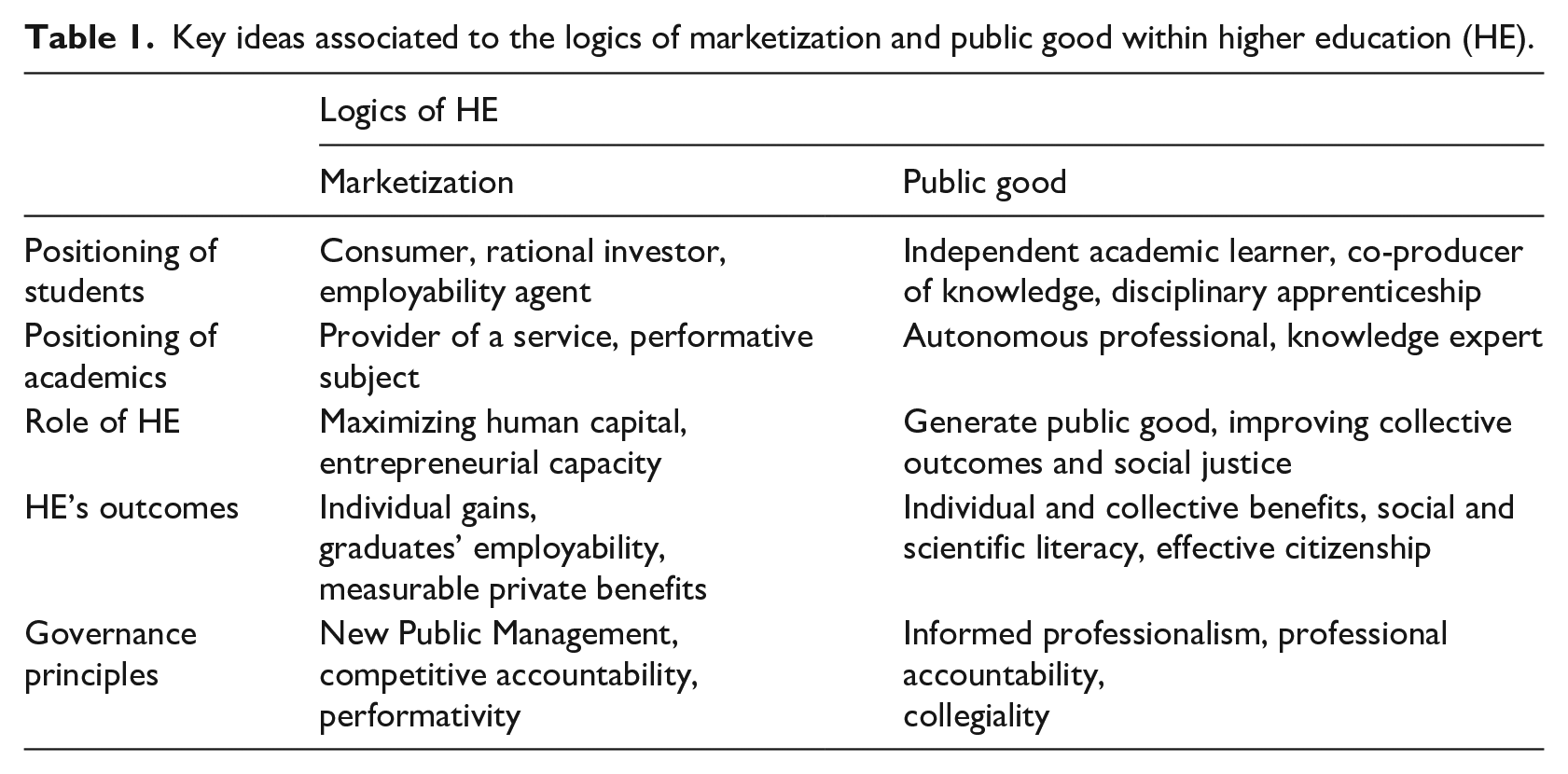
The presentation of points of convergence and separation within this section of the paper illustrates the mix between the two logics in English and Portuguese HE, as it takes into account the positioning of students and academics, the role of HE and its outcomes, as well as the governance principles.
One similarity is the increasingly performative mode of governance which, whilst evident in English HE for at least three decades, has been more recently adopted with increased zeal by Portuguese policy makers and senior managers. In Portugal, the emphasis has been on performance management as a way of meeting public policy imperatives for a more efficient and fiscally sound system. HE policy has been subjected to policy borrowing since the advent of Bologna at the start of this century and this has extended to the adoption of more Anglicized performance modes regarding the assessment of research output and the curricular structure of HE. In England, performative pressures combine private and public modes of accountability. The demand for a more tightly regulated HE system which was established in the mid-1980s in England has extended to new stakeholder imperatives which include a more discerning student-consumer and their families.
In Portugal the consumer model does not appear to be indisputably accepted and public and political discourses also comprise and highlight the collective and societal dimensions as an important part of HE institutions’ aims, suggesting a partial adoption of marketization logics in this country’s HE. By extension, the English model tends to be more explicitly marketized with related expectations on what HE should be generating in terms of market value, both in relation to the evolving internal market and to a shifting external labour market. The England system is also characterized by entrenched institutional hierarchies and segments which maps onto perceived currencies of different institutions in terms of the value-added they generate. By contrast, the Portuguese system has been the object of subtler marketization in this sense, even though there is an implicit hierarchy of institutions and degrees acknowledged by students, academics, employers and society in general. Moreover, this does not feed as strongly into clear differential public perceptions of relative value of the quality of HE and the calibre of graduates leaving different institutions, as well as each institution might be judged differently depending on the disciplinary area under scrutiny.
Additionally, England and Portugal share the growing pressures on HE institutions to raise funds from private sources in recent years. In the UK, this is linked to competition amongst HE institutions expressed by the positions they achieved in national and international league tables that are crucial and seem to have clear impacts on the attraction of students and consequently on funding (Naidoo and Williams, 2015). This is generally recognized, even if it is debatable as to what extent the measurability put in place to build these league tables is adequately appraising the quality of HE (Montané et al., 2017). In Portugal, no national league tables are published but universities have been participating in international ones, publicizing it as a way of promoting their value aiming to attract more students. Moreover, an exploratory qualitative study suggests that Portuguese students might behave as rational consumers and estimate costs and benefits when choosing to attend HE, but not when they select a certain HE institution or programme, since socialization through the influence exerted by family, friends and life plans seem to be significantly important for decision making (Tavares and Cardoso, 2013). Consequently, unfolding Portuguese HE as a market in which league tables play a central role as they do in England is currently inaccurate, but there are signs of a subtle marketization as some universities have been developing strategies aiming at presenting themselves as part of a global HE market.
In terms of the dominant market agenda of employability, there are overlaps but with somewhat different foci. In England, employment outcomes are still based largely on positional competition and market rules, linked also to status signalling (i.e. the importance of ‘where’ students study and other profile features). In Portugal, employability is a driver for change within HE and a general concern for institutions, students, graduates and families. Thus, the institution of study is allied to the subject a student has studied in framing an implicit hierarchy within HE, reflecting less entrenched institutional hierarchies and a lower signalling effect this provides for employers in Portugal. However, in both systems policy understandings of employability have been largely ‘hollowed out’ and the two systems have witnessed stronger institutional endeavours to better equip students for the labour market. In England, this has become strongly associated with the formal measures of graduate outcomes which are seen to convey how well an institution has facilitated a sound private return on investment. In Portugal, measuring of institutional employability is quite problematic, but its importance on the political agenda has resulted in its impact on the rethinking of the public image, the internal organization, and the teaching and learning strategies by HE institutions.
One could say that the student-consumer movement now encompasses the two systems, albeit to differing degrees. In England, this approach has been given significant credence as a way of organizing student expectations and behavioural approaches to institutional life. In Portugal, this is part of an emerging discourse which has coincided with the growing performance management in the system, but its effects are less widespread. Significant here is the way in which a strong institutional narrative exists in Portugal over the expectations of independence and academic rigour amongst students. Such a narrative presents HE as something of a disciplinary apprenticeship whereby the student is in receipt of relevant forms of knowledge which have some alignment to future employment. Relatedly, Portuguese academics are valued for exercising professional authority and relative expertise in disciplinary milieu. The extent to which such a position endures may depend on if and how significantly the Portuguese system moves towards a more market system. Such discourses are somewhat less prominent in English HE which has evolved to a mode of professional accountability based on the fulfilment of state-orchestrated (and, increasingly local-level) performance measures.
This leads to consideration of how the student-consumer agenda has impacted on the two systems. We have seen that in the English context this has become a dominant motif and increasing reality of a more explicitly market-orientated system: one which has shifted costs privately on to individual students. It also coincides with the credentialist undercurrent that partly feeds into a massified HE system. In repositioning the English HE experience less as a disciplinary apprenticeship and more as a relatively transient experience which entails many other facets beyond formal study, much significance is accorded to the fulfilment of satisfaction around a generalized conception of ‘student experience’ (Sabri, 2011).
In England, an incentive structure prevails within institutions which actively affirms a consumerist ethic, and this position has been taken up by a segment of the English student population. In this context, student consumerism and the reframing of HE as a private good go hand in hand: students are encouraged to look to their ‘providers’ to fulfil immediate and longer-term goals which an increasing pecuniary imperative.
In Portugal, this movement has risen in recent years and reflects that in England, but it is buffered to a larger extent by a stronger public professional discourse which depicts students as apprentices of a discipline and educators as knowledge experts. This ethic places rigours on forms of learning at the centre, which has nullified the more extreme features of student-consumerism. In parallel, the contributions of HE to the wider society connected to social equality, social literacy and collective citizenship that have been associated with the public good (Marginson, 2014) are often mentioned and highlighted within political and public debates.
Final discussion: marketization and the public good
It is clear that structural changes in each country’s sector are informed by a common rationality that includes its crucial role within the knowledge economies of the 21st century and the adoption of New Public Management approaches across the sector (Jessop, 2012; Naidoo and Williams, 2015; Teodoro and Guilherme, 2014). Additionally, within the context of massification and of a growing importance given to employability in (re)framing political orientations and institutions, as well as students’ and teachers’ roles (Arora, 2015; Tomlinson, 2017), the changing value of HE relates to the ways in which its missions are understood in both countries.
Recognizing this transnational set of trends, the analysis underlying this article illustrates how different national contexts respond to that common background providing broader knowledge about how the value of HE is currently being (re)framed in England and Portugal, namely by recognizing differences and similarities arising from national specificities and exemplifying the importance of exploring the hybridization of pan-national models with national structures and agents (Marginson, 2018). In both countries, the knowledge economy is an overarching economic narrative and imaginary, in which its relationship to employability is a very relevant and pressing issue within HE. Additionally, a movement towards stronger levels of autonomy and accountability of HE institutions is also observable and is informed by New Public Management approaches. Nonetheless, education policy is a complex process that takes us well beyond local and national levels out to the international and supranational ones. Therefore, changes occurring in England and Portugal are not precisely the same due to each countries’ political, social, cultural and economic specificities and the ways in which their national, institutional and individual actors react and reframe transnational trends and political orientations.
The analysis also suggested that a trend towards policy borrowing might be identifiable, as Bologna contributed to the increasing importance of employability as a quite important mission for HE. Nevertheless, the future trajectories of both systems are rooted in different cultural, economic and social contexts and whether the marketization of HE as it already exists in the UK will flourish in Portugal is not clear and it is open for discussion. In short, even if the knowledge economy and the New Public Management narratives are transnational and clear signs of it are traceable in England and Portugal, those narratives seem to assume contrasting features with its quite significant implications for HE institutions, students and teachers in each of these countries.
Thus, considering England and Portugal as two possible forms of hybridization of pan-national models with national structures and agents, also draws attention to the need of analytical tools for the examination of HE in different countries within a transnational context in which the knowledge economy and the central role of HE tend to be indisputably accepted. It is known that in the UK, as it is in Australia and the USA for the last 30 years, the marketization of HE can be understood as a strong trend (Naidoo and Williams, 2015) that contributes to the reconceptualization of the value of HE, whereas students are featured as consumers and teachers and institutions as providers of a service. In England it is generally accepted that HE is clearly ordered as a market of institutions regulated by rankings and league tables in which students tend to assume the role of consumers and teachers are increasingly pressured to fulfil state-orchestrated (and, increasingly local-level) performance measures. In fact, it was from the Anglo-Saxon countries in which rankings of HE institutions have been put in place for several decades now that these have expanded internationally (Montané et al., 2017). The debates about massification and employability are embedded within this context and institutions are considered on the basis of ensuring graduate-level jobs, with the idea of public good very much aligned with economic demands and employability outcomes.
However, this scenario cannot be accepted as accurate in describing the Portuguese context of the marketization of HE as a strong trend that contributes to the reconceptualization of the value of HE, featuring students as consumers and teachers and institutions as providers of a service. The metaphor of the student as consumer and the teacher as a provider of a service is not extensively accepted in this case; and students might more adequately be pictured as family members and independent learners, as well as teachers are seen as knowledge experts with professional autonomy to a larger extent. Additionally, only a portion of institutions are promoting their participation in international rankings and league tables.
Accordingly, on the one hand the idea of public good cannot be indisputably aligned to economic demands and employability, and on the other hand there is the need to recognize the existence of a tension between the logic of marketization and the logic of the public collective good, as the first is insufficient to understand differences and similarities between HE in England and Portugal.
This analysis leads us to stress the importance of the tension between these two logics – of marketization and of public good – as an analytical framework to better understand the changes occurring in different national contexts, within a transnational framework in which the knowledge economy and the central role of HE seems to be indisputably accepted. We have provided earlier key ideas that might be associated with each of these two logics (see Table 1), on the basis of the assumption that every national case combines characteristics of both. This framework is meant to stimulate future research on the reframing of transnational trends in specific national contexts and systems, accepting the hybridization of global standards with local structures and agents.
The analytical framework acknowledges that the prevalence of student consumerism and marketization presents a value of HE that is circumscribed and conveys a framework for the analysis of HE that is not equally accurate in every national context. Also, the growing importance given to employability and to the role of education in fostering economic development might be featuring HE mainly as a device to respond to professional and economical needs at the cost of promoting the value of HE as a public good that comprises social, moral and cultural roles, in addition to economic ones.
Considering the tension between the logics of marketization and the public good enables highlighting that the potential of HE is much larger than ‘suggested by the neo-liberal model of university as self-serving firm with costumers/students and a brand value’ and that HE institutions enclose
social meanings derived from their connections with other social sectors and with each other, the possibilities unlocked by the knowledge they form and disseminate, and their ongoing effects, direct and indirect, in the lives of their students, graduates, professions, corporations, governmental agencies, civil society organizations and others (Marginson, 2018: 9).
The transnational hegemonic narrative focusing the knowledge-based economy and New Public Management principles, must be confronted with research about the various possible interconnections between state, society and university in various national contexts, taking into account that ‘observation suggests that in HE, as in other social sectors, public goods and private goods might be advanced at the same time, rather than the one necessarily excluding the other’ (Marginson, 2014: 64). Besides contributing towards the existence of a more productive workforce, HE enables increasing intellectual capacity that leads to scientific advance and also generates better informed citizens leading to improved democracy and a more inclusive society (Williams, 2016). It is crucial that educational research highlights and values this wide range of HE outputs contributing to a more holistic understanding of its value and missions, as well as enabling a deeper understanding of the various forms that HE might adopt in different countries, even if it has pan-nationally assumed its pivotal role in fostering the knowledge economy in the 21st century.
Footnotes
Declaration of conflicting interests
The author(s) declared no potential conflicts of interest with respect to the research, authorship, and/or publication of this article.
Funding
The author(s) disclosed receipt of the following financial support for the research, authorship, and/or publication of this article: The research work developed by Mariana Gaio Alves at Southampton University was supported by Fundação para a Ciência e Tecnologia (Portugal) throughout funding with the reference SFRH/BSAB/128269/2016.
