




Abstract
We examine employers’ perception of the collaboration of higher education (HE) with business and the barriers to employers’ engagement. A sample of 162 employers from Portugal filled an original survey, in 2020, designed to examine the relationship between HE and the world of work. The employers differ in the perception of the collaboration of HE with business, and this is reflected in their engagement. Some employers indicate that HE should focus on general skills, and therefore should be autonomous from business (64.8%). Those employers do not report any barriers. Others blame HE for being an ivory tower that disregards their skill needs and imposes cultural barriers on engagement, namely lack of business knowledge, difficulties to communicate with organisations and respond to immediate skills need, and mismatch between the motivations of HE and organisations (24.1%). Finally, some firms acknowledge the excessive focus of HE on academic courses and complementarily undertake the responsibility to resolve their skill problems by means of own training resources (11.1%). We can infer from our findings that not all employers expect ready-to-work graduates and there is no one-size-fits-all solution for skill problems. Firms have agency and implement appropriate strategies. The discourse against HE should therefore be reassessed.
Keywords
Introduction
The employability of graduates is at the forefront of higher education (HE) institutions’ and policy makers’ agendas, and different strategies have been implemented to improve this outcome. Preparing graduates for employment underlies the concept of employability and this has become one of the core missions of HE, especially in the context of massification. In such context, the collaboration between HE and the world of work gained momentum, especially to close the gap between educational outcomes and industry needs (Chen et al., 2020). However, there are varying motivations, barriers and facilitators behind the collaboration that influence the respective outcomes (Ankrah and Al-Tabbaa, 2015).
Some argue that employers view employability as synonymous with work readiness (Mason et al., 2009; Winterton and Turner, 2019) and primarily a matter of individual skills (Moreau and Leathwood, 2006). On the other hand, employers often blame HE for their skill problems and expect schools to produce workers with the required skills. They are especially dissatisfied with work readiness and find graduates to be lacking a variety of skills, notably soft skills (Succi and Canovi, 2020). However, the definition of skills is broad and ambiguous (Stasz, 1997).
This set of arguments raises questions about employers’ expectations of the role of HE as skill suppliers and consequently as a stakeholder to resolve firms’ skill problems: Are the employers willing to collaborate and help HE adjust the skill supply? Do all employers expect HE to provide ready-to-work graduates? This involves assuming collaboration between HE and the world of work as a strategic alliance and specific activities (Galán-Muros and Plewa, 2016). Previous research has shown that employers work badly with the education system to resolve skill problems (Sin and Amaral, 2017) and have no regular tools to identify skill needs or for employment management (Ellis, 2003). Indeed, they need advice and support to forecast their skill needs.
However, current research has failed to collect data on the employers’ expectation of the role of HE in the supply of skills. Instead, they propose employers’ engagement with HE as a strategy to foster employability and to respond to the claims for closer ties with the world of work (Bolden et al., 2008; Hogarth et al., 2007; Petrov et al., 2016). Researchers are also concerned about the barriers that hamper this engagement (Alunurm et al., 2020; Olo et al., 2022). An additional question emerges from this literature: Is there any link between employers’ views on the collaboration of HE with business and the ability of HEIs to involve employers in resolving skills problems?
Our research draws on original data from the Portuguese labour market exploring the employers’ perceptions about the collaboration of HE with business and the reported barriers to engaging with HEIs in Portugal. It should be underlined that research on employers’ engagement addresses only to a set of countries, mainly UK (Basit et al., 2015; Bolden et al., 2009; Petrov et al., 2016), while other countries that have made huge investments in HE, as is the case of Portugal, have been overlooked. Available studies show that employers in Portugal report a set of barriers that impede closer ties with HE institutions (Suleman et al., 2021a) and HE institutions are used mostly as a recruitment channel (Suleman and Laranjeiro, 2018). However, studies focusing on the interaction between the types of collaboration with HE and the barriers that hamper engagement is still missing.
We try to answer the following research questions: How do employers classify the collaboration between business and HE? Do all employers blame HE for their skill problems? Which kinds of barrier affect their perception of the collaboration with HE? How do perceptions and barriers vary across firms? We use an original dataset of firms operating in Portugal in 2020 (n = 162) that included a list of items of collaboration and a scale of relevance. The survey also includes the barriers related to employers’ engagement, and a set of characteristics of firms related to the quality of the labour force, hiring criteria, skill shortage, training policy, size, and source of capital. Examining the data through cluster analysis helps ascertain typologies of perceptions and the associated barriers. The subsequent analysis sheds light on the association between these typologies and the above-mentioned characteristics of firms.
The Portuguese labour market is an interesting case study for different reasons related to the supply and demand for skills. On the one hand, a huge investment has been made in education and training since the early 1990s, including in higher education; however, the firms continue to report skill shortages and lament the costs of workplace training (Suleman et al., 2021b). Furthermore, employers blame HE for the inadequate preparation of graduates, especially for their lack of soft skills. On the other hand, overqualification is high in Portugal essentially due to the lack of knowledge-intensive manufacturing and services (Marques et al., 2022). As a result, the supply of high-skilled workers has outpaced the creation of skilled jobs.
The rest of the paper is structured as follows. The next section provides an overview of the literature on the ties between HE and the world of work, and then a summary of some key features of the Portuguese labour market regarding those ties. After presenting the data and the methodology, the major findings and some key conclusions are reported and discussed. Some policy recommendations are also included to foster collaboration and reassess the role of HE.
The collaboration of higher education and business and employer engagement
Higher education (HE) institutions are often critiqued as being ivory towers where teaching and research are isolated from the needs of firms and community. These institutions have been experiencing multifaceted changes worldwide in recent decades, notably due to the demand for high-quality services and to become socially and economically relevant. As a result, they have engaged with society, labelled their third mission, in an attempt to respond to criticisms of their isolation (Etzkowitz et al., 2000).
One stream of the literature focuses on the collaboration between HE and business and shows that it has a long tradition, have varying organisational forms, multiple motivations, barriers and facilitators, and lead to diverse outcomes (Ankrah and Al-Tabbaa, 2015). However, it has gained momentum more recently to respond to the requirements of the knowledge economy. Matlay (2000) emphasizes that the collaboration started in the turn of the twentieth century in the UK and attempted to prepare skilled workforce for the industrialised economy. Galán-Muros and Plewa (2016) insist that the cooperation exists for centuries, notably for knowledge transfer and to mutually reinforce the benefits for HE and for the society. Davey et al. (2011) explain that HE institutions can benefit from collaboration once are confronted with decreasing public funds, while knowledge and innovation from HE can help business gain and maintain competitive advantage in increasingly dynamic international markets. Therefore, Galán-Muros and Plewa (2016) view the collaboration as a strategic alliance in the sense that it involves voluntary cooperative agreements, share or co-creation of capital, technology or specific assets. Those agreements involve specific activities such as education, research and valorisation that intend to reduce the gap between educational outcomes and industry requirements, as pointed out by Chen et al. (2020).
Alongside this broader view of the HE and business collaboration, some literature focuses on the responses to the specific skill needs of the economy. In fact, employers frequently complain about graduates’ skills and often blame the education system (Cappelli, 2015). These complaints unveil employers’ expectation that graduates will be prepared with the set of skills they need to be competitive in global markets and, therefore, have intensified pressures on HE especially with the increasing supply of graduates following its expansion. The perspective of employer engagement was originated by Leitch (2006) on the behalf of the UK Government to reflect on the long-term skill needs. As other forms of collaboration, the employers’ engagement assumed varying forms (Bolden et al., 2009) and complexities (Wedgewood, 2008). The underlying argument is that employers transform employability into employment (Harvey, 2001) and the initiatives to engage employers help tackling the pressures on HE to equip graduates with suitable skills for economic and labour market imperatives (Teichler, 2009). In such context, employers emerged as a stakeholder to assess the quality of graduates and to demand specific requirements, and, more importantly, they expected their needs to be fulfilled (Harvey and Green, 1993).
However, collaboration between HE and the industry including the employer engagement is far from straightforward. First and foremost, employers decide whether they want, need or can cooperate. Alunurm et al. (2020) discriminate coop and no coop firms and discuss the factors behind the decision to engage in a collaboration. Regarding the interaction to obtain skills, employers decide whether they want to make or buy the required skills, that is, whether to develop training policies to prepare employees themselves or to expect to hire ready-to-work candidates from the labour market (Bellmann et al., 2014). While some employers prefer to benefit from available skills, others choose to train their employees, produce the specific set of skills required in the workplace, thereby reducing skill mismatch. Others use mixed strategies since the combination of skills is unavailable in the labour market.
However, the success of the collaborative approach depends on complex interactions of drivers, as noted by Ankrah and Al-Tabbaa (2015). These authors insist on the proper management of these drivers to reach a positive outcome; otherwise, the same factors would have adverse impacts, if overlooked or mishandled. In such context, researchers have insisted on the barriers and drivers that hamper collaboration that affect the outcomes (e.g., Alunurm et al., 2020; Davey et al., 2011). Some barriers to the employers’ engagement influence the respective outcomes (Basit et al., 2015; Bolden et al., 2009; Olo et al., 2022; Petrov et al., 2016), notably cultural and structural barriers on the part of both HEIs and employers (Bolden and Petrov, 2008; Hogarth et al., 2007; Little et al., 2003). Within HE, barriers include a cultural mismatch that hinders their willingness to engage with employers to ensure the supply of suitable skills. That mismatch opposes a strong focus on academic activities and a disdain for business-like activities. Communication difficulty is another widely reported barrier; it seems that employers and HE lack a common language.
Another barrier to engagement derives from employers. The nature and intensity of engagement with HEI vary across employers depending on their workforce composition, specific skill needs, and position in the products and/or services markets. On the other hand, employers demand immediate answers and expect immediate profits from engagement. The response from HE involves time, and the matching of skills is not taken for granted. Furthermore, although most employers are not willing to engage with HE, especially in influencing course design, they often turn to HE to recruit graduates (Eurobarometer, 2010).
Other firms’ characteristics that influence collaboration are also noticeable, e.g., the size. While large firms, which have considerable research projects, tend to cooperate with HE, small firms lack awareness of the benefits of collaborative activities with HE institutions (Matlay, 2000). Davey et al. (2011) provide examples on the incentives large-sized must promote workplace training through internship and work placements. Matlay (2000) reports the collaboration of HE with economic clusters of small firms. Alunurm et al. (2020) compared firms that cooperate and the ones that lack cooperation and found nuanced evidence. The non-coop firms are small, export-oriented and well-performing. Additionally, although they face financial resources troubles, as well as difficulties in finding suitable partners in HE institutions which hampers the collaboration. The others, those that cooperate, are large firms with lower added value but report barriers related to strategic and organisational culture. Alunurm and colleagues insist that the arguments regarding the effect of firm size on cooperative strategies have been largely discussed, notably the financial resources problem that often affect cooperation, while the relevance of economic performance of small firms represents innovative evidence.
To sum up, the reported barriers indicate that, in addition to financial capacity, a cultural fit between organisations is required from the outset. Not only must both sides make changes to work practices and mindsets, but there must also be a share of values. We note that collaboration may be hampered by the tension between entrepreneurial and academic language (Kettle, 2013). Hence, it is sometimes argued that engagement involves public investment (Wedgwood, 2008), that is, policy makers should promote the mechanisms that encourage active participation with HE in the supply of skills while helping to reduce the costs of this engagement. In fact, the findings of Alunurm et al. (2020) illustrate the relevance of government financial support to foster cooperation with HE.
Higher education expansion and skill shortages in Portugal
The Portuguese labour market is an interesting case to examine the association between HE’s collaboration with business and the barriers to employers’ engagement. Until the start of the democratic regime in 1974, access to HE was limited mainly to wealthy male students (Alves and Tomlinson, 2021). Since then and particularly since the early 1990s, successive governments have sought to expand HE and to converge with EU targets. Massification began with the implementation of the Bologna Process in 2006. An OECD report indicates that 47% of 25–34-year-olds had a HE degree in 2021 (OECD, 2022).
Despite this huge investment, some challenges remain. The employability and quality of graduate jobs is a major concern that has attracted political and public discussion on the benefits of HE in Portugal (Alves and Tomlinson, 2021; Figueiredo et al., 2013, 2017). Graduates are often assigned to non-graduate jobs and there is a declining education premium. This has been a persistent pattern over time.
Employers continue to report skill shortages and struggle with the mismatch between skills supplied by HE and those required in the workplace (Suleman and Laranjeiro, 2018). It should be noted that although employers are satisfied with technical abilities, skill gaps are found in soft skills and work attitudes, and they blame HE institutions for this skill problem. Local level initiatives have been undertaken to strengthen the ties between the education system and the world of work (Suleman et al., 2021b). This calls for a discussion on the drivers of this situation and the barriers to solutions. First and foremost, the data indicate that there is a deficit of candidates from the STEM fields (science, technology, engineering, and math). 1 Young people are less attracted to these fields and this results in costs for employers, who report not only hard-to-fill vacancies for engineers and IT graduates but also the national and international mobility of these graduates (Suleman et al., 2021b). Employers in Portugal also blame HE for an unwillingness to dialogue. Available research reports little or no relationship between HE and business (Olo et al., 2022). However, some initiatives show that there are experiences of collaboration between HE institutions and employers in Portugal for varying activities (Cruz et al., 2022; Suleman, Videira and Araújo, 2021a; Suleman, Videira and Rodrigues Araújo, 2021b) and different levels of engagement (Suleman and Laranjeiro, 2018).
As regards the hiring of graduates, the recent trend points to graduates replacing non-graduates in occupations traditionally occupied by the latter. Faced with skill deficits, some employers are also recruiting low educated young workers and training them using their own training centre and financial resources (Suleman et al., 2021b). Unfortunately, some come up against poaching, in other words, large and wealthy employers that offer higher wages and attract/hire the trained workforce. These employers lament the loss of both skills and financial resources.
Some complaints are also made against employers. Although they often accuse graduates of lacking social skills, it seems they are unable to express their skill needs clearly (Suleman and Laranjeiro, 2018). This raises questions about the tools for forecasting skill needs and making that information available to the education system. On the other hand, the complaints about the preparation of graduates does not necessarily imply that employers want to engage in work with HE to resolve skill problems. Research shows that engagement is low-key and often restricted to using HE as a recruitment channel (Suleman and Laranjeiro, 2018) or for internships or visits (Sin and Amaral, 2017).
Ultimately, the expansion of HE created education opportunities for young people and generated an important supply of highly skilled workers to an economy that traditionally faced skill shortages. However, some new skills problems emerged in the meanwhile. These include a shortage of graduates from certain fields of education and of non-graduates for technical positions, as well as insufficient soft skills and a lack of preparation for the world of work. However, employers continue to be unwilling to address these problems in an appropriate manner and HE institutions remain reluctant to work more closely with business. This leads to question about the employers’ perceptions of the role of HE as suppliers of the skills required in the workplace.
Data and method
The empirical analysis draws on data gathered through an original survey applied to employers in Portugal. The information on employers was provided by the career centre of a public Portuguese university. The centre has a dataset of more 2000 firms and applied the questionnaire in compliance with data protection rules. A website was created to download/upload the questionnaire. It was applied in February 2020 but was suspended in March 2020 due to the Covid-19 pandemic. The dataset comprises information on 162 firms, and it is used to explore the perception of employers on the importance of engagement activities. The size of the sample is certainly a limitation of the study that we should acknowledge. However, it illustrates a rather unexplored association between the employers’ perception of the collaboration of HE institutions with business and the barriers to implement this partnership. Our study might be viewed as exploratory, which can benefit from large sized sample in future research.
Information is also obtained on the characteristics of firms, notably the size, source of capital (national or multinational), industrial affiliation, tenure, geographical location, skill shortages, quality of workforce, hiring criteria, and proxy of training policy (training plan, own training centre).
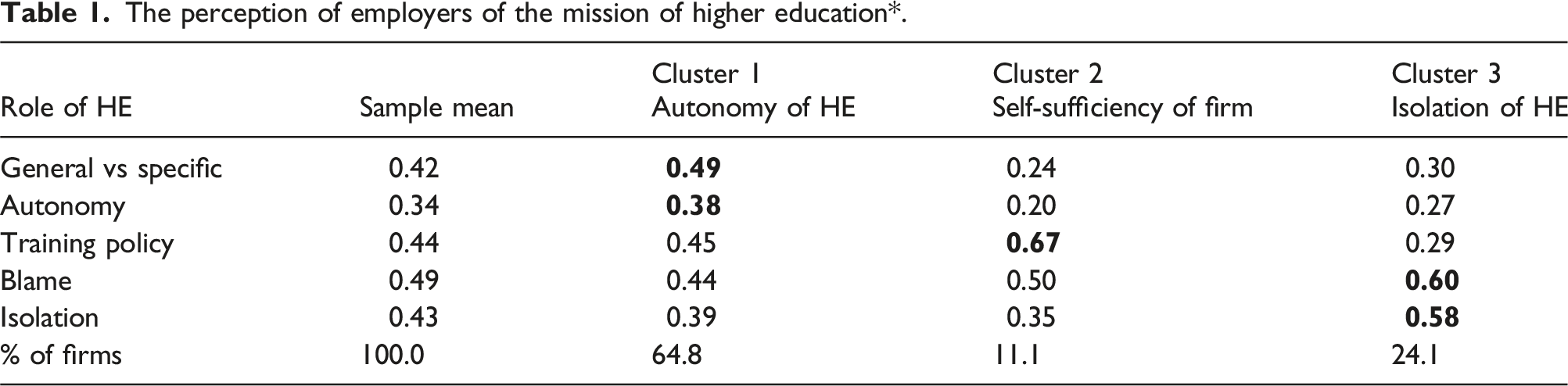
Our analysis comprises two stages: first, we examine the employers’ perception of the higher education mission. Our dataset includes five items related to that perception with an abbreviation in parenthesis; employers were asked to state their agreement/disagreement with each of the following statements, using a seven-point Likert scale: - Higher education should be concerned with general training and firms with on-the-job training (general vs specific). - Firms should not interfere in the choices of higher education institutions (autonomy). - Companies have a training policy that enables them to meet their training, and skills needs (training policy). - Higher education institutions are not able to respond to the firms’ skill needs (blame). - Higher education institutions are not open to collaborating or providing training to meet specific company needs (isolation).
Agreement with the first three sentences suggests that employers acknowledge HE’s autonomy and use their own resources to meet skill needs; full agreement with the last two statements means that employers expect HE to provide appropriate responses to their skill needs and are therefore critical of HE’s ability to supply suitable skills. The data on the level of agreement is used to group employers in line with their perceptions.
We carried out a k-means clustering (Jain, 2010) to group employers according to their perception of the role of HE. We replaced the missing data with series means and used a cosine distance, which entails each observation having a unit Euclidean norm; this yielded benefits in terms of interpretability. Knowing that k-means algorithm is sensitive to initialisation, we began by running it 100 times for k = 2 to k =
We used the sample mean of each variable as the baseline and measured the prevalence of any variable in a particular cluster if its mean in that cluster was much higher than in the sample (see, e.g., Berkman et al., 1989). We subjectively adopted a 15% criterion, i.e., 1.15 times the sample mean.
The second stage of the empirical analysis consists of examining the type of barriers to engaging with HE institutions reported by the sampled employers. We used seven variables that indicate the barriers caused by HEIs: lack of business knowledge; motivation mismatch; lack of immediate responses from HEIs; bureaucracy related to engagement with HEI; difficulty in finding right partner in HEI; excessive focus of HE on academic products; lack of communication between organisations and HEIs; preference to engage with vocational education and training (VET) institutions. In addition, we included three variables related to barriers arising from employers and public involvement: lack of expert in the organisation; lack of financial resources in the organisation; and lack of public funding to promote engagement. We again applied a k-means cluster analysis to identify the bundles of barriers reported by employers in our survey.
Finally, the dataset includes information on the characteristics of firms, notably the size, source of capital (national or multinational), industrial affiliation, tenure, geographical location, skill shortages, quality of workforce, hiring criteria, and proxies of training policy (training plan, own training centre). These variables are expected to help differentiate groups of employers by the underlying characteristics of firms.
Empirical findings
The perception of employers of the mission of higher education*.
Collaboration of higher education with the business and barriers for engagement.
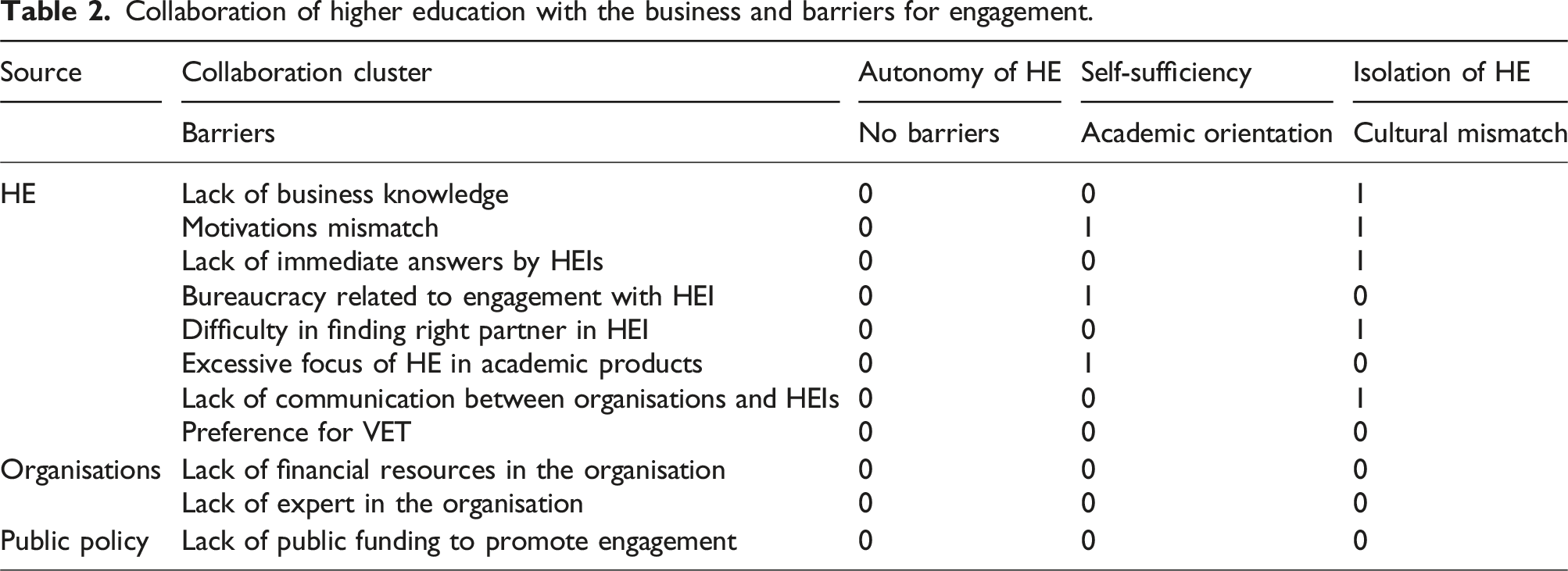
We found that employers who recognise HE autonomy do not report any barriers. The null cluster indicates that a set of employers in Table 2 shows that no barriers exist in the engagement of HE with business. Furthermore, all employers implicitly reject their responsibility for barriers. For example, the no one in the sample reported the barriers related to organisation or public policy.
On the other hand, employers that recognise they should take the initiative to resolve skill problems (Self-sufficiency) blame HEIs for the bureaucracy and academic orientation that make it difficult to access HE and alienates it from businesses. The major criticisms arise however from employers who believe HE are not open to collaborating or to providing training to meet specific company needs, thus making them unable to respond to firms’ skill deficits (Isolation). These employers refer to four barriers that hamper engagement, namely lack of business knowledge, difficulties to communicate with organisations and respond to immediate skills need, and mismatch between the motivations of HE and organisations. This illustrates a perception of cultural mismatch and shows that HE and employers have different motivations.
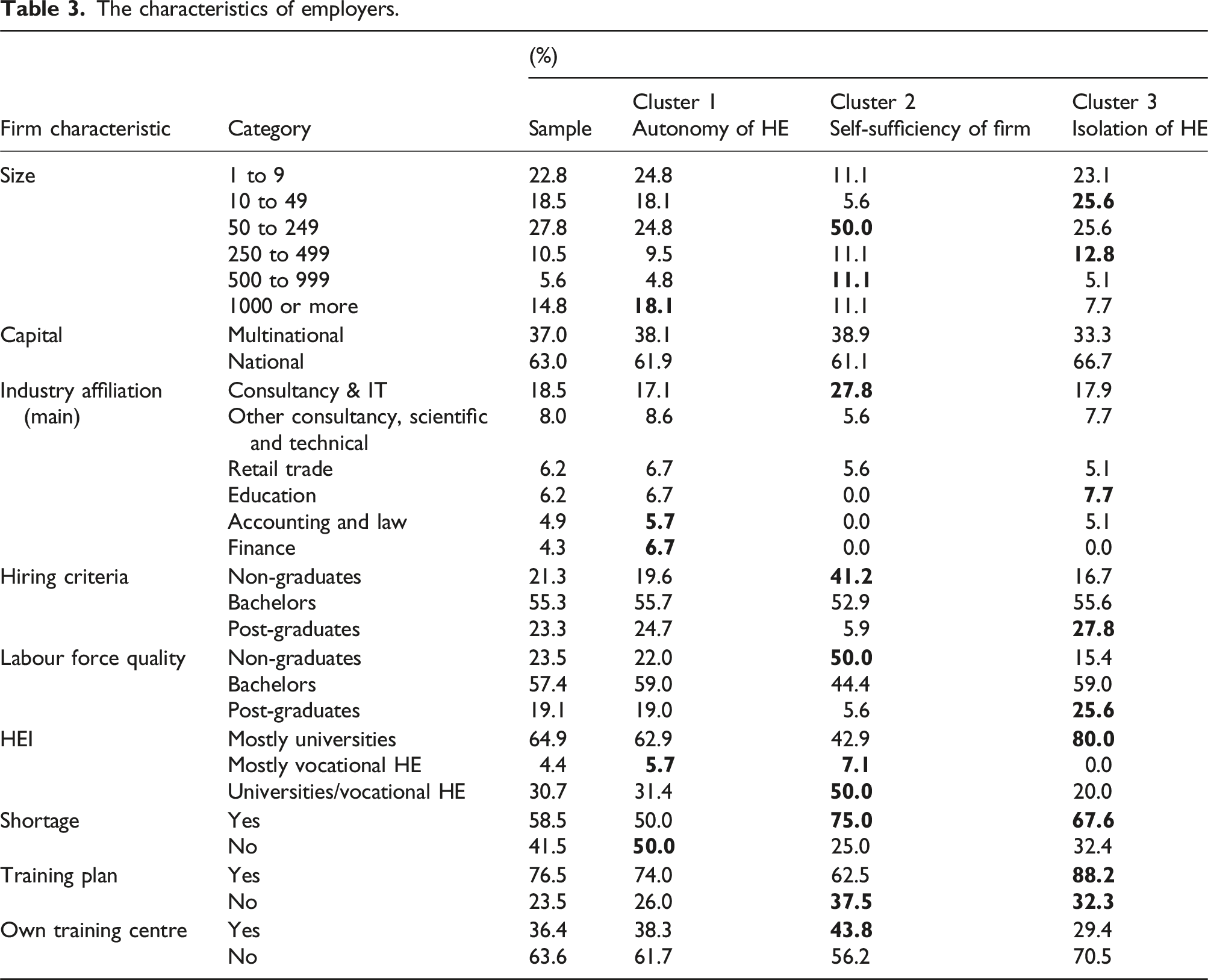
The characteristics of employers.
Discussion and conclusion
Our study explores the association between the employers’ perception of the collaboration of HE institutions with business and the barriers to putting this partnership in place. Considerable research has been devoted to that collaboration, but the employers’ perception is yet underexplored (Chen et al., 2020; Galán-Muros and Plewa, 2016). Mostly, the research focuses on barriers and facilitators, comparing the views of firms that cooperate with the ones that are unwilling or unable to interact (Alunurm et al., 2020) or on the different levels of engagement (Suleman and Laranjeiro, 2018). Our research has raised an important question about the underlying assumption of the collaboration between skill users s and skill providers.
From the outset, the varying perceptions of employers regarding this collaboration of HE with firms is evident. A large majority of employers recognised that HEIs should be independent from the labour market and focus on general skills. Implicitly, those firms reject the argument that employers find collaboration as a strategic alliance (Galán-Muros and Plewa, 2016) to solve skill problems. This category of employers prevails in our sample (64.8%) and reveals that they do not seem to believe that HE is under pressure to provide graduates with skills that fit economic and labour market imperatives (Mason et al., 2009).
In contrast, 24.1% of the sampled employers blame HE for their skill shortages and view HE institutions as ivory towers that distance them from the real world. They claim that HE institutions are unable to respond to the firms’ skill needs and are unwilling to collaborate or to provide training that meets their specific needs. Herein, it seems that the expectations of a strategic alliance have been dashed. Finally, a small number of employers assume their responsibility as skills suppliers and have implemented appropriate tools to successfully produce the required skills.
The above clusters of firms suggest a divide between a ‘make’ strategy, i.e., to train the workforce, (Cluster 2) and a ‘buy’ strategy, that is to hire ready-to-work graduates from the labour market (Cluster 3) (Bellman, 2014). The Self-sufficiency cluster firms prefer to ‘make’ their skills since the ones that are supplied are a mismatch. In fact, most of the employers refer to skill shortages and have implemented tools to address the training of the workforce. Although they hired graduates in the last 3 years, these are what we can call non-graduate firms that use their own resources to prepare the workforce with specific skills (Suleman and Laranjeiro, 2018). The ‘buyers’ (cluster labelled Isolation) have tools to forecast skill needs (training plan) but seem to lack resources for a training centre. They therefore expect HE to provide the skills in their catalogue, in particular in the case of post-graduate candidates.
Each cluster reports specific barriers and the ones mostly reported in the literature, such as financial resources, public funding, are not statistically significant. The indifference of HE referred to by the Isolation cluster involves a cultural mismatch (Bolden and Petrov, 2008; Hogarth et al., 2007; Little et al., 2003) and a lack of market-oriented courses and skills (Suleman et al., 2021b). These barriers are mainly linked to the universities and to the preparation of ready-to-work post-graduate candidates. Ultimately, it is this category of employers that puts pressures on HE (Mason et al., 2009) and blame it for their skill shortages (Cappelli, 2015; Suleman et al., 2021b; Suleman and Laranjeiro, 2018). However, these employers fail to understand that it is almost impossible to provide work-ready graduates not only because there is a lack of consensus on how to define and implement it (Winterton and Turner, 2019) but also due to broad and ambiguous set of employability skills (Stasz, 1997).
The research presented so far raises additional questions. Firstly, it seems that the discourse of employability assumes there is a homogenous demand for skills and a single expectation from employers. Our data showed that, at least in Portugal, a non-negligible proportion of employers acknowledge HE’s autonomy and its focus on general skills. Furthermore, the criticism of ivory tower does not seem completely legitimate and pressure on HE deserves further scrutiny. Therefore, there should be a thorough reassessment of employers’ perception and expectations. We believe that employers continue to view HE as more than a simple provider of specific or specialised skills. The employability discourse therefore seems to be a political issue to judge HE performance in the context of massification and especially in the context of declining public financial support.
The barriers to employers’ engagement are also misleading. It should be noted that engagement primarily involves willingness, but also human and financial resources, the correct tools to forecast skills, and for each stakeholder to assume their role as a skill provider. These are all hard to achieve in a context where small and medium sized firms prevail as in the case of Portugal. Brokers are probably needed to create bridges between HE and employers, drawing on the example provided at local and regional levels. This is an area where the national and regional policy makers should strive to guarantee that employers of all sizes are duly integrated and can voice their skill problems on equal terms. However, the size of the firms deserves proper scrutiny. Alunurm et al. (2020) added that the market position of the firms influences the willingness to collaborate. In other words, if the financial and human resources might affect the ability the interaction between HE and business, there are also other factors that influence the decision to promote or accept collaboration.
In sum, we found significant differences across firms, which reflect a trade-off between a make-or-buy strategy to access suitable skills. Ultimately, the findings indicate that there is no one-size-fits-all solution for skill problems; firms have agency in finding appropriate solutions. Although this research has provided original and interesting findings, caution should be taken when interpreting results. Unfortunately, the pandemic restricted our access to employers and limited the sample size. We hope to return to this survey shortly to collect more data. Hence, there is room for further research that will allow us to compare the perceptions over time.
Footnotes
Acknowledgements
We gratefully acknowledge the comments from the participants of 8th International Conference on Higher Education Advances (HEAd’22), Universitat Politecnica de València, València, Spain, 14–17 June 2022.
Declaration of conflicting interests
The author(s) declared no potential conflicts of interest with respect to the research, authorship, and/or publication of this article.
Funding
The author(s) disclosed receipt of the following financial support for the research, authorship, and/or publication of this article: This work was financed by Portuguese funds through FCT - Foundation for Science and Technology in the framework of the project no. 030016, “BRIGHET- Bringing together Higher Education, Training, and Job Quality”. Reference: PTDC/SOC-SOC/30016/2017.
