




Abstract
The assumption that (early) attendance of universal pre-school enhances the future academic performance of pupils with lower socio-economic and/or immigrant backgrounds underlies many education policies in Europe. The purpose of this study is to assess this assumption for Flanders – a case characterised by near-general enrolment and a ‘schoolified’ approach to pre-school education. We investigated general and equity benefits of pre-school duration regarding academic outcomes in fourth grade, analysing quantitative data from a survey of 1761 pupils. First, multilevel regression analysis showed that pre-school duration was significantly yet weakly related to standardised test scores in science but not in reading. Second, pre-school duration moderately mitigated the relation between parental socio-economic status (SES) and reading outcomes. Third, the relation between pre-school duration and science/reading achievement did not vary significantly across immigrant and linguistic backgrounds. Altogether, these findings indicate a relationship between pre-school participation and short-term academic achievement that is mixed in terms of cognitive task and pupil backgrounds. The result that attending pre-school seems to counter the disparity in reading outcomes between low-SES and high-SES pupils is consistent with existing evidence.
Introduction
The purpose of the present study is to examine the relationship between participation in universal pre-school and academic achievement in primary education in one European context, Flanders – the Dutch-speaking part of Belgium. Here, the term pre-school comprises all types of early childhood education and care (ECEC) for children between the age of two and the age they enter school. Consecutive Flemish education ministers have claimed that early pre-school entry and maximising attendance of children with an immigrant background and/or lower socio-economic status (SES) will boost their subsequent school success (Crevits, 2014; Smet, 2009; Vandenbroucke, 2007). Indeed, syntheses of research into the advantages of a variety of ECEC programmes show that positive effects tend to be stronger when children start pre-school earlier or stay longer (Burger, 2010; Hattie, 2009; Leseman, 2002). However, for certain groups of disadvantaged children, simply increasing the amount of pre-school attendance may not by itself secure higher academic achievement. In addition, the international evidence for the equity benefits of universal pre-school, which is available to all children irrespective of background, concerning academic outcomes is relatively uneven (Ruhm and Waldfogel, 2011).
In the Flemish case, little is documented about the relationship between pre-school participation and academic outcomes. A recent analysis of administrative data by the Education Ministry has filled in some of the knowledge gaps about the relationship between academic achievement in primary education and pre-school attendance (DOV, 2016). However, it is limited by its use of nationality as a proxy for immigrant status and grade retention being an inadequate achievement measure. The Programme for International Student Assessment (PISA) provides some additional data on the relationship between pre-school participation and academic outcomes of 15-year-old Belgian students (OECD, 2010, 2011, 2013). By using data from a retrospective study in Flemish primary education, we examine the relationship between pre-school duration and short-term academic achievement. Short-term refers to primary education, immediate to pre-school, medium-term to secondary and long-term to further education or adulthood.
The contribution of this study to the international research is its focus on an education system in a European sub-state where near-general levels of pre-school enrolment are attained for the general student population, which is becoming increasingly ethno-linguistically diverse (Van Der Wildt et al., 2017). In addition to this, Flemish pre-school education is characterised by a ‘schoolified’ pedagogical approach focusing on formal learning rather than care (Van Laere, 2017). The principal questions are whether or not such conditions allow for narrowing achievement gaps in future educational performance, and whether the inclusion in pre-school of all children from an early age is an effective strategy to that end (Green and Mostafa, 2011). Our study also provides new data regarding the under-researched potential benefits of universal pre-school participation for immigrant and minority-language pupils. Finally, this study has the advantage over previous Flemish research on primary education that it includes academic test measures as outcome and a broader range of pupil background variables.
Literature review
Theoretical tenets
The relationship between pre-school education and cognitive/academic development is based on three theoretical tenets. The first – neuro-psychological – tenet relies on the sensitive periods framework. Heckman (2006: 1900) maintains that ‘although adaptation continues throughout life, human abilities are formed in a predictable sequence of sensitive periods, during which the development of specific neural circuits and the behaviors they mediate are most plastic and therefore optimally receptive to environmental influences.’ Early mastery of a range of cognitive, social and emotional competencies makes learning at later ages more efficient, easier and more likely to continue.
The second tenet is that of engaged time stemming from Carroll’s (1963) seminal paper. It concerns the amount of time students spend on attending to school-related tasks (Prater, 1992). The more time children spend performing academic tasks, the higher their level of proficiency in these tasks will be. However, the existing evidence indicates that, while there is some positive relationship between engaged time and student performance, simply increasing the amount of time in academic learning is not enough to achieve learning gains (Aronson et al., 1998; Cotton, 1989; MacSwan et al., 2017). A narrow focus on increasing the length of time tends to overlook the issues of quality (Hall et al., 2013; Melhuish et al., 2015) and context (McLeod et al., 2018) of the education offered in pre-schools.
The third tenet is that of enrichment in early childhood (Kagitcibasi et al., 2009; Raine et al., 2001). Pre-school provides a nurturing and cognitively stimulating environment, which is designed to meet the developmental needs of each child. However, children from socially disadvantaged backgrounds may be the main beneficiaries of the enrichment opportunities that pre-school can offer (Van den Branden, 2012). In this respect, Raudenbush and Eschmann (2015) assert that low-SES children benefit more from access to universal pre-school than high-SES children because, in its absence, high-SES parents can provide an array of educative environments (at home or pre-school) that are not or less available to low-SES parents. For language-minority/immigrant children, pre-school offers early exposure to the language of schooling. Prolonged pre-school attendance is considered crucial for their acquisition of the majority language because the pre-school environment can offer frequent contact with language-majority speakers at an early age (Becker et al., 2013).
Conceptual clarification
Before addressing the empirical evidence, we clarify a few concepts. Firstly, in the research literature a distinction is made between general and equity benefits (or effects) of pre-school education (Agirdag et al., 2015). General benefits refer to the advantages of pre-school education for the general population of a country or education system (Melhuish and Barnes, 2012). In this respect, Raudenbush and Eschmann (2015) argue that the provision of universal pre-school equalises access to pre-school for young, especially socially disadvantaged, children. When universal pre-school is not available, high-SES parents are more likely to send their children to a private pre-school. Hence, promoting equal access to pre-school for all children can further the cause of social equity in education and society. Consequently, investment in ECEC is considered one of the most cost-effective measures for fostering equity in education as a whole (Heckman, 2006; Rose, 2010). Equity benefits signify that disadvantaged children show stronger gains by profiting more from pre-school than advantaged children. Thus, pre-school offers an adequate educational strategy to help reduce the achievement gap between advantaged and disadvantaged groups (Burger, 2010).
Secondly, a distinction is made between universal and targeted pre-school (Barnet, 2010). Universal pre-school is available to all pre-school children, irrespective of background. Many European countries have expanded such universal pre-school provisions (e.g. Belgium, Denmark, France, Germany, Italy, Norway, Sweden, UK). Targeted pre-school refers to special provisions for select groups of children, usually those demonstrating socio-economic disadvantage, disabilities or other special needs (Barnet, 2010). It is widely maintained in the US, although there is a growing movement in American society promoting public universal pre-school (Zigler et al., 2006). Targeted pre-schools aim at reaching more educational equity by designing separate programmes for disadvantaged children that are primarily legitimised by the above enrichment tenet. Universal pre-schools provide comprehensive early ECEC programmes involving all children, irrespective of background. This raises the question whether the model of universal pre-school is capable of meeting the needs of disadvantaged children in effectively enriching and targeted ways.
Empirical evidence
In this section, we review existing empirical evidence on the potential benefits of universal pre-school education based on the international literature. The leading question is whether the evidence indicates any differences or similarities between Flemish pre-school and comparable European universal pre-school systems in terms of general and equity benefits, particularly in the short term (primary level). Other countries (especially the US) are included – if relevant to our case.
General benefits
The two available Flemish studies revealed positive relations between pre-school attendance and grade retention at age eight (DOV, 2016), and reading outcomes at age 15 (Department of Educational Studies, 2010), which accords with findings from the international research. Reviews and meta-analyses covering a variety of international contexts have established over the years that ECEC programmes have substantive short-term and moderate longer-term benefits for children’s cognitive-academic development (Burger, 2010; Lazzari and Vandenbroeck, 2013; Melhuish et al., 2015; Nores and Barnett, 2010). However, publications from the US dominate the international research output. Because US research (see reviews by Barnett 2011; Camilli et al., 2010; Manning et al., 2010; Nelson et al., 2003) involves almost exclusively target pre-school programmes, its conclusions can only be extended to universal pre-school systems – including those in Europe – with considerable caution.
More valid for comparison with Flemish pre-school is Ruhm and Waldfogel’s (2011) review, focusing on the effects of universal pre-school in various countries. Its main conclusion is that the expansion of ECEC programmes yielded benefits at school entry, in adolescence and for adults in virtually all studies considered. The large-scale expansion of pre-school enrolment, leading to improved access of disadvantaged children, resulted in significant and lasting positive effects on cognitive and school outcomes at different ages across a variety of European countries (France: Dumas and Lefranc, 2012; Hirsch, 2004; Germany: Spiess et al., 2003; Norway: Havnes and Mogstad, 2011; UK: Goodman and Sianesi, 2005). In contrast, a recent longitudinal study conducted in Italy did not show any general academic benefits of universal pre-school attendance: furthering early access to kindergarten for two-year-old children did not affect outcomes on standardised measures in language and mathematics at age seven (Carta and Rizzica, 2018).
Furthermore, universal pre-kindergarten programmes (serving children under five), which have been introduced in some US states, may produce relatively comparable findings. Research demonstrates that participation in pre-kindergarten programmes can improve children’s academic achievement regardless of background or personal circumstances (Haslip, 2018; Weiland and Yoshikawa, 2013). The benefits appeared to be even greater if pre-school started between two and three years of age (Loeb et al., 2007).
Drawing on the above synthesis of existing evidence, we conclude that increasing universal pre-school participation from an early age seems to benefit the general children’s population in terms of future academic outcomes, which corresponds to the (scarce) research evidence available for Flanders.
Equity benefits
The issue of SES-related equity benefits of pre-school attendance in primary education has, so far, not been addressed in a direct way in Flemish research. However, the results from the PISA studies conducted with 15-year-old Belgian students did not show any significant SES-related benefits for reading in the PISA 2009 study (OECD, 2010). This is inconsistent with the findings from an analysis of PISA 2009 data, indicating that in Sweden and the UK the lowest social groups were getting the highest benefits in reading outcomes from universal pre-school duration (Mostafa and Green, 2012). This uneven pattern is reflected in other European studies on the relationship between universal pre-school participation and secondary school outcomes, showing either positive equity effects (Norway: Black et al., 2010; Spain: Felfe et al., 2015), or non-significant effects (Norway: Drange et al., 2016; Sweden: Fredriksson et al., 2010). Nevertheless, the review by Raudenbush and Eschmann (2015) concludes on the basis of 15 large-scale studies on the introduction of early universal pre-schooling across eight nations (Argentina, Canada, Denmark, Germany, Netherlands, Norway, Uruguay, US) that the preponderance of evidence strongly favours the hypothesis of differential social effects. Low-SES children tend to benefit more from increased access than high-SES children across a range of outcomes for 13 of the 15 samples. Individual studies also report equity benefits of increased access to universal pre-school in various European states, as indicated by cognitive gains in the short and medium run for socio-economically disadvantaged groups (Dumas and Lefranc, 2012; Felfe and Lalive, 2014; Havnes and Mogstad, 2011; Spiess et al., 2003). Additionally, other investigations found differential relations between pre-school duration and primary school outcomes favouring lower-class pupils in France (Hirsch, 2004) and the UK (Becker, 2011). US studies on universal pre-kindergarten also report similar short-term benefits for children of low-SES groups (Fitzpatrick, 2008; Gormley et al., 2005, 2008; Magnuson et al., 2007a, 2007b; Tucker-Drob, 2012; Wong et al., 2008). At the same time, a number of individual studies point to the absence of SES-related benefits. Despite increased participation in universal pre-school, no significant differences in schooling outcomes between students from different SES backgrounds were found in a French study concerning children in the first two primary grades who started in pre-school at age two instead of three (Caille, 2001), in two English studies examining primary-level pupils respectively at age eleven (Sammons et al., 2008) and at ages seven and eleven (Blanden et al., 2016), and in a US study of kindergarten children who participated in a pre-kindergarten programme (Weiland and Yoshikawa, 2013).
Regarding equity benefits related to immigrant status, advantages of regular or earlier universal pre-school attendance were found in Flanders where two-year-old children with a non-European Union (EU) nationality showed a decreased grade retention rate at age eight in comparison to EU or Belgian children (DOV, 2016). Comparable studies on the short-term equity effects of pre-school for immigrant students are relatively scarce. We only traced two studies: one from Slovenia reporting the immediate benefits of pre-school for language development in immigrant children (Marjanovic Umek et al., 2006), and a German investigation where children with foreign parents who attended pre-school before age three showed increased school readiness and language skills at age six (Felfe and Lalive, 2014). Concerning the medium-term advantages of Flemish pre-school, we can rely, in part, on the Belgian PISA 2009 data, showing that immigrants profited significantly less than non-immigrants from pre-school participation (OECD, 2010). Other studies revealed mixed benefits in secondary education of universal pre-school attendance for immigrant students in Norway (Drange and Telle, 2010) and Sweden (Fredriksson et al., 2010).
In summary, the positive evidence for the short-term benefits of universal pre-school attendance favouring low-SES students is relatively robust, but such data are lacking in the Flemish case. There is substantially less evidence regarding equity benefits for immigrant or language-minority students. A few indications were found for short-term benefits in pre-school and primary school (including the Flemish case), but for secondary education the existing evidence shows a relatively mixed pattern.
Present study
The purpose of this study is to examine the relationship between universal pre-school participation and academic achievement in Flemish primary education. The present study evaluates whether the assumption that early inclusion in pre-school of disadvantaged groups is an effective strategy to narrow the achievement gap between disadvantaged and advantaged pupils holds for Flemish universal pre-school. This touches upon the question whether the model of universal pre-school is capable of meeting the needs of disadvantaged children in effectively enriching ways. Additionally, we intend to fill a gap in the international evidence regarding equity benefits of pre-school for immigrant and minority-language pupils of primary-school age.
Two research questions are addressed:
To what extent does pre-school duration relate to academic achievement in the general population of primary school pupils (general benefits)?
To what extent does pre-school duration moderate the relations between pupils’ background characteristics (SES, home language, immigrant status, sex) and academic outcomes (equity benefits)?
Drawing upon the extant evidence, we can predict the general benefits of universal pre-school attendance in Flanders. The (non-Flemish) evidence for equity benefits points to SES moderating the relation between pre-school duration and academic achievement. Regarding immigrant or minority-language background, the evidence is too sparse in order to make a well-founded prediction.
Setting
Flemish pre-school
An ECEC split system characterises Flanders. Care services for children up to age three are under the auspices of the Minister for Welfare and pre-school institutions for children from two and a half years to compulsory school age (six years) are under the auspices of the Minister for Education (Van Laere, 2017). Accordingly, young children in Flanders are confronted with the pivotal transition from an informal (home) or formal (childcare) caring environment to a formal learning environment (pre-school). As a consequence of a process of ‘schoolification’, many teachers and parents tend to understand pre-school education as a means to prepare children for primary education by teaching them pre-academic and social skills (Van Laere, 2017). Flemish pre-schools are often attached to primary schools, which allows for an easy transition into formal education. Pre-schools are fully incorporated into the publicly funded school system, universally accessible, non-compulsory and free. Parental free choice of pre-school is legally guaranteed. Pre-schools cater to children aged two and a half to six years, and usually have three age-grouped classes (ages two and a half to three, four and five). Pre-school classes consist on average of 20–25 children with one teacher, although this may vary depending on the pre-school and the time of year (Hulpia et al., 2014). Children are offered a comprehensive, full-day programme (32 hours per week) by teachers with a three-year professional bachelor qualification. The Flemish Government has determined developmental objectives that describe what all children learn at pre-school (Vlaamse Regering, 1997). Altogether, Flemish pre-schools show great likeness in group size, objectives, intensity of education and pedagogical approach.
Pre-school participation
Children’s participation in Flemish pre-schools is high in comparison to other European countries. The available figures indicate that participation increases according to age. During the 2009–2010 school year, 99.1% of all the five-year-olds in Flanders were enrolled in pre-school; 97.3% of all the five-year-olds attended pre-school for a minimum of 220 half-days in third pre-school class. These figures have remained fairly constant over the years (DOV, 2016). The PISA 2009 and 2012 data demonstrate that 95% of 15-year-old Flemish students had attended more than one year of pre-school. The percentages in 2009 for native, first-generation and second-generation immigrant students were 97, 54.9 and 96.4, respectively (Department of Educational Studies, 2010; OECD, 2013).
According to the DOV (2016) study, approximately 10% of the pre-school population attend pre-school insufficiently (<75% of school time). Official figures from the Education Ministry indicate that children from low-SES or immigrant backgrounds make, on average, less use of pre-school provision. Children who attend pre-school less frequently often live in deprived urban neighbourhoods, frequently speak another language than Dutch at home or have a mother with limited education (Crevits, 2016). These are typically children who may experience educational problems. Indeed, the educational achievements of immigrant-background students are lagging behind their non-immigrant counterparts. The socio-economic inequality and the achievement gap between immigrants and non-immigrants in Flanders are among the highest among western countries (OECD, 2010, 2013). Investigations have documented persistent educational underachievement of immigrant-background students across all levels of compulsory education (e.g. Baert and Cockx, 2013; Jacobs and Rea, 2011; Van Laere et al., 2014).
Policies
Flemish education ministers have pointed to lower participation in pre-school as a cause of academic underachievement in immigrant-background children. Lately, they have set up policies to maximise pre-school participation (i.e. higher enrolment/attendance), highlighting the stimulating role of local authorities and agencies (Crevits, 2016; Smet, 2009; Vandenbroucke, 2004). Also, more stringent measures have been taken, like attaching the parental right to a school allowance to the child’s regular pre-school attendance, or mandatory language testing during transition to first grade (Smet, 2010). Furthermore, within the framework of equal educational opportunities policies, a substantial number of pre-schools receive extra funding for raising the academic performance levels of children from low-SES/immigrant backgrounds (Vlaams Parlement, 1997). The expected major benefit of such policies is accelerated acquisition of the language of schooling. Education ministers generally believe that social inequality in education is mainly caused by alleged linguistic deficiencies of immigrant students (Crevits, 2014; Smet, 2009; Vandenbroucke, 2007) – even though there is little scientific evidence for this (Agirdag et al., 2013; Agirdag and Vanlaar, 2018). A reinvigorated ‘Dutch-is-all-that-matters’ discourse reinforces the idea of early immersion in a Dutch-only pre-school environment as an appropriate strategy to counter educational underperformance in immigrant children who speak non-Dutch home languages (Pulinx et al., 2017).
Methods
Participants
We used data gathered as part of the research project called Valorising Linguistic Diversity in Multiple Contexts of Primary Education (Validiv) (2012–2015). Its primary goal was to examine the impact of language diversity in primary schools. However, the collected data are suitable for examining the consequences of pre-school participation, as they include retrospective questions on pre-school attendance and students’ current achievement scores. Relating the retrospective measurement of pre-school attendance to current achievement scores is a common practice in research (e.g. the PISA studies).
Quantitative data were collected during the 2012–2013 school year from 1761 pupils, 1562 parents and 1255 teachers in a sample of 67 primary schools in Flanders. Multistage sampling was conducted. Initially, three urban regions were selected that have relatively ethnically diverse populations – that is, Brussels (metropolitan area), Ghent (Belgium’s fourth agglomeration) and Limburg (five former coalmining towns). Although the sample is not representative for Flanders in its entirety, the pre-school participation rates found in this study are close to the general rates reported for Flanders in the PISA 2009 and 2012 studies (see the previous ‘Setting’ section). Second, based on data gathered from the Education Ministry, 212 primary schools were chosen within these selected regions; 31% of the schools agreed to participate. Non-response analyses revealed that the likelihood of responding positively or negatively was not related to various school characteristics (linguistic composition, denomination, school size, school region).
Variables
Pre-school duration
The main exploratory variable in the analyses is pre-school duration (Table 1). Parents were asked to provide retrospective information on whether their child participated in pre-school and which pre-school year they started. The question was: ‘Has your child been in pre-school?’ There were four answering categories: ‘No’ (scored 0), ‘Yes, started third year’ (1), ‘Yes, started second year’ (2) and ‘Yes, started first year’ (3). This information was used to estimate duration of pre-school as a scale/interval variable.
Descriptive statistics: achievement scores and background characteristics of fourth-grade pupils from 67 primary schools in Flanders (own analysis of Validiv data).
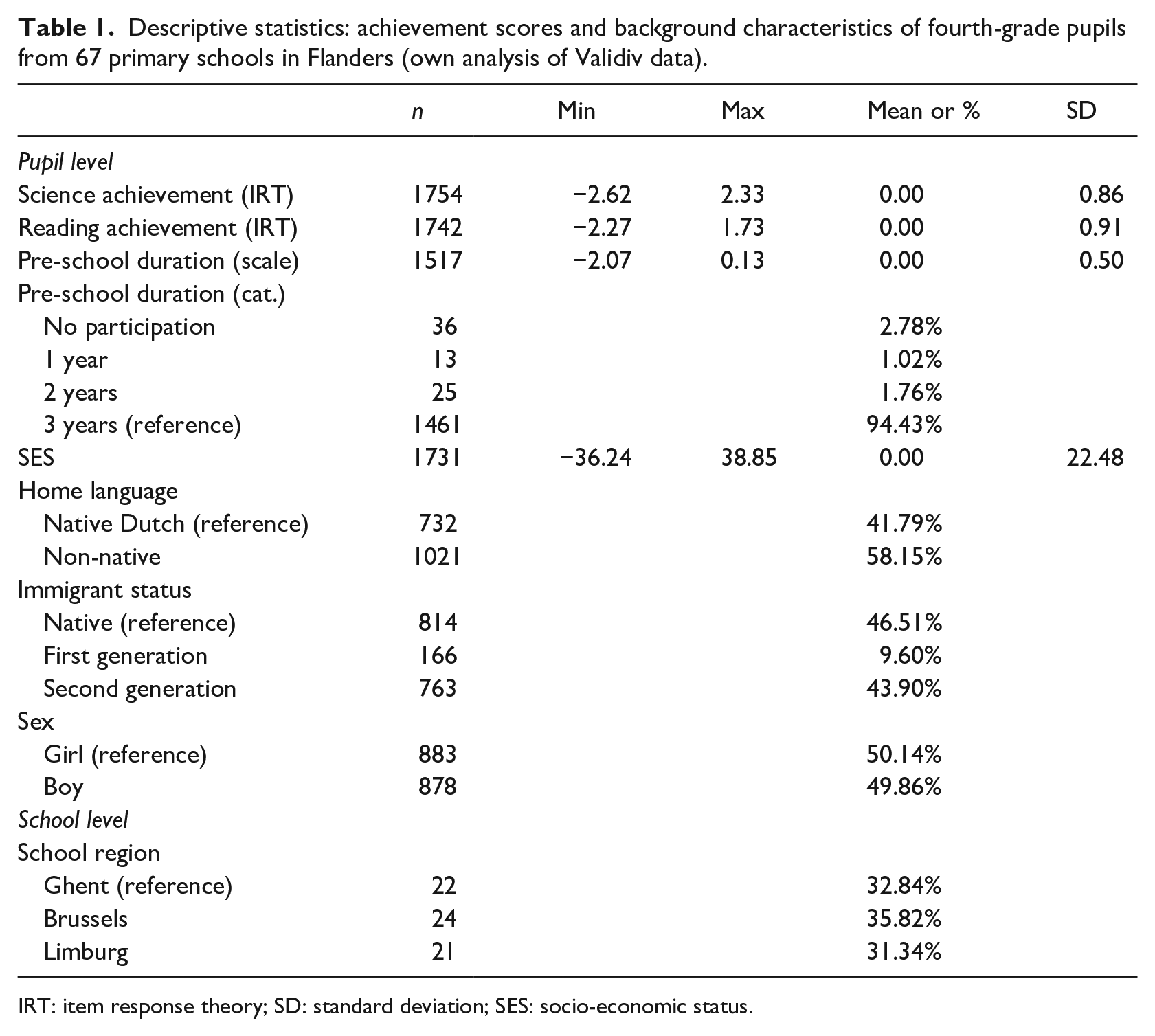
IRT: item response theory; SD: standard deviation; SES: socio-economic status.
Academic achievement
The central dependent variable is academic achievement at the beginning of fourth grade. Given the time limitations, we could not test for all academic subjects. We focused on reading and science performance. Reading performance was assessed using the end of the third-grade version of the Standardised Test for Reading Comprehension of the Dutch National Institute for Educational Measurement (Staphorsius and Krom, 1998). For this investigation, an adapted and abbreviated version was used that contains the first 20 of the original 35 items (only items with an average level of difficulty were selected). The test consisted of three narrative texts (between 15 and 37 lines) and a total of 20 multiple-choice questions. The raw scores showed an average of 10.91 from a total of 20 points (standard deviation (SD) = 4.64). Science performance was measured with a test containing 34 items selected from the publicly released Dutch-language items of the Trends in Mathematics and Science Study (TIMSS) test (Brusselmans-Dehairs and Valcke, 2004). Criteria for item selection were international standard level (five levels of difficulty), cognitive domain (knowledge of facts, understanding of concepts, reasoning, analysing) and subject (biology, physics, geography). Additionally, attainment targets for Environmental Studies in Flemish primary education were considered. On average, pupils scored 20.21 from a total of 34 (SD = 4.78). Both tests used were paper-and-pencil group tests. Two-parameter item response theory scores were calculated for the tests (see Table 1). The fit indices were highly satisfactory for the tests, reading: root means square error of approximation (RMSEA) = 0.025, comparative fit index (CFI) = 0.990, Tucker-Lewis index (TLI) = 0.989; science: RMSEA = 0.013, CFI = 0.980, TLI = 0.979.
Control variables
The control measures are presented in Table 1. Parental SES was measured with the international socio-economic index of occupational status (ISEI08), with a score from 0 to 100 (Ganzeboom et al., 1992). The highest ISEI score of the parents was used as an indicator of SES. Home language was assessed with the information about the languages that the pupils spoke with their parents. When one of the parents reported speaking a language other than Dutch with their child, the pupil was classified as a non-native speaker. There was a very strong association between the reports of parents and pupils on language use (Cramer’s V = 0.788; p < .001). Therefore, when information about language use was missing from the parents’ questionnaire, that information was deduced from the pupils’ questionnaire. Immigrant status was measured based on the country of birth of pupils and their parents. Pupils that were born outside Belgium were classified as first-generation immigrants; pupils born in Belgium with at least one parent born in a different country were classified as second generation; Belgium-born pupils with both parents born in Belgium were classified as natives (= reference category). As for sex, girls were chosen as the reference category. For the school region variable, Ghent was selected as the reference category.
Procedure
In the 67 schools that agreed to participate, the research team surveyed all fourth-grade pupils (median age = 9). The pupil questionnaire consisted of two parts and lasted three hours. In the first part, we gathered information on the background and non-cognitive variables. In the second part, the academic achievement tests were administered. The tests were administered during the first semester in each school by members of the research team. The tests were usually administered in the classroom on the same day; each test took one lesson hour. Parents of the pupils in this sample and all teachers from their schools were asked to fill in a paper-and-pencil questionnaire. Most pupils (95.8%) were present during the administration of the questionnaire and tests; 85% of the parents and 75.4% of the teachers completed the survey.
Data analyses
In this study, the relationship between pre-school duration and fourth-grade academic achievement is investigated. Technically, pre-school duration is an ordinal variable (zero, one, two or three years). However, we identified that the ordinal categories followed a linear trend in relation to reading and science achievement (analyses are not shown here). Hence, we entered pre-school duration as a scale/interval variable in the analyses.
Because the participants were clustered within schools, we used multilevel linear regression and path analysis models conducted with Mplus. Missing data were dealt with using the full information maximum likelihood (FIML) method. FIML uses all available data to estimate parameters based on the available complete data as well as the implied values of the missing data, given the observed data (Enders and Bandalos, 2001). All metric dependent variables were centred. Two-level models were estimated, in which ‘within’ and ‘between’ refer to variables on the pupil level and the school level, respectively. Unstandardised coefficients are shown in Tables 2 and 3. Standardised coefficient sizes are reported in the Results section. We report the StdYX standardisation, which is achieved by the multiplication of the size with the SD of the predictor variable divided by the SD of the dependent variable. A .05 alpha level was used for all the statistical tests.
Multilevel linear regression and path analysis models predicting reading and science achievement of fourth-grade pupils from 67 primary schools in Flanders: unstandardised coefficients (own analysis of Validiv data).
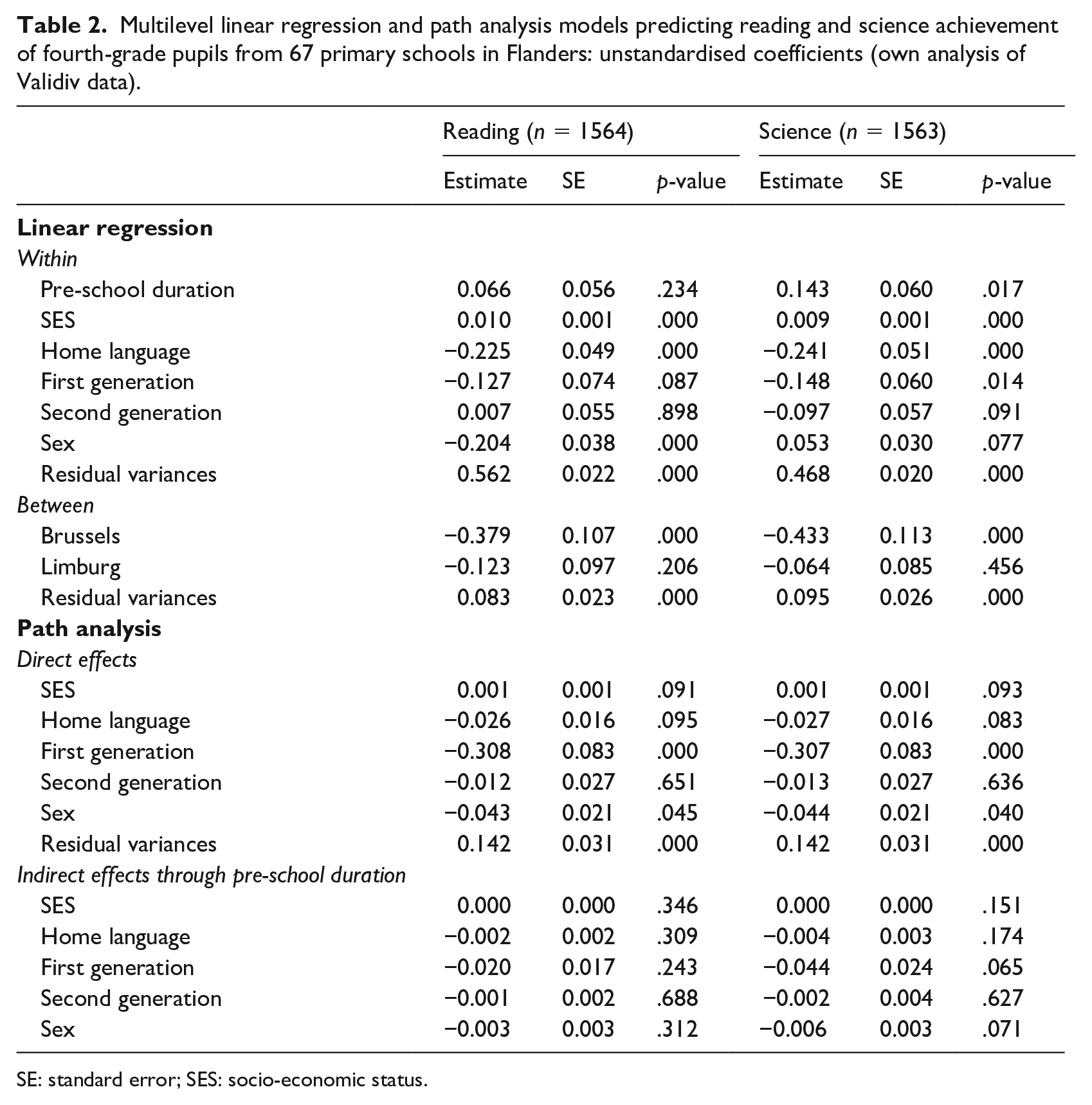
SE: standard error; SES: socio-economic status.
Multilevel linear regression model predicting reading and science achievement, including interaction terms of fourth-grade pupils from 67 primary schools in Flanders: unstandardised coefficients (own analysis of Validiv data).
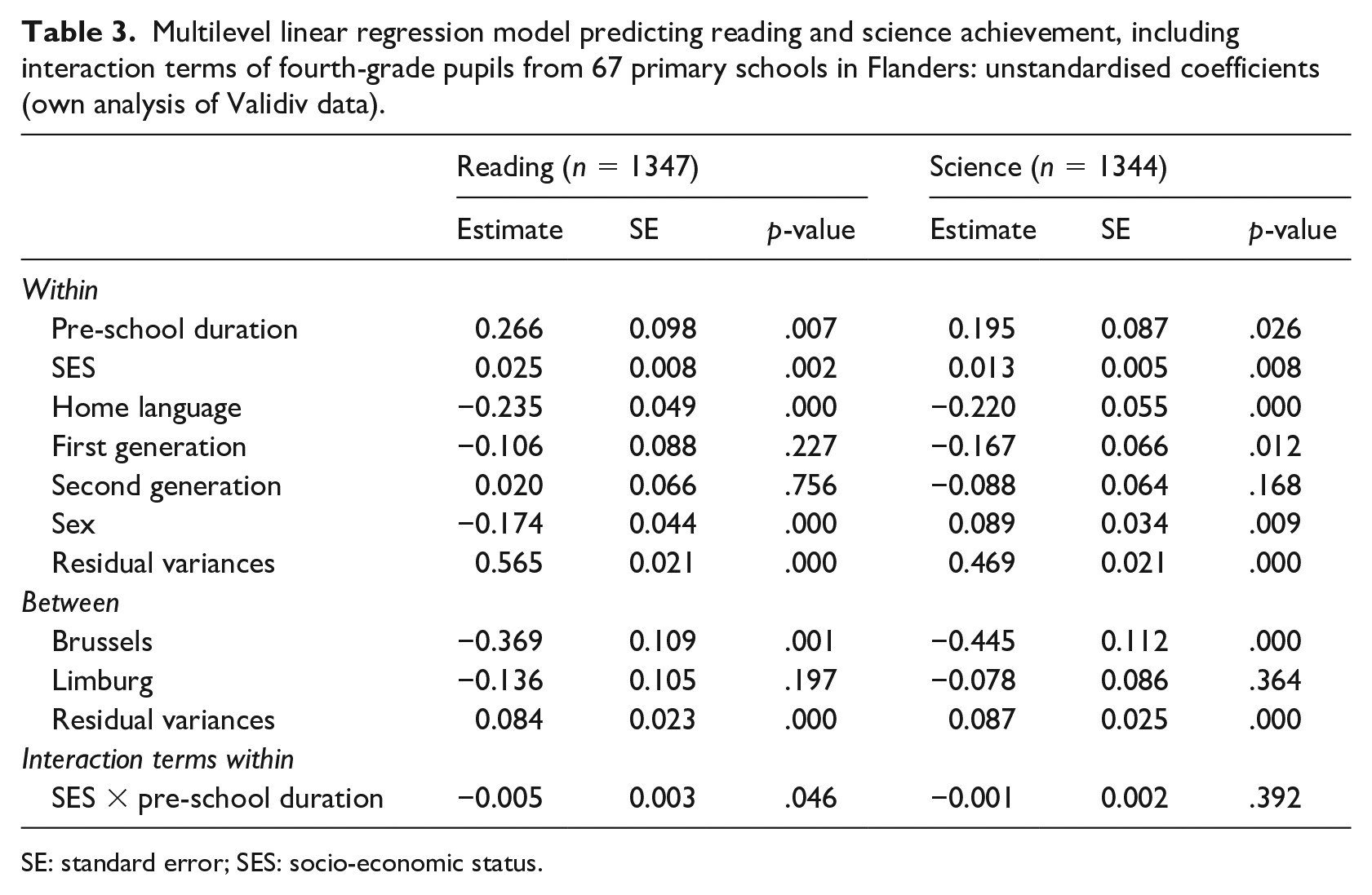
SE: standard error; SES: socio-economic status.
Before addressing the research questions, we explored pre-school duration and its correlates. Regarding the first research question, the direct relation between pre-school duration and academic achievement was examined. To minimise selection effects, we controlled for five variables that could correlate with pre-school attendance and that are shown to have an impact on academic achievement. These are parental SES (Agirdag et al., 2013), home language (Van Laere et al., 2014), immigrant status (Jacobs and Rea, 2011), sex (Van Houtte, 2004) and school region (Baker, 2001). 1 In the path analysis model, the direct and indirect effects of the same variables on the test outcomes were estimated with pre-school duration as the mediating variable.
To address the second research question, we estimated two-way interaction terms between pre-school duration and sex, parental SES, immigration status and home language in a multilevel linear regression model with reading and science performances as predicted variables. The moderation model examines under what conditions the X–Y relation varies. It tests whether the prediction of a dependent variable, Y, from an independent variable, X, differs across levels of a third variable, Z (Fairchild and MacKinnon, 2009). While the interaction terms were initially entered into the model simultaneously, they were only retained in the model if they were statistically significant. In order to facilitate the interpretation, the results are presented as a graph (Dawson, 2014).
Results
Pre-school duration
The descriptive statistics of pre-school duration and the control variables are presented in Table 1. These make clear that the overwhelming majority of students (94.4%) started in the first year of pre-school. However, the coefficients in Table 2 predicting pre-school duration also show that there were differences among various sub-groups in terms of the duration of their participation. SES was positively related to pre-school duration and being a non-native speaker was negatively related to pre-school duration, although neither of these two associations reached statistical significance (p ≈ .090). Pupils who were first-generation immigrants and boys had significant lower pre-school duration than respectively native-born children (b = –.308, p < .001; bStdYX (standardised b) = –.254) and girls (b = –.043, p = .045; bStdYX = –.055).
Research question 1
The relations between predictor and outcome variables are presented in Table 2. The regression analyses in the upper half of the table show that pre-school duration was significantly and positively related to science achievement (b = 0.143, p = .017), yet the strength was rather small (bStdYX = .075). Pre-school duration was not significantly related to reading achievement (b = 0.066, p = .234). Concerning the control variables, the estimated coefficients are in line with previous research on SES, home language and immigrant background as significant predictors of academic performance (see above). The results of the path analyses are shown in the bottom half of Table 2. The coefficients of the indirect effects indicate that for none of the control variables does pre-school duration significantly mediate their relation to the academic outcomes.
Research question 2
The results of the regressions in Table 3 show that none of the interaction terms were significantly related to the science and reading test outcomes, except for the interaction between SES and pre-school duration in relation to reading. Hence, we only included interaction terms with SES in the model. This analysis reveals, in turn, that the interaction between SES and pre-school duration was negatively related to reading achievement (b = −.143, p = .046); the size was moderate (bStdYX = −.455). To facilitate the interpretation of this result, the standardised coefficients are plotted in Figure 1. This makes visible that pre-school duration mitigated the relation between SES and reading achievement – that is, pupils from low-SES families with longer pre-school experience performed higher than those with shorter pre-school experience, whereas for pupils from high-SES families this was the reverse. No significant coefficients were found for science achievement.
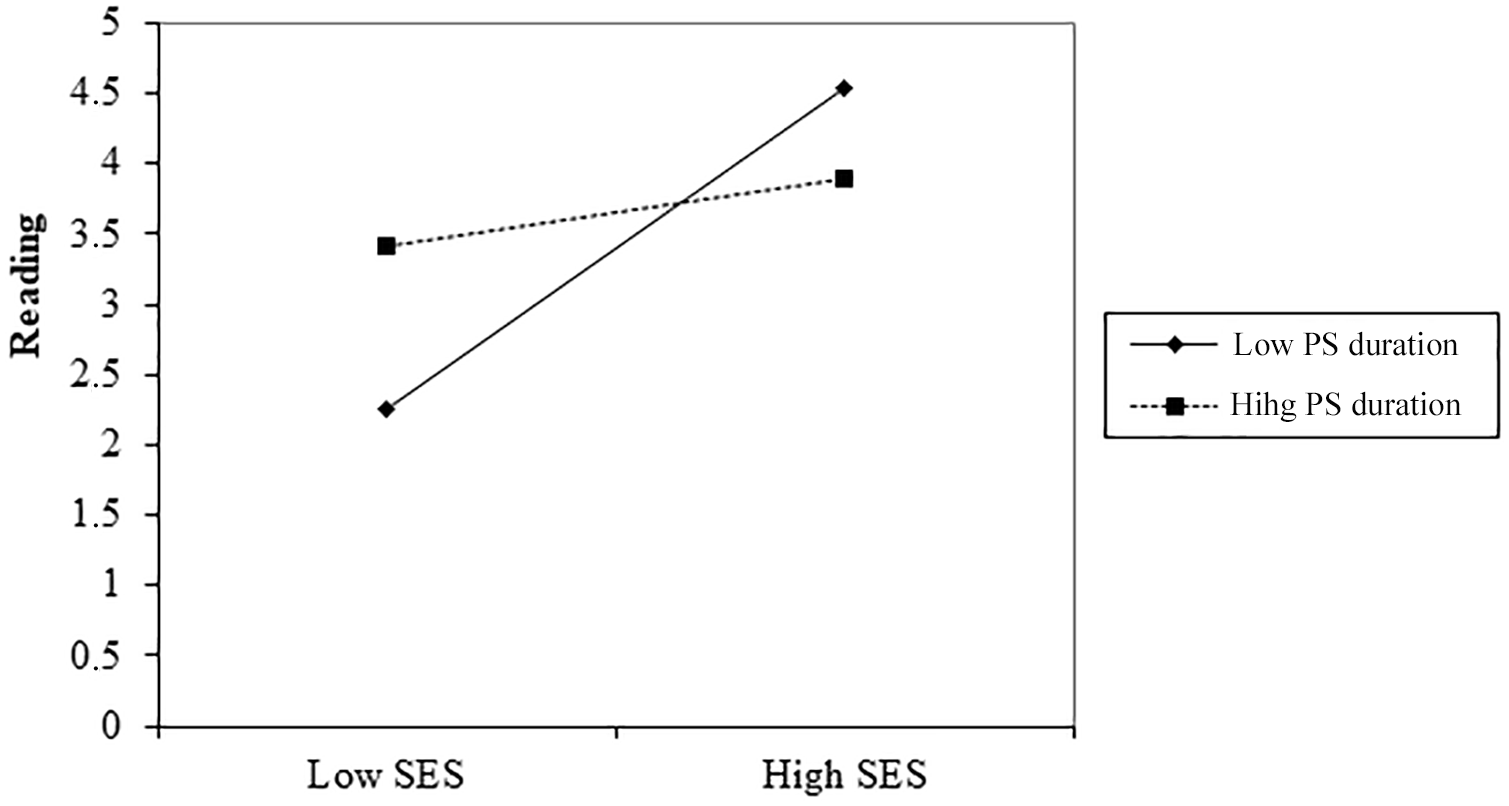
Plot of standardised coefficients of interaction between socio-economic status (SES) and pre-school (PS) duration among fourth-grade pupils from 67 primary schools in Flanders (own analysis of Validiv data).
Discussion
The purpose of this study has been to examine whether duration of universal pre-school related to fourth-grade pupils’ academic achievement in Flanders. We investigated general and equity benefits of pre-school duration, relying on quantitative data collected from fourth-grade pupils and their parents in a wide range of primary schools, while focusing on test outcomes in reading and science.
First, concerning general academic benefits of pre-school duration, our study produced a divided pattern in terms of cognitive task: a small positive relation with outcomes in science, but no significant relation with outcomes in reading. This pattern partly confirms our prediction and is partly consistent with the positive evidence in the research literature (Caille, 2001; Melhuish et al., 2013; Raudenbush and Eschmann, 2015; Ruhm and Waldfogel, 2011; Sammons et al., 2008). Apparently, an early entry in Flemish pre-school seems to relate positively among nine-year-old pupils to their performance in science but not in reading. Hence, in the Flemish instance, the relationship between pre-school duration and academic achievement is related to the kind of cognitive task that is assessed. This indicates a differential cognitive benefit that relates to the context of Flemish pre-school – more specifically, its curriculum – or the way in which science versus reading objectives are generally designed and taught in Flemish pre-school classes. The lack of a significant relation between pre-school duration and reading performance is a startling result in light of the importance of the reading comprehension level as a predictor of academic achievement (Cain and Oakhill, 2006; Dias et al., 2015; Royer et al., 1990). This may imply in practical terms that spending longer time in pre-school is not likely to improve reading comprehension in subsequent years. This implication raises the issue of the development of early literacy skills in Flemish pre-school and requires a closer look at the current pre-conditions for the gains of pre-literacy practices in pre-school for literacy skills in the later school career (Justice et al., 2008; Lonigan and Shanahan, 2009; Strickland and Riley-Ayers, 2006).
Second, our study revealed that pre-school duration mitigated the positive relation of parental SES to reading performance. In other words, in terms of their reading children who spent longer time in pre-school are less affected by their socio-economic background than children who spent fewer years in pre-school. This result is in keeping with previous research (Becker, 2011; Hirsch, 2004; Raudenbush and Eschmann, 2015) and supports the assumption that an earlier start in universal pre-school relates to equity gains benefiting pupils from low-SES backgrounds.
Third, the data suggest that differential relations between pre-school duration and linguistic or immigrant backgrounds relate, instead, to parental SES. Since there is consistent evidence in the literature for a positive correlation between family SES and literacy in the home (Ergül et al., 2017; Liu et al., 2018; Ren and Hu, 2011; Silinskas et al., 2012), underachievement in reading comprehension may be more related to lower SES than a language-minority or immigrant background per se.
Fourth, the finding of non-significant equity benefits of participation in Flemish universal pre-school for academic achievement at age nine for the immigrant and language background variables is inconsistent with the findings from the previous Flemish study (DOV, 2016), showing positive relations between pre-school duration and, respectively, school readiness or language skills at age six and grade retention at age eight. However, the native-language children in the non-participation sub-group constituted a small group (7 from a total of 36). Thus, the result regarding language background should be viewed with caution. This issue needs further investigation in light of the scarcity of studies to date, which examined these specific background variables in primary education, as well as the overall mixed evidence for equity benefits in regard to immigrant and minority-language status in secondary school (Drange and Telle, 2010; Fredriksson et al., 2010; OECD, 2010).
Fifth, the absence of equity benefits in most cases may indicate that initial achievement gaps are sustained in the short term. However, three other explanations are likely. First of all, initial gains in pre-school attained for certain sub-groups may have washed out entirely by fourth grade. Indeed, the trend of a catch-up effect in pre-school fading out in primary school has been evidenced in longitudinal studies (Blanden et al., 2016; Melhuish et al., 2015). Secondly, children from an immigrant or language-minority background may not be served to a sufficient degree by universal pre-school learning environments. Time is to be spread over large, often mixed groups of children with various backgrounds, needs and levels. This dilutes the amount of attention and care that minority children need to accelerate the pace of their learning and catch up with the other children. This interpretation is consistent with Green and Mostafa’s (2011) claim that social gaps in performance are mitigated only by high levels of pre-school provision, where children from less advantaged families get more or better quality provision than those from advantaged families. This raises the issue whether universal pre-school is a more effective approach than targeted pre-school to take care of disadvantaged children, as, indeed, has been questioned in some previous studies (Carta and Rizzica, 2018; Haeck et al., 2015). In addition to this, the ‘schoolified’ pedagogical approach of Flemish pre-school where children are taught in formalised learning environments (Van Laere, 2017) and in relatively large groups (Hulpia et al., 2014) may not be conducive to creating a more equity-based approach to boosting academic success. A third likely explanation lies in the variation in the quality of education across the pre-schools. Lower quality of education in pre-schools catering to large groups of disadvantaged children may be an influencing factor. Unfortunately, this study lacks information on specific pre-school features. Nonetheless, there is strong international evidence that the immediate effectiveness and sustained school success of pre-school provision are connected to its process quality, particularly the features of curriculum, learning environment, teacher–child interactions in the classroom and parent involvement (Burger, 2010; Camilli et al., 2010; Felfe and Lalive, 2014; Hall et al., 2013; Melhuish et al., 2015; Sabol et al., 2013; Sammons et al., 2008). Since quality mediates the benefits of pre-school provision, the academic benefit of increasing pre-school attendance may be largely dependent on its pedagogical quality. Recent qualitative research conducted in four Flemish pre-schools educating children from poor families can illustrate this point. It demonstrated that in entry classes for 2.5- to three-year-olds, linguistic interactions between teachers and children, and among the children, provided few learning opportunities, which lacked, moreover, the high quality in language input and interaction that is needed to adequately develop academic language proficiency (Peleman et al., 2020; see also Roose et al., 2014).
Limitations
A number of limitations to this study are worth mentioning. First, given the observational nature of the data, the relationship between pre-school duration and future academic performance must be understood as covariance between variables and cannot be interpreted in causal terms. Second, given the small size of the sub-sample of children who did not enter pre-school in the first year (or never attended), there is not much variation in terms of duration. Hence, it is quite conceivable that we measured the relationship between academic outcomes and attending pre-school in itself, rather than the intensive margin in terms of number of years. Third, the data concerning pre-school participation were based on self-reporting by the parents. Additionally, among the parents from lower SES and immigrant groups who reported having sent their child to pre-school from the first year, there may have been those whose children attended less frequently. This implies that equal duration of pre-school may, in fact, cover unequal rates of exposure across various groups (DOV, 2016; Leseman, 2002; Loeb et al., 2007), which could bias the data. Finally, we relied on a merely global approach to estimating the relationship between pre-school participation and academic outcomes. Since the present study had a retrospective design, we were not able to assess characteristics of the pre-schools that the participating children attended in the past.
Implications for research
The present study has implications for future research. Detailed comparative studies are needed to address the question of which factors determine why attendance in universal pre-school attains equity effects in certain countries, contexts, systems and curricular subjects, but not in other ones, and for certain pupil categories, but not for other ones. In this regard, we can surely assent the assertion by McLeod et al. (2018) that the uneven nature of the research may reflect the variability over the literature in terms of the nature, quality and context of the pre-school programmes examined; the study design; the quality of the research methodology; and other issues. This study suggests that the factors of level of participation, outcome measure and student background arguably deserve further exploration.
Implications for policy design
This study on universal pre-school in Flanders may suggest implications for policy design. Nonetheless, given the limitations of the current study, some caution is necessary.
First, considering that the size of the group of children entering pre-school late or not is relatively small, policy measures aimed at maximum pre-school participation of children from disadvantaged backgrounds can have only a minimal positive impact when it comes to reducing initial or subsequent achievement gaps (DOV, 2016; Raad Basisonderwijs, 2012).
Second, the (suggestive) result of this study that early pre-school entry did not favour pupils speaking other home languages than Dutch from underachievement in their later school career makes it likely that increasing the exposure of young minority-language children to the majority language by sending them to pre-school as early as possible, is not the royal road to acquire the academic language abilities needed to succeed in primary school and thereafter.
Third, the result that pre-school attendance contributes to reducing the gap in later reading comprehension outcomes between pupils from low-SES and high-SES families suggests that investment in developing early literacy practices and policies is likely to be a more adequate strategy than focusing one-sidedly on an early start in pre-school for immigrant children in order to accelerate their acquisition of the Dutch language.
Finally, we discuss the relevance of the findings emerging from this Flemish case study within a wider European policy context. First of all, regarding European (sub-)states where universal pre-school systems have attained high participation rates, we argue that the key to equitable education for low-SES/immigrant-minority children will be improving the quality of education in pre-school, rather than merely or predominantly maximising pre-school participation (for recommendations, see Hattie, 2009; Van den Branden, 2012). Nevertheless, if the provision of universal pre-school has not reached general levels yet, it remains important to expand its provision by enrolling all young children, regardless of background from an early age. Additionally, we can learn from the Flemish case that its ‘schoolified’ approach to pre-school pedagogy may be questioned from an equity perspective. European countries where ECEC systems are currently undergoing ‘schoolification’ tendencies (e.g. Denmark, France, Norway, Sweden, UK) should at least be aware of concurring pedagogical risks. Over the last decade, many researchers have debated the possible effects of ‘schoolification’ on pre-school pedagogies. Two effects that have raised concern are downplaying the attention given to the caring dimension of pre-school education and the tendency to focus on cognitive and language learning in an academic, decontexualised way (Van Laere, 2017). Our data seem to suggest that Flemish pre-school education may guarantee some mild general academic benefits in the short run, but, at the same time, this seems not to go hand in hand with improved outcomes for children with an immigrant or language-minority background. If this – suggestive – result could be backed with more solid data resulting from future research, this may support the argument that the relationship between ‘schoolification’ of pre-school education and striving for more educational equity is at odds.
Conclusion
This study has provided new data on the relationship between universal pre-school attendance and academic outcomes at primary-education level in a European high-income society where pre-school enrolment approaches general levels. This issue is relevant from an equity policy perspective – namely, from the part that children’s pre-school experience is expected to play in countering persistent socio-economic, ethnic and linguistic disparities in education. We found that in Flanders the general relationship between universal pre-school attendance and academic outcomes at age nine depended on the academic subject (science or reading) assessed. The finding that pre-school duration moderated the relation between SES and reading outcomes indicates that children who spent longer time in pre-school are less affected by their socio-economic background than children who attend less or no time in pre-school. The science performance of pupils from immigrant or language-minority backgrounds seems to benefit from longer pre-school participation, but only in an amount comparable to their non-immigrant or majority-language counterparts. The results suggest that the gains of early inclusion policies may be only minimal in terms of narrowing the existing achievement gaps. Instead, a more comprehensive package of strategies, relating to both quantity and quality of pre-school education, would be necessary to provide equitable learning opportunities to the great majority of disadvantaged immigrant-background children whose participation in pre-school is an established fact. This implication might be especially applicable to European educational contexts that show consistently high levels of pre-school participation of disadvantaged societal groups and are characterised by a ‘schoolified’ approach to pre-school pedagogy.
Footnotes
Declaration of conflicting interests
The author(s) declared no potential conflicts of interest with respect to the research, authorship, and/or publication of this article.
Funding
The authors disclosed receipt of the following financial support for the research, authorship, and/or publication of this article: This work was supported by the Agency for Innovation by Science and Technology (Flanders) (Grant Number 110008).

Notes
Author biographies
Orhan Agirdag, PhD sociology, is professor of educational sciences at KU Leuven, adjunct professor at the University of Amsterdam and a member of the Young Academy of Belgium. Formerly he was a Fulbright Fellow at the UCLA. His research lab focuses on teacher education, early childhood education and multilingualism. He is an author of more than hundred publications that are cited over 1800 times. He published in journals as Educational Review, European Sociological Review, and School Effectiveness and School Improvement.