




Abstract
Peer tutoring in Mathematics has reported academic benefits across many educational levels, from Preschool to Higher Education. However, recent literature reviews and meta-analysis state that students experience higher gains in Primary or Elementary Education (ages 7–12 years) than in secondary education or middle school and high school (ages 13–18 years). This study examined the effects of peer tutoring on students’ mathematics achievement in primary and secondary education under similar settings. 89 students from first, fourth, seventh, and ninth grades participated in the study. The design of this research was quasi-experimental with pretest–posttest without control group. The statistical analysis reported significant improvements for both, Primary and Secondary Education. The comparison between these educational levels showed that there were no significant differences in the increments of the students’ marks. The global effect size reported for the experience was Cohen’s d = 0.78. The main conclusion is that Peer Tutoring in Mathematics reports similar academic benefits for both, Primary and Secondary Education. Future research must be conducted as the superiority of Peer Tutoring in Primary over Secondary Education has yet to be proved in the Mathematics subject.
Introduction
The effects of peer tutoring in Mathematics have been documented during more than four decades. The original research by Harris and Sherman (1973) and Fogarty and Wang (1982) was followed by hundreds of studies in the field. The last studies in the field conclude that students’ interactions during peer tutoring have positive significant effects on students’ mathematics learning (Alegre et al., 2019c; Gamlem, 2019). Several literature reviews and meta-analysis have documented the academic benefits of this methodology from Preschool to Higher Education (Britz, 1989; Morano & Riccomini, 2017; Robinson et al., 2005; Rohrbeck et al., 2003). Peer tutoring has been considered to report similar academic benefits across these educational levels (Bowman-Perrott et al., 2013; Ritter et al., 2009). Nevertheless, recent literature reviews and meta-analysis state that Peer Tutoring in Mathematics is more effective primary or elementary education (ages 7–12 years) than in secondary education or middle school and high school (ages 13–18 years) from an academic perspective (Alegre-Ansuategui et al., 2018). The conclusions of these recent articles open new fields of research, as the superiority of this methodology in Primary over Secondary Education has not been thoroughly examined before. Although the effect sizes reported in all the above-mentioned studies are mostly moderate for both educational levels, effect sizes in Primary Education look somewhat larger than those in Secondary Education. In fact, Leung (2019a) states that future research is needed to address the differences between these two educational levels regarding peer tutoring. Moreover according to several authors, the absence of research in which the effects of peer tutoring are compared within these two educational levels is notorious (Hoogeveen & van Gelderen, 2018; Schwab, 2018). Hence, given the promising results of this way of instruction in Mathematics, it seems interesting to determine if it is more effective for Primary than Secondary Education in Mathematics. Besides, several authors such as Brown et al. (2019), Henderson Pinter et al. (2018), and Myers et al. (2020) state that, to improve academically in mathematics, it is crucial to research on instructional practices in different educational levels that foster students participation during their learning. In this research primary (first and fourth graders) and secondary (seventh and ninth graders) students’ mathematics achievement is analyzed before and after carrying out an identical peer tutoring program. The main objective was to identify any possible differences in the academic outcome for Primary and Secondary Education. The design of the research was quasi-experimental with pretest–posttest without control group. Calculations of parametric tests and effect sizes were performed so that the impact of the methodology on students’ mathematics achievement could be quantified.
Theoretical Framework
Flores and Duran (2013) state that most of the times students like the idea of receiving help from their peers during learning processes. Peer tutors acquire or have acquired the same academic contents as their peers, so they really know the difficulties their peers may experience when learning them. Sharing cultural and linguistic references, using a more direct speech and confidence between them are other factors that should also be considered as stated by these researchers. Different definitions of peer tutoring have been used along the years. Topping (2009) defined peer tutoring as “people from similar social groupings, who are not professional teachers, helping each other to learn and learning themselves by teaching.” Usually, classmates with higher ability or knowledge act as tutors during this process. So, there are students who support and help (tutors) and others who receive that help and support (tutees). Cooperation in pairs is a must in this methodology. Hence, a professional plans an asymmetric learning relationship with their students sharing one goal: the acquisition of a curricular content (Yang et al., 2016). For all above mentioned, it can be considered as a methodology that promotes collaborative learning and fosters inclusion in the classroom (Miravet et al., 2013). Peer tutoring is considered to report benefits not only on students’ academic achievement (DuPaul et al., 1998; Ryan et al., 2004) but also on psychological, behavioral and attitudinal variables (Fantuzzo et al., 1995; Flores and Duran, 2013; B. W. Griffin & Griffin, 1997; M. M. Griffin & Griffin, 1998). Hence, it can be considered as a methodology that has multiple benefits for the students.
Different types of peer tutoring may be defined mainly depending on two factors: students’ ages and students’ roles during peer tutoring. Considering students’ age, two types of peer tutoring may be implemented: cross-age and same-age tutoring (Alegre et al., 2019b). Considering students’ roles, two categories of tutoring may be defined: reciprocal and fixed peer tutoring (Miravet, 2015).
In same-age tutoring students belong to the same school grade level. On the contrary, in cross-age tutoring, students belong to different grade levels and sometimes even distinct educational levels. In fact, it is quite frequent to read cross-age peer tutoring experiences in which tutors from higher educational levels help tutees from lower educational levels (Kalkowski, 1995). Although researchers such as Hartup (1976) and Scruggs and Osguthorpe (1986) highlight that tutees improve the most when older tutors help them, the superiority of cross-age over same-age tutoring has yet to be proved. Topping et al. (2004) state that using older tutors guarantees the success of the experience and they recommend an age gap of at least two years between tutors and tutees. Vogelwiesche et al. (2006) reported that participants in this type of experiences lean toward cross over same-age tutoring. However, Rekrut (1994) and Sheldon (2001) concluded that results for same and cross-age tutoring were very similar. Moreover, previous meta-analysis and literature reviews have not shown important differences between them (Stenhoff & Lignugaris/Kraft, 2007; Topping, 1996). Apart from that, authors such as Cohen (1986) and Ramani et al. (2016) state that same-age tutoring is easier to implement than cross-age from an organizational perspective. They support their statement by affirming that same-age tutoring experiences most of the times are carried out within the same classroom. Then, the extra organizational problems that take place during cross-age tutoring do not arise in same-age tutoring.
In terms of roles of the participants, fixed tutoring is often regarded as the most frequently implemented tutoring type (Miravet et al., 2013). In fixed tutoring, students do not switch roles and keep being tutors or tutees from the beginning to the end of the program. For many researchers and practitioners in the field, this type looks as it is logical that the most skilled students tutor their less skilled peers (Falchikov, 2001; Walker et al., 2009). On the contrary, during reciprocal peer tutoring students switch roles (Pigott et al., 1986). Previous studies in the field state that, from a psychological perspective, reciprocal tutoring is better than fixed tutoring (Miravet et al., 2014). Mathematics self-concept and mathematics attitude seem to benefit more from the role exchange that takes place during reciprocal tutoring (Cheng & Ku, 2009; Fantuzzo et al., 1989; Moliner & Alegre, 2020; Sutherland & Snyder, 2007). No previous literature reviews or meta-analysis have shown significant differences between both types in the academic achievement variables (Leung, 2015, 2019b).
Recently, the academic achievement variable has been thoroughly studied for peer tutoring in Mathematics in several meta-analysis and literature reviews (Leung, 2015; Moeyaert et al., 2019; Zeneli et al., 2016). In these reviews and meta-analysis effect sizes are most of the times larger for Primary Education than for Secondary Education. In this sense, the meta-analysis performed by Alegre-Ansuategui et al. (2018) concluded that educational level may act as a significant moderator in this type of experiences and reported larger effect sizes for Primary Education experiences than those for Secondary Education. Cohen (1986) stated that peer tutoring academic outcomes may differ significantly across ages. As Lodico et al. (2010) suggest, comparison in educational methodologies should take place in as similar settings as possible (same type of students, same type of tutoring, etc.). These reviews and meta-analysis include dozens of studies with each of them being implemented under different conditions (types of tutoring, structuration of the pairs, tutors’ achievement, etc.). The authors of this manuscript were not able to find previous research in which the impact of peer tutoring in Mathematics in Primary and Secondary Education under similar settings.
Hence, given the potentiality of this methodology in Mathematics and the reported differences in effect sizes across different studies, a comparison between primary and secondary education is needed. In this sense, it is necessary to implement peer tutoring in as similar conditions as possible in both educational levels. In this way, differences between the academic outcomes for each of the levels may be examined in a more precise way, that is, without other factors except for the educational level influencing the final outcome. In this research, focus was on Mathematics subject given the previous promising results in the field and the fact that it may be the most important subject in the curricula as other subjects such as Physics, Chemistry, Technology, Biology, or Science are strongly linked with Mathematics. The main motivation of this research is to quantify the effect of peer tutoring in Mathematics in Primary and Secondary Education under similar settings. This way, no differences in organizational settings will influence the effects of the intervention and a more accurate comparison will be possible. Same-age and fixed peer tutoring is implemented and the students’ academic achievement in Mathematics is analyzed.
Materials and Method
Research Design
The design of this study was quasi-experimental with pretest–posttest without control group (Morris, 2008). Using a control group is highly recommended by Leung (2015) in these type of experiences. Nevertheless, as Gersten et al. (2005) state, research in education may be complex due to organizational and ethical issues. In the case of this study, it was not possible to have a control group due to legal issues concerning the experiment. Comparisons between experimental and other groups in the same schools were not allowed by some of the schools’ principals. Hence, the inclusion of the control group was not possible for this research.
Sample Access
Convenience sampling, that is, nonprobability sampling in which the sample is drawn from that part of the population that is close to hand, was used in this research (Etikan et al., 2016) as they were selected for two main reasons: because they were conveniently available to the researchers and because there was an authorization by the institutions and parents in charge of the participants to perform this research. Moreover, one of the authors of this study coordinated the peer tutoring actions at two schools while serving as instructor at one of the middle schools. The teacher had already performed several peer tutoring studies. In this sense, the previous knowledge of the teacher made easy the development of the peer tutoring intervention.
Participants
First- and fourth-grade students from two public schools and seventh- and ninth-grade students belonging to a public middle-school, all of them in the Valencian Community (Spain), participated in the study. As stated in the previous section, the sample was limited to Spanish students due to availability and legal issues. Although 94 students were taking these grades, five of them were excluded from the study due to the fact that they did not attend to school too many days. Hence, only 89 students participated in the program. In this sense, the fact that previous authorization by the parents in charge of the students was needed limited the sample size significantly. 49 were girls and 40 were boys and they were distributed in the following way: 22 students for first grade (6–7 years old), 18 students for fourth grade (9–10 years old), 24 students for seventh grade (12–13 years old), and 25 students for ninth grade (14–15 years old). A total of 40 students from first and fourth grades constituted the sample for Primary Education and 49 students for seventh and ninth grades constituted the sample for Secondary Education. Although the desired sample size for generalizing studies is greater than the 89 students in this research, according to Maas and Hox (2005) only small sample sizes, that is, samples of 50 subjects or less, produces biased estimates of standard errors. Dong and Maynard’s software was used for the calculation of the required sample size and also for estimating the minimum value of effect sizes that could be detected (Dong & Maynard, 2013). For a quasi-experimental pretest–posttest single group design with a type I error of .05, a statistical power of .8, a sample proportion assigned to experimental conditions of .5 and considering that the minimum effect size that could be detected was 0.45 the software indicated a minimum required sample size of 80 individuals. The effect size value of 0.45 was selected as authors such as Lipsey (1990) state that this is the required minimum value to consider that a treatment has produced a medium effect size. Hence, although the sample size may not be sufficient to generalize the results of this study (Tipton & Olsen, 2018), it still may be worth to conduct the study for the above-mentioned reasons.
Mathematics Contents
The mathematics contents that students worked with during the intervention were taught during the first 2 weeks of the second term of first, fourth, seventh, and ninth grade levels of mathematics. During the second term, first graders perform basic exercises with addition and subtraction (one figure). Meanwhile, fourth graders work with length, capacity, and mass. Seventh graders start with algebra with basic first-degree equations. Ninth graders work advanced algebra contents such as polynomial decomposition (Ruffini’s rule) or multiplication and division of polynomials.
Development of the Peer Tutoring Program
Before the implementation of the peer tutoring program, that is, the first school trimester, teachers for each grade used traditional teaching methods, whereas during the second term, the teacher’s lessons were completed with peer tutoring. Fixed and same-age tutoring was employed. Same-age tutoring was chosen over cross-age tutoring due to organizational issues. Moreover, reciprocal peer tutoring requires a previous knowledge by researchers on the students’ capacities in Mathematics. As researchers lacked that knowledge regarding first- and fourth-grade participants, fixed peer tutoring was chosen over reciprocal peer tutoring.
Organization and Scheduling
The peer tutoring intervention was designed to last 24 sessions for each course. All of these sessions were held during the second trimester of the school year (December to March). During 12 weeks, peer tutoring sessions were held twice a week on Monday and Wednesday. Interactions between peers lasted about 20 min. The whole program was implemented during school-time hours. The scheduling was programmed taking into account the implications for practice given by Stevens et al. (2018).
Selection of Peers
To select the peers and assign each student a role (tutor or tutee), recommendations by Topping and Ehly (2001) were followed. Hence, tutors were selected taking into account their previous mathematics grades. To this purpose, a list in which students for each course were included was divided into two sections considering to their first-term mathematics scores. Students in the first section acted as tutors (most proficient students in Mathematics) and the second half played the role of tutees (least proficient students in Mathematics). After that, the tutor at the top of the section was paired with the tutee at the top of the other section. Then, the second tutor of the first section and the second tutee of the second section were paired and so on until there were no more students to pair. This way the grade difference between tutors and tutees is minimized (Campbell, 2019). In ninth grade, as there were 25 students in one class (odd number), the student placed at the top of the list played the role of all-rounder tutor (Ballester & Miravet, 2015).
Materials and Resources
Students worked with the same type of materials before, during, and after the intervention. Materials included worksheets provided by the teacher and the textbook for each grade level. One worksheet was handed out to each student at the begging of every peer tutoring session. Each of these worksheets included two exercises in the case of first and fourth grades and an exercise and a problem in the case of seventh and ninth grades. Mathematics problems were not included in the worksheets of primary education students as it might have been really complex for most of them given that they must read and comprehend the sentence of the problem, identify the question, and create and solve a numerical procedure (Chan & Wong, 2019). The level of difficulty for the exercises and problems were different depending on the worksheet and students’ academic grade. If a pair of students finished way earlier than their peers, they were given extra exercises to do.
Classroom Dynamic
At the beginning of each session, the same worksheet was given to all students in the same grade level. First, students had to work alone. They were given 6 min to finish the first exercise. Later, they had 8 min to help themselves in pairs (peer tutoring). After that, they had to finish the second exercise or problem in 8 min. Finally, 8 more minutes were dedicated to the last peer tutoring interaction between pairs.
Instruments Employed to Collect Information
Participants’ first trimester (term) and second trimester marks in mathematics were used to measure students’ academic achievement. So, their marks in the first term (traditional teaching) were used as a pretest and their marks in the second term (peer tutoring implementation) were used as a posttest. Students in all courses took three different exams during each term. Their average score of the three exams, that is, the numerical grade from 0 to 10 for the first term was their final pretest score and the average of their three exams of the second term was their final posttest score.
Data Analysis
All quantitative data in this research were analyzed by means of SPSS 25.0 software. Averages, percentages, standard deviations, and increments (posttest minus pretest) were included as descriptive data. For the inferential statistical analysis, Student’s t-test was used to detect significant differences between the pretest and the posttest. These tests were performed by courses, educational levels (first- and fourth-grade scores serving as Primary Education and seventh- and ninth-grade scores serving as Secondary Education) and globally (Laird, 1983). Besides, analysis of variance (ANOVA) were also used to detect significant differences in the marks increment of the four courses (Gu, 2013). A post hoc analysis was run using Scheffe’s test (MacDonald & Gardner, 2000). As Debelak and Koller (2019) state, several requirements must be fulfilled before using parametric methods in a study. To this purpose, a Kolmogorov–Smirnoff test was conducted using the pretest scores to ensure that students’ scores followed a normal distribution. Further requirements as using continuous scales for measuring the main variable were also taken into account. Effect sizes were calculated for both educational levels and globally using the expression given by Lee et al. (2019). Cohen’s d value was provided as an indicator of the effect size.
Results
Table 1 shows the descriptive results for the study. Means for students’ mathematics achievement and their respective standard deviations (SD) are reported. Besides, the number of participants for each group (n) is shown in this table for the pretest and the posttest by courses, educational levels, and globally.
Mean Values and Standard Deviations by Courses, Educational Levels, and Globally.

The number of participants that increased or decreased their mathematics achievement marks after the peer tutoring intervention is shown in Table 2. Results are presented by courses, educational levels, and globally.
Students’ Differences After the Intervention.

Student’s t-test were performed to detected significant differences between groups. These tests are shown in Table 3. In Tests 1 to 4, pretest and posttest scores are compared by grade. In Tests 5 and 6, differences between the pretest and posttest were analyzed by educational levels, that is, putting together Grades 1 and 4 (Primary Education) and Grades 7 and 9 (Secondary Education). Test 7 shows the differences between the pretest and the posttest putting all grades together. Test 8 analyzes the increments (posttest and pretest difference) by educational levels. Mean differences for each group
Students’ t-Test by Grades, Educational Levels, and Globally.
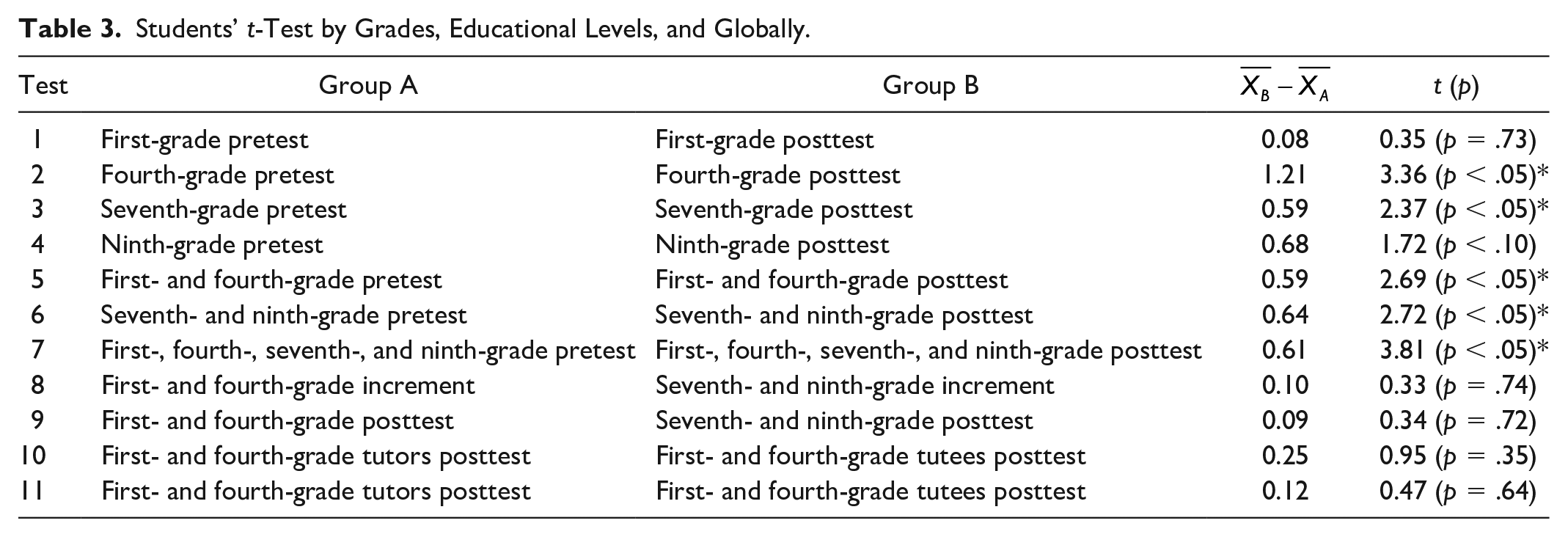
The reported Cohen’s d effect size for Primary Education students was 0.55 and 0.56 for Secondary Education students. The global effect size for the study was 0.78.
Table 4 shows the ANOVA that was carried out to detect differences in the increments among the four grades. This table shows the degrees of freedom (df), sum of squares (SS), mean square (MS), and the parameter (F) and its respective level of significance between groups, within groups and totally. As Table 4 shows, no statistical significant differences were reported. Post hoc analysis did not report statistical differences either (Table 5).
ANOVA With the Increments of First, Fourth, Seventh, and Ninth Grades.

ANOVA = analysis of variance; SS = sum of squares; MS = mean square.
Scheffe’s Test With the Increments of First, Fourth, Seventh, and Ninth Grades.

Discussion
The statistical improvements reported by educational levels in this research are consistent with previous research in the field. On one hand, previous studies by Fantuzzo et al. (1995), Tsuei (2012), Tella (2013), and Tsuei (2014) reported similar results for their Mathematics peer tutoring experiences in Primary Education. Selection of peers, classroom dynamic, and scheduling were also similar with the ones in this study. On the other hand, for Secondary Education, previous studies of Calhoon and Fuchs (2003), Oloo et al. (2016) and Alegre Ansuategui and Moliner Miravet (2017) also reported academic benefits in Mathematics under similar conditions with peer tutoring. Nevertheless, the effect sizes reported in the present study for Secondary Education are larger than those reported in these studies. According to some authors, not including a control group may have produced an overestimation of the effects of peer tutoring in this research (Zeneli et al., 2016). The percentage of participants that increased their academic achievement with this methodology was also very similar for all grades. Bentz and Fuchs (1996), Fuchs et al. (1997), and Fueyo and Bushell (1998) reported similar percentages. They are also consistent with previous meta-analysis and literature reviews in the field as all of them reported a high number of studies (more than 70%) in which peer tutoring led to an improvement in the academic achievement variable (Rohrbeck et al., 2003) or to medium or large effect sizes for peer tutoring interventions (Templeton et al., 2008).
As stated in the “Introduction” and “Theoretical Framework” sections, there is an important lack of studies in peer tutoring that analyze the differences between educational levels under similar settings. The fact that no differences were found between Primary and Secondary Education in this research coincides with previous peer tutoring studies outside the Mathematics field by Leung (2015) and Leung (2019a). Foot and Howe (1998) and Ayers and Gray (2013) discussed both educational levels for peer tutoring. They state that what really matters in is the positive attitude of the peers toward the teaching and learning process. Hence, according to them, is not a question of age, but a question of attitude for both sides (tutors and tutees) that must exert positive interactions between them. Hence, it is expectable that, if no significant differences have been reported in students’ attitudes between primary and secondary education, there should not be any significant differences in the peer tutoring effects between both educational levels. Ma and Kishor (1997) and Topping (2011) state that that transition from primary to secondary education must be considered when it comes to analyzing students’ attitudes and perceptions toward Mathematics. Motivation and attitude decrease due to previous failure experiences for many students in the Mathematics subject as they keep on advancing grade by grade. Hence, the fact that students’ attitude may have experimented a decrease could have affected the results of the tutoring program. That would explain the differences found with literature reviews and meta-analysis by Alegre-Ansuategui et al. (2018) and Alegre et al. (2019a). The similar scores reported for tutors and tutees in both educational levels is also consistent with recent peer tutoring research (Leung, 2019b; Shin et al., 2019) as peer tutoring is expected to benefit academic achievement for most of the students independently of the roles they play (Hickey & Flynn, 2019).
Conclusion
The main conclusion is that Peer Tutoring in Mathematics reports similar academic benefits for both, Primary and Secondary Education. Those benefits are usually significant and should be considered by practitioners in the field given their proven efficiency. Although previous literature and reviews and meta-analysis reported larger effect sizes for Primary Education studies than for Secondary Education studies, this study reported almost identical effect sizes for both educational levels under similar settings. Nevertheless, caution is required when considering this results. The absence of a control group, the small sample size (89 students), the fact that primary students sample from the study was collected from a larger population compared with the secondary students sample, and using a nonprobabilistic sampling technique are limitations that should be considered. In this sense, although results in this study are promising and may help practitioners and researchers in future experiences and studies, the limitations above mentioned must be considered when interpreting them. In this sense, organizational and legal issues (access to control groups, students’ parents and school principals’ authorizations, etc.) as the ones that limited this research should be considered before a peer tutoring implementation when conducting future studies in the field.
Footnotes
Declaration of Conflicting Interests
The author(s) declared no potential conflicts of interest with respect to the research, authorship, and/or publication of this article.
Funding
The author(s) received no financial support for the research, authorship, and/or publication of this article.
