




Abstract
This study examines factors influencing continuity of high academic performance among low socioeconomic status (SES) students in Mexico's upper secondary education, compared to high-SES peers. Using mathematics scores from the ENLACE test (2012–2015, N = 16,622; 3,247 low SES and 13,375 high SES), we apply multivariate logistic regression to assess how personal, school, and instructional variables affect the odds of sustaining top-quartile achievement. Results show that being male, resilient, perseverant, having academic aspirations, and receiving scholarships are associated with odds of continuity. In contrast, attending evening schools or disadvantaged institutions is associated with odds of decline. Only 22% of low-SES students sustained top performance, compared to 31.4% of high-SES peers. To guide interventions, we calculate Population Attributable Risk (PAR). Findings highlight the central role of the school subsystem and lower secondary type, followed by aspirations, resilience, perseverance, and teacher knowledge. Combining odds ratios with PAR supports equity-oriented interventions.
Introduction
Education is key to social mobility because it directly influences economic opportunities (Organisation for Economic Co-operation and Development [OECD], 2018), especially for those from disadvantaged backgrounds (Vélez-Grajales et al., 2015). Sustaining high academic achievement is a challenge for students due to structural inequalities and the limited availability of school-based cultural capital (Farkas, 2018). Torche (2015) argues that education is the main mediator in the intergenerational transmission of advantages, although its effect is weaker among the least educated because of barriers in access and quality.
Although the literature recognizes the potential of education to break cycles of inequality, few studies analyze the continuity of high academic achievement among low socioeconomic status (SES) students (Agasisti et al., 2021; Sheehan & Hadfield, 2024), a key aspect for understanding its limitations and possibilities.
Recent research has consistently shown that SES is a decisive predictor of academic achievement. Munir et al. (2023) demonstrate that students from privileged contexts systematically obtain higher grades and greater rates of academic excellence; however, they clarify that SES does not act as an absolute determinant but as a framework of opportunities conditioned by family and school capital. Similarly, Rahman et al. (2023) and Salako (2024) show that in developing countries SES explains gaps in key subjects, such as mathematics, and that households with more resources and cultural capital accumulate advantages.
In Latin America, Palacios Mena and Ariza Bulla (2023) demonstrate that educational gaps can be explained by factors such as parents’ educational attainment, household resources, cultural capital, and school conditions, while Selvitopu and Kaya (2023) find that maternal education is one of the strongest predictors of achievement.
Other studies, such as Langensee et al. (2024), highlight that economic resources facilitate access to learning materials and environments, while parents’ educational level influences expectations; cultural and social capital shape academic aspirations; household conditions and the ability to attend schools with better infrastructure and teaching quality amplify advantages or disadvantages of origin, creating a network of opportunities that enhances or constrains academic trajectories. Furthermore, Rodríguez-Hernández et al. (2020, 2021) show that SES has greater predictive power for identifying high-achieving students than for low-achieving ones, confirming that favorable socioeconomic contexts increase the likelihood of belonging to the top-performance group. However, they note that maintaining high achievement cannot be understood solely from SES; previous educational trajectories must also be considered.
In Mexico, performance differences by socioeconomic context persist during upper higher education (Hernández, 2019). But research identifying risk or success factors in general do not study Private High School conditions sustaining high performance of vulnerable students (Tuirán et al., 2019).
Sociocultural and Educational Context of Mexico
Mexico is a heterogeneous society, marked by deep territorial and socioeconomic inequalities, high levels of labor informality, and broad cultural diversity. These conditions are reflected in persistent gaps in educational opportunities between urban and rural regions, as well as among schools with varying levels of resources. In Mexico, upper secondary education (Spanish: Educación Media Superior, EMS
In PISA 2022, Mexico scored below the OECD average in all three domains: 395 points in mathematics versus an average of 472, 415 in reading versus 476, and 410 in science versus 485 (OECD, 2023a). In mathematics, more than half of Mexican students performed below Level 2, compared to approximately 30–32% in the OECD, confirming it as the domain with the largest lag (OECD, 2025).
This study focuses on mathematics for three reasons. First, it is the domain with the strongest international lag (OECD, 2023a; von Davier et al., 2024). Second, mathematics functions as a gateway subject, advanced course-taking and is consistently associated with school progression, access to STEM trajectories, and completion of higher education (Ricciardi & Winsler, 2024; Sharpe & Marsh, 2022). Third, quantitative skills (numeracy) remain strongly linked to labor outcomes and productivity (OECD, 2023b) and recent analyses of skills mismatch (Pérez Rodríguez et al., 2024).
This study employs the National Assessment of Academic Achievement in Schools 2012–2015 (Spanish: Evaluación Nacional del Logro Académico en Centros Escolares, ENLACE) to conduct a longitudinal analysis whose relevance extends to the current educational context in Mexico. ENLACE was a mandatory, census-based standardized assessment administered annually by the Mexican Ministry of Education (Secretaría de Educación Pública, SEP) to all students in basic and upper-secondary education in both public and private schools. The assessment measured foundational competencies in Spanish and Mathematics, enabling a population-level measurement of academic achievement with full national coverage.
Although a subsequent national assessment was administered in 2017—the National Plan for the Evaluation of Learning (Spanish: Plan Nacional para la Evaluación de los Aprendizajes, PLANEA)—its structure and reporting approach are not comparable to earlier secondary-level evaluations, which limits its usefulness for examining learning trajectories. In contrast, ENLACE provides comparable measurements across successive cohorts, allowing the identification of long-term trends and the analysis of student trajectories using fully comparable indicators. It captures educational conditions prior to major policy reforms, demographic shifts, and technological developments, offering a baseline for interpreting current outcomes.
The longitudinal design makes it possible to identify structural- and public policy-related factors that affect the continuity of high academic achievement, such as school stratification, educational inequalities, resource gaps, and transitions with curricular misalignments.
This longitudinal and structural potential is consistent with recent cohort-based research in Mexico that reconstructs educational trajectories using ENLACE microdata with individual identifiers (Martínez-Cabrera, 2023), further underscoring its suitability for studying persistent inequalities and cumulative learning processes over time. Although the data are over a decade old, their relevance lies in the fact that they constitute the only national-level longitudinal data source available in Mexico for this period, making it possible to analyze the evolution of academic achievement and to evaluate education policies aimed at sustaining and accumulating learning outcomes.
Additionally, this study helps explain the structural factors behind the persistence or loss of high academic achievement in contexts of inequality. As shown by Solís (2022) and recent OECD analyses (OECD, 2023a; OECD, 2025), educational inequalities are reproduced intergenerationally, with persistent gaps in students’ access to skills and educational opportunities, reinforcing the relevance of ENLACE for understanding learning dynamics in Mexico.
Literature Review
Social Mobility and the Role of Education
Social mobility refers to changes in SES, either across generations or within an individual's lifetime. Vélez-Grajales et al. (2015) and the OECD (2018) relate it to the transition from childhood to adulthood.
Education is central to mobility because of its impact on economic opportunities (OECD, 2018). In Mexico, social origin conditions access to quality education (Solís, 2022). The ESRU Survey on Social Mobility in Mexico (ESRU-EMOVI 2017) shows that children of parents with low levels of schooling tend to remain in lower strata (De la Torre, 2020).
Despite persistent barriers, education continues to be considered a driver of mobility (Brahim & McLeod, 2016). Empirical evidence indicates, however, that this driver operates unevenly: while Mexico has achieved some progress in intergenerational mobility at basic levels, a “bottleneck” remains at upper secondary and higher education, where the influence of social origin continues to be strong (Urbina, 2018).
Cultural Capital and Educational Inequality
From a contemporary perspective, school-valued cultural capital including study habits, behaviors, and participation styles mediates the relationship between family origin and academic achievement (Farkas, 2018). Recent evidence shows that both institutionalized family resources (e.g., parental education) and objectified resources (e.g., books at home) consistently predict secondary school performance (Jin et al., 2024).
Cultural capital not only determines access but also conditions the returns to education: even among students who surpass the schooling levels expected for their social background, economic and cultural origin still imposes limits, meaning not all educational attainment translates into equal rewards (Monroy-Gómez-Franco & Binkewicz, 2025).
Personal Factors
PISA 2022 shows a gender gap in mathematics. Across OECD countries, 11% of boys and 7% of girls reached Level 5 or above, while at the low performance end (≤ Level 2) the rates were nearly identical (31% girls vs. 30% boys) (OECD, 2023a). In Latin America and the Caribbean (LAC), however, the pattern shows low performance among girls. At the regional level, 77% of girls and 72% of boys perform below Level 2, and several countries such as Costa Rica, Peru, Chile, and Mexico show gender gaps greater than 6 percentage points in favor of boys (OECD, 2025).
Another factor is commuting time to school, as longer travel times are associated with absenteeism, fatigue, and lower classroom participation (Bammou et al., 2024; Isaac & Aghegho, 2024).
Regarding socioemotional traits, perseverance captures academic self-regulation relevant to performance and has been shown to improve academic achievement (Huang & Zhu, 2017; Sulistiyo & Qudsyi, 2024). Resilience, on the other hand, stands out as a key resource in contexts of vulnerability, allowing students to sustain performance despite adversity (Olmeda, 2016). High educational aspirations are positively associated with achievement, particularly among low-income students (Kong, 2020).
School Factors
Among school conditions, attending the afternoon shift has been identified as a factor associated with academic disadvantages. In Latin America, double-shift systems often imply less effective instructional time and reduced access to support (tutoring, extracurricular activities), and they are linked to persistent learning gaps (Holland et al., 2015). Regarding the type of lower secondary school (the level prior to upper secondary), Delfín et al. (2024) identify better outcomes in technical secondary schools and the lowest outcomes in general secondary schools. Private schools, however, usually show better results (Ali & Raza, 2024).
Upper secondary education subsystems exhibit heterogeneity in their conditions and school processes covering infrastructure, pedagogical environments, school climate, and resources (MEJOREDU, 2025) which suggests differentiated learning contexts across subsystems. Access to scholarships emerges as a relevant factor: merit-based and targeted scholarships can improve performance and school retention (Laajaj et al., 2022), although their effectiveness depends on the quality of the educational provision (Hernández, 2019).
Instructional Factors
Among teacher-related factors, teacher absenteeism has shown a significant negative impact on school achievements. Nunoo et al. (2023) confirm that even brief absences affect cognitive development, especially in vulnerable contexts.
Classroom discipline also plays a central role. An environment with clear rules, appropriate feedback, and effective classroom management fosters participation and learning (Chalak & Fallah, 2019). Teachers’ subject matter knowledge is another essential factor. Duru et al. (2020) link low teacher knowledge to school failure, while Egboro (2021) emphasizes that teacher training improves content mastery and instruction.
Regarding instructional strategies, practice exercises have been shown to improve performance, especially when they are interactive (Iswan et al., 2019). Feedback information intended to reduce the discrepancy between current performance and the desired goal (Wisniewski et al., 2020) improves performance (Selvaraj & Azman, 2020).
Students’ prior knowledge directly affects their ability to learn new content. Hohensee (2016) warns that teachers often fail to consider how new knowledge transforms prior knowledge, which limits understanding.
Taken together, the reviewed literature supports the importance of analyzing personal, school, and teaching factors as determinants of sustained academic achievement. However, an empirical gap remains regarding how these factors interact for low-SES students during educational transitions, unfolding the following research questions.
Research Questions (RQ)
This study examines personal, instructional, and school factors that affect the continuity of high mathematics achievement among students of low SES as they transition from lower secondary to upper secondary education, using longitudinal data from ENLACE (2012–2015) in Mexico. Based on the reviewed literature, three questions guide this investigation:
Method
The study adopts a quantitative, longitudinal, and explanatory approach, based on multivariate analysis using logistic regression models. Its objective is to identify the personal, school-related, and instructional factors that influence the odds that high-achieving students from different socioeconomic backgrounds maintain or decrease their academic performance during the transition from lower secondary to upper secondary education.
Participants
The original cohort comprised 132,348 Mexican students followed from lower secondary school (2012) through the completion of upper secondary education (2015). Of these, 11.4% (15,084) were classified as low SES (SES 4) and 32.6% (43,173) as high SES (SES 1) (see Figure 1).
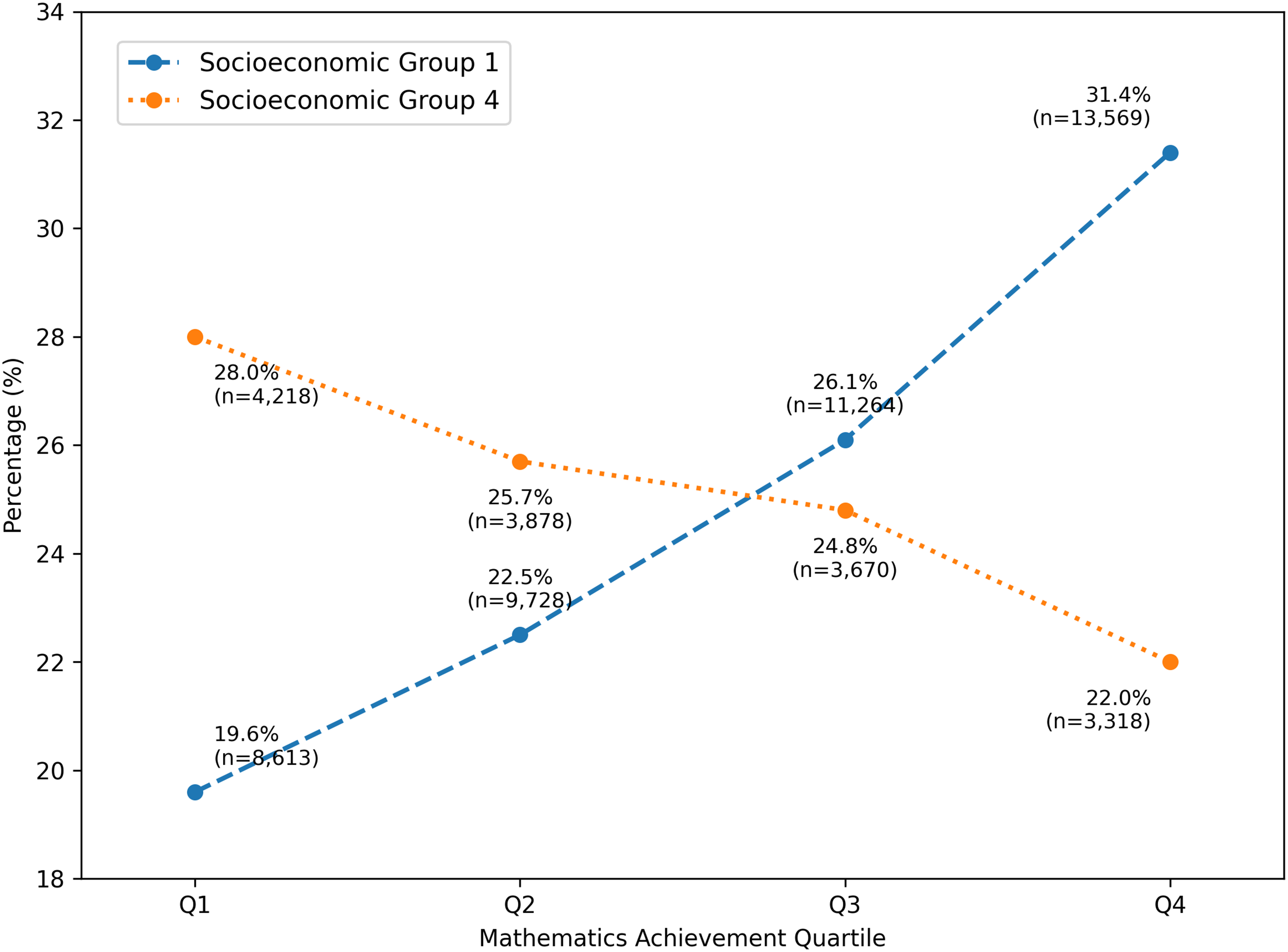
Figure proportion of students by mathematics achievement quartile and socioeconomic group.
For this study, the analytical universe corresponds to students with high academic achievement in lower secondary school, defined as those who placed in the top quartile of mathematics performance in ENLACE 2012 and completed upper secondary education in 2015. This subset included 3,318 low-SES students (SES 4) and 13,568 high-SES students (SES 1) (see Table 1).
Descriptive Statistics by Socioeconomic Status: SES 4 versus SES 1.
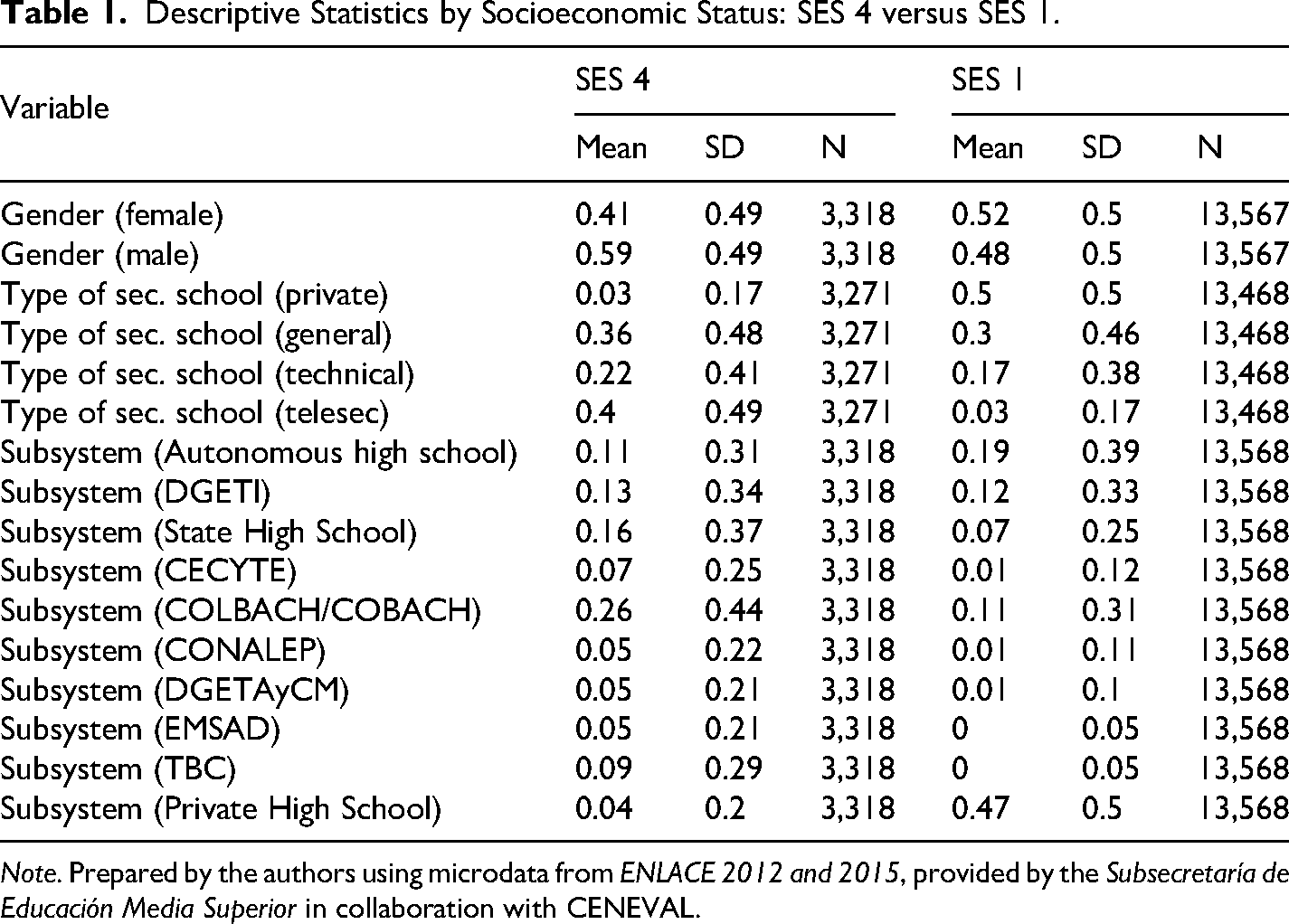
Note. Prepared by the authors using microdata from ENLACE 2012 and 2015, provided by the Subsecretaría de Educación Media Superior in collaboration with CENEVAL.
The analysis focuses exclusively on students who completed both ENLACE applications (2012 and 2015). Consequently, students who dropped out before finishing upper secondary education are not captured, which constitutes a potential source of selection bias.
Although the analytical cohort included 16,886 students, the effective samples used in the multivariate models were slightly smaller 3,247 low-SES and 13,375 high-SES students due to the automatic exclusion of cases with missing values on any independent variable (listwise deletion). Since ENLACE is a census-based assessment, the cohort includes students from all 32 states of the country, ensuring representation of northern, central, and southern regions, as well as both urban and rural contexts.
Data
The data come from the ENLACE assessments, standardized tests administered in Mexico in 2012 and 2015 2 . Both assessments are comparable across years due to equivalent scaling procedures in difficulty and measurement (Tuirán et al., 2019). This study analyzes mathematics scores as an indicator of educational gain.
The ENLACE results, expressed as achievement scores, were grouped into quartiles. The analysis focuses on students who reached the highest level in lower secondary school and examines whether they maintained that level of achievement at the end of upper secondary school. The relevance of this is that social mobility can be fostered by sustained high school achievements.
Variables
The dependent variable, “decline in academic achievement,” is binary: 1 if the student moved from the top quartile in 2012 to a lower quartile in 2015, and 0 if they remained at the top. The independent variables include personal factors (gender, commuting time, perseverance, resilience, educational aspiration), school-related factors (school shift, type of lower secondary school, upper secondary subsystem, scholarship type), and teaching factors (teacher absenteeism, classroom discipline, teacher knowledge, practice exercises, articulation of prior knowledge) 3 . The full coding scheme is presented in Appendix B.
Instruments (Operationalization of Variables)
Personal, school, and instructional variables were obtained from the Student Questionnaire of ENLACE 2015 upper secondary education (SEP, 2015). This questionnaire is an official, standardized instrument developed and validated by SEP and the Centro Nacional de Evaluación para la Educación Superior (CENEVAL). No ad-hoc items were developed for this study; instead, we directly employed the standardized items, which are part of the contextual instruments of these national evaluations and possess recognized content validity (INEE, 2017; SEP, 2015).
Personal Factors
The study variables were operationalized as follows: perseverance (Trabaja_d) was measured with an ordinal item on school effort (“I work hard at school”), coded into three categories: “Describes me very much/Completely” (=0), “Does not describe me/Describes me a little” (=1), and “Describes me” (=2). Resilience (Prob_n_des) was assessed with the item “Problems do not discourage me,” using the same three-category ordinal scale (0–2). Educational aspiration (Niv_max_est) was captured through an item asking about the highest level of education the student expected to attain, with the categories graduate (=0), upper secondary/technical (=1), and bachelor's degree (=2). Commuting time to school (Tiempo_esc) are the average travel minutes to reach school and coded into three categories: less than 30 min (=0), more than 1 h (=1), and 30–60 min (=2). Finally, sex (Sex) was treated as a dichotomous variable (0 = female, 1 = male).
School Factors
Four dimensions related to the school context were included. School shift (Turno), coded as morning (=0) and afternoon (=1). Type of secondary school (T_sec) reflected prior educational trajectories, categorized as private (=0), general public (=1), technical public (=2), and telesecundaria (=3). Scholarships (clavbeca) represented economic support mechanisms and were coded as no scholarship (=0), socioeconomic scholarship (SES, =1), and talent/sports scholarship (=2). Finally, upper secondary subsystem (Subs) identified the institutional organization of the Mexican upper secondary education system, classified into ten categories. 4
Upper Secondary Education Subsystems in Mexico.
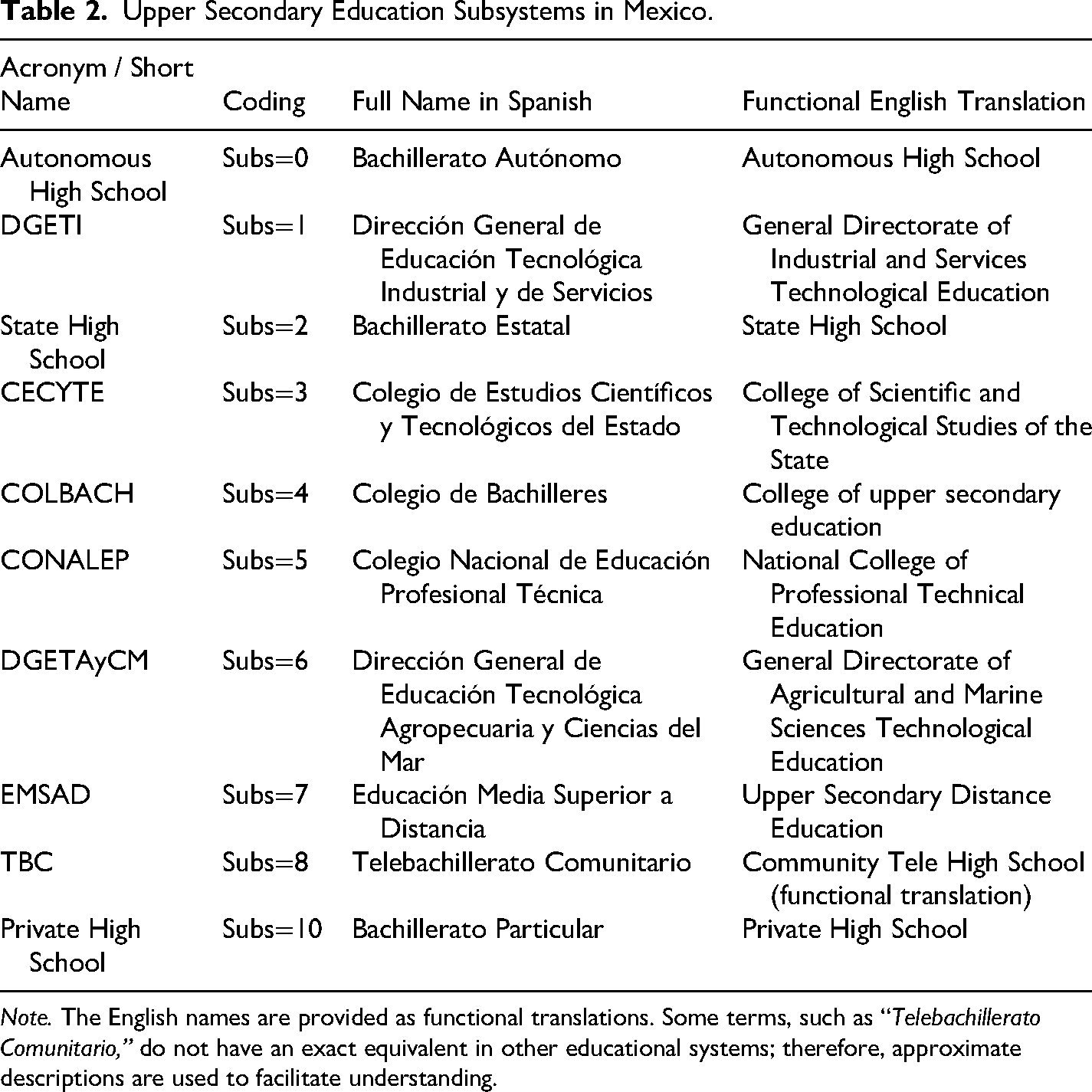
Note. The English names are provided as functional translations. Some terms, such as “Telebachillerato Comunitario,” do not have an exact equivalent in other educational systems; therefore, approximate descriptions are used to facilitate understanding.
The table presents the acronyms of the main upper secondary education subsystems in Mexico, their full names in Spanish, and functional English translations. Some terms do not have an exact equivalent in the Anglo-Saxon educational system; therefore, approximate adaptations are provided to facilitate understanding for international readers.
Instructional Factors (Teaching Practices as Perceived by Students)
The factors were derived from teaching practices as perceived by students. All constructs were measured with a single dichotomous item 5 : 0 = never and 1 = always. Teacher absenteeism (F_maestro) identified continuity in teaching. Subject knowledge in mathematics (C_mat) reflected students’ perception of teachers’ content mastery. Use of exercises (Ejer) served as an indicator of practice-oriented pedagogical strategies. Feedback (Retro) captured formative support provided by the teacher. Classroom discipline (Discip) referred to the classroom climate in terms of order. Connection with prior knowledge (N_apje) assessed whether the teacher promoted links with prior learning.
Socioeconomic Factor
The socioeconomic indicator was constructed from five questionnaire variables (student employment, mother's educational attainment, availability of a microwave, a computer, and automobiles), each coded dichotomously (1 = presence, 0 = absence). An average score was calculated for each student and then classified into quartiles to group students according to their socioeconomic level (see Appendix A). 6 SES 1 corresponds to the highest quartile (most advantaged students, labeled “high-SES” throughout the manuscript), while SES 4 corresponds to the lowest quartile (most disadvantaged students, labeled “low-SES”). Appendix B provides the full coding scheme of all variables to ensure transparency and replicability.
Procedure: General Model Description
A multivariate logistic regression model was applied to examine factors associated with the probability of academic decline in mathematics. The multivariate models incorporated personal, school, and instructional factors. The dependent variable is binary (decline or no decline), and the independent variables include personal, school, and instructional characteristics.
The general equation of the logistic regression model is as follows:
Where:
Data Analysis
Given the binary nature of the dependent variable (1 = dropping from the top quartile; 0 = remaining in it), multivariate logistic regression models were estimated to examine the associations between select predictors and the probability of decline in mathematics achievement. Models were run separately by socioeconomic level (low and high) and incorporated personal, school, and teaching factors defined in the Variables section. Odds ratios (ORs) with 95% confidence intervals (95% CIs) are reported, with statistical significance set at p < .05. To assess assumptions and the robustness of the results, three complementary diagnostic tests were conducted. All analyses were performed using STATA.
Population Attributable Risk Estimation
Based on the multivariate logistic regression models, the Population Attributable Risk (PAR) for each factor was estimated using counterfactual predictions standardized to the sample mean. The procedure was applied independently for each socioeconomic stratum (SES 4 and SES 1), holding constant the same covariates and reference categories as in Table 2 (SES 4) and Table 3 (SES 1).
Multivariate Model (SES 4).
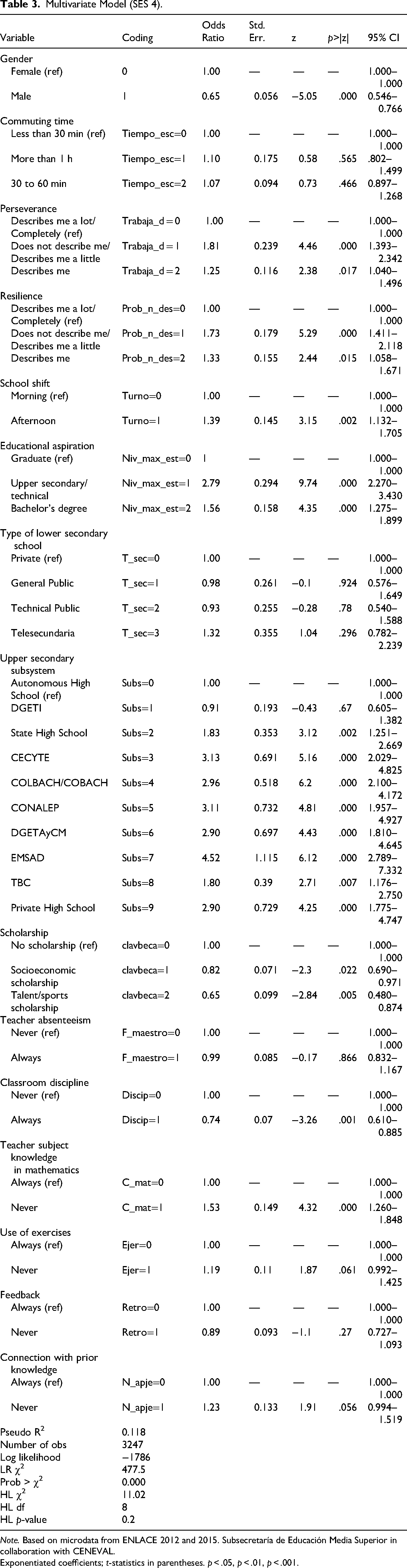
Note. Based on microdata from ENLACE 2012 and 2015. Subsecretaría de Educación Media Superior in collaboration with CENEVAL.
Exponentiated coefficients; t-statistics in parentheses. p < .05, p < .01, p < .001.
The interpretation of the indicator is as follows: a PAR > 0 reflects the potential reduction in population-level risk if the entire cohort were located in the factor's reference category; a PAR < 0 indicates that the reference category is not the most protective, as its universalization would be associated with a higher population-level risk.
Regarding statistical uncertainty, 95% CIs and standard errors were computed through nonparametric bootstrapping with 800 replications (resampling at the student level). p-values were derived from the bootstrap standard deviation under a normal approximation. A significance level of α = .05 was adopted. With respect to missing data and sample size, estimates were conducted using listwise deletion. The effective samples were N = 3,247 (SES 4) and N = 13,375 (SES 1).
Standard diagnostics were conducted to evaluate the robustness of the logistic regression models. Multicollinearity was assessed using variance inflation factors (VIFs), obtained from OLS regressions with the same predictors as in the logistic models; values below 10 were considered acceptable. Model calibration was examined through the Hosmer–Lemeshow goodness-of-fit test (10 groups). Residuals and influence were assessed using deviance and Pearson residuals, Pregibon leverage, and Cook's distance, with conventional cutoffs applied (|deviance| > 2, h > 2k/n, D > 4/n). Finally, sensitivity analyses were performed by re-estimating the models after excluding flagged cases. The complete numerical results of these diagnostics are reported in the Results section and in the supplementary appendices (see Supplemental Material).
Epistemological Considerations
From our standpoint as Mexican scholars specializing in education policy and equity, we position ourselves within a perspective committed to social justice and the expansion of opportunities for students from disadvantaged socioeconomic backgrounds. We acknowledge that this analysis is embedded in Mexico's institutional and cultural context, while also engaging with international literature on Latine students. This approach seeks to highlight both structural constraints and students’ agency, resilience, and aspirations, avoiding deficit perspectives and fostering a critical and reflexive approach oriented toward equity.
Results
The following section presents the results of the multivariate model applied to high-achieving secondary school students from low socioeconomic backgrounds (SES 4).
Results for RQ1: What factors associated with the probability of academic decline among upper secondary students who achieved high performance in lower secondary school and come from low socioeconomic status (SES) households?
The multivariate logistic regression model for students with low SES (SES 4) and high achievement in secondary school (Table 3) was significant (LR χ2 = 477.5, p < .001), with a Pseudo R2 of .118 and N = 3,247. The Hosmer–Lemeshow test did not reject the null hypothesis of good fit (χ2 = 11.02, df = 8, p = .200). The VIFs ranged from 1.07 to 9.96 (mean = 2.17), not exceeding the operational threshold of 10; only variables related to type of secondary school showed relatively high values (7.30–9.96) but remained below the critical threshold (see Appendix C). In the sensitivity analysis, after excluding influential observations (reduced N = 3,047), the odds ratios preserved their sign and magnitude. Although the overall fit improved (Pseudo R2 = .197; LR χ2 = 723.5), we report the full model as the main specification, as it passes the Hosmer–Lemeshow test (see Appendix D). Residual and influence diagnostics showed moderate values: 1.72% of observations with |deviance| > 2, 2.62% with high leverage, and 3.51% with Cook's D > 4/n; maximum magnitudes were |deviance| = 2.52, |Pearson| = 4.80, h = .036, and Cook's D = .004 (see Appendix E).
Regarding individual characteristics, being male was associated with lower odds of academic decline by 35% (OR = 0.65, 95% CI [0.55, 0.77], p < .001). Perseverance emerged as a key predictor: students reporting low effort had 1.81 times higher odds of experiencing a decline in achievement (95% CI [1.39, 2.34], p < .001), while those with intermediate effort also showed increased odds of decline (OR = 1.25, 95% CI [1.04, 1.50], p = .017). Similarly, resilience was significant: students who reported being discouraged by problems had higher odds of academic decline (OR = 1.73, 95% CI [1.41, 2.12], p < .001), and those partially discouraged also exhibited elevated odds (OR = 1.33, 95% CI [1.06, 1.67], p = .015).
In terms of educational aspirations, students who planned to complete only upper secondary or a technical degree had 2.79 times higher odds of decline (95% CI [2.27, 3.43], p < .001), while those aspiring to a bachelor's degree had higher odds of decline (95% CI [1.28, 1.90], p < .001), compared to those aspiring to graduate education.
Among school factors, attending the afternoon shift was associated with higher odds of decline by 39% (OR = 1.39, 95% CI [1.13, 1.71], p = .002). Type of secondary school attended did not show significant effects.
Marked differences were observed across upper secondary subsystems. Compared with Autonomous High Schools, students in EMSAD, CECYTE, CONALEP, DGETAyCM, COLBACH/COBACH, TBC, State High Schools, and Private High Schools showed higher odds of decline, while no significant differences were observed for DGETI (see Table 3).
Scholarships acted as protective factors: socioeconomic scholarships were associated with lower odds of decline (OR = 0.82, 95% CI [0.69, 0.97], p = .022), while talent or sports scholarships were associated with a larger reduction in the odds of decline (OR = 0.65, 95% CI [0.48, 0.87], p = .005).
Results for RQ2: How are teaching practices associated with the probability of maintaining high academic achievement?
Regarding pedagogical practices among low-SES students (SES 4), several relevant effects were identified. Classroom discipline was associated with lower odds of academic decline (OR = 0.74, 95% CI [0.61, 0.89], p = .001). In contrast, lack of teacher knowledge in mathematics was associated with 53% higher odds of decline (OR = 1.53; 95% CI [1.26–1.85]; p < .001).
In contrast, lack of teacher subject knowledge in mathematics was associated with higher odds of decline (OR = 1.53, 95% CI [1.26, 1.85], p < .001). Teacher feedback and connection with prior learning did not reach statistical significance (see Table 3).
Results for RQ3: To what extent do the factors associated with the probability of decline in high academic achievement among low-SES students differ from those of their high SES peers?
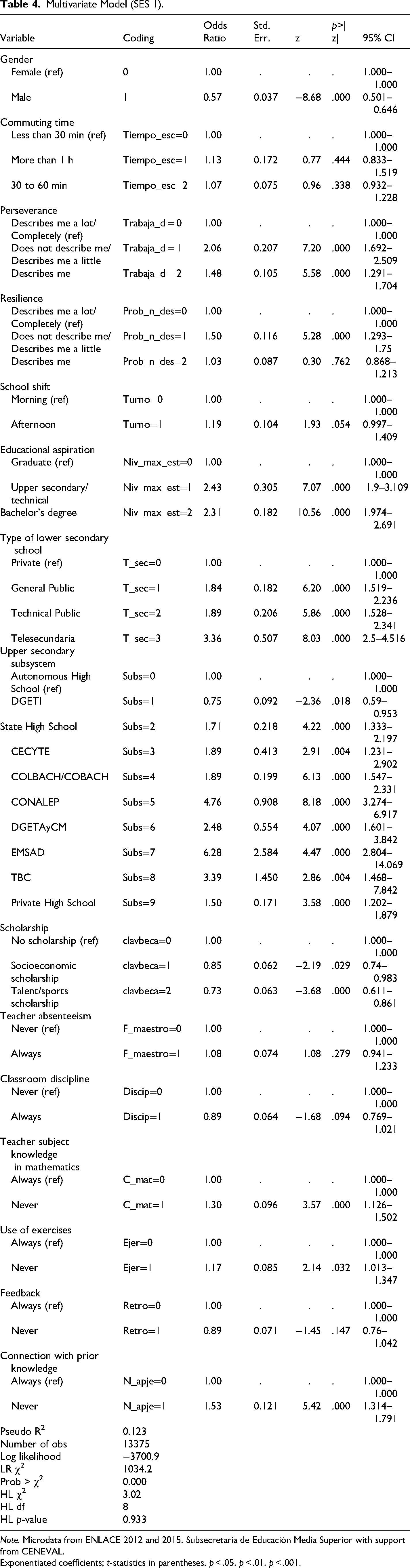
We estimated separate models by socioeconomic stratum. In SES 4, the model was significant (LR χ2 = 477.5, p < .001; Pseudo R2 = .118; N = 3,247) and passed the Hosmer–Lemeshow test (χ2(8) = 11.02, p = .200). In SES 1, the model was also significant (LR χ2 = 1,034.2, p < .001; Pseudo R2 = .123; N = 13,375), with good calibration (χ2(8) = 3.02, p = .933). VIFs were below 10 in both cases (SES 4: 1.07–9.96; mean = 2.17; SES 1: 1.03–3.08; mean = 1.32), ruling out problematic multicollinearity (see Appendices C and F).
For residuals and influence, in SES 4 the flagged proportions were 1.72% (|deviance| > 2), 2.62% (h > 2k/n), and 3.51% (Cook's D > 4/n); maximum values were |deviance| = 2.52, |Pearson| = 4.80, h = .036, Cook's D = .004 (Appendix E). In SES 1, the proportions were higher at 4.8%, 10.9%, and 9.8%, respectively, but magnitudes remained small (maximums: |deviance| = 2.97, |Pearson| = 9.05, h = .051, Cook's D = .004) (Appendix G). In SES 4, the sensitivity analysis excluding influential cases (N = 3,047) preserved the sign and order of magnitude of the ORs (Appendix D); in SES 1, re-estimation was not required given the good calibration and low influence.
The comparison of the multivariate models between low-SES (see Table 3) and high-SES (see Table 4) students is presented descriptively: models were estimated separately and no formal test of coefficient equality across strata was performed. Therefore, the following results report associations within each stratum (OR, and p, with 95% CI in Tables 3 and 4), and any contrasts between SES groups should be interpreted as differences in magnitude rather than statistically tested group differences.
Multivariate Model (SES 1).
Note. Microdata from ENLACE 2012 and 2015. Subsecretaría de Educación Media Superior with support from CENEVAL.
Exponentiated coefficients; t-statistics in parentheses. p < .05, p < .01, p < .001.
Comparison of the multivariate models shows that the factors associated with the probability of academic decline exhibit common patterns but also differences depending on socioeconomic context.
In both groups, being male was associated with lower odds of academic decline, while commuting time showed no association in either stratum (see Tables 3 and 4).
Perseverance emerged as a key predictor across SES levels. Lower levels of effort were consistently associated with higher odds of academic decline, with stronger effects observed among high-SES students (see Table 4).
Similarly, lower resilience was associated with higher odds of academic decline in both groups, although intermediate levels of resilience were only significant among low-SES students.
Lower academic expectations were associated with higher odds of decline in both strata, with stronger associations observed in SES 1, particularly among students aspiring to upper secondary or bachelor's-level education rather than graduate studies.
Attending the afternoon shift was associated with higher odds of academic decline only in SES 4.
School-level factors showed differentiated effects. Attending the afternoon shift was associated with higher odds of decline only in SES 4. Type of lower secondary school was not significant in SES 4; however, in SES 1, students from public secondary schools exhibited higher odds of decline compared to those from private schools, with the strongest association observed for Telesecundaria (see Table 4).
Both models identified important effects. In SES 1, elevated risks were confirmed in EMSAD, CONALEP, and DGETAyCM, while DGETI emerged as a protective subsystem in this group. These subsystem differences were not observed among low-SES students.
Scholarships operated as protective factors in both strata. Both socioeconomic and talent/sports scholarships were associated with lower odds of decline, with talent/sports scholarships showing a particularly strong protective effect among low-SES students.
Teaching practices also revealed contextual differences. Classroom discipline was associated with lower odds of academic decline in SES 4, whereas no statistically significant association was observed in SES 1. Lack of teacher subject mastery in mathematics was associated with higher odds of decline in both groups.
The absence of exercises was associated with higher odds of academic decline only in SES 1, while feedback showed no significant association in either stratum. Connection with prior knowledge emerged as a differential predictor, reaching statistical significance only among high-SES students.
PAR Results for low SES (SES 4)
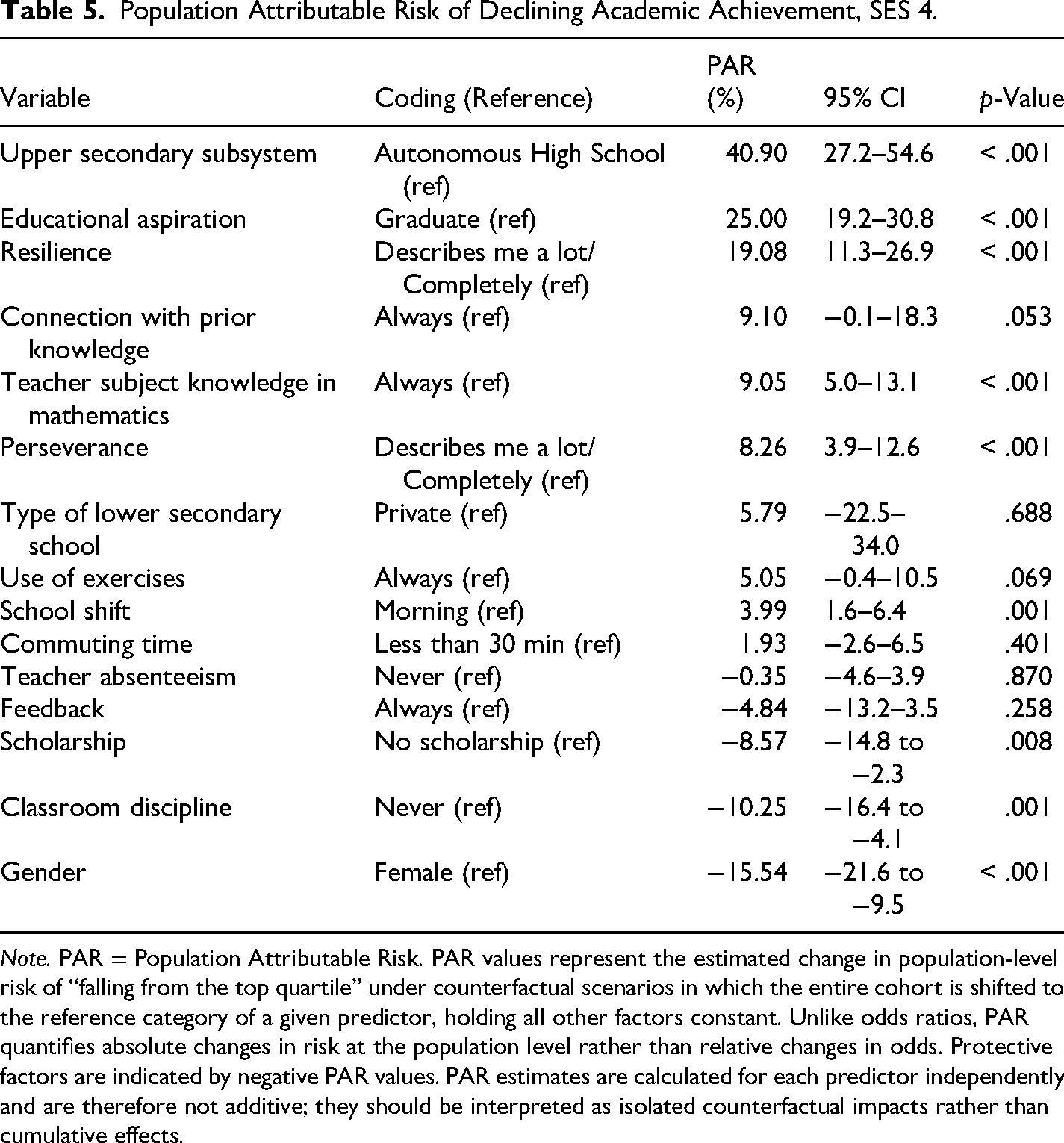
To complement the odds ratios, the PAR of “falling from the top quartile” was estimated using counterfactual scenarios that place the entire cohort in the reference category of each predictor, holding all other factors constant. Unlike odds ratios, PAR directly quantifies changes in population-level risk under hypothetical interventions. In this stratum, the observed average risk was R_obs = 0.3157 (see Table 5).
Population Attributable Risk of Declining Academic Achievement, SES 4.
Note. PAR = Population Attributable Risk. PAR values represent the estimated change in population-level risk of “falling from the top quartile” under counterfactual scenarios in which the entire cohort is shifted to the reference category of a given predictor, holding all other factors constant. Unlike odds ratios, PAR quantifies absolute changes in risk at the population level rather than relative changes in odds. Protective factors are indicated by negative PAR values. PAR estimates are calculated for each predictor independently and are therefore not additive; they should be interpreted as isolated counterfactual impacts rather than cumulative effects.
The factor with the greatest population weight was the upper secondary education subsystem, where placing all students in the standard of education of the autonomous subsystem would be associated with an estimated 40.9% reduction in population risk (95% CI: 27.2–54.6; p < .001). In second place were educational aspirations: under the counterfactual scenario in which all students aspired to graduate studies, population risk would decrease by an estimated 25% (95% CI: 19.2–30.8; p < .001).
Greater resilience was associated with an estimated population-level risk reduction of 19.1% (95% CI: 11.3–26.9; p < .001), while perseverance accounted for an additional 8.3% of avoidable risk (95% CI: 3.9–12.6; p < .001). Ensuring teachers’ disciplinary knowledge in mathematics was associated with a 9.1% reduction in population risk (95% CI: 5.0–13.1; p < .001). Attendance in the morning shift, relative to the afternoon shift, accounted for an estimated 4% reduction in attributable risk (95% CI: 1.6–6.4; p < .01).
Two factors acted as protective at the population level (PAR < 0). Classroom discipline showed a PAR = −10.3% (95% CI: −16.4 to −4.1; p < .01): under the counterfactual scenario in which all students were exposed to the reference condition (absence of classroom discipline), population risk would increase, indicating that discipline operates as a protective factor. With “no scholarship” as the reference, PAR = −8.6% (95% CI: −14.8 to −2.3; p < .01) indicates that universal access to scholarships would be associated with a reduction in population-level risk compared to a scenario in which no students received financial support.
The type of subsystem, educational aspirations, and resilience account for the largest shares of avoidable population risk in SES 4; connection with prior knowledge, teachers’ disciplinary knowledge, perseverance, the use of exercises, school shift, and commuting time contribute smaller but non-negligible proportions of attributable risk. The protective factors of being male, scholarship, and discipline are reflected in negative PAR values, indicating population-level risk reductions under their respective counterfactual scenarios. It is important to emphasize that PAR values are calculated individually and are not additive and therefore must be interpreted as isolated counterfactual estimates of population risk, rather than cumulative effects.
PAR Results for High SES (SES 1)
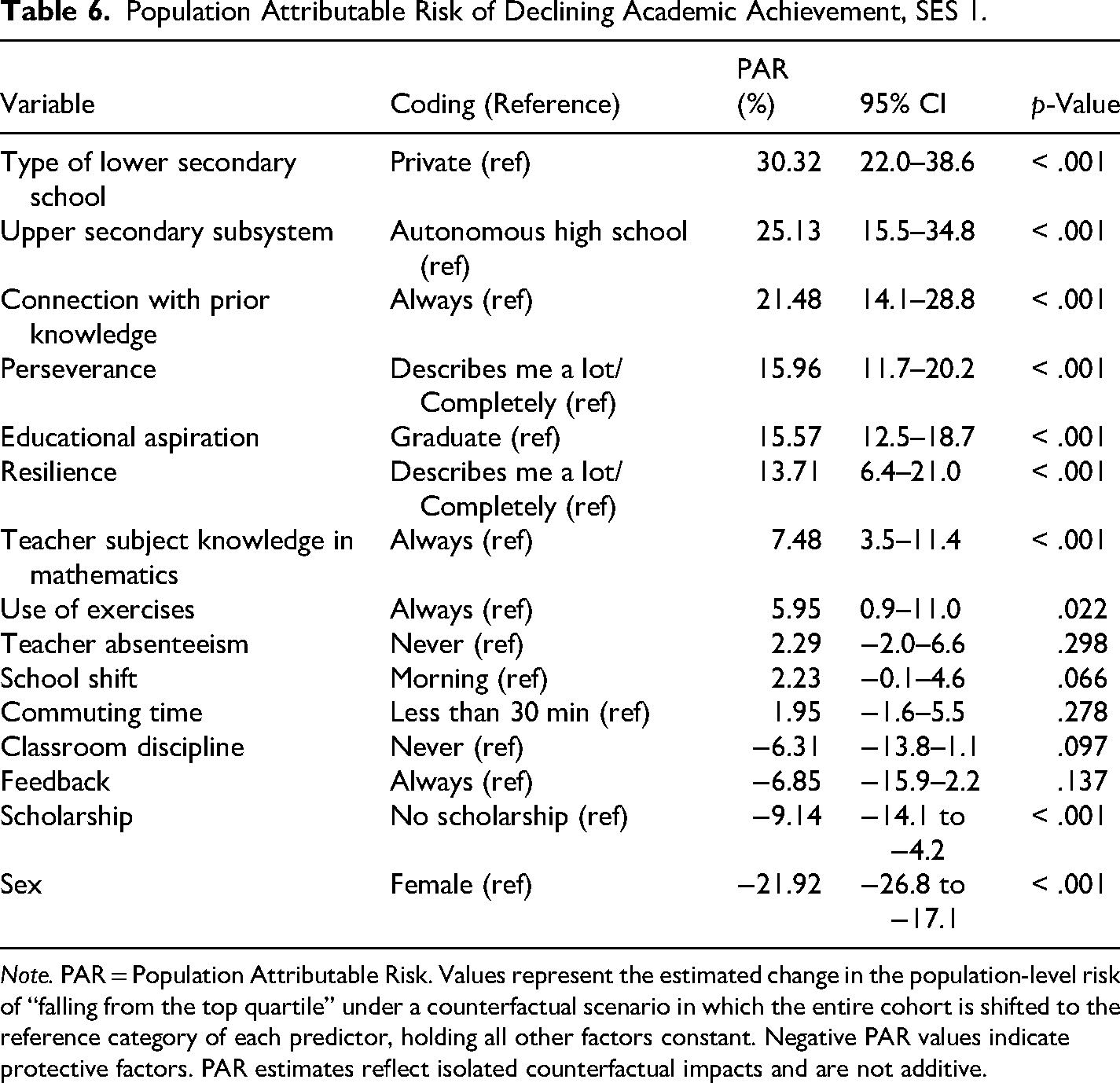
The PAR of “falling from the top quartile” in SES 1 had an observed average risk of R_obs = 0.0956, which represents the baseline population risk of academic decline in this socioeconomic stratum.
The factor with the greatest population weight was the type of secondary school, for which shifting all students to the reference category (Private High schools) was associated with an estimated 30.3% reduction in population-level risk (95% CI: 22.0–38.6; p < .001). In second place, placement in the autonomous subsystem was associated with an estimated reduction of 25.1% in attributable risk (95% CI: 15.5–34.8; p < .001). Connection with prior knowledge accounted for an estimated 21.5% reduction in population risk (95% CI: 14.1–28.8; p < .001), while under the counterfactual scenario in which all students aspired to graduate education, population risk would decrease by an estimated 15.6% (95% CI: 12.5–18.7; p < .001). Perseverance accounted for an estimated 16% reduction in attributable risk (95% CI: 11.7–20.2; p < .001) and resilience explained an estimated 13.7% reduction in population risk (95% CI: 6.4–20.9; p < .001).
Teachers’ disciplinary knowledge in mathematics was associated with an estimated 7.5% reduction in population risk (95% CI: 3.5–11.4; p < .001), universal exposure to the use of exercises explained an estimated 6.0% reduction in attributable risk (95% CI: 0.9–11.0; p = .022).
In SES 1, type of secondary school attended, the upper secondary subsystem, and instructional practices related to connection with prior knowledge concentrate the largest shares of avoidable population risk. To a lesser extent, aspirations, resilience, teachers’ disciplinary knowledge, the use of exercises, school shift, and commuting time also contribute to potential reductions in risk under counterfactual scenarios. Among protective factors (PAR < 0), having a scholarship and being male were associated with lower population-level risk, although their relative magnitudes differed across factors, suggesting distinct dynamics of cumulative advantage within the high-SES stratum. As in SES 4, PAR estimates should be interpreted as isolated counterfactual impacts and not as additive effects (see Table 6).
Population Attributable Risk of Declining Academic Achievement, SES 1.
Note. PAR = Population Attributable Risk. Values represent the estimated change in the population-level risk of “falling from the top quartile” under a counterfactual scenario in which the entire cohort is shifted to the reference category of each predictor, holding all other factors constant. Negative PAR values indicate protective factors. PAR estimates reflect isolated counterfactual impacts and are not additive.
Analyses of PAR show that while in low SES the main determinants are the type of upper secondary subsystem, educational aspirations, and resilience, in high SES greater relevance is found for the type of secondary school attended, the autonomous subsystem, and connection with prior knowledge.
Consistently, perseverance, resilience, and high educational aspirations emerge as protective factors in both groups, although with different population-level impacts. Likewise, being male and receiving a scholarship are associated with lower population risk in both strata.
The findings confirm that trajectories of high academic performance do not depend solely on individual conditions, but also on school and contextual structures that, under counterfactual scenarios, are associated with substantial reductions in population risk of academic decline.
Discussion
The results of this study reveal the factors influencing the continuity of high academic achievement among Mexican students from low socioeconomic backgrounds (SES 4) during the transition from lower secondary to the completion of upper secondary education (EMS).
The interpretation of findings is articulated through two complementary frameworks: school cultural capital, understood as repertoires of behavior and resources (e.g., parental education, books at home, cultural practices) that mediate between the family context and academic performance (Farkas, 2018; Jin et al., 2024), and the academic resilience framework (Agasisti et al., 2021; Sheehan & Hadfield, 2024), which highlights the capacity of certain students to maintain high performance despite adverse conditions.
The results show that family socioeconomic and educational status remains a strong predictor of sustained performance (Farkas, 2018; Solís, 2022). However, the presence of students who manage to sustain high achievement despite economic constraints confirms that SES does not operate as an absolute determinant, but as a framework of opportunities that can be reshaped through available cultural and school capital (Munir et al., 2023; Rahman et al., 2023).
Perseverance and resilience consistently emerge as supports of sustained performance, in line with evidence on sustained effort and coping (Huang & Zhu, 2017; Wu et al., 2022). In low SES, resilience acquired greater relevance, suggesting that disadvantaged students rely more on internal resources to cope with adversity, whereas in high SES perseverance consolidates as a decisive factor associated with lower odds of academic decline.
Educational aspirations were also a robust predictor in both strata, with greater weight in low SES. Students with limited expectations (EMS or technical) exhibited substantially higher odds of experiencing academic decline. This pattern is consistent with international evidence (Gore et al., 2015; Kong, 2020) and raising aspirations toward higher levels, especially among disadvantaged students, may be a mechanism for breaking intergenerational cycles of disadvantage.
The afternoon shift represented a risk factor in low SES, being associated with higher odds of academic decline, reflecting structural disadvantages linked to schools with less effective instructional time and greater shortages, as noted by the National Council for the Evaluation of Social Development Policy (CONEVAL, 2020). In high SES this effect dissipated, suggesting that the impact of school shift depends on its interaction with structural disadvantages.
The type of secondary school had divergent effects: in low SES no significant associations were found, but in high SES, coming from a public secondary (general, technical, or telesecundaria) was associated with higher odds of academic decline compared to Private High Schools. This points to the cumulative advantages that private schools provide through quality and resources, which manifest even at higher levels (Ali & Raza, 2024; Fabregas, 2019).
The EMS subsystem was one of the most decisive factors in both groups. In low SES, EMSAD, CECYTE, and CONALEP were associated substantially higher odds of decline, while in high SES DGETI showed a protective association. These findings reflect structural inequalities between subsystems, where curriculum and teacher’s capabilities directly affect the probability of sustaining high achievement (INEE, 2017). Beyond these structural conditions, future research could explore institutional governance, school leadership, or labor market linkages that explain why certain subsystems mitigate risks more effectively than others.
Teaching practices also showed relevant effects. Classroom discipline was associated with lower odds of decline in low SES, underscoring the importance of classroom management in highly vulnerable settings (Chalak & Fallah, 2019). In high SES, lack of discipline appeared associated with lower risk, though without robust evidence. A possible explanation is that, in certain contexts, less rigid environments may foster autonomy, creativity, and a more positive relational climate that favors learning, especially for high-achieving students. Given its unexpected nature, further qualitative studies are needed to explore how classroom discipline and management are configured in different contexts.
Teachers’ disciplinary knowledge in mathematics was a negative predictor in both strata, validating the literature on the centrality of teachers’ pedagogical and disciplinary competences for student success (Duru et al., 2020; Egboro, 2021).
Connection with prior knowledge emerged as a critical factor in high SES, where its absence was associated with higher odds of decline, consistent with the importance of activating prior learning to consolidate new knowledge (Hohensee, 2016), while in low SES no clear association was found. This could indicate that high-SES students, with greater cultural capital, benefit more from teaching that links content to prior experiences. On the other hand, feedback was not significant in either stratum, possibly reflecting limitations in its classroom implementation, consistent with studies that warn about the superficiality of feedback without strong teacher preparation (Salinas et al., 2017).
Scholarships consistently showed a protective association, more marked for talent and sports scholarships in low SES and for socioeconomic scholarships in both strata. But we need to better understand how scholarships have positive and consistent effects on better learnings (LaSota et al., 2025).
Male gender was associated with lower odds of academic decline in both strata (OECD, 2025). This result may be related to specific features of the Mexican system, where high-achieving male students may receive greater social or family recognition that incentivizes their continuity (Solís, 2022).
The analysis of PAR helps prioritize high-impact levers. In SES 4, the greatest potential for population-level risk reduction lies in EMS subsystem and educational aspirations, followed by resilience and perseverance, and teachers’ disciplinary knowledge. In SES 1, type of secondary school, subsystem, and connection with prior knowledge stand out, followed by perseverance, aspirations, and resilience. Socioeconomic scholarships operate as protective factors in both groups.
The results reveal that sustaining high academic achievement is the product of a complex relationship between personal resources, school and institutional structures, and teaching practices.
From a policy perspective, these findings are especially relevant to current initiatives such as the Marco Curricular Común for upper secondary education in Mexico and the Benito Juárez scholarships currently offered at this level, which seek to articulate differentiated support and strengthen student trajectories. Explicitly linking these results to ongoing policies would underscore their applicability to the present and provide more concrete guidance for policy design and implementation.
The findings support the conclusion that equity in upper secondary education depends not only on expanding access, but on guaranteeing differentiated support conditions that respond to the specific needs of each socioeconomic stratum.
The findings extend beyond their original temporal context, as patterns of academic mobility identified in ENLACE 2012–2015 persist in the current Mexican education system. Structural barriers associated with socioeconomic inequality and institutional segmentation remain highly influential, underscoring the need to interpret these results both as evidence of persistent inequalities and as a basis for considering how new policies might reshape them over time.
Cross-Cultural Lens to Respect Multiculturality in Latine Gifted Studies
Although this study focuses on the Mexican case, its contributions extend to international contexts where Latine students face persistent educational vulnerability. The findings underscore resilience, educational aspirations, and institutional support as key factors in sustaining academic achievement despite socioeconomic adversity. These insights are particularly relevant for educational systems in the United States, Central America, and South America that serve Latine populations with diverse cultural and socioeconomic backgrounds.
By adopting an intercultural lens, the study contributes to the global dialogue on equity in advanced education. It highlights both convergences and divergences in the schooling trajectories of gifted and resilient Latine students, illustrating how structural barriers and protective factors intersect across national borders. The results may inform cross-national comparisons and the design of targeted interventions that respect multiculturality while promoting academic continuity under vulnerable conditions.
Limitations
The data for this study come from ENLACE 2012 and 2015. Nevertheless, we consider the findings to remain fully relevant in the current educational context. The factors that influence the continuity or decline of high academic achievement such as school conditions, educational expectations, and socioeconomic inequalities are structural in nature and persist over time. Recent research (OECD, 2023a, 2025; Solís, 2022) confirms that these dynamics remain present in the Mexican education system, reinforcing the pertinence of our results. In this sense, the analysis not only provides a historical perspective but also offers an interpretive framework that is useful for understanding contemporary challenges and guiding current education policies.
This study uses public and anonymized data from ENLACE 2012–2015, ensuring participant confidentiality. However, the lack of information on unobserved variables such as family environment and school climate may limit the explanation of factors associated with academic performance.
Although the sample is representative of the national cohort of ninth-grade lower secondary students in 2012, given the census-based nature of ENLACE, the analyses focus on students who advanced to the third grade of upper secondary school and took the ENLACE test at both time points, considering those who reached the top quartile in mathematics and completed EMS in 2015. Thus, the results are not generalizable to students at other achievement levels or to those who dropped out. The analysis excludes: (a) those who finished lower secondary but did not enter EMS, and (b) those who entered EMS but did not reach the third grade or sit for the test, implying school dropout. This limitation means the results apply to a population with relatively more stable educational trajectories.
Another limitation of this study concerns the conceptual scope of academic achievement, which was operationalized specifically through mathematics scores on the national standardized ENLACE test (2012–2015). While mathematics is a core subject and a strong predictor of overall academic performance, this approach restricts the generalizability of findings to other learning domains such as language and communication or science. Future research should examine whether the identified predictors of sustained performance such as resilience, educational aspirations, and school factors hold across different academic areas.
An additional limitation refers to the measurement of perseverance and resilience, which is based on single survey items. Although these indicators capture relevant dimensions of non-cognitive skills, they may be more prone to measurement error and may not fully reflect the complexity of these constructs. Future research should use more comprehensive psychometric instruments to assess perseverance and resilience in greater depth.
A further limitation is that SES differences are described based on models estimated separately, without formal tests of coefficient equality. Future work should estimate a joint model with SES × predictor interactions (or tests of coefficient equality) to contrast differences across strata. The PAR values are estimated factor by factor (non-additive) under the specified model and should be interpreted as isolated counterfactual impacts, conditional on model specification assumptions.
Finally, the level of analysis in this study focuses on individual student academic performance, without delving into institutional or contextual characteristics at the school level.
Implications and Conclusions
The findings, including the PAR analysis, help delineate a focused set of priorities to sustain high-achievement trajectories in vulnerable contexts. A central priority concerns the governance of EMS subsystems. Since differences across subsystems account for a large share of risk, selective strengthening is warranted in those with the greatest lags (e.g., EMSAD, CONALEP, and CECyTE).
A second priority lies in the transition from lower secondary to completing EMS. Among high-SES students, attending private lower secondary schools provides cumulative advantages; therefore, for graduates of public secondary schools, it is advisable to install leveling mechanisms (“bridge tutoring”) during the first semester of EMS, with emphasis on mathematics and study habits. This measure aligns with international evidence on how conditions of origin translate into differential capacities to benefit from educational opportunities.
In terms of personal resources, two competencies consistently emerge: perseverance and resilience. Policies aimed at strengthening socioemotional competencies can buffer the effects of daily adversity, in line with what has been documented by Olmeda (2016). Likewise, raising educational aspirations from lower secondary (early vocational guidance, structured exposure to STEM pathways and higher education) is associated with better outcomes; however, these strategies should be accompanied by academic and financial support to avoid the “disenchantment” noted in the literature (Gore et al., 2015; OECD, 2018).
With respect to teaching practices, the results point to two complementary directions: ensuring strong disciplinary knowledge in mathematics through continuous training focused on content and didactics (Egboro, 2021), and promoting pedagogies that link content to prior knowledge and guided practice.
At the school level, investment in classroom management and school climates that foster participation and order is advisable, given their observed protective effect in more vulnerable contexts (Chalak & Fallah, 2019).
Scholarships function as a consistent protective mechanism. Socioeconomic scholarships show effects in both strata, while talent/sports scholarships reinforce persistence in low SES. The recommendation is to strengthen their targeting and continuity, combining them with tutoring and academic support (Laajaj et al., 2022).
In terms of implementation and monitoring, a staged prioritization is proposed: (i) strengthening subsystems at greatest risk; (ii) transition and leveling devices between lower secondary and EMS; (iii) socioemotional development and mentoring; and (iv) teacher training. Monitoring should include indicators of persistence in the top quartile, on-time graduation, and SES gaps, ideally through dashboards disaggregated by subsystem and territory.
Supplemental Material
sj-docx-1-joa-10.1177_1932202X261423615 - Supplemental material for Factors Influencing Academic Achievement Continuity in Low-SES Students: Evidence From ENLACE 2012–2015
Supplemental material, sj-docx-1-joa-10.1177_1932202X261423615 for Factors Influencing Academic Achievement Continuity in Low-SES Students: Evidence From ENLACE 2012–2015 by Aide Mancilla Bocarando and Sandra Patricia Reyes Luscher in Journal of Advanced Academics
Footnotes

Ethics Declaration
This study used secondary anonymized public data from the Mexican ENLACE assessment, which does not require ethics committee approval.
Author Contributions
The authors are solely responsible for the conceptualization, design, data analysis, interpretation of results, and writing of this manuscript.
Funding
The authors disclosed receipt of the following financial support for the research, authorship, and/or publication of this article: This research was supported by a doctoral scholarship from the Consejo Nacional de Humanidades, Ciencias y Tecnologías (CONAHCYT), Mexico.
Declaration of Conflicting Interests
The authors declared no potential conflicts of interest with respect to the research, authorship, and/or publication of this article.
Positionality Statement
As Mexican scholars specializing in education policy and equity, we position ourselves from a perspective committed to social justice and the expansion of opportunities for students from disadvantaged socioeconomic backgrounds. We acknowledge that our analysis is framed within Mexico's institutional and cultural context, while also engaging with international literature on Latine students. This standpoint seeks to highlight both structural constraints and students’ agency, resilience, and aspirations, avoiding deficit perspectives and fostering a critical and reflexive approach.
Supplemental Material
Supplemental material for this article is available online.