




Abstract
Educational equality has been a central tenet framing educational policy in Nordic welfare states and stimulating school reforms in the 1960s and 1970s. However, the conceptualisation of equality has fluctuated, reflecting the changing economic and political climate within which policy statements have been made. In this article, we analyse policy and curriculum documents relating to upper secondary education from the 1970s to the 2010s in two Nordic countries. Drawing on Nancy Fraser’s theorisation of different forms of injustice, we focus on the aims and goals that are attached to the concept of educational equality, analysing how ideas about society and educational equality have changed over these decades. Our analysis suggests that over this period there have been quite dramatic shifts in how equality is conceptualised, inter alia shifting from a focus on economic inequalities to questions of sexuality and ethnicity. Furthermore, ambitions about tackling economic inequality have largely been replaced with ambitions about promoting employability, which is particularly visible in the curriculum of vocational upper secondary education. The Finnish general upper secondary education (GUS) curriculum has gone against the tide. In the 1970s the GUS curriculum had the most conservative tone in terms of equality, whereas the current curriculum requires an agentic stance against discrimination and a critical stance towards marketisation.
Introduction
Nordic countries such as Finland and Sweden have long imagined themselves as nations through reference to social democratic and welfare-oriented ideals in which citizens’ social rights are assured and social differences are minimised (see Anderson, 1983). In the era of neo-liberal reasoning, the principles of welfare states have become subordinate to principles of a market economy (e.g. Avis and Atkins, 2017; Telhaug et al., 2006) and Nordic countries have not been left untouched by this subordination. Neo-liberal reasoning has changed the structures of welfare states, and many previously state-controlled welfare agencies have been subject to processes of privatisation and deregulation (e.g. Larner, 2000). Still, how and to what extent this happens varies between Nordic countries.
In Finland, the education system has remained mainly public, but neo-liberal reasoning has reshaped ideas about what the desired aims and goals of education are (e.g. Komulainen et al., 2011). In Sweden, however, neo-liberalism has also had a dramatic influence on how education is organised. Compared to other Nordic countries, the privatisation of education in Sweden has been intensive and a competitive school market has emerged, particularly in the field of upper secondary education (Dovemark and Holm, 2017; Loeb and Wass, 2011). Thus, the current Swedish education system has been argued to be one of the most market-oriented in the world (e.g. Alexiadou et al., 2016; Hudson, 2011). It was precisely this variation in the ways that neo-liberalism is embedded in education systems, and how it is redefining equality, that provoked us to conduct this cross-cultural analysis. There is a crucial difference between Finland and Sweden with regard to how upper secondary education is organised. Finland has a ‘dual’ structure in which vocational education and training (VET) and the academically-oriented GUS are kept separate, while Sweden has a ‘unified’ structure which encompasses both VET programmes and academically-oriented higher education preparatory programmes (HEPPs). We argue that this difference reflects differences in the level of political ambition to reduce social differences.
We view national curricula as programmes enacted by nation states to train young people as future citizens (Yates and Grumet, 2011). As such, they are forward-looking, based on visions of society and desirable subjectivities. They are compromises reached through political struggle (Englund, 1986; Erekson, 2012), and therefore reflect prevailing policy ‘regimes’ in complex ways. Sally Power (2012: 474) argues that, while a more socially just education is the aim of the majority of education policies, the differences lie in the reasoning about what is considered a socially just education system and what the obstacles are that prevent it from being realised. We argue that the prevailing idea about educational equality is intertwined with the prevailing ways of imagining society. In this article we investigate how two Nordic countries have imagined themselves as societies and how ideas about educational equality have changed over four decades, during which what were social democratic welfare regimes have moved towards becoming neo-liberal regimes which emphasise markets over the state, and individual success over the common good (Lundahl et al., 2010).
The structure of the article is as follows. The next section outlines the methodological framework and data sources. We then move on to how ideas about equality have changed in the curriculum over the past four decades. The analysis is divided into three chronological sections (1970s, 1990s and 2000 onwards). For each section, we start by giving the broad historical context of the key elements that we have identified as central to shaping the curriculum at that time. We then present some key quotations from the respective curricula, illustrating the dominant conceptualisation of equality, and analyse how this can be understood. In a concluding section, we summarise our main results. Specific attention is directed towards VET and the relationship between VET and academically-oriented upper secondary education (GUS in Finland and HEPPs in Sweden). We do this because VET programmes are particularly interesting in the context of equality, since students whose parents do not have an academic education dominate vocational programmes while students whose parents do have an academic education dominate academic programmes (Nylund et al., 2017; Saari et al., 2015). Generally, the vocational programmes are also more gender-segregated than the academic programmes (Ledman et al., 2018; Statistics Finland, 2016). Thus problems of equality, such as issues of class, gender and ethnicity (Arneback and Nylund, 2017; Lappalainen et al., 2013) intersect and are particularly evident in VET programmes.
Cross-cultural analysis: theory, methodology and data
In order to avoid methodological nationalism, in which nation states are considered as taken for granted and identified with particular societies (Robertson and Dale, 2008), we have adopted a methodological approach of cross-cultural analysis. In this approach, analogical phenomena are ‘explored in various cultural contexts, either in different educational institutions in the same country or in the same type of institutions in two or more countries’ (Lahelma et al., 2014: 53). Here, the aim is not to find differences between nation states but rather to find similar or homological processes in two Nordic educational contexts (Lappalainen et al., 2015: 846). More specifically, we report a cross-cultural analysis of Swedish and Finnish policy and curriculum documents spanning four decades.
The analysis starts from the 1970s because that was the period in which comprehensive schooling systems were established. In contrast, the 1990s were a time of geopolitical and economic restructuring across Europe, which we expected to find reflected in curriculum documents. Moreover, at this time the Swedish education system started to move from a highly centralised state-regulated system towards marketisation and competition (Lundahl et al., 2013). Since 2000, the influence of transnational education policies and a rhetoric of competitiveness, efficiency, measurability and accountability has intensified (Dovemark and Holm, 2017). By taking a cross-cultural approach we explore analogical incidents at the equivalent levels of the education system in Sweden and Finland (Lahelma, et al., 2014).
Our analysis draws on Nancy Fraser’s (1997, 2008) theorisation of forms of injustice. Fraser has developed a threefold distinction between economic, cultural and political injustices. The first refers to economic exploitation, marginalisation or even material deprivation. The second refers to cultural subordination, in which the cultural norms of particular groups are consistently viewed as non-legitimate. The third, political injustice, represents a meta-level dimension of injustice, defining who is entitled to just distribution and reciprocal recognition (Fraser, 2008: 17). Different forms of injustice require different remedies and these remedies, according to Fraser (1997), can be either affirmative or transformative. Affirmative remedies are perpetuating, in the sense that they aim to rectify injustices without disrupting the framework that generates them, whereas transformative remedies take up injustices by restructuring the underlying framework that generates them (Fraser, 1997: 23–27). The remedy for economic injustice is the politics of redistribution, which in its affirmative form would mean the reallocation of resources to existing groups considered to be disadvantaged, whereas a transformative remedy would call for substantial restructuring of the relations of production and a challenge to group differentiation (Fraser, 1997: 27). The remedy for cultural injustice is the politics of recognition. In its affirmative form this would involve the celebration of diversity and the upward revaluation of oppressed groups such as women, non-white people, sexual minorities, working class people and people with disabilities (Fraser, 1997: 18). A transformative form of recognition would involve a substantial deconstruction of social and cultural categories, reforming people’s ideas about themselves. The remedy for political injustice, according to Fraser (2008), is the politics of representation, which refers to attempts to guarantee participatory parity. Following Fraserian thinking we conceive curriculum documents as one of the sites where ‘struggles over distribution and recognition are played out’ (Fraser, 2008: 17). We are aware that (in)justice is not equal to (in)equality, but Fraser’s concepts have provided us with a tool both for making possible comparisons between the countries and for researching nuances in how equality is expressed in core policy and curriculum documents.
The curriculum and related policy documents we have selected for closer analysis are those considered to be key to the process of the development of the curriculum, or ‘authoritative texts’ (Englund, 1986). For the Finnish case we have focused on the curriculum documents. This is because (a) there is a clear division between vocationally-oriented and academic upper secondary education, which means that these programmes have different curricula, and (b) there have been frequent reforms over the period in question. The Swedish case differs in both these regards: there is only one curriculum in place for both vocational and higher education programmes over this period and there have been fewer significant reforms. For the Swedish case, we thus include more of the other policy documents in the analysis, particularly official government reports and government bills that have had a clear impact on the development of the curriculum.
In analysing these policy and curricula documents, which set out the value base, aims and goals of upper secondary education, we have been inspired by the methodological approach called ‘what’s the problem represented to be?’ (WPR) (Bacchi, 2009). For the purposes of this paper, this means paying attention to the definition of the problem of equality and the presuppositions that underlie the problem as presented. It also means paying attention to ‘silences’ – i.e. what has been left unsaid – and focusing on ways to problematise the representation of the problem.
The present analysis draws in part on our earlier work, which examines the two relevant national contexts (Lappalainen and Lahelma 2016; Nylund et al., 2017).The novelty of this study is that it offers a cross-cultural and comparative perspective on curriculum development with a specific focus on educational equality. This approach enables international comparisons to be drawn, as notions such as educational equality have been explored across many European countries and are not specific to the Nordic countries.
Table 1 sets out the documents we have analysed. The content of the table reflects the different structures of upper secondary education in Sweden and Finland. In Finland, it is strictly divided into academically-oriented general upper secondary education (GUS) and vocational (VET) routes, which are further divided into 8 sectors, while upper secondary school in Sweden has since the 1970s been ‘unified’ under one core curriculum.
Data: steering documents for upper secondary education.
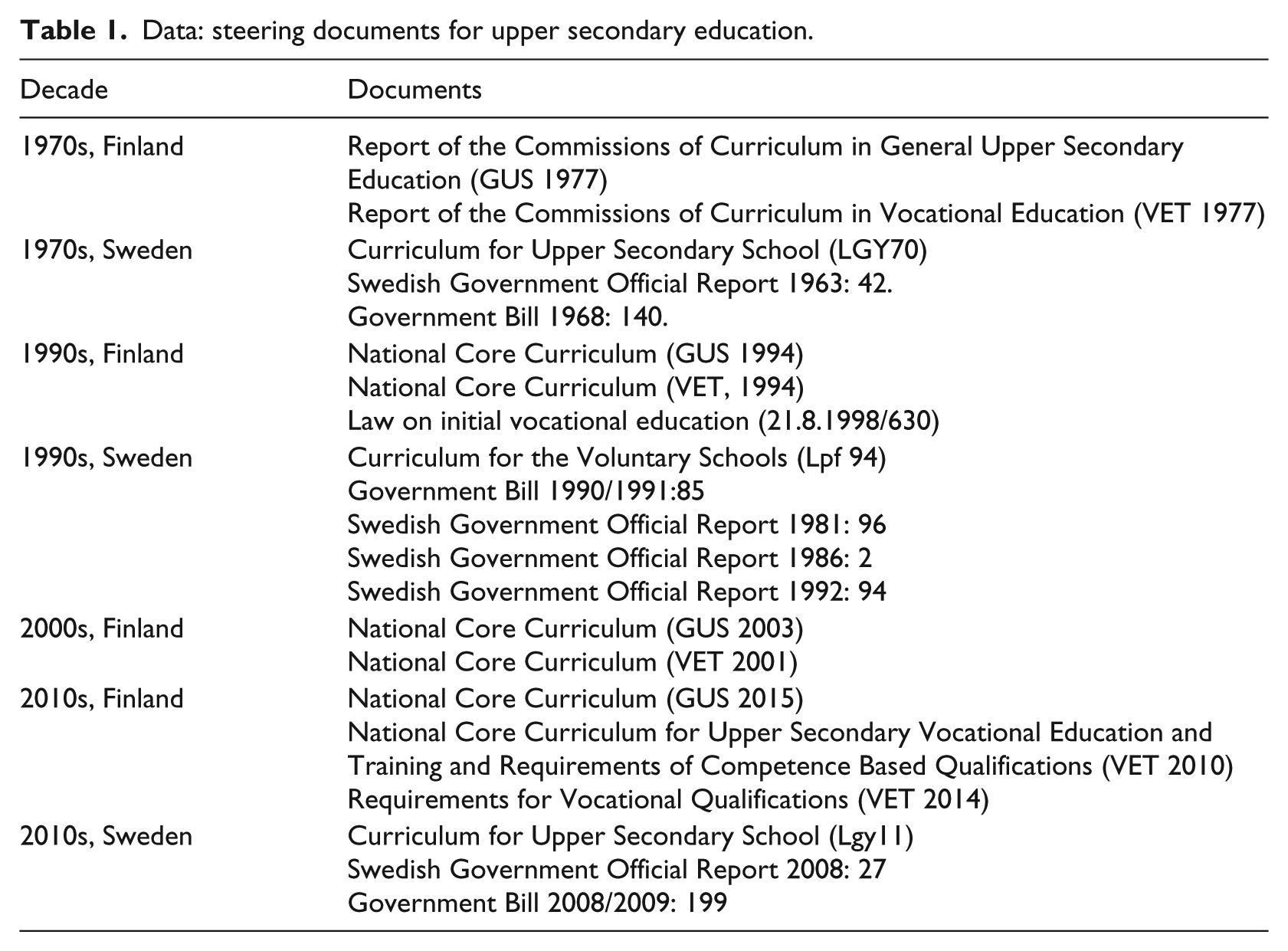
As discussed in the paper by Nylund and Virolainen in this special issue, the structure of the curriculum in both Sweden and Finland consists of several levels (general goals, programme-specific goals, syllabuses, etc.). In the analysis below, particular attention is directed towards the most general level of the curriculum, in which broad objectives and common goals, such as fostering active citizens capable of critical thinking, are stipulated (the quotations in Tables 2, 3 and 4 are all from this level of the curriculum). We have illustrated our analysis with data extracts in which equality is explicitly addressed or social divisions are created, established or challenged. These examples highlight issues that were considered problematic in particular decades (Bacchi, 2009).
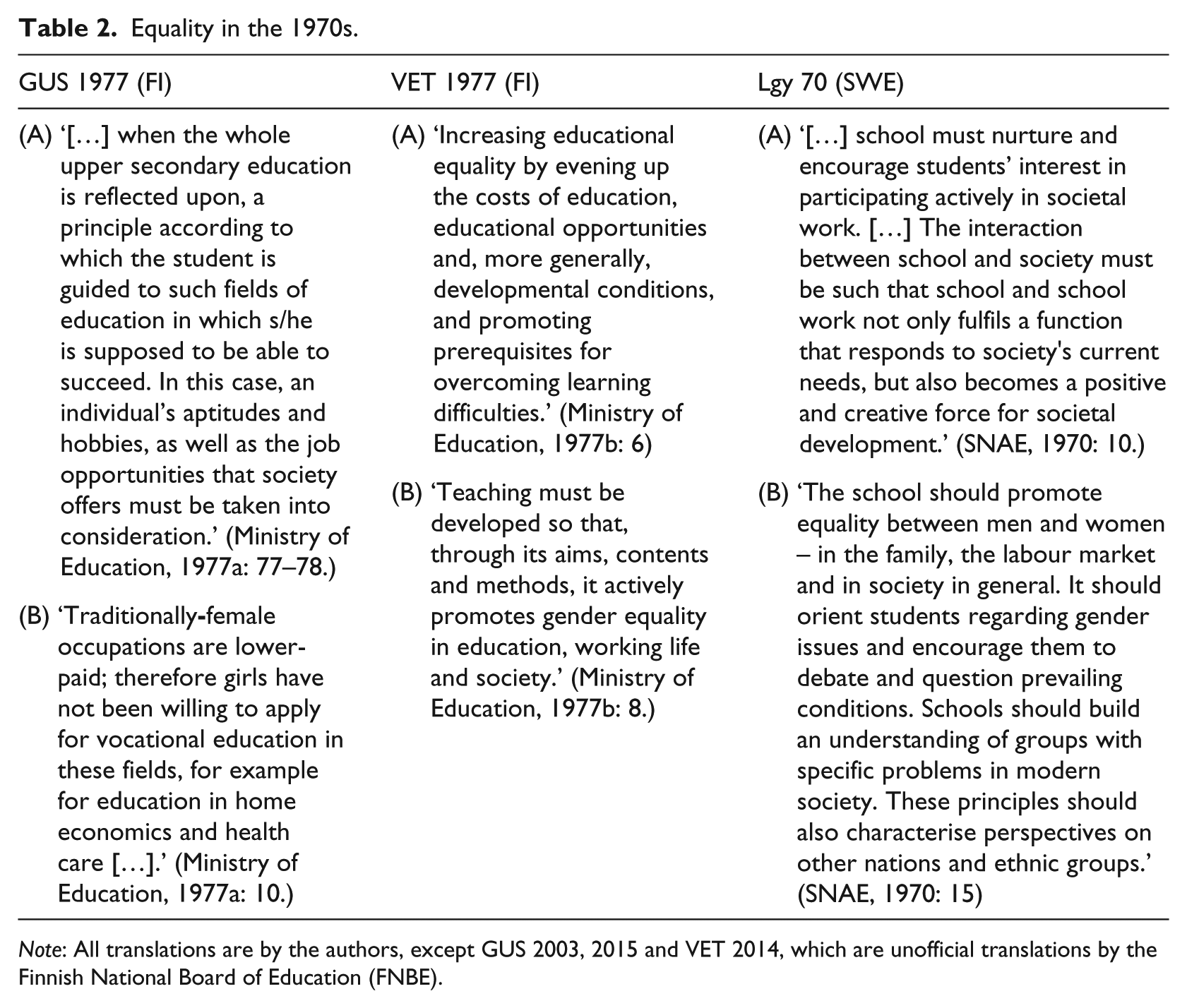
Equality in the 1970s.
Note: All translations are by the authors, except GUS 2003, 2015 and VET 2014, which are unofficial translations by the Finnish National Board of Education (FNBE).
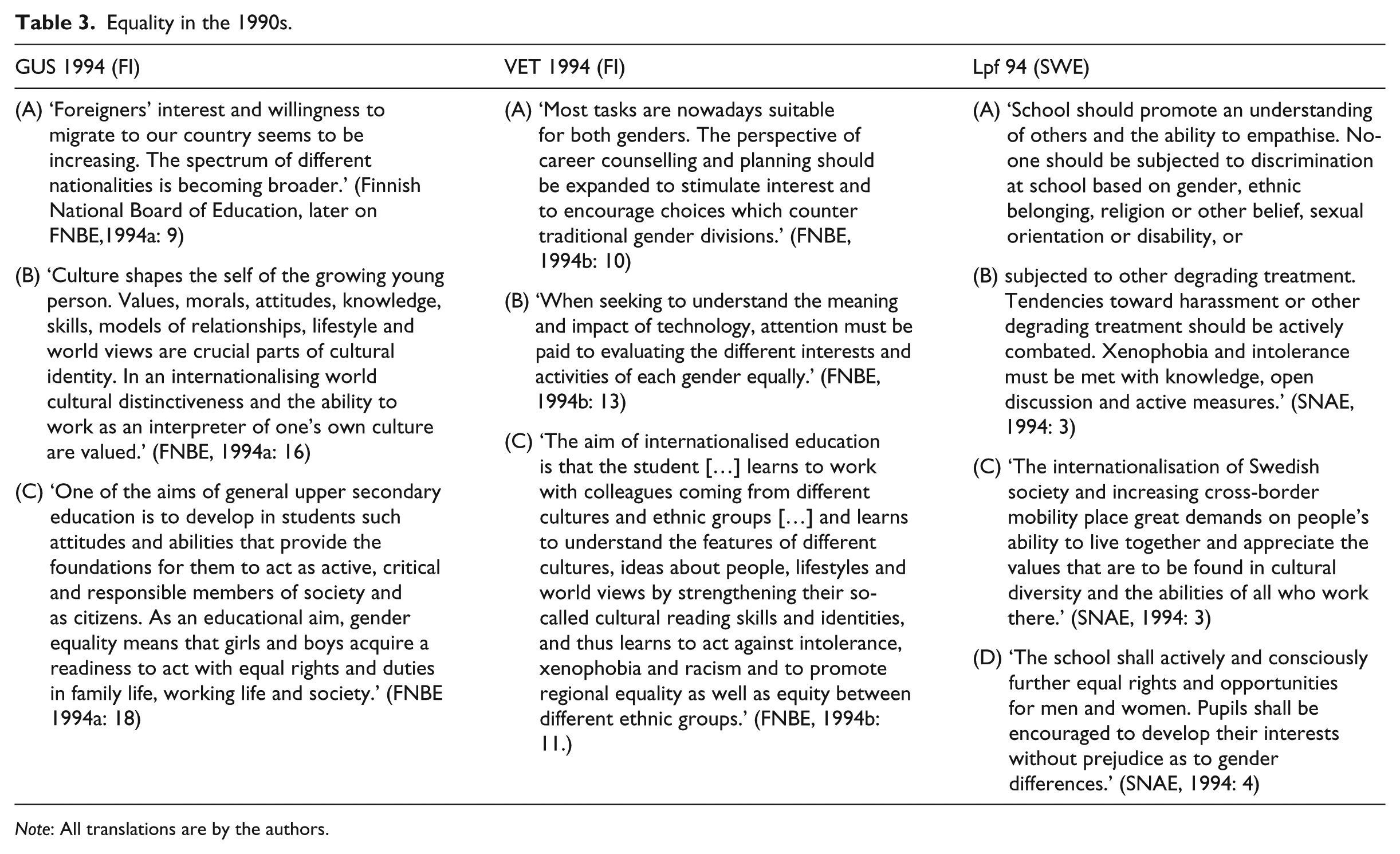
Equality in the 1990s.
Note: All translations are by the authors.
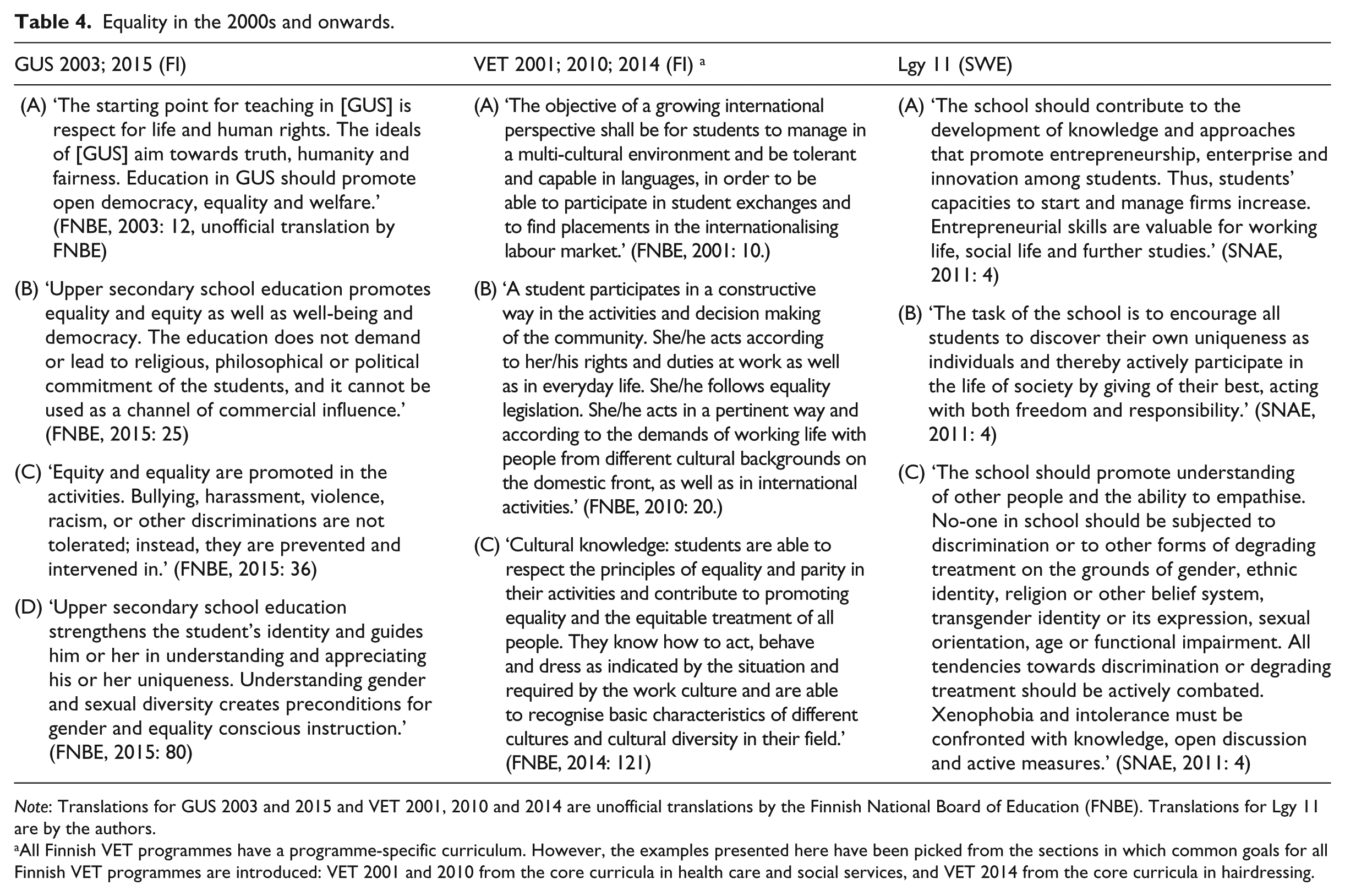
Equality in the 2000s and onwards.
Note: Translations for GUS 2003 and 2015 and VET 2001, 2010 and 2014 are unofficial translations by the Finnish National Board of Education (FNBE). Translations for Lgy 11 are by the authors.
All Finnish VET programmes have a programme-specific curriculum. However, the examples presented here have been picked from the sections in which common goals for all Finnish VET programmes are introduced: VET 2001 and 2010 from the core curricula in health care and social services, and VET 2014 from the core curricula in hairdressing.
Analysis
Educational equality in the 1970s: Towards more equitable upper secondary education?
In both countries, substantial educational reforms were carried out in the 1960s and 1970s. Sweden was a forerunner in establishing a 9-year comprehensive school system in the 1960s and Finland followed in the 1970s. These reforms were ground-breaking in the sense that the whole cohort obtained formal eligibility to join upper secondary education. Therefore, an immediate concern in the 1960s and 1970s was the need for structural changes in upper secondary education, to accommodate this development (Stenström and Virolainen, 2018). Finland and Sweden ended up solving this problem in very different ways.
In Sweden, VET was integrated into upper secondary school education in 1971, resulting in the first joint curriculum (Läroplan för gymnasieskolan 1970 (LGY70)). The 1971 reform can be seen as an accentuation of the trend, that was already growing in strength in the 1960s, for VET to become broader and more school-based. This trend had dramatic effects on the way VET was organised. Previously it had been relatively unregulated and geared mainly towards specific local labour market contexts (Berner, 1989). From 1971 onwards, all VET had a much broader focus and became based mainly in schools, meaning that it could now be taught in the same school buildings as more academic programmes such as natural sciences. In Finland, a unified structure was also discussed, but the political climate did not favour substantial restructuring towards comprehensive upper secondary education (Meriläinen and Varjo, 2008). The reforms of vocationally- and academically-oriented general upper secondary education were carried out separately, and Finland ended up maintaining a dual model of upper secondary education with strict division between the academically-oriented GUS and VET (Meriläinen, 2011).
Even though the Finnish reform was rather conservative in comparison with the Swedish one, in some respects it had a similar impact on VET. As in Sweden, VET had previously been organised as a large number of small educational programmes and courses controlled by a variety of administrative bodies (Jauhiainen, 2002; Klemelä, 1999). Following the reform, VET moved towards a more institutionalised system (Berner, 1989) subject to centralised steering and control.
Table 2 illustrates the conceptualisations of equality framing upper secondary curricula in the 1970s. The political ambition in both countries was to create a less differentiated and more equitable upper secondary school system that was better adapted to the contemporary labour market (Government Bill 1968: 140; Swedish Government Official Report 1963: 42). In Finland, though, this ambition was not so strong that it unified the separate strands of upper secondary education. The Curriculum Commission for GUS reinforced the existing division by emphasising differences in the aims and goals of different types of education, whilst the Curriculum Commission for VET in 1977 emphasised the need to avoid ‘blind alleys’ (Ministry of Education 1977b: 6–7) in which students’ educational choices limit their eligibility for further education (Lappalainen and Lahelma 2016). As the extracts in Table 2 show, the equality problem (Bacchi, 2009) is defined differently in the GUS and VET documents. Whereas the GUS documents of 1977 argue for guiding students to select paths according to their abilities, the VET 1977 documents call for removing structural barriers. Moreover, rather than emphasising the selective aspects of education, VET 1977 calls for struggle against learning constraints, thus avoiding the essentialising of less privileged students.
The main focus in the 1970s was on educational equality in terms of regional, economic and social aspects. However, gender is discussed in both Finnish commission reports from the 1970s and in the Swedish curriculum text. In Finnish GUS documents, gender segregation is taken for granted, whereas in Finnish VET documents teaching is required to act as a force for change. In terms of gender, the Finnish VET documents and Swedish curriculum documents both offer a transformative view on how the equality problem should be solved.
When the Finnish GUS and VET documents and Sweden’s Curriculum for Upper Secondary School Lgy70 are compared using Fraser’s (1997) distinction between redistribution, recognition and representation, it can be argued that the Finnish documents focus mostly on redistribution. Meanwhile, in Sweden’s Lgy70 the emphasis is partly on recognition but mostly on representation. The differences reflect different societal conditions as well as different discursive ‘landscapes’ in these two countries. In the 1970s, Finland was still a less wealthy country experiencing significant emigration (particularly to Sweden), whereas the Swedish labour market pulled workers in from other countries and experienced growing ethnic diversity. In addition, until recently in Sweden there has been a strong discourse about democratic education, which has framed the collective self-understanding of Swedish society (Boman, 2002). In Lgy70 redistribution is brought on to the agenda for thinking about the labour market, where gender equality is discussed and framed in a transformative way.
Surprisingly Finnish VET and the Swedish Lgy70 share some fundamental views on remedies to inequality, whereas the Finnish GUS is the outlier. In comparison to the GUS, Finnish VET and the Swedish Lgy70 present more transformative types of remedy that aim to restructure the underlying framework which produces unequal outcomes. In contrast, in the 1977 GUS document the equality problem was predominantly located with the abilities and attitudes of individual students, and it presents suggestions that amount to affirmative redistribution, aiming to remedy unequal outcomes without changing the underlying framework that generates them (Lappalainen and Lahelma, 2016).
Lgy70 presents society and education as closely related, stressing students’ role as active participants in civil society. Its transformative logic can be seen not only in this general framing, but also in the specific ambitions it articulates for participatory parity, the emphasis it places on removing ‘dead ends’ in the educational system and occupations, and its explicitness about the role of labour unions in society. In Lgy70 it is made clear that the school could and should – through central planning and more equitable education – be active in reshaping society, and that the main means for doing this involve schools in socialising active citizens. However, it is important to stress that, although they were ‘unified’ by having a single curriculum at the most general level, VET and HEPPs were nonetheless steered quite differently at the lower levels of the curriculum. For instance, VET programmes were as a rule shorter (2 years) than HEPPs, and gave much less time to, and different syllabuses for, more general subjects. If the curriculum (including underlying policy documents) is taken as a whole, the reform of the 1970s clearly reduced the distinction between VET programmes and HEPPs, but still viewed and organised them quite differently.
In Lgy70 society is conceived of as becoming more democratic in the future, and is characterised by the growing influence of civil society and citizens. In other words, the formation of society in Lgy70 is to a large extent an ‘open question’ for the next generation to participate in deciding. This is also how society is imagined in Finland’s VET document, whereas in the GUS document the existing societal order is represented as established and legitimated. This is illustrated, for example, in how the salary gap between female- and male-dominated professions is considered not as a problem to be solved but as a given fact.
Educational equality in the 1990s: Towards uncertainty and individualisation
When a curriculum is thought of as a programme for preparing young people for future citizenship, it requires a vision of the future. The 1990s were a period when geopolitical conditions in Europe were changing, not least as a result of the collapse of the Soviet Union. Moreover, due to the collapse of Yugoslavia, Europe witnessed a civil war in which people from the affected countries were forced to escape the conflict and in some cases ethnic cleansing. At the same time Sweden and Finland joined the European Union. These changes had particularly dramatic impacts on Finland, which had previously been a country of emigration in which immigration policy had been relatively strict (Lepola, 2000). In the mid-1990s Finland was also recovering from what had been, on a European scale, an exceptionally deep economic depression. This was reflected in the GUS document, which yearned for more effective use of decreasing resources. In GUS, the future was conceptualised as an era of uncertainty. Cultural homogeneity, which had previously framed Finland as an imagined community (Anderson, 1983), came into question and issues of cultural injustice that needed recognition found their way slowly on to the agenda.
The 1990s were a turning point in Sweden too, which was also experiencing economic crisis, and a conceptualisation of the future as ‘an era of uncertainty’ was very prominent in the policy texts underlying the new curriculum (see, e.g., Government Bill, 1990/1991: 85). An important element of the changing political landscape was that a long period of social-democratic domination of parliament was coming to an end. In the 1990s, social-democratic politics entered an era of ‘hybridization’ in which its traditional values of equality started to co-exist with neo-liberal ideas (Börjesson, 2016; Government Bill 1990/91: 85). On the level of the curriculum an equality discourse remained relatively strong, although there was a clear shift in how equality was perceived and remedied compared to Lgy70. The curriculum in the 1990s focused much more on the individual and her or his ‘freedom to choose’ than in Lgy70, which had represented a more ‘collective’ and societal view of the role, purpose and steering of education. The shift was, inter alia, illustrated by the increased space for students to choose between different courses and the extension of vocational programmes in Sweden to three years’ duration, meaning that these programmes now offered general eligibility to higher education. One way to describe the contrast between Curriculum for the Voluntary Schools Lpf 94 and Lgy70 is that in the former equality is much more a starting point and much less a final goal than in the latter.
In 1998, a law on initial vocational education (21.8.1998/630, 4§) 1 was passed in Finland, which stipulated that all upper secondary vocational programmes were to provide a general eligibility to higher education. In theory, this was a major structural change in terms of educational equality. However, according to Official Statistics of Finland (2018), relatively few students who graduated from the vocational programmes have continued their studies in higher education – for instance, 1.5 % at universities and 22.3 % at universities of applied science in 2016 (375 and 8568 of the total numbers, respectively). Moreover, a specific order (1262/1990) was issued in 1990, requiring authorities to promote equality through a so-called Functional Equality Plan (Ikävalko, 2016: 35).
The equality plan was reflected in Finnish upper secondary curriculum documents. GUS and VET curricula were revised side-by-side, perhaps bringing them closer to each other at that moment than before or since. In the VET curriculum (FNBE 1994b: 10), the aims of equality education were defined by quoting the Functional Equality Plan of Education Administration 1994–1995, which stated that a central aim of equality education was to promote equality between genders as well as between various population groups. Drawing on the Functional Equality Plan, it highlighted the need to develop the attitudes and abilities in students that would enable them to act as active, critical and responsible members of society and as citizens (see column headed ‘GUS 1994’ in Table 3). A move away from distribution towards recognition can be read in both curriculum documents. However, as in the 1970s, a more transformative tone can be read into the VET curriculum, which states that students are supposed to learn to act against racism and xenophobia. In the Finnish GUS curriculum, wordings such as ‘foreigners’ and ‘our country’ only hint as to the audience being addressed. The GUS curriculum was dominated by a liberal version of multiculturalism, in which increased diversity is recognised but the dominant group is able to set the agenda for participation without negotiating the premises for it (Anthias and Lloyd, 2002). This can be interpreted as an affirmative form of recognition within a somewhat nationalistic tone.
An important point of consistency between the Swedish curricula Lpf94 and Lgy70 is the view of society as a relatively ‘open question’. However, if the curriculum of the 1970s viewed society as becoming more democratic, with the role of schools in this being to shape active citizens, the future seemed more uncertain in the 1990s. Recognition of gender, sexuality, ethnicity, disability and other differences becomes more prominent, mainly through ‘affirmative’ remedies. The curriculum document itself becomes much ‘thinner’, including fewer instructions – perhaps reflecting a declining belief in the central planning of education and society as a whole. One could say that the idea of central planning comes into conflict with, and becomes subordinate to, the idea of individual freedom. It is not so much the citizen as a ‘collective entity’ who is going to shape the future, as in Lgy70, but rather individuals who are going to shape themselves and, in doing this, partake in shaping society. The disappearance of any reference to labour unions could be seen as one expression of this shift. The idea of removing ‘dead ends’ is still central, expressed, inter alia, in the strong promotion of general subjects and general eligibility to higher education, which includes VET students. The distinction between VET and HEPPs was thus blurred significantly. However, it is important to note that a number of key policy documents produced some years before the final reform expressed a much clearer transformative logic than that which was expressed in the curriculum in the end. This reflected a changing ideology from the 1980s into the 1990s. For instance, a class perspective and the role of schools in changing the hierarchies of working life were central in the 1980s (Swedish Government Official Report 1981: 96; Swedish Government Official Report 1986: 2). This is illustrated by the quotation below from one of the most extensive inquiries of the time, the final report of the 1976 Secondary School Committee, and is a perspective that is almost absent from the policy texts closer to the time of the reform (Government Bill 1990/1991: 85) and the curriculum itself.
We know that different kinds of programmes recruit pupils from different social groupings. This means we have an inbuilt conflict in upper secondary school, because it simply reflects the socially-conditioned distribution of vocational roles that our society is already largely based on. Few would dispute that, within reasonable limits, society must be based on a division of labour and specialisation. However few, if any, would likely argue that this distribution should be as strongly linked to social background as it is today. Regardless of what one thinks about the power of the education system to break this pattern, it must be argued that it should contribute to such a development more forcefully than hitherto. (Swedish Government Official Report 1981: 96: 381. Translated by authors.).
The distinction between VET and HEPPs was also considerably weakened in these policy texts, not least by a suggestion that all programmes during the first year of study should be organised in relation to sectors (social, technical, economical) rather than in terms of VET/HEP (Swedish Government Official Report 1981: 96). However, this was never realised. Increasing polymorphism, mobility, uncertainty and constant change characterise how society is imagined in all three curricula. As in the 1970s, the Finnish VET curriculum is closer to Swedish Lpf94. Xenophobia, harassment, intolerance and prejudices are defined as potential problems that will need to be addressed, whereas in the Finnish GUS it is maintaining cultural distinctiveness that is defined as a potential challenge.
Educational equality from the 2000s onwards: Change agents and conformist workers
From the 1990s, the Nordic countries began to move towards neo-liberal educational politics and policies, emphasising competence, choice, efficiency and marketisation (e.g. Börjesson, 2016; Komulainen, et al., 2011). In Finland, neo-liberal reasoning mainly reshaped ideas about the desired aims and goals of education, whereas in Sweden it has also fundamentally restructured the ways in which education is organised (see Dovemark and Holm, 2017; Youdell and Ball, 2008). Since 2000 the Finnish GUS curriculum has been revised twice (in 2003 and 2015). The VET curricula were revised in 2001, 2010, 2014 and 2016. 2 Profound reform is currently underway, in which VET will be completely restructured, including changes to how it is steered and regulated, its financial model and the degree system, by 2018 (Ministry of Education and Culture, 2017).
In Sweden, the main change to the upper secondary curriculum since the 1990s took place in 2011. If we look at the most general level of the curriculum, the new curriculum of 2011 (Lgy11) is very similar to that of the 1990s (Lpf94). The most prominent difference is that in the new curriculum entrepreneurship is put forward as a theme which should permeate all content (Ledman et al., 2018; Dahlstedt and Fejes, 2017). However, if we look at the key policy documents underlying the reform and the curriculum as a whole (i.e. including syllabuses, diploma goals and assessment criteria), the changes in the role and conceptualisation of equality are quite dramatic. In the inquiry underlying the reform (Swedish Government Official Report 2008: 27), which consists of almost 700 pages, the words ‘equality’ and ‘inequality’ are mentioned only twice, showing that it is not treated as a key issue. On the same note, the word ‘discrimination’ is mentioned only once, and there is no mentioning of ‘racism’, ‘ethnicity’ or ‘immigrant’ (Hertzberg, 2008).
One difference which illustrates the shift in the conceptualisation of equality between Lgy11 and the two previous curricula (Lpf94 and Lgy70) is that ‘dead ends’ are not so much a concern as is ‘throughput’. The problem of inequality in Lgy11 is understood within a discourse of ‘social exclusion’, through which groups of pupils are differentiated on the basis of their successful transition from school to work (Government Bill 2008/09: 199: 121; Swedish Government Official Report 2008 : 27: 41–42, 675). In this view VET programmes are perceived as having overemphasised theoretical subjects in the previous curriculum, resulting in low throughput. These issues are seen to be related because pupils in VET programmes are claimed to have poor results, and more generally a lack of interest, in theoretical subjects. The proposed remedy to this situation is a curriculum that reduces the hours devoted to studying society, aesthetic experience and language, and instead spending more time preparing for work in more specific, specialised labour market contexts (Beach et al., 2011; Nylund and Rosvall, 2016). One implication of this change is that general eligibility to higher education previously achievable through VET programmes has been removed. The policy thus represents a form of affirmative recognition of the different ‘talents’, ‘interests’ and ‘inclinations’ of pupils (Swedish Government Official Report 2008: 27: 675), making the assumption that this will raise throughput and reduce the social exclusion of vocational students. 3
The core problem to be addressed in Lgy11 is not inequality, but rather the ‘competence’ and ‘employability’ of students. This is expressed, inter alia, in changes to the way VET is to be steered: these changes strongly increase the influence of employers, while the influence of other stakeholders – for example, pupils and teachers – is reduced. Neither a collective nor an individual view of equality permeates this policy or curriculum. Compared to both Lgy70 and Lpf94, how society is viewed and the relationship between education and society in Lgy11 are much less ‘open’ questions. In the new framing, the key role of upper secondary VET is to adapt to the demands of the labour market. This contrasts with HEPPs, which are characterised by a more classical academic discourse that focuses on critical thinking, societal and historical contextualisation, and other such skills (Nylund et al., 2017).
In Finland, where academic and vocational education have remained strictly divided as educational tracks and VET programmes provide formal vocational qualifications in the first phase, context-bound education and employability have been explicit, unquestioned aims in VET all along. The issue has been how to define and produce subjectivities that meet the expected requirements of future labour markets. At a general level, this can be seen in how the aims and goals of the syllabus have been defined. As in the Swedish curriculum of Lgy11, GUS students are expected to develop the facility to form their own views about society, while VET students are supposed to learn to act in particular ways relevant to their work (see also Koski, 2009). In the early 2000s this included an emphasis on the capability to manage in a multicultural society, which was argued to require tolerance and language skills (see Table 4, column headed ‘VET’ quotation A). However, a multicultural society was seen to be somewhere else, rather than in Finland (Isopahkala-Bouret et al., 2014). In the early 2000s, equality was considered in a fairly general manner in both GUS and VET (see Table 4, column headed ‘GUS’, quotation A). The only parts in which equality was discussed more concretely related to student counselling, where promoting ethnic and gender equality in education and preventing social exclusion were defined as counselling objectives. A similar formulation is found in the VET curricula of 2010. Making student counselling responsible for dealing with social and cultural divisions individualises inequality by focusing on particular students: in Fraserian terms, this speaks of affirmative rather than transformative remedies. The shift in focus from distribution to recognition that started in the 1990s was finalised by 2000, and economic inequality has disappeared from the agenda.
Coming into the 2010s, fundamental change has occurred in the relationship between the GUS and VET curricula in Finland. GUS students are still considered as future change agents, whereas VET students are expected to become conformist workers and/or entrepreneurs. However, the problems (Bacchi, 2009) GUS students are supposed to be able to solve are now stated in different ways from those the previous GUS curriculum. Society is seen as complex and controversial. Commercialism and various forms of discrimination such as racism and harassment are recognised as existing facts. In Fraserian terms we can argue that, in the GUS curriculum in particular, cultural and political injustices have been recognised. Moreover, a movement towards transformative remedies can be seen in the GUS curriculum. Rather than celebrating cultural diversity, the curriculum requires educational institutions to act against racism. Knowledge about gender and sexual diversities is needed to develop a more equality-conscious pedagogy. A critical stance towards commercialism and an emphasis on global responsibilities refer more to earlier Nordic social-democratic welfare states than to neo-liberal reasoning. Whereas GUS 2015 emphasises education in a rather holistic manner, emphasizing personal growth and the development of world views in addition to gaining knowledge, in the VET curriculum society is reduced to working life. At a curriculum level VET is extremely context-bound in the sense that the skills and competences that students are meant to learn relate to particular vocations and are described as a learning outcomes. Social heterogeneity is recognised, but the way culture is discussed reflects cultural essentialism, in which the idea prevails that individuals can be divided into groups according to shared patterns of beliefs, behaviours and ways of life, or political and religious commitments (e.g. Alvare, 2017). Considering culture in such an essentialist manner might exclude people from being seen as members of their community and actually mark and strengthen boundaries between members of society (Matthes, 2016), reinforcing the status quo in society. Therefore, we argue that, whereas in the 1970s and even the 1990s the VET curriculum represented a transformative ‘spirit’, this transformative spirit can now be found, rather, in the GUS curriculum.
Conclusions
Equality has traditionally been one of the ideas through which Nordic countries have imagined themselves as nations. However, as shown in our analysis, the conceptualisation of equality has fluctuated over time, reflecting the changing economic and political climate in which the policy statements were made. Our analysis shows both commonalities and differences within and between the two countries at different times. Although the educational structures of both countries shifted towards challenging social reproduction during the 1970s, Sweden went further than Finland in this transformation. In Sweden, both vocational education and higher preparatory education were integrated into the same educational organisation, based on the argument that it is important that different groups study together as the school situation imitates working life. In the early 1990s, another large restructuring of economic thought affected Sweden: this materialised as fewer state-controlled schools and marked the beginning of an extended era of privatisation and arguments associated with individuals’ free choice (Lundahl et al., 2010). Using Fraser’s terms, one can say that there have been fewer attempts at economic transformation in Finland. With regard to how economic injustice and the politics of redistribution are presented in the curriculum texts, the situation has been quite stable in Finland, while the situation in Sweden can be described as having shifted back and forth. Equality issues are still on the agenda in Sweden, but the way education has been organised, not least in terms of the stronger division between vocational and academic programmes in the latest curriculum (Lgy11), is likely to deepen social class divisions (Nylund and Rosvall, 2016). The class division also seems to be deepening through the education market in Sweden, in which some upper secondary schools seek to occupy specific niches that relate to either VET or HEPPs (Lundahl, 2002).
If we condense these findings, it could be said that during the 1970s upper secondary education was imagined as a platform for equality and societal transformation, while in the 1990s individuals were imagined to be responsible for their own progress within a more flexible education system. In the 2000s, education seems primarily to be imagined as equipping students to adapt to society and for VET students in particular to fit into work in commercial and industrial sectors. Imagining societies through the lens of curricula in these two Nordic countries, they thus seem to have undergone a shift from imagining education for equality towards imagining education for employability. This implies an imagination in which all students are first to be made employable or entrepreneurs, with understanding their citizenship and questions of equality for the most part relegated to the background. This is clearer in the case of vocational programmes than in their academic counterparts, and more so in the case of Sweden than in that of Finland.
However, if we shift focus from social class to other marginalised groups, for example based on ethnicity or sexuality, the conclusions are somewhat different. During the 1970s there was some affirmation of these groups, but the debate can be described as having been rather silent, with Finnish GUS being particularly conservative and less progressive in terms of this affirmation and transformation. Reflecting the economic situation and the immigrant situation (which in Sweden saw a shift from labour immigration to refugee immigration), issues of ethnicity and multiculturalism have gradually become more prominent in Swedish curricula and, somewhat later, also in Finnish curricula. The latest curricula in both countries make cultural affirmations about ethnicity and sexuality, although these are more prominent in higher education preparatory education curricula. Returning to our starting point of imagining societies, it can be concluded that the transformation of ethnic and sexual divergence in contemporary curricula would be an issue primarily for individuals attending higher preparatory education.
Our analysis suggests that the shift towards neo-liberal reasoning has been most visible in policy and curriculum documents relating to VET. Overall, one crucial conclusion is that it seems that the VET curriculum is much more prone to change than its academically-oriented counterpart in both countries. In the Swedish Lgy11 reform, the VET curriculum experienced a much more substantial change than did HEPPs. The same is true for Finland, where VET has undergone several curriculum reforms since the millennium while GUS has had only two. Indeed, the Finnish GUS curriculum is interesting in its distinctiveness. Throughout these four decades it has gone against the main current of change. In the 1970s, when both the Finnish VET curriculum and the Swedish upper secondary curriculum LGY70 shared a transformative ethos, the Finnish GUS curriculum did not call for change, but took social divisions for granted. Four decades later, the Finnish GUS curriculum does now take the stance that school should be an agent against forms of discrimination, and stopping the commercialisation of schools also gives a hint of at least some kind of critical stance towards marketisation.
It can thus be argued that upper secondary education in both Sweden and Finland is situated in a strong academic tradition in which subjects with a long historical tradition do not seem to be as easily changed as the VET curricula, which are apparently more exposed to economic and political changes. This can be exemplified with Lgy11. Entrepreneurship has been promoted by agents from the European Commission (Pépin, 2007) down to local agents (Lindster-Norberg, 2016), and it is claimed to be important in order to respond to ever-faster changes in the labour market. However, entrepreneurship has been difficult to implement due to lack of (academic) historicity, which can be illustrated by disputes about what entrepreneurship should include, and when it has been implemented it has been interpreted as very different things (Fejes, Nylund and Wallin, 2018). One effect of this situation is that entrepreneurship is little valued by employers since they do not know how to value this knowledge. Nevertheless, in line with the political climate, in Swedish Lgy11 entrepreneurship was adopted as an overarching goal in the curriculum for all students. However, it was implemented as an compulsory subject only in programmes with a relatively limited academic focus (i.e. a few university subjects). These are also the programmes that are associated with labour markets which by tradition have high unemployment, limited full-time jobs and a weak history of trade unions. They include the hotel and tourism programme, handicrafts (in which the most popular focus is hairdressing) and the natural resource use programme (in which the most popular orientation is looking after horses) (Ledman et al., 2018). Clearly, this one example is not enough to argue that it is educational programmes with low economic, social and cultural capital that are most exposed to being reformed. However, if, as we do in this article, one compares curriculum reforms in a historical context, unequal exposure to curriculum change becomes highly visible. In terms of equality, vocational knowledge does not seem as highly valued as its academic counterpart, a pattern that has also been acknowledged in studies of reforms in other countries, including the UK (Avis and Orr, 2016; Hodgson and Spours, 2010).
Our results show that the neo-liberal discourse has had a powerful voice in Finnish and Swedish curricula post-1990s in a way similar to that which Hoskins (2008) has shown happening in other European countries. It might be blunt to conclude that, in terms of the transformation of social class, curricula in Sweden and Finland from the 1990s onwards started moving towards reproduction of the status quo. Nonetheless, it seems clear that the transformative focus regarding equality in contemporary curricula is primarily on multiculturalism and sexuality. It seems to be difficult, as is the case in other parts of Europe (López-Fogués, 2012), for the curricula to affirm and transform intersections of social class, ethnicity and sexuality. Such a conception of equality is yet to be expressed in either of these two countries.
Footnotes
Declaration of Conflicting Interests
The author(s) declared no potential conflicts of interest with respect to the research, authorship and/or publication of this article.
Funding
The author(s) disclosed receipt of the following financial support for the research, authorship, and/or publication of this article: The research is funded by NordForsk, Nordic Centre of Excellence: Justice through Education in the Nordic Countries [project number 57741] and by the Swedish Research Council [grant number 2015-02002]
