




Abstract
The concept of a Nordic model of education is sometimes used to refer to the considerable similarities of education reforms and systems of the five Nordic countries (i.e. Denmark, Finland, Iceland, Norway and Sweden) during the second half of the 20th century – reforms that aimed at social justice, equality and cohesion not least by providing schooling of high and equal quality, regardless of children’s and young people’s resources, origin and location. This article discusses to what extent one may still speak of such a ‘Nordic model of education’, considering the impact of neoliberal policies in all of the five countries. It is concluded that even if the education systems still display a number of common, inclusive traits, extensive marketization and privatization practices in Nordic countries, and particularly of Swedish education, raise serious doubts about the survival of the alleged Nordic model.
Introduction
The Nordic countries have often been regarded as prime examples of social democratic welfare regimes with certain unique qualities (Esping Andersen, 1996; Hort, 2014b). Similarly, a Nordic education model has often been talked of, implicitly denoting significant similarities between the educational systems of Denmark, Finland, Iceland, Norway and Sweden (e.g. Antikainen, 2006; Telhaug et al., 2004). However, in light of the considerable impact of neoliberal ideas in the Nordic countries during the last few decades, one may reasonably question to what extent this shared education model remains, if it has rather been replaced by a new one and if it is – or indeed ever was – justifiable to speak of a distinct Nordic model at all. With few exceptions (e.g. Blossing et al., 2014), extensive Nordic-comparative studies of the tension-filled field between older and newer education policies are, however, still lacking. While a host of recent education policy research, mostly consisting of single-country studies, describes and analyzes the consequences of the stronger emphasis on academic performance, school choice and New Public Management (NPM) in the Nordic countries, less interest has been shown in the relationship between the older social democratic education policies and the newer, neoliberally oriented ones (although for examples of such analyses, see Antikainen, 2006, 2010; Arnesen and Lundahl, 2006; Blossing et al., 2014; Telhaug et al., 2004; Wiborg, 2004, 2013). My brief introductory notes seek to explore this area somewhat further.
A ‘Nordic model of education’?
A range of researchers from different academic disciplines have identified a Nordic or social democratic welfare model in the post-war period, commonly relating it to other welfare regimes (Esping Andersen, 1996; Hort, 2014a, 2014b; Kuhnle, 1998, 2000). The social democratic welfare regime has been, and in many respects still is, characterized by extensive economic re-allocation and high taxation levels, allowing for universal policies covering, for example, pensions, health insurance, child allowances, comprehensive free-of-charge education and extensive childcare (Hort, 2014b). Four of the Nordic countries were among the five ranked highest in the UNICEF evaluation of child wellbeing in rich Organisation of Economic Co-operation and Development (OECD) countries (UNICEF, 2013), and they clearly stand out among the OECD countries as having continuous and strong support for families with young children (Thévenon, 2011).
Is – or was – there also such a thing as a Nordic model of education? Education has certainly been an important part of the Nordic welfare system; it has been regarded as a crucial instrument for social justice and security by providing schooling of high and equal quality to all citizens regardless of social class, gender or geographic origin and location. In addition, ideas of social cohesion and social community/nation building were central when constructing the new school system after World War II:
The social motive included perspectives on recruitment as well as a perspective on the school and the classroom as an all-embracing social community bringing together students from different backgrounds. The recruitment perspective implied that (…) all young persons should have equal educational opportunity, so that human resources were put to full use. The experience of being on the margin of society would be replaced by loyalty and a sense of belonging. More emphasis on social justice (implying, not least, greater opportunity for people in remote regions) would build a stronger nation. The school as social community would serve nation building because it would develop a sense of belonging and of respect and mutual understanding between students from different social classes. (Telhaug et al., 2004: 143)
During the period from the late 1940s to the 1980s, common ideas about the functions and organization of education framed the development of the school systems in the five countries, in particular, but far from only, at primary and lower secondary level. 1
Reforms of comprehensive compulsory education with no (or very little) streaming were decided on in all the Nordic countries in the 1960s and 1970s, starting with Sweden. Here, a 10-year experimental period in the 1950s preceded the final decision on the nine-year comprehensive school made in 1962, and the other four countries followed at the end of the 1960s and in the 1970s. 2 Representatives of the Nordic social democratic governments actually came up with an idea to design a joint Nordic school system in the 1960s, the Norwegian Minister of Church and Education Helge Sivertsen (1960–1965) being its most ardent advocate (Telhaug, 1966). The idea was not realized, but the fact that it was even discussed at this level illustrates the consensus among leading Nordic politicians on the general orientation of education reform at this point in time.
The importance of the uniquely strong social democratic parties in most of the Nordic countries 3 for the comprehensive school reforms can hardly be overestimated. One should, however, also note that these reforms were based on broad consensus agreements across the political spectrum, in sharp contrast to many other European countries where the idea of comprehensive education was fiercely debated and resisted by opponents (Korsgaard and Wiborg, 2006; Wiborg, 2004).
While acknowledging that there have always been differences between the education policies and systems of the five countries – for example, in the organization of vocational education and training at upper secondary level (see Olofsson and Panican, 2008; Raae, 2011) – there was reason to speak of a distinct Nordic model of education for much of the post-war period.
However, the question of how much of that model has survived the recent spate of changes of education is more difficult to answer.
Breaking up from the old way of governing
In order to secure equality of education, the realization of the comprehensive school model (and the welfare apparatus more generally) to a large extent rested on strong and assertive state government, Sweden being the trailblazer and model (Antikainen, 2006: 230). 4 Yet this top-down governing became increasingly questioned from the 1970s for being undemocratic, rigid and obsolete. In the 1980s, and particularly in the 1990s, decentralization reforms were introduced in all of the Nordic countries, 5 giving the municipalities and individual schools more freedom to implement national education objectives and allocate resources in accordance with local conditions. It might be tempting to reduce the decentralization reforms simply to the effects of advancing neoliberal ideology alone, but this would be an error; democratic-participatory motives were also important, especially at the early stages. At the same time extensive decentralization became an essential precursor that enabled the far-reaching neoliberal school-choice and NPM reforms that were introduced in the 1990s and early 2000s, in many respects echoing the neoliberal/right-wing policies that emerged in New Zealand, the United States, Australia and Great Britain during the 1980s (Whitty et al., 1998). However, the scope and expressions of these reforms varied between the Nordic countries, in particular with regard to choice and privatization – something which I discuss below.
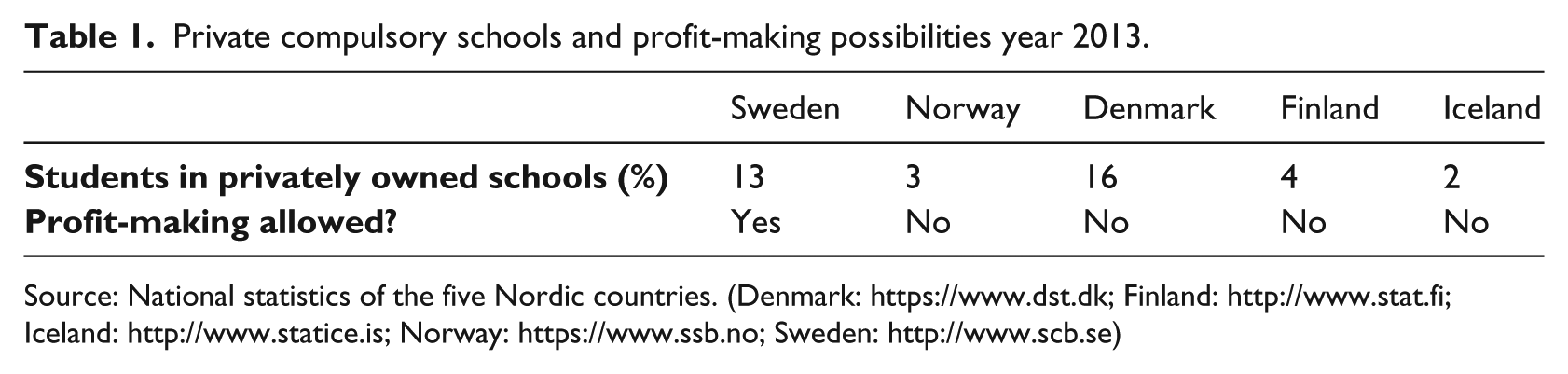
Denmark has had a long tradition of supporting parents’ right to choose education for their children (Rasmussen and Moos, 2014; Wiborg, 2004). In contrast to the other countries, home schooling is allowed, and it has been far more common to attend publicly funded private schools in Denmark than in the other Nordic countries, where traditionally only 1%–2% of compulsory school students have gone to private schools. Sweden has now broken this previously stable pattern following a 15-year period of extremely rapid growth of fully tax-funded ‘free’ schools and the number of children attending such schools (Lundahl et al., 2013). At present, most of the Swedish free schools are owned by corporations which have a right to make profits from their education activities. In the three biggest Swedish cities, one-fourth of all compulsory students and 40%–55% of upper secondary school students attend a free school. In the urban areas of Sweden at any rate, private schooling is thus no longer a marginal phenomenon. Within a decade, a veritable school market has emerged with attributes similar to those of a ‘proper’ market: aggressive marketing of a multitude of programs and schools, profit-making, chains of companies, increasing involvement of venture capitalists that buy and sell schools at a high pace, and so on (Erixon Arreman and Holm, 2011; Lundahl et al., 2013). In contrast, Finland, Norway and Iceland still have little in the way of private education and do not allow private providers to extract profits. When the right-wing government in Norway initiated a Free School Act in 2003, allowing a range of private educational alternatives and providers including commercial firms, the Social Democratic Party was clearly opposed to the move. Back in office in 2005, the party sought to inhibit full implementation of the Act and introduced a symbolically important change of terminology, from ‘free schools’ to ‘private schools’ (Berge and Hyggen, 2011; Imsen and Volckmar, 2014). 6 The initial plans in Finland to follow Sweden by introducing free schools were abandoned after the first Program for International Student Assessment (PISA) study in 2000 had ranked Finland at the top. However, in reality, school choice possibilities have emerged within the Finnish public sector in cases where schools may offer special subject profiles (Arhonen, 2014; Kosunen and Seppänen, 2015; Varjo et al., 2015). In Iceland the 1990 Education Act opened the way for decentralization and competition between public schools, and at the end of the 1990s choice between public and private alternatives was introduced; however, in the years since this has not been realized other than marginally (Sigurðardóttir et al., 2014). Hence, Sweden is the Nordic country that has gone furthest towards a market orientation of education. In the other four Nordic countries there is presently political consensus that education should not be opened up for private, profit-making companies (Table 1).
Private compulsory schools and profit-making possibilities year 2013.
Source: National statistics of the five Nordic countries. (Denmark: https://www.dst.dk; Finland: http://www.stat.fi; Iceland: http://www.statice.is; Norway: https://www.ssb.no; Sweden: http://www.scb.se)
It should be underlined that the neoliberal turn that took place in the 1990s was not as sudden as is sometimes suggested, for example, as a response to economic recession (cf. Wiborg, 2013). To take Sweden as an illustration, for example: the Swedish Employers’ Confederation (Svenska Arbetsgivareföreningen) had started a large, costly campaign aimed at regaining the ideological problem formulation initiative in the early 1970s. The campaign largely targeted pupils, teachers and other school actors, with the aim of making them realize the benefits of enterprise and competition (Lundahl, 1997). Soon after, the right-wing party Moderaterna elevated education policy matters to the top of their agenda, and energetically advocated the introduction of school choice during the 1980s (Wahlström, 2009). More generally, the welfare system as a whole, and not least the education element, was continuously depicted as inefficient, expensive and obsolete in the late 1970s and the 1980s. The first period of non-socialist government since the 1930s (1976–1982) did not influence welfare and education policies substantially, but the right-wing and liberal parties were better prepared and much more successful in this respect during their second period in office (1991–1994).
The ‘Nordic education model’ revisited
In 2002, in a special issue of the Journal of Education Policy, a number of Nordic researchers described and analyzed the changes to education policies that had occurred in their countries during the 1990s (Jónasson, 2002; Lundahl, 2002; Rasmussen, 2002; Rinne et al., 2002; Welle-Strand and Tjeldvoll, 2002). They concluded that developments similar to those seen in other OECD countries had taken place, mainly in terms of decentralization, the introduction of NPM, and an enhanced stress on individual agency and choice. However, the expressions of marketization were still rather modest, even in Sweden (Lundahl, 2002). One striking feature of several of the articles was the reported conviction of the leading politicians and high officials who were interviewed that decentralization, individualization, and the use of the market and firm as models were inevitable if countries were to cope with a rapidly changing world. There were, of course, some variations between countries: in Finland, for example, market-based rhetoric and practices had not yet become prominent in the welfare sector (Rinne et al., 2002), and Denmark – with its long tradition of free schools – seemed to deviate from the other countries in several respects, with stronger divisions between academic and vocational tracks, and talk of quality rather than social inclusion emerging at an earlier stage (Rasmussen, 2002).
A couple of years later, the current author and Anne-Lise Arnesen analyzed a number of research reports with regard to the importance of social inclusion in the education policies of the Nordic countries, and with a view to establishing to what extent education was regarded as a part of welfare policy (Arnesen and Lundahl, 2006). We distinguished four aspects of social inclusion: (a) access to education and to the labor market; (b) integration vs. division of education in terms of public/private and integration/segregation of, for example, ethnic minority children and children with special needs; (c) emphasis on democratic values and participation; and (d) the importance of community and equality vs. a focus on the individual. We concluded that it was still justified to speak of the five Nordic countries as a distinct group in these respects, but we also argued that the social-inclusive policies had been reformulated and restricted, a development which we related to a strengthening of the economic functions of education and a weakening of central governance. Ari Antikainen (2010) discussed the Nordic model in education in similar terms some years later. He distinguished between more rapid policy changes in a neoliberal direction, and slower socio-cultural changes. He stressed, for example, the fact that Nordic citizens still showed strong trust and support for the Nordic model of welfare policies (including high taxation levels). Similar stable support has been found in Sweden in repeated, large-scale surveys (Svallfors, 2011). Stefan Svallfors even concluded: ‘The Social Democratic Party may be in dire straits electorally, but the social democratic welfare state is more popular than ever (Svallfors, 2011: 819).
The present state of affairs
In this section the current situation in terms of equality, inclusion and marketization in Nordic education is considered broadly in relation to the first two categories of inclusion/exclusion previously described by Arnesen and Lundahl (2006) and referred to above.
Access to education and related resources
The Nordic countries still have a generous and, relatively speaking, rather equal provision of education at all levels. The principle that parents’ lack of economic resources should not prevent children from getting education of good quality continues to be upheld. Usually, education is free of charge from primary to tertiary level, but commonly there are parental fees if children attend pre-schools and leisure-time centers. The Nordic countries are almost the only OECD countries that do not have higher education tuition fees (OECD, 2014a). In Sweden and Finland, the costs of private schools are fully tax-subsidized; in the other countries private schools are allowed to take fees for the costs not covered by taxes. Nordic school children have access to free healthcare, special education for those in need of such support, career counselling and school transport. Finland and Sweden provide free hot meals during the school-day, whereas in Iceland parents have to pay for such meals. Danish and Norwegian children usually have to take a lunch box to school (EUFIC 2012).
The Nordic school choice reforms have undoubtedly meant that children and young people have access to more educational alternatives than 25 years ago, at least in urban areas. This difference is most tangible at upper secondary level in Sweden. To take one example: in 2015 young people in the Stockholm area could choose between almost 100 upper secondary schools in Stockholm city, three-fourths of which were free schools (see, e.g., www.skollistan.eu) and more than 560 programs – a rather overwhelming smorgasbord. The market reforms have not restricted formal access to education. In Sweden free schools are completely funded from general taxation and are not allowed to charge tuition fees. They are not allowed to select students on the basis of tests or grades if demand exceeds the number of places, and they are prohibited from excluding, for example, pupils with special needs (SFS, 2010). However, other, more subtle forms of selection may be discerned at work – above all parents’ and young peoples’ knowledge of educational alternatives and future possibilities, their motivation and the resources they have available to invest in an active choice (e.g. parents transporting their child to another part of the city, or young people commuting to another municipality). 7
Differentiation/division of education
Streaming is still largely absent from compulsory education in the Nordic countries, and special education support has moved from separate schools and classes to the ‘inclusive school’, i.e. it is to a great extent now integrated with other teaching in the classroom (Blossing et al., 2014; Egelund et al., 2006). However, Egelund et al. (2006) identify a break in this trend since the 1990s concerning pupils in special schools. In Norway, increasing numbers of children and young people with special needs receive individual instruction or are taught in groups outside the regular classroom (Norwegian Directorate for Education and I, 2013). As Jóhannesson (2006) shows in the Icelandic case, inclusion also tends to get colored by the dominant managerial and individualistic discourses and technologies of the time; students are regarded as consumers of medical and psychological services, special needs education is increasingly treated as a problem of management and accountability, and questions of democracy and the individualization of differences have been silenced. There has been a tendency to introduce special classes for ‘the most talented’, perhaps most obviously in Denmark (Rasmussen and Moos, 2014). The variations between the five countries are considerably more pronounced at upper secondary level, where Sweden differs from the other countries in its comprehensive organization of upper secondary education, including apprenticeship training. From 2011, however, a stronger division between academic and vocational programs was introduced; vocational education no longer gives general eligibility to university studies in Sweden as it had done since the early 1990s (Lundahl et al., 2010).
School choice and market- or competition-oriented policies have clearly affected the divisions between students and schools. The possibilities of choosing a school outside one’s neighborhood area have increased in all the Nordic countries, which has resulted in growing educational divisions; recent research convincingly points to an ongoing flight of middle-class students from schools with increasing proportions of underprivileged students to schools with a more privileged student composition (Bernelius and Kauppinen, 2011; Östh et al., 2013; Schindler Rangvid, 2010; Varjo et al., 2015). In other words, schools are tending to become more homogenous, based on socio-economic and ethnic factors, contrary to the older, post-war vision of schools being arenas for exchange and learning for children from diverse backgrounds.
According to data from the 2012 PISA assessment (cf. OECD, 2014b), all of the Nordic countries – but in particular Norway and Finland – have a higher degree of socio-economic variation within compulsory schools than the OECD countries on average. Norway, Finland and Iceland display significantly less competition between schools in terms of the number of schools competing over the same students, than Sweden, Denmark and the OECD countries on average (Figure 1).
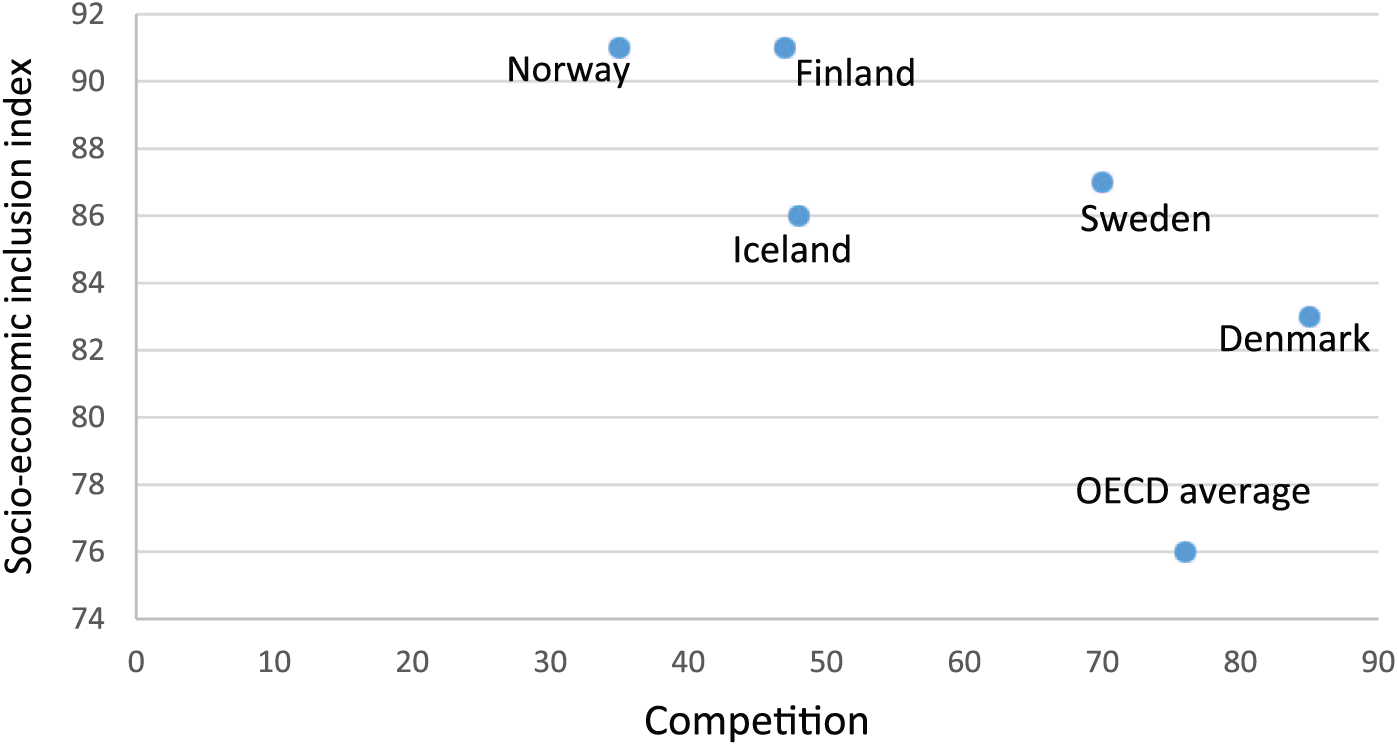
School competition and socio-economic variation within compulsory schools.
Even if the picture of inclusion and competition given above is over-simplified, 8 it still indicates that there are features of the older inclusive Nordic model that remain intact and substantial differences between the five countries with regard to social inclusion and marketization.
Is there a ‘Nordic model of education’ today?
The education systems of the five Nordic countries still display a number of common inclusive traits, enabled by continued extensive public funding of education: free of charge education and related services at primary, secondary and tertiary levels, well thought-out pre-school education and childcare, integration of students in need of special support in ordinary classrooms, etc. In addition, all the Nordic countries retain nine- or 10-year comprehensive compulsory education with little or no tracking. One may add that in many respects the academic and social divisions of Nordic students are small when international comparisons are made. So far then, I would argue that it is still permissible to speak of a Nordic education model that stresses social justice and equality. However, decentralization from the state to the local level and various neoliberal policy measures have been applied in all of the Nordic countries (albeit to varying degrees and in different forms), and these changes have undoubtedly undermined the foundations of the Nordic model. The Nordic countries also show evidence of increasing social and ethnic divisions, a disquieting trend that is most clearly visible in Denmark and Sweden. Indeed, a remarkable change has taken place in Sweden: private schools were almost non-existent before the early 1990s, but a highly visible commercial school market has developed since then, becoming more pronounced in the 2000s. In comparison, Denmark has had private schools for a long time and the increase from approximately 9% in the 1990s to 16% in 2013 is, therefore, not as dramatic as the corresponding increase in Sweden. As has been shown by scholars elsewhere, the marketization of education in Sweden is not just an innocent, administrative matter; it affects most aspects of education and schools profoundly – socially, economically, academically and professionally. It changes the relationships between actors in school and their pedagogical identities (e.g. Beach and Dovemark, 2011; Bunar, 2010; Lundahl and Olson, 2013; Lundahl et al., 2013). In essence then, and especially when considering the developments in Sweden, it is, therefore, highly doubtful if one may still speak of a ‘Nordic model of education’
Post scriptum
The contemporary situation with hundreds of thousands of refugees seeking asylum in Europe, many of them children and young people, constitutes possibly the ultimate test of the old Nordic model of welfare and education with social justice and inclusion as leitmotifs. The prospects look dark: even though they are among the richest countries in the world, the Nordic countries are now raising barriers against those seeking help. It remains to be seen how well these countries succeed in providing the refugees who have crossed immense geographical and cultural borders with inclusive, equal education and a fair chance to start a new life.
Footnotes
Funding
This research received no specific grant from any funding agency in the public, commercial, or not-for-profit sectors.