




Abstract
In recent decades, a range of policy measures to support young people’s school-to-work transitions has been initiated across Europe. However, these transition policies have rarely been studied systematically, particularly from a comparative perspective. Thus, the aim of this article is to compare Swedish, Danish and Finnish policies for supporting young people’s educational and school-to-work transitions. Synthesising and analysing recent research, the article critically draws on Walther’s (2006) classification of transition regimes that recognises a Nordic universalistic regime of youth transitions characterised by emphasis on collective social responsibility, individual motivation and personal development. We conclude that significant policy changes have occurred during the last two decades. Coercive measures have been adopted and social support reduced, making young people more individually responsible for the success of their transitions. Hence, current transition policies diverge in many respects from qualities traditionally ascribed to the Nordic transition regime. We also find significant differences between the three countries’ transition policies, which in some cases indicate policy trade-offs. In addition, we conclude that transition policies are generally weakly coordinated across policy domains, which increases the risk of unintended consequences of these policies.
Introduction
Young people’s educational and school-to-work trajectories have become major policy issues across Europe, partly because of the alarming rates of school dropout, youth unemployment and young people not in employment, education or training (‘NEETs’, cf. Eurofound, 2012, 2014). These issues are, for example, high on the European Union agenda, as reflected in its youth strategy for 2010–2018 and proposed strategy for 2019–2027 (European Commission, 2018).
International comparative studies on school-to-work transitions have identified important similarities between youth transition patterns in different European countries, but also considerable differences. They have also shown (inter alia) that young people’s transitions have been increasingly de-standardised (e.g. Albæk et al., 2015; Gangl, 2001; Müller, 2005; Wolbers, 2007). Various conceptualisations of transition systems have been used in these studies, such as those presented in Iannelli and Smyth (2008), Niemeyer (2007), Pohl and Walther (2007) and Walther (2006). The model of transition regimes formulated by Walther (2006), critically applied here, is partly based on Esping-Andersen’s (1990) welfare state typology and clusters countries according to their constellations of socio-historical, institutional and cultural structures and settings in which school-to-work transitions are embedded.
The combinations of different education and training systems, labour markets and welfare systems result in particular designs of transition policies, reflecting both the prevalent social expectations regarding young people and dominant interpretations of ‘disadvantaged’ youth (Pohl and Walther, 2007; Walther, 2006). The concept of ‘transition policies’ thus denotes ‘the set of education and training, employment and welfare policies addressing young people’s transitions from education to work’ (Walther and McNeish, 2002). A key dimension of transition policies is the degree to which their approach to disadvantage is individualising or structural (Pohl and Walther, 2007). In an individualising approach, disadvantage is attributed to deficiencies of individuals, and the policy focus is on boosting their employability; whereas a structural approach connects disadvantage to inequalities in societal opportunities, and policies are designed to increase equality of access to such opportunities.
Young people’s school-to-work transitions are shaped by numerous institutions and policies associated with diverse domains, including education, youth, employment and social issues. Thus, formulation and implementation of integrated transition policies with a holistic approach, based on young people’s needs, are commonly challenging due to the increasing differentiation, functional autonomy and particularism of these institutional and policy domains (Streeck, 2005). The (lack of) coordination, in turn, is emphasised as a major challenge in the call for integrated transition policies (Du Bois-Reymond and Blasco, 2003; Walther, 2003). Considering the policy fragmentation and de-standardisation of young people’s transitions, there is a need for comparative research that takes a holistic view of the diverse policies affecting young people’s transitions. Typologies such as ‘transition regimes’ have been subject to criticism, because of perceived risks of loss of explanatory power through trying to fit numerous national systems into a limited number of categories, and presenting regimes in a static manner, neglecting change and transformation (Raffe, 2014). In addition, the characterisation of regimes in Nordic countries differs between Walther’s (2006) welfare state-related typology and descriptions in other studies of school-to-work transitions emphasising linkages between education and working life (Allmendinger, 1989; Gangl, 2001; Raffe, 2008; Wolbers, 2007).
Comparative analyses of school-to-work transitions and transition policies commonly focus on differences and similarities between regimes, while cross-country studies of variations within regimes are rare (for such examples, see e.g. Albæk et al., 2015; Lorentzen et al., 2018; Pohl and Walther, 2007). Walther (2006) underlined that he did not elaborate on the differences between countries within a regime, but intended to characterise the whole, the Gestalt of the regime (Walther, 2006: 125). In comparative studies, the Nordic countries are often highlighted as a special case or even a role model in contrast to the increasing social inequality, dualisation and precarisation of labour markets and the exclusion of youth ‘at risk’ in other countries (Ryner, 2007; Thelen, 2014; Walther, 2006). According to Walther’s model, the Nordic countries espouse a universalistic transition regime. Important features include a comprehensive school system, flexible standards of post-compulsory education and training, universal social rights defined by citizenship status, and a labour market characterised by an extended public sector and high rates of female employment. The policy approach in this conceptualised regime is structural rather than individualising, and the focus of transition policies is on supporting the personal development of young people. Hence, most ‘second chance’ measures aim at reopening access and developing individuals’ orientation towards mainstream career options, rather than ‘cooling down’ aspirations and adaptation to low status careers (Walther, 2006).
While many studies have identified similarities between Nordic countries in terms of school-to-work transitions (Buchmann and Kriesi, 2011; Eurofound, 2014; Iannelli and Smyth, 2008; Lorentzen et al., 2018), some have also pointed out significant differences (Bäckman et al., 2015; Jørgensen, 2018; Lundahl, 2012). Hence, the impression that Nordic countries have an inclusive and open-minded approach to young people preparing to establish themselves as adults in the labour market may be erroneously homogenous and idyllic (Lundahl, 2012). Thus, comparative analysis of recent changes in both youth transitions and transition policies in the Nordic countries is clearly warranted.
Aims and structure
Walther’s (2006) model of youth transition regimes emanated from findings in several international comparative research projects from the turn of the millennium. Building on recent research from Sweden, Denmark and Finland, we depart from this model but also critically investigate its relevance when analysing current Nordic transition policies. Our study reveals distinct variations in the structure of upper secondary education, the relationship between the education and employment systems, as well as critical transition points. Examining not only similarities but also differences between countries regarded as espousing the same type of regime, the article contributes to the discussion of the scope and limitations of using ideal types (regimes) in comparative transition research (cf. Raffe, 2014).
Based on recent international and national research on youth transitions and transition policies in the Nordic countries, the article aims to answer the following questions: What characterises youth transition policies of the three Nordic countries in the early 2000s, particularly in terms of individualising vs. structural policy approaches? What important common denominators and differences can be distinguished? Is it reasonable and useful to assume a common, integrated Nordic transition regime, in line with the portrayal by Walther (2006)?
The next sections of the article outline the methodology of the study and the contexts of each of the three selected Nordic countries in terms of structural and institutional aspects of their education systems, including their connections to working life and recent trends in education policy. We briefly touch upon problems hindering statistical comparisons of young people’s school-to-work transitions in the Nordic countries. Thereafter the article compares youth transition policies in the three countries, sequentially focusing on the measures taken to: prevent school dropout, support completion of upper secondary education by young people who have failed to do so, and facilitate school-to-work transitions and employment (cf. Eurofound, 2012: 108). In the concluding section, we return to and answer our research questions.
Methods
The article is based on a review of policy studies, including our own research, 1 on vocational education and training (VET), transitions and transition policies. Various methodological approaches and sources have been applied in the reviewed research. When relevant, European and national statistics are also utilised in the analysis. The study has been conducted as an open exploration of the most important characteristics of policies for prevention of school dropout, completion of upper secondary education and facilitation of school-to-work transitions, using Walther’s concept of a universal Nordic transition regime as the point of departure. However, the comparisons of the countries’ transition policies include considerations of features that are not listed in Walther’s characterisation. Particular attention is paid to: shifts in transition policies during the last two decades, differences between the three countries and findings that may contribute to future research on transition policies.
The policy contexts of Sweden, Denmark and Finland
This section sketches structural and institutional aspects of education, employment and social welfare in Sweden, Denmark and Finland, connecting to the categorisation by Walther (2006: 125–126). We pay particular attention to the national systems of VET, which are important but often overlooked aspects in constructions of transition systems (Raffe, 2014). However, first we outline problems that hinder rigorous statistical comparisons of young people’s school-to-work transitions in the Nordic countries.
Summarising young people’s transitions in statistical terms is not straightforward in any context. It may be difficult even to define seemingly simple statuses, such as ‘leaving school’ or ‘labour market entrance’ (Raffe, 2014: 178–179). For example, in Sweden, the upper age limit for enrolment in upper secondary education is 20 years, so people completing upper secondary education in adult education settings are not included. In Denmark and Finland, there are no such age limits, and upper secondary vocational education is often completed after the age of 25.
Currently, statistics collected by the large international actors (the OECD, EC and UNESCO) provide the most extensive possibilities for comparisons across the Nordic countries. However, such statistics commonly provide cruder and less transparent descriptions than the national statistical databases. Moreover, there is little systematic Nordic collaboration in selecting and harmonising national educational statistics (Lundahl et al., 2018). Bearing these limitations in mind, Table 1 summarises some basic features of youth education and employment in Europe and the three focal Nordic countries.
Illustrative statistics of young people’s education and employment status in Denmark, Finland, Sweden and the European Union.
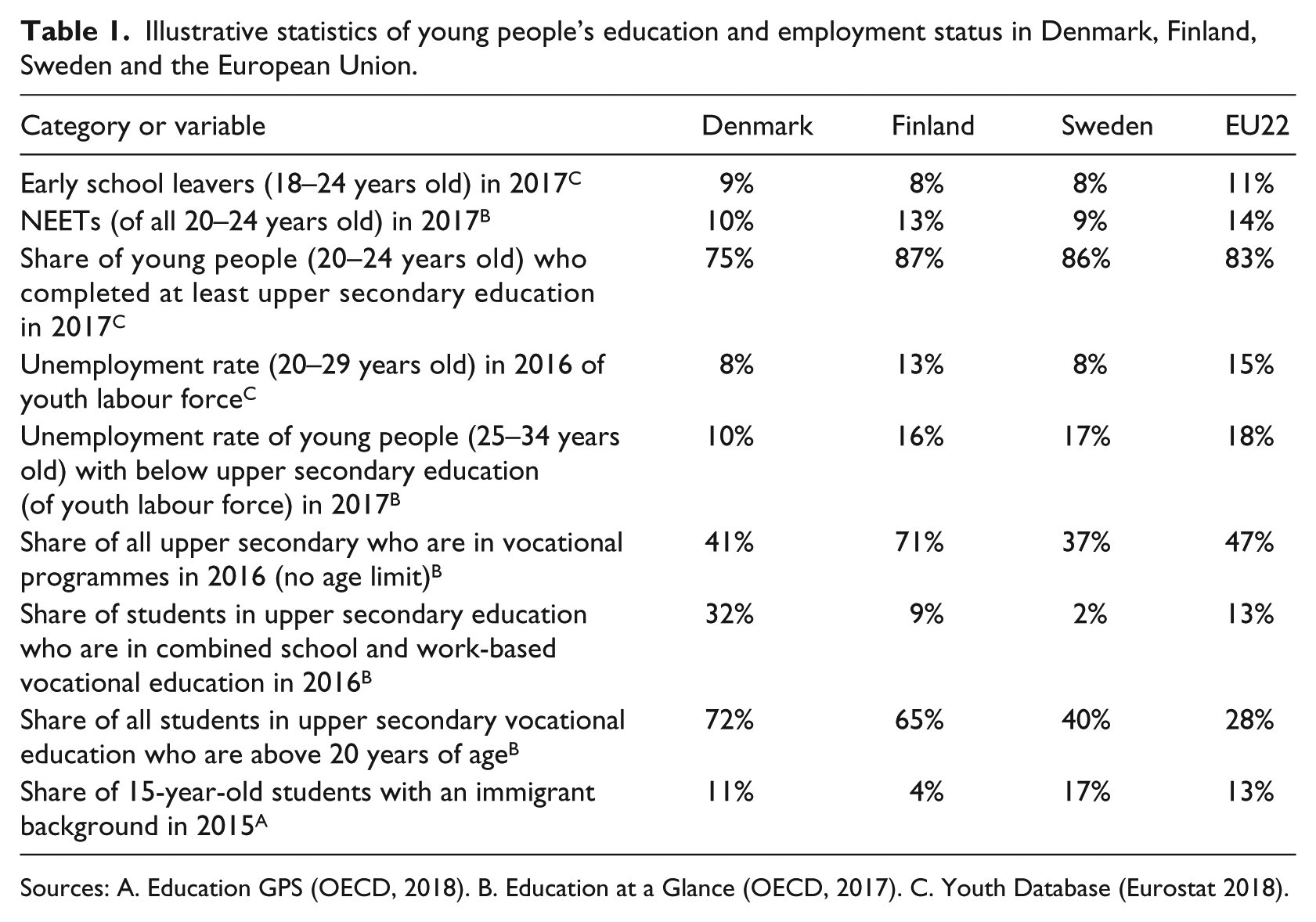
Sources: A. Education GPS (OECD, 2018). B. Education at a Glance (OECD, 2017). C. Youth Database (Eurostat 2018).
While the figures for early school leavers hardly differ between the three countries, Finland has higher NEET rates than Sweden and Denmark. Denmark stands out in several respects; in contrast to the other two countries, it has an apprenticeship training-based VET system, and it has lower graduation rates from upper secondary education than Sweden and Finland. Youth unemployment is lower in Denmark than in the other two countries, particularly Finland. In Finland VET is clearly a more attractive educational choice than in Sweden and Denmark, where the enrolment rates have dropped, partly because VET in these countries does not give direct access to higher education. The age of students in VET is significantly lower in Sweden, due to an age limit of 20 years for admission to upper secondary education. Finally, the proportion of students with a migrant background is considerably higher in Sweden than in Denmark and Finland.
Sweden: comprehensive education, school-based VET and weakened unemployment protection
From the 1960s until the 1990s, the Swedish school system was (and to some extent still is) characterised by universalism, comprehensive organisation and standardisation. However, since the early 1990s Sweden has followed similar policy trends to most other OECD countries: decentralisation and de-standardisation, new public management and privatisation. Almost non-existent before the 1990s, the private school sector has grown rapidly, resulting in a motley school market, especially at upper secondary level. Variations among municipalities and schools, inter alia with regard to career guidance, special needs education and youth schemes, have grown considerably (Lundahl and Olofsson, 2014). Another major contextual change concerns the extensive immigration of refugees, particularly in the early 1990s and mid- 2010s.
Vocational programmes are included in the comprehensive upper secondary school organisation, and between 1994 and 2011 they provided general eligibility for higher education. Swedish VET has a long history of being school-based and still has limited ‘workplace learning’ (APL) elements – roughly half the level of programmes in other EU countries (Lindahl, 2014). Apprenticeship training is infrequent, despite recurrent reform initiatives (Lundahl et al., 2010, Olofsson and Wadensjö, 2011). The attractiveness of the vocational programmes has declined significantly in recent years. Age-based division is stricter in Sweden than in Denmark and Finland; after 20 years of age a young person who wants to attend academic or vocational education at compulsory or upper secondary level is referred to municipal adult education (Komvux) or folk high schools (folkhögskolor) (Nordlund et al., 2013).
Sweden and the other Nordic countries are often characterised as prominent examples of coordinated market economies, with employment regimes marked by universalised protection and high levels of female employment (Gallie, 2009). However, in Sweden (and Finland), unemployment protection has deteriorated significantly for young people in the 2000s, as social assistance and means-tested unemployment benefits have replaced earnings-related benefits to a high extent (Lorentzen et al., 2014).
With few jobs available to early school leavers, the first critical transition point for students with incomplete grades from compulsory school is to upper secondary education. In the early 1990s, the so-called individual programme became the major instrument for facilitating transitions into three-year upper secondary programmes. This was intended to meet the needs of students with uncertain study plans. The programmes were of varying length and content, and could incorporate apprenticeship training (inter alia), but they had little success (Lundahl, 2011).
In 2011, five introductory programmes replaced the individual programme. In 2017, they catered for a quarter of all first-year students at upper secondary level. The second critical transition point is from upper secondary school to work or to either further or higher education. In 2017, 75% of students from the three-year programmes (72% from VET and 77% from academic programmes) graduated from upper secondary education within three years of starting. However, only a fifth of the students starting an introductory programme completed upper secondary education over the longer period of five years (Skolverket, 2017).
Denmark: apprenticeships and early tracking
Like the other two countries, Denmark provides public and universal educational opportunities for all young people with strong national standards. A non-selective school system was introduced for the nine-year compulsory education in 1976, but in contrast to Sweden, comprehensive schooling was never realised at the upper secondary level. Denmark departs from the Nordic model of education (Blossing et al., 2014) and the Nordic universalistic transition regime (Walther, 2006) by having maintained a strong division between vocational and general education at this level (grades 10–12) with early selection and little vertical permeability between the tracks.
Danish upper secondary schools (gymnasiums) are state-led and prepare students for higher education, while VET is based on a modernised model of the apprenticeship system with a neocorporatist type of governance. Young adults who have not completed upper secondary education have access to adult general education or adult VET. The vocational programmes have close ties to the labour market, but weak connections to the general programmes and higher education. In contrast to Sweden (until 2011) and Finland, the vocational programmes in Denmark do not provide general eligibility for higher education. Enrolment in VET is declining, because VET increasingly appears as a ‘dead end’ in the education system. More young people in Denmark than in Sweden include periods of employment during their transition from compulsory school into and through upper secondary education (Albæk et al., 2015). This is related to the Danish ‘flexicurity’ model of labour market regulation, which involves weaker job security regulations than in Sweden (Emmenegger, 2010). This creates higher labour mobility and more employment opportunities for young people in Denmark than in the other two countries.
The two most critical transition points for young people in Denmark are from compulsory school to upper secondary education, and from an initial school-based course in the VET system to an apprenticeship in a company. Responsibility for obtaining a training contract with a company lies primarily with the individual student. Due to a shortage of training placements, many students drop out or transfer to another programme. These students can apply for a compensatory school-based training placement, but many ignore this option as it is held in lower esteem than ordinary apprenticeships (Juul and Jørgensen, 2011). While the transition to employment after completing a VET programme is difficult in the other two countries with mainly school-based training, it is very smooth in Denmark, because it occurs during the programmes. The employment rates of VET graduates are high, because more than half of the apprentices are taken on as full employees by the companies that provided their training.
Since the early 1990s, reforms in Denmark, inspired by neo-liberal ideas, have taken steps to decentralise upper secondary education, increase students’ choices and create a quasi-market for education. While the curricula for upper secondary schools follow clear national standards, the schools themselves are self-governing institutions whose funding is connected to measurable performance goals and outcomes (Juul and Jørgensen, 2011).
Finland: attractive but weakly integrated school-based VET
In Finland, educational policies have also shifted towards a more selective and market-based orientation, but the neo-liberal turn has not been as comprehensive as in Sweden and Denmark. Policy reforms of recent decades, such as the introduction of free school choice for basic education in the mid-1990s, have promoted marketisation of education (Kosunen et al., 2016; Seppänen, 2006). However, many features of neo-liberal education policy, such as national testing systems, public league tables and a large private and independent schools sector, are still absent from the Finnish system (Berisha et al., 2017).
Since implementation of a comprehensive school reform in 1972–1977, the first educational choice facing students after completing compulsory school has been whether to continue with academic or vocational upper secondary education. In contrast to the Danish and Swedish systems, the Finnish education system includes no ‘dead-end tracks’; within certain limits, vocational and general programmes provide equal opportunities for further education, including higher education.
Although general and vocational education are delivered in different schools, tracking in upper secondary education is weaker than in Denmark, and VET programmes attract higher proportions of young people in Finland than in most EU countries. Approximately 40% of compulsory school leavers move on to VET programmes (OSF, 2016). The share of VET students in the 15–19 age group is clearly higher in Finland than in both Sweden and Denmark (OECD, 2017).
There are two critical transition points, from compulsory to further education and subsequently from VET to employment. As in many other European countries, dropout is negatively related to young people’s later career prospects. However, both the risks and consequences of dropping out are not equally distributed. Children from lower socioeconomic status families and immigrant youths are more likely to be excluded from further education and working life than the rest of the population. In addition, they face more difficulties in moving on from being NEETs, advancing their careers and finding stable employment (Järvinen and Vanttaja, 2013).
Young people graduating from VET have difficulties in gaining a foothold in the labour market after completing their studies. In 2016, of all VET graduates, 19% were still unemployed a year after graduation, and only 57 % were employed full time (Statistics Finland). Like Sweden, Finland has a mainly school-based VET system, which has been highlighted as a reason for the weak connection between VET and the labour market. A further similarity to Sweden, and different from Denmark, is that apprenticeship training in Finland has been, and still is, a marginal route for obtaining a vocational qualification, and it is mainly targeted at adults.
Transition policies and measures to meet three objectives
In this section, we synthesise and analyse Swedish, Danish and Finnish transition policies and measures oriented towards three objectives: prevention of dropout, supporting young people’s completion of upper secondary education and facilitation of school-to-work transitions. Central questions are to what extent the policies rest on diagnoses of associated problems as structural or individual, and the structural or individual orientation of the measures taken (Table 2).
Key questions and concepts associated with the three objectives.
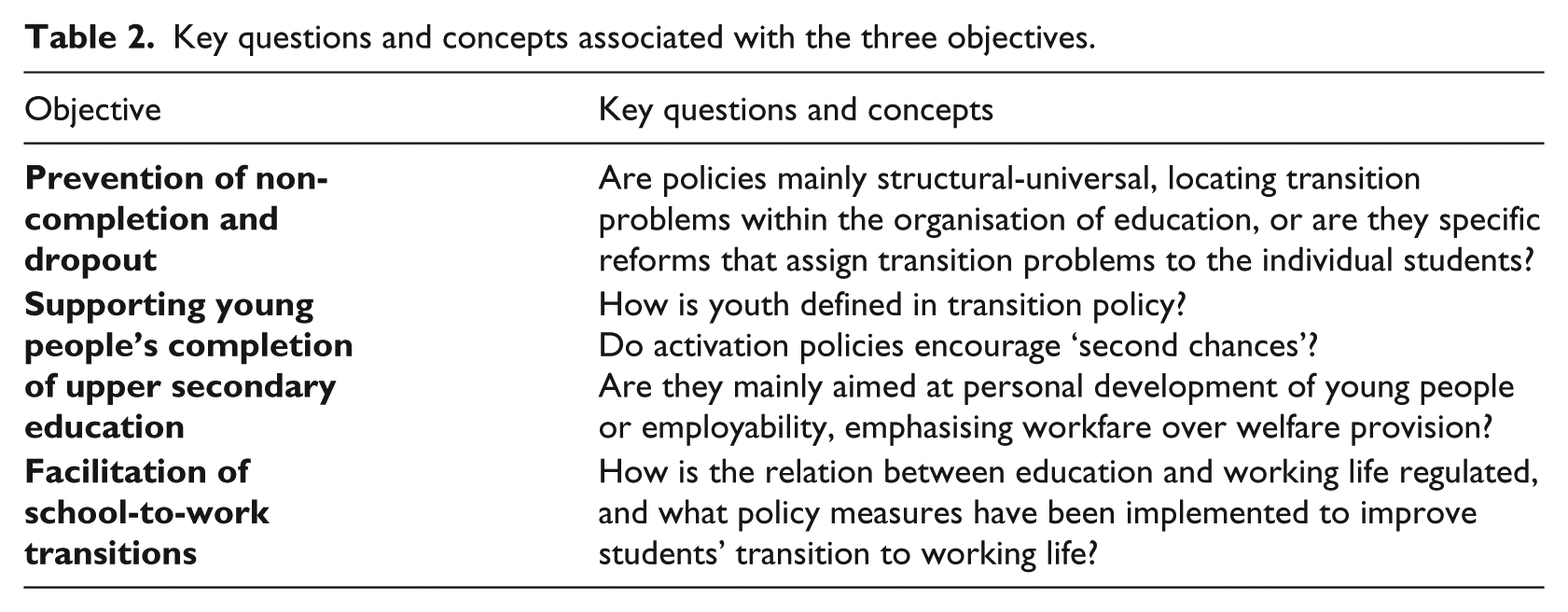
Prevention of non-completion and dropout
A policy discourse of ‘a school for all’ has been coupled with an increased focus on academic achievement, choice and effectiveness in all the Nordic countries during the last three decades (Arnesen and Lundahl, 2006; Blossing et al., 2014). In our present analysis, we find that Nordic policies aimed at preventing non-completion at upper secondary level generally have an inclusive motive, but the measures may follow other logics and, strikingly, often see contrary results. Below we discuss two kinds of reforms and measures related to the prevention of non-completion: structural-universal reforms targeting the organisation and curriculum of upper secondary education, and individualised-selective reforms that specifically target certain ‘at risk’ groups of students by offering allegedly individualised study tracks and special education. The former are intended to provide optimal opportunities for all students, while the latter are intended to incentivise, empower or coerce students to accept responsibility and address their individual problems.
Universal policies targeting upper secondary level organisations and curricula
In all three countries, organisational and curriculum reforms of upper secondary education, particularly the VET programmes, are regularly undertaken in an attempt to solve the problem of non-completion. This tends to be the most politically controversial aspect of transition policies, as solutions proposed at one point may later be seen as causes of the problem (Lundahl et al., 2010). The Danish case is the most striking in this respect. A reform in 2000 attributed the dropout problem to the rigid and standardised programmes on offer (Jørgensen, 2016). This diagnosis fitted well with the neo-liberal agenda favouring choice and individual responsibility. However, within a few years, it became evident that the reform’s effects had been negative and completion rates had declined. Hence, the government rolled back part of the earlier reform in 2007. Individualisation was replaced by structured basic courses.
Similar swings have occurred in Sweden, where upper secondary education reforms in the 1990s prolonged VET programmes, delayed specialisation and softened boundaries between the vocational and academic programmes. Reforms in the late 2000s were largely intended to restore the older order by re-establishing sharper distinctions between vocational and academic tracks and reintroducing apprenticeship training, inter alia to reduce dropout rates and increase the popularity of VET (Lundahl et al., 2010). The results were disappointing; the dropout level did not fall, and recruitment to vocational programmes dropped significantly. A recent public School Commission has proposed a return to offering VET students eligibility for higher education.
In 2017, the Finnish Parliament passed new legislation, one of the central aims of which is to align VET and the labour market more closely by increasing workplace-based learning and removing barriers that still remain between young people and adults in vocational education. This is a sequel to earlier reforms in the early 2000s, when the curriculum of Finnish VET was changed to include an on-the-job training period and skills demonstrations (Virolainen and Stenström, 2014). The reform has been criticised because it coincided with substantial cuts in funding for VET. Moreover, a requirement for successfully shifting the emphasis towards workplace learning is that companies must be willing and able to provide appropriate guidance and supervision to growing numbers of trainees, which the Swedish experiences indicate is not realistic.
Selective measures addressing ‘vulnerable’ students
Special education in the Nordic countries is normally provided within everyday classroom teaching but also involves part-time teaching in separate groups. The three focal countries also have special primary and secondary level schools and programmes targeting children with more severe learning disabilities, but they only constitute a small percentage of each cohort. In 2011, Finland adopted a comprehensive national strategy for special needs education at three levels – general, intensified and special support – depending on students’ needs (Basic Education Act 642/210). This was expected to make the education system more inclusive and reduce numbers of pupils in special education. However, municipalities can still organise education and special education in very different ways. While the organisation of support is inclusive in some municipalities, it is segregated in others and more market-oriented in bigger cities (Lempinen, 2018). Denmark chose another, more selective direction in 2007, introducing special, prolonged basic programmes in VET schools for ‘weak learners’ to help them complete upper secondary education. Research showed that the programmes had ambiguous effects. More time and social support in these programmes helped some students to complete upper secondary education. For others, the placement in a special programme resulted in stigmatisation, demotivation and negative peer effects, increasing students’ inclination to drop out of the programme (Tanggaard et al., 2015). This demonstrated that assigning responsibility for dropout to the students and labelling some students as weak learners can have self-fulfilling effects. Sweden has retained an inclusive special needs policy that, like the Finnish policy, is characterised by considerable local discretion but lacks the kind of strategical approach embedded in the Finnish reform.
Both Sweden and Finland have considered (but not realised for economic reasons) a general prolongation of the nine-year compulsory education to prevent school dropout at a critical transition point. Denmark offers a tenth voluntary year, which attracts half of all pupils. In Finland, a targeted measure offers students who risk failing compulsory school an extra (tenth) year of basic education. All three countries have also created ‘bridges’ – preparatory or introductory programmes – between compulsory and upper secondary education in order to support students in completing compulsory education. In Finland, an ‘Occupational Start’ programme offering young people an alternative VET programme (National Board of Education, 2014b) provides the bridges. In Sweden they are the introduction programmes, targeting young people who are not eligible for a three-year national programme. In Denmark, students regarded as ‘not ready’ when completing grade nine are offered up to a year of preparatory education. Until a reform in 2015, even students who had not completed compulsory school could enrol in an ordinary vocational programme in Denmark, and many of them actually completed an apprenticeship. Since that reform, they have been referred to a reorganised preparatory programme.
In addition, all three countries have constructed special tracks at upper secondary level to accommodate recently arrived students – in Sweden the language introduction programme, in Finland preparatory training programmes and in Denmark a so-called basic integration education (Danish: IGU), which combines language training in schools and practical experience and training for work. Due to a huge wave of immigrating refugees during 2015–2016, proportions of students attending the preparatory language programme in Sweden have been very high (e.g. 28% of first-year upper secondary level students in 2016–2017). Following an abrupt change in policy in 2016, the refugee intake has declined, as well as enrolment rates for the preparatory language programme. In Finland, only 2% of compulsory school graduates move on to preparatory training, including the extra year of basic education (tenth grade). In Denmark, 13% enrol in equivalent programmes.
Supporting young people’s completion of upper secondary education
The measures to reintegrate dropouts and early school leavers in Sweden, Denmark and Finland have many similarities but also differences. In all three countries, the main target groups are young people having difficulties in the transition from compulsory to further education, who are defined as being at risk of interrupting their upper secondary education or are NEETs. Various municipal-level monitoring and tracking services have been established to support smooth, linear transitions between education levels and to get upper secondary school dropouts ‘back on track’ as soon as possible. Although non-standardised life-courses have become more common in recent decades (EGRIS, 2001; Eurofound, 2014), the measures to reintegrate dropouts still seem to be largely based on an implicit ideal of a standardised ‘normal life-course’’(Jørgensen, 2016; Lundahl and Olofsson, 2014; Rinne et al., 2016).
In line with Walther’s model of transition regimes, providing second chance education opportunities aiming at reopening access to mainstream career options still seems to be a policy priority in all three Nordic countries. Although second chance options largely consist of various special measures and programmes, many of them lead to acquisition of formal educational qualifications. Commonly orientated towards vocational learning, opportunities to complete compulsory education are also provided. However, despite these similarities, there are differences between the three countries with regards to alternative ways of acquiring a formal education qualification. In Finland, validating informal skills, i.e. providing opportunities for adults to convert their work experience into formal VET qualifications, is a key strategy (National Board of Education, 2014a). In Denmark, young adults are offered programmes of reduced duration in the adult VET programme after validation of their prior learning. In Sweden, such validation is far less frequent (Ministry of Education, 2016). Young people who are not eligible for upper secondary vocational education are generally referred to the vocational introductory programme, which prepares them either for studies on a regular vocational programme or establishment in the labour market.
In many respects, differences in Swedish, Danish and Finnish policies’ handling of dropouts stem from differences in the definition of ‘youth’, i.e. how each country’s regulations define different age groups. Age-based regulations are less strict in Denmark and Finland than in Sweden, which enables more flexible transitions between educational programmes. While in Sweden the upper age limit for enrolment in upper secondary education (gymnasium) is 20, there are no such age limits in Denmark and Finland where the average age of completing upper secondary vocational education is 28 (OECD, 2017). From 20 years of age, young Swedes who want to complete upper secondary (and sometimes even compulsory) education are referred to adult education services. The different conceptualisations of ‘youth’ in transition policies also emerge when comparing municipalities’ duty to monitor and track dropouts. Sweden has the narrowest definition of ‘youth’ and Finland the broadest. In Sweden, municipalities’ duty to monitor and track dropouts relates to people aged 16–20, but in Denmark it includes young people up to 25, and in Finland people up to 29 years old.
Active labour market policy and its consequences for young people
In all three focal countries, there has been a shift from a universal, Nordic type of welfare state towards a social investment state that emphasises workfare over welfare provision (Kananen, 2014). Hence, there has been a shift from a structural to a more individualising approach to disadvantage. In the name of ‘active labour market policy’ (ALMP), during the past couple of decades sanctions and coercive measures have become much more prominent as methods for increasing the rate of upper secondary education completion (Bengtsson, 2014). The state’s key responsibility is no longer to provide social welfare for people who are unable to support themselves, but to support their employability and help them acquire employment, in sharp contrast to key elements of transition policies included in Walther’s (2006) conceptualisation of a Nordic universal transition regime.
In Denmark, ALMP was introduced in the mid-1990s with a specific focus on young people. Since then it has developed into a set of policy measures intended to ensure that more young people complete upper secondary education. These policies have introduced a shift from ‘soft’ and supportive measures for disadvantaged youth, to ‘tough’ and coercive measures to mobilise young people in education and training (Greve, 2012; Juul and Jørgensen, 2011). Municipal Youth Guidance Centres are not only obliged to seek out ‘dropouts’ but can also punish parents financially if their children under 18 do not follow the education plan. In Finland, punishments have targeted young people rather than their parents: since 1996 people below the age of 25 and with no VET qualification or job have been obliged to apply to educational programmes at least every spring to entitle them to receive unemployment benefits. The so-called ‘Active model of receiving unemployment benefits’, initiated in 2018, tightened conditions for receiving benefits even further. Currently, if an unemployed person cannot fulfil the new activity requirements within 65 days, his/her employment benefits will be cut for the next three months. In Sweden, the coercive methods are less severe than in Finland and Denmark. Unemployed Swedish youths aged 20 to 25 who are participating in the most common unemployment scheme, the job guarantee, have to sign and stick to an individual action plan in order to draw unemployment benefits (Lundahl and Olofsson, 2014).
Discrepancies between the intended and unintended consequences of active labour market policies clearly show that transition policies are far from integrated in the three focal Nordic countries. In Denmark, all young people enrol in upper secondary education, partly due to the youth activation policy. Hence, vocational schools have received growing numbers of disadvantaged students with psychosocial problems. This has contributed to an increase in the dropout rate from the VET system since the mid-1990s (Jørgensen, 2016). In response, since 2007, policy-makers have required vocational schools to make yearly ‘retention plans’ and set goals for reducing their dropout rate. To support this aim, the schools offer individual guidance, psychological advice, mentoring, coaching, access to contact teachers, free school meals and other measures. Effects of these measures have been quite limited, and the non-completion rate in VET has remained at around 50%. However, a large proportion of the ‘dropouts’ return to education later and complete upper secondary education in their late twenties. In Finland, we find indications that the use of sanctions has actually stimulated dropout and interrupted study by playing on fears of social exclusion and ignoring young people’s own aspirations and ambitions (National Board of Education, 2014b). ALMP has also prompted an increase in inequality between young people of different ages, since only those over the age of 25 are allowed to receive unemployment benefits while studying if the studies are expected to improve their chances of employment (Rinne et al., 2016). Sweden does not use the same kinds of explicit sanctions targeting unemployed young people without upper secondary education as Finland and Denmark. Instead, successive Swedish governments have introduced a range of measures that aim to facilitate transitions into work, often in combination with shorter education or training. This policy approach also seems to have had limited success as large groups of young people continue to fail to complete upper secondary education after three, four or more years of studies at upper secondary level, and face difficulties in getting a job. This is especially true for those with the shortest education, disabled young people and youths with a migrant background (Lundahl and Olofsson, 2014).
Facilitation of school to work transitions
In all Nordic countries, combating youth unemployment is a high political priority, and the level of youth unemployment is regarded as a key indicator of the effectiveness of transition policies. Generally, the youth employment rates are high and youth unemployment rates are among the lowest in Europe, excluding students seeking part-time employment (Albæk et al., 2015). However, even in the three focal countries, young people were strongly affected by the general rise in unemployment rates in the 1990s and after the financial crisis in 2008.
The patterns of school-to-work transitions and policies to support these transitions differ considerably between the three countries. Youth unemployment has been consistently lower (and transitions from upper secondary education to stable employment smoother and faster) in Denmark than in Sweden and Finland (Albæk et al., 2015; Eurofound, 2014). However, the dropout rate from VET is higher, and the upper secondary education completion rate lower, in Denmark than in Sweden and Finland (Albæk et al., 2015; Bäckman et al., 2015). These differences can be partly explained by different connections and pathways between education and working life in the three countries. Upper secondary VET is generally assigned a key role in getting early school leavers and disadvantaged youth into employment, but the national VET systems differ significantly in two of the key qualities emphasised by research on school-to-work transitions (Allmendinger, 1989; Gangl, 2001; Saar et al., 2008). The stratification of upper secondary education and the specificity of vocational qualifications are high in Denmark and low in Finland and Sweden. Partly for this reason, upper secondary education has very different relations to working life in the three countries. Based on concepts presented by Greinert (2008), three types of relations can be identified: those based on central state planning, on market-based regulation and on institutionalised negotiation (Jørgensen and Tønder, 2018). Central state planning was important for the Nordic Social Democratic type of governance in the 1950s to 1980s. The forecasting of skill requirements guided educational planning with the aim of matching demands of young people with labour market requirements. While Denmark and Sweden have changed to market-based regulation, the Finnish VET system still relies extensively on planning and forecasting to predict future skill demands (Ahola, 2012). However, in Finland too the students can choose an individual programme and combine subjects flexibly across the vocational and academic tracks. Due to this flexibility and the modularised structure of education, the matching of students’ skills to job profiles is less standardised than in the occupational VET system in Denmark. Consequently, the education-to-job matching of upper secondary students is weaker in Finland than in Denmark (Levels et al., 2014).
In Denmark, the connections between education and working life are mainly managed through institutionalised negotiations between the state and labour market organisations. Institutions engaged in collective skill formation cooperate with the state to regulate access to the most popular VET programmes by using quotas to match numbers of students with supplies of apprenticeships. In occupations where a shortage of labour is expected, all students are guaranteed a training placement. Until the early 1990s, capacities of the vocational programmes in Sweden were determined by local and regional authorities, based on assessments of labour demands. Following deregulation and decentralisation, the schools have primarily adapted their capacities to students’ levels of demand, which has tended to increase mismatch problems in the labour market. Moreover, decentralisation and marketisation has weakened the public authorities’ opportunities to coordinate school-to-work transition policies. These differences between the three countries have implications for their balancing of the social demands of young people with the skill requirements in the labour market. The mainly school-based Swedish and Finnish VET systems can more easily adapt their capacities to the demands of young people leaving compulsory school than the Danish apprenticeship system, which depends on the supply of training placements. While most students in Sweden follow age-homogeneous classes for three years of upper secondary VET, students in Denmark spend extended time searching for apprenticeships, dropping out and shifting into other programmes.
Trade-offs for youth transition policies
Our comparison of transition policies has identified important differences between the three countries and significant shifts in policies. These differences and shifts indicate underlying trade-offs for transition policies on a number of issues. One concerns the breadth or specificity of qualifications. Transition policies have changed considerably in Sweden and Finland during the last two decades in this respect. In the 1990s, it was strongly argued that broad and general qualifications provided better preparation for students for flexibility and lifelong learning than specific vocational skills. Hence, numbers of programmes and specialisations were reduced in all three Nordic systems of upper secondary education and VET. In Finland and Sweden, the extent and level of the general subjects in the VET system were raised with the aim of providing general eligibility for higher education. In contrast, students in the Danish VET system still spend most of their time in work-based learning, which mainly provides industry-specific or even firm-specific skills. However, more recent reforms in Finland and Sweden have aimed to reinvent apprenticeships, increase work-based learning in VET and connect the VET programmes more closely to the labour market (Jørgensen and Tønder, 2018). This shift in policy and the differences in policies in the three countries indicate a dilemma for transition policy. Broad and general qualifications prepare students for lifelong learning and job mobility, but prolong their school-to-work transitions. Specific vocational skills promote fast transitions to skilled work but are expected to have short-term value in a dynamic labour market (Bol and Van de Werfhorst, 2013). This represents a trade-off between the students’ short- and long-term employment opportunities, and between their access to employment and higher education after graduation (Jørgensen and Tønder, 2018). This trade-off, which the three Nordic countries have managed differently, is often manifested as a conflict between education policies favouring general education and citizenship, and employment policies favouring specific skills and employability.
Another trade-off for transition policy concerns the standardisation or flexibilisation of transition pathways. The strong national standards in the universalistic, Nordic transition regime (Walther, 2006) resulted from Social Democratic governments’ attempts to create equal opportunities for all, regardless of location, social class and gender. Since the 1990s, policies have shifted to decentralisation and flexibilisation to allow adaptation of the programmes to the specific demands of local labour markets and students with special needs. However, this shift in transition policies has had unintended consequences. Individualisation of VET programmes in Denmark intended to improve retention of students resulted in higher dropout rates (Jørgensen, 2016). In Sweden, the strong decentralisation and marketisation of upper secondary schools has resulted in growing disparities between the municipalities regarding educational quality and transitions (Lundahl et al., 2013; Lundahl and Olofsson, 2014).
A third trade-off for transition policy concerns the comprehensiveness of schooling. In all three countries, the promotion and upgrading of apprenticeships have been core elements of policies to bring disadvantaged youth into employment. However, apprenticeships are associated with educational stratification (tracking), contrasting with the traditionally egalitarian organisation of education in the Nordic countries (Walther, 2006). This conflict indicates a trade-off for transition policies between the promotions of social equality associated with a comprehensive school system, and social inclusion associated with separate work-based programmes, like apprenticeships (Jørgensen, 2018). Extensive work-based learning and strong involvement of the labour market organisations, especially in apprenticeship programmes, are associated with smooth school-to-work transitions, but apprenticeship programmes are also associated with strong social divisions in upper secondary education.
Concluding discussion
In brief response to the three research questions we initially posed, our comparison of transition policies in Denmark, Finland and Sweden has revealed many similarities but also significant differences. We find that some features ascribed to a Nordic, universalistic transition regime, as proposed by Walther (2006), match current realities of the three countries. These include the comprehensive, public and largely non-selective basic education system, standardised educational routes with some room for individual choices and relatively high levels of state-financed social security in international terms (Albæk et al., 2015). However, other features of the model are less recognisable, and our comparison of the three Nordic countries raises questions about its validity. As discussed in this last section, we have found substantial departures from the qualities ascribed to the universal transition regime. We argue that this can be partly explained by the policy shifts that have occurred during the last two decades. Moreover, differences between the three countries’ regimes can be partly ascribed to differences in education-work linkages. Finally, we discuss our findings’ implications for the notion of transition regimes and integrated transition policies.
The concept of a universal transition regime is associated with an open, low-risk employment regime, and the idea of youth being strongly concerned with personal development and citizenship. However, we find that labour markets in the three Nordic countries are increasingly inaccessible for certain groups of youths, particularly early school leavers, disabled young people and migrant youths who lack upper secondary qualifications. Moreover, the Youth Guarantees have not prevented rises in youth unemployment and NEET rates in all three countries since the economic crisis in 2008 (Albæk et al., 2015). The political discourse about early school leavers is marked more by ideas of vulnerability and employability than by ideas of personal development and citizenship. It is characterised more by an individualising than a structural policy approach in Walther’s (2006) terms. The conceptualisation of young people as ‘vulnerable’ and ‘at risk’ has played an important role in forming policies and educational practices (European Commission, 2010, 2016). However, such categorisations tend to individualise social problems and contribute to the reproduction of stereotypical images of ‘problematic’ youth groups (Brunila et al., 2016; Ecclestone and Lewis, 2014; McLeod, 2012).
We find that activation in education, training and work are central measures for young people’s social inclusion in all three countries, though priorities differ. In all three countries, the measures associated with transition policies intended to get youths back into education or employment have become more coercive and punitive. Contrary to Walther’s (2006) claim that young adults in the universalistic transition regime are encouraged to experiment with yo-yo transitions, we find that current transition policies strongly encourage direct, linear transitions into employment based on arguments about increasing the supply of skilled labour. Despite increasing de-standardisation of people’s life-courses, societal expectations based on a standardised ‘normal’ life-course are strongly emphasised in transition policies. Facilitating direct, linear transitions from compulsory education to further education and finally to working life is seen as a key priority of both education and employment policies.
The notion of a universalistic transition regime highlights the similarities between the Nordic countries. However, we have found significant differences in the political initiatives to promote young people’s transitions. In Finland and Sweden, the measures adopted mainly seek to provide employment or training for youths in the NEET group, while in Denmark the measures mainly focus on activating young people in VET and subsidising apprenticeships for the students. These differences can be explained to some extent by differences in institutional architecture. In Sweden and Finland, early school leavers have very few employment opportunities due to strong employment protection regulations, among other factors (Noelke, 2015). The Danish flexicurity model includes weak employment protection and offers more job opportunities for young people. However, we also find convergence between the three countries. Both Finland and Sweden have extended internships and have introduced apprenticeships in upper secondary education, thereby increasing their regimes’ alignment with the Danish regime.
Our comparison has also identified significant differences in institutional linkages between education and employment systems in the three countries. The Finnish and Swedish VET systems are more school-based than the Danish equivalent. In the Danish apprenticeship system, the transition to the labour market is integrated in the VET programmes. In contrast, in Sweden, the comprehensive organisation of upper secondary education remains, although clearer boundaries between the two tracks were reintroduced in 2011. While transition systems offering extensive work-based training provide a smoother transition to employment, they are also associated with higher dropout rates, as we have observed in Denmark. In addition, ethnic and gender minorities have considerable difficulties gaining access to apprenticeships. The school-based upper secondary schools in Sweden and Finland provide more stability and stronger social support to disadvantaged youths who would not be able to complete an apprenticeship in a company.
In comparison to most European countries, the Nordic countries offer stronger, multi-dimensional social support for all young people, which reduces risks associated with their transitions after leaving compulsory school. Young people in the Nordic countries have also faced less difficulties in their transitions than many young people in the rest of Europe, especially the Mediterranean countries, since the crisis in 2008. However, there is a risk of the concept of a universal transition regime conveying a misleading picture of the current situation in the Nordic countries. This is because their transition policies in recent decades have assimilated many neo-liberal features that have reduced social support and individualised responsibility for successful transitions. In addition, the transition systems in the three countries examined have developed along diverging lines historically.
The concept of a universal transition regime is associated with the Nordic welfare state. However, there have been significant changes since the welfare regime models were formulated more than 25 years ago by Esping-Andersen (1990). A key feature of the Nordic welfare regime was the de-commodification of social welfare. Welfare services were provided by right to all citizens, so they could maintain a decent livelihood without relying on the market. In recent decades this regime has changed to a more dualistic, individualistic and multi-tiered welfare state, where participation in the labour market has become increasingly important for entitlement to benefits (Kvist and Greve, 2011).
Our comparisons have revealed significant differences in the transition pathways and current transition policies in the three Nordic countries, raising questions about their categorisation as representatives of a common transition regime. Emphasising youth policy and social policy, Walther’s typology is based on welfare regime theory, where we find many similarities between the Nordic countries. Other approaches to school-to-work transitions emphasise education-work linkages and labour market structures, in which the three countries display considerable differences (Müller, 2005; Saar et al., 2008; Wolbers, 2007). Denmark has a higher specificity of vocational qualification, stronger educational stratification, stronger occupational labour markets and weaker employment protection than Sweden and Finland. Likewise, the literature on comparative political economy of skills (Busemeyer and Trampusch, 2012) places Denmark’s skill formation regime in a different category (collective) than the Swedish and Finnish regimes (statist). The three countries’ placement in different categories depending on the distinguishing features of the transition system, demonstrates the difficulties of constructing consistent conceptualisations of transition regimes. Our comparisons of transitions and skill formation in the Nordic countries indicate that regimes in all these countries are hybrids, combining features of several regime types (Jørgensen, 2018).
As mentioned in the Introduction, regime theory is based on the assumption of the ‘functional fit’ of the institutional configuration of a regime. However, we have found similar types of universalistic welfare policies in the three countries, which have quite diverse policies and institutions for linking education with working life. This hybridity challenges the assumption of regime theory that hybrids are less efficient than ‘pure’ regimes. Empirical comparisons of school-to-work transitions in the Nordic countries provide no clear evidence that the overall transition policies of one country are more efficient than another. Instead, different strengths and weaknesses of each country are highlighted. This can be explained by the trade-offs for transition policy that we have identified, which imply that strengths of policies in one domain of youth transitions are associated with weaknesses in other domains. For example, comprehensive upper secondary school is associated with high equality of opportunities but also with weak links to working life.
This conclusion has implications for comparative studies of transition policies. As transition policies cover diverse policy domains, no single ‘best practice’ for all domains can be expected. Good practice in one domain tends to be associated with less successful practices in other domains. Such trade-offs may be due to structural constraints, for example difficulty of combining apprenticeships with comprehensive schooling. Alternatively they may be due to relocation effects, i.e. displacement of transition problems in one domain to another domain, e.g. redefinition of social problems as educational or employment problems, or vice versa (Di Stasio and Solga, 2017).
In addition, due to the increasing complexity of youth transitions, transition policies tend to have multiple and conflicting effects. Specific initiatives in one domain tend to have unintended effects in other domains due to the interdependence and interference between policies. In addition, transition policies are aimed at diverse groups of young people, and specific measures often have different effects on different groups. These aspects of transition policies may explain some of the unintended consequences of policy measures that we have identified, for example that solutions proposed to a problem at one point may later be seen as causes of the same problem.
This brings us to the last point from these Nordic comparisons. At the conceptual level, our study has highlighted a need to qualify the term transition policy for future research. We have used the term to denote the diverse strategies and measures designed to prevent school failure and dropout, and facilitate school-to-work transitions. However, these policies are rarely developed with consideration of the overall transition process or the multiple parallel transitions of young people (concerning family, housing, financial, peer groups, etc.). This highlights a previously mentioned need for integrated transition policies (Du Bois-Reymond and Blasco, 2003; Walther, 2003).
Although the Nordic countries have traditions of strong state governance with a long-term perspective, we find few examples of integrated transition policies. Generally, the diverse policy measures related to youth transitions are weakly coordinated across policy domains. Policies are mostly introduced specifically to manage acute problems in one of the three domains examined in this article. A core weakness of specific transition policies is that they rarely consider how measures to improve transitions at one point may have unintended consequences for transitions at other points. For example, measures to guide and activate young people into VET have tended to increase the dropout rate from VET in all three countries (Jørgensen, 2016).
Finally, it can be argued that the decentralisation and marketisation of education, which has been particularly prominent in Sweden, has aggravated this problem: each institution is funded according to its own performance, while overall state or municipal responsibility for the transition process has been weakened. Isolated improvements in the performance of each of the separate institutions or practices that support young people’s transitions can make the overall school-to-work transition more difficult if it becomes fragmented and non-transparent. Hence, there are clear needs to research, develop and implement effective integrated transition policies and practices.
Footnotes
Declaration of conflicting interest
The author(s) declared no potential conflicts of interest with respect to the research, authorship, and/or publication of this article.
Funding
The author(s) received no financial support for the research, authorship, and/or publication of this article.