




Abstract
The European Higher Education Area (EHEA) is an international initiative for the harmonisation of higher education (HE) systems in 49 countries. Literature about UK’s participation in the EHEA is limited, and the role of EHEA’s membership for the UK, particularly after the end of the Brexit transitional period, has not been researched. The originality of the study reported in this paper is in addressing this gap by exploring the perspectives of key UK HE actors on the strategic significance of UK’s memberships in the EHEA post-2020 for the UK. The paper draws on the theoretical ideas of rational choice neo-institutionalism, differentiated Europeanisation and internationalisation, and a thematic analysis of 19 official communications of key stakeholders and six in-depth interviews with their representatives. The findings contribute to filling in a significant gap in the literature about Bologna in the UK in making a distinction between its two memberships in the EHEA and the differences and complexities of the roles they play in constructing UK’s overarching agenda in HE particularly in the post-Brexit context. The article has also contributed to the literature about Bologna more widely, presenting an investigation into differentiated Europeanisation that has been taking place within one unique post-EU country.
Keywords
Introduction
The European Higher Education Area (EHEA) is an international initiative for the harmonisation of higher education (HE) systems, which was initiated by the education ministers from the UK, Germany, France and Italy at their meeting in Sorbonne, France in 1998, before calling upon other European Union (EU) member states to join them (EHEA, 2021a). It was agreed in 1999 that the EHEA would be developed through the Bologna Process (BP) project. The BP has a few action points, such as the adoption of a credit system to measure students’ workload, three cycles of studies (Bachelor’s, Master’s and PhD), quality assurance mechanisms, etc. These action points have developed over the years. The list itself has grown and the meaning and structure of these action points has been evolving (Kushnir, 2020).
The EHEA started emerging as a platform for Europeanisation, particularly after the 2001 adoption of a goal which was originally set for the EU in 2000 in the Lisbon agenda: for the EU to become the most competitive knowledge-based economy in the world (Corbett, 2011). The focus on Europeanisation in the EHEA was reinforced by its initial growing membership of EU countries, references in the EHEA documents to building a European identity within the EHEA and, after all, the inclusion of the word ‘European’ in the name of the EHEA (Kushnir, 2016: 665). The EHEA has eventually started expanding European borders by inviting non-EU countries to join it, which was accompanied ‘by aggravating tensions in the development of a territory-identity integrity in Europe constructed by the Bologna Process’ (Kushnir, 2016: 665). Nevertheless, the BP has become the largest HE initiative in the world, encompassing major developments in HE (Vögtle and Martens, 2014).
2020 was a milestone in the development of these ideas as it marked the deadline for the achievement of a fully functioning EHEA. Ministers of all signatory states and other interested parties have met virtually on the 20th of November 2020 to take stock of what had been achieved and declared their commitment to further development of the EHEA until 2030, supporting its evolving international dimension (EHEA, 2021b). Some would question how influential Bologna post-2020 is, such as in the work of Bergan and Matei (2020: 361) who pose the question about whether the EHEA is a ‘Fata Morgana or Continuing Policy Journey’. Nevertheless, they confirm the tremendous influence Bologna continues to have in the EHEA.
As stated above, the UK is one of the initiators of the EHEA. However, given the fact that the UK consists of Northern Ireland, England, Scotland and Wales, it is important to clarify relevant geopolitical terminology that is going to underpin this article, particularly with reference to two major points: who exactly in the UK was among the initiators of the EHEA and what is meant by the UK membership in the EHEA. First, there is a discrepancy in the references to who originally initiated the EHEA in the literature. A large group of scholars state that the UK along with Germany, France and Italy signed the Sorbonne Declaration in 1998 (e.g. Furlong, 2005; Jakobi and Rusconi, 2009; Matei et al., 2018; Torotcoi, 2018), whereas another, smaller, group of scholars refer to England in place of the UK in this list (e.g. Cemmell and Bekhradnia, 2008; Erkoç and Bayrakçi, 2017; Zmas, 2015). The EHEA website (EHEA, 2021c) details that Tessa Blackstone was the minister who represented the UK as a whole, despite being affiliated with the English administration.
The second and even more important point to clarify is UK’s membership(s) in the EHEA. The Bologna Process started in 1999 when more countries responded to the call of the four founders of the EHEA in the Sorbonne Declaration to join the BP (EHEA, 2021c). 1999 is the year when 27 signatory countries’ memberships in the EHEA began (EHEA, 2021d). The UK has two memberships in the EHEA: one for England, Wales and Northern Ireland, which is presented as ‘the United Kingdom’ on the EHEA website, and the other one separately for Scotland (EHEA, 2021e, 2021f). If one is unfamiliar with the context, this may be confusing as the UK normally represents all four parts of the UK. For the purpose of this article, Birtwistle’s (2009: 59) abbreviation ‘EWNI’, which stands for ‘The EWNI (England, Wales, Northern Ireland) part of the UK’ in the BP, will be adopted to refer to one of the memberships of the UK in the BP. The other UK membership in the BP – Scottish – is more self-explanatory in terms of its geopolitical boundaries. The reasons for the two memberships requires an explanation. This should be attributed to a range of differences that the HE systems in Scotland and the rest of the rest of the UK have had. An example of this is a common 3-year undergraduate degree in England, Wales and Northern Ireland, which lasts 4 years in Scotland (Sweeney, 2010). The Scottish education system at all levels has always been different, and the Scotland Act of 1998, which created reserved powers for Scotland, HE being one of them, further institutionalised those differences (Gallacher and Raffe, 2012), separate EHEA memberships, arguably, being an expression of such differences. No details about the timing and context of the emergence of the dual membership of the UK in the EHEA are provided in scholarly literature, and neither is it explained on the EHEA website. Nevertheless, a representative of the Scottish government, interviewed in the framework of this project, has shed a glimpse of light on this matter, relevant to be cited in the introductory part of this paper: “Scotland’s distinct position within the EHEA/the Bologna Process arose due to Scotland’s education system being fully devolved, and Scottish officials and ministers being needed to provide advice on the Scottish system as relates to e.g. quality assurance and academic recognition (which of course was highly relevant back when the EHEA was founded). There is no, to the best of my knowledge, formal Bologna document which spells out the peculiarities of the UK’s participation within the EHEA: this is instead. . . an internal UK matter which has been accommodated within the structures of the EHEA/Bologna Process in the same way that Belgium has both its Flemish and French communities represented in the Process. I imagine that back in the day when the structures of the EHEA were first being created there will have been internal discussions within the UK about how to best ensure Scotland’s education system was represented, which then led to a Scottish representative taking one of the UK’s two seats (to note that, of course, all countries have 2 seats and others use them in different ways that suit them e.g. Germany having a federal and rotating state seat)”. (P4)
The list of EHEA members (EHEA, 2021a) evidences that only the UK and Belgium have used their two seats to form separate memberships for parts of their countries and presented them as such on the website.
The degree of interaction between the two memberships of the UK in Bologna has not been static. For example, reports submitted by EWNI and Scotland prior to 2005 do not make a formal distinction between the two memberships, such as in the ‘National Report United Kingdom 2003’. The same report features both on the EWNI and Scotland pages of the EHEA website, but it does make 29 references on its 10-page length to the peculiarities of Bologna implementation in Scotland in addition to how it worked in the rest of the UK (EHEA, 2021e, 2021f). All subsequent reports on the EWNI and Scotland pages of the EHEA website are different. However, this is not to say that there have been no more joint relevant documents (see Appendix).
While the UK has left the EU and many might expect Europeanisation to be a matter of the past, this article challenges such assumptions. Specifically, this paper examines the meaning and expressions of Europeanisation in the UK with respect to its relationship with the EHEA by exploring the perspectives of key UK stakeholders in Bologna on the strategic significance of UK’s memberships in the EHEA post-2020 for the UK. This original study addresses a range of overlapping gaps in the scholarship about Bologna in the UK: the distinction between the memberships of EWNI and Scotland and the role they play in constructing UK’s overarching agenda in HE; UK’s reasons for maintaining its EHEA membership specifically in the post-Brexit climate; and the place of Europeanisation, if any, in this context.
The article unfolds as follows: theoretical ideas around rational choice neo-institutionalism, Europeanisation and internationalisation that frame this research are outlined first before a review of prior research about the UK in the EHEA is presented. Methodological decisions are outlined next, followed by the presentation and discussion of the findings from this research.
Neo-institutionalism: The European (international) in the UK
Historically, the UK has had strong international links with different regions of the world and has been managing various international matters in its domestic realm. Recently, the most controversial international affairs have been related to the European Union and ‘the European’. The 2016 Brexit vote and the official exit of the UK from the EU in 2020 are the culmination UK’s European story but it is not the end of it by any means.
UK Europeanisation is of interest here because its EHEA memberships have been a platform for Europeanisation in HE and beyond for a while before reorienting towards more general internationalisation, as explained above. While the EHEA is not an EU initiative and UK’s memberships there have not been directly impacted by Brexit, it is not possible to talk about EHEA-related Europeanisation without considering the Brexit landscape.
The rational-choice neo-institutionalism lens on Europeanisation as a form of internationalisation
Europeanisation has been theorised in relevant scholarship from a plethora of angles: institutionalism (Jones, 2018), neo-institutionalism (Graziano and Vink, 2017), intergovernmentalism (Jones, 2018), new intergovernmentalism (Falkner, 2016), liberal intergovernmentalism, functionalism, neofunctionalism (Börzel and Risse, 2018), postfunctionalism (Schimmelfennig, 2018), transactionalism and new supranationalism (Falkner, 2016). Consensus is lacking in what theoretical approaches are the most suitable for the analysis of the recent context of Europeanisation. For instance, Falkner (2016) explains that new supranationalism may be developing; however, they acknowledge that new intergovernmentalism will potentially dominate in Europeanisation in the near future. Likewise, Börzel and Risse (2018) claim that liberal intergovernmentalism, along with neofunctionalism and postfunctionalism have developed into dominant theoretical approaches. Nevertheless, none of these approaches can fully explain the integration trajectories adopted following different crises in the European project. Börzel and Risse (2018) provide an example, arguing that none of the dominant approaches explain why the Euro crisis resulted in the substantial deepening of European fiscal and financial integration, while the Member States preferred disintegration when it came to dealing with the migrant crisis.
The absence of a ‘go-to’ lens in Europeanisation studies and the growing emphasis on crises and change in the recent European context brought neo-institutionalism to the forefront in informing this research. It is a broad stream of thought that is particularly helpful in explaining the dynamics of organisational behaviour under the influence of the interactions amongst organisations and with a wider society (Peters, 2019). The neo-institutionalist view of Europeanisation appeals to the idea of change which justifies the need to study Europeanisation in the UK’s changing geopolitical context. Change is integral to Europeanisation, finding its expression, for example, in the re-emerging multiple crises in the European project. Crises are part of a cyclical process of Europeanisation (Scipioni, 2018). However, while prior crises eventually drove more integration eventually, more recent crises are seen as threatening the European project (Seabrooke and Tsingou, 2019), with the EU Member States advocating the re-nationalisation of policies. Brexit is, arguably, an extreme case of such re-nationalisation.
Graziano and Vink (2017: 40) state that ‘Europeanization studies have mobilized all strands of the “new institutionalist approaches”—historical, rational choice, and sociological’. The concern of the sociological strand with the interaction between institutions and individuals is beyond the prime aim of the project, although individuals within the organisations they represent are seen as valuable sources of information about these organisations. The focus of the article on the recent post-2020 context pushes the historical strand to the background, with references to significant events in the past featuring in the discussion below as paramount determiners of the rational choices in the recent context. The rational choice stand offers a major and valuable perspective. The rational choice strand of neo-institutionalism highlights ‘the increasing political opportunities provided by European integration’ and resulting ‘strategic organizational adaptation displayed by interest groups. . .when domestic political actors “rationally” use European resources in order to support predefined preferences’ (Graziano and Vink, 2017: 40). The Bologna Process serves as such a resource in the study reported in this article, and EHEA memberships of EWNI and Scotland are framed as a rational choice of stakeholders for UK’s participation in a form of Europeanisation.
Radaelli (2004: 3) maintains that Europeanisation (or European integration) ‘consists of processes of (a) construction, (b) diffusion and (c) institutionalisation of formal and informal rules, procedures, policy paradigms, styles, ‘ways of doing things’ and shared beliefs and norms which are first defined and consolidated in the EU policy process and then incorporated in the logic of domestic (national and subnational) discourse, political structures and public policies’. While this process originated in the EU, it takes places both within and beyond the EU (Kushnir, et al., 2020), which is important in the unique case of the post-EU country – the UK.
Europeanisation is a regional form of internationalisation which is a more global process based on similar principles (Kehm, 2003). However, this is not to say that Europeanisation may not eventually steer away from its regionalisation nature and acquire a more general internationalisation flavour. In fact, Grek and Ozga (2009: 942) maintain that in the UK, for example, ‘there is a persistent trend among policy actors to respond to questions about international contacts through an amalgamation of European and global influences’. A more detailed explanation of this will follow after a brief voyage back to the idea of rational choice in the context of Europeanisation, as well as broader internationalisation processes.
‘Neoliberal Europeanisation’, as aspirations of competition, finance and resources related enrichment, is discussed by Ward et al. (2019: 123) as a plausible reason for the rational choice of Europeanisation. However, the authors discuss the UK economic trajectory in general, disconnected from the specific focus on HE. Bamberger et al. (2019) pick up the theme of neoliberalism in HE internationalisation in general, not linked to any regional processes such as Europeanisation, and explain its dominant effect in policy choices as well, but the authors also emphasise that internationalisation cannot be fully explained by relying only on the ideas of neoliberalism. Additionally, they emphasise the role of growing humanitarian aims of internationalisation which neoliberalism cannot snugly dovetail with. Nevertheless, the possibility of the neoliberal trajectory of Europeanisation and its nested position within a wider internationalisation agenda is important for the analysis of the data reported in this article.
Coming back to the discussion of Europeanisation as a form of internationalisation, it is worth turning to Vink and Graziano (2008: 7) who state that Europeanisation is a process of ‘domestic adaptation to European regional integration’ in or out of the EU, so it is the most optimal form of this international process adapted to the local context. This adaptation can take a variety of forms.
Differentiated Europeanisation is the term that aims to encompass the plethora of these forms. The debates about differentiated Europeanisation have been going on for a few decades, acknowledging the development of different meanings of this process for different countries. Stubb (1996: 283) argued that ‘The debate about differentiated integration. . . is characterised by an excess of terminology which can give even the most experienced specialist of European integration a severe case of semantic indigestion. Two-speed,.. multi-tier,.. circles of solidarity,.. pick-and-choose. . . are a few examples’. The term ‘differentiated Europeanisation’ is useful for the analysis of UK two memberships in the EHEA as it offers a platform to recognise that Europeanisation in HE in EWNI and Scotland may not be the same. Although the concept ‘differentiated Europeanisation’ stems from EU studies, it has already been applied to the analysis of the EHEA which spreads far beyond the EU. Veiga et al. (2015) applied it in the context of Germany, Italy, Norway and Portugal. However, the authors, relied only on the analysis of countries’ Bologna reports prior to 2009 and did not explore the perspectives of key HE actors on the EHEA membership to shed light on a wider Europeanisation agenda of the countries.
Heterogeneous and dynamic nature of Europeanisation in the UK
Grek and Ozga (2009: 941) explain that ‘the UK imagined itself to have retained imperial status and looked on the choice of the European “project” as one of many possibilities’ before it was ‘dragged into a reluctant partnership in Europe’. The ‘balancing of the United Kingdom’s “Ins” and “Outs”’ defines the way UK’s membership in the EU proceeded (Fletcher, 2009: 71). Similar sentiments are present in a wide body of scholarship on UK Europeanisation. For example, Spiering’s (2014) book entitled ‘A cultural history of British Euroscepticism’ elaborates on UK’s wedged position in relation to ‘the European’ historically. Such sentiments are also present in, for instance, Crescenzi et al.’s (2018: 117) discussion of UK’s ‘split Europeanisation’ which has increasingly been dominated by Euroscepticism which is ‘triggered by the increasing mismatch between internationalized economies (and corporate economic interests) and localistic societies’. However, the devolution in the UK has facilitated a degree of divergence in these attitudes, with England representing the majority of the Eurosceptic views and Scotland expressing quite strong pro-European attitudes (Hepburn, 2006). This has remained a trend after Brexit, too (Stolz, 2020).
Brexit has recently questioned the attitude of the UK as a country towards ‘the European’ in any policy endeavour that has European links. The EU Freedom of Movement and, more generally, tight political and economic links with the EU were the main areas of debate leading up to the Brexit vote. This fear has now been replaced by uncertainties related to the post-Brexit cooperation in different areas (Martill and Sus, 2021), including HE (Brusenbauch Meislová, 2021). These changes and resulting uncertainties have put the continuation of Europeanisation in the post-Brexit UK into question. This paper demonstrates that we cannot answer this question before exploring UK’s memberships in the EHEA post-2020 and evidencing their role in sustaining Europeanisation in its peculiar forms.
The UK and the Bologna Process
Grek et al. (2009) and Grek and Ozga (2009) are among those who investigate Europeanisation in the area of education in the UK. Their work echoes the motive of England versus Scotland differential attitude to the European, mentioned earlier. Grek and Ozga (2009: 937) emphasise that ‘policy-makers in England reference global influences, rather than Europe, while policy-makers in Scotland reference Europe in order to project a new positioning of Scotland in closer alignment with Europe’. The authors also point out that the terms ‘the UK’, ‘Britain’ and ‘England’ are often used interchangeably in the education policy literature, and ‘the UK’ is often mistakenly understood ‘as a unitary state in relation to education’ (Grek and Ozga, 2009: 939). Interestingly, this still remains the case at least in relation to how the EWNI part of the UK in Bologna is still presented on the EHEA website – the ‘United Kingdom’ (EHEA, 2021e), as if it represents Scotland as well.
While research about UK HE is boundless, the studies that focus on UK’s participation in the EHEA are limited. Earlier studies are focussed on the work of the Bologna action points specifically in England, while acknowledging similarities with other parts of the UK: for example, quality assurance (Hartley and Virkus, 2003) or study cycles (Field, 2005; Witte, 2008). Lifelong learning features in the study by Jakobi and Rusconi (2008) who investigated its implementation in the four founding nations of the EHEA, including the UK as a whole, admitting that differences exist in the four parts of the UK, but focussing on the similarities among the four constituents of the UK. The promotion of student mobility was perhaps the most attractive EHEA objective for the UK as a whole, but the UK’s international student market has never been limited to the EHEA (Cemmell and Bekhradnia, 2008). Despite some work associated with the Bologna action points, according to Furlong (2005), overall, the UK made little effort in response to the harmonisation call in the EHEA. The author uses the terms ‘the UK’ and ‘Britain’ interchangeably but seems not to include Scotland in the discussion, which is not admitted explicitly. This can only be inferred based on the statements, such as, ‘In Britain the three-year Bachelors is the norm, and most Masters are one year in duration’ (Furlong, 2005: 59). It has already been explained that Bachelor’s programmes in Scotland last 4 years. Such limited enthusiasm for Bologna can be partly explained by Witte’s (2008) analysis which provides evidence that the UK government assumed that its structures had already been quite similar to what Bologna set out to achieve in the EHEA.
The only study that makes a clear analytical distinction between EWNI and Scotland in Bologna is Birtwistle (2009: 59) who emphasises EWNI’s reluctance to take action in relation to the Bologna action line about the implementation of the European Credit Transfer System, ‘The EWNI (England, Wales, Northern Ireland) part of the UK is shown as being regarded as weak in its use and implementation of the European Credit Transfer and Accumulation System (ECTS). . . whereas Scotland is shown as having strength in this area’.
One strand of more recent studies – from the last decade – elaborate more on the idea of the lack of interest in Bologna. Marquand (2018) focuses on England and Wales, stating that the BP was ‘largely ignored’ there in comparison to EU countries. Similarly, Sin (2012: 393) summarises England’s response to Bologna as ‘academic disconnection and missing leadership’ and Sin and Saunders (2014) nominate England’s approach to Bologna as ‘selective acquiescence’ (p. 531), pointing at ‘concerns raised in political circles that perceived and pictured the Bologna Process more like a threat (bureaucracy, top-down enforcement, infringing institutional autonomy) than an opportunity’ (p. 532). Another strand of recent studies explores Bologna in the UK in more indirect ways, meaning not directly focussed on or linked to Bologna action points, which, ironically, confirms the lack of interest in the UK Bologna per se. Examples include: the work of Raffe (2011a, 2011b) on the National Qualifications Framework in Scotland which is encouraged by Bologna but the impact of Bologna on the policy process in Scotland is not emphasised; studies about student mobility to and from the UK through ERASMUS+ which is a supporting pillar of Bologna action lines (Brooks, 2021a; Ploner and Nada, 2019; Zotti, 2021); Brooks’ (2021b) understanding of ‘the student’ that is constructed in the context of European policy linked to Bologna in England in comparison to five EU countries; UK cooperation with European higher education partners post-Brexit (Brusenbauch Meislová, 2021; Courtois and Veiga, 2020; Highman, 2019).
This original study addresses a range of overlapping gaps in the scholarship about Bologna in the UK: the distinction between the memberships of EWNI and Scotland and the role they play in constructing UK’s overarching agenda in HE; UK’s reasons for maintaining its EHEA membership specifically in the post-Brexit climate; and the place of Europeanisation, if any, in this context. The state of affairs post-2020 is of a special interest here because 2020 marks a ‘tipping point’ for the EHEA countries. In addition to the change of European geopolitics in 2020 following the end of Brexit transitional period, 2020 was the deadline for the achievement of a ‘fully-functioning EHEA’ (EHEA, 2021a) and planning further work.
Methodology
The aforementioned gaps in prior research prompted us to seek to understand: What are the perspectives of key HE actors in the UK on the strategic significance of its memberships in the Bologna Process for the UK post-2020 and how does this inform our understanding of UK’s current Europeanisation agenda?
BERA (2018) ethical guidelines were followed in the design of this study. Ethical approval from Nottingham Trent University (UK) was obtained prior to embarking on data collection for this qualitative collective case-study project. While a degree of comparison is planned here, it is not a comparative study per se but rather a study aimed at gaining a full account of the issue under study in multiple cases (Stake, 1994). Two cases feature in the UK context in Bologna: the EWNI part of the UK and Scotland. A degree of overlaps in the remit and functioning of these cases should be acknowledged based on the fact that they are part of one country and the devolved administrations and related policy actors in the UK work closely together in governing different matters including HE (Gallacher and Raffe, 2012).
Each of the cases was informed by two related data sources: (1) in-depth elite interviews with key HE actors representing EWNI and Scotland, respectively, and (2) their official communications relevant to EHEA memberships, available on their websites. 2016–2021 frame the temporal landscape of the communications largely due to the fact that the debates about European cooperation intensified in the UK in 2016 in the context of the referendum that ended in the Brexit vote, and March 2021 marking the end of data collection.
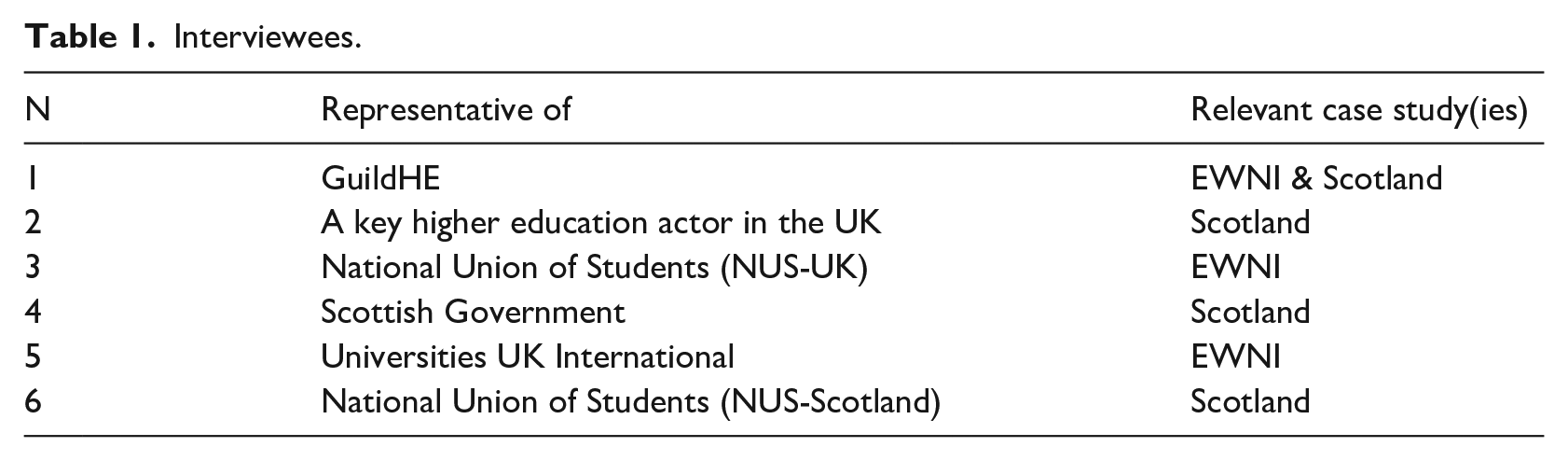
A non-probability opportunistic/snowball sample of six participants for online in-depth semi-structured interviews between January and March 2021 was recruited, targeting representatives from a range of key HE actors – or stakeholders, in other words – listed on the EHEA website for EWNI and Scotland (EHEA, 2021e, 2021f). Initial contacts with all organisations listed on the EHEA website were made via the contact information provided. Table 1 below details which actors were represented in the interviews for the participants who were happy to share their affiliation. An unexpected paradox was also found out in relation to a couple of organisations that rejected the invitation. Despite being listed on the EHEA website as key actors, they stated they did not deal directly with the Bologna Process, and thus, could not contribute an interview. This lack of engagement of some actors resonates with the ideas presented in the literature review in the previous section.
Interviewees.
Supplementary data was collected by searching for official communications of all policy actors mentioned on the EHEA website for EWNI and Scotland (see Table 2 below), not just the six actors represented in the interviews. The keywords ‘Bologna’, ‘European Higher Education Area’, ‘EHEA’, ‘European Union’ and ‘Brexit’ were used when searching their official websites. Communications were selected on the basis that they contained one or more of the key words. Some of the stakeholder websites did not return any results. This may be explained by the lack of their involvement with Bologna, as some of these actors explained in their e-mails in response to interview invitations, as explained above. The search has produced a total of 19 communications (see Appendix). The selected official communications can be categorised into five main types: two national policy documents, two speeches delivered by government ministers, 11 stakeholders’ policy documents, three blog posts on stakeholders’ websites and one lecture delivered by a stakeholder.
Stakeholders listed on the EHEA website.
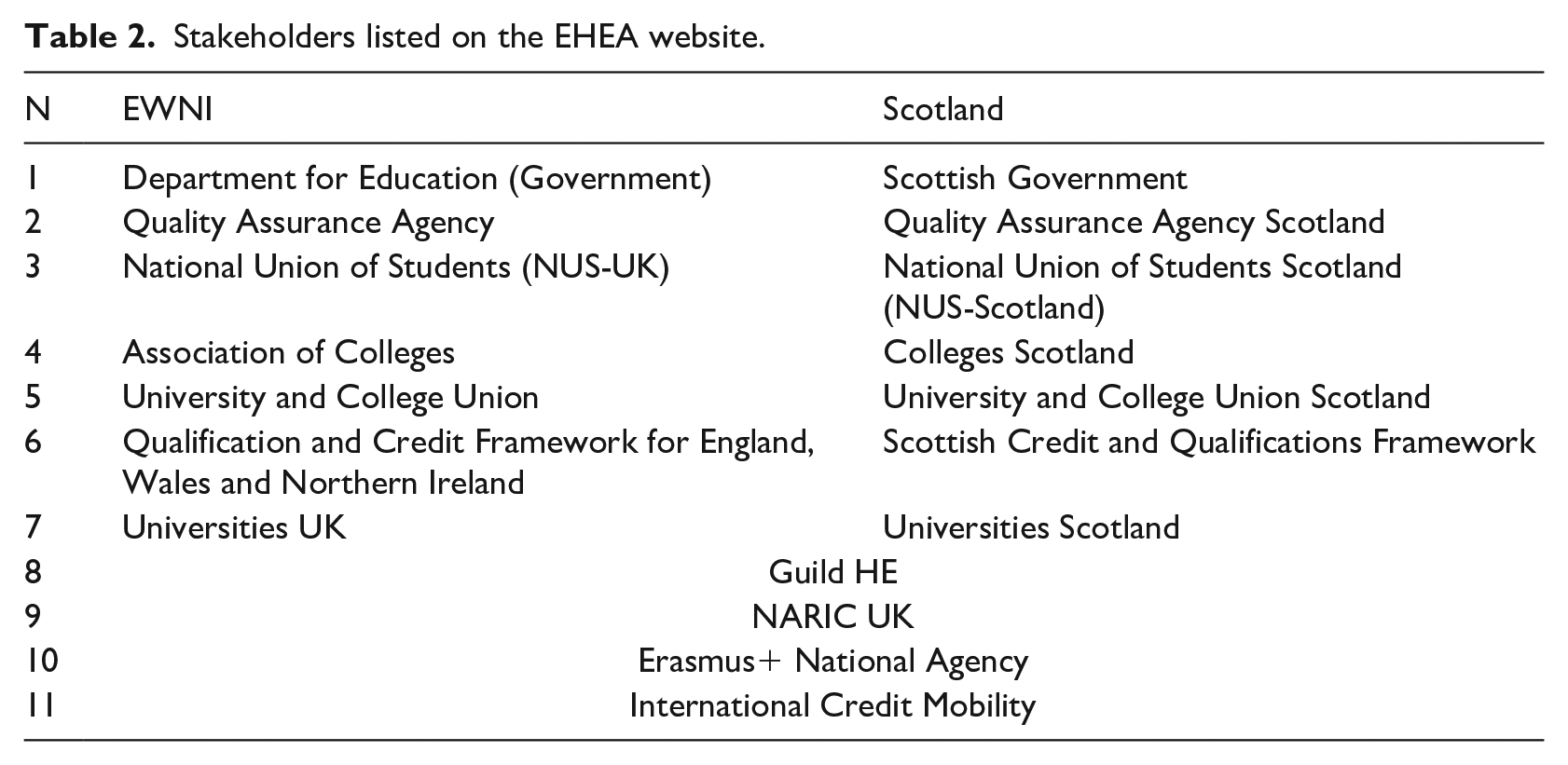
Seventeen out of the 19 selected communications relate to both EWNI and Scotland, 1 – only to EWNI (specifically England), and 1 – Scotland only. The criteria used to decipher whether communications were classified as EWNI or Scotland only, or EWNI and Scotland, depended on the origin of the document and careful consideration of the terminology used within them. As previously mentioned, the terminology to define the geopolitical sections of the UK is complex, and consideration was taken here to ensure accurate classification. It is worth pointing out a close relationship between some EWNI and Scottish actors (e.g. NUS-UK for EWNI and NUS-Scotland for Scotland) as well as the cases of the same organisations representing both EWNI and Scotland (e.g. GuildHE). This is part of the answer to why some documents issued by the actors that are listed as EWNI actors on the EHEA website (EHEA, 2021e) are relevant to Scotland as well and vice versa.
The interviews were transcribed with the help of a transcription company, using the edited transcript type. They were analysed thematically in NVivo, along with the official communications. The analysis followed Rubin and Rubin’s (2012) guide for open and axial coding of themes. The open coding was guided by the conceptual framework outlined earlier and illustrated by a list of relevant quotations from the data. The emerging/preliminary themes were identified through both inductive and deductive approaches: some were identified from the existing literature, and some emerged during the analysis of the data. The initial stage of the open coding was conducted on the interviews and the main policy document (Department for Education [DfE], 2021) and involved identifying the emerging/preliminary themes and following the identification of these themes and their regrouping and finalisation. The second stage of the open coding involved integrating the website information into these same codes/themes. The themes were regrouped in the axial coding and the final super-ordinate themes were identified.
Anonymised data was secured in Nottingham Trent University (UK) DataStore for the duration of the project. Following the completion of data analysis, interview recordings were destroyed, and anonymised interview transcripts were archived into Nottingham Trent University (UK) data repository where they will be stored for 10 years, according to Nottingham Trent University (UK) Records Retention Schedule.
(Heterogeneous) Europeanisation agenda in UK HE through the EHEA memberships
This section contains key findings from the thematic analysis of the interviews and stakeholder official communications, presenting both case studies – EWNI and Scotland – and discussing them as an example of heterogeneous Europeanisation in UK HE which is deliberate and rational. The first two sub-sections below report research findings, exemplifying them with illustrative quotes, prior to the final sub-section analysing these findings in light of the literature and theory.
Rational-choice neo-institutionalism has enabled us to see the nuances of the difference in opportunities provided by UK EHEA memberships that domestic interest groups choose to pursue post-2020. Scotland has embraced specifically Europeanisation opportunities in HE through its EHEA membership, while EWNI have alluded mainly to wider internationalisation ideas that EHEA membership offers, albeit still holding on to EHEA neoliberal offerings which are associated with Ward et al.’s (2019: 123) idea of ‘neoliberal Europeanisation’. Such divergence in external orientations of EWNI and Scotland through the same type of activity – EHEA membership – was expected, given the already existing divergence in the wider education externalisation discourses in the UK in the past, as explicated by Grek and Ozga (2009: 937): ‘policy-makers in England reference global influences, rather than Europe, while policy-makers in Scotland reference Europe in order to project a new positioning of Scotland in closer alignment with Europe’. Additionally, the fact of two separate memberships of the EHEA in the UK strengthened such expectations.
What is striking is the findings about each of the case studies which are quite nuanced and significant for the scholarship about Bologna in the UK on multiple levels. First of all, they highlight the significantly under-emphasised distinction between the dual membership of EWNI and Scotland in Bologna which has passed the 2020 mark and is ongoingly influential in constructing two different trajectories in UK’s overarching agenda in HE with regard to the outward look. The findings also explicate EWNI and Scotland’s reasons for maintaining their EHEA memberships specifically in the post-Brexit climate and the fact that Europeanisation has not vanished with Brexit in this context in the UK.
EWNI’s case
The data highlight the role of EHEA membership as a tactics of internationalisation for EWNI, and that the EWNI’s membership of EHEA is distinctly different from the membership of Scotland. Although the Europeanisation discourse is not completely absent within the interviewees’ responses, this discourse is largely silenced, with the focus on internationalisation more generally. More specifically, Europeanisation is presented as a form of internationalisation. The membership of the EHEA in the EWNI’s internationalisation agenda is complex, and the extent to which the UK is adhering to an internationalisation strategy can be disputed. Interestingly, the 2021 International Education Strategy makes no reference to the EHEA or Bologna Process, despite the EHEA being a key component of internationalisation in HE (DfE, 2021). The focus on internationalisation as the overarching agenda suggests a movement away from Europeanisation per se.
The data suggest that the purpose of EHEA membership post-2020 has notably changed, and the importance of seeming to remain within Europe as a geopolitical space, despite leaving the EU which is a politico-economic union, is evident: “However, at a time where we were leaving the European Union, it was important to make the point that we weren’t leaving Europe”. (P1)
However, the importance of remaining within Europe is mainly incentivised through neoliberal motivations. Despite the fact of formally initiating the development of the EHEA, the EWNI’s membership pre-Brexit was more of a passive-driver role: EWNI exercised limited engagement with the processes unless there was a need for involvement. For example, the EHEA’s discussion over extending the length of Master’s programmes to 2 years led to EWNI engagement to successfully oppose and prevent the proposition becoming policy. To remind, a group of scholars has already shed light on the ignoring of the Bologna agenda and going to the extreme of England and Wales perceiving EHEA membership as a potential bureaucratic and top-down enforcement threat (Marquand, 2018; Sin, 2012; Sin and Saunders, 2014).
Such an attitude to Bologna pre-2020 does not mean complete inactivity in Bologna on the EWNI’s part. A notable example of this was the 2007 Bologna ministerial conference that took place in London. Hosts always make a contribution to the agenda of the conference, so the task undertaken was certainly not just a technical one. However, while the conference took place on the ‘territory’ of EWNI, at least one of the three members of the rotating Secretariat to the international Bologna Follow Up Group – at the time (1 July 2005–30 June 2007) – was Ann McVie representing Scotland (EHEA, 2021g). This suggests that EWNI and Scotland cooperated in the run-up to the conference and, likely, its organisation as well.
Remarks about EWNI’s limited engagement with the Bologna Process, that existed prior to 2020, are also present in interviewees’ responses particularly about the EWNI membership post-2020. For example, P2 describes the EWNI’s attitude as ‘standoffish’, explaining that EWNI should remain part of the EHEA as long as the practices within the EHEA do not start diverging from the UK system too much, and that leaving the EU proves that leaving any other inconvenient partnership would not trigger a lot of hesitation.
Post-2020, the EWNI’s membership has adapted to become more of an observer/consumer, while aspiring to keep working with international partners particularly in the areas of student mobility (P1, P3), HE digitalisation (P1, P5), academic freedom (P5). Notably, EWNI strive for maintaining their external influence and utilising membership of the EHEA as an indispensable facilitator of its wider internationalisation policy and marketisation agenda. But the EWNI’s membership is more nuanced than purely observational. The role of the EWNI’s membership in the EHEA being utilised as a means to maintain external influence within the EHEA as well as globally is also articulated: “I think we’ve always tried to use our engagement with the Bologna process as a way of influencing them, rather than them influencing us”. (P1)
The significance of the BP action lines also arose in the responses, along with references to the importance of the UK maintaining its influence internationally through standardisation: “I think it’s part of a de-Europeanisation. That’s the thing I’m wary of. But if the UK is serious about maintaining its reputation and standards, then it needs, I think, to join in with some of those EHEA international aspirations as well. Because if it’s talking about global Britain, then EHEA is also reaching out and developing these links across the globe”. (P3)
This suggests the use of internationalisation as an alternative to Europeanisation, which is also traced in the discussions with P2, P3 and P6 about the plan for the Turing scheme for student mobility: “They say they want global Britain and a global influence in higher education, and they want students to study anywhere globally. There is a suspicion that studying anywhere globally means anywhere but Europe and probably English-speaking former Empire, but that’s just my opinion”. (P3)
Contrasting to this opinion, the stakeholder information analysed, and the government policies, highlight the importance of outward student mobility to Europe and beyond, underpinned by economic incentives (see, e.g. the UUK’s toolkit to support widening participation in the UK through outward student mobility (Appendix: N9)). This further evidences the global internationalisation agenda of EWNI, not just in recruiting international students, but also pressing for mobility of native students globally. Europeanisation is not an intentional product of the EWNI’s engagement with EHEA, but rather a by-product of it, the interest being primarily to promote internationalisation, founded on economic intentions.
In addition to the observational role EWNI play in its EHEA membership, EWNI also play the role of a consumer. The economic incentives and marketisation of education remain evident incentives for engagement with the EHEA and BP which is in line with Ward et al.’s (2019: 123) proposition that the overall UK’s economic trajectory in relation to anything related to Europe should be called ‘Neoliberal Europeanisation’. Indeed, marketisation remains pervasive in EWNI, and the role of student mobility within this marketisation discourse was a focal point in the data collected, as well as the economic incentives of continued membership. The two quotes below illustrate such views and the contrast between EWNI and Scotland, the latter case being unpacked in more detailed in the next sub-section: “So essentially as long as they maintain their competitive market, that advantage, the UK [EWNI] will continue to do it the way it does it. And align where it needs to, or to be seen to aligning”. (P1) “I think it’s just that their [in England as part of EWNI] market view of education, where you buy it like a consumer, rather than it being a public good. . .The survival of the fittest. The best universities will survive, the weakest ones will go under. And that’s a good thing. Whereas you won’t find that attitude in Scotland, Wales, and Northern Ireland”. (P2)
The last quotation also brings to the forefront the complexity of the relationship among the three parts within EWNI which is exacerbated by the driving role of England in the EWNI membership. This as well as the steering away from the European ties that may be avoided is most apparent in the recent debate about HE quality: “. . .the Office for Students [OFS – a public body of the DfE] has, just before Christmas [2020], put out a consultation on the future of quality. And in it, it said that they would no longer abide by, what’s called, the UK Quality Code. . . So, there’s a UK Quality Code, that, in turn, is based on what’s called the European Standards and Guidelines. And the EHEA says, to be a member, you have to comply with the European Standards and Guidelines. So, in other words, if OFS don’t do that, it calls into question England’s membership of the EHEA. Now, they would find a way around it, I’m sure, but it does create a tension that didn’t exist up until this point. But Scotland, Wales, and Northern Ireland. . . are fully compliant with the European Standards and Guidelines”. (P2)
P2 further explains the seeming first traces of the redrafting of the ‘boundaries’ between the two EHEA members with regard to quality assurance: “The reason for putting Scotland, Wales, and Northern Ireland together is that, increasingly, the Celtic nations take one view of quality in higher education, and England is taking a slightly different view. . . In what we call the Nations, so Scotland, Northern Ireland, and Wales, there would be an outward-looking enhancement-focused view of quality. In other words, it’s not just about saying someone is good or bad or against a basic set of measures. We’re actually trying to say how can we make it better for everyone all the time. . . In England, with the Office for Students, there is a baseline set of regulations to get on the register, and you either comply or you don’t comply. . . Whereas in the Nations, that’s the opposite, we believe that that’s not enough. You need to help people to improve”. (P2)
These emerging differences within EWNI, and similarities between some of its parts and Scotland demonstrate the ever-evolving nature of EHEA memberships. The future will witness whether, and if so, to what the extent these differences will get institutionalised and influence the configuration of UK’s dual membership in the EHEA. The presentation of the data about EWNI above has already made some references to Scotland for the purpose of immediate contrast. A more detailed presentation of the case of Scotland follows below.
Scotland’s case
Scotland’s separate membership of the EHEA demonstrates the wider distinction between the two members’ engagement with Bologna, and the strategies and agendas at play in their respective territories, acknowledged by all participants. For instance, “Clearly, the fact that the Scottish Minister, and Scotland is a separate member of the process, sends their own separate delegation to Ministerial Summits, is indicative of the different way in which different parts of the UK have engaged with Bologna”. (P1)
Unlike EWNI, Scotland is much more enthusiastic about its membership in the EHEA and is expected by the participants of this research project to be actively engaged in its initiatives post-2020: “. . .the Scots have always loved Bologna. They’ve always wanted to be very engaged with it. They hate the fact that we left the European Union, therefore I can imagine them wanting to get even more engaged in the future” (P1)
The foundation for this enthusiasm was laid in the past, with Scotland demonstrating more active engagement in the implementation of the Bologna action points, such as the ECTS analysed in Birtwistle’s (2009) work. Particular areas of interest for Scotland’s membership in the EHEA post-2020 are more nuanced than those of EWNI, presented earlier: “. . .things around digitalisation, the social dimension, sustainability, how to raise awareness of these issues, and how to develop a common framework that people can look to when addressing these issues. . . Particularly sustainability and widening access, they’re really key for our government, so we’ll be interested to see what others are doing in that space. And being part of the EHEA helps us with that”. (P4)
P2 adds quality assurance as a priority for the future, too. In addition, or better to say, something that serves as an umbrella motivation for Scotland to continue its membership in the EHEA onwards are the intertwined ideological and economic incentives. Firstly, Scotland relies on the EHEA for international student recruitment and fears of undermining, or losing, this link sustains ongoing engagement with its processes. Incentivised by this context, Scotland is seeking to negotiate access to the Erasmus scheme, as an important facilitator of student international mobility, now that the UK has withdrawn from the EU without continued access to the scheme: “Scotland’s higher education institutes have the greatest proportional number of European staff and students there than the rest of the UK. . . We said to the UK government during the Brexit negotiations, if you decide not to be part of Erasmus, will you still look at negotiating access for Scotland to be part of Erasmus?.. The UK government refused to negotiate on our behalf. . . the Scottish government has since spoken to the European Commission. There has been a lot of support from MEPs within the European Parliament”. (P4)
This economic incentive seems to be very much intertwined with the second related point. The UK’s exit from the EU has resulted in the increasing significance of Scotland’s membership of the EHEA as a form of engagement with the EU specifically and Europe more widely and a token of their active engagement with the EHEA (and therefore Europe) is demonstrative of Scotland distancing themselves from EWNI, and favouring Europeanisation: “. . . by also engaging more with the European Higher Education area, actually they [Scotland] are able to distance themselves a little bit from the UK [EWNI] area”. (P1)
The established student market from the EU, emphasised in the previous point, seems to be valued in Scotland not just for its economic reward but also for its connection specifically to the European. In contrast to EWNI, Scotland’s membership is indicative of a specific Europeanisation agenda in HE as well as a wider agenda of Europeanisation, as a distinct form of internationalisation:
“. . .the Scottish higher education system is distinctly European, in a way that the UK system is perhaps not as much. . . the EHEA is a way for us to maintain that European connection. We. . . have a fear or a concern being outside of the EU. . . Being in the EHEA, while it’s not the same as that [the EU], it does provide a bit of a link” (P4)
Membership of the EHEA acts now as more of a symbol of Europeanisation in Scotland and continued active engagement in the process is a manifestation of seeking Europeanisation in HE and beyond. The Europeanisation in Scotland through the EHEA after 2020 emerges as a symbol of declaring its different stance from the rest of the UK in developing its HE and other policy areas in the country with a tight link to the European continent.
Within the national policy and the EWNI stakeholder documentation, there is a silencing of Scotland’s separate membership (see, for instance, the International Education Strategy and its claim to represent all devolved nations in the UK (DfE, 2021)). The complexities of the separate seats are largely omitted, or the justification for the separate seats is suggested to be due to Scotland’s separate qualification system and other different aspects of its HE, and not because Scotland intrinsically seeks to have a more active role in the EHEA and is striving for Europeanisation. This seems to be not new in HE documents in the UK as the lack of detail around the emergence of the dual membership and how it has evolved, particularly at the start, is evident, as explained in the introduction. The EWNI’s passive membership of the EHEA and their limited engagement has contributed to a perception that the EHEA and the Bologna Process has fulfilled its purpose: “But it’s interesting that nowadays, whereas historically you would have had higher education institutions in general be very involved with the Bologna Process when it was fresh and when it was driving the mutual recognition of qualifications across Europe, now that that is quote, unquote, done, lots of people within the higher education sector assume that the Bologna Process has fulfilled its remit”. (P4)
Europeanisation associated with the EHEA in the UK post-2020
Having presented main findings from both case studies, it is timely to discuss them more in dialogue with the theoretical and empirical literature on the topic. The EWNI and Scottish cases above have evidenced the deliberate and rational approach of relevant stakeholders to continuing EHEA memberships, shaping their behaviours as members in a particular way to be able to draw certain benefits. In Graziano and Vink’s (2017) terms, both EHEA memberships of the UK can be seen as a resource that enables all devolved nations of the UK to participate in a form of Europeanisation in HE post-Brexit with the aim to draw economic benefits as well as power enhancement and other ideological and political gains.
The rational-choice neo-institutionalist lens has enabled us to see these persisting opportunities provided by UK EHEA memberships and, in Graziano and Vink’s (2017: 40) terms, resulting ‘strategic organizational adaptation displayed by interest groups. . .when domestic political actors ‘rationally’ use European resources in order to support predefined preferences’. Such predefined preferences turned out to be quite different for both UK members of the EHEA.
Our interest was in tracing the meaning of the form(s) of Europeanisation in a very unique case – one of a kind – the country which was part of the EU but is now outside the EU which is, arguably, the source of Europeanisation as that is where Europeanisation originated (Kushnir et al., 2020). Europeanisation in Scotland appears to be a regional form of internationalisation, focussed on European values and principles, which is in line with Kehm’s (2003) ideas about regionalisation. In contrast, Europeanisation in EWNI seems to be happening more in the form of internationalisation, meaning it is focussed on the global arena where the specific Europeanisation motives are pushed to the background. Europeanisation in the case of the EWNI’s EHEA membership is covert internationalisation. Clearly, this is a trend preserved from a decade ago when Grek and Ozga (2009) explicated how policymakers in Scotland referred to European matters more while those in England used more references to the global arena.
The findings from both cases studies partly support the literature detailing the lack of interest of England in Bologna, such as Furlong (2005), Sin (2012), Sin and Saunders (2014) and Marquand (2018). However, this holds ground only in terms of active efforts to reform HE in response to EHEA calls, as indeed, EWNI seems to have confidence in its HE self-sustainability. On a broader scale, EWNI is interested in Bologna largely because the membership offers a chance to exert power and external influence, ironically, by its often passive presence in the EHEA. This ambition of power and influence, arguably, stems back to the imperialist past which has found a lot of other expressions in the present days, as explicated by Ritter (2021). In light of this, the dis-interest discussed in the literature may, in fact, be interpreted as a rational choice of this specific behaviour to manifest the exact relationship that has been formed between EWNI and the EHEA. Europeanisation is exercised by EWNI in a technical way, by choosing to continue to belong to a European Higher Education Area to feed its wider internationalisation agenda. The peculiarity of such EWNI’s post-2020 Europeanisation is not so much about aspiring to assimilate under pre-established common benchmarks but rather to dictate them to others.
Scotland’s membership, contrastingly, is driven by a strong interest in the affiliation and cooperation with the EHEA. It seems to experience a more insecure position in this respect than EWNI, certainly not resembling the EWNI’s post-imperialist stance, driven by England. Scotland’s aspirations to continue Europeanisation post-2020 through its EHEA membership are an attempt to mend the damages caused by Brexit in the overall UK-EU relationship, while recognising that the EHEA is a broader endeavour than the EU.
Both case studies have demonstrated a strong link between the nature of Europeanisation in HE and similar aspirations beyond HE. The divergent motivations for continuing EHEA memberships, arguably, drive UK’s differentiated Europeanisation in HE, with each member steering it in its own direction. While this specific configuration of nations and their Europeanisation associated with the EHEA memberships has not been researched, the idea of differentiated Europeanisation in the UK falls in the same realm as the wider discussions of the co-existence of Euro-sceptic and pro-European views in the UK (Crescenzi et al.’s, 2018; Fletcher, 2009). Moreover, these are not just the two polarised types of views present in the UK when it comes EHEA-related Europeanisation, but rather each of them is tightly associated with a particular EHEA member – that is, Scotland being pro-European and EWNI being Euro-sceptic. Similar divided sentiments between Scotland and at least England also feature in the literature on Europeanisation in the UK pre-Brexit (Hepburn, 2006; Stolz, 2020).
Nevertheless, these matters regarding EHEA memberships are not as black and white as they may seem. The complexity of the differentiated Europeanisation in the UK is in partial convergence of the EWNI and Scotland’s motives to be in the EHEA when it comes to HE marketisation as well as the complexities stemming from the plans for the future of HE quality assurance in all devolved nations.
While the findings presented earlier evidence that market forces incentivise continued EHEA membership in both cases, a large body of literature on the BP explain, in one way or another, that Bologna is a neoliberalist endeavour. This body of literature encapsulates both the drawbacks brought about by neoliberalism as well as the rewards for those who have learned how to compete (e.g. Lucas, 2019; Lundbye-Cone, 2018). Clearly, potential benefits offered by the ‘neoliberal cholera’ in the EHEA (Lundbye-Cone, 2018: 1022) has not left the UK indifferent. It has been taking care of the ‘UK brand of higher education’ (P2), sustaining a ‘neoliberal Europeanisation’ (Ward et al., 2019: 123). However, again, EWNI seem to have developed a more secure position regarding, for instance, student recruitment from the EHEA as it is confident that the benefits of the Erasmus Program can be replaced by the new Turing scheme which offers a broader – global – pool of prospective students. Scotland, on the other hand, remains devoted to the EHEA student market and is fearful of losing established structures and associated ideological ties. The complexity of the differentiated Europeanisation in the UK was also demonstrated by the findings about HE quality assurance in different parts of the UK. These actions and plans have started shifting the ‘boundary’ between the two members with regards to quality assurance: England on one hand and Scotland, Wales and Northern Ireland on the other hand. Future implications of this shift form an area of interest for further research.
Although the changes and resulting uncertainties that Brexit brought about have put the continuation of Europeanisation in the post-Brexit UK into question, this paper showcases the role of UK’s EHEA memberships in sustaining Europeanisation post-2020, albeit in very peculiar forms. These also seems to be a very strong link between the nature of Europeanisation in HE and beyond.
The discussion above contributes to filling in a significant gap in the literature about Bologna in the UK in making a distinction between its two memberships in the EHEA and the differences and complexities of the roles they play in constructing UK’s overarching agenda in HE particularly in the post-Brexit context. The article has also contributed to the literature about the Bologna Process and Europeanisation more widely, presenting an investigation into differentiated Europeanisation that has been taking place within one unique post-EU country, rather than among a range of countries which has been a common approach to studying differentiated Europeanisation to date.
Conclusion
The data presented in this paper have shed light on the perspectives of key UK HE actors on the significance of UK’s memberships in the EHEA post-2020 for the UK and revealed that this is significant for UK’s post-Brexit Europeanisation. While the prime focus of the paper has been specifically on HE, the analysis could not have overlooked the question of a wider Europeanisation agenda in the UK after the end of the Brexit transitional period.
Education on all levels, including HE, is never neutral – it is always political (Marshall and Scribner, 1991). There is a mutual shaping relationship between HE and the politico-ideological context in which it operates. This means that the nature of Europeanisation in HE in both UK’s EHEA members is interconnected with the nature of a wider Europeanisation in the UK that unfolds beyond the boundaries of HE. HE developments and relevant policy choices made by stakeholders encapsulate wider politics that permeate all areas of life. These choices are a product of the wider context. While we assume policy-making choices are rational and free, they are shaped and, one may argue, constrained by the dominant political positions. While this, on its own, can lead us into a theoretical debate about rational choice in policy-making that has existed for decades (Freeman, 2006), what is more important to emphasise here is that not only is UK HE agenda(s) wrought by wider politics but incremental changes in UK HE have the potential to contribute to shaping the future of UK politics of Europeanisation and the future of the UK national state.
The paper has revealed the different rationales that the HE actors in EWNI and Scotland have for continuing their EHEA memberships, which are by default associated with (HE) Europeanisation since the EHEA has been a platform for Europeanisation (Corbett, 2011). These different rationales for Europeanisation in HE and beyond in the two members showcase the persistent development of divergence in political orientations in what is not just the two members of the EHEA, but more importantly, the parts of a devolved, but still one, country. Although Brexit has been delivered, UK’s Europeanisation story is ongoing. The divergent paths in relation to this story within the UK, illuminated by the example of different roles of the EHEA memberships, are not purely technical – such as being attributed to Scotland’s length of the Bachelor’s programmes, etc. The way these divergent paths in Europeanisation develop are likely to contribute to determining the nature of the relationship among different parts of the UK and the future of the UK nation state. So, the rational in future-oriented policy-making should focus on fledgeling unity in the Europeanisation story, which has proven to be capable of becoming a platform of divorce if opposing opinions raise. HE, as a political endeavour, is a place to nurture ways for this unity, which are for future researchers to investigate without much delay.
Footnotes
Appendix
List of official communications.
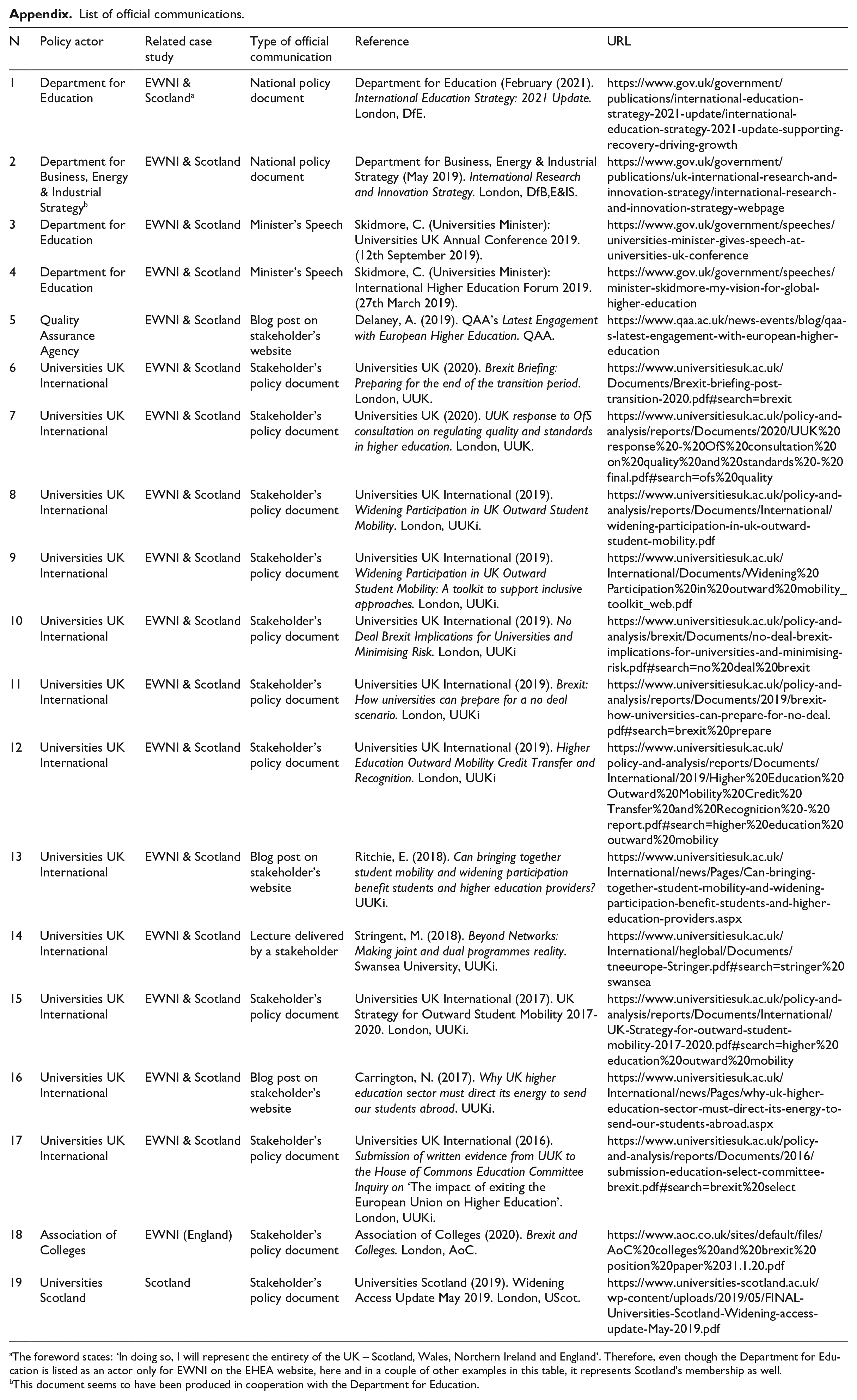
| N | Policy actor | Related case study | Type of official communication | Reference | URL |
|---|---|---|---|---|---|
| 1 | Department for Education | EWNI & Scotland a | National policy document | Department for Education (February (2021). International Education Strategy: 2021 Update. London, DfE. | https://www.gov.uk/government/publications/international-education-strategy-2021-update/international-education-strategy-2021-update-supporting-recovery-driving-growth |
| 2 | Department for Business, Energy & Industrial Strategy b | EWNI & Scotland | National policy document | Department for Business, Energy & Industrial Strategy (May 2019). International Research and Innovation Strategy. London, DfB,E&IS. | https://www.gov.uk/government/publications/uk-international-research-and-innovation-strategy/international-research-and-innovation-strategy-webpage |
| 3 | Department for Education | EWNI & Scotland | Minister’s Speech | Skidmore, C. (Universities Minister): Universities UK Annual Conference 2019. (12th September 2019). | https://www.gov.uk/government/speeches/universities-minister-gives-speech-at-universities-uk-conference |
| 4 | Department for Education | EWNI & Scotland | Minister’s Speech | Skidmore, C. (Universities Minister): International Higher Education Forum 2019. (27th March 2019). | https://www.gov.uk/government/speeches/minister-skidmore-my-vision-for-global-higher-education |
| 5 | Quality Assurance Agency | EWNI & Scotland | Blog post on stakeholder’s website | Delaney, A. (2019). QAA’s Latest Engagement with European Higher Education. QAA. | https://www.qaa.ac.uk/news-events/blog/qaa-s-latest-engagement-with-european-higher-education |
| 6 | Universities UK International | EWNI & Scotland | Stakeholder’s policy document | Universities UK (2020). Brexit Briefing: Preparing for the end of the transition period. London, UUK. | https://www.universitiesuk.ac.uk/Documents/Brexit-briefing-post-transition-2020.pdf#search=brexit |
| 7 | Universities UK International | EWNI & Scotland | Stakeholder’s policy document | Universities UK (2020). UUK response to OfS consultation on regulating quality and standards in higher education. London, UUK. | https://www.universitiesuk.ac.uk/policy-and-analysis/reports/Documents/2020/UUK%20response%20-%20OfS%20consultation%20on%20quality%20and%20standards%20-%20final.pdf#search=ofs%20quality |
| 8 | Universities UK International | EWNI & Scotland | Stakeholder’s policy document | Universities UK International (2019). Widening Participation in UK Outward Student Mobility. London, UUKi. | https://www.universitiesuk.ac.uk/policy-and-analysis/reports/Documents/International/widening-participation-in-uk-outward-student-mobility.pdf |
| 9 | Universities UK International | EWNI & Scotland | Stakeholder’s policy document | Universities UK International (2019). Widening Participation in UK Outward Student Mobility: A toolkit to support inclusive approaches. London, UUKi. | https://www.universitiesuk.ac.uk/International/Documents/Widening%20Participation%20in%20outward%20mobility_toolkit_web.pdf |
| 10 | Universities UK International | EWNI & Scotland | Stakeholder’s policy document | Universities UK International (2019). No Deal Brexit Implications for Universities and Minimising Risk. London, UUKi | https://www.universitiesuk.ac.uk/policy-and-analysis/brexit/Documents/no-deal-brexit-implications-for-universities-and-minimising-risk.pdf#search=no%20deal%20brexit |
| 11 | Universities UK International | EWNI & Scotland | Stakeholder’s policy document | Universities UK International (2019). Brexit: How universities can prepare for a no deal scenario. London, UUKi | https://www.universitiesuk.ac.uk/policy-and-analysis/reports/Documents/2019/brexit-how-universities-can-prepare-for-no-deal.pdf#search=brexit%20prepare |
| 12 | Universities UK International | EWNI & Scotland | Stakeholder’s policy document | Universities UK International (2019). Higher Education Outward Mobility Credit Transfer and Recognition. London, UUKi | https://www.universitiesuk.ac.uk/policy-and-analysis/reports/Documents/International/2019/Higher%20Education%20Outward%20Mobility%20Credit%20Transfer%20and%20Recognition%20-%20report.pdf#search=higher%20education%20outward%20mobility |
| 13 | Universities UK International | EWNI & Scotland | Blog post on stakeholder’s website | Ritchie, E. (2018). Can bringing together student mobility and widening participation benefit students and higher education providers? UUKi. | https://www.universitiesuk.ac.uk/International/news/Pages/Can-bringing-together-student-mobility-and-widening-participation-benefit-students-and-higher-education-providers.aspx |
| 14 | Universities UK International | EWNI & Scotland | Lecture delivered by a stakeholder | Stringent, M. (2018). Beyond Networks: Making joint and dual programmes reality. Swansea University, UUKi. | https://www.universitiesuk.ac.uk/International/heglobal/Documents/tneeurope-Stringer.pdf#search=stringer%20swansea |
| 15 | Universities UK International | EWNI & Scotland | Stakeholder’s policy document | Universities UK International (2017). UK Strategy for Outward Student Mobility 2017-2020. London, UUKi. | https://www.universitiesuk.ac.uk/policy-and-analysis/reports/Documents/International/UK-Strategy-for-outward-student-mobility-2017-2020.pdf#search=higher%20education%20outward%20mobility |
| 16 | Universities UK International | EWNI & Scotland | Blog post on stakeholder’s website | Carrington, N. (2017). Why UK higher education sector must direct its energy to send our students abroad. UUKi. | https://www.universitiesuk.ac.uk/International/news/Pages/why-uk-higher-education-sector-must-direct-its-energy-to-send-our-students-abroad.aspx |
| 17 | Universities UK International | EWNI & Scotland | Stakeholder’s policy document | Universities UK International (2016). Submission of written evidence from UUK to the House of Commons Education Committee Inquiry on ‘The impact of exiting the European Union on Higher Education’. London, UUKi. | https://www.universitiesuk.ac.uk/policy-and-analysis/reports/Documents/2016/submission-education-select-committee-brexit.pdf#search=brexit%20select |
| 18 | Association of Colleges | EWNI (England) | Stakeholder’s policy document | Association of Colleges (2020). Brexit and Colleges. London, AoC. | https://www.aoc.co.uk/sites/default/files/AoC%20colleges%20and%20brexit%20position%20paper%2031.1.20.pdf |
| 19 | Universities Scotland | Scotland | Stakeholder’s policy document | Universities Scotland (2019). Widening Access Update May 2019. London, UScot. | https://www.universities-scotland.ac.uk/wp-content/uploads/2019/05/FINAL-Universities-Scotland-Widening-access-update-May-2019.pdf |
The foreword states: ‘In doing so, I will represent the entirety of the UK – Scotland, Wales, Northern Ireland and England’. Therefore, even though the Department for Education is listed as an actor only for EWNI on the EHEA website, here and in a couple of other examples in this table, it represents Scotland’s membership as well.
This document seems to have been produced in cooperation with the Department for Education.
Data access statement

Declaration of conflicting interests
The author(s) declared no potential conflicts of interest with respect to the research, authorship, and/or publication of this article.
Funding
Iryna Kushnir received funding for this research from Research England awarded through Nottingham Trent University Quality Research scheme.