




Abstract
Higher education in Central Europe has been scrutinised from many different perspectives during the last 30 years. In our analysis, we focus solely on Hungary and specifically on two key areas: governance and organisational structure. Using an analytical model proposed by Leisyte (2014), we analyse how the governance and organisational structure of institutions have changed between 1985 and 2015, and consider what the driving forces might be behind these changes. Through our analysis, we found that the pendulum effect observed in organisational culture and leadership in Eastern Europe (Bakacsi, 2014) in periods of transition could also be identified in the governance models in Hungary. Despite evidence of a convergence of higher education policies in Bulgaria, Romania, Poland and the Czech Republic (Dobbins, 2011) towards the market-type model of higher education governance, we found that in Hungary the model is much more state-controlled and there is already an apparent move away from foreign-inspired ideals and models. It is suggested that Hungary is ahead of the apparent trend in other countries where they have yet to experience a swing in the opposite direction.
Introduction
Higher education in Europe has changed considerably over the last 30 years. Changes such as internationalisation and globalisation, technological development, new knowledge producers and the transformation of institutions into capital producers have all led to the increasing complexity of higher education. Higher education now has to face what Barnett refers to as a ‘supercomplex’ situation going beyond increasing demands with limited resources and involving the selection of narrative frameworks as well, since ‘we can no longer be sure as to which framework we are to inhabit’ (Barnett, 2000: 415). All of these changes have resulted in a continuous reform of governance and funding: the rise and reconsideration of ‘evaluative state’ (Neave, 1998), ‘steering from distance’ (De Boer et al., 2006), and the ‘new public management’ movement (Broucker et al., 2015). Complexity is further enhanced by variations affecting institutional autonomy and accountability, tuition fees, and output- and performance-based allocation mechanisms, to name but a few.
One notable attribute of post-socialist countries is the apparent bottleneck for these developments. While these processes took place gradually in Western European countries from the 1980s onwards, in post-socialist countries all the reforms started simultaneously after the change of regime (within considerably unstable legal and normative frameworks). Although post-socialist higher education systems have different roots, communism standardised them. The resulting Soviet system can be considered an extreme version of the Napoleonic model (Charle, 2003; Karády, 2005). This model has the following characteristics: a strong focus on practical needs and professional training; the separation of teaching and research; highly specialised institutions; a low level of institutional autonomy; state-funded and state-controlled enrolment; and elite higher education, with only a small percentage of the relevant age cohort attaining higher education (Kwiek, 2014).
After the change of regime, the allure of European integration put many post-socialist countries on a similar path, even if the pace of change was different in some countries (Dobbins and Knill, 2009; Leisyte, 2014). Referring to this common path, Scott (2006) aptly commented that ‘even after communism ceased to exist, it continued to promote homogeneity’ (Scott, 2006: 430). Later on, however, the consonance of post-socialist countries started to gradually disappear because of different historical traditions (Leisyte, 2014) or differences in political development. This is evident in the case of Hungary, which for a long time followed a similar path to countries of similar Humboldtian roots, such as the Czech Republic or Poland, but changed course after the ‘illiberal’ U-turn that was taken in 2010.
In this article, we would like to analyse the changes in external and internal governance structures – as well as organisational structures – over the last 30 years in Hungary. The external governance structure refers to the relationship between the state, various other external stakeholders and the institution. Internal governance refers to the decision-making structure of institutions and the involvement of internal stakeholders (Eurydice, 2008).
While there is plenty of comparative research on university governance (e.g. De Boer et al., 2010a; Dobbins and Knill, 2009; Estermann and Nokkala, 2009; Estermann et al., 2011; Eurydice, 2008), the literature and research concerning the organisational structure of higher education institutions (HEIs) in general is sparse, with just a few exceptions (Lombardi et al., 2002; Taylor, 2006). Organisational structure describes the division of work and spheres of authority among different academic and administrative units, and the applied coordination mechanisms. In spite of the magnitude of changes that have occurred on an organisational level, there is a significant lack of research focusing on how institutions have responded to change (Leisyte, 2014). Aside from a handful of case studies (e.g. De Boer et al., 2010b), we found no comparative research on this issue for the Central European region. As a result of these apparent deficiencies, we focus on the emergence of new management units and positions (such as the vice rector responsible for strategy and development), the transformation of their function, changes in the relations between departments/faculties and central administrative units (centralisation versus decentralisation), and the transformation of the academic (faculty/departmental) structure.
Within this context, we wish to answer the question of how the external and internal governance structure and the organisational structure of institutions changed between 1985 and 2015, and what the main driving forces of these changes have been. We have used 1985 as the starting point of our analysis because a new law on education was passed in that year which deviated from the prevalent Soviet model.
Our main thesis is that Hungary, in contrast to many other post-socialist countries in the region, started to swing back to a state-dominated system. In the next section, we will provide an analytical framework, followed by an analysis of the evolution of five governance mechanisms: competition; state control; managerial and academic self-governance; and stakeholder guidance (Leisyte, 2014).
An analytical framework
To present how the governance system of the Hungarian higher education has changed over the given period, we use three ideal types suggested by Dobbins (2011): the state model; the market model; and the academic self-governance model. In the state model, institutions are run by the state. Therefore, many aspects of their operation (structure, funding, admission, curriculum, personnel and selection of executives) are highly regulated and directly influenced by state authorities. The authority of management is given, as well as limited, by the state. Academic self-governance is curtailed. The academic self-governance model is built on ‘a state-university partnership’ (Dobbins and Knill, 2009: 403), where institutions have their autonomy in professional matters (therefore academic freedom is secured), and the state provides funding and regulates institutional processes. The outcome of this is the curtailment of the importance and authority of institutional management. In the market model the state does not protect institutions from market forces. Its role is to create fair competition in the higher education market and to promote social interests by implementing financial and other incentives. Institutions are forced to compete and diversify their funding bases. Survival requires strong management which limits academic self-governance and, sometimes, academic freedom as well.
For analytical purposes, these models must be operationalised. Indicators used in the Autonomy Scorecard (Estermann and Nokkala, 2009; Estermann et al., 2011) can be useful for characterising different models, comparing higher education systems and/or analysing their evolution over time. For example, Dobbins and Knill (2009: 408) analysed the evolution of four Central European higher education systems and took into consideration similar indicators, i.e. who sets strategic goals, who controls/evaluates institutions, how funding is allocated, how executives are selected and how external stakeholders are involved.
In our analysis, we use a framework suggested by Leisyte (2014) as a starting point. In her summary of the transformation of Central and Eastern European university governance, Leisyte (2014) described academic and quasi-market rationale or ‘logics’ as a particular configuration of five governance mechanisms (Leisyte, 2014: 101). Competition describes the necessity and intensity of a fight for resources (funding, students, prestige, etc.), usually in a state-regulated environment. The level of state regulation shows the extent to which the state intervenes directly or through prescriptive regulations in institutional matters. Academic self-governance and managerial self-governance describe the importance of collegial/managerial actors and decision-making practices in internal governance, while stakeholder guidance shows how external stakeholders are involved in decision-making processes. Leisyte (2014) provides a configuration of academic and quasi-market logics and, based on Dobbins and Knill (2009), we added to that the description of state regulation logic. We paired these logics with the ideal types, as shown in Table 1.
The characterisation of three ideal institutional logics/ideal types.
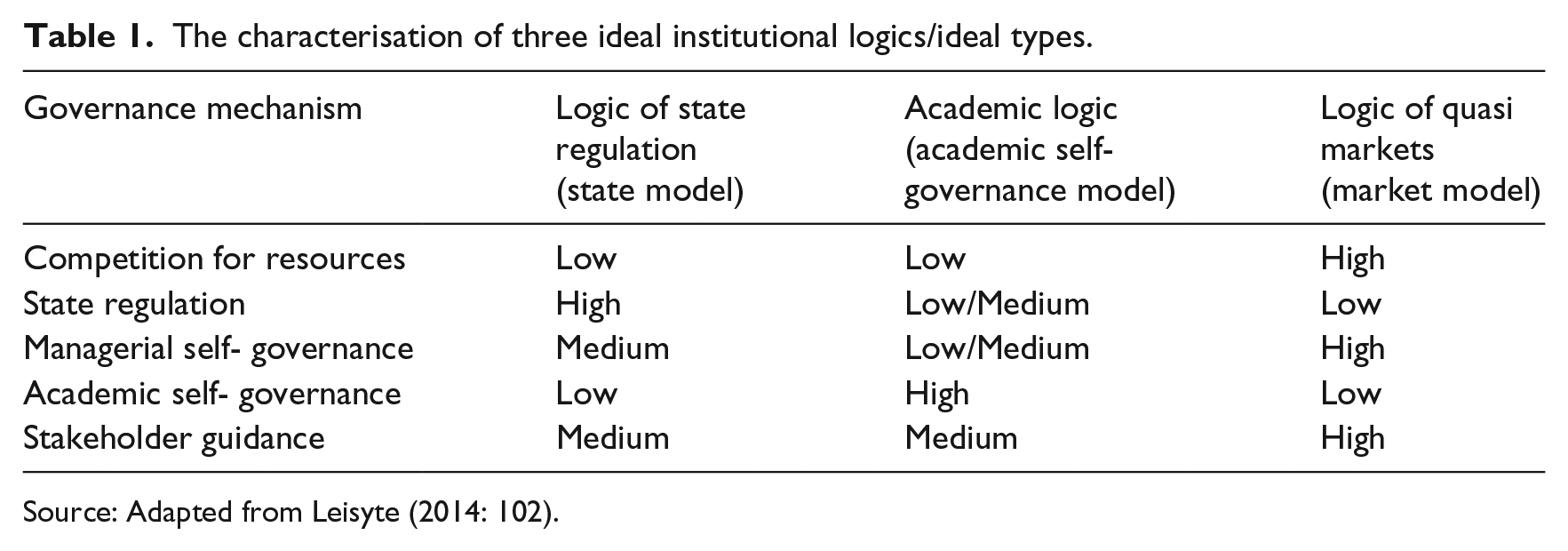
Source: Adapted from Leisyte (2014: 102).
In the following sections, we review the evolution of each governance mechanism and the forces that affected them.
Competition for resources
Expansion: from elite to mass higher education
Following the change of regime, one of the major changes in the Hungarian higher education system was the growth in the number of students. As a consequence, student needs and educational programmes became more heterogeneous. This phenomenon in itself is nothing new as other Central and Easter European (CEE) countries underwent similar changes (Reisz 2003), as well as all over the world. Aniol (2015: 48) describes Polish universities as becoming:
[d]iploma-producing factories and conglomerates of mass occupational education rather than excellence centres shaping top class knowledge and culture, ones also capable of educating humanists to the highest levels, who cannot be substituted by managers, bankers or engineers, no matter how talented and well-educated, even if the best in class.
However, in Hungary, the number of students has quadrupled since 1990. This was primarily due to the growing popularity of ‘atypical’ (mostly evening and distance learning) forms of education, and to a lesser extent the growth in full-time education. After the introduction of tuition fees in 1996, the number of fee-paying students increased as well and they accounted for half of the total number of students by the middle of the 2000s. However, following a reversal of this trend between 2004 and 2006, not only the number of fee-paying students started to decline but there was also a decrease in general in the number of students entering higher education. Although demographic trends contributed to the decreasing number of students after 2005, educational policy had a stronger influence on this decrease (e.g. the reintroduction of fees in 2008 and the changing allocation of state-funded places).
With the increase in demand, the content of educational programmes also changed significantly. Student preferences leaned towards social sciences and business, which resulted in a growing number of institutions starting to offer programmes in these fields. The diversity of educational programmes also increased as new levels of education appeared, such as higher-level vocational training, specialised postgraduate education and PhD programmes. The growth in the number of students and training programmes facilitated not only the evolution of more complex HEIs but also an increase in the number of faculties (see Table 2).
Institutes, faculties, teaching staff and student numbers in Hungary 1990–2015.
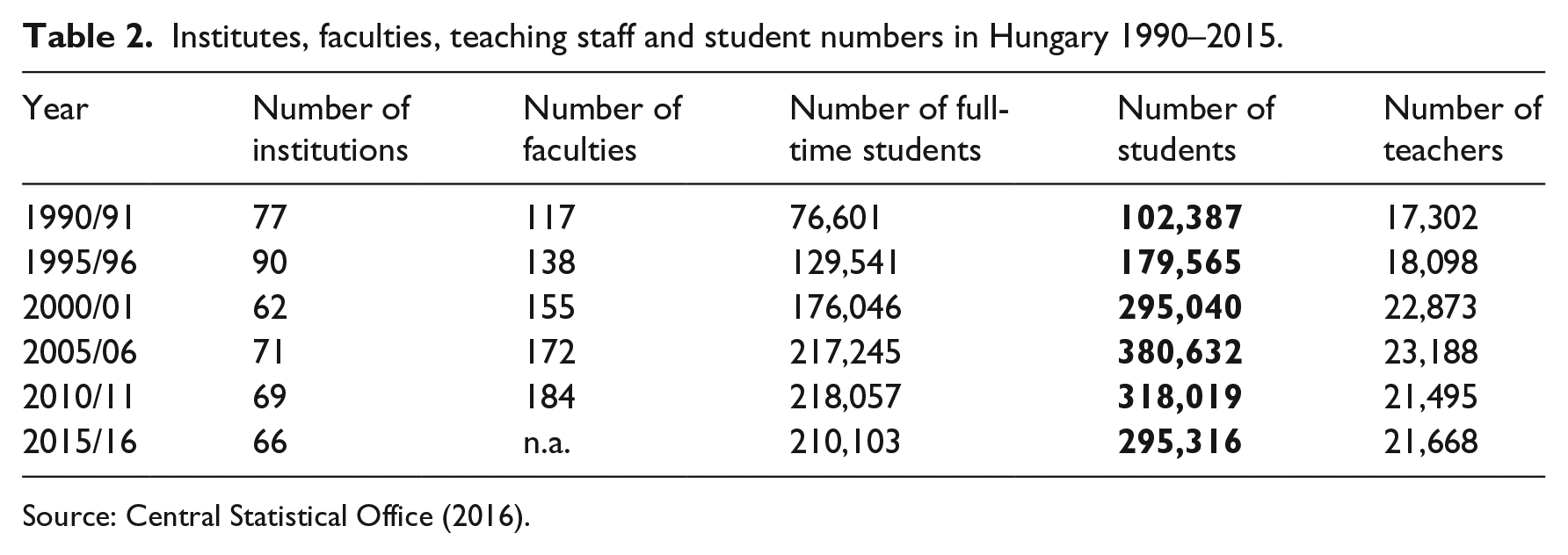
Source: Central Statistical Office (2016).
The transformation of the network of institutions
In the 1980s, Hungary had a highly fragmented higher education system with many specialised institutions. Although the drawbacks of this situation were realised in the 1980s, changes were initiated only in the 1990s when comprehensive institutions (universitas) were preferred. Such institutions were created in 2000 through forced mergers on a wide scale. This was followed by a handful of voluntary mergers. After 2010, however, the government split institutions through demergers either to operate them separately, harking back to the specialised institutions of the Soviet era, or to merge them with other institutions. The splitting of institutions and fragmentation seems to echo the past. Back in the 1920s, Kuno Klebelsberg, Minister of Education in Hungary, was unnerved by the existence of many parallel institutions and many small institutions, which he called ‘dwarf colleges’ (Ladányi, 2000: 25). Again, we see that Hungary appears to be swinging back to earlier times, despite age-old concerns about the inefficiencies incumbent with a fragmented system.
The type of institutions also changed in this period. Until 2005, the higher education system was binary having only universities and colleges, but the two types gradually converged into one another, known as ‘academic drift’. Colleges became increasingly similar to universities in their operation, organisational structure and culture. Between 2005 and 2011, steps were taken towards a unitary system, making it possible for colleges to become universities if they met certain criteria. In 2011, the division of universities and colleges was reinforced, and in 2015, a new type of institution (university of applied sciences) was created, with a focus on meeting social-economic demands and the utilisation of knowledge (EMMI, 2015: 42). All colleges (except for two small institutions) became universities of applied sciences in 2016.
In summary, over the last 30 years a very heterogeneous system of higher education has developed from the point of view of size and profile. The central role of Budapest (having around 45% of students) remained strong for the whole period.
The level and allocation of funding
Following the change of regime, the institutional expenditure-to-GDP ratio in the Hungarian higher education system was between 0.8% and 1.1%. Considering that GDP has risen to 150% since the change of regime, the expenditure of higher education in real terms has also gone up by almost the same amount. However, the number of students has quadrupled and this has led to a significant drop in the cost-per-student ratio. This in turn has led to increased cost-efficiency, but at the same time has increased the potential of endangering the quality. 1
According to the OECD statistics, the higher education expenditure-to-GDP ratio is slightly lower than the expenditure of other, similarly developed post-socialist countries (such as Poland or Estonia), and they, in turn, are considerably lower than the 1.3–1.5% OECD average. Thus, Hungary spends proportionally less on the operation of HEIs than the majority of developed countries, as can be seen in Table 3:
Expenditure on educational institutions as a percentage of GDP.
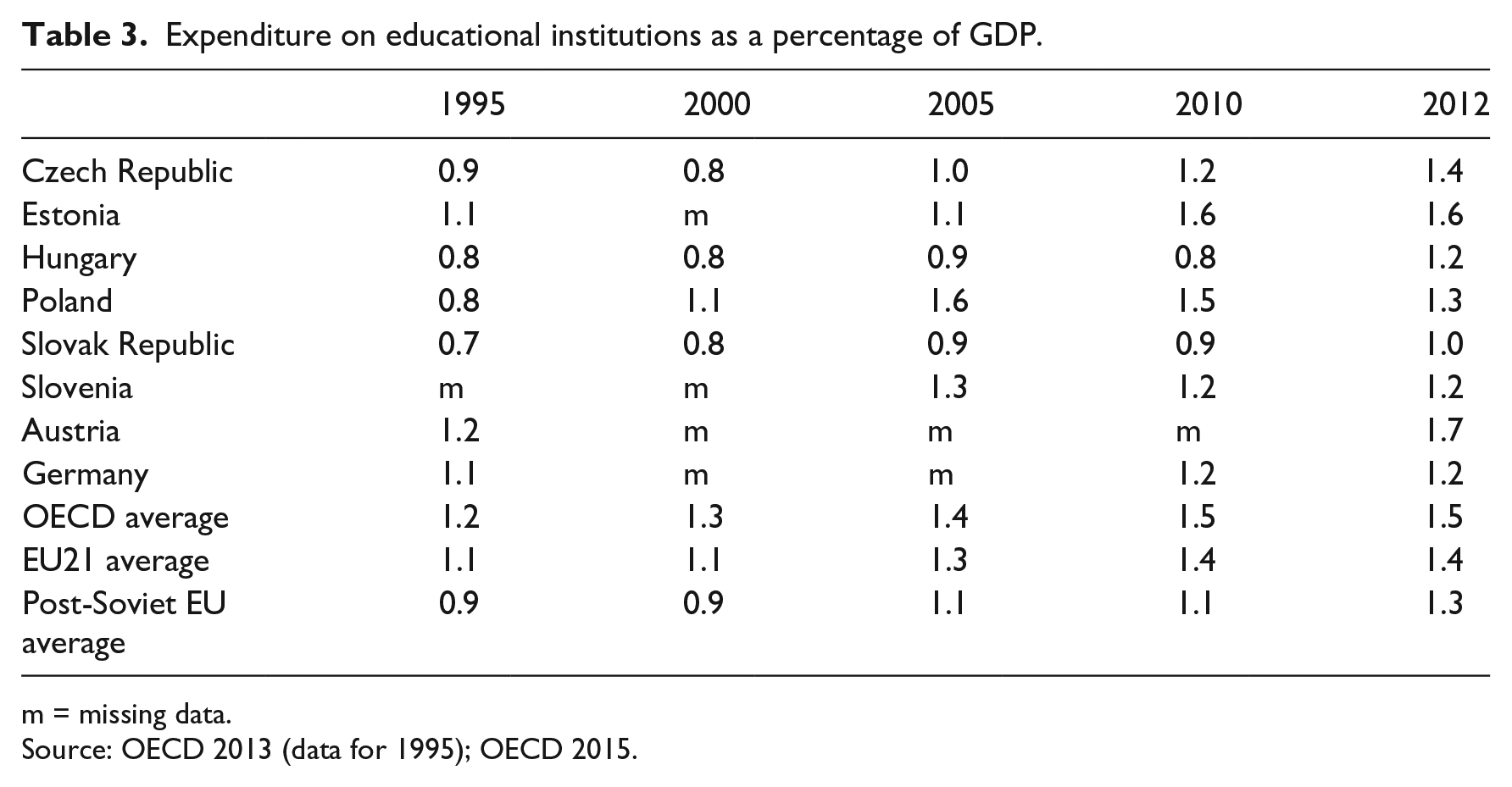
m = missing data.
In the 2000s, the proportion of direct state support was almost 50% of revenues, and about 25% came from other public sources (e.g. the National Health Insurance Fund). Tuition fees were introduced in 1996. As in most post-socialist countries, students performing well in entrance examinations are granted state-funded places, meaning no tuition fees and a high level of financial support from other sources. The others have to pay tuition fees and they are not entitled to any other support, except for government subsidised student loans (OECD, 2008). The introduction of universal tuition fees was attempted twice. However, these attempts were either short-lived (the succeeding government abolished them in 1998) or they were overthrown by a referendum (in 2008). The number of fee-paying students steadily increased from its introduction until the middle of the 2000s, and in 2004 it even exceeded the number of state-funded students. Afterwards, however, the trend reversed, and in 2015/2016 the proportion of fee-paying students was only 37% (Eurydice, 2016: 41). 2
As public statistics are not available regarding the revenue from tuition fees, we can only estimate that fees account for 5–10% of institutions’ own revenues (Expanzió, 2011; Polónyi, 2012), even if until 2011 institutions were allowed to set tuition fees themselves, unlike Western European universities (see Estermann and Nokkala, 2009: 41). As the proportion of corporate commissions was around 5–7% in the 2000s (Polónyi, 2012), we can conclude that 70–80% of institutional revenues came from public sources.
The allocation of direct state funding is also critical in determining the level of competition. Until 1996, state subsidies were distributed in a negotiation process with the ministry, which was based partly on the budgets of previous years and partly on the planned budget of the institution. In 1996, this scheme was replaced by formula funding, where funding was tied to input variables such as the total number of state-funded students or of lecturers. However, the formula was changed quite frequently (Polónyi, 2012), suggesting that institutional lobbies had tried to bend the formula to suit their interests, and the role of negotiation processes was still significant. Before 2005, state-funded places were allocated to institutions and educational programmes by the ministry. In 2005, a competition-based allocation of undergraduate places was introduced where the ministry determined the number of state-funded places for each field of education, and within these, the students were ranked on the basis of their secondary school leaving exam results. The institution to which the student had been accepted received the subsidy for state-funded students.
In 2007, three-year performance contracts were introduced, but they were abolished in 2011. The year 2011 was a general turning point in higher education funding. Public funding was significantly reduced. According to the EUA Public Funding Observatory, direct state support of higher education was 30% lower in 2015 than in 2008 (inflation adjusted), but in 2014 the reduction was 46%. 3
The competition-based allocation of state-funded undergraduate students was abolished in 2012 and replaced by quotas set by the ministry restoring the allocation system existing before 2005. One notable example of state intervention is that state-funded places in 16 educational programmes (law, economics, business administration and some other disciplines highly sought by students) radically decreased due to higher entrance requirements, forcing the majority of students wishing to study in these fields to pay tuition fees. In sum, in the new funding regime, ‘the normative state support of higher education has basically been terminated and replaced by a kind of mixed system of historic budgeting and earmarked state support, which is heavily manipulated: it is non-transparent for the institutions and cannot be foreseen in the long run’ (Berács et al., 2015: 7).
Lakner (2013) concludes from a qualitative study of ‘key actors’ in Hungarian higher education that a withdrawal of direct funding from the so-called ‘institutions and faculties with dubious scientific and professional quality’ (Lakner, 2013: 212) pushes such institutions towards the private sector. Fee-paying students and a lack of government funding thus become the driving forces towards converting public institutions into private or municipally run institutions.
In summary, how has competition in the higher education sector developed in the last 30 years? The dependency of institutions on public sources has remained very high over the whole period. Between 1996 and 2011, competition-enhancing tools were gradually introduced, e.g. tuition fees, performance-based contracts, formula funding and the allocation of state-funded study places. The introduction of these tools were milestones in a process that was tempered by the abundant number of students. After 2011, public funding and the number students decreased considerably leading to increased competition. However, the competition became less transparent – as with the allocation mechanisms, Hungary seemingly returned to the early 1990s with its historic and earmarked budgeting.
External governance: the changing relationship of the state and the institutions
In the 1980s, a researcher explained the crisis of Hungarian higher education as a transformation of institutions from autonomous institutions into the cogs of public administration. As a result:
[i]nstead of universities we have to talk about a peculiar formation, the ‘higher authority-university complex’, if we want to remain loyal to reality … In our opinion, supervisor and supervised organisations have blurred into one big state machine … Different levels of organisational hierarchy – from departments to the rector – function primarily as the link in a chain of a control system rather than the central point of substantial activities (Forintos, 1989: 637).
For this reason, it was not surprising that the 1990s was an era of extensive reinvigoration of Humboldtian ideals even if there were competing ideals (such as entrepreneurial and neoliberal higher education). The Humboldtian ideal places the freedom (and unity) of education and research in the spotlight. This is provided by the state through guaranteeing the autonomy and academic freedom of HEIs. As these were highly limited under the communist regime, the fulfilment of the Humboldtian ideal meant the transcendence of the Soviet model and a return to the national model. The foundation of Humboldtian higher education reached its peak in the higher education law of 1993. In the meantime, in 1989, it was inserted into the constitution that ‘only scientists are entitled to decide in questions of scientific truth and to determine the scientific value of research’ (Article 70/G). Humboldtian higher education in Hungary meant that even if the supervision of higher education became the sole responsibility of the ministry of education (instead of many different supervisory ministries and authorities), any means of allowing direct interventions, such as appointing rectors, were not used by the ministry. The ministry basically played a passive legal supervisory role.
In practice, institutions regained a high level of autonomy in appointments and in setting the content of educational programmes. Self-regulation became more significant not just on an institutional level but on a sectoral level as well. The appearance and significance of buffer organisations reflected this trend. For example, quality was controlled by the independent (but state-funded) Hungarian Accreditation Committee (Hrubos, 2016). On the other hand, institutions remained part of the state budget, which restricted their financial, organisational and HR possibilities (e.g. staff remained public servants; the requirements of public procurements; cutting or freezing institutional budgets during the year). In addition, general governance processes were regulated by the state, such as the composition of decision-making bodies, and therefore the dependence of institutions on the state remained high.
From 1998, the government became more proactive and efforts to control and make institutions more accountable gradually increased (Kozma and Rébay, 2008). This trend was highlighted by the mergers enforced by the state in 2000 and the attempt to introduce governing boards responsible for strategy and general supervision in 2005. Many additional indirect means of control were introduced. Some of these, however, were successfully resisted, such as when the Constitutional Court rejected the introduction of boards.
From 2011 onwards, the state became more interventionist and institutional autonomy decreased radically. The government of 2010 developed the so-called Széll Kálmán Plans which described higher education as a sector with a ‘deformed structure’. The image of needlessly large and deformed higher education is reflected in the goal that ‘higher education should not motivate anybody to spend their young years in happy idleness’ (Ministry of National Economy, 2011: 25). To solve these problems, ‘the state has to return to the world of education’ (Ministry of National Economy, 2011: 24). Regulations on funding, forced mergers, the introduction of new supervisory boards and state-appointed positions (such as the chancellor or financial inspectors) provided more opportunities for the state to directly influence the behaviour of institutions. Even the constitution was changed in 2013 and it now declares that:
Higher education institutions shall be autonomous in terms of the content and the methods of research and teaching; their organisation shall be regulated by an Act. The Government shall, within the framework of an Act, lay down the rules governing the management of public higher education institutions and shall supervise their management (Article X paragraph 3).
This process was accompanied by the withering of buffer organisations. For example, the ENQA-membership of the Hungarian Accreditation Committee had to be reviewed because its independence was questioned, or some of the privileges of the Hungarian Academy of Sciences in relation to allocating research funds were transferred to a state authority.
Managerial self-governance
Three topics will be discussed in this section: the selection of executives, the differentiation of central administration and the role of the rector.
The selection of executives
Institutional autonomy in the selection of executives increased in the 1990s and 2000s. In the 1980s, even heads of departments could be appointed only with the permission of the relevant ministry. From the mid-1990s, it was only the head of institute (rector, director general) whose selection had to be approved by the ministry before appointment. This process was formal, however, and it was generally limited to supervision of the legality of the selection procedure. Institutional autonomy also gradually increased in the selection and appointment of administrative and financial executives. From 2011, however, the situation changed considerably, and the government started to intervene in all selection and appointment processes more actively, and in many cases institutions were deprived of these rights. For example, between 2011 and 2014, it was not the rector who appointed the chief financial director and the internal controller, but the minister responsible for the budget. This system was fully in place following the introduction of the chancellors who were responsible for all administrative matters in the institution, and they must be considered a leader of the institution in administrative and financial issues (Berács et al., 2015; Kováts, 2015). The rector’s responsibility covers only academic issues. This dual executive leadership system is not unheard of in higher education. It was widely used in Germany, for example, although in the last decade German chancellors have transformed from an ‘agent … mediating between the university and the state’ into ‘a functional member within an expanded university leadership’ supervised by a president (Blümel, 2016: 18). This is not the case in Hungary, where chancellors are frequently seen as agents of the government (Kováts, 2016). In more positive accounts, chancellors may break the unfavourable status quo of academic oligarchy and they can provide some additional competences that may be lacking in management. In addition, unlike Germany, in Hungary chancellors are appointed by the prime minister without even consulting the institutions (Kováts, 2015), which is a source of tension.
This highlights one of the peculiarities of Hungary in relation to other countries when it comes to reforms of governance in general: there is a tendency, at least in recent years, towards what some authors describe as unorthodoxy. Hajnal (2014: 36) sees the current direction as follows: ‘a movement towards a Weberian bureaucracy is underway, being more respectable, morally good – more trustworthy and fair – and calculable but at the same time rigid and lacking innovation’.
The differentiation of central administration
The decision to introduce chancellors was justified by an inefficient administration encumbered by a high level of debt after 2012 (when state support decreased significantly). Administration has become increasingly complex since the 1980s. The evolution and differentiation of administration started in the 1980s, but it was notable in 1990 with the appearance of many new units. Mergers fuelled this process, as institutions became so large that expanding central administration and creating centralised services seemed to be a reasonable possibility both from a managerial point of view and in terms of economies of scale. As a response to the student-exchange and lecturer-mobility opportunities taking off at the time, offices managing international relations and organising student-exchange programmes appeared and the departments managing international affairs were extended. In order to exploit the possibilities offered by tenders, offices for Tendering, Grants and Project Management were established (Kováts, 2011).
Since the 2000s when the rate of enrolments stagnated, offices offering value-added services (such as educational and psychological counselling, career support, organising internships, and alumni organisations) as well as PR/marketing departments and corporate relations have appeared in an increasing number of institutions. Even organisational units responsible for corporate relations have been created in a few places. Offices for resource management (HR, quality management, management control) have also been set up. In 2012, units responsible for strategic planning could be found in seven institutions. Nowadays, most of these organisational units can be found in almost all institutions, and they have been created for three reasons: first, to comply with legislative requirements; second, to provide for various consolidating and accreditation-related tasks; and third, as a result of state and EU funding (Kováts, 2011).
The growing number of faculties and the increased pressure to centralise services increased the tension stemming from the question of which activities should be (de)centralised in the institution. Two general models evolved in Hungarian higher education. In the case of the decentralised model, the centre is responsible for only a few functions, and the majority of activities are operated and carried out at faculty level. Regulations, as well as the systems ensuring accurate accounting of the services provided by faculties and their shared use of resources contribute significantly to harmonisation. A typical problem of decentralised models is the frequent lack of competence because ‘centralised decision-making was the norm in the past and the institutions did not have to deal with planning and long-term thinking’ (Lakner, 2013: 210).
In more centralised institutions, faculties may only carry out certain tasks independently. The extreme examples are the multi-faculty colleges caused by organic development, where faculties are essentially responsible for only teaching and research and all administration is centralised. In these institutions, the dean has no responsibility for operative management (this is the task of the rector), but he/she primarily has academic duties. In reality, many institutions adapted mixed models which are a major source of tension (Kováts, 2012).
Shared leadership and the strength of executives
In 1980 Pálvölgyi argued that ‘the authority of executives of higher education institutions is limited by several circumstances: a) orders and regulations of higher authorities supervising the institutions; b) the number and complexity of tasks which forces executives to delegate part of their spheres of authority; c) the structure of the organisation which is characterised by relatively wide participation in decision-making and preparations, the traditional strive for consensus, the formal and informal influence of academics and their groups; d) rotation, that is, leadership appointment is only temporary; and e) the shared leadership, that is, legal norms which define the decision-making authority of the main body of the institution’ (Pálvölgyi, 1980: 95–96). In addition, he also emphasised that the chief executive (i.e. rector) is not elected by the main decision-making body, but he/she gains his/her office from the supervising authority.
Between 1985 and 2011, the problem of shared leadership worsened. Although the direct interventions of the government decreased, complexity and decentralisation increased. Moreover, the consensual organisational culture as well as the rotation of executives remained unchanged. Executives were usually selected from within, which increased conflict-avoidance. With the increase of institutional autonomy, the number and weight of issues in the competence of the senate/university council increased (Polónyi, 2006), while the dependence of the rector on the senate/council increased. It is the President of the Republic who formally appoints the rector (following the minister’s proposition), but until 2011, the ministry rarely intervened in the selection process.
The lack of managerial and financial competence of academic leaders and the decision-making bodies is also worth mentioning. Mergers were enforced in 2000 when institutions were incorporated into other institutions as faculties, thereby raising the role of faculties. Since institutional management was not delegated clear powers, the rector remained dependent on the senate, comprised of faculty representatives competing for their own faculty’s interests. In 2005, the government attempted to reinforce the role and position of rectors by making them more accountable. This was achieved by weakening the position of the senate and delegating part of its power (including the selection of rectors) to a new board consisting of the representatives of external and internal stakeholders. This attempt was prevented by the Constitutional Court, which referred to a breach of institutional autonomy (Barakonyi, 2009). As a result, the weak management position of rectors as well as their dependence on the senate/university council remained.
The introduction of the chancellor system in 2015 made the relationship between the rector, the academic bodies and the administration much more complex, because rectors were weakened further – especially in institutions with heterogeneous profiles. The chancellor system has the potential to overcome the difficulties stemming from the lack of competence, provided chancellors get on well with the rector and other academic leaders. The exclusion of institutions from the selection process, however, has undermined the trust towards chancellors and their legitimacy, and provides an opportunity for government to intervene directly.
Managerial self-governance could not gain supremacy in the studied period. Although in the 1980s the rector was independent of the institution, in the Humboldtian period it became a weak position. Attempts to strengthen the position in 2005 failed. After 2011, with the appointment of many executives by the state, they achieved some independence from institutional stakeholders.
Academic self-governance: the internal governance structure of institutions
The composition and operation of decision-making bodies and other committees
After the change of regime, the composition of the major decision-making bodies (university council/senate, faculty council) changed from apparently democratic to the true representation of (internal) interests. First, several representatives of external social actors (representatives of the Communist Party or the ministry) were forced off the committees, or in other cases (representatives of unions or young communists) they were replaced by representatives of internal stakeholders. Second, in the 1980s, many council members were members in-officio, who were appointed to their position by the rector (in the 1980s the approval of the ministry was also necessary). After the change of regime, most of them were replaced by elected members.
Academic leaders played a significant role in nominating members to different bodies in the 1980s (Pálvölgyi, 1980). This decreased after the change of regime. As a result, the influence of rectors on councils decreased and these bodies could become more independent of the rector, thereby becoming truly able to counterbalance the rector.
In 1984, in a collection of reports on higher education, it was written that ‘on large faculties the number of members in faculty councils is quite high, exceeding 70–80 persons, which makes procedures cumbersome’ (Pálovecz, 1981). Pálvölgyi (1980) also mentions the problem of large councils. In 2012, the number of members in the senate was around 30–40 in most cases (Kováts, 2012). In the past, decision-making bodies were rarely proactive (Pálvölgyi, 1980). There is no empirical evidence concerning their current role, but based on our own experience, we assume that this has not changed since that time. The strength and the ‘bottom-heavy’ (Clark, 1983: 132) nature of institutions are clearly represented in how the number and structure of faculty changed over time.
The change in the number of faculties
Before 1990 there were a lot of specialised institutions and therefore the number of faculties remained low. Between 1987 and 2009, a growth in the number of faculties was a perceivable trend (from 66 to 135). The number of faculties started to increase after 1990. This was fuelled by a number of drivers: the increasing autonomy of institutions to shape their internal operational structure; the process of mergers where many institutions joined the new institution as faculties; the expansion of the system resulting in the differentiation of programmes; and other intra-organisational reasons such as branding. After 2008 (and to a greater extent after 2011), the number of HEIs as well as faculties started to decrease because of a falling number of students, changing regulations and governmental intentions, as well as the crisis in general. In many institutions faculties were abolished (often enforced by the ministry), and departments also merged into larger institutes, resulting in a quasi-faculty structure. As the number of academic staff increased only by 30% during the studied period, faculties became more fragmented in terms of the number of staff. In 1987, an average of 175 academics worked at a faculty, which dropped to 127 in 2009 (Kováts, 2012).
A similar state of fragmentation can be seen in basic academic units and was a cause for concern even as far back as the 1970s and early 1980s. For example, Pálvölgyi wrote that:
[t]here is a medium sized college where on average six to ten full-time academic and three to five administrative staff work per department … but there is also a department employing 14 full-time academics. At large universities in addition to basic units with six to ten academics there are departments with 2–4 and 30–40 persons as well (Pálvölgyi, 1980: 33).
In addition to the establishment of larger departments or groups, other steps were taken to reduce fragmentation such as not allowing the establishment of new academic units without the approval of the relevant ministry in the 1980s.
In 2010, practices in Hungary still seemed to be rather ambiguous (Kováts, 2012). At that time, the number of organisational units per faculty was between 2 and 20 with an average of 7.5, indicating both concentrated and fragmented systems. The number of academic staff ranged between 2 and 101, with an average of 16.4. Faculties of law, where the number of organisational units is high, but the number of academics is below average, characteristically operate in a fragmented fashion. Faculties of art and faculties of science, where numerous institutes and departments operate, also have a more fragmented and complex structure.
Our main message here is that the structure of institutions did not just become more complex, but also more fragmented and thereby more difficult to manage. This is possible when central management cannot prevent the proliferation of new units or even help this process by using internal organisational politics (e.g. to overcome other interests by dividing and conquering). This suggests a weak position for the rector and the strength of academic governance. This trend was partly counterbalanced after 2011 when the administration became less dependent on departments, faculties and academic management.
Stakeholder guidance
In the 1980s, external stakeholders (represented by the party, the ministry, young communists, etc.) were removed from university councils. Until 2005 it was not compulsory to establish advisory or any other type of committee which represented external stakeholders. In 2005, the government attempted to establish boards with some decision-making power. Fewer than half of the members would have been appointed by the government. After the rejection of the board by the Constitutional Court, the Financial Committee was institutionalised as an advisory body. Its membership was fully determined by the institution, and later the maintenance of the body became optional.
In 2015, a new supervisory body was established, the consistory. It has veto power regarding the budget and the strategy and five members: the rector; the chancellor (appointed by the state); and three members appointed by the ministry (institutions may advise candidates). The combination of a small-sized body and a less transparent selection of its members makes it difficult to represent all external interests. Its authority and responsibility dictate its actions as being more controlling and less as a stakeholder guidance body.
Conclusions: back to the future or the empire strikes back?
Major periods in the evolution of the Hungarian higher education governance
Four education laws (1985, 1993 2005, 2011) and over 100 amendments in the last 30 years highlight the pace of change and lack of stability. But is it possible to break down this period and make sense of it? Dobbins and Knill (2009) used the change of political regimes and joining the Bologna process to divide the period. From our perspective, however, major governance approaches adopted by the state seem a better way forward in breaking down the period.
Similar to the Czech Republic and Poland, the Hungarian higher education system is rooted in the Humboldtian tradition. After the advent of communism, however, the higher education system in Hungary followed the Soviet model (Rüegg and Sadlak, 2011). The change of direction away from the Soviet model started well before the change of regime. In the 1980s, many characteristics of the Soviet model (especially the lack of institutional autonomy) were regularly questioned, and significant changes were accepted in the education law of 1985. This led to a higher level of institutional autonomy for schools and HEIs (Derényi, 2009; Ladányi, 1999; Polónyi, 2006). It is true, however, that these changes were only truly fulfilled after the change of the regime (1989–1990), specifically as a result of the Higher Education Law of 1993.
The start of another transition period occurred around 1998, when state institutions were forced to merge by the government. This reflected a new approach of governmental policy focusing on tighter control and greater accountability of institutions despite significant resistance, as in the case of the introduction of boards. This was the period when a new law on higher education was accepted (2005), Hungary switched over to the two-cycle system (2006), and a competitive student allocation system (2005) and performance contracts were introduced (2007).
After the elections and a change in government, a new law on national higher education was passed in 2011. This also meant a major turning point in higher education policy, as the new government adopted more centralised and direct control (e.g. historical and earmarked funding, chancellor system, etc.). Based upon our findings, we suggest dividing the analysed period into the following four sections:
before 1985: the Soviet era, characterised by a Soviet-type higher education system;
from 1985 to 1998: the restoration of the Humboldtian system and an increase in institutional autonomy;
from 1998 to 2011: a transition period dominated by indirect control mechanisms and periodic efforts to increase governmental control;
from 2011 to the present day: back to the future, that is, steadily increasing governmental control and decreasing institutional autonomy.
The change of governance and structure in Hungarian higher education
Based on the analytical framework proposed earlier and the division of periods proposed in the previous sub-section, we have summarised our analysis in Table 4.
The evolution of Hungarian higher education governance.
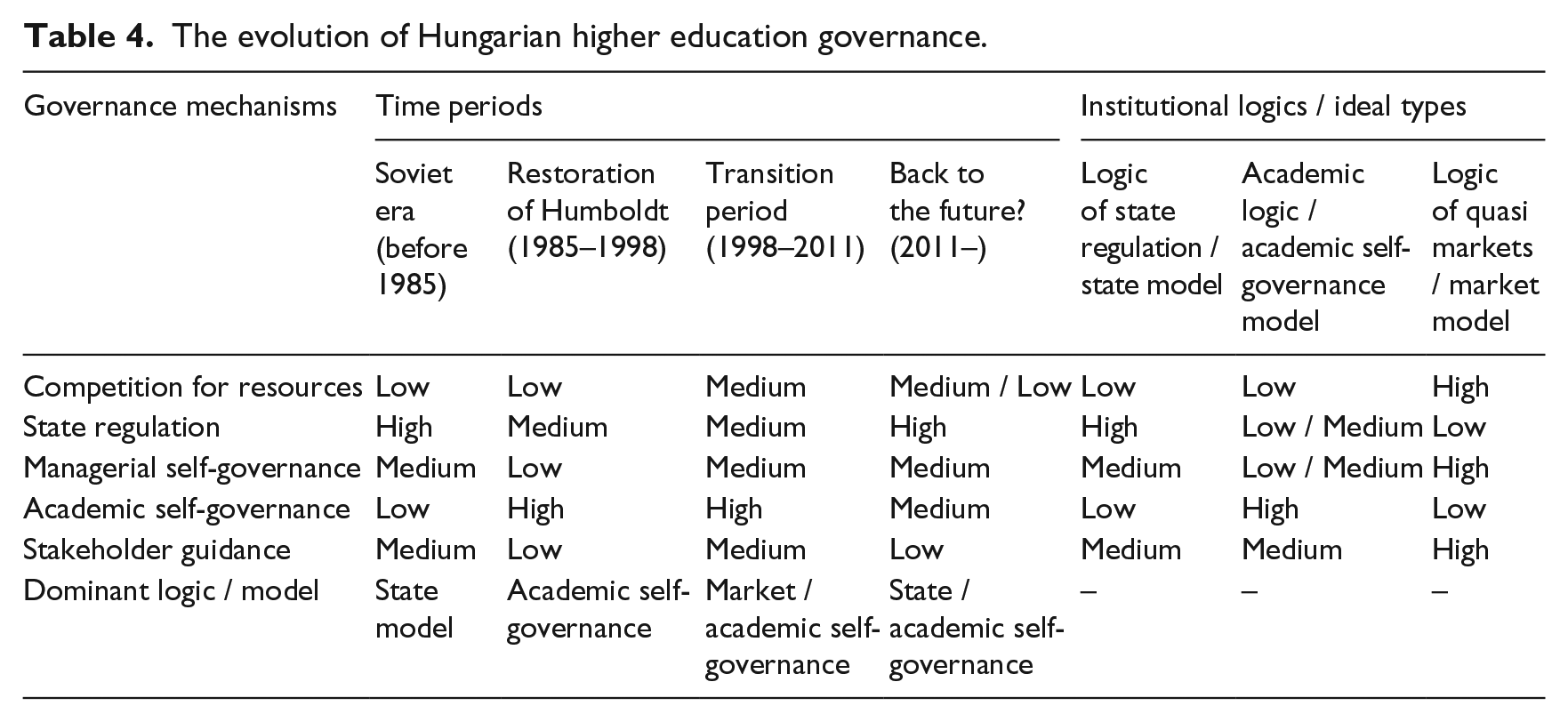
The Soviet era shows much similarity with the state-controlled model. The restoration period resembles the academic self-governance ideal type, and it differs only in the aspect of stakeholder guidance. In Hungary, external stakeholders were not required to be involved during that period, resulting in a ‘low’ value. The transition period is between the quasi market and self-governing ideal types, as there were many attempts to push the system in a more competitive direction. Finally, it failed, and culminated in the ‘back to the future’ period, which resembles a hybrid of the state model and self-governance model. It differs from both in some areas, however. In the state model, academic self-governance and competition have less significance, and external stakeholders have stronger representation than in Hungary. The latter could happen, however, if the number of members in the consistory were increased and the selection mechanism altered in favour of external stakeholders.
The difference between the ‘back to the future’ and the academic self-governance ideal type is the level of state regulation, which ideally should be less intrusive and interventionist. The level of academic and managerial self-governance also differs. In Hungary, this governance is limited/provided by the quasi-independent chancellor, and the state-influenced selection of rectors. Competition also differs because in academic self-governance the regulations of the state are justified by the funding they provide. The lack of resources undermines this justification and necessarily increases competition.
One of the most spectacular changes from the transition period to the ‘back to the future’ period is the growing significance of state regulations. How can this development be evaluated from an international perspective? In the UK, for example, the government started to actively intervene in higher education in the 1980s by creating regulations, powerful agencies (e.g. HEFCE) and incentive mechanisms (e.g. RAE). Other Western European countries applied one of the continental models and so the state remained a powerful actor. Is it possible that the Hungarian ’back to the future’ phenomenon is simply a return of the state ‘to the world of education’ as it was phrased in the Széll Kálmán Plan? In our opinion, this is not the case because recent developments in Hungary are built upon the notion of a zero sum game, where increasing institutional autonomy necessarily weakens the authority of the state. In Western Europe, however, states are able to preserve their strength even if they increase the autonomy of institutions. In the 1990s, the increasing heterogeneity and complexity of higher education acted as drivers for a change in the role of the state ‘from government to governance’ (De Boer et al., 2010a: 20), that is, from directing (regulating) institutions through bureaucratic means to coordinating systems through incentive mechanisms, referred to as ‘steering from a distance’.
Despite the lag caused by the communist legacy and slow expansion, this change also started in most Central European countries – including Hungary. For example, Leisyte concludes that ‘in the new millennium, state control has returned in some areas by regulating university life via intermediary agencies and accountability mechanisms’ (Leisyte, 2014: 113). However, the weakening of buffer organisations and other agencies as well as the decreasing financial and organisational autonomy of institutions in Hungary suggest a turn away from this path. It remains a question, however, as to where the hybrid state of the ‘back to the future’ period will evolve going forward. The answer lies in either a move towards a state-controlled model with direct interventions of the state, or towards academic self-governance with academic freedom and limited institutional autonomy.
Understanding the Humboldtian model in Central Europe
As shown in Table 4, the logic of academic self-governance played a crucial role in the evolution of higher education in Hungary (and perhaps in other Central European countries that also followed the Humboldtian tradition). Academic self-governance is a major characteristic of the Humboldtian model, and this seems to be the key to understanding the process.
Hungary had a Humboldtian higher education tradition before the communist takeover in the 1950s. The Humboldtian ideal places freedom (and unity) of education and research at its core. These were heavily limited under the communist regime, resulting in the transcendence from the Humboldtian to the Soviet model and in many Central European countries, including Hungary, to the return to the national model. Western European universities were generally identified as belonging to this model in the 1990s. This resulted in the belief that the institutionalisation of the autonomy and independence of the university would guarantee the modernisation of Central European universities and the chance to catch with Western higher education (Kozma and Rébay, 2008; Neave, 2003).
The reinvigoration of the Humboldtian model resulted in ambivalent expectations regarding the role of the state: the post-Soviet legacy implies the desire for academic freedom which is difficult to secure in market-dominated circumstances without the necessary competence coupled with a high level of institutional autonomy. It is the state which can provide protection from the vulnerability of market relations, but the communist era has taught us that the state cannot be trusted in restraining itself from intervening in institutional and academic matters. Therefore, we see a state of cognitive dissonance where the desire for and refusal of a provident state co-exist. Similar to the Czech and Polish higher education systems, institutions in Hungary want the best of both systems: the funding and protection of the Soviet system and the academic freedom of the Humboldtian one (Dobbins and Knill, 2009).
The adherence to academic self-governance is rooted in the idea that the protection of academic freedom cannot be expected either from the state, or from the market. The former is hindered by a lack of trust (reaffirmed in recent Hungarian developments), while the latter is hindered by a lack of capability, such as competence, courage and institutional autonomy.
Therefore, the attitude towards the Humboldtian model in Central and Eastern European higher education is different from that in Western higher education:
[a]t the very moment higher education in Central Europe successfully called upon the ghost of von Humboldt to cast out the demons of Party and Nomenklatura, so their colleagues in the West were summoned to exorcise the spectre of the same gentleman, the better to assimilate Enterprise Culture, managerialism and the cash nexus into higher education (Neave, 2003: 30).
Thus the Humboldtian model can be considered as a correction of the overcentralised Soviet model as well as the inhibitor of the transformation processes taking place in Western Europe, facilitating a more significant social participation of institutions. In this way, the Humboldtian ideal simultaneously becomes a progressive notion as well as one hindering progress.
The era of restoration was dominated by the effort to distinguish the new regime from the old. The legitimacy coming from this distinction led to a permissive/supportive interpretation of the state and thereby the rise of the Humboldtian model. Although Europeanisation was important in this period, it became definitive in the transition period. The Bologna process was not only about the introduction of a two-cycle system, but about the modernisation of the entire higher education system, which included the reform of funding and governance (Kozma, 2014). International models upheld by experts and international organisations played an important role in both periods. In the ‘back to the future period’, it is less clear if there is any international model which Hungarian higher education followed. The political project of this period seems to be the regaining or reinforcement of national sovereignty by concentrating decisions on those officials who are elected by and accountable for citizens. It is hard to decide to what extent this is rhetorical.
The pendulum effect
Following Dobbins and Knill (2009), the development of governance can be sketched in Clark’s triangle and, combined with our findings, can be portrayed as follows:
Through our analysis of higher education’s governance systems in a wider context, it has become clearer that the pendulum effect observed in organisational culture and leadership in Eastern Europe (Bakacsi, 2014) during the transition period could also be identified in the governance models in Hungary. Moreover, from a longitudinal perspective and bearing in mind the later crisis period, the pendulum swung back to a well-accepted, more autocratic leadership style with more centralised higher education governance models.
The question of whether these findings can be generalised, at least for CEE countries, appears at first glance to be unlikely. In cultural studies, Hungary has been found to be an exception to geographical clusters with the surrounding countries, and likewise in this case, Hungary seems to have bucked a localised trend. Dobbins and Knill (2009) investigated the convergence of higher education policies in Bulgaria, Romania, Poland and the Czech Republic. They observed a converging trend towards the market-type model of higher education governance for these countries with common pre-communist legacies. We have also found this to be the case in Hungary, with the Humboldtian model of university governance. Leisyte (2014) drew similar conclusions stating that ‘it is possible to argue that the quasi-market logic is increasingly shaping higher education management and governance in CEE countries, although at the same time academic logic is still guiding the governance of higher education in many countries’ (Leisyte, 2014: 113).
However, we have seen that the model is much more state-controlled in Hungary and there is already an apparent move away from foreign-inspired ideals and models. The pendulum has swung away from academic self-regulation thereby reducing the power of academia, to resisting change initiated by the state. However, our key finding of the pendulum affect still stands. It may be that Hungary is ahead of the trend and other countries such as those investigated by Dobbins and Knill (2009) have yet to experience the next swing in the opposite direction.
The idea of a pendulum effect in this study is one that requires further research and raises many questions. The potential for higher education policy and governance running in a cyclical manner seems feasible, although if we consider Clark’s (1983) model indicating three ideal types, then a single pendulum effect needs further consideration. Although Hungary currently appears to be an exception to models of CEE countries, further research may indicate that there is no reason to assume the swing of a pendulum related to governance in higher education should be synchronised across countries. As a final consideration, the swinging back of the pendulum in Hungary could also have the potential to affect surrounding countries with the same effect as Newton’s cradle.
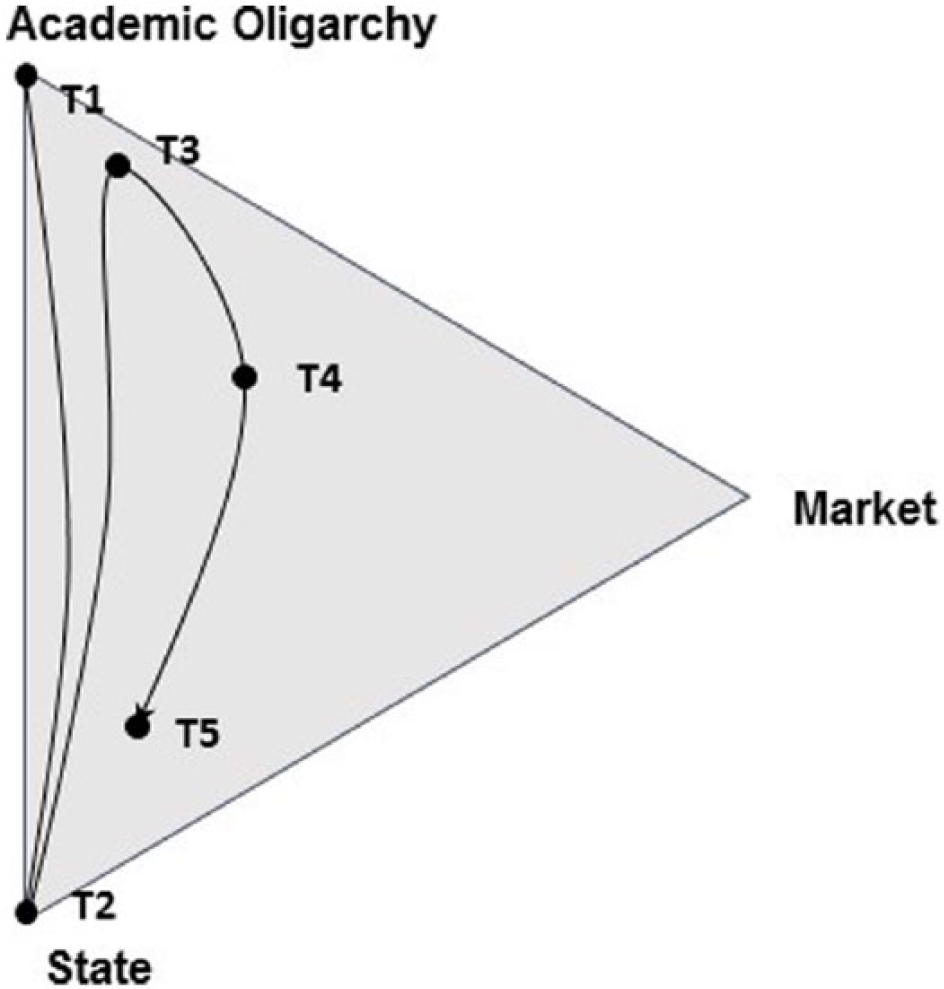
The evolution of Hungarian higher education governance in Clark’s triangle.
Footnotes
Declaration of Conflicting Interest
The author(s) declared no potential conflicts of interest with respect to the research, authorship, and/or publication of this article.
Funding
The author(s) disclosed receipt of the following financial support for the research, authorship and/or publication of this article: Gergely Kováts is supported by the Janos Bolyai Research Fellowship of the Hungarian Academy of Sciences. The financial support is gratefully acknowledged.