




Abstract
This contribution examines the domestic reinterpretations of international and European recommendations in Central and Eastern European countries (CEECs). It asks under what conditions these institutional recommendations, but also global processes such as the university rankings, affect domestic public policies. The countries of Central and Eastern Europe, which have experienced a far-reaching reform process since 1989, have been particularly affected by new standards promoted at the European and international level. The article shows that the combined external and domestic pressures affect higher education institutions (HEIs) in multiple and sometimes contradictory ways. Based on the Polish and Ukrainian cases, it reassesses the (party) political factor in the reorientation of higher education (HE) reforms. It shows that Europeanisation and internationalisation are neither uniform nor linear processes. Ultimately, the announced diversification of HEIs appears as a longer-term process whose outcome remains uncertain.
The countries of Central and Eastern Europe, which have experienced a far-reaching reform process since 1989, have been particularly affected by new standards of public sector modernisation promoted by European and international organisations (IOs). The criteria of EU accession have reinforced these trends.
This contribution examines the domestic reinterpretations of international and European recommendations in Central and Eastern European countries (CEECs), with a particular focus on the Polish and Ukrainian higher education (HE) systems. 1 I consider under what conditions these institutional recommendations, but also global processes such as university rankings, affect domestic HE policies and governance. Commenting on the academic profession in Central and Eastern Europe, Philip Altbach stated that ‘there is no other world region where higher education is as much in turmoil’ (2003: 389). More than a decade after he made this observation, the HE systems of CEECs have undergone extensive reforms linked to their integration into the Bologna Process (Dobbins and Khachatryan, 2014). In the educational sector, CEECs have been subjected to the assistance programmes of various international organisations, including ones with a mandate to monitor educational policies (UNESCO) and others that have progressively gained authority in this area (Council of Europe, OECD, World Bank). 2
This article analyses the selective uses of Bologna Process principles, of recommendations of the European Commission and of the above-mentioned IOs in domestic policy-making. It will focus on issues relative to HE governance and structure, diversification of HEIs and funding, but also on national qualification frameworks, as all these elements have been considered as important preconditions for quality improvement. In both the Polish and Ukrainian cases, the reform and modernisation of higher education were considered as indispensable elements to improve the position of the domestic system on the global educational market. The idea according to which universities should be competitive acquires a double meaning. First, it refers to the global academic competition for students and academic rankings (Erkkilä, 2013). Secondly, it triggers pressure among domestic universities, which have to fight more fiercely to attract students (and fees) in a context of demographic decline and to gain a better position in the domestic academic categorisation/rankings, which may be vital for their funding.
The article shows that combined external and domestic pressures affect HE systems in multiple and sometimes contradictory ways. On the one hand, European processes such as the building of a European Higher Education Area provide opportunities to domestic reformers. On the other, the Polish and Ukrainian case studies remind us that the political configuration should be taken into account at the domestic level. Ultimately, the announced diversification of HEIs appears as a longer-term process whose outcome remains uncertain. In sum, Europeanisation and internationalisation are neither uniform nor linear processes.
Poland and Ukraine differ in their socio-political background. Both countries have followed different historical trajectories (as satellite or member of the Soviet Union) and their democratisation processes have varied in timing. Poland deliberately turned to the West after 1989 (ultimately joining NATO and the EU), whereas Ukraine’s geopolitical situation has remained more complex. Since its independence in 1991, Ukraine has been marred by political instability, with several governmental crises followed by a serious economic crisis in 2009. More dependent on the Russian market, Ukraine finally signed an Association Agreement with the EU in 2014, albeit at a very high political cost, as the Russian annexation of Crimea and the war in the separatist eastern territories followed the Maïdan ‘revolution’ triggered by president Yanukovych’s refusal to sign the Agreement. These differences notwithstanding, the Polish and Ukrainian cases exemplify the impact of external recommendations and of domestic political power relations in HE policy-making.
Despite their heterogeneous research and HE systems, it is possible to identify three rough patterns that go some way towards explaining the potential receptiveness of CEECs to external advice (Dakowska and Harmsen, 2015). First, they share a Communist past, with a high degree of centralisation, ideological structuration of higher education curricula and a Soviet-inspired distinction between research and teaching. Yet, these systems differed in many ways, for example regarding access to HE. Some countries, like the Czech Republic (formerly Czechoslovakia) or Poland, were able to rely on their interwar democratic experience and their acquaintance with the Humboldtian model of research university autonomy (Dobbins, 2011).
The second pattern is the shared experience of post-Communist transformation, increasing these countries’ receptiveness to foreign assistance and international recommendations. The 1990s were a time of exposure to neoliberal reforms applied to the economic sector, but also to sectors such as education or health, leading to a far-reaching privatisation of the public sector. A third development that affected countries in the region unequally is the process of EU accession. In this respect, a distinction must be made between the countries which have completed the negotiation process and accessed the European Union and those which have stayed out of it. The timing of the Bologna Process launch (in 1999) explains why many policy-makers from the new EU member states tended to consider its successive recommendations as part of a more general EU package. The EU accession process – involving conditionality and the allocation of financial resources – has had a noticeable impact on HE policies.
This contribution argues that the transformation process supported by international and European organisations has affected HE institutions. I investigate how definitions of the university objectives promoted by international and European organisations in terms of ‘competitiveness’ and ‘internationalisation’ are used in domestic contexts. While this trend has been well documented in Western countries, in some countries of Central and Eastern Europe it has taken a distinct form due to the limited timespan of the implementation of reforms and the differential perceptions of Western academic models.
Instead of reducing complex HE reforms to a unilateral adaptation to an external constraint – in line with the literature on Europeanisation and diffusion (Börzel and Risse, 2000) – I propose to apprehend the relations between the European institutions and national academic spaces in their reciprocity. I therefore follow a sociological-constructivist approach of the European political field (Georgakakis, 2012; Guiraudon and Favell, 2011) as it interacts with domestic political arenas. The first added value of a European political sociology is to shed empirical light on actor configurations and power relations in the construction of public ‘problems’ (Rowell and Mangenot, 2011). The second contribution of this approach is to seize the relationship between external and domestic actors in their dynamics, through the political uses of European recommendations (Woll and Jacquot, 2010).
The article is structured as follows. In the first part, I discuss the relationship between internationalisation and Europeanisation from a theoretical perspective. I propose an analytical framework that pays attention to the temporalities of HE reform and their domestic context. In the second part, I apply this framework to the Central and Eastern European countries and discuss the main policy responses to external recommendations in terms of diversification of HEIs and regarding the issue of fees. In the third part, I shed light on domestic actor configurations and show how policy entrepreneurs used European but also other external models, based on the Polish and Ukrainian cases.
Higher education internationalisation and Europeanisation revisited
The term ‘internationalisation’, used in both academic and applied policy analysis, can be defined in various ways. In view of the ‘resurgence of internationalisation’, Altbach (2007, p. xi) describes the ‘international imperative’ as ‘growing international forces that are influencing higher education’. However, the question remains open as to how and by whom this ‘imperative’ is voiced, and in which conditions it materialises and leads to direct consequences. Jane Knight defines internationalisation as ‘the process of integrating international, intercultural or global dimension into the purpose, functions or delivery of post-secondary education’ (Knight, 2003: 2). She notes the polysemy of the term, which may relate to international practices (mobility, partnerships, research programmes), the integration of an intercultural or global dimension into curricula, or the commercial trade of HE services (Knight, 2011). The author suggests adopting a combined bottom-up and top-down perspective to analyse the processes which take place at the national and institutional level. While top-down implementation studies focus on ‘refractions, failures or deficits in policy implementation’, ‘bottom-up studies recognize the inevitability of mediations by professionals’ (Rizvi and Lingard, 2009: 53). Combining both approaches may be useful to shed light on the mechanisms of the globalisation of Europeanisation without taking them for granted (Dale, 1999). A political sociology approach provides a useful way to seize both the top-down and bottom-up dimensions of HE reform through the domestic uses of external recommendations.
The European factor under debate
In the past decade, academic debates have largely focused on the relative importance of the European Commission vs. governmental representatives in HE coordination at the European level. Some authors have presented the Bologna Process as an example of ‘resisting the EU’ (Muller and Ravinet, 2008). Critical scholars have, for their part, drawn attention to the structuring role played by EU institutions and processes such as the Lisbon strategy in promoting a market-based logic in various public sectors, including higher education (Bruno et al., 2010; Garcia, 2007). A number of authors tend to agree that European educational initiatives constitute an ‘EU policy’ (Walkenhorst, 2008) increasingly dominated by the Commission (Croché, 2010; Keeling, 2006; Serrano-Velarde, 2015) and structured by the ‘open method of coordination’ (OMC) (Normand, 2010; Alexiadou et al., 2010). My own research shows that the Commission has been a vital player of European HE policy coordination since it became a member of the Bologna follow-up group (BFUG) Board in 2003. Due among other things to the EU programmes and funds earmarked for HE, it is difficult to consider the Bologna Process and other exclusively EU initiatives as entirely distinct. Although the Bologna Process has been ‘presented as an intergovernmental process’, ‘supranational agencies played an important role in the preparations for the meeting in Bologna’ whereas ‘the European Commission has developed its own higher education strategy, building upon the Lisbon process but skilfully bringing on board elements of the Bologna Process’ (Huisman et al., 2012: 84).
The Commission supports most of the Bologna Action lines, e.g. through initiatives ranging from the European Credit Transfer and Accumulation System (ECTS) label (promoting transparency of qualifications) to the ‘Erasmus Mundus’ Programme (fostering the attractiveness of European higher education on a global scale). These measures, which are part of the overall EU approach to educational matters, and the – geographically wider – Bologna process reinforce each other, improving the chances of the genuine implementation of declared objectives across the various higher education systems. Such
Clearly, the ‘power of the purse’ of the European Commission (Batory and Lindstrom, 2011) makes a difference in HE templates and reforms in the CEECs, where the EU funds were an especially welcomed resource in a context of shrinking public funding. Beyond this EU-centred debate, the international dimension of the Bologna Process and of the European HE reform agenda is manifold. Policies coordinated at the European level have deeply influenced HE systems on the European continent and elsewhere. The process is based on the idea of tertiary education harmonisation and thus on a transnational comparison of HE systems, which entails the principle of competition.
While acknowledging the increasingly competitive orientation of the HE international market, many experts from CEECs consider that their country should fully participate in the Bologna Process to earn a better position in this field. 4 Still, it is difficult to isolate the effects of the Bologna Process, which has built on circulating trends and instruments promoted by international and supranational organisations such as the Council of Europe, UNESCO and the European Commission, including diploma recognition, student and staff mobility facilitated by a credit transfer system, as well as quality assurance, to name just a few (Jorge de Melo, 2013). This relationship between European and international factors of change requires further research.
The complex impact of international incentives
Regarding the international dimension of HE reforms, several authors have pointed out the need to consider the education system within a broader international context (Dale and Robertson, 2009; Rizvi and Lingard, 2009; Zgaga et al., 2013). Scholars have heralded the emergence of a ‘global educational policy field’, in which the extent of the autonomy of public policies implemented at the domestic level depends on the ‘strength of specific national capitals’ (Lingard, 2006: 288). In the case of CEECs and their situation on the margins of the European Union, we may ask whether their relatively weak resources – compared with Western European countries – make them more dependent on international pressures.
While internationalisation seems to be an all-encompassing term, its academic definitions and considerations vary. Altbach (2007) describes the Bologna HE harmonisation approach as a regional version of the globalisation process (re)discovered in the 1990s. He acknowledges the power of the Western model as the American university ‘so influential worldwide, [that it] constitutes an amalgam of international influences’ (Altbach, 2007: 25). Influential global players in the field such as the World Bank and the World Trade Organization (WTO) fuel the economic dimension of HE transformation. Thus, HE internationalisation mirrors the inequalities linked to the economic globalisation process, such as the domination of dependent peripheries by northern academic production centres (Altbach, 2007). According to Rizvi and Lingard (2009: x), ‘globalization cannot be viewed as a generalised phenomenon, but rather needs to be seen as a dynamic phenomenon expressed in particular histories and political configurations’. This approach is useful to avoid reifying globalisation and to analyse the mechanisms and agency of this process, which may be understood through its practice, ideology and social imaginary (Rizvi and Lingard, 2009).
While some authors trace back the increased activity of international organisations in education policy-making to the early 1990s and consider them as ‘new arenas of education governance’ (Leuze et al., 2007), others suggest a more refined historical perspective. According to Karen Mundy (2007), educational multilateralism developed in the aftermath of the Second World War, in several phases: firstly, ‘embedded liberalism’ marked by Keynesian policies and the promotion of the right to education by UNESCO in the Cold War context; secondly, starting in the 1960s, the growing role of the OECD, its Development Assistance Committee, but also its Annual Review of member countries’ educational performance; thirdly, neoliberal policies calling for privatisation and the limitation of state intervention in which the World Bank has taken the lead, followed by the OECD, the EU and the World Trade Organization with its General Agreement on Trade and Services (GATS) negotiations (Mundy, 2007).
Bridging the European/international divide
A way to bridge the gap between explanations in terms of globalisation or Europeanisation is to recognise that there is no obvious divide between both notions. For some authors, the European Union is just one among other international organisations involved in ‘educational multilateralism’ (Leuze et al., 2007; Mundy, 2007). Still, the autonomisation of policies promoted at the European level has to be acknowledged. On the one hand, EU policy-makers re-appropriate pre-existing references and give them a distinct regional meaning, as was the case with the European Qualification Framework. On the other hand, EU policies have a scope and binding power that other international organisations do not enjoy.
Another manner of refining the Europeanisation perspective is to examine alternative explanations of change, such as the inspiration drawn from models outside the European Union or references to narratives of global competition promoted by international organisations (Martens and Jakobi, 2010; Martens and Wolf, 2009). Furthermore, a way to escape a narrow perception of Europeanisation as the mere uploading/downloading of policy templates and to refine the Europeanisation/internationalisation relationship is to take into account the transnational channels of circulation of policy ideas. Government agencies such as the British Council or private organisations such as the Soros Foundation were active in promoting HE reforms focusing on transparency, accountability and quality assurance in the EU neighbourhood. The German Rectors’ Conference (HRK) and the German Academic Exchange Service (DAAD) have been active in this field and have promoted the Bologna Process in the European candidate and neighbourhood countries. 5
Finally, although the external dimension of policy transformations can hardly be denied, it should not be taken for granted. The CEECs’ case reminds us that a policy transfer (emulation, inspiration, etc.) can be ‘uninformed’, ‘incomplete’ or ‘inappropriate’, according to the literature on policy diffusion terminology (Dolowitz and Marsh, 2000). Existing scholarship on the HE reforms in the region tells us that domestic political fields and actors are main sites of policy translation; it is not only difficult to isolate European models from other external (UK or US) inspirations, but also to disentangle perceptions of appropriateness from strategic uses of these external models (Vukasovic, 2012, 2015).
Unpacking the external dimension: the Central–Eastern European perspective
The transformations of HE systems in Central and Eastern Europe (CEE) are a case in which international dynamics can hardly be disentangled from the European agenda. Thus, it would be difficult to analyse internationalisation dynamics in the region without taking into account the way in which the prevailing European schemes have shaped academic programmes, teaching methods, mobility, evaluation practices and governance.
In the case of the CEECs, European policies have played a major role over the last decades. First of all, the Bologna Declaration was not a Stunde Null of HE transformations in the region as it capped a whole decade of HE reforms in the aftermath of 1989 (Cîrstocea et al., 2014). The 1990s were the heyday of international assistance to the CEECs. Hence, in the first reform stage, external references and sources of inspiration interfered and varied depending on national situations. International organisations such as the World Bank and the OECD were active in the field, providing funds, loans and expertise to the educational sector. The domestic reform strategies fuelled an internationalisation process of HE institutions, which could also be called Westernisation, as the outside references usually lay within the Western space and especially Anglo-American countries (Dakowska, 2015, Vukasovic, 2015). However, the early 1990s were also a peak period for the European Commission, which emerged as a leader in the coordination of Western assistance to the transition countries, in particular through its Poland and Hungary Assistance to the Restructuring of the Economy (PHARE) programme (Robert, 2004).
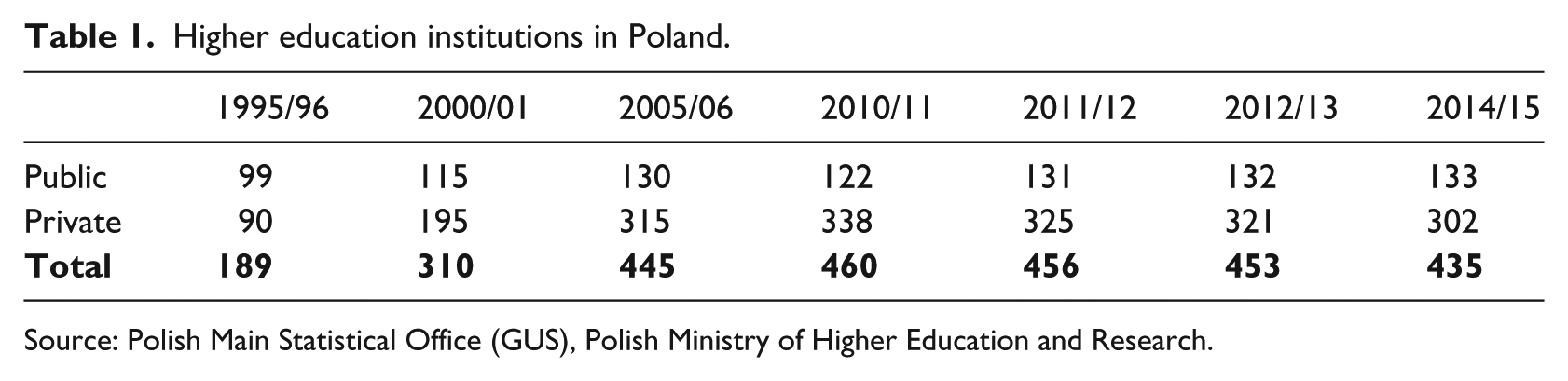
Before analysing these converging external references, I will briefly outline some contextual elements relative to the academic landscape in the region. Several analyses have shown that in Central and Eastern European countries, the academic systems have been affected by changes in this sector in a distinct way. In comparison with Western European countries, the challenges have been both similar and more impactful because of their speed and of local patterns. The massification of higher education took place largely in the 1990s, while public funding allocated to the sector decreased (Sigman, 2014; Slantcheva, 2003). The concurrent HE privatisation process reached much higher proportions than in Western Europe, with peak numbers registered in Poland and Romania: all in all, the private sector enrols around 27% of the student population in CEECs, while it averages 6% in Western Europe (Levy, 2012: 182). In the Polish case, the marketisation of the HE system that started in the beginning of the 1990s resulted in the development of a large private HE sector, whose expansion stopped in the second half of the 2000s (see Table 1). While about two thirds of Polish HEI are private, their number fell from 321 (out of 453) in 2012/2013 to 302 (out of 435) in 2015 (GUS 2013, 2015). 6
Higher education institutions in Poland.
Source: Polish Main Statistical Office (GUS), Polish Ministry of Higher Education and Research.
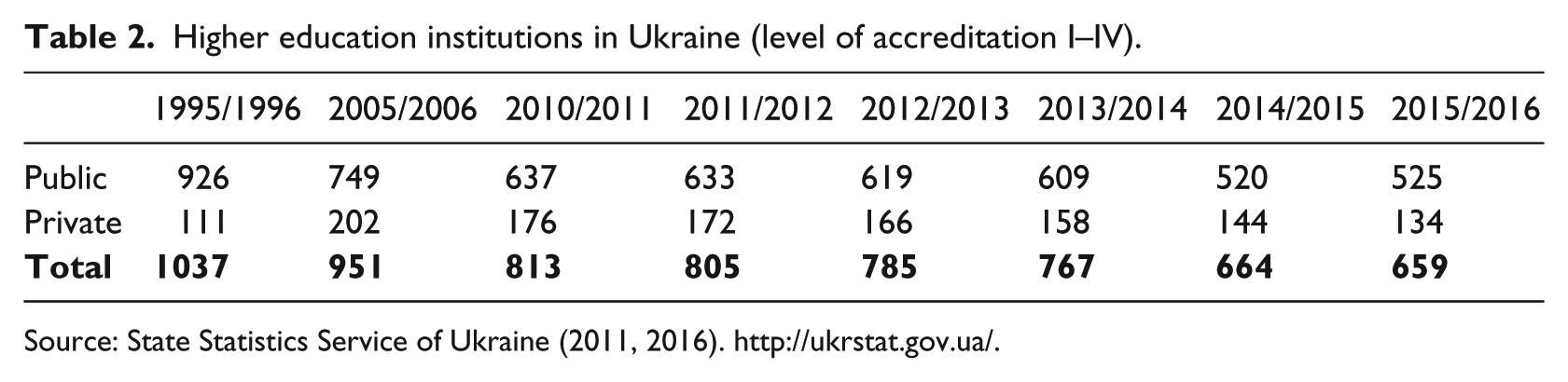
The demographic explains the trend towards higher education ‘deprivatisation’ (Kwiek, 2016). While the overall number of students decreased from nearly 2 million in 2006 to 1469 million in 2014 (GUS, 2015), this decline hit private HEIs harder than the public ones. In Ukraine there were 525 public HEIs and 134 private ones in 2016, compared to 926 public and 111 private institutions two decades before (State Statistics Service of Ukraine, 2016) (see Table 2). The decrease of the number of HEIs is due not only to demographic reasons but also to the loss of the Crimean territory to Russia and the armed conflict in the eastern part of Ukraine. 7 Both in Poland and in Ukraine, the statutory differences between private and public HEIs do not explain the issue of fees, as many students enrolled in public tertiary education institutions still pay fees.
Higher education institutions in Ukraine (level of accreditation I–IV).
Source: State Statistics Service of Ukraine (2011, 2016). http://ukrstat.gov.ua/.
Notwithstanding their specificities, these domestic processes can hardly be disentangled from evolutions that take place in the Western world, as reformers at the national level have constantly referred to foreign academic models.
The overarching European framework of reference
As far as the CEECs are concerned, there is still a debate on how endogenous and exogenous dynamics combine in reform implementation. For some authors, European pressures have resulted in a growing convergence between their HE systems (Dobbins, 2011; Dobbins and Knill, 2009). Others persistently note ‘no significant Europeanisation’ of the HE system they analyse (Pabian, 2009). Varying levels of analysis and choices of data selection contribute to these contradictory results.
As far as the new EU member states (NMSs) are concerned, three phases are generally identified after 1989 (Deca, 2015). The first was the decade of liberalisation and Westernisation, where exposure to foreign models could be expected. A second phase began with the EU accession negotiations, followed by the launch of the Bologna Process, suggesting openness to solutions developed at the European level. Finally, the third, post-accession phase is marked by further cooperation within the European Higher Education Area (EHEA) as well as the publication of international rankings and the increasing use of international comparisons. However, beyond this global scheme, the intensity of reforms and the relative influence of international organisations vary according to the domestic political context. Countries that were not part of the EU enlargement, such as Ukraine, were less dependent on the temporality of the accession process. Still, it makes sense to integrate former Commonwealth of Independent States (CIS) states into the analytical framework addressing their Europeanisation and internationalisation, especially in cases where their government’s attitude towards the EU was influenced by internal political struggles.
EU programmes already played an overarching structuring role during the first phase of the restoration of university autonomy in the early 1990s. The EU programme Tempus (Trans European Mobility Programme for University Studies) helped in developing closer links and expanding knowledge transfers between universities from Eastern and Western Europe. 8 Tempus triggered significant changes in the HE landscape as it helped restructure existing institutions, launch new curricula and study programmes, and promote cooperation with industry. In addition to providing structural support, Tempus encouraged socialisation and the dissemination of expert knowledge. It facilitated the emergence and consolidation of groups of HE experts who instigated reforms within their home universities and later contributed to the domestic dissemination of the Bologna Process. 9 Extended to the former Soviet countries in 1993, the Tempus initiatives have strengthened transnational links between Eastern and Western scholars and academic managers. In Ukraine, the Tempus IV edition focused on the implementation of Bologna principles such as the three cycle system and curricular reforms connected to the labour market as well as ‘Quality Assurance tools for the management of internationalization’ (European Commission, 2012). This illustrates the difficulty of separating the Bologna Process itself and the EU educational initiatives, as they feed off each other.
In the EU candidate countries, European references became more visible in the context of EU accession. While some HE institutions implemented measures aimed at facilitating student mobility (such as the European Credit Transfer System or the two-tier degree structure) on a bottom-up basis as early as in the 1990s, the perspective of accession provided an opportunity for more directive interpretations of the formally non-binding Bologna principles. The interviews with Polish experts show that the Bologna Process – and the international incentives as a whole – were not only considered as a non-negotiable package: these instruments were associated with modernity and progress and considered as tools to transform society. 10
The overarching belief that a country in transition cannot afford to opt out from the process was similar to the attitudes observed in other new EU Member States, such as Romania (Deca, 2015). This domestic framing of the Bologna Process, which seems characteristic of the new democracies from Central and Eastern Europe, explains why the different provisions of the process have systematically been transformed into legal acts and detailed regulations.
Looking for the impact of international organisations
Before the growing focus on the EU level, countries from Central Europe had been exposed to the influence of international institutions active in the education sector. The interest of these organisations in the region did not start in 1989, as is shown, for instance, by UNESCO’s 1972 initiative of opening a European Centre for Higher Education (CEPES) in Bucharest. Both UNESCO-CEPES and the World Bank have been actively involved in the transformations of the Romanian HE system after 1989 (Cîrstocea, 2014; Deca, 2015).
While international organisations active in the educational field have implemented several projects in Poland, their policy impact has been limited. These projects have led to the publication of several reports, which have fuelled public debate as a legitimate point of reference. However, these reports did not directly serve as a basis for reform. While international organisations called for the introduction of tuition fees for all students (Canning et al., 2007; World Bank, 2004), this politically sensitive reform has never been explicitly implemented in Poland, where HE is constitutionally free. Yet, in practice, nearly half of all Polish students pay some kind of tuition fee.
The 2011 HE Act introduced compulsory fees for students who pursue a second major, but the Constitutional Court ruled against this practice in June 2014. This shows that domestic priorities and institutional legacies make it possible to bypass the recommendations of international organisations, which have repeatedly called for the diversification of HE revenues.
In Ukraine, non-European organisations such as the World Bank, United States Agency for International Development (USAID) and the Soros Foundation have played an important role in HE reform assistance. 11 Their resources and expertise have been welcomed by local policy-makers, even if domestic constraints provide the most direct explanation for the adopted reform frameworks. In Ukraine, where HE has suffered from underfunding, roughly half of the student body currently pay fees, including in public HEIs. The strong budgetary pressure linked to the financial crisis and the cost of war in the eastern part of the country have reinforced the trend of reducing the number of state-subsidised (i.e. free) ‘contracts for the higher education training of specialists’. 12 While this trend had already begun in 2010 – under the controversial minister of Education Dmytro Tabachnyk – the pro-European government that came to power in 2014 has further decreased the funding earmarked for these subsidised HE institutions. This decision, resulting from domestic material constraints, resonates well with the objective of ‘diversify[ing] funding sources, drawing to a larger extent on private funding’ included in the Commission’s modernisation of higher education agenda (European Commission, 2011). However, it might conflict with the objective of increasing attainment levels in HE featured in the Europe 2020 strategy. This may also be detrimental to the so-called social dimension of HE, mentioned by the Bologna Process.
Another set of policy trends prioritised by international organisations has been reflected in various reforms that converged with Commission and OECD recommendations. They have introduced mechanisms enabling closer ties with the economic environment as well as quality assurance measures. Following these external recommendations, the Polish government invested in applied, market-oriented courses such as environmental protection (although the latter programme has recently struggled to attract enough students). In 2014 it introduced an ambitious data collection system to obtain information about the income of former students from the national social security office (which has triggered some concern about data protection). Despite this, much HE organisation has remained unchanged, as no radical reform of university governance has been imposed upon the universities (Dobbins, 2015).
In Ukraine the very idea of state contracts for the training of specialists in strategic branches, which has its origins in the Soviet period, shows a correlation between the investments in HEIs and the job market, with a central role still played by the state. A law that aimed at facilitating entry into the labour market for young holders of a HE degree was adopted in 2004 (European Commission, 2012). Several external assistance programmes have focused on the market relevance of HE curricula. The Strategy of Reforming Higher Education by 2020 identified a ‘lack of mechanisms of interaction of high school with the labor market’ and called for ‘attracting professional public employers to control HEIs and determine the content of learning’ and for ‘basing educational standards on professional standards’ (Zhyliaev et al., 2014, P. 35). However, this strategy, which has been developed with the assistance of USAID, has yet to be officially adopted by the government. 13 These cases show that the decision to adapt to external policy recommendations may cause tensions between divergent policy objectives, side effects, and a discrepancy between the declared policy direction and its implementation (particularly noticeable in the Ukrainian case).
In countries outside the EU, the policy translation of international academic competition could lead to a greater stratification of the academic community. Policies aimed at diversifying HEIs and the emergence of institutions targeting the label of ‘world-class university’ are not so much a direct answer to the institutional recommendations of an IO, but rather a political recognition of the growing significance of global university rankings (Erkkilä, 2013). Even countries that seemed the most isolated from the international community, such as Belarus, which was denied admission to the Bologna Process until 2015, have made several initiatives to attract foreign students (mainly from the former Soviet countries) (Gille-Belova, 2015). The Ukrainian government has also joined the trend and launched a policy aiming at differentiating its higher education institutions with the ambition of creating national research universities, but above all to tackle corruption, low quality of teaching and research problems (Oleksiyenko, 2014). Measures undertaken to promote the internationalisation of the domestic HE system may thus illustrate a domestic effort to participate in the international academic exchange.
The political dimension of HE reforms: the Polish and Ukrainian cases
Focusing on the domestic interpretations of the Bologna Process and of the EU recommendations on HE provides an opportunity to approach the Europeanisation process through the prism of the political uses of European recommendations (Woll and Jacquot, 2010). Furthermore, the Polish and the Ukrainian cases offer an opportunity to empirically refine the recent thesis on the (party) political dimension of higher education reforms. In this section, I argue that it is important to take into account the configuration of each national political field to examine the extent to which existing cleavages influence the domestic framing of Western recommendations. The point is not to compare the structure of both party systems as such, as they diverge and result from different historical evolutions. In Poland, the left-wing parties have been marginalised over the past decade even though their leaders tried to distance themselves from their authoritarian and Communist roots. Since 2005, the national-conservative Law and Justice (PiS) and the liberal Civic Platform (PO) have dominated the party landscape. In Ukraine, there is a strong geographical and linguistic component – which accounts for the greater presence of the pro-Russian Party in the regions in the eastern part of the country – but also a strong personalisation of political parties (an example being the Bloc Petro Poroshenko). According to some authors, it is difficult to speak of a functioning party system in Ukraine, as most parties are weakly institutionalised and many of them appear as channels ‘for converting economic capital into political capital’ (Wilson and Birch, 2007: 53). Following the Maïdan Revolution, the Russian annexation of Crimea in 2014 and the military conflict in the eastern part of the country, the cleavage between pro-European and pro-Russian forces has come to the fore.
The Bologna Process has been a challenge to the approach which considers the politics dimension as an important explanatory variable of change: in many countries, the tendency to harmonise HE systems seems to be shared regardless of the political majority in office. In the French and Polish cases, for instance, over the past 15 years noticeable changes in the policy interpretation of the Bologna Process have been mainly rhetorical, with centre-left wing majorities stressing the importance of public funding for HE and the social dimension and centre-right governments emphasising the competitive allocation of public funds. However, a closer look should be taken to see whether the party political dimension can be an explanatory variable that helps in understanding differences in policy interpretation and outcomes. Recent studies have re-evaluated this dimension – albeit focusing exclusively on Western European countries – and privileged a left/right divide as the main variable (Jungblut, 2014, 2015). This cleavage does not necessarily apply to CEECs, where other dividing lines can intervene, such as the divide between the socio-economic liberal and illiberal parties (as in the Polish case) or between a pro-EU and pro-Russia majority (as in Ukraine). Therefore, it is worth asking whether and to what extent a government’s attitude towards European integration and the country’s relationship with the EU can be an indication of its stance toward the Bologna Process and HE reforms in general.
Europe as a window of opportunity for Ukrainian reformers
After the beginning of the conflict in the East and the Russian annexation of Crimea, the new Ukrainian government launched an ambitious higher education reform. The Law on Higher Education adopted in 2014 is based on three projects that had been discussed since 2008. It was only after a pro-European government came to power in February 2014 that a window of opportunity opened for this ambitious reform, led by the Minister of Education and Science, the former rector of Kyiv Mohyla Academy, Serhiy Kvit and his colleagues (Kvit was replaced, in April 2016, by Lilia Grinevich, from the same pro-European majority). Since Ukraine joined the Bologna Process in 2005, this is the first comprehensive attempt to align the domestic HE with the European Higher Education Area’s functioning mechanisms. The last comprehensive Law on Higher Education dates back to 2002. In 2011, a National Qualifications Framework was approved by the Council of Ministers of Ukraine. 14 The 2014 law announced priority treatment for ‘National higher education institutions’ (art. 29) and ‘Research Universities’ (art. 30), which are entitled to extra budgetary support. In tune with the objective of quality and relevance of higher education included in the EU’s HE modernisation agenda, the Ukrainian government has planned to reduce the number of HEIs. 15 For this purpose, hundreds of technical schools and colleges were supposed to be re-labelled as vocational education institutions (a reform that former governments had already unsuccessfully tried to carry out). This met with widespread opposition from technical HEIs. 16 The idea of reducing the number of universities through ‘mergers, consolidation, clustering and specialisation’ reflects the priorities of the European Commission, formulated in the Education and Training 2020 strategy. 17
In Ukraine, internationalisation appears as an important criterion to claim the status of ‘research university’, as the latter considers the HEI’s ‘level of integration in the global education and research space’, the ‘place in the national, industry and/or international rankings’ as well as the ‘number of publications by indexes of recognized international scientometric databases and international peer reviewed journals’ (Law on Ukraine Higher Education, 2014, p. 34–35). However, the implementation of these provisions remains unclear, not only because few Ukrainian scholars are active in international publication channels, but also due to the dire budgetary situation of the Ukrainian state. As the available funds are prioritised for the conflict that is tearing the eastern territories apart, the educational sector is struggling to maintain its level of funding. 18
As far as the Bologna Process is concerned, the Ukrainian 2014 HE Law refers to the European Higher Education Area with provisions on the ECTS, learning outcomes, a National Quality Assurance Agency for Higher Education and ‘alignment of the National Qualifications Framework with the Qualifications Framework of the European Higher Education Area’ (art. 74). However, several structural problems hamper the implementation of these provisions. The problem of corruption persists even though the government intends to address it by setting up more transparent mechanisms of student and staff recruitment. On the domestic level, the principle of an independent quality assurance agency is new. Yet this agency could not launch its activities by the time of the legal deadline because elected members did not meet the required anti-corruption standards. 19 This shows that the pro-European orientation of the central government is not a sufficient prerequisite for the successful implementation of the designed reforms as more path-dependent institutional coalitions may postpone or block the new measures. The entry into force of the EU–Ukraine Association Agreement and Ukraine’s inclusion in the Horizon 2020 research and innovation funding programme open new perspectives for cooperation. Much will depend, however, on the country’s political situation and the evolution of the conflict with Russia.
Bringing the domestic dimension of the HE reforms back in: the Polish case
In Poland, which was signatory to the Bologna Declaration in 1999, both moderate left- and right-wing governments supported the principles of the Bologna Process and took several policy steps in that direction. The 2005 Higher Education Act translated the proposals of the Bologna ministerial meetings into a legal framework. However, this reform was deemed insufficient by the liberal government led by Donald Tusk, the leader of the Civic Platform (PO) that came to power in 2007. The new HE Minister, Barbara Kudrycka, launched a comprehensive reform of the academic system. In 2010, the government adopted a series of legal acts reforming the research system followed by a Higher Education Act, which entered into force in October 2011. 20 This new law introduced evaluation and competition mechanisms, which opened the race to the title of best faculty, ‘national research leading centre [KNOW] diamond grant’ and other measures promoting the internationalisation of academic publications and diversification of research centres. The vocabulary of competition has prevailed in the announcements of these measures, in tune with the narratives diffused by international organisations active in the field.
The HE Law of 2011 and the related regulations led to the definition of syllabi in terms of learning outcomes, the publication of a National Qualification Framework and numerous initiatives promoting HE quality-enhancing mechanisms as well as student and academic staff mobility. In June 2015, the Polish Ministry of Science and Higher Education adopted a programme of HE internationalisation which systematised measures aimed at attracting foreign students and researchers to the country and at facilitating mobility for domestic scholars, for the purpose of boosting the country’s competitiveness on the European and global market. 21 The available EU structural funds were used to support these efforts (Ministry of Science and Higher Education, 2015).
However, although it is considered a committed member of the Bologna Process, Poland’s position in the European Higher Education Area has raised some international concern after the October 2015 parliamentary elections won by the national-conservative party Law and Justice (PiS). In the weeks following the electoral victory, leading PiS representatives publicly expressed their scepticism towards the Bologna Process (Flis, 2015). However, the new minister of Science and Higher Education Jarosław Gowin, appointed in November 2015, has not announced any radical departures from the previous government’s policy orientations and measures that triggered competition among universities and researchers. Overall, in the Polish case, changes in orientation of the ruling majority (left/right, conservative/liberal) have so far triggered mainly rhetorical policy changes. Although it is too early to make any definitive statements about further policy change, both the Polish and Ukrainian cases show that EHEA membership does not necessarily imply a linear advancement towards the common goals.
Conclusion
This contribution confirms the importance of external incentives for HE reform in the context of post-Communist transformation and EU accession. However, it shows that these external factors do not exercise influence per se. They depend on domestic priorities and narratives and can take different forms. In CEECs, it is difficult to disentangle the impact of European and other international factors, both IO recommendations and transnational processes such as the rise of global rankings. Their respective influences may be observed through the ways in which domestic policy-makers and experts interpret external recommendations. In the Polish case, recommendations made by the European Commission and during Bologna ministerial conferences have played a major role. They have been useful to policy-makers and experts, who have used existing reports as legitimising references to show that their reform projects are merely a local version of more global rules.
Contrary to some older EU member states, which may have more leeway in adjusting the various features of the Bologna Process to the domestic educational system, Polish policy-makers have tried to bend their educational system to comply rather strictly with external recommendations. Several new EU Member States, such as Poland and Romania, were eager to present themselves as ‘good pupils’ in European arenas. While EU compatibility and modernisation used to be authoritative arguments to silence academic dissent in the accession period, the growth of EU-critical political movements in the region shows that the argument of an external constraint is no longer sufficient. It appears more audible in the EU neighbourhood, as in the case of Ukraine in the aftermath of the Euromaidan movement. As the country’s new governing elites owe their legitimacy to their promises of implementing the EU–Ukraine Association Agreement and fighting corruption, the pro-European Ukrainian government has a window of opportunity to implement an ambitious HE reform. However, whether the window remains open depends heavily on the overall economic and geopolitical situation and is therefore uncertain. Whether Ukrainian experts and policy-makers are willing and capable of convincing larger parts of the academic community of the usefulness of the Bologna Process, which is remote from their direct, material problems, also remains to be seen. All in all, in CEECs the domestic retranslation of policy patterns and the government’s attitude towards European integration have to be taken into account in order to better understand shifts and stagnation periods in HE policy reforms.
Footnotes
Declaration of conflicting interests
The authors declare that there is no conflict of interest.
Funding
The author(s) disclosed receipt of the following financial support for the research, authorship and/or publication of this article: This research has been funded by a Junior Fellowship of the Institut Universitaire de France.