




Abstract
This paper presents the main findings of an action-research study that took place in seven European countries in order to develop effective educational responses to prevent and combat discrimination. The study entailed the design of media and citizenship education activities, their implementation in the different educational contexts and the evaluation of their effectiveness in raising young people’s awareness of discrimination. The results of the study shed light both on the advantages and constraints of educational practice, variations that often depend on the specific cultural and social context. On the one hand, the analysis and the evaluation of educational experiences suggest that critical media literacy can enable the development of critical reading/viewing skills as well as acts of participatory and inclusive citizenship that question derogative and essentialist media representations of the Other. On the other hand, the results highlight the difficulty of promoting young people’s awareness of discrimination through active methods of teaching and learning or through media content which is far from young people’s experience, interests and concerns.
Keywords
Introduction
In recent years, populism has gained momentum in several European countries. Due to globalisation and migration processes, neoliberal transformations of welfare states and shrinking labour markets, populist parties and movements have (re-)emerged around Europe. In addition, a combination of factors labelled as ‘post-democracy’ (Crouch, 2004), such as decreasing trust in traditional political parties and party de-alignment, have nurtured the popularity of ‘anti-system parties’ and populist movements (Albertazzi and McDonnell, 2008; Canovan, 2004; Rydgren, 2005; Mammone et al., 2013; Wodak et al., 2013). The same context has aroused new forms of discrimination. Indeed, in the last 15 years, European countries have witnessed a growing number of hate crimes towards immigrants, including hate speech, physical violence against and murders of people from ethnic and religious groups such as Roma or Muslims. In particular, new media platforms and social networking sites have been seen by right-wing populist organisations as a driver to promote hate speech towards the ‘other’ and new types of proselytism. Race, gender, disabilities and sexual orientation have been alternatively used as a basis to discriminate against the ‘other’, and media have been used as sounding boards.
From an educational point of view, concerns have emerged about young people and the increase of these populist and discriminatory parties or movements, and the role that media may play in reinforcing stereotyped representations of the ‘other’. On one hand, several studies report falling turnout and party involvement among young people (Kestila-Kekkonen, 2009; Henn and Foard, 2012; Cammaerts et al., 2014). On the other hand, many researchers have pointed out that academics tend to privilege traditional forms of participation such as voting and party membership rather than new modes of political engagement like the protest or boycott (Bennett et al., 2009). At the same time media are seen as means to convey discriminatory messages (Livingstone et al., 2013; Tsesis, 2002) as well as enabling platforms for alternative political practices (Levine, 2007; Mihailidis, 2011).
In this context, media education combined with civic or citizenship education can be viewed as a potential strategy to raise young people’s awareness of (anti-)discrimination and enable their participation as active citizens in contemporary society. This paper explores this potential through the presentation and discussion of the results of e-Engagement against violence (e-EAV), a European project carried out in seven European countries (Austria, Belgium, Bulgaria, France, Italy, Slovenia and the United Kingdom) with the financial support of the European Commission. The project lasted two years (2012–2014) and entailed several actions among which were the design, implementation and evaluation of media and citizenship education material against discrimination in about 20 schools in Europe.
In the following, we firstly present the main trends in Europe of citizenship and media education, with a particular focus on the countries involved in the project. Then we will illustrate the methodological approach that inspired the design of the modules and discuss the results of the action research. We conclude with some considerations on the role of media and citizenship education in contrasting the different forms of discrimination emerging in contemporary European societies.
Citizenship and media education as educational responses to discrimination in Europe
Defining discrimination is a challenging task. Broadly speaking, we can say that ‘discrimination is an action or practice that excludes, disadvantages, or merely differentiates between individuals or groups of individuals on the basis of some ascribed or perceived trait’ (Kohler-Hausmann, 2011: n.p.). That said, there are several competing definitions of this term which basically refer to two related yet distinguishable phenomena (Pager and Shepherd, 2008): intentional discrimination, which indicates direct forms of discrimination such as deliberate disparate treatment (e.g. denied admission to a restaurant or hotel because of sexual orientation), and disparate impact, when the system and its rules have not taken into account the needs of a group protected under the law, or the system has not evolved with our changing society (e.g. older buildings that were built without a ramp for people who use wheelchairs). In our case, we are mainly referring to intentional or direct forms of discrimination, which are actions including speeches and other forms of communication practices that derive from populist ideologies based on contrasting the people (i.e. the ‘us’ or also the ‘in-group’) against the other (i.e. the ‘out-group’). The other can be Muslims, women, etc., and these groups can become the objects of different forms of symbolic or physical violence.
From an educational point of view there has been a long history of attempting to address discrimination issues in Europe through citizenship or civic approaches (Osler, 2012). However, citizenship education is a polysemous concept entailing different meanings depending on the notion of citizenship that underpins it. Indeed, similar to the concept of discrimination, citizenship is a multi-form and dynamic concept. Therefore, each attempt to define it seriously risks neglecting some relevant aspects or oversimplifying its problematic nature. For our purposes, useful is the definition provided by Audgier (2000), according to whom
the core competences associated with democratic citizenship are those called for by the construction of a free and autonomous person, aware of his rights and duties in a society where the power to establish the law, i.e. the rules of community life which define the framework in which the freedom of each is exercised, and where the appointment and control of the people who exercise this power are under the supervision of all the citizens. (p. 17)
This definition, which stems from a comparison among definitions provided within different European contexts, highlights the political and legal dimension of citizenship as well as the role of people in controlling the power. The attention to the function of people in the conceptualisation of citizenship is strictly linked to the idea of participatory democracy, which seems to be increasingly recognised as vital for future society as testified by the frequent use of the adjective ‘democratic’ together with citizenship. The participatory model emphasises the importance of different forms of citizens’ participation in a democracy, particularly in collective deliberative processes, and criticises the reduction of participation to periodic voting in or out of different elites (Pateman, 1970). It identifies citizenship with social agency and with a broader conception of democratic participation, which implies greater involvement and more egalitarian relationships in all public arenas (Ichilov, 1990; Osler and Starkey, 2005). This approach to citizenship has important implications in terms of knowledge and competences for citizenship education at school: basically they can be grouped into two clusters, including on the one hand knowledge in political, legal, social and cultural domains, and on the other hand three types of competences; that is, cognitive competences, ethical competences and action-related competences (Audgier, 2000).
In Europe a relevant role in promoting the development of citizenship has been played by the Council of Europe and the European Commission, which influenced through their recommendations, national policies and initiatives by funding transnational research, curriculum development and mobility programmes across the continent (Osler, 2012). Most importantly, in 2010 the Council of Europe (2010) released the Charter on Education for Democratic Citizenship and Human Rights Education, where education for democratic citizenship is meant as education, training, awareness-raising, information and activities aimed at developing learners’ knowledge, skills and attitudes ‘to empower them to exercise and defend their democratic rights and responsibilities in society; to value diversity; and to play an active part in democratic life, with a view to the promotion and protection of democracy and the rule of law’ (p. 3). Respect for diversity and human rights is at the heart of this document as well as the importance of democratic learning practices in the training of young people, teachers and educators.
Moving from theory to practice, it is worth mentioning a document recently published by the Eurydice Network on citizenship education in European schools (Eurydice, 2012). It reports that citizenship education is part of national curricula in all European countries and it is delivered through three main approaches that are often combined across the continent: as a stand-alone subject, as part of another subject or learning area or as a cross-curricular dimension. Generally speaking, citizenship curricula cover a wide and very comprehensive range of topics, addressing the fundamental principles of democratic societies, contemporary societal issues, such as cultural diversity and sustainable development, as well as the European and international dimensions. More specifically, citizenship education is commonly understood to involve four main components, which are a) political literacy, b) critical thinking and analytical skills, c) attitudes and values and d) active participation (Eurydice, 2012). However, it must be noted that, despite similarities, there are also important differences in the way in which citizenship education is meant and implemented in the different countries. Indeed, even though the Council of Europe and the European Commission have fostered education for citizenship through several means, their impact on national policies and programmes varies considerably. As underlined by Osler (2012),
countries which experienced a period of dictatorship in the second half of the twentieth century, such as Spain, Portugal and Greece, tend to acknowledge its influence in national plans for education for democratic citizenship more readily than many nation-states which had a continuous history of democratic rule in this era. (p. 375)
As for the former communist nation states,
the Council of Europe plays a key role in supporting processes of democratization and the development of civil society in Eastern and Central Europe, offering educational expertise and guidance. In the Balkans, following the wars of the early 1990s, the Council contributes to programmes for peace, conflict resolution and intercultural learning. (p. 376)
As regards media literacy education, since the Nineties this pedagogical approach has abandoned the defensive attitude that characterised its early years, resulting in the resistance and rejection of educators towards media. The new phase, labelled by Buckingham (2003) as the ‘preparatory phase’, sees media literacy education as a tool to develop young people’s critical understanding of, and informed participation in, the media culture that surrounds them. Media are not perceived as dangerous and young people are no longer viewed as passive users. From an educational point of view, the main purpose is now to make young people develop their capacity of understanding the media considering economic and social factors, and to promote active participation and democratic forms of media production (Alvermann et al., 2012; Buckingham, 2003, 2007; Buckingham and Rodríguez-Hoyos, 2013; Brandtzæg et al., 2012; Goodman and Cocca, 2013; Hobbs, 2010, 2011; Kellner and Share, 2007, 2009). In this regard, Kellner and Share (2007) suggest using the expression ‘critical media literacy’: this term enlarges the traditional concept of literacy, including different types of mass communication and popular culture and ‘deepens the potential of education to critically analyse relationships between media and audiences, information and power’ (p. 4). To this purpose, it entails the promotion of ‘skills in analysing media codes and conventions, abilities to criticise stereotypes, dominant values, and ideologies, and competencies to interpret the multiple meanings and messages generated by media texts’ (p. 4). In such a way, critical media literacy helps people ‘to evaluate media content, to critically dissect media forms, to investigate media effects and uses, to use media intelligently, and to construct alternative media’ (p. 4).
The intersection between media and citizenship education mainly lies in their common goals to promote young people’s empowerment and their role as active citizens in democratic life.
When coming to the implementation of media literacy education at school, there is a multifarious situation in Europe. In some countries, media literacy education is an important component of the curriculum, while in other countries only few and sporadic initiatives are carried out at school, or even nothing (Parola and Ranieri, 2010). For instance, in Italy there have been no official and systematic policies from the Ministry of Education about media education at the school level and this discipline has been provided only by certain academics in universities, some cultural associations and/or teachers in schools (Aroldi and Murru, 2014). Similarly, in Bulgaria, media education is not explicitly mentioned in the school curriculum, although media education-related concepts can be found within some subjects, such as Arts, Civic Education and Social Studies (Pérez-Tornero, 2014c). A cross-curricular approach characterises the Austrian policy (Pérez-Tornero, 2014a) as well as the Slovenian one, where media education is officially recognised as part of the curriculum from the pre-school to the university level (Pérez-Tornero, 2014e). Media education is explicitly mentioned in the French (Pérez-Tornero, 2014d) and Belgian school curriculum (Pérez-Tornero, 2014b) in a cross-curricular perspective, while there are subjects that develop it more widely, particularly Mother Tongue and Citizen/Civics Education. In the UK, media literacy education has been optional since the Seventies and references to media literacy education are also present in the English curriculum and more recently in Arts, Design and Music (Pérez-Tornero, 2014f).
In short, some form of media and citizenship education is in place in all seven European countries with provision for media and citizenship education differing between contexts.
e-Engagement Against Violence educational material: Contents and approach
e-EAV educational materials were conceived to be implemented in several different contexts in Europe. They addressed young people (aged 13–19) with the aim of raising (or strengthening) their awareness of how media can contribute to reinforce or contest different forms of discrimination as well as to enable them to produce effective media narratives about discrimination, possibly by questioning it. To achieve these objectives we adopted the critical media literacy approach outlined by Kellner and Share (2007, 2009) and explained above, along with further literature from the wider field of media education (Masterman, 1994; Buckingham, 2003, 2007; Hobbs, 2010, 2011), which provided the background for the design of the educational activities.
e-EAV educational materials consist of five modules, each of which includes 10 units. Modules vary according to the specific media and/or particular uses/functions of media they focus on. Module 1 concentrates on the processes of encoding and decoding representations of different social groups in and through the news media (e.g. online newspapers, blogs, etc.). Module 2, instead, focusses on the ideological functions of fictional media narratives (movies, TV-series etc.). Module 3 deals with social relations and identities that can be performed through video games and also in real-life situations. Module 4 revolves around the political discourses about the ‘other’ performed through different media (political parties’ video ads, electoral posters, etc.). Finally, Module 5 centres on practices of political activism and civic engagement sustained by the use of digital media, especially social networks. Since critical approaches to media education aim not only at enabling young people’s critical understanding of media but also at encouraging their critical participation as media producers in their own right (Buckingham, 2003; Hobbs, 2010), each module includes five units on media analysis and five units on media production engaging students in different types of media education activities. Moreover, the modules have a privileged focus on how media represent specific social identities, power relations and differences between social groups. In this respect, the ‘politics of representation’ (Ang, 2002; Hall, 1980) can be seen as a prominent aspect of the critical media literacy promoted in this context.
Research design
The implementation and evaluation of e-EAV’s modules were carried out under a common participatory action research strategy based on the cooperation between researchers and teachers/educators (Kemmis and McTaggart, 2000). Our hypotheses were that the media literacy education modules (i.e. their contents and pedagogical strategies) would have contributed a) to enable young people’s critical understanding towards media and discrimination, and b) to develop their ability to question and contrast different forms of discrimination that characterise their own social contexts, as well as the wider society. These hypotheses were therefore reformulated into the following research questions:
Do media education activities enable students’ critical understanding of media and (anti-)discrimination practices?
Do media education activities provide opportunities to question discriminatory media messages and discriminatory practices?
In order to understand and assess the impact of the modules on students’ learning and participation, we developed and employed a range of data collection tools before, during and after the activities in school.
At the beginning of the action research we administered a written test to students aimed at seizing their knowledge and opinions about some key topics and issues addressed by module(s) they were going to test. In this regard, the two participant groups in Bulgaria were an exception as the questionnaire was replaced by focus groups relating to the same topics included in the written test. This variation was due to the students’ psychological reticence in answering written questions, as it looked like a ‘real’ examination. Therefore the Bulgarian research team preferred to adopt a less formal approach in order to overcome this resistance and thus to explore students’ knowledge.
During the action research, we adopted two main tools: the logbook and the product evaluation form. The logbook served the purpose of documenting – and reflecting on – the process, particularly the learning situations that occurred and the criticalities that arose in the course of the lessons. Furthermore, the logbook was functional to gather teachers’ and researchers’ evaluations about the units implemented and their suggestions to improve the activity. The product evaluation form, instead, aimed at assessing the quality of media products (e.g. videos, small research projects, newspaper articles, etc.) created by students.
At the end of classroom activities we gathered further data through the same test administered at the beginning and a students’ satisfaction questionnaire. The re-administration of the first test served the purpose of observing eventual changes in students’ answers on the same issues. In this respect, two participant groups in Austria did not have time to fulfil the post-questionnaire because of the end of the school year, whilst in Bulgaria this latter was replaced by focus groups because of the same reasons mentioned above in relation to the pre-test. The students’ satisfaction questionnaire, instead, aimed to obtain students’ evaluations and interpretations of the educational experience. In Bulgaria even the students’ satisfaction test was replaced by focus groups because of students’ reluctance to engage with this type of written feedback, whilst one group in the UK, due to time constraints, provided only verbal comments to the teacher, who reported them in the logbook.
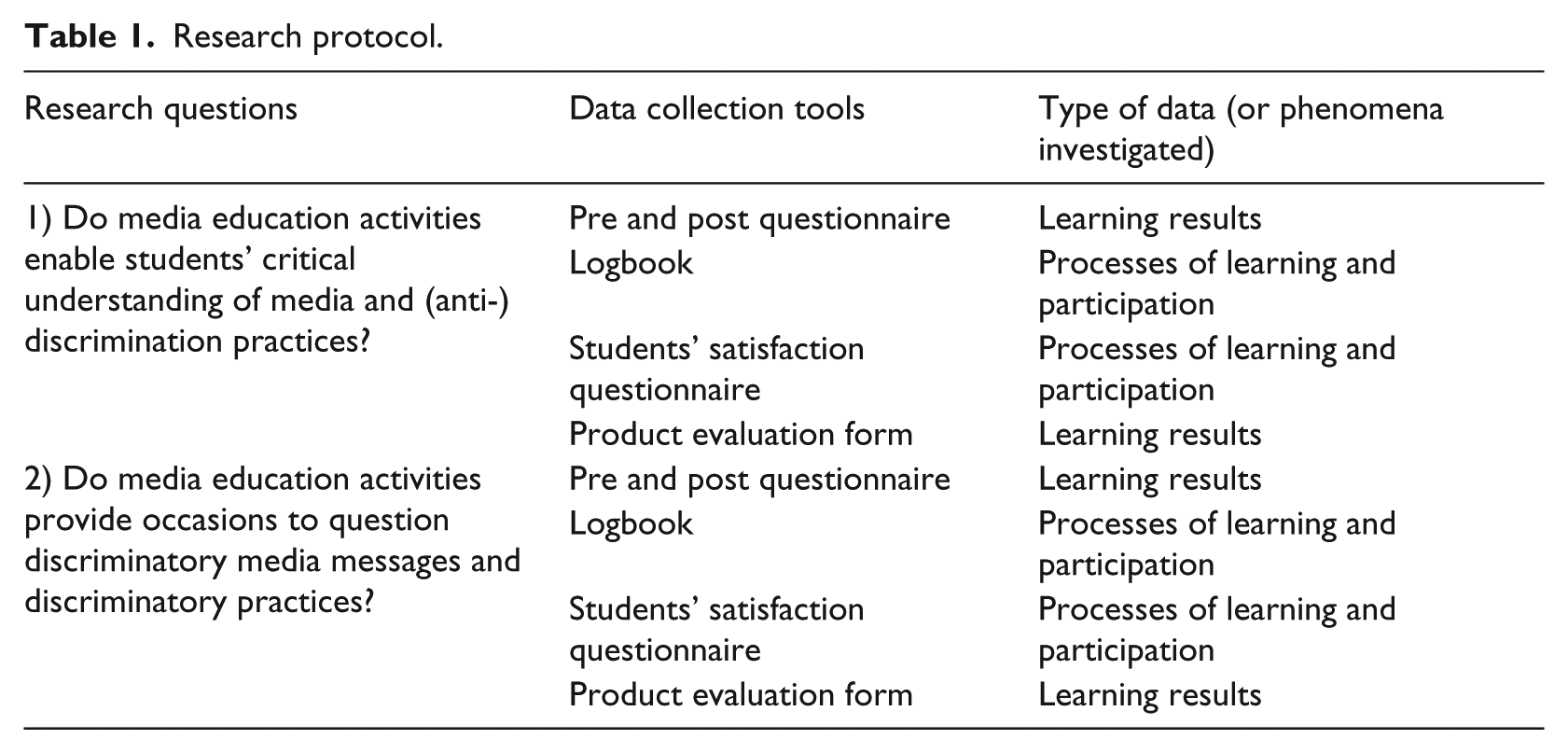
In each national context, researchers drew some conclusions based on the triangulation (Yin, 1994) among the different types of data collected. Table 1 summarises the research protocol adopted, including research questions, data collection tools and types of data collected (or phenomena investigated).
Research protocol.
The comparative analysis was carried out through three main interacting and cyclical procedures indicated by Miles and Huberman (1994): data reduction, data display and drawing verifying conclusions.
Although the empirical investigation of educational practices was carried out through a wide set of data collection tools and according to a common systematic methodology, some limitations regarding data gathering must be acknowledged. As explained above, in two situations (i.e. all groups in Bulgaria and one group in the UK), quantitative data were not collected through the satisfaction questionnaire due to specific circumstances. This prevented, in some cases, the triangulation of qualitative and quantitative data. The difficulties encountered by some partners in collecting data – and particularly the reluctance of several students to provide written feedback or simply their lack of writing skills – somewhat points to the need to adopt other data collection strategies (e.g. small focus groups) in future empirical investigations.
Participants
Overall, 487 students, 19 teachers, 6 educators and 14 members of the e-EAV research team took part in the action research. In each country the e-EAV researchers identified the schools, the teachers and the educators to implement the educational materials. All groups of participants carried out the media education activities in formal education settings – mostly in schools – but the latter often differed from one case to another, even within the same national context. Indeed, the types of institutions involved ranged from private and elite schools to classes intended to reach those excluded from mainstream schools. Despite this difference, most teachers were to some extent already familiar with the use of media in their classes and some of them had already carried out similar educational projects on discrimination issues. The age of participants ranged from 12 to 19. Participant groups varied, sometimes even internally, in terms of gender, class and ethnicity. Regarding gender composition of the whole sample, boys and girls were almost equally present with a slightly higher number of girls. Stronger differences among participant groups and sometimes within the same group were observed along the lines of class and ethnicity. Hence, the sample included both young people with high socio-economic status and students with disadvantaged backgrounds. Nevertheless, most of the young participants in the sample were middle-class boys and girls. Furthermore, some participant groups were ethnically mixed, whilst others were formed almost exclusively by natives with no mixed ethnic background.
Of course, the students’ prior knowledge and awareness of media and discrimination varied greatly from one group to another and, not rarely, from one individual to another in the same group. In some cases, students were already able to discuss the modern media system whilst in others they lacked even the basic media competences and participatory skills.
In each national context different units and modules were implemented and assessed. Specifically, in Austria young participants focussed on Module 2; in Belgium some groups worked on contents of Module 3 while others on those of Module 4; in Bulgaria they concentrated on Module 2, and in France on Modules 2 and 3; in Italy the action-research embraced Modules 1, 4 and 5; in Slovenia students engaged with Module 5, whilst in the UK with Module 1.
Findings and discussion
Reading/viewing critically through media analysis
Overall, analysis-oriented activities enabled participants’ reading/viewing skills only when students were truly interested in the specific media content under consideration and they had the concrete chance to reflect on their own experience as readers/viewers.
Both form and content of media messages played a relevant role in engaging (or disengaging) students. Regarding media language, in several cases (i.e. groups from Bulgaria, France, Italy and the UK), students’ answers provided in the satisfaction questionnaires indicated visual and/or audio-visual language as the favourite types of languages to analyse. Conversely, almost all young participants deemed the analysis based on written texts boring and difficult. For example, in France many students who carried out the analytical activities included in Module 2 – Audio-visual fiction and ideologies stated that they really enjoyed watching and discussing movie extracts, especially those they were more familiar with. In some cases multimedia language contributed to some extent to engage students in the analysis of media content, unknown or irrelevant to most of them before e-EAV activities, particularly about stereotypes based on race and gender. Students from Austria who engaged with audio-visual analysis commented at the end of the activity: ‘I think it is important to watch films critically and to develop an understanding of stereotypes’ (Student, Austria, quoted from Mayer and Sauer, 2014: 12) or ‘I didn’t know what “stereotype” means, it has been well explained and with good examples’ (Student, Austria, quoted from Mayer and Sauer, 2014: 12). Furthermore, some teachers in Bulgaria, Italy, Slovenia and the UK reported higher levels of participation compared to standard lessons and some of them also underlined how multimedia analysis contributed to enabling an unexpected participation among the more disengaged students. If we contextualise students’ appreciation of multimedia analysis in relation to their ordinary uses of media in school, we can claim that the pleasure of working with visual and audio-visual languages was favoured also by its being a novelty. For instance, students from the French groups were used to watching art films at school rather than commercial movies; therefore, analysis of popular media culture for them was a new practice (reported in Jehel and Magis, 2014). Students’ pleasure in analysing and discussing specific multimedia content often turned into an opportunity to develop basic critical reading/viewing skills. This is the case of one group in Italy where many students commented that the analysis of representations based on images was a useful method to better understand how news media representations can vary according to journalists’ points of view and how representations can affect their own opinions and understanding. This is also confirmed by their answers to the question of how to assess the reliability of a news story. Indeed, at the end of the project almost all students were able to provide right answers to this question. In addition, students mentioned a greater number of strategies to ensure the reliability of news stories (reported in Ranieri and Fabbro, 2014).
From this perspective, teachers and researchers observed that debating students’ readings of media messages with peers and teachers as well as engaging students with active methods of teaching and learning (most notably role play) in combination with more traditional socio-semiotic analysis were crucial to taking a more self-reflexive approach. In several cases, students’ reflection and self-evaluation of their own work – whether media analysis or production – were described by teachers and students as important learning moments to make sense of media that permeate their lives. For example, in Bulgaria several students showed at the end of the process a more self-reflexive approach with respect to their own relationship with fictional media. As researchers reported, on the questions ‘Do you think it is true that we always are influenced by the movies we watch? How? Who are more influenced than others by the films he/she watches?’, the initial focus group indicated that students were inclined to overestimate the effects of movies on others (they, them, they), while underestimating the effects on themselves (I, us) (e.g. ‘No we are not. At least I am not. Some more stupid people who doesn’t think are maybe influenced, but not me’, Student, Bulgaria, quoted from Kamenova et al., 2014: 11). On the contrary, in the final focus groups they demonstrated being able to overcome the ‘generalised third person effect’ (Marchand, 2004), starting to reflect more critically on their own experiences as viewers and media producers.
In addition, several students engaged in media analysis-oriented activities stated that the final discussion on their results/products allowed them to compare the outcomes of different analysis as well as to learn from each other. As one student in Italy commented, ‘I liked the debates because they brought me to develop my arguments, talk and express my opinions’ (Student, Italy, quoted from Ranieri and Fabbro, 2014: 20).
To sum up, the focus on students’ everyday experience of digital media often helped to engage them in media analysis-oriented activities. Their participation in multimedia analysis and discussions of their ‘media readings’ enabled them to develop a meta-language useful to analyse their own responses to media. Of course, this does not mean that the mere use of familiar or ‘appealing’ digital media as objects of analysis or production automatically leads to a critical understanding of media. Indeed, critical understanding was usually promoted when students had the chance to share, discuss – and reflect on – their own media readings and writings with peers and teachers. In this regard, our study confirms that learners do not develop critical literacy just through the experience of reading and writing: they have to step back from immediate experience in order to reflect and analyse (Luke, 2004; Redmond, 2012).
Raising awareness of discrimination through media analysis beyond demystification
Our findings also demonstrate the difficulty of raising awareness of discrimination only through an analytical and rationalistic approach. According to teachers, during the analytical activities most students proved to be able to quite easily recognise gender, ethnic and racial stereotypes embedded in different media narratives. This is consistent with students’ improvements in terms of broader knowledge of discrimination and (media) stereotyping which emerged at the end of classroom activities. For example, almost all students who mainly engaged with analytical activities in Module 1 – Information reception and production and Module 2 – Audio-visual fiction and ideologies showed a better understanding of media stereotyping as proved by the higher number of students that mentioned specific forms of stereotyping and the more accurate definitions of stereotypes. In this respect, in one group in the UK, where students had difficulties with writing tasks, the definitions of stereotypes went from being focussed on the idea of representing something (e.g. ‘someone who stands for something’) to slightly more detailed explanations such as ‘images that are greater than the life they show’ (Student, UK, quoted from King et al., 2014: 17).
On the one hand these types of achievements seem to indicate an acquisition of more information about discriminatory situations and an improved mastery of appropriate vocabulary. On the other hand, in several cases, students’ display of new knowledge about discrimination was not likely to be accompanied by a critical understanding of the broader social, economic and cultural implications of ethnic or gender representations in the media and in their lives. For instance, several students in the two French groups that experienced Module 2 – Audio-visual fiction and ideologies positively reacted to the proposal of deconstructing ethnic and gender representations in some commercial American movies by questioning the celebrative portrayal of American heroes. However, they also showed admiration/sympathy towards the gender models embodied by the characters of Twilight, who were supposed to be examples of ‘gender conformity’ as the Twilight women are presented as weak, passive and in need of protection while men are strong and violent (Hayes-Smith, 2011). According to teachers and researchers (reported in Jehel and Magis, 2014), here students succeeded in questioning ethnic and racial stereotypes but failed to decode the gender stereotyping because of some students’ exposure – especially referring to girls – to sexist/patriarchal relations within their families. This resistance by students to adults’ attempts to ‘demystify from the top’ the ideological functions of media also suggests the limits of a prescriptive and rationalistic approach to critical analysis, especially when teachers’ and students’ readings of stereotyping diverge.
Even in other cases in which the focus was exclusively on the analysis of political communication, difficulties emerged in engaging students in a critical questioning of discrimination discourses. As a general trend, students that carried out the analytical activities of Module 4 – Political communication and propaganda were not interested in analysing political communication as conventionally defined, including political speeches, posters of electoral campaigns, websites of political parties and so on. This is the case in Belgium, where two groups of students indicated that the analysis of one speech by Marine Le Pen was among the less enjoyable activities: they explicitly expressed a general lack of interest toward politics and politicians or the immigration issue, which was a key topic addressed during classroom activities (reported in Orban de Xivry and Goffard, 2014).
As a consequence, these groups of students affirmed that they would not repeat the experience since they were not interested in political issues. Interestingly here, not even the group composed mainly of students from immigrant backgrounds perceived the analysis of Le Pen’s discourse as an opportunity to question an example of symbolic violence against immigrants. One might read students’ reactions as an act of ‘anti-racist’ refusal of – and resistance to – anti-immigrant rhetoric, but students’ written responses seem to suggest a more general alienation from politics as conventionally defined.
Conversely, once again, students were more likely to acquire or to strengthen awareness of discrimination when media content and the specific discrimination issues at stake intersected with their life experience and knowledge about discrimination. One teacher in the UK, for example, reported positive comments about some units of Module 1 – Information reception and production dealing with immigration and ethnic prejudice, observing that they were linked to students’ everyday life, had a ‘strong connection with the learning process’ and resulted in continued discussion – even after the end of the activity. According to the teacher, the concern over immigration was seen as being an attitude inherited from parents, many of whom were on benefits and viewed immigration as a potential economic threat. This, in combination with the fact that the group was ethnically mixed, raised the salience of immigration among students, particularly among boys. Interestingly, the teacher reported that following the unit, the group reached the conclusion that much of the concern over immigration is a result of hyperbole and that when living in proximity to immigrants and understanding some immigrant backgrounds, concerns tend to disappear. On the other hand, the teacher observed that the request for cooperation in the achievement of the tasks generated several difficulties during the group presentation of their activities, leading to conflicts and accusations. This observation seems to be confirmed by a few students who expressed negative feelings towards working with peers. Nevertheless, teachers relate that conflicting situations also provided opportunities to ask students to reflect on their prejudices and explained why some sessions had been so difficult. In this regard, the experience of the UK group is very telling about how full of friction and tension a significant process of learning can be, especially when working in difficult teaching and learning environments, as it was in this specific case (i.e. a school designed to reach those excluded from mainstream schools).
In sum, more generally we found that a common feature of significant learning situations in terms of critical understanding and awareness of discrimination is the convergence between ‘personal’ and ‘political’ life within the scope of students’ experiences (i.e. the group of peers, the school, the family, etc.). This connection has often been favoured through active teaching strategies (e.g. role play, news-making based on practical knowledge) aimed at bringing out students’ experiences and knowledge about discrimination rather than adopting what Buckingham (2007: 161) called an ‘unduly rationalistic’, ‘counter-propagandist’ approach to ideological critique. Indeed, similar to other studies on critical media literacy and anti-racist and anti-sexist teaching (e.g. Cohen, 1998; Hammer and Kellner, 2009; Watt, 2012), significant learning was observed when students had the chance to explore and reflect upon their subjective responses – including their emotional investments – to media stereotyping and discrimination without feeling compelled to reproduce the ‘politically correct’ responses more likely expected by adults who endorse a critical pedagogy agenda.
Developing a critical understanding of media through media production activities
In terms of pedagogical strategies, it is quite safe to claim that learning scenarios combining critical analysis and creative production of media turned into more suitable situations to promote a critical understanding about the relations between media representations and (anti-)discriminatory ideologies or social practices. However, this does not imply that media production was unproblematic.
Students’ media products were very different in terms of quality, creativeness and communicative effectiveness, often depending on different existing levels of prior expertise, including media-writing skills and/or knowledge about discrimination. In some cases the lack of writing skills and/or the students’ detachment from the specific form of discrimination under consideration prevented their full participation and the creation of an effective media message. For instance, almost all students in one group in Italy failed to re-write a news story about Chinese migrants in Prato (IT) without reproducing the same ethnic stereotypes embedded in the original publication. According to their teacher, the difficulty in ‘reporting without stereotyping’ relied on dealing with an unknown genre of writing (journalistic reporting), students’ scarce interest toward – and knowledge about – the specific facts and social groups addressed in the article and their inability to find alternative representations on the web (reported in Ranieri and Fabbro, 2014). Although in the following discussion students themselves recognised the limits of their writings, thus moving beyond the ‘third person effect’ (Marchand, 2004), here the learning objectives of the unit were only partially achieved because most students understood the concept of ‘reporting diversity’ but without being able to put it into practice through media writing. In other words, whilst the activity did not impact critical writing, it might have stimulated a more subjective sense-making of the news media production process. In this and other cases, although students failed to achieve media production tasks, they showed at least an acquisition of new knowledge about media production at the end of the activity. Another example is the Bulgarian group who engaged with Module 2 – Audio-visual fiction and ideologies. Students demonstrated a better understanding of media production processes by providing less vague descriptions and explanations of the phases of a movie production, particularly about script writing. On the one hand, common reference to this specific phase of audio-visual production can be interpreted as a positive impact of the unit dealing with the realisation of a screenplay on students’ knowledge. On the other hand, the re-presentation of topics and examples drawn exclusively from the experienced module also indicates the limitation of the learning experience.
This difficulty was also observed more clearly in some media production activities carried out by one Slovenian group dealing with Module 5 – Online activism and networking. In this case students were engaged in the translation of one or more articles of the Universal Declaration of Human Rights into posts or tweets. All groups used visual content already available on the web, posting them without any changes and, in addition, two groups out of six failed to make a connection between the visual material and the Declaration. In this case, the teacher underlined that more time would have been necessary to better discuss the topic of human rights and make students more aware. Conversely, another group of Slovenian students dealing with the same activity showed much more creativity in using different methods, from creating a short video to drawing. Indeed, one group created a video with a mobile phone about Art. 9 – No one shall be subjected to arbitrary arrest, detention or exile. Another group translated Art. 1 by remixing a picture representing six babies: they covered their eyes to stress that every person is born free and has dignity and rights. Two groups focussed on Art. 24 about the right to leisure and paid periodic vacations: one group drew a picture with a palm tree and a woman lying in the hammock, symbolising holidays’ time. Another group presented a picture with four categories symbolising work (clock), sleep (bed), paid vacation (car packed with baggage) and free time (person kicking a ball), while a further group focussed on citizenship, arranging a picture with a passport surrounded by terms such as equality, freedom of movement, residence, right to leave the country and return, privacy and movement. Finally, one group visualised the right to education (Art. 26) and prepared a picture of a school and children and a big traffic sign saying ‘Stop violating the right to education’. Overall, these media productions revealed that students understood the issues relating to equality of rights and improved, though to a limited extent, their capacity to master media format.
Briefly, our research pointed to some difficulties in enabling students to write effective and critical media narratives about discrimination, particularly where students lacked basic media writing skills or knowledge about – or interest in – the discrimination issues. This suggests the need to balance active teaching methods based on familiar media narratives and personal experiences with a more informative approach to discrimination issues and media writing in order to promote more inclusive paths of critical understanding.
Critical and creative writing of media narratives about discrimination and participation
In other situations, students’ media production-oriented activities provided richer opportunities to promote participatory skills, most notably the ability to autonomously question different forms of discrimination through ‘media writing’. Generally students were motivated to make their voices heard and share their views about discrimination. Indeed, almost all students that engaged both in analytical and production activities enjoyed the latter more, even though some of them also acknowledged difficulty in producing creative and critical media messages. According to several students’ comments on media production activities, the vast majority of them were not used to talking about discrimination in school and, even less, to taking a public position about discrimination through original media productions or remixes of existing multimedia contents. Often, the task of producing media content related to topics of discrimination proved to be very challenging, sometimes regardless of the presence of already existing media writing and/or the strong appeal of multimedia production. One group in Italy, for example, created a video against racism based on original content and it was observed how here, a better understanding of racism was also favoured by several propaedeutic analytical exercises of – and discussions about – existing anti-discrimination media discourses (reported in Ranieri and Fabbro, 2014). This example together with similar learning situations well illustrates how often creative production did not automatically generate the ability to question discrimination but how the latter is rather cultivated through different steps – including media analysis and discussion – in which teachers’ scaffolding played a crucial role.
On a more general level, we can say that when media production activities provided the chance to address discrimination issues in students’ own terms, they were more prone to engage critically during the activities. For example, students in one group in Italy involved in activities of Module 1 – Information reception and production successfully wrote five articles covering different forms of discrimination, ranging from racism to homophobia. An article entitled ‘Go back to your country! An Italian-American 11 year-old girl discriminated’ dealt with the topic of discrimination in relation to geographical origin and concerned the story of a student who was repeatedly teased for her origins until she was forced to change schools. Discrimination associated with gender issues arose from the article ‘Servant? No, thanks!’, where a girl questioned the ‘stereotype of servant woman’. This stereotype emerged from an act of discrimination perpetrated against the author by her peers, specifically an invitation to participate in a party but really to clean the rooms. Another article titled ‘Homophobia at home’, instead, regarded the inability of a family to accept ‘a diversity in the sexual sphere of their child’. Here the story was about a 17-year-old girl who discovered she was in love with a girl but whose father did not want to accept this reality. These students’ articles seem to testify not only to students’ acknowledgement of discrimination but also their ability to question it in the context of their personal experiences (reported in Ranieri and Fabbro, 2014). Finally, even the opportunity to participate in the building process of writing rules affecting power relations in everyday school life represented a significant affordance to promote students’ participatory skills. This was particularly evident during the elaboration of a Charter on Teacher’s Rights and Duties by one group in Slovenia, where two classes were involved in the production of a Charter and a list of articles relating to professionalism, privacy, equality, non-discrimination, health, communication and ethics was put down. The Charter shows a high level of quality and content accuracy, but most importantly, as teachers observed (see Humer et al., 2014), the learning outcomes will have long-term effects, since they may influence the relations and organisation within the school in the future.
In conclusion, particularly significant were those media productions through which students addressed racial, ethnic, gender and homophobic discrimination or, more generally, power relations (e.g. between teachers and students) in their own specific contexts (local community, family, school, group of peers). In this respect, our findings are consistent with a growing body of research studies suggesting that young people experience a sense of empowerment from being in control of the production process and being able to represent their own experiences, concerns and aspirations (Burn, 2007; Burn et al., 2014; Hobbs et al., 2013).
Conclusion
This action research has considered some advantages of and obstacles to critical media literacy-oriented activities in raising young people’s critical awareness of discrimination and encouraging practices of participatory citizenship.
Firstly, our findings indicate alongside previous studies (Buckingham, 2007; Hobbs, 2011; Hobbs and Moore, 2013) that relating critical analysis to students’ own concerns, tastes and identities is more effective than engaging them in the abstract analysis of ideology.
Secondly, although in many cases students showed at the end of the activity an increased knowledge of media stereotyping and discrimination, a deeper and broader awareness of discrimination was definitely more difficult to promote – and even to assess – within the short time span of the project. Nevertheless, our study suggests that critical analysis of gender or ethnic representations in the media often proved to be a propaedeutic step towards effective and creative media against discrimination. Media production activities, also emerging from other studies (e.g. Jenson et al., 2014; Tan, 2013), instead often contributed to developing a greater awareness of media languages and how they can be used to discriminate specific social groups.
Finally, the main findings presented and discussed in this paper brought us to reflect in wider terms on critical media literacy education as a pedagogical approach to citizenship education. This pedagogical approach was shown to have some valuable potential in connecting students’ ‘micro-politics’ to wider ‘macro-politics’ (Fiske, 1989; Wilkinson and Mulgan, 1995), encouraging a ‘political thinking’ that implies a view of self in social terms and, of course, a broader definition of politics, which recognises the potentially political dimension of personal everyday life (Buckingham, 2000: 205–207), including entertainment media like movies, TV series and videogames (Van Zoonen, 2004). Indeed, discussions about media representations – but also about discrimination, justice, solidarity, equality – and media production about discrimination issues often provided students with the opportunity to claim and negotiate social identities – thus supporting the development of a ‘social-self understanding’ (Richards, 1998) – and sometimes even questioning discrimination in their own social contexts. However, these processes of ‘civic learning’ resulted as multifaceted and contextual rather than linear and identical (Ranieri and Fabbro, 2015; Ranieri, 2016). Furthermore, as discussed above, in some cases these processes were problematic and contested.
In conclusion, critical media literacy education cannot be seen as an easy solution – and perhaps not even as a solution – to empower young people as active and tolerant citizens. Rather, our action research seems to suggest that it can be better seen as an ‘educational (or pedagogical) affordance’ through which young people can engage in concrete ‘acts of citizenship’ defined as ‘constitutive and disruptive moments when rights are claimed, responsibilities asserted and obligations imposed’ (Isin and Nielsen, 2008). Acts of citizenship – similar to most classroom discussions and media productions about discrimination in our study – are not already inherently exclusive or inclusive, homogenising or diversifying, or positive or negative, but these qualities arise after, or more appropriately, through the act (Isin and Nielsen, 2008). From this perspective, citizenship education, similar to Isin and Nielsen’s definition of citizenship, should be seen as a ‘contested field of possibilities and impossibilities’ and something that is constantly reaffirmed or denied via numerous ‘acts of citizenship’ (Isin and Nielsen, 2008: 38). In this field, critical media literacy education can better function as a detonator of ‘acts of citizenship’.
Footnotes
Acknowledgements
The authors would also like to thank the insightful suggestions and feedback of anonymous reviewers.
Declaration of Conflicting Interest
The author(s) declared no potential conflicts of interest with respect to the research, authorship, and/or publication of this article.
Funding
The author(s) disclosed receipt of the following financial support for the research, authorship, and/or publication of this article: The study presented in this paper has been carried out with the financial support of the DAPHNE Programme of the European Union. The contents of this publication are the sole responsibility of the e-EAV partnership and can in no way be taken to reflect the views of the European Commission.