



Abstract
Background/Context:
Considering that the rise in popularity of podcasts as ubiquitous forms of entertainment mirrors a rise in the use of podcasts as curricular texts, this research explores the need for critical listening practices within and beyond the classroom. Specifically, we draw from our overlapping identities as podcast listeners, teacher-educators, and literacy researchers to trouble how descriptions of the informed consent process in podcast journalism contrast with those of qualitative ethnographic research, which is significant because of how well-produced narrative podcasts resemble ethnographic products, particularly in classroom contexts. We center Serial podcast because of its popularity and significance to the podcast genre, and how clearly the show describes instances for gathering journalistic consent.
Purpose/Objective/Research Question/Focus of Study:
Thinking with and through critical media literacy, we address three research questions: (1) How can a discourse analysis of Serial inform critical listening practices in literacy education? (2) What can a discourse analysis of Serial teach us about informed consent? (3) What might an analysis of a podcast reveal about values and tensions in the fields of journalism and social science research? We hope that engaging with these questions might contribute to how we take up critical listening practices that critical media literacy calls for and, in turn, be informative for teacher-educators seeking to enact and encourage critical media pedagogy.
Research Design:
In this study, we utilize discourse analysis. We identified and transcribed six scenes from Serial, Season 3, and related media. We selected and organized this data, which Brinkmann referred to as “stumble data,” via an abductive method we dub “fortuitous listening and viewing.” We then analyzed the data via Gee’s discourse organization.
Conclusions/Recommendations:
Our findings indicate a tension between podcast journalism and ethnographic research, further delineated as a tension between fidelity to the story versus fidelity to the protection of participants. In some ways, podcast journalism well demonstrates the kind of positive difference-making that critical qualitative researchers aspire to. In other ways, podcast journalism could benefit from better protecting sources from harm in the way that university institutional review boards are designed to help protect participants. Furthermore, considering these tensions is a valuable site for critical analysis, particularly by student and teacher listeners in classroom contexts in which podcasts are being used as curricular texts. We invite fellow educators to join us in designing pedagogy that not only encourages and supports the inclusion of podcasts in the classroom, but also helps to foster a critical framework for engaging in the how and why of podcast journalism.
Keywords
In a recent episode of the popular WTF podcast (Maron, 2019), talk show host David Letterman jokes that he has no idea what a podcast is or how to access one (despite his participation in recording one). Letterman’s joke emphasizes podcasts’ rapid rise to popularity as a medium with multiple subgenres (including interview, game show, true crime, themed narrative, etc.). In the last decade, podcasts have become ubiquitous forms of entertainment and information, with thousands of choices, some with millions of listeners.
The rise of podcasts as popular culture mirrors a rise in their classroom use, with more secondary English language arts (ELA) and social studies teachers using podcasts in curricular literacy. For example, Godsey (2016) reported a 650% increase in podcast-related materials on the Teachers Pay Teachers marketplace in 2015, the year following the viral release of Serial, Season 1 (Koenig et al., 2014)—which is often cited as a turning point in the popularity of the podcast genre. Many educators (Flanagan, 2015; Jeffries, 2015; Sung, 2017; Wen, 2015) have noted that the production quality of podcasts has led to high student engagement, a significant reason to include this genre in the classroom.
Serial podcast specifically deserves to be spotlighted in the rise of podcast culture. A spin-off of popular and long-running National Public Radio mainstay This American Life, a weekly one-hour radio show and podcast with individual episodes organized around unique narrative themes, Serial extended this format to tell longer stories over a full season of serialized episodes. A tagline on the Serial website describes the format as “one story, told week by week.” As many scholars have noted (see, e.g., Baelo-Allué, 2019; Boling, 2019; Haugtvedt, 2017), Serial is notable because of its popularity; it broke records for number of downloads and consistently topped podcast ranking lists. This popularity is often attributed to compelling production choices, which seemingly invite audience participation. In addition, Serial has been perceived as influential in real-life events, and many subsequent podcasts have mimicked Serial’s format and production choices. Finally, as the Serial website claims, “Serial has won every major award for broadcasting, including the duPont-Columbia, Scripps Howard, Edward R. Murrow, and the first-ever Peabody awarded to a podcast” (https://serialpodcast.org/about).
So far, Serial has released three seasons. The viral Season 1 (Koenig et al., 2014) explored Adnan Syed’s contested conviction for the murder of Hae Min Lee when both were teenagers in Baltimore in the 1990s; Season 2 (Koenig et al., 2015) centered on Bowe Berghdal’s controversial desertion from the U.S. Army during the War in Afghanistan; and Season 3 (Koenig et al., 2018) is a mosaic of unrelated stories from within a single Cleveland courthouse to expose a cross-section of the criminal justice system in a particular time and place. We selected Serial, Season 3, as the site of this study because of how it builds on the hallmark elements of the landmark first season and, more directly, because of the ways producer Sarah Koenig clearly demonstrates her process of gathering informed consent from participants. We find it necessary to trouble this process further.
In this study, first, we position ourselves as listeners who enjoy podcasts for both entertainment and information. Second, as former middle and high school ELA teachers, we recognize the curricular value of podcasts as high-interest audio texts that can help students engage with media literacy. However, as literacy education researchers, we likewise recognize that it can be problematic just to focus on including texts that foster engagement without also bringing critical consideration to how students engage with those texts. Therefore, we feel compelled to engage in research that brings critical awareness to popular podcasts, with the intention that our critiques and methods for critique, including discourse analysis, inform how literacy educators engage students with podcasts and media texts. For example, we have previously argued (Griffith & Sweet, 2019) that podcast journalists often engage in a “subtle othering” of their participants by highlighting differences in positionalities and perspectives between the journalist and their participants. This othering is further intensified when the journalists engage in what we call the “Truman Capote effect,” or a privileged (often northern, urban, White, etc.) journalist colonizing the stories of marginalized (often southern, rural, of color, incarcerated, etc.) participants.
The purpose of this article, then, is to build with and from our previous work to investigate the process of informed consent as demonstrated in popular podcasts. Utilizing discourse analysis (Gee, 1999, 2014, 2017) and informed by critical media literacy (Alvermann et al., 2002; Kellner & Share, 2007), we examine key scenes in Serial podcast, Season 3 (Koenig, et al., 2018), and related media.
Specifically, we asked the following questions:
How can a discourse analysis of Serial inform critical listening practices in literacy education?
What can a discourse analysis of Serial teach us about informed consent?
What might an analysis of a podcast reveal about values and tensions in the fields of journalism and social science research?
Our consideration of critical listening practices and informed consent through Serial podcast, Season 3, reflects our interest in how listeners, particularly student listeners in the context of a classroom, may experience podcasts resembling ethnographies. We also recognize possibilities for engaging in critical analysis and reflection around how stories are told in media about real-life people. Because the way we collected data and utilized discourse analysis exemplifies what Brinkmann (2014) called an “abductive method,” we do not seek to present our work as a complete or fixed absolute. Instead, we hope this article will inspire other literacy researchers to build on, challenge, critique, or otherwise engage with our critical wonderings through other podcasts and media texts. Additionally, we hope that our work invites ELA and social studies teacher-educators to join us in considering how to develop pedagogy that both welcomes the inclusion of popular media texts into curricula and fosters a sense of critical consciousness around how we consume these texts.
Theoretical Frame
We think with and through critical media literacy as the theoretical frame for this work. Garcia et al. (2015) noted that “young people today are reading, manipulating, and producing texts in ways that are fundamentally different than in the past” (p. 154), an observation that aligns well with Kellner’s and Share’s (2007) claim that “the majority of information people receive comes less often from print sources and more typically from highly constructed visual images, complex sound arrangements, and multiple media formats” (p. 3). Podcasts represent a significant genre within this undeniable shift to a multimedia literacy environment, which bolsters the need for fostering critical media literacy to inform educators’ and their students’ engagement with texts.
Kellner and Share (2007) defined critical media literacy as expanding “the notion of literacy to include different forms of media, culture, information and commutation technologies and new media, as well as deepen the potential of literacy education to critically analyze relationships between media and audiences, information and power” (p. 3). Additionally, Alvermann et al. (2002) offered a purpose for critical media literacy: “providing individuals access to understanding how the print and nonprint texts that are part of everyday life help to construct their knowledge of the world and the various social, economic, and political positions they occupy within it” (pp. 1–2). The importance of providing such access, particularly for young people, includes “the abundance of media messages (both image based and verbal) in the home and community” (Alvermann et al., 2002, p. 4). Such abundance is evidence of the shift to a multimedia text environment that Kellner and Share (2007) suggested schools have been notably slow to acknowledge or adapt to, continuing to prefer print-based texts. We support instructional shifts toward ELA pedagogy to include media and pop culture texts and exact principles of critical media literacy. These shifts include teaching students to “discriminate and evaluate media content, to critically dissect media forms, to investigate media effects and uses” (Kellner & Share, 2007, p. 4), as well as “creating communities of active readers and writers who can be expected to exercise some degree of agency in deciding what textual positions they will assume or resist as they interact in complex social and cultural contexts” (Alvermann et al., 2002, p. 2). Our research includes a specific example of the need for critical media literacy in secondary ELA contexts, in which podcasts are increasingly being used as texts, and it also serves as a model for the types of critical reflection student listeners can engage in with the guidance of their teachers.
Alvermann and Hagood (2000) also emphasized the importance of engaging audiences in analysis of media, including popular culture, as part of critical media literacy. In addition, Hobbs and Jensen (2009) recognized a dual purpose of media—to serve as both entertainment and information—positing that developing a critical awareness of media should not function to separate those purposes, but simply to foster a recognition of their dual, complementary, and overlapping nature. Our study seeks to encourage literacy educators and ELA students to consider the complexities of podcasts, which both entertain and inform while also arguing for the need for critical tools to consider, trouble, and question media content.
Finally, situating our research within critical media literacy aligns with recommendations for best practices in pedagogy. The National Council of Teachers of English (NCTE) recently published a research policy brief titled Critical Media Literacy and Popular Culture in ELA Classrooms (Lyiscott et al. 2021), which advocates, in part, for ELA classrooms to encourage critical engagement with media and pop culture texts. This policy brief is further supported by a separate position statement by NCTE’s teacher education assembly, English Language Arts Teachers and Educators (ELATE), titled Resolution on English Education for Critical Literacy in Politics and Media (NCTE, 2019). This statement calls for ELA pedagogy to go “beyond basic reading comprehension to the thinking skills that enable students to analyze and evaluate sophisticated persuasive techniques in all texts, genres, and types of media” (NCTE, 2019, para. 8). Our discourse analysis of the informed consent processes within Serial, Season 3, seeks to exemplify the type of analysis and evaluation of sophisticated media texts that educators should foster in secondary ELA classes, as well as reflect a critical engagement with a popular culture text that many teachers and students are already engaging with, both inside and beyond the classroom. A call for an increased focus on critical media literacy within ELA classroom contexts is further supported by research and media around the use of podcasts as classroom texts.
Literature Review
Podcasts in the Classroom
Recent media stories evidence the rising use of podcasts in classrooms through innovative units, lessons, and activities. These include students participating in a mock trial based on Serial, Season 1 (Jeffries, 2015); using episodes of Serial, This American Life, and Radiolab to foster critical thinking skills (Sung, 2017); and using podcasts not only to foster motivation but also to meet Common Core standards (Flanagan, 2015).
Wen (2015) and Drew (2017) noted that the on-demand accessibility of podcasts contributes to their popularity in the classroom because it allows students to listen together as a class or independently at their own pace. This versatility as a whole-class, small-group, or individual text endears podcasts to a variety of pedagogical approaches.
Additionally, Wen (2015) and Godsey (2016) suggested that production details—including the incorporation of background music, sound effects, and shifts in the narration between hosts and characters—help to engage student listeners, and this engagement is what makes podcasts high-interest texts for students and teachers.
However, as we mentioned earlier, through a critical media literacy lens, it is not enough for educators just to engage students with high interest texts; we must also consider how students engage with these texts. When podcasts are included in classroom instruction, they gain credibility via the endorsement of the teacher and curriculum, which might make students less likely to critically question these texts without prompting. Our discourse analysis of Serial, Season 3 demonstrates the need to foster critical reflection and exemplifies one specific area for troubling: the informed consent process.
The Significance of Serial Podcast
While we focused this study on data related to Serial, Season 3 (Koenig et al., 2018), we would be remiss not to engage with the vast amount of research and scholarly perspective resulting from Serial, Season 1 (Koenig et al., 2014)—particularly given that aspects of that work are also relevant to Season 3 and to our study. As we wrote in the introduction, almost all research on Serial, Season 1, notes its viral popularity. For example, Boling (2019) observed that in 2019, five years after its initial release, Serial remained in the top 20 of iTunes top 100 podcasts and that almost one fourth of the top 100 podcasts on iTunes were labeled as true crime (p. 164); she attributed this to “The Serial Effect,” or the expansion of podcasts generally, with a resurgence of interest in true crime stories. One influential factor in the initial and continued popularity of Serial is its production qualities.
Haugtvedt (2017) considers Serial podcast a modernized version of serialized entertainment journalism from the 19th century, which was notorious for porous boundaries between truth and fiction. Baelo-Allué (2019) added that Serial takes advantage of elements common to fictional dramas, including cliffhangers to foster engagement. “Serialization, then, unleashes the considerable power of a desiring, anxious, and invested audience in stories that continually defer closure” (Haugtvedt, 2017, p. 9). Similarly, Engley (2017) highlighted the serial narrative structure as both what makes the show so engaging and what distances it from traditional journalism. For example, the way the show includes a “season finale” is more representative of a fictional drama than a journalistic narrative around events that continue to unfold. It makes sense, then, why Boling (2019) stated that true crime podcasts again blur the lines between news and entertainment, echoing serialized fictional radio dramas of the 19th century.
Another notable production feature of Serial, Season 1, is the way that Koenig presented her conversational dialogue with convicted murderer Adnan Syed. As Bouzis (2017) recognized, Koenig gives Syed “narrative authority” (p. 261) by centering his voice, rather than the voices of the murder victim’s family or of law enforcement. Further, Bouzis (2017) suggested that giving voice to the accused is a discursive strategy for challenging the status of institutional truth claims, given that police, with power to punish through incarceration, have dominated depictions of truth in prior crime narratives. However, Baelo-Allué (2019) troubled the production choice to center the dialogue between Koenig and Syed because it creates a false sense of intimacy, making the listener feel like they are part of the conversation and that Koenig is speaking directly to them; this obscures the active roles of the rest of the production team, including music producers, designers and image curators, script writers, and so on.
In fact, this sense of intimacy and how it fosters audience engagement is another unique aspect of Serial’s audience appeal. Baelo-Allué (2019) positioned Serial as an example of transmedia storytelling in the way it blurs the lines between audience and author, inviting listeners to participate by engaging with layers outside of the podcast, including through supporting images and documents posted on the podcast’s website. The way the podcast presents an unfolding and unfinished story invites participants to contribute to trying to solve the mysteries presented. Huagtvedt (2017) confirmed Baelo-Allué’s assertion by detailing how Serial audience members engaged in forums on the social media site Reddit to discuss evidence, contribute theories, and even discover and reveal the full names and personal details of “characters” on the podcast—leading, in some cases, to instances of real-life harassment.
The perception of real-life podcast participants as “characters” is one of the notable critiques of Serial’s production style. Haugtvedt (2017) troubled how Serial suggests that the episodes will follow characters through a plot, but Koenig was actually profiling people who exist in real time, and representing them in narrative structures like character and plot implies a level of fictionalization—not to mention that the audience’s perception of real people as characters seemingly freed them to out podcast participants for harassment via Reddit. Additionally, Engley (2017) called it ethically dubious for Koenig to report on a story that she had not finished, and noted a journalistic tension in trying to seek truth and answers within a serialized narrative structure—one that invited Koenig to speculate throughout her investigation with “journalistically irresponsible conclusions” (p. 89). Buozis (2017) noted that the way Serial claims to be something less exploitative and sensational than more traditional works of true crime ignores the power of the producer to represent depictions of truth.
Not only are Serial’s popularity, groundbreaking production technique, and unique methods for engaging audiences undeniable (and each of these facets courts controversy), but it also cannot be denied that podcasts like Serial are influencing real-life events. Buozis (2017) claimed that the work of critical journalists like Koenig can affect criminal justice outcomes; this claim was bolstered by Boling’s (2019) recognition that true crime podcasts have been cited in judges’ decisions and in at least two Supreme Court Cases, evidencing how “podcasts are used as a catalyst for change in the cases they cover, and how podcasters balance their competing roles of journalist and advocate” (Boling, 2019, p. 162). These perspectives and debates around the way Serial tells stories, with inherent truth claims, about real people through popular media inform our work around Season 3 and lead us to further consider perspectives from ethnographic research.
Podcasts and the Ethics of Ethnographic Overlap
Drew (2017) placed podcasts into three categories: the “chat show” (interviews/conversations between hosts and guests), the “quick burst” (brief news/entertainment summaries), and the “narrative” (stories about a topic). Serial is best categorized as a narrative, which also bears the most resemblance to ethnographic research. In fact, Serial resembles a “narrative ethnography” (Tedlock, 2018) in which “the author is the active part of the story, a person so enthralled by hearing [their] own voice . . . that [they] cannot remove [themselves] from the narrative” (p. 856). However, we recognize that Koenig is trained as a journalist rather than an ethnographer and is, therefore, not beholden to the ethical considerations of a university’s institutional review board (IRB). So, we wonder if Serial and similar podcasts are actually functioning as pseudo-ethnographies, or journalistic products resembling ethnographies with different ethical consideration for practices such as informed consent, confidentiality, and representation. Next, we take space to outline the legacy of ethnography in social sciences and current ethical considerations to ponder what is at stake for the ethics of narrative podcasting.
Traditional ethnography plays a significant role in the history of social science and corresponding colonizing practices of the West (Denzin & Lincoln 2006). According to Denzin and Lincoln, the “traditional period” (p. 14) of qualitative research began in the United States at the turn of the 20th century. These early researchers investigated an Other, interpreting their experience through a presumably objective lens complicit with imperialism, where “the other was an ‘Object’ to be archived” (p. 15). As such, they cast human beings as Other and thus produced axiological judgments based on the observed differences between the Other and the truth-bearing, Western “knower.” This legacy aligns with an unmistakably colonizing ethos; Denzin and Lincoln (2018) asserted that the history of colonialism cannot exist without “the investigative mentality that turned the dark-skinned other into the object of the ethnographer’s gaze” (p. 9). Further, Denzin (2017) highlighted the direct link between colonialism and qualitative inquiry: The history of qualitative methods has been deeply embedded in the study of race, and the politics of colonialism. From its origins in the 19th century, ethnography’s mission was to discover, study, and record the way of life of the dark-skinned primitive other. (p. 25)
As the ugly legacy of ethnography’s “traditional period” reveals, relying on a Western “knower” to interpret the complicated and socioculturally situated lives of human beings remains egregious.
The methods and epistemological assumptions of these early researchers and the positionality they took regarding their subjects precluded them from producing just narratives. This kind of inquiry “was a one-way matter. . . . It was the researcher’s watching and asking that counted, not the attending to and questioning of the researcher by the people” (Erickson, 2018, p. 41). Those observed were research objects, and the researcher wrote his report without the help of the people who had been studied. In many of these early studies, an ethnographer “presents description as if it were plain fact” (p. 42), thus intending to show detached and even-handed perspectives that did not critique or advocate customary practices.
While the preceding section summarizes the colonizing history of qualitative research, in what follows, we outline the ways in which the field is currently theorizing and conducting methodology and methods. As will be detailed, scholars in the field of qualitative inquiry are moving beyond positivist and postpositivist onto-epistemologies, and the field continues to wrestle with how to do ethical participant engagement and representation. However, Bhattacharya (2009) reminded us that “there is no decolonizing space devoid of imperialism” (p. 105). As such, we (and others) believe the legacy of colonization influences the way methods are currently taught and deployed despite methodologists persistently resisting these influences and making earnest attempts to engage in ethical methods of data curation, analysis, representation, and activism. Though ethical considerations prove paramount, qualitative researchers in the current period are likewise concerned with addressing systemic inequity to make a positive difference.
Systemic Inequity and Positive Difference
Drawing from Denzin (2017), critical qualitative inquiry shifts from traditional qualitative research and concerns itself primarily with effecting positive change. As he put it, qualitative researchers “are no longer called to just interpret the world. . . . Today, we are called to change the world and to change it in ways that resist injustice while celebrating freedom and full, inclusive, participatory democracy” (p. 9). At the same time, Tuck (2009) likewise cautioned against some historical tenets of traditional research. She critiqued what she called “damage centered research”—research that focuses on people’s loss and pain and casts them only as damaged and broken. In doing this, she challenged qualitative researchers to consider, “What can research really do to improve the situation?” (p. 423). Further, Tuck emphasized that critical researchers have lost patience for “those who think of colonization as merely the unfortunate sins of our fathers” (p. 411). That is, colonizing methods continue to abound regardless of researchers’ best efforts to decolonize inquiry. On the other hand, in their discussion of postciritcal ethnography, Anders and Lester (2019) insisted that pursuits of justice presuppose any research agenda, for the moral and the political oversee how researchers conduct their work. They insisted that this work is a moral activity, and one that pushes against whiteness and settler colonial mentality. Likewise, Lester and Anders (2018) posited, “Theoretically, all critical and postcritical ethnographers advocate for change, varying only by degree and dimensionality. In doing so, we engage in political and moral work.” Further, Denzin (2017) wrote that researchers have a responsibility “to engage in ethical work that makes a positive difference” (p. 15). This is a move away from the traditional period, when researchers desired to represent and know a subject; as such, recent emphasis has shifted to the pursuit of justice. While we certainly agree and maintain that qualitative research must take on systemic injustice, Denzin also emphasized that qualitative researchers are “under a promise” (p. 15) to protect those who have shared their stories with us. As we detail in the following paragraphs, engaging in political and moral work while also protecting participants is entangled with ethical questions regarding anonymity and representation.
Anonymity and Representation
Scholars in the field of qualitative inquiry have deeply considered the ethics regarding the anonymity of their participants. In fact, they wonder about the ways that ethics have tended to be reduced to universal principles—principles aligned with informed consent, member checking, and masking the identity of participants (Jerolmack & Murphy, 2019; Lester & Anders, 2018; Lincoln & Tierney, 2004; Surmiak, 2018). These scholars, among others, have noted that institutional ethical review boards, which remain removed from the contexts of studies, prove insufficient for the ethical protections of participants. Thus, a huge amount of responsibility falls on the shoulders of the researchers. Specifically, Surmiak (2018) noted that IRBs tend to default to maintaining confidentiality even when revealing a participant’s identity would provide them a voice that could carry an empowering potential. Lester and Anders (2018) argued that “protecting participants through anonymity and confidentiality is a process,” including advocating for researchers to continually ask for consent throughout the research process. Similarly, researchers now member-check across data analysis, drafting, and revision. Despite these efforts, scholars continue to wrestle with the ethics of participant representation and confidentiality, often noting that ethics of representation are more complicated than the procedural ethics that IRBs typically require and condone (Anders & Lester, 2019; Dávila, 2014; Denzin, 2010; Guillemin & Gillam, 2004; Koro-Ljungberg, 2008; Kuntz, 2010; Lester & Anders, 2018; Pickering & Kara, 2017).
Pickering and Kara (2017) argued that the IRB solely focuses on data collection, and the relationship between the researcher and participant ends there, noting that other than confidentiality, the IRB has little concern for representation. Moreover, Lester and Anders (2018) highlighted that IRBs are designed in general to ensure the privacy and safety of participants, but in their research, they “discovered a focus solely on the procedural ethics to fall short of the everyday, unexpected ethical choices that we faced in our ethnographic work.” Further, Guillemin and Gillam (2004) noted, “Procedural ethics cannot in itself provide all that is needed for dealing with ethically important moments in qualitative research” (p. 262). Similarly, Kuntz (2010) considered the ways in which procedural ethics eschews ethics in relation, and he shifted his work from a focus on procedural ethics to ethics of the everyday. To do this, he insisted that researchers emphasize self-reflexive practices as a way of thinking with their ethical decision-making. Notably, he considered reflexivity a vital component when attempting to do an ethics of care, and we wonder what notions reflexivity might mean for activist podcast journalism. On the other hand, Koro-Ljungberg (2008) wrote that there exists a “tension between the desire to know and the limits of representation” (p. 231). As with qualitative research and with activist journalism, the tension between knowing and representing plays out in the ethical decisions that researchers/journalists make regarding their participants/sources.
While this tension undoubtedly endures, Lester and Anders (2018) reminded us that critical and postcritical ethnographers have a primary responsibility in their research to the people whom they are studying. We have a moral obligation; we have a promise to protect our participants and also work for justice. The methodological literature emphasizes in situ ethics that prove more fluid than procedural ethics while also emphasizing an ethics of care and relation amid questions that arise throughout the research process. These ethical considerations include notions of reflexivity, for these are what create shifts, strains, and movements within relational ethics, which emphasize communication, reciprocity, reflection, and dialogue; this is not top-down. Informed consent and participant representation are complicated. All of that said, we wonder how ethical engagements with participants look in activist journalism.
The Listener’s Perspective
So why hold podcast journalism up to the standards of contemporary ethnographic research if the practices and products are from different fields? One answer comes from the perspective of the listener, who may not distinguish between products from an ethnography conducted under the auspices of a university’s IRB and ethical debates currently taking place in the field of qualitative inquiry, and the pseudo-ethnographic resemblance of podcast journalism. As we have stated, we continue to learn from well-produced podcasts, and as listeners, sometimes we become so engaged in the narrative aspects that we fail to reflect on podcast content with critical awareness. Engagement without critical reflection may also impact student listeners when educators use podcasts as curricular texts, and this context is why educators must foster critical listening.
Part of this discourse analysis is an attempt to trouble how podcast journalism may fall into the pitfalls of traditional ethnography, which has the dangerous potential to involve engaging in a process of gaining informed consent that pays more fidelity to the broader story than to the individual privacy and protection of participants.
Methods
Data Sources and Stumble Data
Our data (see Figures 1–6) include six transcripted scenes from three episodes of Serial, Season 3, and one related episode of HBO’s The Case Against Adnan Syed (Berg, 2019). These scenes comprise what Brinkman (2014) called “stumble data” (p. 723) because we noticed their relationship through a process of fortuitous listening and viewing (further explained in the next section). According to Brinkman, stumble data are data that researchers happen upon—they stumble onto it—and they are also data that trip up researchers. The double entendre is intentional, and we both engaged moments of stumble data from fortuitous listening. In other words, as we listened to the podcast, our critical stance as researchers fostered conversations about scenes that intrigued or challenged us, and these conversations led to our research questions. Bringing these scenes into conversation reflects what Brinkman (2014) labeled an “abductive process” (p. 722); this process does not involve seeking a fixed and universal answer, but rather offers a way to work with the problem in front of us, which can later be revised and challenged. Thus, engaging in an abductive process allows for recursive methodology in which thinking with questions rather than seeking answers provides possibilities for (re)visioning, rethinking, and considering the previously unthought.
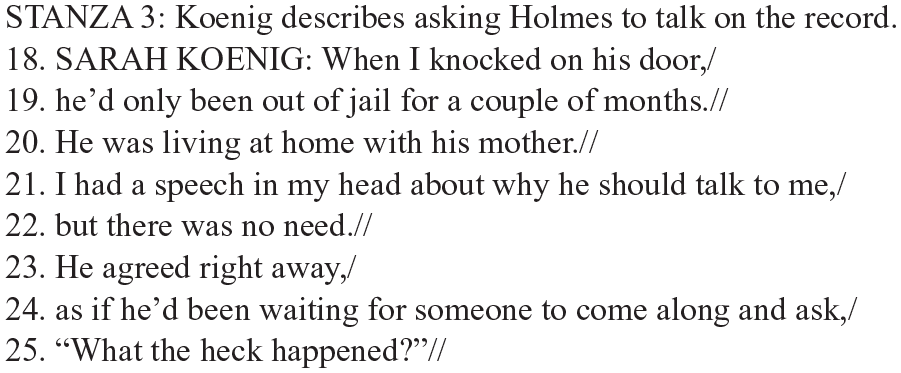
Excerpt from transcribed scene from Serial, Season 3, Episode 4: “A Bird in Jail Is Worth Two on the Street”.
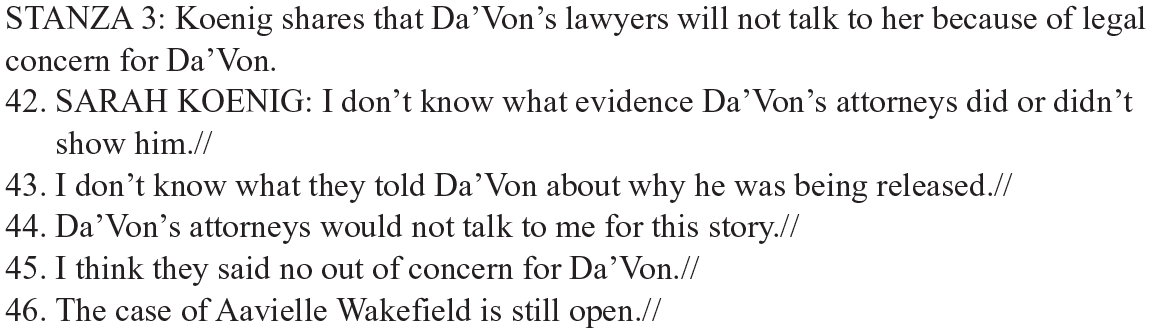
Excerpt from transcribed scene from Serial, Season 3, Episode 4: “A Bird in Jail Is Worth Two on the Street”.
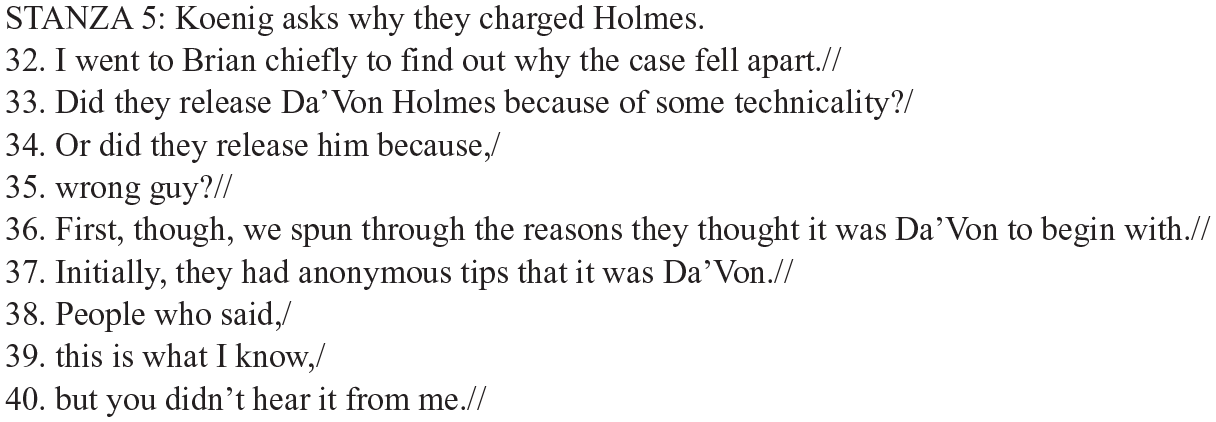
Excerpt from transcribed scene from Serial, Season 3: Episode 5: “Pleas Baby Pleas”.
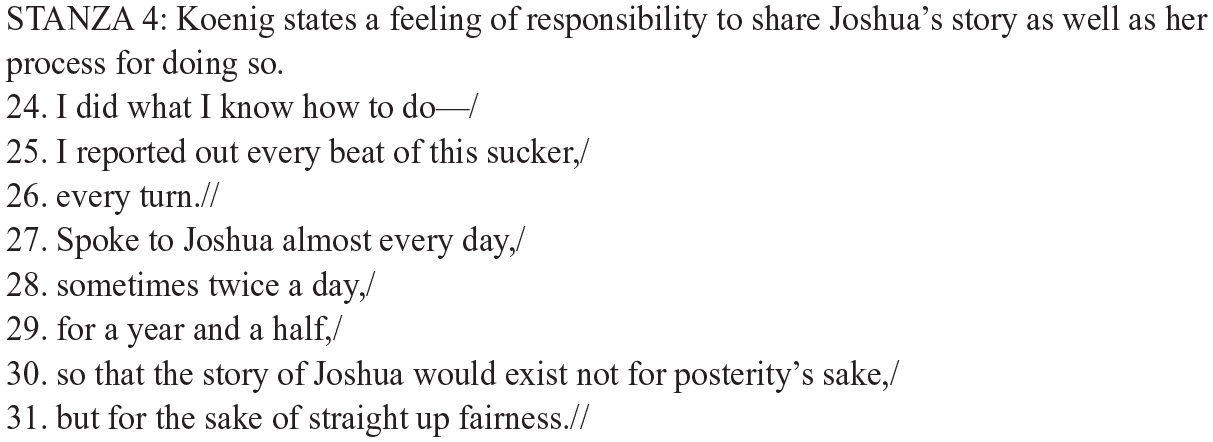
Excerpt from transcribed scene from Serial, Season 3: Episode 9: “Some Time When Everything Has Changed”.
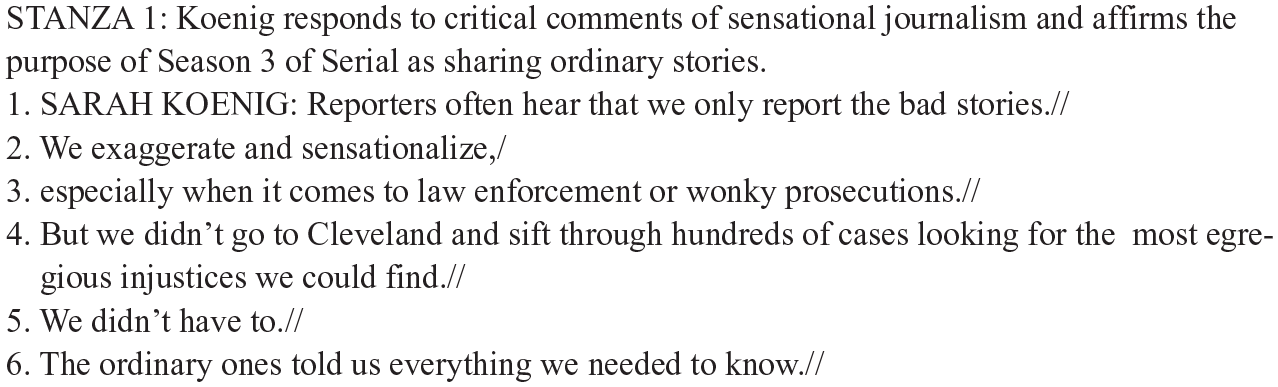
Excerpt from transcribed scene from Serial, Season 3: “Some Time When Everything Has Changed”.
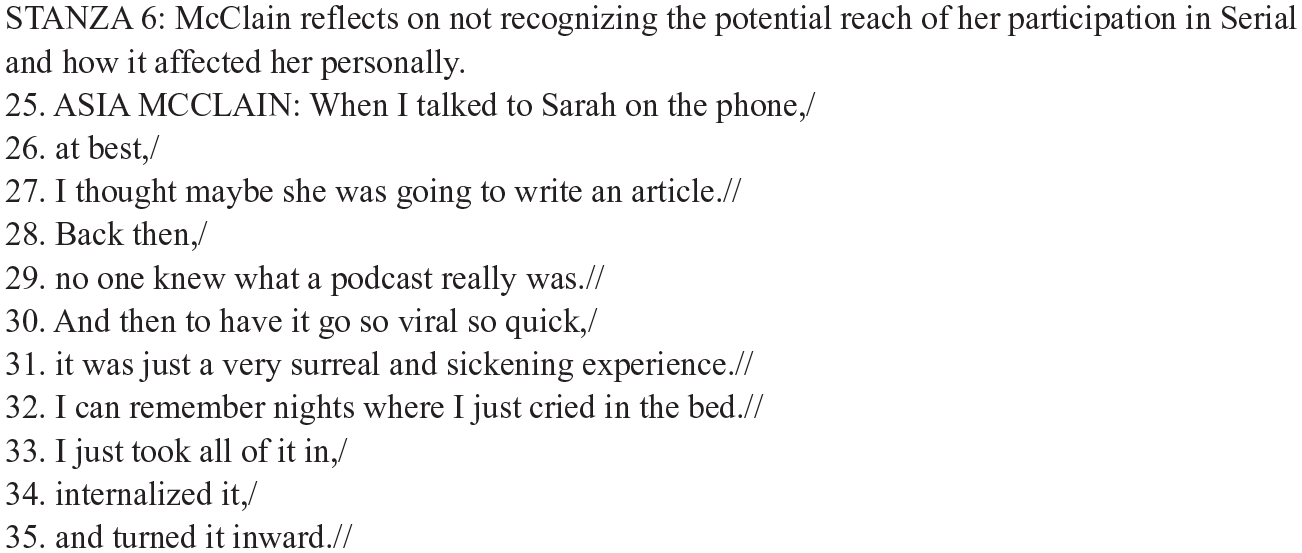
An excerpt from a transcribed scene from The Case Against Adnan Syed (HBO Docuseries), Episode 3: “Justice Is Arbitrary”.
Fortuitous Listening and Viewing
We labelled our abductive process of working with our curated stumble data as “fortuitous listening and viewing” because our interrelated positionalities as podcast listeners, former secondary ELA teachers, and current literacy researchers led us to notice, by chance, certain patterns and connections within the curated data, which we then further investigated intentionally.
We stumbled upon our first bit of data when Jason (first author) was listening to Serial, Season 3, for pleasure. Jason’s previous work with narrative nonfiction (see Griffith, 2017) prompted him to pause and relisten to a scene in which Koenig describes her method of gaining informed consent from participants (see Figure 1). Jason brought this scene up for conversation with Joe (second author), who had also listened to the podcast independently. We consider the ensuing and ongoing conversation between us to be a “dialogic spiral” (Kinloch & San Pedro, 2014, p. 31), where the generative space between our trading of questions and alternating stances as speaker and listener led to our recognition of potential tensions between informed consent practices in podcast journalism and educational research. Upon that recognition, we further discussed why this tension could be problematic; we considered the rise in the educational use of podcasts, because their curricular inclusion conveys tacit authority and might render them pseudo-ethnographies, or works assumed to have ethnographic significance, without a critical examination of the ethics within their methods.
With these focal points established from our dialogic spiral, we reviewed the entirety of Serial, Season 3, with a critical eye toward scenes related to informed consent; this led to us identifying four additional scenes (see Figures 2–5). We stumbled into one final piece of data through another bit of fortuitous timing. Shortly after listening to Serial, Season 3, and after already working on curating the initial data, Jason watched the HBO docuseries The Case Against Adnan Syed, a follow-up to Serial, Season 1, and he identified a scene with specific relevance (see Figure 6).
Because our process of fortuitous listening and viewing is an abductive method utilizing stumble data, we do not intend for our findings to be far-reaching or universal. Instead, we present problematic patterns identified from our data for critical evaluation. We do this so educators can draw on this work to inform their classroom inclusion of podcasts and so other literacy researchers may build on, test, or even challenge our findings with other media texts.
To analyze our curated stumble data, we conducted a discourse analysis utilizing Gee’s (1999, 2014, 2015, 2017) notion of discourse organization.
Discourse Analysis
According to Gee (2015), when people use language, they are saying, doing, and being, but activities and identities are seldom expressed through language alone. To clarify, Gee distinguished “big D” Discourse from “little d” discourse (e.g., public discourse). He uses Discourse to signify the ways people enact, adopt, or recognize sociohistorically situated identities, whereas discourse, or language-in-use, involves “conversations” that negotiate the multiple Discourses. Accordingly, socially situated Discourses shift across time and contexts, and are constantly contested and reified. Further, as people enact their Discourses through multiple and ongoing (little d) discourses with one another, these discourses become the linguistic tools that allow Discourses to shift.
Discourse and identity, then, function as both/and; enacting a Discourse means enacting an identity, such that Discourse creates an “identity kit” (Gee, 1990), allowing people to perform recognizable identities that others affirm. Thus, our identities are affirmed and recognized when we enact our Discourse, and the performance of Discourse also reifies the Discourse being enacted. Discourse is closely associated with intelligible identity. However, discourse analysis is also a method that we outline in the following section.
Discourse Organization
To engage in discourse analysis as a method, we curated our stumble data, transcribed these scenes, and performed what Gee (2017) called “discourse organization,” “the organization of text into lines and stanzas, as well as the way language patterns within and across these lines and stanzas” (p. 196). That is, in transcribing, we organized the language into stanzas to identify how language patterns play out in the discourse. Each line comprises a particular thought that is associated with a particular Discourse. Correspondingly, each stanza encompasses one trajectory of thought. Gee (2017) further clarified, Stanzas are sets of lines about a single minimal topic, organized rhythmically and connected so as to hang together in a particularly tight way. The stanza takes a perspective on a character, action, event, claim, or piece of information. Each stanza has a point of view such that when character, place, time, event, or the function of a piece of information changes (whether in an argument, report, exposition, or description), the stanza must change. (pp. 185–186)
While each stanza is composed of a particular line of thought or “minimal topic” that holds together through rhythmic and semantic connections, the group of stanzas that make up the scene’s transcription reveals insights into the discourse organization that, together with lexical and syntactical choices, provide meaning for the analysis. To consider the lexical and syntactical choices in each line, we rely on Gee’s (2014) approach to organizing speakers’ choices within the stanzas. During the analysis, and as we show in the transcription, a “‘/’ indicates an intonation contour that is heard as ‘nonfinal’ (more is to come). A ‘//’ indicates an intonation contour that is heard as ‘final’ (closed off, what comes next is separate information)” (p. 21). Next, while semantics are clearly important to our Discourses, discourse analysis also derives the meaning of language through analyzing speakers’ syntactic and lexical choices. According to Gee (1999), grammar allows speakers choices in making meaning. These choices create patterns and oppositions that foreground and background information, creating connections and disconnections. In this way, speakers signify a great deal of their communication’s meaning through the syntactical choices they make when composing utterances, and arranging and punctuating words. These intended arrangements, then, highlight certain distinguishing aspects of Discourse so that the reader/listener knows how to read/listen to an utterance and make meaning from it.
By conducting this analysis, we build a case from the bottom up. That is, looking at the syntactical, lexical, and semantic choices of both journalists and participants allows us to examine how their Discourses demonstrate informed consent and related consequences in the building of a public narrative. For step-by-step analysis and clarity of the results, our Findings include excerpted transcripts that show how we organized scenes into lines and stanzas.
Findings
For the sake of clarity, rather than sharing the full transcripts and discourse organizations of the six selected scenes, which we curated via the fortuitous listening and viewing processes outlined previously, the following descriptions and highlighted excerpts demonstrate evidence for the conclusions we drew from the analysis.
First, a scene from Serial, Season 3, Episode 4 (“A Bird in Jail Is Worth Two on the Street”), shows journalist Sarah Koenig’s process of gaining informed consent to record a conversation with a recently released murder suspect, Da’Von Holmes. In Figure 1, Koenig describes how she knocks on Holmes’s door and asks him to talk on the record.
In addition to describing her process for obtaining informed consent from Holmes in this scene, Koenig later revealed that no Cleveland police or government officials were willing to discuss the murder case on the record. The analysis of this scene can be summarized in four key details: (1) Koenig targeted Holmes with the intent of getting him to talk on tape; (2) Holmes agreed because he wanted to air his side of the story; (3) Holmes shares a lot (starting from the beginning of his story); and (4) the Cleveland police were not willing to talk on the record.
The significance of this first scene grows when we add the consideration of a second scene from the same episode. Figure 2 features an excerpt from a transcribed scene in which Holmes explains why he was eventually released from prison. After Holmes’s explanation confuses Koenig, she reveals an important detail to listeners.
Koenig reveals that the murder case in which Holmes had been arrested as a suspect is still being investigated, and the attorneys’ reluctance to speak on the record is to protect Holmes from having any information they share publicly being used against him legally. If we assume that Holmes’s lawyers’ legal training and experience provide them some insight into why a public interview could be problematic for Holmes and should be avoided, this second scene begins to demonstrate a conflict between Koenig’s journalistic story and Holmes’s individual safety. Despite the reluctance of Holmes’s lawyers to go on the record, Koenig interviews Holmes directly, shares details about his perspective, and even speculates about what did/did not happen with regard to his case. In a broader context, Koenig uses Holmes’s story to demonstrate a problematic aspect of the criminal justice system, which is arresting and incarcerating suspects for murder on flimsy evidence. Holmes’s lawyers, by contrast, try to protect their client by not telling his story on the record.
In fairness to Koenig, a scene from Episode 5, “Pleas Baby Pleas,” might include her attempt at a safeguard for Holmes. In this scene, she talks to prosecutor Brian Radigan about why Holmes was charged, locked up, and then released. In Figure 3, Radigan describes how Holmes was first identified through anonymous tips.
In the broader context of this scene, Radigan first describes how difficult it is for Radigan to get informants to go on the record with police and, further, how difficult it is to discern truth from fiction in informant testimony, especially with anonymous tips. After sharing that anonymous tips led to Holmes being arrested as a suspect, Radigan later explains that they released Holmes when they discovered that the anonymous tips lacked credibility.
This scene adds important and nuanced context to Koenig’s journalistic narrative. As listeners, we are justified in feeling a multitude of reactions simultaneously, including outrage that flimsy anonymous tips could be enough to imprison a man as a murder suspect, as well as understanding Radigan’s frustration in feeling a sense of urgency to prosecute the murder case of a baby and finding few willing or credible informants. From a narrative standpoint, it makes sense for Koenig to include both Holmes’s personal account and the missteps by law enforcement that led to his unwarranted imprisonment. Having both perspectives reveals a full and complementary picture of a specific injustice against the backdrop of general difficulties facing law enforcement in investigating a high-profile murder. However, though the broader narrative is both important and provocative for listeners to consider, significant questions remain regarding Holmes’s privacy and individual protection. Especially considering that his lawyers would not go on record for Koenig and that flimsy, unfounded anonymous tips were enough for police to arrest and charge Holmes the first time around, is it possible that the use of his full name and story on the podcast could lead to fresh danger for him in a still-open case?
In fact, Koenig reveals what she sees to be one of the purposes of her podcast in a scene from the final episode of Serial, Season 3. Figure 4 shows an excerpt from Koenig’s description of why she took a personal interest in reporting the story of an incarcerated youth police informant named Joshua, who she believes should be paroled for his contributions to a number of cases.
When Koenig distinguishes between posterity and fairness in Figure 4, she seems to be suggesting that using her podcast to report the stories she selects is a method of advocacy. Specifically, she is fully reporting the stories of her participants, like Holmes and Joshua, to humanize and personalize systemic injustices in the criminal justice system.
Figure 5 verifies that the purpose of Koenig’s podcast journalism is to highlight what she calls ordinary injustices so readers can construct a composite understanding of the Cleveland justice system.
Koenig’s concluding comments in this final episode of Season 3 confirm that she is using the medium to showcase a broad truth through a collection of ordinary stories, and that purpose works reasonably well. The collected stories are evocative and personal, and they help us to imagine ourselves in the circumstances of the interrelated journalistic subjects. The overall mosaic throughout the nine episodes of Season 3 does provide a provocative look at how the Cleveland justice system works and the key places it falls short. There is clearly value for listeners in Koenig’s comprehensive public narrative. However, one final curated scene helps us to further trouble the potential consequences for the individual subjects whom Koenig features.
The HBO docuseries titled The Case Against Adnan Syed (Berg, 2019) revisits the murder of Hae Min Lee, the case highlighted in Koenig’s popular first season of Serial. This television series was released in March 2019, a few months after Serial, Season 3, released its final episode (in November 2018). While most of the HBO series focuses on developments in Syed’s case since the airing of Serial, Season 1 (in 2014), one intriguing scene features six participants reflecting on the adverse effects of being featured in a viral podcast. Figure 6 includes an excerpt in which participant Asia McClain describes how she did not fully understand what the ramifications of her participation would be and that she suffered from the public criticism she received.
The broader scene shows McClain being publicly criticized by the prosecutor in Syed’s case, as well as extensive social media posts doubting her honesty and insulting her. Similar experiences from five additional participants are interspersed throughout this scene to further demonstrate adverse and unanticipated effects of participating in a podcast that goes viral, exposing them to public scrutiny. Interestingly, the HBO series did not ask participants whether they regretted their participation or, in hindsight, would have participated had they known the ramifications.
Taken together, Figures 1–6 and the analysis of the broader scenes from which they were excerpted indicate a notable tension between a public narrative (or fidelity to the story) and individual protections of participants (or fidelity to the participants), and this tension additionally reflects a contrast in the informed consent and participant representation processes of podcast journalism versus ethnographic educational research. We unpack these tensions further and tie them back to critical media literacy in the next section.
Discussion
As we were revising this article, Adnan Syed, the convicted murderer featured in Serial, Season 1 (Koenig et al., 2014), was released from prison. Baltimore prosecutors dropped charges against him with the explanation “that an investigation had revealed problems with key evidence that was used to convict Mr. Syed, as well as the possibility of ‘alternative suspects’” (Holpuch, 2022, para. 4). Serial’s role in contributing to the circumstances prompting Syed’s release continues to be debated. For example, in a piece in Slate (Hampton et al., 2022), three writers troubled Serial’s legacy by noting that the podcast undoubtedly drew attention to the case but also failed to issue retractions, updates, or apologies when evidence and theories that were presented speculatively on the podcast were disproved. Echoing Haugtvedt’s (2017) critique, the Slate piece suggested that the popularity of Serial contributed to listeners trivializing an actual crime involving real people by taking sides between Syed and alternative suspects as if they were contestants on a reality show or characters in a fictional drama. In this way, Hampton et al. (2022) claimed that podcasts like Serial and This American Life effectively foster a sense of emotional investment among listeners, but that same phenomenon can also cause harm to true crime investigations and to podcast participants. However, what is not debatable is how Serial and Adnan Syed are inextricably connected. Every article that we read about Syed’s release discussed Serial’s coverage, and often the podcast title appeared in the byline of the story. We also reflect that we are unlikely to have ever heard about the murder of Hae Min Lee or of Adnan Syed’s case without having listened to Serial.
Syed’s release and the contested role of the podcast in contributing to it provide yet one more correlating layer to our discussion as we consider our findings against the backdrop of podcasts as pseudo-ethnographies, shifts in the field of ethnographic research for education, the ethics of participant representation, and how the implications of these might inform literacy education and how educators utilize podcasts in the classroom. Broadly speaking, we found that podcast journalism and ethnographic research have much to learn from one another, but how participants are protected is an area for further critical reflection, particularly from the perspective of the listener.
What Ethnographic Research Can Learn from Podcast Journalism
Two quotations from creative nonfiction—the creative writing genre that includes literary journalism and within which narrative podcasts might also be categorized—exemplify the sort of tension we have identified between a public narrative and participant protections.
First, Gutkind (2012) wrote, “the creative nonfiction writer with a big issue or idea can wake up the world and make change happen” (p. 74)—and this potential for change holds true for podcast journalism as well. The Case Against Adnan Syed reveals that Serial, Season 1, was instrumental in bringing new awareness to Syed’s case, which may have contributed to the series of legal events that eventually led to Syed’s release. Season 3 resonates in powerful ways, too. Loofbourow (2018) called Serial, Season 3, an “extraordinary achievement” for disrupting listeners’ perceptions of plea bargains, probable cause, parole, and other legal concepts. “In sketching out how Cleveland’s criminal justice system’s different incentive structures interact, Serial scoops out any ‘just world’ beliefs we might have had” (Loofbourow, 2018, para. 8). As listeners, we admit that Koenig’s work in Season 3 taught us much about the nuances, realities, and shortcomings within the justice system, particularly with regard to the problematic ways that parole and probation mechanisms operate.
From this perspective, Serial, Season 3, accomplishes Gutkind’s ideal of waking audiences up to a big issue, and this journalistic concept overlaps with contemporary critical qualitative researchers’ calls for utilizing ethnographic research for positive change with regard to systemic inequity (e.g., Anders & Lester, 2019; Denzin, 2017; and Tuck, 2009). It is clear that Koenig and her collaborators are attempting to engage in the sort of difference-making that critical qualitative researchers aspire to, and to some extent, they are succeeding. Serial is certainly reaching an exponentially larger audience than the results of most ethnographic research conducted under the purview of a university IRB.
Part of the reason Koenig and her collaborators are able to contribute to making a difference and reach such a large audience is that they are not beholden to the type of anonymity that an IRB would default to in order to preserve participants’ confidentiality. That Serial names the specific people, places, and times of their featured cases is part of what fosters the unique participatory listening experience of the podcast. However, a second relevant quote from the field of creative nonfiction raises a significant counterpoint with regard to participant protection and an inherent defense of how the IRB process functions in ethnographic research.
What Podcast Journalism Can Learn From Ethnographic Research and the IRB Process
Essayist Joan Didion wrote in the preface to Slouching Towards Bethlehem that “people tend to forget that my presence runs counter to their best interests. And it always does. That is one last thing to remember: writers are always selling somebody out” (Didion, 1968, p xiv). Didion’s notion of “selling somebody out” means that her sense of fidelity is to accurately reporting a story, regardless of how the real-life people she portrays in that story are perceived by audiences. Didion’s quote aligns well with Koenig’s stated intention to “report out every beat of this sucker” (see Figure 4) in her podcast journalism, and it aligns further with Boling’s (2019) observation that contemporary journalistic standards of ethics have shifted away from traditional notions of “objectivity” and toward a central doctrine of accuracy, fairness, and thoroughness. From a journalistic perspective, as long as reporters are being accurate, fair, and thorough, whatever way audiences perceive participants is fair game.
However, whether or not accuracy, fairness, and thoroughness are ethical from a listener’s perspective grows more complicated when we consider McClain’s reports of negative experiences from her participation in Serial, Season 1 (see Figure 6), verifying our concerns about Holmes’s participation in Season 3 (see Figures 1–3). Didion is missing the other side of her implied transaction, which can be supplemented by Gutkind. Writers like Didion and journalists like Koenig are not “selling out” participants out of malice or for personal gain; rather, they are potentially selling out the protection of participants for the sake of the big idea, and for the sake of the story. We label this as a difference between fidelity to an accurate, overarching public narrative (the story), and the protection of individual participants. Koenig does reveal systemic, important truths to listeners through the public narrative of Serial, but the question remains, at what cost to individual participants?
From her interviews with several true crime podcast producers, Boling (2019) reported, The consensus was that reporters, podcasters especially, need to be careful not to sensationalize stories and remember that there are real people—mothers, fathers and children—that are impacted by these cases and that they deserve respect and concern, not fame. (p. 173)
However, when we consider McClain’s experience (see Figure 6); our concerns about Holmes (see Figures 1–3); Haugtvedt’s (2017) claim that participants in Serial, Season 1, had their personal information shared on Reddit and were subsequently harassed; and Hampton and colleagues’ (2022) assertion that Serial trivialized the experiences of actual victims of crime, we certainly do not think that these examples suggest that producers of Serial were thoroughly concerned with the impacts of the podcast on the lives of the real people who were featured.
Avoiding this type of harm to participants is the major purpose of a university’s IRB. We readily acknowledge that the effectiveness of the IRB process is limited in a number of ways. For example, we have referenced critical qualitative researchers (such as Surmiak, 2018) who have noted that complete anonymity and confidentiality can serve to silence participants whose identities could affect the potency of their stories. We also recognize that, after achieving initial IRB approval, it is more or less up to the researcher whether they continue to pursue informed consent and engage in member checking. However, for better or worse, the IRB process forces the researcher, at least temporarily, to focus on the protection of participants and on mitigating any risks involved in the research, and a similar process does not appear to have factored into Koenig and colleagues’ approach to Serial in the data we collected and considered.
Implications for Podcast Use in Literacy Education
As we stated before, for student listeners who do not engage in critical reflection, there is potentially no difference between the product of ethnographic research conducted with participant protections like informed consent under the purview of a university IRB, and a journalistic podcast that resembles an ethnography but was produced without similar participant protections other than a commitment to fair, accurate, and thorough reporting. Furthermore, if journalistic podcasts, functioning as pseudo-ethnographies, are brought into secondary literacy education primarily for the purpose of engagement and not also for building students’ critical media literacy skills, there seems a tacit endorsement of the text by way of the teacher’s approval and curricular inclusion. Without engaging in the types of critical analysis we have demonstrated in this article, there also exists a tacit approval of the methods exhibited in the featured podcast.
Alvermann et al. (2002) claimed that “there is an urgent need to help students learn how to evaluate [abundant media] messages for their social, political, economic, and aesthetic contents” (p. 4)—and certainly, engaging in a critical examination of how a journalist gains consent is a valuable part of such evaluation. Additionally, Kellner and Share (2007) suggested that “a critical reconstruction of education should produce pedagogies that provide media literacy and enable students, teachers, and citizens to discern the nature and effects of media culture” (p. 4). Our work in this article is an example of how to move beyond just celebrating a podcast for its potential to engage student listeners and to engage in critical media literacy pedagogy.
We especially invite fellow teacher-educators to join us in designing pedagogy for pre- and in-service teachers, which not only encourages and supports the inclusion of podcasts in the classroom, but also helps to foster a critical framework for engaging in the how and why of podcast journalism. We specifically focus on teacher-educators because that is our current role, and because critical media pedagogy that is thoughtfully cocreated in the space of a literacy methods class has the potential to filter into current and future classrooms to benefit many students. We conclude our article with three ideas for this kind of work.
First, to help teachers guide their students away from uncritically taking the narrative bait and immediately diving into the participatory culture of a show like Serial, we need to help them to “zoom out” and reflect on the context of the show through a broad lens. One possibility for doing so is using a variation of our “fortuitous listening” technique, which we used to curate our data and begin our analysis. Although it may be excessive to transcribe and analyze via discourse organization in a literacy methods class, it could be quite fruitful to ask student teachers to listen to the same podcast episode and then to make space in classroom discussion for students to highlight scenes that made them pause and wonder, and to inductively and collaboratively investigate those. What do we notice together about those scenes, and what made us pause and reflect on them? The teacher-educator can probe further and prompt deeper discussion of specific scenes by asking questions around the relationships between journalists and participants, how participants are being represented, and whether we consider those representations to be fair. Jason developed a potentially useful strategy he called “empathy check-ins” (Griffith, 2017, p. 26), which means examining the rhetorical strategies that narrators use to make us like and/or trust them. Do we like this narrator? Do we trust them? Why or why not? When considering how important the production choices are to a podcast like Serial, it is important to reflect on these, along with narrative techniques. Why is this story so engaging? Why are we drawn in, and is there any need to be cautious as we are drawn in? Of course, it is important to ask broad questions like, Who do stories belong to, who is entitled to tell others’ stories, and for what purpose do we tell others’ stories? As a genre and medium, popular narrative podcasts have great potential for valuable discussion around ethical questions, including consent from and consequences for participants when weighed against the value of their collective story.
Second, just as Paris and Winn (2014) have called for more humanizing methods for conducting educational research—including conducting research with, rather than on, participants—we wonder about possibilities for humanizing methods within podcast journalism. A powerful example of participant-centered podcast production is Ear Hustle (Poor et al., 2020), which was developed by producers while they were incarcerated and continues to tell the firsthand stories of life inside San Quentin State Prison. It would be a valuable comparison/contrast exercise to ask student teachers to listen to both Ear Hustle and to Serial, and then to engage in critical, reflective discussions about differences between the shows, particularly the differences between the positionalities of the journalists and how participants are represented within each.
Finally, we see the framing of our work and discussion as being potentially informative to classroom units and projects that involve students creating their own podcasts, including oral history projects that ask students to interview relatives, mentors, neighbors, etc. We encourage teacher-educators in these instances to engage with their students to collaboratively outline the relational ethics behind processes for gaining consent, as well as how they are including and representing the stories of participants. In these instances, the teacher-educator may actually mimic some of the ways that a university’s IRB serves researchers by checking to make sure student teachers are honoring their moral obligation to protect their participants. In co-constructing the relational ethics behind informed consent and participant representation, teacher-educators and student teachers can draw on their discussions and critiques of popular podcasts as mentor texts and/or cautionary tales. This type of instruction could go beyond just encouraging listeners to critically reflect on problematic ways that podcast journalists gather consent and represent participants, and actually foster a kind of storyteller who feels both a moral obligation to protect their participants and the possibility of story to contribute to making a difference in social iniquities.
Footnotes
Declaration of Conflicting Interests
The author(s) declared no potential conflicts of interest with respect to the research, authorship, and/or publication of this article.
Funding
The author(s) received no financial support for the research, authorship, and/or publication of this article.