



Abstract
Psychopathy, Narcissism, and Machiavellianism (the Dark Triad) have each been hypothesized as predictors of socially deviant behavior including sexual coercion, but the three traits also covary significantly with one another. The purpose of this study was to examine several alternative Multisample Structural Equation Models (MSEMs) exploring the relations between the Dark Triad and Sexually Coercive Behavior, testing whether any or all of the three specific “Dark Personality” traits uniquely contributed to predicting sexually coercive behavior. Self-report questionnaires measuring Primary and Secondary Psychopathy, Narcissism, Machiavellianism, and Sexually Coercive Behavior were administered to a sample of undergraduates. The relative fit of each of the MSEMs to the data was examined by means of hierarchically nested model comparisons. The most parsimonious yet explanatory model identified was one in which a single common factor composed of the three Dark Triad indicators explained the relationships among the Dark Triad traits and Sexually Coercive Behavior without any direct contributions from the specific Dark Triad indicators. Results indicate that the three Dark Triad traits, controlling for the common factor, do not differentially predict Sexually Coercive Behavior. These results are interpreted with respect to the principle of Brunswik-Symmetry.
Introduction
The three traits that comprise the Dark Triad (DT) of personality—psychopathy, narcissism, and Machiavellianism—have been central to understanding dispositional tendencies towards harming others (Paulhus and Williams, 2002). The DT are interrelated but distinctive in both their origins and phenotypic features. Researchers are beginning to uncover their common elements (Book, Visser, and Volk, 2015; Jones and Figueredo, 2013), as well as their unique aspects (Furnham, Richards, and Paulhus, 2013). Yet, it is unclear when the common core of these traits is most predictive, and when their unique elements are necessary (cf. Jonason, Kavanagh, Webster, and Fitzgerald, 2011).
It is entirely possible that the unique aspects of one or more DT traits increase reproductive fitness within certain “Dark Niches” (Jones and Paulhus, 2011) by supporting a strategy of exploitive short-term mating (Jonason and Buss, 2012; Jonason and Kavanagh, 2010; Jonason, Li, Webster, and Schmitt, 2009; Jonason, Valentine, Li, and Harbeson, 2011). If there are indeed at least three discriminable traits involved, does that imply the existence of at least three of these Dark Niches? A related, and even more hotly debated, question is whether or not these “Dark Personalities” should be considered as mental disorders at all, or instead as different conditional adaptations (i.e., facultative developmental responses to different socio-ecological niches; see Gladden, Sisco, and Figueredo, 2008) or alternative sociosexual strategies (i.e., obligate genetic specializations to different socio-ecological niches; see Vernon, Villani, Vickers, and Harris, 2008).
Jones and Paulhus (2010, p. 249) defined the DT as follows: (1) Psychopathy: “characterized by callousness, impulsive thrill-seeking, and criminal behavior“; (2) Machiavellianism: “marked by strategic manipulation”; and (3) Narcissism: “associated with grandiosity, egocentrism, and a sense of personal entitlement.” Jakobwitz and Egan (2006, p. 332 define psychopathy in the same manner as Hare (1991) and Levenson, Kiehl, and Fitzpatrick (1995), noting that its identifying characteristics are “selfishness, callousness, lack of interpersonal affect, superficial charm and remorselessness.” Using Hare and Levenson's models, they ascribe these traits to primary psychopathy and create another category, which they deem secondary psychopathy, to include anti-social behaviors. Other researchers (Cooke and Michie, 2001) have included impulsive behavior within the repertory of psychopathic characteristics. Machiavellianism as described by Jakobwitz and Egan (2006, p. 332) consists of “interpersonal strategies that advocate self-interest, deception and manipulation.” Paulhus and Williams (2002) use Chrsitie and Geis' (1970) definition to succinctly describe Machiavellianism as a manipulative personality, which is similarly defined by Jonason et al. (2009). Jakobwitz and Egan (2006) describe narcissists in the same manner as Raskin and Hall (1979), by using the Narcissistic Personality Inventory (NPI) created by the latter. The NPI includes measurements that identify characteristics in subjects such as arrogance, intense vanity, and entitlement.
Although Jonason et al. (2009) reported high and significant convergent validity coefficients for all three traits from a latent common factor, labeled “Exploitive Sexual Style,” Jones and Paulhus (2010, p. 249) argued that while “Dark Personalities” overlap, each contains unique features: (1) “Temporal orientation (strategic vs. impulsive) distinguishes the strategic Machiavellians from the impulsive psychopaths and narcissists“; and (2) “Identity need distinguishes narcissists (high) from the psychopaths and Machiavellians (low).”
The DT and sexual coercion
The DT personalities have each been hypothesized as predictors of socially deviant behavior, including sexual coercion. Gladden, Sisco, and Figueredo (2008) reported that Psychopathy and Machiavellianism converged as inverse indicators of a single latent “Slow” Life History factor, which predicted the Sexual Acts and Perceptions Inventory (SAPI) of self-reported sexually coercive behavior, and fully mediated the relationship between participant sex and sexually coercive behavior. Baumeister, Catanese, and Wallace (2002) also implicated Narcissism in the etiology of sexually coercive behavior.
To explore the possible sexual dimension of the “DT” as a set of evolved adaptive alternative strategies, researchers have examined the mating strategies associated with each of these three “Dark Personalities.” Studies conducted by Paulhus and Williams (2002) show that all three traits are negatively correlated with agreeableness, a trait crucial to long and healthy relationships. Jonason et al. (2009) and Jonason and Kavanagh (2010) predicted that men would more commonly display anti-social behavior because men can increase their fitness by engaging in unrestricted sociosexual behavior. They reasoned that women, on the other hand, would be negatively affected by an inability to retain a partner in conjunction with the high costs of raising a child alone. To test their hypothesis, Jonason et al. (2009) conducted a confirmatory factor analysis, which revealed significant convergent validity coefficients for the three Dark Personalities: Psychopathy (SRP-III) = .74; Narcissism (NPI) = .53; Machiavellianism (MACH-IV) = .38, all ps < .05. Jonason et al. (2009) also reported finding that the latent common factor underlying the DT partially mediated the effect of the sex of the respondent on their short-term mating strategies. Specifically, they reported that men who scored higher on the DT Factor had greater preference for short-term mating and had a higher number of sex partners.
The implications of callousness and manipulation in sexual coercion
Men high in any of the Dark Triad traits, as suggested by Jonason et al. (2009), are likely to have elevated numbers of lifetime sexual partners. There are at least three explanations for this finding, however, including the fact that callous individuals (a) have lower standards for one-time sexual affairs (Jonason et al., 2011), (b) are willing to engage in deception in the service of obtaining sexual experiences (Camilleri, Quinsey, and Tapscott, 2009; McHoskey, 2001), and (c) are willing to engage in aggressive tactics to obtain sex (Baumeister et al., 2002; Jonason, Li, and Buss, 2010; Jones and Olderbak, 2014).
In particular, Jones and Olderbak (2014) found that psychopathic individuals were most likely to engage in direct coercion in the service of obtaining sex, across a variety of scenarios. In contrast, they found situational constraints predicted the use of aggressive sexual tactics among narcissistic individuals, and Machiavellian individuals had no unique relationship with any aggressive sexual tactic. However, Jones and Olderbak (2014) examined which tactics these individuals may use, not whether coercion was considered an option at all as a sexual strategy. Thus, one additional explanation for the high number of lifetime sexual partners among the Dark Triad may be coercion.
The Dark Triad and coercive strategies
Multiple features of psychopathy predispose such individuals towards sexual coercion, including a predisposition towards antisocial behavior (Neumann and Hare, 2008), a lack of self-control (Newman, 1987), and a lack of conventional morality (Glenn, Iyer, Graham, Koleva, and Haidt, 2009). Developmentally, children lacking these moral emotions reject moral and legal rules, regardless of genetic or environmental (or both) influences (Gladden, 2011). Indeed, lacking a “violence-inhibition mechanism” partially explains the aggression inherent to psychopathy (Blair, 1995). Furthermore, their callousness leaves them with no guilt concerning antisocial acts, such as sexual coercion.
In addition, narcissism is theoretically (e.g., Baumeister et al., 2002) and empirically (Bushmen, Bonacci, Dijk, and Baumeister, 2003) associated with sexual aggression. In particular, sexual refusal is particularly toxic against the backdrop of narcissism. Furthermore, Machiavellianism is a trait that is associated with a cynical perspective of humans such that others are seen as objects (Christie and Geis, 1970). This perception of others as instruments for selfish use may lead Machiavellian individuals to view women in ways that justify sexual aggression.
Although repugnant from the perspective of contemporary Western Societies, the willingness to force a sexual partner into a sexual encounter has been documented in animal kingdoms other than humans. Thus, it has been proposed that aggressive sexual tactics may be a method of forcing the issue when it comes to passing on one's genes to future generations. As a result, callousness and manipulation may be unconstrained by specific variance associated with each Dark Triad trait. In other words, engaging in whatever mating strategy is available or necessary may not be specific to any DT, but may instead be related to their common callous and manipulative core. This last point may be especially true when assessing one's hypothetical willingness to engage in a behavior in a consequence-free environment. Thus, whereas empathetic individuals would shut the door immediately (hypothetically or otherwise) on the use of coercion or manipulation to obtain sex, individuals high in any Dark Triad trait should be willing to engage in this strategy given their absence of interpersonal empathy (Wai and Tiliopoulos, 2012).
The principle of Brunswik-Symmetry
Applying different levels of psychometric aggregation and analysis can be thought of as focusing on different levels of a constitutive hierarchy, as described by Ernst Mayr (1982). According to Mayr, the emergent properties of a system are ultimately reducible to the products of the interactions among its constituents, although others have misapplied the concept of emergence to imply that the properties of an integrated whole are not reducible to the synergistic effects of its component parts (e.g., Laughlin, 2005). Whichever of these alternative representations is correct, it is clear that all biological phenomena, and arguably all natural phenomena, are hierarchically organized. It therefore makes a substantive difference at which level one approaches one's descriptions of the natural world, because different dynamics might apply at different levels of organization (Figueredo et al., 2007; Figueredo, Jacobs, Burger, Gladden, and Olderbak, 2011).
One of the pioneers in thinking about the nature of this problem and its implications for psychological research was Egon Brunswik, who developed the Principle of Symmetry in response to the problems that arise as a result of studying interactions among hierarchically organized systems (Wittmann, 2002, 2011; Wittmann and Klumb, 2006). This principle, now commonly known as that of Brunswik-Symmetry, can be stated as follows. Whenever one is relating a predictor with a criterion variable, one must attend carefully to what levels of psychometric aggregation one is using to measure both the predictor and the criterion. This is because it is likely that both the predictor and the criterion belong to hierarchically organized systems, and each can be described at any of multiple ascending or descending levels of analysis. If the correlation one is seeking is intended to model a causal relation, and not merely an association, then one must consider which level of the predictor hierarchy may be acting directly upon which level of the criterion hierarchy. Although all levels in each hierarchy will be connected indirectly, and hence correlated with each other, the Principle of Brunswik-Symmetry states that the correlation will be maximized when both predictor and criterion are assessed at the same level of their respective constitutive hierarchies, suggesting that they should be operationalized at equivalent levels of psychometric aggregation.
In the case of the ontological status of the “DT,” it might therefore not be meaningful to ask whether the constituents are better conceptualized as three distinct phenomena or as three aspects of a unitary construct, but which of these levels of psychometric aggregation predict which specific outcomes, and at what level of aggregation those specific outcomes are assessed. In addition, it is more fruitful to consider what the existence of this hierarchical structure means for the study of “Dark Personalities,” both clinically and evolutionarily. We begin by examining the individual relation of each of the component traits (Psychopathy, Machiavellianism, and Narcissism) to Sexually Coercive Behaviors.
The design of the present study
The present study examined several alternative structural models regarding the possible relationships among the three “DT” traits and the self-reported frequencies of sexually coercive behaviors, using the Sexual Acts and Perceptions Inventory (SAPI; Sisco and Figueredo, 2008). The SAPI was used because we suspected that traditional measures of sexual coercion might be tapping only a limited sampling of the full array of coercive sexual behaviors. Although the SAPI includes items pertaining to behaviors included in more conventional measures, the SAPI was created with the intention of including an expanded spectrum of coercive sexual behaviors. The SAPI was created in response to the feedback of students and colleagues who had been exposed to sexually coercive behaviors that fell outside the range measured by the more conventional sexual violence assessments, such as the Sexual Experiences Survey (SES; Koss and Oros, 1982). Compiled from anecdotal stories of students and colleagues, a list of novel behaviors marked the creation of the SAPI. This expanded spectrum included the following categories of novel behavioral items: (1) illegal behaviors, such as forcing the victim to initiate sexual contact, forceful sexual trafficking, prostitution, force or kidnapping in a romantic or sexual context, and any sexual interactions with a minor; and (2) inappropriate but not necessarily illegal sexual behaviors, such as social manipulation, romantic or sexual stalking, pressure through bets, dares, or the fraternity or sorority “pledge” process, and having unprotected sex while infected with a sexually transmitted disease.
An examination of the descriptive statistics reveals that the rates of self-reported perpetration in both categories of sexually coercive behaviors increased for men as well as women when using the SAPI, as opposed to when using the SES. Furthermore, as compared with using the SES, using the SAPI reduced the disparities by sex in the rates of self-reported perpetration in both categories of sexually coercive behaviors. Not surprisingly, both the SES and the SAPI revealed that men generally reported perpetrating significantly more sexually coercive behavior in both categories than did women. For example, men were more likely to commit all illegal acts, especially conventional rape. Nevertheless, women generally reported perpetrating significantly fewer sexually coercive behaviors relative to men in both categories when using the SES as compared with the SAPI. For example, when using the SAPI, men and women reported having committed similar rates of verbal coercion. We therefore conclude that by broadening the sampling of sexually coercive behaviors, using the SAPI makes it possible to more accurately estimate and compare the rates of self-reported perpetration of sexual coercion by men and women. A more detailed description of the sexually differentiated offending profiles, in spite of the comparable aggregate levels, can be found in Sisco and Figueredo (2008).
Using this inventory as our criterion, we therefore developed several different alternative path-analytic models of the hypothesized structural relations potentially underlying both the structure and function of the DT with respect to Sexually Coercive Behaviors, then used Multisample Structural Equations Models (MSEMs) to systematically compare and contrast the respective structural parameters estimated by these models for the disaggregated subsamples of male and female respondents. This is one sample from university undergraduates, but we refer to it as a multisample because we split it into two based on sex. Because sexual coercion is arguably the ultimate short-term mating strategy, and the latent DT Factor has been reported to partially mediate the effect of respondent sex on short-term mating strategy (Jonason et al., 2009), we hypothesized that it should be possible to discriminate empirically between our alternative theoretical models by documenting any effects of the DT upon Sexual Coercion that are either (1) shared or common among male and female respondents, or (2) specific or unique to one sex or the other.
Materials and Methods
Participants
A total of 324 University undergraduate students, 180 males and 144 females, enrolled in an introductory psychology course in the Southwestern United States, were recruited as research participants for this study. After the recovery of a certain proportion of the missing item and subscale level data, we were left with 178 male and 140 female usable cases for multivariate analysis.
Procedure
We administered a battery of self-report questionnaires measuring DT attitudes and behaviors, as well as frequencies of sexually coercive behaviors, to a sample of undergraduate participants, after obtaining informed consent. The participants were then debriefed and excused.
Measures
Levenson Psychopathy Self-Report (Levenson, Kiehl, and Fitzpatrick, 1995). This questionnaire contains two subscales: a 16-item measure of primary psychopathy and a 10-item measure of secondary psychopathy. The scale ranges from −2 (Disagree Strongly) to +2 (Agree Strongly). Sample items include “Success is based on survival of the fittest; I am not concerned about the losers” (primary) and “When I get frustrated, I often ‘let off steam’ by blowing my top” (secondary). The Cronbach's alphas in our sample were 0.85 for the primary psychopathy and 0.68 for secondary psychopathy. These two subscales were significantly correlated with each other, r = .45, p < .0001, so we aggregated them into a single Psychopathy scale.
Machiavellianism Short Form (Christie and Geis, 1970). This 10-item scale is a measure of Machiavellian attitudes. The scale ranges from −2 (Disagree Strongly) to +2 (Agree Strongly). Sample items include “The best way to handle people is to tell them what they want to hear” and “Anyone who trusts anyone else is asking for trouble.” The Cronbach's alpha in our sample was 0.51.
MMPI Narcissism Scale (South, Oltmanns, and Turkheimer, 2003). The MMPI Narcissism scale is a 20-item measure of narcissistic personality features such as grandiosity, egocentrism, and a sense of personal entitlement. It contains two identical 10-item subscales, which ask participants to respond how they view themselves and how they think others view them respectively. The scale includes items such as “I do not blame a person for taking advantage of someone who lays himself open to it” and “I am an important person.“
Sexual Acts and Perceptions Inventory (SAPI; Sisco and Figueredo, 2008). This 109-item scale measures previous instances of sexually coercive acts performed within the past year. All acts included in the scale are by legal definition nonconsensual. The scale ranges from 0 (Never) to 3 (Three times or more) for each sexually coercive act. This behavioral inventory was subdivided into multiple subscales, classifying them by the tactic used or situation exploited, but aggregated across specific sexual acts (e.g., vaginal intercourse, anal intercourse, digital penetration, and oral sex). The internal consistencies of the five subscales used in the present analyses ranged from marginal to relatively high, indicating that the specific sexual acts included within each situational/tactical category were adequately correlated with each other. These Cronbach's alphas were .69 for Public Indecency (7 items), indicating having sex in public; .61 for Sexual Trespass (4 items), indicating the taking of personal items or videos of sexual acts without permission; .60 for Sexual Abuse (4 items), indicating touching the genitalia of others without permission; .95 for Sexual Assault (20 items), indicating oral or object/body penetration of anus or vagina, whether attempted or completed; and .87 for Victim As Actor (16 items), indicating making others masturbate, strip, perform oral sex on, or penetrate the perpetrator.
Statistical analyses
All univariate analyses were performed using SAS 9.1, and all multivariate analyses were performed using EQS 6.1. All subscale scores were estimated using SAS PROC STANDARD and DATA by simple unit-weighting (Gorsuch, 1983) as the means of the standardized scores for all non-missing items on each subscale, and all scale scores were estimated as the means of the standardized scores for all non-missing subscales on each scale (Figueredo, McKnight, McKnight, and Sidani, 2000; McKnight, McKnight, Sidani, and Figueredo, 2007). The Cronbach's alphas and the covariance matrices of the scales were also both computed using SAS PROC CORR. All the unit-weighted scales were entered as manifest variables for multivariate causal analysis within the structural equation models (SEMs). Multisample SEM (James, Mulaik, and Brett, 1982; Widaman, 1985) was performed using EQS 6.1, disaggregating and then systematically comparing and contrasting the data obtained from the subsamples of male and female research participants. Multisample SEMs are normally applied to the comparison of two or more independent samples from the same population; here, we use this method to compare the male and female subsamples when disaggregated from each other. This is justified because under the null hypotheses being tested, the male and female subsamples are presumed to be independent and intersubstitutable samples of the same population in which there are presumed to be no sex differences in the behaviors being tested. Rejecting null hypotheses so formulated thus represents evidence in favor of systematic sex differences in the model parameters being examined.
SEMs were evaluated by use of chi-square, the Bentler-Bonett Normed Fit Index (NFI), the Bentler-Bonnett Comparative Fit Index (CFI), and the Root Mean Squared Error of Approximation (RMSEA). Index values of the NFI and CFI greater than 0.90 are considered satisfactory levels of practical goodness-of-fit (Bentler, 1995; Bentler and Bonnett, 1980), whereas RMSEA values of 0.05 or less are considered indications of good fit, values between 0.08 and 0.10 are considered indications of a mediocre fit, and values greater than 0.10 are considered indications of a poor fit (Browne and Cudeck, 1993; Steiger and Lind, 1980). The CFI was selected because it is adjusted for model parsimony and performs well with moderate to small sample sizes, especially with Maximum Likelihood estimation (Bentler, 1990; Hu and Bentler, 1995). Alternative fit indices, such as the Bentler-Bonett Non-Normed Fit Index (NNFI), provide poor estimates of model fit with smaller samples (Hu and Bentler, 1995). The differences between hierarchically nested models in their statistical and practical indices of fit indicate the relative loss of fit of the model to the data entailed by either the elimination or constraining of specific causal pathways.
Statistical power
A sample size of n < 250 is considered a “small” sample for the purposes of structural equation modeling. Our usable sample size was n = 318. However, the absolute size of the sample must also be considered in terms of the relative complexity or parsimony of the model. Bentler (1995) recommended a ratio of at least five cases for every parameter freely estimated in confirmatory models. A sample size of n ~ 300 could therefore in principle support k ~ 60 parameter estimates according to this ratio. The most complex of the alternative MSEMs tested with the present data (the “inclusive model”) contained only 28 parameters to be freely estimated, or under half of that estimated maximum. We therefore concluded that we indeed had sufficient statistical power to detect any additional effects of nontrivial magnitude that had not been specified in any of the alternative restricted SEMs. Thus, rather than estimate the power available to reject an entire model, which we clearly had because we rejected several of them, we applied and satisfied the more stringent criterion of whether we would have had sufficient statistical power to detect any of the effects that were omitted (fixed to zero) in any of our restricted structural models.
Results
The inclusive model
We first specified the inclusive model for all of these Multisample SEMs and named it MSEM 1. This model specified a latent common factor underlying the DT, with Psychopathy, Machiavellianism, and Narcissism as its three manifest indicators. This model also specified a second latent common factor underlying the eight tactical or situational subscales of the Sexually Coercive Behaviors sampled by the SAPI, with Public Indecency, Sexual Trespass, Sexual Abuse, Sexual Assault, and Victim as Actor as its three manifest indicators. These specifications for the measurement models constituted a common feature of all the alternative MSEMs tested.
As the inclusive model, MSEM 1 specified a common causal pathway to the Sexually Coercion Factor from a latent DT Factor plus unique causal pathways to the Sexually Coercion Factor from each of the Dark Personality traits, Psychopathy, Machiavellianism, and Narcissism, modeled as manifest indicators of the latent DT Factor.
For MSEM 1, Cross-Sample Equality Constraints were statistically acceptable for all factor loadings of the DT Factor, the effect of DT Factor on the Sexual Coercion Factor, and all intercepts of indicators for the DT and Sexual Coercion Factors, but were statistically rejectable for all factor loadings of the Sexual Coercion Factor. The cross-sample inequality of the factor loadings on the Sexual Coercion Factor is consistent with the sexually differentiated pattern of offending reported above (see also Sisco and Figueredo, 2008). This same set of Cross-Sample Equality Constraints were also tested for all alternative Restricted MSEMs, and were found to yield equivalent results. The same set of Cross-Sample Equality Constraints was thus held constant across all the hierarchically nested model comparisons.
The restricted models (Round 1)
We tested two Restricted MSEMs that each specified one of two possible alternative relations between the “Dark Personality” traits and a general Sexual Coercion factor. MSEM 2 specified only the unique causal pathways to the Sexually Coercion Factor from each of the Dark Personality traits, and no common causal pathway to the Sexually Coercion Factor from the latent DT Factor. In contrast, MSEM 3 specified only the common causal pathway to the Sexual Coercion Factor from the latent DT Factor, and no unique causal pathways to the Sexual Coercion Factor from each of the Dark Personality traits.
Figures 1 and 2 display the MSEM 3 results (MSEM 3 is only shown here because MSEM 2 was subsequently rejected) for the male and female subsamples, respectively. The path coefficients are standardized regression weights obtained by Maximum Likelihood estimation. All path coefficients marked with an asterisk (*) were statistically significant at an alpha level of p < .05.
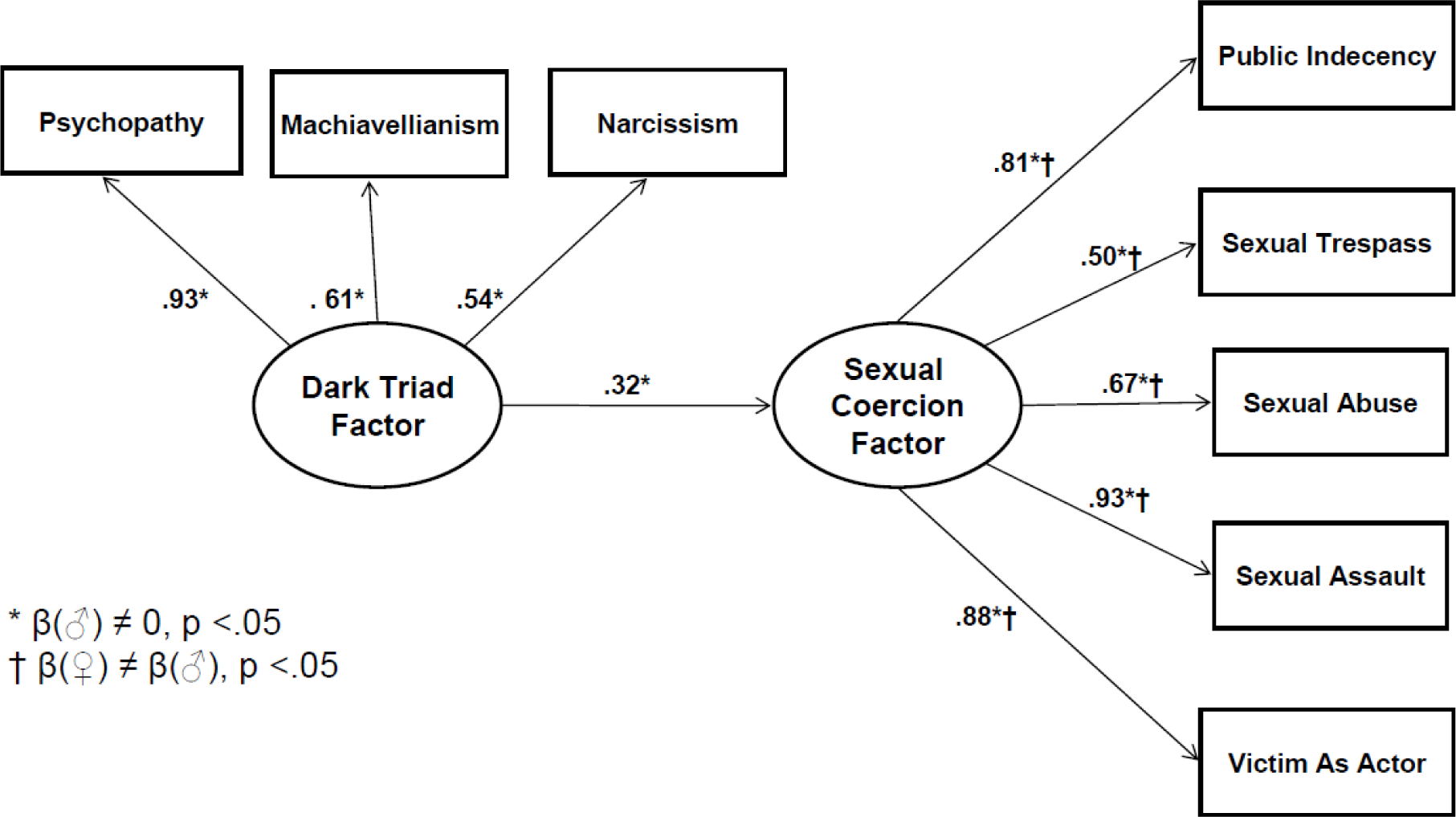
MSEM 3 ♂: Restricted model with 0 specific pathways and 1 common factor pathway
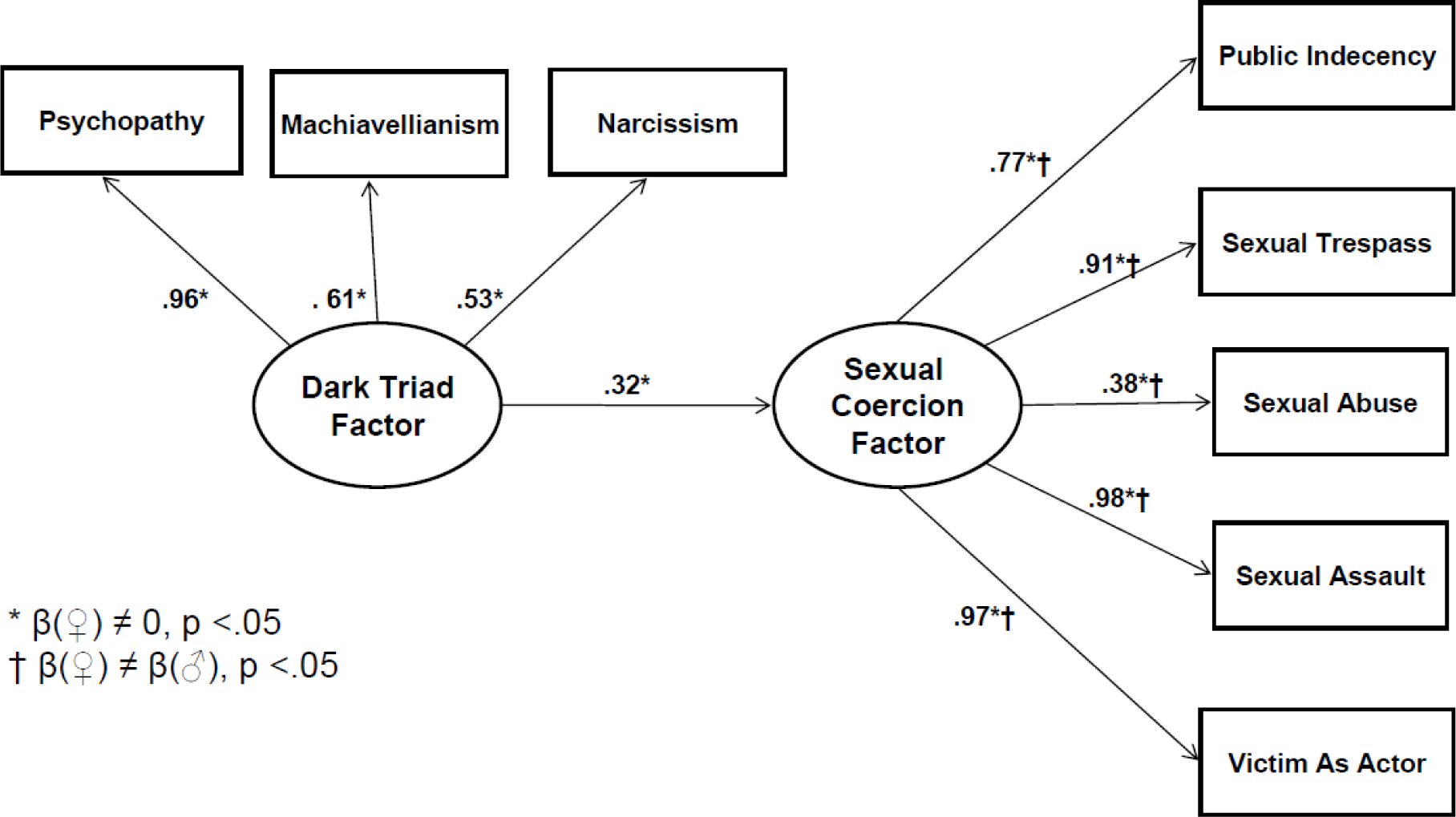
MSEM 3♀: Restricted model with 0 specific pathways and 1 common factor pathway
Table 1 displays the results of the nested model comparisons, comparing and contrasting both Restricted MSEMs (MSEM 2 and MSEM 3) with the inclusive MSEM (MSEM 1).
Hierarchically nested model comparisons: MSEM 1–MSEM 3
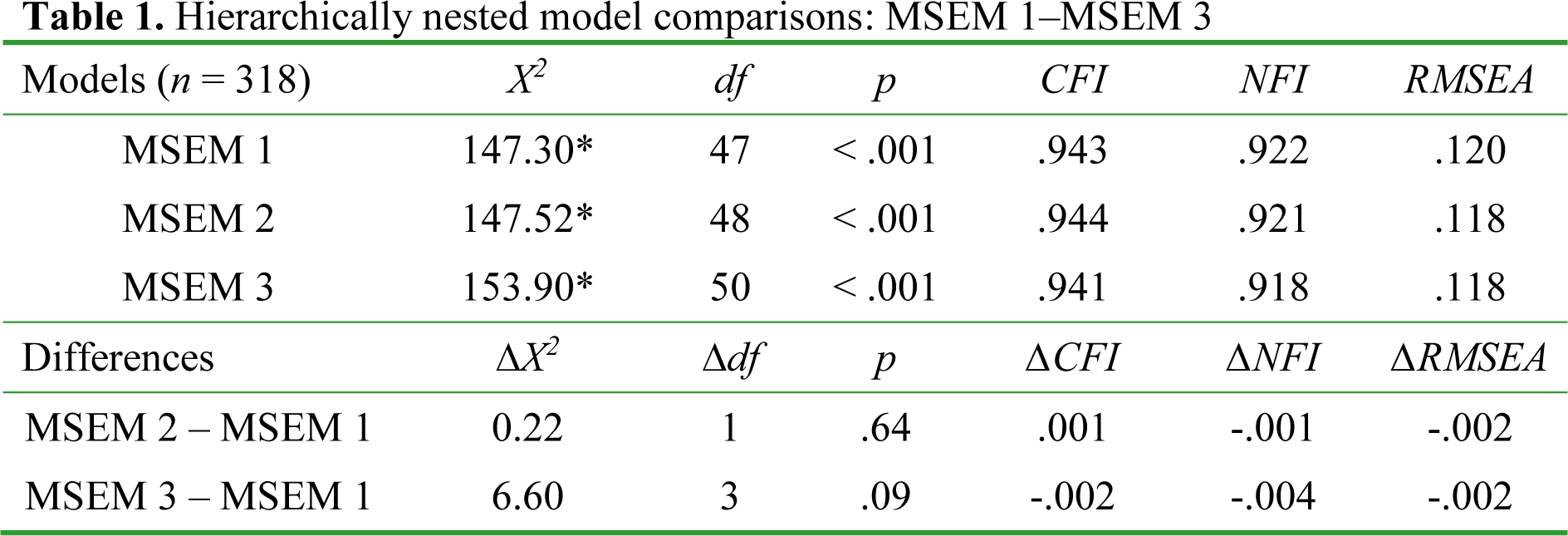
Although both MSEM 2 and MSEM 3 were acceptable by the statistical and practical measures of goodness-of-fit as compared with MSEM 1, we see that the most parsimonious and explanatory model was nevertheless MSEM 3, in which a single common factor composed of the three Dark Personalities (as manifest indicators) explained the relationships among them and predicted the Sexual Coercion Factor, without any unique contributions from the three specific manifest indicators. We might then be tempted to conclude that these three Dark Personality traits apparently did not differentially predict Sexually Coercive Behaviors, when controlling for the shared common factor variance among them.
The restricted models (Round 2)
Alternative MSEMs, however, each specifying a single unique pathway between one and only one of the Dark Personalities and the Sexual Coercion Factor, are each equally parsimonious to MSEM 1, which specifies a single common contribution only from the latent DT Factor to the Sexual Coercion Factor. We therefore tested three more alternative MSEMs examining possible unique relationships between each individual Dark Personality and the general Sexual Coercion factor. MSEM 4 specified the unique causal pathway only from Psychopathy, and neither from the latent DT Factor nor from Machiavellianism or Narcissism; MSEM 5 specified the unique causal pathway only from Machiavellianism, and neither from the latent DT Factor nor from Psychopathy or Narcissism; MSEM 6 specified the unique causal pathway only from Narcissism, neither from the latent DT Factor nor from Psychopathy or Machiavellianism.
Figures 3 and 4 display the MSEM 4 results for the male and female subsamples, respectively. MSEM 4 is shown here because, of the three specified models that each had only one unique casual pathway (MSEM 4-6), MSEM 4 was the best. As before, the path coefficients are standardized regression weights obtained by Maximum Likelihood estimation. All path coefficients marked with an asterisk (*) were statistically significant at an alpha level of p < .05.

MSEM 4♂: Restricted model with one and only one specific pathway from psychopathy

MSEM 4♀: Restricted model with one and only one specific pathway from psychopathy
Table 2 displays the results of the nested model comparisons, comparing and contrasting these additional Restricted MSEMs (MSEM 4 through MSEM 6) with the inclusive MSEM (MSEM 1).
Hierarchically nested model comparisons: MSEM 4–MSEM 6

We therefore see that these three alternative Restricted Models tested (MSEM 4 through MSEM 6) were statistically rejectable in comparison with the Inclusive Model (MSEM 1). This means that MSEM 1 won this second round of empirical testing by virtue of its relative parsimony and its greater fit to data from both sexes. Thus, a single common factor composed of the Dark Personality traits predicted Sexual Coercion without any direct contributions from any of the specific Dark Personalities. When controlling for this latent common factor, these three distinct but related traits did not differentially predict Sexually Coercive Behavior. Furthermore, the testing of the cross-sample equality constraints revealed that both the composition of the DT Factor and its shared effect on the Sexual Coercion Factor were statistically equivalent for males and females, indicating that this common pathway model fit equally well for both sexes.
The restricted models (Round 3)
The only remaining problem is that the statistical, practical, and parsimonious fit indices in structural equation modeling only tell part of the story. They do not assess what proportion of the variance was explained in the criterion variable of interest, but only indicate that the model adequately reproduced the observed multiple correlations. This can happen even when the degree of actual explanatory power is quite low, as long as the structural model is able to reproduce those observed correlations, of whatever absolute magnitude. This implies that differences in overall model performance that are unrelated to our alternative hypotheses, such as may be obtained by adequately reproducing the sex differences in the factor loadings of the Sexual Coercion Factor, might have influenced the outcomes of our nested model comparisons.
Because an SEM represents a simultaneous system of Multiple Regression/Correlation (MRC) equations (Byrne, 1994; James et al., 1982), embedded in each of the alternative MSEMs tested is the specific MRC equation for the Sexual Coercion Factor that bears closer examination. Hierarchically nested model comparisons can therefore be performed focusing only on one specific MRC equation within each alternative MSEM by systematically comparing and contrasting their Squared Multiple Correlations (R2) on the Sexual Coercion Factor (Cohen and Cohen, 1983). This can be done using the model parameters estimated by the MSEMs and testing for significant differences (ΔR2) among their embedded MRC equations. What this means is that our “Round 3” did not consist of running any more alternative models, but rather in examining different indices of their relative explanatory power besides the various indices normally used to evaluate the fit of the empirical data to the alternative theoretical models.
We performed nested model comparisons using traditional MRC methods, comparing and contrasting the Squared Multiple Correlations (R2) on the Sexual Coercion Factor of all five Restricted MSEMs tested (MSEM 2 through MSEM 6) with the inclusive MSEM (MSEM 1). Again, the three alternative Restricted Models, MSEM 4 through MSEM 6, were statistically rejectable in comparison with the Inclusive Model, MSEM 1. As before, only the two Restricted Models, MSEM 2 and MSEM 3, were statistically acceptable in comparison with the Inclusive Model, MSEM 1, but MSEM 3 wins by virtue of its greater parsimony. When evaluated as MRCs (by ΔR2), MSEM 3 now decisively outperforms the best of the Alternative Restricted Models, MSEM 4; MSEM 3 explains over twice as much of the variance in the Sexual Coercion Factor as MSEM 4. Moreover, the advantage in explanatory power of MSEM 3 over MSEM 4 is of non-trivial relative magnitude, involving an R2 of ~.11 instead of ~.05, which is a difference (ΔR2) of ~.06 of the variance in the Sexual Coercion Factor.
This confirms that, given the current data, the optimal (most parsimonious and explanatory) model was a “Partially Constrained” MSEM specifying Cross-Sample Equality Constraints for: (1) all the DT factor loadings; (2) the single shared effect of DT Factor on Sexual Coercion Factor; (3) all the intercepts of the manifest indicators for both the DT and the Sexual Coercion Factors; and (4) none of the Sexual Coercion factor loadings. These results indicate that both the composition of the DT Factor, putatively representing an “Exploitive Sexual Style,” a correlate of fast life history strategy, and its shared effect on the Sexual Coercion Factor are statistically equivalent for men and women, and that this common pathway model fits equally well for both sexes.
Discussion
The results of the present research demonstrate that a willingness to engage in sexual coercion is directly predicted by a common core associated with the Dark Triad. Thus, in addition to a variety of deceptive tactics (Jonason and Webster, 2012), and the presence of reduced mating standards (Jonason et al., 2011), individuals high in callousness and manipulation are willing to force the issue in a sexual situation, perhaps also contributing to the higher number of lifetime partners associated with the Dark Triad (Jonason et al., 2009). Further, the results generally favor the interpretation that the “DT” represents three convergent manifest indicators of a single latent common factor representing an “Exploitive Sexual Style” (Jonason et al., 2009). Nevertheless, this was a single test of these alternative hypotheses with a single sample on a single criterion variable (Sexual Coercion). Indeed, research has found that investigating specific coercive tactics across different scenarios differentiates the Dark Triad (Jones and Olderbak, 2014).
Jones and Paulhus (2011) recently made the strong theoretical prediction that the common core underlying the DT would be discovered to be “callousness,” which is known to be a shared feature of the consensus definitions of Psychopathy, Machiavellianism, and Narcissism. Jones and Figueredo (2013) empirically tested this idea by disaggregating the DT assessments into elementary components, and found that callousness and manipulation were integral to the “Dark Core.” Thus, two specific “Core” Components—(1) Manipulation, from the SRP; and (2) Callousness, from the SRP—were inherent to all three DT constructs.
These results indicate that the “Dark Core” of combined callousness and manipulation, collectively referred to as “Psychopathic Attitudes” (as opposed to the “Psychopathic Behaviors” exemplified by the Erratic and Antisocial components of the SRP), explains most of the substantive content within the observed “DT” common factor. However, many interesting questions remain, for example: Is the “Dark Core” the ancestral form from which all the “Dark Personalities” originally evolved? Has disruptive selection promoted the evolution of specialization among variants of this common tendency through adaptive radiation? Are the “unique features” of each of these “Dark Personalities” the products of disruptive selection for “character displacement” or “adaptive divergence” (see Figueredo et al., 2007, 2010)? Does the existence of partially unique “Dark Personalities” logically imply the existence of partially unique “Dark Niches” (Jones and Paulhus, 2011) that selectively gave rise to them? If so, what are these “Dark Niches” and where and when did they originate?
With respect to the evolution of psychopathy, Figueredo et al. (2007) had predicted:
The human environment has changed dramatically over the Holocene (the last 10,000 years). From agriculture to agri-business, and bronze-age industry to industrial revolutions, many aspects of modern life never existed before. Over the past 300-500 years alone, we switched from small pre-industrial farming towns to post-industrial technological mega-cities, and from semi-arranged patriarchal marriages to speed dating. Psychopaths flourish in mega-cities with speed dating. Given that such psychopath-conducive environments probably did not exist in previous human evolutionary history, psychopathy itself may be a newly emerging adaptation associated with an increasingly complex society. (p. 348)
Two corollaries of this basic hypothesis may be derived for present purposes, requiring different rates or cumulative degrees of evolution for these alternative strategies:
Today's three (or more) “Dark Personalities” might be specialized forms, derived from a recent common ancestor, as adaptations to different Dark Niches. In this view, that “First Psychopath” is probably best represented by the “Dark Core” characteristics of callousness and manipulation.
Today's three (or more) “Dark Personalities” might be alternative phenotypes, or rival mutant strains, still engaged in a struggle for existence of competitive exclusion for a single Dark Niche. In this view, the “Perfect Psychopath” has not yet emerged victorious from this contest, and has therefore not yet evolved.
To better understand these findings within the context of the Principle of Brunwik-Symmetry, it may be necessary to examine a variety of assessments of dark personalities, rather than an isolated few. With a wider range of assessments, we may be able to conceptually separate which assessment characteristics are unique or overlapping. In this way, we may benefit from a taxonomical scheme that can classify the measurements into hierarchal categories according to more fundamental affective, cognitive, and behavioral processes.
Either way, our more detailed analyses, as informed by the Principle of Brunswik-Symmetry, are both partially supportive and partially discrepant with the position of Jonason et al. (2009) with respect to exploitative sexual tendencies in the Dark Triad. We did find some results that converged with those of Jonason, Luevano, and Adams (2012) in that Machiavellianism was not predictive of any particular biasing of sexual relationship choices, when statistically controlled for the confounding effects of other Dark Triad traits such as Narcissism and Psychopathy, as expressed in a quasi-experimental budget allocation task. We also concur that the common factor underlying the “DT” both exists and is even optimally predictive of certain behaviors, such as sexual coercion. Nevertheless, we do not concur that this common factor is best represented exclusively as an “Exploitive Sexual Style.” The psychopathic attitudes that it encompasses appear to be social in general rather than sexual in particular. To support the claims of Jonason et al. (2009), much further work would need to be done to establish its discriminant validity as a specifically sexual strategy rather than a broader social one. That being said, it must be admitted that the present results for sexual coercion are consistent with that interpretation.
Our contrary informed opinion, however, is that the “Dark Core” represents a generally antagonistic, opportunistic, and exploitive stance towards all conspecifics, regardless of sex, and is the product of divergent social, rather than sexual, selection. The fundamental attribute of this adaptive strategy is callousness towards others, and the consequent tendency to manipulate others as if they were mere objects to be used instead of fellow human beings.
One possible limitation of this study is that it uses cross-sectional data, rather than longitudinal data, to test alternative causal theories. In the present case, however, it would appear unlikely that engaging in sexually coercive behaviors could retroactively produce “Dark Personality” traits in individuals as a consequence of having enacted those behaviors, rather than the other way around, even in the absence of observational data on their temporal sequencing.
Regardless of the outcome of the further studies that are needed to resolve these issues, we hope to have at least provided the necessary quantitative methodology and logical rationale for deciding this kind of controversy in other domains, using independent samples. We believe that we have shown that the problem of the ontological status of “The DT” is better viewed within the more general framework of the Principle of Brunswik-Symmetry, and that this principle represents the most useful and effective meta-theoretical organizing principle for a comprehensive understanding of the universal forms and functions of hierarchically-organized higher-order factor models.