




Abstract
This study used the life history (LH) theory to investigate how environmental cues are associated with Machiavellianism. A total of 252 undergraduate students completed self-report measures of social rank uncertainty, Machiavellianism, fast LH strategy, and dominance. The results indicated that Machiavellianism was related to a fast LH strategy. Furthermore, a fast LH strategy mediated an association between social rank uncertainty and Machiavellianism. Finally, Machiavellianism was positively associated with dominance. These findings may enhance our understanding of the evolutionary origin of Machiavellianism.
Machiavellianism has been described as a manipulative and exploitative personality trait (Christie & Geis, 1970). It has its roots in the dark side of personality (Jonason, Li, & Buss, 2010). Existing research has grouped Machiavellianism with narcissism and psychopathy; together, these traits are known as the “dark triad” (Paulhus & Williams, 2002). Research on the dark triad traits has suggested that, depending on the environmental conditions, Machiavellianism can be an adaptive strategy. However, there has been little research on the role of specific environmental cues in Machiavellianism. Furthermore, the nature of the adaptive outcomes of Machiavellianism under specific environmental conditions remains unclear. This study aimed to examine the pattern of associations between environmental factors, Machiavellianism, and its adaptive consequence using the framework of life history (LH) theory.
An LH theory describes how individuals make adaptive trade-offs with respect to growth, development, and reproduction in response to environmental challenges across the life span (Chen, 2017b; Del Giudice, Gangestad, & Kaplan, 2015; West-Eberhard, 2003). An individual’s LH strategy for managing resources depends on the harshness and uncertainty of the environment (Ellis, Figueredo, Brumbach, & Schlomer, 2009). LH strategies are considered to form a continuum, ranging from slow to fast (Figueredo et al., 2006; Griskevicius et al., 2013). Faster LH strategies arise in harsh and unpredictable environmental conditions where earlier maturation, production of more offspring, and lower parental investment are adaptive. In particular, harsh and unpredictable conditions produce a variety of fast LH strategy–relevant behavioral and psychological outcomes such as impulsivity, procrastination, and antisocial behaviors (Chang & Lu, 2018; Chen, 2018; Chen & Kruger, 2017; Chen & Qu, 2017; Del Giudice, 2014; Griskevicius, Tybur, Delton, & Robertson, 2011; Hurst & Kavanagh, 2017). Slower LH strategies arise in predictable, more favorable environments where later reproduction, higher quality of offspring, and higher parental investment are adaptive. Some behavioral and psychological constructs such as risk avoidance, future time perspective, and positive developmental outcomes are considered slow LH strategies (e.g., Chen, 2017a; Chen & Chang, 2016; Chen, Wiium, & Dimitrova, 2018; Griskevicius et al., 2011).
As one of the dark triad traits, Machiavellianism has been considered as a fast LH strategy (Figueredo et al., 2005). Machiavellianism embodied a fast LH strategy that was characterized by short-term goals and immediate gratification (Figueredo et al., 2006; Jonason, Koenig, & Tost, 2010). People with high levels of Machiavellianism tended to use a variety of social tactics (e.g., seduction and hardball) to manipulate others for personal interests (Jonason & Webster, 2012). In addition, characteristics associated with Machiavellianism, such as exploitation and selfishness, were identified as components of a fast LH strategy (Jonason, Koenig, et al., 2010; McDonald, Donnellan, & Navarrete, 2012; Reynolds & McCrea, 2015).
An LH theory also suggests that personality traits may be adaptive tactics to optimize resource allocation and to solve evolutionarily fit challenges, which are induced by main social and environmental tasks (Chen, Shi, & Sun, 2017; Del Giudice et al., 2015). Human personality traits may have been shaped by natural selection to respond to different environmental conditions (Buss, 1991; Figueredo et al., 2006; Nettle, 2006). Unfortunately, little is known about the specific environmental conditions in which Machiavellianism is used as a fast LH strategy.
According to LH theory, Machiavellianism may be an LH strategy, which is induced by unfavorable environmental factors. For example, recent research has shown that childhood maltreatment (Láng & Lénárd, 2015) and an unpredictable childhood environment (e.g., “Things were often chaotic in my house”; Jonason, Icho, & Ireland, 2016) are associated with Machiavellianism in adulthood. An unpredictable early childhood environment may promote Machiavellianism and correlated behaviors (Jonason et al., 2016). In addition to the early environmental conditions and experiences, the perception of future environmental condition may activate the LH psychological mechanisms (Davis & Werre, 2008). For example, if the future is perceived as uncertain, future outcomes may be “discounted,” which may in turn lead to use of fast LH strategies such as procrastination (Chen & Kruger, 2017). For another example, the life expectancy in communities was associated with the rates of homicide, which was seen as a fast LH strategies (Wilson & Daly, 1997). The same logic may be applied to Machiavellianism: The perception of future environmental uncertainty may encourage individuals to adopt Machiavellianism as a fast LH strategy. It would be interesting to know what specific future environmental uncertainties prompt individuals to display Machiavellian behaviors.
An individual’s social rank is reflective of his or her resource-holding power and social skills (de Waal, 1986; Zuroff, Fournier, Patall, & Leybman, 2010b). Stable social rank in a group may allowed individuals to maximize their benefits of resources acquisition while minimizing the costs associated with direct competition (Cummins, 2005). The extant literature suggests that Machiavellianism occurs when individuals lack control over social rank–relevant environment (Láng & Lénárd, 2015). The perception of loss of control originates from a perception of environmental uncertainty (Mittal & Griskevicius, 2014). Given that Machiavellianism is a strategy for gaining control of resources and social dominance through manipulation of other people (Láng & Lénárd, 2015), the uncertainties that trigger it may be related to social status and resources. In other words, individuals may use Machiavellian strategies, such as deception or manipulation, to cope with the uncertain future for social status. In addition, LH research commonly involves testing whether a particular LH strategy mediates a relationship between an environmental condition and personality. For instance, slow LH strategy was shown to mediate associations between environmental uncertainty and the Big Five personality traits (Chen et al., 2017). Similarly, we predicted that slow LH strategy would mediate associations between social rank certainty and Machiavellianism.
Furthermore, we predicted that in the context of uncertainty about social status, Machiavellianism—characterized by cold-blooded self-enhancement—would be a successful strategy for exploiting social resources (Buss & Duntley, 2008; Zuroff, Fournier, Patall, & Leybman, 2010a). This prediction was derived from resource control theory (Hawley, 2003). This theory suggested that Machiavellianism might have an evolutionary function as a means of acquiring social dominance. The extant literature provides some evidence that Machiavellianism and social dominance are associated in several different cultures (Chen & Chang, 2012; Hawley, 2003). Machiavellian individuals seek personal gains at the expense of other people’s well-being. In doing so, they are successful in controlling their environment and other people and, ultimately, in enhancing their social dominance (Jonason, Koenig, et al., 2010).
In this research, we sought to test the hypothesis that Machiavellianism is a condition-dependent LH strategy in response to the environment of social rank uncertainty within the LH framework. First, we predicted that Machiavellianism would be positively associated with a fast LH strategy. Second, we predicted that fast LH strategy would mediate the association between social rank uncertainty and Machiavellianism. Third, we predicted that, under conditions of social rank uncertainty, Machiavellian individuals would be more likely to display social dominance.
Method
Participants and Procedure
Participants were 252 Chinese college students (33.73% men, 66.27% women; M age = 19.77 years, standard deviation [SD] = 1.13). They were recruited from psychology courses and participated in exchange for partial course credit. Participants were asked to complete an online survey to which they were given a link.
Measures
Machiavellianism
Machiavellianism was measured using the Mach-IV Scale (Christie & Geis, 1970), which consists of 20 items assessing Machiavellian attitudes (e.g., “The best way to handle people is tell them what they want to hear”; “Anyone who trusts anyone else is asking for trouble”). Responses are given using a 5-point Likert-type scale (1 = strongly disagree to 5 = strongly agree). As suggested by Dahling, Whitaker, and Levy (2009), 3 problematic items (“All in all, it is better to be humble and honest than to be important and dishonest,” “People suffering from incurable diseases should have the choice of being put painlessly to death,” and “Most people forget more easily the death of their parents than the loss of their property.”) were removed in the present study. A composite score was computed by averaging the scores for the 17 items. In this study, Cronbach’s α was .68.
Slow LH strategy
The Mini-K scale was used to assess individuals’ slow LH strategies (Figueredo et al., 2006). It consists of 20 items (e.g., “I often make plans in advance” and “I avoid taking risks”). Participants responded to items using a 7-point Likert-type scale (1 = strongly disagree to 7 = strongly agree). Previous research indicated that this scale score was positively linked to slow LH strategies when measured by other LH instruments or by environmental conditions theoretically relevant to slow LH strategies (Chen & Qu, 2017; Figueredo et al., 2014; Olderbak, Gladden, Wolf, & Figueredo, 2014). A composite score was computed by averaging the scores for the 20 items. By following one reviewer’s suggestion, we recoded LH scores, so that high scores indicate a fast LH strategy. In this study, Cronbach’s α was .83.
Social rank uncertainty
Participants completed the social rank subscale of the Environmental Unpredictability Scale (Davis & Werre, 2008). Participants were asked to evaluate their chances of attaining a high social rank in the future. It consists of 5 items (e.g., “I will have a happy family life” and “I will be in good health most of the time”) preceded by a stem: “What are the chances you will…?” Responses are given on a 5-point scale ranging from 1 = very low to 5 = very high. The item scores were reverse coded and then averaged to yield a composite score; higher scores indicate a greater degree of social rank uncertainty. In this study, Cronbach’s α was .77.
Dominance
Dominance was assessed using the Resource Control Strategy Inventory (Hawley, 2006), which has commonly been used to assess individuals’ social dominance including obtaining desired roles, possessions, or attention (Chen & Chang, 2012; Hawley, Little, & Card, 2008). It consists of 10 items (e.g., “I am the center of attention when with friends” and “I am successful at getting the things that I and others value”). Participants rated how true each item was for them on a 7-point scale ranging from 1 = not at all true to 7 = completely true. Cronbach’s α was .86 in the current sample.
Analytic strategy
Path analyses were used to test the associations among social rank uncertainty, Machiavellianism, fast LH strategy, and dominance. We followed current practices for mediation analyses (Hayes, 2013), using Model 6 in the PROCESS macro for SPSS. Two control variables, age and sex, were entered into the path analyses. Point estimates of the indirect effects and the 95% confidence intervals (CIs) were obtained using bootstrapping with 10,000 bootstrap samples. A mediation effect is considered statistically significant if the 95% CI does not contain 0.
Results
All means, SDs, and correlations among variables are presented in Table 1. Social rank uncertainty was positively correlated to Machiavellianism and fast LH strategy but negatively correlated to dominance. Machiavellianism was positively correlated to both fast LH strategy and dominance. Fast LH strategy was negatively related to dominance. Lastly, for demographic variables, there was only one statistically significant association. That is, age was positively related to dominance.
Descriptive Statistics and Correlations of Variables.
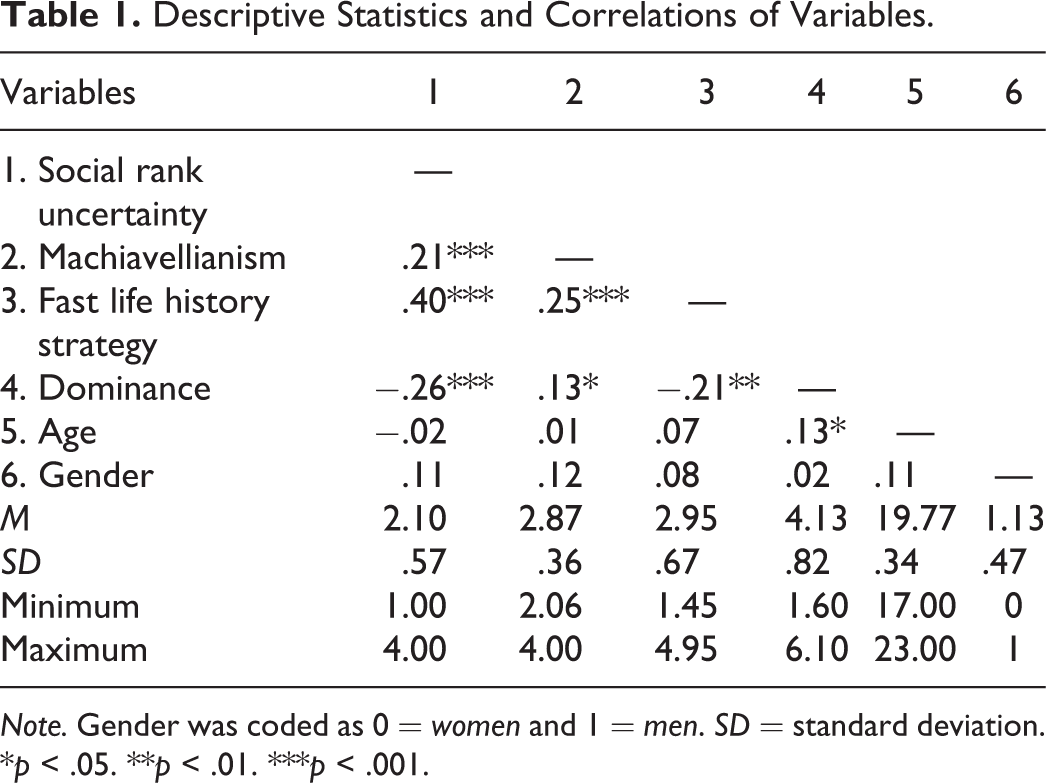
Note. Gender was coded as 0 = women and 1 = men. SD = standard deviation.
*p < .05. **p < .01. ***p < .001.
Path analyses were used to test the associations among social rank uncertainty, Machiavellianism, fast LH strategy, and dominance. First, as shown in Figure 1, Machiavellianism was positively associated with a fast LH strategy. This finding supports the first hypothesis, namely, that Machiavellianism was a fast LH strategy. Second, the association between social rank uncertainty and Machiavellianism was fully mediated by fast LH strategy. This finding supports the second hypothesis that slow LH strategy mediated the association between social rank uncertainty and Machiavellianism. Lastly, the third hypothesis, which was that Machiavellianism would be associated with dominance, was also supported by the model.

The model depicting the associations among the study variables. The path coefficients are unstandardized. Dotted lines = nonsignificant paths. **p < .01. ***p < .001.
The significance of indirect effects of social rank certainty was assessed using the bootstrap estimation procedure. The indirect effects and their associated 95% CIs are shown in Table 2. As predicted, the indirect effects for the hypothesized paths (i.e., social rank uncertainty → fast LH strategy → dominance; social rank uncertainty → fast LH strategy → Machiavellianism → dominance) were significant.
Bootstrapping Indirect Effects and 95% Confidence Interval (CIs) for the Path Models.

Discussion
The goal of the present study was to examine the associations among social rank uncertainty, Machiavellianism, fast LH strategy, and dominance. First, our results indicated that Machiavellianism was related to fast LH strategy. They extend previous research as they indicated that there was an association between social rank uncertainty and Machiavellianism that was mediated by fast LH strategy. Lastly, in the context of social rank uncertainty, Machiavellianism was positively associated with dominance.
This study highlights the adaptive significance of Machiavellianism from an LH perspective. Consistent with previous studies (Figueredo et al., 2005; Jonason, Koenig, et al., 2010; McDonald et al., 2012), we found that Machiavellianism was positively associated with fast LH strategy; it may represent a fast LH strategy.
Furthermore, LH theory emphasizes LH strategy may be affected by environmental factors such as uncertainty. Previous research has indicated that environmental uncertainty might influence the dark triad traits including Machiavellianism (Jonason et al., 2016). In the present study, we specify the environmental uncertainty by focusing on social rank domain. Our findings are consistent with the premise that social rank uncertainty suggests to individuals that they are likely to lack of control over their social status in the future. This information activates a fast LH mind-set and then leads to adopt manipulative behavioral tactics that may enhance their chances of acquiring social dominance. It follows that Machiavellianism may represent an adaptive response to this particular environmental challenge. In the context of social rank uncertainty, Machiavellian individuals may adopt a fast LH strategy in order to attain social dominance.
To our knowledge, this study is the first to reveal relationships among social rank certainty, Machiavellianism, fast LH strategy, and dominance. The findings reported here are novel and important for several reasons. First, this study goes beyond existing literature by exploring Machiavellianism as correlates of social rank uncertainty. Second, this study provides a mediation insight into the explanation of the mechanisms by which social rank uncertainty plays roles on Machiavellianism.
Several limitations of this study must be acknowledged. First, we relied exclusively on self-report data for all the study variables. Relying on a single informant method necessarily limits what we know about other persons’ perceptions. For example, an individual’s rating of his or her dominance may be different from that of other people. Future studies should include peers’ reports or observations from others.
Second, the study was based on a small sample of university students. Machiavellianism is commonly found in the workplace and bureaucracy. Future studies should expand the sample size and explore this issue in workplace and bureaucracy contexts.
Third, although psychometric measures of Mini-K are frequently used to assess the LH strategies in previous research, their validity has been questioned (Copping, Campbell, & Muncer, 2014; see also Figueredo et al., 2015, for a response). Future studies should include other LH strategy measures (e.g., the High K Strategy Scale; Giosan, 2006) to replicate our findings. In addition, given the heritability of LH strategy (Figueredo, Vásquez, Brumbach, & Schneider, 2004) and the potential role of early childhood environments on LH strategy (e.g., Belsky, Houts, & Fearon, 2010; Chen et al., 2017; Griskevicius, Delton, Robertson, & Tybur, 2011), it may be possible that social rank uncertainty may interact with genetic and early childhood factors to influence LH strategies. Future research should include both participants’ early childhood environments and their parents’ LH strategy to directly test these possible association patterns.
Lastly, interpretations of Machiavellianism may vary between cultures. For example, a Machiavellian strategy that threatens collectivism may be not socially accepted in peer groups in China (Chen & Chang, 2012). Further research examining cultural similarities and differences in the pattern of association we have identified is necessary. In addition, some studies (e.g., Jonason, Koenig, et al., 2010) have indicated that Machiavellianism, as assessed by the relevant dark triad subscale, is not associated with a fast LH strategy. Future research that includes multiple assessments of variables may increase internal validity of the research.
Footnotes
Declaration of Conflicting Interests
The author(s) declared no potential conflicts of interest with respect to the research, authorship, and/or publication of this article.
Funding
The author(s) disclosed receipt of the following financial support for the research, authorship, and/or publication of this article: The Research Fund of the School of Social Development and Public Policy at Fudan University.
