




Abstract
The current study provides the first examination of the relationship between life history indicators and the Dark Triad traits in an international sample drawn from the U.S. (n = 264), Singapore (n = 185), and Poland (n = 177). In all three samples, the Dark Triad traits were associated with psychosocial costs, although there were more links in the Singaporean and Polish samples than in the American sample. In the U.S., the quality of one's romantic relationships and psychopathy were negatively correlated. Narcissism was higher in the Polish and American samples than in the Singaporean sample. Men scored higher than women did regardless of location and the sex difference in the individual differences in life histories was mediated by the Dark Triad composite. Results suggest the Dark Triad are related to a volatile socioecology composed of psychosocial costs in the familial, romantic, and platonic relationships.
Introduction
There has been an explosion of research on the Dark Triad traits (i.e., narcissism, psychopathy, and Machiavellianism; Paulhus and Williams, 2002) over the last five years (see Jonason, Webster, Schmitt, and Crysel, 2012). Independently, psychopathy is noted for its characteristic callousness and limited empathy (Ali, Amorim, and Chamorro-Premuzic, 2009); Machiavellianism is noted for its characteristic glib social charm and manipulativeness (Christie and Geis, 1970); and narcissism is noted for its characteristic senses of entitlement, superiority, vanity, and exploitiveness (Raskin and Terry, 1988). Researchers have adopted numerous theoretical paradigms including Social Exchange (O'Boyle, Forsyth, Banks, and McDaniels, 2012), Behavioral Genetics (Vernon, Villani, Vickers, and Harris, 2008), Selection-Evocation-Manipulation (Jonason and Schmitt, 2012; Jonason, Valentine, Li, and Harbeson, 2011), and Life History Theory (Jonason, Koenig, and Tost, 2010; McDonald, Donnellan, and Navarrete, 2011). We integrate the latter two to provide details about the psychosocial costs associated with the Dark Triad traits.
In Homo sapiens, prosocial behaviors, attitudes, and personality traits are evolutionarily stable strategies, but evolution also favors those who employ more self-serving strategies (Buss, 2009; Rushton, 2004). Such strategies - as measured by the Dark Triad - might be in response to environmental contingencies or they could be a heritable, alternative life history strategy (Figueredo, Vásquez, Brumbach, and Schneider, 2004; Jonason, Webster, et al., 2012). Evidence suggests those high on the Dark Triad have a short-term (Jonason, Li, Webster, and Schmitt, 2009; Jonason, Valentine, et al., 2011), opportunistic/ exploitive mating strategy (Jonason, Luévano, and Adams, 2012) along with a strategic approach to friendship-selection (Jonason and Schmitt, 2012) and a protean approach to social interactions (Jonason and Webster, 2012). This has led some to conclude that the Dark Triad traits are part of a fast life history strategy (Figueredo et al., 2005, 2006; Jonason, Koenig et al., 2010; Jonason and Tost, 2010; Jonason, Webster, et al., 2012; McDonald et al., 2011) geared towards maximizing immediate returns over delayed outcomes as would be predicted by the tradeoffs expressed in Life History Theory (Buss, 2009; Rushton, 2004; Wilson, 1975).
Unfortunately, maximizing immediate returns can be costly. For instance, the Dark Triad traits are associated with mate-defection, an ostensible cost to the individual's fitness (Jonason, Li, and Buss, 2010). More work is needed on the costs or tradeoffs individuals pay to further integrate the Dark Triad traits into a Life History paradigm. Most work on the Dark Triad has focused on the group-level costs (e.g., O'Boyle et al., 2012), which might not be the proper level of analyses for an evolutionary investigation of the Dark Triad (Jonason, Webster, et al., 2012). We would argue that stressful life indicators might not necessarily result in the Dark Triad traits as suggested by some experimental work (Griskevicius, Tybur, Delton, and Robertson, 2011), but the Dark Triad traits will necessarily create stressful socioecologies like dating volatile mates (Jonason, Valentine, et al., 2011). In other words, the Dark Triad traits are higher-order traits, whereas aspects of individual's lives like those measured by Life History researchers (e.g., Figueredo, 2007) are seen as lower-order, downstream correlates.
We examine the Dark Triad traits in relation to a wide range of life history indicators to assess the psychosocial costs associated with being high on the Dark Triad. In order to provide detail that is not reliant solely on Western college students (Henrich, Heine, and Norenzayan, 2010), we assess these links in American, Singaporean, and Polish samples. We expect that the Dark Triad traits will be associated with a volatile socioecology (Jonason and Schmitt, 2012; Jonason, Valentine, et al., 2011) with limited social support, low quality relationships with parents, and poor experiences within romantic relationships in these different nations.
We expect to demonstrate that sex differences in the Dark Triad traits are present in different parts of the world, testing the hypothesis that such approaches to life are more adaptive for men than for women because men pay fewer costs and get a greater return for living such a life (Buss, 2009; Figueredo et al., 2006; Jonason, Webster, et al., 2012; Mealey, 1995; Rushton, 2004; Wilson and Daly, 1985). And, in as much as the Dark Triad facilitates a fast life strategy (Jonason et al., 2009; Jonason, Webster, et al., 2012), we would expect sex differences in the overall quality of a person's life (i.e., a composite of their life history indicators) to be mediated by their scores on the Dark Triad.
In this study we provide the first study linking the Dark Triad traits to a multidimensional measure of individual differences in life histories and do so in a cross-cultural sample. We test a number of hypotheses. First, we examine whether the Dark Triad traits are correlated within each sample as well as overall. Second and third, we test whether the Dark Triad traits are correlated with life history indicators overall and in each sample, and whether the overall link between the Dark Triad and individual differences varies across sample site. Fourth, we attempted to test the generalizability of the sex differences in the Dark Triad. Fifth, we examined whether the Dark Triad composite mediated sex differences in life history indicators.
Materials and Methods
Participants
A total of 626 participants (59% female) were recruited from three different universities (52% U.S.; 30% Singapore; 28% Poland). They were aged 17–63 (M = 23.31, SD = 6.26) and received extra credit in their psychology course for participation. The U.S. sample ranged from 17–53 years of age (M = 21.17, SD = 5.04) with 42% female. The Singaporean sample ranged from 19–28 years of age (M = 21.89, SD = 1.62) with 59% female. The Polish sample ranged from 18–63 years of age (M = 26.99, SD = 8.22) with 62% female. The results were robust to partialing the variance associated with the age of the participant.
Procedure
Participants were informed of the nature of the study and were asked if they consented to participate. If they said “yes,” they were asked to specify their country of origin (i.e., U.S., Singapore, or Poland); anyone from another country than these three was excluded from analyses. Participants from Poland were provided a version of the measures in Polish that was translated forward by the third author and then translated back into Polish by an independent colleague. Although Singapore has a predominantly Chinese population, English is the primary language of instruction so there was no need for a translated version. Participants completed a measure of the Dark Triad traits, a life history measure, and reported their sex and age. Upon completion, participants were thanked and debriefed.
Measures
To measure the Dark Triad traits, the Dirty Dozen (Jonason and Webster, 2010) was used. It is composed of 12 items in total (4 per subscale). Participants were asked how much they agreed (1 = not at all; 5 = very much) with statements such as: “I tend to want others to admire me” (i.e., narcissism), “I tend to lack remorse” (i.e., psychopathy), and “I have used deceit or lied to get my way” (i.e., Machiavellianism). Items were averaged together to create an index of narcissism (αOverall = .87; αUS = .87; αSingapore = .88; αPoland = .88), Machiavellianism (αOverall = .86; αUS = .87; αSingapore = .86; αPoland = .85), psychopathy (αOverall = .72; αUS = .78; αSingapore = .75; αPoland = .65), and a single Dark Triad index (αOverall = .90; αUS = .92; αSingapore = .89; αPoland = .85) of all three.
The Arizona Life History Battery (ALHB; Figueredo, 2007) is composed of 179 cognitive and behavioral indicators of life history strategies. They are scored directionally where high scores indicate a “slow” (K-selected) life history strategy on the “fast-to-slow” (r-to-K) continuum. Based on previous results (Figueredo et al., 2005), we constructed an unweighted average, overall life history measure, composed of the subscales (i.e., 20 items for Insight, Planning, and Control, 26 items for Quality of Parental Relationships, 10 items for Familial support/contact, 20 items for Friendship support/contact, 36 items for Quality of Romantic Relationships, 50 items for Altruism, and 17 items for Religiosity) of the ALHB. For instance, to measure Insight, Planning, and Control participants were asked how much they agreed (−3 = strongly disagree; +3 = strongly agree) with the statement “I can head off a bad situation before it happens.” To measure Quality of Romantic Relationships participants were asked how much they agreed (−3 = strongly disagree; +3 = strongly agree) with the statement “I prefer not to show a partner how I feel deep down.” Internal consistency details can be found in the Tables.
Results
We began by assessing the intercorrelations among the Dark Triad traits. In the full sample, Machiavellianism was correlated with psychopathy (r(625) = .64, p < .01) and narcissism (r(625) = .63, p < .01) and psychopathy was correlated with narcissism (r(625) = .44, p < .01). In the American sample, Machiavellianism was correlated with psychopathy (r(264) = .73, p < .01) and narcissism (r(264) = .76, p < .01) and psychopathy was correlated with narcissism (r(264) = .44, p < .01). In the Singaporean sample, Machiavellianism was correlated with psychopathy (r(185) = .61, p < .01) and narcissism (r(185) = .59, p < .01) and psychopathy was correlated with narcissism (r(185) = .42, p < .01). In the Polish sample, Machiavellianism was correlated with psychopathy (r(176) = .48, p < .01) and narcissism (r(176) = .53, p < .01) and psychopathy was correlated with narcissism (r(176) = .18, p < .05). When we examined the correlations in the American and Singaporean samples, all three were larger in America than Singapore (Fisher's zs = 2.78–3.30, p < .05) and Poland (zs = 4.20–4.53, p < .01). The correlations in the Singaporean and Polish samples did not differ significantly.
Our second hypothesis asked whether the Dark Triad were correlated with individual differences in life history strategies. To begin, we tested two Confirmatory Factor Analytic models to determine whether it was the latent Dark Triad or the individual traits that relate to overall life history strategies better. The latent (i.e., hierarchical) model (χ2(2) = 12.71, p < .01, CFI = .98, NFI = .98, RMSEA = .09, 90% CI [.05, .14]) fit the data better than the independence (i.e., nested) model (χ2(1) = 354.68, p < .01, CFI = .46, NFI = .46, RMSEA = .76, 90% CI [.70, .83]). Next we re-ran our analyses but did not use the overall life history composite. So long as we allowed for correlated errors, the latent model (χ2(24) = 120.89, p < .01, CFI = .94, NFI = .95, RMSEA = .08, 90% CI [.07, .10]) fit the data better than the independence model (χ2(14) = 160.01, p < .01, CFI = .92, NFI = .93, RMSEA = .13, 90% CI [.11, .15]), a noteworthy difference given that any correlated errors with the Dark Triad traits were not included in the former model. Such evidence is consistent with the contention that when assessing higher-order personality traits in relation to the Dark Triad, it is the latent model that fits the data best (Jonason, Kavanagh, Webster, and Fitzgerald, 2011). Given the reduced sample sizes and thus increased standard error (Bentler and Chou, 1987), no Confirmatory Factor Analyses were conducted for the country samples.
Despite the fit from above, an examination of the correlations at the trait level is important to localize the links between the Dark Triad and life history indicators. Table 1 contains the zero-order correlations and standardized multiple regression coefficients (controlling for shared variance in the Dark Triad traits) from a simultaneous analyses where we included the three Dark Triad traits as predictors and each life history indicator including the unweighted average (one at a time) to account for the relationships between the Dark Triad traits and the ALHB. Psychopathy scores were correlated with low quality relationships with parents, limited experience in romantic relationships, and low rates of altruism and religiosity. Machiavellianism and narcissism were both correlated with limited experience in romantic relationships and low rates of religiosity.
Zero-order correlations and standardized regression coefficients for the associations between the Dark Triad Traits and the Arizona Life History Battery Scales for full dataset

Notes:
p < .05
p < .01
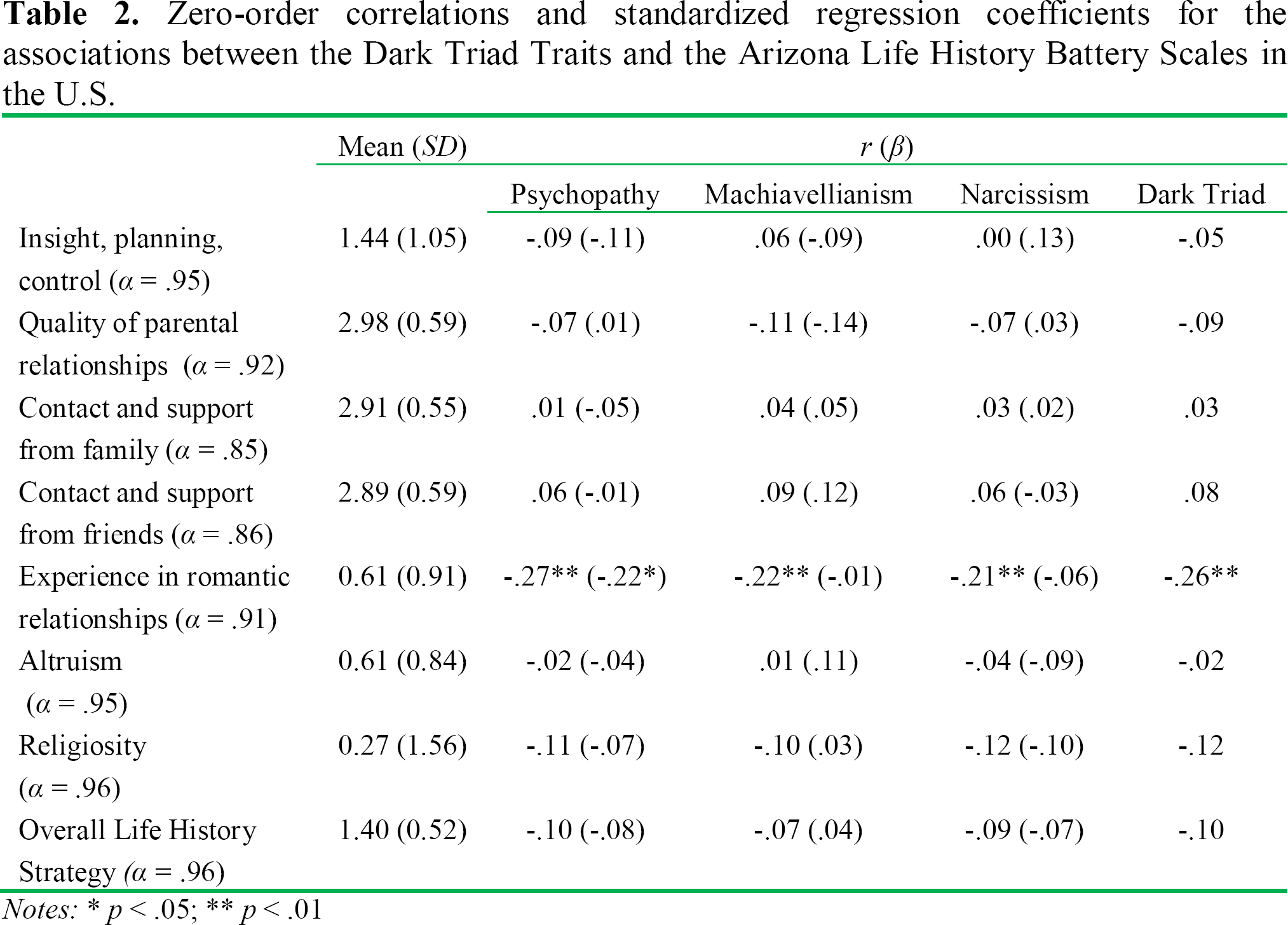
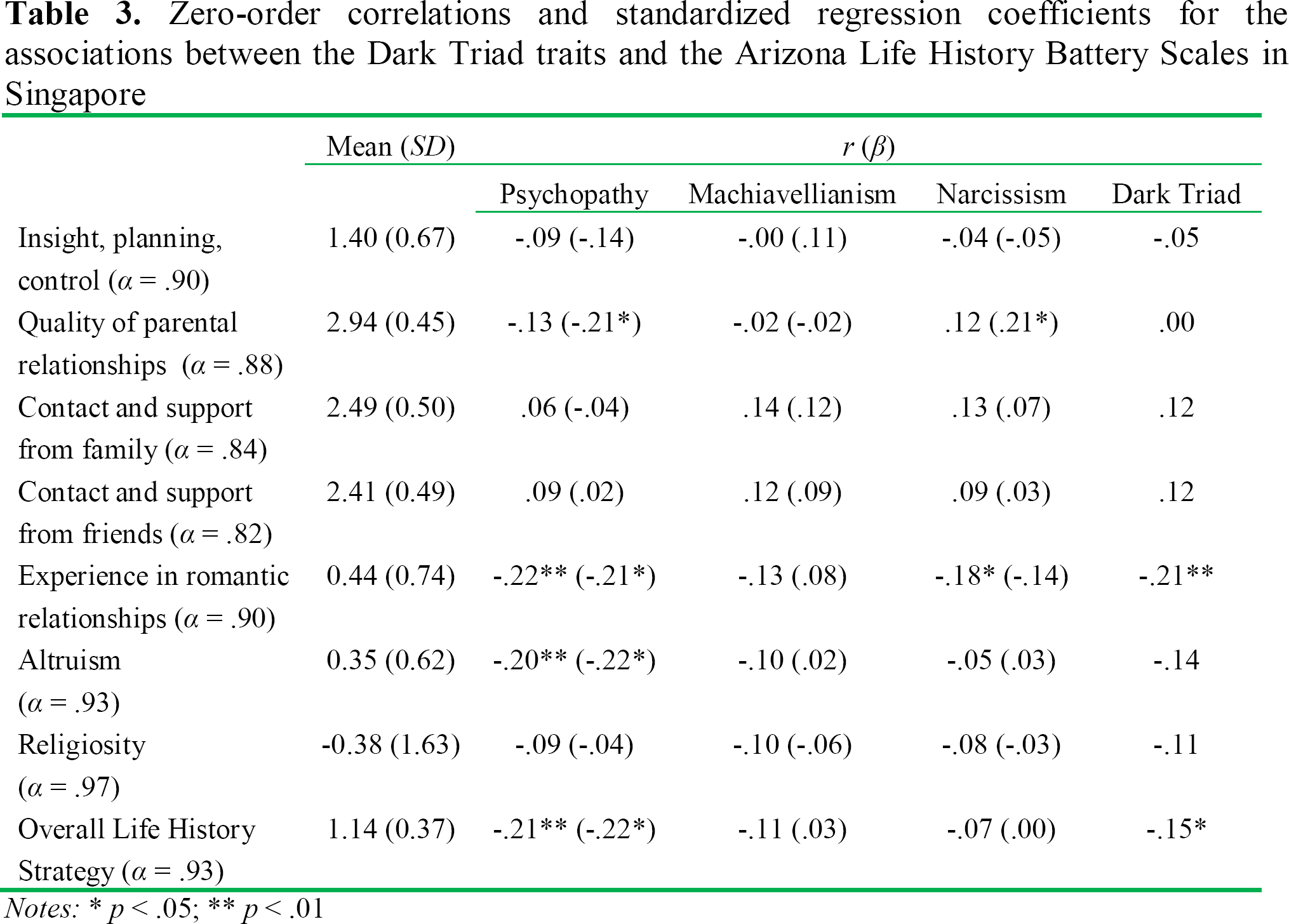
Our third hypothesis asked what was the nature of these links in three different nations. When we compared the overall correlations (lower left corner of each Table) the value in the Polish sample was slightly larger (Fisher's z = 1.69, p < .05) than in the American sample. In the American sample (see Table 2), the only link between the Dark Triad traits and the ALHB is for the quality of romantic relationships, a correlation localized to psychopathy. In the Singaporean (see Table 3) and Polish (see Table 4) samples the Dark Triad traits were linked to low quality interactions with parents, experience in romantic relationships, and altruism. In the case of the Polish sample, psychopathy was negatively correlated with religiosity.
Zero-order correlations and standardized regression coefficients for the associations between the Dark Triad Traits and the Arizona Life History Battery Scales in the U.S.
Notes:
p < .05
p < .01
Zero-order correlations and standardized regression coefficients for the associations between the Dark Triad traits and the Arizona Life History Battery Scales in Singapore
Notes:
p < .05
p < .01
Zero-order correlations and standardized regression coefficients for the associations between the Dark Triad traits and the Arizona Life History Battery Scales in Poland

Notes:
p < .05
p < .01
Our fourth hypothesis was concerned with sex differences in the Dark Triad traits and life history strategies. In a series of ANOVAs, we tested a 2 (participant's sex) × 3 (country) model to account for differences in the Dark Triad traits. There was a main effect for country for narcissism (F(2, 624) = 12.27, p < .01, η p 2 = .04) but not psychopathy (F= 0.68) or Machiavellianism (F = 0.02), suggesting those in Poland (M = 2.75, SD = 1.05) and America (M = 2.68, SD = 0.97) had significantly higher narcissism scores than Singaporeans (M = 2.30, SD = 1.02). Men scored higher than women did on psychopathy (F(1, 624) = 28.55, p < .01, η p 2 = .04), Machiavellianism (F(1, 624) = 27.37, p < .01, η p 2 = .04), and narcissism (F(1, 624) = 11.21, p < .01, η p 2 = .02) and this effect did not depend on sample site for any of the traits (Fs = 1.00–2.27). Given these details, we used the Dark Triad composite in our mediation analyses to follow.
Before testing our fifth hypothesis regarding mediation, we conducted an ANOVA with the ALHB composite as the outcome variable. There were significant effects of participant's sex (F(1, 624) = 12.54, p < .01, η p 2 = .02) and location (F(2, 624) = 17.15, p < .01, η p 2 = .05), and a marginally significant interaction (F(2, 624) = 2.92, p = .054, η p 2 = .01). The location effect suggests Americans (M = 1.30, SD = 0.58) had the fastest life history, then Polish (M = 1.13, SD = 0.51), and then Singapore (M = 0.99, SD = 0.41). Men indicated having a faster life history strategy than women did in the U.S. (men: M = 1.16, SD = 0.69; women: M = 1.39, SD = 0.46) and Poland (men: M = 1.00, SD = 0.51; women: M = 1.21, SD = 0.50). In Singapore, the sexes did not significantly differ (men: M = 0.99, SD = 0.41; women: M = 1.00, SD = 0.42).
Finally, we tested whether sex differences in the Dark Triad mediate sex differences in life history strategy in the overall sample using both Sobel's test and ΔR2. There was evidence of mediation (see Figure 1; Sobel's z = −5.26, p < .01) whereby the coefficient from the sex of the participant to ALHB scores went from −.14 (p < .01) to −.08, with a ΔR2 of .02 (F(1, 622) = 11.63, p < .01). This suggests that sex differences in individual's life histories, at least as measured with the ALHB, are facilitated by scores on the Dark Triad. That is, scores on the Dark Triad may facilitate the creation of a volatile social environment for men (Jonason and Schmitt, 2012; Jonason, Webster et al., 2011). Although power was greatly diminished and thus we must be cautious about interpreting mediation results in each country, we found that full mediation was detected in the Polish and Singaporean samples and partial mediation was detected in the American sample.

Mediation analysis suggesting the Dark Triad fully mediates sex differences in life history indicators as measured by the Arizona Life History Battery
However, others might suggest that life history indicators should come before the development of the Dark Triad (Figueredo, Gladden, and Beck, 2012). Therefore, we tested an alternative mediation model. In this case, mediation was present (Sobel's z = 2.42, p < .05) but it was not full mediation as the path from the sex of the participant remained significant (β = −.18, p < .01) after including the ALHB composite (β = .19, p < .01).
Discussion
Perhaps one of the most provocative claims about the Dark Triad traits is that they could be adaptive so long as they are studied in the proper time-course and with the proper goals in mind (Jonason et al., 2009; Jonason and Webster, 2012). Instead of focusing on the social or group-level costs, an evolutionary paradigm leads one to focus on the adaptive outcomes individuals may accrue by engaging in such an approach to life (Buss, 2009; Jonason, Webster, et al., 2012; Rushton, 2004). Evidence suggests these traits are associated with some fitness advantages (Jonason et al., 2009; Jonason and Webster, 2012) but they must also be associated with some costs. In this study, we examined some of the psychosocial costs in a cross-cultural sample
First, we have documented the range of psychosocial costs those high on the Dark Triad traits suffer for their antagonistic and “now over later” approach to life (Jonason, Koenig, and Tost, 2010; Jonason, Webster, et al., 2012; McDonald et al., 2011; but see Gladden, Figueredo, and Jacobs, 2008). We examined the links between the Dark Triad traits and a lengthy, multidimensional measure of life history indicators cross-culturally and found that those high on the Dark Triad traits tended to have a volatile socioecology in three different nations. This was seen, for instance, through reports of few experiences in good romantic relationships. Prior evidence suggests that those high on the Dark Triad may actively select volatile romantic/sexual partners (Jonason, Valentine, et al., 2011). This selection may lead to unhappy relationships as seen in the susceptibility of outright mate-defection and its correlations with the Dark Triad (Jonason, Li, and Buss, 2010). Overall, most of this association with life history indicators was through psychopathy and not so much Machiavellianism and narcissism which is consistent with other evidence (Figueredo et al., 2005; Jonason, Koenig, and Tost, 2010; Jonason and Tost, 2010); affirming the point of some that each trait has its own psychosocial outcomes and correlates (Jones and Paulhus, 2011; Lee and Ashton, 2005; Paulhus and Williams, 2002).
Second, we provided the first test of whether sex differences in the Dark Triad traits are present in different parts of the world. Across cultures, men generally benefit more and pay fewer reproductive costs than women do from pursuing a fast life strategy (Buss, 2009; Figueredo et al., 2005, 2006; Wilson and Daly, 1985). Furthermore, it appears the Dark Triad facilitates the creation of a volatile socioecology for men more than women. While men may benefit more than women for adopting such an approach to life, they must also pay related costs. It is how individuals – men in this case – negotiate these costs and benefits that result in increased inclusive fitness. It may be that for men, these costs are not severe enough to reproductively exclude them.
Two interesting findings emerged, both which deserve more attention. Rates of narcissism were higher in Poland and the U.S. than in Singapore and men and women were equivalent in their scores on the ALHB in the Singaporean sample. It is unclear why these effects were found but it might be that collectivistic sentiments in Asian societies might be responsible for decreasing the rates of narcissism overall and equalizing them in the sexes. Narcissism might be diametrically opposed to the collectivistic ethos of East Asians. Alternatively, this could be the result of response biases found in bilingual participants (Keysar, Hayakawa, and An, 2012).
In addition, we showed how the manner by which the Dark Triad traits relate to life history indicators may, in part, be a function of sample site. Although power was substantially reduced when we disaggregated the samples by the nationality of the participants, it revealed some hitherto uncovered nuance. Results suggest that those in societies with greater economic security (e.g., U.S.; at least when the participants were children) and who are high on the Dark Triad traits, suffer fewer psychosocial costs in comparison to those who are high on the Dark Triad traits and live in an economically stressed society (e.g., Poland). However, it remains unclear why such differences exist (see Wernke and Huss, 2008).
Strengths, limitations, and conclusions
The primary strength of this paper is that we examined the psychosocial outcomes associated with the Dark Triad traits in different nations. Few assessments have been conducted on these traits in cross-cultural samples (e.g., Cooke and Michie, 1999; Foster, Campbell, and Twenge, 2003). Secondarily, we provide one of the rare assessments of all three of the Dark Triad traits in relation to a multidimensional battery of the psychosocial outcomes of Life History Theory. Most work has either used a brief measure of individual differences in life history strategies (Jonason, Koenig, et al., 2010; McDonald et al., 2011), downstream correlates of the Dark Triad traits (Jonason and Tost, 2010; Jones and Paulhus, 2011), or did not investigate all three traits simultaneously (Gladden, Sisco, and Figueredo, 2008; Gladden, Figueredo, and Jacobs, 2008; Gladden, Welch, Figueredo, and Jacobs, 2008; Figueredo et al., 2005).
There are a number of limitations. First, our reliance on the Dirty Dozen may be problematic. It is extremely short and such measures may have poor predictive validity (Credé, Harms, Niehorster, and Gaye-Valentine, 2012). Indeed, the Dirty Dozen has come under fire lately for its validity (Lee et al., in press; Miller et al., in press) although other studies suggest despite the content lost it has good psychometric properties (Jonason and McCain, 2012; Jonason and Webster, 2010; Webster and Jonason, 2013). Because we were concerned with subject fatigue and wanted to minimize the difficulties in translation to Polish, we feel the Dirty Dozen was a reasonable compromise. Second, we did not investigate factors that may underlie cross-cultural differences and similarities. For instance, one could examine whether sociological/socioeconomic indicators like pathogen load (Schmitt, 2011), socioeconomic status (Griskevicius et al., 2011), or population density might account for inter-country differences. Nevertheless, future research may benefit from a further consideration of these factors. Third, as the data was strictly correlational and self-report in nature, the possibility that the Dark Triad and these life history indicators are heritable (Figueredo et al., 2004; Vernon et al., 2008) and simply co-occur as indicators of an alternative life history strategy cannot be ruled out. Future research will need to test this hypothesis with experimental and other non-self-report methods.
The Dark Triad traits have been repeatedly studied in Western samples. Here, we have presented the first study that examined the Dark Triad as a manifestation of a particular life history strategy in an international sample using a multidimensional measure of individual differences in life history. Generally speaking, those high on the Dark Triad, who tend to disproportionately be men, no matter where they live, appear to have a volatile socioecology characterized by strained romantic, platonic, and familial relationships (Jonason and Schmitt, 2012; Jonason Valentine, et al., 2011). Such an environment seems the likely result of engaging in a lifestyle that we might call quick and dirty.