




Abstract
We sought to test the hypothesis that the Dark Triad traits are condition-dependent responses to a particular set of socioecological conditions in childhood. In three cross-sectional studies (N = 1,403), we examined how the Dark Triad traits were correlated with measures of resource availability, harshness, and unpredictability in one’s childhood and adulthood. The Dark Triad traits were correlated with self-reports of an unpredictable childhood when using both the Short Dark Triad and the Dirty Dozen measures. These effects were somewhat stronger in men than in women and were replicable across samples. We also replicated sex differences in the Dark Triad traits but found none for our measures of socioecological conditions. Results are discussed in terms of the recurrent unpredictability in evolutionary history necessitating the sensitivity and responsiveness to such features to enable survival and reproduction. We contend that the Dark Triad traits might be condition-sensitive adaptations to socioecological unpredictability that all people could have if properly motivated.
Introduction
For years, the personality psychology landscape has been dominated by the Big Five traits (i.e., extraversion, agreeableness, neuroticism, conscientiousness, and openness/intellect; Costa & McCrae, 1995). While still important in understanding sweeping aspects of personality, the taxonomy may fall short in its ability to tap some of the “darker” and less socially desirable aspects of individual differences. One stream of research that has been quickly gaining momentum and addressing this theoretical and empirical gap is the work on the Dark Triad traits (e.g., Furnham, Richards, & Paulhus, 2013; Jonason, Webster, Schmitt, Li, & Crysel, 2012). The Dark Triad traits are characterized by vanity and self-centeredness (i.e., narcissism), manipulation and cynicism (i.e., Machiavellianism), and callous social attitudes and amorality (i.e., psychopathy). The traits have implications for organizational psychology (Spain, Harms, & Leberton, 2014), social psychology (Hodson, Hogg, & MacInnis, 2009), clinical psychology (Jonason & Tost, 2010; D. Jones & Paulhus, 2011), and health (Jonason, Baughman, Carter, & Parker, 2015; Jonason, Koenig, & Tost, 2010).
One reason for the momentum these traits have garnered stems from their integration into an evolutionary or adaptionist paradigm (Carter, Campbell, & Muncer, 2014; Jonason, Jones, & Lyons, 2013). The integration into this paradigm has provided a new way of interpreting the many factors associated with the Dark Triad traits, one that does not assume dysfunctionality and encourages domain specificity in its predictions. For instance, the Dark Triad traits facilitate a short-term (Jonason, Li, Webster, & Schmitt, 2009) and exploitive (Jonason, Girgis, & Milne-Home, 2015) mating strategy in men and a social strategy characterized by a protean approach to manipulation (Jonason & Webster, 2012) and limited empathy which could be instrumental in taking advantage of others (Jonason, Lyons, Bethel, & Ross, 2013) in both sexes. However, what is less clear is why these traits persist in the population and how they can best be understood. Their persistence suggests an evolutionary model might be useful in understanding these traits.
Evidence is overwhelming. The Dark Triad traits are heritable with meaningful unshared environmental variance (Figueredo, Vásquez, Brumbach, & Schneider, 2004; Petrides, Vernon, Schermer, & Veselka, 2011; Vernon, Villani, Vickers, & Harris, 2008). However, few attempts have been made to understand what the environmental variance is. If we consider a Gene × Environment interaction, it may be that the dispositions found in the Dark Triad traits might be condition-sensitive adaptations to socioecological stress. That is, while there is substantial genetic variance associated with individual differences in the Dark Triad traits, genes are not sufficient to explain the complete picture. It may be that all people could be high or low on the Dark Triad traits if properly motivated. 1 While prior authors have examined how childhood conditions are related to personality traits like Machiavellianism (i.e., Slaughter, 2011) and narcissism (i.e., Lyons, Morgan, Thomas, & Al Hashmi, 2013), few have examined all three traits simultaneously (an important task because they overlap and are argued to be part of a coordinated system; Figueredo, Gladden, Sisco, Patch, & Jones, 2015), have not taken an evolutionary perspective, and did not assess general (albeit recalled) childhood conditions and socioeconomic status.
In understanding the role of the childhood conditions on the development of personality, both the harshness (e.g., agreement with the statement “I grew up in a relatively wealthy neighborhood”; Brumbach, Figueredo, & Ellis, 2009; Ellis, Figueredo, Brumbach, & Schlomer, 2009) and the predicability (e.g., agreement with the statement “Things were often chaotic in my house”; Belsky, 2012; Belsky, Schlomer, & Ellis, 2012) matter. For instance, the unpredictability of one’s environment appears to increase mortality salience, future discounting, short-term mating strategies, and risk taking (Griskevicius, Delton, Robertson, & Tybur, 2011; Griskevicius, Tybur, Delton, & Robertson, 2011; Griskevicius et al., 2013), whereas the harshness predicts withdrawal as a self-protective measure (Bowlby, 1979). Consistent information about predictability and harshness (or lack thereof) may be encoded through adaptive heuristics that are especially sensitive to feedback from the world in one’s childhood. Generally speaking, we expect the Dark Triad traits to be more strongly and consistently correlated with unpredictability as opposed to harshness.
Unpredictability is associated with various apparent manifestations of a fast life history strategy (e.g., short-term mating; Belsky, 2012), and the Dark Triad traits have been identified as capturing similar variance (Jonason et al., 2010; Jonason, Li, & Teicher, 2010; Jonason et al., 2009). Unpredictability should set a young person’s brain to see the world as being capricious and irregular, thus making investment in long-term, mutualistic strategies seem limited in utility and payoff. This information may allow people to develop preconceived notions (whether accurate or not) about the kind of life to expect and to set their approach to life to match. 2 The Dark Triad traits may represent solutions to life’s challenges that are sensitive to this information. In addition, men may be more likely than women are to develop a “Dark Triad response” to unpredictability, as the relative payoff is greater for men than for women.
That said, the Dark Triad traits do not fully overlap. The portions of the traits that do not overlap may permit correlations with measures of harshness as well. For instance, narcissism and, to a lesser extent, Machiavellianism might be activated in light of favorable economic conditions; in other words, such conditions may create a sense of entitlement and self-love that can accompany the presence and access to financial stability/abundance (i.e., spoiled brats). Finally, there may be aspects of the psychopathy construct like criminality (i.e., factor 2) that may be sensitive to economic hardship (Harpur, Hare, & Hakstian, 1989). Such information would make the apparent payoff ratio sufficiently high that criminality might be a reasonable response to the world.
The Dark Triad traits are associated with various kinds of apparently socially undesirable behaviors and attitudes. Given that generations of individual, societal, institutional, and governmental efforts have attempted to reduce such behavior, it is surprising (to some) that these traits persist. One reason may be that they are present in all people, in their genetic background, but are not necessarily activated to “problematic” levels in all people. For those people who experience the right (or wrong, depending on perspective) socioecological conditions, these traits may be important in allowing some people to get what they want out of what they perceive to be a capricious world.
Study 1
In this study, we examine whether the Dark Triad traits are sensitive to individual differences in the quality of one’s access to financial and familial resources. We examine how the Dark Triad traits are related to various indicators of socioeconomic status and whether those associations are moderated by participant’s sex. Finally, we replicate sex differences in the Dark Triad traits and test for equivalence in the sexes in relation to socioecological indicators.
Method
Participant and Procedure
Two hundred and eighty four (46% female) Americans (83% White/Caucasian) aged 18–71 years (M = 35.63, SD = 11.64) participated in a larger online study concerning the Dark Triad traits in exchange for US$1 on Amazon’s Mechanical Turk (i.e., mTurk; Buhrmester, Kwang, & Gosling, 2011). Only those participants who completed the measures from unique IP addresses were included. Participants were informed of the nature of the study and were asked to give consent if they wished to participate, and only those who gave consent were included. They progressed through a series of self-report measures that assessed the variables of interest. At the end of the study, participants were debriefed and thanked.
Measures
To measure the Dark Triad traits, we used the Short Dark Triad (SD3; D. N. Jones & Paulhus, 2014). It is a concise, 27-item personality inventory. Participants were asked to report their agreement (1 = Strongly disagree; 5 = Strongly agree) with statements measuring Machiavellianism (e.g., “Most people are suckers”), narcissism (e.g., “I am an average person”), and psychopathy (e.g., “I like to pick on losers”). Items were averaged to create indices of Machiavellianism (α = .84), narcissism (α = .81), and psychopathy (α = .79). 3
We measured socioecological conditions with a multidimensional measure (Griskevicius, Delton, et al., 2011; Griskevicius, Tybur, et al., 2011) that taps various aspects of childhood and adult conditions. Participants completed the measures of childhood socioeconomic status (e.g., “I grew up in a relatively wealthy neighborhood”; α = .85), family resources (e.g., “familial support for food”; α = .91), childhood unpredictability (e.g., “Things were often chaotic in my house”; α = .80), and current socioeconomic status (e.g., “I feel relatively wealthy these days”; α = .90). Participants also estimated, on single-item measures, their household income when they were a child and currently (1 = Less than US$15,000; 8 = More than US$150,000). Correlations among these items can be found in Appendix A.
We also measured the Big Five traits as controls, using the 20-item short International Personality Item Pool (Donnellan, Oswald, Baird, & Lucas, 2006). Participants were asked the degree to which they agreed (1 = Very inaccurate; 5 = Very accurate) with statements such as the following: “Have a vivid imagination” (i.e., openness), “Get chores done right away” (i.e., conscientiousness), “I am the life of the party” (i.e., extraversion), “Sympathize with others’ feelings” (i.e., agreeableness), and “Have frequent mood swings” (i.e., neuroticism). Items were averaged to create composites of openness (α = .81), conscientiousness (α = .58), extraversion (α = .82), agreeableness (α = .84), and neuroticism (α = .80).
Results
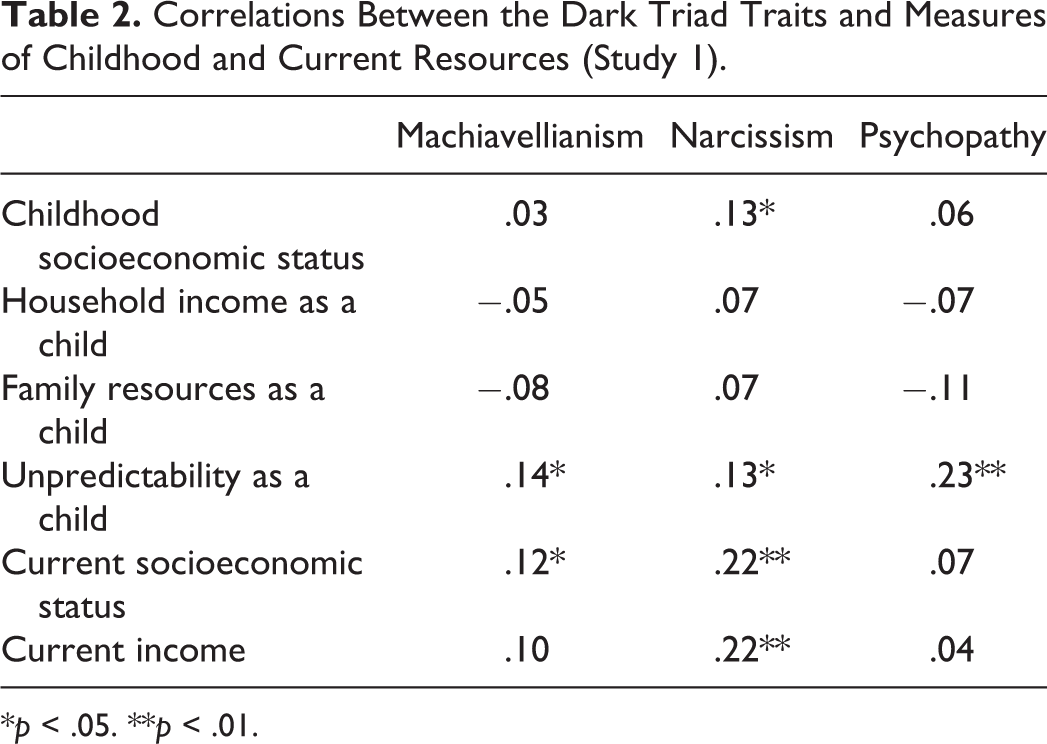
We replicated (Jonason, Li, & Czarna, 2013) sex differences in the Dark Triad traits with men scoring higher than women in all three cases (Table 1). There were no sex differences in the various socioecological indicators including current income. The Dark Triad traits were all correlated with an unpredictable environment as a child (Table 2). Machiavellianism and narcissism were associated with good current socioeconomic status, whereas narcissism was correlated with good socioeconomic conditions as a child. These correlations did not differ much in men and women with one exception. That is, the correlation between narcissism and income when growing up was larger (Fisher’s z = 1.67, p < .05) in men (r = .17, p < .05) than in women (r = −.03).
Descriptive Statistics and Sex Differences Tests of the Dark Triad Traits and Measures of Resources (Study 1).

Note. d is Cohen’s d for effect size.
*p < .05. **p < .01.
Correlations Between the Dark Triad Traits and Measures of Childhood and Current Resources (Study 1).
*p < .05. **p < .01.
In hopes of saying something larger about the relationship between socioecological conditions and the Dark Triad traits, we adopted a Dark Triad composite (Jonason et al., 2009) approach by averaging scores on each of the Dark Triad traits using Principle Components Analyses with Oblmin rotations (66.92% of the variance was accounted for; eigen = 2.01; Loadings .76–.86; Cronbach’s α = .75). The Dark Triad composite was correlated with an unpredictable childhood (r[282] =.20, p < 01), current socioeconomic status (r[282] =.17, p < 01), and current household income (r[282] =.15, p < 01). These correlations did not differ across participant’s sex, and the omitted correlations did not differ from zero.
Finally, we sought to make sure that the relationships reported in Table 2 were robust to the removal of variances associated with the Big Five traits. The Big Five did show various associations with the measures of resources in childhood and adulthood (see Table 3). The associations generally remained. For instance, narcissism was correlated with current income (pr = .12, p < .05), and Machiavellianism was correlated with current socioeconomic status (pr = .12, p < .05). Narcissism (pr = .13, p < .05), psychopathy (pr = .20, p < .01), and the Dark Triad composite (pr = .17, p < .01) were correlated with an unpredictable childhood environment but Machiavellianism dropped out (pr = .09). Details concerning these analyses are available upon request.
Correlations Between the Big Five Traits and Measures of Childhood and Current Resources (Study 1).

Note. E = Extraversion; A = Agreeableness; C = Conscientiousness; N = Neuroticism; O = Openness/Intellect.
*p < .05. **p < .01.
Study 2
Study 1 suggests the Dark Triad traits are all correlated with unpredictable childhoods, consistent with predictions derived from Life History Theory. However, it is limited in three ways. First, it relied solely on an mTurk sample. Second, it relied on only one measure of the Dark Triad traits. Third, it failed to take into consideration the possibility that people—narcissists in particular—might inflate self-reports of their income and other such factors. Therefore, in Study 2, we extend Study 1 by collecting data from both mTurk and a snowball sample, using two brief measures of the Dark Triad traits to ensure the relationships reported were not measurement or sampling artifacts, and ensure that our results were robust to the partialing of variance associated with individual differences in social desirability.
Method
Participants and Procedure
Four hundred and five (46% female) Americans (81% White/Caucasian) aged 17–70 years (M = 32.49, SD = 11.05) participated in a larger online study concerning the Dark Triad traits. Two hundred and twenty of the participants were paid though mTurk (US$1), and the remainder were volunteers through Facebook and Socialpsychology.org. 4 Only those participants who completed the measures from unique IP addresses were included. Participants were informed of the nature of the study and were asked to give consent if they wished to participate, and only those who gave consent were included. They progressed through a series of self-report measures that assessed the variables of interest. At the end of the study, participants were debriefed and thanked.
Measures
Despite its limited validity and psychometric limitations (Carter, Campbell, Muncer, & Carter, 2015; Maples, Lamkin, & Miller, 2014; Miller et al., 2012), we wanted to test the robustness of the correlations reported in Study 1 in another brief measures of the Dark Triad, the Dirty Dozen (Jonason & Webster, 2010). Participants were asked how much they agreed (1 = Not at all; 5 = Very much) with statements such as “I have used deceit or lied to get my way” (i.e., Machiavellianism), “I tend to want others to admire me” (i.e., narcissism), and “I tend to lack remorse” (i.e., psychopathy), and items were averaged together to create an index of Machiavellianism (Cronbach’s α = .76), narcissism (α = .83), and psychopathy (α = .83). 5
We also used the SD3 (D. N. Jones & Paulhus, 2014). It is a concise, 27-item personality inventory. Participants were asked to report their agreement (1 = Strongly disagree; 5 = Strongly agree) with statements measuring Machiavellianism (e.g., “Most people are suckers”), narcissism (e.g., “I am an average person”), and psychopathy (e.g., “I like to pick on losers”). Items were averaged to create indices of Machiavellianism (α = .80), narcissism (α = .79), and psychopathy (α = .75). 6
We measured socioecological conditions as we did in Study 1 (i.e., Griskevicius, Delton, et al., 2011; Griskevicius, Tybur, et al., 2011). Participants completed the measures of childhood socioeconomic status (α = .85), family resources (α = .91), childhood unpredictability (α = .80), and current socioeconomic status (α = .90). Participants also reported their estimated household income when they were a child and currently on single-item measures. Correlations among these items can be found in Appendix B.
We measured social desirability with a short, homogenous measure of the Marlowe–Crowne scale (Strahan & Gerbasi, 1972). Ten items (e.g., “I always try to practice what I preach”) asked participants in a yes/no format to test for individual differences in social desirability. Items were summed to create an index of social desirability (α = .68). 7
Results
We replicated sex differences in the Dark Triad traits (Jonason et al., 2013), and effects were present in both measures of the Dark Triad traits (Table 4). Importantly, the Dark Triad traits, whether they were measured with the Dirty Dozen or the SD3 (with the exception of the SD3 measure of Narcissism), were associated with increased unpredictability in childhood, confirming contentions that the Dark Triad traits are sensitive to the unpredictability in one’s childhood (Table 5). In addition, narcissism (measured with the Dark Triad Dirty Dozen and the SD3) was associated with greater socioeconomic status and household incomes in childhood and currently. Machiavellianism was associated with better childhood conditions, and psychopathy was associated with fewer family resources as a child, but both were localized only to the Dirty Dozen measure.
Descriptive Statistics and Sex Differences Tests of the Dark Triad Traits and Measures of Resources (Study 2).

Note. d is Cohen’s d for effect size.
*p < .05. **p < .01.
Correlations Across Two Measures of the Dark Triad Traits and Measures of Childhood and Current Resources (Study 2).

Note. DTDD = Dark Triad Dirty Dozen; SD3 = Short Dark Triad.
*p < .05. **p < .01.
We compared these correlations across men and women. Although there were apparent differences (available upon request), only three were significant. The correlation between Machiavellianism (SD3 measure only) and family resources was more strongly (Fisher’s z = −2.72, p < .01) correlated in men (r = −.22, p < 05) than in women (r = .05). The correlation between Machiavellianism (SD3 measure only) and unpredictability was more strongly (z = 2.53, p < .01) correlated in men (r = .24, p < 05) than in women (r = −.01). Finally, the correlation between narcissism (SD3 measure only) and unpredictability was more strongly (z = 2.31, p < .01) correlated in men (r = .33, p < 01) than in women (r = .11). Although thin, these moderated correlations suggest men’s latent Dark Triad mechanisms might be more sensitive to socioecological conditions than women’s are.
Principle components analyses with Oblmin rotations 8 suggested that the three Dark Triad traits in the SD3 (64.72% of the variance was accounted for; eigen = 1.94; Loadings .70–.88) and the Dirty Dozen (62.31% of the variance accounted for; eigen = 1.87; Loadings .69–.88) loaded on a single factor (Jonason et al., 2009). Therefore, we created composites of all the items (to maximize variance) of the SD3 (α = .88) and the Dirty Dozen (α = .86). The Dark Triad composite, when measured by the SD3, was correlated with childhood socioeconomic status (r[402] = .13, p < .05), unpredictability (r[402] = .16, p < .01), childhood household income (r[402] = .13, p < .05), and current income (r[402] = .11, p < .05). The Dark Triad composite, when measured with the Dirty Dozen, was correlated with childhood socioeconomic status (r[402] = .12, p < .05), unpredictability (r[402] = .19, p < .01), and childhood household income (r[402] = .14, p < .01). When these correlations were examined in men and women, an interesting pattern emerged (Table 6). Favorable socioecologies focused around money and were associated with higher Dark Triad composite scores in women, than in men. In contrast, unpredictable environments were associated with higher Dark Triad composite scores in men, than in women.
Comparing Dark Triad Composites in Men and Women as They Relate to Socioecological Indicators (Study 2).
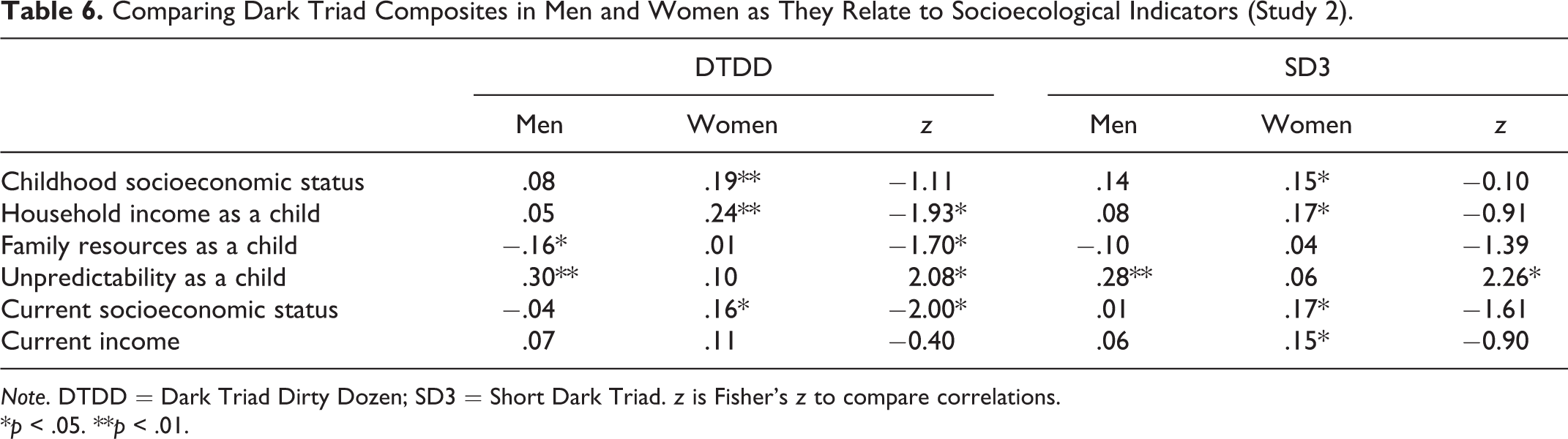
Note. DTDD = Dark Triad Dirty Dozen; SD3 = Short Dark Triad. z is Fisher’s z to compare correlations.
*p < .05. **p < .01.
Study 3
Studies 1 and 2 provided reasonably consistent evidence for our primary hypothesis that the Dark Triad traits should be linked to (self-reports) an unpredictable childhood that was robust to removing variance associated with the Big Five traits and social desirability and measurement variance in the Dark Triad traits. However, the results are reliant on a single measure of childhood conditions, a measure that has not been fully vetted for validity and psychometric properties. Therefore, in Study 3, we attempt to replicate these effects with a series of author-generated, single-item measures in hopes of further testing our hypotheses.
Method
Participants and Procedure
The sample was composed of 705 American participants (48% male), aged 18–76 years (M = 32.54, SD = 11.42), who were paid US$2 for their completion of a series of measures on mTurk. Ethnically speaking, 7% were African American, 77% were European Americans, 7% were Asian American, and 8% were Middle Eastern American. Upon completion participants were thanked for their participation and debriefed.
Measures
To measure the Dark Triad traits, the Dark Triad Dirty Dozen (Jonason & Webster, 2010) was used as before. Items were averaged together to create an index of Machiavellianism (α = .80), narcissism (α = .81), and psychopathy (α = .70). 9 We also averaged all 12 items to create a measure of the latent Dark Triad (α = .87).
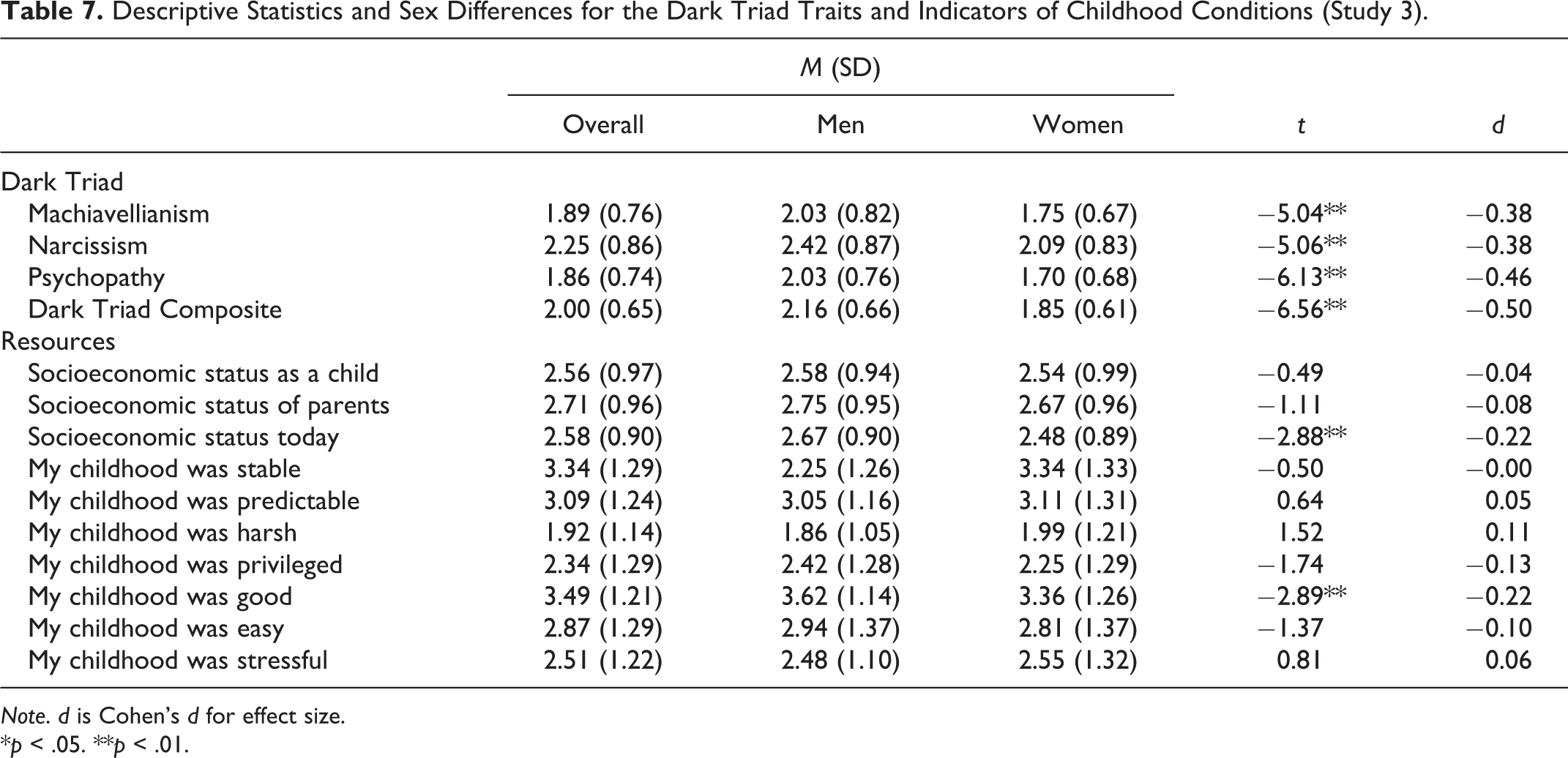
In order to measure childhood conditions, we generated our own measure. It was composed of items assessing socioeconomic status, predictability, and harshness. Instead of treating the items as indicators of latent construct, we opted to treat each independently to bolster the nuance we can provide. The particular items can be seen in Table 7. When asking about socioeconomic status, participants were presented with a scale that ranged from lower class to upper class. When assessing childhood conditions, participants reported their agreement (1 = Not at all; 5 = Very much) with each item. Appendix C has correlations among these indicators.
Descriptive Statistics and Sex Differences for the Dark Triad Traits and Indicators of Childhood Conditions (Study 3).
Note. d is Cohen’s d for effect size.
*p < .05. **p < .01.
Results
In Table 7, we replicated sex differences in the Dark Triad traits (Jonason et al., 2013). Men scored higher than women did on all of the traits. Consistent with that mentioned earlier, there were few sex differences in self-reports of resource conditions. There were, however, two sex differences, albeit small in magnitude. Men reported better socioeconomic status today and a better childhood than women did.
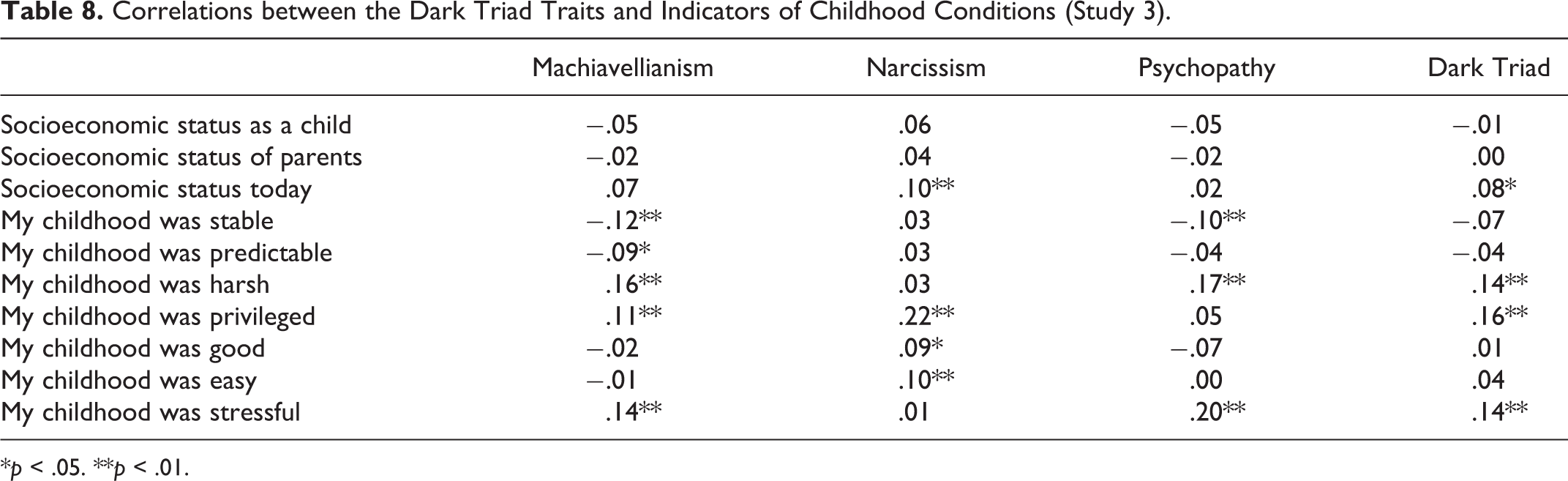
In Table 8, we report correlations between the Dark Triad traits and indicators of (perceived) childhood conditions. Machiavellianism was associated with (perceptions of) an unstable, unpredictable, harsh, and privileged yet stressful childhood. Narcissism was associated with (perceptions of) good socioeconomic status today and a privileged, good, and easy childhood. Psychopathy was associated with (perceptions of) an unstable, harsh, and stressful childhood. These results conceptually—albeit imperfectly—replicate results from Studies 1 and 2 using an alternative measure of childhood conditions.
Correlations between the Dark Triad Traits and Indicators of Childhood Conditions (Study 3).
*p < .05. **p < .01.
We tested whether the correlations between the Dark Triad traits and indicators of childhood conditions differed in each sex. Given the large number of tests, we only report those differences (i.e., Fisher’s z) that were significant (p < .01); a full report of all the correlations is available upon request. The correlation between psychopathy and socioeconomic status today was absent in men (r = −.05, ns) but present in women (r = −.12, p < .05) which were significantly different associations (z = 2.92). The correlation between psychopathy and self-reports of a good childhood was absent in men (r = .01, ns) but present in women (r = −.19, p < .01) which were significantly different associations (z = 2.67). The correlation between Machiavellianism and socioeconomic status today was absent in women (r = −.04, ns) but present in men (r = .13, p < .05) which were significantly different associations (z = 3.26). The correlation between narcissism and socioeconomic judgments of a good childhood was absent in women (r = −.05, ns) but present in men (r = .21, p < .01) which were significantly different associations (z = 3.48).
As there were two sex differences in resource indicators, mediation tests were conducted. In accounting for the sex difference in ratings of having a good socioeconomic status today, we entered participants sex (β = .11, p < .01) into Step 1 and narcissism (β = .11, p < .01) in Step 2. We found partial mediation, ΔR 2 = .01, F(1, 698) = 5.10, p < .05, where the sex difference shrunk to .09 (p < .05). When we tried to account for sex differences in self-reports of a good childhood, the partial mediation effect was the same but marginally significant, ΔR 2 = .01, F(1, 698) = 3.35, p < .07. Given our adoption of item-level analyses, such effects should be interpreted with caution.
Discussion
“Why does evil exist?” is a classic question about the nature of the universe and humankind. Despite considerable efforts to remove antisocial personality traits from the population through religions (e.g., threat of damnation), laws (e.g., threat of imprisonment), social movements (e.g., encouraging self-esteem), and institutional sanctions (e.g., threat of being fired), these traits persist and, by all accounts, may have always been present. They may be impossible to remove as they are, to some extent, present in everyone. All people may have the potential to be high or low on the Dark Triad traits. This potential comes from the encoded potential in the human genotype. Over the course of their lives, events narrow that potential and shape one’s personality and attitudes to create their effective phenotype. This means that exposure to specific conditions is the precipitating factor, which determines people’s trait activation and position on the Dark Triad continuum. Experiences (or at the very least, recollection of) of childhood unpredictability may be some of the prerequisite conditions to activate the dormant selfishness, competiveness, and antisociality found in the Dark Triad traits. While by no means definitive, the present results are consistent with a condition-dependent model of the Dark Triad traits.
Our contention, albeit tentative, is that the Dark Triad traits are part of the encoded genotype of at least humans (if not most species that could benefit from opportunism, selfishness, and exploitiveness at times), but given contextual factors, they are only the effective phenotype in a few. The Dark Triad traits may be condition-dependent adaptations to solve life’s adaptive problems in the face of an unpredictable and harsh world. From this perspective, the Dark Triad traits could be phenotypic responses to predetermined and evolutionary relevant information, responses that might be stronger and more important in men given asymmetries and costs and benefits for living a fast life (Jonason et al., 2010; Jonason et al., 2009). Natural selection is likely to have shaped adaptive heuristics to take in information about the quality of one’s world, process that information, and formulate a solution. This solution acts as the vector one takes to solving the problems of finding mates, keeping mates, protecting kin, and finding food and resources. In the case of the Dark Triad traits, that solution appears to be mate with various partners and lower one’s standards (Jonason et al., 2011); abandon mates and do not try to keep them (Jonason, Li, & Buss, 2010); be competitive, selfish, and manipulative (Jonason et al., 2010; Jonason & Webster, 2012); and seek immediate payoffs over delayed ones (Jonason et al., 2010). The clinical implications for this are important. It suggests those high in the Dark Triad traits may be unfairly vilified and that the model for treating such disorders (i.e., a categorical model) may start with a faulty premise. Many researchers, laypeople, and clinicians may implicitly treat those with disorders as qualitatively different than others. Instead, a condition-sensitive model allows for genetic tendencies to interact with environmental contingencies, thereby making far more people susceptible to going down the path to the “dark side.”
Prior research suggests there may be a higher order latent Dark Triad factor that accounts for the shared variance in the traits (Figueredo et al., 2015; Jonason, Kaufman, Webster, & Geher, 2013; Jonason & Luévano, 2013; Jonason & Webster, 2010). When we examined the Dark Triad composite (Jonason et al., 2009), as a means to understand the shared variance in the traits, we revealed that it was slightly more strongly correlated with an unpredictable childhood than socioeconomic hardship in Studies 1 and 2 but not Study 3, but the way we calculated the composite differed. Both of these approaches may be problematic, as they conflate the various aspects of each part of the Dark Triad traits into one. However, as we did not solely rely on this, we were able to show that unpredictability in one’s childhood is really where the Dark Triad traits link to socioecological conditions, while the traits may have their own, less replicable, and strong links to economic harshness in childhood and adulthood.
Limitations and Conclusions
Despite the novelty and rigor of our study, it has some limitations. First, one might criticize our reliance on Western, Educated, Industrialized, Rich, and Democratic (WEIRD; see Henrich, Heine, & Norenzayan, 2010). The possibility exists that the associations we found between child/adulthood socioecological conditions and the Dark Triad traits might be localized to Western, online samples. As long as we confine ourselves to Western samples, we are confident in our conclusions. However, if we begin to examine various cultural factors, our results might be attenuated or even exacerbated, given local conditions and even display rules related to collectivistic cultures.
Second, we relied on brief self-report measures throughout. While we mostly used validated scales, this creates a number of potential problems. Most important, we used the Dirty Dozen measure twice which has a number of detractors (Carter et al., 2015; Miller et al., 2012). In addition, we are relying on retrospective reports of people’s childhood conditions. As is well known in psychology, memory is frail. However, we see no reason to think that such biases will be particularly localized to those high on the Dark Triad traits but call for longitudinal work to be done on the Dark Triad traits. In addition, we failed to experimentally manipulate the conditions we feel act as precursors to the Dark Triad traits. While that is reasonable, we feel that the amount of exposure needed to create such dispositions might be longer than we can achieve in a laboratory setting. Instead, what might be more fruitful is to see how conditions vary or moderate the associations between the Dark Triad traits and outcomes like selfishness or aggressiveness that are seen as pivotal downstream correlates of the Dark Triad traits. Finally, as we used brief measures of the Dark Triad traits, we were not able to examine subfactors of the traits to provide further nuance to test whether different aspects of these multidimensional traits are sensitive to different inputs from one’s life. That said, it might be argued that once we start examining parts of each trait, we will no longer be examining the trait itself but something else that is related to the global construct in question. Nevertheless, future research might provide such further nuance.
Third, our results did not fully converge in Study 3 relative to the first two studies, and the results are not identical throughout. This should not be of serious surprise in that we adopted item-level analysis and used a different measure as we used in Studies 1 and 2, and sample size can affect the power to detect effects. The results from Study 3, therefore, only partially support our hypotheses. Studies 1 and 2 were more inconsistent which is of no surprise, given measurement invariance. It appears that psychopathy and Machiavellianism are the most sensitive to childhood stress in the form of harshness and unpredictability. Narcissism was associated with childhood unpredictability, but such a link was allusive in Study 3 and dependent on the measure of the Dark Triad traits in Study 2. Narcissism and, to a less degree, Machiavellianism were sensitive to current and childhood economic conditions. Psychopathy was only associated with harsh childhood conditions in Studies 2 and 3. Nevertheless, these effects, in general, were somewhat moderated by participant’s sex, and sex differences in self-reports of having a good childhood might be mediated by individual differences in narcissism.
We do not contend that the Dark Triad traits are ubiquitously adaptive. Indeed, only a naive evolutionary psychologist would make such a domain-general prediction. Instead, the functional utility of the Dark Triad traits and their related dispositions and biases are directly tied to a particular environment or niche. As a society, we may perceive the traits as “bad” because for many of us, the socioecological conditions of our childhood have changed to the point that we wish to punish people characterized by these traits (i.e., we have a vested interest in long-term, mutualistic strategies). However, let us not forget that during most of evolutionary history, human lives were characterized by considerable unpredictability (e.g., food shortages, injuries, deaths, and diseases). We would contend that recurrent unpredictability in our evolutionary history would have created sensitivities to such information about the world and adaptive responses. Just because the world is harsh, does not mean an organism gives up. As Jeff Goldblum said in the first Jurassic Park movie, “Life finds a way”; one of those ways might be found in the Dark Triad traits.
Footnotes
Appendix A
Correlations Among Childhood Conditions Indicators (Study 1).

| 1 | 2 | 3 | 4 | 5 | 6 | |
|---|---|---|---|---|---|---|
| 1. Growing up family income | — | |||||
| 2. Current household income | .34** | — | ||||
| 3. Childhood socioeconomic status | .67** | .15* | — | |||
| 4. Family Resources | .49** | .20** | .56** | — | ||
| 5. Unpredictable | −.25** | −.10 | −.25** | −.55** | — | |
| 6. Current socioeconomic status | .17** | .51** | .23** | .17** | −.01 | — |
*p < .05. **p < .01.
Appendix B
Correlations Among Childhood Conditions Indicators (Study 2).

| 1 | 2 | 3 | 4 | 5 | 6 | |
|---|---|---|---|---|---|---|
| 1. Growing up family income | — | |||||
| 2. Current household income | .38** | — | ||||
| 3. Childhood socioeconomic status | .68** | .20** | — | |||
| 4. Family Resources | .48** | .13** | .54** | — | ||
| 5. Unpredictable | −.16** | −.06 | −.17** | −.50** | — | |
| 6. Current socioeconomic status | .28** | .49** | .27** | .20** | −.05 | — |
*p < .05. **p < .01.
Appendix C
Correlations Among Childhood Conditions Indicators (Study 3).

| 1 | 2 | 3 | 4 | 5 | 6 | 7 | 8 | 9 | 10 | |
|---|---|---|---|---|---|---|---|---|---|---|
| 1. Socioeconomic status as a child | — | |||||||||
| 2. Socioeconomic status of parents | .72** | — | ||||||||
| 3. Socioeconomic status today | .29** | .36** | — | |||||||
| 4. My childhood was stable. | .41** | .32** | .15** | — | ||||||
| 5. My childhood was predictable | .29** | .21** | .11** | .78** | — | |||||
| 6. My childhood was harsh | −.32** | −.23** | −.06 | −.53** | −.41** | — | ||||
| 7. My childhood was privileged | .49** | .39** | .20** | .45** | .36** | −.25** | — | |||
| 8. My childhood was good | .31** | .27** | .12** | .70** | .60** | −.54** | .49** | — | ||
| 9. My childhood was easy | .35** | .27** | .15** | .65** | .63** | −.48** | .54** | .73** | — | |
| 10. My childhood was stressful | −.22** | −.13** | −.11** | −.48** | −.43** | .63** | −.21** | −.48** | −.52** | — |
*p < .05. **p < .01.
Declaration of Conflicting Interests
The author(s) declared no potential conflicts of interest with respect to the research, authorship, and/or publication of this article.
Funding
The author(s) disclosed receipt of the following financial support for the research, authorship, and/or publication of this article: Research was funded by a Seed Grant to the first author from Western Sydney University.