




Abstract
Many published studies have employed the Mini-K to measure a single fast–slow life history dimension. However, the internal structure of the Mini-K has not been determined and it is not clear that a single higher order K-factor fits the data. It is also not clear that the Mini-K is measurement invariant across groups such as the sexes. To establish the construct validity of K as well as the broader usefulness of applying life history theory to humans, it is crucial that these psychometric issues are addressed as a part of measure validation efforts. Here we report on three studies that used latent variable modeling and data drawn from two college student samples (ns = 361 and 300) to elucidate the psychometrics of the Mini-K. We found that (a) the Mini-K had a six dimensional first-order structure, (b) the K-factor provided a parsimonious explanation of the associations among the lower order factors at no significant cost to fit, (c) the Mini-K measured the same K-factor across the sexes, (d) K-factor means did not have the same meaning across the sexes and thus the first-order factors should be used in studies of mean sex differences, and finally, (e) the K-factor was only associated with environment and aspects of mating competition in females. Implications and future directions for life history research are discussed.
Keywords
Several concerns about psychometric research on human life history strategy (LHS) have been raised, most of which relate to construct validity (Copping, Campbell, & Muncer, 2014; Copping, Campbell, Muncer, & Richardson, 2016; Richardson, Sanning, et al., 2016). One concern is that despite frequent reference to a single fast–slow dimension (e.g., Super-K), relatively little work has been done to confirm the unidimensionality of life history indicators and emerging evidence suggests they may be multidimensional. For instance, Brumbach, Figueredo, and Ellis (2009), Richardson et al. (2014), and Richardson, Dai, et al. (2016) found that a single dimension did not subsume all adolescent and young adult LHS indicators. Moreover, Richardson, Sanning, et al. (2016) found that a single dimension did not subsume all LHS indicators in a nationally representative sample of middle-aged adults. Richardson, Dariotis, and Lai (2016) extended these findings to a predominantly urban sample of young adults. These two studies used broad selections of life history indicators and found two dimensions—mating competition (subsuming, e.g., risk-taking, aggression, and number of sex partners) and Super-K (subsuming, e.g., pair-bonding, social contact/support, agreeableness, and aspects of covitality). Taken together, these findings imply there may not be a single LHS variable that can be used to assess life history speed, or in other words, scored to locate people on a single fast–slow dimension.
Copping, Campbell, and Muncer (2014) recently drew attention to the validity of scales developed for the specific purpose of measuring human LHS (e.g., the Mini-K, Figueredo et al., 2006, and high-K strategy [HKSS], Giosan, 2006, scales). High scores on these scales are interpreted as signaling slower LHS, whereas lower scores are taken as implying faster LHS. The authors factored the HKSS and found that a model with a single higher order LHS variable fit the data significantly worse than a model without. This suggests that when the HKSS is summed, participants’ scores do not correspond to any single variable or position on a single fast–slow dimension. Instead, these scores should be interpreted as researcher constructed composites of the four HKSS factors.
The Copping et al. (2014) finding that the HKSS is multidimensional, combined with findings that two unique factors subsumed LHS indicators, raises questions about psychometric applications of life history theory (LHT) to humans. Do these findings of multidimensionality extend other scales designed to measure human LHS, such as the Mini-K and the Arizona Life History Battery (ALHB; see Figueredo et al., 2006)? These measures have been used to produce scores locating participants on a fast–slow (r-K) dimension, but it is not yet clear that their items reflect a single factor. This is because to the best of our knowledge, no study has yet confirmed the dimensionality of the Mini-K, though it has been employed in at least 30 studies (Black, Figueredo, & Jacobs, 2016). Moreover, no studies that we are aware of have tested the Mini-K for measurement invariance across the sexes, which is important, given the documented sex differences in reproductive strategies (for discussion of this, see Copping et al., 2014, 2016; Richardson et al., 2016). Are sex differences limited to the means and variances of LHS factors, or are the identities of LHS constructs themselves different across the sexes? If LHS factors are indeed sex invariant, do they have the same correlates within each sex? These questions have not been adequately addressed in psychometric studies of human LHS.
Current Project
The current project helps to fill these gaps in the literature by applying exploratory structural equation modeling (ESEM), confirmatory factor analysis (CFA), and multigroup structural equation modeling (multigroup SEM) to the Mini-K (the 20-item short form of the ALHB) in three studies of undergraduate students. Specifically, Study I applies ESEM to a sample of undergraduate students to examine the structure of the Mini-K; Study II uses CFA to confirm the structure identified in Study II; and Study III uses multigroup SEM to test for (a) measurement invariance between the samples (and pools them if invariance is found), (b) a higher order K-factor, (c) measurement invariance between the sexes, and (d) associations of the Mini-K with indicators of harshness and mating competition (e.g., risk-taking). Examining the associations between the Mini-K and indicators of mating competition allows us to assess whether K (if indeed the scale is unidimensional) should be conceptualized as overall life history speed. We examine these associations separately by sex, allowing for the possibility that any factors underlying the Mini-K have different correlates within each.
Finally, across the confirmatory studies (II and III), we examine the degree to which the assumption of local independence holds for the Mini-K items. Measurement invariance and local independence are two assumptions that can be tested to establish the usefulness of latent variables (Brown, 2006; Edwards & Bagozzi, 2000). First, a latent variable must explain the associations among its indicators, rendering them (locally) independent conditional upon it. Second, the associations between the latent variable and its indicators must be stable across the distribution of external variables. If these assumptions are not at least partially met, a latent variable cannot be understood as the common cause of its indicators or as having a unique identity.
General Methods
Participants and Procedures
The studies reported here analyzed data from two samples of college students in a large Midwestern university. The project was granted approval through a university-based institutional review board, and participants were recruited through their classes, both online and face-to-face, as well as through a subject pool. Participants did not receive any form of incentive for their participation. Students read an information form, provided consent, and subsequently completed a questionnaire. Overall, the participants sampled were relatively diverse with respect to socioeconomic status (SES). More than 20% of the students at the university we sampled from were first-generation college students, suggesting the institution served an economically diverse student body. Moreover, 58 (8.8%) had primary childhood residence total household incomes below US$25,000 (the 2013 poverty line for a two-child family was ∼US$24,000, Federal Interagency Forum on Child and Family Statistics, 2015), 63 (9.5%) reported that their families were worse off financially than most, 244 (36.9%) reported that their father had a high school level education or less, and 199 (30.1%) reported the same for mother’s educational attainment (the U.S. percentage for both mothers and fathers in 2013 was 30%, Kena et al., 2015). More detailed demographics for each sample are reported in Study I and Study II.
Instruments
Mini-K
The Mini-K is a 20-item brief scale designed to measure the domains captured by the ALHB (Figueredo et al., 2006). These domains include (a) family social contact and support; (b) friends social contact and support; (c) altruism; (d) mother/father relationship quality; (e) insight, planning, and control; (f) intentions toward infidelity; and (g) religiosity. Two to three items reflect each of these constructs (e.g., item contents, see Table 1). For this study, we eliminated the third and fifth Likert-type points (disagree and agree slightly) from the Mini-K to include it within a broader survey that used 5-point scales and machine scoring. This was acceptable because the psychometric properties of 5- and 6- or 7-point Likert-type scales do not differ substantively and can be easily rescaled for comparison (Dawes, 2008; Leung, 2011).
Fit Information for ESEM Models.

Note. ESEM = exploratory structural equation modeling; CFI = comparative fit index; TLI = Tucker-Lewis index; RMSEA = root means square error of approximation.
The Mini-K has demonstrated adequate internal consistency in past research (i.e., coefficient αs around .70; see Olderbak, Gladden, Wolf, & Figueredo, 2014). However, decades of research have indicated that the usefulness of coefficient α is quite limited and its assumptions rarely hold in practice (for reviews, see Bentler, 2009; Sijtsma, 2009). Relevant to this study, coefficient α does not provide any information about internal structure and therefore cannot justify scoring procedures that assume scale unidimensionality (Sijtsma, 2009). In light of this, we used factor analysis to assess dimensionality and observed the magnitude of the factor loadings for information about reliability and validity. Descriptive statistics and α coefficients for the Mini-K are reported in Study I and Study II.
Missing Data
Prior to conducting our studies, we screened each data set for outliers, missing values, and violations of the assumptions of factor analysis. No evidence of outliers or skew statistics larger than two were observed. The percentage of data missing for the variables in the studies ranged from 2.7% to 9.7%. We handled each set’s missing data using full information maximum likelihood via the MPlus 7.11 package (see Enders, 2010).
Analyses
All studies reported here used MPlus 7.11 to test models, raw data as input, and robust weighted least squares (WLSMV) as the estimator because the Mini-K is comprised of ordinal Likert-type items (Muthén, du Toit, & Spisic, 1997). We observed that the ratio of cases to freely estimated parameters exceeded 10 to 1 for all hypothesized models, satisfying the minimum ratio often indicated for SEM studies (Bentler & Chou, 1987). Following convention, we conducted all significance tests at the p < .05 level. We used β = .30 as the threshold for retaining items and interpreting factor loadings (Kline, 2011).
Model Fit
Across the studies, we used a variety of fit indices because they provide different information about model fit. We considered the substantive meaningfulness of the model, nonsignificance of the χ2 likelihood ratio statistic (Bollen, 1989), Tucker–Lewis index (TLI) and comparative fit index (CFI) greater than .95 (Byrne, 2001; Hu & Bentler, 1999), and root means square error of approximation (RMSEA) values of less than .05 (Browne & Cudeck, 1993) as evidence of acceptable fit to the data. In this study, we needed to test differences in fit between models for statistical significance. Importantly, the χ2 value for WLSMV cannot be used for difference testing in the usual way. In this context, χ2 difference testing is carried out via the DIFFTEST function in MPlus.
Study I
Sample
Study I analyzed data from 361 undergraduate students. Most participants were aged 18 to 22 (91.9%,
ESEM
We used ESEM to examine and test the structure of the Mini-K. ESEM is especially useful for exploratory factor analysis (EFA) because unlike traditional procedures, it produces fit statistics that can be used to assess model correspondence to the data. For our ESEM analyses, we used delta parameterization and oblique rotations (Geomin). We began by specifying a single-factor model and then compared it to models with increasing numbers of factors, ceasing when model fit was observed as excellent (using the model fit statistics outlined above).
Results
As a reminder, these analyses examined data gathered with the Mini-K short-form version of the ALHB. We used ESEM to test a single-factor model and found that it fit the data poorly and should have been rejected, χ2(170) = 1,065.17, p < .001; CFI = .79; TLI = .76; RMSEA = .12. We then tested two- and three-factor models and these fit the data poorly as well (for fit information, see Table 1). Four- and five-factor models fit the data better but only CFI met its commonly accepted threshold for good fit (i.e., .95). A six-factor model fit the data even better, with CFI indicating a very good fit and TLI and RMSEA falling just below their thresholds for good fit. We observed that 3 items (1 = I can often tell how things will turn out, 9 = I have a close and warm relationship with my sexual partner, and 10 = I have a close and warm relationship with my own children) did not load substantially on any factors (βs < .30). No modification indices suggested that these items should be linked with other items or Mini-K factors. Thus, we removed these 3 items and the resulting model had an excellent fit to the data, χ2(49) = 61.97, p = .10; CFI = 1.00; TLI = .99; RMSEA = .03. Given the nonsignificant χ2, we did not reject the hypothesis that this model fit the data exactly and accepted it as the best reproducer of the relationships among the items.
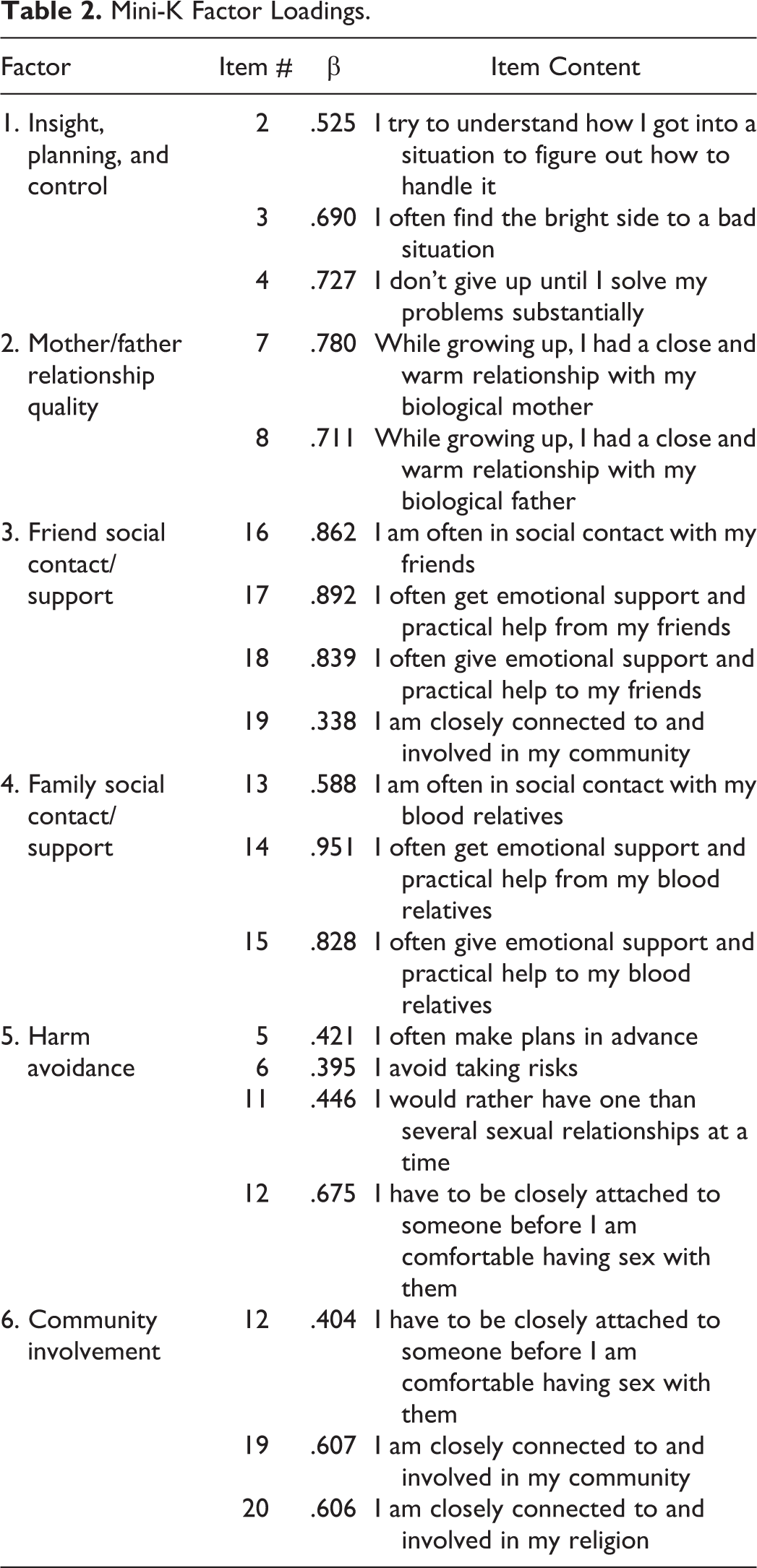
Next, we interpreted the factor identities, loadings, and intercorrelations. Table 2 displays the items, their contents, and loadings that were β > .30. Factors 1 through 4 mapped onto the prespecified identities noted in Instruments. We did not find altruism, intentions toward infidelity, or religiousness factors. Although individual items tapping these domains are or seem to be included in the Mini-K, it does not appear to be the case that the first-order structure underlying the items corresponds to these constructs. Instead, we found harm avoidance and community involvement factors. Notably, Item 12 (I have to be closely attached to someone before I am comfortable having sex with them) reflected harm avoidance and community involvement. This makes theoretical sense, given that harm avoidance should correspond to lesser sexual risk-taking and sexual constraint is also normative in many communities, especially religious ones. Also, Item 19 (I am closely connected to and involved in my community) reflected both friend contact/support and community involvement. This makes sense because friends are found outside of the home environment or in the community.
Mini-K Factor Loadings.
Next, we interpreted the factor intercorrelations (see Table 3). We found that the overall pattern of relationships among the factors did not suggest a higher order common factor subsumed them. The relational factors (i.e., 2, 3, and 4) were significantly and moderately correlated, suggesting they might share a higher order social support factor. Family social contact/support was significantly related to all the Mini-K factors. However, each of the other factors was not significantly related to at least two other factors, and community involvement was only significantly related to family social contact/support.
Mini-K Factor Intercorrelations.
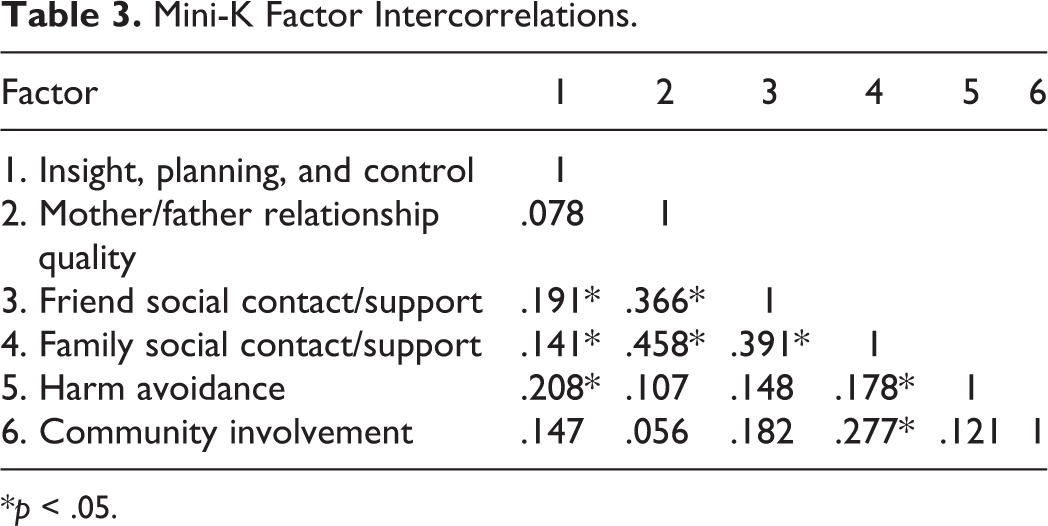
*p < .05.
Discussion
In Study I, we used ESEM to examine the structure of the Mini-K and found that a six-factor solution best fit the data. We found insight, planning, and control; mother/father relationship quality; friend social contact/support; family social contact/support; harm avoidance; and community involvement factors. Importantly, these factors mapped onto constructs that have been theoretically and empirically tied to human LHS in the past (Figueredo et al., 2006; Olderbak et al., 2014; Richardson, Dariotis, & Lai, 2016; Richardson, Sanning, et al., 2016). We observed a pattern of factor intercorrelations that suggested a social support factor likely subsumed the relational factors (e.g., mother/father relationship quality, friend social contact/support), but several other correlations were nonsignificant and community involvement was only significantly related to family social contact/support. This suggests that a general LHS factor was unlikely to subsume all the factors, but we address this issue directly in Study III. One possibility is that some correlations were nonsignificant because the ESEM model allows each item to load on all factors and therefore cross-loadings may capture some of the between factor covariance.
Study II
Sample
Study II analyzed data from 300 undergraduate students. Most participants were aged 18 to 35 (96%,
CFA
We used CFA to test the Mini-K structure found in Study I. In contrast to ESEM, CFA models encode specific assumptions about associations between items and between items and factors. The first is local independence, or the assumption that indicators are independent conditional on their factor. The configuration of indicators or specific factors they reflect or load upon is also specified a priori. Model fit is examined to determine whether assumptions hold.
Results
We tested the six-factor model found in Study I using our second sample and CFA. Fit indices suggested this model fit the data very well, χ2(102) = 197.22, p < .001; CFI = .97; TLI = .96; RMSEA = .06, though the χ2 test was significant. We observed that Item 6 (I avoid taking risks) did not load significantly on its factor (harm avoidance). No modifications indices suggested this item should be linked to other items or Mini-K factors. Thus, we dropped it prior to further analysis. We also observed that Item 12 (I have to be closely attached to someone before I am comfortable having sex with them) did not load substantially on community involvement (β = .16), though it loaded acceptably on its other factor, harm avoidance (β = .68). We removed this item’s first loading and the resulting model fit the data very well, χ2(88) = 152.84, p < .001; CFI = .98; TLI = .97; RMSEA = .05. Now that two of the three harm avoidance items concerned pairing off with one partner and getting to know them before having sex, we changed the factor’s name to pair-bonding. No relatively large modification indices were observed; suggesting no areas of strain existed for this model. Thus, we accepted it as the best reproducer of the relationships among our variables.
Next, we interpreted the magnitude of the factor loadings and intercorrelations (see Tables 4 and 5). All loadings were larger than β = .30 except for the Item 5 (I often make plans in advance) loading on pair-bonding, suggesting they reflected their factors adequately. The Item 5 loading was near β = .30 and in Study I it was larger than β = .40. Thus, we retained it as an indicator of pair-bonding. In contrast to Study I, all factor correlations were statistically significant (ps < .05), ranging from small to large in size.
Unstandardized and Standardized Effects—Study II Final CFA Model.
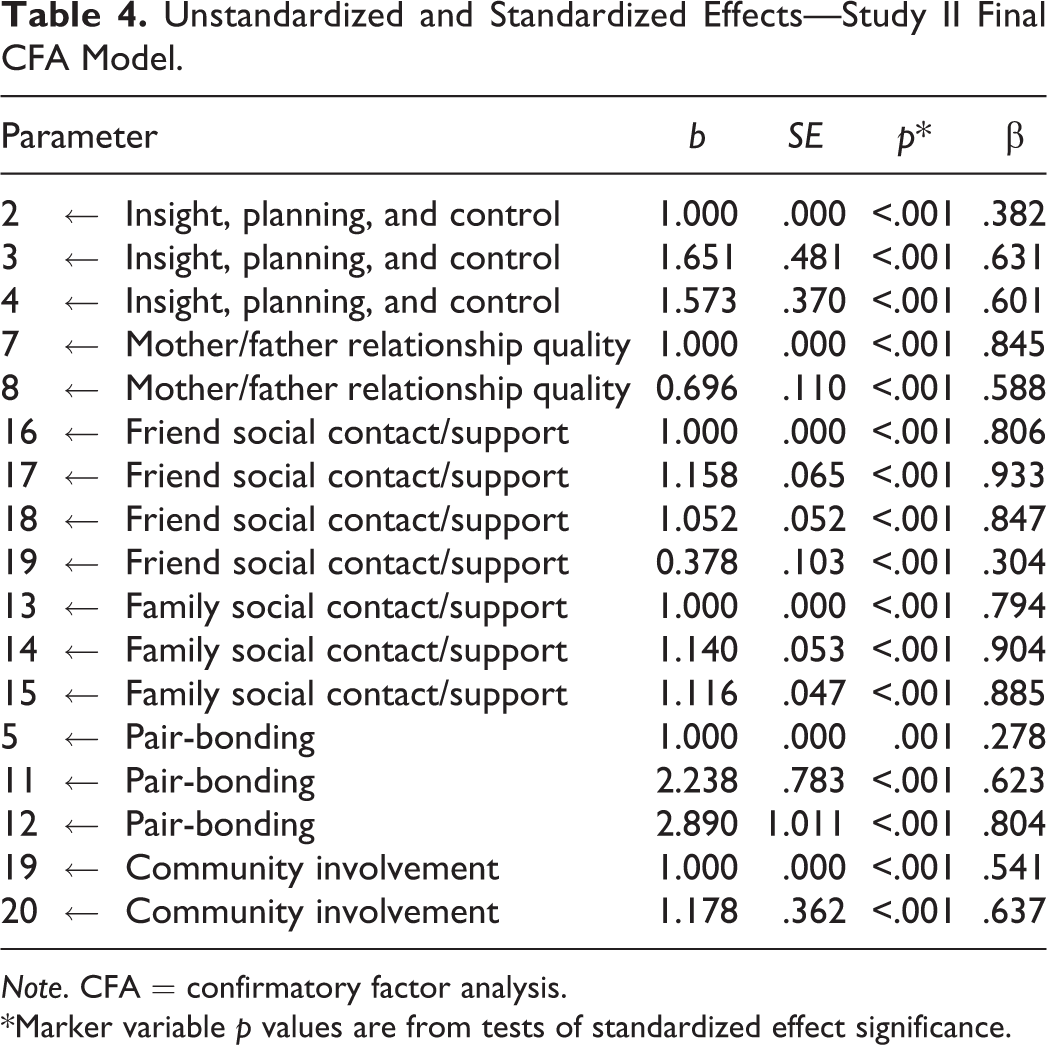
Note. CFA = confirmatory factor analysis.
*Marker variable p values are from tests of standardized effect significance.
Covariances and Correlations for Study II Final CFA Model.

Note. CFA = confirmatory factor analysis.
Discussion
In Study II, we replicated the Mini-K structure we found in Study I, with the exceptions that Item 6 did not reflect its factor and Item 12 reflected only pair-bonding. We were thus able to confirm that six factors subsumed the Mini-K items, including insight, planning, and control; mother/father relationship quality; friend social contact/support; family social contact/support; pair-bonding; and community involvement. Local independence held for all of the Mini-K items. Moreover, we found some weak factor intercorrelations, suggesting a second-order K-factor might not subsume the six first-order factors, but we return to this possibility in Study III. Taken together, Studies I and II suggest that the Mini-K items reflect six life history domains consistent with LHT, though not all were those prespecified in the literature.
Study III
In Study III, we (a) pooled our samples given evidence of measurement invariance and demographic similarity, (b) tested for a higher order K-factor, (c) tested for measurement invariance across the sexes, and (d) examined the Mini-K’s nomological net. As a reminder, we examined the Mini-K’s nomological net to assess whether the data seemed consistent with a single LHS dimension.
Sample
This study pooled the Studies I and II samples. This was acceptable because we observed evidence of measurement invariance with respect to the Mini-K and also because χ2 tests revealed that the samples did not differ significantly in terms of sex, χ2(40) = 44.53, p = .287, and ethnicity, χ2(58) = 60.90, p = .372. We did observe, however, that the Study II sample was significantly younger, t(659) = 3.5, p < .001, consistent with its larger proportion of freshman (55.3%) compared with Study I (22.4%). Given that the age range was not large, along with the other observed similarities between the samples, we proceeded with pooling them.
Instruments
Study III used several additional scales to examine the Mini-K’s nomological net, including measures of risk-taking, impulsivity, substance use, and SES. We included risk-taking and substance use because these variables have reflected mating competition in past research (e.g., Richardson, Sanning, et al., 2016). We included impulsivity because it has been linked to indicators of mating competition (e.g., sensation seeking or reward sensitivity; Richardson, Freedlander, & Katz, 2014). We included SES as an indicator of environmental harshness (see Ellis, Figueredo, Brumbach, & Schlomer, 2009). To incorporate these scales into our model, we used EFA and maximum likelihood to examine them for unidimensionality and saved factor scores using Bartlett’s method.
Risk-taking
The Risk-Taking Scale included 3 items rated on 5-point Likert scales (not at all true of me to very true of me). The item contents were: I don’t mind taking risks, I like doing scary things, and I love exciting experiences. These items were unidimensional and loaded on their factor at β = .69, .59, and .48, respectively.
Impulsivity
The Impulsivity scale included 4 items adapted from the impulsiveness subscale of the revised NEO personality inventory (NEO-PI–R; Lord, 2007; Whiteside & Lynam, 2001). These were rated on 5-point Likert-type scales (not at all true of me to very true of me) and their item contents were, I frequently act on strong feelings, Sometimes my feelings lead me to do things I don’t like, When I experience extreme emotions I tend to act before thinking, and Sometimes I can’t stop what I’m doing because of intense feelings. These items were unidimensional and loaded on their factor at β = .47, .60, .71, and .64, respectively.
SES
SES is in important indicator of environmental harshness (Ellis et al., 2009) and student SES is traditionally indexed using parental income, educational attainment, and occupational status (National Center for Education Statistics [NCES], 2012). In this study, we used 3 items to measure SES. The first 2 items asked participants to report the highest degree earned by their parents. Participants responded on 5-point scales that included none, general educational development test or high school diploma, associate/junior college, bachelor’s degree, or master’s degree, PhD, or professional degree. The final item required participant estimation of the total household income for their primary childhood residence using the points US$1–$10,000, US$10,001–$25,000, US$25,001–$50,000, US$50,001–$100,000, or more than US$100,000. Because most studies have not unpacked the effects of specific SES components on dimensions of LHS, initially we did not form composite SES in this study, but instead included each SES variable in our model. This allowed us to examine, for instance, whether (a) income had different effects than education, (b) mother and father education level had different effects, and (c) SES effects on LHS might be attributable to particular variables. We also repeated our analyses using a traditional composite SES variable for comparison.
Substance use
To assess substance use, we used the frequency of recent use items (i.e., past 3 months) from the Alcohol, Smoking, and Substance Involvement Screening Test (ASSIST; WHO ASSIST Working Group, 2002). The ASSIST consists of eight questions that measure lifetime substance use, recent use frequency, use-related consequences, risk of harm, dependence, and intravenous drug use. Each question addresses nine substance categories including tobacco, alcohol, cannabis, cocaine, amphetamine, inhalants, sedatives, hallucinogens, opioids, and other. The recent use items have 5 points—never, once or twice, monthly, weekly, and daily or almost daily. In past research, the recent use subscale has demonstrated adequate internal consistency (i.e., αs greater than .80) and concurrent validity (e.g., a large correlation with the Addiction Severity Index [r = .84]; Humeniuk, 2006). In this study, the ASSIST frequency of use items were two dimensional. Socially accepted substance use subsumed use of tobacco (β = .56), alcohol (β = .48), and cannabis (β = .61), whereas socially unacceptable substance use subsumed use of cocaine (β = .89), amphetamines (β = .64), inhalants (β = .80), sedatives (β = .52), hallucinogens (β = .86), and opioids (β = .67). Cannabis use also cross-loaded on the second factor (β = .42). The factors were correlated at r = .41. We saved scores on both factors for use in our SEM.
Multigroup SEM
This study used multigroup SEM to test whether the Study I and II samples were invariant with respect to the Mini-K. Specifically, we tested the Mini-K for metric (i.e., same factor loadings) and scalar (i.e., same intercepts) invariance across the samples. If found, metric invariance implies that constructs measured by a set of items have the same meaning across groups, whereas scalar invariance implies that between-group differences in latent variable means can be interpreted. Given evidence of measurement invariance, we pooled the two samples to achieve a larger sample size, which enabled us to test the Mini-K for measurement invariance across the sexes. Prior to invariance testing by sex, however, we tested for a higher order K-factor in the pooled sample. If a higher order K-factor was consistent with the data, we tested for first-order and higher order metric and scalar invariance across the sexes. This enabled us to determine whether the two sexes attributed the same meaning to the K-factor and whether mean sex differences on this factor could be interpreted. Finally, we examined the Mini-K’s nomological net separately by sex, assessing for sex differences in the extent to which K (or whatever factors subsumed it) reflected SES and in the extent to which it (or they) appeared to subsume the indicators of mating competition.
Results
Cross-Sample Invariance Testing
We used multigroup SEM to test our Study II model for configural invariance (i.e., same items load on same factors) across the two samples to produce baseline statistics for our tests of invariance. We found that the configural model fit the data very well, χ2(176) = 313.73, p < .001; CFI = .98; TLI = .97; RMSEA = .05, though the χ2 test suggested it did not fit exactly. No modification indices were relatively large, suggesting no areas of strain existed. Thus, we then constrained all factor loadings and thresholds to equality across the samples, testing for metric and scalar invariance. This model did not fit the data significantly worse than the configural (baseline) model, Δχ2(52) = 68.09, p = .07, indicating that the Mini-K measured the same constructs across the two samples. Therefore, we pooled the samples to allow for invariance testing by sex.
Higher Order K-Factor
Before testing for measurement invariance by sex, we investigated the possibility that a higher order K-factor subsumed the first-order Mini-K factors in the pooled sample. To test this possibility, we first tested the Study II model with no higher order factors to attain baseline statistics for comparison. This six-factor model fit the data very well, χ2(104) = 270.99, p < .001; CFI = .98; TLI = .97; RMSEA = .05, though the χ2 test suggested the model did not fit the data exactly. Modification indices suggested no areas of strain existed for this model. Thus, we then specified a higher order social support factor that subsumed the relational factors (e.g., friend social contact/support) because their intercorrelations were larger than the others. This resulting model did not fit the data significantly worse than the baseline model, Δχ2(6) = 11.30, p = .08, suggesting that the higher order social support factor provided parsimony at no expense to fit. Next, we specified a higher order K-factor that subsumed the social support factor and insight, planning, and control; pair-bonding; and community involvement. We tested this model and it also did not fit significantly worse than the baseline model, Δχ2(8) = 14.14, p = .08, suggesting that the higher order K-factor provided additional parsimony at no cost to model correspondence to the data. Thus, we retained the model with the higher order K-factor (see Figure 1).
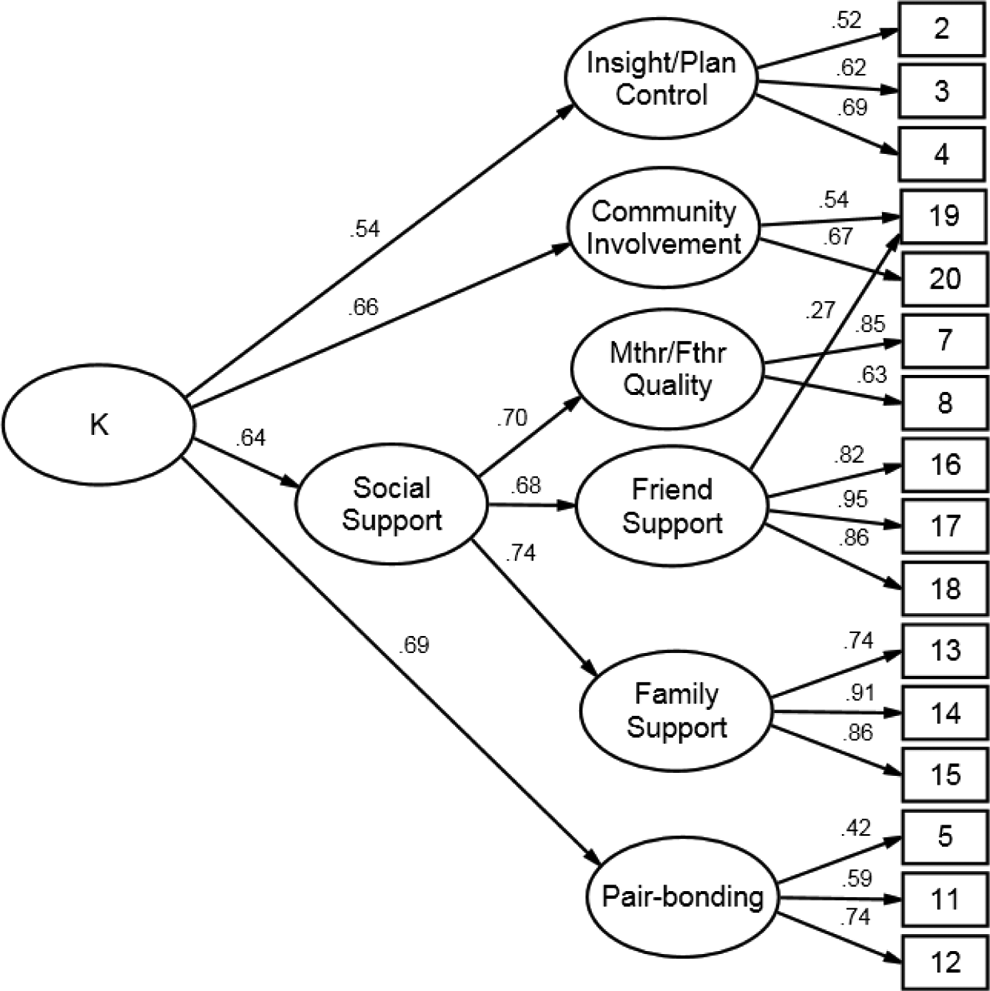
Higher order structure of the Mini-K.
Finally, we interpreted the magnitudes of the second-order loadings on the K-factor and found that they were all large (see Figure 1 and Table 6), ranging from β = .54 to .69. The R 2 statistics were higher order social support factor (.40); insight, planning, and control (.29); pair-bonding (.47); and community involvement (.44). Thus, the higher order K-factor appeared to not only provide a parsimonious explanation of the covariance among the lower order factors but also explained substantial amounts of their variance.
Unstandardized and Standardized Effects—Test of Higher Order Structure.

*Marker variable p values are from tests of standardized effect significance.
Invariance Testing by Sex
We next tested the six-factor (baseline) model for configural invariance by sex and it fit the data for both sexes very well, χ2(176) = 346.18, p < .001; CFI = .97; TLI = .96; RMSEA = .05, though the significant χ2 test suggested it did not fit exactly. Modification indices suggested no areas of strain existed for this model. Thus, we constrained all factor loadings and thresholds to equality across the sexes and the resulting model fit significantly worse than the configural model according to the χ2 difference test, Δχ2(52) = 74.28, p = .02. However, the other fit indices did not change by more than .01 except for TLI, which was actually .01 higher (i.e., TLI = .97) and implied a better fit. Taken together, we reasoned that the fit information could be interpreted as signaling that the loadings and thresholds were invariant across the sexes. That is, the Mini-K appeared to measure the same first-order constructs in males and females.
Next, we tested the higher order factor model for invariance by constraining the higher order loadings on social support and the K-factor to equality across the sexes. Similar to the first-order scalar model, this model fit significantly worse than the baseline model according to the χ2 test difference test, Δχ2(73) = 100.26, p = .02. 1 However, the other fit indices did not change by more than .01 except for TLI, which was .01 higher (i.e., TLI = .97). We next constrained the first-order factor intercepts to equality across the groups and fit was significantly worse, Δχ2(78) = 202.35, p < .001, with both CFI and TLI decreasing by greater than .01. We found that although fit remained significantly poorer if we constrained all intercepts to equality except insight, planning, and control; mother/father relationship quality; and pair-bonding, Δχ2(75) = 116.28, p < .001, it was not substantively poorer in that CFI did not change by .01 and TLI was .01 higher (better). We observed that the insight, planning, and control intercept and the intercept for mother/father relationship quality were significantly higher among males, whereas the pair-bonding intercept was significantly higher among females (ps < .05). Thus, we concluded that the Mini-K appeared to measure the same higher order constructs across the sexes but only the social support factors were scalar invariant. Finally, we constrained the residuals for the six first-order factors and the higher order social support factor to equality across the groups and the discrepancy in fit, compared to the baseline model, was very similar to that observed for the first-order scalar model, Δχ2(82) = 111.05, p = .02. Thus, the first-order and higher order social support residuals appeared to be invariant by sex. Moreover, the situation was the same for a model that also included an equality constraint on the male and female K-factor variances, Δχ2(83) = 110.47, p = .02. That is, similar to the first-order factor residuals, the K-factor’s variance did not appear to be statistically different across the sexes.
Assessing the Mini-K’s Nomological Net
We added scores on our measures of risk-taking, impulsivity, substance use, and aspects of SES as observed variables into the final scalar model described above (see Figure 2). We regressed the K-factor onto mother and father education, along with family income. We regressed risk-taking, impulsivity, and substance use onto the K-factor. We tested this model and it fit marginally well, χ2(493) = 846.94, p < .001; CFI = .95; TLI = .94; RMSEA = .05. We examined modification indices and several were relatively large (>20) and suggested that we should regress socially acceptable substance use on friend social contact/support and pair-bonding for females only. We added these additional specifications and the resulting model fit the data well, χ2(491) = 806.92, p < .001; CFI = .95; TLI = .95; RMSEA = .04. No remaining modification indices were relatively large, suggesting areas of strain did not exist and this model was an acceptable reproducer of the relationships among the variables.

Final SEM models for males and females. The correlations among the external criterion variables are omitted for conceptual clarity. SEM = Structural equation modeling.
For males, no SES variable had a statistically significant effect on the K-factor, though household income appeared to have an effect that was nontrivial in size (β = .17, p = .08). The effects of K on risk-taking and impulsivity were nonsignificant, though the effect on risk-taking also seemed to be nontrivial in size (β = .13, p = .08). K had a small positive and significant negative effect on socially acceptable substance use (β = −.26, p < .001) as well as a moderate negative effect on socially unacceptable substance use (β = −.46, p < .001). For males, the model explained 7% of the variance in socially acceptable substance use and 21% of the variance in socially unacceptable substance use.
For females, mother’s education (β = .18, p < .05) and household income (β = .21, p < .01) had statistically significant effects on K (for all parameter estimates, see Supplementary Materials). The K-factor had a small significant and positive effect on risk-taking (β = .18, p < .01) and a small negative effect on impulsivity (β = −.13, p < .05). K had a small significant negative effect on socially acceptable substance use (β = −.26, p < .001) as well as a large negative effect on socially unacceptable substance use (β = −.53, p < .001). Finally, friend social contact/support had a moderate positive effect on socially acceptable substance use (β = .29, p < .001), while pair-bonding had a moderate negative effect on this variable (β = −.37, p < .01). For females, the model explained 28% of the variance in each type of substance use as well as 3% of the variance in risk-taking and 2% in impulsivity. The pattern of results was the same for a model that included an SES composite instead of the individual mother/father education and income variables. This model fit the data well, χ2(405) = 694.62, p < .001; CFI = .96; TLI = .96; RMSEA = .05, and SES had a small and significant positive effect on K for females (β = .21, p < .01) but not males (p = .56).
Discussion
Our results suggest that the Mini-K measures the same first-order constructs across the sexes (i.e., they have the same meaning) and mean differences on the six first-order factors can be interpreted because the item intercepts are invariant across the groups. At the higher order level, the Mini-K appears to measure the same K-factor across the sexes, but mean group differences on K cannot be interpreted because the first-order latent variable intercepts are not invariant. Specifically, we observed that the insight, planning, and control intercept, along with the intercept for mother/father relationship quality, were significantly higher among males, whereas the pair-bonding intercept was significantly higher among females. Thus, the K-factor appears to be more useful for examination of structure than mean differences. This holds important implications for future research. If researchers compare K-factor means across the sexes, they may draw erroneous inferences about sex differences. On the other hand, inferences about effects on or emitted by the K-factor are less likely to be problematic. Finally, we found that the first-order and higher order factor residuals and the K-factor variances were invariant by sex. This is surprising from an evolutionary perspective, as we would expect larger variances in reproductive strategies among males (Copping et al., 2014).
In our assessment of the Mini-K’s associations with some external criteria, we found that aspects of SES (mother’s education and income, specifically) only related to K among females. This is an interesting finding and suggests that future studies should test for differential effects of environmental components by sex. Perhaps female calibration of LHS is more sensitive to environment and characteristics of mothers in particular. K was only significantly related to risk-taking and impulsivity among females, and the effect sizes were small. Although the available selection of mating competition indicators was quite limited, these findings are consistent with evidence that the K-factor is unique from mating competition and does not subsume indicators such as sensation seeking, risk-taking, reward dependency, aggression, delinquency, and number of sexual partners (Richardson, Dariotis, & Lai, 2016; Richardson, Sanning, et al., 2016). K had significant effects on both substance use factors in males and females. These findings are consistent with evidence that substance use reflects mating competition (+) and also K (−) (Richardson, Dariotis, & Lai, 2016; Richardson, Sanning, et al., 2016).
In males and females, the assumption of local independence held for the Mini-K items and the first-order factors. The items were independent conditional on their first-order factors, and in turn, the first-order factors were independent conditional on Social support and ultimately, the K-factor. For males, local homogeneity (i.e., all relevant information about indicators is provided by their factor) held for the items and factors, but among females, this was not the case for all of the first-order factors. Friend social contact/support and pair-bonding had moderate effects on socially acceptable substance use, holding K constant, suggesting that something unique (from K) about the tendency to form close intimate relationships provided protection from heightened substance use among females, whereas the opposite was the case for the unique effect of greater support from friends. Given that the selection of criterion indicators was limited in this study, more research is needed to determine how useful this factor is in terms of explaining associations between the first-order factors and external constructs. For now, our findings suggest K holds promise in that it explains well the associations among its first-order factors and demonstrates measurement invariance by sex as well as explains some associations between its first-order factors and external variables.
Overall Discussion
More than 30 studies have employed the Mini-K despite several salient unknowns. First, the internal structure of the scale had not been determined and it was not clear that a higher order K-factor fit the data. Stemming from this, no studies had established that Mini-K items were independent conditional on their factors and that these factors themselves were independent conditional on the K-factor. Similarly, no studies had shown that the K-factor explained first-order Mini-K factor associations with external variables. It was also not clear that the Mini-K measured the same constructs across the sexes or other groups, or that mean Mini-K differences across such groups could be interpreted.
The first major contribution of these studies is evidence that the Mini-K has a six-dimensional first-order structure including insight, planning, and control; mother/father relationship quality; friend social contact/support; family social contact/support; pair-bonding; and community involvement factors. The second major contribution is evidence that the K-factor provided a parsimonious explanation of the associations among the lower order factors at no significant cost to fit. Third, local independence held for the Mini-K items and their first-order factors, as did metric invariance across the sexes. Fourth, the K-factor means did not have the same meaning across the sexes and thus the first-order factors should be used in studies of mean sex differences. The final major contribution is evidence that the K-factor may be more sensitive to environment and more related to aspects of mating competition among females.
These findings suggest the K-factor may be scored to summarize participants’ locations on the Mini-K first-order factors and items. From a realist perspective, these findings are consistent with the notion that the K-factor is a real variable with a unique identity. From a descriptivist perspective, the K-factor can be seen as a useful description of its indicators. These findings also suggest that although mean sex differences in dimensions of LHS may be typical in humans, the structure of LHS may be invariant across the sexes. However, we note that the variances on the Mini-K first-order and higher-order factors did not differ by sex, which is surprising from an evolutionary perspective.
The K-factor did not appear to subsume our two indicators of mating competition (risk-taking and impulsivity). It did have effects on substance use, but this has reflected K and mating competition in other research (Richardson, Dariotis, & Lai, 2016; Richardson, Sanning, et al., 2016). This study provides some limited support to the body of recent evidence indicating that the K-factor does not capture overall life history speed, but rather one dimension of a multidimensional human LHS. Another unique dimension of LHS, which Richardson, Sanning, et al. (2016) found to be statistically independent of Super-K, is mating competition. Much more research is needed to confirm the existence of mating competition and K dimensions of human LHS as well as determine to what extent these dimensions are invariant by sex, race/ethnicity, developmental stage, and other groups. More research is also needed to examine whether our finding that K is related to SES only among females is robust.
Limitations
This study is limited by the use of self-report data and it is widely recognized that such data can be affected by error in the retrieval processes associated with memory and self-presentation bias. This limitation applies most significantly to the retrospective SES measures. Second, causal inferences based on the results presented here should remain tentative. Environment cannot be understood as completely exogenous to young adult LHS due to genetic inheritance. Future research should use genetic information and longitudinal data to address this limitation. Such studies may provide important information about whether LHS development is conditional and/or alternative. Relatedly, in this study, we did not address the appropriateness of specifying childhood quality of relationships with parents (Factor 2) as a reflective indicator of K. This specification assumes K is time invariant and could have caused aspects of childhood and young adulthood. This may not be a realistic assumption and therefore researchers should use longitudinal data to test it. In any case, researchers may elect to simply specify Factor 2 as a predictor of K to avoid this issue.
Future studies should also test the structure and invariance of the Mini-K using more representative samples, given that college students are unique in some ways. For instance, it is possible that college students are restricted in range on the K-factor indicators. Although other research suggests this may not be a problem (Figueredo et al., 2014), perhaps it could explain our surprising finding that the K-factor variances for males and females were not significantly different. It is also possible that the structure of the Mini-K varies across development, as suggested above, and thus it will be important to test its structure and nomological net using data from other stages including middle adulthood. Finally, the data used in this study were collected as part of a larger parent study of perceptions of substance abusers and unfortunately, we were not able to collect more information about environment or indicators of mating competition (e.g., sensation seeking, delinquency, number of sexual partners) that could have been very helpful in establishing the validity of the K-factor. We were also not able to collect data on external validity criteria such as pubertal timing, parental investment, and longevity. It will be important for future studies to address the connection between the K-factor and traditional life history events.
Recommendations
Given that the measurement invariance of the Mini-K has not yet been adequately confirmed, we recommend that researchers use multigroups CFA to test for configural, metric, and scalar invariance by sex or across other groups wherever sample sizes permit. Although it may not be appropriate to sum each of the Mini-K domains and use the scores in subsequent analyses, evidence suggests that in the context of CFA, 2 or 3 items can be sufficient to locate the correct construct (Little, Lindenberger, & Nesselrhoade, 1999). Thus, in addition to using the Mini-K to locate and perhaps score the K-factor, researchers may use it in CFA models to study the behavior of its first-order factors and test whether their correlates vary across groups.
If multigroups CFA is not feasible, we recommend that researchers avoid drawing conclusions on the basis of mean sex differences in Mini-K scale scores. However, our findings suggest that examination of sex by Mini-K scale score interaction effects (or sex by predictor interaction effects on Mini-K scores) should not be problematic, though more work is needed to replicate our findings. We also recommend that researchers include indicators of mating competition in their studies, so that the broader dimensionality of human life history indicators can be assessed. If human LHS is not unidimensional, this implies that the Mini-K should not be used as the sole measure of LHS in studies testing hypotheses rooted in LHT. Finally, we hope that future studies will also test for associations between Mini-K scores and traditional life history events (e.g., pubertal timing) to better establish construct validity.
Supplemental Material
Supplemental material for The Psychometrics of the Mini-K: Evidence From Two College Samples
Supplemental material, for The Psychometrics of the Mini-K: Evidence From Two College Samples by George B. Richardson, Ching-Chen Chen, Chia-Liang Dai, Michael D. Brubaker, and Joseph L. Nedelec in Evolutionary Psychology
Footnotes
Declaration of Conflicting Interests
The author(s) declared no potential conflicts of interest with respect to the research, authorship, and/or publication of this article.
Funding
The author(s) received no financial support for the research, authorship, and/or publication of this article.

Note
References
Supplementary Material
Please find the following supplemental material available below.
For Open Access articles published under a Creative Commons License, all supplemental material carries the same license as the article it is associated with.
For non-Open Access articles published, all supplemental material carries a non-exclusive license, and permission requests for re-use of supplemental material or any part of supplemental material shall be sent directly to the copyright owner as specified in the copyright notice associated with the article.
