



Abstract
Life history theory is useful for taking an evolutionary approach to individual differences. An individual’s life history strategy (LHS), based on life history theory, can be measured using the Arizona Life History Battery or a part of it—the Mini-K—as the K-factor. In this study, I examined two research questions regarding the Japanese version of the Mini-K (i.e., Mini-K-J). First, I assessed the construct validity and invariance between sexes of the Mini-K-J because there existed issues with the factor structure of the original Mini-K. These issues were addressed in the original Mini-K, but not in the Japanese version. In particular, I examined whether the instrument consists of a single higher order factor (K-factor) and whether sex invariance exists in the factor structure, following Richardson et al. Second, I assessed criterion validity of the Mini-K-J. In particular, I examined whether the Mini-K-J could capture fast LHS traits in Japanese undergraduates because the Mini-K-J has been validated only using slow LHS traits. The results showed that (1) the Mini-K-J generated a single higher order factor (i.e., K-factor) and five first-order factors, (2) there existed sex invariance of the factor structure, and (3) the higher order K-factor mean might have a different meaning between sexes. These results predominately support Richardson et al. Further, the higher order K-factor of the Mini-K-J could capture fast LHS personality traits. These results suggest that the Mini-K-J would be useful for future studies related to LHS.
Keywords
Evolutionary approaches contribute to broad areas of psychology (Buss, 2015). However, they have mainly focused on general tendencies of humans rather than individual differences (Buss, 2009). More recently, evolutionary psychological approaches have been used to explain individual differences in more detail (Buss, 2009). One such approach is life history theory (Del Giudice et al., 2015; Figueredo et al., 2006; Kaplan & Gangestad, 2005; McArthur & Wilson, 1967; Pianka, 1970; Rushton, 1985).
Life history theory is a mid-level theory that explains differences between species in the allocation of resources and bioenergy for survival and reproduction (McArthur & Wilson, 1967; Pianka, 1970). Resources and bioenergy are finite within each species; therefore, allocations represent a trade-off between each domain of reproduction and survival. These interspecies differences in allocations are expressed via a single dimension, life history strategy (LHS). One end of the dimensional continuum represents a “slow” LHS and the other a “fast” LHS; each species’ strategy is located somewhere on the spectrum. These differences are driven by environmental conditions, particularly extrinsic mortality and morbidity, genetic predispositions, and the interaction between genetic and environmental factors. For faster LHS species, resources are allocated to reproductive rather than somatic effort and, within reproductive effort, to mating rather than parenting. In contrast, for slower LHS species, resources are allocated to somatic rather than reproductive effort and to parenting rather than mating effort. The fast LHS is engendered in unpredictable and unstable environments (i.e., high extrinsic mortality and morbidity), whereas the slow LHS is engendered in predictable and stable environments (i.e., low extrinsic mortality and morbidity) through interaction with genetic predispositions (Figueredo et al., 2004; Figueredo et al., 2006).
Although this was originally a between-species theory, these differences have been applied within-species, especially with respect to humans (Rushton, 1985). While humans are typically on the slow LHS end of the spectrum (Kaplan & Gangestad, 2005), some show a relatively faster LHS (Del Giudice et al., 2015). Individual differences in LHS in humans are associated with various tendencies such as behavioral, cognitive, emotional, and attitudinal patterns (Buss, 2015). Regarding within-species differences, each individual’s LHS is determined by the interaction between their genetic predispositions and childhood environment (Figueredo et al., 2006).
In summary, LHSs are useful for understanding human individual differences from an evolutionary perspective as an ultimate factor (Figueredo et al., 2006; Figueredo et al., 2014). Although originally LHS was expressed as a single dimension, it has been suggested that multiple domains of LHS apply to humans (Copping et al., 2014; Figueredo, 2007; Richardson et al., 2017).
Measures of LHS
LHSs can be measured as a “K-factor” via the 199-item Arizona Life History Battery (ALHB; Figueredo, 2007). The ALHB probes many domains; the higher order K-factor represents one-dimensional individual differences in LHSs as a general or overarching factor, with extremely high and low K-factor values representing the slow and fast LHS, respectively. A wide range of studies has been published on the ALHB (for a review, see Figueredo et al., 2014).
Although the ALHB is useful, the large number of items makes it relatively impractical in some situations; thus, a 20-item Mini-K Scale, comprising items from the ALHB, was developed to measure LHSs (Figueredo et al., 2006) via broad summary statements of the major dimensions of LHS-linked variation. The Mini-K has been used in various studies (Gladden et al., 2008; Olderbak et al., 2014) and has contributed meaningful findings on the evolutionary origins of individual differences (Figueredo et al., 2014). Its simplicity allows other scales to be used in conjunction with it, thereby permitting different aspects of individual differences to be assessed from an evolutionary perspective. The Mini-K has also been translated into several languages, such as Spanish (Sotomayor-Peterson et al., 2013) and Japanese (Kawamoto, 2015), and used in various countries (Figueredo et al., 2011; Figueredo & Wolf, 2009; Kiire, 2017; Sotomayor-Peterson et al., 2013).
Research Question and This Research
Despite the Mini-K’s usefulness, there is a problem with its conceptual structure (Copping et al., 2014; Richardson et al., 2017). Specifically, Richardson et al. (2017) suggested that a one-factor model had a poor fit to the hypothesized single dimension of the Mini-K. Given that life history theory is a mid-level theory, the Mini-K should include a broad range of traits. Accordingly, the internal correlations of the items might be not large, which could inhibit the model fit of the unidimensional Mini-K. In fact, Richardson et al. (2017) found better fit with a model containing six lower order factors (i.e., insight, planning, and control; mother/father relationship quality; friend social contact/support; family social contact/support; pair-bonding; and community involvement), one middle order factor (i.e., social support), and one higher order factor (i.e., the K-factor).
However, Richardson et al. (2017) only tested the dimensionality of the original Mini-K and not the translated versions. Thus, it is necessary to examine whether the translated version of Mini-K also has the same factor structure. In particular, I examined the construct validity of the Japanese translation of the Mini-K (Mini-K-J; Kawamoto, 2015) with Japanese undergraduates, following the procedure of Richardson et al. (2017).
Furthermore, a specific research question of this work pertained to the criterion validity of the Mini-K-J. Specifically, the Mini-K-J has been validated by only using slow LHS traits (Kawamoto, 2015); thus, I examined criterion validity by investigating whether the Mini-K-J is effective in capturing fast LHS traits. Therefore, this study aimed to establish the construct and criterion validity of the Mini-K-J, following Richardson et al. (2017).
Construct Validity
Richardson et al. (2017) examined construct validity of the original Mini-K. In their first step, they extracted six lower order factors (i.e., insight, planning, control, and so forth, as mentioned above) from the Mini-K items by using exploratory structural equation modeling (SEM) and confirmatory factor analysis (CFA). Next, they tested a higher order factor model including a middle order social support factor and a higher order K-factor (Figure 1). Furthermore, they demonstrated construct invariance across sex for a CFA model (i.e., a model with no higher order factor) and a higher order model (i.e., Figure 1). In this study, I followed their approach when testing construct validity of the Mini-K-J. Namely, I used Richardson et al.’s CFA model and examined a higher order factor model and its construct invariance across sex.
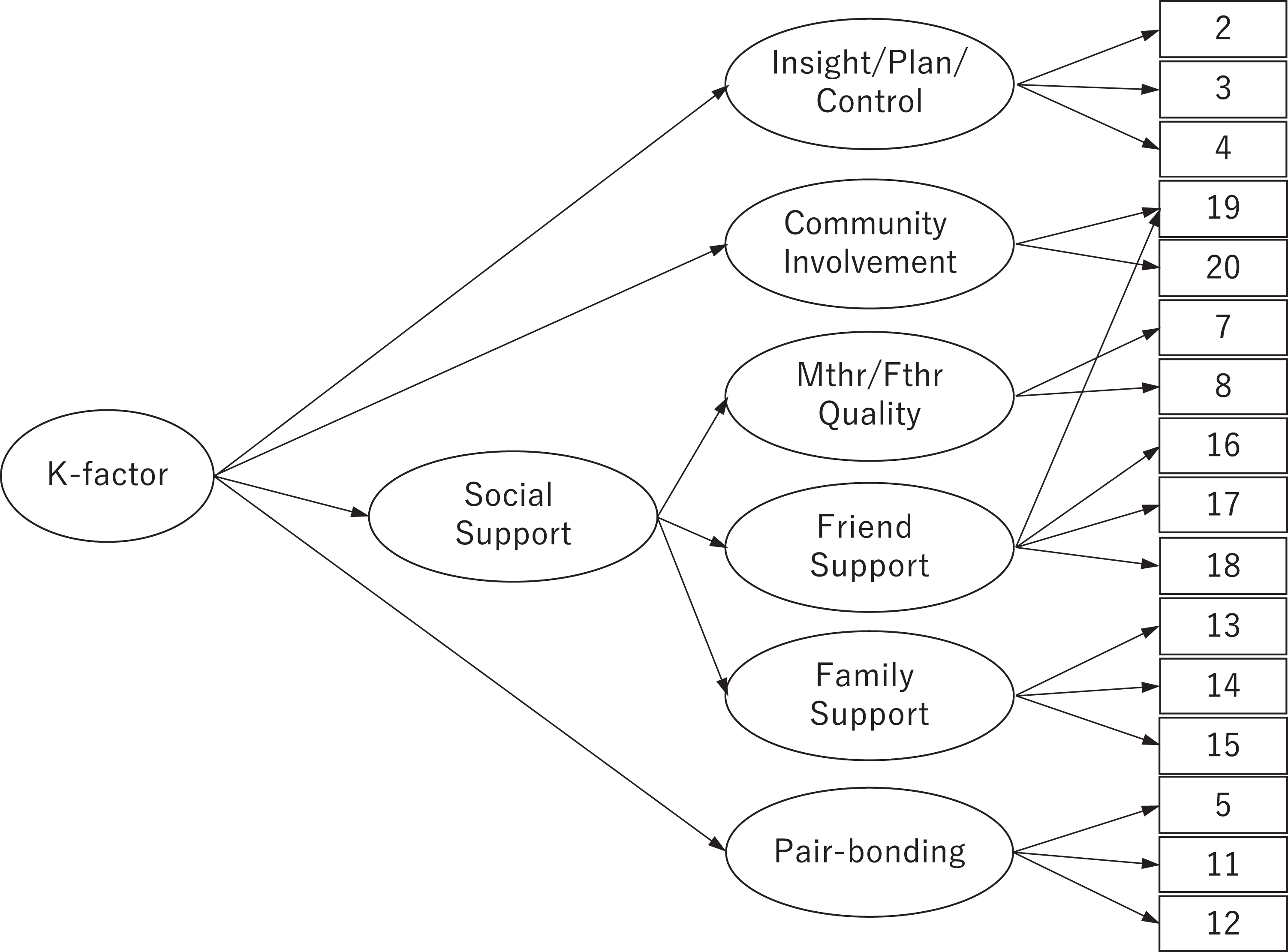
Final model of Richardson et al. (2017).
Note that the final model of this study, Model 1, described in Figure 2, differs from that of Richardson et al. (2017). First, I assumed five lower order factors although Richardson et al. (2017) assumed six because Items 9 and 20 of the Mini-K-J are inappropriate for Japanese undergraduates and were not measured in this study. Item 9 (“I have a close and warm relationship with my own children”) is not suitable for a young sample because most such participants have not yet become parents. Additionally, Item 20 (“I am closely connected to and involved in my religion”) might be unsuitable for Japanese undergraduates because many Japanese individuals do not strongly identify with a specific religion—for instance, they may celebrate a wedding with a Christian ceremony but hold a funeral based on Buddhist rituals. Therefore, I excluded Items 9 and 20 from this study. 1
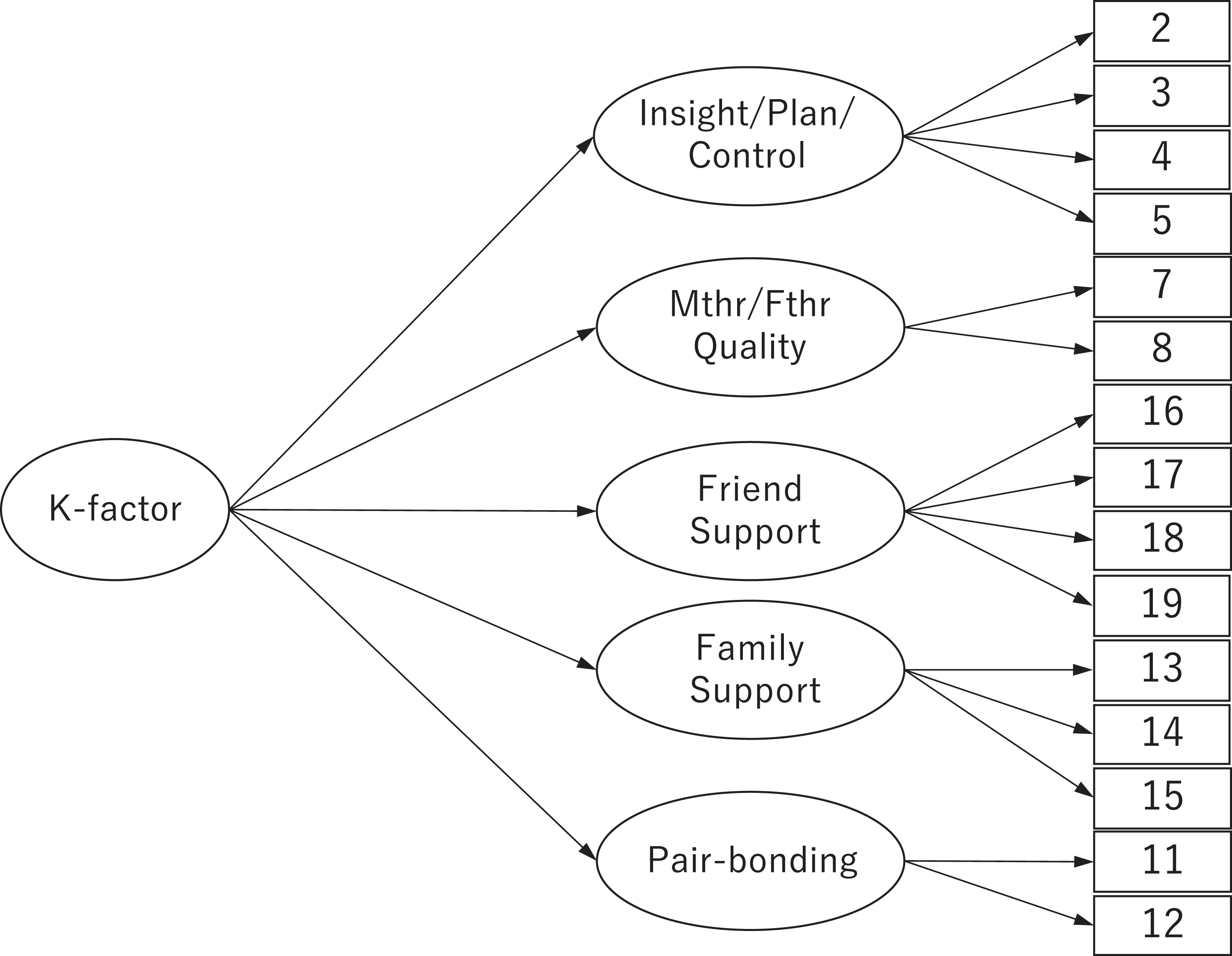
Final model of this study (Model 1). Note that Model 0, which was used as the baseline model, included only lower order factors and factor correlations.
Second, I assumed that Item 5 (“I often make plans in advance”) is included in insight, planning, and control from a theoretical and an original perspective, rather than pair-bonding as in Richardson et al. (2017). 2 Third, I excluded the social support factor to increase parsimony although it was shown in Richardson et al. (2017).
Criterion Validity
Richardson et al. (2017) tested the relationships between the K-factor and life history indices, as did I in this study. Specifically, I conducted multigroup SEM by sex to examine the relationships between the higher order K-factor and fast LHS indices for each sex.
Several fast LHS traits were considered, specifically the Dark Triad personality traits (Machiavellianism, narcissism, and psychopathy), borderline personality (BP), and antisocial personality (ASP).
The Dark Triad personality, particularly psychopathy, is a typical personality trait reflecting fast LHS (Jonason et al., 2010). However, narcissistic people value interpersonal relationships and slow LHS (McDonald et al., 2012). Additionally, Machiavellianism has not been associated with any particular LHS (Jonason et al., 2013). Thus, I hypothesized that Mini-K-J scores would be negatively related to psychopathy but did not hypothesize how scores would relate to the other two Dark Triad personality traits.
ASP is related to psychopathy, with typical examples of this personality showing high aggression and impulsivity. As these traits reflect fast LHS (Figueredo et al., 2014), ASP is expected to be negatively related to the Mini-K-J. Individuals with BP also show impulsivity, short-term interpersonal relationships, and various negative outcomes related to fast LHS (Brüne, 2016). Furthermore, there is a positive relationship between BP and psychopathy (especially Factor 2; Sprague et al., 2012); notably, these traits appear to be heritable (Hunt et al., 2015). Thus, I hypothesized that psychopathy, ASP, and BP would all be negatively related to the K-factor and first-order factors.
Method
All participants were the same as those used in Kiire (2017).
Participants
Participants were 467 undergraduates from Tokyo, Japan. The analyses were conducted only for the 455 participants who provided complete data (247 females and 208 males; M = 19.0, SD = 1.19). Note that Kiire (2017) used the data of only 344 participants who provided complete data and had experience in romantic relationships because Kiire (2017) focused on partner relationships. In contrast, this study targeted LHSs. Thus, the current sample included individuals with no experience in romantic relationships.
Measures
Mini-K-J
The Mini-K-J (Kawamoto, 2015) contains 20 items that assess individual differences in LHS as a K-factor. Participants rate the degree to which each item applies to them via a 7-point self-report scale (−3 = disagree strongly, +3 = agree strongly). Note that I transformed scores from −3 to +3 to the 1–7 range. Higher scores represent a slower LHS and vice versa. Two items were removed because they were unsuitable for Japanese undergraduate students (i.e., Item 9, “I have a close and warm relationship with my own children” 3 and Item 20, “I am closely connected to and involved in my religion”).
Japanese version of the Short Dark Triad
The Japanese version of the Short Dark Triad (Shimotsukasa & Oshio, 2017) contains 27 items that assess individual differences in the Dark Triad traits. Participants responded via a 7-point scale (1 = strongly disagree, 7 = strongly agree). Scores were averaged for each Dark Triad trait.
Japanese version of the PDQ-R
The Japanese version of the Personality Diagnostic Questionnaire-Revised (PDQ-R) (Kiriike & Matsunaga, 1995) was constructed to measure tendencies toward personality disorders based on the classifications of the Diagnostic and Statistical Manual of Mental Disorders III. I used BP (13 items) and ASP (12 items) Scales. Note that items related to criminal behavior were removed (i.e., Item 12 in the BP Scale and Items 3, 7, and 10 in the ASP Scale), and 1 item was added to the ASP Scale (“When I was a child [before the age of 15], I was a delinquent.”). Participants responded “yes” or “no” to each item. For each item, a score of 1 was assigned if the response reflected the given personality disorder, otherwise a score of 0 was allotted. Scores were averaged for each personality disorder scale.
Procedure
The survey was administered in university classes. Participants answered individually and simultaneously by responding to each measure and providing demographic data (i.e., age and sex). All procedures were approved by the ethics committee of Hosei University.
Data Analysis
First, I conducted CFA assuming only lower order factors of this study model (i.e., Model 0, which included only lower order factors and factor correlations based on Model 1). Note that following Richardson et al.’s model, I removed Items 1, 6, 10, 9, and 20.
In confirming the Mini-K-J’s structure, the fit criteria were consistent with Richardson et al. (2017): A Tucker–Lewis index/comparative fit index (TLI/CFI) of over .95 and root mean square error of approximation (RMSEA) of under .05 suggested good fit. Although Richardson et al. (2017) adopted a nonsignificant χ2 statistic as the criterion for good model fit, I avoided this because the χ2 value is highly sensitive to sample size. Additionally, I used the standardized root mean residual (SRMR) with a value of below .05 denoting good fit. For factor loadings, I used a criterion of over .30 on the relevant factor. Note that Richardson et al. (2017) conducted a robust weighted least square means and variance analysis, but the current research used the full information maximum likelihood method. Furthermore, all model comparisons used Bayesian information criterion (BIC), although Δχ2s are reported.
Second, I conducted a higher order factor analysis for Model 1 (see Figure 2), which assumed five lower order factors and the K-factor.
Third, I conducted multigroup CFA by sex, as in Richardson et al. (2017), to assess model invariance by sex using Model 0. Subsequently, I examined invariance using Model 1 (see Figure 2).
Finally, I conducted multigroup SEM by sex to examine relationships between the K-factor and fast LHS indices. Model constraints and sex invariance of the Mini-K-J were following the above analyses’ results. Each effect of Mini-K-J factors on each fast LHS trait was freely estimated across sex. Note that although the sample size of both sexes was somewhat small (N < 250), I did not combine the samples because there might have existed sex interaction effects (Richardson et al., 2017).
Results
Factor Construction
First, I conducted CFA for Model 0, which only included lower order factors of Model 1. The result showed good model fit (CFI = .983, TLI = .978, RMSEA = .032, SRMR = .034, and BIC = 23,870.02). Additionally, all items had loadings greater than .42 and correlations among the five factors were moderate (r = .21–.52, ps < .001). In this study, Model 0 was used as the baseline model.
Second, I tested Model 1, which contained five lower order factors and the K-factor. Model fit was good (CFI = .983, TLI = .979, RMSEA = .031, SRMR = .036, and BIC = 23,844.32) and not significantly different from Model 0 (Δχ2(5) = 4.90, p = .43). 4 These results show that the Mini-K-J can most parsimoniously be described by a single higher order K-factor.
Third, I conducted multigroup CFA to examine invariance of Model 0 with respect to sex. The scalar invariance model exhibited better fit (BIC = 23,919.72) than metric (BIC = 23,950.79) or configural (BIC = 23,981.66) invariance models. These results show invariance by sex of factor loadings and intercepts in the Mini-K-J. This suggests that the Mini-K-J measures the same first-order construct across sex, consistent with Richardson et al. (2017). The factor means were higher in female than male participants, except for insight, planning, and control.
I also assessed a multigroup Model 1. Note that I restricted the factor mean of insight, planning, and control to zero across sex because this lower order factor did not exhibit a sex difference in the factor mean. Based on scalar Model 0 (i.e., lower factor loadings on observed variables and the intercept of observed variables were constrained to be equal by sex), (1) both K-factor loadings on each lower order factor and the factor mean were freely estimated in configural Model 1, (2) K-factor loadings on each lower order factor were subject to the equality constraint by sex in metric Model 1, and (3) both K-factor loadings on each lower order factor and factor mean were also subject to the equality constraint by sex in scalar Model 1. Across all models, K-factor mean, K-factor variance, and residual variances of each lower order factor and observed variable were freely estimated. Results showed that the fit of metric Model 1 was better (BIC = 23,857.10) than that of the configural Model 1 (BIC = 23,868.16; Δχ2(4) = 13.42, p = .01), scalar Model 1 (BIC = 23,861.88; Δχ2(4) = 29.27, p < .001), and/or scalar Model 0 (Δχ2(14) = 23.06, p = .06). Lower order factor means were higher in female participants, except for the mean-constrained insight, planning, and control. Namely, the Mini-K-J measured the same higher order constructs across sex, although only insight, planning, and control was scalar invariant. This indicates that Mini-K-J and the original Mini-K exhibit the same structure across sexes. In addition, the K-factor did not exhibit sex differences. However, because the K-factor might have a different meaning by sex (i.e., different intercepts of first-order factors from the K-factor across sexes; Richardson et al., 2017), I do not interpret mean sex differences here.
Next, consistent with Richardson et al. (2017), I examined further constrained versions of Model 1. Constraints were applied to the residual variances of the five lower order factors and to K-factor variance. Results showed that Model 1, which was subject to only additive equality of residual variances, provided better fit than metric Model 1 (BIC = 23,843.91; Δχ2(5) = 17.41, p < .01). However, Model 1 with additive equality of residual variance and K-factor variance provided poorer fit than metric Model 1 (BIC = 23,873.61; Δχ2(7) = 59.35, p < .001). These results show that residuals of lower order factors were invariant by sex, consistent with Richardson et al. (2017). However, K-factor variance differed by sex in the Mini-K-J as applied to Japanese undergraduates. This result does not support Richardson et al. (2017). Output of the final multigroup Model 1 is reported as Supplemental Material 1.
Relationships With the Mini-K-J and Fast LHS Traits
I examined relationships between fast LHS indices and the K-factor through SEM. Fast LHS indices were averaged for each scale as observed scale scores. The internal reliabilities of fast LHS personality trait scores were barely acceptable (αMachiavellianism = .72, αnarcissism = .76, αpsychopathy = .61, αBP = .59), except for ASP (αASP = .32). Note that although ASP exhibited low internal consistency, I used this measure because antisociality is an important aspect of fast LHS (McDonald et al., 2012). Descriptive statistics and sex differences of fast LHS indices are shown in Table 1. There were no sex differences, except for narcissism.
Descriptive Statistics and Sex Differences of Fast Life History Strategy Traits.

**p < .01.
Results of SEM are shown in Figure 3, and all outputs are reported in Supplemental Material 2. In both sexes, the K-factor significantly explained variance in psychopathy (

Relationships between K-factor and fast life history strategy indices for females and males. Standardized path coefficients are shown. Dashed lines indicate nonsignificant paths. *p < .05. **p < .01. ***p < .001. All K-factor loadings on each lower order factor were statistically significant (p < .001). Model fit was acceptable (comparative fit index = .902, Tucker–Lewis index = .890, root mean square error of approximation = .058, and standardized root mean residual = .082).
Discussion
Factor Construction and Sex Invariance
This research examined construct validity and its sex invariance, following Richardson et al. (2017). Furthermore, I examined criterion validity of the Mini-K-J using fast LHS indices. Construct validity and sex invariance findings broadly supported Richardson et al. (2017).
First, multiple lower order factors and a single higher order factor were replicated in the Japanese version (i.e., Mini-K-J), consistent with Richardson et al. (2017). Note that, because I excluded items unsuitable for university students, I assumed five first-order factors in contrast to Richardson et al.’s (2017) six first-order factors. Furthermore, I excluded Richardson et al.’s (2017) middle order factor based on parsimony. In addition, I included Item 5 in the insight, planning, and control first-order factor as an original perspective of the Mini-K, although Richardson et al. (2017) included this item in pair-bonding. The critical issue was whether a single higher order K-factor could explain the variance in Mini-K-J responses, regardless of the existence of several lower order factors. The results showed that the Mini-K-J measures the one-dimensional K-factor as a higher order factor of five first-order factors: insight, planning, and control; mother/father relationship quality; friend social contact/support; family social contact/support; and pair-bonding. Thus, the Mini-K-J is useful for measuring individual unidimensional LHS, similar to the original Mini-K.
Second, results showed invariance of first-order factor loadings and intercepts for each item across sex, consistent with Richardson et al. (2017). Thus, the Mini-K-J measures the same first-order constructs across sexes as the original Mini-K. As such, mean differences of lower order factors of the Mini-K-J may be interpreted in the same manner as in the original Mini-K (Richardson et al., 2017).
Third, factor loadings of first-order factors on the higher order K-factor and residual variance of each first-order factor were invariant across sex as in Richardson et al. (2017). Furthermore, consistent with Richardson et al. (2017), intercepts of first-order factors of the K-factor were not invariant. Thus, I also recommend not interpreting mean sex differences of the K-factor and examining structures of LHS (Richardson et al., 2017). Note that intercept differences across sex were not the same as in Richardson et al. (2017). In this study, all intercepts were higher in females than males, except for insight, planning, and control. These results might suggest that males tend to adopt a fast LHS in general because males who adopt such a strategy would benefit from low costs of reproduction (Jonason et al., 2013).
Fourth, invariance of the K-factor variance was not consistent with Richardson et al. (2017). In this study, variance of the K-factor was not invariant across sex; rather, variance was larger in males. However, this result is consistent with the evolutionary perspective that males should exhibit a larger variance in reproductive strategies, as noted by Richardson et al. (2017).
These results suggest that the Mini-K-J replicates the original structure of the Mini-K (Richardson et al., 2017), at least with populations of Japanese and American undergraduates, respectively. Furthermore, the fact that a single higher order K-factor could be assumed in both Japanese and American samples suggests that both the Mini-K and Mini-K-J accurately capture the structure of unidimensional LHSs. Thus, these findings suggest that international comparisons are appropriate such as between Japan and the United States and/or other Western countries.
However, these results are statistically rather than theoretically based. Future research is also needed to identify in more detail the construction of lower order factors and their interactions from a theoretical perspective. Furthermore, sex differences in LHS would benefit from additional focus.
Relationships with Fast LHS Indices
Regarding the Mini-K-J and fast LHS indices, psychopathy, BP, and ASP were captured by the K-factor measured with the Mini-K-J as fast LHS traits (i.e., negatively related). These results supported the current hypotheses and previous research (Brüne, 2016; Figueredo et al., 2006; Jonason et al., 2010).
Narcissism was predicted by the K-factor as a slow LHS trait in only males. This supports previous research reporting that narcissism is associated with some slow LHS indices (McDonald et al., 2012), even though individuals high in narcissism pursue short-term relationships (i.e., one of the fast LHS indexes; Adams et al., 2014). In contrast, Machiavellianism was predicted by the K-factor as a fast LHS trait in only females. Although some previous studies have found no relationship between LHS and Machiavellianism (Jonason et al., 2013), Machiavellianism tends to be associated with forethought and flexibility (Jones, 2016). Therefore, there might be some situational factors that make Machiavellianism adaptive only in females. However, links between LHS and Machiavellianism and/or narcissism are inconsistent across cultures (Jonason et al., 2013). Thus, further cross-cultural research is needed to obtain a broader perspective.
Overall, the current results confirmed the criterion validity of the Mini-K-J. In particular, the Mini-K-J could capture fast LHS indices similarly to the original Mini-K and slow-LHS indices (Figueredo et al., 2014; Kawamoto, 2015). Therefore, the Mini-K-J would be of utility for studies addressing LHS, at least those that consider Japanese undergraduates. However, I examined criterion validity only using personality traits. Thus, it is necessary to use more expansive indices, such as demographic or behavioral traits, in future research.
Limitations
The present research has limitations. First, I excluded 2 items from the Mini-K-J, as they were unsuitable for Japanese undergraduates and could have caused bias. Second, I excluded 3 additional items, following Richardson et al. (2017). Future research should examine these items’ meanings in the LHS framework. Finally, this research was conducted in only one Japanese university. Thus, it might be premature to generalize its findings to all undergraduates. However, this research nevertheless replicated previous research that also utilized undergraduates (Richardson et al., 2017). Therefore, both my findings and those of Richardson et al. provide a useful reference for future research that examines the construction of the Mini-K, the validity of the Mini-K items, and the generalization of the Mini-K to undergraduates of broad nationalities. Additionally, there are relatively few studies of LHS in Japanese persons. Thus, data must be accumulated from Japan and other cultures in future research.
Supplemental Material
Supplemental Material, SM1_revise04 - Structure of the Mini-K-J and Its Utility for Measuring Fast Life History Traits in Japanese Undergraduate Students
Supplemental Material, SM1_revise04 for Structure of the Mini-K-J and Its Utility for Measuring Fast Life History Traits in Japanese Undergraduate Students by Satoru Kiire in Evolutionary Psychology
Supplemental Material
Supplemental Material, SM2_revise04 - Structure of the Mini-K-J and Its Utility for Measuring Fast Life History Traits in Japanese Undergraduate Students
Supplemental Material, SM2_revise04 for Structure of the Mini-K-J and Its Utility for Measuring Fast Life History Traits in Japanese Undergraduate Students by Satoru Kiire in Evolutionary Psychology
Footnotes
Declaration of Conflicting Interests
The author(s) declared no potential conflicts of interest with respect to the research, authorship, and/or publication of this article.
Funding
The author(s) received no financial support for the research, authorship, and/or publication of this article.

Supplemental Material
The supplemental material for this article is available online.
Notes
References
Supplementary Material
Please find the following supplemental material available below.
For Open Access articles published under a Creative Commons License, all supplemental material carries the same license as the article it is associated with.
For non-Open Access articles published, all supplemental material carries a non-exclusive license, and permission requests for re-use of supplemental material or any part of supplemental material shall be sent directly to the copyright owner as specified in the copyright notice associated with the article.
