



Abstract
Exposure to environmental cues reflecting potential threats to future survivability is associated with a stronger endorsement of short-term mating strategies. Less is known, however, about the effects of safety and security cues. In four studies, we examined the effects of attachment-related security cues compared to neutral cues on preferences for short- and long-term mating strategies. Preferences were assessed using self-report and behavioral measures. In line with Life History Theory (LHT) and our hypotheses, exposure to attachment-related security cues was mainly associated with a stronger preference for long-term mating strategies and a weaker preference for short-term strategies. Our internal meta-analysis of the experimental security manipulations across studies provided further support for the association between state attachment security and endorsement of mating strategies. We also found some predictable effects of gender and relationship status. Implications for LHT and attachment theory are discussed. (139 words)
Humans have evolved a complex adaptive behavioral repertoire that facilitates coping with environmental challenges in ways that are likely to increase the chances of survival, reproduction, and inclusive fitness (Charnov, 1993; Ellis, 2004; Kaplan & Gangestad, 2005). Based on evolutionary psychology (e.g., Buss, 2014), Life History Theory (LHT; e.g., Belsky et al., 2012; Simpson & Belsky, 2008) explains the strategies organisms use to allocate their limited time, energy, and resources to various vital activities such as reproduction and securing their own survival (Del Giudice & Belsky, 2011). The (unconscious) drive for reproductive fitness affects human sexual behavior and manifests in different adaptive strategies (Chisholm et al., 1993). LHT proposes that exposure to environmental cues indicating safety or challenges to future survivability shape these strategies. In turn, adopting such strategies contributes to differences in the onset of sexual relations, the number of sexual partners, and the level of parental investment (Del Giudice et al., 2016). For example, when encountering environmental cues indicating a dangerous, insecure, or unstable environment that could decrease survival chances, reproducing more quickly increases chances of reproductive success. Thus, individuals are more likely to adopt short-term mating strategies in a hostile environment. In contrast, when encountering cues indicating a secure environment, reproducing later in life and investing more in each offspring tends to be a more adaptive strategy, and individuals are more likely to adopt a long-term mating strategy (Griskevicius et al., 2011).
Mating Strategies
Mating strategies include sexual behaviors, attitudes, and scripts, which affect the timing and frequency of reproduction. These strategies are directly affected by life-history decisions an individual made in response to their environment. More specifically, mating strategies are an integrated set of adaptations that organize and guide an individual’s reproductive efforts regarding the trade-off between quantity and quality of offspring (Gangestad & Simpson, 2000). Depending on environmental cues, this trade-off can result in either short-term or long-term mating strategies (Buss & Schmitt, 1993). These two types of strategies affect relational behaviors, such as relationship initiation and formation. Thus, based on the strategy adopted (and their relationship status), people are likely to look for a new mate or stick with the one they have.
Simpson and Belsky (2008) argued that individuals negotiate three kinds of investment tradeoffs concerning survival and reproduction: (1) reproduce immediately or wait for better opportunities in the future; (2) invest resources and energy in either quantity or quality of offspring; and (3) invest in mating or parenting efforts. This negotiation results in a tendency to prefer one set of mating strategies over the other—short- or long-term 1 (Buss, 1989; Jackson & Kirkpatrick, 2007; Simpson & Gangestad, 1991; Trivers, 1972). Short-term mating strategies focus on the present and on immediate benefits, such as having a one-night stand with an attractive partner or obtaining access to high-quality genes. People who endorse short-term strategies start reproducing earlier in life, tend to have more offspring, and invest less energy and resources in each offspring. These people are also more likely to engage in specific sexual behaviors such as casual sex and sex with multiple partners, thereby increasing the chances of passing on their genes (e.g., Young et al., 2017).
Conversely, long-term strategies focus on the future and on increasing the possibility of establishing a lasting pair bond and gaining access to a partner who will provide support and possibly be a long-term co-parent. Furthermore, when raising children, the preference will be to have fewer offspring and invest more energy and resources in each. People who endorse long-term strategies tend to have a later onset of sexual activity, fewer sexual partners, and fewer children. In other words, a short-term strategy can be defined as increasing onés reproductive success by having a larger pool of mates for sexual intercourse and a large number of children. Conversely, a long-term strategy can be defined as maximizing reproductive success by encouraging commitment to one partner and investing resources in that one partner and one or a smaller number of children (Perilloux & Cloud, 2016). 2
Life History Theory and Gender Differences
Many of the studies based on LHT (Barkow et al., 1992; Buss, 2005; Conroy-Beam et al., 2015) have focused on sex differences, finding repeatedly and cross-culturally that, independent of a secure or hostile environment, men and women tend to differ in their preferred mating strategies (Walter et al., 2020). This difference is thought to have emerged during evolution due to the sexes facing different adaptive problems concerning reproduction, such as parenting effort (Buss, 1989; Trivers, 1972). Although not necessarily a conscious cognitive process, the fact that women are the ones who can become pregnant, carry the baby internally for nine months, lactate, and provide most of the food and care, affects their risk calculation (e.g., Bennett, 2018). Copulating and potentially getting pregnant with a partner who will not provide for the woman and the offspring represents a much more significant risk for women than men (e.g., Rousou et al., 2013; Rusyda et al., 2011). Hence, as soon as women are biologically able to reproduce, the chance of becoming pregnant affects their sexual behavior (although this is not the only factor affecting their sexual behavior), and often women prefer long-term strategies. That said, there are also circumstances when endorsing short-term strategies is adaptive for a woman, such as when an alternative mate could provide greater genetic fitness than one’s long-term mate (Gangestad & Simpson, 2000). Unlike women, men stand to gain more from adopting short-term strategies. Not committing to a single partner and investing less in each offspring - that is, adopting short-term strategies - allow men to have more offspring and spread their genes more broadly (Belsky, 2012; Buss & Schmitt, 1993). These differences suggest that women will be more susceptible to primes that increase preference for long-term mating strategies, whereas men will be more susceptible to primes that increase endorsement of short-term mating strategies.
Environmental Cues and Mating Strategies
People differ in their preference for- or endorsement of- mating strategies. According to Jackson and Kirkpatrick (2007), people exhibit greater variation in their preference for a short-term strategy than in their preference for a long-term strategy because the default is leaning toward long-term strategies. This suggests that preference for a short-term strategy is more likely to be affected by experimental manipulations. That, of course, does not mean that preference for a long-term strategy would not be affected by manipulations. Experimental manipulations allow researchers to examine the impact of various factors on people’s preferences for sexual strategies without needing to wait for years to pass and effects to take place. An example of such manipulations is priming (exposing people to certain cues such as images, words, or vignettes), which are often used in research on attachment and its effects (see ||Gillath et al., 2019, 2022 for reviews).
Based on LHT, researchers have recently started looking more closely at the causal associations between environmental cues and preference for short- and long-term mating strategies. For example, Gillath and colleagues (2011) exposed people to cues of threatening future survivability (death primes), which led participants to be more open to sex - assessed with various behavioral indexes (e.g., approach responses toward sexual images - pulling a joystick closer when seeing sexual images). This finding, however, was observed mainly among men, who stand to gain more from short-term strategies in the face of low survival chances. When faced with impending death, men can still reproduce; they can have sex and impregnate a woman, passing their genes forward, even within a short amount of time. Women are more limited because the length of their pregnancy is not flexible, and they cannot pass their genes forward quickly if they are likely to die soon. Similarly, Griskevicius et al. (2011) examined how exposure to mortality cues influences decisions involving risk preference and temporal discounting. They found that mortality cues motivated people to prefer short-term strategies. But this was the case only among people who grew up relatively poor (see also Griskevicius et al., 2013; Li et al., 2012). Overall, these studies indicate that exposure to environmental insecurity cues is associated with the endorsement of short-term mating strategies, which is in line with LHT. Importantly for the current work, these studies show that it is possible to experimentally manipulate context by using specific cues (such as death primes), thereby affecting the preference for a certain mating strategy. In the current work, we extend this line of research to examine the effects of exposure to attachment-related security cues on the preference for mating strategies.
Attachment Theory
Attachment theory (Bowlby, 1969; Gillath et al., 2016) has been used repeatedly and successfully to study intimate relationships and sexuality (e.g., Dewitte, 2012; Shaver & Mikulincer, 2012; Stefanou & McCabe, 2012). A few studies have already examined the associations between attachment and sexual strategies. In one of the most comprehensive examinations, Schmitt (2005a, 2005b) used samples from 48 nations to study the associations between attachment styles and mating strategies. They found that having an insecure attachment style (anxious or avoidant) was associated with a greater likelihood of adopting short-term mating strategies. Strategy adoption was assessed using measures such as the Short-Term Mating Interests Scale (STMI; Buss & Schmitt, 1993; Schmitt & International Sexuality Description Project, 2003), Sociosexuality Orientation Inventory (SOI; Simpson & Gangestad, 1991), and the “Sexy Seven” sexuality attributes scale (Schmitt & Buss, 2000). Schachner and Shaver (2002), using Buss’s (1989) conceptualization of mating strategies, provided further support for the association between attachment insecurity and short-term mating strategies. They showed that avoidant attachment was positively associated with mate poaching - the enticement of someone else’s mate to engage in uncommitted sexual intercourse. Tracy and colleagues (2003) found associations between insecure attachment style and earlier onset of sexual intercourse, discomfort with intimacy, and an unwillingness to form close bonds in dating relationships among adolescents. More recently, Schmitt and Jonason (2015) found similar associations between attachment avoidance and short-term mating interests, especially among men. All of these can be seen as indexes of preference for short-term strategies (see also Bogaert & Sadava, 2002).
Focusing on attachment insecurity and relying (mostly) on correlational designs, the studies reviewed above cannot say much about causality and directionality. However, manipulating a person’s sense of (attachment) security can be done experimentally, for example, by using priming methods. Thus, Gillath and colleagues (2010) showed that exposure to attachment-related security primes led people to report a lower likelihood of being unfaithful. Likewise, Winterheld and Simpson (2007) showed that attachment-related security priming increases a person’s tendency to inhibit or forgo destructive relational interaction patterns (e.g., betraying one’s partner with a stranger). Here we build on and extend this line of work. We test the possibility that attachment-related security cues can alter sexual behavior and specifically affect the preference for short- and long-term mating strategies.
the Current Studies
Based on LHT, attachment theory, and the research reviewed above, we hypothesized that exposure to attachment-related security cues, compared to neutral cues, would increase people’s sense of safety, comfort, and closeness (e.g., Collins & Read, 1990; Shaver & Brennan, 1992; Simpson, 1990). We expected participants who felt more secure to report (1) a weaker preference for short-term strategies and (2) a stronger preference for long-term strategies. Based on Buss’s (1989) mating strategies theory, we further expected that (3) women would prefer long-term mating strategies, whereas men would prefer short-term mating strategies. Finally, we expected that (4) people already in a romantic relationship would have a stronger preference for long-term strategies because they fit their relationship status and behavior.
To test our overall hypothesis that exposure to security priming would affect a persońs preference for mating strategies, we ran four independent studies providing both direct and conceptual replications and convergent validity. In Study 1, we examined the pattern of associations between manipulated attachment security and mating strategies. We conducted Study 2 to provide a replication of Study 1 and address the low reliability of the subscale assessing long-term strategies in Study 1. In Study 2, we used a different self-report measure to assess mating strategies. Self-reports, however, are known to suffer from various biases and low external validity (Quinio & Lam, 2021), especially for sexual behavior (Schroder et al., 2003). In Study 3, we increased external validity by creating a less artificial setting, asking people to rate “real” dating profiles rather than using a self-report measure. In Study 4, we further increased external validity, using a different setting (a real-world interaction). Study 4 conceptually replicated the pattern of findings from Study 3 despite the different settings. Finally, an internal meta-analysis compared the effects across studies, generating an omnibus effect size. Participants in all four studies were undergraduates pursuing a psychology degree and recruited at university. Participants could sign up for only one study at a time and once they were finished with one study, they could not sign up for other studies from the same project because the system automatically excluded them. Experimenters (research assistants) across all studies welcomed participants and assigned them to the correct lab room and computer. They then answered any questions they might have had, but (the experimenters) did not stay in the room during the priming or the rest of the study. Once in the laboratory, participants were randomly assigned to either an attachment-related-security priming or a neutral priming condition. To check for significant group differences, and to ensure the randomization was successful and did not produce any artifacts, we tested group differences for gender, age, relationship status, sexual orientation, and race. Based on independent samples t-tests, no significant group differences by condition emerged. Table 1 gives an overview of the studies.
Overview of the 4 Studies.

Note: The remaining category for Race is “other”, which is not specified in the table but can be inferred when adding up the numbers to 100%.
Study 1
Study 1 used experimental methods to test the associations between exposure to attachment-related security cues, compared with neutral cues, and preference for long- and short-term strategies. Participants were subliminally exposed to either attachment-related security or neutral words and then immediately (on the same computer) reported their mating preferences using a measure developed in our laboratory (Gillath & Schachner, 2006) 3 . Additionally, based on the literature and our work (e.g., Gillath et al., 2011), we examined the effects of gender and the interaction of prime and gender on preferences for long- and short-term mating strategies.
Our hypotheses for Study 1 were: (1) Participants exposed to attachment-related security-prime words, as compared with neutral prime words, would report a greater preference for long-term mating strategies and a lower preference for short-term mating strategies. (2) Men and women would differ in their preferences, such that a greater preference for short-term strategies would be more pronounced among men compared to women, in line with previous studies (e.g., Gillath et al., 2011). We did not have specific hypotheses regarding the interaction of prime and gender.
Method
Participants
Upon IRB approval, 110 self-reported heterosexual psychology students at a large West Coast University, 40 men and 70 women aged 18–29 (median = 19), participated in the study for course credit. Forty-one percent were Asian or Asian American, 44% were Caucasian, 8% were Latino, 1% were African American, and 6% reported other or mixed ethnicities.
Measures and procedure
Participants were first given general instructions about the study and then specific task instructions: “On each trial, you will see the names of two pieces of furniture (e.g., table – television). Your task will be to decide how similar or associated the two are using any sense of ‘similar’ or ‘associated’ that comes to mind when you see the pair of words. You should indicate your response by pressing a number between 1 and 7 on the keyboard number pad, with 1 indicating that the two pieces of furniture are not similar or associated with each other at all and 7 indicating that they are highly similar or associated. The numbers between 2 and 6 indicate degrees of similarity or association. Each trial will begin with an X on the screen, followed by a brief flash, which you can ignore, and then the pair of furniture words. Please keep your eyes on the location of the X at all times. As soon as you press a number key to indicate your similarity rating, the next trial will begin”. After consenting, participants were randomly assigned to one of two conditions based on prime type, administered via a subliminal priming procedure, to make sure that any differences between groups are attributed to the priming procedure. Participants were told that they would engage in a computerized furniture-judgment task and then complete a few questionnaires. The computerized task was actually our priming procedure, which is an established method that had been successfully used in numerous previous studies demonstrating its effect across many different outcomes (e.g., Gillath et al., 2010; McGuire et al., 2018; Mikulincer & Shaver, 2001; Mikulincer et al., 2005).
In the task, participants were asked to rate, for 15 pairs of pieces of furniture (e.g., table and chair), the similarity or association of the two pieces. Before seeing each pair of objects, participants were exposed subliminally [for 22 milliseconds (ms)] to either an attachment-related security or a neutral (non-attachment-related) prime word. The ‘brief flash’ referred to in the instructions was actually the subliminal prime followed by the mask (a string of Xs). The attachment-related security words were Love, Affection, and Secure; the matched neutral words were Lamp, Building, and Staple. Rough matching of words for each condition was based on word length and frequency in the English language. The security priming represents the treatment condition, whereas the neutral cues function as the control condition. Each presentation of a prime word was followed by a mask, presented for 500 ms, and then by a pair of named pieces of furniture, separated by a hyphen (e.g., cabinet – chair), which stayed on the screen until participants indicated their ratings by pressing a number. Based on random assignment to one of the two experimental conditions, approximately half of the participants (n = 56) were exposed to a subliminal attachment-related security prime, and the other half (n = 54) to a subliminal neutral prime. Both the attachment-related security and the neutral prime words were based on ones used in previous studies (e.g., Gillath et al., 2010; McGuire et al., 2018). The task was programmed using SuperLab Pro. Brightness and contrast were set somewhat low, and the primes, as well as the pairs of pieces of furniture, were displayed in black over a white background in the center of the screen.
Immediately following the priming procedure that occured during the furniture task, participants were asked to complete the Sexual Strategies Preference Scale (SSPS; Gillath & Schachner, 2006), which was based on previous scales used by Simpson and Gangestad (1991) and Wiederman and Dubois (1998). Participants received the following instructions: “The items below refer to sexual relationships. Please use the rating scale provided to indicate how much you agree or disagree with each item, keeping in mind the kinds of relationships in which you would like to have sex.” The ten items following the instructions consisted of five assessing interest in or preference for long-term mating strategies (e.g., “I’m looking for a potential spouse and hope to get married before too long”) and five tapping interest in, or preference for, short-term mating strategies (e.g., “I have no objection to casual sex, as long as I like the person I’m having sex with”). Participants were asked to think about their sexual relationships, without focusing on a specific partner, and rate the extent to which each item accurately described their feelings, using a 5-point scale ranging from 1 (strongly disagree) to 5 (strongly agree). Average values for short-term mating strategy ranged from 1 to 5 and for long-term mating strategy from 2 to 5. Cronbach alphas for short-term and long-term strategies scales in Study 1 were .81 and .55, respectively. The short- and long- term scores were moderately negatively correlated (r = -.31, p < .01).
Results and Discussion
To examine our hypotheses concerning the effects of attachment-related security cues (and gender) on preference for mating strategies, we conducted two univariate analysis of variances (ANOVAs), one for each type of mating strategy (long-term and short-term mating strategies). The predictors in each ANOVA were prime type (secure, neutral) and gender (male, female). The ANOVA predicting preference for long-term mating strategies revealed a main effect for prime type, F(1, 106) = 4.24, p < .05, η2 = .038, such that exposure to an attachment-related security prime led to a stronger reported preference for long-term strategies (M = 4.19) as compared with exposure to a neutral prime (M = 3.95). No other main effects or interactions were significant (all means and SDs are presented in Table 2).
Means and Standard Deviations for Short-Term and Long-Term Mating Strategies as a Function of Sex and Prime Type (Study 1).
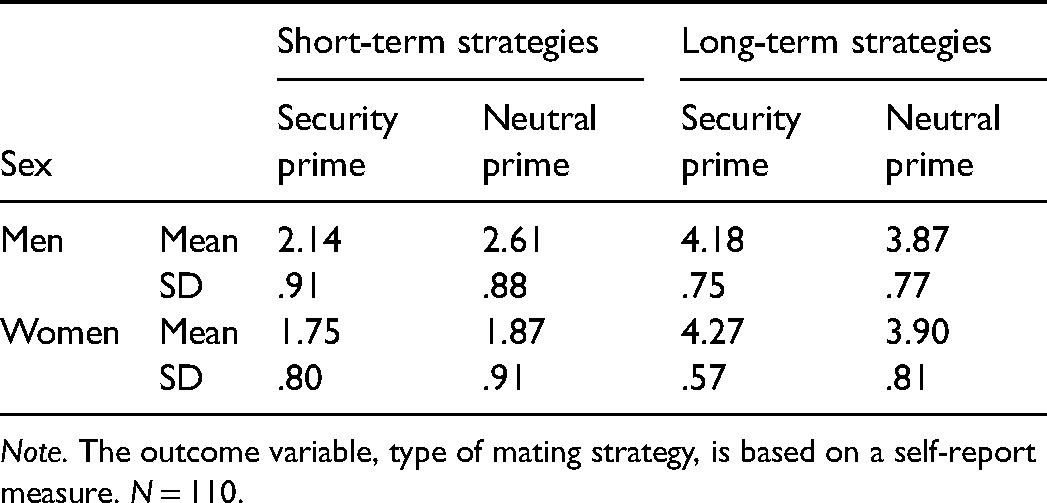
Note. The outcome variable, type of mating strategy, is based on a self-report measure. N = 110.
The ANOVA predicting preference for short-term strategies also revealed a main effect for prime type, F(1, 106) = 7.05, p < .01, η2 = .062, such that exposure to an attachment-related security prime led to a lower reported preference for short-term strategies (M = 1.97) as compared with exposure to a neutral prime (M = 2.44). The ANOVA also revealed a main effect for gender, F(1, 106) = 10.81, p < .01, η2 = .093, such that men reported a stronger preference for short-term strategies (M = 2.49), as compared with women (M = 1.91).
Overall, the results of Study 1 supported our hypotheses. Participants exposed to a subliminal attachment-related security prime, as compared with a neutral prime, reported a greater preference for long-term strategies and a lower preference for short-term strategies. Gender was associated with a preference for short-term strategies, with men reporting a stronger preference for short-term strategies compared to women. No gender differences were found in preference for long-term strategies. No interactions were found, suggesting that the impact of attachment-related security cues was similar for both men and women.
Study 2
Study 2 was designed to replicate Study 1 with some small changes. Again, we exposed people to attachment-related security cues or neutral cues and examined the effects of these cues on people’s preference for short- and long-term mating strategies. There are two differences between Study 1 and Study 2. First, to make sure that the results of Study 1 were not due to the particular way we measured preference for mating strategies, or to psychometric qualities of the SSPS, in Study 2 we used a different validated measure of long- and short-term mating strategies: Jackson and Kirkpatrick’s (2007) Short-term and Long-term Mating Orientation Scales. Second, the set of words we used as primes was slightly different (e.g., we used the word embrace instead of affection and pencil instead of lamp).
As in Study 1, we also examined the effects of gender on preference for long- and short-term strategies. Our hypotheses for Study 2 were: (1) Participants exposed to attachment-related security-prime words, as compared with neutral prime words, would report a greater preference for long-term mating strategies and a lower preference for short-term mating strategies. (2) Sex would affect preference for mating strategies, such that men report a greater preference for short-term strategies compared to women.
Method
Participants
Upon IRB approval, 88 self-reported heterosexual students at a large Midwestern university, 41 men and 47 women aged 18–33 (median = 19) participated in the study for course credit. Seventy-two percent were Caucasian, 10% were Asian or Asian American, 4% were Latino, 4% were African American, and 10% reported other or mixed ethnicities.
Measures and procedure
After consenting, participants were randomly assigned to one of two conditions depending on the type of prime they were exposed to, administered via a subliminal priming procedure. They were again told they would be engaging in a computerized furniture-judgment task, after which they would complete a few questionnaires. The priming procedure was similar to the one used in Study 1.
Based on random assignment to one of the two experimental conditions, approximately half of the participants (n = 41) were exposed to a subliminal attachment-related security prime, and the other half (n = 47) to a subliminal neutral prime. Both the attachment-related security and the neutral prime words were based on those used in previous studies (e.g., Gillath et al., 2006; 2010; McGuire et al., 2018).
Immediately after the priming procedure (on the same computer), participants were asked to complete the Short-term and Long-term Mating Orientation scales (Jackson & Kirkpatrick, 2007). This is a 25-item self-report measure consisting of three subscales assessing short-term mating orientation (STMO), long-term mating orientation (LTMO), and past sexual experience. Participants rated their agreement with each item using a seven-point scale, ranging from 1 (strongly disagree) to 7 (strongly agree). STMO consists of ten items (e.g., “Sex without love is okay”), two of which are reverse-scored. The overall short-term mating score is computed by averaging all ten items. Overall scores ranged from 1 to 6.4. LTMO consists of nine items (e.g., “I am interested in maintaining a long-term romantic relationship”), four are reverse-scored, and an overall score is computed by averaging all items. Overall scores ranged from 2.33 to 7. Cronbach alphas for the STMO and LTMO in the current study were .94 and .89, respectively, and the scores were negatively correlated (r = -.42, p < .01).
Results and Discussion
To test Hypotheses 1 and 2 concerning the effects of prime type (secure, neutral), and sex (male, female), we conducted two univariate ANOVAs, one for each dependent measure (preference for long-term or short-term mating strategies). The ANOVA predicting preference for long-term mating strategies revealed a main effect for prime type, F(1, 84) = 6.40, p < .05, η2 = .071, such that exposure to an attachment-related security prime resulted in a stronger preference for long-term mating strategies (M = 6.48), compared to the neutral prime (M = 5.99, p = .01). Thus, subliminal exposure to attachment-related security primes resulted in people being more likely to endorse long-term strategies.
The ANOVA predicting preference for short-term strategies produced a main effect for sex, F(1, 84) = 16.12, p < .001, with women showing a weaker preference for short-term strategies (M = 2.76) than men (M = 4.05). Although not revealing a main effect for prime, the ANOVA did reveal a significant 2-way interaction between sex and prime type, F(1, 84) = 4.31, p < .05. Pairwise comparisons revealed that among men, attachment-related security priming led to a stronger preference for short-term strategies (M = 4.49), compared to neutral priming (M = 3.61; p = .06). Although no significant differences were found among women, the trend was in the opposite direction. Thus, exposure to attachment-related security primes led to a lower endorsement of short-term strategies (M = 2.54), compared to a neutral prime (M = 2.99; p = .30). All means and SDs are presented in Table 3.
Means and Standard Deviations for Short-Term and Long-Term Mating Strategies as a Function of Sex and Prime Type (Study 2).

Note. The outcome variable, type of mating strategy, is based on a self-report measure here. N = 88.
Study 2 partially supported our hypotheses but also revealed some unexpected findings. As predicted, participants exposed to a subliminal attachment-related security prime, as compared with a neutral prime, reported a greater preference for long-term strategies, regardless of sex. We expected that attachment-related security priming would also lead to a lower endorsement of short-term strategies, and while that was the case (although not significantly) among women, men exposed to attachment-related security priming (compared to neutral priming) actually reported a greater preference for short-term strategies. This surprising finding which could be related to relationship status, requires replication. No sex differences were found in preference for long-term strategies, suggesting that, as in Study 1, the sexes differ more in their endorsement of short-term strategies than in their endorsement of long-term strategies. The difference between the results in the two studies could have been due to the different scales or the relatively poorer reliability of the long-term strategies scale in Study 1.
Study 3
In Study 3, we aimed to replicate the results of Studies 1 and 2 using a different methodology. Here participants viewed targets that looked like real-world profiles from dating websites. Instead of self-report of preference for short- versus long-term strategies, we asked participants to report their preference (liking) for people that are interested in short- or long-term strategies. We assumed that liking these people reflects participants’ own preferences. The internet offers many possibilities for potential short-term and long-term dating partners, and about 39% of Americans indicate having met their current relationship partner online (Rosenfeld et al., 2019). Furthermore, using a larger sample, we wanted to revisit the effects of sex and relationship status on preference for short- and long-term mating strategies.
As suggested by similarity-attraction theory (Byrne, 1969), individuals tend to prefer partners who are similar to themselves in many characteristics such as attractiveness, socio-economic status (Lewis et al., 1997), or personality (Decuyper et al., 2012). We, therefore, expected participants exposed to an attachment-related security prime to prefer potential partners indicating interest in long-term relationships and thus rate them as more attractive. Participants were first given general instructions about the study (similar to those used in Studies 1 and 2).
As in studies 1 and 2, half of the participants were exposed to an attachment-related security prime and the other half to a neutral prime using similar prime words as in the previous studies. For each profile, the participants were asked to indicate how attractive the target is as a potential dating partner. The online dating profiles included details about the target that signal either interest in short-term or long-term relationships. The dating profiles are not only manipulated by the text accompanying the profile but also by the website they supposedly came from: match.com, which is associated with more serious committed relationships, or profiles resembling tinder.com, which tends to be associated with more casual dating. All pictures used in the study were retrieved from “The Chicago Face Database,” which provides high-resolution, standardized photographs of male and female faces of varying ethnicity that were rated as equally attractive (Ma et al., 2015) 4 .
Our hypotheses for Study 3 were: (1) Exposure to attachment-related security primes compared to neutral primes would reduce attractiveness ratings of profiles indicating short-term interest. (2) Exposure to attachment-related security primes compared to neutral primes would be associated with increases in attractiveness ratings of profiles indicating long-term interest. In addition to these two hypotheses, we also planned to examine the possible interactions with sex and relationship status.
Method
Participants
Upon IRB approval, 234 (109 men, 125 women) heterosexual undergraduate students pursuing a psychology degree and aged 18–24 (M = 19, SD = 1.04), were recruited at a large Midwestern university. Of the participants, 30% were in a committed relationship at the time, and 70% were singles. Seventy-six percent were Caucasian, 12% were Asian, 6% were Latino, 3% were African American, and 3% reported other or mixed ethnicities.
Measures and procedure
Participants were first given general instructions about the study (similar to those used in Studies 1 and 2), followed by instructions specific to the task: “The purpose of this study is to better understand how people assess and rate different aspects of online dating profiles. After reviewing the consent form, you will be asked to complete a computerized task. After completing the computerized task, the computer will prompt you with more instructions on how to rate some online dating profiles and online dating profile pictures. Certain aspects of these profiles have been altered/changed or blocked out for privacy reasons. Following the questionnaires concerned with the online profiles, you will be presented with a few demographic questions and asked to answer a few more questions concerning the experiment. Finally, you will be debriefed and allowed to ask questions about the experiment.” After consenting, participants were randomly assigned to one of two conditions based on prime type administered via a subliminal priming procedure and were directed to an online survey.
Primes
We used the same priming procedure as in Studies 1 and 2. Based on random assignment to one of the two experimental conditions, approximately half of the participants (n = 122) were exposed to a subliminal attachment-related security prime, and the other half (n = 112) to a subliminal neutral prime. Immediately following the subliminal priming procedure, participants were asked to complete an online survey including demographics and then rate the attractiveness of 18 target profiles representing potential mates who were interested in either short-term or long-term relationships. To avoid order or carryover effects, the order of the long-term and short-term profiles was randomized.
Target profiles
Thirty-six profiles (half men, half women) using 36 different pictures were created, such that half represented potential mates who were interested in short-term relations (i.e., people who endorse short-term mating strategies), and half were interested in long-term relations using the same photos allowed us to randomize targets across conditions (see Supplemental Material). This was done by providing a verbal context for each picture. The profiles were supposedly taken from the dating websites “www.match.com” and “www.tinder.com” and were combined with information that fits an interest in either long-term or short-term relationships (see more below).
Each participant received 18 profiles of either male or female individuals matching the sexual orientation they reported on the demographic questionnaire. More specifically, each participant received nine profiles of potential dating partners indicating interest in a short-term relationship as well as nine profiles of potential dating partners indicating interest in a long-term relationship in a randomized order. All profiles displayed a picture and provided some basic information such as name, age (range between 19–23), sexual orientation, ethnicity, body type, and location (all places were in the vicinity where the study was conducted). The profiles representing a preference of a long-term mating strategy indicated a specific interest in a long-term relationship, such as wanting to have children and one more general sentence expressing (in different ways on different profiles) the desire to find love. The profiles representing the preference of a short-term mating strategy included one sentence expressing a general interest in a short-term relationship (in different ways on different profiles), such as enjoying going out and partying, and specifically the willingness to engage in casual sex or a one-night stand (e.g., Ím not interested in a serious relationship right now; see Supplementary Material). Each participant indicated on a 1 (not at all attracted) to 7 (very attracted) scale how attracted they were to the person in the profile. For each profile, participants responded to the question: “What is your level of attraction to this person?”. The range for average attractiveness ratings for profiles indicating short-term mating strategy was 1 to 5.88 and for long-term mating strategy 1 to 7 5 .
Results and Discussion
To test our hypotheses, we ran a repeated-measures ANOVA with prime type as a between-subjects variable, type of dating profile (representing the adoption of long-term or short-term mating strategies) as a within-subject variable, and attractiveness level of dating profiles representing short-term or long-term interest as the dependent variable (DV) DV. The ANOVA predicting attractiveness ratings revealed a main effect for mating strategy represented by the target, F(1, 226) = 53.54, p < .001, η2 = .19, such that participants rated profiles indicating long-term interest (M = 3.40, SD = 1.16) as more attractive compared to profiles indicating short-term interest (M = 2.70, SD = 1.19). As well as a main effect for prime type F(1, 226) = 35.8, p < .001, η2 = .14, such that overall attractiveness ratings were significantly lower when exposed to security priming (M = 2.69, SD = 0.09) compared to neutral priming (M = 3.47, SD = 0.10). This can be interpreted in light of an evolutionary adaptation to facilitate pair-bonding (Eastwick & Finkel, 2012). See Table 4 for means and SDs. The analysis further revealed a two-way interaction (see Figure 1) between the type of mating strategies and prime type, F(1, 226) = 44.48 p < .001, η2 = .16, such that in line with our first hypothesis exposure to security priming (M = 3.39. SD = 1.06), compared to neutral priming (M = 2.06, SD = 0.92), resulted in significantly lower attractiveness ratings of profiles indicating short-term interest.

Based on the ANOVA the figure visualizes the two-way interaction between the type of mating strategies and prime type for attractiveness rating (study 3). Pairwise comparisons demonstrate significant group differences.
Means and Standard Deviations for Attractiveness Ratings of Profiles Indicating Interest in Short-Term or Long-Term Mating Strategies as a Function of Sex (Study 3).

Note. The outcome variable, type of mating strategy, is based on a behavioral measure: attractiveness ratings of dating profiles. Total N = 234.
Furthermore, there was a significant three-way interaction (see Figure 2) between type of mating strategy, prime type, and sex, F(1,226) = 4.21, p < 0.5, η2 = .02, such that men and women rated short-term profiles as less attractive when exposed to the attachment-security prime as compared with the neutral prime. Furthermore, exposure to security primes was significantly associated with an increased preference for long-term compared to short-term profiles for both men and women. Although this difference was not significant, for men and women the trajectory was different in the long-term condition, such that for women security priming led to a higher preference for long-term profiles, whereas for men the opposite was true.
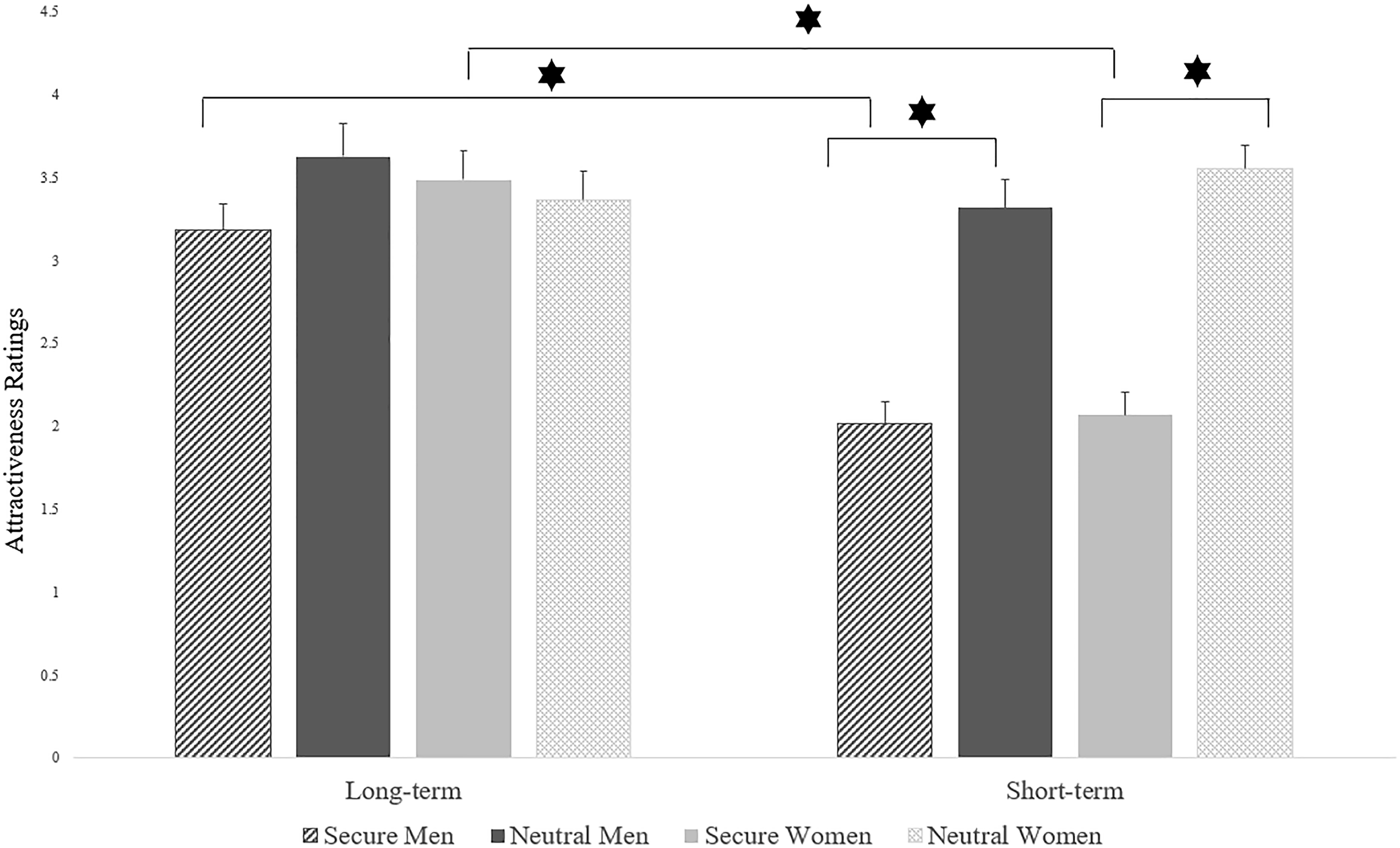
Based on the ANOVA the figure visualizes the three-way interaction for type of mating strategy, prime type, and sex for attractiveness rating (Study 3). Pairwise comparisons indicate significant group differences.
There were no main effects for relationship status or sex. Study 3 partially supported our hypotheses. As predicted, and as consistently found in Studies 1 and 2, participants exposed to attachment-related security primes compared to neutral primes reported a greater preference for long-term mating strategies and a lower preference for short-term mating strategies. We were able to replicate these findings in Study 3 with a larger sample size and using online dating profiles that looked realistic. As in Studies 1 and 2, there were no significant sex differences in preference for long-term strategies. Importantly, relationship status and sex did not result in a main effect and we found no significant differences based on relationship status when using a larger sample than the one used in Study 2.
Study 4
Studies 1–3 provide support for our claims using different DVs and somewhat different prime words. Study 2 also revealed an unexpected interaction between prime and sex, such that exposure to an attachment-related security prime led men to indicate an enhanced preference for short-term strategies, which was investigated further in Study 4, by again including relationship status. Study 3 provided further replication of the findings while also examining the interactions with sex and relationship status. None of these studies, however, tested the effects of prime (or of sex) on actual behaviors related to mating strategies. We tested that possibility in Study 4. Specifically, in Study 4, we once again examined the effects of attachment-related security priming and its interactions with sex and relationship status on preference for mating strategies. However, this time, we used behavioral measures.
To measure participants’ actual behaviors related to mating strategies, we aimed to get as close as possible to a real-life context in the laboratory, creating a setting that masked the real purpose of the study and made the participants believe they were interacting with another real person. Doing that required the use of deception for some part of the experiment, which was, of course, overseen and approved by the local institutional review board.
Another goal of Study 4 was to test the effects of attachment-related security priming and sex on behavior related to mating strategies. Doing so also allowed us to verify that our effects in Studies 1 to 3 could translate into a real-world behavioral context. Studying actual behavior is an important and somewhat neglected activity in contemporary personality and social psychological research (Agnew et al., 2009; Baumeister et al., 2007; Doliński, 2018). Assessing behavior in the laboratory is especially difficult in the case of sexuality and mating strategies. Ideally, behavioral assessments would include an opportunity to engage in sexual behavior, or at least to solicit sex, but doing so would have many ethical and practical obstacles. The closest that previous investigators have come to this conceptual idea is to have a confederate outside the laboratory suggest casual sex and record research participants’ reactions to the suggestion (e.g., Clark & Hatfield, 1989). Responses to these types of offers in the field are mostly interpreted by researchers as indicators of short-term interest (e.g., Clark & Hatfield, 1989, 2003; Tappé et al., 2013; Voracek et al., 2005). This approach also has problems - for example, with the believability of the proposal - and the ability to control the context and other factors such as priming outside the laboratory.
An alternative to this direct approach, which involves more controlled conditions, is to create a situation that involves a similar offer in the laboratory (see Conley, 2011). This approach circumvents some of the liabilities of self-report measures while assessing a behavior that may indicate a willingness to move toward a sexual relationship with a confederate (disguised as another study participant) and provide necessary experimental control. For example, the response of a participant to an offer from an attractive stranger for a date (coffee or a drink) might serve as such an index. Whereas responding yes to such an offer might be seen as a step in the direction of having casual sex and a bias toward short-term strategies, responding with a no to the offer is likely to indicate low interest in getting sexually involved with that person and a bias away from short-term strategies.
Our hypotheses for Study 4 were: (1) Participants exposed to attachment-related security priming compared to neutral priming would exhibit decreased behavior related to short-term strategies (BRSTS); (2) men would exhibit more BRSTS than women; (3) single participants would exhibit more BRSTS than coupled participants; (4) finally, we examined whether attachment-related security priming would interact with sex and/or relationship status. Based on the result of the higher endorsement of short-term strategies among men after receiving the attachment-related security prime in Study 2, we predicted that single men would show more BRSTS as compared with other participants (coupled men, and both single and coupled women) as men tend to have more to gain from BRSTS than women considering the potential parental investment as well as based on the sexual double standard (e.g., Sagebin Bordini & Sperb, 2013; Sprecher & McKinney, 1993).
Method
Participants
Upon IRB approval, 154 self-reported heterosexual students studying psychology at a large Midwestern university, 81 men and 73 women aged 18–29 (M = 19; SD = 1.59) participated in the study for course credit. Forty-seven percent were currently involved in a long-term relationship. Seventy-three percent were Caucasian, 7% were Asian or Asian American, 3% were Latino, 6% were African American, 4% were Native Americans, and 7% reported other or mixed ethnicities. For this analysis, only heterosexual students were included.
Measures and procedure
Participants were invited to participate in a study of communication methods. The sequence of events included consenting, short survey to help us prepare the interview, priming procedure, a (mock) interview, some final questions and debriefing. Immediately after participants signed a consent form, the experimenter left and participants were asked to complete a brief survey that included demographic questions and general interest questions that would be used to create an information sheet for an upcoming interview. These questions asked about sex, age, year in school, race, hometown, relationship status, length of time in one’s current relationship, hobbies, favorite classes, favorite books, favorite movies, favorite restaurants, favorite types of food, and self-descriptive personality traits/characteristics. The experimenter then returned to take a picture of the participant with a digital camera and the participant saw the picture being loaded into the computer. The experimenter then emailed the participant’s information page, and picture to an email account set up for the experiment.
The experimenter then left the room, purportedly to print the “other participant’s” information page (which in reality already existed in an adjacent room). Upon the experimenter`s return, participants received an information sheet that included the “other participant’s” picture and a few details (sex, age matching that of college students, hobbies) as well as the fact that the person was single and hence presumably ‘available.’ Two pictures were used for this purpose so that all male participants saw the same female picture and all females saw the same male picture. After reviewing the other participant’s information page, participants performed the priming task. The experimenter left the room while the participant completed the priming procedure and the interview.
Participants were told that they would be engaging in a computerized furniture-judgment task (similar instructions to Studies 1–3), after which they would interact with another participant (of the opposite sex) through an instant messaging program, taking the role of either interviewer or interviewee. The “other participant” was actually a computerized avatar (virtual confederate) that always generated the same interview questions and reactions. They were again randomly assigned to one of two conditions distinguished by prime type (secure or neutral). Again, approximately half of the participants (n = 80) were exposed to subliminal attachment-related security primes, and the other half (n = 74) were exposed to subliminal neutral primes similar to the previous studies. All the words had been used in previous studies (e.g., Edelstein & Gillath, 2008; Gillath et al., 2006; Mikulincer et al., 2002).
Following the priming procedure, all participants were informed on the computer screen that they had been randomly chosen to be the interviewee, and then they immediately started the interview.
The virtual confederate used two tactics, identified by Greer and Buss (1994), that tend to lead to a sexual encounter when aimed at a potential mate: (1) acting especially interested in what the target person (in our case, the participant) says and (2) asking the target person to go on a date. We tailored the virtual confederate’s comments leading up to an offer of a date so that participants would be inclined to think the confederate was suggesting a date (keeping its nature vague—i.e., whether it was romantic or sexual, to avoid the confederate sounding ‘creepy’), rather than friendship or a “study buddy” relationship. We used the reactions of the participants to the offer as our behavioral index.
During the interview, participants were asked questions about themselves (purportedly by another participant, the “interviewer”), such as: “What class did you like the most last semester?” “What are your favorite sports to watch or participate in?” “What kind of movies do you watch?” The interviews were conducted using an instant messaging program, which was programmed with Adobe Authorware. The program displayed a photograph of the campus building in which the study took place, along with a photo of the supposed “interviewer.” Next to these pictures were two windows, one containing the questions and reactions of the “interviewer” and one for the participant to type in their answers. The instant messaging program displayed each question only after the participant responded, with pauses of a few seconds in between to increase the illusion that the “other” participant was typing. Before each question (or reaction) from the “interviewer,” the line “Jamie is writing…” appeared on the screen, followed by a blinking tracer. Jamie was always the name of the “other participant/interviewer,” whether male or female, and all participants were exposed to the same text messages to control the context in this laboratory setting.
To ensure that participants felt that their interview was private and that they need not worry about being “caught” flirting or exchanging phone numbers, participants were asked to call the experimenter when the interview was over. Once the interview ended, each participant was asked out by the “other participant” to have a “drink” or “coffee.” The “interviewer” wrote: “Okay, the interview is over. That wasn’t too bad, was it?” and waited for a response. After participants responded, to increase the likelihood that participants would interpret this as an offer to be “more than friends,” the interviewer wrote, “You know, we seem to have a lot in common, and you sound like a fun person. I’m not usually so bold as to ask strangers out, but would you be interested in having a coffee or a drink with me after we are finished here, either right now or this evening?” Following the participant’s reaction, the interviewer added, “Anyway, here is my number (785) 231–0813 (a local phone number). Will you call me later?” Once the participant responded to this item, the instant messaging program showed that the interviewer had logged out.
A stack of paper and pens were left on the table to allow participants to write down the phone number. The participant was video recorded during the procedure, and the number of pages in the stack was counted before and after the experiment as a way of checking for sure whether the participant kept the paper with the phone number on it. Participants wrote down the phone numbers on paper notes only.
We used three indices to assess participants’ tendency to agree to the date (coffee or drink) offer (representing, we assume, an interest in short-term mating strategies): the participant’s response to the confederate’s date (coffee/drink) invitation, their response to a request to call the confederate later, and the participant’s writing down the confederate’s purported phone number. Similar measures have been used in previous studies as indicators of interest in a possible sexual encounter or relationship (see Clark & Hatfield, 1989; Gueguen, 2007, 2009).
Although no direct reference to sexual activity was made, participants were led to believe that an attractive potential mate was interested in them and wanted to date them or have a coffee or a drink with them. More specifically, 86% of our participants found the confederate, based on their picture, to be attractive. The confederate did not suggest an academic meeting (such as a joint study session) and did not use any friendship-related words. 6 According to error management theory (e.g., Haselton & Buss, 2000), which is an extension of the evolutionary psychology of mating, people (especially men) are more likely to interpret date invitations offered by women as reflecting sexual intent, which made it likely that our male participants would interpret the invitation to go out as potentially sexual. The dependent measure was a simple count of the three indices: saying specifically yes to the date, saying yes to the request to call, and writing down the confederate’s phone number, so the range of BRSTS was between 0 and 3. We wished to determine whether attachment-related security priming would affect the tendency to agree to the confederate’s offer. At the end participants answered a few questions about the study and were debriefed.
Results and Discussion
We first calculated phi coefficients to assess correlations between the different indices (response to the coffee/drink invitation, response to the request to call, and writing down the phone number). All φs were between .21 and .38, p < .01, and 19% of participants had 0 on all indices, 38% exhibited one of the indices, 31% exhibited two behavioral indices, and 12% exhibited all three behavioral indices. We then calculated a single score by counting the number of affirmative behaviors (from 0 to 3) exhibited by the participant. To test our hypotheses concerning the effects of prime type (secure, neutral), relationship status (single, coupled), and sex, we computed a univariate ANOVA predicting the tendency to exhibit BRSTS (see Table 5 for means and SDs). In line with our second hypothesis, the ANOVA revealed a main effect for sex F(1, 133) = 8.79, p < .001, such that men (M = 1.58, SD = 0.89) indicated a stronger preference for short-term mating strategies than women (M = 1.14, SD = 0.81). In line with our third hypothesis, there was also a main effect for relationship status F(1, 133) = 13.83, p < .05, such that singles indicated a significantly stronger preference for short-term mating strategies (M = 1.68, SD = 0.89) than coupled individuals (M = 1.05, SD = 0.83), which suggests differential effects of security priming as a function of relationship context. There was no main effect of prime type, and our Hypothesis 1 was not supported. This is in line with previous research by Griskevicius and colleagues (2013), where the authors also did not find main effects for prime but instead interactions with prime (see below the 3-way interaction of relationship status, sex, and prime type).
Means and Standard Deviations for Behaviors Related to Short-Term Mating Strategies as a Function of Sex, Relationship Status, and Prime Type (Study 4).

Note. The outcome variable, short-term mating strategy, is based on a behavioral measure: response to the confederate’s date (coffee/drink) invitation, response to the request to call, and writing down the confederate’s phone number. N = 154.
There was a significant 3-way interaction between relationship status, sex, and prime type (see Figure 3), F(1, 133) = 4.35, p < .05, such that female and male singles exhibited significantly more BRSTS than coupled individuals and coupled and single males exhibited more BRSTS than coupled and single females. Although this difference was not significant, in the secure condition single men and single women differed regarding BRSTS, with single men showing more BRSTS, whereas in the neutral condition single men and single women exhibited very similar levels of BRSTS. This study provides additional support for the idea that attachment-related security priming has a different effect on coupled and single individuals. The results provide preliminary support for the idea that attachment-related security priming affects not only self-reports but also behaviors or behavioral tendencies.

Based on the ANOVA the figure visualizes the three-way interaction of relationship status, sex, and prime type for levels of behavior related to short-term strategies (BRSTS; Study 4). Pairwise comparisons indicate significant group differences.
Overall our results support some of our hypotheses: Although there was no main effect for prime type (Hypothesis 1), we did find main effects for sex (Hypothesis 2) and relationship status (Hypothesis 3). We also found a significant 3-way interaction between sex, relationship status, and prime type, with men exhibiting significantly more BRSTS than women and singles exhibiting significantly more BRSTS than coupled people. Men exhibiting more BRSTS than women could be a result of women expecting less pleasure during casual sexual encounters as they are experiencing a much lower orgasm frequency under such circumstances (Conley, 2011).
Meta-Analysis
We conducted an internal meta-analysis of the effects reported in Studies 1, 2, 3, and 4 to determine the consistency of the effects of attachment security on mating strategies. There are several advantages to this methodology: It can increase statistical power, improve precision, and move people away from focusing on a single study (e.g., Braver et al., 2014). In Study 4, we only estimated an effect size for short-term strategies as there was no index of preference for long-term strategies in this study. We calculated the standardized mean difference (SMD) with a 95% confidence interval, which represents the size of the intervention effect in each study relative to the variability observed in that study. The SMD is a common summary statistic for meta-analysis, especially for cases when the measurement of the outcome differs between studies as is the case in our studies, where we measured the preference for mating strategies in a variety of ways (Higgins et al., 2019). The effect size is based on the corresponding means, standard deviations, and the number of participants for short- and long-term mating strategies respectively to estimate: 1. the effect of secure and neutral priming on short-term strategies, and 2. the effect of secure and neutral priming on long-term strategies. This was done using the Wilson (2001) online tool “Practical Meta-Analysis Effect Size Calculator”. The priming condition yielded an effect size for short-term strategies (SMD = -.51; 95% CI: -.68; -.35), such that being primed with an attachment-related security prime was associated with a weaker preference for short-term strategies and a greater preference for long-term strategies. Overall, the meta-analysis across studies provided additional support for the effects of attachment-related security priming on preference for short-term strategies.
General Discussion
The main goal of this set of studies was to examine the effects of exposure to attachment-related security cues on preference for short- and long-term mating strategies. A mating strategy consists of preferences and behavioral tactics (Greer & Buss, 1994). Only in Study 4 were we able to measure a behavioral aspect and go beyond preferences. A secondary goal was to examine the effects of sex and relationship status on these preferences. Studies 1 and 2 were specifically designed to assess the effects of attachment-related security primes without invoking thoughts about a particular long-term relationship (unlike many previous studies using relationship-specific security primes). Study 3 was conducted to test the effects of attachment-related security cues, sex, and relationship status on attractiveness ratings for profiles indicating interest in short-term or long-term mating strategies using a larger sample. Study 4 focused on behaviors rather than self-reports while also examining interactions of attachment security with sex and relationship status. Instead of directly replicating our findings across the studies, we used a variety of DVs, from self-reports to behavioral measures, to increase external validity. In recent decades scholars have criticized the lack of external validity throughout the field of psychology (e.g., Baumeister et al., 2007). In Studies 3 and 4, we were able to demonstrate that our findings are not unique to a specific measure or study design but extend to actual behavior related to mating strategies, thereby increasing external generalizability as our internal meta-analysis also underlines.
Across the four studies, endorsements of short- and long-term mating strategies were significantly but not strongly negatively correlated, which implies that the two are alternatives to some extent but are not completely incompatible (in line with Jackson & Kirkpatrick’s, 2007, ideas and findings). For example, a person might be interested in someone as a sexual partner in the short term while also considering them as a potential long-term partner. This suggests that it is important to measure the two strategies separately rather than assume that they occupy two ends of a single dimension.
As expected, participants exposed to attachment-related security cues compared to neutral cues generally reported a greater preference for long-term mating strategies and a lower preference for short-term strategies. The specific effects in each study depended on particular methodological details (e.g., the nature of the control conditions and the participants’ relationship status). However, the direction of the effects was (except for men in Study 2) compatible with the hypothesis that attachment-related security cues would be associated with wanting to have sex within the context of a stable, long-term relationship rather than a short-term sexual relationship or encounter. Although this might be somewhat speculative, our interpretation of this pattern of results fits with previous findings linking attachment security with relationship stability and commitment (e.g., Duemmler & Kobak, 2001; Morgan & Shaver, 1999), with Belsky’s conceptualization of LHT and the effects of environmental security (and insecurity) on mating strategies (e.g., Belsky et al., 1991), and with Kirkpatrick’s (1998) research on attachment and mating strategies.
The effects we obtained were generally similar across the methodological variations in the different studies. Some of the inconsistencies across studies are probably attributable to methodological differences such as our efforts to increase external validity using different measures as well as DVs. Furthermore, Studies 1 and 2 used explicit measures in the form of self-reports, whereas Studies 3 and 4 used implicit measures of preference for mating strategies. Variability in effect sizes due to differences between using implicit and explicit measures has also been found in other areas (e.g., Greenwald et al., 2009). Future research should revisit our findings and test which are replicable and which are not.
Although unexpected, the reactions of men in Study 2 and singles in Study 4 do not necessarily contradict the theoretical interpretation of the effects of attachment-related security priming. Although the effects here might be sample-specific and we do not want to overemphasize them, the secure base function of an attachment relationship goes beyond providing a safe haven. Having a secure base also allows a person to undertake potentially risky, uncertain activities such as exploration, learning new skills, and moving into new social situations – all of which might include short-term mating activities. Our results fit with those of previous studies (e.g., Jonason et al., 2009; Surbey & Brice, 2007) in which high levels of narcissism and an enhanced sense of one’s own mate-value led men (but not women) to endorse short-term mating strategies.
Potentially the attachment-related security cues made some people feel more confident about being able to obtain sexual or relationship partners, thereby endorsing short-term encounters even more.
The main effect of sex in Studies 1, 2 and 4 was expected, but it did not replicate in Study 3. Study 3 was specifically designed to test for sex as a main effect using a larger sample. Sex differences, however, only manifested in the interaction (see Figure 2). Furthermore, we found a main effect for relationship status in Study 4 but not in Study 3. These inconsistencies suggest that the effects of attachment-related security are more complex and less unidimensional than those reported in the literarure for attachment insecurity. The non-significant main effect for prime type in Study 4 was likely due to using behavioral rather than self-report measures. In situations resembling ‘real-life,’ possible costs are likely to be more salient, more closely mirroring the behavioral tendencies rooted in evolution rather than verbalized opinions of people living in modern liberal society. In other words, these “real life” costs associated with short-term mating strategies may have overridden the priming effects which are usually considered to be subtle. In Study 4, women tended to be less favorable than men toward short-term mating strategies. This pattern corresponds with previous research by evolutionary psychologists (e.g., Buss, 1989) showing that women, who bear greater reproductive costs than men because of the possibility of unwanted pregnancies and the difficulty of rearing offspring alone, tend to prefer long- rather than short-term mating strategies. Furthermore, engaging in short-term behaviors can have negative implications, such as a bad reputation, especially for women (Van Royen et al., 2018).
Although we repeatedly demonstrated predicted effects of attachment-related security priming on preferences for the two kinds of mating strategies, there remains a possibility that these effects resulted not from an experimentally induced sense of security but from semantic associations between memories or fantasies of long-lasting relationships (cued by our priming procedures) and long-term mating strategies. Although activation of an associative network is one possible explanation of our results, we know from other studies (e.g., Carnelley & Rowe, 2010; Gillath et al., 2009) that attachment-related security priming does indeed lead to a sense of security and safety, which in turn affects other behavioral systems. Further research is needed to determine whether our results regarding mating strategies are attributable to increased attachment security or semantic associations between certain kinds of thoughts and memories. Whether the feelings were semantically induced because of memories or the attachment-related security priming created a sense of safety, the resulting feeling and behavior that can be measured are the same.
Our findings regarding the influence of attachment-related security on preference for a long-term relationship may have important implications for couple therapy. Clinical interventions that address a person’s “attachment injuries” (e.g., Brassard & Johnson, 2016; Johnson & Whiffen, 2003) may have effects on other behavioral systems, such as caregiving and sex. That is, they may increase empathy for one’s partner (a benefit of the caregiving system) and lower tendencies toward sexual infidelity (a benefit of integrating the attachment system with the sexual system). We already know that attachment-oriented therapy helps individuals gain a greater sense of attachment security (e.g., Bowlby, 1988; Sable, 1992). The experiments reported here add to the empirical rationale (Mikulincer & Shaver, 2016, Chapter 14) for expecting beneficial effects of attachment-related security enhancement on the sexual aspects of romantic relationships as well.
Limitations
There are, of course, limitations to the current set of studies. First, across all four studies, the participants were predominantly white and heterosexual, thus reducing generalizability regarding other ethnicities and sexual orientations. Additionally, in some samples, we had a higher percentage of Asians or Asian Americans than in the general population. Future studies will have to use more representative samples. Second, the reliability of the new Sexual Strategies Preference Scale (SSPS) was low in Study 1, which led us to use a different measure in Study 2. Despite the low reliability, the results we obtained with the SSPS were similar to those obtained with Jackson and Kirkpatrick’s (2007) scale and the behavioral measures used in Study 3 and 4. Future studies should further examine SSPS and its structure.
Regarding Study 4, we cannot be entirely sure what the participant's agreement to the date means. In other words, we cannot exclude the possibility that different participants may have interpreted the advance made by the interviewer differently—some interpreting it as a romantic act, others as an offer for casual sex, and yet others as a sign of friendliness (see Greitemeyer, 2005; Haselton & Buss, 2000). That said, being asked out in the context of a college campus is commonly perceived as a proposition for a short-term encounter. When people are asked out for a drink or coffee, they usually regard it as noncommittal and are unlikely to expect it to involve long-term-relationship investments or guarantees (e.g., Tappé et al., 2013; Voracek et al., 2005). Furthermore, we did not mention anything about a platonic interest; rather, we implemented, on purpose, a flirty tone during the instant messaging, which should have made this even more obvious.
Including different self-report scales assessing mating strategies and a behavioral measure that goes beyond self-report measures as we did in Study 4, while increasing convergent and external validity, unfortunately often detracts from the internal validity (e.g., Curran & Wirth, 2004). Furthermore, despite random assignment of participants to conditions, we cannot rule out the possibility of selection effects with some participants mostly signing up for the studies to receive course credit. Future research could extend external validity even further by replicating these findings using non-college samples to potentially also resolve the inconsistencies across studies. Second, we measured only self-reports and behavioral tendencies, not actual behavior, so it is difficult to know if, in a real-world situation, people would behave in the same way as in the current studies. Although the dating profiles used in Study 3 appeared standardized, they may have limited external validity to some degree. However, none of the participants raised any concern in this regard, and we also informed them beforehand that we had to remove some aspects from the profiles to protect people’s privacy. Although this was not the focus of this work, with our research design we were not able to account for potential genetic confounds regarding the heritability of life history strategies (e.g., Figueredo et al., 2004). Future research should investigate this interesting possibility. Third, we did not include a measure to assess participants’ attachment styles as we were not interested in the trait component of attachment in this work but in the short-term/state effects of attachment-related security cues. A recent review suggests that the beneficial effects of attachment-related security priming occur regardless of one’s attachment style (Gillath & Karantzas, 2019). We only used established methods and procedures, but it might have been useful to add attachment style or other covariates to provide further evidence that the effects are indeed attributable to attachment-related security priming. Including attachment style in future studies could prove worthwhile, both theoretically and clinically. Furthermore, our main goal was to test the effects of attachment-related security priming compared to neutral cues on mating strategies, as this is an established priming procedure. With this set of studies, we demonstrated the links between state attachment security, LHT, and the mating system. Lastly, in line with LHT, it might be interesting in future studies to assess people who were raised in different environments (a harsh or unpredictable environment vs. a safe and secure environment) and how that potentially buffers preferences regarding mating strategies.
Despite these limitations, the present studies provide for the first time a description of the associations between attachment-related security cues and preferences for long-term and short-term mating strategies. The studies also provide information on the directionality of the associations. Also, the meta-analysis increases our confidence in the main results, showing that across different studies, methodologies, and samples, we found similar effects of attachment-related security priming. Our results are important for theorists and researchers interested in attachment and life-history theories and therapists interested in associations between attachment and sexuality. Additionally, our findings on the effects of state attachment security support LHT as well as investment theory (Trivers, 1972) and help integrate attachment theory and LHT to advance the understanding of both theories, the interaction between attachment and sex, and social and emotional development across the life span (see Del Giudice, 2009; Simpson & Belsky, 2016 for examples of such integration).
Supplemental Material
sj-docx-1-evp-10.1177_14747049221111738 - Supplemental material for Attachment Security Priming Affecting Mating Strategies Endorsement among College Students
Supplemental material, sj-docx-1-evp-10.1177_14747049221111738 for Attachment Security Priming Affecting Mating Strategies Endorsement among College Students by Maximiliane Uhlich, Omri Gillath, Dory A. Schachner and Phillip R. Shaver in Evolutionary Psychology
Footnotes
Declaration of Conflicting Interests
The author(s) declared no potential conflicts of interest with respect to the research, authorship, and/or publication of this article.
Ethical Approval
All procedures performed in studies involving human participants were in accordance with the ethical standards of the IRB and with the 1964 Helsinki declaration and its later amendments or comparable ethical standards. Informed consent was obtained from all individual participants included in the study.
Funding
The author(s) received no financial support for the research, authorship, and/or publication of this article.

Supplemental Material
Supplemental material for this article is available online.
Notes
References
Supplementary Material
Please find the following supplemental material available below.
For Open Access articles published under a Creative Commons License, all supplemental material carries the same license as the article it is associated with.
For non-Open Access articles published, all supplemental material carries a non-exclusive license, and permission requests for re-use of supplemental material or any part of supplemental material shall be sent directly to the copyright owner as specified in the copyright notice associated with the article.
