



Abstract
The current studies examined how the Dark Triad personality traits (i.e., Machiavellianism, narcissism, and psychopathy) facilitate the strategic structuring of an individual's social environment in terms of same- and opposite-sex friends. In one study using normative questions (N = 267) and another using a budget-allocation task (N = 114), we found that the Dark Triad traits were associated with choosing friends for strategic purposes and to create a volatile environment. Narcissistic individuals reported relatively more reasons to form friendships, such as shared interests, makes me feel good, and intelligence. Women high in narcissism chose same-sex friends who were attractive and women high on Machiavellianism chose same-sex friends who have social status. Men high on psychopathy devalued traits associated with good social relationships in favor of friends who could facilitate their mating efforts and to offset risks incurred in their life history strategy. Results are discussed using the selection-manipulation-evocation framework for explaining how personality traits interact with social environments and integrated with findings from evolutionary biology.
Introduction
Modern social-personality psychology is built on the premise that character traits interact with environments to produce important life outcomes (e.g., Kenrick and Funder, 1988). One framework for understanding these pivotal interactions is to detail how people's personality traits lead individuals to select the environments best suited for them, manipulate environments (including other people) to achieve strategic goals, and evoke responses from others that further social aims (Buss, 1984, 1987). The majority of research using this interactive framework (Buss, Gomes, Higgins, and Lauterbach, 1987; Buss, 1992) has focused on the Big Five personality traits (i.e., extraversion, neuroticism, openness, conscientiousness, and agreeableness; Costa and McCrae, 1992; Goldberg, 1990; McCrae, 2002). Beyond the Big Five, other traits may exist that also lead people to select, manipulate, and evoke environments in ways that affect important life outcomes.
A recent trend in personality research has been to focus on the important life outcomes associated with Dark Triad personality traits (i.e., Machiavellianism, narcissism, and psychopathy; Paulhus and Williams, 2002). These traits are often deemed undesirable because of “antisocial” life outcomes (e.g., bullying, racism) frequently associated with them (see Kowalski, 2001) and researchers have spent considerable effort trying to distinguish among the unique and shared features of the three traits most likely to account for important life outcomes (Jonason, Li, Webster, and Schmitt, 2009; Lee and Ashton, 2005; Paulhus and Williams, 2002). Even so, both of these lines of research are limited in that the former is restrictively clinical in nature and the latter is merely descriptive science.
The existing work on the Dark Triad traits from an evolutionary perspective has relied on Life History Theory (Figueredo et al., 2006; Mealey, 1995; Jonason, Koenig, and Tost, 2010). Life History Theory (Thornhill and Palmer, 2004; Wilson, 1975) is a mid-level theory derived from general evolutionary theory, describing differences in the amount of bio-energetic and material resources allocated to somatic effort (i.e., resources devoted to continued survival) and reproductive effort (i.e., devoted to mating and/or parenting). Although humans, as a whole, tend to evidence slow (i.e., K-selected; devoting more to somatic effort) life history strategies, individual differences in genetics and early-life socioecological factors may result in individual differences (i.e., within-species variability) in life history strategies (Rushton, 1985, 1987, 1995). The Dark Triad traits may be indicators of a fast (i.e., r-selected; devoting more to reproductive effort) life history strategy characterized by risk-taking, unrestricted sociosexuality, future-discounting, and an aggressive, selfish, and competitive social style (Figueredo et al., 2006; Mealey, 1995).
As useful as the Life History Theory approach has been in aiding our understanding the Dark Triad traits (Jonason and Tost, 2010; Jonason, Valentine, Li, and Harbeson, 2011), even more can be learned about the Dark Triad traits and their relationship to important life outcomes by combining this approach with the selection-manipulation-evocation paradigm (Buss, 1987; Buss et al., 1987). Doing so would allow us to examine how each of the Dark Triad traits operate in a systematic fashion in individual's social lives. This moves beyond mere description and the (mis)perception that these traits have relevance or effects only in clinical populations.
There is some work on the Dark Triad traits consistent with an interactionist paradigm. For example, research has documented how malevolent personality traits facilitate the active manipulation of others. Whether it is in a work context (Jonason, Slomski, and Partyka, 2012) or a more general interpersonal context (Jonason and Webster, 2012), each of the Dark Triad traits appears to afford individuals with different tactics of manipulation. Alternatively, research suggests those high on narcissism and psychopathy may evoke mate-defection from their romantic partners (Jonason, Li, and Buss, 2010) and activate the amygdala of raters viewing faces of those who are high on psychopathy (Gordon and Platek, 2009). Last, it appears as though those high on psychopathy actively select their sexual and romantic partners as to experience volatile relationships, in part through downplaying the importance of kindness in their mates (Jonason et al., 2011) and those high on psychopathy and Machiavellianism, respectively, have game-playing (i.e., ludic) and pragmatic (i.e., pragma) styles of love (Jonason and Kavanagh, 2010). In order to further advance our understanding of how the Dark Triad traits relate to the structuring of one's social environment, this study examines the reasons individuals select and desire certain types of same- and opposite-sex friends.
Friendships and the Dark Triad
Much of people's lives occur within the interpersonal context of friendships, and most people place considerable emphasis on having friends (Duck, 1991; Fischer, 1982). If people's personalities allow them to actively select environments (Buss, 1984, 1987; Jonason et al., 2011), how do the Dark Triad traits facilitate the functional structuring of social environments? Past research suggests in order to satisfy their risk-taking (Jonason et al., 2010a) and impulsivity (Jones and Paulhus, 2011), those high on any one of the Dark Triad traits may structure their social environment towards volatility (Jonason and Kavanagh, 2010; Jonason et al., 2011). Past work has focused exclusively on sexual and romantic relationships but such partners might be special cases of the larger category of friends—defined as those who one is friendly with and those one knows personally (Bleske and Buss, 2000; Duck, 1991).
Machiavellianism and psychopathy may be distinct in that the former is composed of wanting volatile mates (Jonason et al., 2011) and aggressiveness (Jones and Paulhus, 2010) whereas the other is focused on social manipulation (Christie and Geis, 1970; Jonason and Webster, 2012). In terms of friendships then, psychopathy should be negatively correlated with wanting kind friends who embody socially desirable personality traits or are good people (H1). This should facilitate the structuring of a volatile and exciting social environment. In contrast, who better to manipulate than those who are trustworthy and kind? These people may be easy targets for manipulation and thus, Machiavellianism should be positively correlated with choosing friends because he/she is a good person (H2).
Of the three Dark Triad traits, narcissism has the most social core. Those high on narcissism have an approach orientation to friends (Foster and Trimm, 2008) and seek out others' opinions to validate their own sense of self (Bogart, Benotsch, and Pavlovic, 2004; Morf and Rhodewalt, 2001). Evidence suggests they may do this on Facebook® through more self-promoting content and greater activity rates on the site (Buffardi and Campbell, 2008). One way to validate one's “ego” might be surrounding oneself with many friends and the best way to do that is to have friends for many reasons; the more reasons, the more potential friends and potential ego-validation. So while the overarching reason narcissists may have friends is to validate their ego, this should manifest itself in a variety of ways. Therefore, the number of significant correlations between narcissism and reasons to choose friends should be more numerous than the correlations with the same reasons and scores on psychopathy or Machiavellianism (H3).
Friends as potential mates. One apparent paradox for evolutionary psychologists regarding friendship is that these relationships appear to require considerable investment and time but provide little direct benefits in terms of inclusive fitness (Benenson et al., 2009; Bleske and Buss, 2000; Bleske-Rechek and Buss, 2001; Lewis et al., 2011; Lyons and Aitken, 2010; Vigil, 2007). Because inclusive fitness is the fundamental assumption of all evolutionary work (biological and psychological), rectifying why individuals would opt into “expensive” relationships that do not directly relate to increased mating or survival success is an important theoretical obstacle. Reciprocal altruism theory (Trivers, 1971) provided a compelling basis for explaining certain features of friendships, including cooperation among unrelated individuals in humans and other primates (Alexander, 1979; Axelrod and Hamilton, 1981). However, subsequent work has also validated inclusive fitness explanations of friendship in humans, in that men and women appear to engage in friendships in order to increase their mating success and their survival ability (Ackerman and Kenrick, 2009; Bleske and Buss, 2000; Lewis et al., 2011; Vigil, 2007). Men and women choose friends who could operate as potential mates and as bodyguards. However, little is known beyond these basic sex differences in the reasons individuals might engage in friendships.
As noted above, those who are high on the Dark Triad traits may have an opportunistic and exploitive approach to development (Figueredo et al., 2006), social life (Mealey, 1995), and mating (Jonason et al., 2009, 2010b, 2011). This may translate into them being unwilling to miss an opportunity to mate, and in terms of friendships, they may select opposite-sex friends who could be long- and short-term mates. Therefore, all the Dark Triad traits should be correlated with the selection of friends who could be long- and short-term mates (H4).
Moreover, women who are high on these traits might be particularly likely to use opposite-sex friends for mating opportunities. Because women risk more in any sexual encounter than men do, friendships may allow women to assess potential mates over longer periods (Bleske and Buss, 2000; Bleske-Rechek and Buss, 2001). Given the link between any one of the Dark Triad traits and an opportunistic life history strategy (Figueredo et al., 2006; Jonason et al., 2009), it may be those women who are high on these traits who are especially likely to use friendships as a way of gaining access to mates. That is, by being friends with men she can better determine if he is likely to invest in her and her offspring, perhaps even in spite of her opportunistic mating style. Therefore, women who are high on the Dark Triad traits (especially narcissism and Machiavellianism) should select opposite-sex friends who could be potential mates (H4a). In contrast, because men can benefit more than women can from an opportunistic life history strategy (Figueredo et al., 2006; Mealey, 1995), men who are high on the Dark Triad traits (especially psychopathy and Machiavellianism) should be looking for superficial friendships that they can extract immediate resources from and, therefore, such men devalue traits associated with friendship-longevity like trustworthiness (H4b).
Friends as teammates. As noted above, men and women sometimes choose opposite-sex friends for possible mating opportunities (Bleske and Buss, 2000; Vigil, 2007). Among our reproductive ancestors, same-sex friends could not act as potential mates directly. Instead, if chosen selectively they could act as “teammates” or “compatriots” in pursuing adaptive mating goals (Ackerman and Kenrick, 2009). It is likely that in ancestral environments men and women faced numerous recurring adaptive problems that could have been solved effectively through team efforts (Lewis et al., 2011). For instance, success in intrasexual competition for mates and interspecies competition may be especially effective when done in a team for men (Silverman, Choi, and Peters, 2007) and alloparental childcare and protection is often achieved through teamwork (e.g., cooperative rearing) among foraging women (Sear and Mace, 2008; Silverman and Choi, 2005). Such patterns are seen in most hunter-gatherers (Hill and Hurtado, 2009) as well as highly social non-human species like common bottlenose dolphins (Tursiops truncates; Connor and Krützen, 2003), chimpanzees (Pan troglodytes; Wrangham, 1999), and African lions (Panthera leo; Packer and Pusey, 1982). For instance, male chimpanzees within a troupe form coalitions or functional friendships in order to protect their borders from other troupes, hunt Colobus monkeys (e.g., Piliocolobus badius), and engage in political maneuvering (de Waal, 2000).
One of the most commonly cited reasons for why organisms aggregate is mutual defense from predators (Caine, 1993; Dunbar, 1996). Ancestral men and women (and ostensibly males and females of other social species, too) who failed to form friendships for strategic purposes may have been outcompeted by others who did. Indeed, friendships themselves may be formed around genetic similarities (Rushton, 1989a,b); friendships with similar looking and acting others will increase reproductive fitness because they may share genes. In light of the strategic, exploitative nature of the Dark Triad traits, such effects should be even starker among Machiavellian, narcissistic, and psychopathic individuals. Therefore, the Dark Triad traits will be associated with choosing same-sex friends who can serve a purpose for them (H5).
Men and women high on Dark Triad traits may use same-sex friends to offset the costs involved with pursuing a fast life strategy. For instance, cheating may come with the risk of punishment (Cosmides and Tooby, 1992; Cummins, 1999). As protection from retaliatory aggression, men high on the Dark Triad traits may use friends with a similar value system as a protective barrier from punishment (H5a). In addition, men high on the Dark Triad traits, psychopathy in particular, may enlist the help of other men as help in seeking mates (H5b) given the risks involved in pursuing an exploitive mating strategy. By selecting male friends who have similar social strategies, individuals may actually be choosing friends based on genetic similarity in that similar genes may be responsible for creating malevolent personality traits in people (Rushton, 1989a,b).
In contrast, women who are high on these traits may use same-sex friends to both attract males and act as a buffer in case the woman is impregnated by one of these opportunistic matings. Attractive female friends may act as a lure to potential mates for women high on the Dark Triad traits. Concurrently, engaging in the preferred mating behavior of those high on all of the Dark Triad traits (i.e., short-term) may result in unwanted pregnancies. Women who are high on the Dark Triad traits may select same-sex friends who can offset the costs of the pregnancy by being high on social status, providing assistance in childrearing. Therefore, women high on the Dark Triad traits may choose physically attractive and high social status same-sex friends (H5c).
Current Studies
How do the Dark Triad traits shape individual's environment in the context of same- and opposite-sex friendships? Are there adaptive benefits associated with friendship-choice that may serve individuals mating goals? By answering these questions and more, this study provides the first analysis of the correlations between the Dark Triad traits and preferences in friends. We expect the Dark Triad traits to independently be instrumental in creating volatile social environments with numerous others to feed one's externally validated ego, and that men and women high on different traits will choose friends who can facilitate one's life history strategy while offsetting the costs associated with the same life history strategy (i.e., they get all the benefits but socialize the costs).
Study 1
Study 1 examined the relationships between latent reasons to be friends and characteristics desired in friends of either sex with the Dark Triad traits. Moderation by sex of the participant was also tested. This study capitalized on the depth and breadth of prior measures related to friendship motivations (Bleske-Rechek and Buss, 2001) and the brevity of the Dirty Dozen measure of the Dark Triad traits (Jonason and Webster, 2010).
Materials and Methods
Participants
Two hundred sixty-seven undergraduate psychology and biology students (64% women; 54% single; 89% heterosexual) aged 18–78 years 1 (M = 24.03, SD = 9.30) from Palomar College (i.e., California) received extra credit for participating. Participants logged into a website dedicated to this project. They first answered questions regarding opposite-sex friends, then they completed a measure of the Dark Triad traits, then they answered questions regarding same-sex friends, and last, provided demographic information. Upon completion, participants were thanked and debriefed.
Measures
In order to measure friendship-related motivations, participants completed the items (i.e., 87 characteristics; 63 reasons) from a prior study assessing friendship motivations (Bleske-Rechek and Buss, 2001). Participants rated the degree (1 = not at all; 5 = very much) to which each reason and characteristic reflected their opinions regarding same- and opposite-sex friends. Exploratory factor analyses revealed a murky multidimensional structure so a modified (i.e., internal consistency-based) Thematic Analysis (Braun and Clarke, 2006) was used to reduce the number of variables in our analyses and to create more coherence for interpretation. These items were separately sorted by two research assistants and the first author into face-valid groupings (Bulmer, 1979). Where disagreement arose, the three discussed the categories (17 items were omitted). These categories resembled previously published categorizations (Bleske and Buss, 2000; Jonason, Izzo, and Webster, 2007; Lewis et al., 2011). Men and women were provided with sex-specific, opposite- and same-sex friendship items based on these categorizations. Cronbach's alphas are listed in the corresponding tables below. These reasons might also be further reduced into three categories of reasons. These categories are that the person could act as a mate (composed of all items related to mating, physical attractiveness, and unrestricted mating), the person offers some services (composed of items related to protection and helping one find mates), and that the person is a good person (composed of all the other reasons like kind, trustworthy, and thoughtful). We averaged the corresponding reasons to create indexes for wanting a same- (Cronbach's α = .79) and opposite-sex (α = .82) friend who could be a mate, a same- and opposite-sex friend who offered a service (α's = .52), and a same- and opposite-sex friend who was a good person (α's = .89).
Participants completed the “Dirty Dozen” as a measure of the Dark Triad traits (Jonason and Webster, 2010) by indicating how much they agreed (1 = not at all; 5 = very much) with statements such as, “I tend to want others to admire me,” “I tend to lack remorse,” and “I have used deceit or lied to get my way.” The Dirty Dozen has three subscales, each composed of four items: narcissism (α = .80), Machiavellianism (α = .80), and psychopathy (α = .68). Replicating previous findings, the three subscales were positively correlated with one another (r's = .35 to .64, p's < .01).
Results and Discussion
To get an overview, we ran two Structural Equation Models (SEM) with the three categories of friendship-choice (see Figure 1). We suppressed the nonsignificant paths. Results confirm our predictions but provide better overall tests of our hypotheses. For instance, as confirmation of H1, psychopathy was negatively linked to wanting a friend who is a good person. Narcissism evidenced an opportunistic approach to friendship, choosing friends for all three of these reasons, consistent with H3.

Structural Equation Models of the relationship between the Dark Triad traits and three categories of reasons to form friendships with same-sex (top) and opposite-sex (bottom) others
The SEMs provide an overview. More detail can be provided by examining the correlations between the reasons and the Dark Triad traits in opposite- (see Table 1) and same-sex friends (see Table 2). Confirming H1, psychopathy was negatively correlated with wanting an opposite-sex friend who was trustworthy, simply wanting that person in their company, and sharing similar values. Also confirming H1, psychopathy was inversely correlated with wanting same-sex friends who were trustworthy, creative, kind, sharing similar values, offer protection, or are sociable. Through multiple regression we controlled for the shared variance among the Dark Triad traits. We found that Machiavellianism was uniquely correlated with wanting an opposite-sex friend who was intelligent and a same-sex friend who could not be a mate.
Zero-order correlations and regression coefficients for the Dark Triad and opposite-sex friendships along with corresponding Cronbach's alphas

Note:
p < .001
Zero-order correlations and regression coefficients for the Dark Triad and same-sex friendships along with corresponding Cronbach's alphas

Note:
p < .001
For both opposite-sex (39 cases) and same-sex (15 cases) friends, narcissism was correlated with the most reasons to form friendships, confirming H3. In the case of opposite-sex friends, psychopathy was correlated with three reasons and one characteristic desired and Machiavellianism was correlated with three reasons. In the case of same-sex friends, psychopathy was correlated with three reasons and six characteristics desired and Machiavellianism was correlated with one reason. Partially confirming H4, people high on Machiavellianism and psychopathy reported reasons to choose opposite-sex friends who could be mates (i.e., long-term, short-term, who are physically attractive).
In order to test for moderation by the sex of the participant, we used hierarchical regression with Step 1 containing participant's sex, Step 2 containing the Dark Triad traits, and Step 3 containing three cross-product interactions of participant's sex and standardized scores on the Dark Triad traits. We confine our discussion here to the significant interactions given the lengthy attention paid to the univariate associations above. We found relatively few significant interactions; the Dark Triad traits and the sex of the participant were better and more reliable predictors of reasons to form friendships and characteristics desired in friends on their own. Machiavellianism interacted with sex of the participant only in the context of same-sex friends for wanting a same-sex friend with social status (β = .68, t = 2.49, p < .05), who was an unrestricted mater (β = −.57, t = −2.11, p < .05), and who was protective (β = −.55, t = −1.97, p < .05). The association for social status was stronger in women (B = 0.65, SE = 0.15) than it was in men (B = 0.01, SE = 0.15). The associations for unrestricted mater and protective were stronger in men (B = 0.30, SE = 0.07; B = 0.20, SE = 0.05) than they were in women (B = 0.20, SE = 0.05; B = 0.05, SE = 0.07). In contrast, narcissism interacted with the sex of the participant in the context of opposite-sex friends whose characteristics were protective (β = .81, t = 3.06, p < .01) and an unrestricted mater (β = .56, t = 2.05, p < .05). In both cases, the associations were near-zero in men (respectively, B = −0.03, SE = 0.09; B = 0.04, SE = 0.07) and significant in women (respectively, B = 0.36, SE = 0.07; B = 0.19, SE = 0.05). Similarly, psychopathy interacted with the sex of the participant in the context of wanting opposite-sex friends who were thoughtful (β = .49, t = 2.12, p < .05) and trustworthy (β = .61, t = 2.60, p = .01). In both, they were weakly, negatively correlated in men (respectively, B = −0.16, SE = 0.16; B = −0.16, SE = 0.09) and for the former, positively in women (B = 0.29, SE = 0.13) and near-zero in the latter (B = −0.07, SE = 0.06).
Further tests for moderation were conducted by calculating correlations for the above relationships for men and women separately and then comparing them using Fisher's z-test, but given the liberal nature of this test and the high number of comparisons we decreased Type I error by setting alpha to .001. We only present significant moderation results here for economy. First, opposite-sex friendships were tested. The correlation between psychopathy and choosing a friend who was thoughtful and sensitive was negative in men (r = −.18) and positive in women (r = .14); a significant difference (z = −2.50), albeit where neither correlation reached significance. The correlation between psychopathy and choosing a friend who was trustworthy was negative in men (r = −.37, p < .01) and near zero in women (r = −.01); a significant difference (z = −2.94). This suggests men who are high on psychopathy devalue traits that one would think are essential as part of a good social relationship.
The correlation between Machiavellianism and choosing opposite-sex friends who are physically attractive was stronger in women (r = .43, p < .01) than in men (r = .16; z = 2.32). The correlation between narcissism and wanting an opposite-sex friend who was an unrestricted mater was stronger in women (r = .36, p < .01) than in men (r = −.01; z = 3.00). Similarly, the correlation between narcissism and wanting an opposite-sex friend who was an unrestricted mater was stronger in women (r = .30, p < .01) than in men (r = −.07; z = 2.94).
When we examined the correlations across men and women for reasons to form and characteristics desired in a same-sex friend, we found three significant cases of moderation. First, the correlation between Machiavellianism and wanting a same-sex friend because they had social status was stronger in women (r = .33, p < .01) than in men (r = .01; z = 2.58). Second, the correlation between Machiavellianism and wanting a same-sex friend because they were physically attractive was stronger in women (r = .45, p < .01) than in men (r = .15; z = 2.59). Third, the correlation between Machiavellianism and wanting a same-sex friend who had similar values was stronger in men (r = .24, p < .01) than in women (r = −.07; z = −2.44). The first two findings suggest women who are high on Machiavellianism might choose female friends who advertise qualities men like (e.g., physical attractiveness) and may have the social power to be dominant over other females in intrasexual competition. The latter finding suggests men high on Machiavellianism may choose male friends who have a similar value system, although “values” was rather undefined. Taken together, results confirmed our higher-order expectation (H5) that men and women may strategically choose same-sex friends in order to gain teammates to solve adaptive tasks (Lewis et al., 2011).
Study 2
Study 2 addresses three limitations from Study 1. First, Study 1 relied on normative questions to assess friendship motivations. Second, its results were only as good as the result of the cleaning procedure and the face-valid groupings of the items gathered through the act-nomination procedure. Third, it relied on a brief and, thus, inherently less broad measure of the Dark Triad traits. In contrast, Study 2 used ipsative scales (i.e., budget-allocation task; Li and Kenrick, 2006) to assess the relationships between long measures of the Dark Triad traits and five established friendship motivations (Lewis et al., 2011).
Materials and Methods
Participants and Procedures
One hundred fourteen (76% women; 57% single; 84% heterosexual) volunteers aged 14–70 years (M = 24.88, SD = 8.96) were solicited through the Social Psychology Network website. Participants logged into a website dedicated to this project. They first answered questions about psychopathy, then answered questions regarding same-sex friends, then completed a measure of narcissism, then answered questions regarding opposite-sex friends, then a measure of Machiavellianism, and last, a brief demographics questionnaire. Upon completion, participants were thanked and debriefed.
Measures
Participants completed a budget-allocation task (e.g., Li and Kenrick, 2006) to measure preferences in friends. Because the focus of the study was to examine priorities, which are most apparent when choices are constrained, one low budget condition was used throughout the study. Five traits were utilized to assess preferences in friends and were defined for participants: (1) Offers protection/can fight (By this we mean an individual's ability and willingness to stand-up for you in a fight or to protect you from dangers), (2) can help me find mates (By this we mean an individual's ability and willingness to help you find romantic/sexual partners who you might be interested in), (3) is physically attractive (By this we mean an individual's physical appearance, including their face and their body but not artifacts like their clothes, jewelry, or car), (4) is kind to me (By this we mean an individual's willingness to help you, their generosity, and niceness), and (5) is similar to me (By this we mean an individual shares interests, characteristics, and personality traits with you). These traits were presented in the task in this order from left to right. Participants were instructed they had 10 points they could allocate across these traits but that any point allocated to one trait could not be spent on another trait; and their answers must sum, across the traits, to equal 10.
Before, between, and after the allocation-tasks we assessed the Dark Triad. Narcissism was assessed with the 40-item Narcissistic Personality Inventory (Raskin and Terry, 1988). For each item, participants chose one of two statements that they felt applied to them more. One statement reflected a narcissistic attitude (e.g., “I have a natural talent for influencing people”), whereas the other did not (e.g., “I am not good at influencing people”). The total number of narcissistic statements the participants endorsed were summed to measure overall narcissism (Cronbach's α = .83).
The 64-item Self-Report Psychopathy Scale-III (Paulhus, Neumann, and Hare, in press) was used to assess subclinical psychopathy. Participants rated how much they agreed (1 = strongly disagree; 5 = strongly agree) with statements such as “I enjoy driving at high speeds” and “I think I could beat a lie detector.” The items were averaged to create an index of psychopathy (α = .84).
Machiavellianism was measured with the 20-item MACH-IV (Christie and Geis, 1970). Participants were asked how much they agreed (1 = strongly disagree; 5 = strongly agree) with statements such as: “It is hard to get ahead without cutting corners here and there” and “People suffering from incurable diseases should have the choice of being put painlessly to death.” The items were averaged to create a Machiavellianism index (α = .74).
Psychopathy was correlated with Machiavellianism and narcissism (r's = .44 and .27, p's < .05), but Machiavellianism and narcissism were not correlated (r = −.10). Prior research as had trouble detecting this correlation (Jonason et al., 2010b), precipitating, in part, the generation of the Dirty Dozen measure (Jonason and Webster, 2010).
Results and Discussion
In Study 2, we had to use SEM differently. We did not create indexes given the small number of friendship-motivations. We tried to run a single model with all 10 criterion variables and separately for opposite-sex- and same-sex friends but found unidentified models. The covariance matrix was not positive, definite given the small sample size and linear association between the criterion variables. That is, because each decision to prioritize one trait is a de-prioritization of the others, each rating is dependent on the others. When these intercorrelations are taken into account, the model becomes unidentified even when we allow for non-positive, definite covariance matrixes. This left us with running five SEMs, one with each pair of motivations for same- and opposite-sex friends. When we did this, the models were generally uninformative, having few significant associations, although we could find moderate-to-good fit for the helping find mates (SRMR = .09, GFI = 1.00, RMSEA = .05 (95% CI = .00–.26), p = .33), offers protection (SRMR = .11, GFI = 1.00, RMSEA = .00 (95% CI = .00–.13), p = .64), is physically attractive (SRMR = .10, GFI = 1.00, RMSEA = .05 (95% CI = .00–.26), p = .33), is kind (SRMR = .12, GFI = 1.00, RMSEA = .05 (95% CI = .00–.26), p = .33), and is similar to me (SRMR = .11, GFI = 1.00, RMSEA = .05 (95% CI = .00–.26), p = .33) models. The few significant links reflected (1) links between psychopathy and Machiavellianism and psychopathy and narcissism, (2) among the friendship-motivations, (3) and a handful of significant association between the Dark Triad and friendship motivations. We list the latter here. Narcissism was associated with wanting a same-sex friend who offered protection (.20) and an opposite-sex friend who is physically attractive (.40).
Only one model provided meaningful details and is presented in Figure 2. Consistent with H1, psychopathy was negatively linked to wanting a kind friend. Machiavellianism was positively correlated with wanting a kind opposite-sex friend who might be easier to exploit, consistent with H2, or it may be related to results from Study 1 where Machiavellianism was association with choosing opposite-sex friends who could be mates. Narcissism was also negatively linked to wanting a kind mate, consistent with Jonason et al's (2011) contention that those high on the Dark Triad may actively structure their social environment towards volatility to satisfy their sensation-seeking and desire for a positive hedonic balance.
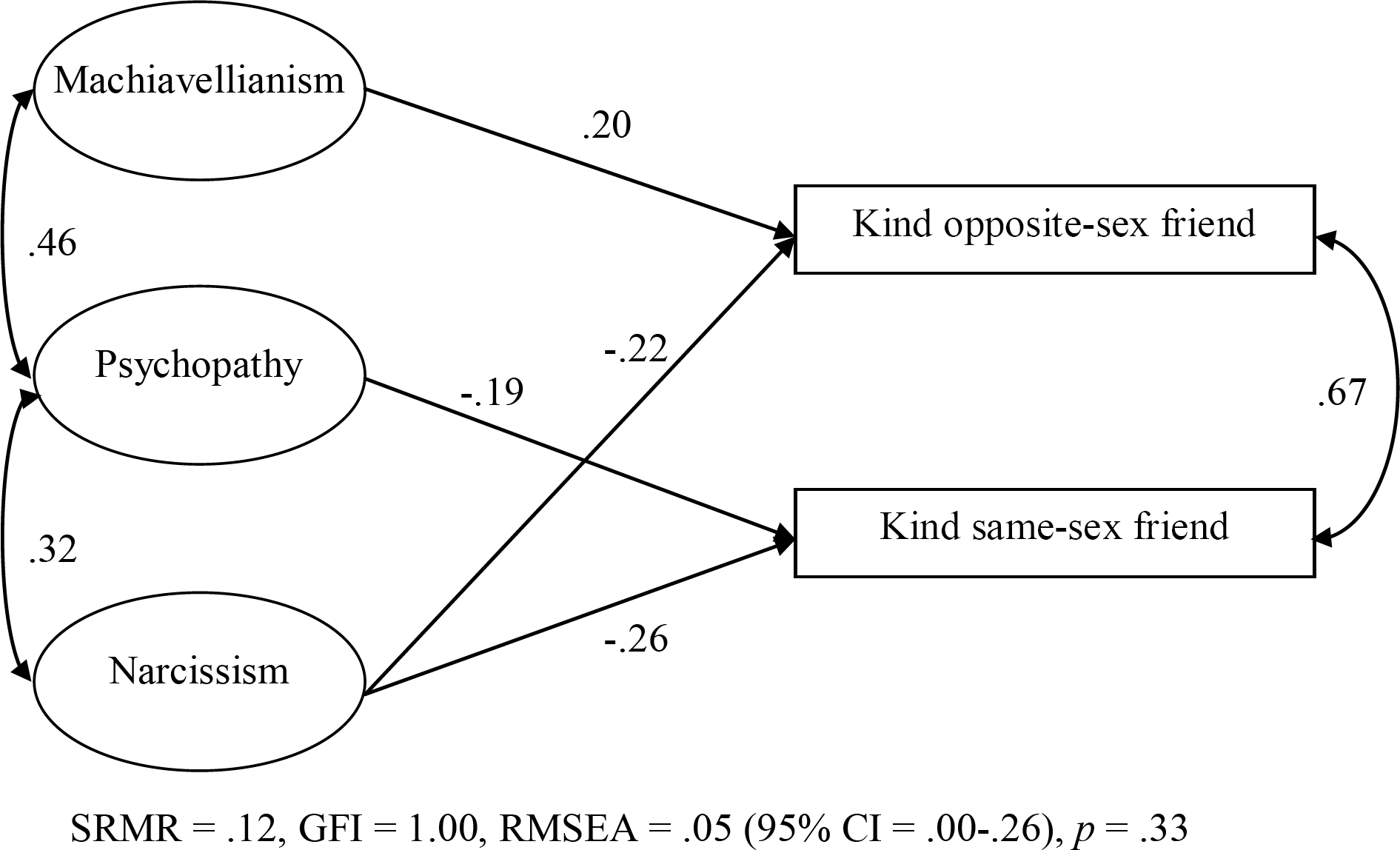
Structural Equation Model for the links between the Dark Triad traits and wanting a same- and opposite-sex friend who was kind
In Table 3, we report zero-order correlations and beta coeffecients for the associations between the Dark Triad traits and preferences for characteristics in friends. Results generally support the hypotheses. For instance, narcissism was negatively correlated with choosing a friend who was kind. Narcissism was correlated with the most reasons to have friends, confirming H3. The positive correlation between narcissism and wanting opposite-sex friends who were physically attractive might confirm H4 in that it is a trait individuals want in their potential mates.
Zero-order correlations and regression coefficients for the Dark Triad and traits desired in same- and opposite-sex friends

Note:
p < .05
p < .01
Again, in testing for moderation by the sex of the participant we ran a series of hierarchical regressions as we did in Study 1. We also confine our discussion to the significant interactions. Sex of the participant and psychopathy interacted (β = −1.05, t = −3.37, p < .01), such that the correlation in men (B = −2.56, SE = 0.59) was stronger and in the opposite direction than it was in women (B = 0.18, SE = 0.42). Narcissism and participant's sex interacted (β = −.74, t = −2.15, p < .05) in predicting wanting a same-sex friend who was physically attractive such that the correlation in men (B = −0.02, SE = 0.04) was in the opposite direction as the correlation in women (B = 0.04, SE = 0.02). Psychopathy (β = .65, t = 2.33, p < .05) and Machiavellianism (β = −.66, t = −2.49, p < .05) interacted with participant's sex to predict wanting an opposite-sex friend who was physically attractive. The correlation between psychopathy and wanting an opposite-sex friend who was physically attractive was stronger in men (B = −1.31, SE = 0.61) than in women (B = 0.27, SE = 0.31). The same was true for Machiavellianism, but was in the opposite direction with the correlation in men (B = −1.35, SE = 0.65) being stronger than in women (B = −.22, SE = 0.31).
To further understand how sex might moderate the associations between the Dark Triad and reasons to form friendship, we present zero-order correlations assessed separately in men and women and comparisons of those correlations using Fisher's z test in Table 4. Results suggested men high on psychopathy wanted same-sex friends who could offer protection and opposite-sex friends who could help them find mates, but these same men were unlikely to select opposite-sex friends who were similar to them, confirming H4a and H5b. Narcissism in women was correlated with selecting same-sex friends who were physically attractive, confirming H5c. Narcissistic men, in contrast, selected same-sex friends who were unkind.
Correlations by the sex of the participant and Fisher's z test to test for moderation

Note:
p < .05
p < .01
General Discussion
To date research on the Dark Triad traits has primarily been limited to either considering the traits to be maladaptive and something that should be treated (Kowalski, 2001) or psychometrically describing the traits and trying to account for the shared correlations among the three (Lee and Ashton, 2005; Paulhus and Williams, 2002). Some recent research has attempted to address these limitations by using Life History Theory to explain how at times, the Dark Triad traits may be adaptive by increasing success at short-term mating (Jonason et al., 2009, 2011). In this case, individual differences are viewed as adaptive responses to socioecological conditions to facilitate reproduction and survival (Rushton, 1985, 1987, 1995). While this paradigm has proven useful, other paradigms can provide more detail about the proximal interactions created by the Dark Triad traits.
In this study, important additional information was gleaned about the Dark Triad traits by using an alternative person-by-situation approach: the selection-manipulation-evocation paradigm (Buss, 1987). Adopting this paradigm may (1) lead to novel findings that might not be predicted from other approaches to the Dark Triad traits, (2) account for previous un- or under-explained results regarding the Dark Triad traits, and (3) provide a single parsimonious model to explain empirical findings involving the Dark Triad traits and important life outcomes. We focused on the first part of this paradigm, selection. Although past research has touched on this paradigm (Jonason et al., 2011; Jonason and Webster, 2012), the present study represents the first formal attempt to utilize this paradigm to understand the Dark Triad traits.
Personality traits can adaptively orient individuals by biasing them to choose certain environments over others. These environmental choices are thought to provide a “fit” between the person and the situation (Buss, 1987). If this is the case, then the reasons individuals choose social environments may be strategically guided by their personality. Indeed, we found systematic support for this contention regarding the Dark Triad traits. First, individuals high on psychopathy chose friends (i.e., they structured their social environment) with what can be called volatile others (i.e., traits like kindness or trustworthiness were not a priority). Second, those high on Machiavellianism may facilitate their “cheater strategy” by choosing friends who are more easily exploited. Third, narcissism was associated with a wider range of reasons to form friendships. These links can be seen in the SEMs and Tables in both studies.
These results raise an interesting possibility. While the Dark Triad traits may all be linked by a “user-mentality” one designed around the immediate extraction of short-term gains, each trait may employ these strategies differently. For instance, narcissism may be relatively more opportunistic than the others. Psychopathy may be more excitement-driven than the others. Machiavellianism may be more manipulative in nature than the other traits. All of these may be indicative of the fast life strategy the Dark Triad traits are linked to (Jonason et al., 2010a). In contrast, when individuals put less effort into mating and more into survival, the reasons they choose friends might reflect less strategic motivations.
Moderation by the sex of the participant was tested in two different ways but results were in relative agreement. We found that men and women who were high on these traits may serve as facilitators in pursuing their life history strategy. Men high the Dark Triad traits like psychopathy chose same-sex friends who shared values with them. It is possible these friends are chosen as “wingmen” (Ackerman and Kenrick, 2009) who are a protective layer between the fast life strategist and those who would punish the cheater. In contrast, women high on Machiavellianism chose friends who are attractive, likely increasing their chances of meeting attractive men through advertising physical attractiveness, a trait men value in their mates (Buss and Schmitt, 1993; Li and Kenrick, 2006). These women also chose same-sex friends who might be able to offset parenting costs associated with short-term mating for women by having high social status.
Women may help their daughters and friends to raise offspring (Alvarez, 2000) and individuals may help their friends to find mates (Ackerman and Kenrick, 2009; Jonason et al., 2007). The former could be called cooperative rearing whereas the latter could be called cooperative breeding, terms that are often conflated. That is, conspecifics may help each other find/retain mates along with helping individuals to rear offspring (Lewis et al., 2011) because of either perceived or actual genetic similarity (Rushton, 1989a, b). In both cases, because engaging in a fast life strategy is accompanied with costs, strategic friendships may offset those costs, freeing up more time and metabolic energy to further pursue this life history strategy. For instance, a woman who engages in casual sex behavior and gets pregnant may offset the costs of childrearing by abandoning her offspring with her mother (i.e., the maternal grandmother) to allow her to continue to pursue a short-term mating strategy.
Patterns like these are seen in not only humans (Hill and Hurtado, 2009; Hrdy, 2009) but in highly social non-human animals. Two male common bottlenose dolphins may monopolize a female dolphin to mate with her and exclude her from mating with others (Connor and Krützen, 2003). Other animals include female lions who participate in a system called allomothering where they rear each other's offspring and male lions team up in order to defend territory, defend mating access, defend offspring, and win access to a pride of females (Packer and Pusey, 1982; Scheel and Packer, 1991). In all three cases, genetic similarity may be a factor dictating the initial formation of these mutually beneficial relationships (Rushton, 1989a, b).
Limitations and Conclusions
A number of limitations characterize this research. In Study 1, some of the Cronbach's alphas fell below the traditional threshold of .70 (Nunnally, 1978) but none fell below the more liberal standard of .50 (Schmitt, 1996). Study 2 did not suffer from this limitation but may suffer previously unknown problems associated with the budget-allocation task in SEMs related to dependence. Although each study used a different method, both were self-report (Nisbett and Wilson, 1977). Last, we confined ourselves to friendship-motivations and the Dark Triad, but there may be other aspects of one's social environments (e.g., familial relations) and other relevant personality traits (e.g., mating strategies) worth examining. Nevertheless, for the questions at hand regarding underlying motivations to engage in friendships and their association with the Dark Triad traits, the self-report, single-point method is reasonable at this stage of scientific scrutiny.
The primary question in this study was; how do the Dark Triad traits facilitate individual's structuring of their social environment with friends? As male chimpanzees and lions do, those high on the Dark Triad appear to structure their social environment with functional friends; friends who serve as potential mates, provide some services, to stroke their “ego”, and to serve as “teammates” in pursuit of their life history strategy. In the brain of those high on the Dark Triad traits may be a proverbial homunculus, evaluating potential friends, asking the question “what can you do for me” or as comedian Eddie Murphy puts it, “what have you done for me lately.”
Footnotes
1
Results were robust to partialing the variance associated with participant's age and thus results do not take this factor into consideration in Study 1 or 2.
Acknowledgements
Thanks to Naomi Lowe for collecting data for Study 1, Marissa Petroff for analysis for Study 1, and Carmelita Harbeson and Sarah Schmitt for editorial suggestions on a prior version.