




Abstract
This article explores how the presence of competing logics in craft higher education (HE) influences educational provision and student experience. Findings are presented from four craft HE case studies across England, including analysis of degree programme specifications and module curricula and interviews with educators, current students and recent graduates conducted in 2018. The article presents how these logics influence employability-focused teaching in craft curricula and how this impacts time, space and facilities allocated to physical craft work. Key tensions identified include perceptions and measurement of graduate “success”, the impact on skill development and studio space and (dis)engagement with professional development training. The article concludes with reflection on how this relates to the perceived value of arts degrees, but argues that the responsibility to “prepare” students for craft careers cannot lie solely with HE providers.
Introduction
Connecting with the national (UK) context for creative higher education (HE) and debates on employability, this article takes an institutional logics perspective (Thornton et al., 2012) to explore the presence of competing logics in craft HE. It investigates how the presence of multiple logics manifests in professional development educational provision and how this is experienced by both students and educators.
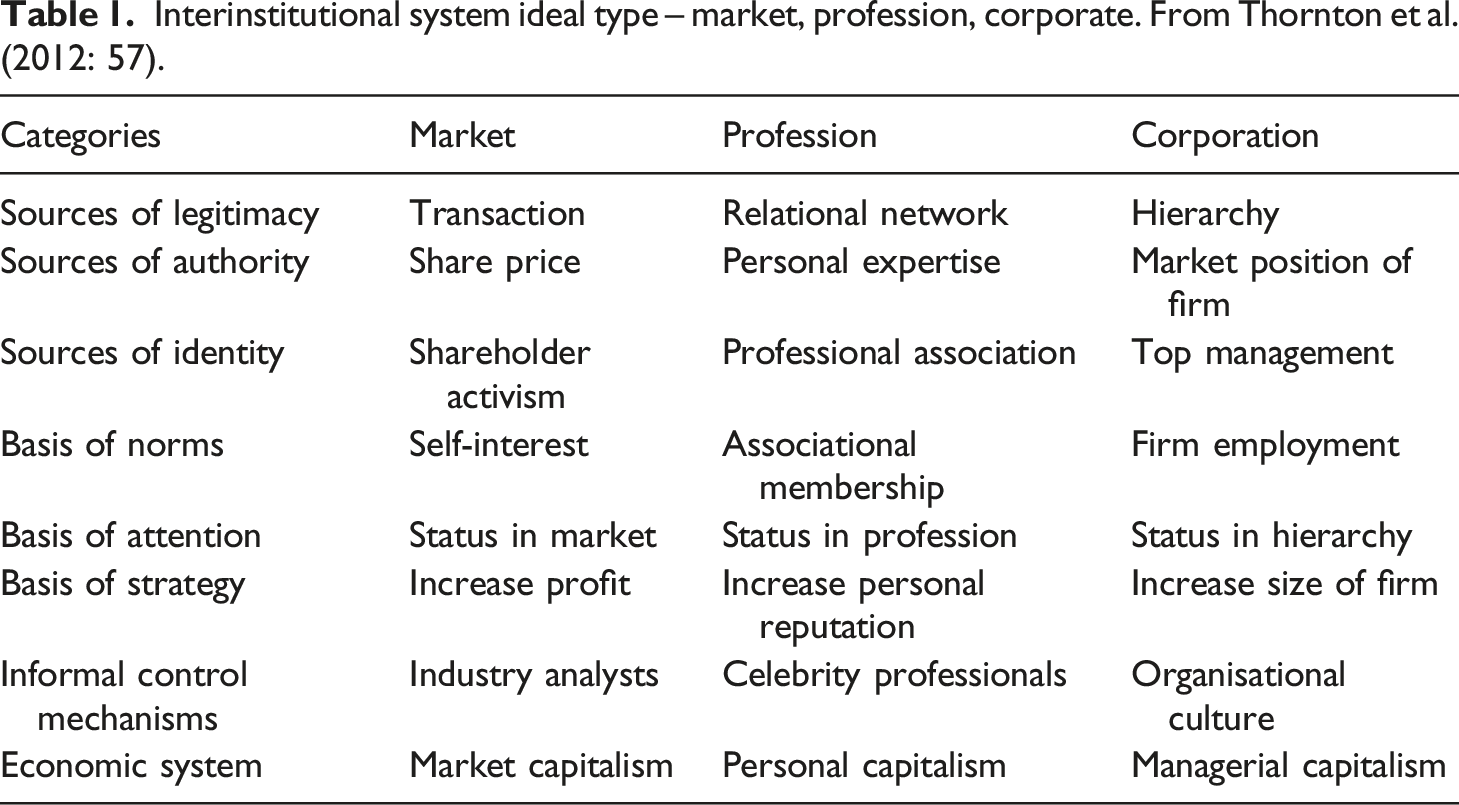
Interinstitutional system ideal type – market, profession, corporate. From Thornton et al. (2012: 57).
Dominant logics emerge when they are both core to the function of the organisation and provide consistent goals for action, creating ‘a sense of common purpose and unity within an organisational field’ (Reay and Hinings, 2009: 629). A core principle is that organisational strategy, structure, and behaviours – including resource allocation and educational practices – should align with the dominant logic to avoid conflict (Dunn and Jones, 2010). The development of dominant organisational field-level logics is influenced by foundational drivers/motivations for organisational formation and the interests of clients/consumers, but also wider institutional environments reflecting the political, social and economic context (Thornton et al., 2012). They are, therefore, subject to change and replacement over time (ibid). This is thought to be influenced by key events, such as government reviews, but also wider social, economic or political ‘jolt[s] or exogenous force[s]’ (Dunn and Jones, 2010: 114), which instil new practices and beliefs. In the HE context, changes in dominant logics could be associated with events such as the Browne (2010) and Augar (2019) reviews of HE but also the 2008 Global Financial Crisis and the Covid-19 pandemic (2020–22 especially).
This article investigates the presence of logics at the crossroads of two industries: craft and HE, suggesting that we may see conflict arise between the dominant logic of each sector. Findings are drawn from four craft HE case studies across England, including analysis of degree programme specifications and module curricula, and interviews with educators, current students and recent graduates conducted in 2018. The paper identifies how professional and market logics manifest in craft degree programmes and discusses how the growing prominence of professional development in the curriculum impacts time, space and facilities allocated to physical craft work. Key tensions are presented, including issues in measuring “success” in craft careers and graduate outcomes, the impact on creative and technical skill development and studio space and student (dis)engagement with professional development training. The article reflects on the relationship this has with rising employability agendas in HE more widely and concludes with critical reflection on the implications of this tension in the context of ongoing discussion on the value of arts degrees.
The article seeks to contribute to studies on creative HE (Orr and Shreeve, 2017) and the employability of creative graduates specifically (Ashton, 2015; Bridgstock et al., 2015) through considerations of specific disciplinary experiences and challenges for crafts. This includes factors such as high facilities and materials costs, an emphasis on studio work and the perceived value of craft work. It also contributes to the developing academic interest in craft work (Luckman, 2015; Naudin and Patel, 2020) by expanding the field of study to approaches to craft in HE and students of craft.
Logics of employability in UK craft HE
The academic turn in craft education (and art and design more broadly) began in the early 1960s (Houghton, 2013; Orr and Shreeve, 2017). At this point most art schools were still independent organisations, however, in the 1970s many were absorbed into the university system (Banks and Oakley, 2016). While this served to elevate creative subjects as academic disciplines (Houghton, 2013), courses are now managed through academic frameworks where ‘university bureaucrats and senior managers demand that the art school mirror the organisational structures, curricula, and prudent use of space that are the conventions in other disciplines’ (Buckley and Conomos, 2009: 24).
The marketisation of the HE sector has been widely documented, emphasising preoccupations among policy makers and HE management with cost-efficiency, performance measures and being seen to deliver value for money (Tomlinson, 2018). Such literature consistently highlights a growing presence of market logic (see Table 1) in which importance is placed on market position and performance rankings, enhancing competitive position and increasing profit margins (Thornton and Ocasio, 1999). This has been observed in students’ organisational relationships (Tomlinson, 2018), institutional resource allocation practices (Alexander et al., 2018), and evaluation systems (Fávero et al., 2020). In the case of craft degrees, the rise of market logic in HE is likely connected with the closure or amalgamation of many courses (Crafts Council, 2016; Houghton, 2013) due to their perceived lack of cost inefficiency compared to other degrees.
Concern for the economic value of HE has driven an emphasis on employability-focused skills development, in response to both political pressure and student demand. Houghton (2016) also charts a move towards a ‘professional curriculum’ in art education emphasising managerial and entrepreneurial approaches. Meanwhile, Banks and Oakley (2016) note an increased emphasis on commercial over artistic practice in both art school curriculum content and student ambitions, resulting in a greater emphasis on training artists for work than developing their artistic sensibility or practice. These studies suggest that there has been a shift towards market logic in creative HE and that this would be observed in curricula.
The preceding discussion has sought to frame the political and sector context for this study and the debate around the employability agendas for creative HE. Existing literature on creative HE has, however, had a tendency to either provide an overview across multiple disciples (Bridgstock and Cunningham, 2016) or focus on specific subjects such as media (Ashton, 2015), performing arts (Bennett, 2009), fashion (McRobbie, 2016) and fine art (Orr and Shreeve, 2017). This article contributes by focusing on an under-researched area: craft. By identifying how logics interact in this environment in relation to professional development, more tailored and effective educational practices and support mechanisms for the sector may be developed.
Methodology
This study takes a conceptually driven approach to understanding how employability and professional development are represented in craft HE in the form of logics, and how these are experienced by students. The investigation lent itself to interpretive, qualitative methods that allowed in-depth investigation of lived experiences (Hesse-Biber and Leavy, 2010). A multiple-case approach with an embedded design (Yin, 2017) was chosen to understand the experience of HE and early career practice which could not be achieved by a single case study design or a single data collection method.
This study followed a discipline-based definition of craft practice, as this remains the dominant definition within the education system (Douglas, 2007). Craft disciplines investigated in this study are those identified as core craft subjects (Crafts Council, 2016): Craft; Ceramics; Furniture; Glass; Jewellery; Metal crafts; Silversmithing; and Textiles, as these capture the majority of the UK craft HE ‘market’ (ibid). Four HE providers and craft degree programmes in England were selected: 3D Design Crafts at Plymouth College of Art (PCA) (South West); 3D Designer Maker at Staffordshire University (West Midlands); Glass and Ceramics at University of Sunderland (North East) and Furniture and Product Design at London Metropolitan (London Met) (London). Selection of case studies was based on craft discipline, but also geographical location, and approaches to professional development identified in a preliminary investigation. It was beyond the scope of this research and capacity of the researcher to achieve full representation in terms of discipline and location, and multiple attempts to recruit a textiles course were unsuccessful. While silversmithing and metal crafts are not explicitly represented in the case study disciplines, students and graduates did engage with these materials under the banner of ‘craft’, ‘jewellery’ and ‘product’. The geographical range of this study matters as place plays a role in the experiences of creative students and graduates (Noonan, 2015), including their professional development education (England, 2022b). Access to case studies was also taken into consideration, drawing on the author’s professional network for two cases, while new connections were established – via email – for the other two, aided by the research connection with Crafts Council UK.
To understand the experience of craft HE, the research compared and integrated multiple data sources (Yin, 2017). It is argued this would have been limited by a single data collection method. The multi-method design involved analysing both primary (interviews) and secondary data (texts – programme specification and module curricula) to develop theoretical and practical applications of knowledge and research findings. This involved combining analysis of descriptions of objectives and practices (Dunn and Jones, 2010) in secondary data with the narrated experiences of educators, students and graduates in primary data. Triangulation was used to integrate different perspectives (staff, student and graduate) on the investigated phenomena of logics and professional development in HE.
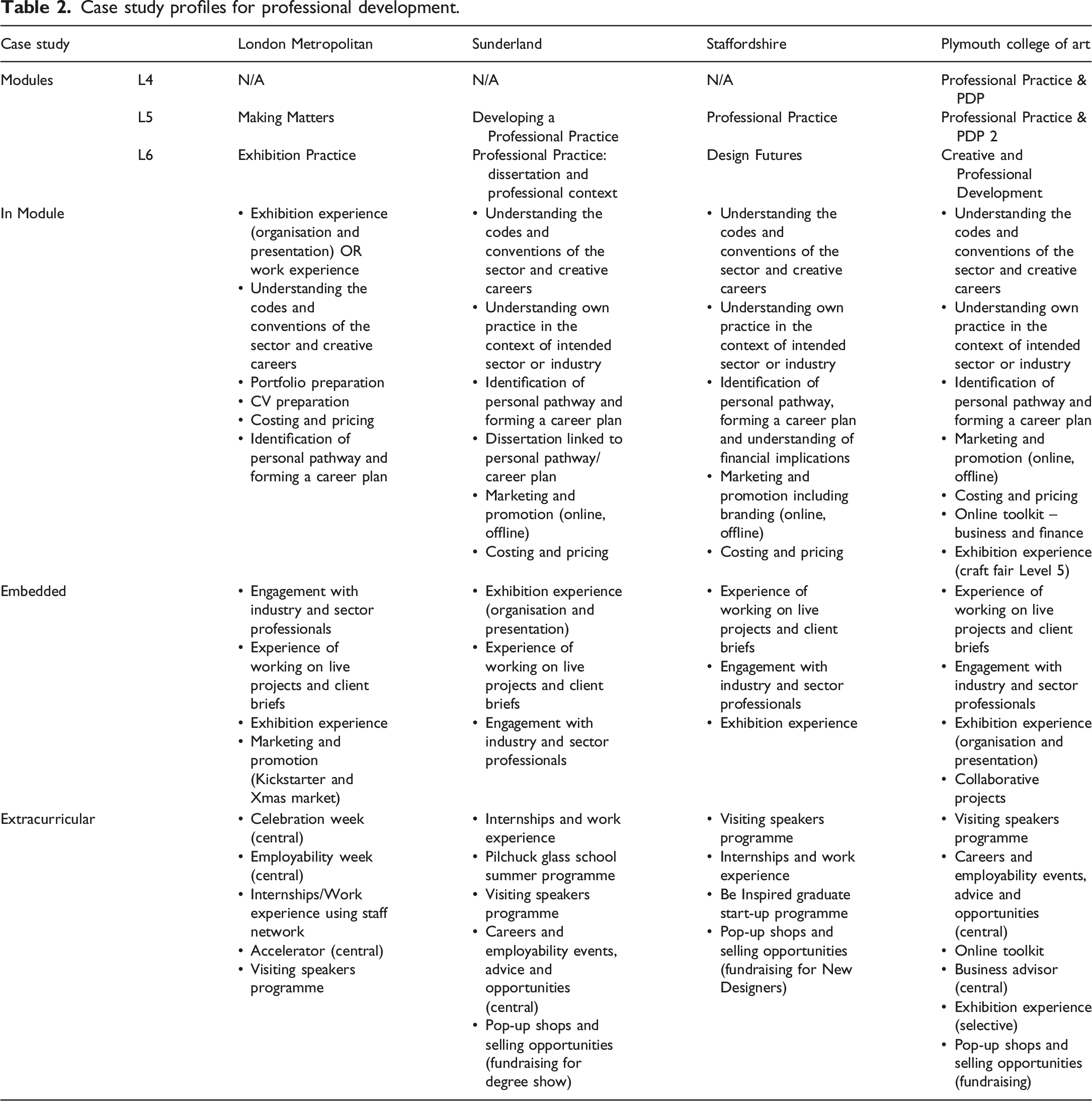
Case study profiles for professional development.
Semi-structured interviews (80 total) were conducted with educators (programme leaders, senior lecturers, tutors and technicians) (n = 15), students (L4: level 4, first year BA, n = 14; L6: level 6, final year BA, n = 26) and recent graduates (0–4 years after graduation) (n = 25). The emphasis in this paper is on educator perspectives, although amplified by the student voice. Student and graduate experiences have been explored further in other publications (see England, 2022a, 2022b). Interviews used open questions and facilitated a targeted focus on the topic of the research and provided in-depth personal perspectives on craft education and professional development, including teaching practices and logic components – practices, values, beliefs, assumptions and rules (Thornton et al., 2012). All interviews were conducted one-to-one and face-to face and verbatim transcripts of all interviews were produced in full. An interview guide was used, but the discussion was guided by participant responses. Interviews with graduates were around 1–1.5 h and around 1 h for educators. Shorter interviews were conducted with final year students (average 45 min) and first year students (average 30 min).
Purposive sampling was used to recruit participants whose education and professional activity aligned with the focus of this study. Student recruitment was facilitated by case study educators and took place on campus following a researcher introduction during a professional development module. Attempts to recruit via emails to student cohorts were ineffective; onsite engagement with students and providing sign-up sheets for interviews (on the day or next day) was vital to the recruitment process and reducing drop-out rates. Graduate recruitment took place in collaboration with the case study organisations, through the researcher’s own personal network and independent desktop research of case study alumni. Snowball sampling was also used by following recommendations from graduate participants. The use of desktop research and graduate participant networks meant that recruitment did not rely solely on the educators from the case study. This lowered bias resulting from educators consciously or unconsciously recommending graduates who would give more positive feedback on their educational experience. The importance of this was highlighted by several graduate participants who felt they would not have been recommended for the study given their experience of the course.
All participants were briefed on the study, given an information sheet and asked to sign consent forms prior to their interview. In addition to gaining individual participants’ consent, organisational sign-off was obtained from Programme Leaders or Heads of Department at each location prior to data collection. This included consent for the institution to be named in the study. All individual participant data within this study was anonymized and interview quotations used are labelled according to their group (‘Educator’ ‘L4/L6 Student’ or ‘Graduate’) and their affiliated case study (PCA, Sunderland, Staffordshire, London Met) and given a unique ID number.
Analysis
In analysing the programme specifications and module guides, Thornton et al.’s (2012) ideal types framework for institutional logics was first used as an interpretive analytical tool for comparing the meanings and practices observed in the case study texts with the guiding principles of the logics in the original framework (market, profession and corporation) (see Table 1). As this analysis only provided a surface level view of logics in the curriculum, thematic analysis (Braun and Clarke, 2006) was then adopted, allowing for descriptive, critical and flexible investigation of the data. The triangulation of data facilitated the identification of themes relating to logics in craft HE.
This secondary data analysis was combined with analysis of interviews regarding logic positions and approaches to professional practice (see Table 2). This was useful for providing a more accurate understanding of practices in craft HE, but also in identifying how logics were represented in educational practices.
Thematic analysis (Braun and Clarke, 2006) was the primary tool used to identify themes in the interview data. A hybrid coding approach was taken, using both inductive or deductive coding (ibid); codes were drawn both from the data itself, based on participants’ experiences (inductive) but theoretical constructs from institutional logics (Thornton and Ocasio, 1999) were also used (deductive) to render visible issues that participants did not explicitly articulate (Braun and Clarke, 2006). The language of institutional logics - ‘material practices, assumptions, values, beliefs, and rules’ (Thornton and Ocasio, 1999: 804) - was identified within the data following the initial rounds of inductive thematic coding. Assisted by additional literature reviews and discussions with organisational/management scholars, this framework was then used to guide subsequent rounds of deductive coding focused on the logics of professional development education. This was useful for focusing attention on this particular aspect of the data, which could be best understood in the context of the pre-existing framework (Braun and Clarke, 2006). The analytical process was iterative, with multiple revisits to the data sources combined with periods of reflection on the broader context of the study, including HE and creative industries policies which informed the identification of further themes within the data. Codes were recorded in Nvivo and interpretations regularly discussed with research supervisors. Emerging themes and early findings were also discussed with other academics at conferences and craft sector stakeholders, including Crafts Council UK as the industry partner for this research. This provided informed, third-party expertise which helped to refine and validate the analysis and conclusions made.
Findings
Institutional logics in craft HE
This section presents the logics identified in craft curricula, with an emphasis on those logics relating to professional development education. Using Thornton et al.’s (2012) ideal types framework (Table 1) for institutional logics as an analytical guide, both professional and market logics were identified as being prominent in programme specifications.
Professional logic was prominent in the emphasis on the development of personal skill and expertise in a particular discipline. It could also be observed in references to students attaining professional status, building a reputation and developing their understanding of the sector. This included identifying high-profile actors and relevant professional associations and becoming part of a professional network. This was identified from statements such as “interact with a learning or professional community or network, as a means to explore professional environments in which personal aspirations are likely to develop.” (PCA, programme specification) and “Opportunities for students to experiment and learn through direct experience, achieving practised understanding of discipline and context.” (London Met, programme specification).
Market logic was observed in programme aims, objectives and key practices that emphasised enterprise development, students’ development of market awareness and how market transactions take place in the craft sector. Its presence was also noted in references to developing their understanding of pricing mechanisms and how to access funding and/or generate an income from creative practice. This was identified from statements such as “Provide an encouraging, supportive and rigorous learning environment that provides professional opportunities, employability and enterprise within a competitive global environment.” (Staffordshire, programme specification) and “students must apply for an opportunity such as an internship, competition or funding – this mirrors the approach that professional artists will need to take in their careers.” (Sunderland, L5 module guide).
Professional development, as articulated in these texts, combines preparation for creative practice and employment. This includes the development of professional understanding of the sector and an awareness of the context of a student’s own practice, identification of a career pathway and demonstration of market awareness. It is also associated with “real world”, work-based learning and professional engagement and building a network of contacts relevant to a student’s chosen field to facilitate the transition from student to professional.
Professional development as an educational feature of craft HE is, therefore, predominantly governed by professional and market institutional logics as it combines elements of professional knowledge and reputation (professional) and market transactions in the creative industries (market). However, corporate logic can also be seen as influencing activities such as evaluations of student success post university (i.e., the Destination of Leavers of HE, DLHE, survey) connected with the employability agenda in HE. Although arguably a better reflection of highly competitive and precarious creative economy employment (Comunian et al., 2021) than HEI performance, graduate employability rates captured by DLHE (and now the Graduate Outcomes survey) are seen to reflect the “value” of a degree programme, which impacts institutional status/ranking and subsequently student recruitment. This was noted as impacting educators’ experiences and subsequently educational delivery. However, this paper focuses on professional and market logic, as the prominent influencers of the student experience – whether a graduate has secured employment, a post-university opportunity (i.e., residency, internship etc.) or started their own business and their subsequent income is not formally assessed. “There's a different culture now from what there used to be. One from the overriding university executive, which is that we're very much accountable under the, we're all under the same bracket. Um, so that's a challenge like I said about the DLHE and retention and recruitment and stuff.” (Sunderland Educator 3)
Professional development in craft HE.
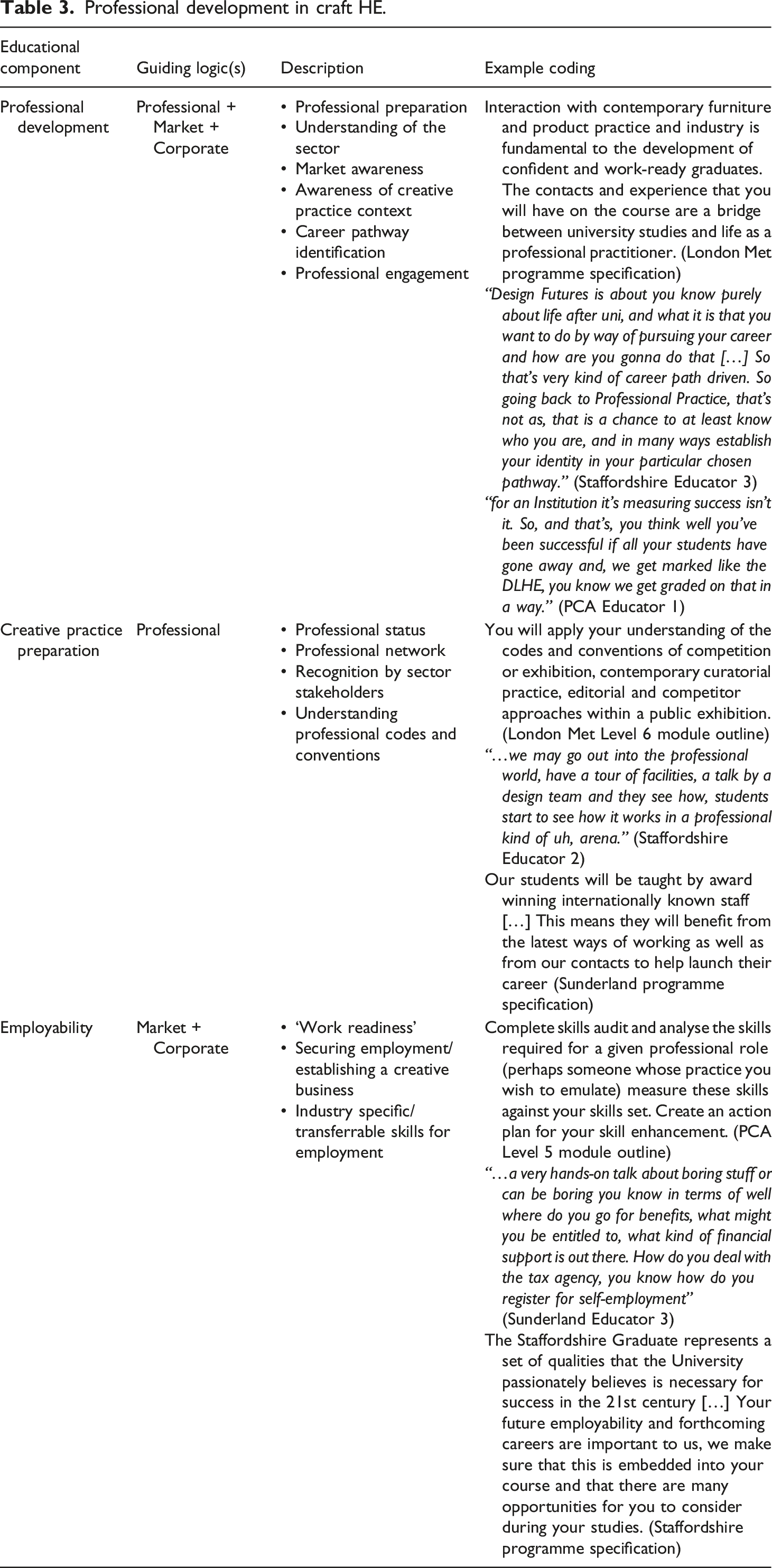
The first component identified was creative career preparation. This appears to be driven by a professional logic and aims to develop students as creative practitioners, building their professional reputation and sector awareness through engagement with different actors (artists, designers, gallerists etc.) and relevant opportunities in the field (exhibitions, competitions, internships etc.). This was not specifically connected to employment, rather it emphasised establishing a creative identity, understanding studio practice and network building. Specific practices associated with creative career preparation at all locations (see Table 2) included conducting artist research, building professional networks, creating marketing and promotional materials such as websites/online portfolios, social media, business cards and artist statements.
The second component identified was employability. This was much more explicitly market driven and concerned with “work readiness”, generating income from creative work, establishing a business and/or securing employment in a diverse range of creative and non-creative occupations upon graduation. It was distinctive in associated core-module activities such as CV and cover letter writing and costing and pricing, guidance on registering for self-employment, but also extracurriculars such as taking part in pop-up shops/selling events and work experience (see Table 2). Importantly, students were also encouraged to consider wider career alternatives and demonstrate transferrable skills such as time and project management, communication and research skills etc. to facilitate entry to a wider range of industries and occupations. This reflects a shift towards market logic in craft education, but also a corporate logic regarding institutional attention on status in the hierarchy of employability rankings.
The impact of a shift towards market and corporate logic on HE curriculum was identifiable in the centralisation of professional development. Educators across the four case studies consistently commented on how professional development education had become more formalised and grown in importance, often reflecting on lengthy experiences of teaching on and managing degree programmes. “…university priorities […] student destination and things like DLHE data have become increasingly important. […] before you could argue they were sort of peripheral subjects, I think more and more they're moving to the centre of university activities.” (Sunderland Educator 1)
Educators identified that specific professional development modules had progressively been brought in earlier in the programme and, as core modules, had also increased in credit weighting on students’ final degree outcomes. This was linked with both higher-level management agendas to improve employability ratings from graduate destination surveys (DLHE), but also feedback from students. The centralisation of professional development education can, therefore, be observed as the influence of market and corporate logic on the organisation of space, time and material practices (Thornton et al., 2012) in craft HE. “we've introduced it in the second year, we used to just leave it till the third year. And you know we might even start from level 4 which is the first year. And just as a light touch because I think it is important for them to be aware of what they might do professionally or different opportunities or ways of thinking” (Staffordshire Educator 2)
Tensions
Defining graduate success in craft HE
The need to raise awareness of career opportunities, particularly when marketing the course to prospective students and their parents was seen as challenging. Furthermore, the pressure for graduates to be “work-ready” and to enter their field immediately as professionals may be unrealistic. It was acknowledged by educators that the pathways to professional practice are far from straightforward or immediate. Issues were identified in the application of standard measurements such as DLHE which are inherently biased against slow, incremental development and place greater demands on being able to demonstrate immediate, measurable results, graduate status and higher salaries as a proxy for value.
In particular, educators criticised the DLHE for a lack of flexibility or acknowledgement of the incubation period required for creative careers (craft and non-craft) during which students may develop their creative practice alongside full or part time employment or be heavily supported by family members (England, 2022a). It was also noted that the expectation of graduate level employment in particular does not fit with the portfolio career profile of craft graduates (Hunt et al., 2010) and commonality of unpaid and low-paid internships and jobs in the creative industries (Comunian et al., 2021). A key tension associated with the multiple logics of craft HE arises from increasing pressure across the HE sector to demonstrate measurable impact on student employability and graduate salaries when graduates enter highly competitive and uncertain labour markets. “the DLHE […] it doesn’t allow a lot of incubation time, for, to be able to develop. If you haven’t done so and don’t have the professional career, graduate career, straight away then it’s seen that you’re somehow failing. And I think it should be allowed more for that period, anything to do with the arts really, where you find your feet and find your workshop, it takes time.” (PCA Educator 1)
Students at both stages also demonstrated an awareness that making a living from creative practice was a long-term goal and that it might not be achievable straight after university. Level 6 Students from across the four case studies identified the need for a further development period and stated they were looking for jobs in industry or opportunities to work with other makers/designers in order to build up their skillset and gain more experience that could support them in the establishment of their own practice. A level 6 student reflects on their ongoing development needs and potential plan of action in the quotation below. “I wanna be like a self-employed artist, that's my ultimate goal. But you can't do that from right after you graduate, just an undergraduate course I guess. And I don't really want to do a master’s degree here, so yeah, I, I will look for like a teaching assistant job or yeah, or maybe do internships in galleries or something.” (L6 student Sunderland 6)
However, overall, professional logic remained dominant in how students across both year groups narrated their ambitions and plans for professional practice in the prominence of expertise and reputation-driven goals. Level 6 students did display a slightly higher concern with market logic in their expectations of professional practice, concerns over future employability or income generation and their perceived levels of preparation for professional practice related to their educational experience. However, it is important to note that this market logic was always heavily mediated by professional logic. The extent to which level 4 students also demonstrated combined market and professional logics is perhaps more surprising. Level 4 students may, however, be increasingly aware of the costs of their education and concerned about the viability of their chosen career path, influenced by the current socio-economic environment, debates around the value of HE and the perceived value of creative degrees. “I want to be able to run and manage my own business and um, and you know, make a living from that hopefully. And just have the skills required to, to do all of that.” (L4 student PCA 5)
Professional development versus studio time
Current students and educators also indicated that there had been a decline in the emphasis on advanced skills-based teaching and a reduction in workshop access for students, with time and space being re-directed towards transferrable skill and conceptual development, written assessments and professional practice assignments. An educator noted that “there’s been quite a lot of hours taken away from that um, provision of craft skills, you know in work loading.” (Sunderland Educator 2). Students reflected that this reduction in tutored time dedicated to practical skills development – including making practices such as traditional joinery, but also digital skills (Computer Aided Design and photoshop) – could also impact their future employability in industry. “we do only get half a day in the workshop […] like half a day in the workshop with an actual lecturer. All the other time is open access, so we don't have anyone to guide us, we're supposed to know what to do. […] it's going to be so embarrassing, if I wanna go to a factory and be like I wanna make stuff and they'll be like, can you? I'm like, not really! […] I can't do joinery, like you probably need, or you probably want.” (L6 student London Met 4).
There was variation in investment and disinvestment strategies across the case studies, pointing to the influence of more general financial and organisational-level pressures, the overall organisational strategy and leadership position which impact departmental budgets and resources. The degree of financial investment made by the university in such facilities subsequently impacted the types of creative and material practices that could be pursued on the programme, particularly for furniture and glassmaking. Whilst making and skills development were still core to the curriculum in all case studies, the supporting infrastructure (workshop space, equipment and machinery, technical staff and advanced skills training) showed signs of being reduced through the downsizing of facilities, subject amalgamations and staff work-loading. Educators were also concerned about potential course closures. “we are trying to get more in, in less time really. That's the biggest change. But if you are, which we commit to, which is designing and making and taking a piece through to production, each stage requires a certain amount of time. And we still do that, but I think that probably we are working towards a point where we won't be able to do that anymore” (London Met Educator 5)
Challenges also arose in engaging students in professional development education associated with their passion for making. This was observed by educators in all locations as students prioritising studio practice and time in the workshops over attendance at contextual studies (art history) or professional development lectures, and potential disengagement with more formal business development training. Below, both an educator and graduate reflect on the challenges around engaging students in professional development education: “there's a lot to learn, and they vote with their feet. And even now with the professional development side of things they tend to, uh, not participate in it as much as they should!” (London Met Educator 5) “I should have gone to my PPD lessons, and I can honestly say as much as I feel I should be ashamed about it, I was either in the hot shop or not there for whatever reason.” (Sunderland Graduate 1).
This suggests that discipline-specific technical expertise is being marginalised in the curriculum due to financial pressures, creating a tension between the priorities of craft students and those of senior management seeking to reduce the high costs of delivering space and resource-intensive degree programmes under conditions of austerity (Banks and Oakley, 2016). Somewhat ironically, the reduction or removal of facilities and studio time here negatively impacted the students’ perception of value for money. This was felt most acutely amongst students at London Met, whose access to fabrication workshops and equipment had been reduced during their degree. It is also important to note that access to materials and equipment is a key driver of students’ choice of university and degree programme. “we have to be here to even be able to use the workshop, two and a half days, well now it's not even two and a half, it's two days a week and I'm paying nine and a half grand a year, it's not enough.” (L6 Student London Met 4). “going around the workshops and looking at all the equipment available, it was just mind-blowing! Um, it’s also one of the only universities to still have glass kilns um, and I’m really excited to try exploring glass because I’ve never done that before.” (L4 student PCA 1)
Discussion and conclusions
This article has presented how professional, market and corporate logics compete for attention, time and space in the development of craft curriculum and professional development education. Key tensions were identified, including how measurements of HE and graduate performance do not account for an incubation period in craft career development and how the centralisation of professional development appears to have occurred alongside a marginalisation of technical skill provision and facilities. Overall, there is a sense that a cultural shift had occurred in the way that creative practitioners were approaching their practice in more economic and employability-conscious manner. This was associated with the economic climate post 2008, current political agendas (for the creative industries and HE), wider social debates around the value of creative education, and the multiple and sometimes conflicting value systems that coexist in the HE system.
It is argued that the political, economic and social context in which craft HE currently operates creates a two-fold institutional pluralism (Dunn and Jones, 2010). Firstly, craft departments in universities exist at the intersection of academia and craft practice, both of which have their own pedagogical priorities; secondly, universities today are positioned as both providers of personal, intellectual and creative development and as the way to get a job (Houghton, 2016) which may juxtapose creative industry employment profiles and pathways for creative graduates. This paper has sought to illustrate this as a central tension in the delivery of professional development education.
While it is important to ask how creative practitioners can be prepared by their educational providers and question whether current methods are effective, this must be done with consideration of the overall health of the sectors that creative graduates enter. This includes an acknowledgement of the oversupply of creative graduates (Bridgstock and Cunningham, 2016), but also structural issues in the creative economy that exacerbate the challenges they face upon graduation, such as the prevalence of precarious employment, low-paid work and unpaid internships and a lack of access to finance (Gill and Pratt, 2008; Luckman, 2018; McRobbie, 2016). It is argued that the demand for graduates to be “work ready” and achieve professional status from a 3-year degree programme is unrealistic as it does not account for the incubation period required for creative careers. Principally, it is argued that the responsibility for the professional “preparation” of creative graduates cannot lie solely with HE providers. By highlighting different forms of professional development education and where tensions emerge, this paper hopes to contribute to the development of craft HE curricula but also the expansion of post-HE professional development opportunities. An acknowledged limitation of this study is that it does not include all core craft disciplines, specifically textiles. This could mean that textiles courses demonstrate somewhat different educational practices and logics to other crafts disciplines included in this study and could be a useful subject for future research.
While this article has focused on the DLHE as the instrument for measuring graduate trajectories at the time, issues remain regarding the new Graduate Outcomes (GO) survey (launched 2018). Positively, the longer period for data collection (now 15 months after graduation) may better reflect incubation periods. The enhanced student voice in this new survey may also provide a more nuanced understanding of creative HE and graduate experiences. However, greater consideration of labour market structures and challenges is still required when measuring university performance. This is particularly pertinent today, at a time of economic crisis, and as pre-Covid-19 economic analysis of the HE sector (Department for Education, 2019) had already put pressure on improving graduate outcomes from creative degrees and enhancing the cost-effectiveness of their delivery. By highlighting the importance of facilities and material engagement opportunities in students’ choice of HE provider, and how integral studio time and associated technical skills and material knowledge development was to craft students’ perceptions of value for money, this paper hopes to support efforts to retain making infrastructure in HE. This could also be amplified by further capturing student voice in graduate surveys.
Further decline in advanced skills-based learning and overall HE provision (Crafts Council, 2016) could drive a demand for and the development of alternative educational models, qualifications and providers – independent organisations, cultural organisations, community groups and social enterprises. However, this could further reinforce divisions between creative ideas and technical skill (Banks and Oakley, 2016; Houghton, 2016). The potential removal of craft from universities also has significant implications for the innovation potential, growth and sustainability of the craft economy due to the loss of access to advanced educational opportunities, infrastructure, technology, funding, networks, research and employment opportunities (Schwarz and Yair, 2010). This also impacts the preservation and adaptation of heritage and industrial crafts practices (Comunian and England, 2019) and has potential to hinder diversification of craft economies (Patel, 2020) if access to educational opportunities is reduced. It is argued that if craft is to remain in HE, both HE providers and wider craft sector organisations need to consider how to effectively and efficiently deliver craft training and develop valuable material-based skills and knowledge, striking a balance between professional, market and corporate logics.
Footnotes
Declaration of conflicting interests
The author(s) declared no potential conflicts of interest with respect to the research, authorship, and/or publication of this article.
Funding
The author(s) disclosed receipt of the following financial support for the research, authorship, and/or publication of this article: This study was conducted in collaboration with Crafts Council UK, the UK’s national development agency for craft, and funded by a Professor Sir Richard Trainor scholarship from King’s College London (2016–19).
