




Abstract
While society’s demand for creativity is echoed across the world, teachers in higher education often struggle to support students’ development of creative competencies. This transdisciplinary systematic literature review of 58 peer-reviewed empirical studies provides a comprehensive overview of creativity-fostering teacher behaviors identified across all academic disciplines in higher education. In our thematic analysis, we identified 22 themes grouped into six overarching dimensions (the six dimensions of fostering creativity, namely, [a] affective, [b] cognitive, [c] behavioral, [d] metacognitive, [e] creativity-in-action, and [f] uncertainty). Based on these dimensions, we developed a new conceptual model of teacher behaviors for creativity: the “meta-creativity” model. This model highlights the transdisciplinary, interactive, and interdependent nature of creativity-fostering teacher behaviors, which are subject to the conflicting needs and tensions of creative processes. This review provides key practical insights for teachers, administrators, and policymakers and new research directions for a more holistic approach to teaching for creativity.
Creativity drives learning, innovation, and economic growth, fuels the continual generation and development of solutions to wicked problems, and lies at the core of human fulfillment and engagement in meaningful work (Collard & Looney, 2014; Craft, 2003; Sawyer, 2015). Creativity thus has the power to shape a more gratifying, socially responsible, economically stable, inclusive, peaceful, and environmentally sustainable future (Csikszentmihalyi, 1997; Jeffrey & Craft, 2001; Sandri, 2013). To address these issues, higher education institutions are increasingly called upon to develop their graduates’ creative competencies, so that they may effectively navigate and thrive in our increasingly complex, ambiguous, volatile, and unpredictable innovation-driven global economies (Gibson, 2010; Montuori, 2012; Sawyer, 2012a).
While the call for creativity as a core 21st-century competency is being echoed across the world (McWilliam et al., 2008; Organization for Economic Cooperation and Development [OECD], 2008, 2018), educational institutions still struggle to support students’ creative development (Cachia & Ferrari, 2010; Craft et al., 2014; Daly et al., 2014, 2019). These challenges remain despite mounting scientific evidence over the past decades, particularly in cognitive psychology, neuroscience, and educational science, that creativity is a learnable skill that can be developed by anyone who practices their creative competencies (Montuori, 2012; Sawyer, 2012a). Indeed, the evidence suggests that creativity follows the same “use it or lose it” rule as other mental abilities (Fischer & Golden, 2018). In other words, creativity can be developed and taught through continual deliberate and reflexive practice, adaptive guidance, and active engagement in and with the creative process (Ericsson, 2004; Hunter et al., 2007; Sale, 2015).
Teachers play a key role in fostering creativity, but research across educational levels has shown that they are largely ineffective in doing so (Jeffrey, 2006; Sawyer, 2015). Barriers to more effective teaching for creativity identified in the research are teachers’ lack of practical experience with creativity-related skills and processes (Bereczki & Karpati, 2018; Fischer, 2020), insufficient teacher training (Livingston, 2010; Tekmen-Araci & Mann, 2019), and a lack of institutional support (Fischer, 2020; Gibson, 2010). Compounding these practical barriers, there is also a dearth of research in the field of teaching for creativity, particularly in higher education. The fragmented research that has been done has focused mostly on K–12 education (Craft et al., 2014; Cremin & Chappell, 2021; Sawyer, 2017; Thurlings et al., 2015). Furthermore, research on creative pedagogies and creativity-fostering practices has remained isolated within disciplinary boundaries (Daly et al., 2019; Hernández-Torrano & Ibrayeva, 2020; Sawyer, 2017).
Since teachers play a central role in students’ development of their creative processes, it is imperative to gain a clearer understanding of how teachers support students’ creative development effectively (Bjørner & Kofoed, 2013). We thus aim to answer the following research question: How do teacher behaviors foster student creativity across disciplines in higher education?
This transdisciplinary systematic literature review addresses this question by (a) providing the first comprehensive evidence-based overview of creativity-fostering teacher behaviors, (b) synthesizing results from studies across all academic disciplines, and (c) focusing on research conducted in higher education. We aim to reconceptualize creativity-fostering teacher behaviors as transdisciplinary practice, and to show that disciplines can benefit by learning from one another. This review provides key practical insights and recommendations for educators, administrators, and policymakers on how to foster creativity and how to develop more effective teacher training programs, as well as new research directions for more holistic approaches in the field of teaching for creativity.
Theory: A Transdisciplinary Perspective on Teaching for Creativity
Creativity in Education
The general consensus in modern educational science and psychological research is that creativity is an emergent inquiry-based process of discovering, generating, accumulating, and developing novel ideas, thoughts, and solutions (e.g., how to solve problems) that are both original and useful in a given system or domain, and that are influenced by various personal development and environmental factors (Amabile, 1983, 2012; Csikszentmihalyi, 1997; Kupers et al., 2019; Montuori, 2011, 2012; Plucker et al., 2004; Runco, 2007; Sawyer, 2012a; Sternberg & Lubart, 1999). This definition implies that creativity researchers have shifted away from exclusively cognitive creativity definitions focused on creative outcomes, to view creativity more broadly as a complex and dynamic process for producing outcomes by drawing on multifaceted creative competencies (creativity-related knowledge, skills, and attitudes; Hernández-Torrano & Ibrayeva, 2020; Lubart, 2010). Through this broad lens, creativity is viewed as a holistic, multidimensional construct that encompasses cognitive, affective, physical, behavioral, metacognitive, and contextual elements (Budge et al., 2013; Daly et al., 2014, 2019; Hargrove, 2013; Sarsani, 2005; Zimmerman, 2009).
Creativity is further inextricably linked with learning, inasmuch as new ideas form in the personal construction of understanding and knowledge, driven by the effortful accumulation of mini-insights that deepen, connect in novel ways, and grow in quality over time (Beghetto & Kaufman, 2007; Beghetto & Plucker, 2006; Gajda et al., 2017; Paavola et al., 2004; Sawyer, 2012a, 2012b). Creativity is therefore closely related to theories of emergence, as “a transformative process of knowing, thinking and doing” (Clarke & Cripps, 2012, p. 114) that is not limited to specific areas, but occurs and is informed by all domains and aspects of life (Montuori, 2012; Treffinger et al., 2002).
This big-picture view of creativity is in line with the evolution of modern creativity research over the past decades, moving from more individual, cognitive, and psychometric approaches toward more social and systems-level approaches that offer more comprehensive understandings of creativity and its development (Craft, 2001; Hernández-Torrano & Ibrayeva, 2020; Jeffrey & Craft, 2001; Kupers et al., 2019; Ryhammar & Brolin, 1999). For example, Amabile’s (1983, 2012) componential theory of creativity encompasses multiple interconnected elements, such as task motivation and passion, domain-relevant skills and expertise, creativity-relevant skills and processes, and creativity-supportive environments. The start of the 21st century thereby marked a greater focus on studying the dynamics of the everyday creativity of all people and its social context, rather than a sole focus on the high-level creativity of singular geniuses (Craft et al., 2014; Montuori, 2012). Importantly, this everyday creativity can be fostered through continual, long-term engagement in the creative process, allowing students to reach higher levels of creativity that lead to ideas with a domain-changing impact, even if they do not start out as creative geniuses (Kaufman & Beghetto, 2009).
In summary, researchers increasingly view creativity and creative processes as dependent on cognitive as well as personal development (of multidimensional creative competencies), both of which interact with the environment, as in the impact of teachers and creative pedagogies (Demirkan & Afacan, 2012; Soriano de Alencar, 2012). By outlining more holistic and effective ways in which to teach for creativity, this review helps teachers to enable a much larger number of students, no matter their social and cultural background, to tap into their creative potential than has traditionally been believed possible, paving the way for new generations of creative change agents who are well-equipped to address the world’s most pressing issues (Gibson, 2010).
Teacher Behaviors for Fostering Creativity
The notion of teaching for creativity implies that creativity is tangible and quantifiable, but this assertion does not seem to reflect reality. Budge et al. (2013) instead captured the open-ended, processual nature of teaching for creativity: It is not necessarily creativity itself that we are teaching or demonstrating, but rather the ways in which the creative process or creation of works may be fostered through a range of acts, discussions, explorations, and exposure to new ideas. As educators we can and should provide a range of learning experiences and environments in which students can explore their own creative process. (p. 153)
Teacher behaviors, defined as teachers’ actions, interactions, and communications with their students to facilitate learning (Pearson, 1989), are among the most influential factors that impact students’ creative growth (de Bruin, 2019; Sawyer, 2015; Tolbert & Daly, 2013). Modification of teaching behaviors has also been advocated as the most feasible way to improve teachers’ ability to foster creativity in their students (Cropley, 2018; Miller & Dumford, 2015; Soh, 2017).
Creativity-fostering teacher behaviors make up a core part of creative pedagogy research (Craft et al., 2014; Cremin & Chappell, 2021), which has traditionally distinguished between teaching creatively (imaginative teaching approaches) and teaching for creativity (teaching practices that inspire and foster students’ creative potential; Jeffrey & Craft, 2004). However, more recent research views the process of fostering creativity as encompassing both, since teaching for creativity and teaching creatively are inherently linked and inform one another (Fautley & Savage, 2007; Jeffrey & Craft, 2004).
Over the past two decades, the field of creative pedagogies and teaching for creativity has seen promising developments marked by a rise in empirical studies and systematic literature review studies, such as those by Davies et al. (2013, 2014), Sawyer (2017), Kupers et al. (2019), and Cremin and Chappell (2021). However, these reviews all focused on creative pedagogies more broadly, and almost exclusively in the context of K–12 education. Only Sawyer (2017) included empirical studies in higher education, but only in art and design. An explicit focus on teacher behaviors and student–teacher interaction, the context of higher education, and perspectives across disciplines are all missing (Hernández-Torrano & Ibrayeva, 2020; Kupers et al., 2019). This reviews thus aims to address those gaps, and to focus on the transdisciplinary integration of research insights from all disciplines in higher education.
The Need for Transdisciplinary Perspectives on Teaching for Creativity
Research on teaching creativity has traditionally been highly fragmented and siloed into specific domains (Daly et al., 2019; Hernández-Torrano & Ibrayeva, 2020; Ryhammar & Brolin, 1999; Sawyer, 2017). Yet while creativity depends highly on domain-specific expertise and skills (Sawyer, 2012a), the way creativity and creative processes are taught and practiced appears to be largely similar across disciplines. For example, in their multidisciplinary research on creativity-fostering teaching practices, Daly et al. (2016) concluded the following: While unique emphases appeared within each discipline, the main finding apparent from these results is the high degree of commonality in creative process pedagogy across disciplines. These findings may appear surprising because the techniques involved in executing creative works differ greatly by discipline. . . . However, students’ responses did not stress these types of domain-specific skills as important learning experiences for their creative process skills. Rather, students across disciplines described similar pedagogical tools as enhancing the development of their creative process skills. (pp. 9–10)
Because of results such as these, an increasing number of researchers have now called for more transdisciplinary perspectives on creative processes and how to teach for creativity (Craft et al., 2014; Cropley, 2018; Daly et al., 2014; de Bruin, 2019; Dineen, 2006; Marquis & Henderson, 2015; Philip, 2018). This transdisciplinary perspective highlights that the development of creativity depends on both the accumulation of domain-specific expertise and craft and the development of domain-crossing competency related to creative processes. Teaching for creativity is about finding the “optimal balance of general creativity education, and domain-specific creative learning” (Sawyer, 2015, p. 28).
This systematic literature review is a direct answer to these calls for more transdisciplinary and practical insights on how to foster creativity, by providing a comprehensive overview of creativity-fostering teacher behaviors. We aim to open siloed disciplinary boundaries so that different academic disciplines in higher education may exchange knowledge on how to foster creativity more effectively (Marquis & Henderson, 2015). In short, we aim to integrate the fragmented research on teaching for creativity and provide practitioners and researchers with a holistic, transdisciplinary outline of evidence-based practices that foster creative competencies.
Methodology
Transdisciplinary Systematic Literature Review
A systematic literature review requires a rigorous and structured qualitative research approach that results in reliable and validated conclusions, giving credence and explanatory power to the findings (Alexander, 2020; Aveyard, 2018; Littell et al., 2008). The transdisciplinary focus of our review study addresses the benefits and opportunities of diverse approaches to teaching for creativity across various domains. As Montuori (2013) argued, transdisciplinarity in systematic literature reviews provides important opportunities to discover new and rich knowledge by integrating rather than eliminating different approaches or avenues of thought, avoiding reductive and disjunctive thinking, and breaking out of dominant paradigms that result from hyperspecialization in educational research (Fay, 1996; Montuori, 2013; van Baalen et al., 2021).
We followed a long-standing high quality standard for systematic literature reviews in the social sciences based on Petticrew and Roberts (2008). First, we formulated a clear research question. Second, we defined search terms and keyword search strings and identified appropriate databases to be used. Third, we developed inclusion and exclusion criteria to clearly navigate the literature search. Fourth, we evaluated the scientific quality of the selected publications using predefined criteria. Finally, we analyzed each selected article in-depth to answer our research question.
Literature Search Terms and Databases
In line with Sawyer (2017), we approached the literature search with targeted, yet deliberately broad search terms, so as not to dismiss any relevant papers prematurely. In reading the literature on teaching for creativity, we found that some articles did not label teaching “behaviors” as such, even when they were a core focus of analysis. Other wordings included “strategies,” “practices,” “approaches,” “roles,” or “student–teacher interaction.” To capture the breadth of research in this domain, we used the broadest possible search strings in line with our research question. Key to our literature search was our focus on (a) fostering creativity, (b) the role and behavior of the teacher, and (c) the context of higher education. These three conditions led us to our search string: [creativ*] AND [teacher(s) OR lecturer(s) OR tutor(s) OR educator(s) OR instructor(s) OR professor(s) OR staff OR faculty] AND [higher education OR university(ies) OR college(s) OR post(-)secondary education OR tertiary education OR undergraduate education OR post(-)graduate education OR graduate school]
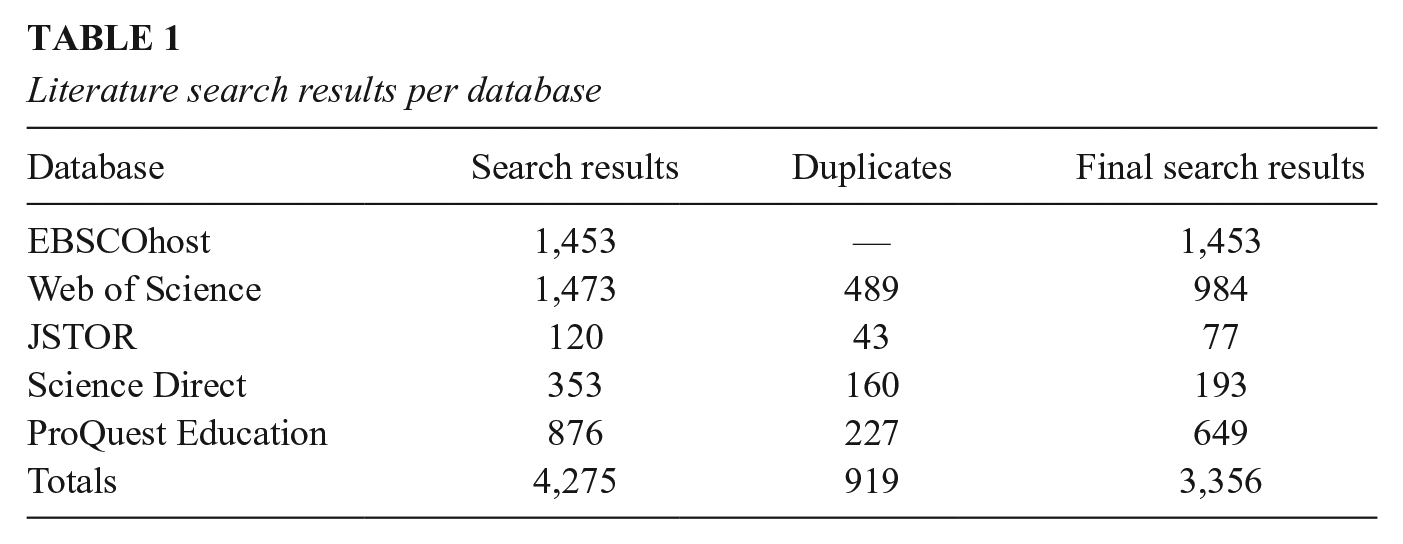
The databases we searched for empirical articles were EBSCOhost, Web of Science, JSTOR, Science Direct, and ProQuest Education, to ensure a comprehensive literature search that included all important educational and psychological research journals related to creativity. Importantly, these databases cover creativity research within a wide spectrum of academic disciplines. We arrived at this comprehensive list of databases by examining and integrating the approaches of prior systematic literature reviews on teaching for creativity (Cremin & Chappell, 2021; Davies et al., 2013, 2014; Sawyer, 2017). Table 1 shows the literature search results per database.
Literature search results per database
Selection Process and Critical Appraisal
In line with Petticrew and Roberts (2008), we applied a multistep selection process to screen the articles identified in the literature search. First, we read all 3,356 abstracts to identify studies potentially relevant to the research question. We used the following inclusion/exclusion criteria to identify relevant articles:
- Scientific, peer-reviewed journal articles published in English (full-texts available)
- Higher education research context (all disciplines)
- No specified publishing timeframe, following the approaches of Sawyer (2017) and Cremin and Chappell (2021)
- Meeting scientific quality criteria based on Petticrew and Roberts (2008)
- Focused on fostering creativity as an object of study
- Focused on teacher behavior and student–teacher interaction
- Studies on teachers’ conceptualizations of creativity, not its nurture, were excluded
- Studies on creativity tools, methods, and creative problem-solving techniques were excluded
This final exclusion criterion was important because many articles that we identified in our search focused on how teachers employed creativity-fostering methodologies, such as design thinking, the double diamond design process, or the theory of inventive problem solving (Y. S. Chang et al., 2016; Guaman-Quintanilla et al., 2023; Lee et al., 2019; Razzouk & Shute, 2012), but not on how teachers supported and interacted with students during their creative processes when using these methodologies, which was the main focus of this review.
As a second step, we screened the full texts of the 603 remaining articles and discussed their relevance for this review through five iterative rounds, using the same inclusion/exclusion criteria. Third, we applied the scientific quality criteria to the 59 remaining eligible articles. The scientific quality check followed the 11 quality criteria drawn from Petticrew and Roberts (2008), taking the approach used by Gast et al. (2017) in which each criterion was evaluated on a 3-point scale (0, 0.5, or 1 point). Each article had to achieve a minimum combined score of 8 on the 11 criteria to be included in the analysis (three articles did not achieve this score). Overall, the average scientific quality score of all included articles was 9.76 out of 11. Two additional articles were identified in the reference lists of the included articles and also met the scientific criteria. The final sample for our thematic analysis consisted of 58 articles.
Descriptive Analysis
The 58 included papers made up a highly diverse sample from a vast variety of different academic disciplines and countries. The sample spanned all overarching higher education domains; applied sciences (37 studies), humanities (30), social sciences (21), formal sciences (8), and natural sciences (6). Some studies covered multiple domains. Specifically, the studies covered the disciplines of art and design (18), engineering (7), education (6), business (3), health (2), psychology (2), mathematics (2), architecture (1), and linguistics (1). An additional 16 articles studied teaching creativity across disciplines, including a selection of the aforementioned disciplines in addition to biology, chemistry, technology, law, and sociology.
The studies were conducted across 16 different countries; 18 in Australia; 17 in the United States; 6 in Canada; 3 each in China, Taiwan, and the United Kingdom (one of which was also conducted in South Africa); and 1 each in Denmark, France, Norway, Germany, Serbia, Belgium, Turkey, and Ireland.
The majority of the studies (49) were published after 2010 (34 in the last 5 years alone), highlighting the rapid increase in creativity education research in the last decade (Cremin & Chappell, 2021; Hernández-Torrano & Ibrayeva, 2020). It was also interesting to note that, counter to previous reviews that found a lack of quantitative studies (Cremin & Chappell, 2021; Sawyer, 2017), our sample showed more variability in research designs. While it was also the case that we found more qualitative studies (32) than quantitative studies (15), our sample also showed studies with mixed-methods designs (11) that included both.
Thematic Analysis
We choose thematic analysis to investigate the data because it allowed us to flexibly use a combination of inductive and deductive coding methods (Boyatzis, 1998; Braun & Clarke, 2006; Patton, 1990). We followed Braun and Clarke’s (2006) six-step process to conduct thematic analysis in which themes emerge in an iterative process of analysis, identifying themes, and discussion (Anzul et al., 2003).
The first step in our analysis was a round of in-depth reading of the final 58 articles. For each study, we extracted the general information, research context, topic and theoretical lens, research design, sample, and overall findings (Petticrew & Roberts, 2008). In the following steps, we set up an initial coding scheme, went through an iterative process of coding and adjustments of the coding scheme to accommodate emerging themes, and finally collaboratively distilled the overarching dimensions and underlying themes. To create our coding scheme, we followed the approach by Greene et al. (2019), which involved consulting existing scales and overviews of creativity-fostering teacher behaviors. The only lists that we came across were the Creativity-Fostering Teacher Behavior Scale (Soh, 2000, 2017), which is based on an original list by Cropley (1995, 2018), recommendations for instruction based on creativity research by Frederiksen (1984), and an overview list from an exploratory review by Sawyer (2015), resulting in 20 initial codes.
We used this initial coding scheme to independently code the first 20 of the 58 identified studies with the qualitative data analysis software ATLAS.ti, while actively searching for new codes in the data. After a series of in-depth discussions, we adjusted the initial coding scheme to 44 codes to accommodate all of the nuanced creativity-fostering teacher behaviors that we identified in the first coding stage. We then proceeded to code the rest of the papers, in addition to recoding the first 20 papers with the adjusted coding scheme, while still keeping an open mind for any themes that we might have missed. In a final step, we engaged in a series of iterative rounds of analysis and discussion to identify overarching dimensions and merge conceptually similar themes.
Findings
In analyzing the 58 papers, we identified 22 themes, which we grouped into six overarching dimensions to develop a holistic perspective on creativity-fostering teacher behaviors in higher education. We frame these six overarching dimensions as the dimensions of fostering creativity. The themes capture the (a) affective, (b) cognitive, (c) behavioral, (d) metacognitive, (e) creativity-in-action, and (f) uncertainty dimensions of creativity-fostering teacher behaviors. These dimensions form the basis of our conceptual model: the “meta-creativity” model (see Figure 1).
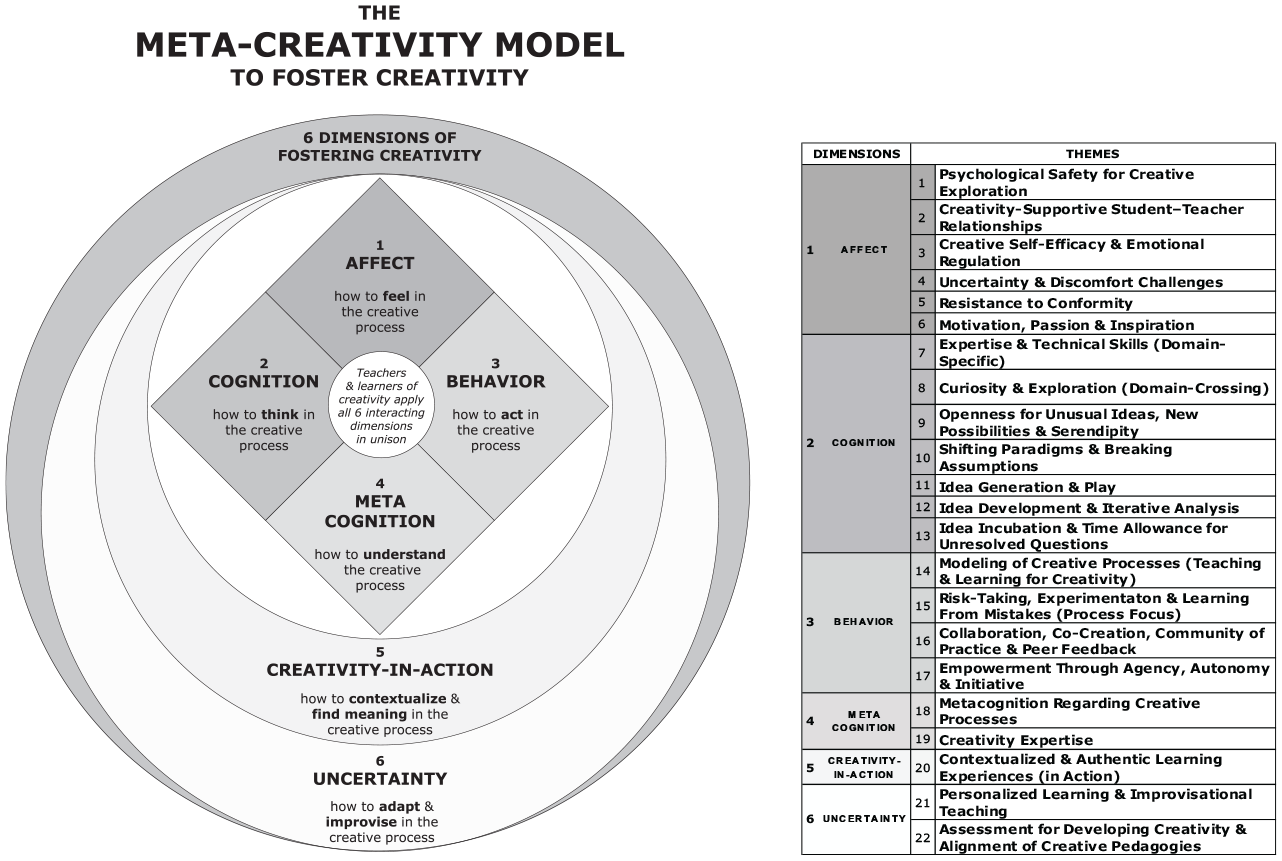
The “meta-creativity” model: a conceptual model of teacher behaviors for creativity development.
Each article included in the review addressed multiple themes (18 on average; see Supplemental Table S2 in the online version of the journal for an overview). The presence of multiple themes in each paper highlights the complex interactions between the themes, indicating that they should not be considered in isolation. In addition, themes were explored in articles that spanned various different academic disciplines. In line with Daly et al. (2016), our review suggests that while creativity manifests differently across disciplines through distinctive mediums (outlets) of creative expression, the behaviors for teaching creativity appear to be largely similar across disciplines. The similarities of the teacher behaviors across different academic disciplines and contexts thereby further highlight the transdisciplinary nature of creativity-fostering teacher behaviors.
We found only a minor difference between disciplines. While creativity was seen as an implicit learning outcome in the traditionally creative disciplines of the arts and design, teachers had to make creativity-related learning outcomes more explicit in other disciplines (e.g., business, engineering, education, or health), even if creativity was considered equally important. In addition, arts and design teachers put a stronger emphasis on creativity-related metacognitive and reflexive practices for students to understand their creative processes more deeply and explicitly.
In the following subsections, the meta-creativity model will be discussed in detail. Each subsection will provide an overview of one of the six dimensions of fostering creativity by describing its individual themes and presenting examples from the empirical studies included in the analysis. To provide additional structure, the 22 themes are listed according to Figure 1.
The Affective Dimension of Fostering Creativity
The affective dimension of fostering creativity covers all teacher behaviors that address students’ emotions to engage them in the creative process.
Psychological Safety for Creative Exploration
Teachers who foster creativity actively create a classroom environment wherein students feel safe to take interpersonal risks and express ideas without fear of negative consequences or judgment from teachers or students. For example, teachers remind students that there is no one right answer in open-ended creative problems and that mistakes are bound to happen (Cole et al., 1999). Importantly, teachers actively engage with students’ ideas even if the ideas seem strange or unusual (Fleith, 2019), they reward creative risk-taking (Daly et al., 2019), and deemphasize competition (Ellis & Meneely, 2015). Teachers maintain a safe environment for creativity by paying close attention to group dynamics, quickly intervening when destructive and negative influences (such as judgmental comments) disrupt students’ creative processes, and J. H.-J. engaging students in group reflections regarding their anxieties when sharing ideas in social settings (Choi et al., 2019; Regier & Savic, 2020).
Creativity-Supportive Student–Teacher Relationships
Teachers who foster creativity build trusting relationships with their students that support cocreation and act as emotional safety nets, allowing students to fully explore their creative processes. For example, teachers identify their own preconceptions regarding individual students and take time to get to know each of them on a personal level in regard to their struggles, needs, interests, life goals, hobbies, passions, and the like (Cole et al., 1999; Ellis & Meneely, 2015). Studies of creativity-fostering teacher behaviors show how teachers deemphasize power relations and treat students as equals while displaying humbleness and acting as cocreators (Barrett & Gromko, 2007; Sefton, 2018). The results also show that teachers often use humor and reveal vulnerabilities in their interactions with students to connect on a more authentic human level (Lilly & Bramwell-Rejskind, 2004; Miller & Dumford, 2015).
Creative Self-Efficacy and Emotional Regulation
Teachers who foster creativity develop students’ confidence in their ability to perform creative tasks and cope with negative and debilitating thoughts and emotions in the creative process, such as self-doubts, self-limiting beliefs, fear of failure, or performance-induced anxiety. Teachers do so by helping students to understand that creativity is a learnable process, which develops through effort and reflexive practice (Hargrove, 2013). During students’ vulnerable and sensitive creative growth processes, teachers take care to continually offer emotional support, faith, and reassurance (Bjørner & Kofoed, 2013). They build students’ resilience in the face of adversity by reframing moments of frustration into moments of creative empowerment (Visser et al., 2017), identifying and accumulating small wins and successful creative moments in students’ current projects or in the past (Clarke & Cripps, 2012; Regier & Savic, 2020), and cultivating students’ capabilities for self-evaluation of their creative processes and outcomes (Belluigi, 2020; Miller & Dumford, 2015).
Uncertainty and Discomfort Challenges
Teachers who foster creativity develop students’ ability to tolerate ambiguity, embrace uncertainty, and step out of their comfort zones to deliberately practice creative process skills. For example, teachers let students experience prolonged ambiguous states of not-knowing, through open-ended, ill-defined tasks that lack information, direction, and readily available solutions—in other words, tasks in which creative problem-solving approaches need to be created, rather than recreated from what has been done, tested, and feels secure (Fetterly, 2020; Greene et al., 2019). Such teachers continually challenge students beyond their current abilities while offering sufficient support and guidance through scaffolding (Barrett & Gromko, 2007; Fischer & Golden, 2018), and introduce renewed uncertainty, complexity, and ambiguity into projects when students become comfortable or complacent in their creative processes (J. H.-J. Choi et al., 2019; de Bruin, 2019).
Resistance to Conformity
Teachers who foster creativity support students in overcoming pressures to conform and fears of social exclusion due to strange new ideas or ways of thinking. For example, teachers support students in embracing ideas that diverge from widely accepted norms and expectations or challenge the status quo (Ellis & Meneely, 2015; Pfeiffer et al., 2017). In fact, teachers encourage students to question and inquire into widely accepted ideas (Daly et al., 2016), they reward students who stand out against conformity (Craft et al., 2014), they emphasize how orthodoxy and social pressures are antithetical forces that inhibit creativity, and they strongly support student individuality and uniqueness that inform creativity (J. H.-J. Choi et al., 2019).
Motivation, Passion, and Inspiration
Teachers who foster creativity encourage students to tap into their passions, interests, and aspirations to facilitate authentic creative expression, engagement in creative processes, and the exploration of personally meaningful ideas. For example, teachers help students to discover their purpose and personal vision, and inquire into what drives, inspires, and energizes them in their professional and personal lives (Cole et al., 1999; Fischer, 2020). Teachers then embolden students to integrate these insights into creative tasks to take ownership and make the tasks more relevant and intrinsically motivating, rather than doing what they think they should (Fischer & Golden, 2018; White, 2006). Teachers thus identify, appreciate, and dig deeper into students’ inspirational experiences as starting points for further explorations (Burke, 2020).
The Cognitive Dimension of Fostering Creativity
The cognitive dimension of fostering creativity covers all teacher behaviors that address students’ creative thought processes through knowledge discovery, ideation, and reiterative idea development and analysis.
Expertise and Technical Skills (Domain-Specific)
Teachers who foster creativity help students develop the necessary expertise and craft to produce creative works within a particular domain. For example, teachers emphasize how creativity, cognitive flexibility, and intuitive thought processes grow out of a deep internalized foundation of domain-specific knowledge, understanding, and skills and a self-directed learning approach driven by interests (Daly et al., 2014; Tolbert & Daly, 2013). Teachers make sure to provide students with many opportunities to gain such hands-on experiences in practicing technical skills (Chamorro-Koc & Kurimasuriyar, 2020; Daly et al., 2019) and to engage in profound and provocative discussions about subject-matter content that iteratively question, construct, and deepen conceptual understanding (Barrett & Gromko, 2007).
Curiosity and Exploration (Domain-Crossing)
Teachers who foster creativity tap into students’ curiosity to explore ideas and wicked problems within and across domains. For example, teachers provide students with opportunities to explore vastly different areas of knowledge, experiences, and idea possibilities (Budge et al., 2013). Teachers thereby help students to embrace their interests as the driving force that fuel long-term engagement in creative processes, and ultimately, creative discoveries by building in-depth (domain-specific) and far-reaching (transdisciplinary) expertise (de Bruin, 2018b; Craft et al., 2014; Morin et al., 2018). We found that teachers particularly inspire students’ curiosity, excitement, and creative inquiry about nonexplainable phenomena, complex issues, and limits of understanding, even beyond their immediate area of expertise (Marquis & Henderson, 2015).
Openness to Unusual Ideas, New Possibilities, and Serendipity
Teachers who foster creativity continually display behaviors that express openness to strange and surprising ideas, new opportunities beyond preconceived opinions, and lucky happenstances that advance ideas in unexpected ways. For example, teachers actively encourage students’ unusual questions (Cole et al., 1999), they accept ideas without judgement—particularly before knowing what those ideas are—and ask students to avoid premature conclusions by iteratively exploring and elaborating on ideas (Daly et al., 2014; de Bruin, 2018b). Teachers also help students to become aware of unexpected, surprising, and serendipitous moments in the creative process as catalysts for creative insights (Barrett, 2006). By telling students the importance of continual preparation, writing ideas down, awareness, and readiness for ideas, teachers prime students and sensitize their creative antennae to pick up idea opportunities all around them (Fischer & Golden, 2018).
Shifting Paradigms and Breaking Assumptions
Teachers who foster creativity help students question their assumptions, cognitive biases, and idea fixations, engage in multiple-perspective-taking, lateral thinking, and possibility thinking, and develop flexible and adaptive thinking under changing conditions. For example, teachers guide students through reflections to uncover their assumptions and biases and become aware of how these block alternative ways of thinking in their decision-making during their creative processes (Ezzat et al., 2017; Fetterly, 2020). They encourage students to deeply empathize with conflicting perspectives and to continually switch between micro- and macro-perspectives on creative challenges to open up possibilities (Barrett, 2006). Teachers also confront students with changing contexts or parameters, for example, by introducing new constraints, liberties, or transdisciplinary links (Sefton, 2018). Similarly, teachers help students to iteratively revise problem definitions during the creative problem-solving process as students gain more insights (Bjørner & Kofoed, 2013).
Idea Generation and Play
Teachers who foster creativity stimulate students’ playful, nonevaluative divergent thinking and ideation processes, for example, by asking students to delay judgement and search for multiple solutions regardless of practical considerations and to elaborate on ideas through creative inquiry, comparisons, analogies, or cross-fertilization of ideas across disciplines (de Bruin, 2018b; Morin et al., 2018). Teachers repeatedly emphasize the importance of expressing ideas in some form external to students’ internal thought processes to make intuitive knowledge explicit, to make room for new associations of ideas to emerge, and to help students develop trust in their intuitive and imaginative thought processes (Barrett, 2006).
Idea Development and Iterative Analysis
Teachers who foster creativity stimulate students to dig deeper into ideas through critical analysis and convergent thinking processes, for example, by encouraging students to analyze, challenge, and evaluate the quality of ideas (for aspects such as originality and usefulness), and to iteratively revise, recombine, and synthesize ideas to discover new possibilities (J. H.-J. Choi et al., 2019; Daly et al., 2014). Importantly, this process is not independent from the previous theme of idea generation; teachers help students to continually switch between divergent and convergent thinking processes in developing ideas further (de Bruin, 2018a; Philip, 2018). However, in challenging students’ ideas, teachers are careful to focus on idea opportunities and frame critical questions within the context of helping students develop ideas to their full potential, as opposed to providing debilitating, judgmental feedback (Ellis & Meneely, 2015).
Idea Incubation and Time Allowance for Unresolved Questions
Teachers who foster creativity support students’ idea incubation processes, the subconscious information-processing whereby understanding deepens and new associations are formed, to let ideas develop over time. For example, teachers provide adequate time for letting ideas simmer and schedule specific incubation periods, such as thinking time during class or during the week (Philip, 2018). They also help students to become aware of how their ideas change over time, demonstrating how continual long-term engagement with creative tasks enables the emergence of higher quality ideas through more exposure to different ideas and views (Daly et al., 2014). Key to these processes is that teachers encourage students to schedule regular times to be actively creative (focused immersion in the creative process), and to stick with unresolved questions longer in order to spark passive (subconscious) idea incubation processes when generating and refining solutions (Burke, 2020; Cole et al., 1999; Fetterly, 2020).
The Behavioral Dimension of Fostering Creativity
The behavioral dimension of fostering creativity covers all teacher behaviors that address what students do during the creative process to help students understand how to actively initiate and engage in it individually and in a group setting.
Modeling of Creative Processes (Teaching and Learning for Creativity)
Teachers who foster creativity act as role models for creative behavior, teach creatively and translate their passions into their teaching, and engage in reflexive practice regarding their own developing creativity. For example, teachers frequently display humbleness and consequently adopt a learning approach in their consistent engagement in the creative process related to their teaching and personal creative projects (Fischer & Golden, 2018). This means that teachers regularly reflect on their creative work habits, in other words, their ways of being, feeling, thinking, and doing during creative processes (Barrett, 2006; Chamorro-Koc & Kurimasuriyar, 2020). Linking their own creative process experiences with students’ creative growth journeys thereby allows teachers to relate to students’ struggles on a deeper level to provide more informed and nuanced support (Grainger et al., 2004). They also embrace creative risks in discovering and experimenting with new ways of teaching and in using their passion for the subject to create unique, memorable, and inspirational learning experiences (Craft et al., 2014).
Risk-Taking, Experimentation, and Learning From Mistakes (Process Focus)
Teachers who foster creativity get students to actively experiment and adopt a process and learning focus regarding creativity and failures. For example, teachers encourage students to try out risky ideas without knowing what the outcome will be (Visser et al., 2017). It is crucial that teachers let students make inevitable mistakes but frame these as important learning opportunities in the creative process to discover new possibilities, limits, and, in turn, higher-quality ideas and solutions (Daly et al., 2019). By moving the emphasis away from outcomes alone, teachers help students to focus more on the creative processes involved in achieving those outcomes (Greene et al., 2019). Essentially, teachers help students to develop the mindset of curious scientists who test ideas, prototype, analyze and synthesize results, revise original premises, and research new directions in an iterative experimental process (Barrett & Gromko, 2007; Morin et al., 2018; Pavlović & Maksić, 2019).
Collaboration, Cocreation, Community of Practice, and Peer Feedback
Teachers who foster creativity support creative group processes, build a community of creative practice, and engage students in peer feedback moments. For example, teachers provide many opportunities for students to initiate and practice creative processes in interdisciplinary groups, highlighting the benefits of cocreation, collaboration, and combining different areas of expertise for inspiring new ideas, while at the same time preemptively cautioning students against potential inhibitors to creativity, such as preconceived views or assumptions related to specific disciplines (Bjørner & Kofoed, 2013). Teachers also facilitate frequent peer feedback moments in which students analyze, evaluate, and refine each other’s creative work and processes to gain new insights and develop ideas further (Hendry & Tomitsch, 2014). Teachers reinforce this collaborative culture by actively cocreating with students, embracing a flat hierarchy, and stimulating idea-sharing, active listening, and curiosity about others’ ideas (Budge et al., 2013). In line with this, teachers encourage students to openly disagree, question, and inquire into ideas and problem-solving approaches to provide new perspectives and achieve higher-quality solutions (Clarke & Cripps, 2012).
Empowerment Through Agency, Autonomy, and Initiative
Teachers who foster creativity empower students to actively engage in creative processes and to take responsibility for their creative development. For example, teachers allow students to choose which creative problems to work on and how to go about solving them independently, even if students’ approaches diverge from teachers’ recommendations and expectations (de Bruin, 2018a). Teachers monitor students’ progress but step away to let them work through creative obstacles so that they may learn the real nitty-gritty of creative processes firsthand by practicing (Barrett, 2006; Regier & Savic, 2020). Teachers repeatedly emphasize that creativity is learned by doing, actively and consistently immersing oneself in creative processes; and, importantly, that creative growth and trust in one’s intuitive thought processes require time, effort, and students’ own initiative (de Bruin, 2018a, 2018b; Fischer & Golden, 2018).
The Metacognitive Dimension of Fostering Creativity
The metacognitive dimension of fostering creativity covers all teacher behaviors that encourage students’ reflexive practice regarding their creative competencies, clarify students’ conceptualizations of creativity, and help students understand their creative growth journeys.
Metacognition Regarding Creative Processes
Teachers who foster creativity prompt students’ reflection regarding their creative processes to achieve deeper and lasting learning. For example, teachers act as clarifiers of thinking and stimulate students to verbalize or write down what they learned from actively creating and to make their tacit knowledge about the creative process explicit, particularly if students do not have much experience with introspection (Hargrove, 2013). Teachers pose reflective questions or mirror emotions, ideas, experiences, or things learned about creativity back to the students (Barrett & Gromko, 2007). They help students to uncover constructive and destructive thoughts, feelings, emotions, and behaviors, and become aware of how these inhibit or facilitate their creative practice (Clarke & Cripps, 2012; Morin et al., 2018).
Creativity Expertise
Teachers who foster creativity explicitly teach creative processes, clarify conceptualizations of creativity, and frame students’ creative competencies as primary learning outcomes. For example, teachers resolve students’ misconceptions and myths, such as that creativity is talent-based or is a one-step process of single moments of insight (Cole et al., 1999; Morin et al., 2018). Teachers also expose students to scholarly work on different stages of the creative process, link creativity with learning (e.g., in the active construction of knowledge or in making order out of complex and chaotic information), and ask students to connect these insights with their own experiences (Bjørner & Kofoed, 2013; Daly et al., 2019). Key to this is that teachers frame creativity as a learnable, multidimensional process that requires the development of creative competencies and personal habits of mind and work, such as persistence, the ability to focus, observational skills, reflexivity, or a curiosity-driven learning approach (Barrett, 2006; Clarke & Cripps, 2012).
The Creativity-in-Action Dimension of Fostering Creativity: Contextualized and Authentic Learning Experiences (in Action)
The creativity-in-action dimension of fostering creativity covers all teacher behaviors that promote the real-world relevance and authenticity of learning to work creatively in order to provide students with real, contextualized, and meaningful experiences of creative processes embedded within and across domains.
Teachers who foster creativity engage students in personally meaningful creative tasks with real-world consequences and position creativity in the context of different disciplines. For example, they engage students in long-term, transdisciplinary, open-ended projects with real-world implications and conditions similar to those experienced in professional settings (Daly et al., 2014; Morin et al., 2018; Spoelstra et al., 2014). Throughout this process, teachers help students to discover connections between the creative learning outcomes of these projects and their lives beyond the academic setting to discover the applicability and relevance of creativity across contexts (Grainger et al., 2004). Teachers who foster creativity further introduce students to the larger community of thought and domain within which they aim to do creative work, for example, by exposing students to many examples of influential creative works, creators, and practices (Barrett, 2006; Hargrove, 2013). But teachers also encourage students to go beyond, to get curious and explore deeply by themselves, and to analyze and reverse-engineer these works and processes as starting points to create-by-analogy and move beyond them with their own creative outcomes (Barrett & Gromko, 2007; Hendry & Tomitsch, 2014).
The Uncertainty Dimension of Fostering Creativity
The uncertainty dimension of fostering creativity covers all teacher behaviors that address the inherent unpredictability, ambiguity, and tensions of teaching and learning for creativity to prepare students to effectively tackle the nonlinear, changing, and oftentimes conflicting and paradoxical demands of creative processes.
Personalized Learning and Improvisational Teaching
Teachers who foster creativity adapt and improvise to navigate the tensions of students’ personal creative processes and to support creative learning during changes. For example, teachers monitor students’ shifting individual needs and introduce increasingly more difficult challenges in relation to their developing creative competencies, works, and practices (Barrett & Gromko, 2007). For both students and themselves, they flexibly manage and balance the tensions of creativity anew in each successive teaching moment, such as intuitive versus rational thought, self-doubts versus self-efficacy, process versus product focus, divergent versus convergent thinking, rigor versus playfulness, structure versus freedom, or conflicting demands of different stages of the creative process (de Bruin, 2018a; Philip, 2018; Visser et al., 2017). Teachers thereby leave task goals and outcome expectations deliberately open and let them emerge through students’ creative work on wicked problems (Black, 2008). Importantly, teachers are mindful of students’ zones of proximal development in negotiating the ever-changing delicate balance between freedom and structure, in other words, between providing challenges and guidance, to achieve optimal creative growth (Fischer & Golden, 2018; Regier & Savic, 2020).
Assessment for Developing Creativity and Alignment of Creative Pedagogies
Teachers who foster creativity regularly provide feedback (formative assessments) and graded assessments (summative assessments) in line with clearly communicated desired creative learning outcomes and their creativity-fostering teacher behaviors. For example, they give regular growth-oriented process feedback depending on students’ quickly changing stages in the creative process, providing suggestions and examples specifically targeted to students’ individual progress but, importantly, without pushing their own agenda (Barrett & Gromko, 2007). Teachers particularly recognize and praise students’ effort, resilience, and risk-taking in the creative process; delay evaluation of ideas until they are fully worked out; and use feedback moments to actively listen and inquire, rather than prescribe students’ creative processes (Cole et al., 1999; Daly et al., 2019; Pavlović & Maksić, 2019).
In grading for creativity, teachers take students’ creative outcomes and creative processes into account, such as stages of idea development, effort, experimentation, agency, creativity-related metacognition, or their ability to navigate complexity and uncertainty (Burke, 2020; J. H.-J. Choi et al., 2019; Fischer & Golden, 2018). Above all, teachers take an active role in aligning their feedback, grading, teaching behaviors, and learning objectives focused on students’ creative processes, since misalignment results in overwhelmingly risky environments and consequent strong student anxiety about engaging wholeheartedly in creative endeavors with uncertain outcomes (Daly et al., 2014; Marquis & Henderson, 2015).
Discussion
This transdisciplinary systematic literature review makes three fundamental contributions to current research and practice on fostering creativity: (a) it introduces the “meta-creativity” model, a new holistic conceptual model of creativity-fostering teacher behaviors; (b) it emphasizes the interaction and interdependence of the six identified dimensions of fostering creativity; and (c) it shows that creativity-fostering teacher behaviors are transdisciplinary practices applicable across academic disciplines in higher education.
Theoretical Contributions
The Meta-Creativity Model
The meta-creativity model provides academics and teaching practitioners with the first comprehensive framework for how to foster the creativity of students in higher education (see Figure 1). The most important finding is that the dimensions of fostering creativity—namely, the affective, cognitive, behavioral, metacognitive, creativity-in-action, and uncertainty dimensions—do not work in isolation. To the contrary, the meta-creativity model is a highly interdependent and interactive model of creativity-fostering teacher behaviors in which the different themes build and depend upon one another.
To illustrate, it is evident from our results that teachers’ impact on the affective aspects of the student–teacher relationship and classroom environment provides students with the necessary trusting, emotionally stable, and motivational foundation to fully engage in the cognitive and behavioral aspects of the creative process. By actively managing and counteracting students’ destructive tendencies and actively nurturing constructive emotional states during these creative processes, teachers who foster creativity create a safe space for students to cognitively explore the boundaries of knowledge, to generate and develop ideas in new ways, and to engage in the creativity-fostering behaviors of individual and collaborative experimentation and risk-taking—with a process-oriented focus on learning.
Teachers use these firsthand affective, cognitive, and behavioral experiences of students during their creative processes to guide them through metacognitive reflections about their creative work habits that facilitate or inhibit engagement in creative practices. These metacognitive strategies allow students to become aware of and better understand their creative growth journeys and deepen their expertise about creativity itself, including all the multidimensional processes that contribute to its development.
But the “what” and “why” are just as important as the “how” in fostering engagement in the creative process, which is why teachers who foster creativity are very deliberate in providing the context of authentic learning experiences. In other words, teachers who foster creativity offer real-world scenarios and projects whereby they introduce students to realistic domain-specific conditions and examples, allowing students to experience real, contextualized, and personally meaningful creative processes in action.
However, all of these five dimensions—affective, cognitive, behavioral, metacognitive, and creativity-in-action—are always subject to the uncertainty of the constantly changing demands and tensions of teaching and learning about creative processes. Because these tensions are inherently unpredictable, teachers must actively monitor, negotiate, and balance such creativity-related paradoxes and contradictions by becoming empathetic and reflexive creative practitioners; not only do teachers guide students’ creative growth journeys, but they also simultaneously act as authentic role models, as well as lifelong students of the creative process themselves.
Notably, most of the studies included in this review addressed multiple dimensions of fostering creativity (see Supplemental Table S2 in the online version of the journal), but they did so without an overarching holistic structure. While the authors of the studies provided rich and detailed vignettes and episodes of effective teaching moments and student–teacher interactions that fostered creativity, these accounts oftentimes remained highly fragmented. The meta-creativity model integrates and synthesizes those fragmented insights into one comprehensive model.
This holistic approach to fostering creativity is very much in line with recent developments in the literature on creative pedagogies and teaching for creativity advocating more multidimensional approaches that expand current creativity-fostering initiatives, which mostly focus on cognitive elements, to encompass the entire spectrum of creativity (Daly et al., 2014, 2019; Hernández-Torrano & Ibrayeva, 2020; Sarsani, 2005). Like earlier research by Budge et al. (2013), we found that teaching for creativity is a lot more complex and influenced by multidimensional processes than traditionally believed. It appears that to foster creativity, we do not actually teach for creativity directly; instead, we teach students the path to creativity, in other words, the way that they can access creativity by developing multifaceted creative process competencies. These competencies are influenced by the six dimensions of fostering creativity and enable students to consistently engage in constructive creative processes within which creative insights emerge.
Transdisciplinary Perspectives on Teaching for Creativity
The meta-creativity model further shows the advantages of adopting a transdisciplinary perspective regarding fostering creativity. Like Daly et al. (2016), we found that the way creativity and creative processes are taught was highly similar across academic disciplines as diverse as the arts, design, engineering, business, mathematics, law, sociology, health, biology, chemistry, linguistics, education, architecture, and psychology. While earlier creativity research emphasized the importance of domain-specific skills and expertise (Csikszentmihalyi, 1997; Sawyer, 2012a, 2015), we not only confirm but extend these discussions by showing that domain-crossing approaches focused on developing creativity work within such domain-specific interdependencies. In fact, comparing studies from different domains, as advocated by Montuori (2013), allowed us to discover these high levels of commonalities surrounding the six dimensions of fostering creativity across disciplines (see Supplemental Table S2).
We did, however, identify a slight difference between the traditionally creative arts and design disciplines and other disciplines. As in the work by Daly et al. (2016, 2019), it became apparent during our analysis that while creativity is an expected implicit learning outcome in the arts and design, teachers had to put more explicit emphasis on and reinforce creativity and creative-process competencies as core learning outcomes in other disciplines (e.g., engineering, business, health, education, or psychology), even though creativity has been shown to play a similarly important role in each. A related finding was that while the metacognitive dimension of fostering creativity became apparent across disciplines, educators in arts and design tended to put stronger emphases on regular reflexive practice and developing expertise in the creative process.
Practical Implications
In accordance with Craft et al. (2014), our findings show that creativity-fostering teacher behaviors closely align with good teaching practices that stimulate more effective, deeper, and curiosity-driven learning, but within a creativity frame focused on developing creative process competencies. The meta-creativity model provides teachers with such a framework that applies to students from all social and cultural backgrounds. With the six dimensions of fostering creativity, we help teachers to zoom out and understand the teaching-for-creativity process from a macro perspective, and provide them with a concise and holistic overview. At the same time, with the 22 underlying themes that underlie the six dimensions, we help teachers to zoom in on creativity-fostering behaviors with many specific examples.
We encourage teachers to experiment with and playfully combine different creativity-fostering teacher behaviors, to adapt these behaviors to individual students, and to reflect on how they interact in practice. The tensions and contradictions of the creative process, as laid out in the uncertainty dimension of fostering creativity, confront teachers with a unique challenge: There is no one right way to teach for creativity and resolve its inherent uncertainties. In fact, the core message from this review for teachers is that they must (a) become reflexive creative practitioners to be able to relate to students’ struggles and provide better guidance, (b) learn how to improvise and flexibly adapt creativity-fostering teacher behaviors based on individual students’ developmental needs in real time, and (c) learn how to integrate domain-specific skill and knowledge acquisition with the development of domain-general creative process competencies.
To put these interacting creativity-fostering teacher behaviors into practice requires preparation, teaching experience, and a deep academic knowledge base, which should be developed continually (Grainger et al., 2004). Teachers who are insecure about their subject matter or their professional role are unlikely to take risks and are unwilling to tolerate ambiguity and uncertainty, for example, not knowing the answers in open-ended tasks. However, this open-endedness is the crucial ingredient for developing creativity and stimulating students’ creative processes. Like Sawyer (2017), our review suggests that teachers with a high degree of creativity expertise and a strong knowledge base in their subject adopt a much more flexible, open, exploratory, and improvisational teaching style in response to students’ challenges during their creative processes, and are thus more effective in scaffolding students’ creative development. Likewise, with the help of the meta-creativity model, we hope to provide teachers and teacher trainers across disciplines in higher education with a cohesive framework that provides just enough structure for teachers to fully embrace the uncertainty, complexity, and possibility that is teaching for creativity.
Limitations and Future Research
We view the results of this review and the proposed meta-creativity model as a new beginning and the foundation for research that can provide a structure for the complex, ambiguous, and unpredictable creative process of teaching for creativity. However, we also acknowledge that more research needs to be done to validate, refine, and more effectively implement the lessons of our research in higher education. We therefore encourage creativity researchers to use this review as a starting point for similar holistic research and teaching approaches to fostering creativity in the future.
First, with the meta-creativity model, we propose that teaching for creativity is about developing students’ multidimensional creative processes. Most prior research on explicit creativity training has focused on developing students’ cognitive abilities (Daly et al., 2014; Hernández-Torrano & Ibrayeva, 2020; Mansfield et al., 1978). It would be interesting to compare our holistic approach to these concentrated cognitive approaches to explore their effectiveness and how they complement one another. While many of the studies included in this review used a mixed-methods or quantitative design, most studies focused on qualitative data in which creativity was an assumed learning outcome. We therefore strongly encourage experimental studies examining the effectiveness of the meta-creativity model.
Second, to study the effectiveness of the meta-creativity model, we need more holistic and comprehensive creativity measurements and validated questionnaires that encompass all six dimensions of fostering creativity. A new creativity measurement should focus not only on creative outcomes but on the creative process involved in generating those outcomes (e.g., Said-Metwaly et al., 2017b). Since most creativity measurements focus on creative outcomes, personality traits, or cognitive elements of the creative process (Said-Metwaly et al., 2017a), we need new holistic creativity questionnaires and observation schemes to more effectively assess teachers’ ability to teach for creativity. The meta-creativity model could provide the structure for such a comprehensive measurement tool.
Third, while the interaction and interdependence of the 22 themes and six dimensions of fostering creativity was one of the core findings of this review, a lot is still unknown about how exactly the different themes interact. We thus encourage future researchers to zoom in on the interplay of our proposed themes to study how teachers apply different creativity-fostering behaviors interactively.
Fourth, with this review, we hope to pave the way for more transdisciplinary creativity research. There is much that disciplines can learn from each other concerning the development of creative competencies (Marquis & Henderson, 2015), and we hope to spark researchers’ ideas about studying and applying transdisciplinary approaches to fostering creativity within domain-specific interdependencies (Sawyer, 2015).
Conclusion
Creativity is learned and taught by doing, in other words, by developing the multidimensional competencies to consistently engage in creative processes and embracing one’s own creative growth. Our transdisciplinary systematic literature review proposes a new conceptual model for such creativity development focused on creativity-fostering teacher behaviors—the meta-creativity model. This holistic, multidimensional approach provides researchers and teaching practitioners with a framework for how to effectively develop students’ creative competencies by applying the six interdependent dimensions of fostering creativity. Our review answers the calls for more holistic, transdisciplinary, and practical frameworks to help teachers navigate the inherently ambiguous, complex, and uncertain process of teaching for creativity. We hope that this comprehensive focus on the creative process will provide teachers and researchers with a clear foundation upon which to build practical interventions and future research projects, so that we may effectively help students across the world to unleash their creative potential and, ultimately, to become change agents for a better future.
Supplemental Material
sj-xlsx-1-rer-10.3102_00346543241258226 – Supplemental material for Creativity-Fostering Teacher Behaviors in Higher Education: A Transdisciplinary Systematic Literature Review
Supplemental material, sj-xlsx-1-rer-10.3102_00346543241258226 for Creativity-Fostering Teacher Behaviors in Higher Education: A Transdisciplinary Systematic Literature Review by Rene Brauer, Jarrod Ormiston and Simon Beausaert in Review of Educational Research
Footnotes

Authors
RENE BRAUER is a double degree PhD candidate at the Department of Educational Research and Development, School of Business and Economics, Maastricht University, Tongersestraat 53, 6211 LM, Maastricht, The Netherlands; and at the Transdisciplinary School, University of Technology Sydney, 15 Broadway, Ultimo, NSW 2007, Australia; e-mail:
JARROD ORMISTON is a senior lecturer of entrepreneurship (research/teaching) at the Transdisciplinary School, University of Technology Sydney, 15 Broadway, Ultimo, NSW 2007, Australia; e-mail:
SIMON BEAUSAERT is a professor in learning and development in organizations at the Department of Educational Research and Development, School of Business and Economics, Maastricht University, Tongersestraat 53, 6211 LM, Maastricht, The Netherlands; e-mail:
References
Supplementary Material
Please find the following supplemental material available below.
For Open Access articles published under a Creative Commons License, all supplemental material carries the same license as the article it is associated with.
For non-Open Access articles published, all supplemental material carries a non-exclusive license, and permission requests for re-use of supplemental material or any part of supplemental material shall be sent directly to the copyright owner as specified in the copyright notice associated with the article.
