




Abstract
Africa’s creative industries are increasingly receiving attention due to their potential to generate human and economic growth and development. Converting this potential into tangible and sustainable development requires consistent collaboration between higher education (HE) institutions and the creative economy. This case study reflects on the role of Creative Imagination Workshops (CIWs) in brokering collaboration between HE and selected creative sectors in Kenya, Nigeria, and South Africa. The CIWs were an initial phase of the African Hub for Sustainable Creative Economies (AHSCE) research project. They aimed to support network building and collaboration by providing online exchange and networking opportunities. Workshop participants were recruited through both formal and informal networking processes. The CIWs demonstrate that intermediaries such as the AHSCE can offer virtual ‘third spaces’ which feature little to no financial barrier to entry, encouraging academics and entrepreneurs to engage with each other, and facilitating the exchange of knowledge and resources. While the virtual workshop delivery model precipitates high levels of attendance and engagement, it is vulnerable to limitations in national infrastructure. Generating enough trust to transform connections initiated virtually into collaborative in-person partnerships also requires an extended timetable or a hybrid model combining virtual and physical interactions.
Introduction
This case study outlines and reflects on insights emerging from Creative Imagination Workshops (CIWs) conducted as part of the African Hub for Sustainable Creative Economies (AHSCE), a research project funded by the UK Arts and Humanities Research Council (AHRC). 1 The project aimed to support interaction and collaboration between African higher education institutions (HEIs), creative entrepreneurs and intermediaries to facilitate the sharing of knowledge, networks, and expertise. It builds on previous research on creative economies in Africa (Comunian et al., 2021) that highlights the critical intermediary role played by HEIs in developing sustainable creative economies in Kenya, Nigeria, and South Africa.
The project ran concurrently in three African countries with three African partners: the University of Nairobi in Kenya, the University of Lagos in Nigeria, and the University of the Witwatersrand in South Africa. Each institution focused the scope of its work on an area of the creative economy based on its disciplinary strengths, namely, Fashion for the University of Nairobi, Performing Arts for the University of Lagos, and Film and Digital Media for the University of Witwatersrand. A Creative Partnerships Coordinator (CPC) was appointed at each institution to act as a broker and liaison between the institution and its respective industry. This case study report offers a self-reflective account of the project’s activities, opportunities and challenges written by the three CPCs on the project.
The AHSCE project comprised three main phases: first, the CIWs to support network building and the exchange of ideas; the Collaboration Voucher Scheme (CVS) to stimulate collaborations between attendees; and a series of interviews with creative entrepreneurs and intermediaries to develop content for the project Knowledge Hub (KH). This case study explores the role of the first phase, the CIWs, in enabling discussion, network building and collaboration between creative practitioners and creative intermediaries, including HEIs. A total of 15 virtual CIWs were conducted across the three Hubs. These sessions provided online exchange and networking opportunities, with input from academics, researchers, and creative entrepreneurs, and live collaborative work across the three universities.
The case study is structured in four parts. First, it defines the terminology used, examines previous literature around the theme, and outlines the ideas that led to the AHSCE project’s creation. Next, it describes the format and implementation of the CIWs and reflects on the positionality of the CPC role. The key findings of the CIWs are then discussed under four main headings: (a) the nature of networks in the creative sector; (b) the challenges and rewards of digital engagement; (c) CIWs as a platform for interactions between academia and the creative sector; and (d) the use of online networking to broker relations and facilitate future collaborations.
Creative industries, higher education and development in Africa
Before delving into the discussion, it is important to define the terminology used, examine previous literature around the theme, and outline the ideas which led to the creation of the AHSCE project.
The notion of the ‘creative economy’ builds on that of the ‘creative industries,’ which is defined in numerous ways across the globe. UNCTAD (2022) consolidates a number of these interpretations to describe the creative industries (CIs) as “the cycles of creation, production and distribution of goods and services that use creativity and intellectual capital as primary inputs.” They comprise “a set of knowledge-based activities, focused on but not limited to culture and heritage, potentially generating revenues from trade and intellectual property rights” (p. 29). The CIs promote innovation, create employment, and enhance the overall welfare of societies by preserving and promoting non-economic cultural and artistic values. The creative economy, on the other hand, defined as “a set of knowledge-based economic activities,” focuses on the potential of the creative industries to generate economic growth and development. It consists of all the interlinked creative industries rooted in development and presents a practical and achievable pathway for development, particularly for developing countries (UNCTAD, 2022). Because of this, the CIs have received increasing global attention due to their income, wealth, and employment-generating potential (Comunian et al., 2014).
HEIs play a critical role in the development of CIs in several ways: first, by the cultural impact generated by their public agenda and physical presence, that is, their grounds, amenities, and cultural spaces; second, by equipping creative workers with creative knowledge and critical thinking skills; and third, by generating creative knowledge through research and development (Comunian and Gilmore, 2015).
A significant portion of the intellectual property within the CIs comprises practical expertise disseminated through professional networks. It is often informal, implicit, and specific to particular activities, making it difficult to codify or protect. This suggests that the sharing of knowledge within the sector might be shaped by the cultural dynamics within specific communities of practice (Wenger, 1998) – that is, within groups of people brought together by a common interest – working at the intersection of higher education (HE) and the CIs (Taylor, 2007). This view corresponds to the notion that knowledge transfer and exchange happen in ‘learning ecosystems’ which enable specific forms of engagement and lead to meaningful learning experiences (Pratt, 2014). Creating shared or ‘third’ spaces for academics and creative practitioners to engage with each other therefore encourages knowledge exchange and transfer. The term ‘third space,’ introduced by Soja (1996) refers to the hybrid space existing in between ‘first’ and ‘second’ spaces, such as home and school, or home and work, which facilitates crucial exchange for ‘creative recombination and extension.’ Therefore, a third space in this context would refer to an accessible virtual, physical, or event-based combination of academic and creative production spaces that fosters diverse forms of exchange across time and space (Comunian and Gilmore, 2015).
The African creative sector has experienced extensive growth and impact on global popular culture in recent years (Prosper Africa, 2022). The music, film, literature, photography, design, fashion and visual art emerging all over the continent are gaining increased global visibility and recognition, as demonstrated by the rising profile of music such as ‘Afrobeats’ from West Africa and ‘Amapiano’ from Southern Africa, fashion weeks in Lagos, South Africa, Dakar and Addis Ababa, and innumerable influencers and content creators using social media to build and monetise direct audiences (Ochai, 2021). This collective talent and entrepreneurial activity generates a burgeoning creative economy that could promote economic growth and advance human development across the continent. However, converting this potential into tangible and enduring development requires targeted policy interventions and consistent collaboration between HEIs and a flourishing creative economy (Comunian et al., 2021).
The intersection between HE and the creative economy has been explored extensively in the context of the global North, but knowledge of how HEIs can contribute to the development of African CIs is limited (Bello, 2021). Some site-specific studies have, however, begun to emerge in the context of local creative economies. These include the role played by networks and creative intermediaries in African creative economies (Comunian et al., 2021), an exploration of the role of HE in the creative economy of Nigeria (Obia et al., 2021), collaboration between HEIs and CCIs in Ghana (Bello, 2021), the role of HE in the development of creative human capital for the fashion industry (England et al., 2021), the relationship between CCI clusters and the level of socio-economic development (Drummond and Snowball, 2019), and how visual artists in East Africa forge sustainable livelihoods (Burton et al., 2021). It is difficult to measure CI activity in Africa since it primarily occurs in the informal economy and is dominated by micro and small enterprises (International Labour Office, 2023). The sector has also grappled with a historical lack of formal support and investment linked to the inability of creative entrepreneurs to meet the collateral stipulations that are a prerequisite for investment by the risk-averse banking sector (Hruby and Annan, 2020).
Despite this, the CIs remain one of the largest employers of women and the youth (Gachara, 2020). They are receiving increasing formal support and investment from organisations such as the African Development Bank (African Development Bank, 2023), Afreximbank (Ochai, 2021), HEVA Fund (Gachara, 2020), and numerous Civil Society Organisations (CSOs) (Institute for Cultural Diplomacy). The increasing attention and investment in the sector suggest an opportunity for creative intermediaries such as HEIs, creative hubs and co-working spaces to leverage novel technologies to connect in shared spaces for creative learning, production, networking, and entrepreneurship. HE, operating as an intermediary at the nexus of education, research, youth development and policy initiatives, has the potential to broker linkages across multiple sectors and agendas with common objectives to foster collaboration (Comunian et al., 2021).
Methodology
This section describes how the CIWs were structured and implemented and presents a reflection on how the positionality of the CPC role contributed to their execution.
The call to participate in the CIWs was primarily distributed through the social media channels Facebook, Instagram, LinkedIn, and Twitter, as well as through professional WhatsApp groups. Other channels included direct emails and referrals to individuals within the CPCs’ and African Co-I’s networks. Participants registered for the events through a secure link on Kings Online surveys. They provided a brief biography which was uploaded to the collaborative web platform, Padlet, to enable participants to begin to network and engage with each other beyond the virtual workshops.
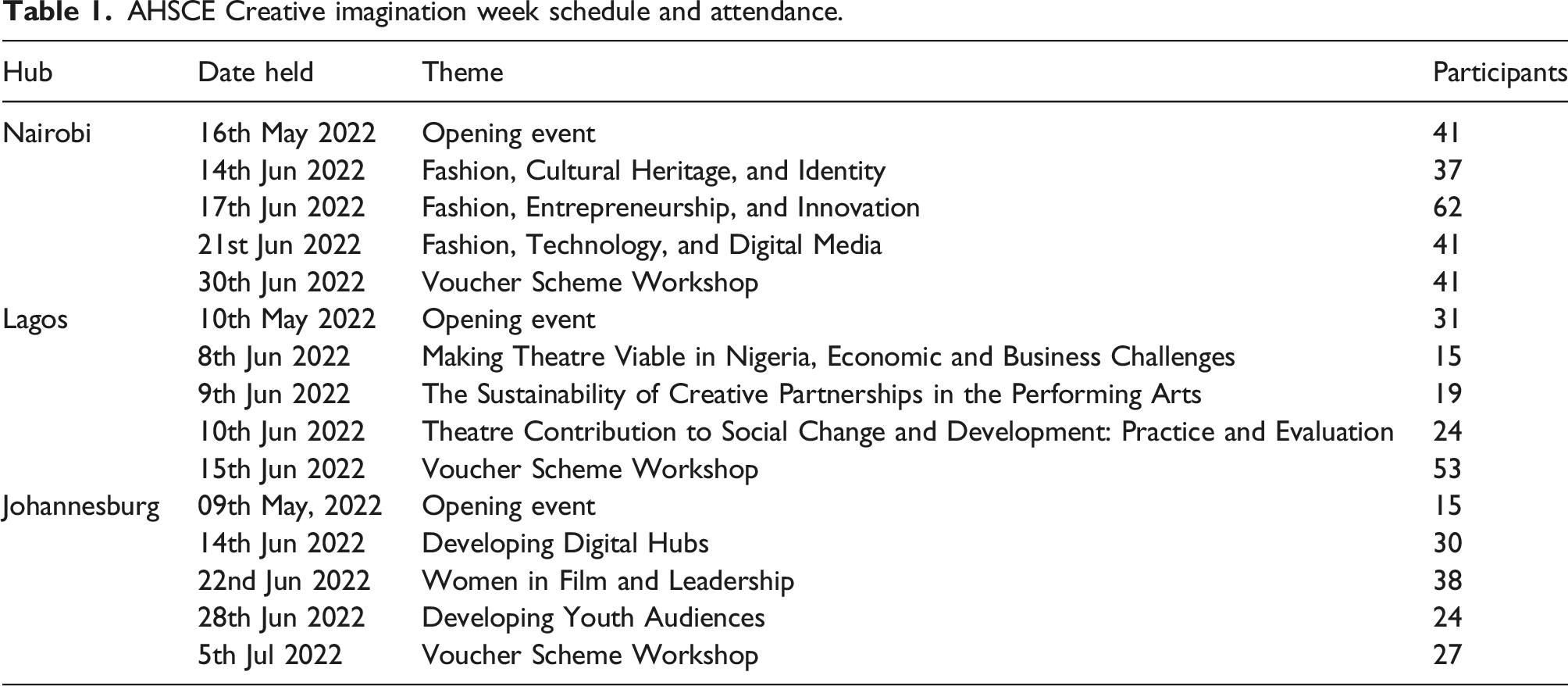
Each Hub conducted five CIWs: the opening event, three themed workshops, and a final session explaining the CVS to participants (Table 1) The opening events started with a welcome from the host institution, a brief outline of the AHSCE project by the UK PIs, and a short address by the local industry partner. The themes to be discussed in subsequent CIWs were then introduced, and each participant assigned to one of three breakout sessions for a brief discussion. These breakout sessions became the first point of interaction for the would-be CVS beneficiaries. They were followed by group presentations in the main session, a question-and-answer session, a summary of main insights and a closing address.
The entire AHSCE team attended the opening CIWs to implement, observe and evaluate the proposed format and adjust it for the subsequent sessions if required. A feedback form was shared with participants after the opening event to sample their views on the accessibility of the event, their use of Padlet, selected themes (which were briefly discussed in the breakout rooms) and other suggestions to improve the effectiveness of the sessions. This initial event left participants across the three Hubs wanting to engage beyond the one-hour slot initially earmarked for the session. An optional 30-min discussion and networking session was therefore added to the subsequent CIWs.
The academic research lead and collaborators worked closely with the CPC in each Hub to implement the themed workshops and create a programme for interaction. While each Hub oversaw its programme, the session typically opened with a welcome from the African Co-I, a brief overview of the overall project and the upcoming voucher scheme, the presentation of the main topic and introductions of the guest speakers followed by the panel discussion and interactive session. This was followed by a brief question and answer session, concluding remarks and the optional discussion and networking session.
The positionality of the CPC role was key to the successful delivery of not just the CIWs but the entire project. Each of us was a national of our respective country, and we were cognisant of our social, cultural, and professional norms, expectations, and relations. We were familiar with factors such as whom to contact, how things are done, how people prefer to interact, and which actions were most likely to yield the best results. This knowledge would have been inaccessible or at best difficult to obtain for the UK academic research leads within the stipulated project timeline. It enabled us to translate the top-line vision of the project into timely and practicable actions within the specific context of our respective industries.
AHSCE Creative imagination week schedule and attendance.
Discussion
This section reflects on the role played by CIWs in brokering creative partnerships by providing a shared space for networking and exchange of knowledge and ideas that encourage creative entrepreneurs to consider collaboration with other entrepreneurs and academia. The key findings/reflections of the CIWs are organised into four main themes: (a) the nature of networks in the creative sector; (b) the challenges and rewards of digital engagement; (c) CIWs as a platform for interactions between academia and the creative sector; and (d) the use of online networking to broker relations and facilitate future collaborations.
The nature of networks in the creative sector
The formation of clusters within the creative sectors appears to combine both formal and informal processes. In Lagos, the anchor for the CIWs was Prof. Duro Oni, a highly respected theatre academic, administrator and practitioner who is a fellow of many of the important local theatre and performing arts bodies. It was easy to garner the interest of theatre practitioners, as many would want to be associated with a project linked to Prof. Duro Oni. Participants were recruited through broadcast messages to theatre practitioners on professional WhatsApp groups, primarily targeting members of the National Association of Nigerian Theatre Practitioners (NANTAP) and the Society of Nigerian Theatre Artists (SONTA).
In Johannesburg, the CPC worked closely with the South African Screen Federation (SASFED) to map existing and potential collaborations. SASFED is the national federation of independent film, television and audio-visual industry organisations in South Africa representing professionals and companies operating in the audio-visual sector. The organisation played an instrumental role in raising awareness of the AHSCE project and promoting its activities amongst its member organisations. Numerous planning sessions were held with SASFED former CEO, Ms Unathi Malunga, resulting in a list of relevant stakeholders in the audio-visual sector to contact.
Nairobi, like Lagos, primarily called for participation through professional groups on social networks and personal contacts. As a result, the events drew in participants from Nairobi and other Kenyan towns, the region, and the diaspora. Word-of-mouth referrals played a huge role in the number of people reached. Creative entrepreneurs who were not part of the CPC’s and Co-I’s direct networks were reached through HEIs, that is, courtesy of lecturers at other universities, most notably Kenyatta University, who had stayed connected with their former students. The varied profiles of attendees created an opportunity for different experiences and perspectives to be explored during the sessions.
The challenges and rewards of digital engagement
When the COVID-19 pandemic broke out in 2020, it expedited a course of digital transformation that had been in progress for several decades (OECD, 2020). The AHSCE project, conceptualised during this period, adopted the virtual engagement and delivery model. The rewards of this model were apparent in the relatively high levels of attendance and engagement at the CIWs. Online workshops were convenient for participants since they did not involve travelling time or cost. It was easy for participants to set aside an hour to attend the sessions while at work. The model is, however, not without its challenges, as limitations of national infrastructure often interfered with connectivity. This was most evident in South Africa, where load-shedding, which refers to scheduled power outages by Eskom, the state-owned energy utility company, had been occurring in the country for up to 8 h a day (Briers, 2022). Frequent transmission breaks brought on by network latency issues caused by power failures disconnected participants from the meetings and frequently rendered speakers inaudible. This had a detrimental effect on attendance, as demonstrated by the discrepancy between the list of registered participants and the attendance register. The quality of engagement in Nairobi and Lagos was similarly limited by poor internet connectivity and high data costs to differing extents.
The collaborative web platform, Padlet, provided a virtual ‘meeting’ space for participants to make introductions, offer commentary, and contribute to the themes under discussion. The platform also enabled participants to ‘shop’ and shortlist individuals they could potentially partner with under the CVS. Its overall uptake amongst the participants was, however, minimal, as most were first-time users and found it difficult to navigate the app.
Collaborative imagination workshops as a platform for interactions between academia and the creative sector
The nature of the interactions and discussions that took place during and around the CIWs emphasise the value to be gained from constructive interaction between HEIs and creative practitioners. The sessions provided a forum for industry stakeholders to discuss opportunities and barriers to networking and collaboration and share information on existing prospects that may be beneficial to either party. The level of engagement at these events confirms that there is room for intermediaries or third parties, such as the AHSCE, to offer neutral platforms or forums that encourage both academics and creative entrepreneurs to step out of their silos and engage with each other in the issues occurring in their industries. Such forums may indeed function as a model for virtual ‘third spaces’ which encourage academics and entrepreneurs to engage with each other beyond their professional practice. The virtual, semi-formal nature of the CIWs featured little to no financial barrier to entry and allowed all participants to engage with the themes being discussed, no matter their background, qualifications, or expertise. Such interactions play a critical role in breaking down social siloes and strengthening social networks, stabilising communities (Butler and Diaz, 2016).
There is room for HEIs to inject some of their research findings into the work of creative entrepreneurs, and equally, room for creative entrepreneurs to expose the HEIs to new creative ventures, industry best practices and output needed for research and teaching. In Nairobi, some participants expressed a keen interest in accessing the University of Nairobi’s repository of research material to inform their creative projects. Some creative practitioners, unfortunately, found out about the CIWs after they had concluded, and they expressed an interest in engaging with the topics through the session recordings. During one of the sessions, a guest speaker, Ms Esther Kute, a lecturer at the Technical University of Kenya, shared links to business support organisations and initiatives accessible to fashion entrepreneurs, subverting the widely held notion that academics are out of touch with the industry.
In Lagos, some creative entrepreneurs voiced frustration at their unsuccessful attempts to initiate programmes with HEIs in the past, accusing them of being too bureaucratic and unwilling to engage in town-gown initiatives. There is a need for the HEIs to shift their perspective and begin to view their former students as partners rather than students. The National Theatre has already made some interventions to bring CCIs and HEIs together, such as National Festival Unity, through which the HEIs and experienced creative practitioners identify latent talents; the Evergreen Music Limited, meant to bring back the culture of live music; and collaborations with performing groups such as Crown Troupe Nigeria, the public play-reading contest that goes around HEIs in Nigeria to identify budding playwrights.
In Johannesburg, it was pointed out that HEIs can play an essential role in building the knowledge base in the creative sector policy sphere for the benefit of government departments which rely on evidence-based policymaking. There is still no sustainable process for building that knowledge base, and every time a new policy is anticipated, research begins from scratch rather than from previous work. The impact of the filming incentive at the Department of Trade and Industry, for example, is not known. There is a need for a dashboard to look at what has been achieved since previous policies were developed so that parties are not constantly starting from the beginning, which can be done by developing a consistent knowledge base that looks at multi-year studies.
The use of online networking to broker relations and facilitate future collaborations
Living in a world unalterably changed by the COVID-19 pandemic, it is important to make judicial use of the opportunities that virtual spaces provide to forge collaborations. Due to the virtual nature of the CIWs, however, most participants preferred to keep their cameras switched off, losing the opportunity to read and respond to each other’s body language as they would in a physical setting. They also missed the opportunity to mingle and network more informally as they typically would before and after events in a shared physical space. This reinforced a situation where the participants engaged with the themes individually rather than collectively. The AHSCE team mitigated this challenge by extending some of the themed CIWs by 30 min beyond the initial one-hour slot indicated in the programme. This bonus session enabled some participants to stay on the call and connect more informally through the Zoom Chat function. Even so, the time allocated for each session was inadequate for a deep enough dive into the topics of discussion. As a result, many of the applications to the subsequent CVS featured individuals who either already knew each other and/or had worked together in the past, or those who were referred to each other by an individual in their mutual networks who either knew them individually or had worked with them in the past. Online networking can and does create new connections, but upgrading these connections to collaborative partnerships requires a component of trust that is created by allocating more time, relating in person, or both. Future initiatives may benefit from incorporating these considerations into their project design.
There is also room to involve a wider audience in such collaborative initiatives. The CIWs would have benefitted from a more aggressive awareness campaign, using tools such as paid advertising on social media, other HEIs offering similar training in the chosen area of the creative economy, and relevant professional organisations and institutions operating in the sector.
Conclusion
Creative economies in Africa, while very promising in their contribution to economic growth and development, often face barriers to growth, such as limited access to funding, resources, and markets. Networking can help bridge these gaps by bringing together stakeholders with different expertise and resources to address the specific needs of the creative economy, such as entrepreneurship, sustainability, digital innovation, gender parity and social change. HE, operating as an intermediary at the intersection of creative education, research, youth development and policy initiatives, is uniquely positioned to facilitate connections and collaborations across diverse sectors and agendas.
The CIWs conducted by the AHSCE demonstrate the potential value to be created by providing shared spaces for academics, creative entrepreneurs, and intermediaries to connect over shared interests. They enabled participants to share their insights, research findings, and success stories, and, in so doing, learn from each another, gain new perspectives, and identify innovative approaches to opportunities and challenges in their respective sectors.
The participant recruitment mechanisms for the CIWs reveal both formal and informal networking processes in the creative sectors. The CPCs and African Co-Is tapped into new and existing networks through digital advertising and word-of-mouth referrals in personal and professional networks and organisations. This indicates the potential to reach a wider segment of the industry by implementing a more aggressive digital campaign and a formal referral scheme.
The virtual model that was adopted for the delivery of the CIWs lowered the cost of attendance by eliminating travel costs and time, leading to high levels of attendance and engagement. Online engagement was also useful in bridging time and space to initialise and sustain connections, not just between the academic and creative communities within each Hub, but also between researchers across the UK, Kenya, Nigeria, and South Africa. These interactions exposed individuals to different ideas, experiences, and best practices, and spurred novel approaches to their work. The virtual model, however, can be impacted by limitations in infrastructure such as the scheduled power outages in South Africa. Upgrading connections that have been initiated online to collaborative partnerships also requires a higher level of trust that is generated through repeated encounters or in-person interactions. Future CIWs could benefit from an extended timetable, a hybrid model combining virtual and physical interactions, or both.
In conclusion, the CIWs conducted by the AHSCE model an accessible format for ‘third’ spaces in the creative industries by limiting barriers to entry and allowing all the participants to engage regardless of their social, professional, or economic status. The workshops created a shared space for academics, creative entrepreneurs, and intermediaries to connect over common topics of interest, facilitating the exchange of knowledge and sharing of resources. They empower stakeholders to collectively address challenges and seize opportunities, contributing to the growth and vibrancy of the creative sector in Africa.
Footnotes
Acknowledgements
The authors would like to acknowledge the financial support of the Arts and Humanities Research Council (United Kingdom) Award Reference, AH/W00688X/1, that made this project possible. They would also like to thank the research participants, Collaborative Voucher Scheme collaborators, and experts who engaged with this research project and facilitated data collection and sharing. Without their generosity and time, this research would not have been possible.
Declaration of conflicting interests
The author(s) declared no potential conflicts of interest with respect to the research, authorship, and/or publication of this article.
Funding
The author(s) disclosed receipt of the following financial support for the research, authorship, and/or publication of this article: This work was supported by the Arts and Humanities Research Council grant number AH/W00688X/1.
