




Abstract
This paper reflects on a cross-sector social intervention that uses roadworthy ‘tiny house’ shepherd’s huts in public spaces as informal locations for connectivity. Working at the intersections between street-level outreach, outdoor education and community arts, the Welcome Hut project can be conceptualised as a hospitality hub. Participants engage in public daydreaming and storytelling that emerges from a welcoming gesture of recognition and reciprocity. The autoethnographic narrative by the project’s initiator traces back how this concrete utopia had initially been created outside of social work networks and gradually gained legitimacy in the field. The paper shares methodological insights from operating a deliberately unlocated mobile practice. It is argued that a ‘vagabond’ intervention opens novel in-between spaces for dialogue through relational disruption. By nurturing spaces for otherness inside social work, the emerging interstices enable practitioners to be inspired by unusual perspectives on professionalism and reimagine their own conditions. This paper is therefore written at the unclassified in-betweens to transcend rigid belongings and disciplinary protocol within contemporary beyond-binary social complexities. The researcher angle that investigates social workers’ everyday realities is voluntarily displaced towards migratory arts venues. Unusual narratives can encourage breathing spaces in fragile and fertile liminalities between life worlds and institutional agendas.
Introducing a mobile shed space
The following autoethnographic reflection shares an experimental form of social and community action as ‘concrete utopia' (Crowther, 2009). Observations and feedback from professional activities inform this analysis of a project which the author of this text had initiated. For more than a decade, I have made use of wooden tourer caravans: roadworthy reproductions of ‘shepherd’s huts’ (see Figure 1) as traditionally solitary shelters for sheepherders in rural Europe which were reinvented as community hubs. The lens of this encounter hut helps to investigate the spaces of disruption, (dis-)engagement and dialogue between social work and the unlocated, uncategorised ‘other’.
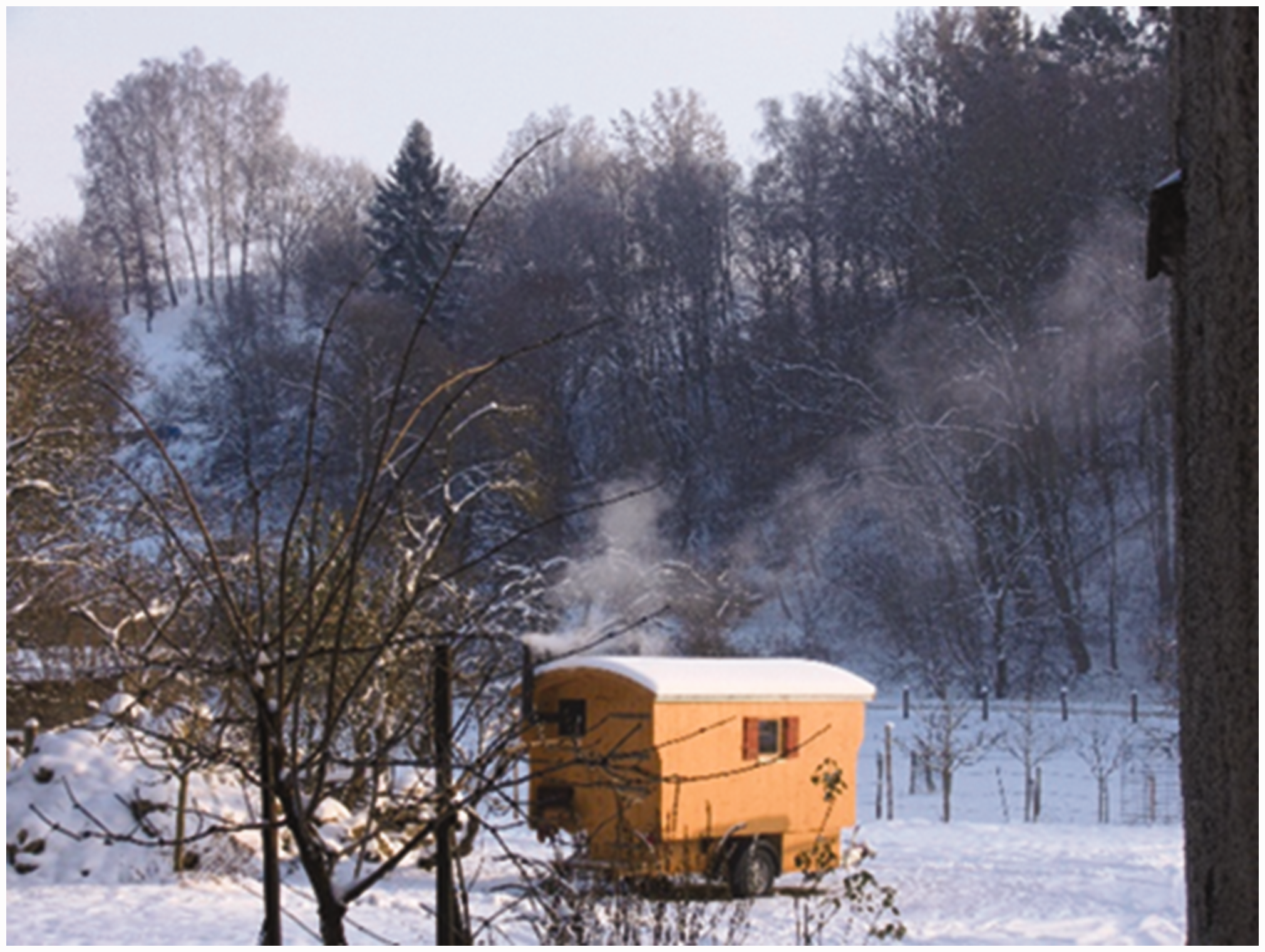
Historic visual: The shepherd’s hut as an outsider dwelling.
When practitioners craft ‘in-between’ spaces, it is important to explicate the meaning attached to them and the values projected into these newly invested liminal spheres: ‘a third space has multiple meanings: it can be a position between formal and informal structures or a newly carved space for imagining, creating and thinking’ (Livholts and Bryant, 2017: 11). The ‘vagabond’ methodology applied in my practice is introduced by means of an existential narrative of the project, allowing to discover the value stance that has framed this specific form of community intervention. The Welcome Hut seeks to facilitate relational, improvised and singular encounters. It is argued that this not easily classifiable approach has been able to co-exist right beside the contemporary priorities for bureaucracy in the social services because of a daily enactment of relational mobility, flexibility and reinvention. Therefore, this article weaves different stages of field experience into an emerging methodological frame. The researcher angle that investigates social workers’ everyday realities is voluntarily displaced towards the hut as a migratory arts venue. The aim of my mobile and uncategorised modus operandi is to transcend rigid belongings and disciplinary protocol for the contemporary challenges of beyond-binary societal complexities. Unusual narratives can encourage breathing spaces in fragile and fertile liminality between civic life worlds and institutional agendas permeated by pressure for accountability.
My trajectory as initiator of the tiny house intervention then structures the experiential accounts by tracing back the practical challenges for the Welcome Hut approach: from the emergence of the idea in postgraduate studies as a very theoretical draft (2007–2010) into a decade of professionalising the utopia in different professional fields and different countries in continental Europe (2010–2018) and then returning into research environments with a more grounded understanding of negotiating professional belongings emanating from the in-betweens (since 2018). This text is written in the second year of my PhD study investigating the vagabond hut methodology, a collaborative research project housed in a Scottish School of Education. My vagabond perspective in social work research is situated at linguistic as well as national borders, deontological identities and works across academic disciplines. While I am not a qualified social worker, several social work networks have asked the Welcome Hut project to come into their field precisely for introducing this ‘other’ approach which will be presented below. The following is then the narrative of a voluntarily unsteady site of practice which is destined to be constantly in motion. This has become an existential necessity in what I have experienced as often highly categorical and divided landscapes of care. My methodology reflects this choice to dwell in the dialogical interstices for the purpose of offering temporary and unlocated shelter.
Otherness in social work
Situating the Welcome Hut as a social work practice despite its eclectic origins implies looking at a long-term trajectory that has introduced informal insights from unconventional out-sites: ‘the basis for opening the borders of Otherness is to recognise that differences exist between the functional system of social work and the life world (Lebenswelt) of citizens’ (Matthies, 2013: 149). This interplay between insider and outsider knowledge in social work can be conceptually discussed from several standpoints: while the practice of a mobile tiny house that travels across communities can be considered as the embodied stranger to sedentary and locally rooted organisations and as an unsteady non-expert to place-based debates in social work, a flipped perspective reveals the need to equally accept the social work sector’s own challenges and entanglements with ‘outsideness’. The ambivalent relationship to marginality is well documented by looking at the discipline’s own historical adherence to dichotomies such as norm and deviance, inclusion and exclusion or centre and periphery: ‘social work is coupled with the concept of the Other. The normative mission of social work – to support people in need – is structurally based on the categorisation of people. The bureaucratic institutional system of professional help is separated from the life world and established on a clear division between workers and service users, of us and the Others, of experts and laypeople, implicating distance and defined roles’ (Matthies, 2013: 151). The travelling ‘other’ then commutes and gravitates around a gap that is historically sparsely populated. The use of an evocative tiny house is a poetic disruption informed by the underlying conceptual attempt of addressing the margins by shifting the centres into the street. The application of a vagabond methodology tries to set a deliberate counterpoint to the dominant spatial configurations of marginalisation as inevitable dichotomies where one has to pick one side: either the one who reaches out or the one who is hard to reach. This vagabond is a practitioner who re-sculptures binary opposites by playfully ‘messing around’ with them. This border dweller is not immediately recognisable as either practitioner or service user but artfully maintains a professional frame of relationality, mediation and adaptation. This mobile improvisation scaffold reflects the choice to be challenged by the existential repercussions of not clearly belonging to one single professional field. Practice models can implement a form of dialogue which implies looking for, rather than just looking at the outskirts of civic engagement (Hall and Smith, 2017).This participatory and horizontal stance allows being at the immersive lookout for engagement with the so-called margins rather than just gazing from a safe distance at pre-painted societal landscapes of remoteness.
Theoretical beginnings
In the writing-up phase of my MSc thesis in Adult and Community Education at the University of Glasgow, I was encouraged by my supervisor to write about something that does not yet exist in adult education, to use my imagination as much as analysis to conceptually move beyond the vocational schemes of lifelong learning (Barr, 2008). These are frequently criticised as unidirectionally prescribed, static forms of welfare to work lacking a vision of holistic human needs (Field, 2006). A disruption of the status quo seemed possible through a reshuffling of educational spatial orders in order to unsettle the immobility that I perceived in top-down social structures and educational policy provision. It was necessary to start my own professional career in an intermediary zone of multidirectional mobility between formal and informal educational worlds to carve out pluralistic perspectives: ‘what looks like remote learners from the centre can also look like a remote educational system from the periphery’ (Hanser, 2019). Reading scholarly works about envisioning real utopias allowed me to move from sociological analysis towards a transdisciplinary bricolage (Lévi-Strauss, 1966) for concrete transformative change: ‘to identify harms that are generated by existing arrangements, to formulate alternatives which mitigate those harms, and to propose transformative strategies for realizing those alternatives’ (Wright, 2007: 26). The harms I had identified in a prescriptive system of re-qualifying people at the margins of society were inspired by Iris Marion Young’s political and philosophical critique of assimilation which can also be applied to the formatting of unique life trajectories into skills containment in educational agendas: ‘The strategy of assimilation aims to bring formerly excluded groups into the mainstream. So, assimilation always implies coming into the game after it has already begun, after the rules and standards have already been set’ (Young, 1990: 164). The relegation of other-than-dominant epistemologies in predominantly Western initiatives for promoting educational justice (Santos et al., 2008) reduces the value of experiential competences, resilience in the face of hardship or relational empathy to uncertifiable qualifications and informal footnotes off a standardised re-qualification CV. My proposal for alternative forms of educational outreach was then inspired by a shift away from deficit models of asking people to catch up through formal learning towards the free-floating recognition of singularity through life story. In order to allow individuals to see themselves as adaptive artisans of their own lives, my educational stance aimed at promoting an existential ‘courage to create’ (May, 1975). Instead of telling people without formal qualifications what to learn I was more curious to learn from their informal and invisibilised ways of meaning-making and give them a frame and space located in the blurred lines between institutionalised upskilling and life-crafted, emancipatory community arts.
Calls for craft-related improvisation skills have recently been supported in the field of social work. The complex engagement with life worlds ‘requires practitioners to act much more on the basis of knowledge, skill, intuition, ritual and courage than bureaucratic rules and to be craftspeople and improvisers. Social workers have to “make” their practice. Ingold (2011) uses the term ‘making’ to draw attention to the skill and improvisation that are easily taken for granted in practices that require craft’ (Ferguson, 2018: 68). There is a deliberate absence of a standard intervention model or operational guidelines in the Welcome Hut philosophy. When institutional partners ask for a blueprint document to brief the own employees in the most efficient way, the Welcome Hut project responds to this request by asking questions about the partner’s own realities rather than providing a one-size-fits-all manual to be followed. The main motivation behind this pluralistic, tailor-made proposition is to constantly reinvent the own listening in the face of alterity (Cooper and McLeod, 2010) and to focus the collective creativity of each project towards singular, place-based life histories, memories and existential traces held and preserved by the host location (Till, 2008). Paradoxically, it can sometimes be a place-aware outsider who allows recollection of self and attention for site-specific resources and treasures. Without the external perspective, these assets might not be noticed in the daily rush.
The otherness of social workers in their own work environment
Services which focus solely on the technicities of social intervention and not their crafts can experience difficulties to address one of the challenges of postmodern societies: to embrace ambiguity, to work through contradictions by means of relationality, to find structure and meaning within, not apart from flux (Bauman, 2008). The ambiguities that accompany the choice to be an insider to the social work microcosm in neoliberal times are complex. Social work professionals themselves often feel othered in the context of the rise of centralised bureaucratic care systems which imply an increase in top-down expert vocabulary (Wastell et al., 2010). These ‘robust’ because of measurable approaches carry their own pitfalls as they can be perceived as auditing cultures or superficial simulations of participation (Cowden and Singh, 2007) which do not necessarily activate a collective imaginary or a culture of engagement and trust. Recent research suggests however that social workers can find agency and co-create ‘meaningful social work’ together with colleagues in supportive institutional cultures (Ferguson et al., 2020). It is therefore necessary to develop healthier frameworks that prevent isolation stemming from increasing pressures on the profession’s performances in combination with reduced funding for such ambitious tasks. The claim for visibility for the own societal contribution also needs to stretch beyond the own social field in order to receive recognition beyond the helping professions. It is legitimate to ask the question ‘whether social work itself is understandable to those who are outside of it’ (Matthies, 2013: 149). Social work could increasingly be perceived as an institutional subculture whose jargon is largely incomprehensible to a non-professional, while the individual social work insider is alienated when the performance of compassion and its measurement metrics have become the main frame of reference. The Welcome Hut seeks to enlarge and expand that frame of reference by opening the doors to a break-out/breathing-in perspective. What – in turn – is then the place that social work practice allocates to those coming from afar who are knocking on its doors with similar values but completely different methodologies?
Phases of a Welcome Hut intervention 1: Connecting for partnerships
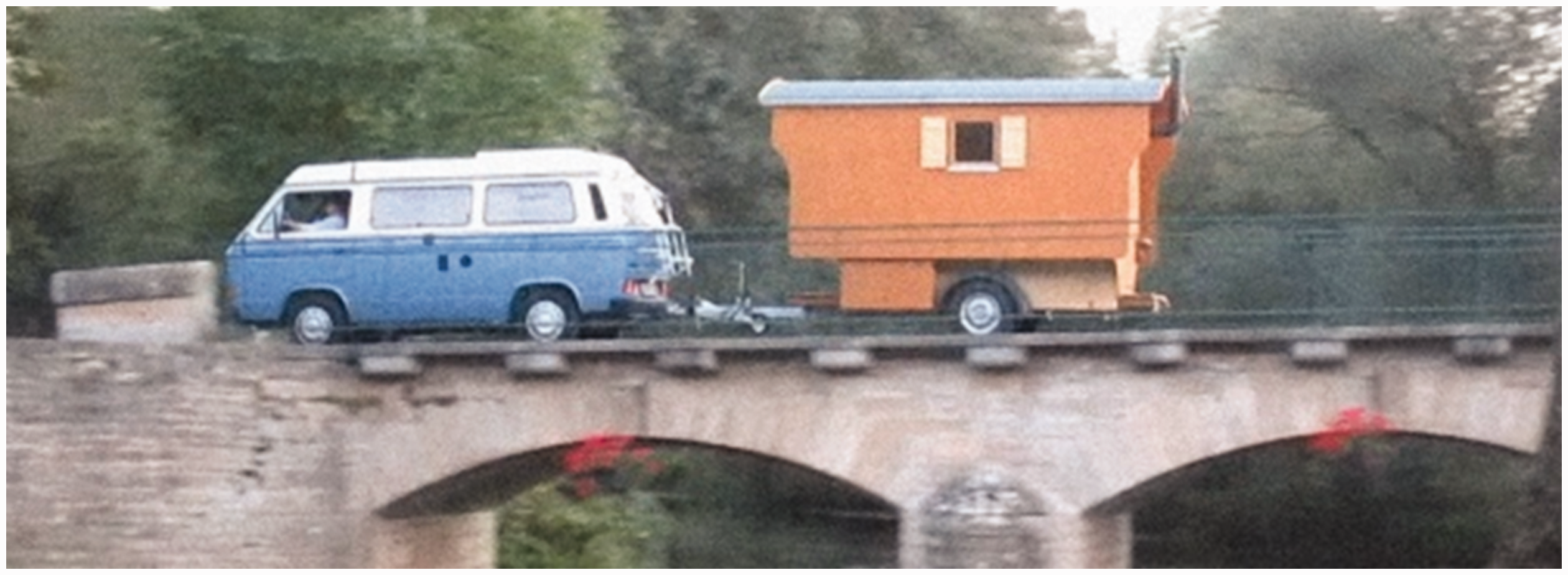
Visual 1: The Welcome Hut ‘dream tank’ en route: symbol of freedom.
The starting point for a new intervention is most frequently initiated through the personal experience of an individual or a small group of colleagues who have entered the tiny house shepherd’s hut. In the picture above, the car and the shepherd’s hut are on the road to a new partnership. This photograph has a symbolic dimension that could reflect a holiday travel rather than a social intervention. The word utopia, etymologically speaking, signifies a non-place, hence refers to ‘coming out of nowhere’. In a similar way, the Welcome Hut enters the symbolic world of social and community work from some mysterious but also intriguingly unclassified world. The disruption through visual codes that could also fit into a tourism brochure creates this dreamy presence-in-transit that pops up from a far-away land. From experience, those social workers who will get involved with the approach will have enjoyed telling life stories in the hut at a cultural festival, in front of a public library, at activist events or when the own children talk about the tiny house visiting their school for a media pedagogy/citizen journalism project week. This encounter sparks the idea to bring the hut to the own workplace. I witness that social workers very often connect enthusiastically with the tiny house approach and its experiential dimension during personal leisure time or off the daily work context, with the own family and away from clinical contexts. This can also be an organised, deliberate time out through Continuing Professional Development seminars where the shepherd’s hut has been invited by a network or federation. The initial step for building new partnerships therefore takes place through word of mouth between colleagues as well as through a constant presence of the Welcome Hut project at non-clinical, public events ranging from adult education to street art festivals.
Phases of a Welcome Hut intervention 2: Reshuffling institutional imaginaries
In the initial phase where ideas spark, professionals discover to what extent they can temporarily reshuffle the own institution beyond usual service divisions and roles in their internal hierarchies. Once senior management and Estates officers have given approval to the hut project, a new working group might form around a shared hope and passion – rather than duty – to host the hut and initiate new collaborations and institutional change. While the tiny house is frequently invited to disrupt the anonymity of the public space for reaching out to isolated parts of a community, a first type of relational disruption already starts intra-muros, a long time before the hut arrives at the premises. While the hosting of the hut is very frequently a one-off experience in an institution, the role as tiny house practitioner in the first project meetings is to encourage novel directionalities for dialogue inside the internal work routines. The remit of the vagabond facilitator does not follow a linear logic but necessitates empathy, intuition, improvisation and the capacity to trigger conversations in settings that were historically framed by sector distinctions and hierarchies rather than interdependencies and horizontal co-design. For each planning meeting, our team suggests to the project lead to invite other stakeholders from the community such as local artists, museum staff, representatives of citizen groups and/or refugee communities who are not habitually included in this social service’s activities.
In this planning phase, project partners define the challenges on an existential as well as spatial dimension in their own everyday practice: Which are the core values of the organisation and in which locations can they manifest? Which element of the institutional vision is currently not implemented? Which areas of the geographical location are too remote to reach from within the own walls? The answers to such questions provide elements of a new narrative that can be communicated through the very visible presence and dynamic appearance of the tiny house in the public sphere. What can initially seem like a short community mapping process to define the locations where the Welcome Hut will be installed can often transform into deeper reflections on the organisation’s future geographical and educational positionalities. A mobile intervention allows potentially limitless sites of outreach inside a distinct area, but each choice of location also carries certain values and stances that can be explored in more detail. Inviting the hut into a district park or at the entrance of a housing estate will provide other encounters than an installation in front of a central library. Just as it can be claimed that education is never neutral (Freire, 1993), the choice of the setting in which a street-level presence will be embedded does not have to be conceptualised as neutral either. Institutional values, localities and techniques for outreach ideally match an accessible, bottom-up purpose for social transformation.
Phases of a Welcome Hut intervention 3: Translanguaging for an audience beyond social work
As mediator between the institutions and the public sphere, the role of the Welcome Hut is also to be engaged in a constant translation process between the often-clinical vocabulary of social services and a more enchanting institutional mission that can convey values and virtues in the streets. Not only the community will engage in storytelling inside the hut. Before the arrival of the micro-venue for storytelling, the professionals have the opportunity to reflect on the own story they want to tell by hosting the mobile space and advertising the event. The excitement of hosting the hut helps to engage differently with the own professional identity and renew the own mission statement in order to reach out to the street with a local message carried from location to location by the vagabond shed. An aim can be to move service provision from the deficit-oriented models and agendas to strength-based narrative situated in salutogenesis (Antonovsky, 1996) as the social science of emerging health rather than persisting pathology. The Welcome Hut interventions are often framed around existential themes which are applied to personal experience, not theory: dreams, hopes, joys, feeling of belonging and inventories of lived or imagined community initiatives. The visual below shows an example of Welcome Hut communication tools that playfully rearrange symbolic representations: mobility, tea time and conviviality as elements of everyday life are reinstalled in unusual ways. Art and design can have significant influence on social interactions. Extended concepts of art that deliberately stretch the boundaries of museums and institutionalised art such as ‘social sculpture’ have been used in social work contexts (Alfreds and Aberg,2017). The mobile sheds and associated imaginaries provide occasions to redesign the own life worlds and discover the plasticity of work routines. The hut’s physical and mediated presence is a visible, but deliberately tiny, quiet and non-spectacular protest in everyday life ‘that reshapes and re-forms our subjectivity, the way we communicate, our social structures, and by extension, the world we inhabit’ (Biddle, 2014: 25).
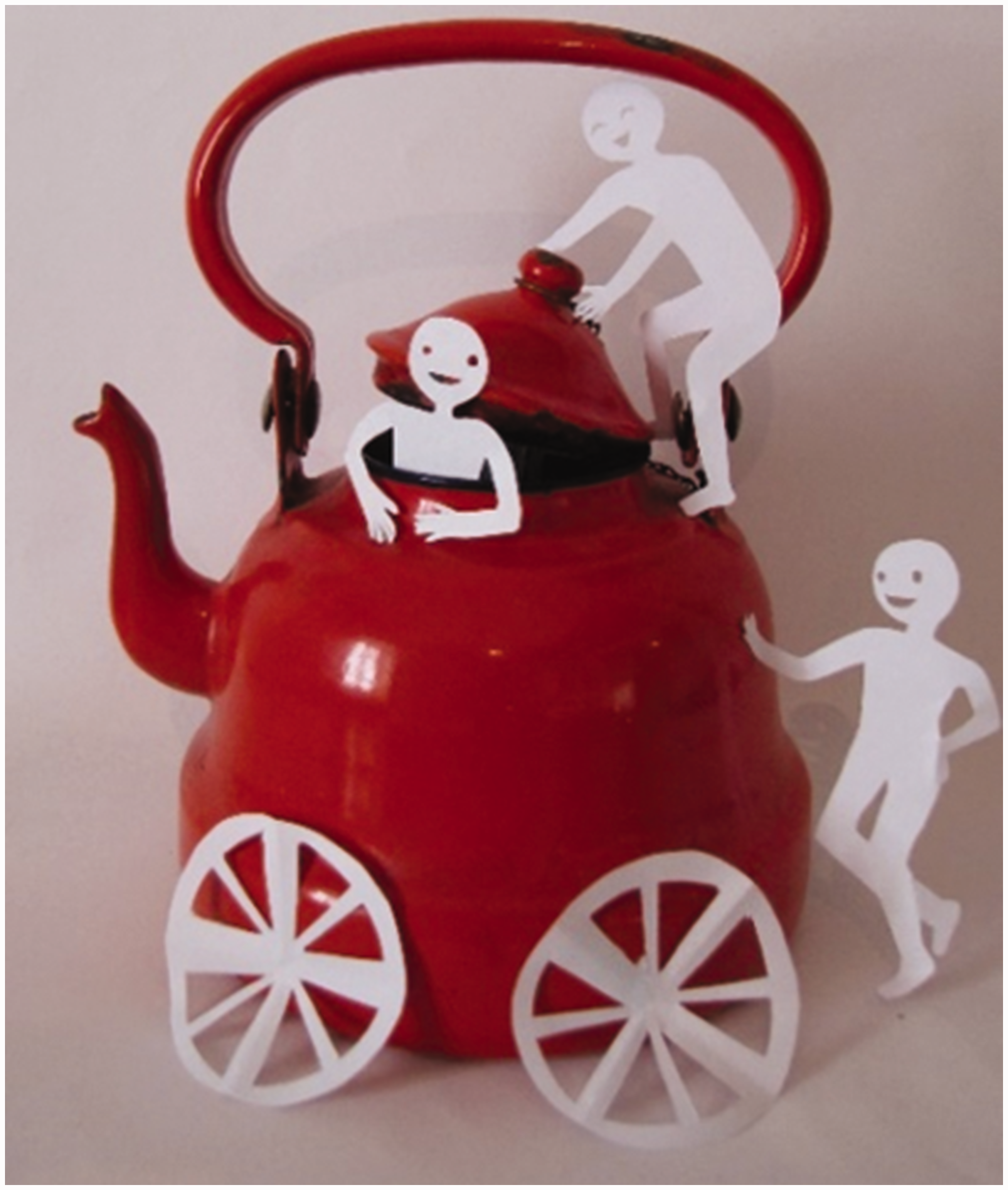
Visual 2: A visual for posters (idea and art work: Roseline Bucher).
Phases of a Welcome Hut intervention 4: Encounter
Preceding the arrival, the host network mobilises its networks through social media, posters, flyers and other types of announcements. At first, the installation of the tiny house in its designated areas triggers curiosity or suspicion, and sometimes both at the same time. The hut is usually open for 6 to 8 hours (a.m. and p.m.) without breaks and as a drop-in. The disruptive installation acts easily towards dialogue, establishing connectivity because of providing a pretext for locals to talk to the project’s facilitators or to each other in order to find out what this pop-up public shed is all about. The experiment of ‘relational disruption’ did not emerge from a wish to confront, oppose or de-institutionalise the field, but from the goal to create a listening institution that meets, becomes attuned to and makes space for those who are on the ground in a specific locality each day. The combination of an artistic pop-up experiment in the public sphere with a critique of structural binaries in social settings is also informed by an ethics of care based on Emmanuel Levinas’ philosophical writings about alterity: In a counter position to the universalistic humanistic stance of Carl Rogers towards ‘the Other’ as needing to be one of ‘genuineness, empathy and unconditional positive regard,’ which has long stood for the basic principles of the helping relationship in social work, a Levinassian perspective starts from the impossibility of knowing the Other. For Levinas, the primary philosophical obligation is an ethical responsibility towards ‘the face’ of the Other; a continuous striving to turn to the Other, while knowing and accepting that we are not the Other, nor can ever be. Striving towards the Other is both an obligation and impossibility. And yet, this striving must persist as a movement of respect for the alterity of the Other, i.e. the Other that I cannot reduce to myself to, or fold upon myself as one and the same. (Chambon, 2013: 125).
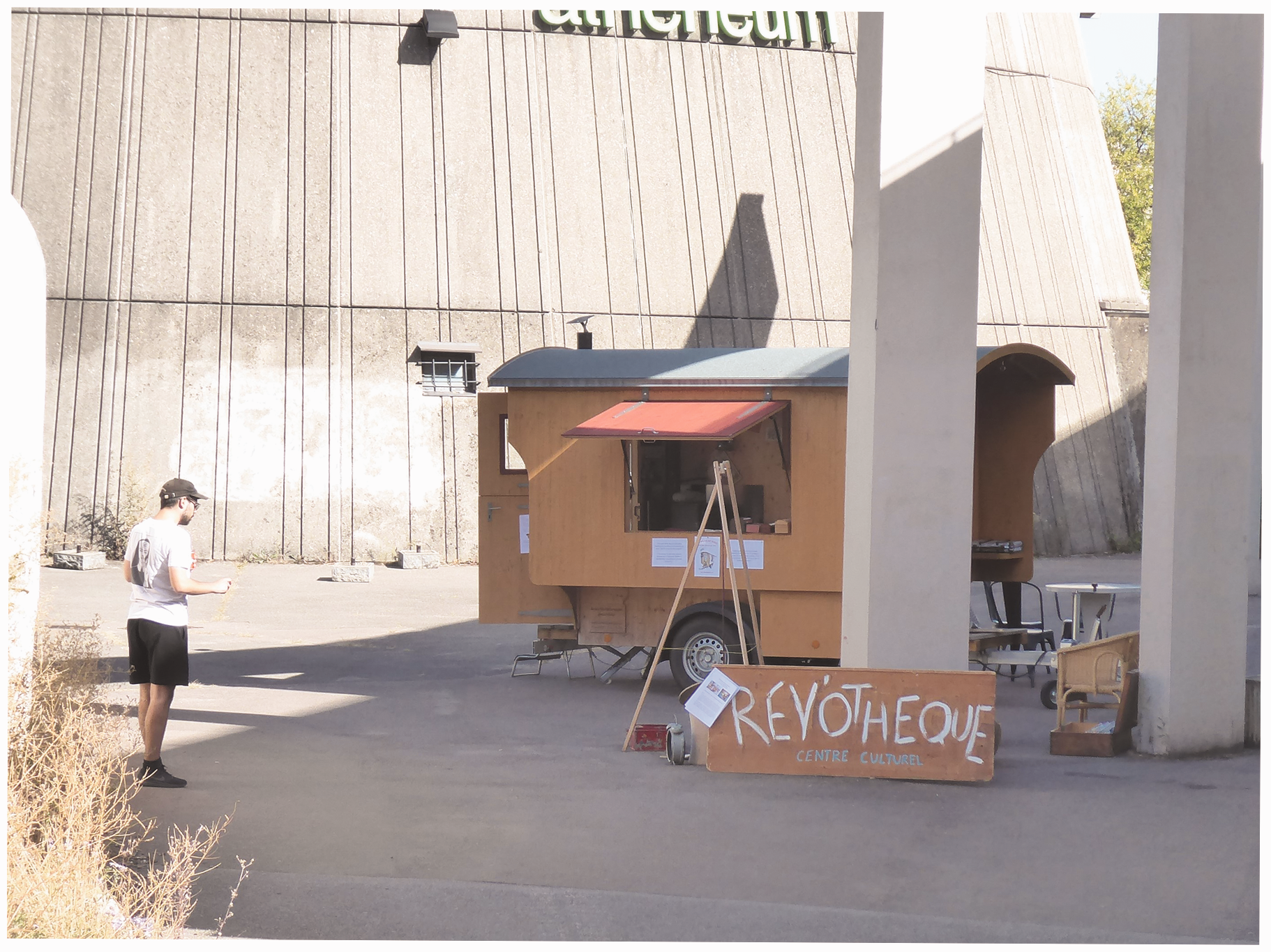
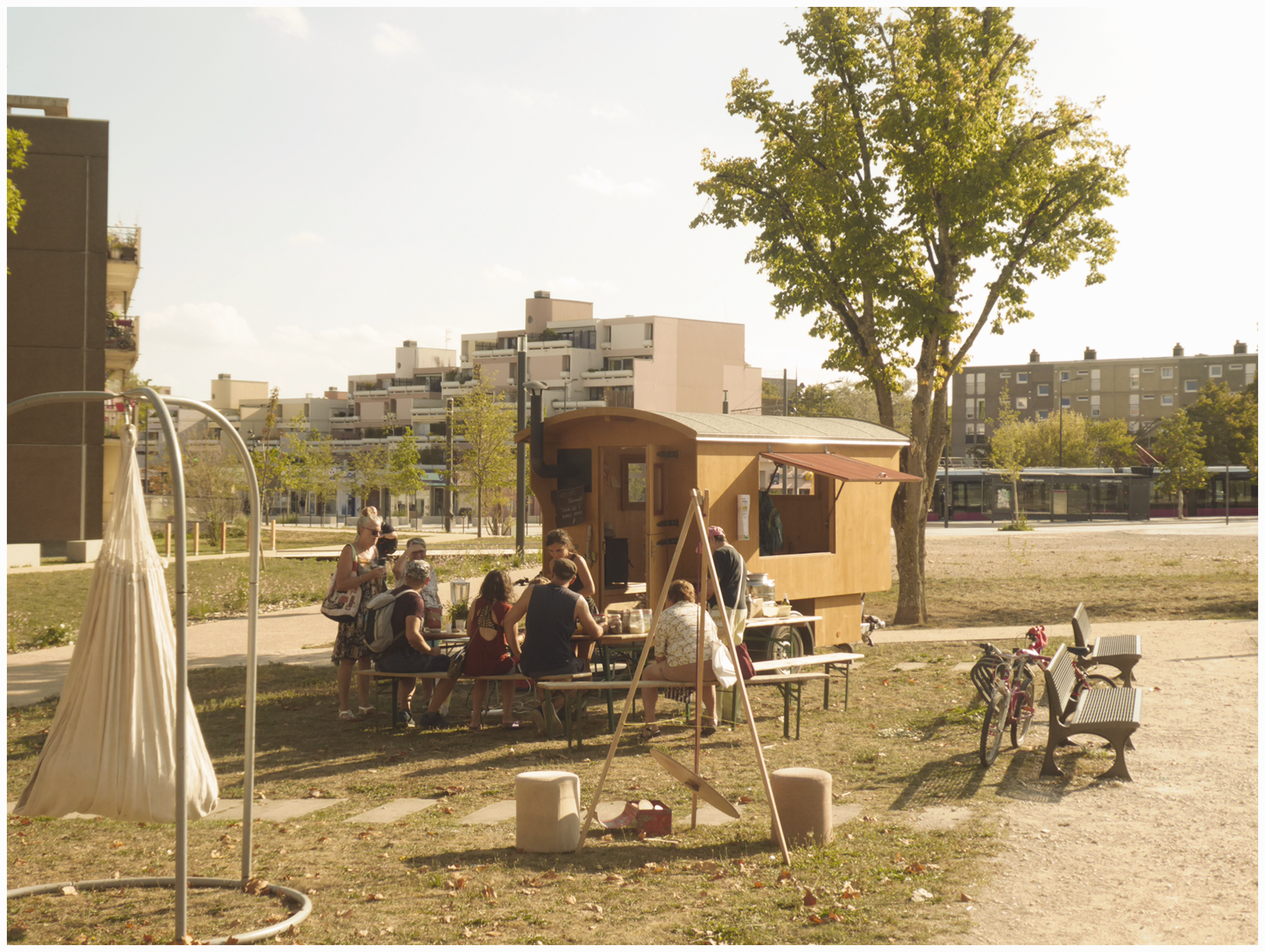
Visuals 3 and 4: The hang out space with intriguing objects and hammocks.
As shown in the above photograph from urban and rural community projects in France, a deceleration ambiance is created around the shepherd’s hut. The open-access installation communicates stillness and caring attunement (Conradson, 2011). The pedagogical landscape around the tiny house invites to slow down and provide a space to just hang out without having to engage in any activity. Encounter is allowed to start with silence or retreat into one of the outside hammocks. This invitation to engagement allows the possibility of disengagement. This absence of pressure to perform collective belonging invites to open up to daydreaming, to relax in the presence of strangers and to let the own ideas flow. The experience that I simply call ‘collective cocooning’ can come unexpected to some visitors who are not used to relaxing in public. The right to retreat and to have access to a profoundly safe environment which communicates ontological security is distributed unequally in stratified societies where gated, privatised communities flourish, but only for the affluent few (Low, 2005).
A large selection of more-than-cognitive, artistic, oral history, multisensory and play methods help every individual to find their own activity, or indeed a deliberate non-activity, within the hut perimeter. The pluralism of outcomes is ensured through the pedagogical freedom that stems from unevidenced daydreaming. The spatial openness and fluidity of this public pedagogy are extremely important as the stance here is to open spaces rather than occupy them with obligatory processes, curricula or change agendas. There is a possibility for a group of strangers that happen to meet in the public shed to engage in narrative arts. The facilitator does not seek to predefine the civic shelter through a hierarchy of activities and outcomes, but safeguards to keep possibilities of spontaneity in these organic flows of intergenerational encounter.
Phases of a Welcome Hut intervention 5: Collective storytelling
Only if the visitors feel at ease and settled in the hut environment, the Welcome Hut facilitator might distribute small boxes with existential questions that can be read aloud by each visitor. There is no obligation to answer. Everyone receives a philosophical and a more personal question about dreams and motivations or local activism. It is the group that directs the process and the facilitator simply introduces the storytelling and reframes discussions for the rare cases when participants want to leave the project’s remit of asset-oriented sharing to enter the domain of trauma and therapy. From 2009 to 2014, I have completed training as a humanistic–existentialist counsellor and this training has profoundly shaped my skills for facilitating the Welcome Hut. However, I do not present the Welcome Hut public sphere experience through a role of counsellor. Equally, while the stories in the Welcome Hut are not narratives of psychotherapy, these stories can still have therapeutic ‘side-effects’. Questions as a form of non-clinical ‘existential care’ can be:
Imagine you meet a magician who will allow you to fulfill one of your dreams. This wish however needs to be for the common good. Which changes do you dream about to improve living conditions in your district or community?
Imagine you win the lottery of time management. Each week, you have 24 hours more to use. What would you do with an 8th day in your weekly routine?
We all have met people who talk us out of our dreams. What is the best way to react to those ‘dream-breakers’ who say on principle that our ideas are not realistic?
Outreach through story is then close to co- and peer care in the neighbourhood and is inspired by narrative resistance (McKenzie-Mohr and Lafrance, 2017) as a collective, political and psychosocial rather than psychological way to own or reclaim the personal life narratives. The authenticity of a gesture of welcome and hospitality will allow participants to take part in the hut experience in their own ways and share a glimpse of trust. Imitating an expected style and token format of life story can for example be expected in institutional procedures for refugee applications (Nouvet et al., 2017). The hut methodology therefore provides a mobile breathing space for a poetics of difference, inspired by Young’s politics of difference (Young, 1990) and imagined through narrative arts. Due to experiences of having been silenced before, a personal voice needs spaces to express itself quietly and timidly. The picture below shows the setting in which discussions around the wood fire stove can take place. Stories are artistically expressed and owned by the participants and are not recorded and published by the Welcome Hut project. Some video recordings focusing on this setting for citizen voice, but not necessarily with sound, can be found through project’s website: www.thewelcomehut.com
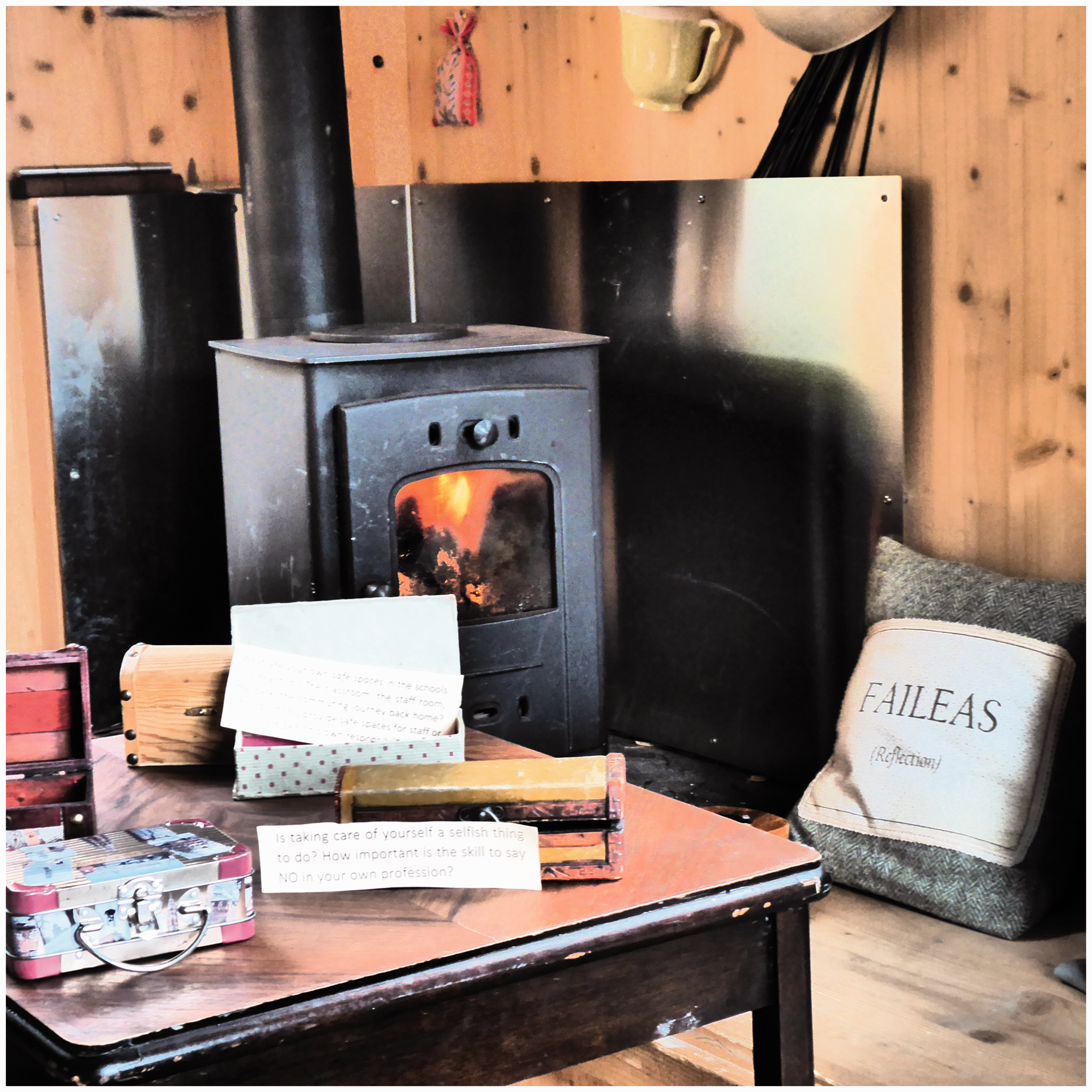
Visual 5: Settings for citizen voice – one of the many storytelling moments.
Phases of a Welcome Hut intervention 6: After the tiny house visit
The Welcome Hut is an arts-based ‘trigger’ but not a permanent part of a community’s public sphere. The preparation phase will have established ways how the temporary disruption through the hut can spark long-term and sustainable shifts in institutional practices and outreach dynamics. The arts and crafts that can be cultivated through hosting the tiny house allow to imagine processes beyond walls, which ideally continue to make their way inside and beyond the institutional walls when the hut visit is over. The institutional partners can provide orientation, tutoring, mentoring in order to formalise ideas for those locals who want to go ahead with the dreams that emerge in the hut. Evaluation talks between the Welcome Hut team and the host organisation take place shortly after the visit.
Mapping the practice
A cross-sector intervention model (below) allows to situate the Welcome Hut itineraries in their decentralised spatiality. At the centre of this map is the core activity informed by an invitation to simply be in a unique space, rather than an outcome-oriented focus. This experiential approach is centered around the wood fire stove and the way visitors of the hut sit together in a collective setting of shelter and intimacy, defined as a spatial experience and not primarily defined as an activity.
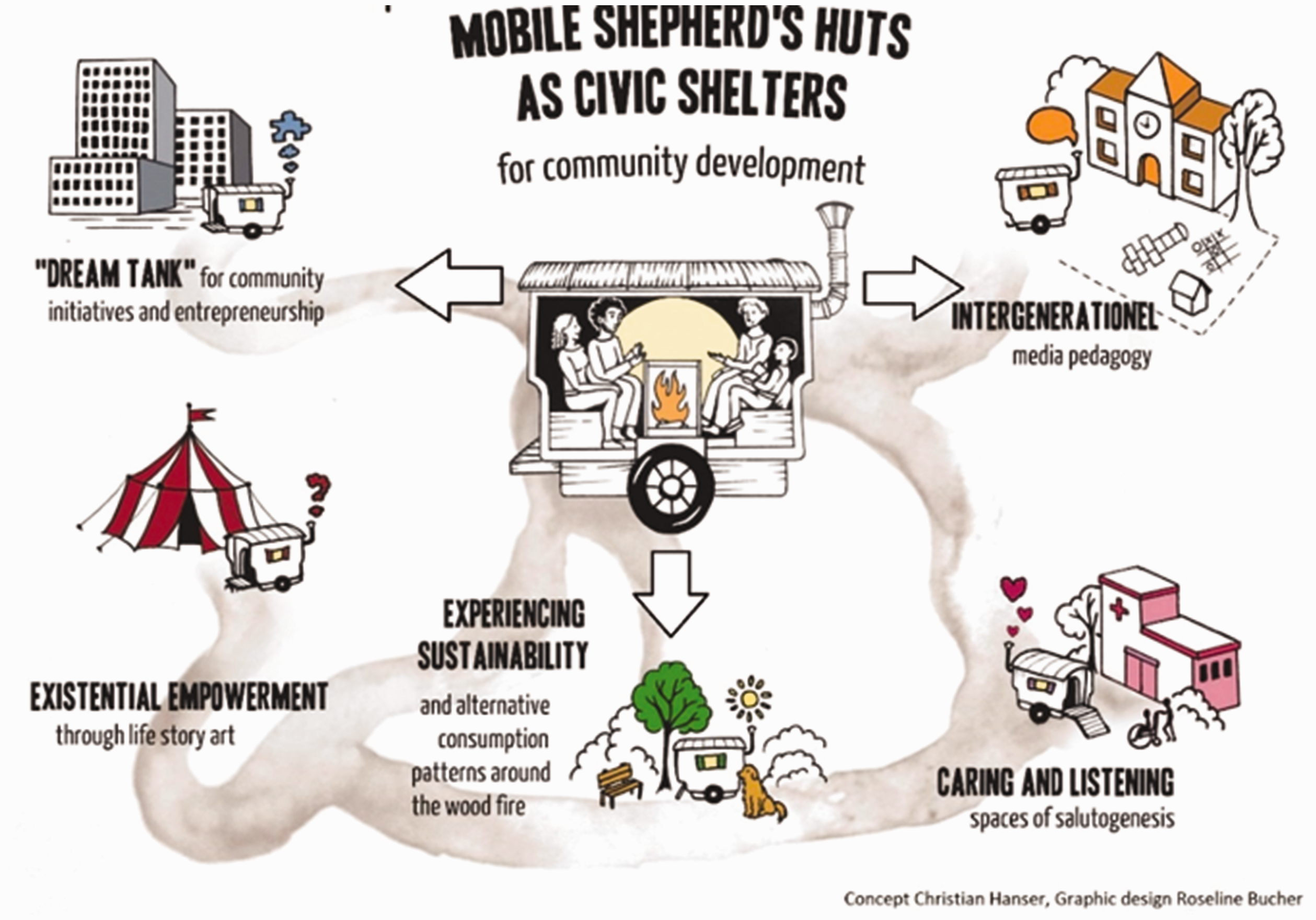
Visual 6: Cross-sector map of a practice founded on wheels.
The shepherd’s hut then roams the paths to different institutional semi-belongings (from left to right: housing estates and community work, cultural social work through festivals, outdoor and experiential education, hospitals and the wider health care sector and schools). The Welcome Hut’s multidirectionality makes it impossible to pin down one clear macro-level location. No single social work field has been willing so far to fund the Welcome Hut in its integrality: it is through multiple connections and funding streams that the model has become financially sustainable. The hut is destined to move back to its own middle, as the vagabond practice is at all times already located at the foundational micro-level. The hut itself, the sitting together around the wood fire stove represents the one stable locatedness of the approach.
The destabilising purpose of sites of in-betweenness
A methodology beyond the own walls can allow to shift the professional focus towards community hubs. These address alienation by allowing the expression of sparks of singularity, utopia and existential meaning. As a method requiring geographical movement and existential mobility, the feeling of resonance and trust inside intermediate zones of alterity can install itself by asking each stakeholder to take a few steps out of the own comfort zone, letting go of certainties for the sake of embracing the own ambiguities. Accepting in-betweenness becomes a flexible stance accommodating a fluid societal future. It is like re-entering the daily workplace, the familiar house that represents the own organisational routine and professional belonging, but entering it all of a sudden from a different street and from an almost invisible, ‘out-of-nowhere’ back-door entrance: ‘This is an “in-between” state, a sense of normlessness that arises from moving from one state to another (Turner, 1969). The doorstep, hallway and porch carry danger, because they straddle the threshold between public and private worlds, they are neither in nor out. Within them, we experience the world differently, we quite literally do not know where we stand’ (Ferguson, 2018: 70). Giving attention to this messy and unlocated voice initially triggers the feeling of shaky transition, but in this process one can work through imbalance to find a temporary rest: from everyday professional otherings experienced ‘at home’ when the norm and business as usual maintain their very own exclusions and divisions. One is obliged and encouraged to find new reference points in the surroundings permeated by alterity and gradually works out togetherness by communicating differently: ‘do we learn, develop and use social work as a way of bringing people together to create stronger collectives? Or is the discipline used as a way of identifying vulnerable groups as problem populations? And has our knowledge the effect of distancing ourselves from “them?”’ (Chambon, 2013: 123). When the category of ‘them’ loses grip and fades out in the fragile, liminal zones of mobilities, co-migrations and a tacitly accepted ‘them-ness’, a new fertile interstice for inclusive redefinitions of ‘us’ emerges. It is through this interstice that my itinerant shed space has been able to ‘sneak’ into the field of social work.
From a business plan to an existential compass
One factor for being successful in entering the field of social work through finding my own interstice-backdoor into professional recognition is the short insider perspective I had previously acquired. In the year before acquiring the first Welcome Hut caravan from personal savings I had signed up and audited Master of Arts degrees in Social Work in 2009 after already having graduated with an MSc in Adult Education. I saw social work as perfectly complementary to my theoretical background in emancipatory Freirean adult education (Freire, 1993) to combine transformative pedagogies with crucial practical anticipation: ‘It is much easier to be a realist about what exists than about what could exist, and much easier to dream of a better world without worrying about the practical problems of unintended consequences and perverse dynamics’ (Wright, 2007: 27). What I remember most vividly from the last of these semesters in Social Work in continental Europe is the struggle of many students (including myself) with abstract diagrams and the need to develop an extensive business plan for an imaginary idea as social innovator in order to validate the degree. I had my conceptual idea ready to be tested, but the longer I worked on fitting my idea into graphs and numbers, the more a feeling of alienation overcame my brief social work student experience. The business plan had the overarching status of a foundational skill for the social work training but also seemed to mirror existing managerial realities rather than unsettle them. The legitimisation of what constitutes an innovation was too docilely embedded in diagrams and too smoothly awarded through internalising the rhetoric of the funding status quo: ‘As Edmund Burke remarked, “to innovate is not to reform!” (Oxford Dictionary of Quotations, 2000) certainly, we must not fall into an uncritical romanticisation of any research practice because of its novelty or technological prowess’ (Phillips and Shaw, 2011: 610). Does social innovation then emerge when we do what the status quo of funding tells us? At what stage is the business plan the virtuous guide and at what stage is rejecting the dance with predefined rhythms of technicity justified, for the sake of pilgrimages towards experimental imperfections?
The strong reliance on impact measures and corresponding metrics fuels contemporary debates in the field of social work. Through the shepherd’s hut approach, I have recently been given the chance to integrate my decade-long detour from the business plan model into degrees in the Social Sciences. I would describe my contribution as a form of ‘existential care’. Despite the constant advancements in care technologies and more and more efficient models for health care provision, a gap seems to widen as professionals in the social and health sectors, including social workers who are silently thinking of quitting the profession, do not see the diverse benefits inherent in the fields of social work but feel alienated by static protocols. The temporary ‘dream tank’ of the Welcome Hut addresses professional belonging by looking at major causes for loss of meaning, alienation and low retention rates in the own field from an existential perspective. It may be an ‘existential vacuum’ (Frankl, 2006) that emerges when the idealism of entering the social sector meets the realities of the field. According to existential approaches to burnout and depression, personal struggles relating to aimlessness, futility and the incapacity to find meaning in the environment surrounding the modern worker can drain out and block social workers’ radical social imagination: ‘there is so much scepticism among people who are convinced of desirability and willing to participate in the political work to make alternatives achievable, but have lost confidence in the workability of visions beyond the existing social order’ (Wright, 2007: 32). Programmes and projects that are guided by technicity can miss out at the challenge for a much bigger picture in the profession: ‘I think the idea that social work has become bureaucratised and dominated by record-keeping, sticking to tight timescales imposed by government guidance, and so on, has had a pervasive impact on how social work sees itself […] It seems to me that one implication of these kind of findings is that social work departments need to become more attuned to what their workers are doing – the narrative has to change’ (Ferguson in Turner, 2020).
Existential fatigue can be prevented by developing the individual worker and the peer network’s ability not to compromise on the spaces to imagine anew and therefore reject the confines of dominant neoliberal trends. This is a shift from institutionally expecting individual resilience towards cultivating peer zones of resistance. Even in managerial macro-systems, alternative micro-methodologies can survive and make zones of freedom visible that exist at the border zones of stimulus–response metrics and audit cultures: ‘Human freedom involves our capacity to pause between stimulus and response and, in that pause, to choose the one response toward which we wish to throw our weight’ (May, 1975: 100). The future tasks in tensed social systems can then shift from continuously acknowledging dysfunctions (something we do very well, and sometimes excessively), to cultivating the art of pausing. Temporal sanctuary and temporal insurgence (Sharma, 2014) in an accelerated society helps to reactivate an imagination beyond what we already know and to nurture a constructive culture of risk-taking for social change. Social work students can then be encouraged through ‘existential care’ to temporarily dwell in oases of imaginative freedom to develop their own stance in the world. Instead of focusing only on elaborate business plans to trim fragile ideas already at the qualifying stage of social work education, students can be given the space to develop their own tailor-made and peer-supported existential compass.
Social work as the designing of in-between zones of encounter
In the early phase of the Welcome Hut projects (2010–2013), I worked exclusively in the cultural sector as a community artist, not in horizontal social work partnerships. My explanation for this is based on the feedback that I received for frequent applications to social services in these years, when I suggested the installation of the hut in organisations’ courtyard. The choice to offer storytelling workshops in a wooden shepherd’s hut inspired enthusiastic feedback in artistic networks, with public libraries and community education, but my proposal for a shepherd’s hut day was met with hesitation and even suspicion in highly institutionalised social work contexts. The benefits of working inside a wooden wagon were not clear to service managers.
Bank and Nissen have pointed at the inevitable cultural dimension of standardisations in the context of clinical, psychoanalytical work environments: when we ‘look at pictures and descriptions of Freud’s actual therapeutic setting, we see a space filled with cultural reference; archaeological items, figures, handwoven carpets, books, and other paraphernalia, a heavily impregnated cultural space’ (2018: 518). Chambon highlights the ambiguity with thinking about spaces as neutral, particularly in-between places of encounter as somewhat unaffected by a wider cultural and political embeddedess: ‘Is the middle a neutral place? Or a wish for a neutral place’ (2005: 4). Human geography also highlights this need for novel and more complex ways to perceive the in-between, relational and inclusionary spaces in mental health practice (Parr, 2008) and social work’s dealings with mobilities (Roy, 2017). Jeyasingham (2014) suggests that the role of space ought to be considered as much as processes in social work practices. Making space for the possibility of a novel work setting, even if this comes with bulkiness and suspicion, helps to bring the cultural and spatial bias attached to any type of space to the foreground and to then subsequently discuss it.
The tiny house has lately become a very effective invitation for networks of social workers to think of the multiple ways how mobile interventions can be designed, inspired by but also different from established practices such as home visits and street outreach. There are many parallels for the social worker in hosting a visit of the Welcome Hut and spending a day on home visits: ‘what goes on in the home visit is characterised by its difference from the experience of working in the office. The journey from the office onto the streets and into the home requires workers to make a transition from a static experience dominated by being seated in front of the computer screen and based on use of the mind rather than the body, to an experience that is mobile, deeply sensory and embodied’ (Ferguson, 2018: 72). Ferguson, in his article asking for a social science of home visits, also cautions to perceive a home visit as a mere extension of social work protocol into the domestic sphere, or as a colonisation of private life worlds. No two home visits are the same (Pink et al.,2015) and there is no blueprint for creating the rare space where singularity can surface, which can allow to feel at home, and dwell in shelter.
Community outreach workers and office workers are then invited to come together by co-creating improvisation and transformations in the in-betweens: ‘Community workers have, since the settlement movement at the end of the nineteenth century, tried to develop socialspatial perspectives on and responses to segregation and vulnerability, without succeeding in making a decisive breakthrough in reshaping the mainstream of social work. Regardless of this fact, community workers must also revisit and renew their own theoretical thinking and practices in a transformed world’ (Turunen, 2017: 181). Vagabond disruption allows professionals to critically assess the possible own adherence to sedentarist orthodoxies of social work. Social work in liminality then becomes a work-in-progress, a form of art, an act of home-making in inventive versions of temporary belonging. Professional territories do not only preserve clear-cut boundaries and borders, but are ‘co-constituted, folded together, produced through practices, situated, multiple and mobile’ (Amin, 2002: 389).
The freedom of orientation in pressures of scaling up
By being a vagabond social facilitator rooted outside of the social services but asked to complement their work, I had the freedom to formulate my own professional stance of how this space for being more than doing can be applied in the midst of a rhetoric of efficiency. This has allowed me for nine years to simply listen to and engage largely beyond time constraints with the multiple literacies voiced or silenced in public spaces. While the Welcome Hut project received major funding for a first tiny house shepherd’s hut financed by the public service in France in 2017, the entry into the possibility of large-scale social innovations also brought its challenges. On the one hand, there is a clearly identified move to site-specific, area-based approaches in social practices (Atkinson and Kintrea, 2004). On the other hand, experimental approaches which carry the transformative potential for decolonising spatial practices towards the geographies of singularity (Jazeel, 2019) clash more or less overtly with the functionalist realities of the status quo. Having coordinated the journey of the Welcome Hut, it feels as if a practice that has been successful because of its uncompromising stance of non-efficiency through daydreaming was now asked to become a prototype for impact, transform into a hospitality product rather than practice and only simulate daydreaming, emancipation and utopia while actually governed by visitor numbers, not people’s actual and qualitatively evaluated experience. Operating in an incoherent large-scale mode seemed to dilute the deeper and more transformative experience of the years before the innovation-award spotlights. Even in the vagabond stance driven by negotiation, reconciliation and flexibility it is not always possible to combine the best of all worlds without sacrifices.
Spaces and processes are intertwined (Kraftl, 2013). The preservation of the project’s initial values for a larger and long-term practice model demands additional time, specialised training, readiness for ontological disruption (Nicol and Sangster, 2019) through research. Learning the art of hosting, taking time to witness a space before occupying it, offering a non-formatted presence beyond scheduled events, all of this appears not to be a priority in agendas for immediate policy impact. But a vagabond methodology loses its magic if institutionalised at the speed of policies’ narratives of urgency rather than at the pace of its intrinsic human and more-than-human ecosystems (Bronfenbrenner, 1979). Our team’s future route with the Welcome Hut project, based in France and in Scotland, is to train, accompany, research and ultimately encourage other small-scale formats and ‘tiny disruptions’. A horizontal network of itinerant facilitators corresponds better to the initial ideas than a vertically established, centralised franchise of dream huts as cabin-kit-containers. The choice to preserve singularity in pressures of standardisation has allowed the practice to move further down the road into a research methodology whose full structure and destination has not and may never be fully defined. Preserving this latent welcome of uncertainty is promising as it keeps a window to new understandings of geographies of singularity open: ‘The singularities to which I am referring are simultaneous with one another, they are relational too, but they are discontinuous with our conceptual systems. We do not have the language for them, which is not to say these singularities have not yet emerged. They exist, but in radically different epistemic domains. This is what makes them singular and incomparable in the concept world we inhabit’ (Jazeel, 2019: 9).
The move to the other
Social work research is inevitably concerned with alterity. One question demands constant revision: ‘Methodologically, how as researchers can we make that move into the text of the other?’ (Jazeel, 2019: 9). New texts can be co-constructed. The tiny house allows an unfolding of stories that are co-constructed each day. The installation of the hut is an invitation for a shared text which we can enter physically, if one crosses the more-than-cognitive threshold from mastery of the known to improvisation with the unusual. The pictures below show a Welcome Hut session at a highly participatory network event for Social Work PhDs and ECRs in Scotland 2019, organised by members of staff from Napier University Edinburgh, funded by the Scottish Graduate School of Social Science and taking place at the University of Edinburgh.
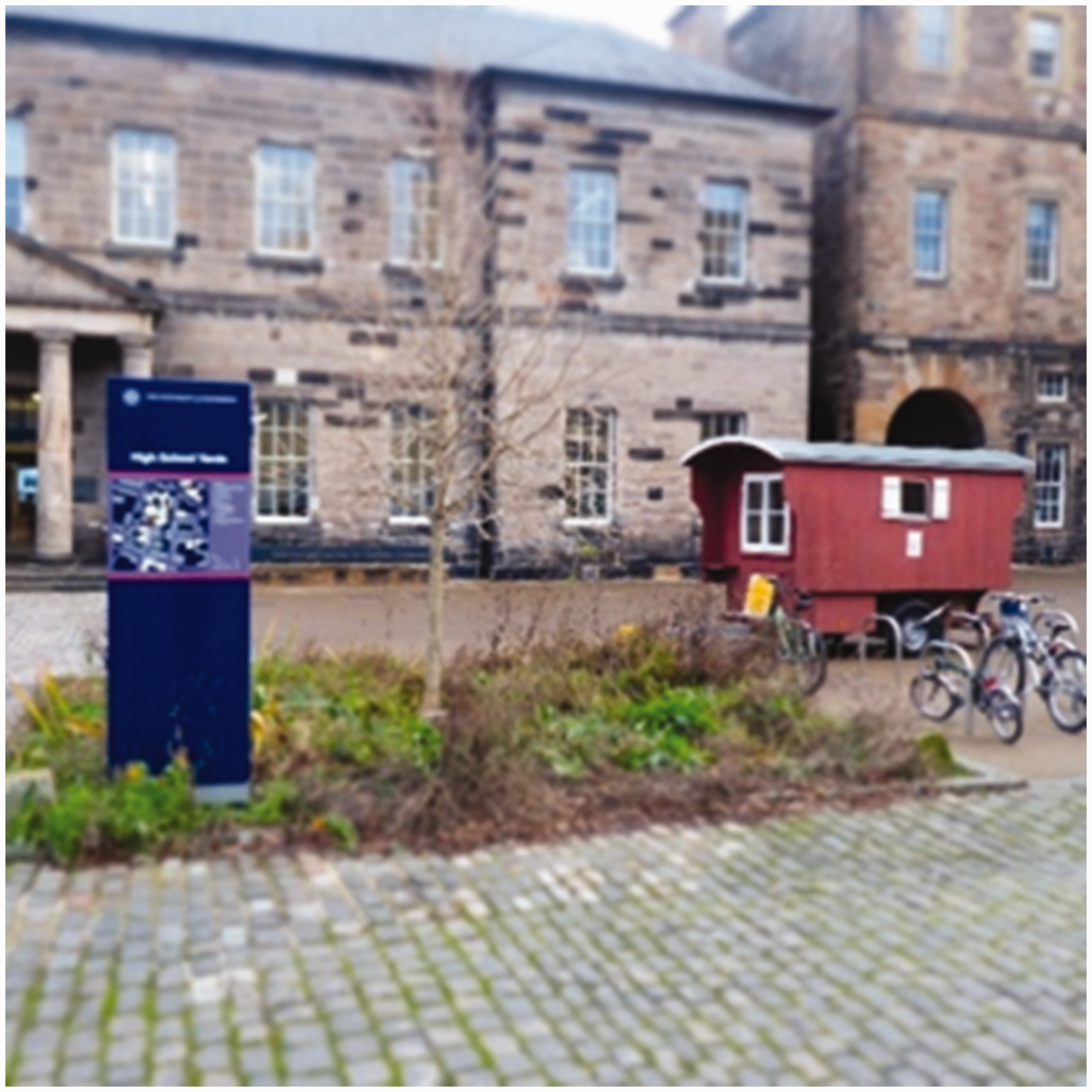
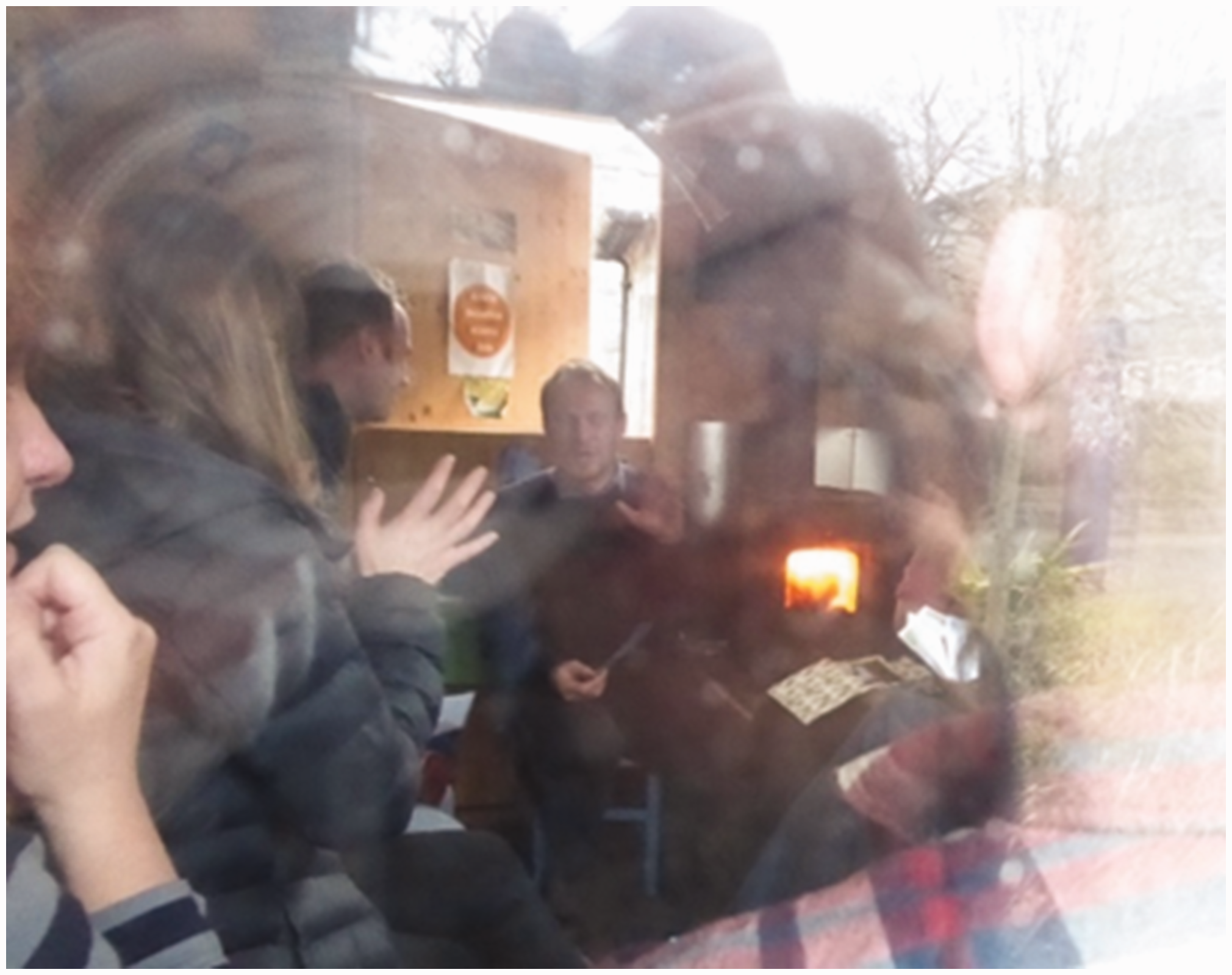
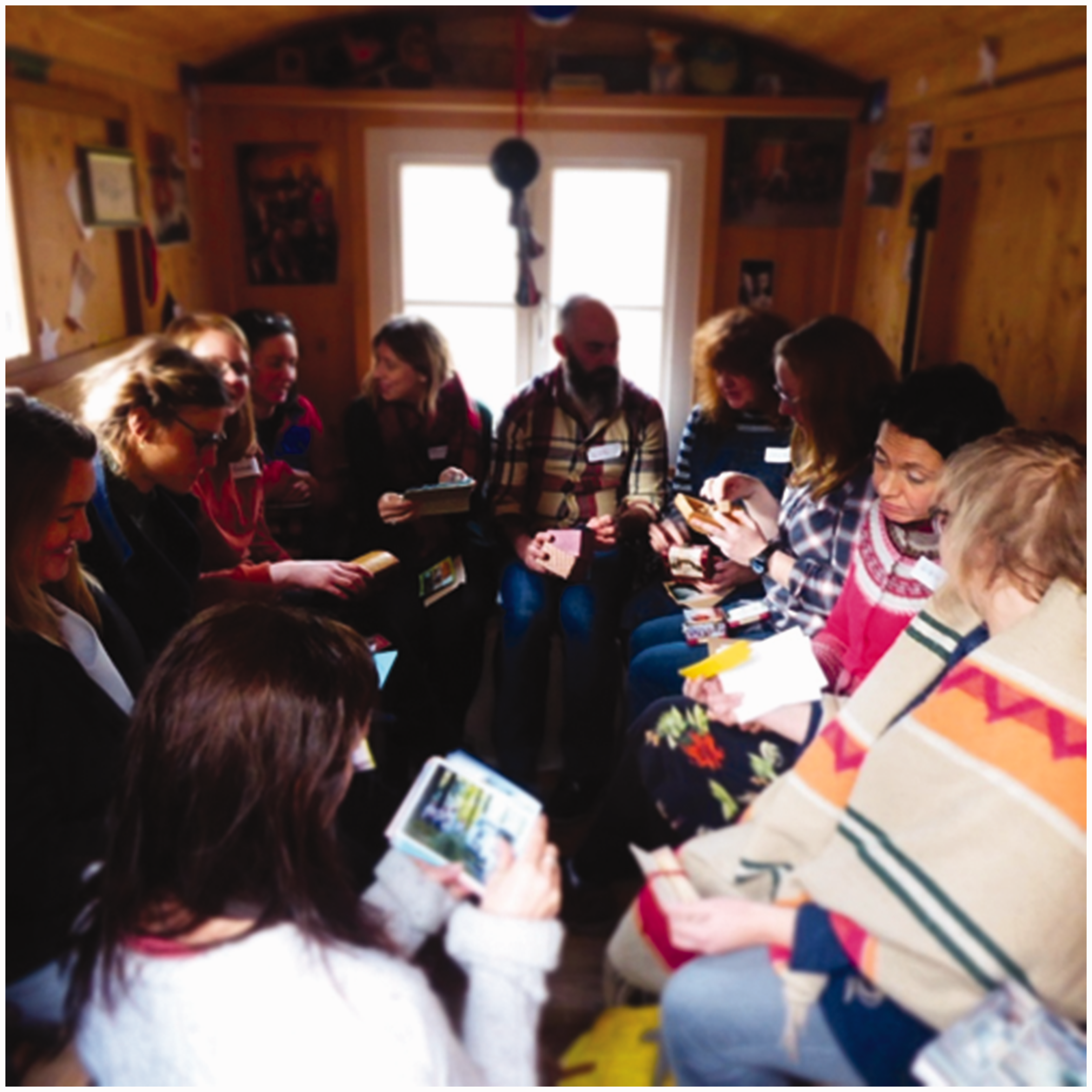 Visuals 7, 8, and 9: Perspectives on the hut at the Scottish Social Work event.
The first photograph shows the outside perspective when participants walk into the event venue and see the shepherd’s hut from a distance. It might not be clear from that walk-by view that the Welcome Hut is part of the event. The second, blurred photograph is taken from outside the hut, looking inside from the window to notice that a wood fire stove is heating the place. The third perspective is the inside perspective, once the outdoor venue transforms into an immersive experience. During this full-day programme in Edinburgh, the hut as a fringe witnessed very different periods. Until half an hour before the end of the lunch break, no attendee had yet come to the Welcome Hut. The inside temporalities between keynotes and workshops were too short to make the way outside into the courtyard of the university campus. But once a first small group of social work researchers including the organising team of the event decided to finish their lunch inside the hut, the peripheral out-dwelling of the event suddenly gained a central position in the day’s activities and discussions. It had not been the hut facilitator who transformed the all-day drop-in fringe into a well-noticed novelty. It had been the group of Early Career social work researchers who made this move to the ‘other’, for having their tea in a dreamy temporary encounter space. Without their mobility, the fascinating discussions about social work futures inside the university building might have gone on without participants noticing the Welcome Hut. The constructive disruptions by the vagabond necessitate reciprocity and depend on visibilities co-acknowledged at the centre. I have written this article as an ‘other’ who has become more and more interested in connecting to social work. This article has sketched out the benefits that the ‘bulkiness’ of the itinerant other can bring to smoothly administered social work contexts. Social work systems’ ambition to act in the most impactful ways according to a pre-established dominant paradigm will then be offered an interlude for breathing imagination: drifting along in the floating clouds situated right next to the profession’s ambitious and evidence-based skyscrapers. The tiny shed-space places poetic, utopian question marks in a public sphere replete with ideological exclamation marks. These are also questions of shelter in a challenging profession.
Shelter from what?
Shelter in which real and imagined professional spaces? Shelter towards which meaningful, and ideally peer-supported destination?
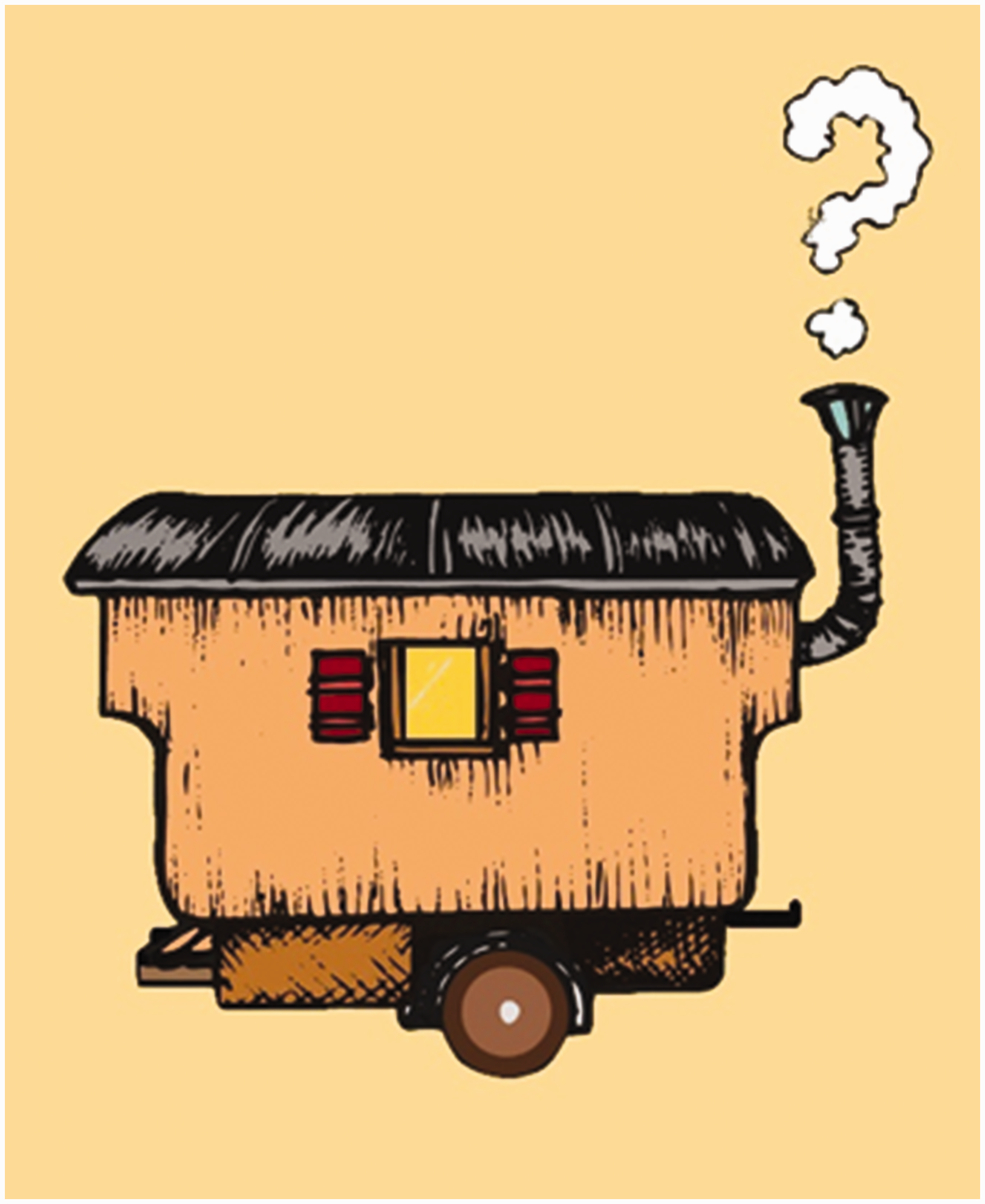 Final visual: Questions marks in a public sphere replete with exclamation marks (art work: Roseline Bucher)
Footnotes
Declaration of conflicting interests
The author(s) declared no potential conflicts of interest with respect to the research, authorship, and/or publication of this article.
Funding
The author(s) received no financial support for the research, authorship, and/or publication of this article.
