




Abstract
Reflexivity is acknowledged as a crucial concept and is pivotal in the methodology of qualitative research. Various practices of reflexivity are adopted in the social science disciplines. However, the concept is difficult to pin down and the challenge for researchers is to address how to become reflexive and do reflexivity in research practice. In social work, reflexivity has further been developed and applied in practice contexts. The practice terms, critical reflection and reflection or reflectivity are interrelated in ways that aim to explain reflexivity in the profession which, in turn, can offer an enhanced understanding of reflexivity applied in research. This exploratory article promotes practising reflection – questioning, analysing and evaluating oneself in employing reflexivity in all the research stages: methodological construction, data collection and data analysis by undertaking three key self-focused activities: (1) thinking about one’s own thinking; (2) observation of emotions/thoughts, role boundaries and power dynamics in research relationships; and (3) exploration of perceptual experiences. Maintaining the reflexive stance is achieved through reflectivity. The article is largely descriptive but draws on experience in a doctoral study of cultural competence and promotes the effective use of reflexivity in qualitative social work research.
Introduction
In emerging discussions around researchers’ positioning in ethnography (De Andrade, 2000; Eppley, 2006; Pillow, 2003) and feminist studies in the 1970s (Hayfield and Huxley, 2015; Pillow, 2010), social researchers have critically considered the role of a researcher’s impact on the research. Generally, reflexivity suggests an awareness of a qualitative researcher’s self-influence on the research (Probst, 2015) – the researcher evaluates and understands how their influence on the study design, data collection and interpretation of data shapes the direction of the findings (Finlay, 2002). Reflexivity has also been increasingly recognised in academic and professional disciplines (Finlay, 2002; Houston, 2015). In social work, reflexivity has developed through divergent interpretations of the concept originating from social science research. The profession has formed specific meanings of reflexivity such as an emancipatory practice in relation to power/knowledge generation and the role of practitioners’ cognition and emotion in analysis in practice (D’ Cruz et al., 2007). Varied conceptualisations of reflexivity can be attributed to an ambiguous concept (Finlay, 2002). Several studies have reported definitions of reflexivity (Pillow, 2003; Finlay, 2002; Fook, 1999), typologies (Day, 2012; D’Cruz et al., 2007; Longhofer and Floersch, 2012) and utilities (Berger, 2015; Probst, 2015). Moreover, previous studies have not adequately dealt with how researchers do reflexivity and integrate it into their work (Probst, 2015). Hence reflexivity can still be obscure in relation to what reflexivity is, and how to be reflexive or do reflexivity in research.
This article will review the research conducted on the first author’s PhD study of cultural competence development (Ide, 2021) in applying reflexivity during the research stages: methodological construction, data collection and data analysis. Various theoretical frameworks of reflexivity in social sciences and social work were discussed. Reflexivity can be implemented by undertaking three, self-focused activities: (1) thinking about one’s own thinking; (2) observing emotions and thoughts, role boundaries and power dynamics in the research relationship; and (3) exploring perceptual experiences. Reflection is a prerequisite and entails analysing, evaluating and questioning oneself in the reflexive process. This article aims to demonstrate being reflexive and doing reflexivity through reflection where, within the research, for example, the first author addressed the ‘difference’ between meanings of research participants’ perceptions of their experiences and her own interpretations of the meanings. Consequently, the author came into new understandings and interpretations of the experience. The first author conducted the qualitative research in a doctoral study while the second author was a supervisor. The research received ethical approval from the University of Auckland Human Participants Ethics Committee on 4 June 2015.
Methodological reflexivity
In qualitative research, reflexivity has become a means of understanding knowledge production. The process involves reflecting on the knowledge that researchers produce and their role in producing that knowledge (Braun and Clarke, 2013). Since qualitative social sciences challenge the dominance of realism: ‘There are no objective observations, only observations situated in the worlds of the observer and the observed’ (Denzin and Lincoln, 1994; cited in Padgett, 2017: 7), social scientists contended that reality is rather constructed from what we know of the world and thus, reality depends entirely on human interpretation and knowledge (Braun and Clarke, 2013). Knowledge is seen as contextualised, situated and mediated by a knower’s perspective – knowledge is shaped by researchers’ preconceptions, values, interests and the circumstances in which they conduct the research – these cannot be eradicated from the process (Corlett and Mavin, 2018). Thus, reflexivity plays an essential role in acknowledging and articulating the researcher’s subjectivity underpinning research. Reflexivity has formed the conceptualisation within various theoretical frameworks in social sciences, which will be explained below.
Reflexivity is an interrogative manner of referring back to the knowledge itself that is generated/interpreted (Houston, 2015). Historically, research has been conducted in a way that the subject-researcher who is ‘out’ (of the research participant’s group) studied the object-participants (Hayfield and Huxley, 2015). In field studies, ethnographers (outsiders) have been portrayed as a part of a group and reported the interpretation of their experience of being an insider in detached scrutinising what we know and how we know (Finlay, 2002). In phenomenologist theories, reflexivity focuses on interrogating the researcher’s subjectivity as part of investigating how the subject is present in the object, as the subject and the object are enmeshed – understanding how their interpretations came about, thus how they construct their knowledge (Finlay, 2002). The researcher should be aware of the insertion of their values and subjective ways of knowing and being in analysing and writing in the research, and that requires them to be reflexive about their assumptions and biases and to control these – situating the researcher in a neutral stance (Pillow, 2010).
Social constructionists, on the other hand, argue about the inward approach to subjectivity looking into individuals; it is rather looking outward into the interaction, discourse and shared meanings; they emphasise that qualitative research is a co-constituted account (Finlay, 2002). Due to the emerging examination of the researcher/researched dyad in the 1970s, social science researchers have acknowledged the qualitative difference in the work done between insider and outsider researchers (De Andrade, 2000). Traditionally outsider research has been extolled as a research virtue, while insider research was argued to be not valid (Hallawell, 2006). As feminist and minority race/ethnic researchers have increasingly studied their insider communities, objectivity in the research has been under scrutiny regarding how insider researchers objectively analyse data from their insider research participants (Pillow, 2010). However, researchers’ attempts to stabilise their positioning (as insider or outsider) as fixed and binary have become problematic (Eppley, 2006). A professor of American religious history, D. Weaver-Zercher, who compiled a scholar’s (Hostetler’s) work of mediating Amish culture, illustrated that insider/outsider positioning is socially constructed and is discursively constituted (Eppley, 2006). This work has had an impact on ethnography and feminist researchers in fieldwork, such as ethnographer De Andrade (2000), who analysed how her insider research shaped the research process. In social construction theories, reflexivity explores the dynamic of the researcher–researched relationships. An analysis/evaluation of subjective responses, intersubjective dynamics, and the research process is crucial, which has significantly affected the research result (Finlay, 2002).
Furthermore, reflections upon the relationship between ‘us’ as researchers and ‘them’ as participants has drawn some attention to power in research relations (Hayfield and Huxley, 2015). Some studies have utilised participative approaches, where researchers seek to enlist participants as co-researchers. In the way of reflexivity involves participating in a reflexive dialogue during data analysis or evaluation: this dialogue focuses on how the participants’ interpretations are confronted, modified and honed by the researcher’s own interpretations (Finlay, 2002). All these concepts are relevant for reflexive research, and this article strongly recommends practising reflection toward the reflexive process.
On the other hand, while reflexivity has become significant in the production of qualitative research, the necessary techniques may not be clear (Day, 2012), and it can be considered too subjective (Finlay, 2002) leading to questioning the validity of the research. Particularly in quantitative social research, an open discussion about the complex dynamic between researcher and researched may be perceived as weakening the research findings although insight into the dynamic is necessary for quantitative research, the field emphasises the importance of controlling the research environment and minimising any factors that may intrude on the research process (Ryan and Golden, 2006). However, the (post)positivist approaches are arguable in the study of subjectivity and lived experience within qualitative paradigms; particularly in a social constructionist orientation: ‘Language is conceptualised as active and symbolic, as creating rather than simply reflecting meaning’ (Braun and Clarke, 2021: 6). Thus, researcher’s reflexivity, which entails reflection on the process of knowledge production and meaning-making based on theoretical (as well as personal) assumptions is indispensable.
Reflexivity as applied in social work practice
Social work has developed approach(es) of reflexivity in practice formed through divergent interpretations of the concept originating from social science research. The profession has formed specific meanings or interpretations of the term (Houston, 2015). Firstly, reflexivity implies emancipatory practice, which is an inspection of professional knowledge and practice in relation to power (D’ Cruz et al., 2007). Traditionally, theory and practice were seen as separate entities that have been constructed in a way that produces hierarchical splits between researchers and practitioners and between clients and practitioners in social work (Fook, 2016). Reflexivity can be mitigation to combine formal theory and practice, and that links with critical reflection – knowledge of/in practice (Fook and Gardner, 2007) and developing new ways of practising. Practitioners’ experiences can be shared for knowledge creation in integrating theory and the knowledge (practice wisdom) they have gained in practice. Critical reflection has an emancipatory element, questioning existing power relations, thus shifting the balance between power and knowledge from the purview of academics and researchers to being inclusive of practitioners’ knowledge (D’Cruz et al., 2007).
Reflexivity, therefore, applies a critical lens to how professional knowledge and power are deployed in a dichotomous relationship. This type of reflexivity is also applicable to client–social worker relationships. As knowledge (a description of reality) about clients is often constructed by practitioners in practice, Parton and O’Byrne (2000) proposed the term relational reflexivity. It challenges assumptions about what the practitioners may understand about their clients generated from formal and practice theory (D’Cruz et al., 2007). When a client is involved in practice through sharing experiences, perspectives and ideas, this engagement influences the knowledge of the practitioner (Williams, 2006). In this sense, the practitioner is reflexive about their own influence of knowing. The interactive dialogue can be crucial to achieving better outcomes in practice. The reflexive approach can thus change power dynamics in practice relationships rather than merely applying professional knowledge in practice.
Secondly, reflexivity implies a self-consciousness in the practitioner’s emotions at play in social work practice (D’Cruz et al., 2007). Such a psychodynamic approach to reflexivity is also acknowledged in social science research. Psychodynamic theorists recommend introspection and self-reflection to explore the unconscious process in structuring relations between researcher and participant, and reflection assumes the role of a tool by which the researcher becomes aware of the emotional investment they have in the research concerned and provides the data regarding the social/emotional world of the participant (Finlay, 2002).
In social work, reflection has strongly encouraged students and practitioners to increase awareness of the self in working with clients in practice. Schön (1999) introduced the concepts of reflection-in-action and reflection-on-action in his book The Reflective Practitioner. For Schön, reflective practice is a process for internal (thought) and external (action) changes through reflection. Reflection-on-action is often processed in post-intervention activity in practice. Practitioners pay attention to their actions and emotions in specific practice situations that involve critical thinking, exploring why they felt and acted in the way they did and how these emotions and actions might influence the relationship with clients in self-reflection. On the other hand, reflection-in-action considers better action in a situation while confronting the situation in real time. The reflective practitioner attempts to act and respond differently using a subjective measure of knowledge (‘knowing in action’) which is gained from previous, or similar, situations. Reflection-in-action often refers to reflexivity in social work (Longhofer and Floersch, 2012).
Reflection-in/on-action can become a concept of reflectivity (D’Cruz et al., 2007). It is a process of reflecting on practice – that you have an ability to reflect on the ways your actions and assumptions influence a situation – whereas reflexivity is where you have an ability to locate yourself in the picture (Fook, 1999). A reflexive stance is contributed to by a process of reflectivity (Fook, 2016). With the implication, reflectivity, which involves inter and intrapersonal dimensions in reflections, presumably aids practitioners in becoming reflexive. Finlay (2002) helpfully distinguishes reflection from reflexivity: reflection is ‘thinking about something’; a subject ‘I’ reflects on an object and reflexivity manages to use immediate, continuing, dynamic and subjective self-awareness. The capability of reflection on a deeper level is crucial for reflexivity; however, it is seldom mentioned in the research field (Mortari, 2015). Probst and Berenson (2014) discussed a potential pitfall of the process that researchers might face emotional challenges, such as discomfort, frustration, and vulnerability, during the research process. Also, the process of reflexivity is time-consuming, researchers may not always have enough time for adequate reflection (Probst and Berenson, 2014). However, this article advocates to practice it in qualitative research by demonstrating the significant role and process of reflection to be reflexive or do reflexivity in the author’s research journey.
Becoming reflexive through reflection
As discussed earlier, reflection is vital in moving toward reflexivity. The next crucial question is how can reflexivity be emerged and actioned in research? Pillow (2010) argued that how reflexivity happens was never made clear in the previous literature. Finlay (2002) defines reflexivity as ‘conscious self-awareness’, and that entails self-activities determining self-consciousness (Popoveniuc, 2014). The key activities involve self-awareness work variously described by different authors: self-examination (Bryman, 2012), self-questioning (Corlett and Mavin, 2018), self-reference (Pillow, 2003), and self-scrutiny (Hallawell, 2006). However, the purpose is the same to increase awareness. Indeed, ‘self-reflexivity is a superior form of self-activity in which the self-consciousness is produced’ (Popoveniuc, 2014: 205). A primary aspect of (self)-reflexivity is to make aware of the observer expectancy effect, which is a form of reactivity in which a researcher’s cognitive bias causes them to subconsciously influence the participants (Popoveniuc, 2014). Reflexivity seemingly brings researchers’ subconsciousness into awareness. They are able to recognise and address the assumptions and preconceptions that may affect knowledge production and the process. Reflexivity, therefore, supports the researchers for a journey of awakening in reflection. However, how such awareness and/or insight emerges from reflexivity is not well known.
In this article, the occurrence of reflexivity is illustrated through the first author’s engagement in reflexivity, which was pivotal for her PhD study of cultural competence development. Reflexive empirical research involves several levels of reflection (Corlett and Mavin, 2018). To be reflexive, the ability to reflect as deeply as possible is required according to Mortari (2015). Such reflection is not merely reflecting on some phenomenon or experience, rather the author questioned, analysed, and evaluated her research process, including herself, actions, emotions and thoughts while undertaking three main self-focused activities: (1) thinking about her own thinking; (2) observing emotions and recognising her self-location and positioning; (3) exploring/examining her perceptual experiences. Reflexivity was produced by a reflective process alongside reflection at different stages: methodological construction, data collection and data analysis during the research which is illustrated later.
Methodological construction stage: Thinking about one’s own thinking
Reflexivity in ‘thinking’ began from a methodological construction process in the early doctoral research, which focused on inductively gained knowledge using a bottom-up method of gathering scarce information about cultural competence development. The research drew attention to the educational and practice experiences of research participants to examine how they apply their learning and training of cultural competence to demonstrate their competence in practice. Roy Bhaskar’s (1978) critical realism (CR) supported the rationale for the study. CR contends that reality is complex, temporal and changing in a situation over time and it arguably consists of three ontological domains: the real (discovery of structure or mechanism); the actual (an actual event that has taken place); and the empirical (experience of an actual event) (Bhaskar, 1978). A crucial point is that there is a significant assumption of a link between the existing world and perceptions of the world that are not identical. The idea links with social constructionist perspectives. There is no definitive version of reality, but there are versions of external reality (Bryman, 2012). An exploration of the researcher’s underlying worldview and philosophical and theoretical perspectives has considerable importance and recognise the researcher’s assumption and preconceived idea about reality experienced by individuals. ‘The phenomena we study are seen through our ontological and epistemological lens’ (Corlett and Mavin, 2018: 4). What we think ‘we see’ makes an interpretation that underlies our assumptions and preconceptions that brings into our observation and analysis of what ‘we see’; thus, what ‘we see’ should be investigated through reflexivity (Day, 2012). Reflexivity is questioning of oneself over how what you see is influenced by your way of seeing (Fook, 1999). Hence, I considered practising reflexivity, thinking about my worldview where I stand affects understanding others, which began from my personal reflection.
First author’s personal reflection
I understand that individuals’ experiences are subjective through their perceptions of the world. However, I felt a surge of anxiety – how could I be sure about my understanding of participants’ experiences which include content in a culture I have never experienced since I come from a different background from most of the research participants? I have to know where I stood and to understand what I know (or what I think I know) and how I know. I need to recognise my perception of the world separate from the participants to address where these merge.
This initial reflection led to further reflections – how crucial it is to be in touch with the self and to understand others and their experiences in their social and cultural contexts as close as possible. A significant issue was that I lost a strong sense of self or cultural identity when trying to trace these. I become nobody, losing my Japanese-ness due to less contact with my own ethnic group and living away from that society for over a decade. Ironically, my ethnic identity as Japanese is more significant in New Zealand, distinguishing me from the people of this host country, than it was in the more homogenous country of Japan.
I searched deeply into myself to find an understanding of self-identity to determine how self-influence has constructed the research; I noted that cross-culturalism is embedded in the research, which resulted in the recruitment since the research did not set specific categorised groups of participants; they came from diverse backgrounds with identified with at least 10 different cultural and race/ethnic groups. Cultural studies often compare and identify the differences between groups such as ethnic/racial majority and minority groups or representation of diverse groups (representing non-majority cultures) (O’Neil Green et al., 2007). The exploration of culture-focussed studies in education, health and practice from various scholarly sources brought forth many comparative studies between different cultures. However, my decision-making for this research recruitment was spontaneous, without conscious thought. Subsequently, I questioned the thinking behind this decision.
In another reflection, I realised that I, unconsciously and unintentionally, avoided categorising any participant’s identity as singular due to experiencing my cultural identity as changeable (being a minority Japanese in New Zealand and being a majority Japanese (however, I am often seen/perceived as an outsider) in Japan) by moving between different contexts. In focussing on broad generalisability among the group I might have overlooked the unique experiences of individuals. Moreover, ‘minority’ ethnic/racial groups, in contrast to ‘majority’ groups, for participant recruitment was eschewed as it may be associated with the power relations between two groups. In the reflection, I acknowledged that my decisions over recruitment partially resulted from my feelings of being left out of both (Japanese and New Zealand) groups.
Reflexivity in thinking helps to understand what I know and how I know – what are my perspectives and assumptions about the world and how my self-influence (including my emotions) has either intentionally, or unintentionally, affected the formation of the research. Research is a deliberative process; however, decision-making is not completely consciously based on rational thinking and logical reasoning.
Data-collection stage: Observing fluid self-location and positioning
Another activity of reflexivity is self-observation, which was often employed during data collection. A researcher is an active observer who participates while studying a group of observed, the researcher must observe their actions in the research (Mortari, 2015). Hence, the researcher observes how their presence and the act of research influence the study situation (Fook, 1999). In this process, the first author undertook reflectivity from social work practice toward reflexivity. Reflectivity necessarily entails an introspection of the self in reflection. Therefore, knowing of the self has become prominent. Knowing oneself often signifies the researcher’s identity, which then signifies their positionality (how they understand the world) in a research context. The researcher’s self-location (gender, race, class, sexuality, ethnicity and nationality) is an indicator of how these factors influence all stages of the research process (Pillow, 2010). Self-location makes a connection with others by considering with whom, where and what, possibly, when in a research context. As ‘knowing thyself’ (the ancient Greek aphorism) helps us understand the other, we understand the other by referring to the similarities between the two through self-reflexivity (Pillow, 2003). Reflexivity can be a critical lens in the researcher–participant relationship (in relation to power) through reflective practice.
Researcher reflections on moments in the research process
When interviewing one of the student participants, similarities between us were easily discerned from our similar ethnic heritage and cultural backgrounds. In the interview context, the participant openly shared her feeling during a conflict with local students in a class. She disagreed with decriminalisation of prostitution in New Zealand. In her view, the law is morally wrong, and she implied that prostitution brings dishonour or disgrace to the family perceived in many Asian countries/cultures. She assumed that included my country and culture, thus that I also would have the same view on this.
Later in the interview, I noticed that the participant became hesitant and defensive when I asked further questions. I reflected on the interview understanding – why and how this happened – and realised that I was not empathetic. She seemed to be emotionally frustrated with the experience due to lack of acceptance of her viewpoint from her classmates, and that my assumption led to responding in the way I did. I observed my emotional reaction to this. Group acceptance, which often indicates an agreement with beliefs, opinions or values sometimes imposed within my culture, can be more important than self-acceptance. I am often sceptical about seeking a majority acceptance as righteous; therefore, I did not reasonably respond to her. The further analysis (reflection) of this, it became suddenly clear that I had perceived her experience through my understanding and experience in my own culture. From her perspective, she might have felt excluded in the class group. Consequently, my poor response could have had a significant effect on her attitude and behaviour toward me. Reflexivity enabled me to address the difference without our similarities. After this reflection, I also realised that I detached a cultural self-position or maintained a nobody identity, while the participant might be her cultural self and considered the author as insider.
Reflexivity can be also an observation of role performance – understanding the researcher’s multiple dynamic roles. Researchers shift between personal and researcher roles and when the shifts occurred and which role takes primacy, as researcher roles are neither stable nor static (Day, 2012). For instance, I had insider status sharing a group identity (immigrant, Asian, gender, age) with this student participant; in addition, we had both experienced hardship when going back to university in adulthood through speaking and writing in other than our native language. That built a stronger connection between us. In the insider context, I was responding to her from my more personal role. A similar status positioning between researcher and participant is the master status discussed by some researchers (Pillow, 2003). However, it has been also argued that insider researchers hold a privileged position in conducting qualitative research (Hayfield and Huxley, 2015). From the previous example, my insider status did not have a positive impact on the relationship by the end of the interview with the participant. If I had played a researcher (outsider) role, I could have encouraged and empowered this participant. Fixed researcher positionality is problematic as any person cannot be completely outside or inside as the researcher is flexible in their insider–outsider positioning (Eppley, 2006; Hallawell, 2006). I have learned from this experience through observing and increasing awareness of my self-location and position in the relationship with the participant that we negotiate our identities of positioning both as insider and outsider in the context and that this evolves through interacting with the participant.
Furthermore, reflexivity involves an observation of the power imbalance between researcher and participant. Growing recognition of researcher’s and participant’s subjectivity by questioning objectivity in research has led to a need to consider the power imbalance in the research relationship (Day, 2012). Power is not something that is intrinsically held by persons but by peoples and groups; they are positioned differently within power structures, and power is not equally distributed (Day, 2012). Power may be seen as ingrained in the relationship in that the researchers are often positioned as powerful. Reflexivity often focuses (becoming aware of power) on privileged researchers. However, it is not always the case.
Another example from my study occurred when I was interviewing several Māori (indigenous people of New Zealand) social workers. I was challenged as they redirected questions about culture and cross-cultural social work practice back to me. The study of culture or related to culture was a sensitive issue as well as an area of expertise on the topic for Māori people due to the ongoing struggle for their recognition and rights due to the country’s history of colonisation. New Zealand social work has increasingly focused on its colonial origins as a British colony with significant European settlement in the 19th century (Beddoe, 2018). The profession aspires to bicultural practice, based on The Treaty of Waitangi (henceforth, in Māori language Te Tiriti o Waitangi), which is a partnership between various tribes of Māori and the British Crown signed in 1840 (Eketone and Walker, 2015; Ruwhiu, 2013). Two distinct cultures: an indigenous Māori culture and a largely Anglo-European New Zealand national culture, co-exist, often uncomfortably, within the society, incorporating the values and traditions of both cultures and reflecting this society’s customs, laws, practices and institutional arrangements (Eketone and Walker, 2015). Within this historical and societal context, I needed to gain trust from the participants, being Tau iwi (neither Māori nor Pākēhā (European New Zealander)) as someone who studies cultural practice. I was not merely given solo privilege as a researcher in this particular context.
Reflexivity reveals researcher–participant power differentials and unequalised power, not only in the immediate interviewing context but also in wider social and cultural contexts. The researcher needs to have the ability to understand and address power distribution/operation in the micro and macro contexts. Reflexive researchers are encouraged to manage power differences by empowering and collaborating with research participants (Day, 2012). I found that researcher reflexivity is an ethical research process important in addressing power differentials by increasing awareness of the power dynamics that exist in researcher–participant relationships. However, reflexivity might not be a method of managing power imbalance.
Discussion: Exploring perceptual experience in data analysis
As previously illustrated, reflexivity in thinking and observing has presented as understanding oneself (assumptions, emotions, self-location and positioning) that leads to recognising others. Reflectivity involved inter/intrapersonal dimensions in reflection assist being reflexive/doing reflexively. Reflection entails a subject–object analysis or subject ‘I’ analysis as Finlay (2002) mentioned. The process forms a dichotomy between the knower of self (subject) and the self as known (object) in reflection (Yan and Wong, 2005). The concept stems from the Western philosophical tradition, George Herbert Mead’s classic distinction between the ‘I’ and the ‘me’: reflective self-awareness distinguishes between the subject-self ‘I’ (knower – the reflecting aspect of the self) and the object-self ‘me’ (known – the self as reflected on) in reflection (Kondrat, 1999). The role of subject who reflects and the object which is reflected – that is, the subject becomes the object of the analysis (Mortari, 2015). The subject–object analysis is an objective analysis of self in reflection. However, such reflection focuses more on emotions and thoughts towards interpretations about reality/experience of that subject and may exclude comparing different interpretations – and discussing interpretations behind these interpretations. Reflexivity can include that, although it may not occur spontaneously.
Reflexivity is a post-examination of the subject–object analysis by the subject ‘I’ (the knower). Reflexivity involves exploring and examining perceptual experiences – how we perceive participant (and researcher) experiences. The process is vital as we tend to see others from our (different/privileged) standpoint. [W]hen people obey the injunction to put themselves in the position of others, they too often put themselves with their own particular experiences and privileges, in the position they see others. When privileged people put themselves in the position of those who are less privileged, the assumptions derived from their privileged often allow them unknowingly to misrepresent the other’s situation. (Young, 1997: 48, cited in Pillow, 2003)
Since assessing the self is the same self being assessed, the knower and known are in the same social and historical contexts (Yan and Wong, 2005). The subject–object–subject analysis (reflexivity) acknowledges the influence of subjective knowledge: ‘[the] reflexive approach does form the basis for such crucial conceptual functions as personal meaning, interpersonal and interpretive understanding, and accurate empathy as a way of knowing self and other’ (Kondrat, 1999: 458).
A reflexive researcher can consider participants’ perception of the world by recognising their self-view influence. For instance, understanding a researcher’s perceived reality can expand their thinking about others’ perceived reality, while these realities may not be identical. The outcomes of reflexivity bring insights such as new thoughts or understandings about how the reality(ies) between the two can be constructed and adjusted through the researcher’s internal dialogue. Reflexivity can awaken the consciousness of the researcher’s subjective/personal involvement in research. Making oneself the object of self-inquiry becomes the subject of his or her experience (Mortari, 2015). The process is a source of insight through becoming more reflexive (Figure 1). Bringing insight from reflectivity and reflexivity.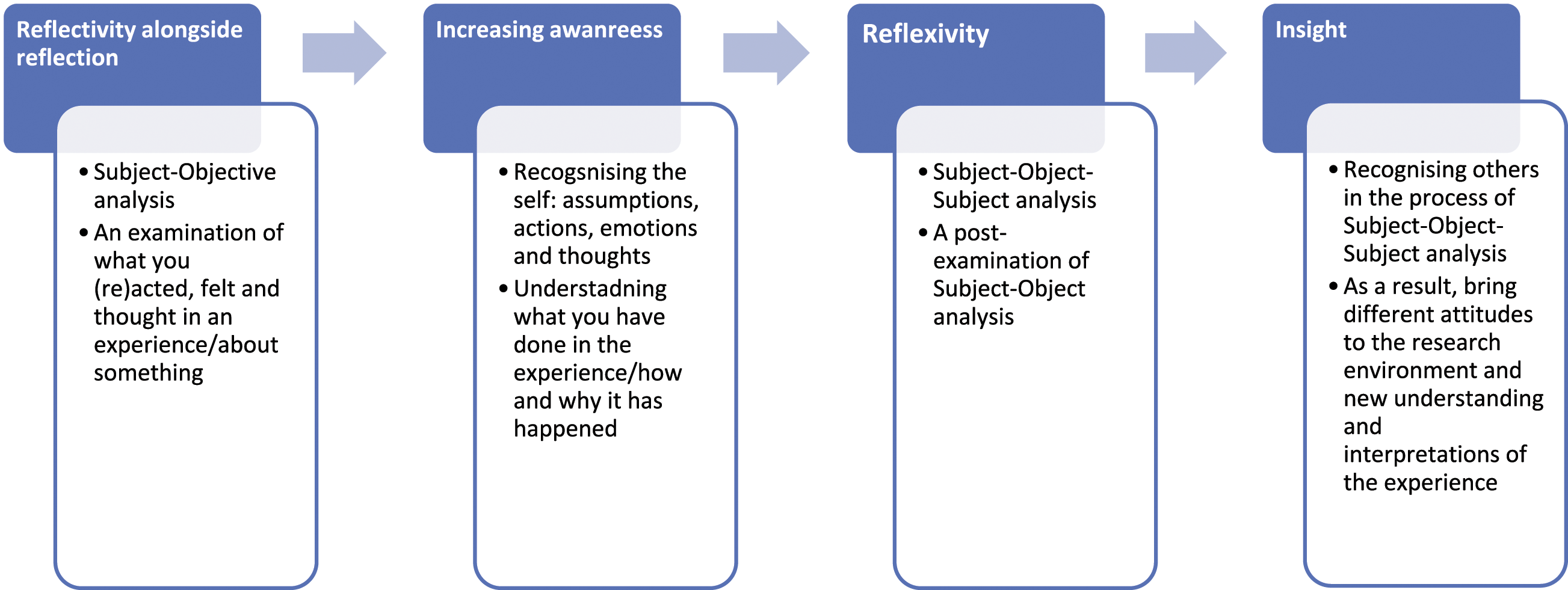
Therefore, we need both reflectivity and reflexivity for understanding and interpretation of the experiences of participants as well as our own.
An example of the reflective-reflexive process
My first analysis of Māori participants’ meanings of cultural competence based on their words in texts and transcripts suggest the support of Māori people and culture in social work practice. Their meanings correspond to the Aotearoa New Zealand Association of Social Workers (ANZASW) social work Code of Ethics statement that the New Zealand social worker demonstrates an understanding of knowledge of Te Tiriti o Waitangi in their practice of social work (ANZASW, 2019). However, the analysis was not complete without understanding their real meaning as the meaning in their words was seemingly not inclusive of non-Māori cultures, even though the Code of Conduct developed by the Social Workers Registration’s Board (SWRB) emphasises demonstration of the social worker’s competence in practice is required in working with indigenous people (Māori) and many different ethnic and cultural groups in Aotearoa New Zealand (SWRB, 2016).
The subject–object analysis began with a reflection on my understanding of the meaning of cultural competence – what causes the participants’ meaning to be incomprehensible to me. Cultural competence means to collaboratively work with any ethnic/race and cultural individuals, families and communities, which links with my understanding of Te Tiriti o Waitangi, which is a demonstration of difference between two cultures being united in the law and also an awareness of historical oppression continuously creating inequality and disadvantages which may impact on personal and social relationships in the present time. The culturally competent practitioner should understand and consider such elements in the practice relationship with clients in practice; however, culture is not necessarily only specified groups. Understanding of the Treaty results in the view involving cultural competence coming from my way of seeing New Zealand society – as a multicultural society. Eketone and Walker (2015) explain that, in a multicultural society, it is often understood that non-dominant cultural groups are not fully accommodated – they live under the country’s laws and customs within a society in which a power dynamic is generated where the privileged in the society maintain mono-culturalism. On the other hand, Aotearoa New Zealand uniquely recognises biculturalism stemming from Te Tiriti o Waitangi, a formal, political, social and cultural structure within the country coexists between two cultures. ‘With this view, New Zealand could not claim to be multicultural because government institutions and policies only accommodate one, or at best two, cultural ways of being, knowing, valuing, and doing’ (Eketone and Walker, 2015: 108).
My subject–object analysis then shifted to how the participants perceive their world, analysing data by use of the subject ‘I’. I questioned my initial analysis by re-assessing a couple of participants’ interviews where participants discussed their uncomfortable experiences of being a Māori person in New Zealand society in answering a question about their understanding and meaning of cultural competence in practice. In a particular conversation with one participant, I was sympathetic toward her. My response came from the experience of being treated as the Other on some occasions. However, I left a note in my research journal: ‘is there something that I misunderstood and or mis-interpreted here? [The participant] looked nonplussed.’ This note led to questioning me about my understanding, what does Other mean to her and myself? I more likely accept the ‘Other’ status from my understanding of being the Other from where I stand as a migrant, and this needed to be differentiated from what the Māori participants saw, and how they experienced their reality, as it depends on where they stand. Those participants’ central focus regarding cultural competence was seemingly related to the historical issues – Māori colonisation and oppression. In the subject–object–subject analysis, I acknowledged the ‘different’ realities between us and I was reflexive in perceiving their meaning differently – if participants see New Zealand’s colonial history as continuously affecting the present, not the past. If so, their strong resistance to one dominant culture in social work practice by embracing their culture makes much sense. In the process, I went back and forth between described experiences of participants and my understanding (awareness) of them in reflections. Eventually, I transformed the analysed information into some form of knowledge. My perception of the world and subjective knowledge is essential for understanding experiences of Others and interpreting the participants’ realities. This sounds significantly subjective. However, Kondrat (1999) asserts that ‘subjective’ is used in a pejorative term (such as contaminated or biased), but it is a way of knowing something in its own right.
Conclusion
Reflexivity is often perceived as uncertainty due to its construction within various theoretical frameworks and, as a result, there are several practices of it in research. In this article, the core of reflexivity, conscious self-awareness drew attention to the occurrence and integration of it into the first author’s research. Reflectivity alongside reflection, which is a step toward reflexivity exploring and elaborating in social work, guided the author in the process of reflexivity. Since the ideas of social constructionism have been absorbed into social work and practice, social workers’ reflexivity can be more attentive to such things as reflective practice, interpreting clients’ problems and knowledge in/of practice. In qualitative research, reflexivity enables researchers to recognise their presence and particular ways of seeing and thinking and acknowledging that what they see influences how they see their world and others. Researchers’ understanding of their world, participants’ views of their world, and then addressing and comparing differences by recognising the influence of the researcher’s self-view can bring together each other’s knowledge and experiences in creating new knowledge.
Reflexivity is, however, not a natural skill but one which can be improved by education and training (Mortari, 2015). Pillow (2010) strongly suggests that researchers, in particular novice researchers, consistently keep researcher logs, field notes and journals. These provide an initial mapping of a researcher’s own thinking and observe any changes from the beginning, middle and end of the research (Pillow, 2010). The examples in this article demonstrate that evocative questions have emerged from the first author’s research journals and notes. Reflection was crucial for being reflexive and doing reflexivity. The process may be back and forth to check/evaluate the researcher’s perception of the world and participants (it can include cross-checking with them). That leads to further reflexivity to review the findings through analysing the process of knowledge the researcher is generating – questioning the interpretation of the Other’s lived experience using the researcher’s own words and paradigms to present the Other’s experience. The article encourages using reflexivity for further progression of qualitative social work research.
Footnotes
Declaration of conflicting interests
The author(s) declared no potential conflicts of interest with respect to the research, authorship, and/or publication of this article.
Funding
The author(s) received no financial support for the research, authorship, and/or publication of this article.
