




Abstract
This article explores the potential values of a critical realist theory of ideology on the analysis of planning issues. In particular, it argues its usefulness in promoting planning as a vanguard of societal transformation. The critical realist theory of ideology revitalizes the epistemological inquiry of beliefs, which enables an evaluation of the social, economic and environmental impacts of the ideas and beliefs embedded in planning. Furthermore, the essence of critical realist theory of ideology is to explain the (re)production of the ideology, which paves the way for transformative planning, as transformation cannot be realized without eliminating constraining social conditions. Finally, critical realism situates its critique of ideology within the wider transformation process by rendering visible the dimensions that can contribute to eradicating the ideology in question, and shaping better planning ideas, including ethical reasoning, utopia thinking and transformative agency. A meta-theoretical framework based on critical realism is proposed to guide a critique of ideology in planning. By using an example of planning for sustainable urban development in Copenhagen and Oslo, the paper demonstrates the ways in which the meta-theoretical framework can be applied to planning in a quest for societal transformation.
Introduction
Planning studies have repeatedly engaged with ideology throughout history. The recent decades have clearly witnessed a renewed interest in inquires on ideology in planning (Davoudi et al., 2020; Grange, 2014; Gunder, 2005, 2010; Sager, 2015, 2020; Shepherd, 2018; Xue, 2018). The latest attempt at bringing the ideology to the forefront of planning analysis is the Special Issue of Planning Theory (volume 19, issue 1) on Narratives of power: bringing ideology to the fore of planning analysis, which examines the politics of contemporary planning through the lens of ideology. Agreeing on the premise set forth in the Special Issue, that a variety of theories on ideology exists which serve as valuable analytical tools with which to shed light on different planning issues (Shepherd et al., 2020), this paper sets out to explore the distinct values of a critical realist theory of ideology in the analysis of planning, particularly regarding planning in quest of societal transformation. By doing so, the paper aims to enrich the ongoing debates on ideology and planning by demonstrating the ways in which a realist approach to ideology provides a different angle when addressing planning challenges, issues and solutions, as well as promotes the transformative edge of planning.
We live in an era of multiple crises and challenges (e.g. climate change, ecological degradation, pandemics, social injustice, poverty and political instability). To cope with them, it is widely acknowledged that our urban societies need to undergo an urgent transformation. However, mainstream planning has often been criticized for lacking a transformative edge or even being a hindrance to progressive social change (Albrechts, 2015; Rydin, 2013). This sets the scene for the inquiry of ideology in planning in this paper in which I seek to answer that if planning purports to be a vanguard of societal transformation, what kind of theory of ideology might be necessary, illuminating and adequate. Drawing on critical realism – a deep realist philosophy of science, I propose a meta-theoretical framework for the critique of ideology, which is particularly useful in fostering the role of planning as a driving force of progressive social change. Although a well-established philosophy of science, critical realism has inspired few planning studies (e.g. Boonstra and Rauws, 2021; Næss, 2015; Xue, 2012); the potentials of its theory on ideology have been underexplored within the planning field. This paper represents a preliminary attempt at joining the two domains, which also contributes to expanding the application of critical realism in planning studies. Therefore, by bringing in a realist position, this article contributes to the recent ongoing debates on ideology and planning, which are dominated by post-structuralist traditions.
The paper is structured as follows. In A Missing Realist Approach to Ideology and Planning, based on a brief review of the recent literature on ideology and planning, and from the perspective of societal transformation, I argue for the advantages of bringing a realist approach to ideology to the debates. In A Critical Realist Approach to the Critique of Ideology, I introduce the core concepts of a critical realist theory of ideology and arrive at a meta-theoretical framework for conducting the critique of ideology in planning. This is followed by an example revolving around a critique of the green growth ideology in urban planning that aims at sustainability transformation (An Example: The Green Growth Ideology in Planning for Urban Sustainability Transformation). The example is based on several studies conducted by the author over a few years, which have investigated, examined and criticized the prevalent sustainable urban development ideas and strategies in the context of Nordic cities: Copenhagen and Oslo (Mete and Xue, 2020; Næss and Xue, 2016; Xue, 2014, 2015; Xue et al., 2017). The purpose of the example is to illustrate ways in which the critical realist theory of ideology could be applied in planning. As such, the example is never a full and systematic account of the critique itself. In Conclusion, the paper concludes by summarising its contributions to the existing academic debates on ideology in planning.
A missing realist approach to ideology and planning
A dominance of post-structuralist approach to ideology in planning analysis
The concept of ‘ideology’ has been heavily debated in the history of philosophy and political science. Although the concept is imbued with different connotations, two large traditions can be distinguished (Eagleton, 2007). One tradition concerns the ontological definition of ideology. Davoudi et al. (2020) summarize this tradition as a focus on ‘what an ideology is’. Originating from Hegel and Marx who viewed ideology as false consciousness, this tradition takes an epistemological perspective and is preoccupied with the truth and falsehood of ideas and beliefs. The other tradition has less of an epistemological focus and more of a sociological one, with a concern over the function of ideas and beliefs within society. Therefore, this tradition can be said to focus on ‘what an ideology does’ (Davoudi et al., 2020). However, the distinction between the two traditions is not clear-cut with the boundary between them being blurred.
Despite the blurred distinctions, currently, it is fair to say that the epistemological notion of ideology as a distortion of reality is a rather unpopular conceptualization (Eagleton, 2007; Grange, 2014; Norval, 2000). The reinvigorated interest in the theory of ideology after the 1960s has been dominated by a linguistic approach and, more generally, post-structuralist thinking, which is preoccupied with the function of ideology (Gunder, 2010; Grange, 2014; Laclau, 1996; Norval, 2000). This sociological and political notion of ideology is bound up with the post-structuralist perception of our world as being one which lacks intrinsic meaning, essence and absolute truth. Apparently, this position on social ontology renders it incompatible with the epistemological theory of ideology, as the latter presumes the existence of one reality and some order of truth. In light of post-structuralist thinking, the task of ideology analysis is to investigate the formation of representation, paradigms, symbolization and the ways in which these shape our world (Norval, 2000).
Within the planning literature, there is not an abundance of attempts to reflect on ideologies. Depending on the focus and intention of inquiries, planning scholars have utilized different theories of ideology to shed light on the planning issues in question. Harvey (1985), adopting the Marxist interpretation of ideology, contends that, without being aware of it, planners are committed to the ideology of harmony within the capitalist social order. Therefore, planners contribute to the process of capitalist social reproduction through producing, maintaining and managing the built environment. According to Harvey, the ideological presupposition of social harmony is the most imposing and effective mystification. Hence, he calls for planners to rethink ideology particularly at those historical turning points at which one might identify the ‘crisis of ideology’ (Harvey, 1985: 182).
Resonating with the dominant post-structuralist approach to ideology, common to the more recent ideological engagement with planning is the adoption of a broadly sociological perspective on ideology that is neutral to epistemology but focuses on its functions and effects. Much literature is devoted to revealing the role ideological mechanisms play in shaping, (de)legitimizing and conditioning planning practices within specific historical and geographical contexts. The unpacking of the ideological mechanisms has been informed by different theories of ideology, such as Freeden’s morphological approach (Shepherd, 2018), a rhetorically-informed political theory of ideology (Davoudi et al., 2020), the Laclauian post-Marxist interpretation of ideology (Grange, 2014), Hall’s approach to conjunctural analysis (Inch & Shepherd, 2020) and the Lacanian theory of psychoanalysis (Gunder, 2005, 2010). These inquiries on ideology have covered a wide array of planning issues ranging from national planning reforms (Davoudi et al., 2020; Shepherd, 2018), planning culture (Grange, 2014) and housing development (Davy, 2020; Inch & Shepherd, 2020; Zanotto, 2020) to urban policies (Gunder, 2003, 2005, 2010).
Arguments for bringing a realist approach to ideology in planning analysis
The abovementioned post-structuralist theories of ideology have proven to be very valuable as regard unpacking the ideological mechanisms that shape, navigate and shift planning practices. Without denying their values, I argue that a realist approach to ideology, as represented by critical realism, is particularly advantageous to strengthening the potentiality of planning as a driving force of societal transformation.
Firstly, the post-structuralist approach to ideology is more interested in understanding the ways in which ideological mechanisms are manifested in planning than evaluating the contents of the beliefs and values, as well as their resultant impacts on substantive planning strategies. For example as stated in the editorial by Shepherd et al. (2020), all the articles in the Special Issue focus on the role of ideology and effects instead of tackling it ‘head on’. However, the substantive dimension of planning is of importance when it concerns either facilitating or hindering societal transformation, for example such as seen in land use strategy. Compared to urban sprawl, compact land use structure has ramifications on travel behaviour and dwelling patterns which are more in favour of climate mitigation and environmental protection (Newman and Kenworthy, 1999; Næss, 2012). The choice of land use strategy is strongly affected and shaped by beliefs, values and rationales in planning. As beliefs reflect what one believes to be true, good, and ought to be, they play a significant role in shaping, framing and constraining planners’ formulation of meaningful aims and objectives, choice of tools and methods, planning process, adoption of actions and strategies, as well as the criteria chosen to evaluate those strategies (Fagence, 1983; Gunder, 2010; Kramer, 1975). Therefore, the content of beliefs and ideas affect the transformative impacts of planning practices. Identifying and criticising the beliefs through scrutiny, evaluation, justification, or falsification have considerable implications for materializing planning’s potentiality in fulfilling societal transformation goals, such as climate mitigation, social justice and ecological preservation. This calls for a theory of ideology that enables the evaluation of the beliefs in planning against certain norms and values. Arguably, only a realist position that presumes the existence of moral truth could make an evaluative stance to beliefs possible.
Secondly, through unpacking the functions of ideology in planning, the post-structuralist approach indeed enhances planners’ awareness of ideological forces, thus laying a necessary foundation for planners’ resistance to them. To further strengthen planning’s potential for counteracting ideological pressures or even eradicating them, it will benefit from a critique of ideology that provides deeper insights into the social structures and mechanisms generating and sustaining that ideology. As I will discuss in A Critical Realist Approach to the Critique of Ideology, the theory of ideology informed by critical realism enables an exploration of the social roots forming the ideology in question.
Thirdly, societal transformation is a normative project which indispensably involves an envisioning of desirable futures and normative values on which futures are built. This emphasis on normativity aligns with the very nature of planning that is laden with value inquiries and is heavily dependent on normative judgements. Particularly for planning that is ambitious for societal transformation, it needs to engage in inquiries on value issues and challenge existing values, norms, and beliefs which appear as hindrances to transformation. Post-structuralist theories of ideology that predominantly focus on ‘what an ideology does’ and are silent on epistemological issues do not explicitly (if not implicitly) engage in an inquiry of defining what the normative values and ethical premises should be. In contrast, a moral realist position holding that there exists the moral real will subject actually existing values to critique, enabling planners to challenge certain ethical premises and articulate alternatives.
A critical realist approach to the critique of ideology
Originated by Roy Bhaskar in the 1970s, critical realism is a school of thought in the philosophy of science in parallel with but distinct from philosophies, such as positivism, empiricism, hermeneutics and post-structuralism. Critical realism claims to combine ontological realism, epistemological relativism and judgemental rationalism. Through ontological realism, critical realism embraces the idea that reality exists independently of human consciousness and knowledge of it, and further identifies three layers of reality: the empirical, the actual and the real (Bhaskar, 1975/2008). The empirical layer is comprised only of what is experienced. Nevertheless, not all events can be experienced. Therefore, the actual layer is constituted of all the events or occurrences that happen, independently of whether we experience them or not. The real layer includes the mechanisms which generate the events and experiences. The generative mechanisms are one of the central notions of critical realism explaining the formation of events and phenomenon. Epistemologically, critical realism holds a relativist position, meaning that our knowledge about reality is socially determined and conceptually mediated; it attempts to approach reality, but is always fallible. However, not all knowledge claims are equally fallible. Through some theoretical and methodological tools, we can rationally judge the ability of knowledge to inform us about external reality. These basic ideas constitute the foundations of critical realism’s understanding of ideology.
A critical realist theory of ideology
Bhaskar’s concept of ideology follows a Marxist account, defined as ‘lived systems of false or inadequate ideas’ (Hartwig, 2007: 252). In other words, the definition of critical realist ideology focuses on the epistemological dimension of ideas. Following this definition, not all systems of ideas, values and beliefs can be categorized as ideology. Certain requirements must be fulfilled for them to be considered as ideology. Firstly, these ideas are false in the sense of being misleading, inadequate, untrue or representing a form of misconception of reality. Secondly, the existence of these false ideas is necessary, which means that there are social conditions generating and sustaining their existence. Thirdly, the maintenance of the false ideas fulfils certain functions; namely, they are beneficial in its effects on the reproduction of the social relations that generate it (Hartwig, 2007). As such, the critical realist understanding of ideology embraces its content, function and formation, which will be explained in more detail in the following paragraphs.
In terms of the content of ideology, critical realism involves an evaluative stance on beliefs and ideas. Evaluating the validity of the beliefs can be conducted by identifying a theory-practice inconsistency that undermines or even deconstructs the validity of the assumptions, values, or contents of the beliefs; or by identifying a weak, incorrect or blind point in the beliefs (Bhaskar, 2016). It is by virtue of this evaluation that the foundation is laid for the rational shaping of alternative values and beliefs directed at removing, displacing, or transforming the false beliefs at a later stage of the critique of ideology.
The pivotal element of the critical realist theory of ideology can be argued as being its emphasis on explaining the formation of the ideology, in other words, the reasons for which a wrong belief prevails despite its falsity. This explanatory endeavour is framed as an explanatory critique which enquires about the causal role of social structures in the wide acceptance of a false belief. Critical realism provides the possibility of developing a non-reductionist understanding of social explanations to the generation as well as sustaining of an ideology. The underlying generative mechanisms on which these false beliefs are grounded can include features, such as economic structures; cultural norms; political landscape; social structures, for example rules and laws; institutional settings; and discourses (Bhaskar, 2010). Knowledge of the structural causes of the false beliefs paves the way for transformation as the false beliefs cannot be removed without eradicating their causes.
Critical realism further provides a general philosophical account of the ways in which ideology functions in society, framed as a TINA (which stands for ‘there is no alternative’) formation (Bhaskar, 2016). A TINA formation occurs when a false belief is first presented as a necessity, expressed as ‘there is no alternative’. The point is that this is a false necessity, as there indeed exist alternatives, either conventional, reformist, or radical. Once this false necessity is accepted, it entails defensive or supporting mechanisms to sustain the original false necessity and build a defensive shield (Bhaskar, 2008; Norrie, 2010). In other words, the TINA formation indicates the process by which a false necessity is undermined by and must be protected against its own falsity (Bhaskar, 2016). With the TINA analysis, Bhaskar aims to unpack ‘the internal nature and patterning of ideology as thinking moves and negotiates the world’ (Norrie, 2010: 109).
Bhaskar (2016) committed the critique of ideology to transformation and emancipation. With this purpose in mind, Bhaskar further develops the theory of ideology by adding the elements of ethical naturalism, concrete utopianism and transformative agency.
The evaluation of beliefs or ideas can only be conducted against certain ethical standpoints. Critical realism applies a realist thinking to the domain of ethics and morality, known as ethical naturalism. It suggests that there exist moral truths, and we can move from knowledge of the way the world works to moral claims of the way it ought to be through rational ethical reasoning (Bhaskar, 2016). In the criticism of beliefs, ethical reasoning constitutes part of the rational inquiry and judgement through argument. According to Bhaskar (2016), although moral truth exists at the level of the real, it is constellationally embedded within the geo-historical development of human society and its interpretation at the level of the actual is always contingent and variable, dependent on the actual contexts. The judgement of moral claims can be informed by science, but also requires public debate and democracy (Price, 2019). Further, the exploration of moral truth should compare competing alternatives and use judgemental rationality.
The negative criticism of ideology already postulates the possibility of better alternatives. These better alternatives can be suggested as ‘an exercise in concrete utopianism, postulating an alternative to the actually existing state of affairs, incorporating unacknowledged and even hitherto unimagined possibilities for the satisfaction of wanted needs and wanted possibilities for development, grounded in sustainably potentially disposable resources in the context of a different social order’ (Bhaskar, 2016: 263). Utopia constitutes part of the exercise of normative thinking, by imagining a future state that can better fulfil the moral truth. As Archer (2019) interprets, ‘concrete’ in concrete utopianism means ‘realizable, but non-actualized possibilities’, the realization of which may be prevented by identifiable constraints.
For the social structures that generate and sustain the ideology to be removed or transformed, merely identifying and explaining them is insufficient. Agents’ actions are necessary. Although agents are born into the social structures which condition (though not determine) their actions, ‘the agents can – through the powers they possess – form projects that transgress the situation in which they live’ (Danermark et al., 2019: 86). The transformative power of agency is not only embedded in the practice of dismantling the existing ideology and its structural causes, but also in actively searching for and bringing in new norms and ideas that are hitherto unactualized. According to Archer (2000), the ‘corporate agency’ – agents who are organized to collectively express interests and strategic pursuit – plays a strategic role in transforming the established structures and cultures. The ultimate outcome of social change or stability is dependent on the social interaction between corporate agents. With the potential bargaining power determined by the initial society’s distribution of resources, a corporate agent strategically negotiates with other agents to promote its vested interest (Archer, 1995).
To encapsulate, the aforementioned core concepts of the critical realist theory of ideology can be synthesized into a meta-theoretical framework. As shown in Figure 1, the framework consists of two major blocks: negative criticism of ideology and positive action to eradicate ideology. As a meta-theoretical framework, a critical realist approach to ideology provides no substance other than a conceptual framework guiding the undertaking of the critique. As such, the different steps can be fleshed out with concrete theories, dependent on the specifications of the issues in question. A meta-theoretical framework for a critique of ideology informed by critical realism (author’s synthesis).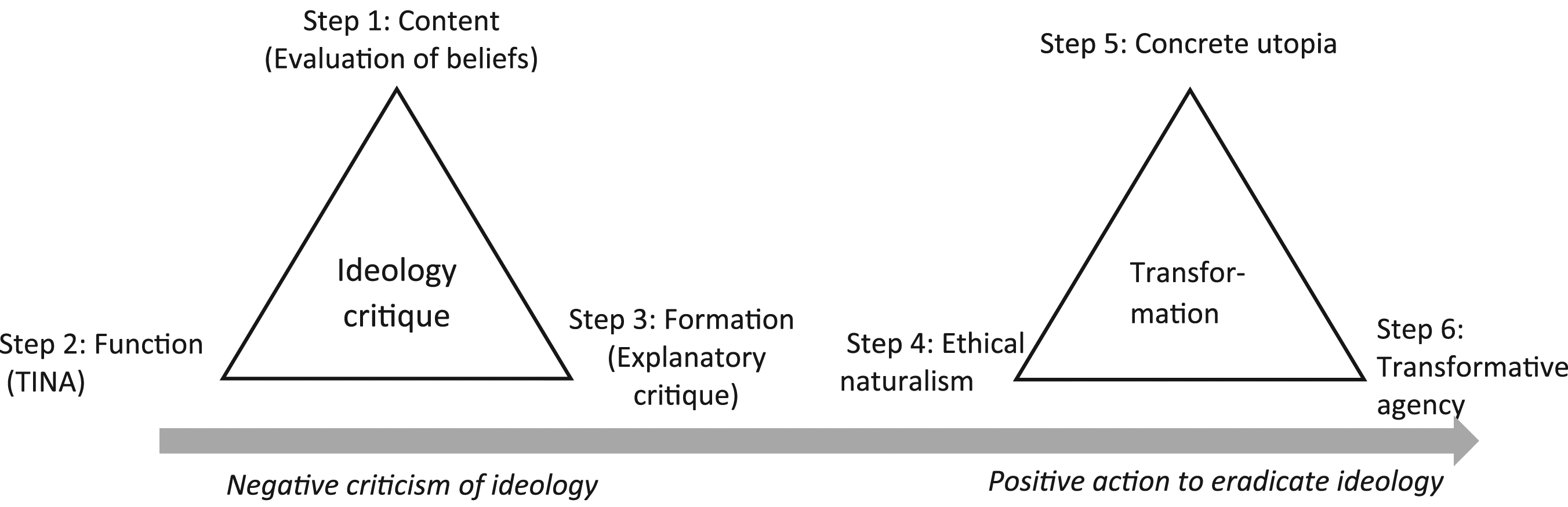
A critical realist informed critique of ideology in planning
In this section, I will briefly explain the ways in which the meta-theoretical framework can inform the critique of ideology in planning by following the steps illustrated in Figure 1.
The critique will start with the endeavour to render explicit the underlying beliefs and values in a planning strategy or practice, then subject them to scrutiny as well as criticism (Step 1). Beliefs, values, ideas and rationales are indispensable and necessary elements constituting planning, either implicitly or explicitly. Although a planning strategy may appear to be adopted due to ‘muddling through’ without following definable beliefs, this pragmatism may involve a process of struggles between competing rationales. The critical realist approach will contribute to augmenting the intellectual capability of planners to recognize and criticize the beliefs, especially those widely accepted ones which can significantly impact environment and society.
Identifying the beliefs as ideology in planning would be followed by an attempt at understanding the function of ideology by addressing the ways in which planning is subject to ideological influence and the ways ideology manifests itself (Step 2). Although the TINA formation provides an overarching explanation of the way that ideology functions in society, more concrete theories can illuminate the ways in which ideological mechanisms are manifested within different planning contexts. Most of the existing studies on ideology and planning offer a range of theoretical perspectives to reveal these ideological mechanisms. For instance Davidson (2010) uses the concept of empty signifier to explicate the cynical, ideological functioning of the use of sustainability in city planning. By referring to Hall’s conjunctural analysis, Inch and Shepherd (2020) unpack the way by which ideology reaffirms the hegemony in the face of challenge. Here, it shows the potential of critical realism to bridge the trenches between a realist and a post-structuralist approach to ideology.
The next step will move to an explanation of social structural conditions that (re)produce the ideology (Step 3). The generation and sustaining of an ideology in planning can be a consequence of multiple mechanisms simultaneously at play which, however, are not readily observable but have to be investigated by looking beneath the empirical manifestation (Danermark et al., 2019). Different theoretical perspectives that can best illuminate the planning issues can be drawn on to shed light on the generative mechanisms. For example a discourse theory can be adopted to unpack the discursive mechanisms that lead to the shaping and shift of ideology in planning (Gunder, 2005; Zanotto, 2020).
Following the critical realist approach, the criticism on the ideological beliefs will naturally lead to a formulation of substantive ethical values based on which a better future can be built (Step 4). Despite planning being a profession that is deeply ethical, the actual existing moralities of planning are characterised by a strong moral relativism (Campbell and Marshall, 1999; Forester, 1999). Ethical debates in planning have primarily focused on process and denied a formulation of universal substantive values and, in turn, the distinction of better and worse planning outcomes (Campbell, 2012; Forester, 1999). This is partly because answering normative questions of ‘what should be done’ or ‘what is better’ risk being accused of imposing moral superiority and excluding other perspectives, which generates tensions in a world of difference, diversity and multiple ethical claims. Consequently, the actual existing moralities of planning to a great extent align with the prevailing ethical values embedded in the ideological beliefs, and planners lose the vantage point of providing foundations for progressive and radical subversion as well as transformation. For planners to be able to confront and eradicate the dominant ideological beliefs in planning, an articulation of alternative normative values and a rational reasoning of them are of necessity.
To transform the ideology in planning, planners can go further to envision futures that can better fulfil the articulated normative values (Step 5). Harvey (2000) argued that the existing utopian visions of urban development, such as compact city, new urbanism, competitive and liveable cities, are characterized as a ‘degenerate utopia’ as they either maintain mainstream capitalist market values or in the process of degenerating into a utopia of neoliberalism. The intriguing question for planners is whether they could construct a ‘progressive utopia’ capable of providing a rebuttal to the ideological claim of ‘there is no alternative’ (TINA), thereby functioning as a catalyst for transformation. Methodologically, scenario planning can be a fruitful approach to strategically and tactically exercise utopian thinking, by envisioning and devising different futures (Börjeson et al., 2006). Particularly, normative scenario planning aims at formulating better urban future alternatives which embed values precious to the world. It can also include working back from the desirable future to check the feasibility of the scenarios in the current physical, social, political and economic conditions in order to devise necessary measures and actions for its realization (Höjer and Mattsson, 2000).
The last step in the critique of ideology in planning will be to enable transformative planners (Step 6). Studies on the agency side of planners have demonstrated a growing discrepancy between planners’ professional values and their actual ability to realize them (Grange, 2013; Inch, 2010). However alarming this lack of action room may be, more worrying is that planners conform to the dominant ideological beliefs promoted by strong political or societal forces, despite these beliefs possibly lying in conflict with the planners’ own professional values. This is the case as depicted in most planning literature on ideology which appears to describe planners as being passive recipients of hegemonic political ideas, susceptible to political penetration (Davoudi et al., 2020; Grange, 2014; Gunder, 2010; Shepherd, 2018). Planners’ commitment to the political hegemony in turn reinforces the stability and reproduction of the dominant ideology. The critical realist concept of corporate agency will not only contribute to a greater awareness on the way that ideology shapes planning but also facilitate planners in confronting the ideological illusions and mobilizing forces for transformative actions.
An example: The green growth ideology in planning for urban sustainability transformation
In this section, I will illustrate the ways by which the meta-theoretical framework can inform a critique of ideology in planning by drawing on an example of the green growth idea in planning for urban sustainability transformation. Urban planning for sustainability has a strong intention and ambition for transforming the urban development towards a long-term sustainable future. Therefore, the critical realist theory is very suitable for an inquiry of ideology in this planning issue. The approach adopted is to develop a step-by-step critique following Figure 1 by drawing on theoretical arguments and generalized research evidence as well as by frequently referring to two Nordic cases of urban planning: the region of Copenhagen and Oslo. As already mentioned, this example is to illustrate the application of the meta-theoretical framework and is neither a comprehensive critique of the ideology nor an in-depth study of the cases.
Step 1: Green growth as an ideology in planning for sustainable urban development
The concept of sustainable development and the ways of achieving it have been very much contested. Since the 1980s, the mainstream and prevailing thinking about sustainable development has been based on the idea of green growth which holds a strong belief in decoupling economic growth from negative environmental impacts (OECD, 2019; Xue, 2016). Although being increasingly challenged by alternative thinking in the more recent decade, such as degrowth (Schneider et al., 2010), the notion of green growth still has a deep foothold in global and local sustainability politics. Dematerialization through improving eco-efficiency and substitution is theoretically argued to be the main path towards green growth (Nordic Council of Ministers, 1999). Associated with this notion is an acceptance of growth and competitiveness as something inherently good.
It is not difficult to identify this green growth belief in the sustainability planning of both Copenhagen and Oslo, where the belief is automatically accepted in planning documents at different levels. It is exemplified in the following statements: ‘We will show the world and especially other big cities that CO2 emissions can be reduced effectively without adversely affecting economic growth.’ (Municipality of Copenhagen, 2007) ‘Urban development will facilitate a versatile and competitive business sector that ensures value creation and workplaces for all.’ (Municipality of Oslo, 2018: 43)
Meanwhile, ‘Oslo is Europe’s leading environmental city and take care of biodiversity, cultural heritage and the city’s distinctiveness’, and ‘Oslo is a zero-emission city with reduced noise pollution and has equipped itself to meet a changing climate.’ (Municipality of Oslo, 2018: 17)
Being applied to urban development, green growth implies pursuing urban growth in the demographic, economic and physical aspects whilst reducing the burdens on the environment. This has led to typical land use strategies that aim at enhancing resource-use efficiency. In both Copenhagen and Oslo, densification within the inner-city, brownfields development, compact structure and new development close to urban transport nodes are major land use strategies to increase land use efficiency and meanwhile accommodate a growing need for residential and non-residential buildings as well as infrastructure (Næss et al., 2011; Xue, 2015). In addition, investing in public transport infrastructure is a substitution strategy to replace car driving, thus reducing energy consumption and CO2 emissions (ibid.).
In light of critical realism, a critical-evaluative stance on the green growth belief is required in order to identify whether it is ideological. There is no space to provide a full-range critique of this belief other than by in a simplified manner drawing on the conclusions of existing studies. From different perspectives, the idea of green growth is evaluated as a false belief. Empirically, evidence from even the forerunners of environmental sustainability in urban development does not suggest that green growth has occurred in urban development (Tapio, 2005). In the Copenhagen region, despite the strong compact city strategy, growth in the housing stock during the period 1991–2008 has only been relatively decoupled from residential energy consumption (Xue, 2015). Similarly, only relative decoupling has been achieved between the growth in the size of urbanized area and economic growth in the Copenhagen region, thus suggesting that urban growth still leads to encroachment on undeveloped land. A similar trend has been found in the Oslo region, in which traffic growth in the region has only been relatively decoupled from economic growth between 1996 and 2008 (Næss et al., 2011). One may argue that the evidence of relative decoupling suggests that these cities are on the trajectory towards green growth. However, there are limits to what the decupling strategies can achieve in terms of environmental sustainability. For example densification as a land-saving strategy to accommodate growth in the building stock can only be possible when opportunities are available, such as the availability of low-density neighbourhoods or brown fields. When these opportunities for densification are used up, further growth in the building stock will have to take undeveloped land (Næss, 2021). In addition, the current achievement of relative decoupling is a result of low-hanging fruits being picked up. To obtain the same or higher degrees of decoupling seems difficult unless advanced technological innovation can be developed and implemented both on a large scale and rapidly. However, time is what we are lacking, as indicated by Intergovernmental Panel on Climate Change (2021) that we need to change in the very near future in order to avoid climate catastrophe. Apart from these empirical findings that suggest a gap between the belief in the theoretical achievement of green growth and the reality in urban development, the theoretical plausibility of the green growth assumption has also been heavily questioned. The idea of green growth through dematerialization is refuted as being ontologically flawed due to its failure to acknowledge the asymmetrical reliance of human socio-economic activities on nature (Venkatachalam, 2007; Xue, 2014).
Step 2: The function of the green growth ideology in planning
The TINA formation can be used to illustrate the ways which green growth ideology obtains a hegemony in the planning for urban sustainability. The necessity is firstly bestowed stating that future urban development must pursue a sustainable development paradigm based on economic growth. During the 1980s in Denmark and following a similar trajectory to many European countries, a conservative-liberal coalition government moved away from a welfarist approach addressing balanced and equal development across the country. Instead, it introduced a neoliberal agenda in pursuit of competitiveness by stimulating growth in major cities and regions (Galland, 2012; Olesen and Richardson, 2012). The promotion of the capital region as a growth locomotive is framed as a ‘must’: ‘A strong and competitive capital city is an important prerequisite for Denmark’s spatial development. Denmark must have a capital that can attract companies, jobs and employees in global competition.’ (Ministry of the Environment, 2006: 11).
Meanwhile, being sustainable has also become a political agenda since the 1980s. Discursively, the idea of green growth that aims at reconciling growth and sustainability becomes the only and necessary way to embrace both imperatives. As argued above, there is a fundamental contradiction in the green growth belief. Therefore, a series of TINA defence mechanisms, discursively and practically, must be adopted to shield this false necessity as well as to resolve the internal tensions and contradictions. Here, a tactical strategy framed as a ‘sustainability fix’ (While et al., 2004) or ‘green fix’ (Holgersen & Malm, 2015) is invented to guard the false necessity. The strategy employs sustainability policies to sustain and enhance urban competitiveness or to overcome a crisis of capital accumulation during economic downturn. This strategy is well-embraced in the sustainability planning of Copenhagen, in which being sustainable is framed as a way to strengthen the region’s competitive edge. As stated in the 2006 national planning report (Ministry of the Environment, 2006: 17): ‘Green spaces, recreational areas and attractive urban environments are key prerequisites for attracting companies, jobs and employees.’
Even green growth per se is regarded as a competition field: ‘The world’s cities are fighting hard to top the green growth agenda… If the city does not have a clear strategy and remain in control, Copenhagen is at risk of becoming marginalised in low-growth Europe.’ (The municipality of Copenhagen, 2011: 26).
In this process, the false necessity was sustained by the ‘green fix’ practices that contradict some, if not all, of the legitimating ideas (here, the environmental sustainability idea). The green fix strategy results in a selective adoption of environmental strategies that can potentially boost (at least not hinder) economic competitiveness. Its success as measured in growth promotion will most likely aggravate environmental deterioration and weaken the sustainability commitment (Holgersen and Malm, 2015; Xue, 2018) .
Despite the TINA defensive mechanisms, the internal tensions and contradictions in the false necessity can only be covered but cannot be removed (Bhaskar 2016). The tensions between the fulfilment of growth and sustainability goals are manifested as fragmentation and even contradictions in planning strategies. In the case of the Copenhagen region, densification in the inner-city has been accompanied with low-density urban sprawl in the surrounding municipalities, the latter being a strategy to compete for investment and residents (Xue, 2018). In Oslo, strategies for sustainable mobility, such as public transport investments and reduction in car parking lots, have been combined with road capacity increases which counteract the goal of sustainability (Næss et al., 2011; Xue et al., 2017). Furthermore, the Oslo region has planned several high-speed transportation infrastructures that will enlarge job and service catchment areas as well as promote regional economic growth. This regional enlargement policy will also likely result in an increase in total travel distance, contradicting the densification strategy that aims at reducing travel volume (Xue et al., 2017) .
Step 3: Social conditions producing the addiction to green growth ideology in planning
Despite the belief in a green growth urban future being illusory, why does it still have a persuasive dominance in urban sustainability planning? Following the explanatory critique of critical realism, the explanation of the production and commitment to the ideology should move beyond the sphere of ideas and beliefs and dig into underlying social structures. Here, in accounting for the social necessity of the fallacious belief in urban green growth, the growth compulsion emerging from the capitalist market economic structure plays a crucial role in forming a growth necessity (Gordon and Rosenthal, 2003; Xue, 2012). Notwithstanding differences in the trajectory, both Copenhagen and Oslo have experienced a shift in the political context from Keynesianism to the neoliberalism, leading to the dominance of the market economy (Næss et al., 2011). Fierce competition in the market economy sets the ‘growth or die’ dynamic in motion and forms the profit-driven economy. Therefore, the growth imperative has a structural characteristic inscribed into the capitalist economic system (Harvey, 2010). The growth imperative from the economic sphere further expands into other social planes by building a growth-based society. A growing economy is the premise for achieving a sufficient level of employment rate, avoiding the collapse of the housing market, and maintaining a functional welfare state. In the cultural domain, the inflation of a consumerist lifestyle is closely linked to the capitalist growth impulsion. The idea of green growth, through improving the resource efficiency of production and consumption to solve environmental problems, does not essentially threaten the growth model and the interests of the business sector, and demands no radical changes in lifestyle (Fournier, 2008). Instead, the green shift is often hailed as a new driver of global and local economic growth.
Urban development, the building sector and the transportation system have played an important role in perpetuating, expanding and saving the capitalist mode of production and consumption (Harvey, 1973/2009). Construction and maintenance of buildings and infrastructure contribute significantly to capital surplus absorption and capital accumulation. For example in Denmark, even during the economic downturn in 2020 when the aggregate national GDP declined by 2.1%, the housing sector contributed to a growth of the national GDP by 0.5%. In addition, dwellings, built environment and transport infrastructure are necessary material preconditions for capitalist production, circulation and accumulation. In Norway, the recently published National Transport Plan (Samferdselsdepartementet, 2021) addresses that an effective transport system lays the foundation for building up a competitive business sector, thus contributing to economic growth. Therefore, planning, given its potential power in shaping land use, infrastructure and built environment, is often subject to the mainstream political propaganda for economic growth and green growth.
Step 4: Post-growth informed normative values in planning for sustainability transformation
Through the above steps, a deep insight has been developed into the falsity of the green growth ideology as well as its formation and function. Hence, what could be the alternatives that might lead to the fulfilment of the sustainability targets? Below I attempt to develop an alternative ethical reasoning for sustainability planning, informed by recently emerged post-growth debates (Holden et al., 2017).
Regarding environmental sustainability, respecting environmental limits is a normative value stemming from the fact that we live on a limited planet with finite natural resources and ecological boundaries. Assessed in different ways, human beings have exceeded several environmental limits, perhaps the most precarious being climate change (Steffen et al., 2015). From an anthropocentric perspective, we have a moral obligation to preserve the quality of our planet in order to leave future generations living conditions necessary to meet their needs and live a decent life (Arler, 2001). Adopting a non-anthropocentric view, humans have responsibilities not to overexploit non-human resources for the flourishing of other species which have inherent values even in the absence of humans to enjoy it. Since maintaining economic growth through decoupling cannot remain within ecological boundaries, the key to minimising environmental impacts is to reduce the scale of the total economic output (Martinez-Alier et al., 2010). A sufficiency strategy seeking to lower the affluence level in the Global North is proposed as a necessary way to cope with environmental unsustainability. With regards to urban development, to respect environmental limits through addressing sufficiency, the level of housing consumption per capita should be reduced, the total volume of urban built environment shrunk and individual mobility decreased. Residents in both Copenhagen and Oslo regions have a very high average living standard, measured in housing consumption and mobility level. In both city regions, per capita residential floor area has exceeded 50 m2, being among the highest in the world. In 2012, Norway reached the top in Europe in per capita daily driving distance, with an average of 33.5 km (Xue et al., 2017). Considering the ethical arguments above, to transform both locally and globally towards environmental sustainability will require a reduction in consumption levels in both city regions.
Another ethical value to be argued for in a sustainable future is to ensure social justice both intra-generationally and inter-generationally. Inter-generational equity is a main moral concern when judging the necessity for our generation to respect environmental limits. Safeguarding intra-generational equity is based on the moral premise that we are responsible to population groups beyond our specific community or nation. However, it appears to be more challenging and demanding to achieve an equitable distribution when the total resource and consumption level must be reduced. Unlike the situation in a growth society in which everyone will have their share increased through ‘making the cake bigger’ by economic growth, an equitable distribution within limits cannot be achieved without redistribution from the wealthy to the poor (Næss and Xue, 2016). A case in point would be housing; with a ceiling for average per capita housing consumption, an increase in floor area for those who already overconsume housing space will lead to worsening living conditions for those lacking a dwelling or to them living in substandard housing.
Redistribution within limits is not only for securing social equity but also based on an ethical premise of satisfying human needs. This value is explicitly articulated in the definition of sustainable development by Brundtland Commission, with priority being laid on the world’s poor (World Commission on Environment and Development, 1987). Unlike human wants, desires and preferences, needs, are objective, non-negotiable, and universal across cultures and over time (Doyal and Gough, 1991). Failure to satisfy them will always result in serious harm. Thus, there exists a threshold in the sense of ‘the minimum quantity of any given intermediate need satisfaction required to produce the optimal level of basic need satisfaction’ (Gough, 2014). This implies that future urban development and planning need to secure everyone’s ability to obtain a minimum quality of life, for example by safeguarding everyone’s access to adequate housing (UN, 1948).
Step 5: A post-growth scenario of sustainable urban development and planning
Principles of the post-growth scenario of sustainable urban development and planning (for a full account of the scenarios, see (Mete and Xue, 2020; Næss and Xue, 2016; Xue et al., 2017)
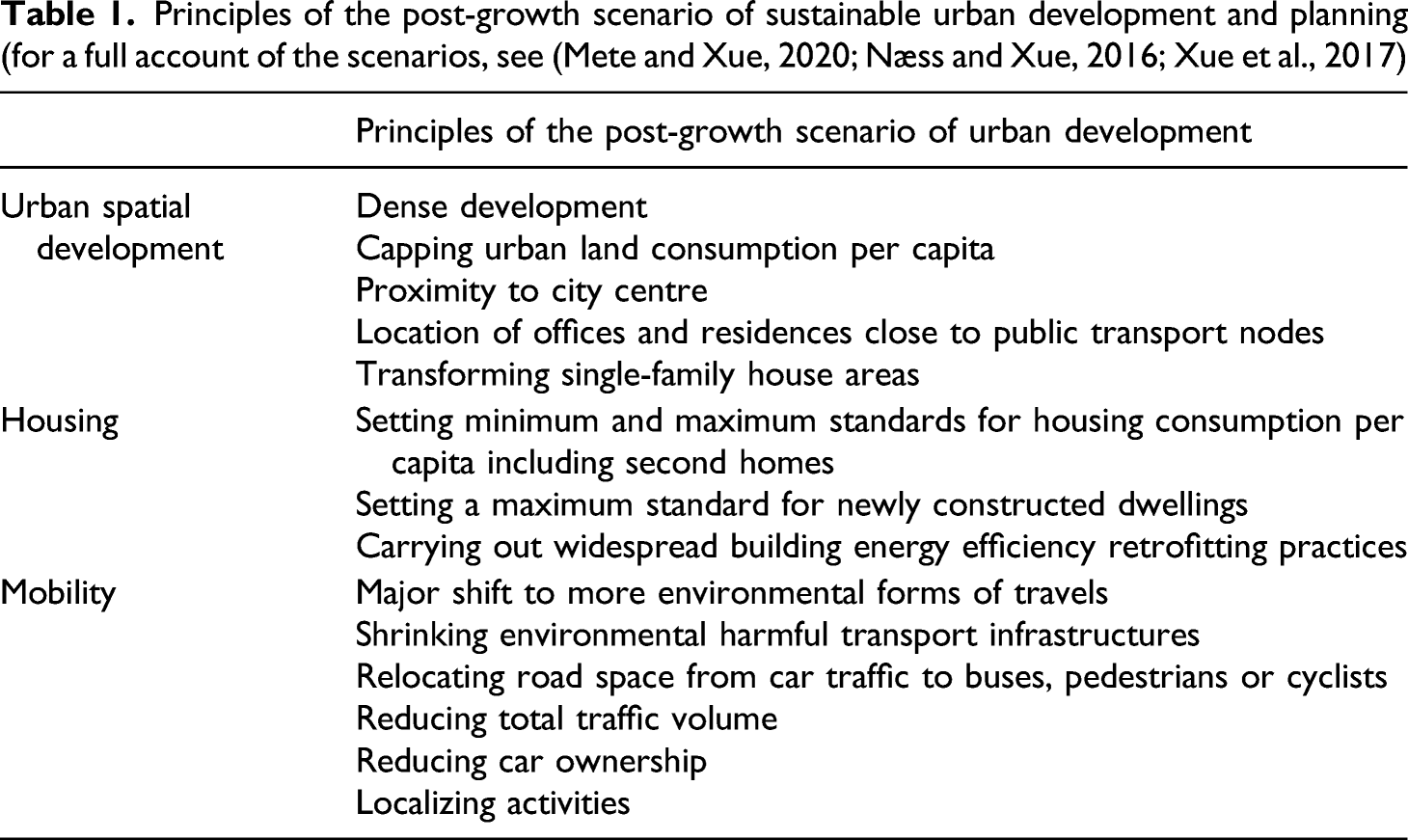
Concerning urban spatial structure, dense development would be combined with setting a cap on urban land consumption per capita. If the urban area per capita within the continuous urbanized area of Oslo could be reduced from 277 m2 (figure in 2015) to 200 m2 in 2035, accommodating a projected population growth of 3,50,000 would save 66 km2 of undeveloped land from being converted to built-up areas. This would in practice mean stricter land regulations for the regional cities surrounding Oslo. The construction of new and more environmentally friendly buildings through densification should be combined with the abolishment of some of the environmentally least favourable built environments, such as car-dependent office parks, shopping malls and single-family home areas. This could widen the possibilities for nature regeneration projects as well as enhance the integrity and coherence of the natural areas and landscapes surrounding the city. Post-growth housing policies would primarily focus on setting maximum standards for housing consumption per capita for the concern of climate mitigation and environmental protection. A mere reduction of 6 m2 in residential floor area per capita from 50 to 44 m2 would stabilize the total residential energy consumption, even in the face of population growth in the Oslo region (Mete and Xue, 2020). Meanwhile, the ethical premises for securing an equal distribution of housing and everyone’s access to housing suggest setting a minimum standard for housing consumption. Regarding transportation, in contrast to the green growth-oriented transport planning in which continually increasing mobility is considered essential for competitiveness and growth, in a post-growth scenario, reversing the present trend is assumed with stabilized or even declined traffic volume, particularly for passenger cars. This would necessitate a change in our travel behaviours towards a certain degree of collective self-limitation, confining much of our major activities in the local area. In the Oslo region, this suggests containing the current regional enlargement infrastructure policy, in addition to densification, that enhances the proximity of activity destinations. Simultaneously, the planned expansion of motorways in Oslo should not only be halted, but the existing road spaces could be replaced by environmentally friendly elements, such as a biking infrastructure, walkable neighbourhoods and better public transport services.
Step 6: Transformative planners
The articulated post-growth normative values and urban development scenario suggest an alternative to the sustainability planning that is based on the green growth ideology. In the course of resisting and even eradicating the false belief and pursuing urban sustainability transformation beyond green growth, planners have to overcome the ‘passivity’ as illustrated in the literature and strategically engage in transformative actions. Inspired by critical realism, the premise for planners to perform transformative actions is to become self-conscious of their values, interests, and projects so as to form a corporate agency. Compared to the primary agency of planners who passively react and respond to their given context, a corporate agency of planners is aware of their role as representing wider public interests, articulates the values of planning and strategically organizes their pursuit. Tactically, corporate planners, whilst pursuing this eradication of the green growth ideology and materialization of post-growth urban sustainability, need to know the distribution of resources among relevant corporate agents and their own (in)accessibility to certain resources. With the bargaining power endowed by planners’ accessibility to certain resources, corporate planners can convert this into negotiating strength in a particular relationship to other corporate agents involved. Based on these strengths, planners can engage in strategic interaction with other corporate agents to build alliances to attain joint or mutually compatible goals.
Conclusion
In this paper, I have sought to bring in a critical realist approach to the planning debates on ideology arguing for its values to promote the transformative strength of planning. To recap, the critical realist ideology critique brings the following distinctive values into the debates.
Firstly, ideology inquiries in planning have predominantly focused on the functions and effects of ideology. Critical realism goes beyond this focus by drawing attention to the content of the beliefs as well as their impacts on planning strategies. By adopting an evaluative stance on ideas and beliefs, critical realism revitalizes the epistemological inquiry that has been dispensed by most recent ideology theorists. As beliefs shape planning strategies which, in turn, generate interventions into the spatial reality, it is vital to scrutinize the content of beliefs to understand the effectiveness of planning ideas in influencing environment, people and society. This is essential as regards planning strategies that aim at transforming urban development towards desirable futures.
Secondly, critical realism allows the development of a holistic explanation of the (re)production of ideology. Therefore, ideologies in planning can be explained by delving into deep social structures beyond the sphere of our observations and experiences. In this case, the critical realist approach renders it possible to embrace interdisciplinary explorations of explanations and, in a fruitful way, accommodates concrete theories from different disciplines relevant to the exploration. This explanatory critique can also deepen and broaden the understanding of wider social roots that shape ideas in planning theory and practice.
Thirdly, critical realism shows the potential of reconciling a post-structuralist and realist approach to ideology, combining the epistemological dimension of beliefs (by evaluating ideas) and the sociological one (by unpacking the ideological mechanisms).
Last but not least, the critical realist ideology critique moves further from a pure critique of beliefs and ideas to include positive action to transform the ideology. For critical realism, positive action is a necessary and natural step subsequent to negative criticism, as an evaluation of ideas and an explanation of the social conditions for their generation cannot be conducted without normative values and an imagining of better alternatives. Although ideology theories that primarily ‘diagnose’ ideologies can also inform transformative actions, arguably, the critical realist approach offers ‘prescriptions’ by providing planners with stronger and more solid theoretical ground on which to carry out transformative actions.
All in all, these distinct values reinforce the transformative edge of the critical realist ideology critique, and the approach is particularly fruitful for planning whose ultimate goal is one of achieving societal progress and transformation.
However, it should be emphasized that any attempt at proposing alternative values and concrete utopias should avoid the trap of the TINA formation, or in other words, they should not be framed as presenting the only possible way. The intention of proposing alternatives is to refute the claim of ‘there is no alternative’ in the ideology. They do not represent the only possible pathway to the future, and should not be reduced to imperatives for everyone to select a certain action (Sayer, 2012). In the context of urban sustainability, due to limited space, I have only tried to present one post-growth urban development scenario. Several urban future scenarios could have been framed to demonstrate possible strategic choices as well as to compare them. By choosing this approach, it will liberate planners and citizens from the existing ideological constraints, provide more space for debates and secure ground for promoting collective and conscious choices. Furthermore, the ethical reasoning is part of an attempt at exploring moral truth and, by its nature, the proposed ethical propositions are subject to contestation and debate. Unlike the TINA formation, alternative ethical propositions are formulated without the intention to exclude, instruct, preach or even impose. Instead, they invite the engagement of ethical arguments and rational judgement. Through this process, we can discover ethical premises that are close to moral truth in a particular geo-historical context.
Footnotes
Acknowledgements
The author would like to thank professor Tim Richardson and associate professor Daniel Galland for their insightful discussions and comments on the early versions of the paper.
Declaration of conflicting interests
The author(s) declared no potential conflicts of interest with respect to the research, authorship, and/or publication of this article.
