




Abstract
In many European cities, urban experimentation is increasingly preferred as a method for testing and disseminating innovations that might ignite a transformation toward more sustainable cities. By both academics and practitioners, these experiments tend to be approached as relatively neutral initiatives through which plural urban stakeholders willfully collaborate, while their success is seen as above all dependent on effective management. For this reason, the political nature of urban experiments, in the sense that they entangle different and often contending stakeholders in their innovation processes, remains relatively unarticulated in both practice and the academic literature. Building on the urban experimentation literature and political theory, this conceptual paper argues that the depoliticization of experimental initiatives is especially problematic for unleashing their transformative potential, which requires revealing the existing power-relations and biases keeping the status quo in place and negotiability of radical alternatives. From this perspective, the paper sketches out four ideal-typical trajectories for experiments as related to their (de)politicization; optimization, blind leap, antagonistic conflict and transformation. Bringing insights from political theory to bear on the urban experimentation literature, we proceed to hypothesize the implications of our ideal-types for urban experiments’ transformative capacities. The paper closes by presenting a future research and policy agenda.
Keywords
Introduction
Urban experimentation has gained currency as a way of changing currently unsustainable urban institutions and practices in many European cities (Evans et al., 2016; Marvin et al., 2018; Voytenko et al., 2016). Experimentation stimulates plural urban actors to find new, collaborative ways to envision and test alternatives to current urban systems and practices to give shape to the cities of the future (Loorbach, 2010; Nevens et al., 2013; Puerari et al., 2018). However, despite urban practitioners and academics being generally optimistic about experimentation and its potential to ignite change, critics argue that experimentation is often reduced to a matter of efficiently managing stakeholders and socio-technical innovations (see e.g. Gerritsen et al., 2020; Kenis et al., 2016; Kenis and Lievens, 2014; Lawhon and Murphy, 2012; Shove and Walker, 2007). This view depoliticizes experimentation, which is in its explicit aim to combine different, often contradictory interests belonging to plural urban actors quintessentially a political venture (Kenis and Lievens, 2014; Kenis et al., 2016; Savini and Bertolini, 2019; Sengers et al., 2019). Depoliticizing discourses and practices, which ignore or obscure this political dimension to urban experimentation, would seem to reduce its potential. Indeed, fundamental urban change requires radical choices over the future of cities which confront dominant logics, power-relations and biases (Avelino et al., 2016). Nevertheless, research has seldom engaged with depoliticization’s consequences for urban experimentation and its ability to realize fundamental change, nor is it clear what a politicized approach could offer or look like. To address these gaps, we pose the following questions: How can we conceptualize (de)politicization in urban experimentation and what are the potential implications for its transformative capacities?
To answer these questions, we turn to political theorists (e.g. Žižek, 2000; Mouffe, 2005, 2013a; Swyngedouw, 2009, 2010) concerned with the depoliticizing tendencies of techno-managerial discourses and practices that dominate contemporary policymaking. Drawing on their insights, we outline four ideal-typical ways in which (de)politicization might affect urban experimentation: optimizing the status quo; the blind leap; antagonistic conflict; and agonistic transformation. Indeed, some experiments simply optimize current institutions and practices because more fundamental alternatives are invisible or deemed unreasonable. Others aim at fundamental change but insufficiently engage with the plurality of stakes and visions entangled, thus taking a leap in the dark. Still others, confront dominant orders, but antagonistic conflict prevents them from making a longstanding impact. Finally, we use Mouffe’s (2005, 2013a) concept of agonism to illustrate a politicized approach towards experimentation wherein pluralism and disagreement – both of which are inherent to the politics of experiments – are used to foster change.
We furthermore synthesize our insights from political theory with the sustainability transition and transformation literature, which underly thought on how experiments could achieve desired impacts (Castan Broto et al., 2019; Geels, 2002; Loorbach, 2010; Meyer, 2023; Nevens et al., 2013; Roorda et al., 2014; Stirling, 2015). Using our framework, we hypothesize how (de)politicizing urban experiments affect several of the capacities that according to these literatures enable an experiment to ignite change (Bertolini, 2020; Nevens et al., 2013; Roorda et al., 2014). In doing so, we both build on the merits and criticize these literatures, for we believe that this can enrich our understanding of urban experimentation and the conditions which must be in place for them to ignite change. Theorizing the politics of urban experiments promises to propel these fields forward, showing how experiments can be established and developed to enhance their impact.
The remainder of this piece is structured as follows. In the following section, we discuss the main strands of academic work underlying the experimentation literature as well as their criticisms to identify and discuss five capacities urban experiments must possess to ignite change. In the third section, we bring the work of political theorists to bear on this literature to present a framework that problematizes the relationship between (de)politicization and the dynamics of change in urban experiments. After hypothesizing our framework’s implications for urban experiments’ transformative capacities, we conclude by outlining a policy and research agenda.
How to achieve change toward sustainable cities by experimentation?
The notion of experimentation occupies a central place in scholarly and policy fields concerned with climate action and other major sustainability challenges (Sengers et al., 2019). However, various scholars note that experiments tend to fall short of addressing these issues comprehensively (Kaika, 2017). Additionally, many experiments do not survive the initial funding period (Voytenko et al., 2016) and it seems difficult to scale promising innovations up beyond the parameters of a given experiment (Van Winden and Van Den Buuse, 2017). Consequently, the question of how experiments could lead to urban change persists, despite the abundant amount of experimental activity across cities. To address this question, we briefly outline the main strands of work that inform the experimentation literature as well as their criticisms. Based on this discussion, we frame five capacities that we suggest are favorable to the potential of experiments to induce change, allowing us to more specifically describe how (de)politicization might influence experiment's outcomes.
In their literature review, Sengers et al. (2019) identify transition scholarship and the more governance-focused area of transition management as key schools of thought that influenced both the experimentation literature and practice. The interdisciplinary field of transition scholarship theorizes and researches the dynamics of paradigmatic societal, economic and technological shifts (Hölscher et al., 2018). Much of this field’s understanding of experimentation and its role in effecting change is inspired by the multi-level perspective (MLP) (Geels, 2002; Hölscher et al., 2018). The MLP views experiments as belonging to micro-level niches; testbeds for novelties and innovation that may lead to shifts in so-called regimes; societal sub-systems made up of interdependent institutions and practices, such as the mobility or energy system (Geels, 2002: 1261). The third macro-level, the so-called landscape, makes up a series of “deep structural patterns” (Geels, 2002: 1260) which in times of crisis undermine the regime, further forcing its reform. Transition management translates these significant concepts found in transition scholarship into more actionable governance-orientated methods for igniting change (see e.g. Loorbach, 2010 for a seminal contribution). Within this method, the transition process typically starts with the empowerment of ‘front-running’ actors in so-called transition arenas where they discuss and formulate potential regime alternatives (Loorbach, 2010). Experimentation serves to strategically establish a variety of niches that could open up new transition pathways toward structurally changing the regime (Roorda et al., 2014). In comparison to more incremental innovation efforts, transition experiments provide additional flexibility to go beyond regime optimizing innovation (Späth and Knieling, 2020). Through lobbying and strategic interactions with regime players, the innovations demonstrated in the experiment are then sought to be scaled up to affect (parts of) the regime (Kemp and Loorbach, 2006).
This type of experimentation has gained popularity in the academic and policy domains over the past decade or so (Loorbach et al., 2020). Yet, despite widespread recognition for their important conceptual and practical contributions, there have also been fierce criticisms from scholars who claim that both transition studies and management lack consideration for the political implications of societal change (e.g. Kenis et al. 2016; Meadowcroft, 2009; Shove and Walker, 2007). Such critiques have sparked a lively scholarly discussion that goes beyond the scope of our paper. Nonetheless, based on Köhler and his colleagues’ (2019) review of this topic we may still infer that transition research focuses on the policy interactions between emergent niches and established regimes, with less articulation of the politics of experimentation itself. Sengers and his colleagues (2019: 162) similarly note a “prominent focus in the experiments literature on consensus-oriented, learning and shared visioning approaches to experimentation”. These conclusions chime with the assertion that, at its core, transition scholarship and management seem to assume a consensus can be reached over a desired condition for society to transition toward, at least on the level of transition arenas and experiments (see e.g. Kenis et al., 2016; Shove and Walker, 2007). These criticisms expose some of the depoliticizing aspects of transition scholarship’s more managerial approach to experimentation (Sengers et al., 2019), which can risk hiding the uncomfortable trade-offs, political fractures, exclusions (e.g. of those not front-running actors) and power-relationships inevitably underlying experimental ventures (Kenis et al., 2016; Shove and Walker, 2007).
This brings us to the transformations literature, which is another body of work concerned with achieving societal change toward sustainability (Hölscher et al., 2018). While the concepts of transitions and transformations are not mutually exclusive, there are important differences between these literatures. (Hölscher et al., 2018; Stirling, 2015). Most prominently, transformations imply more radical changes on a systemic level that go beyond change in societal sub-systems, both in an etymological sense (transformation meaning ‘to change in nature’ vs transition meaning ‘to change from one state to the next’) and conceptually (Hölscher et al., 2018; Stirling, 2015). Stirling (2015: 54) argues that transformations, in contrast to the more formulaic and narrower approach to change implied by transitions, are “involving more diverse, emergent and unruly political alignments, more about social innovations, challenging incumbent structures, subject to incommensurable knowledges and pursuing contending (even unknown) ends.” Within this same line of thought, Meyer (2023) argues for a type of experimentalism that offers terrain for plural actors to explore, debate and integrate diverse ways of knowing and doing so to cultivate and grow meaningful action without a focus on consensus-building.
This view on experimentation, which promotes open (and open-ended) debates on urban futures amongst plural urban stakeholders, is mindful about the choices which fulfilling that future entails and acknowledges those who contest it, offers an interesting alternative to the more techno-managerial approach invited by transition studies to explore. Moreover, moving experimentation beyond relatively modest and isolated interventions toward more radical and systemic ones might promise a route forward if we were to successfully address the formidable issues posed by urban sustainability (Meyer, 2023; Stirling, 2015). In light of this, we contend that the field of transformations scholarship and its political sensitivity could enrich transition studies to help us better understand the possibilities for experiments to truly rethink unsustainable urban institutions and practices. Conversely, the transformations literature could learn from the concrete steps for designing, implementing and learning from experiments offered by transition scholarship (Hölscher et al., 2018). Therefore, along with others, we draw from both these literatures and their corresponding criticism to establish five capacities experiments must possess to make a transformative impact.
Radical
Urban transformation requires that urban systems and the urban fabric are thoroughly transformed such that they break with current unsustainable institutions and practices. To ignite transformative change, the experiment in question should therefore not help to optimize unsustainable systems and practices. Instead, it should introduce socio-technical innovations and practices that pose fundamental alternatives to the status quo (Loorbach, 2010; Nevens et al., 2013; Roorda et al., 2014; Stirling, 2015).
Challenge-driven
The experiment should tackle urban challenges for the long term, rather than showcase short-term innovations (Castan Broto et al., 2019; Roorda et al., 2014). Avoiding the experiment’s purpose becoming hollow over time requires constantly reflecting on its goals and whether they address pressing challenges in urban areas (Castan Broto et al., 2019).
Open-ended
The trajectory of an experiment should remain open-ended, able to adapt to new insights and circumstances as needed (Rotmans and Loorbach, 2009). Pursuing transformation can be likened to “shooting at a moving target” in that there is no clear-cut answer or definitive evidence stipulating how it can be achieved or even what the end state should be (Castan Broto et al., 2019; Iwaniec et al., 2019). It is therefore necessary, alongside a continuous reflection on the viability of the methods to achieve set goals, to also continuously scrutinize and possibly alter those very goals. In so doing, both the current pathway and potential of alternatives should be continuously evaluated (Castan Broto et al., 2019).
Mobilizing
Experiments should mobilize actors and allocate necessary resources during and beyond the experiment’s running period and after initial funding stops (Hölscher et al., 2019; Roorda et al., 2014). This requires that it has a “wow-factor” (Roorda et al., 2014: 31) and sparks a degree of controversy to draw attention and gain momentum. Furthermore, building awareness for the experiment by mobilizing plural urban actors could allow the emergence of radical alternatives, resulting in the experiment having a wider impact (Meyer, 2023; Roorda and Wittmayer, 2014).
Strategic
The experiment should generate valuable lessons about how to foster fundamental transformation. Such lessons should be accessible to stakeholders outside the experiment, sharing knowledge beyond the particular venture (Hölscher et al., 2019; Roorda et al., 2014; Rotmans and Loorbach, 2009). This requires that reflexive learning activities are conducted over the course of the experiment, creating constant flows of knowledge (Beukers and Bertolini, 2021). These might result in new insights and actions during the experiment, which also ensure that it is open-ended (Lissandrello and Grin, 2011). Such knowledge should also be disseminated beyond the experiment to allow it to be scaled up (Roorda et al., 2014).
Unpacking (de)politicization in urban experiments
“Losing” the political in urban experimentation
In this section, we draw on political theory to widen our discussion of the transformation and transitions literatures, as well as the more managerial and politically engaged strategies for experimentation they elicit. We believe that theories on (de)politicization could shed more light on the potential implications of these strategies for the dynamics of change in urban experiments, for they too address the facilitating roles of managerialism and political engagement for societal change. The work of Chantal Mouffe, and her seminal book On the Political (2005) in particular, distinguishes between what she calls “the political” and “politics.” The political addresses radical heterogeneity in individual beliefs about how society should be organized. As such, it accounts for the constant potential for conflict among contending interests to how problems are defined and societal issues should be solved. Politics comprise the manifold practices and institutions that structure the political sphere, encompassing for example policymaking or voting. Politics bring stakeholders together to decide how society is to be organized and societal issues defined and solved. Hence, for Mouffe (2005: 18), decision-making in politics can never be fully rational or consensual, for it is “the expression of a particular structure of power relations constitutive of the social order.” There “are always other possibilities that have been repressed and that could be reactivated.” Politics therefore prioritize some conflicting options and groups over others, instituting a dominant or, in Mouffe's words, hegemonic social order.
According to various political theorists (e.g. Žižek, 2000, Mouffe, 2005, 2013a), the social distribution of power (who gets to decide?), biases (with what intentions?), and forms of inclusion and exclusion (who/what wins or loses?) makes it possible for agents to disagree with hegemonic social orders and negotiate counter-hegemonic alternatives. In view of this, conflict and disagreement should be respected as important aspects of political practices and institutions. This is not only to allow voices from outside the hegemonic social order to be heard, but also because discord opens up possibilities for challenging the status quo and therefore for fundamental social change (Beaumont and Nicholls, 2008). Yet various critics (e.g. Mouffe, 2005, 2013a; Swyngedouw, 2009, 2010; Žižek, 2000) argue that contemporary politics are quintessentially post-political in their assertion that political decisions can always be made rationally and consensually. This is problematic because it endangers the democratic foundations of decision-making in contemporary politics by panning alternative interests which are seen as unreasonable. Furthermore, perhaps most importantly given our focus on urban experimentation and its impacts, the hindering of more radical alternatives means that change can only occur within a limited set of possibilities established by existing power relations. This situation stands at odds with the apparent need to radically transform the urban fabric and provisioning systems. Or, as Slavoj Žižek puts it: “[T]oday’s predominant form of ideological ‘closure’ takes the precise form of [a] mental block that prevents us from imagining a fundamental societal change, in the interests of an allegedly ‘realistic’ and ‘mature’ attitude.” (Žižek, 2000: 324, emphasis in the original)
From this perspective, one might suggest that urban experiments are indeed a potential loci of fundamental urban change, but only in the measure that they could open up spaces in which plural urban actors can construct a counter-hegemonic project that contends with existing orders. However, a number of scholars (e.g. Caprotti and Cowley, 2017; Gerritsen et al., 2020; Kenis et al., 2016; Kenis and Lievens, 2014; Savini and Bertolini, 2019) observe that experiments often adhere to the techno-managerial discourses the aforementioned political theorists criticize, in assuming that stakeholders can develop a rational, consensually agreed vision of change. Hence, the contingencies, power dynamics, biases, and mechanisms of inclusion and exclusion that underly urban experimentation often remain invisible (Kenis et al., 2016; Gerritsen et al., 2020; Shove and Walker, 2007).
This might prove problematic, first, because very different urban actors become involved with one another in experiments. Without recognizing these complex entanglements, less visible but potentially more desirable alternatives rooted in less powerful actors’ visions and concerns might be ignored or deemed irrational (Gerritsen et al., 2020). Second, techno-managerial discourses tend to reduce an experiment’s degree of success to narrow definitions, particularly framed by its competitiveness with existing regimes in a given societal order. They might focus, for example, on the extent to which innovations fostered within an experiment reduce the monetary costs of achieving certain goals as compared with prevailing technologies without questioning the logic underlying the comparison (Karvonen and Van Heur, 2013; Kenis and Lievens, 2014). This suggests that techno-managerialism hampers experimentation’s capacity to induce system change because the process of brokering a consensus threatens to align experiments with dominant social orders. As a result, experiments tend to promote dynamics of change that merely optimize certain aspects of the status quo, rather than promoting radical and systemic transformations.
That said, “the political in its antagonistic dimension cannot be made to disappear simply by denying it, by wishing it away,” even when hidden under a power-laden consensus (Mouffe, 2013b: 18; see also Barry and Ellis, 2015; Beaumont and Nicholls, 2008; Hillier, 2002; Swyngedouw, 2009). Attempting to bring change about by way of techno-managerial discourses, without regard to the political, could therefore result in pathways that might initially seem feasible, but which lack solid foundations because many stakeholders remain unheard. In this scenario, an experiment would take a blind leap toward change without sufficiently tapping into the plural interests and visions entangled in it. This could lead to resistance to change. Stakeholders might disengage after the initial funding period, for example, if innovations do not fit into their organizational goals anymore, and if their wishes to accordingly adapt the course of action are ignored (Voytenko et al., 2016).
“Recovering” the political in urban experimentation
The question remains of how the political can be “recovered” so that a fundamental, democratically founded transformation of hegemonic social orders becomes possible. In light of this question, some (e.g. Swyngedouw, 2009; 2014; Žižek, 2000, 2012) have focused on how the political resurfaces in spontaneous, albeit sometimes violent “moments” of political protest demanding action, such as Occupy Wall Street or the England Riots from 2011. However, although such moments directly and forcefully challenge the hegemonic social order, they rarely lead to a constructive, long-term engagement with the important nodes of power that stabilize the hegemonic social order. For this reason, they can rarely consolidate fundamental social change (Beveridge and Koch, 2017). Furthermore, the idea that the political emerges only in moments of antagonistic outburst has been criticized on the grounds that it dismisses more mundane forms of political agency embedded in local and everyday practices (Beveridge et al., 2014; Beveridge and Koch, 2017; Larner, 2018; Mitchell et al., 2015). In sum, if the political and its conflictual dimension were to be useful, managerial and institutional practices are needed to define problems and structure solutions, engage with key power centers, and expedite more mundane forms of political action. Otherwise, antagonistic conflict will arise, with little prospect of resolution, and thus without action (Barry and Ellis, 2015; Hillier, 2002).
We believe that Mouffe’s writings (2005; 2013a) on agonism offer a potential means of maneuvering urban experimentation back onto the terrain of the political in more structured and constructive ways. In agonistic politics, actors, despite “acknowledging that there is no rational solution to their conflict, nevertheless recognize the legitimacy of their opponents. They are adversaries, not enemies” (Mouffe, 2005: 20). A core task of agonistic politics is that of accommodating integration among the different rationalities in a given context. Ideally, this should allow an organic will to action to emerge, without an experiment having to resort to asserting a power-laden consensus.
Although Mouffe’s writings on agonism remain relatively abstract, others have taken up her work to theorize how urban policy and planning could facilitate agonism. Mäntysalo et al. (2011) and Pløger (2021), for example, use the concept of “agonistic trading zones” to describe a local policy context in which stakeholders recognize and actively coordinate their divergent rationalities, which often coexist uneasily with one another. Instead of pushing a certain rationality (say that of policymakers), stakeholders actively “trade” knowledge and resources by formulating easily understandable “thin descriptions” (as opposed to technical “thick descriptions”) of what (knowledge and resources) is to be exchanged in the context of a given experiment (Galison, 2010: 35). In other words, although citizens or business partners may not fully understand the complexities of a certain experiment (as conveyed in thick description), continuous and creative dialogue around thin descriptions could ensure that the interests at stake in a given decision, as well as the dynamics of inclusion and exclusion surrounding it, are fully visible and comprehensible (Balducci and Mäntysalo, 2013; Barry and Ellis, 2015; Mäntysalo et al., 2011). Doing so could enable stakeholders to contend with certain decisions made and allow them to assert alternatives that might be more promising. Furthermore, agonistic trading requires that positions of power can be occupied by any actor at any given time, as long as actors use their power responsibly (Pløger, 2004). In addition, decisions should always remain provisional, allowing for the reassertion of previously excluded options. Together, these measures should ensure that a plurality of alternative options and groups are equally visible and open to negotiation.
Treating urban experiments as agonistic trading zones could facilitate transformative dynamics. A constant agonistic exchange of ideas and resources, in contrast to seeking a rational consensus as is arguably the goal for more controlled transition arenas and experiments, could establish a democratic foundation on which to strive for fundamental change. Second, leaving contending options perpetually open while making discussable the biases that underly them will allow new visions and opportunities to be constantly articulated as serious proposals. In turn, this could stimulate a will to participate and act because those involved in an experiment feel heard and engaged. We propose that thisbalancing act of participating actors between management and politicizationis essential for establishing a counter-hegemonic experiment that interacts with and ultimately transforms existing social systems.
Four ideal-typical change dynamics
Bringing together our discussion in the previous section, Figure 1 represents how we see politics and the political relate to the change dynamics in urban experiments. Our schema is intended as conjectural; far from being conclusive, it should be seen as a basis for propositions that require exploration. Whereas the horizontal axis represents a continuum between depoliticized and politicized urban experimentation, the vertical axis indicates the degree to which politics aim to manage and institutionally embed experiments. In the lower-left quadrant, we see a situation in which low politicization and low politics limit the scope of possibilities and exclude true alternatives to the status quo. This state of affairs is governed by the assumption that rational and consensual decision-making is possible and no special effort is needed to manage and institutionally embed the experiment’s conflictual dimension in institutional frameworks. This results in change dynamics that help optimize the prevailing status quo. Examples are found in many experiments with ‘smart’ innovations (smart grids, smart parking, smart lampposts). While many of these experiments do demonstrate cutting-edge technologies and practices, they tend to optimize existing institutions and practices without having a long-lasting transformative effect (Savini and Bertolini, 2019). Four scenarios of change in urban experiments as related to politics and the political.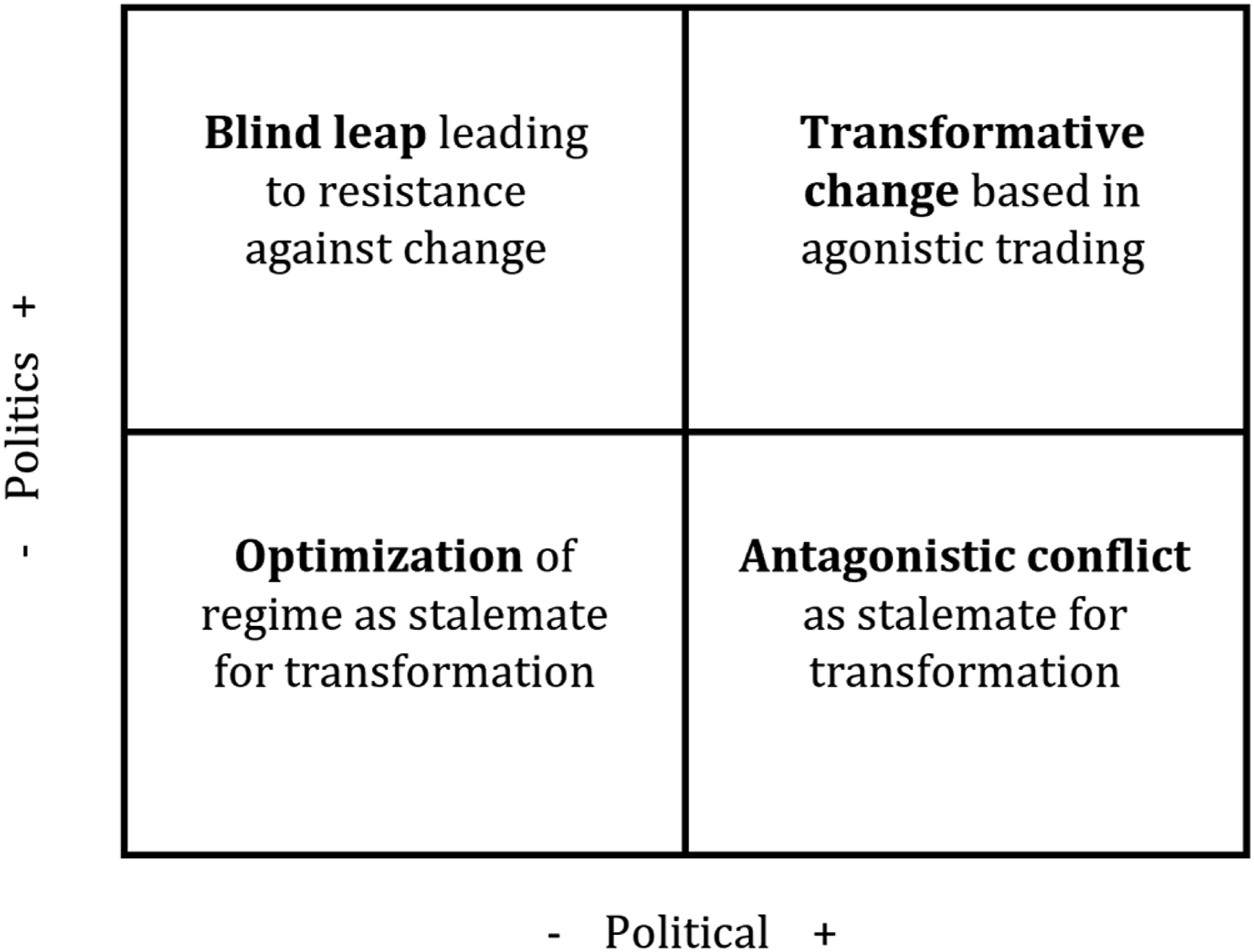
The upper left quadrant describes a situation in which politics serves to manage and institutionally embed an experiment, but without considering the plural interests and visions involved. Approaches chosen in these circumstances might seem both radical and feasible at first, but go on to prompt passive or active resistance. Think about experiments that do not survive the initial funding period because stakeholders pull-out because the experiment takes a turn they cannot influence or support. Checker (2011) provides a detailed case study that exemplifies this dynamic. She describes how sustainability experiments implemented in New York City were eventually met with resistance because citizens and other local actors felt unheard because local government officials and business investors (perhaps unwilfully) disregarded their requests and interests.
On the other side of the horizontal axis are two situations in which the experiment is politicized. This means that the plural interests, visions, and alternatives at stake in them, as well as the power-relations that include and exclude these different agendas and concerns, are all visible. In the lower right corner of the schema, no strategies are in place to manage and institutionally embed the conflictual dimensions of the political. This leads to antagonistic conflicts without the prospect of resolution. In all likelihood, this situation would either prevent adequate action or pursue it through attaining positions of power and legal procedures, which could result in biases and delays that prevent fundamental change. This is seen, for instance, in experiments where pioneers just focus on its survival (e.g. Druijff and Kaika, 2021), leaving no strategies or practices in place to constructively engage with and transform the status quo beyond the experiment. Other examples of these antagonistic conflicts are found in case studies of transition arenas to reduce e-waste in South-Africa 1 (Lawhon, 2012a, 2012b). These show how techno-managerial approaches fail to bring together stakeholders in transition arenas due to a lack of trust between local actors, governments and global actors, together with a lack of clarity on actor roles and positions of power.
The upper right quadrant denotes a situation in which decisions are made in and through an agonistic trading zone, which we see as a potential answer to the above mentioned question. Here, debates are adversarial, alternatives visible, decisions provisional, and power treated ambivalently. Together, these elements have the potential to bring about transformative change, both radical and consolidated. In their case-study of three urban experiments, Rizzo and his colleagues (2021) demonstrate how using strategies for negotiating the experiment's pathway based on agonism drew out significant disparities in interests amongst involved actors. There were, for example, significantly different ideas about social innovation between municipal actors and citizens. As a result of being open to these differences as well as discussing in detail the power-differences between actors, doors were opened to new directions for the experiment that would have otherwise remained closed.
Relating (de)politicization to the transformative urban experiments’ capacities
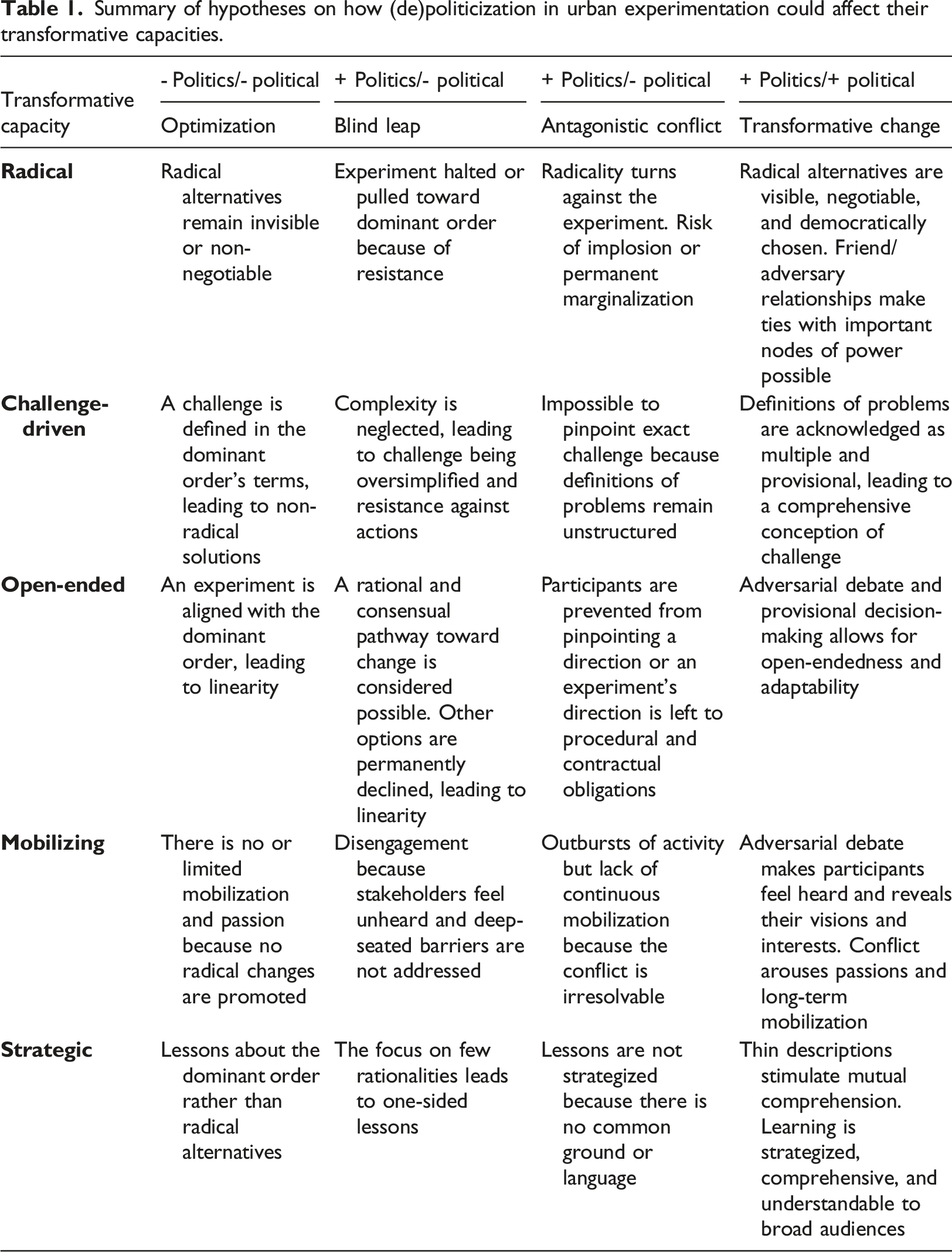
Summary of hypotheses on how (de)politicization in urban experimentation could affect their transformative capacities.
Radical
Trying to break radically with practices and technologies that make up a dominant logics is an intrinsically political act (Avelino et al., 2016). A challenge here is both to safeguard agonistic debate over an experiment’s course so that radical alternatives can become apparent and negotiable, as well as to establish a clear and cohesive counter-hegemonic project (or niche). What is more, strategies should be in place to confront (parts of) the status quo effectively. Change in the form of optimization does not inherently foster these dynamics, because it does not adequately challenge the hegemony of the status quo (Kenis et al., 2016). Pushing change without recognizing the political involves taking a blind leap that might provoke active or passive resistance, especially when the proposed changes are radical. Stakeholder disengagement, actors embedded in the dominant status quo retaliating against experimental activity, and NIMBYism serve as examples of such opposition toward radical transformation. Resistance often arises because different options remain invisible or appear non-negotiable (Barry and Ellis, 2015), eventually halting the project or pulling it toward convention.
Without being accompanied by any strategy to cope antagonistic conflict, an experiment’s radicality could turn against itself. If antagonistic conflict within the experiment lasts or conflict between the status quo and a counter-hegemonic project is only conceived in terms of a friend-enemy relationship (Mouffe, 2005), then it will prove hard for those involved to influence those in power in their attempts to foster change. In this case, the experiment would risk implosion or remaining marginal and would have no prospects of fostering fundamental change. Examples of this include grassroots experiments that attempt to evade being “hi-jacked” by existing logics which also drastically reduces their outreach (Druijff and Kaika, 2021)
If the experiment is constituted as an agonistic trading zone, open debate over ideas among actors, enabled by thin descriptions of their interests, might produce opportunities that are both radical and democratically founded. In this situation, there should be a strategy in place that connects the experiment to important nodes of power within dominant societal orders, while maintaining its radicality. An agonistic approach could help do this, for it promotes adversarial relationships both among stakeholders, and between the experiment and dominant societal orders. Such friend/adversary rather than friend/enemy relationships might reveal radical options and confront dominant societal orders without risking the experiment being hijacked or reigned in, such that it merely optimizes the status quo.
Challenge-driven
Rather than simply showcase innovations, an experiment should propose a substantive strategy for tackling urban challenges (Castan Broto et al., 2019; Wolfram et al., 2019). Urban challenges are contingent and conflictual, mirroring the contingent and conflictual character of the political in general. As such, they confound single, overarching definitions (Stirling, 2015). Experiments that optimize the prevailing status quo will likely construe challenges in narrow terms; they might solely stress the need to reduce the costs or CO2 exhaustion of dominant technologies, for example (Kenis et al., 2016). Experiments that take a blind leap will likely grasp challenges without attending to their contingency and conflictual character, because participants assume that they can reach a rational consensus on the issues at stake. This risks overlooking the complex social realities that subtend such challenges (Swyngedouw et al., 2002). Should change nonetheless occur in such cases, it will likely meet resistance. This is because stakeholders will experience and define the challenges at hand through very different rationalities and no strategies will be in place to articulate and mutually understand these differences.
Moving experiments onto the terrain of the political could result in a better grasp of the multiplicity of urban challenges, raising to visibility alternative perspectives that go beyond measurability or managerial convenience. But unresolved antagonistic conflict over what a given challenge involves would make it difficult or impossible to define the challenge because stakeholders’ understanding of it will diverge too strongly, thus preventing action. There have to be strategies in place to comprehend what is at stake. The idea of an agonistic trading zone could open up experiments, allowing them to serve as places for debate and inquiry into multiple aspects of the challenge to be addressed. This is made possible by the fact that various interests are visible in this scenario. Exchanging thin descriptions (Galison, 2010) could serve to make the challenge at hand comprehensible to all stakeholders, putting them in a better bargaining position when it comes to formulating solutions. Finally, the fact that decisions are provisional means that new lessons could continuously guide and hone how problems are defined.
Open-ended
An experiment should provide space to explore and adapt to new lessons and findings, avoiding linearity in its setup and elaboration (Castan Broto, et al., 2019; Rotmans and Loorbach, 2009). This entails recognizing that there are no one-sided solutions to urban challenges, but rather many conflicting options. An experiment that optimizes a dominant societal order, however, would likely increase linearity. This is because actions will be taken within parameters that are set by that order, leaving little space for thought and practice that falls outside them. Several authors (Druijff and Kaika, 2021; Torrens and Von Wirth, 2021) have already pointed out this tendency by highlighting how the regulations setting boundaries on what experimental initiatives can do often align closely with existing societal orders. These researchers show, among other examples, that existing regulations on urban development often threaten the experimental dimension of experimental initiatives – those aspects that push toward alternative and more sustainable modes of living.
Taking a blind leap without drawing on different stakeholders’ interests in change could result in a more linear experiment, in which it is expected that stakeholders will agree that the experiment will take a single direction (Kenis et al., 2016; Uitermark and Nicholls, 2017). Changing the experiment’s direction will remain impossible for so long as alternative options are suppressed or invisible. Antagonistic conflicts might, conversely, leave the experiment too open, because actors would not be able to agree on any direction of change. Contractual obligations might force actors to take action in some capacity, but such actions would likely not result in an open-ended innovation endeavor but rather in a minimal effort to follow existing regulations.
An approach premised on the notion of an agonistic trading zone could help ensure that an experiment is open-ended, in that it casts all decisions as provisional and open to contestation. Furthermore, this approach would offer strategies for debating the various directions that an experiment might take. Thin descriptions, for example, create a mutually comprehensible discourse with which to explain and pinpoint various directions. In addition, creative dialogue and debate might lead certain actors to consider pathways that they might not otherwise entertain within their particular rationalities.
Mobilizing
Experiments should mobilize actors as a means of allocating necessary resources, both for their duration and beyond (Roorda et al., 2014; Voytenko et al., 2016). According to Roorda et al. (2014: 31), an experiment should have a “wow-effect” and spark controversy so as to draw attention to itself, securing greater exposure and increasing the chances that its innovations might eventually spread. This connects with Mouffe’s (2013a, 2016) point that allowing the political (including its conflictual dimension) to surface stirs up passions that can mobilize actors and draw in participants. An experiment that merely optimizes dominant technologies and practices is unlikely to have a wow-factor or rouse passion, for it displays no truly new possibilities.
If a blind leap is taken, the conflictual dimension of the political remains hidden. This is because a consensus is assumed, which could erect barriers. Although they might remain neglected during the course of an experiment, these barriers would be likely to surface at some point, leading actors to disengage because their interests would not have been taken into consideration. Research indicates that such disengagement is one of the main problems afflicting experiments, especially after the funding period, for it diminishes their support base and might prevent upscaling (see e.g. Voytenko et al., 2016).
Mouffe (2005) and Žižek (2000), for all their differences, argue that contemporary governance and policies’ inability to mobilize actors results from an inability to acknowledge the political. Mouffe (2005: 23) argues that “passion” can be stirred up around societal issues only if there appear to be ways of fundamentally challenging or impacting the status quo. Antagonistic conflict could induce such passion and unite actors around a cause that they deem important enough to fight for (Žižek, 2012). Nonetheless, as we argued earlier, proceeding with an experiment without having a strategy for managing and institutionally embedding conflict will usually lead to a short-lived outburst of discontent, which does not develop into long-term mobilization.
Creating space for agonistic trading could make it possible to realize a more persistent experiment, which engages and mobilizes by arousing passions. Ongoing dialogue might ensure mutual comprehension, as well as identifying (and perhaps overcoming) barriers among participants. Furthermore, because all interests are open to negotiation, stakeholders will have clear expectations and the issues that would likely mobilize them will be apparent. The fact that the different options before an experiment are constantly visible and negotiable allows for new synergies to arise around specific proposals and goals.
Strategic
The experiment should generate valuable lessons that can steer it toward fundamental change. Such lessons should be accessible to stakeholders outside the experiment, allowing for their dissemination beyond the experiment (Hölscher et al., 2019; Roorda et al., 2014; Rotmans and Loorbach, 2009). An experiment that aims to optimize current conditions would generate lessons concerning how to marginally improve existing technologies and practices. No knowledge to do with radical alternatives would be generated or disseminated. Taking a blind leap runs the risk that any lessons learned will be one-sided because this approach would accept only a few rationalities or perhaps even only one rationality. This might lead to lessons that focus only on the technological aspects of the experiment, for example, while ignoring its underlying social or political dynamics (Caprotti and Cowley, 2017; Lawhon and Murphy, 2012).
When antagonistic conflict prevails and little effort is made to ensure mutual comprehension, there will be no common ground from which to generate lessons. There would be too many competing rationalities (Kenis, 2019) and too little exchange, leading to under-strategized learning activities in which some stakeholders will be unable to grasp their peers’ contributions (Mäntysalo et al., 2011). An exchange of thin descriptions, as in the approach based on agonistic trading zones, might foster mutual understanding while simultaneously recognizing the different rationalities at play (Galison, 2010; Mäntysalo et al., 2011). Acknowledging that it is impossible to arrive at a consensus on the basis of thick descriptions (that is, the complexities of one another’s rationalities), this approach uses thin descriptions to communicate how an experiment is proceeding and deliberate over its direction.
Politicizing urban experimentation: towards a research and policy agenda
The sustainability literature demonstrates that urban experiments play an important role in imagining and realizing changes that move toward more sustainable cities. Urban experiments offer protected spaces in which new actor constellations can inspire and articulate visions of sustainable urban futures. With varying degrees of success, the lessons that are drawn from such endeavors can spark change within the broader societal orders in which they are embedded (Lissandrello and Grin, 2011; Majoor et al., 2017). As some authors have already pointed out, however, neglecting the deeply political aspects of experimentation risks painting an overly optimistic picture, in which experiments are seen as neutral interventions with necessarily beneficial outcomes (Savini and Bertolini, 2019).
In this conceptual paper, we have aimed to enrich the relatively consensual and managerial perspectives on experimentation invited by the transitions literature. We have argued that these perspectives risk obscuring the plurality of contending options that fall outside a hegemonic social order, as well as the power relations underlying decisions over whether to include or exclude these alternative possibilities (Kenis et al., 2016). This is problematic, because the aim to disrupt and transform regimes implies that existing power-relations, biases, and logics must be confronted while a broad range of alternatives to existing practices and structures must be visible and negotiable. The transformations literature offers an alternative perspective in sketching out an approach to experimentation that is more politically sensitive (Stirling, 2015; Meyer, 2023). Yet, this literature remains less outspoken about actionable strategies and practices to organize urban experiments. In our attempt to integrate and broaden these literatures, we used political theory to argue that urban experimentation requires a deliberate balancing act between management (politics) and politicization to ensure they both provoke and engage with prevalent social orders so they can be transformed.
The challenge for practitioners, then, lies in devising approaches to urban experimentation that “recover” and make use of their political dimension whilst steering away from a focus on technological artifacts, manageability, and short-term results. In taking some initial steps towards an approach to urban experimentation premised on the notion of an agonistic trading zone (cf. Mäntysalo et al., 2011), we have drawn on Mouffe’s (2005; 2013a) writings on agonism and the work of planning theorists who have applied her work to local governance contexts. Such an approach has the potential to stimulate adversarial debate that goes beyond the appearance of a rational consensus in a given experiment. It also provides practical tools (trading zone) for converting debate into a means of mutual comprehension tool, allowing action to be taken (Balducci and Mäntysalo, 2013; cf. Mäntysalo et al., 2011). We contend that an explicit openness to plural viewpoints would encourage inventiveness, although there may be moments throughout experiments when this strategy is most advantageous and necessary. Consider, for example, the initial phases, where many decisions are taken that influence the eventual implementation as a key moment where this approach would suit. Or, the evaluation phase, when lessons for follow-up steps are to be drawn.
Researchers face the further tasks of theorizing and empirically scrutinizing processes of depoliticization in urban experimentation, as well as establishing new theoretical and practical perspectives on their politicization. This work might begin with a more detailed understanding of the ideal-typical change dynamics we have sketched out in this paper. That might entail, for example, close-up and longitudinal research following an experiment’s trajectory over time and space so as to spell out which specific actions lead to which change dynamics and to identify the tipping points at which the one produces the other. How is, for instance, an initially politicized experiment neutralized and vice versa? What role do different actors, regulations, and events play in this process? There is still a dearth of close empirical case studies of these dynamics in urban experimentation (Sengers et al., 2019). Furthermore, our proposed approach to experiments as zones of agonistic trading requires further elaboration based on empirical evidence to define its parameters more fully and understand its benefits in practice. Finally, but perhaps most urgently, our hypotheses need further exploration. We believe this would not only add to existing scholarship on transitions and transformations to sustainable urban futures, but also suggest how urban experiments might be practically set up and elaborated in ways that have a transformative impact.
Footnotes
Declaration of conflicting interests
The author(s) declared no potential conflicts of interest with respect to the research, authorship, and/or publication of this article.
Funding
The author(s) disclosed receipt of the following financial support for the research, authorship, and/or publication of this article: This study is supported by Nederlandse Organisatie voor Wetenschappelijk Onderzoek (023.017.081).