




Abstract
The urgency of the current polycrisis calls for a renewal of planning theory. We propose sufficiency planning as an approach, within earth system boundaries as its fundamental premiss to embrace the ecological, interpersonal, social, and individual realms of planning. The reframing of planning through sufficiency normativity builds on an ontological exploration informed by critical realism’s concept of four-planar social being. This approach explicates a philosophical interpretation of planning as a social act that interrelates with nature, social interactions, social structures and inter-subjectivity. In this paper, we lay out the main principles of sufficiency planning, its relevance to existing planning theories, and implications for planning practices.
Introduction
There can be no conclusions. We are, after all, engaged in a continuing search to improve the practice of planning through the power of theory. And that is an ongoing effort that must remain open to the future (Friedmann, 1998: 253).
In the course of almost three decades after the above statement was made, both practices and theories of planning have undergone continuous change, partially caused and driven by a rapidly changing world, with its associated emerging challenges and problems. Intellectual searches for renewed planning theories have always aimed at improving planning practices in order to tackle new challenges and steer development towards a better future, in a world of changing conditions. Our contemporary world demonstrates an era characterized as a polycrisis: global warming, biodiversity loss, ecological overshoot, growing inequalities, democracy deficits, and political polarization, to name but a few (Naess and Price, 2016). As a relatively new term, ‘polycrisis’ describes the phenomenon in which simultaneous occurrences of multiple, interconnected crises interact and create a complex systemic challenge, beyond the sum of individual crises (Lawrence et al., 2024). Polycrisis emerges when crises across different domains – such as social, environmental, and economic – compound one another, leading to heightened complexity, instability and unpredictability. Thus, the nature of polycrisis addresses the causal entanglement of multiple crises and their emergent effects.
In this paper, we focus particularly on the ecological crises caused by the overshoot of earth system boundaries (such as loss of biodiversity, climate change, depletion of resources), and their intersection with social and economic crises. By arguing that the ecological conditions set a foundation for social, economic, or political stability and well-being, we seek a planning paradigm that operates within earth system boundaries. Meanwhile, both professional and public trust in planning has declined, and planning practices have been criticized for reinforcing the status quo and failing to bring positive change to development initiatives (Albrechts, 2015; Rydin, 2013). Planning itself is in crisis, as claimed by several scholars (Davoudi, 2023; Fawaz, 2023), and as a discipline, needs to reflect and reinvent itself continuously. Following this line of thought, the question is how can planning respond fruitfully to this new reality of polycrisis? What kind of more responsive and accountable form of planning could lead to climate friendly, ecologically preserving, socially just, and politically democratic development initiatives?
Taking note of the new reality of polycrisis, we explore sufficiency planning as an approach which traverses environmental, social, and individual domains. This exploration of a new planning model is predicated on a critical realist social ontology, in particular, the four-planer social being (Section ‘Planning as a four-planar social being'). Based on this ontological foundation, we draw on sufficiency normativity as a way to address the polycrisis and frame sustainable futures within earth system boundaries (Section ‘Sufficiency normativity'). The notion of sufficiency normativity offers important insights for planning theory and practice which is unfolded on the four planes (Section ‘Sufficiency planning'). The paper is primarily a conceptual exploration, but refers to examples from two Nordic planning contexts – Norway and Finland – where the authors have conducted research and are knowledgeable about local conditions and practices.
Planning as a four-planar social being
Planning on four planes
Thinking about how planning might better address several intertwined crises entails an ontological reflection on planning’s relationship with nature, society, and individuals. In this regard, the critical realist concept of the four-planar social being provides a non-reductionist and comprehensive ontological foundation for analysing and reflecting on the role of planning in society today. As a social ontology, the concept of four-planar social being suggests that every social activity, practice and being exists simultaneously on four interdependent planes: (a) material transactions with nature; (b) social interactions between people; (c) social structures; and (d) stratification of the embodied personality (Bhaskar and Hartwig, 2016: 53).
Since any social phenomenon exists on more than one plane at once, this implies that “real and good social change”, including radical change, can only succeed by acting on all four planes simultaneously (Scott and Bhaskar, 2015: 18). Planning – as both a social phenomenon and an intentional social act striving to overcome crises and transform towards a ‘better’ society – will certainly benefit from an explication of the four planes.
Material transactions with nature
Plane (a) suggests that all social practices that occur within the biosphere, are dependent on non-human beings, and react back into nature. In Bhaskar’s words, “the irreducibility of the plane of material transactions with nature in the social world means that the material and natural character of what happens is an essential feature of all social explanations” (Bhaskar, 2011: 11). This helps us to situate all human activities in the context of the natural environment (Scott and Bhaskar, 2015), including planning. The power of planning in changing, shaping and transforming nature can never be overexaggerated. Through intervening in land-use processes and patterns, planning activities can exert positive or negative impacts of various degrees on non-human nature and ecosystems, at all scales. Hence, it is not surprising that both Intergovernmental Panel on Climate Change (IPCC) and Intergovernmental Science-Policy Platform on Biodiversity and Ecosystem Services (IPBES) point at land-use planning as an important tool for tackling current climate and nature crises. Meanwhile, more frequent and intense climate and natural disasters – as a consequence of the Anthropocene epoch – have impacted planning practices, thus posing new challenges and demands.
This plane of the four-planar social being embeds a clear notion of anti-anthropocentricism, as elaborated in a three-fold set of relationships: ecological asymmetry, in the sense that nature is independent of human beings; the essential dependence of human beings on nature for survival and flourishing; and the natural character of human beings (Bhaskar, 2011). From this approach, the view follows that humanity is constellationally overreached and contained by nature, which in turn, represents an absolute constraint (Bhaskar, 2011). Therefore, the ecological crisis – insofar as we are experiencing it, is arguably the most important issue, as ecology and nature set the premiss for any human activity. The non-dualistic conception of nature and humans helps to negate the belief in decoupling – a process through which human productive activities are decoupled from material use. In turn, this inevitably indicates a priority for non-growth-centred approaches, in order to respect the finiteness of nature. The relevance of this non-anthropocentric view of nature in the field of planning is elaborated upon in Section ‘Sufficiency planning'.
Social interactions between people
Plane (b) concerns how people, or differently situated agents, interact with each other, and on which premises interactions are built upon in the social realm. Social practices include the various ways in which different social groups or agents engage with each other (Norrie, 2009).
Planning is a social activity, made possible only by diverse types of interaction between professionals, civil society, politicians and other actors. The configurations of social interactions influence both planning processes and outcomes. The focus on social interaction has long dominated theoretical debates on planning, with an emphasis on democratic and legitimate decision-making. To a large extent, planning models based on instrumental, communicative, deliberative, or agonistic rationality attempt to reframe premises about the social interactions through which planning is conducted. For example, agonistic planning promotes agonistic pluralism based on competition between opponents (Mouffe, 2013), while deliberative rationality points to another mode of social interaction that emphasizes consensus building, deliberation, and avoidance of confrontation (Forester, 1999).
Social interactions in planning are also related to the normative dimension, that is, the ‘desired’ modes of social interaction that planning approaches aim to shape as an outcome. Diversity, inclusiveness, equity, conviviality, democracy, solidarity – to name but a few – are often framed as normative values that planning seeks to achieve. These values point to social interactions that are non-racial, equal, mutually respectful, and democratic. It is important to mention that both the social interactions themselves and their outcomes imply a scale dimension, ranging from between individuals, through intra- and inter-city social groups, to ethnic groups both nationally and globally.
Social structure
Social structure is broadly conceptualized by Porpora (2013: 195) in four different ways: “(1) patterns of aggregate behaviour that are stable over time; (2) lawlike regularities that govern the behaviour of social facts; (3) systems of human relationships among social positions; and (4) collective rules and resources that structure behaviour”. Critical realism considers social structure as involving not only relations between social positions, but also relations between these positions and social objects such as rules and resources (Buch-Hansen and Nielsen, 2020; Hartwig, 2015).
To understand planning on the plane of social structure, we can distinguish between structures within planning system, and those in the broader society beyond. The former could be legal structures (e.g., planning acts), cultural structures (e.g., political ideology), moral structures (e.g., value systems in planning), while the latter could be cultural structures (e.g., individualism, competitiveness, climate change denial), political structures (e.g., representative democracy), property structures (e.g., land and property ownership), and socio-economic structures (e.g., the neoliberal capitalist economy). These structures are made up of established rules, norms, and resources, as well as the systems of human relations that they produce. An example of an established rule would be a planning act that sets out the ground rules for preparing, making, approving and implementing land use planning; while an example of a system of human relations would be the systematic relationship between planners and politicians based on their social positions as professional advisors and decision-makers in land-use matters.
Social structure has causal power and also possesses emergent property. Social structures facilitate, motivate and constrain social activities and shape actions in a certain way, but they are never deterministic, since agents also possess emergent property and their actions are intentional (Bhaskar, 2008). Although social structures confront individuals in an objective way, they are created, reproduced and transformed by the actions of particular agents. This produces an analytical dualism – that structure and agency are dialectically related, but are ontologically distinctive, with their own causal power which cannot be conflated (Archer, 1995). This critical realist approach distinguishes from Giddens’ structuration theory which claims that structure and agency are mutually constitutive and cannot be untied (Næss, 2015). In the open system of a society, planning is exposed to an extensive network of social structures with different tendential properties and relational powers operating simultaneously, counteracting, amplifying or nullifying each other.
The stratification of the embodied personality
Plane (d) emphasizes the agency of agents – constituted partly from the social position one occupies, and determined by the distribution of particular resources and opportunities (Bhaskar and Hartwig, 2016). Any social act is not possible without human agency. As indicated by the analytical dualism mentioned above, agency also has causal power, and consequently cannot be reduced to its social context or position. Although social structures condition agency, this conditioning always takes place through the mediation of agency – and further agency, through actions that lead to the reproduction or transformation of social structures. Archer (2000) distinguishes between primary and corporate agency. A person acquires primary agency through belonging to particular collectivities that share the same life chances, while corporate agency is formed when agents are organized in collective projects in the pursuit of transforming society. These discussions on agency are particularly important during a crisis era when transformation initiatives are highly desirable.
Agents in the planning context concern primarily planners. Their intentional and/or unintentional activities that react back onto the social structures, either reinforcing, modifying or transforming them (Næss, 2015). Questions about planners’ identity as experts, moderators, mediators, mobilizers, advocates, and entrepreneurs are subject to constant disputes, in connection with various different models of planning. The different ways of framing the identity of planners imply different types of agency that individual planners should possess. Thus, the intriguing question is: What kinds of planners’ agency are necessary in order to deal with the polycrisis?
Interpreting planning on this plane also points to the fact that planning as a social activity can influence agency, and the actions of other agents who may or may not be involved in the planning process. The impacts of the built environment on people’s subject well-being, sense of belonging, aesthetics – and generally their psychological and mental states, are well documented (Mouratidis, 2021). As argued by Næss (2015), the possibility of being able to influence behaviour and action through spatial structures, land use and the built environment is a precondition for the existence and meaning of planning strategies and practices. In addition, the process of organizing planning practices – such as participation, deliberation and communication, generate feelings among relevant actors of being included or excluded, heard or ignored, respected or overruled.
Planning taking a stratified, interconnected and holistic approach to polycrisis
As mentioned earlier, what distinguishes a polycrisis from a juxtaposition of multiple, separate crises is that crises in a polycrisis are causally interconnected, and interwoven with emergent impacts. These crises need to be addressed and resolved as a whole, instead of being dealt with individually. Bhaskar and Hartwig (2016) argue that the polycrisis we face in our contemporary world relates to each of the four planes, reflected in the four e’s: ecological crisis, ethical crisis, economic crisis, and existential crisis – which interact with each other and amplify the ongoing harms being caused. On plane (a), it is clear that we are experiencing an ecological crisis. On plane (b), the most obvious crisis is the ethical one, arising from growing inequality in the distribution of, and access to resources, wealth, life chances and well-being, as well as a decline in democracy and the legitimacy of political decisions (Bhaskar and Hartwig, 2016). The eagerness to exploit natural resources for maintaining economic growth and affluence can result in increased inequality, both globally and nationally. On plane (c), there is an economic crisis characterized by the capitalist system that causes and reinforces the skewed distribution of resources and authoritative power, and exacerbates climate change and biodiversity loss. All this can lead to various types of existential crises on plane (d) (Bhaskar, 2020).
The four-planar social being offers a meaningful ontological foundation on which to critically reflect, examine and eventually resolve the current polycrisis, by bringing the four planes together in an ontologically dialectic, relational and holistic way. The four-planar social being has been further developed into a ‘social cube’, operating as a “tensed socio-spatializing process” (Bhaskar, 2008: 160) (Figure 1). The four planes are intrinsically hierarchically structured with plane (a) representing the most fundamental stratum, and plane (d) the most emergent. The lower strata condition the higher ones, such that plane (a) provides the ontological and causal foundation upon which the subsequent planes depend. This stratification implies a form of ontological dependency, wherein each successive plane both emerges from, and is conditioned by the preceding one, while also exhibiting its own emergent properties. The four-planar social being (Bhaskar and Hartwig, 2016, p. 54).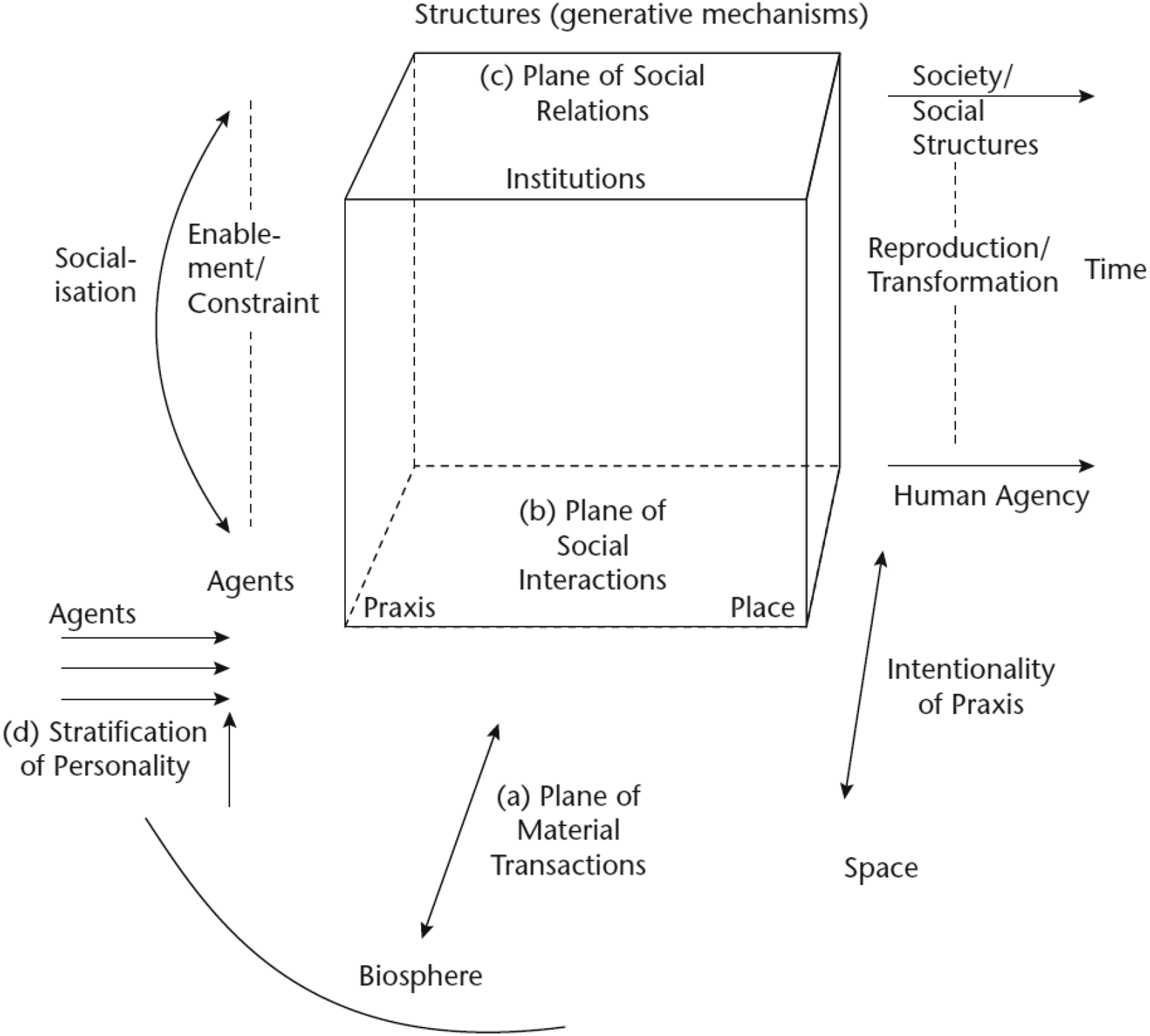
This social ontology enables planning to take a radically different approach to the polycrisis in a stratified, interconnected and holistic manner. Situating planning on the four individual planes provides insights into each single aspect of planning with respect to nature, social interactions, social structures and embodied personality. Planning that takes a stratified approach in this way connotes that these four planes point to different dimensions of social reality, each being “subject to multiple and conflicting determinations and mediations” (Bhaskar, 2008: 160). Strategies can be developed and tailored to handle the crises lying on the various different planes. However, these planes ought to be conceived as being relational and interconnected. Plane (a) – the natural environment – conditions all the other planes; social interactions on plane (b) are shaped and can change social structures on plane (c), which in turn, is mediated and transformed by plane (d) – agency. Cross-plane interconnection implies that measures and desirable outcomes on one plane do not necessarily result in positive impacts on the other planes (Buch-Hansen and Nesterova, 2023).
Taking this interconnected perspective seriously, it is clear that planning should avoid reductionist thinking that singles out certain planes when addressing the polycrisis. Notwithstanding this desirable approach, existing planning thoughts often have a single-plane focus. For example, as a response to the ecological crisis, the posthumanist planning approach has been primarily preoccupied with human relationships with nature, i.e. plane (a). Addressing the ethical crisis, communicative, deliberative, or agonistic planning pays more attention to interaction between relevant actors in planning process, namely plane (b). The Marxist planning tradition draws on explanations from capitalist mechanisms, which clearly belongs to plane (c). Addressing single-plane issues tends to result in a narrow understanding of planners’ identity, role and agency (plane (d)). This approach cannot sufficiently and effectively tackle the polycrisis that requires a coherent and effective perspective. There are a myriad of case studies that illustrate that communicative planning practices that promote social interaction through communication without addressing social structures that produce power imbalance, can lead to a failure to make democratic decisions (Purcell, 2009). Failures can also occur in the sense that planning decisions based solely on deliberation and consensus building can end up with land-use plans that aggravate ecological degradation and climate change (Xue, 2014). Understanding planning based on the ontology of four-planar social being allows planning practitioners to address the polycrisis as an interwoven whole, and underscores the following discussion on a more substantive form of planning based on the sufficiency normativity.
Sufficiency normativity
To address the ecological crisis (in particular), all human activities need to fit within the earth system boundaries and the regenerative capacity of the finite world. This entails a necessary reduction in absolute resource consumption, often referred to as a ‘sufficiency’ strategy. Although there is no generally acknowledged definition of sufficiency (Heindl and Kanschik, 2016), the notion is built on the idea of reducing environmental damage according to the earth system boundaries (Moser et al., 2015; O’Neill et al., 2018; Princen, 2003; Vita et al., 2019), simultaneously with an increased focus on socio-environmental justice and well-being (Rao and Baer, 2012; Rao and Min, 2018). Hence, sufficiency can be defined as “the space between a generalizable notion of human well-being and ungeneralisable excess”, within the earth system boundaries (Gough, 2023: 1). By cutting across the various different domains – such as ecological, social, economic and individual, the sufficiency idea constitutes a holistic, normative principle for tackling the polycrisis.
By initiating an absolute reduction of consumption, sufficiency differs from other environmentally aligned approaches that disregard the environmental carrying capacity and rely on technological solutions – such as ‘efficiency’ (O’Neill et al., 2018; Princen, 2003; Spengler, 2016; Steinberger and Roberts, 2010; Vita et al., 2019). Hence, sufficiency stands in contrast to the idea of decoupling where continuous growth in the levels of production and consumption is seen as possible. Sufficiency measures could mean, for example, capping, reusing, repairing, modifying, sharing, services instead of products, a focus on necessary goods and services, or moving from ownership of products to usership of services (Freudenreich and Schaltegger, 2020; Grubler et al., 2018; Haberl et al., 2020; Schneidewind and Zahrnt, 2014).
Sufficiency is grounded on the idea of both ‘limitarianism’ and ‘sufficientarianism’. The former indicates setting a maximum to the number of goods people may own, while the latter suggests a minimum limit for consumption based on the principle of social justice. These upper and lower limits generate a ‘consumption corridor’ within the limits of the earth system boundaries and justice norms (Fuchs et al., 2021; Gough, 2023). A limitarianism-induced maximum is a cumulative scale measure (Spengler, 2016), and limits the amount of overconsumption in order to reduce environmental damage (Lorek and Fuchs, 2013). A minimum level suggested by sufficientarianism means that all individuals should be able to fulfil their universal basic human needs, which can be regarded as an individual scale measure (Spengler, 2016). To identify this minimum level, the concept of basic human needs becomes central. Even though needs are universal, objective and non-substitutable (e.g., need for food and shelter), need satisfiers can be variable and context-specific (e.g., different types of cuisine and forms of dwelling) (Gough, 2023). The same need can be satisfied by different satisfiers, which carry more or fewer environmental impacts. The point is that defining minimum need satisfiers should also take into account the ecological ceiling. Thus, the notion of sufficiency normativity imagines an ideal social interaction “where both poverty and riches no longer exist, where necessities are guaranteed and luxuries are shrunk, where provisioning of essentials is prioritized and excess production and unreproductive labour is minimized” (Gough, 2023: 2).
For a long time, the focus of sufficiency discussions was on voluntary activities at the individual level (Heindl and Kanschik, 2016; Spengler, 2018). In these discussions, sufficiency often refers to bottom-up, individual, voluntary reduction of consumption towards more ecological lifestyles. The voluntary approach to sufficiency is in line with the mainstream values and economic structures that support individual liberty, and preferences neutrality. However, such an approach has been contested, as it inherently requires that a free choice of living sufficiently is available, and thus, can refer only to people who live in affluence (Alcott, 2008; Princen, 2003).
In contrast, taking sufficiency as a societal organizing principle beyond individual voluntary choice, would necessitate fundamental changes in socio-economic structures towards a non-material quality of life (Princen, 2022). In other words, the sufficiency principle is at odds with mainstream capitalist socio-economic organization, and neoliberalist values and norms which advocate material growth, efficiency, competitiveness, and individualism. Gough (2023) makes a compelling argument that contemporary values structured according to the orthodox economy need to be transformed as, by holding the principle of preference neutrality, it does not differentiate better or worse preferences for consumption.
To avoid the potential rebound effects of voluntary individual-scale actions (e.g.,Schanes et al., 2019; Sorrell et al., 2020), we need to understand that consumption is shaped by political, economic, socio-cultural, and infrastructural aspects that surpass the individual realm (Schor, 2007; Shove et al., 2015). This has led to a discussion on binding policy instruments (Alcott, 2008; Figge et al., 2014). Sufficiency policy, then, involves “policies that aim to decrease the demand or use of goods and services with high environmental impacts to achieve per-capita consumption levels that ensure emissions and resource use to stay within the environmental carrying capacity” (Spengler, 2018: 234). Such policy instruments could be regulatory (e.g., banning high-carbon options), economic (e.g. carbon taxes), nudging (e.g., social comparisons), cooperative (e.g., focus on collective services), or informative (e.g., communication plans) (Linnanen et al., 2020). However, policy discussions have sometimes been criticized for hints of paternalism, since they interfere with, and reduce individual freedoms (Muller and Huppenbauer, 2016).
Sufficiency planning
Sufficiency planning structured according to the four planes.
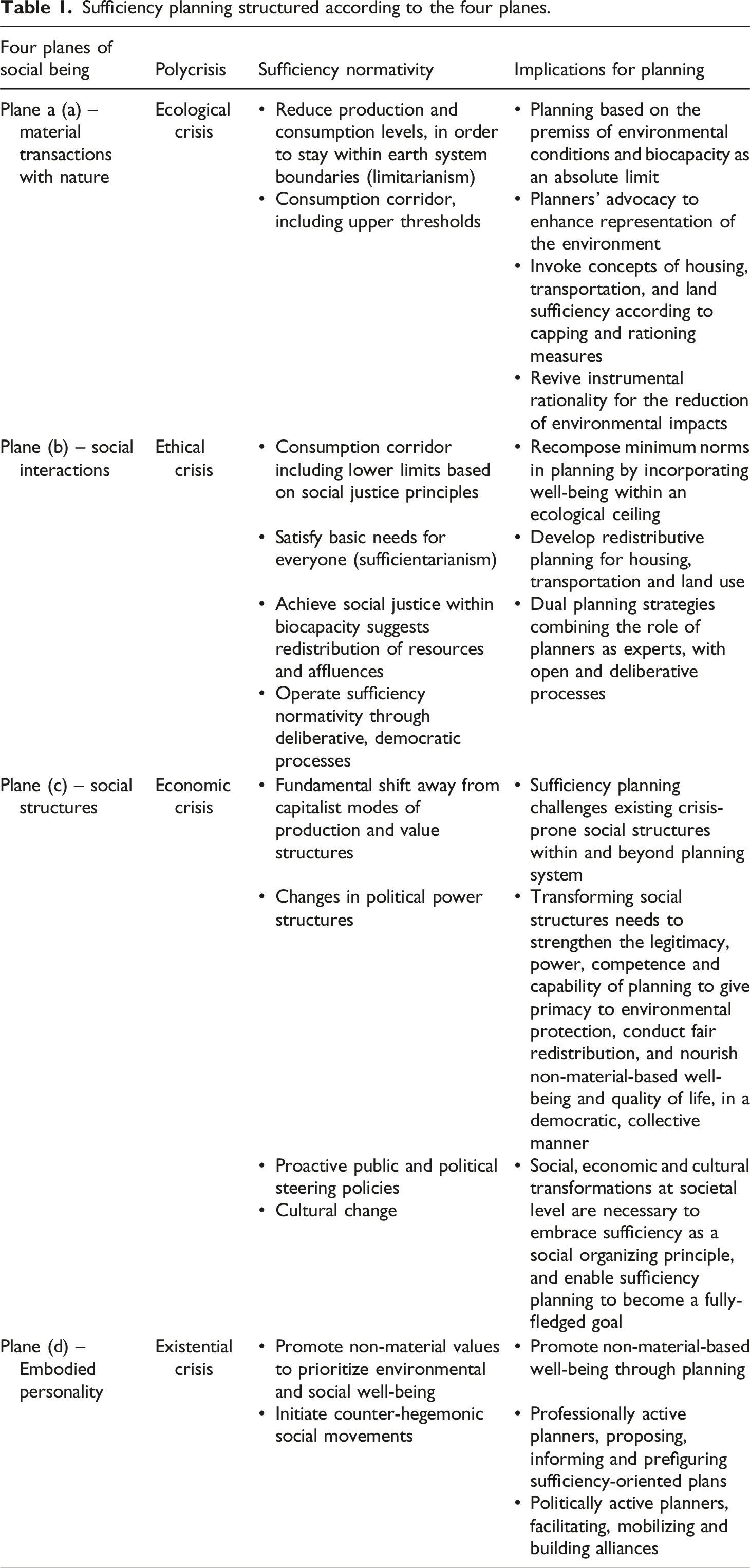
In the following texts, we will investigate what sufficiency planning is, in combination with discussions on how it differs from mainstream planning paradigms, and how it relates to existing planning theories. In order to make our ideas more concrete and operational, we draw on ‘good’ and ‘bad’ examples from existing research studies or planning practices, primarily in the context of Finland and Norway.
Plane (a): Planning premised on and prioritizing the environment
Planning initiatives that take into account the relational, anti-dualistic approach to non-human being would start with enquiring into the ecological capacity which provides the material conditions that are necessary for any planned land use and activities. This requires an update on existing natural resources, ecological functions and values, as well as planners’ knowledge and expertise on how land use imposes different types of impacts on the environment, both locally and beyond – as often highlighted by ‘degrowth’ planning advocates (Durrant et al., 2023; Xue, 2022b). The urgency of halting ecological degradation and mitigating climate change further justifies planning approaches that prioritize environmental concerns. Prioritizing environmental interests is particularly necessary when they are at odds with other land-use purposes, such as the construction of roads and holiday homes, as nature is often undervalued and sacrificed by current planning priorities, particularly in conflictual situations. This means that in land-use conflict situations, the representation and voice of the non-human environment – often vulnerable and underrepresented – need to be augmented and strengthened. Similar to the argument espoused by posthumanist planning theories, advocacy planning which originally sought to include and make visible traditionally marginalized social groups, can be expanded to nature and non-human species (Jon, 2020).
The natural logic of sufficiency thinking leads to capping and rationing initiatives. Inspired by the ‘consumption corridor’ – with a ceiling defined by ecological constraints (Fuchs et al., 2021), in the planning context, the philosophy of ‘limitarianism’ implies limiting and downsizing the extent of land consumption, housing consumption, and transportation, and undoing excesses such as overconsumption and the accumulation of luxuries. Relevant concepts – such as housing sufficiency and transportation sufficiency – have been explored theoretically, and practised sporadically. The notion of housing sufficiency suggests smaller living spaces; lower indoor temperatures; more shared spaces; a cap on per-capita floor area; prioritization of multi-family buildings over single-family houses; reduction in the demand for materials, water and energy; cohousing; and progressive property taxes based on per-capita floor area (Bohnenberger, 2021; Næss and Xue, 2016; Sandberg, 2018).
In the transportation sector, sufficiency could mean, for example, promoting low-carbon mobility options – such as walking, cycling, public transportation and ride sharing; a reduction in demand for mobility; shorter travel distances; staycations; lower speed limits; and car-free living (Dijk et al., 2019; Waygood et al., 2019; Zell-Ziegler et al., 2021). As one Finnish study illustrates, to meet sustainable levels of material consumption, the average living space per capita needs to be limited to as low as 20 m2 (a reduction from 38 m2), and the yearly travel distance per person should be reduced from 17,500 km to 10,000 km, in combination with a dramatic decrease in the use of private cars (Lettenmeier et al., 2014).
Applying the sufficiency thinking to land consumption invokes the concept of land sufficiency. Taking this as a norm, planning approaches should, first and foremost, try to reduce the demand for ‘land take’, particularly the appropriation of natural land. In contrast to the widely applied densification strategy in urban planning, other potentially more transformative practical applications could include the ‘no net land-take’ goal – a land policy that aims at zero land take, that has been adopted by several EU countries, as well as municipalities in Norway (Decoville and Feltgen, 2023; Eichhorn et al., 2024; McCormack et al., 2022). Today’s prevailing discourse tends to be directed towards increased demand on land to facilitate the ‘green shift’ which is dependent on upscaled production of renewable energy and exploitation of minerals. This paradox – that more land needs to be taken in order to be ‘green’ – exacerbates conflicts in land use between protection and construction purposes. As the demand for, and requirements on land use are driven by societal development, being sufficient in terms of land consumption (i.e. reducing the demand for land take), appeals to sufficiency norms regarding other domains of life.
Arguably, it is necessary to revive instrumental rationality in planning practices, in order to reduce environmental impacts. Issues of climate mitigation and the protection of nature necessitate clear and measurable goal setting (e.g., carbon neutral or zero land-take goals), and the adoption of appropriate and effective means for achieving such goals (e.g., land-use structures, tools, models, environmental assessments, etc.). The need to understand and solve environmental problems is clearly linked to levels of knowledge about ecology and the natural sciences in general (such as the cumulative and aggregate effects of fragmented land use and the earth system boundaries). Incorporating and exercising this type of knowledge in planning includes the required instrumental and substantive rationality that builds on the logical relation between the ‘means’ and the ‘ends’ (Alexander, 2000). However, a long time ago, the development of planning theories turned away from instrumental rationality, and instead, plan-making was redirected towards pragmatism and argumentation (Alexander, 2000; Connell, 2010; De Vries and Zonneveld, 2018). The notion of sufficiency planning challenges this movement by arguing for the integration of instrumental rationality. Undoubtedly, including ‘hard’ environmental norms within ‘soft’ pragmatism-oriented planning practices raises challenges. Being able to combine the various rationalities in planning practices is both essential and indispensable in order to tackle the polycrisis as a whole.
The perspective of sufficiency planning aligns with – but also goes beyond – several existing planning thoughts that address current ecological predicaments. For example, Rees (2017) and other ‘degrowth’-minded scholars (Savini et al., 2022) acknowledge the biophysical prerequisites for urban sustainability, while arguing for planning practices that support self-reliance and the contraction of consumption in order to keep within the regenerative capacity of ecosystems. The emerging ‘material turn’ in planning – especially the posthumanist approach – addresses the previously ignored material aspects by seeing the non-human environment as a performing agent which needs to be incorporated in planning (Jon, 2020). Giving primacy to the non-human environment and ecosystems is crucial to solving the current natural and climate crises; however, the posthumanist approach to planning hardly goes beyond the natural domain, and does not engage in a discussion on its implications in the social domain.
Plane (b): Recomposing social justice and redistribution within limits
Planning plays a vital role in affecting the ethical crisis as experienced on this plane. Since its inception, the field of planning has been based on the ethical premiss of promoting justice and equity; nonetheless, this is often manifested within an overall framework of increasing wealth and material living standards (Fainstein, 2009). The concept and pathways to social justice conditioned by ecological constraints will inevitably need to be recomposed. Connoted in the concept of sufficientarianism, social justice means that everyone will have their basic needs satisfied, and this can only be achieved through redistribution within an imperative ecological ceiling.
To meet everyone’s basic needs requires setting minimum standards. For instance, it is usual practice in today’s planning system to regulate the minimum size of residential units and green areas per capita. To satisfy the need for mobility, planning can also regulate the longest distance to collective transport nodes like train stations or bus stops. Although these minimum norms to secure everyone’s needs is nothing new in the planning practices, taking into account ecological boundaries would challenge both the contents and thresholds of such minimum standards. In contested developments, such as holiday homes in the Nordic context, a relevant question is whether having access to holiday homes constitutes a basic need. Despite its long historical tradition and deep cultural roots, building and using holiday homes generate heavy ecological burdens (Xue et al., 2020). Answers to this question will justify or invalidate planning attempts at allocating more land for the development of holiday homes, at the cost of nature, wildlife, landscapes, and climate effects. In this and similar cases, one can distinguish between needs, and needs satisfiers (Gough, 2020). While being able to enjoy recreational activities in nature is a basic human need, satisfying this need could be realized through more environmentally friendly ways of land use, as opposed to providing private, individual cabins. This approach challenges planners to rethink how basic needs might be better satisfied by satisfiers that demand fewer resources (e.g., replacing private cars with public transport options to satisfy mobility needs).
Furthermore, the minimum standards that are set in current practices – such as the requirement on minimum dwelling size – often go beyond recommended ecological ceilings (Gough, 2020; O’Neill et al., 2018; Sandberg, 2018). The minimum norm in planning standards needs to reflect social and well-being dimensions, in combination with ecological boundaries. For example, a smaller dwelling size can fulfil sheltering needs and other functions through better and flexible design, or by sharing spaces at the neighbourhood level (Bohnenberger, 2021; Stefánsdóttir and Xue, 2018).
Following the logic of sufficiency, another dimension of social justice to consider is redistribution (Koch and Mont, 2016), which would consequently reduce equality gaps. The need for redistribution within a scenario of limited resources poses challenges to planning authorities who need to consider how to distribute a ‘shrinking cake’ amid attempts to satisfy basic needs for all. The phenomenon of ‘trickle-down’ thinking – as in the housing sector, where more dwellings are being built, with the expectation of providing enough housing for the poor – is challenged (Næss and Xue, 2016). In contrast, housing redistribution measures would adversely affect those who currently live with excess residential space. Such measures would include regulating minimum occupancy rate or maximum unoccupancy duration, maximum per capita housing consumption, dividing and redesigning houses that are too spacious, exploring superfluous capacity, and reusing existing building stock. Redistributive transportation planning measure would suggest reallocating road space that is currently for cars, to buses, pedestrians or cyclists (Nello-Deakin, 2022; Tennøy and Hagen, 2021). Densification as a land-use strategy can also play a more significant role in redistributing access to amenities, public goods and facilities. However, in Oslo, densification has disproportionally developed in working-class neighbourhoods, thus exacerbating uneven socio-spatial development between affluent and relatively less wealthy areas (Andersen and Skrede, 2017; Cavicchia, 2021). A justice-oriented densification strategy could take place in wealthy single-family dwelling neighbourhoods, to facilitate more inclusive and even urban development trends.
Sufficiency planning happens in the course of social interactions, which also concerns plane (b). Sufficiency scholars have highlighted democratic, deliberative processes in order to agree on sufficiency goals in terms of living spaces (Buch-Hansen and Koch, 2019; Gough, 2020). Likewise, sufficiency planning needs to avoid imposing professional ideals in the manner of modernist planning, but should instead situate itself within the democratic bounds of participation, deliberation and agonistic pluralism. In exploring methods of setting minimum and maximum thresholds for the consumption corridor, Gough (2020) proposes a dual strategy – a process of combining two forms of knowledge: “the codified expert knowledge and the experientially grounded knowledge of ordinary people” (212). We argue that implementing sufficiency planning approaches requires planners to take the expert role, with suggestions that adhere to the notion of sufficiency normativity, by engaging in open, deliberative dialogue with different interest actors. It is not certain that such a process would lead to the breakthrough of sufficiency planning tenets, insofar as we acknowledge the potential dilemma that planners face when they are situated between democratic decision-making and maintaining professional values (Durrant et al., 2023). We will return to this transformative potential of planners in the discussion on plane (d).
As this discussion has suggested, the sufficiency planning model addresses inequality and injustice challenges differently from mainstream planning thoughts about social justice. For example, Fainstein (2017) proposes equity, diversity and democracy as constituting social justice, but she does not challenge the unjust, growth-oriented capitalist system. Sufficiency planning suggests measures for justice premised on a finite planet, and therefore also confronts the capitalist economic and associated structures which underly the ongoing crises on plane (c).
Plane (c): Institutionalizing sufficiency normativity in planning
Current economic structures that are characterized by growth imperatives, competition, privatization, marketization, and profit maximization are volatile and prone to crisis. Planning practices have long been bound to these structures and associated societal values and norms, both by maintaining them and relying on them to fulfil public goals (Durrant et al., 2023; Rydin, 2013; Savini et al., 2022; Xue, 2022b). Sufficiency planning on plane (c) concerns the social structure realm, where sufficiency normativity can come into being in the form of institutionalized planning systems to provide resistance to, and a transformative impetus regarding those social structures.
Within the planning arena, various aspects either constrain or enable the practice of sufficiency planning, for example, ways of organizing planning systems, regulated power distribution, prevailing ideology and culture, and available tools and instruments. In the context of Norway, planning structures tend to be more of a constraint than an enabler of sufficiency planning. The major legal structure – the Planning and Building Act (PBL, 2008), underpins the planning value system by focusing on neutrality in sectoral interests, processes, and the decentralization of power (Hanssen and Aarsæther, 2018). Arguably, the value principle of neutrality concerning sectoral interests can hinder the prioritization of environmental and climate concerns, in both plan-making and decision-making. Likewise, a highly decentralized planning system has weakened the capability of national and regional authorities to intervene in local planning practices that go against social and environmental interests at broader geographical levels (Strand and Næss, 2017). Existing planning tools are often imbued with a growth premiss, and are thus more conductive to justifying the conversion of land for developmental purposes. For example, traffic modelling and cost-benefit analyses which form the basis for decision-making regarding the transport infrastructure are based on projected traffic growth. This results in road capacity expansion, thus realizing the so-called ‘self-fulfilling prophecy’ by making the expectation of traffic growth become true (Næss et al., 2014). Furthermore, ideological conditions that underpin planning strategies are, to a large extent, steered by the political hegemony of neoliberalism, as manifested in planning’s belief in green growth, competitiveness, freedom of choice, satisfaction of individual preferences, and aversion to a steady-state situation (Gunder, 2010; Xue, 2022a).
Restructuring planning systems in order to normalize and institutionalize sufficiency thinking, and to resist current unequal, unsustainable and crisis-prone systems, needs to take place in all the structural realms: legally, methodologically, culturally, organizationally, etc. Transforming these structures needs to take the direction of strengthening the legitimacy, power, competence and capability of planning, in order to give primacy to environmental protection, conduct fair redistribution, and nourish non-material-based well-being and quality of life, in a democratic, collective manner. As the ‘social cube’ shows (see Figure 1), planning is a “tensed socio-spatializing process”. As such, suggestions about the re-institutionalization of planning cannot be prescribed at more detailed level, because the structural conditions are specific, unique and complex, depending on the context.
The prospect of normalizing sufficiency planning also depends on the configuration of broader societal structures. Planning practices are susceptible to penetration by political ideals (Davoudi et al., 2020; Grange, 2014; Gunder, 2010; Shepherd, 2018), but any room for planners to resist this penetration is rather limited (Grange, 2014; Inch, 2010). Taking Norway as an example again, any possibility for regional and sectoral authorities to object to local plans is highly steered by political ideals. When the right-wing government was in power, political signals were sent out to regional and sectoral authorities to reduce the use of objections about local plans. Another vital structural condition – the strong growth imperative of the globalized capitalist economy, considerably constrains planning’s potential to initiate any sufficiency-oriented planning interventions (Barry, 2019; Næss et al., 2020; Rydin, 2013). Since local economic prospects, the generation of new work places, and the maintenance of services and welfare are dependent on mobile capital investment, any room for planning to take a restrictive approach to land use, housing construction and infrastructure building which can hinder investment inflows, is limited.
The cultural structure manifested in spatial norms, mobility norms, and dwelling preferences can also constitute constraints to the popularity and acceptance of sufficiency planning measures. Studies show that any normative valuation of desirable or appropriate size of living space varies culturally (Hagbert and Femenías, 2016). Downsizing dwellings can therefore be considered as a regression in living standards. Social, economic and cultural transformations are necessary to enable sufficiency to become a social organizing principle, and for sufficiency planning to become a fully-fledged goal. For example, in Finland, sufficiency has been applied as a framework for the National Climate Policy in reconceptualizing consumption (Linnanen et al., 2020). However, studies have already pointed out that such a planning initiative can hardly survive in Finland, as it would require deep societal transformation, in order to ensure that basic needs can be fulfilled at the same time (Lage, 2022).
Plane (d): Reshaping the role of planners
The model of sufficiency planning is pertinent to the enhancement of well-being and the meaning of life that is beyond excessive possession of materials, thus addressing the existential crisis inherent in plane (d). Additionally, it concerns the inner being and agency of planners, particularly regarding their role in driving sufficiency planning. This involves planners striving to resist constraining structures, transform such structures, and even invent new conducive conditions. Despite disputes in the sufficiency literature as to whether this is an individual choice or a societal project (see Section ‘Sufficiency normativity'), sufficiency planning belongs to the latter category, since it should be a collective endeavour. Clearly, cultivating, making and implementing sufficiency planning measures cannot happen without the transformative agency of planners.
For analytical purposes, we can distinguish three types of planners’ agency, with different degrees of transformative potential: passive planners, professionally active planners, and politically active planners. Invoking Archer’s term of ‘primary agency’ (Archer, 2000) (see Section ‘Planning as a four-planar social being'), planners gain agency through their social position as professionals who can exert more or less influence on political situations. Passive planners try to behave more as value-neutral bureaucrats, committed to the expectations of others (politicians, developers, local residents, etc.), and are reluctant to make claims for greater professional autonomy (Grange, 2013; Inch, 2010). Clearly, this approach does not live up to the notion of sufficiency planning as a value-driven, normative project that expects planners to proactively resist dominant extractivist planning paradigms.
Striving for sufficiency planning strategies would require professionally active planners to inform politicians and the wider public by proposing alternative futures and development paths, based on a value system that is different from the prevailing one. Prefiguration – by envisioning a sufficiency future, is the first step towards its realization. Davoudi (2023) argues that engaging in prefiguring alternative futures can be thought of as constructing concrete utopias in the here and now. Concrete methods could include scenario planning, especially normative and explorative scenarios which contrast and compare with the business-as-usual development trajectory (Xue, 2022b). An example could be planning road projects, in which non-construction or a low-traffic-growth scenario (based on the sufficiency principle) is juxtaposed upon the traditional forecast-based development trajectories that usually point to high traffic growth (Næss and Strand, 2012). This non-growth scenario could lead to a discussion of how it can be achieved, and how it would benefit nature, the climate, and human well-being.
Pursuing sufficiency planning cannot circumvent a reflection on what constitutes basic needs and human well-being. Here, planners can engage the public and politicians in such reflections, through deliberative planning. For instance, planners can raise questions about, and discuss relationships between individual well-being and mobility growth, size of homes and living quality, and essential leisure activities (Bertolini and Nikolaeva, 2022; Buch-Hansen and Koch, 2019). Exploring new norms that can achieve a high quality of life within the earth system boundaries should be part of planning strategies. However, planners who take this proposing, informing and prefigurative role do not necessarily make a breakthrough in planning processes, as Durrant et al. (2023) state: “planners in democratic societies are rarely in a position to impose spatial visions on their own, nor should they be seen to do so” (293). Nevertheless, such transformative agency of planners as active professionals can broaden the horizons of other actors involved in planning processes, and thus begin to cultivate possibilities for moving beyond the mainstream.
Moving further up the ladder of transformative agency, planners can take on the role of political activists pursuing the political project of sufficiency planning, and thus demonstrating corporate agency. As pointed out by several post-growth planning scholars (Durrant et al., 2023; Savini, 2024), one of the most crucial roles of planning in driving societal transformation is to create synergies between diffuse niche-level practices and projects, by building up interdependence and complementarities. Politically active planners will engage with activities such as facilitating experiments, mobilizing interest groups, and building alliances. Admittedly, taking on this role as an active political actor would put planners in public institutions in a challenging situation, having to confront moral dilemmas between professionalism and activism (Rydin, 2024).
Conclusion
In this paper, we have explored sufficiency planning as an antidote to the global polycrisis we are experiencing today. A polycrisis is characterised by multiple interwoven ecological, social and political crises, and requires solutions that comprehend the interrelatedness, consider the mutual impacts, and target the entirety of the challenges. Renewing planning thinking in accordance with changing realities is necessary in order for planning theory to be pertinent to practice. The concept of four-planar social being provides a social ontology that makes a stratified, interrelated, and holistic understanding and solution possible in addressing a polycrisis. Our study has fleshed out this ontology by applying the notion of sufficiency normativity, which offers a societal organizing principle that can be effective in resolving multiple interrelated crises.
Unfolded on the four planes representing the environmental, the interpersonal, the social and the individual, sufficiency planning proposes a new normativity to cope with the polycrisis, by reducing excessive production and consumption, attending to social justice through redistribution, challenging growth-entrenched institutions, and encouraging a transformative role for planners. Through “effective epistemic integration” (Bhaskar, 2011: 13) enabled by the ontology of the four-planar social being, sufficiency planning provides the means to cope with challenges on each plane, while simultaneously avoiding causing harm between planes. This requires a combination of different planning rationalities in a coherent and complementary manner, rather than pursuing any strategy exclusively.
The model of sufficiency planning as we have outlined it, can be categorized as what Alexander (2022) refers to as a ‘higher-level theory’, designed for generic planning practice, in that it is abstract, general, and decontextualized. In terms of the critical realist ‘social cube’ (see Figure 1), every planning practice needs to be understood as a concrete singular endeavour which contains a universal element – yet always in association with a particular geohistorical trajectory – and it therefore has a unique singularity (Bhaskar, 2008). As a planning model, sufficiency planning plays out in the form of specific differentiations within tensed socio-spatializing processes. The contextualization of sufficiency planning within different territorial and temporal contexts, substantive fields (e.g. transportation, spatial, land use), and prescribed forms of planning practices (such as strategic planning, zoning planning), could lead to various manifestations.
Many recent planning thoughts have taken nature and ecology as the central premiss, such as posthumanist planning theory, the bioregional approach, and post-growth planning. In the post-growth planning literature, satiation and limits are addressed as one essential principle (Rees, 2017; Savini, 2024; Xue and Kębłowski, 2022). Sufficiency planning can be seen as enriching the wider post-growth planning dialogue with a solid ontological grounding – it also expands the domain beyond a mere focus on satiation and the earth system boundaries, to embrace social justice, equity, and well-being, at both individual and societal levels. Likewise, planning theories that address social structures and planners’ agency – such as Healey’s (2003) collaborative planning approach; and social justice – such as the just city theory (Fainstein, 2017) – have drawn attention primarily to one or two planes. The discernible feature of sufficiency planning is its holistic and interrelated position that accommodates different planning rationalities and theoretical perspectives that are necessary to cope with the polycrisis as it unfolds on all planes. Sufficiency planning also promotes the combination of process-oriented planning theories with substantive aspects which deal with the impacts and consequences of planning decisions on the environment, society and the economy (Huxley and Yiftachel, 2000; Jon, 2020; Purcell, 2009; Xue, 2022b). To be able to manage the current polycrisis, it is also necessary for planning to direct attention to likely impacts that different planning actions are likely to generate.
Uncertainty is not intrinsic to sufficiency planning itself, but instead, characterizes the broader context within which planning practices are pursued. Sufficiency planning can be understood as a normative model that represents a desirable trajectory in an uncertain world, and offers a guiding framework for sustainable decision-making amidst unpredictable conditions. Princen (2022) argues that the urgency of the current situation has made sufficiency an imperative, necessary social organizing principle, and we hold that this is also makes the case for the pursuit of sufficiency planning.
Footnotes
Declaration of conflicting interests
The author(s) declared no potential conflicts of interest with respect to the research, authorship, and/or publication of this article.
Funding
The author(s) received no financial support for the research, authorship, and/or publication of this article.
