



Abstract
Despite its widespread adoption by industry, the academic literature is quite skeptical about the Net Promoter Score (NPS). Given the persistent use of NPS by managers, this research note provides a deeper understanding of its practical implementation while exploring the potential benefits NPS offers to managers, focusing on the distinction between transactional and brand health NPS. Furthermore, this research note also introduces five essential managerial considerations for using NPS, further extending the scope for managerial-relevant future research.
Keywords
Introduction
Twenty years ago, Net Promoter Score (NPS) was introduced as a superior predictor of sales growth, and hence for managers the “one number you need to grow” (Reichheld, 2003). NPS is a calculation based on the likelihood to recommend (LTR) question that clusters respondents based on their answers into Promoters, Passives, and Detractors. Today, NPS is arguably one of the most widely used customer mindset metrics adopted by roughly two-thirds of US-based CMOs (CMO Survey, 2023). Despite its enduring popularity in practice, academia remains skeptical about NPS, leading Bendle et al. (2019, p. 211) to summarize the state of research on NPS as an “academic-practitioner divide”.
Two main streams of critique on NPS have emerged (see Grisaffe, 2007 for more details): first, by using past sales growth data instead of future orientated sales data, and by relying solely on a correlation analysis, the original research is considered flawed. Second, while the LTR question itself is quite established in marketing research, the NPS calculation itself is problematic; for instance, the cut-off points appear to be set arbitrarily and parts of the sample are not considered in the calculation. In addition, empirical evidence does not universally support the sweeping claim that NPS is the “one number you need to grow.” While there is evidence that NPS is connected to other dimensions of marketing performance such as word of mouth (Raasens and Haans, 2017), customer spending (Mecredy et al., 2018), and retention (De Haan et al., 2015), the relationship between NPS and sales growth remains controversial: Studies by Morgan and Rego (2006), Keiningham et al. (2007), and Dawes (2022) did not find a connection with sales growth, however other studies did, for example, by Baehre et al., (2022, 2022b); van Doorn et al., (2013). Nevertheless, these studies also concluded that NPS is not superior to other customer mindset metrics nor is it superior to other calculation methods based on the LTR question.
In summary, despite not being considered a superior metric by academic literature, widespread use of NPS by industry suggests that NPS is here to stay. Hence, academia should provide guidance to managers on how and when they can or cannot use NPS. Therefore, this research note aims to deepen our understanding of NPS utilization in practice by: (a) outlining the potential benefits NPS offers to managers despite not being a superior predictor of future sales growth; (b) noting the different ways NPS is employed in practice; and (c) introducing five important considerations for managers on utilizing NPS that open up a potential research agenda for future, managerial-relevant research on NPS
Benefits of NPS in Managerial Practice
While NPS may not serve as a superior predictor of customer behavior and sales growth, NPS is heavily used in managerial practice, implying that managers value NPS for features beyond its predictive capabilities alone. First, managers use NPS as a non-financial KPI focusing on how customers perceive the company, an approach which offers multiple benefits. For instance, NPS serves as a counterbalancing KPI to financial data, enabling decision-makers to steer towards long-term, healthy growth by prioritizing the establishment of a strong brand and fostering robust relationships with customers (see Reichheld and Markey, 2011). Similarly, NPS plays a pivotal role in cultivating a customer-first mindset within the company. By utilizing NPS, managers signal their commitment to valuing customer interactions and experiences throughout the organization. NPS also provides valuable insights regarding the voice of the customer, making it an essential component of the decision-making process. Managers can use NPS to set targets, inform strategic and operational decisions, and even incorporate it into the company’s compensation scheme. In addition, NPS facilitates benchmarking against other units or competitors, providing a valuable indicator of the company’s performance.
Second, the widespread adoption of NPS means that it is recognized outside the organization itself. When hiring new employees, firms benefit from the likelihood that individuals are familiar with the NPS concept which can expedite the onboarding process, allowing new employees to quickly grasp and engage with this key performance metric. Furthermore, NPS has gained recognition among investors and can be utilized effectively in financial reports as can be seen by the inclusion of NPS in more than 3,000 quarterly or annual reports filed with the SEC since 2003 (SEC, 2023).
Third, NPS is not only extremely versatile in its use (e.g., decision making, target setting, etc.) but also how it is captured. Many companies use NPS to capture feedback for recent transactions, however it can also be employed as a brand health metric, allowing for competitive benchmarking by surveying all customers active in the market. Reichheld and Markey (2011) even propose extending NPS to include other stakeholder groups. It can also be instrumental in measuring employee satisfaction (see Pelaez and Calderon, 2023), as well as evaluating relationships with suppliers, investors, retailers, and other stakeholders.
Transactional Versus Brand Health NPS
NPS is predominantly used to measure transactional NPS, also known as bottom-up NPS (Reichheld and Markey, 2011). Following their most recent experience with a company (typically after a product purchase, a (web-) store visit, or a service encounter) the NPS question is posed to customers. This is particularly significant for online retailers who strive to capture NPS at every interaction along the customer’s purchase journey. For instance, it is not uncommon for NPS to be captured via a feedback button while customers are browsing a webstore. Subsequently, they may be asked to evaluate the check-out and delivery process. Even if they return a product or contact customer service, they are again asked to evaluate that specific encounter. In this manner, NPS is primarily used by these companies to improve their operational performance by focusing on what matters to customers (Markey, 2014).
For example, for many years, Apple has been one of the companies that evaluates transactional NPS to enhance its retail operations (Moorman et al., 2018). Feedback is shared with store staff daily, fostering discussions aimed at improving operational performance. Additionally, Apple’s approach involves promptly reaching out to customers who have provided negative feedback, with store managers personally calling these customers to address their concerns, in order to retain their loyalty and identify root causes behind low NPS.
The second type of NPS is brand health NPS, also known as top-down NPS (Reichheld and Markey, 2011). In contrast to transactional NPS, this version is not typically captured by the focal company but by a market research agency as part of a traditional questionnaire that may include additional survey questions related to the purchase funnel or brand image dimensions. The market research firm samples all potential customers in the market and the NPS question is posed for the focal company and its competitors (Markey, 2014). This approach allows managers to benchmark their performance against competitors and track their progress within the wider market context. Managers utilize this version of NPS to set targets for the organization and drive strategic decision-making, as they believe that brand health NPS is closely related to sales growth (Markey, 2014), which has been supported by academic research (Baehre et al., 2022a).
Future Research: Helping Practitioners to Enhance Their NPS Utilization
Future Research Agenda.
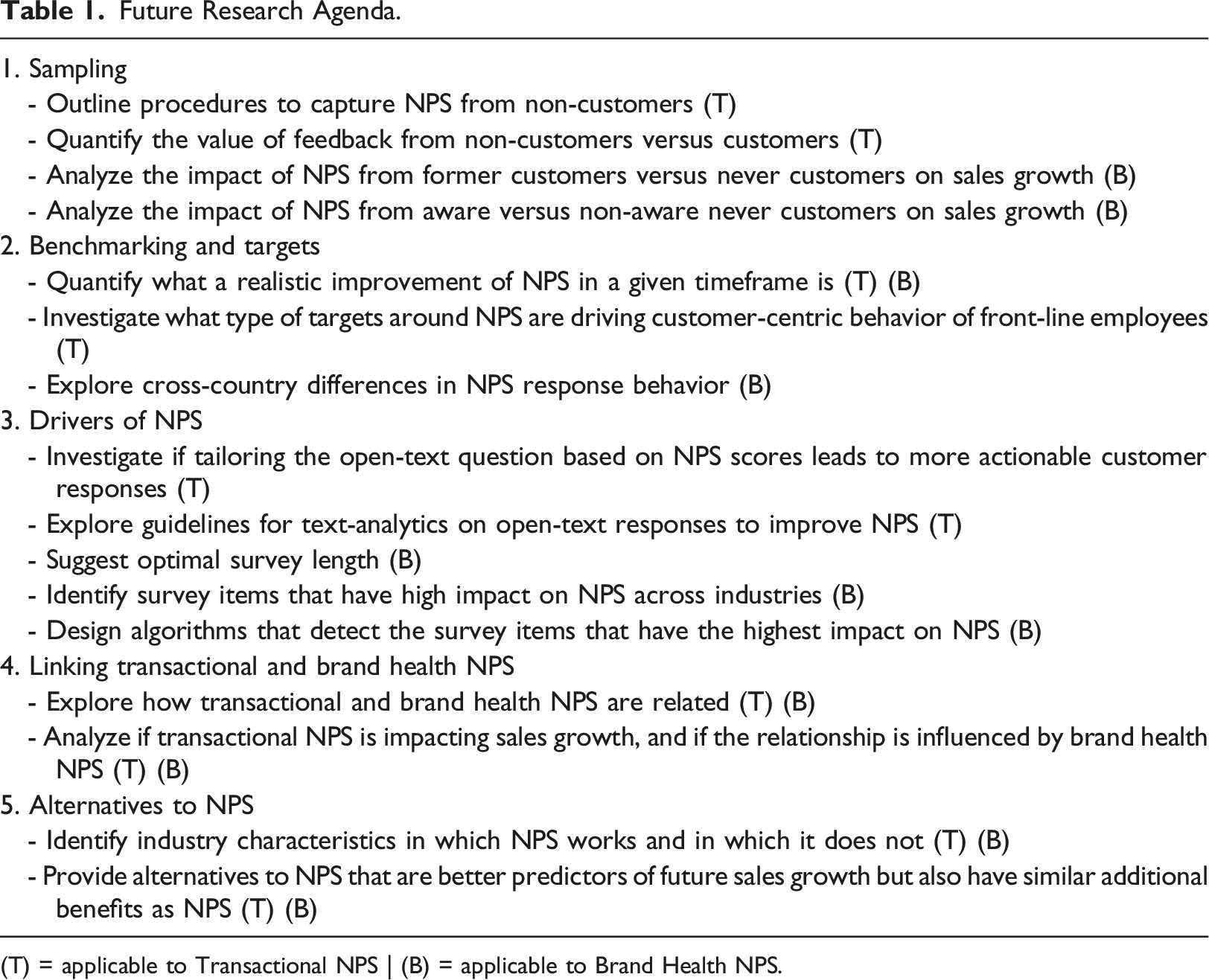
(T) = applicable to Transactional NPS | (B) = applicable to Brand Health NPS.
Sampling
Before implementing NPS, managers must decide from whom they will collect feedback. Academics often default to the approach of posing the NPS question to current customers. This seems logical as current customers own the product/use the service and therefore have knowledge about it. However, Reichheld (2003) did not limit the sample in the original NPS study to current customers only, instead the study focused on customers who are familiar with the brand. Furthermore, management consultants Bain and Co., who rolled out NPS programs under Reichheld’s supervision, advocate for capturing NPS from all potential customers in the marketplace (Markey, 2014). Hence, a lot of companies track NPS beyond their current customer base. The reasoning behind this is that limiting feedback to current customers overlooks the perspectives of other important groups such as former customers, who have intentionally or unintentionally abandoned the brand. Additionally, those who have never purchased but are aware of the brand through advertisements, word of mouth, media coverage, store visits, or product try-outs, also have opinions that can influence the company’s reputation.
For managers using transactional NPS, listening to non-customers becomes a crucial enabler in improving operational performance. For instance, understanding why people leave a (web-) store without making a purchase can provide more valuable insights than researching the opinions of a customer who has successfully made a purchase. Future research could outline systematic procedures for capturing feedback from non-customers by identifying touchpoints where people had an interaction with a brand but are not becoming customers. Additionally, academia could quantify the value of including non-customers’ input given that managers may hesitate to include these respondents in case it lowers their NPS.
Similarly, capturing feedback from current non-customers is beneficial for brand health NPS, as they have been identified as a significant source of potential sales growth (Baehre et al., 2022a). However, asking current non-customers if they would recommend a brand might be problematic, as they may not have sufficient knowledge about the brand and hence, might bias NPS scores. Most likely, the picture is not black and white, and people will hold a certain degree of knowledge and opinions about more brands than they currently use, and therefore a strict limitation to current customers might not be optimal.
Consider this example from the automobile industry: Most people are aware of BMW, and have a certain association with the brand. However, only few people own a BMW, and hence have the best knowledge of the brand. Moreover, there are also people who have previously owned, rented or test driven a BMW. Arguably, they also have a certain degree of knowledge of the brand. But there are also people who have friends, colleagues or neighbors who drive a BMW, and they might have heard something positive or negative about the car. Additionally, media coverage, marketing campaigns, and endorsements also influence the attitudes of current non-customers. Therefore, these people might not have first-hand experience with the brand and therefore limited knowledge, but still have an opinion, which they might raise when they are confronted with the NPS question.
Two interesting questions emerge from this scenario. First, how much brand knowledge do people need to have in order to voice recommendations, and second, how much knowledge does someone need to have in order that a friend or colleague would follow their recommendations, a crucial prerequisite in the relationship between NPS and sales growth. Future research could delve deeper into understanding current non-customers by distinguishing between former customers and those who have never purchased/used the brand as these two groups may have different brand knowledge which could impact future sales growth. Moreover, exploring whether the NPS question should be limited to individuals who are aware of the brand could also help mitigate potential biases introduced by non-aware respondents.
Benchmarks and Targets
Companies often rely on NPS for benchmarking, decision making, and target-setting in assessing their industry performance. Reichheld’s (2003) paper introduced a first benchmark, suggesting that NPS scores above 75 are considered world-class, while Bain and Co.‘s NPS Prism also provides industry specific benchmarks (Markey, 2014). This is required as scores differ across industries. For example, according to Bain and Co.‘s NPS Prism 2022, NPS is the highest in the automobile industry, while it is lowest for internet providers, leading to a scenario where the lowest scoring automobile brand has a higher NPS than the highest scoring internet provider. Hence, managers who benchmark their NPS versus that of other companies, and base decisions and incentives on these benchmarks, may not be looking at the right data.
Recent research challenges the notion that a high NPS score alone leads to sales growth. Instead, Baehre et al. (2022a) propose that the key lies in focusing on improvements in NPS over time. Managers should prioritize continuous improvement of their NPS as such improvements are associated with future sales growth. Hence, academic insights can help to guide benchmarking and target setting for practice: By investigating the extent by which companies can realistically improve their NPS within a given timeframe, researchers can equip managers with the information needed for effective goal-setting and performance evaluation.
Linking these targets to financial incentives has led to the emergence of NPS gaming behavior (see Reichheld et al., 2021). Managers must consider two key aspects: First, to emphasize continuous improvements, the NPS survey itself - including the presentation of the question (e.g., with or without similes), the scale orientation (left to right or right to left), the use of colors, and other factors - as well as its administration - who is surveyed and when - should remain consistent over time to ensure the value of longitudinal data. Second, for both transactional NPS and brand health NPS, meaningful comparisons can only be made if NPS is captured uniformly across units (e.g., stores) or competitors. Therefore, particularly for transactional NPS, targets for frontline employees should not be based on NPS scores alone. Instead, targets should focus on customer follow-ups or the implementation of improvements, encompassing a comprehensive approach to fostering better customer experiences. Academia can contribute to these initiatives by investigating the ideal target setting conditions to drive customer-centric behavior among frontline employees.
In building brand health NPS, managers need to recognize that scores may only be comparable within one country, and targets may need to be set per country to overcome potential cultural differences in response behavior (Seth et al., 2016). Further academic research is essential in identifying and quantifying these disparities.
Drivers of NPS
NPS, in itself, can only serve as a high-level diagnostic, akin to “taking the temperature” of a brand or store (Baehre et al., 2022a). An improvement in NPS indicates positive performance, while declining scores signal emerging problems. Consequently, once managers begin tracking NPS, they face the challenge of understanding the drivers of both positive and negative responses in order to drive action; this necessitates the capture of additional data for NPS.
Reichheld and Markey (2014) suggest that in capturing additional data managers add only one open-text question to the NPS survey, typically implemented for transactional NPS, which should be tailored in its wording based on the given NPS score. Academic studies could assess if changes in the wording of this question are necessary and if these changes would lead to more actionable responses. With advancements in language processing artificial intelligence, analyzing unstructured data is no longer a fundamental issue. However, how topic trees are modeled and how the most influential comments are flagged for managers is significant, academia could provide valuable guidance to managers in shaping text analytics to extract meaningful insights effectively.
Brand health NPS surveys typically do not include an open-text question but instead consist of additional market research questions related to the purchase funnel or brand image statements. Academic research can guide managers in designing an effective brand health NPS survey by offering guidance in three key areas. First, academia could provide insights on the optimal survey length to ensure both high response rates and nuanced data. Second, it can suggest essential questions and statements that should be included in every brand health NPS survey. Identifying items that consistently impact brand health NPS across various industries would help create a standardized and reliable survey framework. Third, academia can propose algorithms that enable managers to identify the most influential brand image statements. These statements would serve as focal points for managerial decisions, ensuring that actions taken are targeted and drive positive outcomes.
Linking Transactional and Brand Health NPS
Many companies utilize both transactional and brand health NPS. Expanding on the argument of identifying root causes, it is often hypothesized that improving transactional NPS positively impacts brand health NPS. However, academia has largely overlooked the distinction between these two types of NPS. Future research could explore the relationship between both types of NPS, including investigating the link between transactional NPS and sales growth, either at the store or firm level, and whether this relationship is potentially influenced by brand health NPS.
Alternatives to NPS
While NPS is widely used across industries, there are concerns about the applicability of the “recommend” question in certain contexts, such as B2B settings, industries with long-purchase cycles, or low-involvement goods. Therefore, future research could delve into identifying the specific industry characteristics in which NPS functions effectively as a predictor of future sales growth, thus offering the most value to managers.
Given that NPS is not a universal superior predictor of sales growth, the question of whether a superior cross-industry predictor exists, remains. To date, neither academia nor practice has provided a better alternative that combines the superior predictive ability of sales growth with the additional benefits of NPS, such as driving customer-centric decision-making, using a widely recognized and versatile tool. Academic research provides potential to develop superior alternatives that serve as transactional and brand health metrics across a range of industries.
Conclusion
In summary, NPS is more than just a predictor of future performance for managers; it is a valuable tool that can facilitate the cultivation of customer-centric practices within organizations. Like any tool, its effectiveness depends on appropriate and informed usage; otherwise, it may yield unintended consequences. Hence, it is crucial for academia to provide managers with the necessary guidance, explaining how and when to employ NPS effectively. To create such a guide, academics need to broaden their understanding of how NPS is utilized and identify key considerations in its implementation and usage. This research note serves as an initial step, seeking to evolve research on this widely used managerial metric.
Footnotes
Declaration of Conflicting Interests
The author(s) declared no potential conflicts of interest with respect to the research, authorship, and/or publication of this article.
Funding
The author(s) received no financial support for the research, authorship, and/or publication of this article.
